Home » Posts tagged 'Asha Touch'
Tag Archives: Asha Touch
Q3’13 smartphone and overall mobile phone markets: Android smartphones surpassed 80% of the market, with Samsung increasing its share to 32.1% against Apple’s 12.1% only; while Nokia achieved a strong niche market position both in “proper” (Lumia) and “de facto” (Asha Touch) smartphones
Details about Samsung’s strengths you can find inside the Samsung has unbeatable supply chain management, it is incredibly good in everything which is consumer hardware, but vulnerability remains in software and M&A [‘Experiencing the Cloud’, Nov 11, 2013] post of mine.
My findings supporting the above title:
- 205 million Android smartphones were delivered in Q3’13, representing 15.2% growth sequentially (Q/Q) and 67.3% growth relative to the same period of last year (Y/Y)
- Meanwhile the number of Apple iPhones shipped increased only to 33.8 million, growing by 8.3% sequentially (Q/Q), but still representing a 25.65% growth relative to the same period of last year (Y/Y)
- The shipment of “proper” smartphones from Nokia (S60/Symbian and Lumia/Windows Phone) increased to 8.8 million units, representing 18.9% growth sequentially (Q/Q) and 39.7% growth relative to the same period of last year (Y/Y)

- Meanwhile the shipment of “de facto” smartphones from Nokia (S60/Symbian, Lumia/Windows Phone and Asha Full Touch in S40 Series) increased to 14.7 million units, representing 25.6% growth sequentially (Q/Q) and 14.8% growth relative to the same period of last year (Y/Y). It is also important that the decline of Asha Full Touch after its peak of 9.3 million units sold in Q4’12 has been reversed with 5.9 million units shipped, representing a sizable 37.2% growth sequentially (Q/Q).
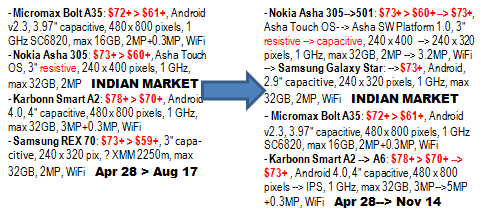
- The new (in Q3’13) Asha 501 became the most popular smartphone on the Indian market in the $60-80 price range (as per Flipkart, see above), successfully beating off the best competitive offerings from Samsung and the two leading local brands, Micromax and Karbonn. This is another positive sign of successfull revival of the Asha Touch platform started with Asha 501 (via the Asha Software Platform 1.0) as described in the New Nokia Asha platform for developers [‘Experiencing the Cloud’, May 9, 2013] and New Asha platform and ecosystem to deliver a breakthrough category of affordable smartphone from Nokia [‘Experiencing the Cloud’, May 9 – July 5, 2013] posts of mine. Everything is well represented by comparing the “micro reports” included into the bottom left corner of the overall chart a quarter ago and now:

- As one currently could see this Nokia (the devices part of it soon becoming the part of Microsoft*) could realise its goal of selling “100 million of the new generation Asha smartphones over the coming years, beginning with the Nokia Asha 501”. The Asha 500, Asha 502 and Asha 503 introduced in October 22 could already deliver a huge jump in shipments of “de facto smartphones” under Asha brand, helping to defend further and even improve Nokia’s market position against the sub $100 Android smartphones in Q4’13. Note also that Asha 500 was announced for $69 list price (before taxes or subsidies) which means that—depending on “race to the bottom” competition—could easily mean a street price of $60+ on the Indian market.
-
* See also the previous posts of mine:
– Unique Nokia assets (from factories to global device distribution & sales, and the Asha sub $100 smartphone platform etc.) will now empower the One Microsoft devices and services strategy [‘Experiencing the Cloud’, Sept 3 – Oct 23, 2013]
– Microsoft answers to the questions about Nokia devices and services acquisition: tablets, Windows downscaling, reorg effects, Windows Phone OEMs, cost rationalization, ‘One Microsoft’ empowerment, and supporting developers for an aggressive growth in market share [‘Experiencing the Cloud’, Sept 3 – Oct 23, 2013]
– Microsoft Nokia Transaction Conference Call with slides from Microsoft Strategic Rationale inserted-ebook – 3-Sept-2013 edited by Sándor Nacsa from those two sources into an ebook format PDF
– Leading edge Nokia phablets for both entertainment and productivity: Lumia 1320 targeting the masses at $339, and Lumia 1520 the imaging conscious business users and individuals at $749 [‘Experiencing the Cloud’, Oct 26, 2013] - The Asha Touch revival was also able to stop the decline of the overall Nokia “mobile phones” category (Nokia S30, S40, Asha and Asha Full Touch phones) exactly at 55.8 million units, the same number as for the Q1’13.

- In addition there are now the Leading edge Nokia phablets for both entertainment and productivity: Lumia 1320 targeting the masses at $339, and Lumia 1520 the imaging conscious business users and individuals at $749 [‘Experiencing the Cloud’, Oct 26, 2016].
- With that Nokia established a strong niche market position on both the $130+ market (starting with Lumia 520 sold at that price in India, also the most popular one on Flipkart for the the $80-160 price range of devices) and the sub $80 market against the onslaught of Android devices. The rest will depend now only on Microsoft.



Than for the lead smartphone market, i.e. Mainland China I will include here:
- China market: Smartphone sales top 93 million units in 3Q13, says Analysys [Digitimes, Nov 12, 2013]
There were 102.66 million handsets sold in the China market during the third quarter of 2013, growing 13.6% on quarter and 54.5% on year, of which 93.08 million units were smartphones, increasing 20.7% on quarter and 89.3% on year, according to China-based consulting company Analysys International.

While for the worldwide market:
- China-based smartphone vendors set to rise in 2013 rankings, says IC Insights [Digitimes, Nov 13, 2013]
Lenovo, ZTE, Huawei and Yulong/Coolpad have taken advantage of the surging low-end smartphone market. According to IC Insights, the four major China-based handset companies are forecast to ship 168 million smartphones in 2013 and together hold a 17% share of the worldwide smartphone market.
Lenovo, ZTE, Huawei and Yulong/Coolpad shipped a combined 98 million smartphones in 2012, a more than 300% surge from the 29 million units shipped in 2011, IC Insights disclosed. It should be noted that the China-based suppliers of smartphones are primarily serving the China and Asia-Pacific marketplace, and offer low-end models that typically sell for less than US$200.
Low-end smartphones are expected to represent just under one-third (310 million) of the total 975 million smartphones shipped in 2013. IC Insights forecast that by 2017, low-end smartphone shipments will represent 46% of the total smartphone market with China and the Asia-Pacific region to remain the primary markets for these low-end models.
Samsung Electronics and Apple are set to continue dominating the total smartphone market in 2013. The two vendors are forecast to ship 457 million units and together hold a 47% share of the total smartphone market in 2013, IC Insights said. In 2012, Samsung and Apple shipped 354 million smartphones and took a combined 50% share of the total smartphone market.
Nokia was third-largest supplier of smartphones behind Samsung and Apple in 2011, but has seen its share of the smartphone market fall. Nokia’s smartphone shipments are forecast to decline by another 4% and grab an only 3% share of the total smartphone market in 2013, IC Insights indicated.
Other smartphone producers that have fallen on hard times include RIM and HTC. While each of these companies had about a 10% share of the smartphone market in 2011, IC Insights estimated they will have only about 2% shares of the 2013 smartphone market.

-
Gartner Says Smartphone Sales Accounted for 55 Percent of Overall Mobile Phone Sales in Third Quarter of 2013 [press release, Nov 14, 2013]
– Western Europe Grew for the First Time this Year
– Lenovo Became the No. 3 Worldwide Smartphone Vendor for the First Time
Worldwide mobile phone sales to end users totaled 455.6 million units in the third quarter of 2013, an increase of 5.7 percent from the same period last year, according to Gartner, Inc. Sales of smartphones accounted for 55 percent of overall mobile phone sales in the third quarter of 2013, and reached their highest share to date.
Worldwide smartphone sales to end users reached 250.2 million units, up 45.8 percent from the third quarter of 2012. Asia/Pacific led the growth in both markets – the smartphone segment with 77.3 percent increase and the mobile phone segment with 11.9 percent growth. The other regions to show an increase in the overall mobile phone market were Western Europe, which returned to growth for the first time this year, and the Americas.
“Sales of feature phones continued to decline and the decrease was more pronounced in markets where the average selling price (ASP) for feature phones was much closer to the ASP affordable smartphones,” said Anshul Gupta, principal research analyst at Gartner. “In markets such as China and Latin America, demand for feature phones fell significantly as users rushed to replace their old models with smartphones.”
Gartner analysts said global mobile phone sales are on pace to reach 1.81 billion units in 2013, a 3.4 percent increase from 2012. “We will see several new tablets enter the market for the holiday season, and we expect consumers in mature markets will favor the purchase of smaller-sized tablets over the replacement of their older smartphones” said Mr. Gupta.
While Samsung’s share was flat in the third quarter of 2013, Samsung increased its lead over Apple in the global smartphone market (see Table 1). The launch of the Samsung Note 3 helped reaffirm Samsung as the clear leader in the large display smartphone market, which it pioneered.
Lenovo’s sales of smartphones grew to 12.9 million units, up 84.5 percent year-on-year. It constantly raised share in the Chinese smartphone market.
Apple’s smartphone sales reached 30.3 million units in the third quarter of 2013, up 23.2 percent from a year ago. “While the arrival of the new iPhones 5s and 5c had a positive impact on overall sales, such impact could have been greater had they not started shipping late in the quarter. While we saw some inventory built up for the iPhone 5c, there was good demand for iPhone 5s with stock out in many markets,” said Mr. Gupta.

In the smartphone operating system (OS) market (see Table 2), Android surpassed 80 percent market share in the third quarter of 2013, which helped extend its leading position. “However, the winner of this quarter is Microsoft which grew 123 percent. Microsoft announced the intent to acquire Nokia’s devices and services business, which we believe will unify effort and help drive appeal of Windows ecosystem,” said Mr. Gupta. Forty-one per cent of all Android sales were in mainland China, compared to 34 percent a year ago. Samsung is the only non-Chinese vendor in the top 10 Android players ranking in China. Whitebox Yulong [Coolpad] is the third largest Android vendor in China with a 9.7 percent market share in the third quarter of 2013. Xiaomi represented 4.3 percent of Android sales in the third quarter of 2013, up from 1.4 percent a year ago.

Mobile Phone Vendor Perspective
Samsung: Samsung extended its lead in the overall mobile phone market, as its market share totaled 25.7 percent in the third quarter of 2013 (see Table 3). “While Samsung has started to address its user experience, better design is another area where Samsung needs to focus,” said Mr. Gupta. “Samsung’s recent joint venture with carbon fiber company SGL Group could bring improvements in this area in future products.”
Nokia: Nokia did better than anticipated in the third quarter of 2013, reaching 63 million mobile phones, thanks to sales of both Lumia and Asha series devices. Increased smartphone sales supported by an expanded Lumia portfolio, helped Nokia move up to the No. 8 spot in the global smartphone market. But regional and Chinese Android device manufacturers continued to beat market demand, taking larger share and creating a tough competitive environment for Lumia devices.
Apple: Gartner believes the price difference between the iPhone 5c and 5s is not enough in mature markets, where prices are skewed by operator subsidies, to drive users away from the top of the line model. In emerging markets, the iPhone 4S will continue to be the volume driver at the low end as the lack of subsidy in most markets leaves the iPhone 5c too highly priced to help drive further penetration.
Lenovo: Lenovo moved to the No. 7 spot in the global mobile phone market, with sales reaching approximately 13 million units in the third quarter of 2013. “Lenovo continues to rely heavily on its home market, which represents more than 95 per cent of its overall mobile phone sales. This could limit its growth after 2014, when the Chinese market is expected to decelerate,” said Mr. Gupta.

Mark Zuckerberg’s personality is hyped (again) with a quite worthwhile initiative (otherwise) but with substantial global financial interests behind it as well
The internet.org initiative for the next 5 billion people is even a bigger announcement than the Steve Ballmer’s retirement from Microsoft announcement given The Upcoming Mobile Internet Superpower [Aug 13, 2013, with extensive follow-up & ‘The global forces behind …’ analysis, later in the post, as of August 22 at 9:08pm] and the substantial global financial interests (uncovered there and) otherwise also tied to the creation of the whole global Facebook phenomenon (also indicating that Mark Zuckerberg has been just a strawman of something significantly bigger going on behind the scenes from the very beginning). Just two images which were included into the The Upcoming Mobile Internet Superpower as a reminder of that (before documenting the internet.org initiative in this post):


While the true intent of this announcement is covered by things described above, here is what was officially told to the world:
Every one of us. #ConnectTheWorld [Internet.org YouTube channel, Aug 20, 2013]
Technology leaders launch partnership to make internet access available to all [joint press release available from http://internet.org/ and number of other sources, Aug 20, 2013]
Facebook, Ericsson, MediaTek, Nokia, Opera, Qualcomm, Samsung to be founding partners
MENLO PARK, Calif., Aug. 20, 2013 – Mark Zuckerberg, founder and CEO of Facebook, today announced the launch of internet.org, a global partnership with the goal of making internet access available to the next 5 billion people.
“Everything Facebook has done has been about giving all people around the world the power to connect,” Zuckerberg said. “There are huge barriers in developing countries to connecting and joining the knowledge economy. Internet.org brings together a global partnership that will work to overcome these challenges, including making internet access available to those who cannot currently afford it.”
Today, only 2.7 billion people – just over one-third of the world’s population – have access to the internet. Internet adoption is growing by less than 9 percent each year, which is slow considering how early we are in its development.
The goal of Internet.org is to make internet access available to the two-thirds of the world who are not yet connected and to bring the same opportunities to everyone that the connected third of the world has today.
The founding members of Internet.org –Facebook, Ericsson, MediaTek, Nokia, Opera, Qualcomm and Samsung – will develop joint projects, share knowledge, and mobilize industry and governments to bring the world online. These founding companies have a long history of working closely with mobile operators and expect them to play leading roles within the initiative, which over time will also include NGOs, academics and experts as well. Internet.org is influenced by the successful Open Compute Project, an industry-wide initiative that has lowered the costs of cloud computing by making hardware designs more efficient and innovative.
In order to achieve its goal of connecting the two-thirds of the world who are not yet online, Internet.org will focus on three key challenges in developing countries:
Making access affordable: Partners will collaborate to develop and adopt technologies that make mobile connectivity more affordable and decrease the cost of delivering data to people worldwide. Potential projects include collaborations to develop lower-cost, higher-quality smartphones and partnerships to more broadly deploy internet access in underserved communities. Mobile operators will play a central role in this effort by driving initiatives that benefit the entire ecosystem.
Using data more efficiently: Partners will invest in tools that dramatically reduce the amount of data required to use most apps and internet experiences. Potential projects include developing data compression tools, enhancing network capabilities to more efficiently handle data, building systems to cache data efficiently and creating frameworks for apps to reduce data usage.
Helping businesses drive access: Partners will support development of sustainable new business models and services that make it easier for people to access the internet. This includes testing new models that align incentives for mobile operators, device manufacturers, developers and other businesses to provide more affordable access than has previously been possible. Other efforts will focus on localizing services – working with operating system providers and other partners to enable more languages on mobile devices.
By reducing the cost and amount of data required for most apps and enabling new business models, Internet.org is focused on enabling the next 5 billion people to come online.
Facebook, Ericsson, MediaTek, Nokia, Opera, Qualcomm, Samsung and other partners will build on existing partnerships while exploring new ways to collaborate to solve these problems.
“For more than 100 years, Ericsson has been enabling communications for all and today more than 6 billion people in the world have access to mobile communications,” said Hans Vestberg, President and CEO of Ericsson. “We are committed to shaping the Networked Society – where everyone and everything will be connected in real time; creating the freedom, empowerment and opportunity to transform society. We believe affordable connectivity and internet access improves people’s lives and helps build a more sustainable planet and therefore we are excited to participate in the Internet.org initiative.”
“As a world leader in mobile solutions for emerging markets having powered more than 300 million smart devices within 2 years, MediaTek whole heartedly supports the Internet.org initiative,” said MK Tsai, Chairman of MediaTek. “Global internet and social media access represent the biggest shift since the industrial revolution, and we want to make it all-inclusive.”
“Nokia is deeply passionate about connecting people – to one another and the world around them,” said Nokia President and CEO Stephen Elop. “Over the years, Nokia has connected well over a billion people. Our industry is now at an exciting inflection point where internet connectivity is becoming more affordable and efficient for consumers while still offering them great experiences. Universal internet access will be the next great industrial revolution.”
“Today, more than 300 million people use Opera every month to access the internet. Tomorrow, we have a chance to serve the next 5 billion people connecting on mobile devices in developing countries. It’s in Opera’s DNA to save people time, money and data, and through Internet.org we think we can help advance these goals,” said Lars Boilesen, CEO Opera Software.
“Mobile has helped to transform many people’s lives in the emerging regions where often a computing device will be the first and only mobile experience they’ll ever have” said Paul Jacobs, chairman of the board and CEO of Qualcomm Incorporated. “Having shipped more than 11 billion chips, Qualcomm is a market leader that is committed to the goal of bridging the digital divide. We’re pleased to be a part of Internet.org and to be working with key ecosystem players to drive this initiative forward.”
“This new initiative has big potential to help accelerate access to the internet for everyone,” said JK Shin, CEO and President of the IT & Mobile Communications Division at Samsung Electronics. “We’re focused on delivering high quality mobile devices to ensure that the next five billion people have great mobile internet experiences.”
The Internet.org website launches today and provides an overview of the mission and goals, as well as a full list of the partners. In the coming weeks, it will feature interviews with technology leaders and experts, along with the latest news on Internet.org activities.
The embedded video on the internet.org site explains further: Mark Zuckerberg aims to put the entire world online [CNN YouTube channel, Aug 21, 2013]
adding more fuel to the campaign, as two follow-up videos on CNN channel as well:
– Zuckerberg, tech companies look for “next 5 billion… [CNN YouTube channel, Aug 21, 2013]
– Mark Zuckerberg’s Internet plan: realistic or impossible? [CNN YouTube channel, Aug 22, 2013]
And the leading global media was awash with extensive coverage of this as evidenced here just with the following videos:
– Mark Zuckerberg’s World-Wide Plan for the Internet [Bloomberg YouTube channel, Aug 21, 2013]
– Mark Zuckerberg Announces Plan To Get Billions More People Online [HuffPost Live YouTube channel, Aug 21, 2013]
– Facebook-led project pushes for wider internet access – corporate [Euronews YouTube channel, Aug 22, 2013]
– Chinese manufacturing grows and Facebook wants to spread the internet worldwide [FRANCE 24 English YouTube channel, Aug 22, 2013]
From the participant companies we had the following corporate communications in addition to the joint press release:
Ericsson and Internet.org – providing the internet for everyone, everywhere [Aug 21, 2013]
The Networked Society will bring significant economic, social and environmental benefits to hundreds of millions of people, one of which is providing internet access to the remaining two-thirds of the planet. Today (Aug 21, 2013), Ericsson, Facebook and a number of other tech giants took a step closer to realizing these benefits through the announcement of a global initiative we call Internet.org. Through this, we aim to reduce the cost of delivering basic internet services and make them available to everyone, everywhere.
So, why is this initiative so important? In the Networked Society, connectivity is the starting point for new ways of innovating, collaborating and socializing. It’s about creating freedom, empowerment and opportunity, transforming industries and society while helping find solutions to some of the greatest challenges facing our planet.
Hans Vestberg, President and CEO of Ericsson, says: “For more than 100 years, Ericsson has been enabling communications for all, and today more than 6 billion people have access to mobile communications. We are committed to shaping the Networked Society – where everyone and everything will be connected in real time; creating the freedom, empowerment and opportunity to transform society. We believe affordable connectivity and internet access improves people’s lives and helps build a more sustainable planet, and therefore we are excited to participate in the Internet.org initiative.”
Some of the initial areas that are considered barriers to increasing access to the internet are the cost of smartphones, the cost of delivering data, and inefficient data-hungry applications. Cheaper phones, improved data compression techniques, and apps that use less data and reduce battery usage are some of the initial areas of investigation. Others include more efficient allocation of spectrum, edge caching, sharing hardware design, and efficiency optimization.
Ericsson has several areas of expertise to offer the initiative, including: knowledge of scale, its global presence and local expertise, and its technology leadership in the area of mobile networks and supporting service enablers.
Ericsson believes that communication is a basic human need, and fulfilling this has been our mission since the foundation of our company.
Opera helps connect the next 5 billion online [Opera News, Aug 21, 2013]
Today, only 2.7 billion people are connected to the internet. The cost of getting online is one of the biggest challenges for users worldwide. We want to help get the next five billion online.
For the last 17 years, we have built products and services to get people online. We believe in the power of sharing ideas. Opera Mini is our mobile browser that uses compression technology to save you time and money. Operators around the world have embraced Opera Mini and Opera Web Pass as the best choice for their users to get online.
WE HAVE PARTNERED WITH FACEBOOK TO GET THE NEXT 5 BILLION ONLINE
Meet Internet.org – a partnership between Facebook, Opera, and other technology companies. This is a global effort that will also involve help from local communities, non-profit organisations and experts across the world. We are proud to contribute to the project with our competence in Internet technology.
WE WANT TO HEAR FROM YOU
Are you among the few in your country who has access to the internet? Tell us how you spend your time online. How has the internet helped you? We’d love to hear from you. Get in touch with us on Twitter, Facebook or byemail.
“Today, more than 300 million people use Opera every month to access the Internet.
Tomorrow, we have a chance to serve the next 5 billion people connecting on mobile devices in developing countries. It’s in Opera’s DNA to save people time, money and data, and through internet.org we think we can help advance these goals.”
— Lars Boilesen, CEO Opera Software.

Further information about the other companies’ involvement you can find in the following article also linked on the internet.org homepage:
Facebook Leads an Effort to Lower Barriers to Internet Access [The New York Times, Aug 20, 2013]
MENLO PARK, Calif. — About one of every seven people in the world uses Facebook. Now, Mark Zuckerberg, its co-founder and chief executive, wants to make a play for the rest — including the four billion or so who lack Internet access.
On Wednesday, Facebook announced an effort aimed at drastically cutting the cost of delivering basic Internet services on mobile phones, particularly in developing countries, where Facebook and other tech companies need to find new users. Half a dozen of the world’s tech giants, including Samsung, Nokia, Qualcomm and Ericsson, have agreed to work with the company as partners on the initiative, which they call Internet.org.
The companies intend to accomplish their goal in part by simplifying phone applications so they run more efficiently and by improving the components of phones and networks so that they transmit more data while using less battery power.
For Mr. Zuckerberg, the formation of the coalition is yet another way in which he is trying to position himself as an industry leader. He has been speaking out more forcefully than other tech executives on topics like immigration overhaul, which the industry sees as critical to its hiring needs. With Internet.org, he is laying out a philosophy that tries to pair humanitarian goals with the profit motive.
“The Internet is such an important thing for driving humanity forward, but it’s not going to build itself,” he said in a recent interview. “Ultimately, this has to make business sense on some time frame that people can get behind.”
But the effort is also a reflection of how tech companies are trying to meet Wall Street’s demands for growth by attracting customers beyond saturated markets in the United States and Europe, even if they have to help build services and some of the infrastructure in poorer, less digitally sophisticated parts of the world.
Google, for example, began a program with phone carriers last year that offers wireless users in some developing countries free access to Gmail, search and the first page clicked through from a search’s results. Google is also reaching for the sky with Project Loon, an attempt to beam Internet access down to earth from plastic balloons floating more than 11 miles in the atmosphere.
Twitter, which is preparing to offer shares to the public in an initial stock offering, has struck its own deals with about 250 cellphone companies in more than 100 countries to offer some free Twitter access, and worked to make sure its service is easy to use on even the cheapest cellphones.
These companies have little choice but to look overseas for growth. More than half of Americans already use Facebook at least once a month, for instance, and usage in the rest of the developed world is similarly heavy. There is nearly one active cellphone for every person on earth, making expansion a challenge for carriers and phone makers.
Poorer countries in Asia, Africa and Latin America present the biggest opportunity to reach new customers — if companies can figure out how to get people there online at low cost.
The immediate goals of the new coalition are to cut the cost of providing mobile Internet services to 1 percent of its current level within five to 10 years by improving the efficiency of Internet networks and mobile phone software. The group also hopes to develop new business models that would allow phone companies to provide simple services like e-mail, search and social networks for little or no charge.
While that sounds far less exciting than, say, Google’s idea of delivering the Internet by balloon, Mr. Zuckerberg says small efforts can add up to big changes.
“No one company can really do this by itself,” he said.
Facebook is already working on techniques to reduce the average amount of data used by its Android mobile app from the current 12 megabytes a day to 1 megabyte without users noticing.
Qualcomm, whose chip technology is prevalent in advanced cellphones, has created new designs to stretch a phone’s battery life, slice the amount of data needed to transmit a video and extend the reach of mobile networks through tiny devices similar to Wi-Fi routers.
The coalition partners have also begun trying new ways of reducing the data charges paid by cellphone customers while still enabling phone makers and carriers to make money.
For example, Nokia, the Finnish cellphone maker, ran a recent experiment with Facebook and the Mexican phone carrier Telcel, in which it bundled free Facebook access with some of its Asha feature phones. Sales rose significantly, and the company decided to run similar promotions for customers of Bharti Airtel, a mobile carrier in India and Africa.
[Note that with new Nokia Asha platform, which is a full platform enhancement of the earlier Asha Touch upgrade of the legacy S40 platform, Nokia has done already the most among the internet.org founding members to achieve the now declared common challenges of Making access affordable, Using data more efficiently and Helping businesses drive access. You can check that by reading the posts behind the indicated tags on this blog.]
However, the Internet.org team does not plan to tackle some thorny infrastructure issues that are huge barriers in the developing world, particularly the long-distance transmission of data to far-flung places.
Michuki Mwangi, regional development manager for Africa at the Internet Society, a nonprofit group that has long worked to expand global Internet access, said the continent sorely lacked local interconnection points, forcing most requests for content like YouTube videos to be routed through Europe at high cost. Creating more connection points would require navigating a thicket of government interests and powerful incumbents. But at the very least, the group would like Facebook and Google to put copies of their content on a greater number of African servers to deliver it more quickly and cheaply, something that both companies say they are considering.
As with the Open Compute coalition started by Facebook in 2011 to improve the efficiency of data centers, Facebook will seek to add other partners to Internet.org, including national governments, wireless phone carriers and Microsoft, a longtime Facebook ally that has its own projects to expand access.
But Google — whose search and YouTube video products are as fundamental as Facebook’s social network to many Internet users — is likely to remain outside the group.
For one, its own efforts to expand Internet access are aggressive. In addition, the company is constantly refining its Android software, which runs the majority of new smartphones sold, to improve efficiency and battery life.
“We’re always making investments in technology and programs to help people get online,” said Courtney Hohne, a Google spokeswoman. “We have teams around the world working on products tailored to local needs.”
Bill Gates, the chairman of Microsoft and co-chairman of the Bill and Melinda Gates Foundation, recently suggested that Project Loon and similar projects were not the best use of resources to help people in the poorest nations.
“When a kid gets diarrhea, no, there’s no Web site that relieves that,” he said in a recent interview with Bloomberg Businessweek.
Mr. Zuckerberg acknowledged that basic health care is essential, but said that “if you can afford a phone, I think it would be really good for you to have access to the Internet.”
The potential is already obvious in places like the Philippines, where the second-largest mobile phone company, Globe Telecom, has used free Twitter, Facebook or Google access as promotions to increase the number of its 37 million users who also subscribe to a mobile data plan to 20 percent from virtually zero in two years.
“Once you’re connected, you’re connected, and you don’t want to look back,” said Peter Bithos, Globe’s senior adviser for consumer business.
For Facebook, which generates most of its revenue from selling advertising that it shows to its users, the immediate profits from expanding Internet access will be minimal, Mr. Zuckerberg said, although he acknowledged that the long-term potential was there.
“We’re focused on it more because we think it’s something good for the world,” he said, “rather than something that is going to be really amazing for our profits.”
Nokia: Continued moderate progress with Lumia, urgent Asha Touch refresh and new innovations to come against the onslaught of unbranded Android and forked Android players in China and India
Nokia Corporation’s CEO Discusses Q1 2013 Results – Earnings Call Transcript [Seeking Alpha, April 18, 2013]
… At the highest level, I am pleased that in Q1 2013 Nokia Group achieved underlying operating profitability for the third quarter in a row. In a moment, I will share my perspective on Nokia’s Q1 performance. However, I wanted to first note that we believe this quarter further underscored that Nokia, and other industry participants continue to operate in one of the most exciting and fast moving business environments in the world today.
Compared to a year ago a lot has changed in our industry, and I wanted to share some of the trends we’re seeing. For example, the distance between the various Android participants seems starker than ever before as the dominance of one hardware vendor becomes more visible. Additionally, unbranded Android and forked Android players continue to emerge from China and India creating new dynamics both within and increasingly outside of Asia. With this growth in low-priced fragmented versions of Android the Android experience is becoming inconsistent across the lower-end price range.
In February, Mobile World Congress highlighted the growth in startup alternative platforms with many new entrants placing bets on next generation technologies like HTML5. While we have not yet seen one of these alternative platforms gain broad scale we should not underestimate what could happen if a dominant Android provider shifts some of its focus to an alternative platform.
We also saw new attempts to disrupt existing business models, whether it is the new Facebook home forking the Android experience or Amazon providing a differentiated tablet that forks the Android stack, we see leading technology companies take deliberate steps to change Android and possibly disrupt our industry. There are some patterns of change that seem inevitable. For example, consumers are expecting their digital lives to be more and more mobile as evidenced by the recent statistics about the shift towards mobility at the expense of less mobile PC experiences. Consumers are also increasingly discerning about the capabilities and new experiences that attract their attention. They are less interested in counting cores and pixel density, and more interested in experiences that are truly innovative.
This constant pattern of change in our industry is an opportunity. We believe we can move through the industry fragmentation and churn within unrelenting focus on executing our strategy. Thus, we remain focused on improving the competitiveness of our products effectively managing our costs and moving with urgency. …

…
People are responding positively to the new innovation throughout the Lumia portfolio imaging, design and navigation are capturing attention among reviewers, operators, retail associates and ultimately consumers. We believe we have increased the competitiveness of our Smart Devices, and as a result Lumia is clearly making progress. We’re pleased that today Lumia is even out shipping the iPhone in countries like Argentina, India, Poland, Ukraine and of course in our home country of Finland.
Importantly, the positive consumer reaction to the innovation and differentiation in Lumia is starting to come through in our numbers. We are encouraged by the financial performance of our newer Lumia devices based on Windows Phone 8, which generated not only solid growth, but also a gross margin in Q1 that was somewhat above the Smart Devices average.
At the same time, we’ve recognize that we must continue to increase our sales and improve our retail execution for Lumia. For example, in the United States, securing what operators call hero status or the top spot at the point of sale is critically important, because it attracts premium subsidies and additional marketing investment.
Later this quarter, a new Lumia device is anticipated to have hero status with a leading U.S. operator, an event which will mark the beginning of a season of new product introductions. Additionally, Nokia, Microsoft and operators have committed to increase the global Windows Phone marketing dollars towards Lumia. Together with Microsoft we are working on major marketing campaigns, training more retail associates, improving how we leverage operator marketing that is available to us, and seeding more live devices to create a more engaging point of sale experience. Overall, we are very pleased with our progress around Lumia.
…
… indeed we plan a refresh of elements of our mobile phones portfolio. Some of which has been announced, and it’s just landing in the market. For example, the very lowest price points the Nokia 105, which when you look at the volumes for Q1, some of the significant movement in volume levels were at the end of the predecessor to the 105 product line, that space, and now we’re just entering the market with new product there. And, of course, we’ve also signaled that in the very near term you should expect to see a freshening in the Asha product line. If you know, we’re roughly 9 months or so into the Asha full touch line relative to when we began shipping it.
So, reasonable to expect that it’s due for freshening and we’re looking forward to that in the near-term.
…
With respect to the Lumia portfolio going into Q2 some of the principal drivers of additional volume relate to the newer products that are entering the market, the 720 and 520 are important in this, particularly the 520. 520 is obviously at a lower price point and moving into markets, where that’s far more competitive than some of the hero products could be except for the people willing to pay top dollar for a device.
…
Nokia Corporation Q1 2013 Interim Report [April 18, 2013]
…
Nokia Group net sales in Q1 2013 were EUR 5.9 billion
– Devices & Services Q1 net sales decreased 25% quarter-on-quarter to EUR 2.9 billion.
– Lumia Q1 volumes increased 27% quarter-on-quarter to 5.6 million units, reflecting increasing momentum.
– Mobile Phones Q1 volumes decreased 30% quarter-on-quarter to 55.8 million units, reflecting competitive industry dynamics and an estimated higher than normal seasonal decline in the market addressable by Mobile Phones.
– Nokia Siemens Networks net sales decreased 30% quarter-on-quarter to EUR 2.8 billion, reflecting industry seasonality.Nokia Group net cash higher quarter-on-quarter
– Nokia Group ends first quarter 2013 with a strong balance sheet and solid cash position. Gross cash was EUR 10.1 billion and net cash was EUR 4.5 billion.
– Nokia Group strengthened its net cash position by approximately EUR 120 million sequentially. Nokia Siemens Networks contributed approximately EUR 210 million to the Nokia Group net cash position.…
NOKIA OUTLOOK
– Nokia expects its Devices & Services non-IFRS operating margin in the second quarter 2013 to be approximately negative 2 percent, plus or minus four percentage points. This outlook is based on Nokia’s expectations regarding a number of factors, including:
>> competitive industry dynamics continuing to negatively affect the Mobile Phones and Smart Devices business units;
>> consumer demand for our products, particularly for our Mobile Phones products;
>> continued ramp up for our Lumia smartphones;
>> expected increases in Devices & Services’ operating expenses; and
>> the macroeconomic environment.– In the second quarter 2013 supported by the wider availability of recently announced Lumia products, Nokia expects the sequential growth in Lumia unit volumes to be higher than the 27% sequential growth in the first quarter 2013.
– Nokia continues to target to reduce its Devices & Services non-IFRS operating expenses to an annualized run rate of approximately EUR 3.0 billion by the end of 2013.
– Nokia expects HERE’s non-IFRS operating margin in the second quarter 2013 to be negative primarily due to lower recognized revenue from internal sales.
– Nokia and Nokia Siemens Networks expect Nokia Siemens Networks non-IFRS operating margin in the second quarter 2013 to be approximately positive 5 percent, plus or minus four percentage points. This outlook is based on Nokia Siemens Networks’ expectations regarding a number of factors, including:>> competitive industry dynamics;
>> product and regional mix; and
>> the macroeconomic environment.– Nokia and Nokia Siemens Networks continue to target to reduce Nokia Siemens Networks’ non-IFRS annualized operating expenses and production overheads by more than EUR 1 billion by the end of 2013, compared to the end of 2011.
…
In the first quarter 2013, we received a quarterly platform support payment of USD 250 million (approximately EUR 188 million) from Microsoft. Our agreement with Microsoft includes platform support payments from Microsoft to us as well as software royalty payments from us to Microsoft. Under the terms of the agreement governing the platform support payments, the amount of each quarterly platform support payment is USD 250 million. We have a competitive software royalty structure, which includes annual minimum software royalty commitments that vary over the life of the agreement. Software royalty payments, with minimum commitments are paid quarterly. Over the life of the agreement, both the platform support payments and the minimum software royalty commitments are expected to measure in the billions of US dollars. Over the life of the agreement the total amount of the platform support payments is expected to slightly exceed the total amount of the minimum software royalty commitment payments. In accordance with the terms of the agreement, the platform support payments and annual minimum software royalty commitment payments continue for a corresponding period of time.
…
The following table sets forth the mobile device volumes for our Devices & Services business for the periods indicated, as well as the year-on-year and sequential growth rates, by geographic area.
DEVICES & SERVICES MOBILE DEVICE VOLUMES BY GEOGRAPHIC AREA
million units |
Q1/2013 |
Q1/2012 |
YoY
|
Q4/2012 |
QoQ
|
Europe |
11.8 |
15.8 |
-25% |
19.4 |
-39% |
Middle East & Africa |
15.5 |
21.4 |
-28% |
21.8 |
-29% |
Greater China |
3.4 |
9.2 |
-63% |
4.6 |
-26% |
Asia-Pacific |
23.1 |
26.1 |
-11% |
28.7 |
-20% |
North America |
0.4 |
0.6 |
-33% |
0.7 |
-43% |
Latin America |
7.7 |
9.6 |
-20% |
11.1 |
-31% |
Total |
61.9 |
82.7 |
-25% |
86.3 |
-28% |
On a year-on-year basis, net sales decreased in all regions except North America where the increase was primarily due to our Smart Devices business unit. The largest relative year-on-year decline in net sales was in Greater China followed by Europe and Middle East and Africa. In Greater China and Europe the net sales declines were primarily due to our Smart Devices business unit whereas in the Middle East and Africa the net sales decline was primarily due to our Mobile Phones business unit.
On a sequential basis, net sales decreased in all regions except Greater China where the increase was primarily due to our Smart Devices business unit. The largest relative sequential declines in net sales were in North America followed by Middle East and Africa and Europe. The sequential net sales decline in North America was primarily due to our Smart Devices business unit, whereas in Middle East and Africa and Europe the net sales declines were primarily due to our Mobile Phones business unit.
At constant currency Devices & Services’ net sales would have decreased 33% year-on-year and 23% sequentially.
…
Volume
During the first quarter 2013 we shipped 55.8 million Mobile Phones units, of which 5.0 million were Asha full touch smartphones.
On a year-on-year basis, our Mobile Phones volumes in the first quarter 2013 were negatively affected by competitive industry dynamics, including intense smartphone competition at increasingly lower price points and intense competition at the low end of our product portfolio as well as an estimated higher than normal seasonal decline in the market addressable by Mobile Phones. Compared to the first quarter 2012, our Mobile Phones volumes declined across our portfolio, most notably for our non-full touch devices that we sell to our customers for above EUR 30. These declines were partially offset by sales volumes of Asha full touch smartphones in the first quarter 2013 that were not part of our portfolio in the first quarter 2012.
On a sequential basis, our Mobile Phones volumes in the first quarter 2013 were negatively affected by competitive industry dynamics, including intense competition at the low end of our product portfolio and smartphone competition at increasingly lower price points affecting the rest of our Mobile Phones portfolio, as well as estimated higher than normal seasonal decline in the market addressable by Mobile Phones. Compared to the fourth quarter 2012 our Mobile Phones volumes declined across our portfolio, most notably for lower priced devices that we sell to our customers for below EUR 30.
Asha full touch smartphones Q1 volumes decreased 46% quarter-on-quarter to 5.0 million units, reflecting intense competitive industry dynamics as well as lower seasonal demand.
During the first quarter 2013, our Mobile Phones channel inventory declined in absolute unit volumes.
Average Selling Price
The year-on-year decline in our Mobile Phones ASP in the first quarter 2013 was primarily due to general price erosion and an increased proportion of sales of lower priced devices, partially offset by a net positive impact related to foreign currency fluctuations.
The sequential decline in our Mobile Phones ASP in the first quarter 2013 was primarily due to general price erosion, a net negative impact related to foreign currency fluctuations and a higher proportion of sales of lower priced devices.
Gross Margin
The year-on-year decline in our Mobile Phones gross margin in the first quarter 2013 was primarily due to a negative product mix shift towards lower gross margin devices, as well as the net negative impact related to foreign currency fluctuations, partially offset by lower freight costs.
On a sequential basis, the increase in our Mobile Phones gross margin in the first quarter 2013 was primarily due to lower warranty costs, partially offset by higher price erosion than cost erosion and higher fixed costs per unit because of lower sales volumes.
…
Q1 OPERATING HIGHLIGHTS
DEVICES & SERVICES OPERATING HIGHLIGHTS
SMART DEVICES
– Nokia started shipping the Nokia Lumia 620, a compact smartphone with a colorful design that brings Windows Phone 8 to a more youthful audience.
– Nokia announced the Lumia 520, its most affordable Windows Phone 8 smartphone, delivering experiences normally found only in high-end smartphones, such as the same digital camera lenses found on the flagship Nokia Lumia 920, Nokia Music for free music out of the box and even offline, and the HERE location suite.
– Nokia announced and started shipping the Nokia Lumia 720, a midrange Windows 8 smartphone with high-end camera performance featuring a large f/1.9 aperture and exclusive Carl Zeiss optics designed to deliver clear pictures day and night. The sleek and stylish smartphone comes with the latest high-end Nokia Lumia experiences, including Nokia Music, the HERE location suite, and the option to add wireless charging with a snap-on wireless charging cover.
– Nokia’s Lumia range of smartphones continued to attract businesses, including Foxtons, London’s leading estate agent, which has chosen the Nokia Lumia 820 as its business smartphone; Mall of America, the United States’ largest retail and entertainment complex, which is switching from BlackBerry to the Nokia Lumia 920 because of the tight integration with Microsoft services and built-in Microsoft Office suite; and The Coca-Cola Company, whose sales associates in Vietnam and Cambodia are using Nokia Lumia smartphones for order processing, equipment validation and market execution improvement.
– The Windows Phone Store continued to strengthen in terms of the quantity and quality of applications. Windows Phone offers more than 135 000 applications and games. Key new applications that arrived in Store during the quarter included Pandora, United Airlines and Temple Run.
MOBILE PHONES
– Nokia announced the Nokia 301, the most affordable Nokia device to offer video streaming; it also comes with new smart camera features inspired by the digital camera lenses on Nokia’s Lumia smartphones.
– Nokia announced the Nokia Asha 310, which provides Dual SIM and Wi-Fi in the same device, a first for Nokia smartphones.
– Nokia announced the Nokia 105, its most affordable phone to date, retailing at a recommended price of EUR 15. The Nokia 105 is the ideal device for the first-time phone buyer, featuring a bright color screen with clear menus and essentials like FM radio, multiple alarm clocks, speaking clock and flashlight. The dust- and splash-proof, pillowed keymat and battery life of up to 35 days also make it ideal for people in search of a reliable back-up phone.
HERE OPERATING HIGHLIGHTS
In the first quarter 2013, HERE continued to strengthen its offering on Nokia’s Lumia range as well as broaden the experiences available across the Windows Phone 8 ecosystem:
– HERE further integrated its location-based experiences to enable people to seamlessly transition from driving to walking to public transit thanks to improved app-to-app linking and syncing of favorites from here.com to any HERE experience. HERE now also offers unique capabilities for users to customize their home screen as a personal location dashboard.
– With LiveSight technology, HERE introduced innovation that is aimed at changing the way people interact with maps, and their world. After first showcasing the technology in the HERE City Lens application, HERE also announced that it is extending LiveSight to HERE Maps. LiveSight recognizes what people see through their phone’s camera and layers that view with relevant, place-based information.
– HERE further strengthened the Windows Phone 8 ecosystem by making its suite of location-based experiences available for non-Nokia Windows Phone 8 devices. HERE offers HERE Drive, HERE Maps and HERE Transit to owners of non-Nokia Windows Phone 8 devices in Canada, France, Germany, Italy, Mexico, Spain, the United Kingdom and the United States. HERE also continued to broaden access to its maps content and the HERE Platform through several new partnerships, including:
– Mozilla, which as a first collaborative step with HERE now has HTML5-based HERE Maps for the new Firefox OS.
– Toyota Motor Europe, which selected the HERE platform’s Local Search for Automotive to power its next generation Touch & Go navigation and infotainment systems. Local Search for Automotive is a specifically designed solution developed to fulfill the requirements of the automotive industry. This announcement marks a significant advancement in our longstanding partnership with Toyota and includes plans to collaborate with Nokia to study more services that leverage the HERE Location Platform.
– More than 10 companies decided to adopt the HERE Location platform, including Terra in Brazil and Tiscali and SEAT Pagine Gialle in Italy, demonstrating that the platform is gaining momentum across industries.
– Wetter.com, Europe’s largest German language weather portal with 13 million unique visitors, which is laying information from radar stations and satellite imagery on top of their HERE-powered map. For instance, this enables people to pinpoint where it is raining with great precision.
– Garmin, which is the first customer to launch Natural Guidance in the U.S. market and did so at the Consumer Electronics Show. Natural Guidance provides directions in a more humanized way with recognizable landmarks, buildings, traffic lights and stop signs, such as “turn right after the church” or “turn left at the traffic light.”
– HERE continued to strengthen its long lasting relationships within the automotive industry, with a number of companies deciding that they would continue to benefit from our automotive grade quality maps by selecting HERE as their partner for Map Updates. These included FujitsuTEN Australia Limited, KIA Europe, Mitsubishi Motor Corporation (MMC), Nissan Mexico, Subaru Canada and Volkswagen Europe.
…
Nokia: end of the decline?

Nokia exceeds previous Q4 2012 outlook for Devices & Services and Nokia Siemens Networks [Nokia press release, Jan 10, 2012]
Nokia provides preliminary financial information for Q4 2012 and preliminary outlook for Q1 2013
Nokia Corporation
Stock exchange release
January 10, 2013 at 15:00 (CET+1)Espoo, Finland – Nokia today provided preliminary information on certain aspects of its fourth quarter 2012 financial performance and also provided preliminary information on its outlook for the first quarter 2013.
Nokia now estimates that Devices & Services has exceeded expectations and achieved underlying profitability in the fourth quarter 2012.
– Mobile Phones business unit and Lumia portfolio delivered better than expected results; and
– Operating expenses were lower than expected.
– Devices & Services non-IFRS operating margin for the fourth quarter 2012 now expected to be between break even and positive 2 percent.Seasonality and competitive environment are expected to have a negative impact on the first quarter 2013 underlying profitability for Devices & Services, compared to the fourth quarter 2012.
Nokia also estimates that Nokia Siemens Networks has exceeded expectations for the fourth quarter 2012, delivering record underlying profits and a third consecutive quarter of underlying profitability.
– Strong performance in higher margin product categories and geographic regions; and
– Better than expected cost management.
– Nokia Siemens Networks non-IFRS operating margin for the fourth quarter 2012 now expected to be between 13 and 15 percent.Seasonality is expected to have a negative impact on the first quarter 2013 underlying profitability for Nokia Siemens Networks, compared to the fourth quarter 2012.
Commenting on the preliminary Q4 financial information, Stephen Elop, Nokia CEO, said:
“We are pleased that Q4 2012 was a solid quarter where we exceeded expectations and delivered underlying profitability in Devices & Services and record underlying profitability in Nokia Siemens Networks. We focused on our priorities and as a result we sold a total of 14 million Asha smartphones and Lumia smartphones while managing our costs efficiently, and Nokia Siemens Networks delivered yet another very good quarter.”Preliminary financial information for the fourth quarter 2012:
Nokia currently estimates that Devices & Services net sales in the fourth quarter 2012 were approximately EUR 3.9 billion, with total device volumes of 86.3 million units.
– Mobile Phones net sales of approximately EUR 2.5 billion, with total volumes of 79.6 million units of which 9.3 million units were Asha full touch smartphones.
– Smart Devices net sales of approximately EUR 1.2 billion, with total volumes of 6.6 million units of which 4.4 million units were Nokia Lumia smartphones.
– Total smartphone volumes of 15.9 million units composed of 9.3 million Asha full touch smartphones, 4.4 million Lumia smartphones and 2.2 million Symbian smartphones.
– Devices & Services Other net sales of approximately EUR 0.2 billion, including a positive impact from non-recurring IPR income of approximately EUR 50 million.Nokia currently estimates that Devices & Services non-IFRS operating margin for the fourth quarter 2012 was between break even and positive 2 percent, which compares to the previous outlook of approximately negative 6 percent, plus or minus four percentage points. Devices & Services non-IFRS operating margin includes a positive impact from non-recurring IPR income of approximately EUR 50 million.
During the fourth quarter 2012, multiple factors positively affected Nokia’s Devices & Services businesses to a greater extent than previously expected. Preliminary information indicates that the main factors include:
– Within the Devices & Services business, better than expected financial performance in the Mobile Phones business unit and Lumia smartphones. In addition, Devices & Services recognized non-recurring IPR income of approximately EUR 50 million; and
– Lower than expected Devices & Services’ operating expenses, partially due to greater than expected cost reductions under the restructuring program.Nokia currently estimates that Location & Commerce net sales in the fourth quarter 2012 were approximately EUR 0.3 billion and the non-IFRS operating margin was between 13 and 15 percent.
Nokia and Nokia Siemens Networks currently estimates that Nokia Siemens Networks net sales in the fourth quarter 2012 were approximately EUR 4.0 billion and the non-IFRS operating margin was between 13 and 15 percent, which compares to the previous outlook of approximately positive 8 percent, plus or minus four percentage points. Nokia Siemens Networks non-IFRS operating margin includes a positive impact from non-recurring IPR income of approximately EUR 30 million.
During the fourth quarter 2012, multiple factors positively affected Nokia Siemens Networks’ businesses to a greater extent than previously expected. Preliminary information indicates that the main factors include:
– More favorable product and regional mix in Nokia Siemens Networks. In addition, Nokia Siemens Networks recognized non-recurring IPR income of approximately EUR 30 million; and
– Better than expected improvement under Nokia Siemens Networks’ restructuring program to reduce operating expenses and production overheads.Preliminary outlook for the first quarter 2013:
Nokia expects its non-IFRS Devices & Services operating margin in the first quarter 2013 to be approximately negative 2 percent, plus or minus four percentage points. This outlook is based on Nokia’s expectations regarding a number of factors, including:
– competitive industry dynamics continuing to negatively affect the Smart Devices and Mobile Phones business units;
– the first quarter being a seasonally weak quarter;
– consumer demand, particularly for our Lumia and Asha smartphones;
– continued ramp up for our new Lumia smartphones;
– expected cost reductions under Devices & Services’ restructuring program; and
– the macroeconomic environment.Nokia expects Location & Commerce non-IFRS operating margin in the first quarter 2013 to be negative due to lower recognized revenue from internal sales, which carry higher gross margin, and to a lesser extent by a negative mix shift within external sales.
Nokia and Nokia Siemens Networks expect Nokia Siemens Networks non-IFRS operating margin in the first quarter 2013 to be approximately positive 3 percent, plus or minus four percentage points. This outlook is based on Nokia Siemens Networks’ expectations regarding a number of factors, including:
– competitive industry dynamics;
– the first quarter being a seasonally weak quarter;
– product and regional mix;
– expected continued improvement under Nokia Siemens Networks’ restructuring program; and
– the macroeconomic environment.Nokia will provide more details when it reports fourth quarter and full year 2012 results on January 24, 2013.
Nokia will be hosting a conference call today at 13:30 UK time (8:30 EST).
With Asha Touch starting at $83 [Feb 22: $65] and Lumia at $186 [Feb 22: $168] Nokia targeting the entry-level and low-end smartphone markets–UPDATED [Dec 19, 2012] new entry prices and Lumia 505 (? $220 ?) with AMOLED ClearBlack and Gorilla Glass
Preliminary information: Core post: Smartphone-like Asha Touch from Nokia: targeting the next billion users with superior UX created for ultra low-cost and full touch S40 devices[this same blog, July 20, 2012 – Feb 12, 2013]
Update as Feb 5, 2013:
– Lumia 510 lowest retail price in India is Rs.8,924/ – [$US 168]
– Asha 305 lowest retail price in India is Rs.4,045/ – [$US 76]
Feb 22, 2013: Rs. 3,548/ — [$US 65]
Update as of Dec 19, 2012 :
– Lumia 510 lowest retail price in India is Rs.9,375/- [$US 172]
– Asha 305 lowest retail price in India is Rs.4,399/- [$US 81]
– Nokia Lumia 505 Price in India and Leaked Features [Price India Review, Dec 7, 2012]:
“Nokia Lumia 505 Price in India will be around Rs. 12,000 [$US 220]”
 – NOKIA LUMIA 505 EXCLUSIVE TO MEXICO WITH TELCEL [Usuario Celular (User Cell), Dec 18, 2012] as translated by Google from Spanish
Nokia decided to launch their exclusive Nokia Lumia 505 in Mexico with Telcel, a phone with Windows Phone 7.8.
Until recently not known official details of this phone [Lumia 505 product page dated Dec 15, 2012 on Nokia Mexico site], but Nokia has already shown the features and here we bring to all.
First, as already mentioned, the Lumia 505 comes with Windows Phone 7.8, which runs on a Snapdragon processor along with 256 MB of RAM and 4 GB of internal memory space.
The screen of the Nokia Lumia 505 is 3.7 inch AMOLED ClearBlack technology with a resolution of 800 x 480 pixels. Corning Gorilla Glass has to avoid scratches on the screen.
It has a single 8-megapixel camera with autofocus, which also allows you to record video with a resolution of 640 x 480 VGA resolution.
Obviously includes 3G, WiFi, GPS, Bluetooth, FM Radio, Accelerometer, among others. Furthermore, the purchase of this phone include 7 GB of free storage on SkyDrive storage service in the cloud from Microsoft.
It will be available in three colors: Black, red and pink.
At the moment there is no official price, but hopefully not as expensive as you see, its features are modest. Once we have this data will update the post
[from Wikipedia: Telcel is a Mexican wireless telecommunications company, owned by América Móvil. Founded in 1989 and based in Mexico City, Telcel is the leading provider of wireless communications services in Mexico. As of December 31, 2006, Telcel’s cellular network covered more than 63% of the geographical area of Mexico, including all major cities, and 90% of Mexico’s population. Telcel holds concessions to operate a wireless network in all nine geographic regions in Mexico using both the 850 megahertz and 1900 megahertz radio spectrum. According to Cofetel (Comision Federal de Telecomunicaciones–Mexico’s Federal Telecommunications Commission), as of July 2008, Telcel’s subscribers represented an estimated 77.2% share of the Mexican wireless market. On August 2011, Telcel reported it has 66.9 million cellular subscribers.]
Update:
– High-volume Nokia Lumia superphones with Windows Phone 8 extended on the top for China, and on the entry level needed for Asia and Middle-East as well [this same ‘Experiencing the Cloud’ blog, Dec 5, 2012] where detailed information about the Lumia 620 is given
– Marko Ahtisaari from Nokia and Steven Guggenheimer from Microsoft on the Internet of Things day of LeWeb Paris’12 [this same ‘Experiencing the Cloud’ blog, Dec 5, 2012] where you could watch Marko Ahtisaari launching the Lumia 620 in 6 minutes on the LeWeb Paris’12
– Nokia increasing competition in entry-level to mid-range smartphone segment [DIGITIMES, Dec 7, 2012]
Nokia is strengthening its deployment in the entry-level to mid-range smartphone market with the launch of Lumia 620, a move which will affect the sale of Windows Phone 8 handsets rolled out by HTC and China-based smartphone brands, according to industry sources.
The Lumia 620, priced at US$250 unlocked, will hit the shelves in some markets in Asia, including China, in January 2013, prior to the launch of WP8 models by China-based vendors, indicated the sources, noting that the Lumia 620 will be also available in Europe and the Middle East later.
The Lumia 620 comes only one month after Nokia launched its first wave of WP8 phones, the Lumia 920 and Lumia 820, indicating Nokia’s strong efforts to regain market share, particularly in India, China and other emerging markets, the sources commented.
The move by Nokia may force HTC to also roll out low-priced WP8 models, as well as affect the pricing strategies of China-based brands, including Huawei and ZTE, which are set to launch WP8 phones soon, added the sources.
In addition to penetrating into the entry-level to mid-range sector, Nokia has announced that it is partnering with China Mobile to launch the Lumia 920T for the high-end segment in China.
HTC has launched its WP8X and WP8S smartphones in cooperation with China Mobile, China Telecom and China Unicom, respectively.
New Nokia Lumia 510, our most affordable Lumia smartphone [nokia YouTube channel, Oct 23, 2012]
Nokia Lumia 510 now available online for pre-order for Rs 9,999 [$US 186] [BGR India, Oct 31, 2012]
Nokia’s newly launched Lumia 510 is now available for pre-order FlipKart for Rs 9,999. FlipKart says that it will ship the product in six to eight working days. Nokia had previously said that it will price the device under Rs 11,000 and going by the FlipKart price it looks like Nokia has made good on the promise.
For those who don’t know, the Lumia 510 is perhaps the cheapest Windows Phone based smartphone in the market. It features a 4-inch display with a resolution of 800×480 pixels, a 5-megapixel camera, an 800MHz single-core processor, 256 MB of RAM, 4GB of internal memory and has a 1,300 mAh battery.
Additionally, users will get 7GB of free SkyDrive storage and it will ship with Windows Phone 7.5, but it will receive the update to Windows Phone 7.8.

All prices are from the FlipKart.com.
More information on the above: Official Nokia Comparison of the Specifications
Nokia Lumia 510 brings Windows Phone to lower price points [Oct 23, 2012]
Bright 4-inch display and signature Lumia experiences in Nokia’s new entry-level Windows Phone
Espoo, Finland – Nokia today announced the Nokia Lumia 510, a smart and modern entry-level smartphone. Featuring a bright, 4-inch display, the Nokia Lumia 510 makes the unique benefits of Lumia and Windows Phone even more affordable.
“With the Nokia Lumia 510 we continue to meet our commitment to bring Windows Phone to new, lower price points,” said Jo Harlow, executive vice president of Nokia Smart Devices. “People who use Windows Phone quickly realize how much more intuitive it is than other smartphone platforms, and Nokia Lumia is the best embodiment of the Windows Phone experience. With the Nokia Lumia 510 we’re looking forward to welcoming more people into the Windows Phone experience.”
Following on from the success of the Nokia Lumia 610, this latest addition to the Nokia Lumia range comes in five vivid colors for a fun and personal way to enjoy Windows Phone.
Windows Phone is different to other smartphone platforms thanks to Live Tiles, making it easy to see incoming messages and updates; People Hub, which brings together contacts and updates from across social networks into one location, and access to Microsoft Office and Internet Explorer 9 on the mobile.
Unique Lumia experiences also make the Nokia Lumia 510 unlike any other entry-level Windows Phone. Downloading the Camera Extras app provides exclusive digital lens functionality to go with the five megapixel camera and built-in autofocus. Nokia Maps, Nokia Drive and Nokia Transport also offer the most comprehensive smartphone location and navigation experience available.
The Nokia Lumia 510 will be available in red, yellow, cyan, white and black. Nokia estimates the retail price for the Nokia Lumia 510 to be around USD 199, excluding taxes and subsidies. Sales are planned to begin in November 2012, starting with India and China, and followed closely by other Asia-Pacific countries and South America.
For more information see:
– Core post: Nokia Design direction [this same blog, Aug 1 – Oct 29, 2012]
– The precursor of 2012 smartphone war: Nokia Lumia vs. Samsung Omnia W in India [this same blog, Jan 3 – July 9, 2012]
– Nokia’s strategy for “the next billion” based on software and web optimization with super low-cost 2.5/2.75G SoCs [this same blog, Feb 14 – April 23, 2012]
– Core post: MediaTek’s ‘smart-feature phone’ effort with likely Nokia tie-up [this same blog, Aug 15 – Sept 3, 2012]
– The Where Platform from Nokia: a company move to taking data as a raw material to build products [this same blog, April 7, 2012]
Nokia Design direction
Update: Marko Ahtisaari, Head of Design at Nokia on the Lumia 920 & Working with Microsoft [minipcpro YouTube channel, Oct 31, 2012]
 People Made: Conversations with Nokia Designers [published on nokia YouTube channel, July 31, 2012] prepared for and shown on “People Made – An Exhibition on Nokia Design” held between June 8 and September 2 in Helsinki (see the background information below)
Views/opinions/answers by Marko Ahtisaari, Executive Vice President, Design; member of the Nokia Leadership Team, leading both the industrial design and user experience design activities in Nokia.
Part 1 – PT1 [7:27] What is the biggest motivation in your role?
… [8:23] I think for me it’s that moment when you see the impact of something that you and the team have been working on, in the hands of people and then inventing ways to use it, or take it further that you haven’t anticipated. And I think that power to cross things that spread imagination and empower people. That’s for me, and recently that’s been with N9 getting feedbacks in how the imagination races when you start using it. And us of course making it better. [8:57] …
Part 2 – PT2 [3:30] Where will Nokia Design have its biggest impact in the future?
… [4:12] Further to what Pete’s said one particular topic of the studio, the scale is what we can do to impact change at extremely affordable price points. And that’s something that our industry as a whole does not get excited about, innovations in that area. They care more about something very expensive parts of the portfolio like get N9 and innovating then. What we can do under 10 Euros, under 5 Euros that changes everything, in a way from bottom up? That’s very unique and exciting. [4:51] …
Regarding the design aspects of N9 see:
– Nokia to enter design pattern competition for 2011 smartphones with MeeGo [this same Experiencing the Cloud, Dec 9, 2010 – Jan 31, 2012]
– Nokia N9 UX [?Swipe?] on MeeGo 1.2 Harmattan [this same Experiencing the Cloud, June 24 – Oct 27, 2011]
[12:40] What are the foundations Nokia Design is laying for the future?
… [13:20] I think if continue on that, real challenges: we make things that are combinations of hardware and software, how do we make the business more sustainable in value in the sense that we can give you a phone and it has a longer life. May be one phone is enough, and then you can upgrade it, even in our industry where the cycle is so fast, and constantly the engines and technologies are changing. How do we get to a path that isn’t built on selling you one every year. [13:47] … [15:01] I think one area where we have huge opportunities: we are just at the beginning. If you look at the physicality of the object, how natural we can make the interaction? I think the N9 shows a bit, it’s like a hint. It’s the first glimpse of how you can make something so direct. Peter and I were last summer in the garden of alvaraldos (??), experimental summer house muratsava (??). In the garden walking with Nato Fukasawa (??), and we were asking “Do you think that your view of just discovering the most natural way that a person relates to an object, is that already applied to software?” He said: “Oh, maybe now with this directness .. I’m coming to see you next year.” [response] “Oh, we have something to show you.” We are just at the beginning, so how do we make common technology to recede to the background, so feel even more natural, it becomes even more invisible? [15:58]
Part 4 – PT4 [8:28] How will our industry change in the next decade?
… [10:29] I think an important angle to that which Peter you raise as we have to develop ways of moving very quickly in five to ten months, not just five to ten years, and catch the small things that change. Couple of the things that are certainly happening: one is this drive to lower and lower cost, then almost anyone can manufacture, and how is that changing? Everything sort of democratization of making things, not only effecting our industry. And then the other one, which is I think good all around us, more democratization of information, so we are getting to a point where there will be a website for that. And this period of having apps as a way to structure our relationship with these devices probably [will end]. It’s difficult to see from the inside, because this is all moving so fast, but I think we’ll see more of the open web again, then we’ll have the Internet back. [11:22] … [12:02] We are very sensitive to small beautiful ideas [12:05]
[15:25] What will the Nokia Design legacy be in the future?
… [16:00] Potential. [16:07]
Important presentation video (you should click on the image to go to a video page):
see at: http://www.dmi.org/dmi/html/conference/europe12/CE12AHT.htm
More information:
– Nokia Lumia (Windows Phone 7) value proposition [this same Experiencing the Cloud, Oct 26 – Nov 2, 2011]
– Designing smarter phones–Marko Ahtisaari (Nokia) and Albert Shum (Microsoft) [this same Experiencing the Cloud, Nov 23, 2011]
– Best practice industrial and user experience design – Nokia and Microsoft [this same Experiencing the Cloud, Dec 17, 2011 – Jan 31, 2012]
– Less focus on feature phones while extending the smartphones effort: further readjustments at Nokia [this same Experiencing the Cloud, June 25, 2012]
Simplifying core use of phones is the focus of innovation at Nokia [The Hindu, July 24, 2012]
Nokia recently launched Lumia 610 in India, adding to the Lumia 800 and 710 ranges it already has in the market. It plans to launch the Lumia 900 here soon.
Marko Ahtisaari, Executive Vice-President (Design) of Nokia, spoke to M. Soundariya Preetha on the “heads up” design principle the company is adopting for its products. The correspondent was at Nokia’s design studio in Helsinki recently at the invitation of the company. Excerpts:
How does Nokia plan to take forward its “heads up” principle in the design of its products?
It is about designing products in a way that allows people to have heads up. It means the user interface is planned simple, is easy to quickly look at and does not demand more of your attention. I am interested in the 50 to 100 everyday things that people do with the phone that can be designed better. It involves combining innovation in hardware and software, an innovation that helps simplify the core use of the phone. One example is what we already have in the market for some time: on the screen of your phone you see the time and some view of what notifications you would have on the screen even when the phone is taking almost no power.
Why is design an important factor in a product?
We are ahead in a trend towards purity and we are focusing the product on essentials. People appreciate attention to detail. Our key challenge and opportunity is how do we apply the same level of attention to detail to all ranges of our products. Another challenge and opportunity is material innovation. We are meaningfully different because of quality and attention to details.
Apart from design, the other key areas that make the difference include photography features, continuous innovation, and features related to location and motionon our products (maps, drive, and public transport).
Can you elaborate on the plans to extend some features of the smart phone to all ranges?
Nokia recently launched Asha touch products, introducing full touch experience at new price points. We can do these kinds of hardware and software combinations, and can innovate in all price points. We cannot restrict innovation to a category of products.
Moving forward, how would you like Nokia products to be?
It is designing phones that feel human yet extremely advanced, phones that feel very organic and beautiful. Design is the soul of a product. It plays a key role in building products better, and it means consequent attention to details.
Design also stands out by re-imagining and improving what people do every day with phone and designing the product is such a way that people can use it heads up. It allows people to be connected to each other.
More information: Smartphone-like Asha Touch from Nokia: targeting the next billion users with superior UX created for ultra low-cost and full touch S40 devices [this same Experiencing the Cloud, July 20, 2012]
‘Heads up’ urges Nokia design chief [Yle News, March 15, April 27, 2012]
Nokia’s Executive Vice President of Design Marko Ahtisaari says in an interview with the Finnish business magazine Optio that he is looking for the next big leap in mobile user interfaces. It is likely to involve a radically different way of using mobiles.
His vision for the mobile phone in 2020 can be summarised in two words: ’heads up’, meaning that users should be able to use their phones without hunching over a screen.
He refused to give further details, beyond saying that it is a breakthrough, and that it involves speech commands.
In a word association exercise, Ahtisaari said that Google’s Android operating system was a ‘business innovation’, and had ‘nothing to do with design’. He also described Apple’s iPad as ‘significant’, and the iPhone as ‘five years old’.
Nokia’s forthcoming Lumia 900, meanwhile, was described as pure, clean-cut and simplified.
Ahtisaari also said that work on developing tablets takes up around a third of his time at Nokia.
On Windows Phone and Nokia’s ability to change its preferred smartphone platform, Ahtisaari told Optio that he believes the premise of the question is wrong.
”First you have to ask, how much Windows Phone should change,” said Ahtisaari. If the operating system is modern and holistic, it is pointless to change it. The most important thing is to get it into the market quickly, because the life cycle of operating systems is not eternal. Evolution always goes in 7-8 year leaps.”
Nokia’s Lumia 800 and 900: Seamlessly Simple [Industrial Designers Society of America (IDSA), July 10, 2012]
Q & A with Marko Ahtisaari, EVP, Nokia Design
The smartphone market is highly competitive with two operating systems currently taking a large share. With the Lumia project, Nokia set out to establish the Windows Phone operating system as the third ecosystem, building awareness of its superior capabilities and simplicity and to establish Nokia as the leader of this ecosystem. Designed to be singularly beautiful, and as the lead product in Nokia’s brand renewal, the Lumia line also expresses the company’s strategy to stand out in a crowded marketplace.Which came first the device or the OS? Which side (Nokia or Microsoft) initiated this unique collaboration?
The Nokia Lumia 800 and Nokia Lumia 900 were both born out of work that was ongoing at Nokia and Microsoft before the two companies came together.
Early on, we discovered that the design principles that inspired us were closely aligned. These are phones that aspire to be human and advanced and authentically digital. The design approach is one of rich reduction: on-screen and off this required taking away the unnecessary to make a simpler more beautiful phone. It’s a phone that puts your stuff front and center, where you want it and can find it fast. These phones are designed to be unobtrusive when in use, with the boundary between physical and digital interaction blending seamlessly at the curved edge of the screen. The result, we think, is a very natural fit.
Did the Nokia ID team have strong UI competency? What challenges did you face designing within Microsoft’s OS constraints?
Yes, our Lumia team comprises ID and UX designers. One of the biggest challenges was controlling the screen temperature of the colors. Nokia Lumia smartphones are colorful to the core; color is inherent in the polymer of the polycarbonate and central to the digital experience with the live tiles. The bold and simple look of these matching colors belies the amount of work that went in to achieving them, but the results we ultimately achieved on the Nokia Lumia 800 and Nokia Lumia 900 really make the Windows Phone interface pop.
How was research divided among the two teams? Did Nokia focus on materials? How did the Nokia team contribute to user research?
Yes, we started with materials; it’s the material that determines the form and function of the phone. Polycarbonate is RF transparent, so it offers great antennae performance and, as we mentioned, it allowed us to ingrain the color in the monobody. It’s a material that Nokia has mastered, and we continue to innovate with. For the Nokia Lumia 800 and Nokia Lumia 900, we used post-processing techniques more commonly reserved for metals, such as machining to tight tolerances and removing part lines, ensuring there is high definition in every detail to create a premium look and feel for the phone.
What was the biggest obstacle to getting the monobody to flow seamlessly into the glass display?
We had immense challenges in manufacturing and assembly. We had to rethink the entire construction concept and design of the phone from the inside out. We had made the body out of a single piece of polycarbonate, and so we needed to assemble the internals and chassis in sections through the screen aperture, locking them together with a puzzle joint. It was a bit like putting a ship inside a bottle.
We minimized flaws by using as few parts as possible, simple split lines, tight tolerances and relentless attention to detail. All of the openings on the body were machined after the injection moulding and then coated to achieve the most precise geometry possible. In this way we were able to produce the part with a level of craftsmanship normally associated with materials like metal.
How did you arrive at using cyan, light magenta and lime as the colors for the body?
We wanted to create a timeless device, not follow a trend. The colors of our Lumia range are inspired by the CMYK color palette, traditionally used in the print industry. These colors are distinctive modern design icons, people recognize them instantly. As primary colors they contrast with each other, and when you put them together with a black glass screen they produce a bold confident look that really stands out.
This line has a strong heritage including the N9. Which design element was most difficult to leave behind or omit in iterating from the N9 to the Lumia 800 (or Lumia 900)?
The Nokia Lumia 800 was a continuation of the Nokia N9 approach, iterated to get the best of Windows Phone. We brought back the camera key to better integrate the camera experience and utilized 64 pixels of screen real estate to position the soft keys.
With a less but better design attitude, everything has to earn its place. We took the same approach with the inbox accessories. Starting with the USB cable, we designed the USB plugs with aluminium caps to make the plugs as compact as possible. We created the European charger as a pure cylinder, matching the 38mm diameter socket. The high gloss white finish from the tool meant we could avoid the use of protective coatings while allowing tight draft angles and masking visual imperfections.
What do you hope will be the design legacy of these devices?People want phones that look great and work brilliantly. The best legacy for Nokia Lumia 800 and Nokia Lumia 900 would be to continue to give people exactly that.

Background
Helsinki is World Design Capital 2012 [Conversations by Nokia, Jan 5, 2012]
Marko Ahtisaari, Nokia SVP Design, said: “WDC Helsinki 2012 is a natural way for us to talk about our latest design innovations such as the Nokia N9, in which the physical form, materials, user interface and services – such as Nokia Maps – are combined into one seamless whole.”
One of the many activities Nokia will organize during WDC Helsinki 2012 is a design exhibition. The exhibition provides people with a unique chance to learn the stories behind some of the Nokia devices that changed the world. In addition to looking at the past 20 years, the exhibit will also give insights into the future design of mobile products.
People Made: An exhibition designed and curated by Nokia Design [nokia YouTube channel, June 11, 2012]
People Made: Nokia’s role in shaping the industry and changing lives [page on the Nokia website, June 8, 2012]
People Made, an exhibition as part of World Design Capital Helsinki, looks across more than 20 years of Nokia product making, and explores how Nokia has been instrumental in changing the lives of millions of people around the world.
Life-changing design innovations
The exhibition charts some of Nokia’s most significant design innovations, starting with the first mass-market digital handset (Nokia 1011) through to Nokia’s latest game-changing products (Nokia Lumia 800 and 900). The exhibition also offers a compelling human dimension. A new film installation called ‘Changing Lives’ shares personal, and often emotional, perspectives on Nokia and the influence of its products as told by the people who have had their lives changed by mobile technology.
Nokia designers on the future of the mobile industry
A further aspect to the exhibition is a film documenting a series of conversations between Nokia designers on the role they and design have in shaping the future. Taking a speculative look at the coming decade, the designers explore where the industry is headed, the challenges and opportunities that will exist, and they share their thoughts on advancing design and the Nokia legacy.
Innovations in colour
A special addition to the exhibition during its stay in Helsinki is a studio called the Colour Space. The Colour Space explores and celebrates the process of design. At the centre of the space is a permanent showcase of Nokia’s latest innovative experiments with colour.
Showcasing the brilliance of the Finnish design community
The Colour Space will also host ongoing workshops, seminars and ‘live’ projects where experts from the Finnish design community show some of the practices and methods behind the brilliant design work that permeates our lives.People Made — Nokia Products That Changed The World will be at the Cable Factory in Helsinki from June 8.


People Made at WDC Helsinki [Brand Book Nokia blog, June 13, 2012]
People Made, the exhibition which premiered last year at London’s Design Museum, has just re-opened its doors at World Design Capital Helsinki. As part of the Hi Design expo at Kaapeli, People Made looks across more than 20 years of Nokia product making, and explores how Nokia Design has been instrumental in changing the lives of millions of people around the world.
“The exhibition charts some of Nokia’s most significant design innovations, starting with the first mass-market digital handset, the Nokia 1011, through to Nokia’s latest game-changing products such as the Nokia Lumia 800 and 900.” says Stephen White, who curated People Made. “But the exhibition also takes a speculative look forward in a film with Nokia designers discussing their role in shaping the future.”
New elements for this run of the exhibition include a film installation exploring the influence of Nokia and its products as told by Nokia customers. The second new element is a space celebrating the process of design through ongoing workshops and seminars where experts from the Finnish design community share some of the practices and methods behind the brilliant design work that permeates our lives.
People Made – Nokia Products That Changed The World
8 June – 2 September 2012
Merikaapelihalli, Kaapelitehdas, Helsinki
Entrance freeDesign and curation: Nokia Design
Exhibition build: Eastway, Fair Factory
Photography: Angel Gil


Working harder: How industrial design influences Nokia [Nokia Connects, June 30, 2012]
If there’s one thing that practically everyone agrees on when it comes to Nokia phones, it’s that they’re beautifully designed and as hard as nails.
In fact, there’s an entire genre of memes dedicated to their amazingly indestructible nature. While these are loads of fun, what they show is how the principals of industrial design underpin everything Nokia does. But what exactly is industrial design and why has it been so central to Nokia’s evolution, and reputation?
What is industrial design?
Industrial design has its roots in early 20th century Germany. Eager to catch up with the industrial dominance of Great Britain and the USA, the state began to sponsor efforts to integrate traditional craftsmanship with industrial mass production. This eventually led to the creation of the Bauhaus, a school which was a to have a huge effect on not just industrial design, but everything from typography to architecture. Rather a group of like-minded creatives, than an explicit design philosophy, Bauhaus inspired designers embraced the new era of mass production as an opportunity to create art for living. You don’t have to look far to see their influence.
The World Capital of Industrial Design
In fact, if you happen to be anywhere near Helsinki, this year’s World Design Capital, you can just jump on a tram to the Cable Factory. Here you’ll find Hi Design 2012, an exhibition dedicated, to showcasing Finland’s amazing wealth of industrially designed products. Finland, as well as the other Nordic countries, industrialized a lot later than most of Western Europe. As a result, the Nordic countries were better able to preserve their traditions of craftsmanship and integrate them into commercial production. Today, the Finns produce a huge selection of carefully constructed mechanical masterpieces, everything from stunning lifts by Kone to kick ass snowmobiles from BRP Finland. Then, of course, there’s Nokia.
People Made
Nokia helped put Finnish Industrial design craftsmanship on the map, so it’s no surprise an entire floor is dedicated to mobile tech. The exhibition, People Made, which first kicked off at the London Design Museum, looks back over 20 illustrious years. From classics like the first mass-market digital handset, the Nokia 1011, right up to the Nokia Lumia 800 and 900, you get a real sense of Nokia’s design heritage. The beauty of these devices, as well as accessories like the Nokia Play 360 and Nokia Luna, are great examples of how industrial design has evolved over the decades. We’re sure that those early German design pioneers, from almost a century ago, would have approved.

See also: Nokia Products That Changed The World: Stephen White [Nokia Connects, Dec 7, 2011]
Smartphone-like Asha Touch from Nokia: targeting the next billion users with superior UX created for ultra low-cost and full touch S40 devices
Updates: Nokia Asha 310 debuts with Dual SIM and Wi-Fi [Nokia press release, Feb 12, 2013]
Nokia Asha 310: $102 (list) – a dual SIM enhanced version of the Asha 309: $99 (list)
+ Both Asha 309 and 310 are WiFi enabled, EGPRS and GPRS based versions with modest camera (2 MP), video (176 x 144 pixels H.263 only recording at 13 fps, playback at 15 fps) and processing power (800 MHz as indicated in India) capabilities. The top Asha 311 ($115 list price in India) is a 3.5G phone with 3MP camera, 640 x 480 pixels H.263 and MPEG-4 recording at 25 fps, playback at 30 fps, and a 1 GHz ARM11 processor. The best retail price on the major Asha market, India: Asha 309 is Rs. 4349 [$US 80.5] and Asha 311 is Rs. 5349 [$US 99]. You can download a detailed comparison of these top Asha devices from here (PDF).
…
Swap SIM cards to suit your lifestyle
With Nokia’s built-in Easy Swap Dual SIM technology, consumers can use the external slot on the Nokia Asha 310 to insert a secondary SIM card, while keeping their principal SIM card in place behind the battery. The Nokia Asha 310 puts the user in control, with the ability to shift between SIM cards for personal or work use without turning off the phone. They can also swap SIM cards while on-the-go, to get the best available tariffs when commuting. Nokia Easy Swap Dual SIM makes it possible to assign and store unique profiles for up to five SIM cards. Users can designate SIM cards for text, voice and data and switch between them at their convenience.
Freedom to do more online with Wi-Fi
The addition of Wi-Fi in the Nokia Asha 310 gives users a fast and easy way to enjoy more online, including streaming videos from YouTube or downloading the 40 free EA Games from Nokia Store. The ability to connect to free Wi-Fi hotspots whether at home or on the go means users aren’t constrained by their data plan.
The Nokia Asha 310 comes pre-loaded with Nokia Xpress Browser, which delivers a fast and fluid browsing experience and support for thousands of web apps. Nokia Xpress Browser compresses Internet data by up to 90%, saving consumers money.
…
“The Nokia Asha 310 is the first-ever Nokia smartphone to offer both Easy Swap Dual SIM and Wi-Fi in the same device. It gives consumers the best of both worlds, allowing them to separate work and play, or speak with friends on other mobile networks more affordably,” said Timo Toikkanen, executive vice president, Mobile Phones, Nokia. “The addition of Wi-Fi support gives users the freedom to enjoy much more of the Internet compared to competitive devices at this price point.”
The newest addition to the Asha Touch family of smartphones, the Nokia Asha 310 features a 3″ scratch-proof, capacitive touchscreen that complements the sophisticated design. It features a 2 megapixel camera and comes with a 4GB* memory card included, with support for a further 32GB of external memory.
The Nokia Asha 310 will be available to purchase in Asia, India, the Middle East, Africa and Brazil starting Q1 2013. Suggested pricing is 102 USD before taxes and subsidies. Available colors include black, white and golden light.
*In Brazil, The Nokia Asha 310 will have a 2GB memory card included
How Asha got smart [Nokia Conversations, Jan 24, 2013]
… We talked to Jussi Nevanlinna, VP product marketing, to find out more. …
Nokia Xpress Browser – More browsing, less waiting [nokia YouTube channel, Jan 15, 2013]
…
Sometimes particular components in the Asha range are actually ahead of the curve. Take battery life, for example. People who use a smartphone have been taught not to expect a particularly great battery life – a day or two, perhaps. So a phone like the Nokia Asha 309 comes as a real revelation to them. This phone has a standby time of 42 days. You could leave it on the kitchen table, go off sailing round the world for a month, come back and still have several days’ work left in it.
…
And lastly, how is the Series 40 operating system holding up into the 21st Century?
Pretty well, we think. Again, we have to base this on what our customers tell us. The OS has an extremely high Net Promoter score – that’s a measure of how likely people are to recommend something to other people. They describe the user experience as “rich” and say that it “performs quickly”.
And, of course, while Series 40 was first conceived quite some time ago, it’s in a continual process of evolution. When we moved to touch, that demanded a whole host of technical improvements and redesigns for the interface and user experience.
Asha Touch devices are actually the leading smartphones in a number of markets. In China and Indonesia, the Nokia Asha 305 is the top-selling smartphone in its price band. In India and Pakistan, in fact, across the IMEA (India, Middle-East and Asia) region, it’s the top-selling smartphone overall.
One reason for this is the way we go about creating them. We don’t just take an expensive design and then shrink it down or chop things off until it hits the price point. Some of our competitors do this, and it can lead to phones that feel ‘cheap’. Our phones are built from the ground-up to deliver a particular set of user experiences. They are purpose-built, not cut-down.
Diwali Offer with Nokia Asha Smartphones TVC [NokiaIndiaOfficial YouTube channel, Oct 16, 2012], remark from Wikipedia: Diwali … known as the “festival of lights,” … observed by Hindus, Jains, Buddhists, Sikhs …
The Story of my Nokia Asha – Aditya in Jakarta [Sept 26, 2012]
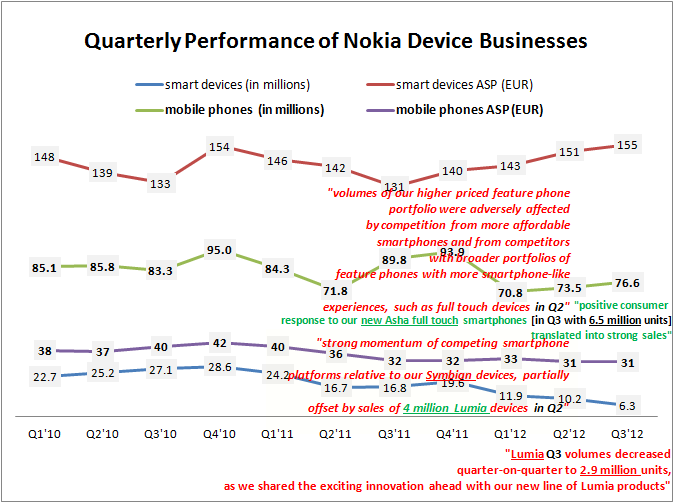
Nokia Corporation Q3 2012 Interim Report [press release, Oct 18, 2012]
… Mobile Phones Q3 volumes increased quarter-on-quarter to 77 million units; strong sales start for new Asha full touch smartphones, with volumes of 6.5 million units. …
…
Commenting on the Q3 results, Stephen Elop, Nokia CEO, said:
… In our mobile phones business, the positive consumer response to our new Asha full touch smartphones translated into strong sales. And in Q3, our mobile phones business delivered a solid quarter with sequential sales growth and improved contribution margin. …
…
Mobile Phones
Q3/2012
Q3/2011
YoY
ChangeQ2/2012
QoQ
Changevolume(mn units)
76.6
89.8
-15%
73.5
4%
ASP
31
32
-3%
31
0%
… On a year-on-year basis, the decrease in our Mobile Phones volumes in the third quarter 2012 was primarily due to the decline in volumes of our lower priced devices that we sell to our customers for below EUR 30. Volumes of our higher priced devices also declined, partially offset by volumes of our newly launched Asha full touch smartphones.
On a sequential basis, the increase in our Mobile Phones volumes in the third quarter 2012 was primarily due to volumes of our Asha full touch smartphones. In addition, volumes of our devices that we sell to our customers for below EUR 30 increased sequentially, whereas volumes of our QWERTY devices declined sequentially.
… On a sequential basis, our Mobile Phones ASP was approximately flat in the third quarter 2012 as higher sales of our lower priced devices that we sell to our customers for below EUR 30 were offset by higher sales of our Asha full touch smartphones which carry higher ASPs.
…
THIRD QUARTER 2012 OPERATING HIGHLIGHT
…
– Nokia announced the Nokia Asha 308 and Asha 309, new additions to the Asha Touch family. The dual SIM Nokia Asha 308 and single SIM Nokia Asha 309 give consumers fast web access at low cost. Nokia also released a new version of Nokia Xpress Browser, which enables up to 90% more efficient mobile browsing and faster access to rich web applications compared to conventional browsers. The Asha 308 and Asha 309 offer a fluid ‘swipe’ user interface and an open environment for third-party application development, characteristics that have earned the complete Asha Touch range full smartphone classification from global market research companies and analysts such as GfK.
– Nokia unveiled Nokia Life+, the latest evolution of its widely-used Nokia Life service. Nokia Life+ is a Web application, which will provide millions of people with valuable information on education, health and “infotainment” topics. Nokia Life+ will be supported by the Nokia Asha 308 and Nokia Asha 309 smartphones alongside a wide range of Nokia mobile phones.
…
Nokia Asha 308 – Ready for everything [nokia YouTube channel, Sept 27, 2012]
Nokia expands Asha Touch range to offer consumers smarter Internet experiences [press release, Sept 22, 2012]
… Nokia estimates the retail price for the Nokia Asha 308 and Nokia Asha 309 to be about USD 99, excluding taxes and subsidies, with shipping expected to start in the fourth quarter 2012. …
… In addition … Nokia introduced a new web-based tool that makes it even easier to build new applications. With Nokia Xpress Web App Builder, publishers can create appealing web apps for Asha Touch devices, and even novices can turn their web content into a fun and sophisticated web app for Nokia consumers. … Xpress Web App Builder is available at xpresswebapps.nokia.com
Introducing the Nokia Asha 309 [nokia YouTube channel, Sept 24, 2012]
Major improvements over the previous Asha Touch 305 and 306 as per the detailed specifications comparison:
- Capacitive Multipoint-Touch vs Resistive Multipoint-Touch
- 64 MB RAM / 128 MB ROM vs. 32 MB RAM / 64 MB ROM
allowing max user storage of 20 MB vs. 10 MB - Camera focus range of 60 cm to infinity vs. 100 cm to infinity
- Video recording frame rate of 13 fps vs. 10 fps
- Bluetooth 3.0 +A2DP vs. Bluetooth 2.1 +EDR
while in some specification offering less, the most important one is:
- GSM talk time is up to 9 hours vs. 14 hours
(with the same BL-4U 3.7V 1110 mAh battery)
Came to India: Nokia Launches Asha 308 And 309; Prices Start From Rs 6200 [US$ 116] [TechTree, Oct 18, 2012]
Asha positioning vs. Lumia and Android, see: The BGR Show – Nokia’s Smartphones Guru [iamOTHER YouTube channel, Aug 9, 2012]:
[3:19] First of all what we’re working on with Windows Phone is to take it as low end price point as we possibly can. Having said that, the Nokia Asha devices have really been developed with the emerging market consumer in mind. We’ve brought a lot of smartphone like features to the user interface, as well as investing in making access to the Internet possible for consumers who have real affordability constraints, for data compression in our browser etc. We are working to continue to invest there so that Asha is a relevant competitor to the lowest end Android devices. [4:05]
Nokia Feature Phone To Dominate While Smart Phone To Fade: India Key [analysis by Seeking Alpha, Aug 12, 2012]
With the second largest population of any country in the world and the fastest growing mobile device market over the last year; India provides a vast amount of opportunities for Nokia (NOK). While The Microsoft (MSFT) partnership and its subsequent offspring, the Lumina smart-phone, keep garnering all the headlines, the “feature-phone,” will lead this stock out of the abyss!
…
First a little historical background; facing international pressure to liberalize the country’s telecom industry, the Indian government passed the National Telecom Policy of 1994. This resulted in the country being divided into 20 (There are currently 23) telecommunication circles for basic telephony and 18 circles for mobile services; each circle represented a geographic region in which a particular telecom operator would provide service. An auction was held to determine which telecom operator would receive a spectrum license for each circle; the license gave them the exclusive right to provide service for that spectrum within the specified area. A similar spectrum auction has been held each time a new wireless spectrum (2G/3G/4G) was introduced over the past two decades. To this end, on May 2010, an auction was held for 3G spectrum licenses and resulted in exorbitant prices being paid by a majority of the country’s largest operators, “The Indian 3G spectrum auctions ended after 34 days, 183 rounds and prices close to $15 billion.”
…
Having spent such a significant amount for the licenses, these 7 operators were left with little additional capital to invest in 3G infrastructures; instead the majority focused their efforts on extracting revenue from the established 3G circles. As a result, many of the largest towns and significant pockets of the largest cities are still void of 3G coverage and this spotty service is greatly hindering the willingness of people to adopt 3G technology.
…
In a country with a very low per capita income and arguably the most cost-conscious consumers in the world, most are unwilling to pay significantly more for 3G services.
Nokia Asha 305 Price in India 2012 14th August valid in Bangalore, Hyderabad, Chennai,Mumbai and Delhi: Best Price: Rs. 4350 [US$ 78]
The Asha 305 was recently compared (Nokia’s masquerade [BGR, Aug 13, 2012]) to S Mobility’s (Spice Mobility’s) entry-level Android phone Mi355 “Stellar Craze” because of:
Spice is one of the new crop of Nokia’s lethal rivals in Asia, a nimble Indian upstart vendor that blindsided Nokia with its broad selection of dual-SIM phones in 2011 when Nokia still relied on a single-SIM product range.
Stellar Craze Asha 305 Weight 120g 98g Thickness 13mm 13mm 3G support Yes No Camera 5 Mp 2 Mp Display size 3.5″ 3″ Pixel count 480×800 240×400 Pixel density 266 155 Screen type Capacitive Resistant Dual-SIM Yes Yes Price in India Rs 6,600 [US$ 119] Rs 4,600
Nokia’s Asha 305 is in most ways far cruder device than the Stellar Craze. But it weighs less, looks sleek and has a snappy new UI. And in most parts of India, the lack of 3G support is not a problem.
Over the next four quarters, Nokia’s battle for survival is going to be waged in the streets of Rio De Janeiro and Mumbai, where blue-collar consumers will compare the Asha 305 to devices like Stellar Craze. Will they accept a sleek feature phone with a 3-inch screen and a low price that represents a big improvement in display and software quality over the previous budget phones? Or will they spend 40% more to reach for an Android device like the Stellar Craze, with four times the pixel count, 3.5G support and a fancy 5-megapixel camera?
S Mobility Q4 & FY12 Investor/Analyst Conference Call Transcript [May 16, 2012] is providing more insight into the entry-level Android smartphone market in India:
Pranav Kshatriya, Brics Securities, India
Big players like Samsung and LG are focusing lower end of smart phones pricing their Android phone in the Rs. 6,000 and Rs. 7000 [US$ 108 and US$ 126] category and is it really possible to give good quality handsets at a price which is lesser than that? Or how do you see the valid proposition for your smart phone as against the multinationals that are collaborating with Google and then launching their handset?
Sanjeev Mahajan, CEO of Spice retail
I think we can answer this in 2 parts, one we can try and give a retail perspective to it. I ask my colleagues to add their perspective from a Spice Mobile point of view.
The market is moving towards the price point that you talked about. So now you have a wide series of offerings for android phones in the range of Rs. 5,500 to Rs.6000 [US$ 99 to US$ 108]. In India, if value is at the bottom of the pyramid, over time you will find the shift on the smart phone category towards a lower price point. Now having said that, I don’t think there will be a drastic change. You would find smart phones at Rs.6,000 or so but in my assessment you will not find smart phones at about Rs.
More about that:
– Spice Mobility Launches Stellar, Stellar Horizon and Stellar Craze, Ice Cream Sandwich to boot [June 7, 2012]
– Spice to Launch India’s First ‘Secure Android’ Handset Range [May 16, 2012]
End of updates
This quite remarkable achievement is coming amongst the deepest drop in Nokia devices quarterly performance, as well illustrated by the diagram below. Compare the YoY numbers over the last two years, and read the official Nokia explanations given for the last Q2 quarter (shown in red):

Source: Nokia Corporation, Quartely results as of July 19, 2012
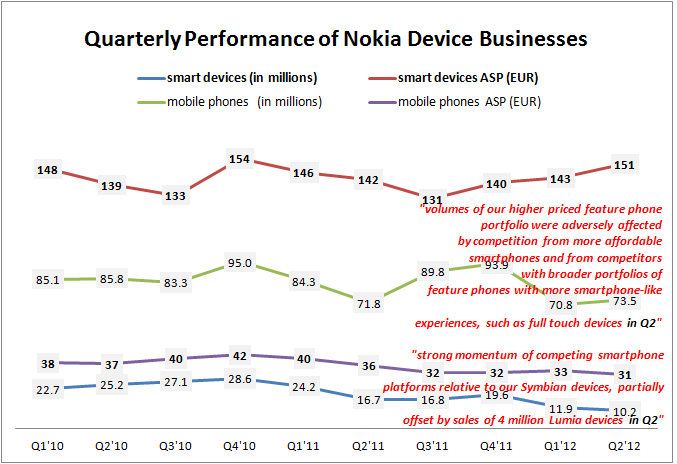

Source: YCharts as of July 23, 2012

The related financial higlights for the last Q2 quarter (reported on July 19, 2012) were as follows:
– Net sales were 4.0 billion Euro, down 5 percent sequentially and 26 percent year over year
– Non-IFRS gross margin in Q2 was 18.1 percent, down 630 basis points sequentially primarily due to the recognition of approximately 220 million EURO of inventoryrelated allowances* in Smart Devices
– Non-IFRS OPEX was 1.1 billion Euro, down 3 percent on a sequential basis and 14 percent year over year
– Non-IFRS operating margin was negative 9.1 percent in Q2 down sequentially from a negative 3.0 percent in Q1
* Nokia: “In Q2, we recognized approximately EUR 220 million of allowances in Smart Devices related to excess component inventory, future purchase commitments and an inventory revaluation. These allowances relate to our Smart Devices product, that is, Lumia, Symbian as well as MeeGo. Because our internal sales outlook is now lower, we believe we will not be able to use some of the components which we already have on our books, as well as components we have committed to purchase. In addition, we have reduced the carrying value of some of our inventory.”
Note: There is a simultaneous substantial reduction in the Mobile Device segment. The whole next gen operating system effort, code-named Meltemi has been killed. See: Nokia scraps phone software to conserve cash: sources [Reuters, July 26, 2012]. It goes as far as Nokia Beijing Institute began layoffs [First Financial Daily, Shanghai, July 26, 2011]. But it is an important remark in that article, that “layoffs mainly involved in the forward-looking technology departments and R & D personnel, and is not responsible for the outside world said S30 and S40 mobile phone R & D and assume Windows Phone Handset R & D tasks of R & D center in China.”
Regarding Nokia’s long-term competitiveness Stephen A. Elop, Nokia CEO made the following remarks to the analysts [July 19, 2012]:
During the second quarter, we demonstrated stability in our feature phone business. Our Mobile Phones Q2 volumes of more than 73 million were up quarter-on-quarter. During the quarter, we introduced new innovations to our feature phones such as Mail for Exchange, low-end full touch devices and very affordable multi-SIM devices. The feature phone market remains an attractive market, and we plan to improve our competitiveness and profitability in this space by further developing Series 40 and Series 30 devices.
In our Smart Devices business, we continue to see increased consumer support for Lumia and the Windows Phone ecosystem. Last week, a Nielsen survey confirmed how satisfied Nokia Lumia 900 owners in the U.S. are with their devices. The Lumia 900 earned a Net Promoter Score of 63 with 96% of owners extremely or somewhat satisfied and 95% willing to recommend the device to others. Through all of this, we are learning about new feature requirements that we plan to bring the market to improve our global consumer satisfaction. These results are no doubt enhanced by the progress that developers are making with applications. We were pleased to announce that the Windows Phone ecosystem has exceeded 100,000 applications.
Most importantly, we are seeing progress in our Lumia numbers. We sold 4 million Lumia devices in Q2, which is up from about 2 million in Q1, with growth driven by the expanded availability of the Lumia 900 and the Lumia 610 across markets. As we look ahead, we expect the launch of Windows 8 for PCs and tablets, plus the launch of Windows Phone 8, to be a catalyst for Lumia. Windows Phone 8 will share the same Metro user experience and the core operating system technologies as Windows 8, providing a similar platform for developer applications across devices. As Microsoft shared, the look and feel of the Lumia interface is to become familiar to millions of people through PCs, tablets and Xbox consoles. Plus, we anticipate that Microsoft will launch a bold and aggressive marketing campaign for Windows 8, which we believe will have a halo effect for Lumia. And as the lead mobile partner for Microsoft, we plan to deliver competitive smartphones with Windows Phone. We intend to broaden the price point range of Lumia devices to price points both higher for better gross margins and lower for volume. Additionally, we are investing in new materials, new technologies and location-based services for a great consumer experience.
For existing Lumia devices, we have already started the pattern of updates including WiFi tethering, flip to silence, media content streaming and exclusive applications like some from Zynga. As we anticipate the upcoming release of Windows Phone 8, we have worked with Microsoft on a release for existing devices. We are planning for all 4 Lumia devices to receive an update with some Windows Phone 8 features like the new start screen, like core camera experiences and updates to Nokia Drive, Nokia Transport and Nokia Music. This is one example of our continued commitment to enhance the existing Lumia products over time even after Windows Phone 8 ships.
However, to prepare developers for the new Windows Phone platform, Microsoft announced the Windows Phone 8 platform in June. As a result, we anticipate some impact to our Lumia business in Q3, although Lumia activations have been flat to up in the weeks following the announcement of Windows Phone 8. Thus, leading up to the introduction of the Windows Phone 8 products, we plan to introduce tactical measures and promotional campaigns. As we do throughout any product life cycle, we plan to pursue traditional marketing and promotional activities to encourage the adoption of Lumia devices.
We are committed to Windows Phone as our primary smartphone strategy. We have learned that it takes tremendous amount of work to break through as the third ecosystem, and we are viewing the launch of Windows 8 and Windows Phone 8 as an important moment in this journey.
These remarks show clearly (look even at the difference in the amount of remarks that are devoted to Asha vs Lumia in the above) that there is change now, with Less focus on feature phones while extending the smartphones effort: further readjustments at Nokia[on this Experiencing the Cloud blog, June 25, 2012] which had the following topics discussed:
- Speculations about Nokia
- Nokia and the Windows Phone Summit
- Nokia Q&A conference for financial analysts and investors, June 14, 2012
- Nokia announcements, June 14, 2012
- Scalado acquisition
- Asha Touch family of mobile devices
The last one gave detailed information about the new Asha Touch products from which I will highlight the following here:
These latest phones have been designed to provide an incredibly rich, smartphone-like experience to consumers who want to be set free from excessive data consumption costs and short battery life.
…
The new devices take full advantage of the Nokia Browser 2.0, a major recent update which uses Nokia’s cloud technology to reduce data consumption by up to 90%, meaning that consumers can enjoy faster and cheaper internet access. Web sites load up to three times faster in comparison to devices without cloud-accelerated browsing, making it simple for users to find and select from more than 10,000 web apps available for download. They deliver a richer and more interactive consumer experience whilst using less data than a stand-alone internet connected app.
Consumers can easily stay connected with friends and family at the touch of a button as well as share files and links across their social networks. Furthermore, the Nokia Browser’s Download Manager feature helps consumers to manage external content easily, saving music, video or pictures on a memory card, while surfing the internet.
The Asha family is also getting positive support from developers and consumers. Nokia Store has just broken the 5 billion downloads landmark. From January to April, 42% of all content downloaded from Nokia Store was delivered to Asha and other Nokia devices based on the Java ecosystem. Just one year ago, that number was 10%. Also, there are 410 Nokia developers with apps which have achieved more than 1 million downloads. India Games and Pico Brothers just passed 100 million [each].
As well as providing a great, social online experience, the Nokia Asha 305, Asha 306 and Asha 311 have been created with entertainment in mind. All users will receive an exclusive gift of 40 EA games to download for free* and keep forever. These games range across action, arcade and sports, and include titles such as Tetris®, Bejeweled®, Need for Speed(TM) The Run and EA SPORTS(TM) FIFA 12. The Nokia Asha 311 also comes with 15 levels of Angry Birds pre-loaded onto the phone, perfect for making the most of the touchscreen and 1GHz processor.
*Data costs may apply.
…
The estimated retail price for Nokia Asha 305 is EUR 63 [US$ 79] and it’s expected to start shipping in the second quarter of 2012. The estimated retail price for Nokia Asha 306 is EUR 68 [US$ 85]. The Nokia Asha 311 has an estimated retail price of EUR 92 [US$ 115]. Both devices are expected to start shipping in the third quarter of 2012. Above mentioned prices exclude taxes and subsidies.
From this should be quite obvious that the Less focus on feature phones while extending the smartphones effort: further readjustments at Nokia [on this Experiencing the Cloud blog, June 25, 2012] statement in the title of that previous post should not be interpreted in a kind of simplistic way. Let’s quote Elop on that from the analyst call yesterday:
Sandeep Deshpande – JP Morgan Chase & Co, Research Division
Could you possibly talk about the products that you plan and when the new products will be launched for this, the low end market, which is where you’re seeing some of the problems in China for instance? And how do you see yourself positioning in that market? Is it on price? Or is it the difference with Windows Phone 8that you’re going to position yourself on?
Stephen A. Elop
So thanks. I can’t give you comments on specific products and announcement dates and so forth. But we have signaled very clearly that it is our intention to introduce products at lower and lower price points, and the plans are well advanced in that direction.
In terms of positioning in those lower-priced markets, it is the case that Windows Phone itself, as well as what we contribute as Nokia, are the principal source of differentiation. We do intend to present them as a different experience that we believe is superior, particularly on some of the topics that are of interest, not only all over the world but very heavily an emerging markets, things like social networking. And that doesn’t necessarily mean Facebook in a number of these markets. There’s a number of other environments or social environments that people are using. And clearly, we’ve demonstrated some of that with the early launch of products into countries like China, but you’ll see a lot more of that going forward.
The other thing I’d highlight as well here is on the Mobile Phones side, it is the case that just at the end of Q2, we introduced a new family of Asha full touch products. Too early to call sales results because they’re just moving into channels and so forth, just beginning the sales process. But for a number of people in those emerging markets, at the right price point, which may be below what a smartphone is selling for traditionally, they’re getting smartphone-like capability including Internet access, social networking access and a variety of other capabilities like our proxy browser [see explanation for that further down, related to the MWL topic], all designed to reduce total cost of ownership for those devices.
So it’s partially about Lumia devices coming down but also recognizing in what we traditionally call the feature phones space smartphone-like capability being introduced more and more.
… [much later, in response to a question about “too much and ‘asymetric’ reliance on Microsoft”] … as it relates to shaping our own destiny, we have substantial ability to shape what we’re doing, what devices, what incremental software we build in and around Windows Phone, as well as other platforms, including our Mobile Phones platform, including our location-based assets and so forth. …
And indeed as early as in the first half of July the first Asha Touch device, Asha 305 came to the market: second week of July to Pakistan, third week to India etc. (also available almost everywhere now, including Europe). The market of crucial importance for Nokia now is obviously India, where the brand new product is sold already as low as US$ 72 (INR 3,967) while on Nokia India on-line shop it is advertised for US$ 85 (INR 4668) vs. US$ 91 (INR 5,029) of list price. This is showing clearly that Nokia has quite a big price elasticity potential for the new Asha Touch products!
Stephen Elop made it quite obvious in his remarks yesterday that:
For Q3, with limited near-term visibility, we are providing guidance that has a conservatively broad range. We believe there are several drivers that could move us into the upper part of the expected range. As noted in our press release today, these include: continued improvements in Mobile Phones including strong sales of our Asha full touch products, which were just introduced to market at the end of Q2; lesser impact on Lumia sales during the transition to Windows Phone 8, which would lead to more normal demand for products; and better-than-expected progress against our structural cost savings actions.
On the cost side of the new Asha Touch devices I will further elaborate in a companion post (specifically investigating the “ultra low, manufacturing cost” aspect of them), and will only go through the “superior” User Experience (UX) question in detail here. For that let’s see first a video demonstration:
Nokia Asha 311 touchscreen phone [TheBestOfUppropfdr YouTube channel, July 12, 2012]
Then is the first detailed review from Pakistan as well. This is worth to watch because also showing that people used to review Android smartphones could quite underestimate the power of this new user experience: Nokia Asha 305 – Full Review (Most Indepth) [DrTech0logy YouTube channel, July 12, 2012]
What this reviewer is right:
Nokia Asha 305 and 306 are not worth buying, the touch screen is awful, as it is a resistive touch screen, Nokia X2 is the best in this price.
Referring to the question put on her facebook site:
Can you tell me which is a good phone in the price 8,000 to 8,500???
She is also noting in the same thread that:
… we can’t play youtube videos we can only download them …
how’s the video quality and max length of video you can shoot? Wait for Nokia Asha 311 to come out..
[Indeed, before making premature product conclusions wait for the significantly better in those, and even other respects Asha 311 with a capacitive touch screen, Gorilla glass, 1 GHz processor, 3.5G instead of 2.75G of the 305/306, VGA video etc.!]
These are also told in her review video, where the general conclusion, nevertheless, is that this entry Asha Touch device is a good one for that price. [Plus consider the quite large price elasticity aspect (mentioned earlier) Nokia built into as well!] Nowhere, however, she is reviewing the device from the overall user experience point of view.
So let’s examine that in more detail, first with another video from the next to the previous source which is clearly evaluating the UX aspect aspect as well:
Nokia Asha 311 [TheBestOfUppropfdr YouTube channel, July 12, 2012]
It is worth to add to that some technical documentation evidence:
UX overview [a section in the Essentials part of Series 40 Full Touch Design Guidelines, June 8, 2012]
Series 40 Full Touch UI
- Intuitive, fast, and enjoyable to use.
- Flexible and relevant personalisation to fit your style; have your favourite apps on My page.
- Visually appealing; clear and eye-catching graphics and transitions in compact size.
- Familiar and trustworthy UI, building on Series 40 UI heritage.
The lock [or title] screen is the topmost layer of the UI that people first see when the screen has been waken up. Lock screen is visible when the phone is in locked mode. Its main purpose is to prevent any accidental interactions with the phone while it’s not being used. A swipe gesture from any edge of the screen unlocks the phone and moves to the screen that was active before the phone was locked. On lock screen, people see the current time and date, the status of the phone, and notifications about incoming events at a glance. Lock screen is only displayed in portrait mode.

Figure 1. Unlocking the screenHome screens
There are three home screens: My page, App launcher, and My app. People can swap between home screens by swiping or flicking horizontally.

Figure 2. Home screens: My page, App launcher,
and My app (in this case, dialler)My page:
- Can be personalised by the user.
- Contains favourite contacts and shortcuts to apps.
- Editing the content can be triggered with a long press on the screen.
- Time and date is always visible on My page.
- Tapping on the time opens Alarm clock.
- Tapping on the date opens the Calendar.
- My page can be scrolled vertically.
App launcher:
- Shown at the end of the start-up process.
- Shown when the user has exited an app by pressing end key.
- Contains all phone apps, on one single page.
- Also downloaded apps are placed here.
- The user can reorder the icons by pressing and holding the screen to activate the edit mode.
My app:
- Three possible apps to have here; dialler, music player, or radio.
Opening and closing apps
On home screen, apps can be simply tapped to open.
The notification baris accessible throughout the UI, but only in portrait orientation. The notification bar is a dynamic zone from which people can always access shortcuts, core functions, ongoing events and missed events. Any new notification takes the top position of the list as the most recent one. When open, the bar accommodates 3 rows of information with notifications and direct links to apps.
Figure 3. Notification bar with new activity, notification bar
after time-out, and open notification barApps are closed with the back navigation path, or by pressing the endkey.
Figure 4. Open an app with a tap. Close it from the Back icon.
Return to the home screen where you opened it from.


More information:
other sections in the Essentials part of Series 40 Full Touch Design Guidelines:
|
other parts of Series 40 Full Touch Design Guidelines:
|
Series 40 UI Component Demos [Nokia Developer project summary, July 20, 2012]
This simple example application demonstrates the basic use of LCDUI [Limited Connected Device User Interface] components. The example is meant for both designers and developers: designers get an impression of how the components actually look on the device and developers learn how to use the LCDUI UI components. The application does not have an engine or further meaning. The texts are “lorem ipsum” and icons are simple thumbnails or images.
Please check the Series 40 Full Touch Design Guidelinesfor more information.


Considering Metro UI or Panorama Style on Series 40 Full touch devices for designing UI [wiki article of a Nokia Developer project, started on July 16, 2012, not finished as of July 20]
Introduction
Above picture shows an abstract panorama page. I guess you all used panorama applications on Windows Phone, Nokia Lumia. We use the same concept, but we need to consider the limitations of device like memory, processing power and optimization should be kept in mind.
Designing
UI Components
You need to create all these UI components in canvas on your own, using images and drawing on them. How about painting button on mobile, doesn’t sounds good.LCDUI Canvas
You can think of an instance of canvas as an artist’s canvas on which you draw images that might include text.
…
Nothing is Impossible with S40 Full touch UI API
…
Get Inspired and Start Working


UI components [a section in the Essentials part of Series 40 Full Touch Design Guidelines, June 12, 2012]
The UI components listed below are the Java components available with full touch styling. Please read the LCDUI Overviewfor a structural overview of the offering.
UI stencils
Series 40 full touch visual design stencils are a collection of realistic user interface views and components. The stencils can be used to create mockups which are close to the final visual result. With this set you can create more refined concepts for presentations to stakeholders. The set contains Nokia fonts and drawing files representing the Java components for Series 40 full touch. The visual design stencils are available for Adobe Illustrator CS5, Adobe Fireworks CS5, and Inkscape version 0.48 or above.
DOWNLOAD: Series 40 full touch visual design stencils
When creating icons for your application, please see theicon creation guidelines and the Nokia icon toolkit.
Java UI components


With such a superior UX design foundation comes an advanced SDK and a full fledged IDE for Java developers:
Introduction to the Nokia SDK 2.0 for Java [nokiadevforum YoTube channel, June 25, 2011]
Introduction to the Nokia IDE (Beta) for Java ME [nokiadevforum YoTube channel, June 25, 2011]
New tools unleash the potential of Nokia Asha Touch phones [Nokia Developer News, June 25, 2012]
Beta releases of Nokia SDK 2.0 for Java and Nokia Web Tools 2.0 are now available. These new Series 40 development tools are your route to realising the extended Series 40 opportunity created by the introduction of the Asha Touch phones.
Nokia SDK 2.0 for Java
In addition to the usual tools — documentation, APIs, and an emulator — the Nokia SDK 2.0 for Java contains our first full featured, customised IDE. Based on the Eclipse platform, Nokia IDE for Java will streamline your development activities, with features such as the Device SDK Manager, Nokia specific JAD attribute editor, and a range of code templates.Listening to user feedback we know that in the past developers have been frustrated with trying to find the right SDK for Series 40 development. With Nokia SDK 2.0 for Java, we are introducing the Nokia SDK Manager. From within the Nokia IDE for Java you can now specify a phone, screen size, form factor, or feature and instantly get a list of the SDKs supporting your choice. The SDK or SDKs can then be installed immediately, right from within the IDE.
Among the code templates you will find one with everything you need to implement an app with in-app purchasing capabilitiesand the JAR attribute editor makes targeting you app package at Series 40 phones simple and straightforward.
Finally, there are a number of updates to the SDK that are designed to take advantage of new features being introduced in Series 40 Touch. There is an updated Nokia UI API that gives you features such as multi-point touch and an implementation of the Mobile Sensor API (JSR-234). The emulator has been updated too with an orientation simulator, the integration of Nokia Mapsinto the location simulator, and useful links built into the emulators menu.
Nokia Web Tools 2.0
Series 40 web apps are the best way to deliver great experiences to Series 40 users that leverage your existing web assets. With the release of Nokia Web Tools 2.0 you now have the ability to enhance those experiences with features such as file upload and download, password management, and the addition of in-app advertising to your web apps. In addition, there are several improvements in HTML and CSS support, enabling you to deliver richer UIs.Nokia Web Tools 2.0 enables you to code web apps that take full advantage of these features, and test them on your computer — Nokia Web Tools 2.0 is available for Microsoft Windows, Apple Mac OS X and Ubuntu Linux. The Web App Simulator offers support for the full-touch screen resolution and has been updated to provide a more phone-accurate rendering of web apps.
Within the Web Developer Environment there have been a range of improvements such as enhanced validation — which is now tailored to Series 40 supported HTML, CSS, and JavaScript APIs. There is also a wider range of templates, examples, and code snippets to get you started with common web app content layouts and interaction paradigms, such as sharing on social networks and file transfers. While small, improvements such as keyboard shortcuts and incremental uploads will help speed up your development.
Series 40 represents the single largest opportunity for you to deliver Java and web apps to mobile consumers worldwide. The introduction of Nokia Asha Touch phones delivers these users a near smartphone experience and the updated tools enable you to take full advantage of this in your apps. With accelerating download rates, there has never been a better time to target Series 40.
Indiagames, Psiloc and Liverpool FC have already used these tools to create apps for the new Asha Touch phones and share their experiences in this video:
This video provides an insight into how developers from around the world are taking advantages of the Java and web apps technology in the Nokia Asha Touch phones to deliver great experiences to their users. Hear Indiagames, Psiloc, and Liverpool FC and InfoMedia explain the benefits of developing for the Series 40 Developer Platform and the success they have achieved. Also discover how the latest tools — Nokia SDK 2.0 for Java and Nokia Web Tools 2.0 — have aided with development. Create your Java and web apps for Asha Touch phones:http://www.developer.nokia.com/series40
Psiloc create World Traveler for Asha Touch using the latest Java tools from Nokia Developer [nokiadevforum YoTube channel, June 25, 2011]
In addition to the support given to the Java developers the opportunity is a great now to web developers as well. They can develop rich and responsive, true smartphone-like web applications for the new Asha Touch devices:
MinesFinder [wiki article of a Nokia Developer project, July 19, 2012]
This article explains how to write a highly responsive Series40 WebApp. It uses a Minesweeper clone as example.
Note: This is an entry in the Asha Touch Competition 2012Q3
Introduction
If you are writing a Series 40 Web App, you are prepared to cater for the low end of mobile phones. Knowing that the devices which will run your app are very basic should not stop you from trying to deliver a high-end user experience. It is more the other way around, knowing that those phones have limited capabilities should encourage you to use every trick to provide your user with a premium feeling.
In my eyes user experience (UX) has three big topics:
- Function – what does the app do, how bug-free is it, etc…
- Design – how does the app, and the UI, look
- Responsiveness – how does it feel using the app, how fast is it
Of course, there fields have no 100% hard borders. They affect each other and you have to think about all aspects, but I will concentrate on number 3, the responsiveness. And within this part, I concentrate on the speed of the application. To be even more concrete, I’ll talk about reducing these so called “browser round-trips”.
Reducing those round-trips has the highest priority if you try to speed up your app. A round-trip takes almost as much time as opening the app. If the user has to wait 2-3 seconds after every single click the does, he won’t be very satisfied with the experience. In addition, every round-trip is a possible point of error. If the user has a bad internet connection, a round-trip can break the app.
To make sure that this is not only gray theory, I created a Minesweeper clone, MinesFinder. You can find the source in the Nokia Project . I try to get it into the Nokia Store. Until then you can visit [[1]] with your Nokia Browser to play it.
You can play the game without a single round-trip. You can flag fields, dig for mines, get a “You Loose” message if you hit a mine and a “You Win” message if you have flagged all mines correctly. In addition there is a counter, showing how many flags you have already planted.
1. Use MWL [Mobile Web Library, explanation see below] where ever you can.
…
2. Use JavaScript like a server-side scripting language.
…
3. Use CSS instead of program logic.
…
Summary
The Nokia Web Tools, the Mobile Web Library and the Nokia Browser are highly capable tools which enable you to create very responsive apps for a very big audience. But you have to master MWL and you have to think sometimes outside of the box.Using MWL where ever you can, using JavaScript like a server-side scripting language and moving on-demand logic into CSS and the app start will reduce your server round-trips and increase the responsiveness of your application.
Gallery
Main game view.
Settings and info screen.
Cheat mode activated.
You loose.
You win.


Overview – Web Developer’s Library [Nokia Developer library page, June 19, 2012]
This topic contains the information you need to develop web applications on the Series 40 platform. Web apps for Series 40 run on mobile phones that lack the processing power and memory to run a conventional browser directly on the device. Therefore, the web browser for Series 40 devices, known as the Nokia Browser for Series 40, has two parts: the web app client and the proxy server.
Developers can create interactive applications using web standards such as XHTML, cascading style sheets (CSS), W3C widgets, and the JavaScript™ programming language. You can easily make rich, interactive pages that run well even on devices with limited resources.
Nokia Browser for Series 40 is a distributed (or proxy-based) web browser that supports full web page rendering on devices with limited processing power and memory, such as some Series 40 devices. On the phone, there is a small browser called the Nokia Browser for Series 40 Client. On a Nokia server, a larger browser application (called the Nokia Browser for Series 40 Proxy server, or simply the server) processes browsed web pages and runs web apps. The server does most of the processing for the handset client, and it communicates with websites on behalf of the client. The server sends the client optimised web page data, reduced in size to be easier to transmit to and process on the phone. The client has a JavaScript library called MWL (Mobile Web Library), which contains code to support application-like interaction on the device. MWL processing should normally be the only JavaScript that executes on the handset.
The following figure shows the Nokia Browser for Series 40 environment.
…

Liverpool FC Match & News Centre app: web apps for Asha Touch [nokiadevforum YoTube channel, June 25, 2011]
This is really showing that Nokia’s strategy for “the next billion” based on software and web optimization with super low-cost 2.5/2.75G SoCs [this Experiencing the Cloud post, Feb 14 – April 23, 2012] had already been technically implemented with these Asha Touch devices. A couple of relevant excerpts from that post showing clearly the company’s new direction which have already been in works during the last 17 months:
Historically, feature phones have been primarily used for calling and text messaging, while smartphones – with the aid of their more capable operating systems and greater computing power – have provided opportunities to access the Internet, navigate, record high-definition video, take high-resolution photographs, share media, play video games and more. Today, however, the distinction between these two classes of products is blurring. Increasingly, basic feature phone models, supported by innovations in both hardware and software, are also providing people with the opportunity to access the Internet and applications and, on the whole, offering them a more smartphone-like experience.
… some competitors’ offerings based on Android are available for purchase by consumers for below EUR 100, excluding taxes and subsidies, and thus address a portion of the market which has been traditionally dominated by feature phone offerings, including those offered by Nokia. Accordingly, lower-priced smartphones are increasingly reducing the addressable market and lowering the price points for feature phone.
…
In Mobile Phones, we have renewed our strategy to focus on capturing volume and value growth by leveraging our innovation and strength in growth markets to provide people with an affordable Internet experience on their mobile device – in many cases, their first ever Internet experience with any computing device. Almost 90% of the world’s population lives within range of a mobile signal, yet there are around three billion people who do not own a mobile device. Of those who do own a mobile device, fewer than half use it to access the Internet for a number of reasons ranging from personal choice and affordability to the lack of an available Internet connection. We recognize that there is a significant opportunity to bring people everywhere affordable mobile products which enable simple and efficient web browsing, as well as give access to maps and other applications and innovations.
…
We acquired Smarterphone, a Norwegian company that brings new user interface technology and expertise to Nokia. We’ve increased download rates from feature phones to more than 4 million a day by improving store access and payment schemes and adding new apps like Whatsapp, Foursquare and EA. … And we delivered a new proxy browser, and we’re now bringing the browser and web apps down to super low-end devices.
…
Cavaiani is talking about technology Nokia bought from his former firm, Novarra, and is now using in the browsers of the company’s four new Series 40 (S40) Asha phones. The new S40 browser, like Silk and Opera Mini, is a proxy browser: it uses servers around the world to download content and compress it before the content gets sent to your phone.
…
Nokia’s approach is a bit different from both Opera’s and Amazon’s. Opera’s servers ingest entire Web pages and send them to phones as static documents in Opera’s own markup language, OBML.v
From what we know of Amazon Silk, the browser on Amazon’s as-yet-unreleased Kindle Fire tablet, it combines a full browser on the Fire with algorithms that pre-fetch pages on Amazon’s cloud servers, and also compresses images and stores them at Amazon.
Nokia’s new browser starts with a basic HTML browser on the Series 40 phones. Nokia’s servers look at desktop Web pages and boil down or remove more complex content, for instance parsing and executing JavaScript and resolving CSS into more basic HTML, Cavaiani said. They also reduce the quality (and the size) of images. There’s no Flash support.
The browser is able to handle dynamic pages that only reload part of the page at a time when the user presses a button. The browser also has deep access to the phone’s hardware, which is different from Opera Mini.
“We can also inject services into the browser. The latest browser introduces a geo-location API, so now that’s open to developers to create geo-location apps,” he said.
The browser even supports widgets, dynamic overlays that can perform actions on Web pages like sharing them on Twitter or translating them into a different language.
…
”Traditionally, proxy-based browsing has offered users a very limited experience, because such browsers typically do nothing more than paint content provided by a proxy. This has changed, with Nokia Browser for Series 40 support for Series 40 web apps. Using Mobile Web Library, the Nokia Browser for Series 40 client can execute JavaScript code in web apps. This code makes it possible to create interactive user interfaces and graphical transitions to deliver users beautiful web experiences. Now web designers and developers can deliver compelling application experiences to users at low cost — both in terms of development effort and user data charges.
With the latest version of the Series 40 browser, Series 40 web apps can now go even further by offering users location aware web apps and the ability to send SMS messages. Location features leverage the network-based location capabilities of Series 40 phones for accurate and timely location information. In addition, performance has been enhanced further with images embedded in a web app now cached on the user’s phone for faster page loads and refreshes. ”
…
Web apps are small games and applications that you can purchase, or download for free using Ovi Store on your mobile phone. With web apps you can access content from well-known global brands, or the local brands you know and love. Once downloaded, apps are permanently saved within Nokia Browser, so they’re always easy to find and super fast to load. And because web apps are specially optimised for your phone, they provide a beautifully clear and simple way to access your favourite content.
…
Nokia Browser 2.0 makes use of cloud-based servers which adapt standard web pages so that they perform better on Nokia Series 40 devices. Since web pages are compressed and cached in the cloud, end users can access web sites in a manner which is faster and requires significantly less data to be sent over their mobile network. For pay-per-use contracts this will result in more cost-effective browsing, while users on an operator data plan will be able to do more web surfing without exceeding their monthly usage limits.
The new version reduces data consumption by up to 90%, meaning that consumers can enjoy faster and cheaper internet access. Web sites load up to three times faster in comparison to devices without cloud-accelerated browsing and consumers will also benefit from a number of other enhanced capabilities.
From the first look, consumers are easily able to discover new web content and enjoy one-click access to top, local sites via the Nokia Browser’s inviting and intuitive start page. We have optimized the browser to enable users to easily stay connected with friends and family at the touch of a button as well as to share files and links across social networks. The new and improved Download Manager helps consumers to manage external content easily, saving music, video or pictures on a memory card, while surfing the internet.
…
The browser includes a revamped, modern user experience that makes it simple to find, install and use interesting web apps that offer a richer, more desktop-like internet experience. Launched in mid-2011, the Nokia Browser is the first browser of its kind to support web apps, and now boasts a catalogue of more than 10,000 of the latest apps. Several publishers have experienced over a million downloads in a matter of months, demonstrating strong consumer demand.
…
Last year, while media attention focused on the launch of the new Nokia Lumia phones, McDowell was laying the groundwork for the expansion of Nokia’s next billion strategy.
A major part of McDowell’s strategy has been moving away from the idea that Series 40 devices were a “low-end business cash cow” towards smarter, aspirational, phones for everyone:
“We’ve planted the seeds for Series 40. These are not the dumb phones…they are as smart as possible. In reality, the distinction between a smart phone and a feature phone is fairly technical, and when a consumer thinks about a smart phone they think about accessing the internet, downloading apps, anice display… and these are all things we can, and do, deliver with Series 40,” says McDowell.
…
“In Europe and the US we download data without thinking very much about the cost, but in growing economies it is a huge issue. With the Nokia Browser you can get a full internet experience, with very clever cloud compression technology to make that experience affordable.”
…
Nokia is celebrating selling 1.5 billion phones by looking to the future. … “What we are trying to do is a radical thing. We sometimes forget that half the world’s population does not have a phone. So, celebrating 1.5 billion is great, but it’s backward looking. What we want to say is – we are only half way to where we are going.”
…
“For a lot of people Series 40 is the first time they’ve ever had access to the internet or a computer. And the story of connecting those people is a huge story, because it will change the world.”
Series 40 began in the late 1990s in flagship devices [first was the Nokia 7110, developed in 1999], sold at fairly high prices to western customers, Vasara said. That has now been transformed into a range that is now selling in huge numbers in high growth economies, at a fraction of the cost.
“The people who buy these phones – and who will be buying these phones – are ambitious, and very aware of technology. They’re young, urban and what we call ‘hyper-social’. In other words, they know what the best of the best is – and we have to deliver a product that is state of the art and affordable.”
…
The future of Series 40 will be more about the services that you want in your “neighbourhood” – in your own language, delivering information that “feels very local.” Part of that will be working with developers to develop more Series 40 apps.
With all that Nokia had been turbocharging the aging S40 platform for developers in terms of expressiveness, power and development efficiency. The company had already indicated the strategic importance of it in Nokia 2011 fiscal year report [looong PDF, March 8, 2012] in the following way:
In the Mobile Phones business … we plan to drive third party innovation through working with our partners to engage in building strong, local ecosystems. [p. 90, as part of the strategy for the trend: Increasing Importance of Competing on an Ecosystem to Ecosystem Basis]
In support of our Mobile Phones business, we also plan to drive third party innovation through working with our partners to engage in building strong, local ecosystems. [p. 91, as part of the strategy for the trend: Increased Pervasiveness of Smartphones and Smartphone-like Experiences Across the Price Spectrum]
In the Mobile Phones business, we believe our competitive advantages – including our scale, brand, quality, manufacturing and logistics, strategic sourcing and partnering, distribution, research and development andsoftware platforms and intellectual property – continue to be important to our competitive position. Additionally, we plan to extend our Mobile Phones offerings and capabilities during 2012 in order to bring a modern mobile experience – software, services and applications – to aspirational consumersin key growth markets as part of our strategy to bring the Internet and information to the next billion people. At the same time, we plan to drive third party innovation through working with our partners to engage in building strong, local ecosystems. [p. 91, as part of the strategy for the trend: Increasing Challenges of Achieving Sustained Differentiation and Impact on Overall Industry Gross Margin Trends]
By … focusing on driving operator data plan adoption in lower price points with our feature phone offering, we believe we will be able to create a greater balance for operators and provide attractive opportunities to share the economic benefits from services and applications sales compared to other competing ecosystems, thereby improving our long-standing relationships with operators around the world. [p. 93, as part of the strategy for the trends in: Supply Chain, Distribution and Operator Relationships]
Creating a winning ecosystem around our Location & Commerce’s services offering will be critical for the success of this business. The longer-term success of the Location & Commerce business will be determined by our ability to attract strategic partners and developers to support our ecosystem. Location & Commerce is aiming to support its ecosystem by enabling strategic partners and independent developers to foster innovation on top of their location platform. We believe that making it possible for other vendors to innovate on top of Location & Commerce’s high quality location-based assets will further strengthen the overall experience and make our offering stronger and more attractive. [p. 97, as part of the strategy for the trend: Increasing Importance of Creating an Ecosystem around Location-Based Services Offering]
Therefore, such a local partnering strategy had already been in the works some time and quite successfully, as proven by the testimony from probably the largest and most successful local S40 development partner (with 800 million subscribers, mostly in India):
Indiagames talks about their experience developing Java games for Asha Touch [nokiadevforum YoTube channel, June 25, 2012]
And quoting Gondal:
[2:46] The one piece of advice I can give developers is that content and platforms are very-very local. And while there might be certain pieces of content which may suddenly be global hits, it’s very important for you to look at each market individually, and design and develop for that content. [3:05]
Such an advice is well supported by the strategies and achievements of the company:
Indiagames achieve 100 Million Downloads on Nokia Store with games content focused on India [nokiadevforum YoTube channel, June 25, 2012]
More information on leading Nokia developers:
– Pico Brothers, an only two-people Finish company, are the second developers to achieve 100,000,000 downloads, reaching the milestone just two weeks after UTV Indiagames. The company’s strategy for success has involved delivering simple, clever apps that provide short bursts of entertainment. Apps like ‘Milk the Cow’, ‘Talking Hamster’ and ‘Flashlight Extreme’ are Pico Brothers apps that deliver instant fun and utility. They mostly monetize their applications in UK, France and Germany. See: Pico Brothers join the 100 million club [Nokia Developer News, May 4, 2012]
– Inode Entertainment, a 10 people Mexican company, is the third developer to achieve the one hundred million download milestone via Nokia Store. It was one of the first publishers in the Nokia Store, has been developing games since 2006, and its portfolio spans Symbian, Series 40, S60, and Symbian 3 (and soon Windows Phone). Most of Inode’s apps are free, but if it feels it needs to price them, it aims for the 99-cent mark. It is developing for several markets exploiting the potential for that in the Nokia Store. See: Gaming for the Masses: Inode Entertainment Joins the One Hundred Million Download Club [Nokia Developer News, June 25, 2012] as well as Inode Entertainment passes 100 million downloads in Nokia Store [Nokia Conversations, June 26, 2012] and Inode Marketing Videos [inodeEntertainment YouTube channel, May 6, 2011]:
Recently Inode began targeting the latest Asha Touch phones as well [nokiadevforum YouTube channel, July 23, 2012]:
Current (June 28, 2012) Nokia Store Data (note that Lumia apps are in the Windows Phone Marketplace):
– Globally, there more than 120 million registered Nokia Store customers
– Nokia Store offers more than 120,000 apps, and currently drives more than 15 million download requests per day
– Nokia Store has over 100,000 content items available for Series 40 devices, and nearly 25,000 content items targeting Nokia Asha devices specifically, which take advantage of Asha’s more advanced features.
– To date, Nokia Store has driven more than 5 billion cumulative downloads (Series 40 devices accounted for 13% of the first billion, and 42% of the last billion)
– Nokia Store offers operator billing supported by 145 operators, across 52 markets
– 80% of Nokia Store traffic converts to a download
– Apps are No. 1 among paid-for and free downloads
– Nokia Store available in 190+ countries, of which 90% in local language
– 411 developers have achieved more than 1M downloads through Nokia Store, while 63 have achieved 10M or more, 28 with 25M or more, 9 with 50M or more, and 3 developers have now passed the 100M downloads milestone – namely UTV IndiaGames (IN), Pico Brothers (FL) and Inode (MX)
– See: Nokia Developer – Global reach statistics
Less focus on feature phones while extending the smartphones effort: further readjustments at Nokia
Update as of Aug 9, 2012: … Lumia direction … camera direction …
… Asha positioning vs. Lumia and Android:
[3:19] First of all what we’re working on with Windows Phone is to take it as low end price point as we possibly can. Having said that, the Nokia Asha devices have really been developed with the emerging market consumer in mind. We’ve brought a lot of smartphone like features to the user interface, as well as investing in making access to the Internet possible for consumers who have real affordability constraints, for data compression in our browser etc. We are working to continue to invest there so that Asha is a relevant competitor to the lowest end Android devices. [4:05]
see: The BGR Show – Nokia’s Smartphones Guru [iamOTHER YouTube channel, Aug 9, 2012]
- Speculations about Nokia
- Nokia and the Windows Phone Summit
- Nokia Q&A conference for financial analysts and investors, June 14, 2012
- Nokia announcements, June 14, 2012
- Scalado acquisition
- Asha Touch family of mobile devices
Closely related information:
– Windows Phone 8 software architecture vs. that of Windows Phone 7, 7.5 and the upcoming 7.8 [June 22, 2012]
– The new, high-volume market in China is ready to define the 2012 smartphone war [Jan 6 – Feb 17, 2012]
– Tech investment banking expertise to strengthen the unique value focus of growing the HTC brand and to achieve high growth again [April 18 – 25, 2012]
Other related information:
– The Where Platform from Nokia: a company move to taking data as a raw material to build products [April 7, 2012]
– Nokia under transition (as reported by the company) [March 11-30, 2012]
– Nokia’s strategy for “the next billion” based on software and web optimization with super low-cost 2.5/2.75G SoCs [Feb 14 – April 23, 2012]
– Nokia trying the first Lumia month in China with China Telecom exclusive [March 28, 2012]
– MWC 2012 day 1 news [Feb 27, 2012]: Samsung and Nokia [Feb 28 – March 1, 2012]
– China-based second-tier and white-boxed handset makers targeting the emerging markets [Feb 13, 2012]
–Nokia CEO: salespeople to deliver true WP7 retail experience supported by improved product management, marketing and accelerated global coverage with a full breadth of products [Jan 29, 2012]
– Nokia’s Lumia strategy is capitalizing on platform enhancement opportunities with location-based services, better photographic experience etc. [Jan 12 – April 27, 2012]
– Smarterphone end-to-end software solution for “the next billion” Nokia users [Jan 9, 2012]
– The precursor of 2012 smartphone war: Nokia Lumia vs. Samsung Omnia W in India [Jan 3 – 23, 2012]
– Be aware of ZTE et al. and white-box (Shanzhai) vendors: Wake up call now for Nokia, soon for Microsoft, Intel, RIM and even Apple! [Feb 21 – March 25, 2011 ]
Speculations about Nokia
A “short-term surprise” technology speculation: Nokia Air [s60betalabs YouTube channel, June 24, 2012]
A “short-term” investors’ speculation: Nokia Takeover Seen As Collapsing Shares Signal Bottom: Real M&A [Bloomberg, June 15, 2012]
… Nokia plunged 18 percent yesterday after forecasting a wider second-quarter operating loss from handsets and saying it will cut as many as 10,000 jobs as it cedes market share to Apple Inc. (AAPL)’s iPhone and Samsung Electronics Co. devices. After wiping out about $100 billion in market value, Espoo, Finland- based Nokia trades at a 38 percent discount to its net assets, the least expensive on record, according to data compiled by Bloomberg dating back to 1995.
…
Nokia started out as a wood-pulp and paper company in 1865 before expanding into rubber, electronics and eventually telecommunications. The company’s market capitalization, which was more than 300 billion euros in 2000, has tumbled more than 90 percent since the iPhone was introduced five years ago, valuing it at 6.8 billion euros ($8.6 billion) as of yesterday.
…
Nokia had $12.4 billion in cash and short-term investments as of March 31, topping its market value of $8.6 billion yesterday, the data show. After accounting for debt, Nokia’s net cash position of $5.9 billion is still the equivalent of 68 percent of its market capitalization.
“Close to half of the market cap is cash — that’s cheap no matter what’s going on,” Falcon Point’s Mahoney said. For private-equity firms, “it’s cheap enough. When you are at this type of level, you don’t even need to cut costs that much to get value out of the transaction.”
…
“Who would buy them at this point?” Lars Soederfjell, a Stockholm-based analyst with Bank of Aaland, said in a telephone interview. “You need to stabilize the business. There’s too much uncertainty. It’s more like buying a lottery ticket than anything else.”
Still, industry analysts at Gartner and Framingham, Massachusetts-based IDC say they expect the Windows Phone platform will make inroads as Microsoft develops it further.
Carolina Milanesi, an analyst at Gartner, said the firm forecasts Windows Phone will be the second-biggest smartphone ecosystem after Android in 2015. IDC expects Windows Phone to pass Apple’s iOS in 2016.
…
Nokia seen to be running out of money and time [Helsingin Sanomat, June 15, 2012]
A result warning and the decision to cut 10,000 jobs by the end of next year is a stark indication of how badly Nokia’s business activities and financial position have weakened this year. Furthermore, there are no indications of improvement any time soon.
The Finnish mobile telephone manufacturer expects its operating loss to increase in April-June, and the complicated turns of phrase in the result warning suggest that the spiral will not end in the third quarter either.
…
Nokia is cutting 3,700 jobs in Finland. A mobile phone factory in Salo, which employs 850 people, is to be shut down, and the research and development unit in Oulu is to be scaled back. In addition, a research and development unit in the German city of Ulm, which has 730 employees, is to be shut down.
Job cuts are also likely to affect locations in Finland other than Salo and Oulu, but Nokia gave no further details on the matter on Thursday.
The aim is to reduce the operational costs of the mobile phones unit to EUR 3 billion by the end of next year. In 2010 the costs were EUR 5.4 billion.…
By the end of March Nokia’s net assets (liquid assets minus debts with interest) had declined by more than EUR 2.1 billion. In the present quarter this trend has probably accelerated.
The depletion of assets and the significant reduction in sales could eventually lead to insolvency and possibly even bankruptcy. To avoid this, costs need to be reduced to better correspond to shrunken business activities.
After the reductions in jobs, Nokia has about 44,000 employees at work around the world [sans Nokia-Siemens obviously]. The last time that the company had such a small work force was in 1998. The serious problems are attributed to miscalculations by the management and the board of directors that have been made since 2005.
The company lost competitiveness because it held on too long to the antiquated Symbian operating system.
Nokia and the Windows Phone Summit
Closely related information:
– Windows Phone 8 software architecture vs. that of Windows Phone 7, 7.5 and the upcoming 7.8 [June 22, 2012]
Nokia at Windows Phone 8 Microsoft Dev Summit 2012 [Camb078 YouTube channel, June 21, 2012]
Nokia at the Windows Phone 8 unveiling [Nokia Conversations, June 20, 2012]
Today, Nokia’s Kevin Shields – who leads product development for Lumia smartphones – joined Microsoft representatives on stage at the Windows Phone Summit in San Francisco to outline how we’re working together to build a winning Windows Phone ecosystem and bring new experiences to Lumia phones.
Microsoft’s Terry Myerson, Kevin Gallo and Joe Belfiore started the morning by previewing Windows Phone 8, which will come out later this year, and unveiled new hardware specs like NFC, multi-core processors and improved screen resolutions.
With years of experience building NFC experiences on Symbian, the Nokia N9 and most recently the Nokia Lumia 610 NFC with Orange, we’re excited about what we can do with NFC across the whole of Windows Phone. Just take another lookat the Nokia Play360 NFC speakers if you have any doubts.
Microsoft also revealed that Nokia would continue bringing unique innovations to Windows Phone 8 through our hardware, services and apps.

Nokia Lumia owners to get new Windows Phone 8 experience
But the news doesn’t stop there. For those who already have Lumia devices with Windows Phone 7.5, you’ll be able to update your phones with some of the new Windows Phone 8 features like the start screenand download new apps from companies like Zynga, whose Words with Friends and Draw Something will be available in Autumn.
Microsoft also announced today that the Windows Phone Marketplace has reached 100,000 apps, and with Windows Phone 8 sharing the Windows 8 core, millions of Windows developers will also be able to develop for Windows Phone ecosystem. Lumia customers can expect thousands more apps to be introduced across Windows Phone platform.
The announcements underline the progress Nokia is making with the Lumia family of smartphones and in building a winning ecosystem with Microsoft. It shows how the Windows Phone experience continues to evolve at a faster pace than the competition and how Nokia’s continued investments in great location-based services benefit partners, developers and consumers.
New apps and functionality for Lumia owners
Finally, Kevin revealed that Nokia will deliver existing Lumia customers exclusive new Marketplace apps like digital Camera Extras to bring new possibilities to your Lumia including panorama shots, a self-timer, Action Shot for capturing movement and Smart Group Shot for creating the perfect group shot from several different images; new features for Nokia Drive and Nokia Transport; and also distributing a pattern of updates like WiFi tethering and flip-to-silence.
To learn more about those updates and when you can expect to see the new apps in Marketplace, check out this dedicated post. There’s a lot of exciting new stuff coming to Lumia now and in the future and we’ll keep you posted.


Camera Extras for Nokia Lumia — More Options for Capturing Great Pictures [Nokia YouTube channel, June 20, 2012]
Nokia Drive for all Windows Phone 8 smartphones [Nokia Conversations, June 20, 2012]
Location-based services, as Nokia announced last week, are becoming more and more core to our strategy. We’re focusing on location-based services, not just at Nokia, but bring our extending our services across many industries.
Today, we are making Nokia Drive available to other Windows Phone 8 partners to offer a turn-by-turn navigation experience for people in over 110 countries. Nokia Driveis one of the key experiences on Nokia Lumia smartphones, thanks to its ease of use and the experience that has gone into developing our location-based services. With Nokia Drive on Windows Phone 8, we will make drive navigation effortless.
Nokia Drive is one of the major apps that on Nokia’s location platform. Today, we are also making this platform and its unrivalled quality of data and richness of features available on Windows Phone 8 for all partners. This means that Nokia’s Location platform will be central to the Windows Phone 8 experience, with the intention of developing smartphones that bring advanced location experiences. Windows Phone 8 partners and developers will be able to use our location assets to build location-based apps and experiences of superior quality.
Nokia has more quality location data than any smartphone manufacturer in the market. Our platform is the most advanced mobile location platform in the world because it offers true offline functionality (for the past six years), fast client-side map rendering (50 fps) and only requires 10 per cent of the bandwidth when compared to traditional server-side map platforms.
The Nokia location platform is the biggest in the world:
We have maps data for more than 190 countries in more than 50 languages and navigation in more than 110 countries
We collect information from Nokia Drive users and local authorities to provide traffic alerts in 26 countries, and also allow dynamic rerouting
We have venue maps in over 5,000 shopping malls, train stations, airport, sports venues, etc. in 35 countries
We support multi-modal routing: by car, on foot (including footpaths, shortcuts, etc. in over 400 cities) and by public transportation (over 100 cities)
Also, Nokia’s location data is not confined to smartphones and computers. Our data already powers four out of five cars with in-car navigation and our customer list includes top brands in the tech and auto industries: Bing, Yahoo!, BMW and Ford.
All of these elements are coming together to form the ultimateWhere experience, connecting individuals with the world around them. At Nokia, we are working on constantly improving that experience, and striving to deliver novel and meaningful customer interactions with our location platform, content and apps.
*Image credits: Samsung and HTC respectively. This is a mockup of what Nokia Drive might look like on different Windows Phone 8 devices.


Nokia Q&A conference for financial analysts and investors, June 14, 2012
Nokia’s Elop: Lumia price cuts will help us take on Android in retail war [ZDNet, June 14, 2012]
Consumers do actually like Nokia’s Windows Phone Lumia device, but retailers are proving harder nut to crack, according to Nokia chief exec Steven Elop – as he set the scene for a price war with Android.
For the relatively small number of consumers the Lumia has reached in its short existence, the phone has been “well received”, Elop told analysts on a conference call Thursday.
…
With “specific support from Microsoft”Nokia will aim to increase its appeal by pushing the price of the Lumia line below the entry level Lumia 610 as part of its “low end price point war” with Android.
The real challenge, Elop said, is convincing retailers to bring the device out of the shadows.
“How do you get a preferred position on a shelf, how do you make sure the lights on your device are brighter than the ones from down the road?” asked Elop.
While the aim is to get more Lumia devices into the hands of consumers, Nokia will in fact narrow its direct sales and marketing efforts to select markets, palming off less significant ones to distributors to be managed through a central hub.
The US, UK, China and “certain” Asian and European nations would remain in focus with more effort placed on carrier partnerships, said Elop.
“We’re deliberately going through a cycle of concentrating on some markets at the expense of others.”
…
While mapping and navigation have become commoditised, Elop said, Nokia’s location-based services would give it an edge over rivals, pointing to Nokia City Lens, its augmented reality application, and its public transport mappingsystem.
Elop blamed Nokia’s inability to differentiate the Nokia experience on Windows Phone to date on its late entry on the platform but added that Windows Phone 8 (Apollo) and Windows 8, both expected to be released by the end of summer or thereabouts, will be “key milestones” for Nokia.
Nokia to End “Meltemi” Effort for Low-End Smartphones [AllThingsD, June 14, 2012]
One of the casualties of Nokia’s latest cuts is Meltemi, the company’s effort to create a new Linux-based operating system for low-end smartphones.
…
Nokia never officially confirmed the existence of Meltemi, so it likewise isn’t confirming its demise. However, sources tell AllThingsD that the project has been shelved, though elements of it may live on in other efforts.
…
Asked about Meltemi on a conference call Thursday, Nokia CEO Stephen Elop said that he had never talked publicly about a development project by that name, but noted that Nokia was ending some development projects.
In its press release, Nokia also took pains to note its continued focus on its current low-end smartphone platforms, known as Series 30 and Series 40. Last week, the company announced new all-touch phones in its Series 40-based Asha line.
…
Richard Kerris, who helps lead Nokia’s efforts with developers, said that Thursday’s moves, while difficult, should allow the company to put more resources into its key projects.
“We have awesome products in the pipeline, and our developers are going to love them,” Kerris said.
Nokia is also exploring alternatives for another of its development environments, known as Qt, which today is used largely in embedded devices.
“We’re fans of Qt, and we’ll continue to support it in the near term, but are being open about looking for opportunities which may be best for this developer framework,” Kerris said.
More information:
– Nokia Meltemi survivors suggest axed OS was nearly ready [SlashGear, June 21, 2012]
– No Meltemi, what about Smarterphone? What is there beyond S40? What of Qt? [My Nokia Blog]:
According to TheRegister, the Smarterphone team will work on S40 instead.
– MediaTek lands 2.5G handset solution orders from Nokia, say sources [DIGITIMES, May 21, 2012]
MediaTek reportedly has landed orders for 2.5G handset solutions from Nokia with shipments to begin in the third quarter of 2012, according to industry sources. MediaTek declined to comment.
Given that global demand for 2.5G handset solutions still reaches one billion units a year, there is room for MediaTek to further expand sales in the segment although the company’s sales of 2.5G solutions have been turning weak recently, indicated the sources. MediaTek shipped 550 million 2.5G solutions in 2011.
With a revised goal of shipping 75 million 3G solutions in 2012, mostly to first-tier handset makers in China, MediaTek is expected to post strong revenue growth in the second half of the year, the sources noted.
Nokia announcements, June 14, 2012
- Nokia sharpens strategy and provides updates to its targets and outlook [Nokia press release, June 14, 2012]
- Nokia announces executive changes; renews Leadership Team [Nokia press release, June 14, 2012]
Nokia’s own diagnosis:
During the second quarter 2012, competitive industry dynamics are negatively affecting the Smart Devices business unit to a somewhat greater extent than previously expected. Furthermore, while visibility remains limited, Nokia expects competitive industry dynamics to continue to negatively impact Devices & Services in the third quarter 2012. Nokia now expects its non-IFRS Devices & Services operating margin in the second quarter 2012 to be below the first quarter 2012 level of negative 3.0%. This compares to the previous outlook of similar to or below the first quarter level of negative 3.0%.
Nokia’s strategic changes:
Nokia plans to:
- Invest strongly in products and experiences that make Lumia smartphones stand out and available to more consumers;
- Invest in location-based services as an area of competitive differentiation for Nokia products and extend its location-based platform to new industries; and
- Improve the competitiveness and profitability of its feature phone business.
Nokia City Lens for Nokia Lumia: Augmented Reality Browser (Beta) [Nokia YouTube channel, May 8, 2012]
In Smart Devices:
Nokia plans to extend its strategy by
- broadening the price range of Lumia; and
- continuing to differentiate with:
– the Windows Phone platform,
– new materials,
– new technologies and
– location-based services, including navigation and visual search applications such as the recently announced Nokia City Lens- acquisition of assets from Sweden-based Scalado, which currently has imaging technology on more than 1 billion devices. This acquisition is aimed at strengthening Nokia’s imaging assets.
Scalado’s Vision [ScaladoInc YouTube channel, June 1, 2012]
In Mobile Phones:
Nokia aims to
- further develop its Series 40 and Series 30 devices, and
- invest in key feature phone technologies like the Nokia Browser, aiming to be the world’s most data efficient mobile browser. Early results of this innovation can be found in Nokia’s latest Asha feature phones which offer a full-touch screen experience at lower prices.
Additional reductions in Devices & Services:
Nokia plans to pursue a range of planned measures including:
- Reductions within certain research and development projects, resulting in the planned closure of its facilities in Ulm, Germany and Burnaby, Canada;
- Consolidation of certain manufacturing operations, resulting in the planned closure of its manufacturing facility in Salo, Finland. Research and Development efforts in Salo to continue;
- Focusing of marketing and sales activities, including prioritizing key markets;
- Streamlining of IT, corporate and support functions; and
- Reductions related to non-core assets, including possible divestments.
Nokia plans to reduce up to 10,000 positions globally by the end of 2013.
Taking into account these planned measures the company now targets to reduce its Devices & Services non-IFRS operating expenses to an annualized run rate of approximately EUR 3.0 billion by the end of 2013. This is an update to Nokia’s target to reduce Devices & Services non-IFRS operating expenses by more than EUR 1.0 billion for the full year 2013, compared to the full year 2010 Devices & Services non-IFRS operating expenses of EUR 5.35 billion. This means that in addition to the already achieved annualized run rate saving of approximately EUR 700 million at the end of first quarter 2012, the company targets to implement approximately EUR 1.6 billion of additional cost reductions by the end of 2013.
Joining the Nokia Leadership Team effective July 1, 2012:
- Juha Putkiranta as executive vice president of operations
In place of Niklas Savander, executive vice president of Markets who led Nokia’s sales, marketing, supply chain, manufacturing operations and information technology teams
Formerly, Putkiranta was senior vice president, supply chain. “Juha has demonstrated exceptionally strong leadership in leading our supply chain operations,” said Stephen Elop. “His breadth of experience at Nokia will help with our focus.”
- Timo Toikkanen as executive vice president of Mobile Phones
In place of Mary McDowell, executive vice president of Mobile Phones, who is leaving to pursue other opportunities outside of Nokia
Formerly, Toikkanen was vice president, business development, programs and special projects. “Timo is well known as an engaging leader with valuable business acumen and keen insights into delivering customer satisfaction,” said Stephen Elop. “These attributes will be key as we progress through our transformation.”
- Chris Weber as executive vice president of sales and marketing
In place of:
– Jerri DeVard, executive vice president and chief marketing officer [joining Nokia just in January 2011] who led Nokia’s marketing and brand management as a member of the Nokia Leadership Team, and who is leaving to pursue other opportunities outside of Nokia
– Niklas Savander, executive vice president of Markets who led Nokia’s sales, marketing, supply chain, manufacturing operations and information technology teams [Note that Savander had sales duties just for the last two months, taking over from the long-term Nokia veteran Colin Giles who decided “to leave the company to be closer to his family”]Formerly, Weber was senior vice president Markets, Americas. “Chris has made tremendous strides in kick starting our re-entry into the US and his track record of driving results will serve Nokia well,” said Stephen Elop.
In addition to that there were two additional new appointments:
Tuula Rytila as senior vice president and chief marketing officer
In place of Jerri DeVard, executive vice president and chief marketing officer [joining Nokia just in January 2011] who is leaving to pursue other opportunities outside of Nokia. Rytila, who will report to Weber, was formerly senior vice president of portfolio and business management.
Susan Sheehan as senior vice president of communications
Sheehan, who reports to Elop, was formerly vice president of communications.
There were new single word expressions of the executives’ views on the second day of a meeting considering the options, according to Helsingin Sanomat:
Exhausting week for Nokia CEO
Difficult decisions made late Wednesday…
- love – “Love for design and love for future products”: Marko Ahtisaari, Design
- passion: Henri Tirri, Chief Technology Officer
- purpose: Michael Halbherr, Location and Commerce
- consumer: Chris Weber, Sales and Marketing
- consumer: Tuula Rytilä, Chief Marketing Officer
- commitment: Jo Harlow, Smartphones
- result: Timo Toikkanen, Mobile Phones
- result: Juha Äkräs, Human Resources
- success: Stephen Elop
Scalado acquisition
Scalado Remove – Capture a clear view [ScaladoInc YouTube channel, Feb 13, 2012]
Nokia to acquire developers, technologies and intellectual property for imaging from Scalado [Nokia press release, June 14, 2012]
Acquisition aimed at enhancing imaging experiences for Nokia Lumia devices
Espoo, Finland and Lund, Sweden: Nokia is announcing plans to acquire world-class imaging specialists as well as all technologies and intellectual property from Scalado AB.
“Nokia has been working with Scalado for more than ten years and they’ve contributed to many of our leading imaging applications,” said Jo Harlow, executive vice president, Smart Devices at Nokia. “This transaction would enable us to combine our leadership in camera devices with their expertise in imaging, helping people move beyond taking pictures to capturing moments and emotions and then reliving them in many different ways.”
The Lund site is planned to become a key site for Nokia’s imaging software for smartphones, in addition to Nokia’s existing locations in Espoo and Tampere, Finland.
“This is a great opportunity for many of our people to show their leadership in imaging and to continue to build its future,” said Håkan Persson, chief executive officer of Scalado AB. “Doing this as part of Nokia, already a leader in mobile imaging, will reinforce the strength of the technologies and competences developed at Scalado. We are very excited about this opportunity, which is a natural next step in our longstanding relationship with Nokia.”
The transaction, which is subject to customary closing conditions, is expected to close during the third quarter of 2012. The terms of the transaction are confidential.
Scalado Rewind – The perfect group shot 3 [ScaladoInc YouTube channel, July 15, 2011]
Nokia to acquire developers, technologies and intellectual property for imaging from Scalado [Sacalado press release, June 14, 2012]
Lund, Sweden: Scalado is announcing plans under which Nokia would acquire world-class imaging specialists as well as all technologies and intellectual property from Scalado
“This is a great opportunity for many of our people to show their leadership in imaging and to continue to build its future,” said Håkan Persson, chief executive officer of Scalado AB. “Doing this as part of Nokia, already a leader in mobile imaging, will reinforce the strength of the technologies and competences developed at Scalado. We are very excited about this opportunity, which is a natural next step in our longstanding relationship with Nokia.”
The Lund site is planned to become a key site for Nokia’s imaging software for smartphones.
Scalado AB will continue to exist. All present customer agreements and obligations will remain with Scalado AB. The main task of Scalado AB will be to continue to work with our customers honoring our delivery and support obligations and fulfill any and all obligations in relation to its existing customers.
“We are very pleased to have signed an agreement with Nokia” said Anders Lidbeck, Chairman of the Board of Scalado AB. “We believe that this not only creates value for Scalado employees and shareholders but also ensures the future development and use of the Scalado heritage and technology”
The transaction, which is subject to customary closing conditions, is expected to close during the third quarter of 2012. The terms of the transaction are confidential.
Home /ABOUT US
Scalado is a world leader in the mobile imaging industry, with a long history of developing innovative platform-independent imaging solutions. Based on Scalado’s unique Random Access JPEG and more than 50 patent and patent pending technologies, these innovations are currently being used by the world’s leading global telecom and platform players in over 1 billion mobile devices, a figure that is growing with over 500 million devices each year.
Since the start, the company’s mission has been to help camera and mobile phone manufacturers to significantly improve their imaging solutions in order to deliver an optimal end-user experience. Scalado helps companies shorten their time-to-market and differentiate their products through imaging solutions that offer top of the line advantages in editing, enhancing, viewing and sending images.
Scalado’s technology has gained worldwide recognition by all of the major players in the IT industry. The company already licenses its solutions to the top five tier 1 mobile phone manufacturers, top 10 ISP/Sensor companies, and most leading platform providers. As a result, when someone is using a camera phone, it’s very likely that Scalado’s patented imaging platform is onboard.
Through the years, the company has received several awards for innovation and excellence in export. In 2010, Scalado was bestowed the Hermes Export Award by the Swedish Chamber of Commerce on World Trade Day, and listed as one of the fastest growing companies in EMEA.
Scalado has offices in Sweden (HQ), Korea, China, Taiwan, Singapore and the United States. The company employs around 110 people, most of them working at its Swedish HQ in Lund. Scalado has been doubling its revenues year on year since 2007.
Introducing PhotoBeamer [ScaladoInc YouTube channel, May 29, 2012]
The first product from Scalado was the imaging web tool Scalado™ ImageZoom™. Today we still work with imaging but have changed our focus to benefit the telecom industry and hand held devices.
2012
- Scalado™ now included in more than 1 billion mobile devices (over 500 million/year)
- Scalado™ Remove showcased live at Mobile World Congress in Barcelona
- Scalado™ will co-host 6Sight, Future of Imaging Conference, in June in New York City
2011
- Scalado™ now included in more than 900 million camera phones
- Scalado™ releases Camera & Album application
- Scalado™ expands into China and Singapore
- Scalado™ is one of the fastest growing companies in EMEA (Europe, Middle East and Africa) according to Deloitte
2010
- Scalado™ is awarded with the prestigious prize “Export Hermes”
- Scalado™ now included in more than 500 million camera phones
- Scalado™ relocates to new and larger head office
- Scalado™ employs a new CEO, Håkan Persson
- Scalado™ changes logotype and graphic profile
- Scalado™ expands into Japan and Taiwan
- Scalado™ starts collaboration with Qualcomm Incorporated
- Scalado™ opens regional office in USA
- Scalado™ nominated for the Great Export Prize 2010 (Sweden)
- Scalado is nominated at the “Mobile Gala” for “Innovative Technology of the Year”
2009
- Scalado™ shows its financial strength with highly-prized “triple-A” credit rating
- Scalado™ now included in more than 400 million camera phones
- Scalado™ featured in the 100 million club (published by Vision Mobile)
- Scalado™ nominated in GSMA’s Mobile Innovation Grand Prix EMEA Tournament
- Scalado™ expands into North America
- Red Herring names Scalado™ as winner in the Europe 100 awards
- Scalado™ and Kodak join forces to enhance next-generation imaging solutions
- Scalado™ optimizes new imaging solution for Windows Mobile® 6.5
- Scalado™ SpeedTags™ technology in Fujitsu Microelectronics’s products
2008
- Scalado™ launch the Scalado™ PhotoFlow™ application plug-in
- Scalado™ registers several patents for Scalado™ PhotoFlow™
- Scalado™ launch Camera Solution including Scalado™ SpeedTags™
- Scalado™ registers Scalado™ SpeedView™ as registered trademark
- Scalado™ signs a Scalado™ CAPS™ licensing agreement with Symbian
2007
- Scalado™ signs major agreement on Scalado™ CAPS™ with Sony Ericsson and Motorola
- Scalado™ launch Scalado™ SpeedView™ and registers patents for its technology
- Scalado™ signs agreements with LG and HTC
2006
- Scalado™ signs a strategic agreement with Teleca Mobile for global sales and customer services
- Scalado™ launches a new release of its Camera Phone Solution, CAPS™ 3.1
- Scalado™ signs a global agreement with a Korean Mobile Phone manufacturer licensing Scalado™ CAPS™
- Scalado™ opens regional office in Korea
- Scalado™ signs an agreement with a leading Taiwan Mobile Phone manufacturer licensing Scalado™ CAPS™
2005
- Scalado™ celebrates its 5th Anniversary
- Scalado™ attracts a new investor: the Danish VC firm, IVS A/S
- Scalado™ delivers imaging solutions to several tier1 manufacturers of camera phones
- Anders Cedervall becomes chairman of the board of directors
- Scalado™ wins the Series 60 Challenge Awards with PhotoTwister™
2004
- Scalado™ licenses mobile imaging technology to Sony Ericsson
- Launch of imaging application Scalado™ PhotoTwister™
- Scalado™ attracts new investors
- Scalado™ gains access to advanced Nokia technical and marketing support
- Scalado™ changes strategy, and focuses only on imaging solutions for the telecom industry
- Scalado™ launches Scalado™ CAPS™: an enhanced imaging software platform for mobile phones
2003
- Launch of Scalado™ ImageZoom™ Generator
- Scalado™ signs OEM agreement with Axis Communications
- Scalado™ signs of license agreement with CNN.com
- Scalado™ signs of exclusive distribution agreement with Macromedia for ImagePilot™
- Launch of first camera phone application, AutoRama™
- Scalado™ enters partnership with Symbian
- Scalado™ signs of license agreement with Sony Ericsson
- Awarded Prize for Scalado ImageZoom™ by the European IST
Prize evaluation group2002
- Launch of ImageZoom™ 1.0
- Registration of the Scalado™ ImageZoom™ patent
2001
- Development of the web tool Scalado™ ImageZoom™
2000
- Scalado™ is founded by Fadi Abbas, Maziar Jahanshahi, Sami Niemi and Pierre Elzouki
Scalado SpeedTags Camera Solution Latest Version [scal99 YouTube channel, May 29, 2009]
Home /ABOUT US /Innovations
Over the years Scalado has developed a wide range of imaging technology solutions, all with the aim of making imaging fun, fast, and efficient. A selection of Scalado’s innovative technology is presented below.
Scalado Remove solves common photographic problems with unwanted objects in captured images, such as people getting in the way of our camera shot. Remove detects and selects the unwanted object and simply removes them automatically or by touching the selections on the screen after capturing the image.
Scalado has continued its research around effective image capturing, and has lately released the Scalado Camera Framework, which makes it both effective and simple to achieve the same performance as SpeedTags on any platform.
This technology deals with a problem that photographers have been struggling with since the first group picture was taken: to get everyone to look their best at the same time. With Rewind, users can take the best facial expressions from several shots and combine them in the same picture.
TimeWarp takes a bust of images, where the capturing starts even before the user presses the button! The user can then decide which picture to use, by browsing back and forth in time.
2008–1st zero shutter lag capturing device
Zero Shutter Lag is the only software-based innovation that enables the user to capture photos instantly. Zero Shutter Lag is the first of many innovations based on the SpeedTags-technology. Its follow-on products include Rewind, Shot-to-shot, Burst, HDR and several others.
2007–SpeedTags: Revolutionizing capturing
SpeedTags is one of the innovations that really make a difference in the mobile camera industry. Its introduction changed the way images are captured on a mobile device, and greatly enhanced the user experience and quality of a digital imaging. The top 10 world players in the Sensor/ISP industries already integrate SpeedTags in their devices, and the technology is now available in 450 million new sensors and SOC’s (System-on-a chip) every year.
2005–The 1st super-fast album viewing for mobile phones
Image viewing technology has never been easy, but in 2005 Scalado introduced a technology that made it faster and easier to view, search and organize images. The market was impressed and inclined to ask the question that Scalado is frequently asked – how can you do this on a mobile device? This early technology has been further developed and more advanced solutions have been released through the years.
2004–The 1st advanced mobile editor
This product is unique; not only because it was the first advanced image editor on a mobile phone, but also because it was the first time that a mobile handset manufacturer used imaging in its marketing campaigns. During the campaign for N90, Nokia marketed the phone and the image editor using the sentence: “Editing on-the-fly? I could not believe it either”.
2004–CAPS™–Making imaging faster and more efficient
CAPS™ is Scalado’s flagship product and with its unique features, it has made imaging in mobile devices faster and more efficient since its launch in 2004. CAPS™ is a software development kit that enables developers to produce imaging solutions that are extremely CPU and memory efficient and that drastically decrease processing time when managing multi-megapixel images.
2003–The 1st panoramic images on a phone
Scalado created the first imaging technology in the world for capturing and viewing panoramic images on a mobile phone. It is based on the random access technology and Scalado managed to integrate this tool in Sony Ericsson’s T610.
Scalado has several patents for random access technology. The best known is Random Access JPEG (RAJPEG), which is a very effective way to process images. RAJPEG saves a huge amount of working memory and increases performance significantly. It enables an astonishing user experience on any device, independent of the existing memory and CPU performance.
This was Scalado’s first innovation. Regardless of the size of the image, ImageZoom makes it possible for the user to access – using any internet connection – and zoom into a specific part (or parts) of a megapixel image, without having to download the entire image.
Asha Touch family of mobile devices
Nokia Asha 311: fun, fast and always connected [Nokia YouTube chnnel, June 5, 2012]
Nokia accelerates the journey to mobile internet with the introduction of Asha Touch device range [Nokia press release, June 6, 2012] [3″ WQVGA, i.e. 240×400]
Fun, colorful range of touch screen phones will bring fast mobile web browsing, social networks and gaming to millions
Bangkok, Thailand – Nokia has today taken another step towards connecting the next billion consumers by unveiling the Asha Touch family of mobile devices, taking the full touch experience to new price points. The three new phone models – the Nokia Asha 305, Nokia Asha 306 and Nokia Asha 311– further expand the successful Asha family, first introduced in October 2011. Today, there are 10 Asha devices available in more than 130 markets, providing young, social consumers with a choice of phones to match their own lifestyle.
These latest phones have been designed to provide an incredibly rich, smartphone-like experience to consumers who want to be set free from excessive data consumption costs and short battery life. The Nokia Asha 305, Asha 306 and Asha 311offer a new, fully re-designed touch user interface, combining the proven ease-of-use from Nokia’s heritage with digital design innovations specifically fit for the purpose.
The beautifully crafted Nokia Asha 311 is a fast and fluid 3.5G capacitive touchscreen [3″ WQVGA, i.e. 240×400] device, powered by a 1GHz processor to provide a great internet experience. The bright and edgy Nokia Asha 305 is a fun and affordable phone, featuring the exclusive Easy Swap dual SIM. Its sister, the Nokia Asha 306, is a single SIM model, and becomes Nokia’s most affordable Wi-Fi handset to date.
“By introducing the Asha Touch phones to the market, we’re accelerating our commitment to connect the next billion consumers,” said Mary T. McDowell, Nokia’s executive vice president for Mobile Phones. “These phones deliver on what young, urban people value most — a great-looking device; and an intuitive and affordable experience for connecting to the internet, to their friends, and to a world of entertainment, web apps and content.”
Great for fast, affordable mobile internet and gaming entertainment
The new devices take full advantage of the Nokia Browser 2.0, a major recent updatewhich uses Nokia’s cloud technology to reduce data consumption by up to 90%, meaning that consumers can enjoy faster and cheaper internet access. Web sites load up to three times faster in comparison to devices without cloud-accelerated browsing, making it simple for users to find and select from more than 10,000 web apps available for download. They deliver a richer and more interactive consumer experience whilst using less data than a stand-alone internet connected app.
Consumers can easily stay connected with friends and family at the touch of a button as well as share files and links across their social networks. Furthermore, the Nokia Browser’s Download Manager feature helps consumers to manage external content easily, saving music, video or pictures on a memory card, while surfing the internet.
The Asha family is also getting positive support from developers and consumers. Nokia Store has just broken the 5 billion downloads landmark. From January to April, 42% of all content downloaded from Nokia Store was delivered to Asha and other Nokia devices based on the Java ecosystem. Just one year ago, that number was 10%. Also, there are 410 Nokia developers with apps which have achieved more than 1 million downloads. India Games and Pico Brothers just passed 100 million.
As well as providing a great, social online experience, the Nokia Asha 305, Asha 306 and Asha 311 have been created with entertainment in mind. All users will receive an exclusive gift of 40 EA games to download for free* and keep forever. These games range across action, arcade and sports, and include titles such as Tetris®, Bejeweled®, Need for Speed(TM) The Run and EA SPORTS(TM) FIFA 12. The Nokia Asha 311also comes with 15 levels of Angry Birds pre-loaded onto the phone, perfect for making the most of the touchscreen and 1GHz processor.
“Nokia is taking another interesting step forward in connecting consumers to the Internet, seeking to improve their experience through a new touch user-interface that is allowing the company to compete in new mass-market price bands. The mass-market is a competitive segment, but we believe Nokia’s upgraded Asha portfolio has included an attractive package that can enable consumers to have lower running costs, taking advantage of things like its compressed browser and a long-life battery”, says Neil Mawston, Executive Director of devices research at Strategy Analytics. “It is also interesting to see how Nokia is promoting its Asha strategy with global launches taking place in important high-growth markets such as Asia. Nokia resonates well there and the response from local consumers is likely to be positive”.
Product details
The Nokia Asha 311 is a colourful, compact touch screen device that comes
with all the features you’d expect for a fun and easy mobile experience. It boasts a bright and colourful, scratch resistant capacitive glass screen with polarization filters ensuring users get the best experience from the unique and visually entertaining user interface. The Nokia Asha 311also features a 3.2MP camera and pre-installed Nokia Maps, in addition to the 15 level pre-bundled version of Angry Birds.
The pre-loaded social client makes accessing Facebook, Twitter and many other global social networks simple while Nokia Browser makes using mobile internet fast and affordable. It also includes the most popular messaging services. “WhatsApp has a clear vision of creating a reliable and easy to use cross-platform messaging application that enables people to stay in touch with their family and friends from all around the world,” said, Brian Acton, Co-Founder of WhatsApp Inc. “By partnering with Nokia whose worldwide reach in mobile is well established, WhatsApp becoming available for the Asha Touch devices will enable us to further realize our core mission”.
The Nokia Asha 305 is a fun and entertaining Easy Swap dual SIM phone, helping users make the most of their phone while retaining control of their costs. The phone features a bright and colorful 3″ WQVGA resistivetouch screen along with Bluetooth and Dual Band connectivity. Forty EA games are available for download with every phone as well as a 2MP camera, Nokia Maps and the revolutionary Nokia Browser which helps significantly lower data costs.
The Nokia Asha 306 is the sister device to the Nokia Asha 305. Along with all
the great features that come with its sister, such as bright and colorful, 3″ WQVGA resistive touch screen and 40 EA games for download – a Nokia exclusive offer, the Nokia Asha 306 also provides WLAN, enabling users to stay connected while on the move. It also supports video streamingthrough both GPRS and WLAN, meaning this handset truly is a fun way to stay in touch.
The estimated retail price for Nokia Asha 305 is EUR 63 [US$ 79] and it’s expected to start shipping in the second quarter of 2012. The estimated retail price for Nokia Asha 306 is EUR 68 [US$ 85]. The Nokia Asha 311 has an estimated retail price of EUR 92 [US$ 115]. Both devices are expected to start shipping in the third quarter of 2012. Above mentioned prices exclude taxes and subsidies.
The new devices images are available at Nokia.com/press.
*Data costs may apply.
Nokia Asha 306: discover a fun way to stay in touch [Nokia YouTube chnnel, June 5, 2012]
Have a Touch: Nokia’s new Asha phones [Nokia Conversations blog, June 6, 2012]
A great new touch screen experience, fast web browsing, games and social networks lie at the heart of three new mobiles phones being launched today by Nokia.
The Nokia Asha 305, Nokia Asha 306 and Nokia Asha 311are a colourful range of mobile phones designed for young, urban and social people to get online faster, better and cheaper.
The devices will run on Asha Touch, which is a new, fun and playful touch screen interface that builds on Nokia’s swipe heritage.
Asha Touch will provide aspirational young people a first ‘smartphone-like’ experience, for example, through the notification bar and the 10,000 web applications that are available. This is on top of more than 25,000 regular apps already in the Nokia Store.
Nokia Browser 2.0
All the phones also feature a major update of the Nokia Browser, which uses cloud technology to reduce data usage by up to 90%. The benefits are numerous: web pages will load faster, battery life is improved and mobile Internet access becomes much more affordable.
Keeping in touch with friends on social networks is also central to the three new members of Nokia’s Asha family. They all come pre-loaded with applications for Facebook and Twitter, and there is also email and instant messaging.
People who want great games will not be disappointed either. Each phone will come with a gift of 40 free games from EA to download and keep forever. The games will include Tetris®, Bejeweled®, Need for Speed™ The Run and EA SPORTS™FIFA 12.
So, now we know that the Nokia Asha 305, Nokia Asha 306 andNokia Asha 311come with great features and dozens of free games.
What are the differences between the phones themselves?
The Nokia Asha 305 and the Nokia Asha 306:
- 3.0” WQVGA resistive touch screen
- 2 MP camera
- Music player and FM radio
- Built-in speaker
- Plug and Play, easy PC connection and file transfer
- GPRS/EDGE connectivity
- Nokia Mapsand Nokia Life (in selected markets)
- Colours: Silver White, Red, Mid Blue and Dark Grey (varies by market)
In addition, the Nokia Asha 305will benefit from Nokia’s Easy Swap Dual SIM technology, which allows SIM cards to be swapped without opening up or turning the phone off. This is useful for storing different numbers on your SIMs and for taking advantage of different operator rates.
The unique feature of the Nokia Asha 306is its Wi-Fi capability. Indeed, it is set to be Nokia’s most affordable Wi-Fi handset device.
The Nokia Asha 311
- 3.0” scratch resistant, capacitive glass screen
- Polarised display filters for better usability in direct sunlight
- WLAN
- 3.2 MP camera
- 1GHz processor
- Music Player, FM Radio and Internet Radio
- Plug and Play, easy PC connection and file transfer
- HSPA connectivity
- Nokia Mapsand Nokia Life (in selected markets)
- Colours: Dark Grey, Rose Red, Blue, Brown and Sand White (colours will vary by market)
The Nokia Asha 311 … is a 3.5G mobile phone powered by 1GHz processor to make for a speedy online and gaming experience. As well as the 40 free EA games, the Nokia Asha 311 will also include 15 preloaded levels of Angry Birdsfor you to enjoy.
Taken together, these new mobile phones, the Nokia Asha 305,Nokia Asha 306 and the Nokia Asha 311are another big step in the quest to connect the next billion.
For approximate costs, before local taxes or operator subsidies:
Nokia Asha 305 – 63 euros / 85 USD, available in Q2 2012
Nokia Asha 306 – 68 euros / 93 USD, available in Q3 2012
Nokia Asha 311 – 92 euros / 121 USD, available in Q3 2012Nokia Asha 305 will be available in the second quarter of 2012. Nokia Asha 306 and Nokia Asha 311 are arriving in the third quarter of 2012.
Infographic: How Nokia Browser saves you time and money [Nokia Conversations blog, June 7, 2012]
Searching for content on the Internet from your mobile phone is now faster and cheaper, with the Nokia Browser.
It uses Nokia’s unique compression technology, which means the pages that you visit are reduced by up to 90%, making surfing the Web faster, and more importantly, cheaper.
Check out our Nokia Browser infographic for more reasons as to why you should all be using Nokia Browser.

Initially, Nokia Browser was created to help the next billion internet users connect for the first time to the Netwithout compromises.
While it’s still vitally important for people in emerging markets to have a great, affordable browsing experience, Nokia Browser is also great for everybody else, too, proving to be up to three times faster then other browsers.
As you can see by the infographic, this means that when you use your Nokia Browser, you would be saving a day every year. This has to be good news for everyone.
To save yourself some money, and browsing time, be sure to check out the latest Nokia Browser 2.0 which is already preloaded on your Asha phones as the recently launched Nokia Asha 305, Asha 306 and Asha 311. Nokia Browser is available in 87 languages and in 250 countries.
If you have a Series 40 phone you can update to the latest version of the Browser. Check it out!
Nokia Browser 2.0 update available now [Nokia Conversations blog, April 23, 2012]
Getting online fast, and affordably, is crucial for Internet users everywhere. Now that experience is about to get even faster and easier with an update for all existing Nokia Browser users, covering phones across the Nokia Asha range and Series 40 devices.
We know Nokia Browser is often the first, and main, way of accessing the Internet for millions of you in dynamic fast-growing parts of the world. Since the Browser launched last yearyou’ve been able to access all the information you need, without the headache of worrying about your data bill.
Nokia Browser condenses data by up to 90%. That makes loading web sites faster, and cheaper – in fact, our cloud-accelerated browsing makes loading web sites up to three times faster. If you’re on a pay-per-use contract you’ll enjoy cheaper browsing, or if you’re on an operator data plan you’ll be able to do more web surfing without exceeding your monthly usage limits.
Download Manager
As well as needing less data to show the same web pages you also want to do different things at the time. We know you are busy. Using the new Download Manager you can save music, video or pictures on a memory card, while you’re surfing the Internet.
The update also includes a host of new features to make searching, discovering and sharing content even easier…

Better searching and sharing
The Browser now has a new, more intuitive, user interface with one-click access to top local sites from the start page. A new feature enables multitasking while browsing, meaning that you can switch between text messages and the web.
Nokia Browser 2.0 makes it even easier to share content across social media: You can post any page URL via Facebook or Twitter from within the browser, including a comment directly from the options menu. If you’re in China, you’ll be able to do the same for Sina Weibo and RenRen.
The Browser makes it simple to find, install and use Web Apps, which provide you with a more desktop-like internet experience. Launched in mid-2011, the Nokia Browser is the first browser of its kind to support Web Apps, and now boasts a catalogue of more than 10,000 apps. Nokia Series 40 users have downloaded more than 35 million Web Apps in total, with the most-downloaded app – ‘Free Wi-Fi Locator’ – having been downloaded more than 2 million times alone.
The update supports all forms of Nokia Series 40: Touch, QWERTY and Non-Touch, including the Nokia Asha range, as well as popular devices such as the Nokia C3-00, Nokia C2-03 and Nokia X3-02. The update will be pre-loaded on some current and all future Nokia Series 40 devices, while for existing users the update arrives as a free, optional over-the-air download. New users can download it from the Nokia Store.
image credit: webwizzard

Nokia makes internet access faster and easier with new browser for Series 40 devices [Nokia press release, April 23, 2012]
– Nokia Browser 2.0 delivers enhanced speeds and a new user interface for a faster, better way to explore the web
– Powered by cloud-based servers, it delivers accelerated browsing and reduces data consumption by up to 90%, without compromising the internet experience
– Web apps from the expanding catalog are easier than ever to explore and install right in the browserEspoo, Finland – Nokia has today announced the availability of Nokia Browser 2.0, a major update dedicated to Nokia Series 40 devices. The new version reduces data consumption by up to 90%, meaning that consumers can enjoy faster and cheaper internet access. Web sites load up to three times fasterin comparison to devices without cloud-accelerated browsing and consumers will also benefit from a number of other enhanced capabilities.
From the first look, consumers are easily able to discover new web content and enjoy one-click access to top, local sites via the Nokia Browser’s inviting and intuitive start page. We have optimized the browser to enable users to easily stay connected with friends and family at the touch of a button as well as to share files and links across social networks. The new and improved Download Manager helps consumers to manage external content easily, saving music, video or pictures on a memory card, while surfing the internet.
Free Wi-Fi Locator – Smartphone-like web app on an Asha device – consumer don’t have to compromise
An app that showcases many features of the platform is this Movie Review app.
The browser includes a revamped, modern user experience that makes it simple to find, install and use interesting web apps that offer a richer, more desktop-like internet experience. Launched in mid-2011, the Nokia Browser is the first browser of its kind to support web apps, and now boasts a catalogue of more than 10,000 of the latest apps. Several publishers have experienced over a million downloads in a matter of months, demonstrating strong consumer demand.
With this update, developers will find new monetization capabilities, more extensive user interface options for their web apps and productivity improvements for Nokia Web Tools so they can continue delivering engaging, connected experiences to the ‘Next Billion’ consumers.
The update supports all forms of Series 40: Touch, QWERTY and Non-Touch, including the Nokia Asha range, as well as popular devices such as the Nokia C3-00, Nokia C2-03 and Nokia X3-02. The update will be pre-loaded on some current and all future Nokia Series 40 devices, while for existing users the update arrives as a free, optional over-the-air download. New users can download it from the Nokia Store. The browser is available in 87 languages in over 200 countries and territories.
Nokia Browser 2.0 makes use of cloud-based servers which adapt standard web pages so that they perform better on Nokia Series 40 devices. Since web pages are compressed and cached in the cloud, end users can access web sites in a manner which is faster and requires significantly less data to be sent over their mobile network. For pay-per-use contracts this will result in more cost-effective browsing, while users on an operator data plan will be able to do more web surfing without exceeding their monthly usage limits.
“With our new version, we’ve created a newer, faster, better browsing experience. As many consumers around the world will experience the internet for the first time through a mobile phone, this is a great step towards our goal to connect the ‘Next Billion’,” explains Dieter May, senior vice president of mobile phones services, Nokia.
New in the Nokia Browser 2.0
- Faster browsing with speed improvements throughout the experience.
- Easier access to new and popular Web apps to enable a richer and more engaging internet experience.
- New, intuitive user interface offers one click access to search, most popular content and most valuable features.
- Media handling enhancements provide an easier way to enjoy video, audio and images. Users can download in background mode while continuing to browse the web or queue downloads for later when performance or rates are better. Downloads can be saved to memory cards or phone memory for later offline viewing or listening.
- One-click share on Social Networks by remembering Facebook and/or Twitter login to easily share any page URL and comments from your browser.
Developers can find out more about how the updated browser will enable them to build rich standards-based web apps at: http://www.developer.nokia.com/Develop/Series_40/Series_40_web_apps/.
Consumers can download the Nokia Browser 2.0 at: http://store.nokia.com/content/51924
 Experiencing the Cloud