Home » Posts tagged 'ecosystem'
Tag Archives: ecosystem
Android security
February 14, 2017, RSA Conference: Delivering Secure, Client-Side Technology to Billions of Users Adrian Ludwig, Director of Android Security, Google.
Google aims to make the web safe for all. Director of Android Security Adrian Ludwig will discuss the progress they’ve made, the gaps that remain and how client-side security can make the web more secure.
THE BASICS
30 Aug 2016, WIRED UK: How Google is putting security at the heart of Android By ADRIAN LUDWIG. Google’s director of Android Security explains the operating system’s built-in security features
Android has been the fastest growing operating system of all time.
Google launched the first Android phone in the US in 2008, and there are now 1.4 billion Android users around the world.
The total ecosystem is huge: 400 companies partner with 500 carriers to produce over 4,000 distinct phones, tablets, and TVs running Android.
When we founded Android, the idea was somewhat crazy — build an open standard for hardware makers. Android is open-sourced and provided for free on all hardware.
This makes it possible for hardware makers to build a wide variety of different devices (phones, tablets, and even watches) while simultaneously making it easier for developers to build one app that works across any of these different devices.
Having an open ecosystem and over a billion users means that we take security very seriously. From the very beginning, security has been baked into the heart of Android. For example:
Application Sandbox
All Android applications run in what we call an “Application Sandbox.” Just like the walls of a sandbox keep the sand from getting out, each application is housed within a virtual ‘sandbox’ to keep it from accessing anything outside itself. This means that even if a user were to accidentally install a piece of malware, it’s forbidden from accessing any other app on the device.
The latest security technology
Android devices use leading hardware and software security technologies such as encryption, application signing, system integrity checks, SELinux, ASLR, and TrustZone to protect user data and the device.
More control in Android M
Users are even more safe with the new permissions model in Android M by giving them more control over what apps are allowed to access. Apps trigger requests for permissions at the time they need to do something.
For example, if your photo posting app wants to access your photo roll, it has to ask you first. So if a flashlight app starts asking for access to your phone book, you can just say no.
Google Play
Google Play — our official marketplace for Android apps and games — is also an important part of Android security. Before applications become available in Google Play, they undergo an application security review process to confirm that they comply with Google Play policies, prohibiting potentially harmful applications. We suspend developer accounts and apps that violate our policies.
Third Party Verify Apps Feature
Since Android allows alternative app stores other than Google Play, our users often download apps from third-party app stores. In order to help make this third-party experience secure, we also have a feature called Verify Apps that warns the user or blocks potentially harmful apps, even if the app wasn’t from the Play Store.
It will check apps when you install them and periodically scans for potentially harmful apps to keep users safe. Over 1 billion devices are protected with Google Play which conducts 200 million security scans of devices per day.
The results of these efforts have made malware relatively rare on Android. Based on our research, fewer than one per cent of Android devices had a Potentially Harmful App (PHA) installed in 2014, and fewer than 0.15 per cent of devices that only install from Google Play had a PHA installed.
In future installments, we’ll talk more about how we work with the broader security community to protect Android users, and offer a few tips for you to protect your phone as well.
THE CONTRIBUTION FROM THE PARTNERS COMMUNITY
31 Aug 2016, WIRED UK: How Google’s bug bounties reward you for hunting out flaws in its Android software By ADRIAN LUDWIG. Google’s head of Android Security explains how bug bounties keep the OS secure.
Our last post looked at the ways in which we protect users against harmful software inside of Android and through our app store Google Play.
Android, however, is an open ecosystem used by more than 1.4 billion people around the world, so it makes sense to tap into all of those Android partners, developers, users, and researchers to help locate vulnerabilities and problems. This is the advantage of an open ecosystem: we can work with the broader security community who help us improve security and make Android stronger.
The priority for this approach is that we must be transparent about how exactly Android works. Android is open source, and this means we publish the latest programming source code for Android here.
Anyone can review the code to identify potential security risks. Anyone can build a device using this open source code (as well as add their own customisations). And anyone can suggest modifications or improvements to the core open source project.
Secondly, we work hard to encourage research on Android. We have come up with many ways to incentivise people to poke around in our code and find problems.
In 2010, Google started what we call security reward programs to pay security researchers who find major flaws. In 2014 alone we paid more than $1.5 million to security researchers who found vulnerabilities in Chrome and other Google products.
The success of this program led us to extend it directly to Android. In 2014, we started Google Patch Rewards — an experimental program to reward proactive security improvements for a few of our open-source projects. Rewards for qualifying submissions range from $500 for one-line improvements, up to $10,000 for complicated, high-impact improvements that almost certainly prevent major vulnerabilities in the affected code.
Then in 2015, we started the Android Security Rewards Program to help reward the contributions of security researchers who invest their time and effort in helping us make Android more secure. Through this program we provide monetary rewards and public recognition for vulnerabilities disclosed to the Android Security Team.
The reward level is based on the bug severity, increasing for higher quality reports that include reproduction code, test cases, and patches. In the last six months of 2015, we paid more than $200,000 to researchers for their work, including our largest single payment of $37,500 to an Android security researcher. This was part of the total $2 million paid out to researchers across all the programs.
On top of our own programs, we also sponsor third-party competitions such as Mobile pwn2own, ZDI’s annual contest that rewards security researchers for highlighting security vulnerabilities on mobile platforms.
Finally, we work closely with our hardware partners so devices can be updated with the latest patches. For more than three years, we have been working with Android manufacturers every month through bulletins of security issues with which they can keep their users secure.
Manufacturers such as Samsung, LG, and Blackberry are collectively providing millions of devices with these monthly security updates.
Nexus devices have always been among the first Android devices to receive platform and security updates. Since last year, Nexus devices have been regularly receiving security-focused, over-the-air (OTA) updates each month in addition to the usual platform updates. These fixes are also released to the public via the Android Open Source Project.
For Android, security has always been a priority. We are extremely grateful to the wider research community for helping us find security flaws. It’s great to us — but more importantly, to 1.4 billion people around the world — to see so many people pitching in to make Android safer.
FROM THE USERS THEMSELVES
2 Sept 2016, WIRED UK: How to keep your Android phone safe from prying eyes By ADRIAN LUDWIG. Google’s director of Android Security reveals practical ways to keep your data safe.
Over the course of this dedicated security series we have focused on how security is baked into the very heart of Android.
But the Android operating system also empowers you to take safety into your own hands.
This final piece in our series focuses on how each and every Android phone user can play an active role when it comes to safety on the internet. Today, smartphones have become nearly indispensable. So it’s important to keep your phone, but also its contents, secure.
We’re going to walk you through some top ways to keep your mobile security skills as sharp as possible. These are simple but highly effective ways to keep you safe, such as finding your phone if it’s lost, keeping your personal information secured, and making sure the apps and games you download are safe.
One of the most basic threats to mobile security is pretty simple and is probably something that has happened to all of us: losing your own phone. We entrust our phones with some of our most personal data – texts from loved ones, family photos, work emails, bank account information, and more. In the wrong hands, that data could cause trouble but when your phone goes missing, it’s not always easy to figure out where to start, who to call, or how to keep your information safe.
Find Your Phone is a new Android feature that will help you if your phone is ever lost or stolen. In a few simple steps, you can not only locate your phone, but also lock and call it, secure your account, leave a callback number on the screen, and more. The feature can be used to find lost Android and iOS devices, and soon, you’ll also be able to access it by searching Google for “I lost my phone.”
You can use Find Your Phone in My Account, or just by searching ‘find my phone’ on any Google browser. Plus, it works for both Android and iOS devices.
A second easy thing you can do if you don’t want anyone who picks up your phone or tablet to have access to your stuff is to switch on your mobile device lock. On an Android phone or tablet, you can pick a PIN, a password, or a pattern.
For added security, you should also set your device to automatically lock when it goes to sleep. You can take this even one step further and customise your settings so that your patterns and passwords are not visible when you’re entering them.
Download apps from trusted stores and marketplaces and help ensure your phone is safe when it’s in your own hands. Some apps can affect your device’s security, so only download them from places you trust. We work to make sure that all apps available on Google Play pass stringent policy checks, including checks for potentially harmful behaviour.
If you have Google Play installed, you’re automatically protected from potentially harmful apps with the Verify Apps feature. It’s turned on by default and warns you before you install an application we believe is potentially harmful. It’ll also check your device once a week for potentially harmful apps. If you see a warning from Verify Apps, we recommend not installing that app.
In the last year, we’ve significantly improved our machine learning and event correlation to detect potentially harmful behaviour. We protect users from malware and other Potentially Harmful Apps (PHAs), by checking more than 6 billion installed applications per day. We protect users from network-based and on-device threats by scanning 400 million devices per day. And we protect hundreds of millions of Chrome users on Android from unsafe websites with Safe Browsing.
We have also continued to make it even more difficult to get PHAs into Google Play. Last year’s enhancements reduced the probability of installing a PHA from Google Play by over 40 per cent compared to 2014. Within Google Play, install attempts of most categories of PHAs declined. Data Collection decreased over 40 per cent to 0.08 per cent of installs, spyware dropped 60 per cent to 0.02 per cent of installs and hostile downloaders also decreased 50 per cent to 0.01 per cent of installs.
Overall, PHAs were installed on fewer than 0.15 per cent of devices that only get apps from Google Play. About 0.5 per cent of devices that install apps from both Play and other sources had a PHA installed during 2015, similar to the data in last year’s report.
It’s critical that we also protect users who install apps from sources other than Google Play. Our Verify Apps service protects these users and we improved the effectiveness of the PHA warnings provided by Verify Apps by over 50 per cent. In 2015, we saw an increase in the number of PHA install attempts outside of Google Play, and we disrupted several coordinated efforts to install PHAs onto user devices from outside of Google Play.
xx
‘Live book’ on the ‘Allwinner phenomenon’
 Working for my ‘Experiencing the Cloud’ trend tracking blog I recognized an absolutely shocking trend in early September, 2012 that here is a $99 Android 4.0.3 7” IPS tablet with an Allwinner SoC capable of 2160p Quad HD and built-in HDMI–another inflection point, from China again. As I worked through that it was also necessary to explore The future of the semiconductor IP ecosystem in order to understand of what is going behind. This whole process lead to this separate blog called ‘USD 99 Allwinner’ the essence of which you can understand by reading its About page. This page will also explain the ‘live book’ style of the new ‘USD 99 Allwinner’ blog.
You can start from that or from the two large compiled collections on the ‘Experiencing the Cloud’ already mentioned above. For those who will start from the About page I will include there a couple of notable excerpts from the large collection posts of the ‘Experiencing the Cloud’.
So Hello world! Here is the Allwinner SoC and the ecosystem built around it.
Have a good reading!
Marko Ahtisaari from Nokia and Steven Guggenheimer from Microsoft on the Internet of Things day of LeWeb Paris’12
Marko Ahtisaari: From the HERE location cloud, through design (principles) and new Lumia 620 announced, to the Internet of (Small) Things, or Nokia’s vision for IoT [leweb YouTube channel, Dec 5, 2012]
– [02:20] Now the Internet is everywhere around us on the multitude of devices.
– [02:40] We move forward … to an Internet of ten, twenty, thirty, forty smaller things that are on, in around us that are all connected to the Internet
– [03:48] So what kind of world we do want to have as we go forward is something where the technology allows us to reach each other remotely but doesn’t get in the way of human interaction and in that connection with the environment that we have every day. So that’s the first, I think, important shift when you’re talking about the Internet of Things. But the other, equallly important , is a return to the significance of place.
– [04:50] Now as we look at these devices that are increasingly packed with sensors, we know that they are aware and they know where they are. And all of these ten, twenty,  thirty, forty things that we will have, on us, with us, will be located in a place. And to take advantage of that, to use location, if you like, as a lens for our activities and the experience we make, you need a digital model of the real world. And that’s what we’re building with what we have just recently recently announced as the HERE location cloud. [05:27]
[see:
– Nokia redefines digital map landscape by introducing HERE as new brand for its location and mapping service [Nokia press release, Nov 13, 2012]
– HERE. City and Country Maps – Driving Directions – Satellite Views – Routes.
– HERE. Developer Site.]
– [05:34] A real-time digital abstraction of the world, we call it HERE.
<from this on you should better watch the video about HERE>
– [10:08] <talk about design, you should watch as well> [10:55] The role of the architect and designer is to give a gentler structured life. The way I interpret that is that you focus on those things the people do fifty to hundred times a day, and you make them better. [11:10] <talk about design principles, continued now for Nokia smartphones> [14:06]
– [14:08] <talk about the new Lumia 620 announced on the scene> [19:45]
– When do you think the Internet of Things will be a reality?
[21:00] What you’re seeing now is the startups here are in the forefront. I think the key thing is to establish things that do one or two or three things, and do them extremely well. And for that we have these products here today. [21:28
Detailed information about the three subjects of his talk (or closely related), on my blog:
– Nokia HERE Maps for everything, for FireFox OS in a strategic partnership with Mozilla [Nov 13, 2012]
– The Where Platform from Nokia: a company move to taking data as a raw material to build products [April 7, 2012]
– Nokia’s Lumia strategy is capitalizing on platform enhancement opportunities with location-based services, better photographic experience etc. [Jan 12 – April 27, 2012]
I WILL ADD TO THAT NOW:
– Nokia HERE by Michael Halbherr [JB Su YouTube channel, Nov 15, 2012]
– Nokia Design direction [Aug 1 – Oct 31, 2012]
– Best practice industrial and user experience design – Nokia and Microsoft [Dec 17, 2011 – Jan 31, 2012]
– Designing smarter phones–Marko Ahtisaari (Nokia) and Albert Shum (Microsoft) [Nov 23, 2011]
– Nokia N9 UX [?Swipe?] on MeeGo 1.2 Harmattan [June 24, 2011 – Aug 10, 2012]
– Nokia to enter design pattern competition for 2011 smartphones with MeeGo [Dec 9, 2010 – Jan 31, 2012]
– my detailed companion post on Lumia 620 giving also comparison with other WP8 Lumias: High-volume Nokia Lumia superphones with Windows Phone 8 extended on the top for China, and on the entry level needed for Asia and Middle-East as well [Dec 5, 2012]
– Unique differentiators of Nokia Lumia 920/820 innovated for high-volume superphone markets of North America, Europe and elsewhere [Sept 6 – Nov 13, 2012]
– Less focus on feature phones while extending the smartphones effort: further readjustments at Nokia [June 25 – Aug 9, 2012]
– Nokia Lumia (Windows Phone 7) value proposition [Oct 26-28, 2011]
+ Nokia under transition (as reported by the company) [March 11 – 30, 2012]
+ Regarding the new products below the Windows Phone 8 based Lumias (Lumia 620 … Lumia 920) see:
– With Asha Touch starting at $83 and Lumia at $186 Nokia targeting the entry-level and low-end smartphone markets–UPDATED [Dec 19, 2012] new entry prices and Lumia 505 (? $220 ?) with AMOLED ClearBlack and Gorilla Glass [Nov 1 – Dec 19, 2012]
france3 TV station put three questions to Ahtisaari after his keynote which shed more light on what is the connection of those things he was talking about to the subject of the Internet of Things:
Strangely (or not, if taken otherwise) I could not find any written reports on the web about the HERE, the talk on design, only for the Lumia 620 announcement by Ahtisaari:
From The Australian report:
“It is a performance device in a compact package,” he said.
… the device does support Near Field Communication, which makes it possible for users to transmit data merely by tapping their phones or waving them near terminals equipped with the technology.
According to Mr Ahtisaari, when the phone goes on sale in January it will retail for $US249 ($238) before tax or subsidy. It will launch into the Asia Pacific region, the Middle East and Africa, before coming to Europe later.
“When we designed the Lumia family, we knew there was an opportunity for a more compact product,” he said. “But it still has the solid products like the camera and the signature apps we have developed like Maps, Drive, City Lens.
“We wanted something that was a bit more playful in a market that is essentially grey or black or white rectangles. We are introducing choice.”
The phone sits nicely in the hand and the high-colour gloss finishes have a richness which Mr Ahtisaari said was achieved by overlaying a translucent layer on top of an opaque layer.
From CNET report:
Marko Ahtisaari, Nokia’s executive vice president of design, put the new colors front and center as he unveiled the phone at the LeWeb conference here.
The phone comes in base colors, but using Nokia’s “dual shot” approach, transparent but colored covers that form new color combinations.
“With the 620, we wanted to introduce some bold blends,” Ahtisaari said. “We use a technique called dual-shot application of color, with an opaque layer underneath then a translucent layer above.” A yellow base becomes lime green with a cyan cover and orange with a red cover, for example.
Steven Guggenheimer: pretty clear Microsoft vision coming out of his discussion at LeWeb as:
– Huge ecosystem is the major attraction for partners
– Consistent UI across devices with choice in price, form factors and personalisation
– Continuity in innovation while running an app on all those seemlessly
– Relieve HW manufacturers of the pretty painful extra SW work and bring more vendors to operators than just Apple and Samsung (even if Samsung will jump on the Windows bandwagon in full, in addition to Android) to select from, in particular Nokia as a big player
– CIOs getting cool devices that fit into enterprise IT in terms of security etc., while might be offered as real alternatives to iOS/iPad and Android devices to the end-users in terms of consumerization of IT
– Developers reusing their skills in the world of Windows embedded for IoT as well
– While Steven Sinofsky is a phenomenal visionary and shipper, one who ships products, but there is a great bench of executives, Julie Larsen Green, John DeVaan …, so the team is still there to continue on
– Enabling the digital world globally by serving the fastest growing markets of the developing world as well
Detailed information about the subjects of this discussion (or essentially related, as that of Intel), on my blog:
– Boosting both the commodity and premium brand markets in 2013 with much more smartphones and tablets while the Windows notebook shipments will shrink by 2% [Nov 20, 2012]
– Giving up the total OEM reliance strategy: the Microsoft Surface tablet [June 19 – July 30, 2012]
– The future of Windows Embedded: from standalone devices to intelligent systems [March 9-29, 2012]
– Steven Sinofsky, ex Microsoft: The victim of an extremely complex web of the “western world” high-tech interests [Nov 13, 2012]
– Microsoft Surface with some questions about the performance and smoothness of the experience [Nov 12, 2012]
– Microsoft Surface: its premium quality/price vs. even iPad3 [Oct 26, 2012]
– Microsoft Surface: First media reflections after the New-York press launch [Oct 26, 2012]
– ASUS: We are the real transformers, not Microsoft [Oct 17, 2012]
– Urgent search for an Intel savior [Nov 21, 2012]
– Intel Haswell: “Mobile computing is not limited to tiny, low-performing devices” [Nov 15, 2012]
– Can VIA Technologies save the mobile computing future of the x86 (x64) legacy platform? [Nov 23, 2012]
– AMD 2012-13: a new Windows 8 strategy expanded with ultra low-power APUs for the tablets and fanless clients [Feb 3, 2012]
– BUILD 2012: Notes on Day 1 and 2 Keynotes [Oct 31, 2012]
– Acer Iconia W510: Windows 8 Clover Trail (Intel Z2760) hybrid tablets from OEMs [Oct 28, 2012]
– NOOK Media LLC: the finalization of the strategic joint venture between Barnes & Noble and Microsoft [Oct 6, 2012]
– The cloud experience vision of .NET by Microsoft 12 years ago and its delivery now with Windows Azure, Windows 8/RT, Windows Phone, iOS and Android among others [Sept 16-20, 2012]
I searched the web for reports on that discussion and attributed that to the questions shown above. It’s quite typical that there were only two reports, the TechCrunch one just simply copied in quite a number of others. As you could see these two reports are also just focusing on certain questions and also reporting on them in a kind of distorted/biased way. So I will recommend read once again my concise summary of the microsoft vision as truly represented by Guggenheimer and watch the video record as well (if you have not done so yet).
Here is what I’ve found:
1. [02:57] Why should we care about Microsoft and Windows?
TechCrunch’s summary of the answers:
Starting off the discussion, Kirkpatrick noted how Microsoft is still unsurpassed in the enterprise and how its successes like Xbox and Kinect reflect on the company’s strengths. At the same time, though, many people remain very skeptical about the company’s future – especially in the startup and developer community. Asked about why we should care about Microsoft and Windows 8, Guggenheimer noted that the company’s scale, including the millions of PCs that are expected to sell next year, make it an interested target for developers. He also stressed how the Windows store charges developers less than most other stores (especially for developers with sales over $25,000) and offers them access to a broader hardware ecosystem and access to significantly more eyeballs than other platforms.
memburn’s summary of the answers:
In one word: “opportunity.” Guggenheimer confirmed that some 1500 devices have been certified for Windows 8 already… and it only launched in October. The potential for growth is massive. Users can upgrade from older versions of Windows or buy a new device: and Windows 8 runs on tablets, laptops, desktop computers and smartphones. Whether the adoption curve will really spike as high as Microsoft hopes it will remains to be seen, but this is a key point for major app developers: they won’t build for a platform that no one is using, or for one where they can’t guarantee the best possible experience for their users.
Guggenheimer says that if developers want hundreds of millions of devices to have the potential to access their apps, Windows 8 is the way to go. He also stressed the flexibility of the company’s system. For example, developers can use Microsoft’s engine to accept payments from users, or they can use their own.
2. [05:26] What is the case that you can really have a better phone, a better tablet than what Apple is making , and what Google is making and licensing?
3. [07:12] What is the most amazing stuff we are going to see as consumers, as employees on these phones and tablets, that we can’t do on the other products? What is the differentiated selling proposition?
TechCrunch’s summary of the answers:
Kirkpatrick pushed Guggenheimer to explain why Microsoft’s products are better and why developers – and consumers – should care. Guggenheimer took the standard Microsoft line here and argued that the company’s new products like Windows 8 and Windows Phone 8 offer a more personalized experience (he was clearly referring to the live tiles here) and a broader choice of form factors and price points than its competitors. It’s clear that for Guggenheimer, who previously focused on hardware, after all, the wide variety of hardware devices in the Windows ecosystem is a major selling point. This holiday, he said, will be interesting, but we will see thousands of devices in all kinds of sizes and designs by next year.
memburn’s summary of the answers:
“For the individual, it’s the personalised setup,” said Guggenheimer. There is a “constantly updating customised screen”, a number of devices at a range of price points and the choice of more and more phones, tablets, laptops and desktop computers. “Give hardware manufacturers a year with Windows 8, and you’ll see hundreds of thousands of devices,” said Guggenheimer.
While the devices come in every shape, size and colour, he said they have one thing in common: a consistent user experience. “As developers, when you build an app, it runs on all of those [devices],” said Guggenheimer.
5. [11:36] The trade-off required from the HW vendors for this, does it frustrate them, or you feel they can be completely fine with it? … with some going with Android … Samsung we have seen making big-big play on Android.
memburn’s summary of the answers:
He sees it as a middle ground between Android and Apple’s strategies:
- Apple’s model: Build all the hardware so all the software will run on the machines, but only offer consumers a limited choice of devices
- Android’s model: While manufacturers can build any hardware they like, the software experience is not consistent over all devices. It’s lead to the dreaded f-word that is a major drawback for Android users: fragmentation.
- Microsoft’s model: Partner with manufacturers and provide enough definitions for the hardware so that there are set standards, so all the applications will run on every device, but still offer the customers a wide product range.
10. [19:40] What does it [Sinofsky being forced out] do to the shape of Microsoft? What was your reaction to Sinofsky leaving? How big the deal is it for the company?
TechCrunch’s summary of the answers:
Kirkpatrick, of course, also used this opportunity to ask about Steven Sinofsky’s unexpected exit from Microsoft just days after the launch of Windows 8. According to Guggenheimer, Sinofsky is a “phenomenal visionary” and “phenomenal shipper.” While Kirkpatrick insinuated that Sinofsky was pushed out, Guggenheimer obviously wouldn’t say so and just reiterated Microsoft’s company line that he “decided to leave.” “We’ll miss Steven,” he said, but he also argued that Microsoft has a very deep bench of executive talent.
memburn’s summary of the answers:
The quick departure of the former President of the Windows Division just days after the launch of the OS he helped design has sparked lots of rumours about whether he left voluntarily or was pushed out. Guggenheimer didn’t elaborate on exactly what happened, but he admits that while they’ll “miss him” and “he did great things” at Microsoft, “we have a great bench — the team under Steven is still there.”
11. [20:58] How do you think about global and the developing worlds’ importance in terms of what you are doing?
memburn’s summary of the answers:
With the range of low and high-end devices and partnerships with major international manufacturers, Guggenheimer seems to think the answer to that question is ‘yes’. He said that they’re focusing on the shift: the market in countries like China has outstripped places like the US, and Microsoft is aiming to enable the digital world globally. He said that international expansion is not an obstacle for developers, stating simply that “if you develop for Windows, it’s going to work in 200 countries.”
And finally see what was shown by Microsoft at LeWeb 2012 [Charbax, Dec 8, 2012]
Giving up the total OEM reliance strategy: the Microsoft Surface tablet
Follow ups:
– Microsoft Surface: its premium quality/price vs. even iPad3 [Oct 26, 2012]
– Microsoft Surface: First media reflections after the New-York press launch [Oct 26, 2012]
Updates #2: As the result of this sudden turn of direction 9 months ago, the previously closely cooperating with Microsoft OEMs are now (March’13) working with the company in the most cautious way:
Brand vendors cautious about Microsoft when it comes to hardware design [DIGITIMES, March 25, 2013]
Notebook brand vendors have turned cautious about revealing their new products’ industrial designs for next-generation Windows as they are concerned that Microsoft may use their designs for the benefit of its new Surface products, according to sources from the upstream supply chain.
The sources noted that the brand vendors have already lost their trust in Microsoft and the software giant’s strategy of pushing Surface tablets is starting to impact itself.
Although Microsoft only had sales of about 1.5 million Surface tablets so far, the company continues to expand into the retail channel with its branded products and has even established an online store for ordering the devices.
To avoid from design leakage, many brand vendors have hidden their important designs and will only showcase the prototype of the new mobile devices during Computex 2013 to minimize the risk.
China market: Microsoft to launch Surface Pro, say Taiwan makers [DIGITIMES, March 29, 2013]
Microsoft, following the launch of the10.6-inch Surface RT in the China market, will launch the 10.6-inch Windows 8 Surface Pro there on April 2 at a retail price of CNY6,500 (US$1,045) for the 64GB version and CNY7,300 for 128GB, according to sources with Taiwan’s supply chain.
Surface RT is priced at CNY3,688-4,488 plus CNY800 for a touch cover, the source indicated.
According to previous estimation by market observers, Surface RT and Surface Pro shipments to the global market would have reached one million units and 500,000 units respectively so far since their launch, but the actual volume for the two models so far is estimated at about one million units in total, the sources said.
Viewing that Microsoft has not placed additional orders for Surface RT, an estimated one million units of Surface RT remain in the inventory, the sources indicated.
Microsoft has talked with partners about developing second-generation Surface models, but those partners have generally been conservative, the sources noted, adding that Microsoft is inviting notebook and chip vendors to co-develop tablets based on Windows-ARM platform but those vendors have been reluctant.
Updates #1:
Microsoft Surface : Assembly in China [NIDA ISM YouTube channel, June 23, 2012]
Annual Report for the Fiscal Year Ended June 30, 2012 [Microsoft Corporation, July 19, 2012]
ITEM 1A. RISK FACTORS [p. 14]… our Surface devices will compete with products made by our OEM partners, which may affect their commitment to our platform. …
Microsoft’s radical new business plan is hidden in plain sight [Ed Bott on ZDNet, July 30, 2012]
Microsoft is reimagining its entire business model, and they’ve laid out the details for anyone to inspect. You just have to read between the boilerplate sections in the company’s most recent 10-K.
…
In the Sinofsky regime, Microsoft isn’t interested in hobbies or side projects. The company’s motto is “Go big or go home.” Earn a billion dollars. Get a billion users. Don’t think small.
I expect a massive marketing push behind Surface, and I would be shocked if we don’t see more PC hardware from Microsoft in the next 12 months.
Deal with it, OEMs.
Microsoft plans to pick up the pace. Dramatically.
Microsoft has a reputation for being too slow to respond. This year’s 10-K contains a new section that suggests that’s all about to change:
Many of the areas in which we compete evolve rapidly with changing and disruptive technologies, shifting user needs, and frequent introductions of new products and services. Our ability to remain competitive depends on our success in making innovative products that appeal to businesses and consumers. [emphasis added]
…
Microsoft unveils Windows 8 OEM licensing charges [DIGITIMES, July 11, 2012]
Microsoft has released licensing rates for OEM Windows 8, including US$60-80 for Windows 8, US$80-100 for Windows 8 Pro (with Office) and US$50-65 for Windows RT (with Office), according to Taiwan-based notebook supply chain makers.
Microsoft also confirmed the launch schedule of Windows 8 at the end of October with the RTM version of Windows 8 to be released in the first week of August for testing.
Sources from notebook players pointed out that the supply chain is placing high hopes on Windows 8 and expect the operating system to help resurrect consumer demand for traditional notebooks; however, due to remaining uncertainties, most players are still taking a conservative attitude about the launch.
Sources also noted that Windows 8 is unlikely to help significantly boost PC demand before 2013 since the new operating system will increase hardware costs due to some components needing to feature additional functions such as touchscreens to allow the operating system to perform fully, while the addition of the operating system’s licensing costs, the increasing expenses are expected to boost Windows 8-based products’ end prices to a rather unfriendly level.
However, as the notebook supply chain will gradually shift their production to touchscreen models with costs to start to see drops, the sources expect demand for Windows 8-based products will see an obvious increase starting mid-second quarter 2013.
Steve Ballmer, Jon Roskill, Kurt DelBene, and Tami Reller: Worldwide Partner Conference 2012 Day 1 Keynote [Microsoft, July 9, 2012]
Steve Ballmer: …
… there’s over 1.3 billion Windows systems on the planet. We’ve sold over 630 million Windows 7 licenses. … In the next 12 months, most forecasts would be for 375 million — 375 million new Windows PCs to be sold. That’s bigger than any phone or any other single device ecosystem. It is a stunning number. And all of those represent new opportunities as they move to Windows 8. …
But Surface is just a design point. It will have a distinct place in what’s a broad Windows ecosystem. And the importance of the thousands of partners that we have that design and produce Windows computers will not diminish. We have a mutual goal with our OEM partners to bring a diversity of solutions, Windows PCs, phones, tablets, servers, to market. And what we seek to have is a spectrum of stunning devices, stunning Windows devices. So, every consumer, every business customer can say, “I have the perfect PC for me.”
And we’re excited about the work from our OEMs. We may sell a few million, I don’t know how many, of the 375 million, but we need partners to have that diversity of devices. We’re excited about the work our OEM partners are doing on Windows 8, and we’d really like to show more of that today to you and everybody collected here, Rich. …
Tami Reller, Chief Financial Officer and Chief Marketing Officer, Windows and Windows Live Division: …
Today, as we sit here, more than 50 percent of enterprise desktops are running Windows 7. …
Windows 8 is on track to RTM, or release to manufacturing, the first week of August. (Applause.) And Windows 8 will reach general availability at the end of October. (Applause.)
General availability means that new Windows 8 PCs will be available to buy and upgrades will also be available starting late October. …
Microsoft OEM head change related to Surface, say Taiwan makers [DIGITIMES, July 4, 2012]
Microsoft has announced the replacement of Steven Guggenheimer with Nick Parker, originally vice president of OEM Sales and Marketing, for the position of corporate vice president for OEM Division. The personnel shuffle is related to Microsoft’s plans to launch Surface tablet PCs, representing Microsoft’s long-term business model of stepping into hardware, Taiwan-based supply chain makers have guessed.
The personnel change has caused worries among Taiwan-based PC vendors and ODMs, because it signals that Microsoft’s launch of Surface is not a short-term promotion for Windows 8 but marks a new “software + hardware” business model which is expected to bring troubles for hardware partners, the sources analyzed.
As Microsoft will step into the hardware business, it is naturally no longer concerned about the long-term close relations established by Guggenheimer with hardware partners and therefore has decided to change his position, the sources claimed.
Microsoft Surface chassis suffers low yields [DIGITIMES, July 9, 2012]
Microsoft reportedly planned to adopt unibody magnesium-aluminum chassis for its Surface tablet PCs originally, but affected by chassis makers’ limited capacity, the company has instead turned to adopt a magnesium chassis and use MegVapor technology for surface treatment to allow the device to feature a similar exterior to traditional metal chassis; however, due to the method having a rather low yield rate, is has greatly affected Microsoft in trying to mass produce its new tablet PCs, according to sources from the upstream supply chain.
Microsoft has not confirmed the rumors.
The sources pointed out that before Microsoft launched Surface, the company has inquired at several metal chassis makers about their available capacity and revealed to these makers that its orders for Surface tablet PCs will go as high as five million units before the end of 2012; however, the chassis makers were forced to give up because of lack of capacity.
Although Microsoft’s current chassis design for Surface allows the device to feature a similar exterior and sturdiness as traditional magnesium-aluminum, while having several color choices, the drawback of the design is that the device will be heavier.
The sources also pointed out that the chassis is supplied by a China-based supplier, but since the company is a second-tier maker, its low yield rates are causing Microsoft to pay a lot of attention to the supplier’s manufacturing process hoping for improvements.
Samsung Said To Plan Windows RT Tablet For October Debut [Bloomberg, July 7, 2012]
… The decision to support Windows RT follows Samsung’s earlier announcement that it will back another version of Windows. … Samsung’s Windows RT tablet will feature Qualcomm Inc. (QCOM)’s Snapdragon processor …
Apple led the tablet market at the end of the first quarter, with 11.8 million units shipped, or a 58 percent share, according researcher IHS ISuppli Inc. Samsung was second, with 11 percent, followed by Amazon.com Inc., which had 5.8 percent. …
HP, Dell to launch 10.1-inch Windows RT tablet PCs in 4Q12 [DIGITIMES, July 6, 2012]
Hewlett-Packard (HP) and Dell will launch 10.1-inch Windows RT tablet PCs equipped with processors developed by Texas Instruments and Qualcomm respectively in the fourth quarter of 2012, according to supply chain makers.
In addition to the two US-based brand vendors, Lenovo, Toshiba and Asustek Computer are all preparing to release Windows RT-based tablet PCs.
Meanwhile, although Acer is preparing to release Windows 8-based tablet PCs, the company currently has no plans to launch Windows RT-based models in 2012, while Sony and Samsung Electronics are turning conservative about developing Windows RT-based tablet PCs, according to the two firms’ current component supply status.
The sources pointed out that both Windows 8- and Windows RT-based tablet PCs are expected to be priced starting from US$599 and could go as high as US$1,000, while the machines’ major competition will be Apple; however, the sources hope the tablet PC competition will no longer revolve around price and instead attract demand from enterprise users and consumers that are used to the Windows operating system and its strong software compatibility.
End of updates
Surface by Microsoft [surface YouTube channel, June 19, 2012]
#1 excerpt:
Microsoft Announces Surface: New Family of PCs for Windows [Microsoft press release, June 18, 2012]
Two models of Surface will be available: one running an ARM processor featuring Windows RT, and one with a third-generation Intel Core processor featuring Windows 8 Pro. From the fast and fluid interface, to the ease of connecting you to the people, information and apps that users care about most, Surface will be a premium way to experience all that Windows has to offer. Surface for Windows RT will release with the general availability of Windows 8, and the Windows 8 Pro model will be available about 90 days later. Both will be sold in the Microsoft Store locations in the U.S. and available through select online Microsoft Stores.
…
Contributing to an Expanded Ecosystem
One of the strengths of Windows is its extensive ecosystem of software and hardware partners, delivering selection and choice that makes a customer’s Windows experience uniquely their own. This continues with Surface. Microsoft is delivering a unique contribution to an already strong and growing ecosystemof functional and stylish devices delivered by original equipment manufacturers (OEMs) to bring the experience of Windows to consumers and businesses around the globe.
…
Suggested retail pricing will be announced closer to availability and is expected to be competitive with a comparable ARM tablet or Intel Ultrabook-class PC. OEMs will have cost and feature parity on Windows 8 and Windows RT.
Microsoft’s unique contribution to an already strong and growing ecosystem is well demonstrated by the following images provided by Microsoft (the accompanying text was also provided by Microsoft):

Conceived, designed and engineered entirely by Microsoft employees, and building on the company’s 30-year history manufacturing hardware, Surface is designed to seamlessly transition between consumption and creation, without compromise.
Surface features a built-in kickstand that lets you transition Surface from active use to passive consumption.
The 3 mm Touch Cover represents a step forward in human-computer interface. Using a unique pressure-sensitive technology, the Touch Cover senses keystrokes as gestures, enabling you to touch type significantly faster than with an on-screen keyboard. It will be available in a selection of vibrant colors.


#2 excerpt:
Microsoft Announces Surface: New Family of PCs for Windows [Microsoft press release, June 18, 2012] (data higlights are mine to denote the essential differences)
Surface for Windows RT Surface for Windows 8 Pro OS: Windows RT Windows 8 Pro Light(1): 676 g 903 g Thin(2): 9.3 mm 13.5 mm Clear: 10.6” ClearType HD Display 10.6” ClearType Full HD Display Energized: 31.5 W-h 42 W-h Connected: microSD,USB 2.0, Micro HD Video, 2×2 MIMO antennae microSDXC,USB 3.0, Mini DisplayPort Video, 2×2 MIMO antennae Productive: Office ‘15’ Apps, Touch Cover, Type Cover Touch Cover, Type Cover, Pen with Palm Block Practical: VaporMg Case & Stand VaporMg Case & Stand Configurable: 32 GB, 64 GB 64 GB, 128 GB
(1), (2). Actual size and weight of the device may vary due to configuration and manufacturing process.
The product introduction/overview part of the event keynote:
Steven Sinofsky
[President, Windows and Windows Live Division]Today when you have your tablet, you want to be entertained, you have to hold it. You’re always sitting in an awkward position or perhaps you have to choose from a seemingly endless variety of add on stands and cases that solve a relatively simple problem but by adding weight, adding fitness.
What if I just want to watch movie or listen to music and do something else. We think that this should be an integral part of the design. We think that a stand should be integral. So we built a stand into the device.
This stand is made of the same VaporMg as the rest of the case. And it’s completely integrated into the device. The hinge design is like that of the finest luxury car and when not in use it just fades away. No extra weight, no extra thickness, no separate add on. It’s integrated just like the software and the hardware integrated into Surface.
And then once you have this kickstand you can sit back and enjoy a truly hands free experience. You could go and just put the Surface on a table, lay back and watch a movie. And that’s really what entertainment should be about with the Surface. But you know Surface is designed to be mobile. We designed Surface to be rugged and move around but with VaporMg and Corning Gorilla Glass 2.0 you do not need to worry at all, but we know many people preferred to have some sort of cover. A cover that helps to just act like an easy on/off switch at least.
So Surface has a cover. We designed the cover to be an integral element of the PC. We built a magnetic connector into the device to hold it very securely.
So let me attach the cover, click — you heard that it’s solid — click, close the cover it’s integrated into the device. It’s made from a fine northwest pola? tech. Feels great in your hand like a book, it just fits there. And when we looked at the whole Surface on the cover, we challenged ourselves to do more. This cover is just 3 mm. Combined with Surface they are just over 12 millimeters that’s less than 0.5 inch. And we said why not do something with this Surface. Why shouldn’t we just take this Surface and make it a full multi touch keyboard.
This Touch Cover is not just a full multi touch keyboard, but it’s a modern track pad with left and right buttons. It even has the keys for the Windows 8 Metro Style UI. This keyboard combined with the kickstand form the hallmark of just hands on creativity. On average typing is twice as efficient as typing on glass. And it’s certainly more comfortable. Now of course the innovative on screen keyboard in Windows is still there and you can mix and match. The choice is really going to be yours. Just put them on the table and you’ve got a great stand.
Let me go over here and show you a different Surface. This Surface is connected to external HDMI. That’s built into the device. I’m going to go here and now I’ve got the Touch Cover connected. Now with front and rear facing cameras on this device, I can record videos. I’m going to start the camera application. So now I can go here and I could tilt this around and angle it, so I could see it. This camera is angled at 22 degrees, but angling at 22 degrees everybody at the table their head is perfectly framed into the picture or when I’m sitting at the seat, I can do a Skype call and I am perfectly framed. But this device also has Windows on it or Office on it. So I go into the desktop and I see here is Word running.
Now what is really neat, as I could also have using the multitasking capabilities I could dark the camera out there and now I can record a video or a interview and take notes, I could record my self and read from my notes. And that integration is really cool, in fact I could even use the USB port and plug in an external speaker and microphone even though it has dual array mics and dual speakers built in, and I could get super high quality recording. And so that’s a quick look at Surface.
Now there is so much more to show you today. Now imagine if you will that we took all of those capabilities of Surface and we build them so that you could use all the applications that you’re familiar with. You could use Photoshop or you could use other applications. Those applications would be built using the latest of the Intel Core Processor. Now that in addition to the Surface that we’re releasing today for Windows RT, we also have a Surface that’s designed with these latest Intel processors. So, in addition to working on the NVIDIA ARM processor we’re also working with on a Surface for Windows 8 Professional. I would like to introduce Mike Angiulo now, who’s going to come up on stage and show us a little bit of the next generation of Surface.
Mike Angiulo
[corporate vice president of Windows Planning, Hardware and PC Ecosystem]Thank you very much Steven. I’m proud to introduce you to another member of the Surface family. This is Surface for Windows 8 Pro. The Windows ecosystem has always been about choice. And for the millions of professional desktop users out there, people who use their PC everyday to design and to create things, this is a great choice for you. It shares the same design principles that Steven was talking about. It’s a stage for Windows. It shows the same pride in craftsmanship. It’s less than 2 pounds and less than 14 millimeters, it’s a full PC.
Now this also has a ClearType display. Steven’s PC had a ClearType HD. This is a ClearType full HD display, and what that means is three things. It’s a combination of a very specific pixel geometry, rendering and an optical bonding process that together create the effect that your eye can’t distinguish between the individual pixels at normal viewing distances, in this case 17 inches, less than ARMs length.
This ClearType display also reduces Z-height [alternate term for X-height] and conserves battery power. It has some of the other high performance features you saw too. It’s got that 2×2 antenna technology. This is the first in tablets. It has dual high performance antennas and receivers so that you get the best Wi-Fi performance possible no matter how you hold it. It also has a chassis that’s build out of that same durable and elegant VaporMg that enables features like the 0.7 millimeter thin kick stand less than a millimeter. It’s got the same compatible accessory spine that Steven had, so if you take a Touch Cover like he had, it just clicks in, it clicks in the same. It has that same design and feeling because the entire Surface family of products was designed together. Even close like this, this is still less than 17 millimeters, this PC has specs that rival those of the finest Ultrabooks that have ever been announced. And it delivers the power and the flexibility that you would expect of a high end PC. This PC is powered by Intel’s third generation Core i5 processor, the Ivy Bridge processor.
This is their 22 nanometer process that results in a CPU that’s faster, a GPU that has double the 3D graphics throughput, all while using less power than today’s Core i5s. With that power comes a unique design challenge, how do you design a PC that you might be holding in any different way or have a cover in the front and the back to integrate active cooling. There is no obvious place to put a vent, so here is our solution. This is called perimeter venting. You see this groove that goes all the way around the outside of the case. There is a good shot of it up on the screen. This allows air to be uniformly distributed across the entire PC when necessary in a way, that you never block it with your hands. In fact you never even feel it, which makes the PC really comfortable to hold which is really helpful in doing things like flipping back your keyboard and taking notes with digital ink.
Surface for Windows 8 Pro supports digital inking. Windows apps of all kinds can support inking. So here what I’ve done is, I can go back for the desktop and show you what I launched. I launched the Windows Reader and this is a PDF file of one of Steven’s blog posts. So you could see I can pan and zoom. What I can really do here is I can come and I could do ink. I’m going to come and say this is great.
Now what you’ll notice when I ink and I zoom in, as I zoom in that ink stay smooth. That’s because it’s being sampled at 600 GPI, that sub-pixel accuracy for ink. What that does is that keeps your hand writing very smooth and hopefully yours is a little better than mine.
One of the neat things about this too is, as I’m inking from here I can see the tip of the pen almost feels like it’s writing exactly on the screen. Since this screen is optically bonded, we eliminated the layers in between the thin covered glass in the screen. So it feels like you’re inking write on the page. The distance between the stylus and where I see the ink is only 0.7 millimeters. That’s the thinnest and closest distance of any tablet PC, any inking tablet ever.
Now one of the other things that’s going on here is as I am moving my hand, you see the page is not moving underneath my hand. That’s because Windows has palm block technology. This Surface has two digitizers. It has one for touch and a separate one for digital ink.
And what happens is as when I bring the pen close to the screen, Windows sees the proximity of the pen, and stops taking touch input. So my hand doesn’t mess up what I’m waiting. And when I’m done with the pen, you can see the little magnetic charging connector there. It just clicks in. So that’s one of the cool things on Surface for Windows 8 Pro and inking.
The apps that I’d be showing you, they look really great in the native resolution of the screen, the 1080 resolution. But if you want to unlock the highest possible resolutions that Ivy Bridge supports. Even higher resolutions that are possible on via HDMI out. We have DisplayPort. So now with DisplayPort, I can take this PC. I can docket and I basically have a full professional workstation with the power of a desktop PC.
I have one here that’s plugged in and synced up to the show monitor and this kind of a PC is powerful enough to run big applications. Applications like Photoshop, Autodesks, Solidworks, enterprise applications that require a TPM [Trusted Platform Module] chip. In this case, I’m going to copy some higher res photos on to the PC and edit them in Adobe’s Lightroom. So on copying on to the desktop and what you’ll see here, this is the five-second copy. That’s a whole gigabyte. That’s a whole gigabyte of pictures. They just copied in five seconds.
Surface has support for really fast USB 3.0 and the new USB SuperSpeed drives, a gigabyte file copy in five seconds is five times faster than USB 2.0, which makes sense with this PC because they will be using it to do big jobs whether you’re editing big photos like this, and – or you’re dealing with big video files or you’re doing in Steven’s case a big job might be typing a super-long blog-post that you may have read. Surface is up for the tasks.
Now let’s say you are in fact doing one of those big typing jobs. You’ve seen already, Steven talked a little bit about Touch Cover and the improvements it makes for typing. Let’s say you’re really fast touch typist or maybe you just prefer the feel of tactile keys.
Well, we’ve got another Surface choice for you. This is Surface Type Cover. It shares the same full-pitch layout as Touch Cover. But what we’ve done is we’ve taken a key switch that has a 1.5-millimeter travel and we built it into the thinnest possible package. So you can touch type – I can touch type on this as fast as I can touch type on any keyboard. Fully compatible with Windows; you see the shortcut keys here. It has a full modern trackpad with clicking buttons and this completes the Surface family of products. I’d like to pull all the Surface family together, all at one point.
Panos, would you join us with the colors of Touch Cover Surface for Windows RT, Surface for Windows 8 Pro and a handful of the Touch Cover colors that we’re going to have it launched. That’s the complete Surface family.
Thanks Steven. Now that’s how we feel to in Panos especially, Panos Panay is the leader of the team that created Surface and has some great stories in some more detail about the product and how it came to be. It’s all yours.
Panos Panay
[General Manager, Microsoft Surface] Thank you.
Super cool – super cool. Thank you. Thank you for having me. I’m unbelievably humbled right now and flattered to be up here. But truthfully I’m recognizing an entire team that’s back in Redmond right now waiting to see your blog posts, to see what you have to say. We have a team full of designers, development engineers, manufacturing engineers, hardware testers, all working on these products right now as we speak.
Before I get into what I’m going to talk about today, I’m just going to show you a little [bit more about the design,] …
#3 excerpt:
Microsoft Announces Surface: New Family of PCs for Windows [Microsoft press release, June 18, 2012]: the 1st image was provided ny Microsoft, the next two are from the Microsoft provided video record
Advances in Industrial Design
Conceived, designed and engineered entirely by Microsoft employees, and building on the company’s 30-year history manufacturing hardware, Surface represents a unique vision for the seamless expression of entertainment and creativity. Extensive investment in industrial design and real user experience includes the following highlights:
- Software takes center stage: Surface sports a full-sized USB port and a 16:9 aspect ratio – the industry standard for HD. It has edges angled at 22 degrees, a natural position for the PC at rest or in active use, letting the hardware fade into the background and the software stand out.

- VaporMg: The casing of Surface is created using a unique approach called VaporMg (pronounced Vapor-Mag), a combination of material selection and process to mold metal and deposit particles that creates a finish akin to a luxury watch. Starting with magnesium, parts can be molded as thin as .65 mm, thinner than the typical credit card, to create a product that is thin, light and rigid/strong.

- Integrated Kickstand: The unique VaporMg approach also enables a built-in kickstand that lets you transition Surface from active use to passive consumption – watching a movie or even using the HD front- or rear-facing video cameras. The kickstand is there when needed, and disappears when not in use, with no extra weight or thickness.

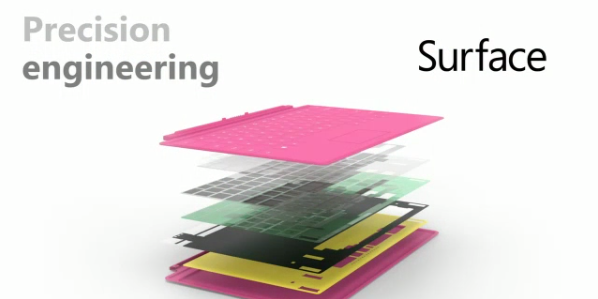
- Touch Cover: The 3 mm Touch Cover represents a step forward in human-computer interface. Using a unique pressure-sensitive technology, Touch Cover senses keystrokes as gestures, enabling you to touch type significantly faster than with an on-screen keyboard. It will be available in a selection of vibrant colors. Touch Cover clicks into Surface via a built-in magnetic connector, forming a natural spine like you find on a book, and works as a protective cover. You can also click in a 5 mm-thin Type Cover that adds moving keys for a more traditional typing feel.

The product design part of the event keynote:
Panos Panay
[General Manager, Microsoft Surface]… [I’m just going to] show you a little bit more about the design, show you a little bit more about the culture of how these products were build. So I think it might be interesting for you to hear that. I really want to share with you more of our team. So just watch this video really quick and I’ll be right back.
[Video Playback]
You’re going to get to meet a lot of the people you just saw on the video in just a few minutes. They’re actually backstage right now, preparing to show you more details of the product and give you a few minutes to put your hands on it, talk a little bit about the design.
Let me start by doing that to just give you a quick preview of what you might see backstage in just a few minutes. You’ve heard Steven and Mike both said this was build as the stage for Windows 8. That was part of our core vision for the product. It is very important for us that we had the hardware fade to the background for this product. It was important, so the Windows software could rise to the Surface. It gives you the best experience possible. When the hardware fades away and what comes to the Surface is that entertainment PC one when you’re using the device. Note the chamfered angles on the side of this product either chamfered at 22 degrees. That’s two things. One, it’s a physical manifestation of the actual stage itself. You can see as it falls away, just as we intended for the hardware to do. But two, it actually sits perfectly comfortable in your hands.
And let me call it by something. I’d say perfectly a lot. I’d say perfect a lot. As part of our team culture, what was really important for us as we had so many parts of the design that had to be in detail and be simple and be right that we always tried for perfection on every sub-component of this product, it includes this chamfered angle.
What it does is, it sits in your hand very comfortably, in a way that when you hold it, it feels like, it’s feels airy. Most importantly, you can use it all day in comfort. It’s really important when you talk about the hardware fading to the background that the hardware is not in your way to accomplish what you want to do. It’s meant to move you forward, which you think this product does.
Now when we talk about hardware fading to that back, another thing that’s super important is a seamless lines throughout the product. When you look at this product, you’ll see lines going throughout it, every line calculated, every line built, formed perfectly on the device.
But there is one challenge. Our vision for the product beyond being a stage for Windows was also that we had to bring creativity and productivity to folks such as yourselves.
The opportunity to transform this device well, to transition it to the state of getting things done. Putting this kickstand in the product, flies right in the face seamless lines and getting it perfect. But we really spent a lot of time here. We knew that if we do not get the kickstand perfect, this device would not work. We could not take any chances. Take a look at the three hinges that you see within this device. This is a really simple example of the details of the product. These are three custom-made hinges, mind you there are over 200 custom parts built from the inside out of this product to make it come to life.
But these hinges, they respect just as Steven told you. They respect to feel and sound like a high-end car door. When you close the device, the kickstand just goes away. It’s not in your way. When you needed the device, it’s there, just in time. You want to get something done, just open it and it feels great.
The spec we created was around sound. We iterated over and over again in our anechoic chamber. This is a critical point. We’ve really wanted to get the sound rights. So you get that – this full feeling, that emotional attachment to your product when you open this kickstand and close it. It makes it yours, it goes away when you don’t need it and it’s there when you do.
Now, we talked about VaporMg a few times. Now let me bring VaporMg to life just a little bit here. So you can understand a little bit more about what we did. VaporMg essentially becomes what lets us, get our product design and create life out of it. You can see the break up behind me, let me just explain a few things that we have going on.
I’m holding up my room key, it feels weird to hold at my room key. But if you look at this quickly, what you’ll see is 0.77 millimeters of thickness. This is an important point. If you can’t see it, that’s all right, same as a credit card, pull it out, your credit cards likely somewhere between 0.75 or 0.85 millimeters thick. It’s just a illustrated point. VaporMg is a process where we start with an ingot of magnesium and we melt it down to a molten state. Within injection mold the magnesium, there are some tools and we’re able to actually mold the intricate details that are needed for Surface. We mold down to 0.65 millimeters of thickness in any given part. 0.75 … [he means the credit card thinkness just mentioned], we mold to 0.65, this is important to understand, because for us to get to the design we needed for this product, to get the kick stand, integrated seamlessly and hold this line throughout the product we had to be able to mold to those tolerances.
Every micron matters within Microsoft Surface. we’ve actually stacked up every part from designing from the inside out, so tightly in the product and so cleanly that even if you stuck a piece of tape in the middle of the device, it would bulge, it would bulge out. That tells you how strong this product is, how much strength comes with it, how light it feels in your hands, all those parts play into each other.
The best part about VaporMg is not just that we can mold a 0.65 and get the intricate details like the 0.65 millimeters angles that go around the product this radial. The best part is the smoothness of the finish that comes out of the tools. After approximately 152 steps to get the VaporMg looking just like you see now, you find that the Surface finish on this product and as Mike says, bright in craftsmanship is perfect, it’s seamless. It screens watch quality finish and when you put it in your hands, it feels elegant, when you touch it, you’re going to want to hold it, I promise you.
Now I’m proud of VaporMg and I’m proud of the team for the product that they’ve done, but nothing, nothing stirs me more, nothing gets me more excited than Touch Cover. I really want to walk you through Touch Cover for just a few moments. This is an important technology that came out of our group. I’m going to walk you through it in two ways, the first way is through the experience and the second way I’m going to talk about is the technology.
Let’s do the experience first, we explained you what we try to do with Touch Cover from the get go, you notice I’m going to connect it now to my blue Touch Cover. So I just click it in, as you would expect. The Surface turns blue along with my Touch Cover and you have a beautiful integration of hardware and software. My Surface knows what is connected to it. I can now bring to life the vision that is Touch Cover for this product. The vision that lets you produce content when you want it, how you want it as fast as you’ve always done it, that’s what this product was designed for.
Let me give you one more second on this, on a little bit of the experience. The thing that was so critical for us in creating Touch Cover was that it had to be 3 millimeters thin. This essentially is at odds of any other keyboard you’ve used and still have a great typing experience. It also had to be a cover you wanted to connect, something you always had with you, something that gave you confidence just like the kick stand to bring this product to life.
We designed flex magnets in this product, that’s a combination of alignment in clamping magnets. You could actually never miss connecting this device, you can’t miss, we force you to not miss. We do that to give you confidence. You close it, it feels like a book, we design this organically like a book; we wanted it to feel just like that. What has more covers on it than books themselves? This spine feels like a book. When you put it in your hand and you walk away with your product, you’ll hold it like a book. When you carry it against your books, it will feel like it’s another book, it’s just light enough and it feels just perfect.
Now that said, I think you’re going to fall in love with Touch Cover. I know I have. I mean I’m seriously in love with it outside of my wife, Touch Cover is number two. It’s very important to me. Now, I never want to take Touch Cover off, and I’d argue that you don’t need to and you never have to.
You saw Mike move his Touch Cover to the back. Now when he did that I’m sure every single one of you thought like wait a minute, how do you move it to the back? Well, Touch Cover is pretty smart; it has an accelerometer built into it. The moment you fold it back, we know you fold it back, we know when you’re not using it and it’s turned off for you.
So you never have to take it off and underneath your fingertips, it feels great. So now you’ve got a comfortable device with Touch Cover that’s yours, it’s personalized to you. You saw the beautiful colors that we have coming to market and essentially what’s brought to you is an experience like none other with Touch Cover and Surface together.
Now I showed you the experience, but I wanted to show you the technology, because it really is important that you understand it and quite frankly, we have a bit of a mad scientist, who many of you know, named Stevie Bathiche. Stevie actually invented Touch Cover, the fact that we have 30 years of input experience using mice and 15 years creating keyboards, we really understand how to create a great typing experience. We also knew that if we brought you Touch Cover, and Touch Cover wasn’t any good, boy, what a breaking moment. But we’ve actually evolved this technology to a point through Stevie and his work to come to a place where we’ve brought you an experience that’s amazing at typing. There’s actually seven layers squeezed in, pressed right into Touch Cover to keep it 3 millimeters thin. Now that’s super thin, but critical for you to have a great experience when folding it back.
Let me explain to you how the technology works just ever so slightly and quickly. So what you’re going to see is I’m going to put my hands down on this machine here and, what you’re seeing is this is Surface for Windows RT, and my hands are down on Touch Cover. You’ll notice that my hands are laying flat on Touch Cover right now yet nothing is happening. If this was in fact a capacitive screen or the phone you might have in your pocket or some other device you might have, the keyboard would take up off the screen and you put your fingers down and it would look something like that.
Now that’s me actually pressing on Touch Cover, and it knows the grams of force coming off my fingertips, on to Touch Cover. Why is this critical? When you type in touch type speed, you have to find your home position and rest your hands. To do that, your keyboard can’t fire when you put your hands down, it’s comfortable, you can rest your hands and note as I put pressure on the J key, how the pressure goes up as I push harder and as I release, the pressure comes off.
It’s actually measuring every gram of force coming off my fingertips and as I start to type, it knows how many keys I’ve hit. This keyboard actually measures 10 times faster in scanning from a keyboard matrix than any keyboard, guarantee that you use today. It is super fast and brings great, great opportunity for you to be productive and get stuff done.
Obviously, I have a lot of pride in this product. I hope you’ll love it. I can’t wait for you to get your hands on it back there, and I really mean that. Steven, thanks for having me up here today.
Steven Sinofsky
That was a moment for our team for sure. I do want to talk a little bit about some availability and pricing information and things like that I know people want to know. Surface for Windows RT, I still say that there will be much more information available on the web and available shortly. So Surface for Windows RT will be available in both a 32 and a 64-gigabyte model and will be priced like comparable tablets that are based on ARM. Surface for Windows 8 Professional will come in 64-gigabyte and 128-gigabyte storage models and will have a retail price comparable with competitive Ultrabook-class PCs. Additional specifics on pricing and packaging will be announced as we get closer to retail availability.
Now of course, retail availability for the Surface PCs will be around the time of – for the Windows RT PC, will be at the time of the Windows 8 general availability and for Windows 8 Pro about three months later. Surface will be available through the Microsoft’s physical stores here in the U.S. and will be available through the select online outlets of the Microsoft store as well.
So welcome everybody to Surface. I just want to invite Steve Ballmer back up on stage one more time and thank you, thank you very much.
Steve Ballmer
I want to thank Steven and Mike and Panos and their team. This has been an unbelievable journey. We’ve invested significantly as you can see in talent, in time, in capital to bring the Surface to market. I was asked in the last few days here why now, why now? We took the time to really get Surface in Windows 8 right to do something that was really different and really special.
We’re very proud; very, very proud of the Surface just like we’re very proud of Windows 8. Because of Windows 8, because of Windows 8 the Surface is a PC, the Surface is a tablet, and the Surface is something new that we think people will absolutely love. We really want those of you here to have a chance to see and touch the Surface and talk with some of the people who are involved in designing the product.
We have several stations set up next-door where you can see the work that went into the creation of the Surface, and we hope you’ll stay and join us for that. Today has been the fun for us to put on for you very, very exciting and I want to thank you all for being part of today’s event. Thanks.
The justification part of the event keynote (was the general introduction, i.e. the first part of the event): i.e. how and why Microsoft decades long hardware innovation history has now been expanded by PC/tablet level innovation, why after Windows 8 innovation Microsoft needed a matching innovation in hardware as well?
Steve Ballmer
Well, good afternoon and welcome, I certainly want to thank everybody for joining us for today’s event. The past several years have seen great change in the industry and great innovations coming from Microsoft. We’ve helped usher in the new era of cloud computing, we’ve embraced mobility, we are redefining communications and attempting to transform entertainment. In all that we have done Windows is the heart and soul of Microsoft from Windows PCs to Windows Servers to Windows Phones and Windows Azure. Windows is proven to be the most flexible general-purpose software ever created spurring on an ecosystem of unrivaled success.
When Microsoft was founded our vision was odd and broad: a computer on every desk and in every home. And while certainly we are optimists to the core Windows has exceeded even our most optimistic predictions. It now powers well over 1 billion PCs from desktops to laptops to ATMs to NASA workstations and more: in homes, in businesses, in schools and in governments literally around the world.
With Windows 8 we’ve re-imagined the Windows product. We re-imagine Windows from the chipset to the user experience, to power a new generation of PCs that enable new capabilities and new scenarios. We approached the Windows 8 product design in a forward-looking way. We designed Windows 8 for the world we know, in which most PCs are mobile and people want access to information and the ability to create content from anywhere anytime.
People want to do all of that without compromising the productivity that PCs are uniquely known for: from personal productivity applications, to technical applications, business software and literally millions of other applications that are written for Windows that work perfectly on Windows 8. We are incredibly gratified by the enthusiastic response to Windows 8 from our partners, our OEM partners, thousands of developers and literally millions of people consumers who’ve downloaded our previews.
Excitement is high with the new X86 and ARM SoC support. The new Metro User Interface and the new Store all getting very broad interest.
Today, we want to add another piece, another bit of excitement and another piece to that Windows 8 story.
At our foundation Bill Gates and Paul Allen made a bet, a bet on software, at the same time it was always clear that our unique view of what software could do would require us to push hardware sometimes in ways that even the makers of the hardware themselves had yet to envision. That’s the nature of the dynamic between hardware and software pushing each other and pulling each other forward. In fact, our number one revenue product actually the year I joined Microsoft 1980 was a hardware product, something known as the SoftCard. Let’s just take a little bit of a look back at the role of hardware at Microsoft.
[Video Playback]
We believe that any intersection between human and machine can be made better when all aspects of the experience hardware and software are considered in working together. Just let’s take the mouse as an example.
To be successful Windows 1.0 really needed a mouse so we built one. Early reviews of mice were not very positive as people struggled to understand the real value. In fact actually it was so new the Canadian Customs quarantined the Microsoft mouse at the border for four weeks thinking that it was alive.
Our most successful hardware product has been the Xbox and with Kinect we’ve created a whole new user experience. And now developers are pushing Kinect, viewing more exciting and even cooler things for both the game console and for Windows PCs. This combination of hardware, software and peripherals in the Xbox case work together to deliver an absolutely amazing experience.
We see that sort of combination working also today in our PC ecosystem. We believe in the strength of that ecosystem, of software and hardware companies that work together to deliver selection and choice that makes your Windows experience uniquely your own. Those partnerships are essential to the re-imagination of Windows. We’ve worked with the component companies, Intel, AMD, NVIDIA, Qualcomm and Texas Instruments.
Of course the ultimate landing point of this PC experience is through our partnerships with OEMs: HP, Dell, Asus, Acer, Samsung, Sony, Lenovo, Toshiba and many, many more. They will deliver more PCs to market in the year 2013 than in any previous year. IDC estimates that number at over 375 million Windows PCs. That will ensure that software developers and content creators have a larger number of new systems to target with their Windows 8 applications than any other non-phone platform.
However, with Windows 8 we did not want to leave any scene uncovered. Much like Windows 1.0 needed the mouse to complete the experience, we wanted to give Windows 8 its own companion hardware innovation. What is this innovation? It’s something new, it’s something different, it’s a whole new family of computing devices from Microsoft.
[Video Playback]
This is the new Microsoft Surface. It embodies the notion of hardware and software really pushing each other. People do want to create and consume, they want to work and they want to play, they want to be on their couch, they want to be at their desk and they want to be on the go. Surface fulfills that dream. It is a tool to surface your passion, to surface your ideas, to surface your creativity and to surface your enjoyment. I really want you to take the time today to get to know Microsoft Surface. So let’s now learn more from Steven Sinofsky and the Microsoft Surface team.
Steven Sinofsky
Just as we’ve re-imagined Windows we also have a vision for re-imagining the tablet.
We see a tablet that is designed the way that Windows has been designed. We see a tablet that represents a unique vision with a seamless expression of entertainment and creativity. A tablet that works and plays the way that you want to, a tablet that’s a great PC, a PC that’s a great tablet, a new type of computing, Surface.
Surface is a stage for Windows. Surface is designed for the software experience to take it, have it take centre stage. Surface is super thin at 9.3 millimeters. It’s just thin enough for this full size USB port for peripherals or just charging your phone while you are at the hotel. The edges are bevelled away at 22 degrees, so the PC itself fades into the background. It feels natural in your hands.
Surface is the first PC with a full magnesium case. Through unique process the liquid metal is formed into an ultra rigid, yet ultra light frame. It is incredibly in strong and it’s airy at under 1.5 pounds, just 676 grams, and it’s finely balanced. We didn’t stop there, the case is one of a kind. It’s made from a physical vapor deposition process. It results in a permanent scratch and wear resistance for Surface. This VaporMg case is a first of a kind, and it accentuates the unique feel of Surface.
Surface is of course great for entertainment. It has access to all of the Windows apps for music, for video, for Xbox and gaming. We can see here I’m running Internet Explorer. I can browse smoothly, use see great pages using ClearType and have a great experience just with all the – with browsing. It’s 10.6 inch optically bonded, wide screen display, is custom designed for Surface. And of course people play games. I can go and play any of the interesting games that are on – in the Windows Store and I can use Surface for using all the sensors that are within Windows as well. Surface works for all of those games.
Movies and entertainment look great as well. Excuse me just a second. Surface looks great for entertainment as well. In fact I’m going to show here for the first time a very exciting new application. This is the Netflix application designed specifically for Windows 8. Now with the wide screen you get 30% more viewing area and no banding or letter boxing like you traditionally see.
I’m happy to show this new Netflix application … [, give you an early look how it’s designed specifically for Windows 8 with semantic zoom. And Netflix will have this ready at the Windows 8 launch. I can go here and start a movie and see it stream straight to my Surface PC. Just like you would expect.
Now to stream so well Surface needs great Wi-Fi. Surface is the first tablet to incorporate dual 2×2 MIMO antennas. That means it provides the very best Wi-Fi reception of any tablet today. Surface is incredibly great for Windows and for entertainment PC. And we are just getting started.] …
More information:
– Surface Website
– On-Demand Keynote: Microsoft Surface Event
– Broll: Product imagery of Microsoft Surface
– Broll: Images from Microsoft Surface Event
– Product & Event Images
– See it in Action
And remember this leading edge Microsoft Surface family, leading edge even against Apple’s market leading offerings, so this product is definitely just the tip of the iceberg. Consider this Channel 4 report which is showing the kind of the future which could come from Microsoft as seen back to the beginning of last year:
– Touching, waving at and talking to the future with Microsoft [Channel 4 News YouTube channel, Feb 8, 2011]
(Note towards the end of the video, Panos Panay to appear as simply from Microsoft Surface.) Additional infomation:
– Benjamin Cohen, the reporter in the video, had this detailed blog post about that visit
– Steve Clayton, the Microsoft’s not that long ago initiated, ‘Next at Microsoft’ storyteller, had also this detailed blog post about that visit
Note that Microsoft shares started to raise already last Friday (obviously based on expectation when the invitations to a ‘mistery event’ were sent out). Nevertheless from $29.34 to this Tuesday’s closing price of $30.71 that was only a 1% growth. Interestingly during the same period Apple’s share price had a 1% growth as well, although Apple made its series of announcements a week earlier, on Monday last week (June 11th, 2012):
– Apple Introduces All New MacBook Pro with Retina Display
– Apple Updates MacBook Air and Current Generation MacBook Pro with Latest Processors and New Graphics
– Mountain Lion Available in July From Mac App Store
– Apple Previews iOS 6 With All New Maps, Siri Features, Facebook Integration, Shared Photo Streams & New Passbook App
which resulted in 0.5% growth only.
So the stock market evaluated the Microsoft Surface against the above Apple introductions, and found that on equal level from business growth perspective, although Apple’s closing price yesterday was $587.31, i.e. 19x higher. In terms of market capitalisation Microsoft remains on the same 47% of Apple’s, so from business competition point of view the announcement of Microsoft Surface is not changing the positions as far as the opinion of the overall business world is concerned. INTERESTING!
Meanwhile the earlier Microsoft Surface product has been renamed as Microsoft PixelSense in order to avoid confusion:
About Microsoft PixelSense [Microsoft page for the press on the PixelSense microsite, June 18, 2012]
The Samsung SUR40 with Microsoft PixelSense is an innovative product that responds to touch, natural hand gestures and real world objects placed on the display, providing effortless interaction with information and digital content in a simple and intuitive way. With a large, 360-degree, 4-inch thin horizontal user interface, the Samsung SUR40 offers a unique gathering place where multiple users can collaboratively and simultaneously interact with content and each other. In addition, the SUR40 provides businesses with unique value in delivering information and services in a more friendly way allowing better engagement with their customers. The Samsung SUR40 with Microsoft PixelSense is targeted for companies across a variety of industries including retail, hospitality, health care, and public sector.
The Samsung SUR40 with Microsoft PixelSense is a major advancement in computing that moves beyond the traditional user interface to a more natural way of interacting with information. The four key attributes that make this experience unique are:
Multiuser experience.The horizontal form factor makes it easy for several people to gather together, providing a collaborative, face-to-face computing experience.
Massive multitouch contact. The Samsung SUR40 with Microsoft PixelSense recognizes many points of contact simultaneously, not just from one finger, as with a typical touch screen, but up to dozens and dozens of items at once.
Direct interaction.Users can actually “grab” digital information with their hands and interact with content through touch and gesture, without the use of a mouse or keyboard.
Object recognition. Users can place physical objects on the display to trigger different types of digital responses, including the transfer of digital content.
At CES 2011, Microsoft unveiled the designed for touch experience featuring Microsoft PixelSense technology, which gives LCD panels the power to see without the use of cameras.
This experience comes to life in the Samsung SUR40 with Microsoft PixelSense, which incorporates significant technological advancements designed to enhance the user experience.
The Samsung SUR40 with Microsoft PixelSense features key hardware and software technology advancements informed by feedback from users around the world.
Microsoft PixelSense™.Microsoft PixelSense allows a display to recognize fingers, hands, and objects placed on the screen, enabling vision-based interaction without the use of cameras. The individual pixels in the display see what’s touching the screen and that information is immediately processed and interpreted.
PixelSense technologydelivers an innovative user experience built on the principles of direct interaction using touch and objects. The Microsoft Surface 2.0 SDK allows application developers to take advantage of capabilities of PixelSense technology.
Thin form factor with multiple configuration options.The Samsung SUR40 is four inches thin, which makes it easy to use as a table, hang on the wall with the VESA mount, or embed in walls or custom enclosures. There are standard leg supports available or customers can design and attach their own leg supports.
High definition large format display. The 40-inch, stunning high-definition screen (1920 x 1080 resolution) enables enhanced multiuser and multitouch experiences.
Microsoft PixelSense activities are available on the Microsoft PixelSense blog and Microsoft PixelSense on Twitter.
For more information, press only: PixelSense PR team
Also these two videos appeared on a new Microsoft® PixelSense™ YouTube channel [June 18, 2012]:
The Power of Microsoft® PixelSense™
Samsung SUR40 with Microsoft® PixelSense™
Now some first reactions from the event attendees:

Microsoft Surface: a closer look [TheVerge YouTube channel, June 18, 2012]
See also this article: Microsoft Surface with Windows RT hands-on pictures and video [Joshua Topolsky from The Verge, June 18, 2012]

Microsoft Surface tablet demo June 18, 2012 Event in SF [SlashGear YouTube channel, June 18, 2012]
See also these articles, same date, on SlashGear (the first ones are kind of liveblogging):
– Microsoft Surface Tablet Hands-on by Vincent Nguyen
– Microsoft Surface re-introduced as a handheld tablet by Chris Burns
– Microsoft Surface cover doubles as built-in keyboard by Cory Gunther
– Microsoft Surface for Windows 8 Pro revealed by Chris Burns:
This tablet introduced its own “Perimeter Venting” so as not to get too hot [in fact to solve the problem of cooling with a tablet which can be used in both portrait and landscape modes], works with Pen input (with digital ink, explained in a different post), and has a display that’s just 0.7mm from the glass that covers it. The Microsoft Surface for Windows 8 Pro has two digitizers, one for ink, one for touch, and has a bit of magnetization for its pen so no holes or clips are needed.
– Microsoft Surface to feature digital ink stylus support by Cory Gunther
At the event live they said it best by stating, “This surface has two digitizers. One for touch, one for digital ink.” All stylus or pen input is converted into digital ink and the new Surface tablet is extremely responsive and accurate.
The distance between the screen (digitizer) and the stylus is only .7mm thick, and allows for it to be highly accurate, making you feel like the ballpoint of a pen is actually writing on the “surface”. Surface will see the proximity of a stylus and stop recognizing hand inputs.
– Microsoft Surface Windows RT confirmed with NVIDIA’s Tegra processor by Cory Gunther
NVIDIA has just issued a rather short note confirming that their Tegra processor will be under the hood and powering the smooth and fluid Windows 8 RT model. They didn’t specify which Tegra processor as expected, but we are speculating it will be the quad-core Tegra 3 KAI platform, or the Tegra 3+ that was detailed as coming soon [… an upgraded Tegra 3 called T3+, with code-names Wayne and Grey splitting off in the third quarter of 2012 with LTE. Grey specifically will have access to LTE data speeds, with Tegra and Icera hardware being part of this sector for NVIDIA] in a lot more than just Android devices.
Microsoft Surface Touch Cover vs Type Cover hands-on by Chris Burns
These keyboards bring on a fair stab at what 3rd party manufacturers have been attempting for the iPad and a host of Android tablets now for several years. The keyboards on both units aren’t going to bring you a perfect replacement for a notebook computer if you’re attempting to match the laptop-bit of the equation, but if you’re the sort of person to work on a desk, you might be in business.
Microsoft Surface could debut MagSafe-data hybrid hook-up by Chris Davies
The four-pin port is on the right lower edge of the new tablets, and seemingly matches up with the MagSafe-like connector detailed in a patent application from the company. If so, that could mean a single hook-up for recharging the Surface and synchronizing it with other devices.
Microsoft’s patent application followed in the footsteps of Apple’s magnetic charger system – which allows the cord to break away easily if someone trips over it, rather than yanking your laptop off the desk – but added in a data connection. With just one port, the Surface could be hooked up to both a charger and other external hardware, with an optical data link used for maximum speed potential.
…
The potential for such a connection is vast. Microsoft has been coy about external device support for Surface, only mentioning the USB and video-output ports, but with this proprietary port it could be used with a docking station to add in an optical drive, wired network connection and more.
We’ve been waiting for just such a strategy from Apple for some time, and indeed the Cupertino company has an optical data MagSafe patent application of its own. More on Microsoft Surface in our hands-on here.

Microsoft Surface Tablet: Hands-on [laptopmag YouTube channel, June 18, 2012]
See also these articles:
– Microsoft Surface Tablet Hands-on: The Future of Windows is Here [Video] [Michael A. Prospero from LAPTOP Magazine, June 18, 2012]
– iPad vs Microsoft Surface: Tablet Specs Compared [Kenneth Butler from LAPTOP Magazine, June 18, 2012] (data higlights are mine to denote the essential differences)
Device
iPad 3
Surface (Windows RT)
Surface (Windows Pro)
Price
$399
TBA
TBA
CPU
Apple A5X dual-core
Nvidia Tegra 3 [simply Tegra]
Intel Core i5
OS
iOS 5
Windows 8 RT
Windows 8 Pro
Display
9.7 inches
(1024 x 768)10.6 inches
(Resolution unknown)10.6 inches
(Resolution unknown)Size
(inches)9.5 x 7.31 x 0.37
.37 inches thick
.53 inches thick
Weight (pounds)
1.44
1.49
1.99
Storage
(Built-In)16GB, 32GB,
64GB32GB, 64GB
64GB, 128GB
Ports
10-pin
microSD, USB 2.0, Micro HD Video, 2×2 MiMO Antenne
microSDXC, USB 3.0, Mini DisplayPort, 2×2 MiMO Antenae


Microsoft to Unveil a New Tablet – Good or Bad Idea? [The Wall Street Journal YouTube channel, June 18, 2012]
See also this article: Microsoft Unveils Surface Tablet to Rival iPad [Shira Ovide from The Wall Street Journal, June 18, 2012]
… Al Hilwa, an analyst at IDC, said the combination of PC and tablet features makes surface a “true converged” device. “A Swiss Army knife of a tablet?” …
The computer makers‘ business is dependent on Microsoft, so they may not express annoyance publicly at Microsoft’s trading on the hardware makers’ turf. But at least some hardware executives are fuming privatelyat Microsoft’s decision.
Microsoft’s move to make its own tablet “comes with consequences, which is complicating choices for consumers and complicating relations with third-party manufacturers,” said Sarah Rotman Epps, an analyst with Forrester Research Inc.

Microsoft “Surface” Tablet Announced, Powered by Windows 8 [Eric Savitz for ForbesVideo YouTube channel, June 18, 2012]
See also these articles:
– Microsoft: Live From Hollywood! Introducing Microsoft Surface Tablet (Updated) [Eric Savitz from Forbes, June 18, 2012]: a live blog of the event
– Microsoft Announces Surface, Its New Windows 8 Tablet [Kelly Clay from Forbes, June 18, 2012]
…
As no one does keyboards better than Microsoft, yet another keyboard is also available for Surface that features a full trackpad with clicking buttons. Though Surface is slightly heavier than the iPad and has 25% less battery life (31.5 Watt hours compared to the iPad’s 42.5 Watt hours), Surface is truly one of the most powerful and lightweight mobile PCs we have seen.
It’s clear that Surface is designed for current Windows users, and according to NetMarketshare, Windows XP, Vista, and 7 combine for 93% of all desktops. For these users – especially those in the corporate environment – there is a hesitation to switch to another platform, even just for mobile use. As a result, Surface could be a game-changer in the tablet industry. Not only does it feature key capabilities that Apple has yet to ever integrate (such as a keyboard), but Surface will undoubtedly make it easier for curent Windows users to transition from home to office and in-between. While a price has yet to be set, it’s expected to be extremely competitive compared to other tablets, ensuring that Surface is a device that many current Windows users will want to own.
Other notable first reports:
1. WIRED magazine [June 18, 2012]:
– Liveblog: Meet ‘Surface,’ Microsoft’s New Windows 8 Tablet
– Microsoft May Be Late to Tablet Fight, But Has the Cash to Keep Sparring
– Microsoft Dives Head-First Into Mobile Hardware With Two 10.6-Inch Tablets
…
Surface is much, much more than a new tablet platform. It’s also Microsoft’s first fully branded computing device — an ambitious new development direction after years of making only simple computer peripherals. And Surface is also a challenge to every hardware partner in Microsoft’s OEM stable.
“Its a bold move on the part of Microsoft,” says Gartner analyst Michael Gartenberg. “This is a real change in strategy for them, and it’s certainly a vote of no confidence for their partners. This shows how high the stakes are. There is competitive pressure from Apple that is clearly a threat to their business. Steve Ballmer seemed to be channeling Steve Jobs on stage, saying hardware and software have to be designed to together.”
…
As for pricing, Microsoft isn’t saying, but Gartenberg weighs in:
“I’m guessing somewhere between $600 and $1000 — Microsoft was very vague. This the problem you encounter when you launch something so far ahead of delivery,” he said. “For a launch like this, it’s all about the details. Everything about this event, the mysterious invitations, the presentation — Microsoft is trying to be Apple. But the only company that has successfully been like Apple, is Apple.”
2. engadget [June 18, 2012]:
– Live from Microsoft’s mystery press conference in Los Angeles! by Dana Wollman
– Hands-on with Microsoft Surface for Windows RT, Touch Cover and Type Cover (update: video!) by Dana Wollman:
… (Microsoft has only said that the ARM chip is made by NVIDIA. No one ever said it’s a Tegra 3 SoC, but that is naturally our best bet.) …
Based on remarks by Steve Ballmer and others during the presentation, it sounds like a lot of thought went into the two keyboards, so we wouldn’t be surprised if a large focus group of touch typists were able to prove Redmond’s engineers right. But having played with both, we don’t imagine this being like settling in with a new laptop or Transformer-style dock. You might have to re-learn how to type (or at least teach your brain to fuhgeddaboutit and trust your fingers to land where they’re supposed to.) …
Even after some brief handling, we feel impressed, almost sobered by what Microsoft’s managed to produce after vowing to take the Windows 8 hardware-software package into its own hands. Surface for Windows RT is well-made, polished, durable and carefully engineered. And yes, that’s sobering news: Microsoft’s own OEM partners, everyone from ASUS to Acer to HP, should feel a tinge of defensiveness. If Redmond’s mission until now has been to showcase all the possible form factors for Windows 8, it may have just taken a step in the opposite direction by upstaging everybody else.
– Microsoft reveals its own Windows 8 tablet: meet the new Surface for Windows RT by Jon Fingas:
Not unlike Apple’s last two generations, there’s a magnetically attached cover, but it’s more than just a protector: here, it includes a full multi-touch keyboard and trackpad.
– Microsoft one ups other tablet ‘smart’ covers with Surface’s Touch Cover and Type Cover by Terrence O’Brien:
… right now we’re pretty enamored with Microsoft’s Touch Cover for the newly announced Surface. See, it works almost exactly like that other “smart” tablet shield, but this one actually earns it’s smart moniker. When you peel the plastic shroud back it turns into a fully functional keyboard and touchpad. Obviously, being a thin plastic sheet, the cover is relying on touch for key presses, not the actual depression of mechanical switches. …
Perhaps one of the more interesting features though, is their ability to force Win 8 to color coordinate with your chosen shade of folio. Click the blue Touch Cover on to the Surface and the background switches to a soothing shade azure. There’s even an accelerometer inside those 3mm-thin softer covers — which is an impressive feat of engineering. The Touch Covers can easily distinguish between you simply resting your hands on the keyboard and actually typing, which should help minimize accidental key presses.
– Microsoft announces Surface for Windows 8 Pro: Intel inside, optional pen input by Donald Melanson
– Microsoft Surface tablets: the differences between Windows RT and Windows 8 Pro models by Darren Murph
3. CNET [June 18, 2012]:
– Microsoft breaks tradition with Microsoft Surface tablets
– Surface touches the right keys, but not a complete picture
– Who is the Microsoft Surface for, exactly?
– Five key takeaways from Microsoft’s Surface event:
… 1. Don’t confuse this with the table thing [i.e. the old Surface now called Microsoft PixelSense]. … 2. This isn’t just aimed at the iPad and Android tablets [as it can work like a PC, complete with a full version of Windows]. … 3. This thing is high-tech. … 5. This is just the start [as Microsoft is positioning Surface as the beginning of a family]. …
– Why Microsoft built its own tablet — think Apple and Xbox
…
The tablet and ultraportable form factors are especially fertile ground in terms of growth and innovation. A recent Online Publishers Association studyfound that 31 percent of the U.S. Internet population (74.1 million users) own tablets, up from 12 percent in 2011. By 2013, the study projected that 47 percent of the U.S. Internet population (117.4 million users) would own tablets.
At this juncture, Google’s Android platform (including Amazon’s Kindle) and Apple’s iOS are splitting the market. Apple’s continuation of its firm grip on hardware and software integration is working exceedingly well, as evidenced by the company’s incredible financial success.
…
Google gives its Android platform to partners for free, which leads to some fragmentation and a fraction of the profits Apple is generating. Like Microsoft, Google plans to introduce its own branded tablet this month. Microsoft expects that it can generate some buzz and give Windows users a legitimate alternative to Apple’s iOS and Google’s Android, as well as incent its developer community to build native apps for its platform.
Note: In the above argumentation CNET relied on the released the same day “A Portrait of Today’s Tablet User – Wave II” U.S. findings from the Online Publishers Association (OPA), particularly the one represented on the following slide:

for which the accompanying OPA press release stated the following:
… Tablet adoption has significantly increased in the past year; 2012 saw 31% of the U.S. internet population owning tablets (74.1M users), up from 12% (28.3M users) in 2011. Furthermore, by the year 2013 this figure is expected to increase with a projected 47% of the U.S. internet population (117.4M users) owning tablets.
Of these tablet users, the Android platform has drawn level with iOS, largely in part because of the strong sales of the Kindle. 52% of tablet owners have an iOS operating system, while 51% use an Android powered tablet (percentages do not add up to 100% because tablet owners own/use more than one type of tablet). This is a drastic change from 2011, which saw 72% of tablet owners use some form of the iPad while only 32% used an Android tablet. …
4. AllThingsD [June 18, 2012]:
– Microsoft’s Surface Tablet Takes On Apple’s iPad liveblog by Ina Fried
– Microsoft Launches New Surface Tablets With Windows 8 by Bonnie Cha
– Microsoft CEO Steve Ballmer on Where Microsoft’s New Surface Tablet Fits in PC Ecosystem by Ina Fried
In a brief chat after the event, Microsoft CEO Steve Ballmer said that PC makers have known for an unspecified period of time that Microsoft would be doing its own hardware.
Ballmer noted that there will be a lot of PCs sold that will be made by companies other than Microsoft.
“If you look at the bulk of the 375 million machines that get sold (next year), they probably aren’t going to be Surfaces,” Ballmer said. “On the other hand, we could have a sizeable business.”
“It’s an important companion to the whole Windows 8 story,” Ballmer said. “It’s an important piece. It’s not the only piece.”
While Microsoft kept the details of Surface tightly limited to a small group of Microsoft employees working on the project, Ballmer said PC makers weren’t totally taken by surprise.
“Our PC partners knew in advance we were announcing something today in this space,” Ballmer said.
So how did they feel about it? “No comment.”
Ballmer said Microsoft’s goal is that Surface “gives people a full range of things to think about, sort of primes the pump for more innovation around Windows 8, (and) brings new technology to the Windows PC platform.”
Just how closely to the vest has Microsoft been keeping Surface? Ballmer said he has not personally been using a prototype on a regular basis.
“We wanted to keep things under wraps,” Ballmer said. “I’m out in public a lot.”
5. Boy Genius Report (BGR) [June 18, 2012]:
– Live from Microsoft’s tablet event! by Brad Reed
– Microsoft unveils Surface tablet by Zach Epstein
– Microsoft Surface tablet hands-on by Brad Reed
I have to admit that the Touch Cover felt somewhat alien to me at first when I was playing around with it, but that could be due to the fact that I didn’t have a lot of time to play around with it — Microsoft was really herding reporters quickly through the line. The Type Cover did feel quite natural as a keyboard should, however, so at the very least, there should be one strong option for people who prefer traditional keyboards.
The tablet’s 10.6-inch display screen looked gorgeous, although Microsoft was being weirdly evasive when asked what the exact screen resolution was. The tablet’s “VaporMg” casing is extremely solid, and the tablet feels very strong in your hands. Despite being 9.3 millimeters thick, the Windows RT version of the Surface is in no danger of bending under pressure.
In terms of software, Windows RT brings some cool new capabilities to the tablet form factor, including the ability to run two apps on the same screen simultaneously. One Microsoft rep, for instance, demonstrated how to have Outlook email on one half of the screen while having sports scores on the other half. And of course, the home screen on both versions of the Surface tablet features Windows 8′s Metro UI that is significantly more intuitive, colorful and user-friendly than past editions of Windows.
The future of consumer legacy of immersive technologies
Why is such a subject on the “Experiencing the Cloud” blog? One reason is the news relayed in Lockheed’s “retail” flight-sim software causes buzz in industry [Orlando Sentinel, April 10, 2012] article. Please read!
The other, and an even more important reason is that the future of immersive technologies is already getting to be known. Last week I’ve investigated one of the leadership initiatives under way, The Where Platform from Nokia: a company move to taking data as a raw material to build products [April 7, 2012]. Its current state-of-the-art from immersion point of view could best be assessed from the following video:
Nokia Maps 3D: The World As You See It [nokia YouTube channel, Dec 7, 2011]
And here is the approach used in the creation of such a mirror world: Nokia Maps 3D: Making Of [nokia YouTube channel, Oct 24, 2011]
While such mirror world creation is “just” laying the foundation for the application of a much wider and broader set of immersive technologies, the people engaged in the legacy immersive technologies have almost no idea of what is going on in terms of superseding their own stuff with these new, indeed revolutionary offerings.
The most advanced and the most mature community for consumer legacy of immersive technologies is the one of the flight simulation by enthusiasts. The technologies from there are even used in high-value commercial set-ups as well demonstrated by such current news that IDSI demonstrates high-resolution Immersive Desktop at I/ITSEC conference [IDSI press release, April 9, 2012]: “Software content included a PC version of Battlefield Bad Company 2 as well as Lockheed Martin’s PREPAR3D flight simulator [based on the earlier Microsoft Flight Simulator product we should add].”
Watch these two videos in order to get a little experience of the current state-of-the-art for flight simulation by enthusiasts:
PAKT Ketchikan International Airport (ORBX) – FSX HD [TheAviatorFSX YouTube channel, Feb 8, 2012]
FSX: Orbx 1S2 Darrington Muni!!! [HD] [B767rules YouTube channel, Jan 8, 2012]
Next read the following wikipedia articles about the technology used by flight simulation enthusiasts:
- Immersive technology: “refers to technology that blurs the line between the physical world and digital or simulated world, thereby creating a sense of immersion.” (It has already been referenced before the above videos.)
- Amateur flight simulation: A general overview article. (It has already been referenced as “flight simulation by enthusiasts” because the “amateur” attribute is rather incorrect – as we will see below – as well as misleading).
- Microsoft Flight Simulator (FS or MSFS, the last version FSX): Microsoft released the first version (for IBM PC) in 1982 which was licensed from an already available product base from Bruce Artwick /subLOGIC Corporatiom and reached commercial maturity with version 3.1 coming from The Bruce Artwick Organization. …
- X-Plane (simulator): The first version was released in 1993 for the Macintosh. Its author, Austin Meyer had been a long time MSFS user but had become frustrated with the Microsoft product and decided to build his own one. Later it become multiplatform as the one man effort became the Laminar Research company. … Only the latest X-Plane v10 version, released just in December 2011 has real chances to overcome the overwhelming dominance of MSFS (more precisely the latest FSX).
- Lockheed Martin Prepar3D: Microsoft ceased the further development of MSFS in the beginning of 2009 but an earlier, “software technology platform” version of it, the so called ESP was licensed in November 2009 to Lockheed Martin which released it later under the name of Prepar3D®. The latest 1.3 version was released on March 23, 2012 as well as a much more widely accessible and affordable ($49.95) academic licensing for it on March 26. At the same time the price for the Professional License version (released in September 2011) was decreased to an affordable $199. The Academic License means “Undergraduate and K12 student instruction”, “K-12 after school programs”, and “Individual student use, K-12 and undergraduate” eligibility but it “is not to be used, offered, sold or distributed through markets or channels for use as a personal/consumer entertainment product”. The latter restriction also applies to the Professional License with having eligibility in “Civil or law enforcement training”, “Private pilot use”, “Military training”, “Flight school instruction”, “Professional instruction”, “Air traffic control instruction”, and “Graduate student instruction”. With such restrictions Prepar3D is a legally constrained albeit technologically fully compatible follow-up to the MSFS. (Note that a Developers version had been available for quite a while with a subscription fee of $9.95 per month, see the Prepar3D® License Comparison).
- Microsoft Flight (Update: In July 2012, Microsoft ceased development of the game permanently to re-align its “long-term goals and development plans.” The game is still available for download and play. See on Kotaku or much below.):
Prepar3D license restricitions are definitely coming from legal agreements between Microsoft and Lockheed Martin (although none of the companies are speaking about that). The writing – however – is on the wall since February 29, 2012 when Microsoft released an absolutely new product for “personal/consumer entertainment” use, called “Microsoft Flight”. Moreover, unlike the enthusiast-centric MSFS, the new product focuses much more on the universal appeal of flight and aims to engage a much wider audience. Below I will include further comparison details between MSFS and Flight. - Precision Manuals Development Group (PMDG): It is a commercial add-on aircraft developer for the MSFS series and a leading representative of the thriving ecosystem existing around MSFS. It was founded as early as 1997 and it is “a global business with employees and contractors working in Canada, Belgium, Germany, Greece, Russia, South Africa and the United States” and “currently has employees and contractors located in the following US States: Utah, California, Florida, Georgia, Massachusetts, Nevada, New York, and Washington.” Unfortunately in dealing with Microsoft PMDG “was surprised and disappointed to see that the developers of FLIGHT elected to bring in a bunch of people to see FLIGHT, while very noticeably keeping out many of the same folks who have supported MS and the genre for years. The message was made loudly and clearly that our input was not desired and that the strategic objectives of FLIGHT do not involve the community that companies like PMDG, Aerosoft and the like represent.” – as described in Some thoughts on Flight… [Jan 6, 2012].
This made PMDG think about where could they go from there? Here is the statement from their founder/owner Captain Robert S. Randazzo:- “Well-first- I’m not overly concerned. As hardware advances- FSX is really just coming into its own on the average consumer’s hardware– so we intend to continue FSX development for the foreseeable future! There are a number of directions in which we can go- and PMDG has already been taking steps to sort out what platform our future products will feature.
- There has been some loose talk about PMDG and Xplane10– but I must tell you that while we are evaluating that product, and while we do have someone on staff helping to map out the process by which our products wind up in Xplane10- we are still some way out on that project line… From a developers standpoint Xplane10 certainly seems to be a good solid platform that will help our products to shine- but, like FSX it has some weaknesses and we need to evaluate whether it makes sense to allow XPlan10 at this time.”
- Next to the PDMG we should mention the fast expanding (globally), and (unsually) headquartered in Germany, Aerosoft (company information as not in wikipedia) as an even bigger force forming the future of MSFS legacy as being 20 years in the business of add-ons for that. Mathijs Kok who is responsible for the project portfolio there made the following statement recently: “For 2012 all our efforts are on FS2004, FSX and X-Plane 10. Next year could be different.” [Aerosoft Forums, March 1, 2012].
In an earlier interview he said: “2012 is very much a transition year. We got loads of new simulators, X-Plane 10, MS FLIGHT, AeroflyFS and we are seriously looking at all of them. We have also just completed a re-organization of Aerosoft so we can handle the changing market better. Note this is not a bad sign, in fact it means hiring more staff! We are now more a ‘content’ producer. All we make should be usable in as many projects as possible.
Soon you will see the first products that will have FS2004/FSX/Prepar3D/X-Plane installers. One thing that’s important this year is that many or our big projects are being overhauled and moved to X-Plane. Many Mega Airports will get new version as the airports have changed (new runways etc). At the same time we will spend more time on the trains and bus simulators, As long as they are ‘serious’ we know they will sell very well. ” [airdailyX, Jan 15, 2012]
Note: In addition to Flight Simulation, Aerosoft has train simulation offerings (from some others as well), a whole range of other simulations (mostly from others), and a department called AVIATECH for High-End graphic solutions for the professional simulaton. No wonder that on “Who works where” page of airdailyX not less than 38 people are listed as working for them (while only 10 for PMDG).
See also Life after FS2004 for the serious simmer [Aerosoft Sim News, March 28, 2012] as a very good evaluation of the possibilities choices available – FS9, FSX, XPX, Flight or P3D. - OrBX (company information as not in wikipedia) is the biggest of such ecosystem companies as on the same list not less than 51 people are listed for them. The company roots are just going back to 2005, and was only formally incorporated in 2007. Their success could be attibuted to a unique, FTX terrain regions technology “which combines the use of aerial photography to create custom landclass textures implemented using some key differentiators from the default FSX terrain system”. They have also “new ‘Flow’ technologies that add even more realism” (VehicleFlow, NatureFlow, ObjectFlow, PeopleFlow, TextureFlow, Audio, Aero, SnowFlow and StaticFlow). They are also the most focused one strategically as “Orbx continues to extend the capabilities of FSX and Prepar3D with technologies that add realism and immersion”.
Fall City Airport with Nature Flow (ORBX 1WA6) – FSX HD / i7 2600 @ 3.47ghz with GTX 580 [TheAviatorFSX YouTube channel, Sept 1, 2011]
FSX – ORBX PEOPLE FLOW – AS REAL AS IT GETS! [FLIGHTANIMATION YouTube channel, Oct 2, 2011]
Fall City with Vehicle Flow (ORBX 1WA6) – FSX HD [TheAviatorFSX YouTube channel, Nov 23, 2011]
Then here is the some information about the most visited domains by the community of flight simulation enthusiasts. It is obvious from that:
- The community is at least 1/2 million people strong and steady.
- They are hobbyists and/or private pilots and/or semi- or retired aviation professionals.


DETAILED INFORMATION FOUND IN MY INVESTIGATION
Prepar3D Trailer [LockheedMartinVideos YouTube channel, Sept 21, 2011]
Lockheed Martin Launches Academic Prepar3D® Simulation Software as a Learning Tool for Students [Lockheed Martin press release, March 26, 2012]
ORLANDO, Fla., March 26, 2012 – Lockheed Martin [NYSE: LMT] released academic licensing of its Prepar3D® simulation software to immerse students in learning and problem solving. The special pricing of $49.95 makes simulation accessible to the academic community for engaging the next generations in science, math and social studies curricula.
Currently used for professional training, Prepar3D harnesses gaming technology for experiential learning. The software presents a realistic virtual world to support educational scenarios anywhere from underwater to suborbital space.
“Simulation makes learning tangible,” said Chester Kennedy, vice president of engineering in Lockheed Martin’s Global Training and Logistics business. “It is ideal for concepts that have complex relationships or to reinforce rote learning. Simulation immerses the learner in an experience to make the lesson more memorable and reduce the time it takes to master a new skill.”
In Prepar3D, students can see the effects of their decisions and experiment with challenges at different levels. It also allows students from around the world to collaborate to solve real-life problems. With a free software development kit that accompanies the program, instructors can create customized academic lessons incorporating features such as people, wildlife, buildings, vehicles and weather.
Prepar3D is now used by the Experimental Aircraft Association and National Flight Academy to engage students in science, technology, engineering and math (STEM) disciplines. Lockheed Martin donated copies of Prepar3D to these organizations in 2011 to integrate learning objectives with inspirational stories of flight to interest youth in technological careers.
The new academic software can be purchased for educational efforts at or below the undergraduate level at www.prepar3d.com.

Prepar3d test with 30cm ground textures (4096×4096) Part 1 [ALeclercqCreations YouTube Channel, Nov 14, 2011]
Prepar3d test with 30cm ground textures (4096×4096) part 2 [ALeclercqCreations YouTube Channel, Nov 15, 2011]
Lockheed Martin Receives Industry Innovation Award From Metro Orlando Economic Development Commission [Lockheed Martin press release, Sept 16, 2011]
ORLANDO, Fla., September 16, 2011 —
Lockheed Martin’s [NYSE: LMT] Central Florida operations have been named among the 2011 recipients of the William C. Schwartz Industry Innovation Award by the Metro Orlando Economic Development Commission.
The award honors companies for creating, developing and successfully implementing products, ideas and processes. The award cited two Lockheed Martin programs that are meeting urgent customer needs through affordability and innovation initiatives: Prepar3D simulation software and the HULC hydraulic-powered exoskeleton.
…
Out of the Screen – Prepar3D [LockheedMartinVideos YouTube channel, Sept 19, 2011]
Lockheed Martin’s Prepar3D® Software to Soar at National Flight Academy [Lockheed Martin press release, June 13, 2011]
ORLANDO, Fla., 06/13/2011 —
Lockheed Martin (NYSE: LMT) will provide its Prepar3D ® visual simulation software to power the National Flight Academy’s (NFA) immersiveaviation experience as part of the academy’s hands-on approach to teaching the principles of science, technology, engineering and math (STEM) to students.
“We believe in the mission of the National Flight Academy, which couples STEM curriculum with aviation to inspire youth about technological careers,” said Dale Bennett, president of Lockheed Martin’s Global Training and Logistics business. “With the call from our nation’s leadership – and that of our own corporation– to reinvigorate America’s innovative spirit, we feel it is a great opportunity to support an organization with such a vital cause.”
The NFA is designed to address the concerns of declining STEM skills and standards in our country by providing immersivehigh-tech adventures that combine classroom math and science fundamentals with hands-on aviation experiences. Prepar3D ® is visual simulation software that brings immersive game-based technology to training, experiential learning and decision and performance support for non-government, government and commercial organizations.
For NFA, Lockheed Martin will donate copies of Prepar3D ®, upgradable as new product versions are launched. In addition to providing immersivesoftware to facilitate the students’ learning, Lockheed Martin has donated more than $2 million to the NFA.
“The National Flight Academy’s mission is to educate youth on the fundamentals of STEM, and to do that it is critical we provide valuable learning experiences,” said Vice Admiral Gerald Hoewing, president of the National Flight Academy. “This project can’t happen without companies like Lockheed Martin.”
Prepar3D ® is based on the Microsoft ESP ™ Flight Simulator product line and is compatible with add-on software created for ESP ™. On the web site, http://www.prepar3d.com, users can get the software as well as download a software development kit to create add-ons such as aircraft, instruments, boats, buildings and other environmental features.
Lockheed Martin’s Prepar3D™ Launches Nov. 1 [Lockheed Martin press release, Oct 20, 2010]
ORLANDO, Fla., 10/20/2010 —
Prepar3D ™, Lockheed Martin’s professional training and simulation software, will be available for purchase starting Nov. 1 on www.prepar3D.com for $499per licensed copy.
Lockheed Martin [NYSE: LMT] created Prepar3D ™ (pronounced “prepared”), based on Microsoft® ESP™ technology, as a training application for military, educational, civil and aviation professionals. The Prepar3D ™ software lets individuals and organizations conduct realistic training by engaging users in immersiveenvironments. It can also be used for evaluating and preparing people for real world assignments and tasks.
“We believe this enhanced training capability will be a great asset not only for aviation professionals, but also for emergency responders, maritime forces and others,” said Chester Kennedy, vice president of engineering at Lockheed Martin Global Training and Logistics. “Delivering Prepar3D™ direct to users over the Web provides a real-time, low-cost response between identifying a mission need and implementing a solution.”
At www.prepar3D.com, users can buy the software and download a software development kit to create add-ons such as aircraft, instruments, boats, buildings and other environmental features. Additionally, Lockheed Martin is launching a Prepar3D™ Development Networkto which software and hardware developers can subscribe for a monthly fee. The developer subscription includes two development license copies of Prepar3D™, software tools, add-ons and support forum access to grow Prepar3D ™ capabilities.
Lockheed Martin began furthering development of the Microsoft® ESP™ COTS program in late 2009 and since then has added features including the Distributed Interactive Simulation (DIS) protocol, sensors, global underwater capabilities, multi-channel support for dome displays, and a rapid cockpit design capability. Future plans call for expanding training capabilities for military and civil applications for ground forces, seaport load crews and heavy equipment operators.
Visitors to the Interservice, Industry, Training, Education and Simulation Conference (I/ITSEC) in Orlando this November can see Prepar3D ™ on display in the Lockheed Martin booth.
Lockheed Martin Launches Prepar3d ™ to Provide Richer Training Experience for Warfighters [Lockheed Martin press release, May 17, 2010]
ORLANDO, Fla., 05/17/2010 —
Lockheed Martin (NYSE: LMT) has released its new Prepar3D ™ software that enables rapid creation of medium-fidelity simulations for training exercises.
The Prepar3D ™ (pronounced “prepared”) software interface gives organizations the ability to conduct more realistic and robust training exercises by adding platforms such as air and ground vehicles to training systems that run on Distributed Interactive Simulation (DIS). DIS is an open standard for conducting real-time platform-level wargaming and is widely used by military organizations.
“The Prepar3D™ interface will enhance the ability of military services to provide realistic and integrated training experiences for warfighters before they deploy, so they can fight exactly as they’ve trained,” said Chester Kennedy, vice president of Engineering at Lockheed Martin’s Simulation, Training & Support business unit. “One example would be an aircraft flying in the Prepar3D ™ environment which can now be joined to a system such as Warfighter’s Simulation, which simulates large-scale training exercises, for a richer training experience. We can quickly create custom training solutions based on a customer’s needs.”
In late 2009, Lockheed Martin and Microsoft entered into an agreement that allows Lockheed Martin to further develop Microsoft® ESP™, which was originally designed for flight applications. Lockheed Martin will also modify Microsoft ESP™ to enable its use for ground environments to better train military forces and civil agency missions such as disaster preparedness. Changes under way include military scenarios and features to create custom training solutions, such as a weapons capability.
Visitors to the Interservice Training & Education Conference (ITEC) in London this week can see Prepar3D ™ on display in the Lockheed Martin booth.
Lockheed Martin-Microsoft Agreement to Bring Better Training to Warfighters [Lockheed Martin press release, Nov 11, 2009]
ORLANDO, Fla, 11/30/2009 —
Lockheed Martin (NYSE: LMT) and Microsoft Corp. entered into an intellectual property licensing agreement that allows Lockheed Martin to further develop the Microsoft® ESP™ PC-based visual simulation software platform to better train warfighters for battle.

Microsoft ESP technology allows users to operate realistic vehicle models that incorporate real-world physics to enhance realism, such as in the interior and instrumentation of a Boeing 747-400 shown here.
The agreement provides Lockheed Martin with access to the ESP technology portfolio, enabling the company to build cost-effective simulation solutions for customized training for its worldwide customers. Lockheed Martin’s software development teams will extend the current capabilities of ESP to enable a whole new suite of innovative ESP-based solutions that will evolve beyond flight training to include ground and civil agency applications.
“The training needs of our military and civil government customers continue to expand,” said Chester Kennedy, vice president of Engineering at Lockheed Martin’s Simulation, Training & Support business unit. “Seeking out and developing new innovative solutions such as this one based on the proven Microsoft ESP technology allows Lockheed Martin to provide our customers with new and tailored training systems more quickly and cost efficiently.”
“Solutions built on Microsoft ESP can engage users in immersive experiences with very realistic environments—making them ideal tools for training, evaluating, and preparing personnel for optimal performance in the real world,” said Chris Cortez, general manager of Strategic Programs at Microsoft, and a retired Marine Corps major general. “ESP models the entire world and will allow Lockheed Martin’s developers to easily add their own content, objects, scenery, simulation functionality, and scenarios to create custom training solutions.”
The Microsoft ESP IP licensing agreement builds on the existing Microsoft/Lockheed Martin Strategic Allianceto bring meaningful information technology services and products to market and continue to fuel innovation. It is also an example of Microsoft’s broader efforts to collaborate with industry through IP licensing.
Microsoft ESP is a visual simulation software development platform that brings immersive games-based technology to training and decision support for commercial, government and education organizations.

A Bell 206B JetRanger police helicopter flying over an urban downtown is one example of how Microsoft ESP enables pilots to navigate through a wide variety of highly-realistic static and animated objects including ground and air vehicles, buildings, and other structures.
Visitors to the Interservice/Industry Training, Simulation & Education Conference (I/ITSEC) in Orlando this week can see Lockheed Martin’s first ESP-based solution on display in booth 2049. The Pilatus PC-12 desktop trainer showcases the affordable, powerful training and mission rehearsal capabilities ESP will bring to Lockheed Martin’s customers.
Lockheed licenses Microsoft ‘visual simulation’ technology [TechFlash, Nov 30, 2009]
To answer the biggest question first, this is not the future of Microsoft’s consumer Flight Simulator product. Flight Sim’s fate remains uncertain following the company’s decision to disband the studio behind the long-running and beloved product.
However, it is an example of the core Flight Sim technology living on. Microsoft has reached a deal to license to Lockheed Martin its Microsoft ESP system, which the Redmond company derived from the Flight Simulator project two years ago with an eye toward offering a “visual simulation” platform — taking the immersive world originally created for Flight Sim and allowing it to be customized for specialized commercial applications.
Microsoft says it will also look to license the ESP technology to other companies to use and offer to their own customers, as Lockheed will be doing. But in deciding to offer the underlying intellectual property for use and development by other companies, Microsoft is signaling that it doesn’t plan to further develop ESP itself.
“This clearly was not going to be a core piece of our growth,” said David Kaefer, Microsoft’s general manager of intellectual property licensing, saying the decision was part of Microsoft’s broader re-evaluation of its business priorities in the midst of the economic downturn. “What we decided was that it was a lot better to take the investment, earn some money back but also enable our partners to take it forward and succeed.”
Under the licensing agreement, Microsoft says Lockheed is expected to further develop ESP to train warfighters in battle. At the same time, Lockheed’s software developers will also extend the technology beyond flight training for use as a general simulation tool by the military and other government agencies.
Financial terms weren’t disclosed, but in general such licensing agreements provide benefits to Microsoft when the people who license its technologies see success with the resulting products.
Microsoft Confirms Aces Closure [IGN PC, Jan 23, 2009]
Studio responsible for Flight Simulator shut down amidst layoffs.
Microsoft has confirmed the closure of Aces Game Studio, the internal development studio responsible for Microsoft Flight Simulator. Flight Simulator is one of the company’s oldest product lines, stretching back more than 20 years. The closure came amidst the company’s first major layoffs in its history, announced on Thursday. Approximately 5,000 Microsoft employees will be laid off; around 1,400 were cut immediately, with the remainder to but cut over the next 18 months.
In a statement, Kelda Rericha of Edelman, Microsoft’s public relations firm, said that the decision was made within Microsoft’s Internal Entertainment Business “to align our people against our highest priorities.”
The closure of Aces marks the shuttering of another major developer within Microsoft Game Studios. Since September of 2007, the company has shut down FASA Studio (Crimson Skies: High Road to Revenge, MechWarrior 4: Mercenaries, and Shadowrun), announced the closure of Ensemble Studios (Age of Empires), and Carbonated Games (Hexic HD, Uno). In addition, Bungie, the studio responsible for Halo, left Microsoft Games Studios and became an independent studio, though Microsoft does maintain an ownership stake in it.
Does this mean the end of the Flight Simulator franchise? According to Rericha, “We are committed to the Flight Simulator franchise which has proven to be a successful PC based game for the last 27 years. You should expect us to continue to invest in enabling great LIVE experiences on Windows, including flying games, but we have nothing specific to announce at this time.”

Microsoft ESP models all types of terrain using accurate DEM and vector data [from MS, Oct. 29, 2008]

What Microsoft planned before closing Fligh Simulator and the associated ESP:
Microsoft ESP Showcases the Future of Immersive Simulation Experiences [Microsoft press release, Dec 2, 2008]
Government, industry and academic professionals attending Interservice/Industry Training, Simulation and Education Conference (I/ITSEC) 2008 get an early look at future capabilities and new visual simulation solutions built on Microsoft ESP.
ORLANDO, Fla. — Dec. 2, 2008 — Microsoft Corp. today unveiled for the first time new capabilities of the next version of the Microsoft ESP visual simulation software development platform at I/ITSEC 2008. Show attendees can preview new ground-vehicle operations capabilities and multi-channel display support that will be available in ESP version 2.0. For a firsthand experience of the current version of Microsoft ESP, a range of innovative simulation solutions designed to help government and military organizations improve operational functionality, enhance mission-critical skills and mitigate risks will be displayed.
Since the debut of Microsoft ESP earlier this year, significant progress has been made working with partners and the academic research community to bring the power of immersive simulation to the desktops of defense and civilian agencies for mission rehearsal, interactive training and decision support. Growing interest in Microsoft ESP can be attributed to the cost advantages and productivity gains realized from creating mission-critical visual simulation solutions on a common software development platform that supports Windows-based commercial off-the-shelf (COTS) hardware and software.
“Government and military organizations are looking to augment traditional readiness programs with affordable, powerful and portable simulation solutions,” said David Boker, senior director of business development for ACES Studio at Microsoft. “Microsoft ESP transforms how people learn and organizations plan and prepare by enabling partners to rapidly add scenarios, change out variables and integrate different technologies into their synthetic environments.”
In the next version of Microsoft ESP new capability for ground-vehicle operations will extend the immersive experiences of mission rehearsal and skills training from warfighters in the air to warfighters on the ground. Support for multi-channel displays will expand the view from a single-cockpit screen view to a full panoramic visual environment, making simulations built on Microsoft ESP suited for first-responder training, ground transportation training, route familiarization, mission rehearsal, and rescue and recovery operations. Working closely with partners to define and prioritize feature sets, Microsoft will be disclosing additional capabilities over the course of the software development cycle of ESP version 2.0.
Microsoft ESP makes it easy and cost-effective for government, industry and academic professionals to apply immersive games technologies to learning opportunities, workforce readiness, decision-making and operational excellence. Solutions built with Microsoft ESP’s simulation engine, tools, application programming interface (API) and synthetic world content can be used over and over again to create custom high-fidelity, dynamic, immersive experiences. Partners using ESP can augment existing capabilities, build and deploy new solutions, and integrate them with existing simulations.
“The combination of Northrop Grumman’s mission-critical experience with Microsoft ESP’s innovation is enabling the next generation of simulation solutions to be the most advanced ever seen for planning, rehearsing, training and debriefing military missions,” said Barry Rhine, sector vice president and general manager of the Command and Control Systems Division of Northrop Grumman Mission Systems. “New simulation solutions that are emerging allow for better execution, which in turn helps create a more effective military and increases warfighter safety.”
Microsoft ESP simulation solutions at I/ITSEC 2008 include the following:
The Northrop Grumman simulator demonstrating virtual landing of an F-18 Hornet on the CVN-21 “carrier of the future” incorporating Microsoft ESP, Virtual Earth and Microsoft Surface with Northrop Grumman’s Command and Control Mission Rehearsal (C2MR)
A Mine Resistant Ambush Protected (MRAP) vehicle simulator showcasing Microsoft ESP version 2.0’s forthcoming ground-vehicle operations capability
A helicopter flight simulator revealing Microsoft ESP’s version 2.0 multi-channel display capabilities across three large screens
The F-16 cockpit trainer from Flight-Dynamix demonstrating the integration of Microsoft ESP version 1.0 into an existing custom hardware simulation solution
A demonstration produced by the School of Engineering Sciences at the University of Southampton, United Kingdom, made using Microsoft ESP and Windows HPC Server 2008, showing a helicopter landing on a moving ship. A white paper, “Real-Time Computational Fluid Dynamics for Flight Simulation,” describing the process used by the scientists has been published by the I/ITSEC conference.
“It is important to be able to apply a variety of techniques in order to accurately solve challenging problems such as a helicopter interacting with a ship air wake,” said Dr. Kenji Takeda, senior lecturer in the School of Engineering Sciences at the University of Southampton. “Improvements in price/performance of technologies such as Microsoft ESP and Windows HPC Server 2008 are helping to make such breakthroughs possible.”
In response to partner requests, the Microsoft ESP group has enhanced marketing efforts on a number of fronts, including the January 2009 availability of a single-client license at $899 (U.S.) and a single software development kit (SDK) at $99 (U.S.); the announcement of a worldwide Microsoft ESP Partner Program to provide increased technical and marketing opportunities; and an ESP Developer Center on the Microsoft Developer Network (MSDN) now available athttp://msdn.com/ESP.
I/ITSEC show attendees can experience Microsoft ESP by visiting Booth 3718.
More information about Microsoft ESP is available at http://www.microsoft.com/esp. Developers can access specific information from the Microsoft ESP Developer Center Web page athttp://msdn.com/ESP.
Update: Microsoft Reportedly Shuts Down Vancouver-Based Studio [UPDATE: Projects Cancelled]
… Microsoft has informed Kotaku that they have not shut down the studio but it has ended development on flight simulator Microsoft Flight and Project Columbia, a Kinect interactive TV project designed for children.
Although Microsoft would not comment on how many people were laid off, they say Microsoft Game Studios in Vancouver has “more projects and development in the pipeline.”
Here’s their official statement:
Microsoft Studios is always evaluating its portfolio of products to determine what is best for gamers, families and the company, and this decision was the result of the natural ebb and flow of our portfolio management. Many factors were considered in the difficult decision to stop development on “Microsoft Flight” and “Project Columbia,” but we feel it will help us better align with our long-term goals and development plans. For “Microsoft Flight,” we will continue to support the community that has embraced the title and the game will still be available to download for free at http://www.microsoft.com/games/flight/.
A tipster contacted Kotaku to share the news, which was reported by a Facebook page dedicated to innovation in Vancouver and confirmed by several former Microsoft Game Studios Vancouver employees on Twitter. According to the folks at Facebook group Can We Do It Here, “the entire studio at Microsoft Games Studios on 840 Cambie has been laid off. 35 people in total.”
Update: SUPPORT REMINDER [FLIGHT NEWS UPDATES, July 27, 2012]
We know there are a number of questions out there in the community about the discontinuation of development for Microsoft Flight. We wanted to make to be sure to clarify a few things. While we will not be continuing active development, we are committed to keeping Flight available for our community to enjoy. All the content you have paid for is still valid, and the content that is available for sale will continue to be available onhttp://www.microsoft.com/games/flight/ If any further information becomes available for us to share, we will do so. If you do have questions about errors you run into or have gameplay questions;
1. First, check out the following support links; your question may be answered in one of them.
2. Ask the Flight community. We monitor community channels and try to respond there when possible. Other users may also be able to answer your question as well.
3. If neither of the above methods helps you find an answer, email us at Tell MS Flight.
Please note: The support alias offers English-language support only, and forMicrosoft Flight only (for assistance with FSX and earlier entries in the Flight Simulator franchise, please visit http://support.microsoft.com).
WE HOPE YOU ENJOY MICROSOFT FLIGHT! [news update on Microsoft Flight site, Feb 28, 2012]
We’re proud to open the hangar doors and present the future of flying on your PC. Whether you’re a complete newcomer to aviation or an experienced PC pilot, we believe you’ll enjoy flying with us.
The release of Flight represents the culmination of three years of hard work and experimentation as we worked to reimagine the 30-year-old Flight Simulator franchise, push forward the evolution of the PC flying experience, and bring the thrill and wonder of flight to whole new audiences.
There’s a lot to do in Flight’s version of Hawaii, from basic flight instruction to hunts for hidden Aerocaches, from experimenting with different aircraft to showing off your skills in aerobatics challenges, from ferrying passengers and cargo around the islands to advancing your career as a pilot. We hope you’ll have fun exploring the environment we’ve built.
We’ve only scratched the surface of how we can deliver on our vision. There are a lot of opportunities on the horizon to continue to evolve the experience, and the team is already hard at work designing ways to fulfill the promise those opportunities represent. We’re excited about continuing to provide new and interesting ways to fly.
The future is bright. We hope you’ll enjoy what we’ve made so far and can’t wait to show you what we’re working on next.
See you in the sky!
Joshua Howard
Executive Producer, Microsoft Flight
Microsoft Flight Release Trailer [MSFlightOfficial YouTube channel copy of the Microsoft Flight Announce Trailer of March 5, 2012, Feb 26, 2012]
ICON A5 to Be Feature Aircraft in Microsoft Flight [ICON Aircraft press release, Jan 4, 2012]
ICON Aircraft announces a new collaboration with Microsoft. Microsoft has chosen the ICON A5 amphibious Light Sport Aircraft to be the featured aircraft in the upcoming launch of the Microsoft Flight PC game. The starter pack will be available to download for free this spring. It features the A5 as the default aircraft and includes the Big Island of Hawaii.
“ICON and Microsoft Flight share the common goal of making the fun of flying accessible to everyone who has ever dreamed about it. ICON does this by fusing world-class product design with the very best engineering, and Microsoft does it by combining the excitement of a great gaming experience with the authenticity of a top-notch flight simulator,” said ICON Aircraft CEO and founder Kirk Hawkins. “We’re excited to have such a central role in Microsoft’s highly anticipated launch of Flight.”
Developed by Microsoft Studios, Microsoft Flight emphasizes the thrill and wonder of aviation and requires no past experience or special hardware, making it accessible for beginners. At the same time, realistic flight physics, weather patterns, cockpits, and graphics ensure that Microsoft Flight will also challenge experienced PC pilots.
“‘Microsoft is excited to work with ICON to provide the opportunity to experience the revolutionary ICON A5 before it’s available anywhere else,” said Joshua Howard, executive producer of Microsoft Flight. “The excitement that the A5 is generating in the aviation community makes the A5 the perfect aircraft to bring the joy of aviation to the masses via Microsoft Flight.”
Microsoft Flight will be available to play at the Consumer Electronics Show, which starts on January 10. The game is available through closed beta at:
https://connect.microsoft.com/site1134/InvitationUse.aspx?ProgramID=6087&InvitationID=FLY-BRQXBXTB.ABOUT ICON AIRCRAFT:
ICON Aircraft is a consumer sport plane manufacturer founded in response to the new sport flying category created by the Federal Aviation Administration (FAA) in 2004. ICON’s first plane is the A5, an amphibious sport aircraft that fuses outstanding aeronautical engineering with world-class product design. It has won some of the world’s most prestigious design awards and has inspired a global following. The company has received more than 600 order deposits and is scheduled to start production of the A5 at the end of 2012. ICON Aircraft’s facilities are in Southern California, a hotbed for automotive design and aerospace engineering.
Microsoft Flight Behind the Scenes [MSFlightOfficial YouTube channel copy of the Microsoft Making Of Microsoft Flight video of Feb 9, 2012, Feb 4, 2012]
INTERVIEW WITH JOSHUA HOWARD [news update on Microsoft Flight site, March 2, 2012]
…
What about Flight and the team interested or excited you?
I was initially skeptical about joining this team, having never been a flight simulator fan. But when the team said, “No, no, no: This is about taking the magic of flight and trying to deliver it to a whole new group of people,” that got me excited. I’m here because we have this amazing experience – what it is to fly – that we can use software to deliver, and I’m an old-school believer in using software to empower people and bring them experiences they could never have elsewhere. I’d spent most of my career building fun for humans — that is, games for people who wouldn’t normally call themselves gamers — and the idea of bringing the magic of flight to millions and millions of more people than ever before was very exciting. …What was it like joining a team that includes people who have been making airplanes for Microsoft for decades?
The subject matter expertise in this team is just astounding. Many of the people on theMicrosoft Flight team have a similar back story – they have had two parts of their lives: their professional lives which have been about software, and their hobby which has been all things aviation. At some point they had the chance to turn their hobby into their day job. This means that for this team, this product is much more than a job. ……
The team has been really quiet about what they’ve been doing during the development process. Why the low profile?
We set out to do something that’s never been done before. That’s hard.
We had to wander around a bit, to experiment. And any time you’re experimenting, you’re going to have some false starts, you’re going to have to back up a bit and try a new path. You can’t tell everybody, “We’re just days away, trust me,” because you’re going to wander until the moment that you realize you’re there, and you don’t really know how long it’s going to take. That moment you know you are there is defined by building an experience that captures the vision the team had. And it took us a while to do that.…
FSX vs. MS Flight – The comparison [HD] [TakeoffWithUs YouTube channel, March 14, 2012]
…
- FSX was designed as a simulator, MS Flight is and always will be an arcade game..with payware planes/scenery/textures FSX becomes more realistic. but if you want a true flightsim turn over to X-Plane10. X-Plane is even being used in real-life simulators around the world. FS9/10 is not MSFlight will never and i repeat NEVER!!! be a simulator….. case closed!!spookyrambo 1 week ago
- yes you are right!!TakeoffWithUs in reply to spookyrambo (Show the comment) 1 week ago
Notes:
– The flight simulator X-Plane is from a small software company called Laminar Research and has been evolved since 1993, released first fo Macintosh. Their other popular program is a virtual reality combat simulator Giant Fighting Robots (for iPhone/iPod Touch/iPad, Plam Pre and Android) which “grew out of Laminar’s experience in creating the mobile versions of the X-Plane simulator, but is itself not related to flight simulation at all (though the physics are pretty realistic!)”. There is also X-Planner, “a tool for keeping real-world pilots safe by allowing them to easily perform pre-flight preparations and planning”, as well Jet Skier and Running with the Bulls.
– X-Plane 10 – Flight Simulator Trailer 2012 [oprealgamingOfficial YouTube channel, Jan 17, 2012]
– Microsoft Flight vs. MSFX vs. X-Plane 10 Comparison Video: Microsoft Flight till [0:50] – FSX till [1:47] – X-Plane 10 after that
– X-Plane 10 : State of the Union [Xplane10’s Blog, March 6, 2012]
– Interview Ben Supnik, Graphics Developer X-Plane 10 [Aerosoft Sim News, March 21, 2012]
– Good Questions [Ben Supnik, March 14, 2012]: “… The conference was attended by a number of MSFS third party developers, a few X-Plane third party developers, as well as Austin, myself, and Aerosoft management. So the audience was mostly technical people (developers) and mostly MSFS, not X-Plane developers. The sessions covered two basic areas: Boot-camp … New features … For me, the most useful aspect of the sessions was the interactive aspect. … The experience also has changed my view on the scenery tools. … For the upcoming US developer’s conference (in Columbia in April) the sign-ups so far look like a more mixed group, with some very experienced X-Plane people and some totally new developers coming over from the MSFS world. …”
– BTS: Interview with Austin Meyer at Aerosoft Dev meeting (1/2) [mcphatstudios YouTube channel, Mar 18, 2012]
BTS: Interview with Austin Meyer at Aerosoft Dev meeting (2/2) [mcphatstudios on Mar 31, 2012]
XP Reviews : Don’t mention the war! [flightime56 on Xplane 10’s [User] Blog, March 26, 2012]
1. There is a war going on, a subtle war but a fight to death one at that, and it is who can win the “Lost Generation” of Ex-MSFS Simmers
Now most MSFS Simmers would say “we don’t care, we like what we have anyway and don’t need you”, but the it is not their hearts that is the aim of all this but their wallets.
And this whole saga is twisting and turning like a cornered snake in the fact that what was written in stone only months ago could now be “well we will even now chip a little off the block here and here”.
Flight said, and still do “we do our own thing here now and don’t need the large universe of MSFS developers to develop for Flight”, Fine in that and that is loud and clear, “Steve Balimar Ballmer has no doubt screamed (and sweated) at the flight development team “Why are we giving all the profits away to them!”
Problem is Mr Balimar Ballmer is that “Them” built MSFS into the huge product machine it is today.
2. The MSFS developers where were initially attracted to Prepar3d as it was the perfect fit as Lockheed’s product can be easily adjusted for MSFS aircraft and scenery, the only person looking in another area was Mathijs Kok of Aerosoft, he still has a foot in the door with Prepar3d but also looked at the up-coming X-Plane10 product from Laminar Research and bravely decided to support it. It was first and foremost a business decision, but a big call to change to a completely different platform – and since then he has supported the simulator 100%.
The issue with Prepar3d was its entrance cost, At nearly $500 compared to X-Plane’s Eur69.95 so when Flight declared that it was not going to move on the developer issue then other developers including the MSFS bright star PMDG also decided to develop X-Plane products.
3. This is of course all mostly early in the year old news, but then Aerosoft ran the now called “Mallorca Conference” in which the MSFS developers got together with Laminar to see the future of the X-Plane10 product and have a say on what they thought of X-Plane and what they liked and what they didn’t.
I noted that the conference was probably the most important in Laminar Research’s career, the results were however even more astounding than you could have ever imagined.
The reason was that Laminar went to Spain to was do one thing and came back and did another. It went to sell X-Plane10 to the MSFS community. It came back home with a list of “yes we are interested but if you want us then we will need this or this”.
More astounding is that Laminar said “okay we will see what we can do”, and then the list slowly filtered out.
4. We knew that the crucial items that was the priority was to get the plausible scenery “city elements” out into the simulator and that was known before Mallorca, the interesting part wasthat the MSFS developers wanted better tools to accelerate the process of add-on elements and to help in the quicker creation of custom scenery – including airports and their infrastructure.
This really would not be a surprise as Laminar need as much product out there as soon as possible to make the simulator a viable product and for the MSFS developers to start the business of making money out of the platform.
5. In this area you have to understand that X-Plane is not like other simulators, the fundamental underlying structure is not like anything else, not MSFS or Flight or even a “shoot them up” game – and it is this feature that gives X-Plane a bigger advantage over any other simulator. If you look carefully a the Flight-MSFX_XP comparison video it will show you how different X-Plane10 really is from the others.
On both the MSFS products they both clearly show the photographic base with buildings on top view, fine higher up but with squashed cars and everything else from any other angle. Flight is the worst at this level and MSFS is still very good with buildings and with trees well situated.
X-Plane looks and feels very different, but it does look 3d and very animated, those empty green spaces are just waiting to be filled in and at this point it only has the small selection of default buildings to fill out the view.
However take the add-on MSFS scenery and the huge range of coming default scenery and you will have something bordering on the spectacular. That is X-Plane10′s promise and depth and to a developer that green real estate it is worth money.
6. The other items that trickled out of Mallorca all point towards the same direction and issues. 64bit was a surprise and that came out from nowhere, X-Plane devotees expected that one coming in a few years time, now it is suddenly coming in a beta form in only a few months (or even weeks).
The other item now coming is seasonal textures, only as an add-on and only in a local environment right now and not as a Global Default, don’t ask when but it is a big job to convert all those tiles, but regional seasons will be possible soon – That was another item that was constantly put on the Laminar “We will get around to that” list.
Texture size limit bumped up to 4096 x 4096 max as well to help the boat along, so with all this suddenly dropping into your lap – then as a scenery designer he must be wondering now what simulator he is really working on.
Overall Laminar Research are wanting to get the ball rolling as quickly as possible and were probably more surprised than us by what was presented to them at Mallorca.
7. Then another bombshell….
“Prepar3D for professional use is now offered at $199.00, for students with hands-on educational experiences at $49.95″…
Feeling the heat – Of course, only a few months ago the official word was “No, as Prepar3D is for professional use, we have no reasons to go into a consumer market” was Lockheed’s mantra…well take two.
The next date to put in the event calender is for the Orbx major announcement for April, no doubt it will want to put forward Prepar3D as THE platform of choice….that heat must have been getting very hot.
So if you were an MSFS developer then what would you do now, drop tools and just go back to the MSFS community and carry on the as in the past in the better FSX/Prepar3D platform and note that X-Plane is too hard to re-engineer – that would clearly make the most sense.
But would it?
Remember money is business, and to make money you have to sell product, lots of it.
If you go back to Prepar3D then all the product you have is already sold and so you just move it from one folder through a Prepar3D installer to the next…no money in that….Aircraft too.
$199.00 is still a very high price to pay for a hobby, If you’re a student then it is bargain – so how many 50 -60 year old’s will now go back to school!
8. No doubt the area X-Plane can-not compete on one level and that is cities, the default scenery is fine but the cities are simply non-existent, fly to London and it is not there, New York…nothing, Sydney is a joke really.
And this is the current achilles-heel for the platformbecause simply there has been no past professional add-on support to create the scenery system, but that does not mean that developers should not discount X-Plane and why they won’t.
Money and features – The big carrot is that the new underlying OSM world gives developers a smorgisboard of ideas to create great product and animated product. If they use the OSM network to their benefit then X-Plane10 cities will be a work of art – the other benefit is HDR.
HDR is a feature that is yet really stillborn but holds the greatest promise for X-Plane10, It hasn’t had much refining yet (If any at all) and it is still very frame rate hungry, but when it works it is gobsmackingly beautiful in its execution, any scenery created correctly in HDR will be overwhelmingly good.
All this scenery with HDR/OSM 3d cities will suddenly leave any other simulator in the dust for quality, it won’t happen overnight but it will come quicker that you realise.
Aircraft…and non yet there either, because most new aircraft have to be created or converted for X-Plane10′s use and that takes time -and so we are all sitting in that strange twilight zone of nothing at the moment.
but once they do start flowing it will be a trickle turning into a full flow of products, same with airports as all are being created but still not on your desktop yet.
9. Another carrot is you, the X-Plane user – as most MSFS product is already sold and you are a market waiting to be developed and if you get it right then you can not have just only the MSFS market but you can add the X-Plane users to your customer base as well, in fact you are worth far more than the MSFS market as you are ripe for the plucking for products that can be repackaged and resold.
We see ourselves as a minority group but there is over 140.000 users in X-Plane with a core of 25.000 and that is growing by 20% every year, in anyone’s guess that is a lot of money to be made.
The odd thing is that it is very hard to estimate the total users of MSFS as they are not as centralized as X-Plane users are, you usually find there is 20,000 here but it is mostly 4,000 there.
10. Other overall issues are that X-Plane is also multi-platform, 10 years ago the Windows box ruled every domain, but today Apple are selling to the converted, they will never out-sell a windows computer but the numbers still add up and PrePar3D is Windows only.
Another plus for developers is Laminar Research itself. If you want a feature then it will be pushed through in an update, Laminar for the first time is hungry and wanting to please the developers as it knows its future depends on their involvement – If the two can work together then X-Plane10′s future will be assured and the developments and products will create a simulated world like no other, the promise is there and the money is too, but right now it really could go either way.
11. If you were a developer with a business to run what would you do?
The biggest reason is that “Yes it is difficult to convert to X-Plane”, but it has the most new features (and exciting current ones) for a long term business model and is constantly innovative with new ideas.
X-Plane isn’t going to go and do a “Flight”, and Lockheed could turnoff the tap in a few years if the low income business model isn’t living up to corporate costs.
You can work more closely with Laminar to build X-Plane into a genuinely large platform and the underlying flight model is certainly more realistic.
If the platform grows and performs there will be more money to be made out of X-Plane by creating a larger merged community.
X-Plane’s current situation is that the developers created (mostly scenery) product for MSFS and not for X-Plane, in every other area X-Plane is as good or even better than most simulators, it is just missing that vital component.
X-Plane10 was created to fix most of the scenery issues and will mostly succeed, but it still can’t beat the shear numbers of people creating products and add-ons for a platform….so to winning the developers hearts is the key to future success for Laminar Research and Mallorca was ground zero for that, win them and you win, win.
In the end we will all settle down in our own little simulated worlds just like it was a few years ago after all this swapping around of chairs for chairs, If anything X-Plane10 was certainly timely in its release…and maybe Austin will have the last laugh after all.


A Whole New World for Technology in Education [Lockheed Martin feature article, March 26, 2012]
Lockheed Martin launches Prepar3D® simulation software as an immersive educational tool for students at the undergraduate level and below.
Offering a virtual world simulation that spans from deep underwater all the way to suborbital space, Lockheed Martin Prepar3D® software is now available as a hands-on learning tool for students. The software harnesses the power of gaming technology for an educational purpose.
“Our Prepar3D software presents a virtual world for experiential learning, transporting students to realistic settings where they can see the effects of their decisions,” says Martile Allen, Lockheed Martin Prepar3D program manager.
“Imagine students applying geometry to figure out the shortest flight plans, or learning about marine life at the Great Barrier Reef. These types of lessons can come to life through virtual worlds,” adds Allen.
In addition to offering a platform to teach science, technology, engineering and math, Prepar3D allows students to work together to solve challenges and build their communication and teamwork skills.
Currently, the National Flight Academy uses Prepar3D as part of its hands-on programs to link learning standards and aviation games in the classroom, at community venues and in an in-residence program aboard the NFA Ambition, a new land-based simulated training aircraft carrier.
“Our nation is facing a shortage of skilled STEM professionals,” says David Shikada, the National Flight Academy’s chief marketing officer. “Consider that the U.S. is ranked 35th in math education and 29th in science education worldwide. Stats also show that the U.S. has made no significant performance gains in the last four years in science.”
“To reinvigorate the American spirit of innovation and build a better future for next generations, we must inspire young people to choose STEM disciplines so we can build a workforce that can bring new ideas and new products to the global marketplace,” Shikada says.
Since 2009, the National Flight Academy has brought Aviation Classroom Experience (ACE) labs to five schools in Florida. The program uses virtual game play and simulation to teach students aerodynamics, propulsion, navigation, communications, flight physiology and meteorology.
A typical ACE installation consists of a series of individual computer workstations, three Prepar3D flight simulators and an air traffic control station.
“It’s amazing seeing these kids’ faces light up when they work with their peers on a challenge. What’s even better is seeing the light bulbs go on when they understand a math or science topic that they were having difficulty mastering,” says Shikada.
Lockheed Martin Prepar3D can be used for educational curricula, after school programs, summer camps and at home. The software will be showcased during the USA Science & Engineering Festival in Washington, D.C., April 28 and 29.
In 2010, Lockheed Martin launched Prepar3D for immersive mission rehearsal and procedures training by professionals and military personnel. The new academic version is now available at www.prepar3d.com for student instruction at and below the undergraduate level.
Lockheed Martin Experience [Lockheed Martin feature article, March 23, 2012]
Lockheed Martin is returning to the 2012 USA Science & Engineering Festival as the presenting host and a major exhibitor. The timing is auspicious as we celebrate our 100th anniversary this year, marking a century since our pioneering founders – Glenn L. Martin and Malcolm and Allan Loughead – first incorporated their aircraft companies. Lockheed Martin’s exhibits will explore the corporation’s legacy of innovation, collaboration, and the evolution of advanced technology and exploration through interactive and hands-on experiences. Examples of the interactive presentations from Lockheed Martin that will be at the 2012 Festival include the Orion Crew Exploration Vehicle, Flight Simulators, and the Robot Raceway. These, and others which will be on display at the Festival, are designed to inspire the future engineers and technologists who may someday develop solutions that make a profound difference in our world.
[Note that the simulators are in the normal font sizes within the list given below !]
Science Festival Demostration
Exhibit Description
F-22 Cockpit The F-22 Cockpit Demonstrator is an immersive fighter jet simulator. Attendees can fly the airplane and land safely at an airport to experience the feeling of being a fighter jet pilot inside a full-working cockpit. Engineers will discuss the opportunities for future pilots, as well as the engineering aspects behing the simulation.
HIL
This exhibit will fully immerse visitors with the F-35 fighter jet in a virtual environment. The participants will wear a head-mounted display and will interact as virtual maintainer inside the F-35 weapon bay.
T-50 Trainer The T-50 Cockpit Demonstrator is an immersive fighter jet simulator. It contains a full-working cockpit for each individual to experience the feeling of training like a fighter jet pilot. The simulation allows the individual to perform an afterburner take-off, fly the airplane, and land safely at an airport. Engineers will discuss the opportunities for future pilots, as well as the engineering aspects behing the simulation.
Environmental Booth
This exhibit will highlight several different models, displays, and Lockheed Martin technologies related to monitoring and understanding the environment, particularly as they relate to energy efforts. Highlights include:
· The WindTracer model from Lockheed Martin’s Energy Solutions Center, along with simple wind turbine models.
· The Multitouch Executive Dashboard – Energy (MED-E), which can visualize many different types of grid data — from power transmission lines to generation sources and the natural gas infrastructure of the US and European Union. It will be used as a centerpiece to discuss how real-time monitoring is important to alternative energy technologies.
· A tornado display model built by a Lockheed Martin engineer, and a display which details how tornados work.
Mondo Spider vs. Titanoboa
From the same team that brought us the Mondo Spider at the Festival in 2010, Titanoboa is a 50 ft mechanical snake powered by solar panels. Look for these two exhibits outside the convention center.
Antarctica 2041 – Renewable Energy in Extreme Environments
An exhibition of renewable energy equipment that was tested in Antarctica, as well as video footage from the icy frontier.
Solar Decathlon
Hampton University will display its efforts to produce a sustainable living and universal design house for the 2013 Solar Decathlon.
OmniGlobe
The OmniGlobe is an eye-catching and enlightening display that projects a wide range of geographic imagery, from flood zones and oceanic currents to CO2 levels.
Nanotechnology Exhibit
The Nanotechnology Tube (nanotube) canopy will allow Festival-goers to explore a range of applications for nanotechnology.
BioBus
The BioBus pulls in electricity from the solar panels on the roof and the wind turbine mounted on the bumper, runs its engine on waste veggie oil collected from restaurant fryer grease, and provides heat with pellets made from compressed sawdust. It powers a mobile microscope research lab where more than 10,000 students every year explore bugs, bark, cells, particles, and more at up to 30,000 X magnification.
Electromagnetic Devices
Three radioactive and magnetic devices will be on display: an electrophorus, an electroscope, and a kelvin generator. The devices provide a clear way to communicate the fundamentals of physics.
Fun Exhibits LLC
This interactive public artwork exhibit requires people to work together through shared-control interfaces. This fosters a sense of community as strangers engage each other in cooperative play. These exhibits stimulate enthusiasm for science by activating the most powerful motivator for learning: natural human curiosity. This booth includes: a ferrofluid magnetoscope, an exhibition on interactive electrolysis and the hydrogen economy, and a pedal-powered bubble dance party.
Museum of Interesting Things
The Museum of Interesting Things is a traveling interactive demonstration/exhibition of antiques and inventions inspiring innovation and creativity – learning from the past to create an inventive future. They will bring the following exhibitions…
· Eureka! The Invention Show: Explores the industrial revolution and mechanical era as it relates to green energy and alternative power, with interactive demonstrations of such items as the steam engine, Thomas Edison cylinder phonograph, windup toys and mechanical inventions.
· Can you hear me now? The Communications Show: Traces the evolution of inventions involving communication, including telegraphs, box wooden telephones, teletypes, wire recorders, crystal radios, pigeon post, cell phones and computers.
FIRST Robotics
FIRST Robotics Competition robots will take to the court, free throwing basketballs in a scaled-down Rebound Rumble challenge while FIRST Lego® League teams will compete in the Food Factor Challenge. Interact with the Lockheed Martin sponsored teams that engineered the robots and find out what it takes to build a functioning robot from scratch, and check out the simulcast of the FIRST Championships live from St. Louis.
Spirit of Innovation Award Winners: Electric Very Light Car team from West Philadelphia High School
The West Philly EVX Team from West Philadelphia High School Auto Academy, West Philadelphia, Penn., will display its Electric Very Light Car (EVLC). The EVLC is being prepared for commercial market and will set the standard for efficiency with electric vehicles.
Spirit of Innovation Award Winners: UTRApod team from Thomas Jefferson High School, Alexandria, Va.
This student team from Alexandria, Va., will demonstrate its ULTRApod, an underwater unit that uses turbines to harness hydrokinetic energy from a flowing river. Electricity generated by the turbines is then used to power an ultraviolet chamber that disinfects and purifies dirty river water.
NCIS:LA
Lockheed Martin brings engineering and Hollywood together in DC! Come and meet actors from the hit TV show NCIS as they pose for photos, sign autographs, and describe how the show incorporates real Lockheed Martin technologies.
Future Cities
The Future City Competition is a national, project-based learning experience where students in 6th, 7th, and 8th grades imagine, design, and build cities of the future. Two student teams will present their projects in the Lockheed Martin exhibit space.
Science Olympiad
Science Olympiad student teams from the DC Metro area will demonstrate a variety of devices built for the Science Olympiad competition, including structures, vehicles, musical instruments and catapults. Science Olympiad team coaches will be on hand to share information with teachers and students.
MBSD
You’ve read about futuristic printing technologies. This booth will include an iPad game that allows students to construct 3D models of LM products and print them out to a 2Dprinter. The booth will include a 3D printer with continuous output to show how engineers can use them to rapidly prototype 3D electronic models.
Becoming Sustainable by Design
The mobile and interactive In the Zone display conveys how Lockheed Martin employees are committed to sustaining people, places and products to ensure the long-term viability of the Corporation. The four different zones, which include Sustainability, Environmental Remediation, Energy & Environment and Safety & Health (EESH), demonstrate how EESH considerations can be applied to everyday actions and business practices.
The display consists of a pop-up wall and four kiosks, which run interactive presentations and games. The F-35 Carbon Check Demo challenges participants to get the lowest carbon emissions when ordering parts for an F-35. At the conclusion of the game, Festival-goers can ask about how to make more sustainable decisions to reduce carbon emissions as well as costs.
Robot Raceway
Grab hold of your creative and competitive instincts as you design and program your own robotic race car and compete against your fellow students to see who can race past the finish line and capture the checkered flag first.
Mission Capabilities Powered by Cloud Computing
This demonstration features multiple critical missions that are powered by cloud computing, such as biometric-enabled identity management and emergency response and incident reporting. The identity management demonstration shows how Lockheed Martin can use biometrics to identify and authenticate people to special events, air ports, secure facilities and financial services, securely without compromising user privacy.
The emergency response and incident reporting demonstration shows how Lockheed Martin uses geospatial data to support crises management and humanitarian incidents. Festival-goers can see firsthand how cloud computing can reduce time to respond to crises on a global basis and provide real time situational awareness to first responders. Both demonstrations are engaging for a wide age range.
Cyber Security Exhibit: Cyber Security & You!
Festival-goers can participate in interactive sessions such as Email Flag Identification, Cyber Jeopardy, and other hands-on age appropriate activities.
Additionally, students will learn how Lockheed Martin delivers technology to customers while also learning about potential career paths in science, technology, engineering and mathematics (STEM).
Helicopter Simulator Soar through the skies of Washington, DC. This Lockheed Martin demonstration puts you at the hands of a helicopter. Pilot your way up, down, left, right, and spin your way through an aerial tour of our nation’s capital.
Meet the Astronauts
Do you dream about becoming an astronaut? Come and meet our astronauts. Hear stories that will help you turn your dreams into reality. This special appearance will include: a speaker Q&A panel and an autograph signing.
Orion Capsule
Come and see the next generation of space transportation, the Orion Multi-Purpose Crew Vehicle. See the full size test capsule and how it was flown to test the emergency escape system that will ensure the safety of future astronauts.
Orion service module model and associated materials Alongside the capsule you will see a scale model of the Orion and service module like it will appear in space and see the progress Lockheed Martin is making toward Orion’s first flight. You might even get a chance to fly the Orion Simulator and dock with the International Space Station. Hubble Telescope Model
Have you seen those incredible images from space, taken by the amazing Hubble Space Telescope? Now is your chance to see a scale model of the Hubble and learn how it works.
Solar Display
Lockheed Martin-built spacecraft and instruments are giving scientists new insights into how the sun, the center of our solar system, works. See these exciting images and learn a little more about Earth’s brightest neighbor.
Nokia under transition (as reported by the company)

Note and updates: stock price is up 3.17% as per above (those numbers are in US$)
– see more: Nokia trying the first Lumia month in China with China Telecom exclusive [March 28, 2012]
– Nokia seeks to retake China market share [Reuters, March 28, 2012]: “Shares in Nokia rose 3 percent to 4.116 euros, helped also after Sweden’s Swedbank lifted its rating to “buy” from “neutral”.”
– Are Nokia’s Largest Shareholders Betting on a Turnaround With New Releases in China? [Wall St. Cheat Sheet, March 28, 2012]
279 institutional firms indicated owning shares of Nokia Corporation (NYSE:NOK) in both Q3 2011 and Q4 2011. These firms reported owning a total of 348.305 million shares on 09/30/2011 and 382.757 million shares [out of 3.74B, i.e. ~10%] on 12/31/2011. The shares closed at $5.66 on 09/30/2011 and $4.82 on 12/31/2011, for an aggregate market value of $1.971 billion and $1.845 billion, respectively.
– Nokia: The Recovery Begins; One Analyst Turns Bullish [Forbes, March 30, 2012]
… Town Hall Investment Research analyst Jamie Townsend this morning upped his rating onNokia to Buy from Avoid.
His view: for Nokia, the turnaround has begun. And for that he credits the company’s still unfolding new relationship with Microsoft, and its decision to adopt Windows Phone 7 as the operating system for its high-end smartphones.
“Our renewed enthusiasm is primarily driven by Nokia’s smartphone business and our belief that long term the company is now poised to slowly reestablish itself as a meaningful player in smartphone markets around the world,” Townsend writes in a research note. “While we believe that Q1 and Q2 2012 will continue to show the struggle between the death of Symbian and the rise of WP7, we also believe the pieces are now in place for a gradual reversal in the market share losses experienced in the last three years. Specifically, we are expecting positive unit surprises in the U.S. and Western Europe over the next two quarters, albeit coming off a very low base and expectations. While only a wild card right now, we also believe that some sort of partnership between Microsoft, Nokia and RIM is now a real possibility.”
…
“We believe that there are two issues for RIM that relate to NOK,” he writes. “First, we believe that RIM is now where NOK was approximately a year ago. There was no longer any doubt as to the declining state of the smartphone business but also no clear path to recovery. As we know from Nokia’s last year, the recovery required bold action and the a long lead time to the actual point of product improvement. We believe investors should wait until the recovery is clear which in our view is not yet the case with RIM, but is now on the near horizon for NOK.”
“Second, RIM management on the quarterly conference call made it abundantly clear that the company is seeking a new partnership that will allow it to enhance its consumer appeal but allow it to focus its attention on its core historical strength with the enterprise,” he adds. “We believe that this strategy carries a number of risks, but also believe that Nokia/Microsoft represents the most likely candidate for such a partnership. We have no data points to support that this will happen or that Nokia/Microsoft would want it to, but believe it to be a real possibility over the next six months. Should it occur we believe it would be perceived as a meaningful positive for NOK shares.”
NOK this morning is up 7 cents, or 1.2%, to $5.49.
End of updates
According to the below excerpts from the Nokia 2011 fiscal year report [March 8, 2012]
Current strategic business units, their responsibilities and accountabilities:
[F-9] As of April 1, 2011, the Group’s operational structure featured two new operating and reportable segments: Smart Devices and Mobile Phones, which combined with Devices & Services Other and unallocated items form Devices & Services business.
As of October 1, 2011, the Group formed a Location & Commerce business which combines NAVTEQ and Nokia’s social location services operations from Devices & Services. Location & Commerce business is an operating and reportable segment. From the third quarter 2008 until the end of the third quarter 2011, NAVTEQ was a separate reportable segment of Nokia. As a consequence, Nokia currently has four operating and reportable segments: Smart Devices and Mobile Phones within Devices & Services, Location & Commerce and Nokia Siemens Networks.
Prior year segment specific results for 2009 and 2010 have been regrouped and recasted for comparability purposes according to the new operational structure.
[F-26] Nokia’s reportable segments represent the strategic business units that offer different products and services. The chief operating decision maker receives monthly financial information for these business units. Key financial performance measures of the reportable segments include primarily net sales and contribution/operating profit. Segment contribution for Smart Devices and Mobile Phones consists of net sales as well as its own, directly assigned costs and allocated costs but exclude major restructuring projects/programs and certain other items that are not directly related to the segments. Operating Profit is presented for Location & Commerce and Nokia Siemens Networks. Nokia evaluates the performance of its segments and allocates resources to them based on operating profit/contribution.
Smart Devices focuses on smartphones and smart devices and has profit-and-loss responsibility and end-to-end accountability for the full consumer experience, including product development, product management and product marketing. ([52] Nokia’s portfolio of smartphones covers price points ranging from around EUR 100 to more than EUR 500, excluding taxes and subsidies. During 2011, we shipped approximately 77.3 million smartphones.)
Mobile Phones focuses on mass market feature phones and related services and applications and has profit-and-loss responsibility and end-to-end accountability for the full consumer experience, including development, management and marketing of feature phone products, services and applications. ([54] Nokia’s portfolio of feature phones covers a wide range of price points from the Nokia 100, our most affordable device which costs about EUR 20, excluding taxes and subsidies, through to devices with more premium features costing upwards of EUR 100, excluding taxes and subsidies. During 2011, we shipped approximately 339.8 million feature phones.)
Devices & Services Other includes net sales of Vertu, spare parts and related cost of sales and operating expenses, as well as intellectual property related royalty income. Operating expenses of Devices & Services Other also include common research and development. Other income and expenses include major restructuring projects/programs related to the Devices & Services business as well as other unallocated items.
Location & Commerce develops a range of location-based products and services for consumers, as well as platform services and local commerce services for the Group’s feature phones and smartphones ([96] in support of our strategic goals) as well as ([96] a portfolio of products for the broader Internet ecosystem, including products for our direct competitors) for other device manufacturers, application developers, Internet service providers, merchants, and advertisers. Location & Commerce also continues to serve NAVTEQ’s existing customers both in terms of provision of content and as a business-to-business provider of map data ([56]providing comprehensive digital map information and related location-based content and services for mobile navigation devices, automotive navigation systems, Internet-based mapping applications and government and business solutions). Location & Commerce has profit and loss responsibility and end-to-end accountability for the full consumer experience.
Nokia Siemens Networks provides a portfolio of mobile, fixed and converged network technology, as well as professional services including managed services, consultancy and systems integration, deployment and maintenance to operators and service providers.
[F-71] Nokia Siemens Networks B.V., the ultimate parent of the Nokia Siemens Network group, is owned approximately 50% by each of Nokia and Siemens and consolidated by Nokia. Nokia effectively controls Nokia Siemens Networks as it has the ability to appoint key officers and the majority of the members of its Board of Directors, and accordingly, Nokia consolidated Nokia Siemens Networks.
Business and segment information:
| 2009 | 2010 | 2011 | |
| Devices & Services | |||
| Net sales (EUR in M) | 27853 | 29134 | 23943 |
| Operating profit (EUR in M) | 3564 | 3540 | 884 |
| Gross margin | 33.10% | 29.90% | 27.70% |
| Operating margin | -1% | 12.20% | 3.70% |
| Volume (units in M) | 431.8 | 452.9 | 417.1 |
| ASP (EUR) | 64 | 64 | 57 |
| Smart Devices | |||
| Net sales (EUR in M) | 12649 | 14874 | 10820 |
| Gross margin | 37.20% | 30.80% | 23.70% |
| Contribution margin | 11.40% | 9.30% | -3.80% |
| Volume (units in M) | 67.8 | 103.6 | 77.3 |
| ASP (EUR) | 187 | 144 | 140 |
| Mobile Phones | |||
| Net sales (EUR in M) | 14644 | 13696 | 11930 |
| Gross margin | 28.50% | 28.00% | 26.10% |
| Contribution margin | 15.30% | 17.00% | 12.40% |
| Volume (units in M) | 364 | 349.2 | 339.8 |
| ASP (EUR) | 40 | 39 | 35 |
| Location & Commerce | |||
| Net sales (EUR in M) | 756 | 869 | 1091 |
| Operating profit (EUR in M) | -594 | -663 | -1526 |
| Gross margin | 82.70% | 80.60% | 80.40% |
| Operating margin | -78.60% | -76.30% | -139.90% |
| Nokia Siemens Networks | |||
| Net sales (EUR in M) | 12574 | 12661 | 14041 |
| Operating profit (EUR in M) | -1639 | -686 | -300 |
| Gross margin | 27.10% | 26.80% | 27.10% |
| Operating margin | -58% | -5.40% | -2.10% |
| Nokia Group | |||
| Net sales (EUR in M) | 40984 | 42446 | 38659 |
| Operating profit (EUR in M) | 1197 | 2070 | -1073 |
| Gross margin | 32.40% | 30.20% | 29.30% |
| Operating margin | 2.90% | 4.90% | -2.80% |
The overall market situation and the related Nokia strategies and actions:
Devices & Services:
[87] In 2011, the global mobile device market benefited from continued strength in key growth markets, such as the Middle East and Africa, Greater China and Latin America and, according to our estimate, industry mobile device volumes increased by 11% during the year. Smartphones continued to capture the major part of the volume and value growth, as well as the public focus, in the mobile device market. We estimate that our mobile device volume market share was 26% in 2011, compared to an estimated 32% in 2010, with the decline primarily driven by market share losses in the smartphones segment.
In February 2011, we announced our new strategy for our Devices & Services business, which has three core elements.
First, in smartphones, we announced our partnership with Microsoft, discussed below, to bring together our respective complementary assets and expertise to build a new global mobile ecosystem for smartphones. Under the partnership, formalized in April 2011, we are adopting and licensing Windows Phone from Microsoft as our primary smartphone platform. We launched our first Nokia products with Windows Phone under the Lumia brand in October 2011.
Second, in feature phones, our strategy continues to be to leverage our innovation and strength in growth markets to connect the next billion people to the Internet and information. Through our investments in developing assets designed to bring a modern mobile experience – software, services and applications – we believe we have the opportunity to connect the “next billion” aspirational consumers around the world to the Internet and information, especially in key emerging markets.
Third, we believe we must also invest to take advantage of future technology disruptions and trends. Through ongoing research and development, we plan to explore and lead next-generation opportunities in devices, platforms and user experiences to support our industry position and longerterm financial performance.
The competitive landscape for that is the following:
[60] The mobile device market continues to undergo significant changes, most notably due to the broad convergence of the mobile telecommunications, computing, consumer electronics and Internet industries. With the traditional feature phone market continuing to mature, a major part of volume and value growth in the industry has been in smartphones offering access to the Internet. Additionally, other large handheld Internet-centric computing devices, such as tablets and e-readers, have emerged, trading off pocketability and some portability for larger screen sizes, but in many cases offering both cellular and non-cellular connectivity in the same way conventional mobile devices do. Due to their larger size, such devices are not replacing conventional mobile devices, but are generally purchased as a second device. Nevertheless, larger-screened Internet-enabled devices have captured a significant share of consumer spend across the broader market for mobile products and digital content and in different ways. For example, some competitors seek to offer hardware at a low price to the consumer with the aim of capturing value primarily through the sale of content.
The increasing demand for wireless access to the Internet has had a significant impact on the competitive landscape of the market for mobile products and digital content. Companies with roots in the mobile devices, computing, Internet and other industries are increasingly competing directly with one another, making for an intensely competitive market across all mobile products and services. At the same time, and particularly in the smartphone and tablets segments, success for hardware manufacturers is increasingly shaped by their ability to build, catalyze or be part of a competitive ecosystem, where different industry participants, such as hardware manufacturers, software providers, developers, publishers, entertainment providers, advertisers and e-commerce specialists are forming increasingly large communities of mutually beneficial partnerships in order to bring their offerings to the market. A vibrant ecosystem creates value for consumers, giving them access to a rich and broad range of user experiences. As a result, the competitive landscape is increasingly characterized in terms of a “war of ecosystems” rather than a battle between individual hardware manufacturers or products.
At the heart of the major ecosystems is the operating system and the development platform upon which devices are based and services built. In smartphones, our competitors are pursuing a wide range of strategies. Many device manufacturers are utilizing freely available operating systems, the development of which is not paid for from device sales revenue or software license fees. The availability of Google’s Android platform has made entry into and expansion in the smartphone market easier for a number of hardware manufacturers which have chosen to join Android’s ecosystem, especially at the mid-to-low range of the smartphone market. For example, some competitors’ offerings based on Android are available for purchase by consumers for below EUR 100, excluding taxes and subsidies, and thus address a portion of the market which has been traditionally dominated by feature phone offerings, including those offered by Nokia. Accordingly, lower-priced smartphones are increasingly reducing the addressable market and lowering the price points for feature phones.
In general, we believe product differentiation with Android is more challenging, leading to increased commoditization of these devices and the resulting downward pressure on pricing. In addition, there is uncertainty in relation to the intellectual property rights in the Android ecosystem, which we believe increases the risk of direct and indirect litigation for participants in that ecosystem. Google, HTC, LG, Motorola, Samsung and Sony Ericsson are among competitors which have deployed the Android operating system on their smartphones. Samsung is among our strongest competitors, competing with us across a broad range of price points.
Other companies favor proprietary operating systems, including Apple, whose popular high-end iPhone models use the iOS operating system, and Research in Motion (RIM), which deploys Blackberry OS on its mobile devices. Both Apple and RIM have developed their own application stores, through which users of their products can access applications.
Apple, which has already gained a strong position in the market for high-end smartphones and tablets, has also used the strength of its ecosystem to further expand its offering of digital content through other interfaces such as television sets. Similarly, Google has sought to extend the Android ecosystem with its Google TV Internet-based television service.
Nokia currently offers smartphones based on the Symbian, MeeGo and Windows Phone operating systems, and we are transitioning to using Windows Phone as our primary smartphone platform. Users of Symbian-based Nokia products can access digital content and third-party applications through Nokia Store, while users of our Windows Phone devices can access the Microsoft-run Marketplace for digital content and third-party applications. The Windows Phone operating system is also being deployed on smartphones by others, including HTC and Samsung.
The significant momentum and market share gains of the global ecosystems around the Apple and Android platforms have increased the competitive barriers to additional entrants looking to build a competing global smartphone ecosystem, such as Nokia with the Windows Phone platform. At the same time, other ecosystems are being built which are attracting developers and consumers, and which may result in potential fragmentation among ecosystem participants and the inability of new ecosystems to gain sufficient competitive scale.
We also face intense competition in feature phones where a different type of ecosystem from that of smartphones is emerging involving very low-cost components and manufacturing processes, with speed to market and attractive pricing being critical success factors. In particular, the availability of complete mobile solutions chipsets from low-cost reference design chipset manufacturers has lowered the barriers of market entry and enabled the very rapid and low-cost production of feature phones by numerous manufacturers in China and India, which are gaining significant market share in emerging markets, as well as bringing some locally relevant innovations to market. Such manufacturers have also demonstrated that they have significantly lower gross margin expectations than we do.
We also face competition from vendors of unlicensed and counterfeit products with manufacturing facilities primarily centered around certain locations in Asia and other emerging markets which produce inexpensive devices with sometimes low quality and limited after-sales services that take advantage of commercially-available free software and other free or low-cost components, software and content. In addition, we compete with non-branded feature phone manufacturers, including mobile network operators, which offer mobile devices under their own brand, as well as providers of specific hardware and software layers within products and services at the level of those layers rather than solely at the level of complete products and services and their combinations. In the future, we may face competition from established Internet companies seeking to offer smartphones under their own brand.
Our competitors use a wide range of other strategies and tactics. Certain competitors choose to accept significantly lower profit margins than we are targeting. Certain competitors have chosen to focus on building products and services based on commercially available components and content, in some cases available at very low or no cost. Certain competitors have also benefited from favorable currency exchange rates. Further, certain competitors may benefit from support from the governments of their home countries and other measures which may have protectionist objectives.
Transition:
[88] Year 2011 was a year of transition for Nokia. Prior to the announcement of our partnership with Microsoft in February 2011 and the adoption of Windows Phone as our primary smartphone platform, the Symbian and MeeGo operating systems were our primary smartphone platforms. Following our announcement of the Microsoft partnership, we expected to sell approximately 150 million more Symbian devices in the years to come and to ship one MeeGo device. However, the demand for our Symbian devices began to deteriorate. The consequent decline in our Smart Devices net sales and profitability was a result of both a decline in our Symbian smartphone volume market share and pressure on pricing as competitors aggressively capitalized on our platform and product transition. Towards the end of 2011, the competitiveness of our Symbian devices continued to deteriorate as changing market conditions created increased pressure on Symbian, which further adversely affected our Smart Devices net sales, profitability, market share and brand perception. In certain markets, there has been an acceleration of the trend towards lower-priced smartphones with specifications that are different from Symbian’s traditional strengths, which has contributed to a faster decline in our Symbian volumes than we anticipated. We expect this trend to continue in 2012.
To endeavor to maximize the value of our Symbian asset going forward, we expect to continue to ship Symbian devices to specific regions and distribution channels, as well as to continue to provide software support to our Symbian customers, through 2016. The software support for our Symbian customers was outsourced to Accenture commencing from September 2011. As a result of the changing market conditions, combined with our increased focus on Nokia products with Windows Phone, we believe we will sell fewer Symbian devices than previously anticipated.
Towards the end of 2011, we launched the Nokia Lumia 800 and Nokia Lumia 710, our first smartphones based on the Windows Phone platform. During 2011, we also launched the Nokia N9, which was the outcome of efforts in our MeeGo program. Since the start of 2012, we have continued to bring the Lumia experience to several more geographies, including the United States, where we have launched the Nokia Lumia 900, the first LTE device designed specifically for the North American market, which is available exclusively through AT&T. In late February 2012, we announced our intention to bring the Lumia 900 to markets outside the United States and introduced the Lumia 610, our lowest cost Lumia smartphone to date.
During the first half of 2011, our mobile device market share decline was further negatively affected by weakness in our feature phone portfolio primarily due to a lack of a dual SIM offering. During the second half 2011, however, the competitiveness of our feature phones improved when we introduced several dual SIM devices, as well as the new Nokia Asha range of feature phones, which offers a more smartphone-like user experience. These new additions helped us recapture some market share in the feature phone segment.
Year 2012 is expected to continue to be a year of transition, during which our Devices & Services business will be subject to risks and uncertainties, as our Smart Devices business unit continues to transition from Symbian products to Nokia products with Windows Phone and our Mobile Phones business unit continues to bring more smartphone-like features and design to our feature phone portfolio. Those risks and uncertainties include, among others, continued deterioration in demand for our Symbian devices; the timing, ramp-up and demand for our new products, including our Lumia devices; further pressure on margins as competitors endeavor to capitalize on our platform and product transition; and uncertainty in the macroeconomic environment. Mainly due to these factors, we believe that it is not appropriate to provide annual financial targets for 2012.
Longer-term, we target:
• Devices & Services net sales to grow faster than the market, and
• Devices & Services operating margin to be 10% or more, excluding special items and purchase price accounting related items.
Partnership with Microsoft:
[F-26] In February 2011, Nokia announced a partnership with Microsoft to bring together the respective complementary assets and expertise of both parties to build a new global mobile ecosystem for smartphones. The partnership, under which Nokia is adopting and licensing Windows Phone from Microsoft as its primary smartphone platform, was formalized in April 2011.
The Group is paying Microsoft a software royalty fee to license the Windows Phone smartphone platform, which the Group records as royalty expense in its Smart Devices cost of goods sold. Nokia has a competitive software royalty structure, which includes annual minimum software royalty commitments and reflects the large volumes that the Group expects to ship, as well as a variety of other considerations related to engineering work to which both companies are committed. The Group expects that the adoption of Windows Phone will enable it to reduce significantly its operating expenses.
In recognition of the contributions that the Group is providing, the Group will receive quarterly platform support payments from Microsoft. ([90] In the fourth quarter of 2011, we received the first quarterly payment of USD 250 million (approximately EUR 180 million).) The received platform support payments are recognized over time as a benefit to our Smart Devices costs of goods sold. The total amount of the platform payments is expected to slightly exceed the total amount of the minimum software royalty commitments.
The Microsoft partnership also recognizes the value of intellectual property and puts in place mechanisms for exchanging intellectual property rights.
[89] We are contributing our expertise on hardware, design and language support to the Microsoft partnership, and plan to bring Nokia products with Windows Phone to a broad range of price points, market segments and geographies. We and Microsoft are closely collaborating on joint marketing initiatives and on a shared development roadmap on the future evolution of mobile products. The goal for both partners is that by bringing together our complementary assets in search, maps, locationbased services, e-commerce, social networking, entertainment, unified communications and advertising, we can jointly create an entirely new consumer proposition. We are also collaborating on our developer ecosystem activities to accelerate developer support for the Windows Phone platform on our mobile products. Although Microsoft will continue to license Windows Phones to other mobile manufacturers, the Microsoft partnership allows us to customize the Windows Phone platform with a view to differentiating Nokia smartphones from those of our competitors that also use the Windows Phone platform.
Specific initiatives include the following:
- Contribution of our mapping, navigation, and certain location-based services to the Windows Phone ecosystem. We aim to build innovation on top of the Windows Phone platform in areas such as imaging, while contributing our expertise on hardware design and language support, to help drive the development of the Windows Phone platform. Microsoft will provide Bing search services across our mobile device portfolio and will contribute its strength in productivity tools, advertising, gaming, social media and a variety of other services. We believe that the combination of navigation with advertising and search services will enable better monetization of our navigation assets and create new forms of advertising revenue.
- Joint developer outreach and application sourcing to support the creation of new local and global applications, including making Windows Phone developer registration free for all Nokia developers.
- Planning towards opening a new Nokia-branded global application store that leverages the Windows Marketplace infrastructure. Developers would be able to publish and distribute applications to hundreds of millions of consumers that use Windows Phone, Symbian and Series 40 devices.
- Contribution of our expertise in operator billing to ensure participants in the Windows Phone ecosystem can take advantage of our billing relationships with 112 operators in 36 markets.
Strategy for the trend: Continued Convergence of the Mobile Communications, Computing, Consumer Electronics and Internet Industries
[90] Value in the mobile handset industry continues to be increasingly driven by the convergence of the mobile communications, computing, consumer electronics and Internet industries. As consumer demand and interest for smartphone and tablets with access to a range of content has accelerated, new opportunities to create and capture value through innovative new service offerings and user experiences have arisen, with a greater emphasis and importance on software and ecosystem-driven innovation, rather than standalone devices. These opportunities seek to capitalize on various elements of ecosystems such as search services, maps, location-based services, e-commerce, social networking, entertainment, communications and advertising. Capturing these opportunities requires capabilities to manage the increased complexity and to provide an integrated user experience where all these various elements interact seamlessly either in one device or across multiple devices and electronic products. We expect these new opportunities to continue to emerge in 2012.
We believe that we are well-positioned with our new strategy and partnership with Microsoft, including our collective goal to build a new global mobile ecosystem for smartphones, to capture a number of these opportunities.
In Mobile Phones, we plan to leverage our innovation and strength in growth markets to connect the next billion people to the Internet and information. We also plan to drive third party innovation through working with our partners to engage in building strong, local ecosystems for our feature phones.
Strategy for the trend: Increasing Importance of Competing on an Ecosystem to Ecosystem Basis
[91] The increasing importance of ecosystems is, to a large degree, driven by the convergence trends mentioned above and the implications for the competencies and business model adjustments required for longer-term success. In the market for smartphones, we have seen significant momentum and emphasis on the creation and evolution of new ecosystems around major software platforms, including Apple’s iOS platform and Google’s Android platform, bringing together devices, software, applications and services. A notable recent development has been the increased affordability of devices based on the Android smartphone platform, which has enabled them to compete with a portion of the market that has traditionally been dominated by feature phone offerings. As Android is available free of charge and a significant part of the source code is available as open source software, entry and expansion in the smartphone market has become easier for a number of hardware manufacturers that have chosen to join Android’s ecosystem. Additionally, the success of an ecosystem and its ability to continue to grow may also depend on the support it lends to different kinds of devices. With multiple products available to suit different needs, such as mobile devices, tablets, computers and televisions, there is demand for greater seamless interaction between these devices. A number of vendors across different ecosystems are pursuing multi-screen strategies to capitalize on these opportunities.
Our partnership with Microsoft brings together complementary assets and competencies with the aim of creating a competitive smartphone ecosystem. We believe that together with Microsoft we will succeed in attracting the necessary elements for the creation of a successful ecosystem and that by extending the price points, market segments and geographies of our Windows Phone smartphones, we will be able to significantly strengthen the scale and attractiveness of that ecosystem to developers, operators and partners.
Strategy for the trend: Increased Pervasiveness of Smartphones and Smartphone-like Experiences Across the Price Spectrum
[91] During the past year, we saw the increasing availability of more affordable smartphones, particularly Android-based smartphones, connected devices and related services which were able to reach lower price points contributing to a decline in the average selling prices of smartphones in our industry.
This trend affects us in two ways.
First, it puts pressure on the price of our smartphones and potentially our profitability, as we need to price our smartphones competitively. We currently partially address this with our Symbian device offering in specific regions and distribution channels, and we plan to introduce and bring to markets new and more affordable Nokia products with Windows Phone in 2012, such as the Nokia Lumia 610 announced in February 2012.
Second, lower-priced smartphones put pressure on our higher-end feature phone offering from our Mobile Phones unit. We are addressing this with our planned introductions in 2012 of smarter, competitively priced feature phones with more modern user experiences, including software, services and application experiences. In support of our Mobile Phones business, we also plan to drive third party innovation through working with our partners to engage in building strong, local ecosystems.
Strategy for the trend: Increasing Challenges of Achieving Sustained Differentiation and Impact on Overall Industry Gross Margin Trends
[91] Although we expect the mobile device industry to continue to deliver attractive revenue growth prospects, we are less optimistic about the gross margin trends going forward. The creation and momentum of new ecosystems, especially from established Internet players with disruptive business models, has enabled handset vendors that do not have substantial software expertise or investment in software development to develop an increasingly broad and affordable range of smartphones and other connected devices that feature a certain user interface, application development and mobile service ecosystems. At the same time, this has significantly reduced the amount of differentiation in the user experience in the eyes of consumers. Our ability to achieve sustained differentiation with our mobile products is a key driver of consumer retention, net sales growth and margins. We believe that as it becomes increasingly difficult for many of our competitors to achieve sustained differentiation, overall industry gross margin trends may be depressed going forward.
Through our partnership with Microsoft and development of the Windows Phone ecosystem, we will focus more of our investments in areas where we believe we can differentiate and less on areas where we cannot, leveraging the assets and competencies of our ecosystem partners. Areas where we believe we can achieve sustained product differentiation and leadership include distinctive design with compelling hardware, leading camera and other sensor experiences and leading location-based products and services. Other ways for us to differentiate our products include using our localization capabilities, global reach, strong brand and marketing. We believe that our first Lumia devices reflect a number of these new and differentiated experiences on Windows Phone. We expect to continue to introduce new and more differentiated products from our Lumia product family in multiple markets throughout 2012.
In the Mobile Phones business, we believe our competitive advantages – including our scale, brand, quality, manufacturing and logistics, strategic sourcing and partnering, distribution, research and development and software platforms and intellectual property – continue to be important to our competitive position. Additionally, we plan to extend our Mobile Phones offerings and capabilities during 2012 in order to bring a modern mobile experience – software, services and applications – to aspirational consumers in key growth markets as part of our strategy to bring the Internet and information to the next billion people. At the same time, we plan to drive third party innovation through working with our partners to engage in building strong, local ecosystems.
Finally, we believe that we must invest in new projects to drive differentiation and take advantage of future technology disruptions and trends. Through ongoing research and development, we plan to explore and lead next-generation opportunities in devices, platforms and user experiences to support our industry position as well as our ability to further differentiate over the longer-term. For example, new web technologies such as those commonly referred to as HTML5 may lead to less operating system-centric ecosystems. It is important to be able to drive such industry developments, which we believe will define the future of our industry.
Strategy for the trend: Emergence of New Business Models
[92] We believe that the traditional industry monetization model – capturing the value of the overall experience through the sale of a mobile device – will continue to dominate in the near to medium term. However, we are also seeing the emergence of new indirect monetization models where the value is captured through indirect sources of revenue such as advertising revenue through applications rather than the actual sale of a device. These indirect monetization models could become more prominent in our industry in the longer-term. Accordingly, we believe that developing a range of indirect monetization opportunities, such as advertising-based business models, will be part of successful ecosystems over the coming years. Obtaining and analyzing a complex array of customer feedback, information on consumer usage patterns and other personal and consumer data over the largest possible user-base is essential in gaining greater consumer understanding. We believe this understanding is a key element in developing new monetization opportunities and generating new sources of revenue, as well as in facilitating future innovations, including the delivery of new and more relevant user experiences ahead of the competition.
The exploration of new revenue streams is a key element of our partnership with Microsoft. We are jointly developing new services with Microsoft to drive innovation and new sources of revenue from our ecosystem. We believe that our ability to understand the specific needs of different geographic markets and consumer segments and to localize services and applications appropriately will be a key competitive differentiator. To support this, in the coming years we plan to invest in local advertising platforms to further enhance and enrich our localized offerings. Supported by our scale, we believe that we have the opportunity to deliver more compelling and relevant local services and to build new monetization models for Nokia and the Windows Phone ecosystem.
Strategy for the trends in: Supply Chain, Distribution and Operator Relationships
[93] The industry in which we operate is one of the fastest growing and most innovative, with a broad range of industry participants contributing product and technological innovations. In particular, the role of component suppliers has grown in importance. At the same time, much of the value creation for consumers has shifted from hardware to software. Nevertheless, we believe that there continues to be substantial room to innovate in hardware. From that perspective and in order to deliver market-leading innovations and sustainable differentiation through hardware, it is critical to have good relationships with high quality suppliers. With good supplier relationships, allied with the strength of our world-class manufacturing and logistics system, we believe we are well-positioned to deliver high-quality hardware as well as to respond quickly to customer and consumer demand.
Amid rapid change in the industry, we have also seen new sourcing models emerge. Especially in smartphones, our competitors have shifted from traditional multi-sourcing strategies where you have multiple suppliers for each component, to more focused sourcing strategies where they integrate key strategic suppliers closer to their operations as well as use advance cash payments to secure supply for several quarters in advance in order to have more unique and differentiated components as well as more predictability in their sourcing. This means that we also need to look for new and more innovative ways of sourcing key components, particularly in our Smart Devices business.
Our own manufacturing network continues to be a valuable asset, especially in our high-volume Mobile Phones business. We realized, however, that we need to adjust our manufacturing to meet the lower overall demand for our products and increase our speed to market for our mobile products. In 2011 and in February 2012, we announced our plans to adjust our manufacturing capacity and renew our manufacturing strategy to focus product assembly primarily in Asia to better reflect how our global networks of customers, partners and suppliers have evolved. The changes included the closure of our manufacturing facility in Cluj, Romania at the end of 2011. We also announced planned changes at our facilities in Komárom, Hungary, Reynosa, Mexico and Salo, Finland. These three facilities are planned to focus on smartphone product and sales package customization, serving customers mainly in Europe and the Americas, while our smartphone assembly operations will be transferred to our facilities in Asia – Beijing, China and Masan, South Korea – where the majority of our component suppliers are based. With these adjustments to our manufacturing network, we are aiming to continue to generate meaningful benefits relative to our competitors.
As in any global consumer business, distribution continues to be an important asset in the mobile device industry. We believe the breadth of our global distribution network is one of our key competitive advantages. We have the industry’s largest distribution network with more than 850,000 points of sale globally. Compared to our competitors, we have a substantially larger distribution and care network, particularly in China, India and the Middle East and Africa.
During 2011, the importance of operator-driven distribution increased. Whereas in the past operators dominated distribution only in the large western markets in Europe and the United States, they have recently been growing their share of distribution in large growth markets such as China, a traditionally strong market for us. We have been historically more successful where our mobile products are sold to consumers in open distribution through non-operator parties. It is therefore increasingly important to not only have a large number of points of sale globally, but also to have good relationships with key operators in each region.
Strategically, we want to be the preferred ecosystem partner for operators. By creating a new global mobile ecosystem with Microsoft and focusing on driving operator data plan adoption in lower price points with our feature phone offering, we believe we will be able to create a greater balance for operators and provide attractive opportunities to share the economic benefits from services and applications sales compared to other competing ecosystems, thereby improving our long-standing relationships with operators around the world.
Strategy for the trends related to: Speed of Innovation, Product Development and Execution
[94] As the mobile communications industry continues to undergo significant changes, we believe that speed of innovation and product development are important drivers of competitive strength. For example, a number of our competitors have been able to successfully leverage their software expertise to continuously bring innovations to market at a pace faster than typical hardware cycles. This has placed increasing pressure on all industry participants to continue to shorten product creation cycles and to execute in a timely, effective and consistent manner.
In February 2011, we announced our new strategy, including changes to our operational structure, company leadership, decision-making, ways of working and competencies designed to accelerate our speed of execution in an intensely competitive environment. The changes to our ways of working fall into six categories:
- globally accountable business units;
- a revised services mission;
- local empowerment;
- simplified decision-making;
- a performance-based culture with consistent behavior; and
- a new leadership structure with new leadership principles.
We believe under the new operational structure and with these new ways of working we can deliver noticeable improvements to our speed of innovation, product development and execution of both our Smart Devices and Mobile Phones business units.
Strategy for the trends related to: More Active Licensing Strategies of Patents and Intellectual Property
[94] Success in our industry requires significant research and development investments, with intellectual property rights filed to protect those investments and related inventions. In recent years, we have seen new entrants in the industry as new ecosystems have lowered the barriers to entry. In 2011, we saw intensified and more active licensing and enforcement strategies of patents and intellectual property emerge through a series of legal disputes between several industry participants as patent holders sought to protect their intellectual property against infringements by new entrants. It is not only traditional industry participants that have sought to safeguard their intellectual property; non-manufacturing patent licensing entities owning relevant technology patents have also actively been enforcing their patents against new entrants. These companies’ sole business model is to buy patents from the innovators and to maximize the value from those patents. As a result, the industry’s focus on patents and intellectual property has increased significantly and patent portfolios have become increasingly valuable for industry participants. Increased activity has also created lucrative opportunities to monetize patents by selling them to others. We expect this trend to continue in 2012. We believe we are well-positioned to both protect our existing business as well as generate incremental value to our shareholders through our industry-leading patent portfolio.
We are a world leader in the development of mobile devices and mobile communications technologies, which is also demonstrated by our strong patent position. During the last two decades, we have invested more than EUR 45 billion in research and development and built one of the mobile device industry’s strongest and broadest intellectual property right portfolios, with over 10 000 patent families. In 2011, we continued to work hard to enforce our patents against unlawful infringement and realize the value of our intellectual property. Our 2011 initiatives included, among other things, the signing of a patent license agreement with Apple, which we expect will have a positive financial impact on our future business, as well as capitalizing on strong market conditions by divesting several hundred patent families in a series of transactions to non-manufacturing patent licensing entities. Despite such divestments, we have maintained the strength and size of our patent portfolio on a stable level of approximately 10 000 patent families.
Strategy for the trends related to: Uncertain Global Macroeconomic Environment
We are currently experiencing a time of great global macroeconomic uncertainty. This uncertainty can cause unprecedented and dramatic shifts in consumer behavior, which can have significant effects on the mobile device industry. These effects could include, for example, consumers reducing the amount they are willing to spend on mobile products, which would negatively affect industry average selling prices, or consumers postponing purchases of new products, which would negatively affect device replacement cycles. These types of shifts in consumer behavior could potentially have a material adverse effect on our net sales and profitability in 2012.
While negative to the industry overall, we believe that the impact of any dramatic shifts in consumer behavior could be mitigated to a certain extent by our global distribution network, geographically well diversified supply-chain, relatively fragmented customer space and the breadth of our offering, which covers a wide range of price points. Furthermore, during our ongoing transition to Windows Phone as our primary smartphone platform our financial position has continued to be relatively strong. We continuously monitor the strength of our financial position and assess its adequacy in different net sales and profitability scenarios.
Additionally, we have identified and implemented certain precautionary measures designed to limit the possible immediate direct negative consequences resulting from the potential deterioration of the economic situation within the eurozone.
Restructuring in accordance with all that:
[F-64] In April 2011, Nokia announced plans to reduce its global workforce by about 4 000 employees by the end of 2012, as well as plans to consolidate the company’s research and product development sites so that each site has a clear role and mission. In September 2011, Nokia announced plans to take further actions to align its workforce and operations, which includes reductions in Sales and Marketing and Corporate functions in line with Nokia’s earlier announcement in April 2011. The measures also include the closure of Nokia’s manufacturing facility in Cluj, Romania, which – together with adjustments to supply chain operations – has affected approximately 2 200 employees. As a result, Devices & Services recognized a restructuring provision of EUR 456 million in total.
In 2010, Devices & Services recognized restructuring provisions of EUR 85 million mainly related to changes in Symbian Smartphones and Services organizations as well as certain corporate functions that were expected to result in a reduction of up to 1 800 employees globally.
[96] The factors and trends discussed above influence our net sales and gross profit potential. In addition, operational efficiency and cost control are important factors affecting our profitability and competitiveness. We continuously assess our cost structure and prioritize our investments. Our objective remains to maintain our strong capital structure, focus on profitability and cash flow and invest appropriately to innovate and grow in key strategic areas.
We expect that the adoption of Windows Phone as our primary smartphone platform will enable us to reduce significantly our operating expenses. For example, the Microsoft partnership allows us to eliminate certain research and development investments, particularly in operating systems and services, which we expect will result in lower overall research and development expenditures over the longer-term in our Devices & Services business.
We announced in 2011 that we are targeting to reduce our Devices & Services operating expenses by more than EUR 1 billion for the full year 2013, compared to the Devices & Services operating expenses of EUR 5.35 billion for the full year 2010, excluding special items and purchase price accounting related items.
We have announced a number of planned changes to our operations during 2011 and 2012 in connection with the implementation of our new strategy in our Devices & Services business and the creation of our new Location & Commerce business. The planned changes include substantial personnel reductions, site and facility closures and reconfiguration of certain facilities.
Initially, we announced that we are focusing our restructuring work primarily on the research and development teams to ensure that we correctly allocate resources for the new strategy at appropriate cost levels. In addition, we agreed to outsource our Symbian software development and support activities to Accenture, which resulted in the transfer of approximately 2 300 employees to Accenture.
We later announced that we are accelerating structural change in other parts of the organization in order to ensure that we are responsive to the changing dynamics in our industry. This phase includes the alignment of our markets organization and other supporting functions. For sales, this includes a move to simplify our model based around four regions, twenty areas and additional local offices that serve individual countries or territories.
We also announced plans to adjust our manufacturing capacity and renew our manufacturing strategy to reflect how our global networks of customers, partners and suppliers have evolved, including the closure of our facility in Cluj, Romania, the review of our manufacturing operations in Komárom, Hungary, Reynosa, Mexico and Salo, Finland and the transfer of smartphone assembly operations to Beijing, China and Masan, South Korea.
With respect to combining NAVTEQ and our Devices & Services social location services operations to form our Location & Commerce business, we announced a plan to capture potential synergies and opportunities to increase effectiveness through automation. The planned changes in the Location & Commerce business are estimated to affect approximately 1 300 employees.
Since we outlined our new strategy, we have announced total planned employee reductions of approximately 11 500 employees, as well as the transfer of approximately 2 300 employees to Accenture as noted above.
The planned measures support the execution of our strategy and are expected to bring efficiencies and speed to the organization. In line with our values, we are offering employees affected by the planned reductions a comprehensive support program. We remain committed to supporting employees and the local communities through this difficult change.
As of December 31, 2011, we had recognized cumulative net charges in Devices & Services of EUR 797 million related to restructuring activities in 2011, which included restructuring charges and associated impairments. While the total extent of the restructuring activities is still to be determined, we currently anticipate cumulative charges in Devices & Services of around EUR 900 million before the end of 2012. We also believe total cash outflows related to our Devices & Services restructuring activities will be below the level of the cumulative charges related to these restructuring activities.
In the past, our cost structure has benefited from the cost of components eroding more rapidly than the price of our mobile products. Recently, however, component cost erosion has been generally slowing, a trend that adversely affected our profitability in 2010 and 2011, and may do so in the future.
The currency volatility of the Japanese yen and United States dollar against the euro continued to put pressure on our costs in 2011. During 2011, we were able to manage the currency volatility driven cost pressure with an appropriate level of hedging and by managing our sourcing towards more favorable currencies. Our currency exposure profiles have not changed significantly and continued currency volatility of the Japanese yen and US dollar against the euro may negatively affect us in the future.
Location & Commerce:
[97] Our Location & Commerce business aims to positively differentiate its digital map data and location-based offerings from those of our competitors and create competitive business models for our customers.
In the fourth quarter 2011, we conducted our annual impairment testing to assess if events or changes in circumstances indicated that the carrying amount of our goodwill may not be recoverable. As a result, we recorded a charge to operating profit of EUR 1.1 billion for the impairment of goodwill in our Location & Commerce business. The impairment charge was the result of an evaluation of the projected financial performance of our Location & Commerce business. This took into consideration the market dynamics in digital map data and related location-based content markets, including our estimate of the market moving long-term from fee-based towards advertising-based models especially in some more mature markets. It also reflected recently announced results and related competitive factors in the local search and advertising market resulting in lower estimated growth prospects from our location-based assets integrated with different advertising platforms. After consideration of all relevant factors, we reduced the net sales projections for Location & Commerce which, in turn, reduced projected profitability and cash flows.
Location & Commerce’s resources are primarily focused on the development of:
(i) content, which involves the mapping of the physical world and places such as roads and points of interest, as well as the collection of activity data generated and authorized for use by our users;
(ii) the platform, which adds functionality on top of the content and includes the development tools for us and others to create on top of it; and
(iii) applications built on the content and platform.
Our Devices & Services business is a key customer of Location & Commerce. Devices & Services purchases map and application licenses from Location & Commerce for its Nokia Maps service sold in combination with GPS enabled smartphones.
Competition:
[61] With respect to digital map data and related location-based content, several global and local companies, as well as governmental and quasi-governmental agencies, are making more map data with improving coverage and content, and high quality, available free of charge or at lower prices. For example, our Location & Commerce business competes with Google which uses an advertising-based model allowing consumers to use its map data and related services in their products free of charge. Google has continued to leverage Google Maps as a differentiator for Android, bringing certain new features and functionality to that platform. Apple has also sought to strengthen its location assets and capabilities through targeted acquisitions and organic growth.
Location & Commerce also competes with companies such as TomTom, which licenses its map data and where competition is focused on the quality of the map data and pricing, and Open Street Map, which is a community-generated open source map available to users free of charge. Aerial, satellite and other location-based imagery is also becoming increasingly available and competitors are offering location-based products and services with the map data to both business customers and consumers in order to differentiate their offerings.
Strategy for the trend: Location-Based Products and Services Proliferation
[97] A substantial majority of Location & Commerce net sales in 2011 came from the licensing of digital map data and related location-based content and services for use in mobile devices, in-vehicle navigation systems, Internet applications, geographical information system applications and other location-based products and services. Location & Commerce’s success depends upon the rate at which consumers and businesses use location-based products and services. In recent years, there has been a strong increase in the availability of such products and services, particularly in mobile devices and online application stores for such devices. Furthermore, as the use of the Internet through mobile devices has been growing rapidly, the anchor of the Internet is moving from the desktops to mobiles. This shift is making location-based content a key element of most Internet experiences. We expect this trend to continue, but we also expect that the level of quality required for these products and services and the ability to charge license fees for the use of map data incorporated into such products and services may vary significantly. By combining our NAVTEQ business with our Devices & Services social location services operations, we believe our Location & Commerce business will be better positioned to capture emerging business opportunities with a broader offering which is no longer limited to digital map data.
Strategy for the trend: Increasing Importance of Creating an Ecosystem around Location-Based Services Offering
[97] Creating a winning ecosystem around our Location & Commerce’s services offering will be critical for the success of this business. The longer-term success of the Location & Commerce business will be determined by our ability to attract strategic partners and developers to support our ecosystem. Location & Commerce is aiming to support its ecosystem by enabling strategic partners and independent developers to foster innovation on top of their location platform. We believe that making it possible for other vendors to innovate on top of Location & Commerce’s high quality location-based assets will further strengthen the overall experience and make our offering stronger and more attractive.
Strategy for the trend: Emergence of the Intelligent Sensor Network
[98] Mobile Internet devices are increasingly being enabled with a rich set of sensors such as a GPS, a camera and an accelerometer which enable interaction with the real world. This interaction also enables the collection of large volumes of rich data which, when combined with analytics, enable the development of increasingly sophisticated, contextually-aware devices and services. We believe the combination of NAVTEQ with our Devices & Services social location services operations will enable Location & Commerce to participate in this industry development and seize new opportunities to deliver new experiences that bridge the virtual with the real world.
Strategy for the trend: Price Pressure for Navigable Map Data Increasing
[98] Location & Commerce’s net sales are also affected by the highly competitive pricing environment. Google is offering turn-by-turn navigation in many countries to its business customers and consumers on certain mobile handsets at no charge to the consumer. While we expect these offerings will increase the adoption of location-based services in the mobile handset industry, we also expect they may lead to additional price pressure from Location & Commerce’s business customers, including handset manufacturers, navigation application developers, wireless carriers and personal navigation device (“PND”) manufacturers, which are seeking ways to offer lower-cost or free turn-by-turn navigation to consumers. Turn-by-turn navigation solutions that are free to consumers on mobile devices may also put pressure on automotive OEMs and automotive navigation system manufacturers to have lower cost navigation alternatives. This price pressure is expected to result in an increased focus on advertising revenue as a way to supplement or replace license fees for map data.
In response to the pricing pressure, Location & Commerce focuses on offering a digital map database with superior quality, detail and coverage; providing value-added services to its customers such as distribution and technical services; enhancing and extending its product offering by adding additional content to its map database, such as 3D landmarks; and providing business customers with alternative business models that are less onerous to the business customer than those provided by competitors. Location & Commerce’s future results will also depend on Location & Commerce’s ability to adapt its business models to generate increasing amounts of advertising revenues from its map and other location-based content.
We believe that Location & Commerce’s PND customers will continue to face competitive pressure from smartphones and other mobile devices that now offer navigation, but that PNDs continue to offer a viable option for consumers based on the functionality, user interface, quality and overall ease of use.
Strategy for the trend: Quality and Richness of Location-Based Content and Services Will Continue to Increase
[98] Location & Commerce’s profitability is also driven by Location & Commerce’s expenses related to the development of its database and expansion. Location & Commerce’s development costs are comprised primarily of the purchase and licensing of source maps, employee compensation and thirdparty fees related to the construction, maintenance and delivery of its database.
In order to remain competitive and notwithstanding the price pressure discussed above, Location & Commerce will need to continue to expand the geographic scope of its map data, maintain the quality of its existing map data and add an increasing amount of new location-based content and services, as well as using innovative ways like crowd sourcing to collect data. The trends for such location-based content and services include real-time updates to location information, more dynamic information, such as traffic, weather, events and parking availability, and imagery consistent with the real world. We expect that these requirements will cause Location & Commerce’s map development expenses to continue to grow, although a number of productivity initiatives are underway designed to improve the efficiency of our database collection processing and delivery. In addition, we will need to continue making investments in this fast paced and innovative location-based content and services industry, for instance through research and development, licensing arrangements, acquiring businesses and technologies, recruiting specialized expertise and partnering with third parties.
Restructuring in accordance with all that:
[F-64] In September 2011, Nokia announced a plan to concentrate the development efforts of the Location & Commerce business in Berlin, Germany and Boston and Chicago in the U.S., and other supporting sites and plans to close its operations in Bonn, Germany and Malvern, U.S. As a result, Location & Commerce recognized a restructuring provision of EUR 25 million.
Nokia Siemens Networks:
[99] Nokia Siemens Networks’ has a broad portfolio of products and services designed to address evolving needs of network operators from GSM to LTE wireless standards, a base of over 600 customers in over 150 countries serving over 2.5 billion subscribers and one of the largest services organizations in the telecommunications infrastructure industry. The company’s global customer base includes network operators such as Bharti Airtel, China Mobile, Deutsche Telekom, France Telecom, Softbank, Telefonica O2, Verizon and Vodafone.
Geographical diversity provides Nokia Siemens Networks with opportunities in both emerging markets, which may experience rapid growth, and developed markets where it believes its technologically advanced products and services portfolio provides a competitive advantage, while the geographic diversity of its customer base reduces exposure to fluctuating economic conditions in individual markets.
Nokia Siemens Networks’ net sales depend on various developments in the global telecommunications infrastructure and related services market, such as network operator investments, the pricing environment and product mix. In developed markets, operator investments are primarily driven by capacity and coverage upgrades, which, in turn, are driven by greater usage of the networks primarily through the rapid growth in data usage. Those operators are targeting investments in technology and services that allow them to provide end users with fast and faultless network performance in the most efficient manner possible, allowing them to optimize their investment. Such developments are facilitated by the evolution of network technologies that promote greater efficiency and flexibility.
In addition, those operators are increasingly investing in software and services that provide them with the means to better manage end users on their network, and also allow them additional access to the value of the large amounts of subscriber data under their control. In emerging markets, the principal factors influencing operator investments are the continued growth in customer demand for telecommunications services, including data, as well as new subscriber growth. In many emerging markets, this continues to drive growth in network coverage and capacity requirements.
The telecommunications infrastructure market is characterized by intense competition and price erosion caused in part by the entry into the market of vendors from China, Huawei and ZTE, which have gained market share by leveraging their low cost advantage in tenders for customer contracts. In recent years, the technological capabilities of those vendors, particularly Huawei, has improved significantly, resulting in competition not only on price but also on quality.
The pricing environment remained intense in 2011. In particular, the wave of network modernization that has taken place, particularly in Europe but increasingly in other regions including Asia Pacific, has experienced some aggressive pricing as all vendors fight for market share.
Nokia Siemens Networks’ net sales are impacted by those pricing developments, which show some regional variation, and in particular by the balance between sales in developed and emerging markets. While price erosion is evident across most geographical markets, it continues to be particularly intense in a number of emerging markets where many operator customers have been subject to financial pressure, both through lack of availability of financing facilities during 2011 as well as profound pricing pressure in their domestic markets.
Pricing pressure is evident in the traditional products markets, in particular, where competitors may have products with similar technological capabilities, leading to commoditization in some areas. Nokia Siemens Networks’ ability to compete in those markets is determined by its ability to remain price competitive with its industry peers and it is therefore important for Nokia Siemens Networks to continue to reduce product costs to keep pace with price attrition. Nokia Siemens Networks continued to make progress in reducing product and procurement costs in 2011, and will need to continue to do so in order to provide its customers with high-quality products at competitive prices. There is currently less pricing sensitivity in the managed services market, where vendor selections are often largely determined by the level of trust and demonstrated capability in the field.
In November 2011, Nokia Siemens Networks articulated its regional strategy, identifying three markets, Japan, Korea and the United States, as its priority countries where it will target growth. The Middle East and Africa, where political, financial and competitive pressures have led to particular weakness in 2011, will be the focus of turnaround efforts. In the remaining regions, Latin America, China, Asia-Pacific, Canada and Europe, Nokia Siemens Networks goal will be to defend market share and find areas for future profitable growth.
Over recent years, the telecommunications infrastructure industry has entered a more mature phase characterized by the completion of the greenfield roll-outs of mobile and fixed network infrastructure across many markets, although this is further advanced in developed markets. Despite this, there is still a significant market for traditional network infrastructure products to meet coverage and capacity requirements, even as older technologies such as 2G are supplanted by 3G and LTE. As growth in traditional network products sales slows, there is an emphasis on the provision of network upgrades, often through software, as well as applications, such as billing, charging and subscriber management, and services, particularly the outsourcing of non-core activities to companies
The competitive landscape for that is the following:
[70] Conditions in the market for mobile and fixed network infrastructure and related services improved, but remained challenging and intensely competitive in 2011. The market continued to be characterized by mixed trends as growth in mobile broadband and services was offset by equipment price erosion, a maturing of legacy industry technology and intense price competition.
Industry participants have changed significantly in recent years. Substantial industry consolidation occurred in 2007 with the emergence of three major European vendors: Alcatel-Lucent, Ericsson and Nokia Siemens Networks. The break-up of Nortel occurred in 2009 when it entered bankruptcy protection and many parts of the business were sold, including the wireless carrier unit, Metro Ethernet Networks, and its GSM business. In January 2011, Motorola Solutions completed its separation from Motorola Mobility Holdings Inc. In April 2011, Nokia Siemens Networks acquired the majority of Motorola Solutions’ wireless network infrastructure assets.
During 2011, the competitive environment in the telecommunications infrastructure market was characterized by continued overall growth in global network operators’ capital expenditures in Euro terms, mainly attributable to the Japanese, Chinese, APAC, North East Europe and Latin American markets. Growth in capital expenditures declined in the Middle East and remained relatively unchanged in the European and North American markets in Euro terms in 2011. Increased smart phone usage drove increased investments in the United States and European wireless markets. The vendors from China, Huawei and ZTE, continued to grow their market share but at a slower pace than in previous years and continued to challenge Alcatel-Lucent, Ericsson and Nokia Siemens Networks. Nokia Siemens Networks’ ability to compete with low-cost vendors primarily depends on its ability to be price competitive and, in certain circumstances, its ability to provide or facilitate vendor financing. In recent years, the technological capabilities of the Chinese vendors, particularly Huawei, has improved significantly, resulting in competition not only on price but also on quality. In addition to the major infrastructure providers, Nokia Siemens Networks also competes with Cisco and NEC.
In the Networks Systems business, the decline of 2G (GSM, CDMA) continued in 2011, whereas investments in 3G continued and increased worldwide. Also, fourth generation (4G) LTE trials and pilots continued strongly as operators continued to merge towards next generation LTE and all-IP networks. Within the LTE segment, leading vendors are competing based on factors including technology innovation, network typology and less complex network architectures as well as integration towards all-IP networks.
Growth in wireline and wireless broadband services sped up optical and wireless network upgrades in developed markets. In addition, the related investment in mobile backhaul networks continued to increase due to data traffic increases in the operator networks.
In services, which remained the fastest growing part of the industry, competition is generally based on a vendor’s ability to identify and solve customer problems rather than their ability to supply equipment at a competitive price. Competition in services is from both traditional vendors such as Alcatel-Lucent, Ericsson and Huawei, as well as non-traditional telecommunications entities and system integrators, such as Accenture and IBM. In addition to these companies, there are also local service companies competing, which have a narrower scope in terms of served regions and business areas.
Nokia Siemens Networks’ Business Solutions business unit assists network operators in transforming their business, processes and systems to enhance the customer experience, drive new revenue and improve operational efficiency to enable them to successfully address the challenges and opportunities of mobile broadband, smartphones, tablet computers, multi-play offerings, service innovation and new growth areas. In this area, Nokia Siemens Networks faces competition also from information technology and software businesses like Accenture, Amdocs, HP, IBM and Oracle, which are active in areas such as the service delivery platform market and business insight and analysis services.
Certain competitors may receive governmental support allowing them to offer products and services at substantially lower prices. Further, in many regions restricted access to capital has caused network operators to reduce capital expenditure and has produced a stronger demand for vendor financing. Certain of Nokia Siemens Networks’ competitors may have stronger customer financing possibilities due to internal policies or government support. While the amount of financing Nokia Siemens Networks provided directly to its customers in 2011 remained at approximately the same level as in 2010, as a strategic market requirement it plans to offer this financing option only to a limited number of customers and primarily to arrange and facilitate such financing with the support of export credit or guarantee agencies.
Strategy for the trends in: Mobility and Data Usage
[100] Over recent years the two most evident trends in the telecommunications market – the rise in use of mobile services and the exponential increase in data traffic – have converged. One result is that services once regarded as available primarily, if not exclusively, through fixed or wireline network are increasingly in demand from wireless networks also.
Alongside traditional voice and data services, such as text messaging, end-users access a wealth of media services through communications networks, including email and other business data; entertainment services, including games and music; visual media, including high definition films and television programming; and social media sites. End-users increasingly expect that such services are available to them everywhere, through both mobile and fixed networks, and a wealth of new devices, optimized to allow them to do so, have become available including tablet computers, highly sophisticated multimedia smartphones, mobile broadband data dongles, set-top boxes and mobile and fixed line telephones.
The widespread availability of devices has been matched by a proliferation of products and services in the market that both meet and feed end-user demand. These continue to drive dramatic increases in data traffic and signaling through both mobile access and transport networks that carry the potential to cause network congestion and complexity. During 2011, this increase continued to gain momentum as more users moved towards smartphones and tablets and even more devices that require constant connectivity were introduced to the market.
While the growth in traffic is clear, it has not been met by corresponding growth in operators’ revenues from data traffic, where growth appears to be slowing. This presents operators with a challenge: to cope with the growing traffic load within networks, it is fundamental that operators continue to invest in their networks, but within the financial constraints that their current business models dictate.
This means that while the addition of capacity, speed and coverage is crucial, it is critical that networks are built efficiently and effectively in a manner that optimizes capital investment and delivers networks with architecture sufficiently flexible to cope with evolving requirements.
During 2011, Nokia Siemens Networks recognized the centrality of mobile networks to the future development of telecommunications and announced that it would place mobile broadband at the heart of its strategy, articulating an ambition to provide the world’s most efficient mobile networks, the intelligence to maximize the value of those networks and the services capability to make all elements work together seamlessly. Nokia Siemens Networks said it expected to increase investment in mobile broadband.
Also during 2011, Nokia Siemens Networks launched the network architecture designed to equip operators to meet the challenges they are facing. “Liquid Net” architecture provides flexibility across networks to adapt to changing customer needs instantly, using existing resources more efficiently. This optimizes capital investment and allows operators to seek new revenue opportunities. Liquid Net uses automated, self-adapting broadband optimization to remain constantly aware of the network’s operational status, as well as the services and content being consumed, to ensure the best user experience. Liquid Net consists of three areas: Liquid Radio, Liquid Core and Liquid Transport.
Strategy for the trends in: Managed Services and Outsourcing
[101] There has been an acceleration in the development of the managed services market as operators increasingly look to outsource network management to infrastructure vendors. The primary driver for this trend is that managed services providers are able to offer economies of scale in network management that allow the vendor to manage such contracts profitably while operators can reduce the cost of network management. The outsourcing trend is also underpinned by many operators taking the view that network management is no longer either a core competence or requirement of their business and are increasingly confident they can find greater expertise by outsourcing this activity to a trusted partner that can also improve quality and reliability in the network.
Nokia Siemens Networks believes that this trend will continue and that it could in future be driven by financial imperatives of its customers facing slowing revenue growth but a continuing requirement for capital investment in their networks, a dynamic that has the potential to threaten their profitability levels. This results in some operators aiming to control their operating expenditure. In those circumstances, the outsourcing of the management of their network to infrastructure vendors, such as Nokia Siemens Networks, can be an attractive option.
In emerging markets, such as Africa and India, price pressure and competition in the end-user market has increased the financial pressure on many operators, which in turn has resulted in a similar trend as operators have looked to control and cut costs through outsourcing network management.
The trend towards network management outsourcing is evident in every region of the world and has intensified. Nokia Siemens Networks believes that this trend generates its own momentum in the market as vendors can increasingly demonstrate their capabilities with reference accounts and operators are exposed to their competitors taking steps that can enhance profitability and improve network quality and reliability.
In the announcement of its new strategy in November 2011, Nokia Siemens Networks reaffirmed its commitment to services, and will continue to aim to support mobile operators with high end services and will seek to maximize the potential of its global delivery model, with its global network solution centers in Portugal and India which offer the benefits of scale and efficiencies both to Nokia Siemens Networks and its customers.
Strategy for the trends in: Customer Experience Management
As operators in many markets see the growth of net new subscribers slowing or even stopping, they are increasingly focused on leveraging the value of the subscribers they have. As the acquisition of new subscribers to networks in such markets can be both difficult and expensive, customers look to limit “churn”, where end users transfer to a rival service provider, as well as to increase the revenue derived from each user through the addition of value-added services, such as access to media and entertainment and social networking services. This often requires that operators invest in software and solutions that allow customers to enjoy an improved experience. One of the key foundations for this improved end-user experience is understanding an end user’s behavior and preferences, which in turn allows the operator to tailor service offerings to the individual consumer. This not only includes services and applications, but also bespoke billing platforms and identity management solutions.
Nokia Siemens Networks continues to develop and enhance its offerings in this area, and in November 2011 announced that its Customer Experience Management unit would be a lead business area in its new strategy. Nokia Siemens Networks believes it has the industry’s leading subscriber database management platform, complemented by flexible billing and charging platforms and other software and solutions that provide its customers with the tools, flexibility and agility required to respond to a rapidly changing end-user market. Nokia Siemens Networks also provides business process and consulting services that help to lead its customers through business transformation opportunities.
Strategy related to: Motorola Solutions Acquisition
[102] In April 2011, Nokia Siemens Networks acquired the majority of the wireless network infrastructure assets of Motorola Solutions for a total consideration of EUR 642 million. The acquisition increased Nokia Siemens Networks’ global presence and expanded its position and product offerings in key markets. See Item 4B. “Business Overview – Nokia Siemens Networks – Motorola Solutions Acquisition.”
Trasition to a: New Strategy and [the corresponding] Restructuring Program
[103] Nokia Siemens Networks’ focus is on becoming the strongest, most innovative and highest quality mobile broadband and services business in the world. Rather than targeting the full spectrum of telecommunications equipment and services, Nokia Siemens Networks is the first of the telecommunications companies to refocus on providing the most efficient mobile networks, the intelligence that maximizes the value of those networks and the services that make it all work seamlessly.
In November 2011, Nokia Siemens Networks announced a new strategy, including changes to its organizational structure and an extensive restructuring program, aimed at maintaining and developing Nokia Siemens Networks, position as one of the leaders in mobile broadband and services and improving its competitiveness and profitability. Nokia Siemens Networks expects substantial charges related to this restructuring program in 2012. See Item 4B. “Business Overview—Nokia Siemens Networks—New Strategy and Restructuring Program” for a description of the main elements of the new strategy.
Year 2012 will be a year of transition for Nokia Siemens Networks as it implements its new strategy and restructuring program. Accordingly, Nokia and Nokia Siemens Networks believe it is currently not appropriate to provide annual targets for Nokia Siemens Networks for 2012. Additionally, the macroeconomic environment is making it increasingly difficult to estimate the outlook for 2012.
Longer-term, Nokia and Nokia Siemens Networks target Nokia Siemens Networks’ operating margin to be between 5% and 10%, excluding special items and purchase price accounting related items.
Nokia Siemens Networks targets to reduce its annualized operating expenses and production overheads, excluding special items and purchase price accounting related items, by EUR 1 billion by the end of 2013, compared to the end of 2011. While these savings are expected to come largely from organizational streamlining, the company will also target areas such as real estate, information technology, product and service procurement costs, overall general and administrative expenses and a significant reduction of suppliers in order to further lower costs and improve quality.
Nokia Siemens Networks plans to reduce its global workforce by approximately 17 000 by the end of 2013. These planned reductions are designed to align the company’s workforce with its new strategy as part of a range of productivity and efficiency measures. These planned measures are expected to include elimination of the company’s matrix organizational structure, site consolidation, transfer of activities to global delivery centers, consolidation of certain central functions, cost synergies from the integration of Motorola’s wireless assets, efficiencies in service operations and company-wide process simplification.
Nokia Siemens Networks has begun the process of engaging with employee representatives in accordance with country-specific legal requirements to find socially responsible means to address these reduction needs. Nokia Siemens Networks will continue to share information in affected countries as the process proceeds. In order to reduce the impact of the planned reductions, Nokia Siemens Networks intends to launch locally led programs at the most affected sites to provide re-training and re-employment support.
Qualcomm’s new partnership with Nokia
Follow-up:
Nokia Lumia (Windows Phone 7) value proposition [Oct 26, 2011]
Note: The “affordable” Nokia Lumia 710 is the one produced by Compal (the 800 is by Nokia itself). Snapdragon S2 MSM8255 @ 1.4GHz is used in both models.
From being an enemy to being a partner [China Daily, Aug 4, 2011]
Paul Jacobs, chairman and chief executive officer of Qualcomm Inc, said the biggest challenge for him since he took over the company in 2005 was to turn Qualcomm from an enemy disliked by many industry players to a popular and amiable partner.
The company, which was founded by his father, Irwin Jacobs, in the United States city of San Diego in 1985, had been known for providing support for a digital wireless technology named Code Division Multiple Access (CDMA).
Unlike his father, who closely focused on CDMA technology, the son has a much broader vision and he strongly believes in the upcoming mobile Internet, in which cell phones are going to be the devices that everybody uses and connects to the Internet.
The idea has driven Jacobs junior to expand his father’s business into two major parts – mobile phone chipset production and patent licensing. The patent licensing includes CDMA technology and European-adopted technology Wideband Code Division Multiple Access (WCDMA).
Jacobs said he has witnessed some critical changes in the past six years. Instead of being caught up in lawsuits concerning intellectual rights, which used to be a common occurrence, companies have begun to regard Qualcomm as a good partner.
“Partnership was the thing we were missing,” he said in an exclusive interview with China Daily. It was great that Qualcomm had been known for two things – innovation and execution– because the company would come up with new things and would deliver qualified chips on time.
However, many companies didn’t like Qualcomm because it imposed high intellectual property royalties on its products. “They felt like they were our hostages. They didn’t like us. They resented us,” Jacobs recalled.
So in the first all-hands meeting after the son took the helm in 2005, he got up and said: “We are going to be known for three things – innovation, execution, and partnership.”
The company seemed to benefit from the decision and win back partners. Qualcomm and Nokia Corp, the world’s biggest mobile phone maker by volume, had fought for years over intellectual property disputessince Jacobs started to act as CEO.
Now the two companies have settled the lawsuits and are working together in San Diego to develop Nokia’s first smart phone running on a Windows platform.
Nokia Corp’s chief executive officer, Stephen Elop, said Qualcomm would be “an important partner” as his company is about to enter the Windows phone era.
“But Nokia still has a general strategy that we would like to have multiple partners for critical components,” Elop said at the Nokia Connection 2011 event in Singapore in June.
Jacobs said he is “very excited about that opportunity”, as Nokia eventually paved the way to adopt Qualcomm’s chips. “Our relationships are good and I think they will be even better when the first batch of Nokia phones starts to come out.”
Currently, all nine Windows phone models in the world’s markets are powered by Qualcomm’s Snapdragon chips, said the company.
“Qualcomm has the lead position on Windows Phone and it will take its competitors time to get up to speed on that operating system,” Jon Erensen, research director of Gartner’s mobile handset and consumer electronic semiconductors, wrote in an email to China Daily.
Qualcomm also sees good partnerships growing in the Chinese market, as China contributed the biggest revenue share of 29 percent in the company’s 2010 fiscal year, surpassing South Korea.
In China, the most important strategic alliance for Qualcomm is China Telecom Corp Ltd, the smallest telecom carrier of the country. The operator took the 3G license in 2009and runs a CDMA network in China.
China’s CDMA industry chain has flourished since 2009. Wang Xiaochu, general manager of China Telecom Corp Ltd, said the toughest time for China’s CDMA terminal industry chain had passed, since the market volume grew to 41.9 million units in 2010 from 7.67 million mobile phones in 2008.
China Telecom expects to sell more than 60 million CDMA mobile phones in 2011 and, by mid-June, about 25 million units had already been shipped.
“China Telecom is really where the center of the CDMA universe is now. It used to be more North American focused. Now I think it’s much more about China and Asia,” Jacobs said.
Qualcomm could be one of the companies that benefits most from China’s booming CDMA industry, since the company dominates the world’s CDMA chip market.
Meanwhile, the company has also cooperated with China Unicom to help produce WCDMA handsets.
Qualcomm’s relationship with China Mobile Ltd, the world’s biggest telecom carrier with more than 600 million subscribers, was relatively weak in the past. China Mobile adopted GSM technology in the 2G era and home-grown TD-SCDMA technology in the 3G era. Qualcomm had few products supporting these standards.
But Jacobs said his company’s latest chips, such as dual-core MSM 8960, are about to support various international telecommunication standards, including TD-LTE technology, which China Mobile is actively promoting.
Since China is now the world’s biggest mobile phone production country and mobile phone market, Qualcomm would really like to build up its partnerships with Chinese carriers and mobile phone makers here, the CEO added.
Wang Yanhui, secretary-general of the China Mobile Phone Alliance, said Qualcomm had signed patent licensing agreements with more than 50 mainland handset manufacturers and is setting up a research and development team of roughly 1,000 people in Shanghai.
Domestic handset makers, such as Huawei Technologies Co Ltd and ZTE Corp, are all in good relationships with Qualcomm. Jacobs expected these Chinese companies to achieve a similar success with South Korea companies such as LG Corp and Samsung Electronics Co Ltd.
Jacobs said it was very interesting in China that because China issued 3G licenses relatively later than other countries, Chinese mobile phone makers had built up an export market first.
“Then they come back to China’s 3G market with rich experience. That’s going to help them to achieve a greater success.”
In addition to providing high-end chips, which run at a fast speed and have rich functionality, Qualcomm also focuses on low-end mobile chips aimed for the mass market.
“We are driving the price down at that low endto get the mass market smart phone because we really believe that providing mobile broadband very widely to a lot of people is important, not just because of the good business for us, but because it also improves people’s lives,” he added.
Qualcomm’s move to further cut the low-end mobile phone chips could apply more pressure on some Taiwan-based chip makers, such as MediaTek Inc, but the hundreds of small- and medium-sized mobile phone manufacturers in China would benefit from the competition.
…
Qualcomm’s global annual revenue rose to $11 billion in fiscal year 2010 from $7.53 billion in 2006. The company shipped 207 million MSM chips in fiscal year 2006, and the figure increased to 399 million in fiscal year 2010.
Qualcomm Signs MOU with China’s Ministry of Information Industry for CDMA [Dec 4, 2000]
The MOU confirms MII’s support of Qualcomm’s Framework Agreement with China Unicom dated January 28, 2000, pursuant to cooperation between China and Qualcomm in developing CDMA technologies. This MOU also supports the deployment in China of a nationwide network based on CDMA technology with continued migration to advanced CDMA technology supporting higher data rates. With over 70 million mobile communications subscribers, China has become the second-largest and fastest-growing mobile market in the world. Qualcomm’s MOU with MII has laid down the foundation of long-term cooperation between Qualcomm and China’s information industry.
Qualcomm Announces Signing of Commercial License for CDMA Network Products with Huawei Technologies [Nov 1, 2001]
Under the terms of the royalty-bearing license agreement, Qualcomm has granted Huawei a license under Qualcomm’s CDMA patent portfolio to develop, manufacture and sell cdmaOne™ and third-generation (3G) CDMA2000 1X/1xEV network equipment. The license grants Huawei the right to use Qualcomm’s patented technology and chipsets to make and sell cdmaOne and CDMA2000 1X equipment in China and worldwide.
Qualcomm Enters into CDMA Subscriber Unit and Infrastructure License Agreements with 11 Chinese Manufacturers [Jan 23, 2002]
… making a total of 17 domestic Chinese telecommunications equipment manufacturers that are now licensed by Qualcomm. Under the terms of the worldwide royalty-bearing license agreements, Qualcomm has granted these Chinese manufacturers licenses under Qualcomm’s CDMA patent portfolio to develop, manufacture and sell cdmaOne™ and third-generation (3G) CDMA2000 1X/1xEV-DO subscriber unit and/or infrastructure equipment.
China Unicom Announces the Signing of a Detailed Agreement with China Telecom on the Disposal of its CDMA Business [July 28, 2008]
Previously, on 2 June 2008, Unicom announced that it had entered into a CDMA Business Framework Agreement with China Telecom. On that same day, Unicom announced that it planned to merge with China Netcom Group Corporation (Hong Kong) Limited (“Netcom”) (HKSE: 0906, NYSE: CN).
The total consideration, payable in cash to Unicom by China Telecom, remains unchanged at RMB43.8 billion (approximately HK$50.1 billion [US$6.3B]) and Unicom expects to realise an estimated net gain before tax of approximately RMB37.6 billion (approximately HK$42.9 billion). The net proceeds from the disposal are expected to be used by Unicom for the expansion of its GSM network coverage, the improvement of GSM customer service and the enhancement of IT support systems and platforms for value-added services, in order to lay a solid foundation for the introduction of 3G services. The net proceeds will also fund the Unicom’s working capital and other general corporate purposes.
Upon completion of the Transaction, Unicom will focus on the operation of its GSM network and prepare for the introduction of 3G services. As of 30 June 2008, Unicom had 127.6 million GSM subscribers and 43.17 million CDMA subscribers. As part of the Transaction, 29.3% of Unicom’s employees will be transferred to China Telecom.
After that restructuring – however – Qualcomm had no China Telecom related press releases at all showing clearly that the company’s focus moved elsewhere on the China market (CDMA/EV-DO tech. manufacturing or other technologies), e.g. ZTE to Develop CDMA2000 Femtocells Based on Qualcomm System on Chip Solutions [March 23, 2010] or Qualcomm Now Demonstrating Products Based on LTE TDD Technology [Sept 8, 2010].
The Changes in the Nokia relationship
– Qualcomm Initiates Patent Infringement Proceedings in the UK against Nokia [May 24, 2006]
– Qualcomm Files Complaint Against Nokia with International Trade Commission [June 12, 2006]
– Nokia’s Announced Plan to Ramp Down its CDMA2000 R&D and Manufacturing Will Not Impede the Continued Growth of CDMA2000 [June 23, 2006]
– Qualcomm Responds to Nokia’s Latest Maneuver to Delay Judicial Determinations that Nokia’s GSM Handsets Infringe Qualcomm’s Patents [March 20, 2007]
– Qualcomm Files Additional GSM Patent Infringement Suits Against Nokia [April 3, 2007]
– Qualcomm Files Arbitration Demand Against Nokia to Resolve Dispute Over License Agreement [April 5, 2007]
– Nokia and Qualcomm Enter Into a New Agreement [July 23, 2008]
Companies Agree to Settle All Litigation
Nokia (NYSE: NOK) and Qualcomm (Nasdaq: QCOM) today announced that they have entered into a new agreement covering various standards including GSM, EDGE, CDMA, WCDMA, HSDPA, OFDM, WiMAX, LTE and other technologies. The agreement will result in settlement of all litigation between the companies, including the withdrawal by Nokia of its complaint to the European Commission.
Under the terms of the new 15-year agreement, Nokia has been granted a license under all Qualcomm’s patents for use in Nokia mobile devices and Nokia Siemens Networks infrastructure equipment. Further, Nokia has agreed not to use any of its patents directly against Qualcomm, enabling Qualcomm to integrate Nokia’s technology into Qualcomm’s chipsets. The financial structure of the settlement includes an up-front payment and on-going royalties payable to Qualcomm. Nokia has agreed to assign ownership of a number of patents to Qualcomm, including patents declared as essential to WCDMA, GSM and OFDMA. The specific terms are confidential.
“We believe that this agreement is positive for the industry, enabling the market to benefit from innovation and new technologies,” said Olli-Pekka Kallasvuo, CEO of Nokia Corporation. “The positive financial impact of this agreement is within Nokia’s original expectations and fully reflects our leading intellectual property and market positions.”
“I’m very pleased that we have come to this important agreement,” said Dr. Paul E. Jacobs, CEO of Qualcomm. “The terms of the new license agreement, including the financial and other value provided to Qualcomm, reflect our strong intellectual property position across many current and future generation technologies. This agreement paves the way for enhanced opportunities between the companies in a number of areas.”
Nokia and Qualcomm Plan to Develop Advanced Mobile Devices [Feb 19, 2009]
Nokia and Qualcomm Incorporated (Nasdaq: QCOM) today announced that the two companies are planning to work together to develop advanced UMTS mobile devices, initially for North America. The companies intend for the devices to be based on S60 software on Symbian OS, the world’s most used software for smartphones, and utilize Qualcomm’s advanced Mobile Station Modem™ (MSM™) MSM7xxx-series and MSM8xxx-series chipsets for cutting-edge processing performance and ubiquitous mobile broadband capabilities. The first mobile devices based on this collaboration would be expected to launch in mid-2010 and be compatible with the forthcoming Symbian Foundation platform.
“Nokia is very pleased to be in discussions with Qualcomm around designing mobile devices that can benefit from the high level of integration found on MSM chipsets,” said Kai Oistamo, executive vice president, Devices, Nokia. “We are eager to demonstrate to the industry the possibilities that exist when innovative and open software is combined with advanced hardware solutions.”
“Nokia and Qualcomm are leaders in advanced wireless technologies, and this new level of cooperation would bring exceptional leaps in mobile performance to people around the world,” said Steve Mollenkopf, executive vice president of Qualcomm and president of Qualcomm CDMA Technologies. “We are very excited about the possibility of the substantial synergies between S60 software and MSM chipsets.”
Qualcomm Innovation Center Joins the Symbian Foundation [Oct 29, 2009]
Qualcomm Innovation Center, Inc. (QuIC) and the Symbian Foundation today announced that QuIC, a wholly-owned subsidiary of Qualcomm Incorporated, has joined the Symbian Foundation and has been appointed to the Symbian Foundation board of directors. QuIC will support the Symbian Foundation with active participation on the board of directors and each of the four councils that govern the development of the Symbian platform.
QuIC’s charter is to focus on optimizing open source software for use with Qualcomm technology. QuIC brings to the Symbian Foundation a wealth of knowledge and expertise in open source and, as a Symbian Foundation board member, QuIC is committed to working with its fellow board members for Symbian’s continued commercial success. QuIC joins wireless operators AT&T, Vodafone and NTT DOCOMO; silicon providers ST Microelectronics NV and Texas Instruments; and handset manufacturers Samsung, Sony Ericsson and Nokia on the Symbian Foundation board.
The Symbian platform comprises a complete, open source mobile operating system, user interfaces, middleware and key mobile applications used in more than 300 million smartphone devices worldwide. It includes the critical software elements a manufacturer or operator needs to build a mobile device. Symbian was built for mobile and enables mobile developers to use open SDKs to create compelling mobile applications that take full advantage of all Symbian-based handsets.
“QuIC joining the Symbian Foundation and the Symbian Foundation board demonstrates our commitment to provide expertise and to optimize technology with the Symbian platform,” said Rob Chandhok, president of QuIC. “High-level operating systems offer the potential to unleash tremendous innovation and we are excited to help advance that process on the Symbian platform. Working as part of the Symbian Foundation, QuIC looks forward to participating in technology innovation in areas such as multi-core CPU support, Web browser and application enhancement, and CDMA and LTE support.”
“The Symbian Foundation welcomes QuIC, whose membership and board participation brings us significant wireless technology expertise and whose leadership will act as an important catalyst for the growth of the Symbian ecosystem,” said Lee Williams, executive director of the Symbian Foundation. “On behalf of the Symbian Foundation board, we look forward to collaboratively evolving and rapidly expanding the Symbian open source software platform with QuIC.”
Qualcomm, HP, HTC and Nokia Executives to Keynote at Uplinq 2011 [April 28, 2011]
Qualcomm Incorporated (Nasdaq: QCOM), the leading developer and innovator of 3G and next-generation wireless technologies, products and services, today announced the general session keynote speakers for the Uplinq® 2011 conference, hosted by Qualcomm on June 1-2 at the Manchester Grand Hyatt in San Diego. Speakers will include Dr. Paul E. Jacobs, chairman and CEO of Qualcomm, Jon Rubinstein, senior vice president and general manager, Palm Global Business Unit, Hewlett-Packard Company, Peter Chou, CEO of HTC and Stephen Elop, CEO of Nokia.
Dr. Paul E. Jacobs will open the conference on June 1 with his keynote, “Mobile Computing: The Next Great Frontier,” which will focus on the continuing evolution of mobile and expanding opportunities for developers to take the mobile experience to new levels. In addition, Dr. Jacobs will share insights about how advances in mobile computing and other technology enablers are breaking down barriers for developers and empowering them to change the lives of people everywhere. HP’s Jon Rubinstein will follow Dr. Jacobs with a fireside chat on the opening day of Uplinq.
On June 2, the second day of Uplinq, HTC’s Peter Chou will give the opening keynote. Rounding out this lineup of wireless industry leaders will be Nokia’s Stephen Elop who will give the second keynote on Day Two of the conference.
Key message: transition from device-to-device battle to ecosystem-to-ecosystem battle
Uplinq 2011: Nokia Stephen Elop Keynote Highlights [June 17, 2011]
The Uplinq Daily Show on Qualcomm LIVE! Interview with Nokia’s Stephen Elop [June 2, 2011]
Stephen Elop’s keynote at Qualcomm’s Uplinq [June 10, 2011]
… There is an opportunity for a third and competitive ecosystem to emerge. …
It is not just the device, or the software on that device. These ecosystems that I described are so much more than what you are holding in your hand. Nokia will be contributing mapping, navigation and various location-based services… and you know what… all the manufacturers of Windows Phone will be taking advantage of that… I want HTC and Samsung to be successful with Windows Phone because our principal competitor is not each other, but Android. So we are contributing service elements for the benefit of everyone in the ecosystem.
…
Equally, Microsoft is contributing a number of services and capabilities… for example: Bing, AdCenter, Xbox, Office productivity experience, unified communications (voice, video etc.) You will have heard about the acquisition of Skype ten days ago, clearly that will be part of the Windows Phone ecosystem.
…
Parts of the ecosystem, as well, are the chipset and other hardware contributors. Which is why Qualcomm, ourselves, Microsoft, are all working together to deliver the best experiences for this ecosystem.
…
How do we take the ecosystem beyond the mobile experience? We believe that, fundamentally, we are just at the beginning of the mobile revolution. The mobile platform, with a variety of sensors and capabilities associated with a device, is giving opportunities to create entirely new and extended experiences that are only possible on that mobile device. So we are only at the beginning of mobility and have an opportunity to extend the ecosystem in different directions to make that even more compelling.
…
Of course, this ecosystem is not just about mobility and the smartphone, it is also about tablets, it’s about television sets, gaming platforms, automobiles and all the different places where people expect to have a fully connected digital experience.
…
And so we at Nokia definitely recognise the importance of delivering on this broader promise of the larger connected digital experience.
…
Perhaps the first and most notable of these today relates to tablets. So there’s a lot of activity and hype about tablets in the marketplace. But the market conditions are not yet optimised… Say there are 201 tablets being sold today, only one of them is being sold out a furious rate… and being very successful. The other 200 tablets… are not really landing with consumers. For Nokia, when I get asked about our tablets strategy, the first thing I say is that I don’t just want to be tablets number 202. Because, really, if we cant differentiate from that pack… then we’re not going to be successful. So as we look at it, we believe we have to do something that is fundamentally differentiated. And we have some options to do that, given our market penetration, our strengths in emerging markets… so watch this space, you will see some interesting things.
…
We do have the ability to reach out to very large numbers of well identified consumers. With our existing smartphone operating system we have, today, over 200 million registered users, 60 million of whom are active in our apps and store environment on a [rolling] thirty day basis. … Around the world we have tremendous reach. It is today that we are adding 140,000 new registered users [every day]… and they are downloading 5 million items a day [now 6 million]
Now part of the reason, in many parts of the world, that this has been attractive is because of the focus we have had on monetisation enablers. I mentioned earlier the operator billing relationships – we are able to measure the uplift for developers in areas where there is operating billing, compared to those where there is not. You get a three and half times uplift in the volume of money you can make when we have an operating billing relationship. The reason is simple… it is much easier for consumers to just click the button.
A lot of other things we are doing for developers: removing the registration fees to participate in Windows Phone development, all sorts of thing to make it easier to publish and distribute your application. We are also hoping you will recognise the extended opportunity, even beyond Windows Phone, to monetise your application on other platforms [Symbian, Series 40] that reach into China, India and Russia.
Nokia picks Qualcomm for Windows phone, seeks others [Reuters, May 20, 2011]
Nokia said on Friday it was negotiating with several chipset suppliers for its future Windows Phone models after deciding to use Qualcomm in its first smartphones using Microsoft’s software.
Nokia announced in February it would use Microsoft’s Windows Phone software in all of its smartphones.
Microsoft Windows Phone operating system (OS) is available only on Qualcomm’s chips, but the U.S. software giant has said it was expanding the supplier base.
“The first Nokias based on Windows Phone will have the Qualcomm chipset,” said a Nokia spokesman.
“Our aim is to build a vibrant ecosystem around Nokia and the Windows Phone OS and with that intent we are naturally continuing discussions with a number of chipset suppliers for our futureproduct portfolio,” he said.
He said one of the companies involved in the talks was ST-Ericsson.
Nokia To Use ST-Ericsson Chips For Windows Phone 8 Handsets [May 19, 2011]
In an interview at STMicroelectronics’ annual Analyst Day, [Carlo] Bozotti [the Chief Executive of the European semiconductor maker] told Forbes that ST-Ericsson will be one of two chip suppliers for Nokia’s upcoming Windows Phones.
…
The first ST-Ericsson chipset that will appear in a Nokia Windows Phone is the U8500, a sophisticated dual-core system-on-a-chip that has been favorably compared to Qualcomm’s Snapdragon line because it offers multiple wireless technologies like Wi-Fi, Bluetooth, GPS and a fast, built-in HSPA+ modem, all in a compact format. Some later Nokia Windows Phones – the company has previously said it is planning to release 12 Windows Phone devices over the course of 2012 – will run on future versions of the U8500, said Bozotti.
The 5-years long experience of close partnership with Microsoft
– Microsoft and Qualcomm to Revolutionize the Next Generation of Smartphones [May 4, 2006]
– Qualcomm’s Collaboration with Microsoft Reshapes the Smartphone Market [Oct 23, 2007]
– Qualcomm [Snapdragon] Powers Next-Generation Windows Phones [Windows Mobile 6.5] Launching Around the Globe [Oct, 2009]
– Qualcomm Becomes the First Chipset Company to Support Microsoft Windows® Phone 7 Series [Feb 15, 2010]
The Company is working with Microsoft and multiple device manufacturers on smartphones powered by its Snapdragon™ platforms and running Windows Phone 7 Series software, currently scheduled to begin launching in time for the 2010 holiday season. Snapdragon chipsets integrate high-performance, custom CPUs with 3G and powerful multimedia capabilities in a single chip.
The latest version of Windows Phone software, announced today, is distinguished by its smart design and delivery of truly integrated experiences. Combining the capabilities of Windows Phone 7 Series software and Qualcomm’s industry-leading chipset solutions will enable a new generation of devices that redefine the possibilities of mobile experiences.
“People’s lives are not a set of discrete tasks and their phones should not be either. Windows Phone 7 Series software offers a fresh approach that integrates the Web, applications and content and brings new services such as Zune and Xbox LIVE to the phone for the first time,” said Andy Lees, senior vice president, Microsoft. “We’ve worked closely with Qualcomm on Windows Phone 7 Series software and Qualcomm’s Snapdragon chipsets are an integral partof bringing to life the rich, integrated experiences on a Windows Phone in a way that conserves battery life and provides always-on connectivity.”
“Qualcomm has a long history of working closely with Microsoft on Windows Phone, and we are continuing this collaboration to support the launches this year of exciting new Windows Phone 7 Series devices based on our Snapdragon chipsets,” said Steve Mollenkopf, executive vice president of Qualcomm and president of Qualcomm CDMA Technologies. “We are very excited about the next generation of devices that will leverage the synergy of our highly integrated system on a chip solutions and Microsoft’s Windows Phone 7 Series software.”
 Experiencing the Cloud