Home » Posts tagged 'Rockchip'
Tag Archives: Rockchip
Entry level Chrome OS based commercial and consumer products built on Rockchip RK3288-C SoC
Once you have regular security problems on your Windows 10 PC like me, and you are essentially already close to 100% using web applications only like me, than it is time to move over to the Chrome OS platform. And this could be done now with a rock bottom cost. This is what I’ve found by examining the latest Chrome OS platform information as well as the entry level hardware represented by devices built on Rockchip RK3288-C SoC (a low-end quadcore 64-bit ARM SoC with lowest cost IP inside, so the SoC is the lowest cost too).
There is a “hidden” advantage as well. The “Android apps on Chrome OS” is in Beta now, but when the current Android Framework in Chrome OS will move from support of Android Marshmallow [6.0] to Android Nougat [7.0] Coming to Chrome OS 58 or 59 all Google Play store apps will be available properly on Chrome devices as well. In a companion post I’ve examined the current state-of-the-art of Android security as well, and that is looking much better than that of current Windows 10. So as far as all this information is concerned such a platform change looks like the final solution for my current security issues on Win10.
There is a further impetus from yesterday’s news on Microsoft Edge comes last in browser security battle By 18 hours ago from techradar: (more…)
Bloomberg (Businessweek) legitimizes Allwinner and Rockchip as challengers to Intel and Qualcomm via the tablet space, as well as Spreadtrum in the smartphone space
Although the title is just:
- Qualcomm, Intel Threatened as Allwinner Nabs Tablet Share [Bloomberg, March 17, 2014]
- Qualcomm, Intel Threatened as Allwinner Gains Tablet Share: Tech [BloombergBusinessweek, March 17, 2014]
Note that for me there is nothing new about those titles as I introduced a whole new blog to the “Allwinner phenomenon” as evidenced with a specially designed banner on the right here:
And the first post of mine, “Hello world! Here is the Allwinner SoC and the ecosystem built around it”, was created 16 months ago, on November 26, 2012. For very well founded reasons which were explained in quite a detail in that post. Please read them as you will learn much more about the Allwinner case than from the whole Bloomberg (Businessweek) articles. Your interest will be more satisfied with quite a number of additional posts in January 2014, October 2013, September 2013, June 2013, April 2013, March 2013, January 2013 and December 2012.
Allwinner’s success is explained now in the Bloomberg (Businessweek) articles by the following quote:
Local chipmakers benefit from their proximity to the device manufacturers because it bolsters their ability to anticipate and react to new features that are in demand, said Ben El-Baz, head of U.S. marketing for Allwinner.
“Shenzhen is really the electronics hub for the world,” El-Baz said in a phone interview. “We are so close to the market that we’re able to come out with new solutions faster than our competitors. We can do it at lower cost.”
as well as the fact that:
The surge in cheaper devices hasn’t gone unnoticed by more established computer makers. Hewlett-Packard this year began selling the HP 8, a $170 tablet that runs on an Allwinner quad-core processor.
In [1], however, the internal text contains reference to Rockchip as well:
Note that this same blog of mine started to recognize Rockchip 2 years ago with MWC 2012: Fuzhou Rockchip Electronics post which was followed 10 months later with another one claiming no less than China’s HW engineering lead: The Rockchip RK292 series (RK2928 and RK2926) example. Under the Rockchip tag you could find even more recent ones.
Intel Corp. (INTC) and Qualcomm Inc. (QCOM), the two largest U.S. chipmakers, are under threat in the fastest-growing part of the tablet market from a band of upstarts with names like Allwinner Technology Co. and Fuzhou Rockchip Electronics Co. that are little known outside southern China.
Allwinner, based in Zhuhai near the manufacturing center of Shenzhen, became the No. 2 tablet-processor maker behind Apple Inc. in 2012 as demand for cheaper tablets stoked sales of its low-cost chips, according to IDC. Qualcomm ranks third, while Intel comes in at No. 6, following Rockchip.
…
Success at Allwinner, which was founded in 2007, and Rockchip, established in 2001, is being driven by increasing demand for inexpensive tablets in their home market, where some devices sell for as little as $50, and in other developing economies. Sales of tablets that retail for less than $150 and don’t carry a brand name will rise 36 percent this year, IDC estimates, driving a 22 percent increase in total tablet shipments. The market for tablet processors grew 32 percent in 2013 to $3.6 billion, according to Strategy Analytics.
…
Allwinner accounted for 18.2 million of the 88.3 million tablet processors shipped in the fourth quarter of 2013, IDC said. That was more than three times what Santa Clara, California-based Intel, the world’s largest chipmaker, shipped in the same period. Rockchip sold 9 million.
…
Rockchip representatives didn’t return messages for comment.
…
|
Update: China’s Parallel Universe [EE Times, March 26, 2014]
End of update |


while both articles contain a whole paragraph devoted to Spreadtrum as well:
Note that this same blog of mine started to recognize Spreadtrum 27 months ago with World’s lowest cost, US$40-50 Android smartphones — sub-$100 retail — are enabled by Spreadtrum post which was followed 7 months later with another one claiming no less than Lowest H2’12 device cost SoCs from Spreadtrum will redefine the entry level smartphone and feature phone markets. Under the Spreadtrum tag you could find even more recent ones.
Spreadtrum’s Relationships
Like MediaTek, Shanghai-based Spreadtrum Communications Inc. is building on its relationship with handset makers serving the China market and exporting from there. The company, founded in 2001, supplies both processors and modems for smartphones that can retail for as little as $25, said Diana Jovin, a U.S.- based vice president at Spreadtrum.
Her company, which is owned by the Chinese government, has learned that quickly providing adaptable solutions is needed to succeed in a rapidly changing market, she said.
“A significant part of the mobile-handset ecosystem is centered in China,” Jovin said. “We’re the only vendor located in China serving those customers. We’ve expanded our portfolio quite rapidly and have the breadth and depth to compete effectively on a global basis.”
Spreadtrum, which has supplied chips used in Samsung’s Galaxy Star model and HTC Corp.’s Desire, is looking to build on its China base just as Qualcomm, the largest maker of semiconductors used in phones, is trying replicate its worldwide market dominance in that country, the biggest global mobile-phone market.
Regarding the question how the western chipmakers could meet these challenges:
Intel Priority
Intel Chief Executive Officer Brian Krzanich — who has made catching up in mobile computing a priority since taking over the company in May — said he’s aiming to quadruple tablet-chip sales to 40 million this year and processors from his company will make their way into devices costing less than $100. To speed adoption, Intel will provide tablet makers with subsidies — what it calls “contra revenue” — to make the cost of its chips competitive. That will cut into profitability this year.
Kathy Gill, a spokeswoman for Intel, said the company is “absolutely accelerating” its roadmap for its Atom line of low-power, low-cost processors for phones, tablets and budget laptops.
…
New Chips
Qualcomm has already responded to the demand for lower-cost devices made in China with new chips, said Cristiano Amon, the head of the company’s chip division.
The adoption of a faster wireless-data technology called long-term evolution, or LTE, particularly by No. 1 wireless carrier China Mobile Ltd., will open the door for Qualcomm, the San Diego-based company says. While other companies including Intel, MediaTek and Broadcom Corp. (BRCM) have announced LTE-capable chips, Qualcomm has been in the market for more than two years and has 100 percent market share in devices that have integrated modems, according to IDC.
Qualcomm’s Edge
Qualcomm’s advantage in LTE modem chips will be tough to beat. Unlike for stand-alone processors, there’s no source of off-the-shelf modem designs [there is, however, highly advanced semiconductor IP on the market with CEVA as the lead vendor in that space which is dating back to CEVA Introduces Low Power, Multi-Mode LTE-Advanced Reference Architecture for the New CEVA-XC4000 DSP Architecture Framework [press release, Feb 21, 2012] – you can find more about that in The future of the semiconductor IP ecosystem post of mine], and building one takes years of experience, testing and qualification work with phone-service providers, according to Will Strauss, an analyst at Mesa, Arizona-based Forward Concepts Co.
In processors, “everybody can get in, thanks to ARM and the ease of implementing your own applications processor. They’ve lowered the bar,” Strauss said. At the same time, “the barrier for entry for LTE modems is still very, very high.”
The articles end, however, with a kind of gloomy outlook for the leadiong Western chipmakers:
I would be much more sceptical about the Western SoC vendors’ capabilities to withstand the onslaught of Chinese SoC vendors (including MediaTek). Even the “lack of modem technology” argument given above applies only to a limited degree as:
See more in: Chinese smartphone brands to conquer the global market? [‘Experiencing the Cloud’, March 18, 2014]

Still, Chinese companies have created an obstacle that their more established rivals may struggle to overcome, said Jim McGregor, an analyst at Tirias Research. While the volumes are huge in China and emerging markets, the devices’ low prices leave little room for profits — particularly for companies like Qualcomm and Intel that have shareholders who are accustomed to wide margins, he said.
“We are not just talking about a billion here, but several billion units,” McGregor said. “It’s foolish to avoid that kind of market. The problem is with a publicly traded company, it’s against their instincts to go for it.”
The tablet market in Q1-Q3’13: It was mainly shaped by white-box vendors while Samsung was quite successfully attacking both Apple and the white-box vendors with triple digit growth both worldwide and in Mainland China
Details about Samsung’s strengths you can find inside the Samsung has unbeatable supply chain management, it is incredibly good in everything which is consumer hardware, but vulnerability remains in software and M&A [‘Experiencing the Cloud’, Nov 11, 2013] post of mine.
|
Note what was communicated in the 2013 global tablet forecast [Dec 11, 2012]:
|

My findings behind the title statement:
- White-box vendors from Mainland China delivered 62.6 million tablets in Q1-Q3’13 vs. 35.4 million a year ago (76.8% growth) per DIGITIMES Research
(the two latest sources used for that are included in the end) - Apple delivered 48.2 million tablets in Q1-Q3’13 vs. 42.8 million a year ago (12.6% growth) per IDC
(the IDC sources used are the corresponding quarterly press releases) - Samsung delivered 27.3 million tablets in Q1-Q3’13 vs. 8.7 million a year ago (214% growth) per IDC (with a H1’13 correction from Samsung itself)
- IDC’s latest forecast couldn’t take properly into the account the group of white-box vendors (44.6 million in “Others” category vs. 62.6 million), even more than a year ago (25.8 million in “Others” category vs. 35.4 million)
- With such error for Q1-Q3’13 there was a 142.6 million strong worldwide market by IDC vs. 76.4 million a year ago (86.7% growth)
- Together the white-box vendors, Apple and Samsung, as the market changing vendors/vendor group delivered 132.7 million tablets in Q1-Q3’13 vs. 86.9 million a year ago (52.7% growth)
- Meanwhile the “Others” group (with improper inclusion of white-box vendors) by IDC delivered 49.8 million tablets in Q1-Q3’13 vs. 25.8 million a year ago (93% growth)

- Mainland China had a 4.4 million strong tablet market in Q3’13 vs. the 44.6 million worldwide market as per IDC. Since white-box vendors sold 25 million tablets worldwide (according to DIGITIMES Reasearch) in Q3’13 vs. only 16.8 million sales in the ‘Others’ category by IDC we can safely raise the 49.8 million number by upto 10 million to upto 60 million. This means that in the current quarter Mainland China constituted at least 8.8% of the worldwide tablet market.
- The sequential (Q/Q) growth rate on the Mainland China market per Analysis Int. is:

- Meanwhile the sequential (Q/Q) growth rate on the worldwide market per IDC is:

- This means that Mainland China has much less seasonality than the worldwide market, which is a sign of greater untapped tablet demand than in other markets of the world. Considering the fact that an unusually large group of local tablet vendors are playing the local brand game in China, while the white-box vendor game outside, any global brand tablet vendor should already participate in the Mainland China market in order to succeed worldwide. Lenovo, Samsung and Microsoft have clearly recognised this:


 (the two latest Analysis International sources used for that are indicated later)

- Samsung has dramatically increased its market penetration efforts in Q3’13 and succeeded quite well. In fact it was able to push back somewhat the growth rate of the group of local brand vendors (from 170% Q/Q growth rate in Q2’13 to 150% in Q3’13) while significantly increased its own growth rate (from 170% to a whopping 220%).

- Therefore, if things stay as it is (see the above chart) Samsung will outgrow local brand vendors on the Mainland China market within a year.
- Otherwise, if the group of local brand vendors will be able to withstand Samsung’s local efforts and significantly improve the value of their own brands, then the outlook may return to a view which could have been forecasted after Q2’13 (see the below chart):

- Meanwhile two local brands, Teclast (台电) and Onda (昂达) each were able to beat two other global brands, Asus and Acer, on the Mainland China market in the last two quarters.
- The group of ‘Others’, i.e. other local brands taken together were able to grow by similar rate in the last two quarters which shows that with an ongoing consolidation of the local brands (details ommitted here) a few local brands may join Teclast and Onda as the strongest local vendors which will have an opportunity to change their white-box vendor status abroad (and grow globally under their own brand as well).


The Q3’13 and Q2’13 Analysys International sources:
– Nov 8, 2013: http://www.enfodesk.com/SMinisite/maininfo/articledetail-id-389539.html
– Aug 28, 2013: http://www.enfodesk.com/SMinisite/maininfo/articledetail-id-376953.html
The Q3’13 and Q2’13 DIGITIMES Research sources:
- Digitimes Research: White-box tablet shipments to reach 25 million in 3Q13 [DIGITIMES Research, Nov 11, 2013]
China white-box tablet shipments reached about 25 million units in the third quarter of 2013, up 56.3% sequentially and 40.4% on year thanks to strong overseas shipments, which accounted for 80% of the total volume. Among white-box tablet shipments, 7-inch models accounted for the largest share, while 8-inch models, which were originally expected to become new star products, were unable to do so because of high costs from the bezel design and limited supply of 8-inch panels.
Although white-box tablets are expected to see extraordinary growth in 2013, they are also expected to face more obstacles and challenges in the future. First, they will see strong price competition from large brand vendors, which will offer Android-based products at price levels similar to those of white-box models. Second, the tablet market will gradually reach saturation and should no longer see demand as strong as before.
Third, white-box tablet costs have already hit the bottom margin, causing related assembly service providers and component suppliers to see limited profits. Several unhealthy players were already been eliminated from the market at the end of the second quarter, while the remaining players will need to rely on pumping up their shipments to support their profitability. However, such a strategy is unlikely to sustain for long, Digitimes Research noted.
Digitimes Research also found that white-box tablets in Europe or North America are mostly used as gifts in product promotions or bundling deals and therefore specifications are not as high as those of regular tablets. As for emerging markets such as Eastern Europe, Southeast Asia and Latin America, most consumers are buying white-box tablets with a single-core processor, because of limited purchasing power.
As for application processors (APs), 70% of white-box tablets with phone functions adopted solutions from MediaTek in the third quarter, replacing the solutions from China-based Allwinner, the original favorite. Digitimes Research estimates that the proportion of white-box Wi-Fi-only tablets using MediaTek’s solution will also increase dramatically starting the fourth quarter, further impacting China-based Allwinner and Rockchip’s AP shipments. In addition to low prices, China-based AP suppliers will also need to consider how to create additional value for their APs to survive the competition.
- Digitimes Research: White-box tablet shipments suffer over 25% drop in 2Q13 [DIGITIMES Research, Sept 2, 2013]
White-box tablet shipments reached only 15.9 million units in the second quarter of 2013, down 26.3% sequentially due to weakening tablet demand in May and June. Many smaller white-box players were also forced to quit the market, according to Digitimes Research’s latest figures.
Although white-box tablet shipments peaked in April 2013, increasing component costs and the fact that consumers are becoming more sensitive over tablet pricing, are impacting white-box players’ profitability.
For component supply, China-based chipmakers’ competition is gradually becoming fierce for both single-core and dual-core processors. In August 2013, some single-core processor prices were as low as US$5. By the end of 2013, dual-core processor will become the basic specification for entry-level white-box tablets, while mid-range models will turn to quad-core processor completely, Digitimes Research noted.
DRAM and NAND Flash remained at high price points in the second quarter of 2013, but as related players are increasing their supplies in the third quarter, prices are dropping.
As for panels, an entry-level 7-inch TN panel was priced at about US$10-11 at the beginning of the third quarter, and the price has been rising. Although the industry is seeing tight panel supply, the issue is expected to be eased as more panel players will open up new production lines to manufacture small-to-medium size panels in the first half of 2014.
White-box vendors’ over-optimism about demand in the first half created high tablet inventories for the vendors. Weak demand in Europe and North America has affected sales of both first-tier brand vendors and white-box players.
As for China, local first-tier brand vendors’ increasing sales have impacted white-box models’ demand in the country. Emerging markets such as India, Russia, countries in Eastern Europe, Latin America and Southeast Asia, are only providing limited contributions to white-box tablet players because shipments to these countries have just recently started.
Currently, strengthening their inventory management and expanding into overseas emerging markets will be important tasks for white-box tablet players to survive in the tablet market.
The first multimode Android tablets and laptops from Lenovo
After Lenovo defies PC slump with 35% profit jump [Reuters TV YouTube channel, Nov 7, 2013]
the company launched its highly anticipated, multi-mode Yoga Tablet, with up to 18 hours of battery life, as well as its new dual-mode consumer laptop, IdeaPad A10 with the ability to flip the screen 300 degrees into a stand mode for a more natural, comfortable touch experience. These innovative offerings for the Android market are the latest steps in Lenovo’s ongoing consumer brand building effort. For the Yoga Tablet Lenovo is even partnering with Ashton Kutcher – the well known actor and technology investor with 15 million Twitter followers – to showcase this cutting edge technology and innovation.
Consolidated sales of Lenovo’s Mobile Internet Digital Home (MIDH) consumer products, including smartphones and tablets already increased 106 percent year-over-year during the second fiscal quarter to US$1.5 billion, representing 15 percent of the Company’s total revenue during the quarter. In China, Lenovo’s smartphone shipments increased by 64 percent year-over-year, helping the company maintain its strong position as the second largest smartphone supplier in that market. With the latest Android based offerings Lenovo could further its consumer market position in a differentiated way both in China and worldwide.
LENOVO® YOGA TABLET
The Yoga Tablet’s innovation lies in the unique handle design of its cylindrical battery, enabling three different usage modes – hold, stand and tilt, each offering a unique and beneficial way for users to interact with their tablet. The battery lasts up to an incredible 18 hours, taking the tablet experience to the next level. The Lenovo Yoga Tablet is available with both 8- and 10-inch screen sizes along with built-in multimedia features for entertainment on the go.
Innovative Multimode Design.
 Yoga Tablet’s pioneering design incorporates a battery cylinder and kickstand on the side of the device, shifting the center of gravity and opening up multiple usage modes: Hold, Tilt, and Stand. In hold mode, the weight of the device falls into your palm rather than your fingers, making it more comfortable for reading and browsing. Lay it down for Tilt mode and you have a perfect viewing angle for typing or gaming. Flick the kickstand and rest it upright in Stand mode to comfortably watch videos, listen to music, or video-chat.

 Optional Wireless Keyboard

Turn your Yoga Tablet 10 into a productivity machine with the optional Accutype keyboard, a stylish Bluetooth accessory that also serves as a cover for your device.
Detailed Specification
Processor |
Yoga Tablet 8: MT8125 (WiFi)/8389 (3G in select countries, not US) Quad Core 1.2GHzYoga Tablet 10: MT8125(WiFi)/8389 (3G in select countries, not US) Quad Core 1.2GHz |
Operating System |
AndroidTM 4. 2 Jelly Bean |
Display/
|
8-inch or 10-inch HD display (1280×800) with multitouch & 178o wide viewing angle |
Memory |
RAM: 1GB LP-DDR2 memory |
Storage |
Internal Storage: 16GB/32GB eMMCExternal storage: 64 GB micro-SD card storage support |
Sound |
Dual front-facing speakers with Dolby® Digital Plus DS1Microphone with noise reduction |
Integrated Comms |
Micro USB, up to 32G micro SD card, 3.5 millimeter audio jack, micro SIM (3G in select countries, not US) |
Wireless |
802.11b/g/n Wi-Fi , 3G (in select countries, not US): WCDMA (900/2100 MHz)*, GSM/EDGE (900/1800/1900 MHz)*, integrated Bluetooth® 4.0** |
Camera |
5MP rear camera, 1.6M HD front camera |
Battery*** |
Extended battery life with up to 18 hours on a single charge |
Weight**** |
Yoga Tablet 8: .88-.89 pounds (401-404 grams)Yoga Tablet 10: 1.33-1.34 pounds (605-610 grams) |
Dimensions |
Yoga Tablet 8: 8.39 x 5.67 x (.12 – .29) inches (213 x 144 x (3.0-7.3) millimeters)Yoga Tablet 10: 10.28 x 7.09 x (.12 – .32) inches (261 x 180 x (3.0-8.1) millimeters) |
* Phone call functionality only available in select countries: India, China, ASEAN Indonesia, Thailand
** Android 4.2 OS supports the PXP profile of Bluetooth 4.0
*** Actual battery life may vary based on many factors including screen brightness, active applications, features, power management settings, battery age and conditioning, and other customer preferences. Testing consisted of full battery discharge while performing each of the following tasks: two hours of video playback plus two hours of MP3 audio playback in Stand-by Mode plus two hours of Internet browsing using WiFi in Tilt Mode plus twelve hours of reading in Hold Mode.
**** Wi-Fi/3G weight allowance: ± 2g
Lenovo Unveils Its First Multimode Yoga Tablet [press release, Oct 29, 2013]
Multimode computing leader Lenovo (HKSE: 992) (ADR: LNVGY) today debuted its first multimode Yoga Tablet at a livestream launch event with Ashton Kutcher, the company’s newest product engineer. Known for pioneering innovative multimode devices like the Yoga convertible laptop, Lenovo now brings people a new way to get the most out of their tablet experience.
The game-changing Yoga Tablet features three unique modes, giving consumers a better way to use a tablet. Withhold, tilt and stand modes, the tablet adapts to the way people use it instead of forcing people to adapt to the technology. Additionally the Yoga Tablet has an amazing up to 18 hours of battery life1 to truly fit users’ ultra mobile lifestyles.
Lenovo Yoga Tablet Product Tour [Lenovo YouTube channel, Oct 29, 2013]
Meet the Yoga Tablet, Lenovo’s multimode tablet. Enjoy a better tablet experience with three awesome modes: hold, stand and tilt modes and get an amazing up to 18 hours of battery life. Featured song is “Keep Together” by Hunter Hunted. Learn More:http://lnv.gy/yogatablet“Watching and discovering that people frequently use tablets in three main ways allowed us to break the mold on the current ‘sea of sameness’ designs, giving them a better way to read, browse, watch and interact with content,” said Liu Jun, senior vice president and president, Lenovo Business Group, Lenovo. “As consumers’ continue to demand innovative multimode designs we’re thrilled to have Ashton Kutcher on board with us to help further develop the immersive and complementary hardware and rich content experience.”
Yoga Tablet: Three Modes And Longer Battery Life Give Tablets A Better Way
One size does not fit all, especially when it comes to tablets. Lenovo designers and engineers identified three challenges tablet users face: fatigue when holding and using the tablet; no self-supporting mechanism when laid on a flat surface; and an inadequate viewing angle when set on a table. These scenarios inspired Lenovo to break the mold on the “sea of sameness” design and to create Yoga Tablet’s unique modes.
Lenovo Yoga Tablet: Better by Design [Lenovo YouTube channel, Oct 29, 2013]
Why did Lenovo design the Yoga Tablet with three modes, a unique hinge, and 18-hour battery life? Lenovo product managers, designers and engineers discuss the user research they conducted that directly contributed to the design of this innovative multimode tablet. Learn More: http://lnv.gy/yogatablet
With its exclusive cylindrical handle, hold mode is designed to fit an individual’s hand, so the Yoga Tablet is easier to hold and offers more control over the device whereas other tablets require two hands. Hold mode makes reading, checking social media and browsing the web easy and parallels how people hold magazines when reading.
To convert the Yoga Tablet into stand mode, simply rotate the side cylinder 90° so that the tablet stand deploys, allowing the tablet to stand by itself on a desk or table. Users can change the viewing angle to fit what’s comfortable for them from 110° to 135°. Stand mode makes it easy for users to comfortably watch movies, place video calls and interact with the ten-finger touchscreen without having to rely on add-on accessories.
Users can lay the Yoga Tablet down in tilt mode to type directly on the tablet, play games and just surf the Internet with a better viewing angle. To further enhance the rich content and multimode tablet experience, users can enable the tablet’s auto-detection software that automatically brings up frequently used apps in hold and stand modes.
The Yoga Tablet’s multimode design not only provides a better usability experience, it offers dramatically longer battery life of up to 18 hours1, which is significantly more than the amount of typical tablets. Its cylindrical handle packs in powerful, dual batteries and unlike most tablets, it uses batteries typically found in laptops. The Yoga Tablet can even charge other devices such as smartphones via its USB on-the-go2. The 10 inch and 8 inch models run on MT8125 for WiFi models and MT8389 Quad Core processors for 3G models with 16 or 32 GB capacity and feature Android 4.2. Also equipped with Dolby® audio, Yoga Tablet’s front-facing speakers create a powerful surround sound experience through the device speakers and with headphones.
Extremely mobile, both models are featherweights weighing in at 1.35 lbs for the 10-in model and 0.88 lbs for the 8-in model. They feature high definition 1280 x 800 displays, a 5 MP auto focus rear camera plus an additional front camera, a micro SD expansion slot, allowing up to 64 GB of total storage, WiFi and optional 3G in select countries and a micro USB connection and Dolby DS1 for rich audio. Lenovo offers an optional Bluetooth keyboard for the 10-in model that functions as a cover and even wakes up the tablet when it’s removed and puts the tablet to sleep when it’s attached. Users can also opt for a WD100 dongle in select countries to stream video content from the tablet wirelessly to a TV. Lenovo also offers a portfolio of services solutions for the Yoga Tablet including warranty extensions, upgrades and premium technical support.
Pricing and Availability3
MSRP is $249 and $299, for the 8-in and 10-in, respectively. Starting on Oct. 30, the 8-in model will be available exclusively at Best Buy stores and www.lenovo.com while the 10-in model will be available via major retailers including Amazon.com, BestBuy.com, Fry’s, Newegg.com andwww.lenovo.com. The Lenovo Yoga 10 Bluetooth Keyboard Cover is $69 and will be available beginning Oct. 30 via major retailers and www.lenovo.com.
For the latest Lenovo news, subscribe to Lenovo RSS feeds or follow Lenovo on Twitter and Facebook. Also follow news about the Yoga Tablet at #betterway. The press kit is available at: http://news.lenovo.com/betterway.
About Lenovo
Lenovo (HKSE: 992) (ADR: LNVGY) is a US$34 billion personal technology company – the largest PC maker worldwide and an emerging PC Plus leader – serving customers in more than 160 countries. Dedicated to exceptionally engineered PCs and mobile internet devices, Lenovo’s business is built on product innovation, a highly-efficient global supply chain and strong strategic execution. Formed by Lenovo Group’s acquisition of the former IBM Personal Computing Division, the Company develops, manufactures and markets reliable, high-quality, secure and easy-to-use technology products and services. Its product lines include legendary Think-branded commercial PCs and Idea-branded consumer PCs, as well as servers, workstations, and a family of mobile internet devices, including tablets and smart phones. Lenovo, a global Fortune 500 company, has major research centers in Yamato, Japan; Beijing, Shanghai and Shenzhen, China; and Raleigh, North Carolina. For more information see www.lenovo.com.
1Actual battery life may vary based on many factors including screen brightness, active applications, features, power management settings, battery age and conditioning, and other customer preferences. Testing consisted of full battery discharge while performing each of the following tasks: two hours of video playback plus two hours of MP3 audio playback in Stand-by Mode plus two hours of Internet browsing using WiFi in Tilt Mode plus twelve hours of reading in Hold Mode.
2Additional cable required to use this feature.
3Prices do not include tax or shipping and are subject to change without notice. Reseller prices may vary. Price does not include all advertised features. All offers subject to availability. Lenovo reserves the right to alter product offerings and specifications at any time without notice.
LENOVO® IDEAPAD A10 LAPTOP
Want to enjoy apps on the go on an ultraportable Android notebook without busting your budget? The Lenovo A10 is an innovative, thin and light, dual-mode laptop that flips 300 degrees from laptop to stand mode, a perfect way to enjoy movies on the go or make the most of touchscreen applications.
Note: Pricing and availability information will come later. According to a Chinese source the starting price of IdeaPad A10 will be around 1,500 RMB, i.e. US$ 246. The official price of the 10-inch Yoga Tablet in China is 2,299 RMB, i.e. US$ 377. Considering that the price of the Yoga Tablet in U.S. is $299 this could mean an IdeaPad A10 starting price for the external markets as low as $199. In Germany the laptop is priced at €249, corresponding to which $249 is the more likely price.
Multimode Notebook — Switch Between Laptop and Stand Modes


When you’re relying heavily on the keyboard — writing emails or blogging, for example — keep your A10 in the classic laptop mode for maximum productivity. But when you’re focusing on touch applications, web chatting, or enjoying a film or video, flip the screen 300 degrees to enter stand mode. The A10’s unique design means it adapts to whatever you choose to Do.
Detailed Specification
Processor |
Rockchip RK3188 Cortex-A9 Quad Core 1.6GHz |
Operating system |
Android |
Bus architecture |
1066MHz DDR3 SDRAM (PC2-8500) |
Graphic Chipset |
Integrated Graphics, ARM Mali-400 MP4 533 MHz |
Display/Resolution |
10.1″ HD (1366 x 768) with multitouch |
Standard memory |
DDR3L (Max Memory 1GB or 2GB) |
SSD |
eMMC 16GB, 32GB |
I/O ports |
Combo headphone jack, Combo build in Microphone jack, USB 2.0 × 2, Micro USB × 1, TF card (Micro-SD) |
Audio |
Combo audio jack × 1, Speaker × 2, Built-in microphone |
Video |
HDMI port × 1 |
Bluetooth |
only support BT&WIFI combo module |
Keyboard |
New Key Board |
Touch pad |
One piece touchpad |
Integrated camera |
0.3 mega pixels |
Battery |
2 cells/22.6Wh Polymer, supports up to nine hours of continuous video playback |
AC adapter |
5V Universal AC Adapter, 100-240V/50-60Hz, 10W with 5V DC output |
Weight |
less than 1kg |
Dimensions |
just 17.3mm at its thickest point |
Lenovo A10 Debuts as First Lenovo Laptop Powered by Android [press release, Oct 18, 2013]
Multimode computing leader Lenovo (HKSE: 992) (ADR: LNVGY) today announced the Lenovo A10, an affordable, ultra-portable, dual-mode laptop and the company’s first to run on Android 4.2 OS. Weighing less than 1kg and measuring just 17.3mm at its thickest point, the Lenovo A10 is an ideal companion for users on the go, providing easy access to a wide range of apps on a unique, dual-mode platform, which enhances the user experience for entertainment and Web browsing as well as productivity.
Lenovo IdeaPad A10 – ARM TechCon ’13 [ARMflix YouTube channel, Oct 29, 2013]
Andy Frame, Senior Marketing Manager, Processor Division of ARM showcases the Lenovo IdeaPad A10, a dual mode Android notebook. It is based on quad-core ARM Cortex-A9 & quad-core Mali-400 GPUs.
“In laptop mode,” users can take advantage of the A10’s unique, Lenovo-customized user interface, which provides an app launcher, task bar and status bar for quick, intuitive access to the app library and desktop, as well as convenient multitasking and app switching. File manager software, also included with the Lenovo customized OS, makes it easy to locate and manage a library of documents, videos and music. In laptop mode, the device offers a full-size ergonomic, AccuType keyboard for safe, comfortable use.
With the A10’s 10.1-inch HD (1366 x 768) resolution screen flipped around 300 degrees in “stand mode,” the Lenovo A10 shines as a device optimized for touch-enabled apps and entertainment. The stable hinge and “fold-back” design keeps the device steady and prevents shaking and bouncing while using the 10-point multi-touch screen. Stereo speakers and an integrated 0.3M webcam help users stay connected with family and friends while enjoying an immersive “sight and sound” experience with multimedia apps, games and video.
The Lenovo A10 is powered by an [Rockchip] RK3188, quad-core Cortex-A9 processor, running at a maximum frequency of 1.6GHz, the highest frequency for all quad-core ARM-based CPUs currently available. The Cortex-A9 processor delivers solid performance for gaming and entertainment purposes, as well as enhances users’ ability to multitask and be productive. In addition, the A10’s battery supports up to nine hours of continuous video playback, ensuring that it is ready to perform, both on the road and at the desk.
“With the recent explosive growth in Android-based, smart connected devices, customers are relying more on Android apps for both work and play. Why should they be required to switch and duplicate to use their laptop? Lenovo’s A10 brings ultra-portability and dual-mode benefits to Android users at a reasonable price,” said Bai Peng, vice president and general manager, notebook business unit, Lenovo Business Group. “Thin and light, with multiple modes and user-inspired innovations for an outstanding user experience … the A10 is uniquely Lenovo.”
Pricing and availability varies per region. The A10 will not be available in North America. Please contact your local PR representative for details.
For the latest Lenovo news, subscribe to Lenovo RSS feeds or follow Lenovo on Twitter and Facebook.
About Lenovo
Lenovo (HKSE: 992) (ADR: LNVGY) is a US$34 billion personal technology company – the largest PC maker in the world and an emerging PC Plus leader – serving customers in more than 160 countries. Dedicated to exceptionally engineered PCs and mobile internet devices, Lenovo’s business is built on product innovation, a highly-efficient global supply chain and strong strategic execution. Formed by Lenovo Group’s acquisition of the former IBM Personal Computing Division, the Company develops, manufactures and markets reliable, high-quality, secure and easy-to-use technology products and services. Its product lines include legendary Think-branded commercial PCs and Idea-branded consumer PCs, as well as servers, workstations, and a family of mobile internet devices, including tablets and smart phones. Lenovo, a global Fortune 500 company, has major research centers in Yamato, Japan; Beijing, Shanghai and Shenzhen, China; and Raleigh, North Carolina. For more information see www.lenovo.com.
*Prices do not include tax or shipping and are subject to change without notice and is tied to specific terms and conditions. Reseller prices may vary. Price does not include all advertised features. All offers subject to availability. Lenovo reserves the right to alter product offerings and specifications at any time without notice.
H2CY13: Upcoming next-gen Nexus 7, the ASUS MeMO Pad HD 7 “re-incarnation” at reduced by $50 price, dual/quad-core mid-range tablets from white-box vendors starting from $65
(while entry level will start from $40) … with that there would be tremendous pressure on low-volume tablet supliers (branded or white-box alike), as well as Samsung and Apple. Meanwhile China strengthens its position as the world leading PC Market.
Complementary post reminder:
Eight-core MT6592 for superphones and big.LITTLE MT8135 for tablets implemented in 28nm HKMG are coming from MediaTek to further disrupt the operations of Qualcomm and Samsung [‘Experiencing the Cloud’, July 20, 2013] from which the following excerpts I will include here as the ones directly related to the content given here as well:

At the end of July the launch of a tablet chip is expected: the MT8135, with 2xA15 +2xA7, still using an Imagination GPU, and mainly targeting the high-end tablet market. If Google OS will be closed and converged that will have a huge impact on us.
… We will use Windows as a second priority, while using Firefox [OS] and HTML5 as a secondary backup, by keeping track of them. Because we judge that the [Android] OS convergence from Google profitability point of view is very low, therefore our vote for these two emerging open OS’s is in the ‘not so urgent’ category, in addition to and outside of Android. The other focus is again on Windows Phone 8. For the moment, however, WP8 hardware configuration requirements are still higher (mainly memory), power consumption – after optimizing the gap with Android – is not too large.
End of the complementary post reminder
Rumor: New Nexus 7 specs, features and launch details mentioned in chat with Asus rep [Android Authority, June 30, 2013]
AE: The Tablet should be released before the ending of Q2
C: when exactly is before Q2?
AE: That will be before the ending of July…
AE: There has not been confirmed specification as yet, but here is some basics specification , that you can look at:
7 inch LED with 1980*1200 resolution
Qualcomm Snapdragon 600 Quad Core CPU / Snapdragon APQ8064 CPU
2GB of RAM
32GB internal storage
5Mpx rear camera and 1.2Mpx front camera
Android 4.3
4000mAh battery
Wifi a/b/g/n,Bluetooth 4.0 and NFC enabled
LTE / WCDMA / GSM supportThis is not confirmed specifications but you can review it
vs. the first one: Nexus 7: Google wanted it in 4 months for $199/$245, ASUS delivered + Nexus Q (of Google’s own design and manufacturing) added for social streaming from Google Play to speakers and screen in home under Android device control [‘Experiencing the Cloud’, June 28, 2012] which already has an ASUS only “reincarnation:
Experience MeMO Pad HD 7 [asus YouTube channel, June 16, 2013]
- 7-inch HD [1280 x 800] tablet with a wide-view angle IPS display for stunning visuals
- Rear 5MP and front 1.2MP dual cameras to capture the moments
- Dual stereo speakers with Sonicmaster Technology for incredible sound effect.
- Ultra light, weighs only 302g
- Up to 10 hrs battery life to make it through your day
ASUS Announces MeMO Pad HD 7 and MeMO Pad FHD 10 Tablets [press release, June 3, 2013]
ASUS MeMO Pad™ HD 7 — the value tablet for mobile entertainment
ASUS MeMO Pad™ HD 7 has a quad-core processor and 1GB RAM for smooth and responsive performance with apps of all kinds. The 7-inch display has a 1280 x 800 native resolution for crisp text and images, and IPS technology for accurate, vibrant colors with 170-degree wide viewing angles. MeMO Pad™ HD 7 also features high-quality stereo speakers with enhanced sound, courtesy of ASUS SonicMaster audio technology.MeMO Pad™ HD 7 has a 1.2-megapixel front-facing HD camera that can capture 720p HD videos and models are also available with a rear 5-megapixel camera. Just 10.8mm thick and 302g, the feature-packed MeMO Pad™ HD 7 has a lithium polymer battery that lasts for up to 10 hours with 720p video playback. Models are available in four colors — black, white, pink and green.
MeMO Pad™ HD 7 has 16GB of storage and a MicroSD card slot, plus 16GB ASUS WebStorage free for one year. Together with the ASUS WebStorage Office, users can view, create, edit and share Microsoft Office documents online.
AVAILABILITY & PRICING
ASUS MeMO Pad™ HD 7 has an MSRP of US$129 for 8GB capacity and US$149 for 16GB [a “follow up” to the $199 Nexus 7 tablet developed jointly by Google and ASUS and announced a year ago], and will be available starting in July 2013.
Asustek and HP enter China tablet market with entry-level models [DIGITIMES, July 1, 2013]
Asustek Computer and Hewlett-Packard (HP) are both set to enter the China tablet market with new cheap tablet models: the Asustek 7-inch 8GB MeMO Pad HD 7, priced below CNY999 (US$163) and HP Slate 7, priced at CNY999 [$163], according to sources from channel retailers.
Asustek’s 8GB MeMO Pad HD 7 will be supplied to the China market exclusively and is expected to appear later in July.
Prior to Asustek and HP, Acer already offered its 7-inch Iconia B1-A71 tablet [1.2GHz dual-core MT8317T based] at CNY699 [$114], while Lenovo is pushing its A1000 for a price of CNY999 [$163].
Compared to first-tier vendors, most China-based white-box tablet players are offering their products at prices between CNY299-500[$49-81.5], giving them advantages in pricing, but first-tier vendors still outmatch white-box players in product quality, specifications and after-sales service, the sources said.
Currently this is the best 7” quad-core offering from purely mainland China technology:
7” quad-core Allwinner A31s based Onda tablets for $65 (v701s) and $81 with IPS (v711s) in China, while for $89 and $99 outside [‘USD 99 Allwinner’, June 22, 2013] for which here is the Onda V711s Quad Core A31s 7″ IPS Tablet PC In-depth Review [dealsprime YouTube channel, June 24, 2013]
With and 1280×800 resolution Onda V712 quad-core version is available from April 8, 2013. The current price for Onda V712 Quad Core RAM 2GB 7 Inch IPS Screen Android Tablet 16GB outside China is $139 (699 yuan, $114 inside). It has 0.3MP front and 2MP back camera (vs. 1.2MP front and 5MP rear on ASUS MeMO Pad HD 7), but its video capability is 4K.
Meanwhile the cheapest dual-core mid-range tablet from white-box vendors is the new ICOO D70PR03 for 399 yuan i.e $65. This is with 1.2GHz Allwinner A20 SoC and 1024×600 IPS screen.
China white-box tablet players seeing success in landing government procurement orders [DIGITIMES, July 1, 2013]
China-based white-box players are gaining the upper hand in the competition with first-tier brand vendors for tablet procurement orders from Asia Pacific governments due to their advantages in pricing, while improved product quality and stability also helped the white-box players to narrow their gap with first-tier players, according to sources from tablet players.
The government in Thailand recently released procurement orders for 1.6 million education-purpose tablets which were mostly taken by a China-based white-box player, and first-tier vendors are having trouble competing due to considerations about profitability, the sources noted.
The sources pointed out that the white-box maker landed orders for a total of 800,000 tablets from the Thailand government worth NT$1.57 billion (US$52.35 million), equivalent to a price of NT$1,900-2,000 [US$63-67] for each device.
However, even with such a low price, the sources believe the white-box maker is still profiting from the orders.
Currently, an entry-level 7-inch tablet from a China white-box player is priced at about US$50 and can go up to US$70-90 in the retail channel, giving them strong advantages in price competition.
Although first-tier brand vendors are also aggressively trying to enter the entry-level tablet market, white-box players are still expected to achieve shipments of 120 and 170 million units in 2013 and 2014, respectively.
Thailand school kids get tablet computers [Aljazeera via AussieNews1 YouTube channel, Aug 23, 2012]
Surprise auction winners [Bangkok Post, June 29, 2013]
Dark horses Shenzhen Yitoa Intelligent Control Co of China and Supreme Distribution (Thailand) won yesterday’s bidding for the second phase of the One Tablet per Child scheme to supply 1.22 million tablets, beating out Shenzhen Scope Scientific Development.
The Chinese firm clinched the bid for the first and second zones, while the Thai company won the contract for the third zone.
The Office of the Basic Education Commission (Obec) held an e-auction for the tablets yesterday seeking bidding winners to supply 1.63 million tablets.
Education Minister Phongthep Thepkanchana said Shenzhen Yitoa won a bid to supply 431,105 tablets for Prathom 1 students worth 842 million baht for the first zone in central and southern provinces.
The company offered a price of 1,953.12 baht [$63] per tablet, 28.2% lower than the median price set at 2,720 baht each.

According to earlier information: “The tablet will have government specifications of a seven-inch display with a camera resolution of 1024×600 pixels, a minimum 1.5-gigahertz dual-core processor unit, one gigabyte of RAM, eight gigabytes of storage memory, 3,600 milliampere hours of lithium polymer battery life, and continuous Wi-Fi internet access for at least three hours.”
The Chinese firm also won the bid to supply 373,637 tablets for Prathom 1 students worth 786 million baht for the second zone in the northern and northeastern provinces.
The company offered 2,103.64 baht [$67.5] per unit, 22.7% below the median price.
Supreme Distribution, meanwhile, proposed the lowest price for tablets in the third zone, covering Mathayom 1 students in the central and southern provinces, at 2,908.24 baht [$93], down slightly from the median price of 2,920 baht.
The Thai computer assembly firm will supply 426,683 tablets worth 1.24 billion baht.
Obec postponed the bid for the fourth zone – covering some northern and northeastern provinces – to July, as Shenzhen Yitoa was the only bidder in the auction. The conditions require at least two bidders in competition.
Mr Phongthep said purchasing contracts are expected to be sealed in the week ahead. All winners are obliged to deliver their tablets within 90 days of signing contracts.
Panuwat Khantamoleekul, the managing director of Supreme Distribution, said the company could not offer a sharp rate cut since Mathayom 1 specifications are higher than those for Prathom 1.
He said his company will build its own factory in Thailand to assemble materials sourced from China.
It set up a local office here two decades ago and also won an earlier bid to supply tablets in Russia.
Shenzhen Yitoa Digital Appliance Co. Ltd [Global Sources, April 14, 2013]
Offering a Wide Range of Electronic Products
Shenzhen Yitoa Digital Appliance was founded in 2007, which is affiliated to Shenzhen Yitoa Intelligent Control Co., Ltd. We are a nationally known enterprise designing, developing, manufacturing and selling intelligent controllers of digital equipment. Our main products include e-book readers, MIDs, tablet PCs and other devices.Releasing Three New Products Monthly
Every year, we invest $800,000 in our R&D department to innovate and renew users’ digital life. This gives our 100 experienced engineers the resources they need to add up to three new products a month. Simply send us your OEM/ODM requirements, and we’ll complete a sample for you in as fast as one week. Now our company cooperates with Aigo, Newsman, Skyworth and other national famous companies.Recipient of International Certifications and Recognitions
With a 16,000-square-meter factory, 100 engineers, 1,600 workers and 25 assembly lines, our monthly capacity is over 1 million pieces. For your assurance, all of our products carry CE, CQC, CCC, UL and VED approvals, and are manufactured under ISO 9001:2000 and ISO 14001:2004 guidelines. Moreover, we have been recognized as a hi-tech enterprise in 2004, one of the top 100 Shenzhen Software Enterprises in 2005, and one of the top 20 Shenzhen Software Export Enterprises in 2006.
Leading Tablet PC Brands Reduce 2013 Targets [DisplaySearch blog, June 27, 2013]
We recently pointed out [Smaller Tablets to Get Even More Popular in the Second Half of 2013 [DisplaySearch blog, June 18, 2013]] that 2013 would be the year in which smaller tablet PC shipments (especially 7” and 8”) would surpass larger tablet PC shipments (such as 9.7” and 10.1”). Tablet PCs are starting to overlap with larger smart phones, as well as with ultra-slim notebook PCs.
Our latest forecast for the tablet PC market in the Quarterly Mobile PC Shipment and Forecast Report is for 67% Y/Y growth – from 153.6M in 2012 to 256.5M in 2013. Within this growing market, the share held by the top 12 brands, including Apple, HP, Acer, Dell, Lenovo, ASUS, Samsung, Toshiba, Sony, Amazon, Google, and Microsoft, is falling because the whitebox market [iPad-sized Tablets No Longer Driving Panel Growth Momentum [DisplaySearch blog, June 27, 2013]], especially in China, is growing faster. We estimate that the top brands, which shipped a combined 104.2M units in 2012, have reduced their 2013 shipment plans from 172M forecast in April to 167M forecast in June.
Apple’s iPad series accounted for 67M units in 2012 and remains the market leader, but is also the leading example of this trend. We estimate that Apple originally planned to ship 88M iPads in 2013, has reduced its target to 74M, including 31M iPads and 43M iPad minis.
We estimate that Samsung’s total tablet PC and phablet business plan is nearly 50M units in 2013, a big jump from 15.6M in 2012. Samsung plans include 39.5M tablet PCs, and 10M Galaxy Mega series (5.8” and 6.3”; while Samsung defines these as phablets, we classify them as smart phones).
Other tablet PC brands expect to grow their business in 2013. Among them, Lenovo, Microsoft, HP, and Acer are the most aggressive. Lenovo has two product lines for its tablet PC – X86 and ARM series. In 2013, Lenovo is planning for 3M X86 and 8M ARM.
Tablet PCs and Touch Adoption Expected to Drive Mobile PC Shipments Through 2017, According to NPD DisplaySearch [press release, May 6, 2013]
SANTA CLARA, CALIF., May 6, 2013—The mobile PC market is expected to increase from 367.6 million units shipped in 2012 to 762.7 million globally by 2017, driven by touch-enabled form factors, according to the NPD DisplaySearch Quarterly Mobile PC Shipment and Forecast Report. The majority of this shift will come as tablet PCs begin to replace notebook PCs this year as the dominant mobile PC form factor, and touch becomes a key feature in mobile PC adoption.
“The mobile PC industry is undergoing significant change this year,” said Richard Shim, senior analyst with NPD DisplaySearch. “The rapid rise and establishment of white box tablet PCs (tablets made by small local brands, mainly in China) is putting pressure on traditional notebook PCs. These low-cost tablets are reaching further into emerging regions where notebook PC penetration rates have remained low, resulting in cannibalization by tablet PCs.”
Tablet PC shipments are forecast to increase 67% Y/Y to 256.5 million in 2013, and reach 579.4 million by 2017. White box tablet PCs accounted for one-third of tablet PC shipments in 2012 and will maintain at that level for the next several years.
Notebook PC shipments are expected to decline 10% over the next four years, from 203.3 million in 2013 to 183.3 million in 2017, but there will be pockets of growth. Shipments of notebooks with touch capabilities are expected to grow 48% Y/Y in 2014. In the notebook category, touch will be used mainly in ultra-slim PCs, which includes Intel-specified Ultrabooks, the MacBook Air, and other slim form factor notebooks. Ultra-slims, which are at the premium end of the notebook market, are forecast to account for two-thirds of touch-enabled notebooks in 2013. By 2017, they will be 80%. Intel’s recent mandate that third-generation Ultrabooks (using the company’s next generation Haswell processors) must include touch will also help adoption.
Figure 1: Global Mobile PC Shipments, 2012-2017

Source: NPD DisplaySearch Quarterly Mobile PC Shipment and Forecast Report
New operating systems such as Windows 8 are unlikely to be a major driver of touch adoption. Rather, penetration of touch in notebook PCs will be driven by a reduction in cost and new form factors, such as hybrids, sliders, and convertibles.
“Thus far, Windows 8 has had a limited impact on driving touch adoption in notebook PCs, due to a lack of applications needing touch and the high cost of touch on notebook PCs,” added Shim. “Form factors aimed at differentiation from standard clamshell notebooks will help to drive consumer adoption of touch-enabled notebook PCs, starting in the second half of 2013.”
The NPD DisplaySearch Quarterly Mobile PC Shipment and Forecast Report covers the entire range of mobile PC products shipped worldwide and regionally. With analysis of global and regional brands, the Quarterly Mobile PC Shipment and Forecast Report provides an objective, expert view of the market with insight into historical shipments, revenues, forecasts, and more. For more information about the report, please contact Charles Camaroto at 1.888.436.7673 or 1.516.625.2452, e-mail contact@displaysearch.com or contact your regional NPD DisplaySearch office in China, Japan, Korea or Taiwan for more information.
About NPD DisplaySearch
NPD DisplaySearch, part of The NPD Group, provides global market research and consulting specializing in the display supply chain, including trend information, forecasts and analyses developed by a global team of experienced analysts with extensive industry knowledge. NPD DisplaySearch supply chain expertise complements sell-through information from The NPD Group, thereby providing a true end-to-end view of the display supply chain from materials and components to shipments of electronic devices with displays to sales of major consumer and commercial channels. For more information, visit us at http://www.displaysearch.com/. Read our blog at http://www.displaysearchblog.com/ and follow us on Twitter at @DisplaySearch.
About The NPD Group, Inc.
The NPD Group provides global information and advisory services to drive better business decisions. By combining unique data assets with unmatched industry expertise, we help our clients track their markets, understand consumers, and drive profitable growth. Sectors covered include automotive, beauty, consumer electronics, entertainment, fashion, food/foodservice, home, luxury, mobile, office supplies, sports, technology, toys, and video games. For more information, visithttp://www.npd.com/ and npdgroupblog.com. Follow us on Twitter: @npdtech and @npdgroup.
China [branded] smartphone vendors to foray into tablet segment [DIGITIMES, July 1, 2013]
China-based smartphone vendors, including Huawei, ZTE, Lenovo and Xiaomi Technology, all will step up their efforts to penetrate the tablet market, according to industry sources.
Huawei plans to launch a new 7-inch tablet in the third quarter of 2013, and together with a 10.1-inch model released in early 2013, Huawei is sourcing about two million flat panels from China-based Truly Opto-electronics currently, the sources indicated.
Meanwhile, Huawei also purchases a portion of displays used in its new tablets from Innolux. However, the Taiwan-based flat panel maker declined to comment on orders from individual clients.
Lenovo also unveiled its Windows 8-based tablet, the Lenovo Miix10, recently. The Lenovo Miix, which is expected to hit the market in the third quarter, is equipped with a 10.1-inch 1366 by 768 IPS display and is power by an Intel dual-core Atom processor.
Xiaomi reportedly will step into the tablet segment by unveiling its first tablet in mid-August, the sources revealed, adding that Xiaomi will utilize tablet chipset solutions from MediaTek.
White-box vendors expected to lower prices for entry-level 7-inch tablets to US$40 in 2H13 [DIGITIMES, June 7, 2013]
The market for 7-inch tablets is seeing intense competition and white-box vendors are expected to further reduce prices for entry-level models to US$40 in the second half of 2013, according to Taiwan-based supply chain sources.
Entry-level white-box tablets are expected to continue selling well in markets such as China, and supply chains are able to increasingly decrease pricing for entry-level components, said the sources.
Meanwhile, Digitimes Research predicts that 254 million tablets will be sold in 2013, up 63.9% on year.
China-based white-box 2013 tablet shipments likely below forecasts [DIGITIMES, June 14, 2013]
China-based white-box tablet vendors’ shipments in 2013 were originally forecast at 120 million units, but actual shipments may fall short due to strong competition from inexpensive models launched by brand vendors, according to supply chain sources.
In addition to brand vendors, the white-box tablet vendors also face increasing competition from entry-level large-size smartphones, the sources said, adding that smartphones sized 5.7- to 6-inch are posing some of the biggest challenges.
Pricing for both the inexpensive brand models and entry-level large-size smartphones are becoming more similar to white-box tablet vendors’ products and that trend is expected to continue, causing the shipments to be less than expected in 2013, the sources added.
Digitimes Research: China mobile AP market to expand in 2013 [press release, June 14, 2013]
The China mobile application processor (AP) market will expand over 60% in 2013 to 506 million units, with smartphone-use APs accounting for 77.4% of total shipments, Digitimes Research said in its new report.
The market for smartphone APs in China climbed to 241.5 million units in 2012, up significantly from 69 million in 2011, according to Digitimes Research. The number will increase to 391.7 million units in 2013.
Shipments of China-made smartphone APs are forecast to account for 34% of the global smartphone AP market in 2013, compared to 26% in 2012 and around 10% in 2011, Digitimes Research noted.
As for China-made tablet APs, the market will reach a size of 115.2 million units in 2013, compared with a mere 10.5 million units [in 2011], Digitimes Research indicated.
Dual-core processors will overtake single-core chips to become the mainstream spec for tablets produced by China’s brand and white-box companies in the second half of 2013, while the penetration of quad-core powered tablets will also expand substantially, Digitimes Research pointed out.
China-based mobile AP vendors will ship a combined 506 million units in 2013, while the global mobile AP market will come to a size of 958 million units, Digitimes Research projected.

Prices of smartphone and tablet solutions to drop 10-20% in 2H13 [DIGITIMES, June 18, 2013]
Prices of chipset solutions for smartphones and tablets are expected to decline 10-20% sequentially in the second half of 2013 due to competition between MediaTek and Qualcomm, according to industry sources.
Qualcomm is scheduled to host its annual QRD (Qualcomm reference design) forum in Shenzhen on June 20, which is expected to attract participants from China-based branded as well as white-box smartphone and tablet vendors, the sources noted.
While showcasing its new solutions for the second half of the year, the forum also aims to grab smartphone and tablet solution orders from MediaTek, which has been prevailing in China’s solution market using a variety of reference designs, said the sources.
Qualcomm said earlier that over 40 OEMs have launched more than 200 new smartphones and tablets in 14 countries recently, mounting increasing pressure on MediaTek, said the sources.
China-based solution vendors such as Spreadtrum Communications have also joined the price competion, driving the unit price of quad-core smartphone solutions to below US$10 in China recently, the sources revealed.
China market: White-box tablet makers approaching MediaTek for quad-core solutions [DIGITIMES, May 27, 2013]
China-based white-box tablet makers are reportedly approaching MediaTek for the purchase of the chipmaker’s integrated MT8125 and [the upcoming] 8135 [to be based on A15 + A7 “big.LITTLE” architecture] quad-core application processors for tablets, according to industry sources.
The move by the white-box tablet makers comes after branded tablet vendors in China and Taiwan have begun using the MT8125 and 8135 solutions for tablets targeting the US99-149 segment, the sources noted.
White-box tablet makers currently purchase quad-core solutions mainly from China-based IC vendors including Allwinner Technology and Rockchip Technology, while buying Wi-Fi and Bluetooth chips from Realtek Semiconductor and RDA Microelectronics.
The 28nm quad-core solutions from Allwinner and Rockchip are priced at US$4-5, or about 50% lower than the comparable quad-core chips offered by MediaTek, since the chips offered by Allwinner or Rochchip do not support voice communications, said the sources.
In order to compete effectively in China and other emerging markets and differentiate products, white-box tablet makers have been forced to adopt MediaTek’s quad-core solutions, commented the sources.
MediaTek Introduces New Quad-Core Application Processor for Fast-Growing Tablet Market [pres release, May 29, 2013] used in ASUS MeMO Pad HD 7 shown earlier
TAIWAN, Hsinchu – 29 May, 2013 – MediaTek Inc., a leading fabless semiconductor company for wireless communications and digital multimedia solutions, today announced the availability of the new quad-core application processor – MT8125 designed for the fast growing global tablet markets. The new tablet platform is an extension of the company’s highly successful quad-core portfolio, it integrates a power-efficient quad-core Cortex™- A7 CPU subsystem with speed up to 1.5GHz, PowerVR™ Series5XT Graphics that delivers compelling multimedia features and sophisticated user experiences. To simplify product design and speed time-to-market, the MT8125 supports 3G HSPA+, 2G EDGE and Wi-Fi versions, all of which are pin-to-pin compatible, allowing device manufacturers to easily expand their portfolios with a full range of tablets by leveraging the existing or planned design requiring no additional rework.
Inheriting MediaTek’s technology breakthrough of quad-core SoC platform and high-end multimedia capabilities, the MT8125 incorporates premium multimedia features, supporting up to Full HD 1080p video playback and recording, 13MP camera with integrated ISP and Full HD (1920 x 1200) displays. The new tablet SoC also delivers ground breaking visual quality powered by the leading picture quality technology – MiraVisionTM, derived from MediaTek’s extensive experience in the Digital TV market.
The MT8125 includes full support for MediaTek’s leading 4-in-1 connectivity combo that converges Wi-Fi, Bluetooth 4.0, GPS and FM, bringing highly integrated, best-in-class wireless technologies and expanded functionality to high-performance multimedia tablets. The MT8125 also provides support for Wi-Fi certified Miracast™ which makes multimedia content sharing between devices easier.
“During the last two years, application processors used in tablets have taken a fast evolution from single-core 1GHz to quad cores, clocking over 1.5GHz. Competition will force chipset vendors to maintain pace – by implementing more advanced features while reducing the system cost by increasing the level of integration*,”said Gartner Research Director Roger Sheng.
“MediaTek’s team has worked closely with Lenovo to integrate their solutions into our design process, helping us accelerate the development and introduction of new, innovative tablets. In turn, this allows us to fulfill our commitment to delivering the outstanding user experience our customers demand. The tablet market is moving fast, and Lenovo aims to be at the forefront of tablet innovation. MediaTek helps us do that,” commented Wayne Chen, vice president and head of mobile business unit for Lenovo.
“We’re confident that our comprehensive reference designs will be the industry benchmark, particularly benefiting the mid-to-high-end tablet market. It is an innovative, cost-effective and definitely faster time-to-market solution.” said Joe Chen, GM of Home Entertainment Business Unit, MediaTek. “By taking advantage of our strengths in the multimedia field, mobile communications and multi-screen technologies, we offer a complete multi-core processor family for smartphones and tablets, enabling a significant difference in performance and power efficiency – all while ensuring seamless streaming performance across the array of devices when users are consuming entertainment and information. ”
The MediaTek quad core tablet SoC is now being widely adopted by MediaTek’s global customers including Lenovo IdeaTab S6000 series.
Lenovo S6000 10.1″ MediaTek MT8389 [Charbax YouTube channel, March 4, 2013]
Note:
1. According to LinuxGizmos.com “It appears, however that Lenovo’s 10-inch, quad-core S6000 Android tablet uses a scaled down, 1.2GHz version of the MT8125 called the MT8389. … The MT8389 also appears to have a lesser PowerVR SGX GPU, according to All-RSS.com. As a result, the Lenovo S6000 has more limited 1280 x 800-pixel resolution and a 5-megapixel camera.”
2. Quad-core SoC competition in as per this:

MT8125 / 8389
Quad-Core Cortex-A7 1.5GHz + CPU Tablet Platform [May 29, 2013]
Overview
MT8125/8389 is an extension of MediaTek’s highly successful quad-core portfolio, it integrates a power-efficient quad-core Cortex™- A7 CPU subsystem with speed up to 1.5GHz, PowerVR™ Series5XT Graphics that delivers compelling multimedia features and sophisticated user experiences.
Features
High-end Multimedia Capabilities
• Supporting up to Full HD 1080p video playback and recording, 13MP camera with integrated ISP and Full HD (1920 x 1200) displays
• Delivering ground breaking visual quality powered by the leading picture quality technology – MiraVisionTM, derived from MediaTek’s extensive experience in the Digital TV market.
Best-in-class Connectivity Technology
• Including full support for MediaTek’s leading 4-in-1 connectivity combo that converges Wi-Fi, Bluetooth 4.0, GPS and FM, bringing highly integrated, best-in-class wireless technologies to tablets
• Providing support for Wi-Fi certified Miracast™ which makes multimedia content sharing between devices easier
Supports 3G HSPA+, 2G EDGE and Wi-Fi
• MT8125/ 8389 supports 3G HSPA+, 2G EDGE and Wi-Fi versions, all of which are pin-to-pin compatible, allowing device manufacturers to easily expand their portfolios with a full range of tablets by leveraging the existing or planned design requiring no additional rework.
MT8377
1 GHz Dual-Core Tablet Platform [May 29, 2013]
Overview
The MediaTek MT8377 features a dual 1GHz Cortex™-A9 application processor from ARM, a PowerVR™ Series5 SGX GPU from Imagination Technologies, MediaTek’s proven 3G/HSPA/Edge modem, and runs the Android 4.0 “Ice Cream Sandwich”. y integrating a dual-core application processor architecture widely deployed in the majority of today’s premium tablets, the MT8377 boosts application and browser performance by up to 40% compared to single-core platform.
Features
Richest Multimedia Features
• Providing rich multimedia features including a 8MP camera and high-definition 1080p video playback
• Supporting high-resolution displays of up to HD720 (1280×720) resolution
• Integrating built-in stereo 3D panel support and DTV-grade display picture quality
Best-in-class Connectivity Technology
• Including full support for MediaTek’s leading 4-in-1 connectivity combo that converges Wi-Fi, Bluetooth 4.0, GPS and FM
MediaTek allocating more resources for development of tablet solutions [DIGITIMES, June 10, 2013]
MediaTek is relocating its tablet solution unit from its wireless communications group to the home entertainment group, meaning that the Taiwan-based top IC design house is looking to put more of its hardware and software resources into developing chips for tablet applications, according to industry sources.
The move echoes company president Hseih Ching-chiang’s statement that MediaTek aims to roll out new chips for tablet applications on a quarterly basis in the next few years.
The emphasis on the development of chips for tablets indicates that MediaTek believes that tablets will become the next-generation killer application and that the global tablet market is likely to continue to grow robustly in the coming years, commented the sources.
Meanwhile, MediaTek has adopted a strategy to push sales of its tablet solutions to non-Apple branded vendors in China and Taiwan, which have been focusing on promoting mid-range tablets for the US$99-199 segment, the sources indicated.
Given the high price/performance ratio and reliability of MediaTek’s chipset solutions, more and more entry-level tablet vendors in China are likely to queue up for table solutions from MediaTek, said the sources.
MediaTek is expected to ship a total of 20 million chipsets for tablets in 2013, accounting for 15% of the global non-iPad tablet market, estimated the sources.
MediaTek 2Q13 performance beats guidance [DIGITIMES, July 5, 2013]
MediaTek has reported consolidated revenues of NT$9.77 billion (US$323.52 million) for June, down 10.6% sequentially but up 24.6% on year.
MediaTek’s second-quarter revenues totaled NT$33.28 billion [US$1.1B], increasing 38.8% sequentially and surpassing the company’s guidance of NT$30-31.6 billion set for the quarter.
For the first half of 2013, revenues amounted to NT$57.25 billion [US$1.9B], up 33% from a year earlier.
Digitimes Research: China mobile AP shipments rise in 2Q13 [press release, June 24, 2013]
The China mobile application processor (AP) market is forecast to reach a total of 114.5 million units in the second quarter of 2013, up 9.6% sequentially and 88.6% from the 60.7 million units shipped a year ago, Digitimes Research said in its new report. Smartphone-use APs continued to account for the majority of total shipments.
The market for smartphone APs in China will amount to 92.3 million units in the second quarter, representing a 16% increase compared to 79.6 million units in the first quarter, whereas that for tablet-use APs declined 10.8% on quarter to 22.2 million units, according to Digitimes Research.
The China mobile AP market, which consists of smartphone- and tablet-use APs, is set to total 219 million units in the first half of 2013, said Digitimes Research. The top-5 suppliers – MediaTek, Qualcomm, Spreadtrum Communications, Allwinner Technology and Rockchip Electronics – contributed as high as 192 million units, or 87.7%, to the overall shipments, Digitimes Research indicated.
MediaTek has enjoyed robust growth in its SoC shipments for smartphones and tablets with shipments for the first half estimated at 84 million units, while Qualcomm‘s shipments to China’s mobile AP market are set to total about 42.7 million units, Digitimes Research predicted. Meanwhile, Spreadtrum with its low-price strategy is expected to ship 38 million units in the first half of 2013, Digitimes Research said.
Specializing in tablet-use SoCs, Allwinner and Rockchip will both report significant on-year growth in their shipments for the first half of 2013, Digitimes Research indicated. Allwinner‘s shipments will climb to 18 million chips in first-half 2013 from only 4.7 million units a year earlier, while Rockchip‘s shipments for the same period will reach 10 million chips compared with the 5.5 million units shipped in the first half of 2012.

Note: Out of 47.1 million units used in tablets for H1CY13 28 million came from Allwinner and Rockchip, which is almost 60%. 38% belongs to Allwinner, 21% to Rockchip.
Digitimes Research: TSMC expanding in China [press release, June 20, 2013]
Taiwan Semiconductor Manufacturing Company (TSMC) has significantly expanded its presence in China’s IC industry, as the foundry’s technology advantages and manufacturing capabilities help it ride the wave of smartphone and tablet growth in the local market, according to Digitimes Research.
TSMC has received a pull-in of orders from a number of China-based IC design houses, which specialize in mobile SoCs such as application processors and place a heavy emphasis on demand domestically. Their booming businesses have boosted TSMC’s sales coming from the China market, said Digitimes Research.
TSMC saw sales generated from the total orders placed by its China-based clients climbed to US$820 million in 2012 from US$510 million in 2011, an about 61% increase. Sales are set to rise further to top US$1.4 billion in 2013, Digitimes research forecast.
China-based Semiconductor Manufacturing International (SMIC) has also enjoyed growth in its sales coming from the local market, Digitimes Research indicated. Sales generated from orders placed by SMIC’s local China-based clients arrived at the highest quarterly level for a third consecutive quarter in the first quarter of 2013, Digitimes Research said.
In addition, Digitimes Research noted that China’s IC design sector has entered a new phase of development. The number of China-based IC design companies exceeded 500 in 2012 with their combined output value ranked third worldwide.
IHS Boosts Tablet Panel Shipment Forecast as White-Box Products Storm the Market [press release, July 2, 2013]
EL SEGUNDO, Calif.(July 2, 2013)—Boosted by orders from unbranded, white-box Chinese manufacturers, global demand for tablet panels is exceeding expectations, spurring IHS to increase its forecast for displays by 6 percent for 2013.
A total of 262 million displays for tablets are forecast to be shipped in 2013, compared to the previous forecast of 246 million, according to the May Edition of the “LCD Industry Tracker—Tablet” report from information and analytics provider IHS (NYSE: IHS). This will represent 69 percent growth from 155 million in 2012, as presented in figure 1 attached.

“Competitive dynamics in the tablet market have changed dramatically this year as Chinese white-box smartphone makers have entered the tablet market in droves,” said Ricky Park, senior manager for large-area displays at IHS. “These companies are producing massive quantities of low-end tablets that appeal to consumers in China and other developing economies. Because of this, the white-box manufacturers are driving up demand for tablet panels, particularly smaller displays using the older twisted nematic (TN) technology, rather than the newer screens using in-plane switching (IPS).”
Unbranded tablet makers purchased 40 percent of all tablet panels in April, up from just 17 percent in the first quarter of 2012, as presented in figure 2 attached.

Partly because of the rise of white-box makers, shipments of smaller 8- and 9-inch tablet displays will rise by nearly 200 percent in 2013. In contrast, larger displays in the 9-, 10- and 11-inch range will suffer a 5 percent decline.
The boom in white-box tablets is being driven the introduction of turnkey designs offered by processor makers. The designs make it easy for new, inexperienced market entrants to offer tablet products.
The Chinese white-box manufacturers hold certain advantages over the major incumbent tablet manufacturers. The white-box manufacturers are able to produce tablets at lower cost, more quickly and with greater flexibility in production. These companies also have the capability to manufacture both unbranded tablets, and make products for the major brands on a contract manufacturing basis.
Such white-box players also have been agile enough to take advantage of the current high availability and low-cost of tablet panels. Makers of displays for the shrinking PC market have switched over to the tablet market, spurring a glut that has depressed pricing. As prices have fallen, the white-box makers have demonstrated enough flexibility to boost production of low-cost tablets.
“Playing to their strengths, the white-box manufacturers are set to continue to increase their presence in tablets and propel the expansion of the overall tablet market,” Park said.
IHS believes the strong growth of tablet panel demand continued in the second quarter. The arrival of more turnkey tablet design solutions will drive up demand for 7- and 8-inch panels throughout the year.
The 8-inch panels are becoming an increasingly large segment of the tablet market, with a display area more appealing to users than the 7-inch size. In all, the 8-inch panels accounted for 11 percent of panel shipments in April, with Samsung and Acer having recently launched new tablets in that size. With more introductions likely coming in the third quarter, IHS expects a substantial market share for the 8-inch by the end of this year.
The market for larger-sized, 10-inch and bigger tablet panels may begin to enjoy a recovery in shipments with the launch of the new Intel Corp. Atom microprocessor, code-named Bay Trail. This new device could help reduce the cost of x86 microprocessor-based tablets and improve battery life. Bay Trail also could generate opportunities for hybrid-form tablets that include keyboards.
The x86 tablets, with Microsoft Corp.’s new Windows 8 operating system, would have functionality better suited to the needs of the commercial and business worlds than either the Google Android- or the Apple iOS-based tablets, which are designed with the consumer in mind.
About IHS (www.ihs.com)
IHS (NYSE: IHS) is the leading source of information, insight and analytics in critical areas that shape today’s business landscape. Businesses and governments in more than 165 countries around the globe rely on the comprehensive content, expert independent analysis and flexible delivery methods of IHS to make high-impact decisions and develop strategies with speed and confidence. IHS has been in business since 1959 and became a publicly traded company on the New York Stock Exchange in 2005. Headquartered in Englewood, Colorado, USA, IHS is committed to sustainable, profitable growth and employs 6,700 people in 31 countries around the world.


Flexible Display Market to Reach Nearly 800 Million Unit Shipments by 2020 [IHS press release, June 5, 2013]
EL SEGUNDO, Calif. (June 5, 2013)—Demand for flexible displays is set to undergo massive growth during the next seven years, with a broad variety of applications—ranging from smartphones to giant screens mounted on buildings—driving a nearly 250 times expansion in shipments from 2013 through 2020.
Global shipments of flexible displays are projected to soar to 792 million units in 2020, up from 3.2 million in 2013, according to a new IHS report entitled “Flexible Display Technology and Market Forecast” . Market revenue will rise to $41.3 billion, up from just $100,000 during the same period, as presented in the attached figure.

“Flexible displays hold enormous potential, creating whole new classes of products and enabling exciting new applications that were impractical or impossible before,” said Vinita Jakhanwal, director for mobile and emerging displays and technology at IHS. “From smartphones with displays that curve around the sides, to smart watches with wraparound screens, to tablets and PCs with roll-out displays, to giant video advertisements on curved building walls, the potential uses for flexible displays will be limited only by the imagination of designers.”
Generation flex
IHS classifies flexible displays into four generations of technology. The first generation is the durable display panels that are now entering the market. These panels employ a flexible substrate to attain superior thinness and unbreakable ruggedness. However, these displays are flat and cannot be bent or rolled.
Second-generation flexible displays are bendable and conformable, and can be molded to curved surfaces, maximizing space on small form-factor products like smartphones.
The third generation consists of truly flexible and rollable displays that can be manipulated by end users. These displays will enable a new generation of devices that save space and blur the lines separating traditional product categories, such as smartphones and media tablets.
The fourth generation consists of disposable displays that cost so little that they can serve as a replacement for paper.
Starting small
With their thin, light and unbreakable nature, flexible displays initially are expected to be used in smaller-sized products, such as mobile phones and MP3 players. However, once large-size displays are available, flexible technology will be used in bigger screen-size platforms, such as laptops, monitors and televisions.
The largest application for flexible displays during the next several years will be personal electronic devices. This segment will be led by smartphones, with shipments climbing to 351 million units by 2020, up from less than 2 million this year.
Flexible stars at SID
Flexible displays were a major topic at the Society for Information Display (SID) Display Week event in Vancouver in May.
During an SID keynote address, Kinam Kim, president and CEO of Samsung Display Co., discussed his company’s flexible organic light-emitting diode (OLED) display technology. Kim said that the technology will be suitable for wearable electronics devices like Google Glass.
Also at SID, LG Display showed a 5-inch OLED panel constructed out of plastic that was both flexible and unbreakable.
Furthermore, Corning at SID showed its Willow Glass, which can be used as with both OLEDs and liquid-crystal displays (LCD) in mobile devices such as smart phones, tablets and notebook PCs. Because of its thinness, strength and flexibility, Willow Glass could enable future displays to be wrapped around a device or a structure.
IHS predicts OLEDs will be the leading flexible display technology during every year for the foreseeable future, accounting for 64 percent of shipments in 2020.
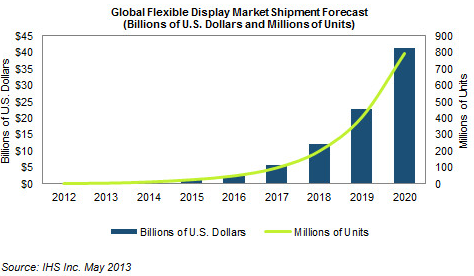
How Intel Can Enable a Successful $200 PC in the Age of the Media Tablet [IHS press release, May 20, 2013]
Vancouver, British Columbia (May 20, 2013)—Can PC makers produce ultrathin, touch-screen PCs that are appealing to consumers—and that are priced at just $200?
The astounding answer seems yes—if microprocessor Intel Corp. is willing to cut the price of its semiconductor components to PC makers, according to a PC Dynamics Market Brief from information and analytics provider IHS (NYSE: IHS).
Speaking at the IHS/SID 2013 Business Conference, held May 20 in Vancouver, Canada, Zane Ball, Intel vice president and general manager, Global Ecosystem Development, is presenting his company’s plan to empower the PC industry to produce low-cost notebooks incorporating touch technology. Craig Stice, senior principal analyst for compute platforms at IHS, believes Intel has a shot at success.
“A price point that low seems far-fetched considering the mobile PC prices of today, with Ultrabooks and other ultrathins going as high as $1,000 or more,” Stice said. “However, the small laptops known as netbooks saw their prices reach down into the $200 range at the height of their popularity a few years ago, and a cost analysis of netbooks shows how such a low level of pricing can be used to support a no-frills type of ultrathin PC.”
The cost estimate for a standard netbook, based on the IHS Compute Systems Cost Analyzer that calculates the major components of a netbook on a third-quarter 2013 timeline, comes out to $207.82, as shown in the attached table.

“Hitting this kind of price point is not impossible for the PC industry, already a cutthroat market accustomed to razor-thin margins,” Stice said. “Such a possibility was stated by outgoing Intel CEO Paul Otellini, who during Intel’s first-quarter earnings call in April made the bold prediction that touch-enabled, ultrathin Intel-based notebooks using non-core processors could be available by the end of this year.”
Intel holds the cards
The key factor that could make this happen is Intel, which can control up to 33 percent of the total bill-of-materials cost for the PC through the central processing unit (CPU) and motherboard. If Intel decides to provide a price break for just these components, PC original equipment manufacturers could see their margins improve, allowing them to drive down prices for the retail market. With PC competition so fierce, it takes only one PC manufacturer to find a price point that sells—and others are bound to follow suit shortly afterward.
Intel could also be instrumental in introducing an even more powerful ultrathin-type mobile PC than netbooks, which have now been overtaken by media tablets and are on their way out of the market altogether.
Intel’s next-generation Atom processor, called Bay Trail, has the potential to deliver a performance boost that will clearly separate the traditional netbooks of old from the new generation of mobile and ultrathin PCs.
Avoiding netbooks’ fate
While netbooks had limited computing power and were regarded more as devices for content consumption, the new and much more economical ultathins, in contrast, would possess considerably more power and be categorized as content-creation devices. Such a perceptible enhancement could increase their chances of survival in the marketplace, unlike the short-lived netbooks.
Much depends on Bay Trail, which Intel says will move from two processing cores to four to provide beefed-up performance. Along with Bay Trail, Intel’s own high-definition embedded graphics and an extended battery life for improved power will yield a processor bearing similar performance to the chipmaker’s renowned family of Core processors. All these traits could be part of the new, less expensive ultrathin being projected.
What PC manufacturers also must do
What these developments portend for the PC industry is significant. If the PC industry is able to get down to the $200 price point, and Intel’s Bay Trail processor delivers what it claims to do, then the PC market will have its much-needed shot in the arm. Such a turn of events could then spark the mobile PC market, which has been losing steam to flashier rivals like smartphones and tablets.
Besides Intel’s willingness to cut its own price point to make chips available at a lower cost to customers, a second important factor involves the PC makers themselves. For their part, PC manufacturers also need to find a way of getting to the magic price point of $200—and possibly sacrifice even more margin in exchange for the greater amount of volume that they seek.
All told, the scenario above—merely hypothetical at this point—is not entirely out of reach. A strong second half is already being forecast for PCs this year: add in the potential for lower-priced next-generation ultrathin systems, and the PC industry may finally have a valid competitor to lower-priced media tablets.

China Becomes World’s Leading PC Market in 2012 [IHS press release, April 29, 2013]
EL SEGUNDO, Calif. (April 29, 2013)—China rose to the top of the PC market for the first time ever on an annual basis last year, relegating the United States to second place with a lead of more than 3 million units, according to an IHS iSuppli PC Dynamics Market Brief from information and analytics provider IHS (NYSE: IHS).
PC shipments in 2012 to China amounted to 69 million units, exceeding the 66 million total reached by the United States. Only a year earlier in 2011, the United States was the leading global destination for PCs.
Beyond its large size, China’s PC market exhibits distinct characteristics that set it apart from the computer trade elsewhere, possessing a vast untapped rural market and unique consumer-purchasing patterns. While desktop PC shipments lagged notebooks around the world, the two PC segments were on par in China in 2012, with an even 50-50 split, as shown in the attached table.

“The equal share of shipments for desktops and notebooks in China is unusual, since consumers in most regions today tend to prefer more agile mobile PCs, rather than the bulky, stationary desktops,” said Peter Lin, senior analyst for compute platforms at IHS. “The relatively large percentage of desktop PC shipments in China is due to huge demand in the country’s rural areas, which account for a major segment of the country’s 1.34 billion citizens. These consumers tend to prefer the desktop form factor.”
The market will change gradually as desktop PCs face rising competition from the high value proposition presented by notebooks. Notebooks will then surpass desktops in the country by 2014, tracking more closely with the worldwide desktop-to-notebook PC ratio of 36 to 64 percent.
The desktop vs. notebook pattern of consumption in China is only one example of the distinctive hallmarks of the country’s dynamic PC market. In another indicator, China also has approximately a 50-50 proportion in consumer vs. commercial PCs, compared to the 65-35 percent ratio for the rest of the world.
A third pattern unique to the China PC market is the preferred notebook display size of 14 inches, which accounts for more than 70 percent of notebook PC shipments in the country. For the rest of the world, the 14-inch makes up less than 30 percent.
A fourth pattern of note is the attach rate of PCs with a pre-installed operating system, especially for notebooks. While mature PC markets in other parts of the world claim a 90 percent attach rate, the proportion for China comes out to lower than 50 percent, with the ratio even lower in the desktop PC market.
Despite such exclusive behavior, the China PC space shares one common trait with the worldwide PC market. Like the rest of the world, demand in China remains weak as consumers migrate to using mobile devices like cellphones. China’s PC market is projected to grow only by 3 to 4 percent this year.
Even so, a vast market opportunity continues to exist for PCs in the country, in the form of potential first-time buyers mostly residing in the countryside. The government already plans this year to invest some 40 trillion yuan—equivalent to some $6.4 trillion—to build rural infrastructure in the next 10 years, and PC original equipment manufacturers can take advantage of the initiative to build out and expand from the cities, IHS believes.
China is also on track to retain its position as the largest PC market in the world for the foreseeable future unchallenged and alone—further providing PC brands a rare opportunity for expansion, counter to the myriad travails they face in the rest of the world.

The endgame for ST-Ericsson, other SoC vendors like Allwinner to benefit tremendously from Ericsson’s advanced thin modems
As ST-Ericsson: Fundamental repositioning for modem, APE and ModAps spaces [‘Experiencing the Cloud’, Oct 8, 2012] was considered impossible after STMicroelectronics and Texas Intruments are exiting the mobile market as there is no chance to compete with aggressive SoC vendors from PRC and the market #2 MediaTek from Taiwan [‘Experiencing the Cloud’, Dec 12, 2012] now we have the endgame of ST-Ericsson as decided by its parent companies.
Note that modemless SoC vendors like Allwinner, Rockchip etc. will tremedously benefit from this type of endgame, as Ericsson will become a modem-only SoC vendor with the so called thin modem business taken over. This part of ST-Ericsson is dealing with the highly strategic and competitive LTE multimode thin modems (including 2G, 3G and 4G multimode), i.e. the well proven in last year trials Thor M7400 SoC solution (to come in devices of H2 2013), and its enhanced (with Single RF Chip Carrier Aggregation and ability to achieve 150Mbps) mass market follow-up, the Thor M7450 SoC solution (designed in 28nm, now sampling and to come in devices of 2014) based on the revolutionary architecture introduced in Thor M7400 which enables market-leading power consumption. All the so called legacy modems (as well as the remaining parts of the ST-Ericsson business) will be taken over by STMicroelectronics, but no further development will be done for them (and only selective development for the remaining parts of the ST-Ericsson business).
Financial responsibility for the respective businesses was taken over by the two parent companies from March 1st, 2013. The break up will be completed in Q3 2013. While Ericsson and STMicroelectronics will take over around 1800 and 950 people (employees and contractors) respectively. Of the remaining workforce approx. 1600 will be be made redundant in the process. For the remaining 200 employees and contractors in the so called connectivity business the future will be decided by the outcome of selling that business.
Here are
- the details,
and then
- a collection of related press releases
Details
STMicroelectronics, Ericsson End Venture After Failed Sale [Bloomberg, March 18, 2013]
“In 2009 the situation was different, we started with a great base of European customers,” STMicroelectronics Chief Executive Officer Carlo Bozotti said on a conference call. “Unfortunately this customer base has changed.”
…
Potential buyers that were approached, including customer Samsung Electronics Co., declined to make an offer, people familiar with the matter said last week. Samsung is “a great customer for us and we continue to work for a lot of products with this company,” Bozotti said today, declining to comment on any talks for Samsung taking over the venture.
STMicro, Ericsson split mobile chip unit, 1,600 jobs go [Reuters, March 18, 2013]
“All possible scenarios were considered but the option announced today was always a real possibility,” STMicro chief executive Carlo Bozotti told a conference call on Monday.
ST takes on mobile chips…but not the market [EETimes, March 18, 2013]
In a conference call Monday morning (March 18) Carlo Bozotti, CEO of ST (Geneva, Switzerland) promised continued support for ST-Ericsson’s existing products and customers but also indicated that ST would not be trying to replicate ST-Ericsson’s platform-level engagement with the mobile devices market. This approach puts a question-mark over the future relevance of ST’s fully-depleted silicon-on-insulator (FD-SOI) manufacturing process, a proprietary technology that is out of the mainstream of global CMOS manufacturing, but which has reportedly shown technical advantages for mobile applications where power consumption and battery life are key parameters.
…
“ST will not continue the so-called ModAp – ModAp is the integration of the application processor and the modem in one chip – in terms of new development,” said Bozotti during the conference call. “Of course, we will go on as long as needed with the existing products to support our customers. So we have not called – and we will not call – for any end of life.”
Moving on to stand-alone application processors, Bozotti said: “Of course our focus area is the digital consumer, is automotive. In the case of portable equipment we will not offer a complete platform for the market. However, we may develop dedicated solutions using our FD-SOI technologies for high volume requirements in the area of portable equipment.”
…
With regard to the decision to exit the joint venture Bozotti said: “This is extremely intense R&D. The dynamic of the wireless market is with increasing polarization in terms of key customers in this market. And also we are seeing an increasing trend of vertical integration of their activities including the design and manufacture of semiconductor chips,” Bozotti said.
Ericsson’s Management Hosts Strategic Way Forward For ST-Ericsson Conference (Transcript) [Seeking Alpha, March 18, 2013]
In April of 2012, last year, ST-Ericsson announced its strategic plan. And in October of 2012, Ericsson and ST together announced that we are, as parents, conducting a strategic review of the business plan and the future ownership structure of the joint venture. In — on December 10 of the last year, 2012, ST then makes an announcement that they intend to exit as a shareholder in ST-Ericsson. And then following that announcement, Ericsson, on December 20, announces to all of you that we have taken a decision to not acquire the full majority of ST-Ericsson. Now during a few months here in the beginning of the year, we have been exploring various strategic options for the ST-Ericsson assets, and that’s obviously the context of today’s call.

Key Points
- Ericsson and STMicroelectronics have agreed on a separation of the
company into three parts – Ericsson takes on thin modem operations
The aim that we have with this takeover is obviously to maximize the value. And also, we believe that the modems here have a good fit into the strategies of our company. ST-Ericsson, then, unfortunately will have to carry out the restructuring activity in the remaining — remainder of the joint venture, we’ll come back to that.
- Agreement aims to maximize assets and the future plans for both
parent companies as it relates to their respective strategies- ST-Ericsson to restructure current operations prior to separation
- The closing of the transaction is expected during Q3, subject to
regulatory approvals- Costs for implementing this strategic plan, including Ericsson’s part of
ST-Ericsson’s restructuring, is provided for in the provisions of SEK
3.3 B. taken in 2012
So how will this work? So if we look at the split-up of the joint venture, and we again start with Ericsson on the right-hand side of this slide: We take on the design, the development and the sales of the LTE multimode thin modems, and that includes, then, 2G, 3G and 4G multimode. This will be approximately 1,800 employees and contractors. The main sites will be Sweden, Germany, India and China. And we will then be financially responsible for this part of the JV from March 1, 2013.
On the ST side, they will take over the existing products in the JV other than the LTE modems, then, and then also all other related business as well as certain assembly and test facilities. This will be approximately 950 employees and with the main sites being France and Italy. And they will also then be financially responsible for that from 1st of March this year.
In the JV, then, they will — it will be then restructuring activity that have commenced today. And the remainder of the joint venture will then be, over time here, reduced and run down. And then also, we will look at selling the connectivity business. All in all, this is approximately 1,600 employees and contractors, and you’ll have around 200 of those being employees and contractors in the connectivity business. So this is the split-up of the JV.

Modems of Strategic Value for Industry
 Ericsson takes control of the thin modem business targeting smartphones and tablets
– Significant amounts invested to establish industry leading technology and IP
– Leverage our heritage and investment in leading research, global standardization and industry leading infrastructure solutions- Thin modem architecture covers
– Low power, highly integrated multi-mode multiband modems for GSM/GPRS/EDGE, TDSCDMA, HSPA+, LTE (TDD/FDD), LTEAdvanced
– Widest array of frequency bands and a feature set that includes Single RF Chip Carrier Aggregation, VoLTE and IMS

First of all, we’ve said in the past that we believe that the modem assets have a strategic value to the wireless industry, so this is consistent with what we’re trying to explain here. We are taking over the thin modem business, and the target market is the smartphones and the tablets. We’ve invested significant amounts of money to establish this position from a product perspective, from a testing perspective and where we are with the thin modems today within the joint venture. This also leverages our heritage and the investment in our R&D standardization and in, of course, our leading infrastructure solutions.
In terms of the thin modem architecture and what it covers, we believe we have advantages on low power. It’s highly integrated multimode, multi-baseband, with a variety of GSM, GPRS, EDGE, TD, HSPA, LTE TDD/FDD and then LTE Advanced. So it’s very comprehensive. And of course, some of the other features that will — sets this apart: It’s a Single RF Chip Carrier Aggregation. It includes VoLTE and IMS.
Total Addressable Market
 +400 m thin modem units in 2013 for smartphones/tablets
- Best estimate of the market for thin modems is an ASP of approximately USD 13-18 in 2013.
- Ericsson aims to be top 3 in that market
- Connected devices: M2M, Modules (via industrial partners), and other data centric devices
- License business model towards ModAp market: +400 m ModAp market

… in terms of the market itself that we’re targeting. Again, focus on the thin modems, and we see over 400 million units on the thin modems in 2013. That’s the green area, and that’s growing at 10%. We see the average sales price of approximately $13 to $18. And it’s — our aspiration is to be in the top 3 in this market.
In addition, there are other markets to connected devices: machine-to-machine, modules, data-centric devices. And then of course, there’s an opportunity to move toward a license business model with the ModAp in the ModAp market. But we’re very clear: the thin modem is a — going to be our focus, it’s going to be a focused organization. And again, it’s a 400 million unit in 2013, moving to greater than 600 million, from a market perspective, in 2017.
…
Next Steps and Ambitions
If we then look at the next steps. So we will now obviously finalize the formal break-up of the JV. ST-Ericsson will carry out the necessary restructuring of what this will remain — will — what will remain in the JV, and then we will move on with the necessary approvals. We think that the break-up will be completed by the third quarter 2013.
If we look at the product portfolio, then. The modem 7450 will have a volume ramp-up in the first half of 2014. And then it will be — the follow-up product will be the M7500. That work — will have a volume ramp-up in the first half of 2015. When we look at these — we are excited about the modem company, obviously, and the thin modem products. We will look at success in an 18- to 24-month time frame. Again, as Doug mentioned, the — our ambition is to be top 3 in the thin modem market and, of course, that this segment should add to Ericsson overall profitability.

Introducing ST-Ericsson latest advanced LTE modem (This is a slideshow without audio) [STEricssonVideos YouTube channel, Feb 24, 2013] i.e. the M7450
[the previous transcript continued]
Question-and-Answer Session
…
So what we’ve been trying to tell you is that we take over the thin modem products, which is, today, it’s 7400 which the mass-market product will be 7450. The legacy modem products will all be with ST, so this is the thin modem business. And all the assumptions around the ramp-up and so forth is in this slide: We have — the first half of 2014 will be the volume ramp-up of 7450, first half of 2015 will be the ramp-up of M7500. So that’s the business that Ericsson is taking over. And it’s correct to assume that, this year, in 2013, we don’t think there will be a lot of revenue on these modems.
…
Q: … I guess I would have thought that, if your position in thin modem multimode LTE was that exciting and an established semis company might have been better positioned to leverage that. …
… we … think that the modem, thin modem, business has a strategic value for the industry. We think it’s important, with more alternatives. That is — obviously goes hand-in-hand with our company overall mission around the network society, 50 billion connected devices, and so forth. So from that point of view, I think the strategic intent is quite clear. I also think that we have been reviewing a lot of different strategic options. This, what we present today, is the best solution out of all the different options that we have looked at. And we are here today to really welcome the modem company into Ericsson. And we are also convinced that we will be able to add value to the industry, which we have been stating for, for quite some time now.
… first and foremost, we have a product, okay? That product is in the market. It‘s been trialed, so the development effort has been worthwhile. We also have customers. I also think that, Ericsson working with the modem company and other partners in the industry, we have a very important role to play when it comes to connecting the access points with the networks. And I think we have — I think we have a very good role to play in this, and also very skilled engineers. That kind of work together end to end.
Q: … you’ve said your ambition is to be a top 3 player in this market. So would this mean that you may have to raise your investments in this business going forward? And secondly, you mentioned good customer traction with your existing thin modems, but I believe 7400 was being sampled, too, last year. But you are essentially indicating that there will be no revenue for — from 7400 this year. So I mean, how does this change with 7450? Are you already seeing some customers signing up on the product?
… We have — first and foremost, what we will take over once this — we have gotten all of the regulatory approvals is a thin modem operation with around 1,800 employees and contractors. We think that — given the portfolio ambition and the sales ambition we have, that the resources we have in that unit will be sufficient to deliver on the ambitions. So that’s what we have said and that’s what we will repeat again.
Showcasing Thor M7400 at CES [STEricssonVideos YouTube channel, Jan 15, 2013]
[the previous transcript continued]
Just to start with the — as you say, the 7400, that has been in customer testing. It’s been in field operator testing in the past, first global field operator testing. The 7450 has always been our expected mass product. 7450 has a smaller footprint, carrier aggregation and a variety of different other attributes, but it’s based on the 7400 software that has gone through this testing. So we’ve had very positive feedback and interest on the 7400, in terms of the architecture, and certainly on the 7450 and our current plans and timelines that we have with the 7450.
Q: So basically, if I look at the market, most of your competition is moving towards an integrated model where you have baseband and apps processor, but it seems that you are trying to focus more on the modem technology. And I’m just trying to understand what do you — why do you think this strategy is going to be more successful than what your competition is doing. And also, basically, your ambition is to be a top 3 player in this market long term. Once we get there, what do you think would be the long-term profitability in this business?
What we’re doing is we have been a very focused team, just as Jan said. As we’ve made this split, it’s going to be a very focused, competent team that’s just focused on the thin modems. As we presented earlier, we believe there’s a big-enough market in the thin modem area. And certainly, our expertise is more on the modem side than the application processor side, and that’s where we want to put our focus and our strength.
… then on the profitability, I think that what we will — the way we will measure success here in this business will be — will obviously be around achieving a top 3 position in the thin modem market. We have talked about the size of that market in terms of 400 million units, approximately, for 2013; also with the ASP there of between $13 and $18. We also will measure success in getting high volumes of the 7450 modem. And then we will also measure success when this LTE thin multimode modem business adds to the Ericsson group profitability. So those are the first, I would say, midterm objectives. And as we have said before, we will measure this in an 18- to 24-months perspective, so that’s kind of the time frame. We are — we also, then, have given you an indication on the resources in the unit that we take over, and we have also said that we think that this will be sufficient for the product portfolio ambition and so forth. So I think we have given you quite a lot for you to model a possible break-even point and so forth of this business.
Q: I would like to start quickly on the — well, what you’re planning to do actually with the ModAp business. So STMicro told us this morning that they are planning to discontinue basically working on that. And you are now clearly focusing on making your same — standalone modem. But do you have the ambition to eventually license your IP so that other companies that don’t have the existing modem capabilities are able to do ModAp processors?
Yes. So our primary focus is going to be the thin modem product itself. We certainly will look at machine-to-machine connected devices and potential for licensing the thin modem to customers that have the application processor. And that’s probably where we are right now in terms of our business plan and our revenue models.
Q: … as you fairly mentioned, there’s only one company shipping such products today, but there is also a lot of roadmaps that we’ve seen from some other of your — some of your other new competitors now are planning to release this kind of products as well at the end of this year and early next year. So how do you expect that to play over the long term? Do you think you have something that already gives you a head start of 6 month or 1 year on this front?
… we feel very committed to this thin modem because we have been monitoring the progress of not only ours but our competition in terms of the attributes and the characters of the unique selling points. We’ve invested a lot in this thin modem. We’ve seen the test results and where we see going forward with the 7450. So we’re confident, but we also know it’s going to be a tough market. But as we said in the past 6 months, we believe this is an asset that’s important to the industry.
Q: … will it be treated as licensing revenues?
No.
Demonstrating 150Mbps with Thor M7450 [STEricssonVideos YouTube channel, Feb 27, 2013]
THOR M7450 – LTE ADVANCED [ST-Ericsson product microsite, Feb 24, 2013]
Bringing Carrier Aggregation to the mainstream market
With the roll out of LTE and LTE Advanced technologies, device manufacturers face a number of new challenges. Operators require terminals that support an increased number of frequency bands and consumers expect increased data speed and improved battery lifetime. Device makers, however, cannot compromise device design and will need modem solutions that can do more within the same footprint.
Carrier Aggregation is one of the most important features in LTE Advanced that helps to address these challenges. It overcomes the fragmentation of the frequency spectrum by using multiple component carriers to increase the transmission bandwidth and data rate for an individual user.
The Thor M7450 is a multimode multiband platform supporting Carrier Aggregation with a single chip RF transceiver and support for over 17 bands. The complete modem is a highly integrated two chip solution with integrated memory. It delivers download speeds up to 150Mbps and is based on the revolutionary architecture introduced in Thor M7400 which enables market-leading power consumption.
Thor M7450 solves the design challenges and adds a number of new features in a solution footprint which makes it possible for phone manufacturers add LTE advanced without increasing size.
HIGHLIGHTS
For global devices
LTE FDD/TDD, HSPA+, TD-SCDMA, GSM
Single radio transceiver with support for 17+ bands
A streamlined modem
Highly integrated two chip solution with integrated RAM and single chip RF Carrier Aggregation
Power efficient architecture
For all devices
Interfaces for data devices and smartphone application processors
Complete and pre-tested reference design

Thor M7450 Carrier Aggregation [STEricssonVideos YouTube channel, Feb 26, 2013]
THOR™ M7400 LTE AND HSPA+ [ST-Ericsson product microsite, Feb 15, 2011]
Paves the way for global LTE devices
The Thor™ M7400 is a new generation of multimode mobile broadband modem. It
supports the latest LTE and HSPA+ technologies. The small form factor and high power efficiency of the M7400 enable slim form factor smartphones, tablets and other mobile broadband enabled devices. The advanced multimode RF design offers new level of flexibility to support regional LTE FDD/TDD/HSPA bands in Asia, Europe and North America in combination with global HSPA/EDGE.
A breakthrough in modem architecture delivers an optimum combination of hardware acceleration, for lowest power consumption, and flexible execution in software allowing feature and performance enhancements in existing hardware.
Equipped with the latest communication interfaces it enables efficient integration between application processor and modem, including memory-less modem design when combining with an application processor.
HIGHLIGHTS
Truly global
LTE FDD/TDD, HSPA+, EDGE
Radio supporting up to 16 LTE/WCDMA/GSM bands

A streamlined modem
Smallest two-chip thin modem solution
Power efficient architecture
Highly integrated radio solution
For all devices
Interfaces for data devices and smartphone application processors
Memory-less modem design possible when combined with an application processor
Complete and pre-tested reference design
Making a CS fallback from LTE to 3G, and back again, while streaming video [STEricssonVideos YouTube channel, Feb 27, 2013]
CS-Fallback – An Introduction [WirelessMoves, Feb 19, 2012]
One approach to deploying LTE without packet switched voice call functionality at the beginning is to instruct mobile devices to use a 2G and 3G network when the user makes or receives a voice call and return to LTE afterwards. This solution is referred to as CS fallback and has been specified in 3GPP TS 23.272. As it’s likely that it will be deployed over time in quite a number of networks and used over many years, I thought I have once again a closer look at the specs and write a little primer about it. A little warning: This is somewhat of a propeller head post which requires some background knowledge on the circuit switched core network of GSM and UMTS and how LTE works.
…
International Roaming
As CS fallback is not a Voice over IP technology, it is likely that it will mostly be used in LTE networks before VOLTE becomes available. Furthermore, CS fallback can be used as a backup solution in roaming scenarios in which voice capable LTE devices are roaming in a foreign LTE network in which VOLTE is not available or in case no roaming agreement is in place for IMS voice services.
Pros and Cons of CS fallback
The main advantage of CS fallback is that it will enable network operators and device manufacturers to introduce LTE devices with a single cellular radio chip before VOLTE becomes available and network are deployed widely enough to prevent having to hand over the call to UMTS or GSM too often (how that is done is another story).
…
Summary
CS fallback sounds easy but from the description above I think it is quite clear that it is not quite that. A new interface to be implemented in the MSC software and the MME, the use of roaming retry functionality that is not used so far (please correct me if I’m wrong) and the new CS fallback flag in the location update message will keep network and device engineers busy for a while. A lot of effort for a “temporary” solution.
Making VoLTE [Voice over LTE] voice calls that last [STEricssonVideos YouTube channel, Feb 27, 2013]
What is VoLTE | Voice over LTE | Tutorial [Radio-Electronics.com, Feb 18, 2010]
The Voice over LTE, VoLTE scheme was devised as a result of operators seeking a standardised system for transferring voice traffic over LTE. Originally LTE was seen as a completely IP cellular system just for carrying data, and operators would be able to carry voice either by reverting to 2G / 3G systems or by using VoIP.
…
In many ways the implementation of VoLTE at a high level is straightforward. The handset or phone needs to have software loaded to provide the VoLTE functionality. This can be in the form of an App.
The network then requires to be IMS compatible.
While this may appear straightforward, there are many issues for this to be made operational, especially via the vagaries of the radio access network where time delays and propagation anomalies add considerably to the complexity.
See also: LTE / Voice calls and LTE / Enhanced voice quality [both in Wikipedia]
The world’s first dual mode high definition VoLTE [STEricssonVideos YouTube channel, Feb 26, 2013]
Company press releases
ST-ERICSSON UNVEILS ULTRAFAST THOR M7450 LTE ADVANCED MODEM WITH FIRST SINGLE RF CARRIER AGGREGATION SOLUTION [press release, Feb 24, 2013]
Thor M7450 Modem includes support for 150Mbps and an extensive number of frequency bands.
Barcelona, February 24, 2013 – Today at Mobile World Congress 2013, ST-Ericsson, a world leader in wireless platforms and semiconductors, announced the Thor™ M7450 LTE Advanced modem which uses a single radio for Carrier Aggregation. The M7450 supports all relevant 3GPP specified frequency bands having 10 flexible RF ports enabling 17 frequency bands or more in the same device. With this modem, ST-Ericsson significantly increases the number of LTE bands compared to devices currently on the market allowing device manufacturers to address a global market with less number of device variants.
With the roll out of LTE and LTE Advanced technologies, device manufacturers face a number of new challenges. Operators require terminals that support an increased number of frequency bands and consumers expect increased data speed and improved battery lifetime. Phone makers, however, cannot compromise device design and will need modem solutions that can do more in the same footprint.
“There is an ever increasing demand for mobile broadband access no matter where you are in the world, making the ability to efficiently handle data traffic a top priority for our customers and operators,” says Staffan Iveberg, Senior Vice President of Thor Modem Solutions for ST-Ericsson. “Next-generation modems need to combine extensive frequency band support to offer flexibility for operators and markets – all without increasing the modem size. ST-Ericsson is leading the way with the Thor M7450 LTE Advanced modem.”
Today, many operators only have 5 or 10 MHz bandwidth allocations in each frequency band for LTE which is insufficient for LTE Category 3 or 4 with data rates up to 100 or 150 Mbps. Carrier Aggregation allows bandwidth from two different frequency bands to be combined enabling higher data rates.
“With the Thor M7450, we are continuing to innovate in modem technology to bring increased download speed without compromising on size or power consumption,” continued Iveberg. “No one else is delivering a complete LTE Advanced modem that is both fast and power efficient in this compact size.”
The Thor M7450 is a two chip solution with integrated RAM to enable a compact size. The M7450 is designed in 28nm CMOS technology and builds on the revolutionary architecture introduced in Thor M7400 which delivers market-leading power consumption. It supports 3GPP Release 10, LTE category 4, with downlink speeds up to 150Mbps and VoLTE. With LTE-FDD, LTE-TDD, HSPA+, GSM and TD-SCDMA integrated in the same chipset, the M7450 addresses the need for a simple and cost effective solution for widespread global adoption of LTE devices.
The Thor M7450 is being demonstrated by ST-Ericsson in Barcelona this week and is currently sampling with customers.
For additional information, a white paper is available here.
CHANGING THE GAME: ST-ERICSSON UNVEILS NOVATHOR™ FAMILY OF SMARTPHONE PLATFORMS COMBINING ITS MOST ADVANCED APPLICATION PROCESSORS WITH THE LATEST GENERATION OF MODEMS [press release, Feb 15, 2011]
ST-Ericsson today announced three new application processors, the Nova A9600, A9540, A9500 together with two next generation modems the Thor M7400 and M7300 as well as two additions to its complete highly integrated smartphone platforms the NovaThor T5008 and U4500.
…
ST-Ericsson’s new Thor modems, the Thor M7400 and the Thor M7300, support the latest LTE and HSPA+ dual carrier technologies, while preserving backward compatibility with existing 3G/2G networks, in a small and highly-integrated radio solution that supports up to eight LTE/WCDMA/GSM frequency bands. These modems enable the development of truly global smartphones, tablets and many other mobile broadband-enabled devices.
…
The Thor M7400 can connect to 2G, 3G, TD-SCDMA, HSPA, HSPA+ dual carrier and LTE FDD/TDD networks. It offers peak download speeds of up to 100Mbps in LTE networks. The Thor M7400 supports voice calls via fallback to circuit-switched networks and via the VoLTE (Voice over LTE) standard, it is sampling Q2 2011.
ST-ERICSSON’S HIGH-PERFORMANCE MODEMS PAVE THE WAY FOR GLOBAL LTE DEVICES [press release, Feb 15, 2011]
… The Thor M7400 is the industry’s smallest and first two-chip LTE/HSPA+ modem, which also continues the low power consumption track record from ST-Ericsson’s market-leading HSPA+ modems. …
… “In Thor, ST-Ericsson’s engineers have achieved the optimum combination of hardware acceleration, for low power consumption, and execution in software, enabled by our in-house vector processing technology, which offers the flexibility to continuously add features and performance enhancements to existing chipset hardware,” said Jörgen Lantto, executive vice president, chief technology and strategy officer of ST-Ericsson. “Our radio solution is unique in that it supports the regional LTE FDD/TDD bands in use in Asia, Europe and North America, as well as HSPA/EDGE networks worldwide, allowing device manufacturers to offer truly global devices.”
The ThorM7400 and ThorM7300 modems are based on a common architecture, enabling ST-Ericsson and its customers to benefit from shorter time-to-market by re-using of modem certification and application processor interfaces across platforms, reducing time-to-market. The new Thor modems are also pin-to-pin compatible which enables customers to completely reuse their design across the two platforms. …
Available for operator testing and integration into devices from Q2 2011, the Thor M7400 modem can connect to 2G, 3G, TD-SCDMA, HSPA, HSPA+ dual carrier and LTE FDD/TDD networks. It offers peak download speeds of up to 100Mbps in LTE networks. The ThorM7400 supports voice calls via fallback to circuit-switched networks and via the VoLTE (Voice over LTE) standard.
…
ST-Ericsson developed high-performance vector processing (EVP) to efficiently handle complex computational tasks for all access standards. It is currently used in ST-Ericsson TD-SCDMA platforms.
ST-ERICSSON THOR M7400 MODEM SELECTED AS CES 2012 INNOVATIONS HONOREE [press release, Nov 8, 2011]
… The ST-Ericsson Thor M7400 4G multimode modem delivers the high power efficiency and compact footprint needed to enable sleek and slim form factor smartphones, tablets and other connected devices. The Thor M7400 is a groundbreaking multimode solution, supporting the latest LTE, HSPA+ and TD-HSPA mobile broadband technologies, and enables efficient integration between application processor and modem.
“The Thor M7400 sets a new standard for 4G multimode modems delivering extremely high data performance, low power consumption and size advantage over alternative solutions,” said Jörgen Lantto, executive vice president and chief technology officer at ST-Ericsson. “To further optimize its footprint, the Thor M7400 includes memory-less technology to optimally integrate with application processors in 4G mobile broadband devices. As a result, the Thor M7400 makes ultra-fast web browsing and high speed data connectivity ubiquitous, easy and reliable. We are proud to have our innovative product recognized by the Consumer Electronics Association.”
STMicroelectronics Announces Resignation of Didier Lamouche [STMicroelectronics press release, March 11, 2013]
STMicroelectronics (NYSE:STM), a global semiconductor leader serving customers across the spectrum of electronic applications, announced today that Didier Lamouche, Chief Operating Officer, whose operational role was suspended when he took the assignment as President and Chief Executive Officer at ST-Ericsson in December 2011, has decided to resign from the company effective March 31, 2013 to pursue other opportunities.
“Over the past years Didier has brought his strong contribution to ST, initially as the Chief Operating Officer, and then taking the challenging task to lead ST-Ericsson” saidCarlo Bozotti, President and CEO of ST. “We thank him for his outstanding contribution and wish him all the best for his future”.
About STMicroelectronics
ST is a global leader in the semiconductor market serving customers across the spectrum of sense and power and automotive products and embedded processing solutions. From energy management and savings to trust and data security, from healthcare and wellness to smart consumer devices, in the home, car and office, at work and at play, ST is found everywhere microelectronics make a positive and innovative contribution to people’s life. By getting more from technology to get more from life, ST stands for life.augmented.
In 2012, the Company’s net revenues were $8.49 billion. Further information on ST can be found at www.st.com
ST-ERICSSON ANNOUNCES CHANGE IN EXECUTIVE MANAGEMENT [ST-Ericsson press release, March 11, 2011]
Following the STMicroelectronics’ announcement issued earlier today, ST-Ericsson, a joint venture of STMicroelectronics (NYSE:STM) and Ericsson (NASDAQ:ERIC), announced today that Didier Lamouche, president and chief executive officer, has decided to resign from the Company to pursue other opportunities.
Hans Vestberg, Chairman of the ST-Ericsson’s board of directors, said: “Didier Lamouche came into ST-Ericsson when the company was in a very challenging situation and has been instrumental in bringing the company to the point where it is more focused on strategy execution, a much lower breakeven point and positive momentum where the new LTE modem-based products are ready for market introduction this year. On behalf of ST-Ericsson’s board, I thank Didier for his strong contribution to ST-Ericsson.”
Lamouche will remain in his current position until March 31, 2013.
ABOUT ST-ERICSSON
ST-Ericsson is a world leader in developing and delivering a complete portfolio of innovative mobile platforms and cutting-edge wireless semiconductor solutions across the broad spectrum of mobile technologies. ST-Ericsson was established as a 50/50 joint venture by STMicroelectronics (NYSE:STM) and Ericsson (NASDAQ:ERIC) in February 2009, with headquarters in Geneva, Switzerland.
www.stericsson.com
www.twitter.com/STEricssonForum
ST-ERICSSON ANNOUNCES GLOBAL WORKFORCE REVIEW [ST-Ericsson press release, March 18, 2011]
ST-Ericsson, a joint venture (JV) of STMicroelectronics (NYSE:STM) and Ericsson (NASDAQ:ERIC), today announced a plan for a global workforce review, following the announcement made today by Ericsson and STMicroelectronics about the future of the joint venture.
The proposed key steps of agreement between the parent companies include each parent taking on parts of ST-Ericsson. It is proposed that Ericsson will assume approximately 1,800 employees and contractors, with the largest concentrations in Sweden, Germany, India and China. It is also proposed that ST will assume approximately 950 employees, primarily in France and in Italy, to support ongoing business and new products development within ST.
In addition, ST-Ericsson is pursuing external options for the future of the connectivity business, which employs around 200 employees worldwide.
In connection with the transfer of the majority of its workforce to the parent companies, ST-Ericsson will carry out restructuring of its current operations which could impact some 1,600 employees worldwide, out of which in a range of 500-700 are in Europe, including 400 to 600 positions in Sweden and 50 to 80 positions in Germany.
ST-Ericsson – with the support of both parent companies – will honor all obligations to employees, including those related to restructuring.
The proposed changes are subject to negotiations with work councils and employee representatives as required.
Ericsson and STMicroelectronics agree on strategic way forward for ST-Ericsson [STMicroelectronics press release, March 18, 2013]
Ericsson (NASDAQ:ERIC) and STMicroelectronics (NYSE:STM) today announced an agreement on the way forward for the joint venture (JV) ST-Ericsson. As communicated by the parent companies in December 2012, both have been working together toward a strategic solution for the JV. After months of intensive joint work, the parent companies have selected the strategic option which maximizes their respective future prospects and growth plans.
The main steps agreed upon to split up the JV are the following:
- Ericsson will take on the design, development and sales of the LTE multimode thin modem products, including 2G, 3G and 4G multimode
- ST will take on the existing ST-Ericsson products, other than LTE multimode thin modems, and related business as well as certain assembly and test facilities
- Starting the close down of the remaining parts of ST-Ericsson.
The formal transfer of the relevant parts of ST-Ericsson to the parent companies is expected to be completed during the third quarter of 2013, subject to regulatory approvals.
After the split up it is proposed that Ericsson will assume approximately 1,800 employees and contractors, with the largest concentrations in Sweden, Germany, India and China.
It is also proposed that ST will assume approximately 950 employees, primarily in France and in Italy, to support ongoing business and new products development within ST.
Today, it is also announced that Carlo Ferro is appointed President and Chief Executive Officer of ST-Ericsson, effective April 1, 2013. Ferro is currently Chief Operating Officer of ST-Ericsson and succeeds Didier Lamouche who, as previously announced, will pursue opportunities outside the company. Ferro will lead the work in securing both business continuity of ST-Ericsson and effective completion of the transition phase.
Hans Vestberg, President and CEO, Ericsson and Chairman of the Board of Directors, ST-Ericsson said: “I welcome Carlo Ferro as the new President and CEO of ST-Ericsson. Carlo has over twenty years of experience in the semiconductor industry and a strong track record in driving and managing complex transformation projects. He has been a contributor to the solid progress ST-Ericsson has made the past year in terms of strategy execution and significantly lowering the breakeven point.”
“In line with what we announced in December last year, we have now moved to the next step of our exit process and found a solution with Ericsson that fully aligns with our new strategy”, said Carlo Bozotti, President and CEO of ST. “The agreement made with Ericsson represents a major step forward in reaching our new financial model target and allows us to further strengthen the skillsets of our company, by welcoming in ST, at completion, additional strong competences to fuel growth in specific key product areas. Moreover, it protects and leverages the ongoing ST-Ericsson’s business, allowing us to reinforce our relationships with key customers, both of ST and of ST-Ericsson”.
With the proposed transfer of competencies from ST-Ericsson, ST will further strengthen its capabilities in the areas of application processors, RF, analog and power as well as software and complex system integration. In addition, ST-Ericsson’s portfolio includes devices that are complementary to ST’s focus on the fastest growing segments of the wireless semiconductor market, such as system-optimized analog mixed signal and power management devices, high-quality, low-power audio and video enhancements and innovative energy harvesting solutions.
The agreement is fully in line with ST’s financial model target of an operating margin of 10 percent or more and with plans to reduce quarterly net operating expenses to an average quarterly rate in the range of $600 million to $650 million by the beginning of 2014.
In addition, as a result of the agreement, ST expects to incur cash costs, including the covering of ST-Ericsson’s ongoing operations during the transition period and its restructuring costs, in the range of approximately $350 million to $450 million, narrower than the range provided at the end of January 2013.
Linux client market share gains outside the Android? Instead of gains will it shrink to 5% in the next 3 years?
The Linux Foudation quite proundly referred to ReadWriteMobile: The ‘Year of the Linux Desktop’? That’s So 2012 [Feb 3, 2013]
For those Linux enthusiasts still pining for the mythical “Year of the Linux Desktop,” the wait is over. In fact, it already happened. In 2012 Microsoft’s share of computing devices fell to 20% from a high of 97% as recently as 2000, as a Goldman Sachs report reveals [”Clash of the titans” downloadable from here, dated Dec 7, 2012]. While Apple has taken a big chunk of Microsoft’s Windows lead, it’s actually Google that plays Robin Hood in the operating system market, now claiming 42% of all computing devices with its free “Linux desktop” OS, Android.
Read more at ReadWriteMobile.
from which I will include here the following chart:

for which Goldman Sachs commented as:
The compute landscape has undergone a dramatic transformation over the last decade with consumers responsible for the massive market realignment. While PCs were the primary internet connected device in 2000 (139mn shipped that year), today they represent just 29% of all internet connected devices (1.2bn devices to ship in 2012), while smartphones and tablets comprise 66% of the total. Further, although Microsoft was the leading OS provider for compute devices in 2000 at 97% share, today the consumer compute market (1.07bn devices) is led by Android at 42% share, followed by Apple at 24%, Microsoft at 20% and other vendors at 14%.
Note from Goldman Sachs: Microsoft has gone from 97 percent share of compute market to 20 percent [The Seattke Times Dec 7, 2012]:
I asked Goldman Sachs about what happened in the 2004-2005 time frame — as seen in the above chart — that made Apple’s vendor share jump, Microsoft’s share plummet and the “other” category to go from zero to 29 percent. Goldman Sachs replied that it has to do with more mainstream adoption of non-PC consumer computing devices but declined to elaborate beyond that.
Microsoft was put into the “Challenged” category (along with Google BTW) by Golmann Sachs noting that:
… we estimate that Microsoft would have to sell roughly 5 Windows Phones or roughly two Windows 8 RT tablets to offset the loss of one traditional Windows PC sale, which we estimate has an overall blended selling price of $60 for business and consumer.
but a kind of more positive than negative outlook was predicted for the company by
… we expect the recent launches of Windows Phone 8 and Windows 8 tablets to help the company reclaim some share in coming years.
Apple, at the same time, was into the “Beneficiaries” category (along with Facebook and Samsung BTW) by Goldmann Sachs for the reason of:
… we believe loyalty to the company’s ecosystem is only increasing and this should translate into continued growth going forward. In particular, we see the potential for Apple to capture additional growth as existing iOS users move to multiple device ownership and as the company penetrates emerging regions with new devices such as the iPad miniAAPL and lower priced iPhones. As a result, we believe Apple’s market share in phones has room to rise much further, and that its dominant tablet market share appears to be more resilient than most expect. We expect these factors to continue to drive the stock higher.
This is, however, not going to happen if taking a judgement from the stock market reflections since then with 13.7% drop in Apple’ share price vs. that of Dec 7 (the report publishing date) and a whopping 34.5% drop vs. its last peak on Sept 19, 2012 (at $702.1):
source: Yahoo! Finance
Why Did $AAPL Stock Go Down After Beating Earnings Estimates And $AMZN Stock Go Up After Missing? [Techcrunch, Jan 29, 2013] had the following explanation:
The moves in different directions for Amazon and Apple have been about expectations and guidance. Wall Street has higher expectations for Apple and ‘different’ expectations for Amazon. Wall Street wants Apple’s ‘gross margins’ to grow. They don’t expect Amazon’s ‘profits’ to grow. It sounds silly, but if Apple has reported lower profits and a huge gross margin increase the stock might have shot up. If Amazon had reported record profits today on decreasing margins, Wall Street might have panicked.
…
Wall Street has stopped caring about Apple’s profits today. They were displeased with forward guidance. Growth rates have slowed measurably at Apple which is understandable for a company of its’ size. Wall Street is worried that growth is slowing and competition from Google and Samsung are taking a toll. Apple has given Wall Street so many wonderful surprises so magic has become the norm. Now that Apple is boring, they have run for the hills.
That moode didn’t change even after Apple CEO Tim Cook was trying to assure investors at the Goldman Sachs Internet and Technology Conference on Feb 12, just a week ago. Read the Wrap up: Apple CEO Tim Cook’s Goldman Sachs Conference keynote [AppleInsider, Feb 13, 2013] from which I will quote only the following excerpts as the most notable ones:
Cook went on to say that introducing a “budget device” was not something Apple would be comfortable with, and instead pointed to the strategy seen with the iPhone lineup. In that model, new variants like the iPhone 5 are sold at the highest price while preceding versions like the iPhone 4S and iPhone 4 are sold at discounted rates.
…
According to Cook, the iPad is “the poster child of the post-PC revolution” and has driving the push to tablets since its introduction in 2010.
While Apple’s tablet has been the downfall for a number of PC alternatives, such as netbooks, the device is also said to be hurting the company’s own Mac computer sales. During the last quarter of 2012, Mac sales dropped 22 percent year-to-year on low demand and supply constraints. Apple’s iPad business, however, grew by nearly 50 percent over the same period.
“The cannibalization question raises its head a lot,” Cook said. “The truth is: we don’t really think about it that much. Our basic belief is: if we don’t cannibalize, someone else will. In the case of iPad particularly, I would argue that the Windows PC market is huge and there’s a lot more there to cannibalize than there is of Mac, or of iPad.”
Cook noted that burgeoning markets like China and Brazil will be major players in future growth, and the company is banking on its ability to draw customers in to the Apple ecosystem with “halo products.”
“Through the years, we’ve found a very clear correlation between people getting in and buying their first Apple product and some percentage of them buying other Apple products.”
At the same conference Microsoft, similarly to Apple, declared a ‘no change’ strategy despite of the obvious failure of its Windows 8 and Windows Phone efforts so far. In the No “Plan B” for Microsoft’s mobile ambitions: CFO [Reuters, Feb 13, 2013] report one can read:
“We’re very focused on continuing the success we have with PCs and taking that to tablets and phones,” Microsoft’s Chief Financial Officer Peter Klein said
…
“It’s less ‘Plan B’ than how you execute on the current plan,” said Klein. “We aim to evolve this generation of Windows to make sure we have the right set of experiences at the right price points for all customers.”
…
Gartner estimates that Microsoft sold fewer than 900,000 Surface tablets in the fourth quarter, which is a fraction of the 23 million iPads sold by Apple. Microsoft has not released its own figures but has not disputed Gartner’s.
Windows phones now account for 3 percent of the global smartphone market, Gartner says, which is almost double their share a year ago but way behind Google’s Android with 70 percent and Apple with 21 percent.
To grab more share, Klein said Microsoft was working with hardware makers to make sure Windows software is available on devices ranging from phones to tablets to larger all-in-one PCs.
“It’s probably more nuanced than just you lower prices or raise prices,” said Klein. “It’s less a Plan B and more, how do you tweak your plan, how do you bring these things to market to make sure you have the right offerings at the right price points?”
So the last 3 months went against Goldmann Sachs’ November 2012 predictions. The only question now remains whether those 3 months brought any changes in the non-Apple and non-Microsoft territories which would question other parts of the Goldmann Sachs’ forecast as well?
There were no negative changes just strengthening of the already established dominant position against both Apple and Microsoft:
1. Mainstream tablets 7-inch at US$199, say Taiwan makes [DIGITIMES, Feb 19, 2013]
Google’s Nexus 7 and Amazon’s Kindle Fire HD have reshuffled the global tablet market and consequently 7-inch with a price cap of US$199 has become the mainstream standard for tablets, according to Taiwan-based supply chain makers.
Cumulative sales of the Nexus 7 have reached six million and are expected to reach eight million units before the expected launch of the second-generation model in June 2013, the sources said. The Nexus 7 and Kindle Fire have driven vendors to develop inexpensive 7-inch tablet models instead of 10-inch ones, the sources indicated.
In order to be as reach US$199, 7-inch tablets are equipped with basic required functions such as access to the Internet and watching video, the sources noted. While Google, Amazon, Samsung Electronics and Asustek Computer are competitive at US$199 for 7-inch tablets, white-box or other vendors need to launch 7-inch models at lower prices such as US$149, the sources said. Fox example, China-based graphics card vendor Galaxy Microsystems has cooperated with Nvidia to launch a 7-inch tablet in the China market at CNY999 (US$160).
2. Digitimes Research: 68.6% of touch panels shipped in 4Q12 from the Greater China area [DIGITIMES, Feb 19, 2013] meaning that in supply chain terms there is a growing concentration on suppliers not only from Greater China but especially from mainland China:
Taiwan- and China-based touch panel makers held a 68.6% global market share for touch panels shipped during the fourth quarter of 2012, according to Digitimes Research.
China-based panel makers saw the biggest share in the handset touch panel market during the fourth quarter due to smartphone demand in China, while Taiwan-based panel makers only held a 27.5% share in the market largely due to lower-than-expected sales of the iPhone 5, said Digitimes Research.
In terms of touch panels used in tablets, Taiwan-based panel makers saw a drop in their global market share to 59.9% during the period largely due to the iPad mini using DITO thin-film type touch screens provided from Japan-based touch panel makers. China-based panel makers meanwhile held 18.6% in the market due to demand for white-box tablets in China, added Digitimes Research.
Meanwhile, Digitimes Research found that Taiwan-based TPK provided 70.9% of all touch panels used in notebook applications in 2012.
3. Touch Panel Market Projected for a 34% Growth in 2013 from 2012 [Displaybank, sent in a newsletter form, Feb 19, 2013] published to promote Touch Panel Market Forecast and Cost/Issue/Industry Analysis for 2013 [Jan 30, 2013]
The touch panel market is growing rapidly due to the increasing sale of smartphones and tablet PCs. The touch panel market size in 2012 was 1.3 billion units, a 39.4% growth over 2011. The market is projected to grow 34% in 2013, growing to more than 1.8 billion units.
Touch Panel Market Forecast (Unit: Million)
(Source: Displaybank, “Touch Panel Market Forecast and Cost/Issue/Industry Analysis for 2013”)

Smartphone and tablet PCs, major applications that use touch panels, are expected to continue to grow at a high rate. In addition, most IT devices that use display panels have either switched to or will start using the touch panels soon. Therefore the touch panel market will show a double digit growth annually until 2016, by unit. The market size is expected to reach more than 2.75 billion units by 2016.
With the explosion in the sale of smartphones and tablet PCs during the past few years, our lives have changed dramatically. They are now common place in our lives, and have a huge influence in the IT industry in general. With the introduction of Windows 8 OS in October 2012, upsizing of touch panels has begun. The impact of this event on the immediate growth of the touch panel market and the long-term effect is so immense that it cannot be estimated at the moment.
The financial crisis that started in 2008 left much of the IT industry hobbling worldwide. But only the touch panel market is enjoying a boom. Many new players are pouring into the industry, and those on the sidelines are waiting for the opportune moment to enter. As more players enter the competitive landscape, touch panel prices are falling rapidly. In addition, to gain competitiveness and to differentiate itself in the market has led players to develop and improve structure, technique and process, and seek out new materials.
The introduction of Windows 8 is leading the increase in touch capable Notebook and AIO PCs. It is still too early for the touch interface to completely displace keyboard and mouse, but the touch functionality does add convenience to some operations. We are sure to see an increase in specialized apps that capitalize on such functions. Therefore, touch functions will complement traditional input methods. As the technology is still in early implementation stages, it is used only in select high-end Ultrabooks. But it’s only a matter of time before touch functions make its way to mid-end products.
Forecasting the future of touch panel industry is not only difficult, but also outright confusing in the current landscape due to the rapid expansion; the increase in number of devices that use touch panels; more players in the market; and rapid development of new products and new processes. In serving clients, Displaybank has released “Touch Panel Market Forecast and Cost/Issue/Industry Analysis for 2013” to provide industry outlook by application, product, and capacitive touch structure. The report also includes the supply chain of set makers and touch panel manufacturers; and cost analysis of major capacitive touch panels by size and type. This report will serve as a guide to bring clarity and understanding of rapidly transforming touch panel industry.
4. Cheaper components could allow 7-inch tablets priced below US$150, says TrendForce [DIGITIMES, Dec 14, 2012]
Viewing that Google and Amazon have launched 7-inch tablets at US$199, other vendors can offer 7-inch tablets at below US$150 only by adopting cheaper components, according to Taiwan-based TrendForce.
As panels and touch modules together account for 35-40% of the total material costs of a 7-inch tablet, replacing the commonly used 7-inch FFS panels with 7-inch TN LCD panels accompanied by additional wide-view angle compensation could save over 50% in panel costs, TrendForce indicated. In addition, replacing a G/G (glass/glass) or OGS (one glass solution) touch module with a G/F/F (glass/film/film) one, although inferior in terms of transmittance and touch sensitivity, can cut costs by about 70%. Thus, the adoption of a TN LCD panel and a G/F/F touch module for a 7-inch tablet could reduce material costs by about US$25, TrendForce said.
Given that the type of DRAM affects standby time only as far as user experience is concerned, costs can be reduced through replacing 1GB mobile DRAM priced at about US$10 with 1GB commodity DRAM priced at about US$3.50, TrendForce noted. As for NAND flash, 8GB and 4GB eMMC cost US$6 and US$4, respectively, and therefore the latter should be the preferred choice to save costs.
For CPUs, China-based IC design houses, including Allwinner Technology, Fuzhou Rockchip Electronics, Ingenic Semiconductor, Amlogic and Nufront Software Technology (Beijing), provide 40-55nm-based processors at about US$12 per chip which could be alternatives to chips used in high-end tablets which cost about US$24, TrendForce indicated.
While the sales performance of tablets below US$150 is yet to be seen, such cheap models are expected to put pressure upon China-based white-box vendors, and in turn intensify price competition in the tablet market in 2013, TrendForce commented.
5. Strong demand from non-iPad tablet sector to boost short-term performance of IC vendors [DIGITIMES, Jan 28, 2013]
Demand for IC parts from the tablet industry in China has been stronger than expected in the first quarter of 2013, which could help boost the short-term performance of IC design houses, while offsetting the impact of slow demand from China’s smartphone sector caused by high inventory levels, according to industry sources.
Entry-level tablets meet market demand in terms of pricing and functionality, particularly in China, said the sources, adding that demand for entry-level tablets in China and other emerging markets could top 4-5 million a month in 2013 compared to 2-3 million in the second half of 2012.
MediaTek, while seeing demand for its handset solutions from China decrease in the first quarter of 2013, has also enjoyed emerging IC demand from the tablet sector, with plans to release chipset solutions for the segment in the second quarter of the year, the source revealed.
Since the growth momentum for tablets in 2013 is expected to come from non-iPad vendors in China and other emerging markets, Taiwan-based suppliers of LCD driver, analog and touch-controller ICs as well as those of Wi-Fi, audio and Bluetooth chips will benefit from the trend thanks to cost advantages and strong business ties in these markets, the sources commented.
6. Allwinner A31 SoC is here with products and the A20 SoC, its A10 pin-compatible dual-core is coming in February 2013 [Dec 10, 2012] and The upcoming Chinese tablet and device invasion lead by the Allwinner SoCs [Dec 4, 2012], both from my own separated trend tracking site devoted to the ‘Allwinner phenomenon’ coming from mainland China and having the potential of drastically altering the 2013 device market (not taken into account at all by Goldmann Sachs report):
that already resulted in huge growth of the mainland China Android tablet manufacturing in 2012, as well shown by this chart: which has already fundamentally affected the worldwide tablet market in 2012: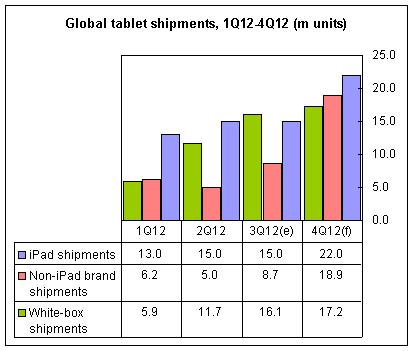
7. What Allwinner started in 2012 with the single core A10/A13 SoCs and which was further boosted by the quad-core Cortex-A7 A31 SoC on Dec 5, 2012 with the release of Onda V972 and V812 tablets (for US$ 208 and US$144 respectively) is an incredible strategic inflection point for the whole ICT industry, which ALL SoC vendors should compete with. Rockchip shown as the #2 on the mainland China market just followed the suite:
8. Now the most ambitious external challenger Marvell Announces Industry’s Most Advanced Single-chip Quad-core World Phone Processor to Power High-performance, Smartphones and Tablets with Worldwide Automatic Roaming on 3G Networks [press release, Feb 19, 2013] which is going to add to the competition the integrated on the SoC 3.5G modems:
Marvell’s PXA1088 is the industry’s most advanced single-chip solution to feature a quad-core processor with support for 3G field-proven cellular modems including High Speed Packet Access Plus (HSPA+), Time division High Speed Packet Access Plus (TD-HSPA+) and Enhanced Data for GSM Environment (EDGE).
The Marvell PXA1088 solution incorporates the performance of a quad-core ARM Cortex-A7 with Marvell’s mature and proven WCDMA and TD-SCDMA modem technology to provide a low-cost [elsewhere stated by Marvell that this SoC is for the phones space in the “$100 range”] 3G platform for both smartphones and tablets. The advanced application processor technology of the PXA1088 enables a breakthrough end user experience for multimedia and gaming applications with universal connectivity. Marvell’s complete mobile platform solution includes the Avastar® 88W8777 WLAN + Bluetooth 4.0 + FM single-chip SoC and the L2000 GNSS Hybrid Location Processor, and an integrated power management and audio codec IC.
Marvell’s PXA1088 is backward pin-to-pin compatible with its dual-core single-chip Unified 3G Platform, the PXA988/PXA986, enabling device partners to upgrade their next-generation mobile devices to quad-core without additional design cost.
…
Currently, the PXA1088 platform is sampling with leading global customers. Products based on this platform are expected to be commercially available in 2013 [elsewhere stated by Marvell that “We’ll start seeing PXA1088-based phones in the first half of this year”].
9. Yesterday we had two significant advancements described in the Ubuntu and HTC in lockstep [Feb 19, 2013] post here. Especially the Ubuntu related part is remarkable as first time we had a new platform which can span the whole spectrum of devices: from smartphones, to tablets, to desktops, to TVs – actually all from a smartphone capability expanded via docking and other means to a screen, to a TV, a keyboard, and a mouse. This is certainly an extreme case of the new Ubuntu capability which can have implementation in different devices as well. Even in that case, however, the source and binary codes could be the same. This is also cleverly using the already well established Android drivers and Android Board Support Package (BSP) infrastructure of the most cost-efficient ARM SoC vendors. Note that this is furthest from any “license violation” attacks as the original OHA terms and conditions are stating the Apache V2 licencing which:
The Apache license allows manufacturers and mobile operators to innovate using the platform without the requirement to contribute those innovations back to the open source community. Because these innovations and differentiated features can be kept proprietary … Because the Apache license does not have a copyleft clause, industry players can add proprietary functionality to their products based on Android without needing to contribute anything back to the platform. As the entire platform is open, companies can remove functionality if they choose.
10. Finally today came Google Glass: showing how radically the user experience might be changing in the next 2-3 years:
More information: Google Glass – Home [Feb 20, 2013] where it is also possible to grasp its wonderful, non-intrusive seign like this:

Conclusion: There are even more uncalculated by Goldmann and Sachs advancements in the non-Apple and non-Microsoft spaces than in Apple and Microsoft ones. Just in these 3 months! Therefore it would be ridiculous if Goldmann and Sachs’ “consumer compute platform share” forecast as shown in the chart above will be fullfilled!
Allwinner vis-à-vis HTC on 2013 International CES
Allwinner has launched its latest quad-core application processor A31 in December 2012 and will create another legend in the consuming world.
If you would like to know more about A31, please schedule a meeting with us at CES 2013 via Eva.wu@allwinnertech.com.
Booth No:MP40016
Booth Map:http://www.mapyourshow.com

You could already have all the necessary information from my special posts given in a newly created blog about the ‘Allwinner phenonmenon’:
– Allwinner A31 SoC is here with products and the A20 SoC is coming [Dec 10, 2012]
– Is low-cost enough for global success? [Dec 5, 2012]
– The upcoming Chinese tablet and device invasion lead by the Allwinner SoCs [Dec 4, 2012]
– $40 entry-level Allwinner tablets–now for the 220 million students Aakash project in India [Dec 4, 2012] from this alone 220 million additional tablets would have been delivered from 2013 to 2016
– USD 99 Allwinner [Nov 30, 2012]
– It’s a Strategic Inflection Point [Dec 1, 2012]
This is the most dramatic disruption in the whole history of ICT, what I am calling the ‘ALLWINNER PHENOMENON’ (or ‘Allwinner et al phenomenon’ sometimes when including Allwinner’s internal mainland China competitors such as Rockchip into account as well). EVERYBODY SHOULD BE AWARE of the fact, however, that even in the latest forecasts by bigname ICT market researchers the ‘Allwinner phenomenon’ is not taken into account at all. The two very recent reports from IDC given as updates in my Boosting both the commodity and premium brand markets in 2013 with much more smartphones and tablets while the Windows notebook shipments will shrink by 2% [this ‘Experiencing the Cloud’ blog, Nov 20 – Dec 10, 2012] are the latest examples of that fact. So, keep that in mind as the ‘Allwinner phenomenon’ will add hundreds of millions to those forecasts starting as early as in 2013. Especially the numbers for the tablets will be affected.
I personally would be most curious about the Windows 8 (rather Windows RT obviously) support on the Allwinner A31 SoC as already indicated on the A31 product page. Maybe HTC will be the first company bringing out a product based on that?
I would not be surprised at all if HTC will bring out double, x86/64 and ARM platform based products for the portable PC and the tablet markets (using IDC terminology) by marrying the A31 SoC with VIA Technologies current 40nm VIA Nano X2 dual-core x86/64 chip, based on the still state-of-the-art (that is much better than the current Atom) Isaiah/CN micro architecture CPU core from its subsidiary Centaur Technology. You can find all related information about the latter in my earlier post on this blog:
– Can VIA Technologies save the mobile computing future of the x86 (x64) legacy platform? [Nov 23, 2012]
$99 Android 4.0.3 7” IPS tablet with an Allwinner SoC capable of 2160p Quad HD and built-in HDMI–another inflection point, from China again
[This is a huge, compiled collection basically finished in September, 2012. Contains updates till November, 2012. It was published in early December, 2012. A new USD 99 Allwinner blog was launched on Nov 30, 2012 based on this compilation. Please read the two entry posts of that as well: The upcoming Chinese tablet and device invasion lead by the Allwinner SoCs and $40 entry-level Allwinner tablets–now for the 220 million students Aakash project in India in order to understand very quickly that It’s a Strategic Inflection Point of enourmous consequences, and not only for the ICT industry.]
Or it is first time that we can see globally that China is on a different, significantly more effective price/performance/functionality trajectory of its own than anybody else. Even the latest challengers to the already fading Wintel empire will be affected by this. We should therefore understand: 1. The new challenge—2. The learnings from similar fundamental shifts in the history of ICT—3. The current market for this new industry trajectory—4. The initial advantage that made possible this trajectory—5. The most significant new customer value which will assure its global victory in the end—6. The current way of thinking of the established client device players.—7. Possible further hardware advances sustaining this new trajectory.
Inside PRC the situation is even more dramatic. Below you could see 3 market leading products on the mainland China market as was indicated on Sept 25 by vast and quite sophisticated marketplace information of PConline, the largest portal in the PRC specialising in IT product-related content, in terms of advertising revenue. The type of SoC used in those products is shown in blue ink. A13 and A10 are from Allwinner Technology, while RK3066 is from Fuzhou Rockchip Electronics. Both are quite successful SoC companies founded in China. Information about these tablets will be given in section 3. The Teclast & Window tablets shown below are also available globally for $120 and $215 respectively.

Update: All three tablets essentially have kept their position up to now (Dec 3). The price of Teclast P75D even went down to ¥499 i.e. $80 at one of the dealers, three of the dealers have price between ¥594 and ¥599, i.e. between $95 and $96, while 5 others still selling it for ¥699 i.e. $112 by today’s exchange rate. This is showing clearly that the $99 pricing for the HAIPAD i7 is realistic even in terms of the hottest tablet of such kind on the mainland China market which has ¥646 i.e. $104 across all of its dealers on PConline.
At the same time the unchanged ¥259 i.e. $41.5 price of Andorra A713 clearly shows the fact that for a non-IPS 7” tablet with the Allwinner A13 SoC, essentially a constrained to 512M RAM version of A10 with no HDMI output, there is a well established entry-level price in China. Note that the A713 tablet has a capacitive multi-touch (5-point touch) screen, so it is not a kind of cheap resistive screen variety of tablets.
 This whole story will end in section 7. with the even more dramatic development of a PCMCIA card (or as was renamed PC Card) format package called EOMA-68 (see: Embedded Open Modular Architecture), which contains a whole computer with an Allwinner A10 SoC, 1GB of RAM, 1 to 16 GB of NAND Flash etc. All this for a target price of $15. Almost all interfaces available of the Allwinner A10 SoC have been made available on the 55x85mm credit-card-sized card, including both Transport Streams, SIM Card, PATA, the 24-pin Camera Interface, both 24-pin LCD Interfaces, VGA, Composite Video (CVBS), SPDIF, AC97, I2S, GPS, CAN-Bus, Infrared, and many more. This is in addition to the standard EOMA-68 Interfaces of Ethernet, I2C, SATA, LCD 24-pin RGB/TTL, USB2 and 16 GPIO pins.
While this is a FLOSS-related initiative rooted in UK, the hardware part is fully based on mainland China companies, including Allwinner Technology. What is the benefit for the FLOSS-people could be much more for the Chinese industry network already moving along a much faster and more effective trajectory than the outside world. To me it can go as far as a SoC vendor like Allwinner Technology will be able to produce these type of cards as well which will significantly enhance the possibilities and worldwide competitiveness of the hundreds of independent manufacturers is Shenzhen, Zhuhai and elsewhere in PRC. As a consequence the consumer equipment prices could go down even more and/or functionaly, as well as quality, could be risen even more.
Meanwhile the SoC and subsequent Android tablet competition is intensifying very-very fast inside PRC as evidenced by this latest Overview of the latest/best 7″ Tablets out of Shenzhen China [Charbax YouTube channel, Oct 28, 2012]:
Finally there is an even stronger newcomer, Nufront already on the Chinese SoC market, also posing the greatest challenge to Allwinner for the next year as it stands on Nov 1. We are talking about the Taishan platform with:
The NS115 mobile computing chip, a dual-core ARM Cortex™-A9 MPCore™ processor up to 1.5GHz and Mali™-400 MP GPU implementation, features 1080P HD encode/decode and support of Android 4.0
which justifies a whole section of its own to describe the whole strength of:
8. The Nufront challenge coming from inside
All those finding are compiled into this very large composite post on my trend-tracking blog here, which has the following sections with final names reflecting better the individual section contents as:
- The new challenge
- A proper recollection of what happened to Intel’s memory business
- The market and industry situation reflecting this new inflection point
- The Allwinner advantage 全志
- The wireless display and 2160p (“Quad HD”/4K) outlook
- Are the established client device players recognizing this strategic inflection point or not?
- Possible further hardware advances sustaining this new trajectory
- The Nufront challenge coming from inside
Please go through those compiled sections at least by reading the emphasized texts which I’ve put everywhere to make fast reading possible.
Note as well that section 2. is also on a new blog of mine, USD 99 Allwinner, as an expanded version standing on its own and made accessible from every post there via It’s a Strategic Inflection Point page.
Finally, on this new blog you will find the USD 99 Allwinner page as well which, besides providing the rationale for the naming and the existence of that blog, will summarize my current (Dec. 1) opinion about the mobile device market for 2013, especially the threat which may force Microsoft and Intel to adjust their current strategies radically.
1. The new challenge
HAIPAD I7 IPS 1024*600 Multitouch Screen with Android 4.0 Dual Camera 1080P HDMI [Merimobiles.com, Sept 10, 2012]

List Price:
$269.99Your Price: $99.99 [with free shipping worldwide]
[when it became available in April’12 it was briefly $137.99 already]
[more tablets of this kind coming to the market too, e.g. the $99 Dragon]Haipad i7 Android ICS 7” capacitive IPS Thin Tablet Review – Allwinner A10 Merimobiles ColonelZap [SchlumpfiHB YouTube channel, April 15, 2012]
TECH SPECS:
Warranty:
– 1 Year, click here for detailsCPU:
– Allwinner A10 1.2 GHzOS:
– Android 4.0.3Memory:
– 1GB DDR3 Ram, 8GB Nandflash built in
– Extend Memory up to 32GB via micro sd cardScreen:
– 7 inch IPS 5 points Capacitive Multitouch
– 1024*600Audio:
– Stereo Speaker
– 3.5MM headphone jack
– Supports: AAC, AAC+, eAAC+, AMR-NB, AMR-WB, QCP, MP3, WMA, WAV, MIDI, M4AVideo:
– 1080P,WMV/ASF/MP4/
3GP/3G2M4V/AVI/MJPEG/RV10/DivX/
VC-1/MPEG-2/
MPEG-4/H.263/H.264
– 1280*720P HD 30 fps, 1080P,720*480 D1 30fps
– Real-time Video decodeCamera:
Front 0.3MP camera,
back 2.0MPBattery:
– 3600mAhFeatures and highlights: – Allwinner A10
– 8GB Nandflash
– 3D G- Sensor
– 802.11b/g,support WAPI
– Capacitive touching panel multi-point( 5 point touch)
– OTG and host expand
– USB2.0 data transfer
– Micro 5pin USB
– Supports mouse, external keyboard
– HDMI output
– Multilanguage support
– Excellent Ebook reader
– Weather on line
– Web Browser
– Slim body
– Sound Card:AC97
– 196.3*122.3*8.5mm
– standby time:36 hours
– working time:4~5hours (play video online)Package Content:
HAIPAD I7
Earphone
USB Cable
Charger
Color:
Gray
Language:
English
Regarding the multimedia capabilities I will suggest to go through a review of a similar tablet: MPMan MID74c (NATPC Primatab 7″) tablet review part 3: multimedia and HD video playing capabilities (Boxchip Allwinner A10) [ARCHTABLET NEWS, May 25, 2012]. Two videos are included there as well!
As you can see this process was well visible much earlier, in the beginning of Q2 2012 at the latest. Besides the September milestone of reaching the $99 cost with such a high-quality IPS tablet, another impetus for me to write this post was a last Sunday’s article titled Hardware is dead [VentureBeat, September 15, 2012]:
I go to China every four or five months for work. I have to visit all the corporate headquarters in Beijing and Shanghai, but the highlight of every trip is the day I spend at Hua Qiang Road North in Shenzhen. Pretty much every piece of electronics we use today is sourced and manufactured within 100 miles of Shenzhen, and Hua Qiang is the city’s electronics shopping district.
On my last trip, in July, I met a ‘procurement’ consultant, and he told me which of the 50 mega malls in the area to visit to buy tablets.
In the US, when we talk about tablets we usually mean the iPad and increasingly the Kindle devices, but beyond that there is not much else in the market. I had heard that tablets in China had already reached low price points. You can buy a reasonable Android phone for $100 retail, and I wanted to see if I could find a $150 tablet. This consultant pointed me to a mall filled with hundreds of stalls selling nothing but tablets. I walked into the middle of the scrum to a random stall. I pointed to one of the devices on display and asked, “How much for this one?” 300 kuai. My Mandarin is a bit rusty, so I had to ask again. Slowly, the stall owner repeated renminbi 300 yuan.
If this were a movie, the lights would have dimmed and all the activity in the room frozen. 300 renminbi is US $ 45. And that was the initial offer price given to a bewildered foreigner in China, no haggling. I felt a literal shock.
I bought the device and did some more research. This was a 7-inch tablet, Wi-Fi only with all the attributes of a good tablet. Capacitive touchscreen. Snappy processor. Front facing camera. 4GB of internal memory and an expandable memory slot.
I later found out that these devices are now all over the supply chain in Shenzhen. At volume, say 20,000 units, you can get them for $35 apiece. My device ran full Android 4.0 Ice Cream Sandwich and had access to the full Google API, including Gmail, Maps, YouTube and Google Play (not quite sure how that works either).
Once my heart started beating again, the first thing I thought was, “I thought the screen alone would cost more than $45.” My next thought was, “This is really bad news for anyone who makes computing hardware.”
…
My contacts in the supply chain tell me they expect these devices to ship 20 million to 40 million units this year. Most of these designs are powered by a processor from a company that is not known outside China —
All Winner[Allwinner]. As a result, we have heard the tablets referred to as “A-Pads.”When I show this tablet to people in the industry, they have universally shared my shock. And then they always ask “Who made it?.” My stock answer is “Who cares?” But the truth of it is that I do not know. There was no brand on the box or on the device. I have combed some of the internal documentation and cannot find an answer. This is how far the Shenzhen electronics complex has evolved. The hardware maker literally does not matter. Contract manufacturers can download a reference design from the chip maker and build to suit customer orders. If I had 20,000 friends and an easy way to import these into the US, I would put my own name on it and hand them out as a business cards or Chanukah gifts.
I think this leads to an important conclusion: No one can make money selling hardware anymore. The only way to make money with hardware is to sell something else and get consumers to pay for the whole device and experience.
…
Postscript
I thought discovering the A-Pad was pretty exciting. So I was dismayed to find that the week after I got back from China, a device that looks a lot like my A-Pad was on sale at Fry’s Electronics for $79. No brand listed. The process has already begun.
Jay Goldberg is a financial analyst with an investment bank. He has been working with tech companies for ten years. Prior to that he lived and worked in China for almost 10 years.
A morale of this story is not the one written in the title of the article, i.e. it is not true at all that “hardware is dead”, rather we are witnessing again an old phenomenon first discovered by Intel’s Andy Grove back in the 80’s and coined with a term “[strategic inflection point]”. With no proper representations in places like Wikipedia (don’t confuse with mathemetical concept only included there) you better search the web with the phrase:
“Andy Grove” “inflection point” Japanese “memory chips”
For me the best quote for my initial purposes here is from the permitted excerpt of Andy Grove’s famous Only the Paranoid Survive [Sept 1, 1996] book, reformatted for more immediate recognition of the intended meanings as follows:
I’ll describe what a strategic inflection point is a bit later in this book. For now, let me just say that a strategic inflection point is a time in the life of a business when its fundamentals are about to change. That change can mean an opportunity to rise to new heights. But it may just as likely signal the beginning of the end.
…
You can be the subject of a strategic inflection point but you can also be the cause of one. Intel, where I work, has been both.
In the mid-eighties, the Japanese memory producers brought upon us an inflection point so overwhelming that it forced us out of memory chips and into the relatively new field of microprocessors.
The microprocessor business that we have dedicated ourselves to has since gone on to cause the mother of all inflection points for other companies, bringing very difficult times to the classical mainframe computer industry.
Having both been affected by strategic inflection points and having caused them, I can safely say that the former is tougher.
Next I should give a brief explanation for “changing fundamentals of a business”. As is obvious from the recollection given below (section 2.) there were certain assumptions on which Intel’s original DRAM business was based upon. These assumptions were questioned by its Japanese competitors entering the lucrative DRAM market, first time winning against Intel in 1979 with better manufacturing yields and then by 1982 in terms of overall manufacturing competence as well. Equally important was that Intel was not able to remedy the situation although the symptoms were well recognized and seemingly effective actions were taken as well.
Please study that recollection first and then the sections which follow after that and which describe the observable facts about this very latest strategic inflection point. You will be able to both understand the current situation properly (unlike the investment analyst quoted above) as well as to predict the possible outcome of this inflection point for the ICT industry as whole (with the highest probability possible at all). I wish you good reading!
From the brief understanding of the new challenge as given above I should also paraphrase my remaining points of study as:
2. A proper recollection of what happenned to Intel’s memory business
3. The market and industry situation reflecting this new inflection point
4. The Allwinner advantage
5. The wireless display and 2160p (“Quad HD”/4K) outlook
6. Are the established client device players recognizing this strategic inflection point or not?
7. Possible further hardware advances sustaining this new trajectory
2. A proper recollection
of what happened to Intel’s memory business
Exerpts about the factual evidence are taken from the following scientific article:
A PROCESS MODEL OF STRATEGIC BUSINESS EXIT: IMPLICATIONS FOR AN EVOLUTIONARY PERSPECTIVE ON STRATEGY [Robert A. Burgelman, Strategic Management Journal, Vol. 17, 193-214 (1996)] (available here for download)
…
Table 1. Key events in the evolution of DRAMs at Intel: 1970-85
1970
E1. Intel introduced the first 1K (kilobit) dynamic random access memory (DRAM) in volume. The product used the new metal-oxide semiconductor (MOS) process technology. This process technology was relatively slow but less power consuming than the standard bipolar process technology. Intel was the first successful mover in DRAMs.
1972-74
E2. Intel introduced 4K DRAMs. Intel captured more than 80% of the 4K DRAM market in 1974.
E3. The first competitive challenge came from Mostek, a new startup. Mostek focused on user-friendliness of DRAMs in the 4K DRAM generation.
1976-77
E4. Intel introduced a standard 16K DRAM. Intel captured more than 35% of the 16K DRAM market in 1976.
E5. The competitive challenge from Mostek and others continued. By 1979, Intel’s market share in standard 16K DRAM was less than 5%.
E6. High demand for EPROMs created a shortage in Intel’s manufacturing capacity. For the first time, DRAM manufacturing capacity was shifted toward the higher-margin EPROM products.
1979
E7. Intel introduced the first 5-volt ‘single-power-supply’ 16K DRAM. Single-power supply greatly simplified the user’s design and production tasks. In 1979, Intel was the only supplier of single-power-supply 16K DRAMs and captured a price premium of double the industry average for three-power-supply 16K DRAMs.
E8. Intel expected the 64K DRAM generation to be introduced later and to be based on single power supply. Fujitsu introduced a standard 64K DRAM in 1979 and captured a large market share.
E9. The single-power-supply 16K DRAM remained a small-niche product.
E10. Intel fell behind in manufacturing yields relative to top Japanese producers of DRAMs (Prestowitz, 1988: 46).
1982 E11. Intel’s 64K DRAM with ‘redundancy’ entered production. Redundancy involves adding an extra column of memory elements so that, in the event of a process-induced defect, the auxiliary column could be activated. This allows a defective memory chip (at testing) to be reprogrammed before shipment and to increase yields. Intel expected that ‘redundancy’ would help overcome its disadvantage in manufacturing yields relative to the Japanese, and that the 256K DRAM generation would be based on the redundancy process technology.
E12. However; Fujitsu and Hitachi entered with a standard 256K DRAM in 1982 and captured a large market share.
E13. Intel was now far behind in manufacturing competence relative to the Japanese.
…
…
March 1985
…
E30. COO Andy Grove felt strongly that the burgeoning logic (microprocessor) business needed to get more resources
Summer 1985
…
E34. The General Manager of the Components Group stepped down and was reassigned to another business area. Andy Grove assumed direct operational control over the DRAM exit process. He assigned two senior managers to immediately and fully implement the DRAM exit decision.
October 1985
E35. The decision was reached to close Fab 5 for DRAM production. Fab 5 was to be transformed into a process technology site for microprocessors. Animosity and mistrust between manufacturing and process technology personnel flared at Fab 5.
E36. Andy Grove went to Portland to speak to the group: ‘Welcome to the Mainstream Intel’. That is, Intel the ‘microcomputer company’.
…
Intel’s initial success in the 1K (kilobit) DRAM (1971-73) was due to the ability of its technologists to come up with a process technology that allowed production yields sufficiently high to beat magnetic core memory, which was the industry standard of the day, in the market (E1). Process technology was therefore viewed by Intel management as the firms’ ‘distinctive competence’ (Selznick, 1957) on which its ability to differentiate its products and get a premium price depended (E7, E11, E18, E22). Having maintained leadership in the 4K DRAM generation (1972-76) (E2, E3), Intel’s process technologists came up with the first 5-volt single-power-supply 16K DRAM in 1979. Intel process technologists decided to focus on the single-power-supply 16K DRAM because they projected a relatively long life cycle for the 16K generation due to the technological challenges posed by the 64K generation (E18). They also believed that the single-power-supply process would eventually dominate the memory industry. They considered it too risky to tackle both the 64K DRAM generation and the single power supply in the same product.
While it is usually difficult to observe distinctive competence independent of the successful product with which it is associated, and the risk of tautology is high, Intel’s pattern of strategic actions offers the opportunity to make independent observations. When changes in the DRAM industry structure shifted the basis of competition from process technology to largescale precision manufacturing, Intel continued to rely on process technology to compete in four successive product generations. The first independent observation concerned the 16K DRAM generation. But, as documented below, inertial deployment of process technology competence was also observed in the 64K, 256K, and 1 Meg (megabit) product generations. Paradoxically, the distinctive competence that provided Intel with its initial competitive advantage became a source of failure later on.
…
Falling behind reinforces the impetus process
Falling behind in the market made it difficult for the DRAM business managers to compete with Intel’s other businesses for resources. Business managers had tried to reposition Intel’s single power-supply 16K DRAM as a niche product that would fetch a higher unit price (‘2x’). They had expected that eventually the whole 16K market would have to go for single-power-supply. This did not happen for the 16K generation, however, and further impetus for exit was gained when the strategy to reposition Intel’s DRAMs as niche products failed (E9; Cogan and Burgelman, 1990).
Repositioning
Intel was already late in the 64K generation and Japanese companies had entered the DRAM market in 1979. In addition, Intel’s 64K product design was flawed and expected to result in uncompetitive low manufacturing yields (E10). The DRAM process technology group responded by introducing a new process technology called ‘redundancy’, as a way to overcome the low yield problem (E11). This new process, however, had a major defect which showed up late in its development. Intel introduced its 64K DRAM with redundancy only in 1982. These delays were fatal for Intel’s strategic position in the 64K generation. A former General Manager of the Memory Components Division (during the early 1980s) said that he took a 1-week trip to see the Intel sales engineers and explain that Intel would be late. He said (Cogan and Burgelman, 1990: 15):
“The sales force was very disappointed in the company’s performance. Any sales force wants a commodity line. It’s an easy sell and sometimes it’s a big sell. That trip was perhaps the most difficult time in my whole career. When I announced we would be late with the product, the implication was that Intel would not be a factor in the 64K generation.”
Having assessed that they were behind in the 64K generation, the DRAM process technology group took another gamble. They had come up with yet another innovative process technology—complementary metal-oxide semiconductor (CMOS)—which was to eventually supersede the standard n-channel MOS (NMOS) technology. They decided to apply the CMOS technology to a new 64K DRAM product as well as in the 256K generation (E16). This raised the difficult question for the memory components division about how to effect the transition from NMOS to CMOS. The NMOS products had been made at the Chandler (Arizona) facility, but that capacity had been shifted to microcontrollers based on the maxmize margin-per-wafer start rule. In early 1984, the decision was made to phase out the NMOS line (E17).
The former General Manager of the Memory Components Division (during the early 1980s) said that the new business strategy was to reposition Intel in DRAMs. The idea was to create a niche market with premium pricing for 64K and 256K CMOS products, so that Intel could maintain a memory presence while accelerating back into an overall leadership position at the 1 Meg (Megabit) generation. But for both the 64K and 256K DRAM products, the innovative solution did not produce competitive advantage. The large majority of customers for the 64K generation were looking for standard products of high quality (few defect devices) at low prices. Japanese companies provided what customers wanted at very low prices. The Japanese had introduced standard 256K DRAMs in 1982 (E12), and Intel had fallen far behind the Japanese in manufacturing yields (E13). Intel entered with its CMOS 256K product only in 1984, and it remained a small niche product. The former General Manager of the Memory Components Division (during the early 1980s) said that standard DRAMs were being sold at less than half of the price Intel was asking, and the improved performance of the CMOS chips just wasn’t worth it to most customers. Intel’s repositioning effort resulted in completely losing strategic position in the DRAM market. Intel’ s market share shrunk from more than 80 percent in the 4K DRAM generation in 1974 to less than 1 percent in the 256K DRAM generation in 1984 (Cogan and Burgelman, 1990). Repositioning thus failed to reestablish Intel as a key player in the industry. Also, prices for the niche products were lower than expected, making it harder for DRAMs to compete with other products for Intel’s scarce manufacturing resources.
The Director of Technology Development observed that Intel’s DRAM business had entered a ‘death spiral’. In the face of strong competition from Japanese manufacturers, business managers’ focus on the more profitable products and technology development’ s preoccupation with leading-edge processes contributed to missing the
DRAM mainstream market. This led to cutbacks in manufacturing capacity and budgets which made it even more difficult to compete. This manager, in an interview in October 1988, anticipated a similar vicious circle (‘death spiral’) for EPROMs, which had also become a commodity product, and correctly foresaw the decision to exit from EPROM manufacturing, which happened in 1991.
Strategic context
For Intel’s top management, the strategic context of DRAMs had always been very clear. DRAMs had very strong legitimacy. DRAMs was the business that ‘made Intel’, as one senior manager put it, and some top managers, including the CEO, viewed DRAMs as a core business and one that served as technology driver on which the learning curve of the company depended. It was not easy for top management to admit that the legitimacy of DRAMs was vanishing. And it was difficult to decide to exit from DRAMs even though objective analysis seemed to suggest that this was the appropriate course of action in light of Intel’s strategic alternatives.
…
3. The market and industry situation
reflecting this new inflection point
Let’s see first the latest market data by one global analyst companies, IDC: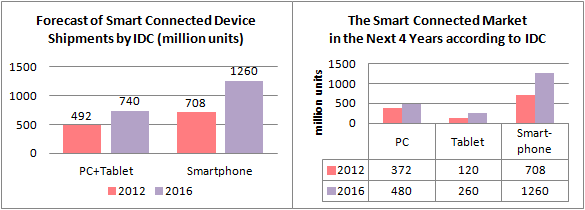
Source: IDC Expects Smart Connected Device Shipments to Grow by 14% Annually Through 2016, Led by Tablets and Smartphones [IDC press release, Sept 26, 2012]

According to the latest information from China the tablet market is quite underestimated by IDC:
How many tablets does China make, how big is the Chinese market?
80 percent of media tablets made in China are exported
 Unit: Million of units
Source: Chinese industry estimates
as China alone will be delivering 50 million tablets this year and the overall Chinese estimate is 155 million units vs. 120 million per IDC:
By volume, the Android tablet sector has grown to an estimated 80 million units, outpacing the 75 million iPads sold by Apple thus far, according to estimates by Rockchip [marketing] vice president Feng Chen.
as reported by Junko Yoshida, ex-editor in chief of EE Times who now has a strong emphasis on China as “a roving reporter”:
in China Fabless: Rockchip rattled by Android tablet wars [Sept 25, 2012]
Just nine months ago, Fuzhou Rockchip Electronics, a developer of apps processor for tablets, looked almost invincible. …
… since then, the Android-based media tablet market has gotten far more competitive. By volume, the Android tablet sector has grown to an estimated 80 million units, outpacing the 75 million iPads sold by Apple thus far, according to estimates by Rockchip [marketing] vice president Feng Chen.
…
At the beginning of 2012, the target price of a 7-inch capacitive screen media tablet featuring Cortex-A8 was $99. That price has since dropped to around $65, due largely to Allwinner, a red-hot Chinese fabless company that has flooded the tablet market with its own turnkey system. … Rockchip’s situation vividly illustrates the challenges most Chinese fabless chip companies now face.
During a recent interview with EE Times here, Rockchip’s Chen said, “This is a new world war we’re fighting.” … Indeed, nearly every apps processor [sic, SoC] vendor here is in a rough spot because “the time-to-market requirement has gotten much shorter,” he noted. “Worse, catching the market rhythm or cycle — at the right time – has become much harder.”
…
“… now, as end-product cycles get shorter, we do everything from designing a chip to developing a board and software that goes around the hardware — literally within a couple of months,” he explained.
In March, for example, Rockchipstarted to design its RK3066, a dual-core Cortex A9 chip with a quad-core Mali-400 GPU. By April [15], it hustled to showcase sample tablets based on the chip at the Hong Kong Electronics Fair. By May, the company began shipping the new apps processor to its customers.…
Note regarding the timing of RK3066 SoC development:
– The initial version of RK3066 datasheet brief is dated Oct 30, 2011. the 1.0 version of it February 15, 2012.
– The RK30xx platform was announced on Feb 27, 2012 with information that “Dual-core ARM Cortex-A9 processor with up to 1.4GHz speed, implemented with Artisan Processor Optimization Pack (POP)” and that “Samples of the Rockchip RK30xx platform will be available in March 2012.”
…
Unlike other startups here, Rockchip has been profitable from the start. But as the tablet battle heats up, it also needs to find a way to move to the next level. “We are fighting a world war. We need the world’s top talent.”
The company also needs access to capital. Without it, Rockchip can’t even think about mergers or acquisitions. Organic growth alone won’t get it to the next level, Chen acknowledge, saying he expects consolidation in the Chinese fabless sector but “no Chinese companies want to give up.”
Lastly, Chen said, “We need to be clear on the market” so that Rockchip can choose its battles.
Another of her observation:
– Yoshida in China: How Nokia failed, MediaTek won [Sept 26, 2012]
Earlier this month when I sat down for breakfast here with Feng Chen, vice president of China fabless company Rockchip, he abruptly asked if I knew the “80-3-2 rule.” I had never heard of it.
The subject came up as we were discussing the global media tablet market. Chen, who noted that this is his personal theory, not Rockchip’s, explained: If you design a system (or chip) with performance of at 80 percent compared to the best-in-class product on the market, and if you offer it at one-third the price, you can double the sales volume of your system (chip).
Chen used the media tablet market as an example. Many Android-based tablets with relatively less performance than Apple’s iPad, will eventually exceed sales of iPad in volume, he argued.
In other words, don’t over-engineer it.
Android, along with outsourcing and faster product turnarounds are the key elements that make the 80-3-2 rule possible. The rule also offers a mechanism for getting products in the hands of consumers.

Source: IHS iSuppli
Does the 80-3-2 rule make sense? Sort of.
The chart above illustrates the theory’s flaw: While Apple gets all the profits generated by the iPad, sales revenue for the Android camp is divvied up by many me-too Android tablet and chip suppliers. Presumably those companies, all subscribing to the 80-3-2 rule, are fiercely undercutting one another, further reducing their margins.
So, the 80-3-2 rule is simplicity itself, but it doesn’t look sustainable to me.
Chen’s theory reminded me of something else. The Economist carried a story about “frugal innovation.” The article cited companies like General Electric and India’s Tata Consultancy Services (TCS) that developed new products like a hand-held electrocardiogram (by GE) and a water filter (TCS).
“Instead of adding ever more bells and whistles, they strip the products down to their bare essentials,” embarking on “frugal innovation,” or as it is sometimes called, “reverse innovation,” the Economist explained.
According to the Economist, “Frugal innovation is not just about redesigning products; it involves rethinking entire production processes and business models. Companies need to squeeze costs so they can reach more customers, and accept thin profit margins to gain volume….”
Therein are the dots we can use to connect to Chen’s theory. His 80-3-2 rule also addresses the issue of how a company finds a way to develop a product and a business process to squeeze costs, gain volume and reach millions of new customers.
(Full disclosure here. The Economist article was first pointed out to me by a U.K.-based engineering executive who works for Taiwan’s chip giant MediaTek. He was explaining how MediaTek’s recent success has a lot to do with “frugal innovation.” MediaTek, virtually unknown 10 years ago, is now a power house with huge market share in the Chinese smartphone and media tablet markets.)
MediaTek has fundamentally changed the playbook for the chip industry here, especially for smartphones and tablets. More chip suppliers for smartphones and tablets who are competing with MediaTek are now expected to provide similar “turnkey systems” that MediaTek delivers, rather than just reference designs.
Technology development, especially in the electronics industry, has historically been one-dimensional. It all pretty much comes down to how your engineering team makes a system operate faster, run more apps and features, while consuming less power.
Frugal, or reverse, innovation and the 80-3-2 rule both suggest that it’s time to rethink innovation in more in multi-dimensional terms.
I can think of two good examples for how ignoring reverse innovation costs companies. … Nokia … Japanese LCD TV manufacturers like Sharp …
Her latest report continues with Yoshida in China: ‘Shanzhai’ clouds tablet data [EE Times, Nov 8, 2012]
NEW YORK – The global tablet market may be a lot bigger — perhaps as much as 50 percent bigger — than previously thought depending on how you measure the increasing numbers of “Shanzhai” tablets produced in China.
Loosely translated, “Shanzhai” means white box, as in, no label. These tablets manufactured in China are distinguished from “knockoff” products, which the original Chinese term “Shanzhai” suggests.
Earlier, I wrote about the global market for tablets during the third quarter of this year. According to estimates, shipments reached 27.8 million units.
Several industry sources based in Beijing and Shenzhen responded with notes saying that the math behind the industry estimates didn’t add up. The Chinese observers argue that most estimates ignore the size of the white box tablet market.
Factoring in the number of apps processors shipped by Chinese fabless companies and tablet displays from its panel vendors, the number of white box tablets made in Shenzhen during the third quarter could total as high as 18 million units, Chinese sources claimed.
Add those to the branded tablets sold by Apple, Samsung, Amazon, Asus and Lenovo and the global tablet market in the third quarter jumps to 42.5 million units. That’s 52 percent more than the global total estimated by IDC in 3Q.
This huge gap makes me wonder what other Chinese consumer electronics products are uncounted or under-counted.
One thing to take into account is Chinese fabless chip company Allwinner Technology — how it operates and and how it has taken advantage of the growing white box market.
The applications processor vendor has substantially expanded its market share over the last 18 months, primarily based on the strength of its turnkey system that has been described as “super easy to use” by Chinese industry sources. The solution allegedly makes it a snap for practically any white-box vendor to make media tablets and ramp up production in a Shenzhen minute.
According to sources in Shenzhen, Allwinner holds as much as 60 percent of the white box market and shipped 3.5 million apps processors in August alone. Allwinner is said to have shipped 5 million apps processors in October, generating $30 million revenue (at a $6 average selling price). If true, wow!
The momentum behind white box tablet production in Shenzhen is building. Chinese sources now believe shipments have climbed from 6 million units in August to 9 million in October.
Who’s buying all these tablets?
A source in Beijing describes them as “tablets shipped by no-name brands at about $50.” The end market is not necessarily China, but “mostly emerging economies including Southeast Asia, the Middle East, Eastern Europe, South America and Africa, etc.” He added that Chinese consumers “have similar tastes and demands as those living in the developed world. They don’t really buy these low-end tablets. They buy iPad or Samsung.”
If true, we may need to rethink not just the size of the booming tablet market, but the consumer revolution triggered by the tablet market well beyond China’s border.
The lack of recognizable brand names makes it that much harder to track unit shipments. Plus, chip shipment figures can be inflated or double-counted. Then there is China’s vast gray market.
Even taking all of those factors in account, the explosion of tablets in emerging markets is no mirage – and it might be spreading much faster than any one imagined.
For example, one source in Shenzhen estimates that annual shipment of white box tablets this year could hit 50 million units.
With all that she (Junko Yoshida) came closest from the West to understand the new ICT phenomenon rooted in China. Now let’s look at what others have come to so far:
The overall tablet market trend is illustrated by IHS iSuppli via the tablet display shipments as follows:
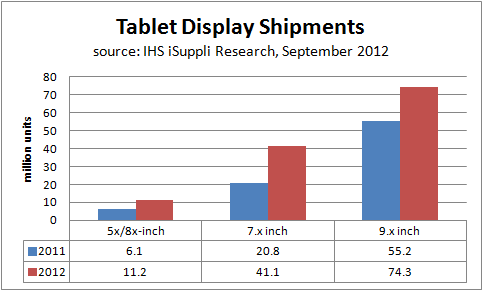
then it is described in Global Tablet Display Shipments to Soar by 56 Percent in 2012 [IHS iSuppli press release, Sept 17, 2012] as:
… [the first part of the press release is essentially giving information which is represented by the diagram above] …
LG and Samsung Dominate Tablet Display Shipments
LG Display and Samsung Display were the main suppliers of tablet displays in the first quarter with 42 percent and 38 percent shipment market share, respectively. Both are market leaders because they make the liquid crystal display (LCD) panels that are used in the iPad, which continued to dominate the media tablet space with a commanding 58 percent of all tablets shipped in the first quarter.
[LG Display holds 70% of iPad panel shipments [DIGITIMES, Sept 20, 2012]: while Samsung Electronics, Sharp and Chimei Innolux (CMI) have all been seeing decreasing shipments … CMI will make up less than 5% of overall iPad panel shipments by the end of the third quarter in 2012.]
Aside from supplying Apple, LGD also furnishes display panels to Amazon and Barnes & Noble, while Samsung provides panels to its internal tablet division. Investments are being made by the two major tablet panel suppliers in capacity allocation and technological improvements to supply high-performance tablet panels and to develop wide-viewing-angle technologies like in-plane switching (IPS) and fringe-field switching (FFS). Both LGD and Samsung Display are also looking to convert amorphous-silicon fabs into making oxide silicon panels to help improve tablet panel resolution, power consumption and overall performance.
Panel Manufacturers Enter the Tablet Panel Fray
Other LCD panel suppliers also are jumping into the fast-growing tablet market. In particular, Japanese suppliers such as Sharp, Japan Display and Panasonic are actively targeting the tablet panel market by dedicating capacity at their Generation 6 and Generation 8 fabs in order to make tablet panels.
Together the capacity allocation this year for small and medium displays by the Japanese is expected to increase 164 percent from last year’s levels, reaching 5.5 million square meters in 2012. Of particular interest is the oxide silicon capacity at Sharp, which has been supplying panels from its G8 fab for the latest iteration of the iPad—also called the new iPad. Another company, Panasonic, is likely to produce 7.x-inch and 8.x-inch tablet panels during the second half of this year.
For their part, LCD suppliers based in Taiwan, such as AU Optronics and ChiMei Innolux, reportedly are adjusting their business models—some to focus on tablets for the education sector, and others to supply tablets for the white-box market in China.
It is believed that AUO may be one of the suppliers qualified to supply the smaller iPad’s 7.85-in panels.
But unlike Tier 1 tablet display makers LGD and Samsung Display, Taiwanese panel suppliers primarily target the Chinese market that is geared more toward lower-priced tablets. To meet lower price points, display specifications are usually dialed down compared to Tier 1 products. Displays targeted at the white-box tablet market in China mainly employ the more basic twisted nematic (TN) LCD, not the wide-viewing-angle LCD technologies of IPS and FFS.
Regardless of the display technology and market segment, display suppliers are making sure they align their strategies to serve this fast-growing market.
Chimei Innolux to Win 40%-50% Share of White-brand Tablet PC Touch-panel Market [CENS, Aug 15, 2012]
Chimei Innolux Corp., the largest thin film transistor-liquid crystal display (TFT-LCD) panel manufacturer in Taiwan, is expected to win a 40% to 50% share of the global market for white-brand tablet PC applications, according to the company.
Some 40 million to 60 million white-brand tablet PCs are expected to be shipped this year, similar to the total shipments of Apple`s iPad.
Major market research firm DisplaySearch recently forecast that some 121 million tablet PCs would be shipped worldwide this year, and the annual volume would increase to 416 million units in 2016, in conjunction with a compound annual growth rate (CAGR) of 28% over next five years. Apple would continue to be the market leader in next five years with a market share of 60%, while white-brand counterparts are expected to enjoy high growth due to their advantageous pricing.
Jeff Hsu, Chimei Innolux`s vice president, pointed out that demand for white-brand tablet PCs from emerging markets has been quite strong this year. In addition to sales in China, many Chinese white-brand tablet PC makers also export products to other nations. So, the annual demand for touch panels for white-brand tablet PCs this year is expected to reach some 60 million units, with 7-inch models as the mainstream and followed by 10-inch ones. Chimei Innolux aims to ship more than 25 million touch panels for white-brand tablet PCs, accounting for 40% to 50% of the application market, Hsu said.
Hsu also added that this year, the mainstream touch-panel type in tablet PC application has shifted from resistor to capacitive, which is expected to benefit many Taiwanese suppliers with more advanced technology. Jtouch Corp. of Taiwan, for example, is stepping up boosting production capacity of its new touch-panel factory in Hunan Province of China. The firm`s large-sized touch panels are expected to account for more than 20% of its revenue this year. Mutto Optronics Co., Ltd. recently also won big-ticket orders for tablet PC touch panels, and expected to see a 30% sequential revenue growth in the third quarter.
Google recently pushed its Nexus 7 tablet PC priced for only US$199, and the company immediately sold out one million units. A white-brand tablet PC with 7-inch screen is often priced for about US$100 only, and such more affordable device has won very hot market responses in Latin America, Southeast Asia etc. Currently, monthly tablet PC shipments in China are between three million and four million units.
However in Tablet PCs will have good sales in the third quarter [Micdigi from China, July 19, 2012], from a knowledgeable source in Shezhen:
In the first quarter of 2012, the manufactures have good business, but in the second quarter they have so worse business.
As they have produced so many products in the first quarter, they have large stock of goods that they have to mark down price to sell them.
In the second quarter of 2011, the tablet PCs has good sales. But in this year, it is so cold.
In the third quarter, tablet market will rebound.
VIA chips was the winner in all the chip manufactures last year.
But in this year, Allwinner with high cost/performance chips gets the winner.
Most of Shenzhen tablet manufactures export to other countries. Because Chinese do not like knock off tablet PCs or SurperPad tablet PCs, they like brand ones.
In the third quarter, the tablet market will rebound and the fourth quarter will be the boom season.
I think the manufactures must get ready for the fourth quarter.
They had better prepare products with high cost performance.
This is one of the reasons why Nexus 7 not yet allowed to enter China market [Sept 11, 2012]:
While the Nexus 7, the tablet co-developed by Google and Taiwan-based vendor Asustek Computer, has been witnessing booming sales in major markets around the world, it is difficult for the model to be available for sale in the China market because the China government has not yet approved its import, according to industry sources in Taiwan.
The China government’s negative attitude is interpreted as a response to Google’s announcement of withdrawing from the China market in March 2010, the sources pointed out. It is difficult for the Nexus 7 to enter the China market, even through sale of Asustek’s marketing network there, the sources indicated.
Without the Nexus 7 in the market, China-based white-box vendors of tablets are under much less competitive pressure, the sources indicated. This is because the Nexus 7 has the advantage of Google’s and Asustek’s brand image with commensurate product quality and is expected to be strongly competitive with 8GB Android 4.0 tablet models in the 7- to 9-inch range launched by China-based white-box vendors, including Ainol, Onda, Teclast and Cube, at US$149, the sources pointed out. In addition, the Nexus 7 will bring competitive pressure on tablet PC models of equal specifications offered by Samsung Electronics and China-based vendors Lenovo and Hasee Computer in the China market, the sources indicated.
Without the China market, the cumulative global sales volume of Nexus 7 will reach an estimated 3.5 million units at the end of 2012, the sources noted.
Tablet Shipments to Surpass Notebook Shipments in 2016 [NPD DisplaySearch press release, July 3, 2012]
Total Mobile PC Shipments Exceed 800M Units by 2017
Tablet PCs, such as Apple’s iPad, are expected to be the growth driver for the mobile PC market over the next few years. Tablet shipments will surpass notebook shipments in 2016, according to the latest NPD DisplaySearch Quarterly Mobile PC Shipment and Forecast Report. Overall mobile PC shipments will grow from 347M units in 2012 to over 809M units by 2017.
While notebook PC shipments are expected to increase from 208M units in 2012 to 393M units by 2017, tablet PC shipments are expected to grow from 121M units to 416M units in this period, for a compound annual growth rate of 28%. A key driver for tablet PC growth is adoption in mature markets (including North America, Japan and Western Europe), which will account for 66% of shipments in 2012 and remain in the 60% range throughout the forecast period. Tablet PC shipments into mature markets will grow from 80M units in 2012 to 254M units by 2017.
Figure 1: Worldwide Mobile PC Shipment Forecast (000s)

Source: NPD DisplaySearch Quarterly Mobile PC Shipment and Forecast Report
“Consumer preference for mobile computing devices is shifting from notebook to tablet PCs, particularly in mature markets,” said Richard Shim, senior analyst at NPD DisplaySearch. “While the lines between tablet and notebook PCs are blurring, we expect mature markets to be the primary regions for tablet PC adoption. New entrants are tending to launch their initial products in mature markets. Services and infrastructure needed to create compelling new usage models are often better established in mature markets.”
Figure 2: Emerging and Mature Market Tablet Shipments (000s)

Source: NPD DisplaySearch Quarterly Mobile PC Shipment and Forecast Report
Building upon convenience-oriented features including instant-on capability, long battery life and extreme portability, tablet PCs are expected to evolve in form factor and performance, making them a compelling alternative to notebook PCs. Tablet PCs are expected to incorporate multi-core processors, increasingly stable operating systems, growing app libraries and higher resolution displays.
In addition, notebook PCs are also evolving to meet the challenge from tablet PCs. Thinner form factors, higher resolution displays and touch functionality features are expected to increase. The notebook PC market will remain the largest part of the mobile PC market during the forecast period, accounting for 60% of mobile PC shipments in 2012, declining to 49% by 2017.
Digitimes Research: China tablet SoC developers enjoy robust shipment growth in 2012 [DIGITIMES Research, Nov 20, 2012]
There has been a surge in demand for tablet-use SoC solutions in the China market thus far in 2012, benefiting local IC design companies such as Allwinner Technology, Rockchip Technology and Amlogic, according to Digitimes Research. The tablet-IC market in China is dominated by local SoC developers, which mainly adopt the ARM architecture enabling a low-cost and easy-to-design platform.
Shipments of China makers’ branded and white-box tablets destined for the local market are forecast to reach about 15 million units in 2012, while those destined for overseas will climb to as high as 44.15 million, Digitimes Research said. In total, shipments of China makers’ branded and white-box tablets are estimated at nearly 60 million units in 2012, Digitimes Research indicated.
China’s white-box tablet companies will account for 81% of the overall units shipped in 2012, Digitimes Research said. Shipments of China’s brand-name tablet companies are set to reach only about five million units in 2012, Digitimes Research added.
Europe, the Middle East, Southeast Asia and South America are the key markets which China-based tablet exporters will target in 2012, Digitimes Research noted. The exporters, mainly white-box makers, have their products sold through local distributors and telecom carriers in the target markets. [8%]
Allwinner will unseat Rockchip as the top developer of tablet SoCs in 2012. Allwinner is forecast to ship a total of 22 million chips in 2012 [37%], while Rockchip‘s shipments will total 12.5 million units [21%], Digitimes Research said. Amlogic will rank third with shipments of 5.5 million units [9%], followed by Taiwan-based VIA Technologies with 4.5 million units [8%], according to Digitimes Research.
Source: Digitimes Research, November 2012
Non-Apple tablets to drop to US$150-200 upon release of upcoming 7.85-inch iPad [DIGITIMES, Sept 18, 2012]
Tablets priced US$199-400 are expected to drop in price to US$150-200 in order to help non-Apple tablet makers stay competitive when Apple releases its reported 7.85-inch iPad, according to industry sources.
The sources are predicting that Apple will have a big influence on the 7-inch tablet market just like it currently has with its 9.7-inch iPad series and competitors will need to drop their tablet prices as well as provide more value-added features for the devices, said the sources.
If major tablet makers were to drop product prices they would most likely not incur losses as many makers make a substantial amount of profits from 3G plans with telecommunication providers, added the sources.
The sources still haven’t confirmed an exact release date for Apple’s 7.85-inch iPad but are expecting it will be early in the fourth quarter.
MediaTek’s Q3 sales expected to beat company’s guidance [Focus Taiwan, Sept 16, 2012]
… Bill Lu, a Morgan Stanley analyst in Hong Kong, expected MediaTek to ship over 200 million smartphone chips in 2013 by offering a more complete solution to Chinese handset. …
Another upside factor for MediaTek is growing interest in “white-box” tablets in emerging markets, which could approach 100 million to 150 million units in 2013 and drive up MediaTek’s revenue if the company can tap into the supply chain, Lu said.
A white-box tablet is a model without a registered brand name, which is usually sold more cheaply than branded tablets to gain traction among price-sensitive consumers.
Global shipments of white-box tablet PCs to reach 40 million units in 2012, say chip designers [DIGITIMES, July 25, 2012]
Forecast global shipments of white-box tablet PCs in 2012 have been upward adjusted from 30 million units originally to 40 million units due to growing demand in emerging markets including China, India, Thailand and Latin America, according to Taiwan-based design houses of ICs used in tablet PCs.
An estimated 10 million white-box tablet PCs were shipped globally in 2011, and shipments increased to 18 million units in the first half of 2012, the sources indicated.
Vendors/makers of white-box tablet PCs currently cluster in Shenzhen and Dongguan, southern China, the sources noted. A large portion originally made netbooks and have stepped into tablet PCs as chips and the Android operating systems have matured, the sources said.
White-box tablet PCs are primarily competitive in price with models launched by own-brand vendors, with retail prices standing at US$59 for 7-inch models and US$149 for 10.1-inch models, the sources indicated.
China white-box vendors showcase tablets at HK fair [DIGITIMES, April 16, 2012]
Many China-based white-box vendors are showcasing 7.0-inch tablet PC models at shipment prices of US$65-80 and 10.1-inch models at US$100-110 at the 2012 Hong Kong Electronics Fair (Spring Edition) taking place during April 13-16.
These white-box vendors include Dream Technology, Aocos, PCTX, HKC, Onn and Onda.
These tablet PC models are equipped with chipset solutions mostly developed by China-based Allwinner Technology, Android 4.0, Wi-Fi modules, 4GB built-in memory, 800×480 or 1,024×600 16:9 touch screens, plastic casings. In addition, 9.7-inch tablet PCs equipped with IPS touch screens and metal casings are priced at US$130-140.
If these tablet PC models are also equipped with 3.5G modules, shipment prices will increase by US$45 on average, according to white-box vendors.
White-box vendors indicated that they have reached combined shipments of three million tablet PCs a month.
China-based white-box tablet PC makers ramping up shipments, say sources [DIGITIMES, April 13, 2012]
China-based white-box tablet PC makers have ramped up their combined shipments to three million units a month recently, and total shipments of tablet PCs by all makers are expected to top 50 million units in 2012, market research firm eMedia Asia has estimated.
In Guangdong province alone, hundreds of small- and medium-size businesses have entered the development and production of tablet PCs on an OEM, ODM or OBM basis, according to industry sources.
With the availability of Android 4.0 platform, white-box makers have rolled out tablets in 7-, 8-, 9.7- and 10.1-inch sizes with specifications catered to customer’s demand, said the sources, adding that the models target markets in the Middle East, Southeast Asia and Latin America.
The white-box makers are able to deliver a 10.1-inch model, which runs on Android 4.0 and has a display resolution of 1024 by 600 and 4GB built-in storage, at FOB prices of about US$100-110, indicated the sources.
Shipments of tablet PCs by China-based makers totaled 14 million units in 2011, eMedia Asia said.
Suggested further reading: Here is a recent set of briefing documents produced by Seasize Technology Co., Ltd, formed in 2007 in Shenzhen China with roots in trading of electronic goods for export as early as 2005, see: Support [Seasize, Aug 20, 2012]
Download Free
CHINA TABLET PC SOURCING GUIDE (English) [Aug 8, 2012]
This is a guide to purchasing (“sourcing”) from China, and working with Chinese factories. It will probably be most helpful to people like me – entrepreneurs developing a new product or starting a new business that need to obtain parts and raw materials from China. It is written humorously, but hopefully there is some useful advice.
CHINA TABLET PC WHOLDSALES MARKET 2012(English) [Aug 7, 2012]
This article is provided by Seasize Technology- professional tablet PC manufacturer in Shenzhen,China, exclusively to customers. You may share this information to your friends and colleagues. Seasize should not be held responsible for any information that may be misleading or incorrect.
CHINA TABLET SOLUTIONS INTRODUCTION(English) [Aug 8, 2012]
This article is provided by Seasize Technology- China popular tablet pc solutions:chips company&chips introduction. The performance of a tablet model is determined by the tablet solution. To select and source the right tablet products, you have to know the difference among tablet solutions and identify the right tablet designers and manufacturers.
which are giving a kind of industry insider’s view into the complex world of the Chinese ICT goods market.
How relevant is it? A year earlier Company Introduction [Sept 5, 2011] described Seasize Technology’s business as:
After years of development, Seasize technology already has a strong domestic procurement and export capacities. We are committed to provide affordable and quality digital video and GPS navigation products. Our company persist the principle of: Customer first, quality first not only meets the needs of customers and has been recognized by customers.
Since its inception, the company mainly engaged in two major product lines: digital audio playback systems and GPS navigation devices,
Digital audio and video aspects of the products covered MP3/MP4/MP5 players, digital TV set-top box, digital television etc.
GPS navigation devices contain : GPS navigator, GPS tracker, networking version of GPS, GPS navigation and digital TV combo products, and the recently launched GPS navigation function with Internet personal terminal device (MID).
Based on trade in the same time, has been developing its own brand and own technology products, after years of effort, the company has filed multiple patents in the country, and has registered the brand. Dependent on many years of trading experience and technology accumulation Seasize Technology already has more advanced ability to enter this industry. It can be expected in the near future that we will get a place in the relevant fields, and access to long-term development.
Its new profile [May 27, 2012] stated a subsequently changed description as:
After years of development, we have grown up into a strong company which enjoys many advantages from procurement, production and export. We have passed ISO9001:2008 certificate in year 2011 and established a standard quality system that will ensure our delivery of quality product to our customers. Our product lines include two areas: digital audio&video products and GPS-related products. We are committed to provide our customers with cost-effective solutions, whose value has been seriously balanced against its prices.
and then there is a SOURCING GUIDE-Android Tablet pc,tablet pc,wifi tablet pc,google tablet pc,tablet pc review,wholesale tablet pc [Aug 8, 2012] page which was quite probably the marketing campaign page for the above documents with leads generated via registrations for each, with more direct indication of the China Tablet Solutions Introduction [Aug 8, 2012] as well as another one of Risks of Doing Business in China.
Seasize therefore is definitely trying to expand its purchasing business as well, so its documents could be valuable, even sufficiently authentic for those people who are potential partners of Seasize. As such these documents might describe the purchasing situation over there for everybody else as well. For Seasize’s track record of activities see: Seasize Technology Co., Ltd.: Newsletter Archive [May 31, 2011 – Aug 7, 2012 and beyond].
4. The Allwinner advantage 全志
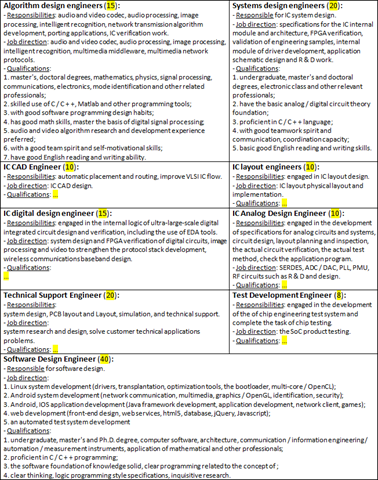 珠海 Zhuhai 全志科技 Allwinner Technology (150 ~ 499 employees) — 148 campus hirees only for 2013 (click here for a full content) recruited with a roadshow held in:
– 西安 Xi’an: at 西安交通大学 Xi’an Jiaotong University (XJTU) on Sep 18; at 西安电子科技大学 Xidian University on Sept 21
– 哈尔滨 Harbin: at 哈尔滨工业大学 Harbin Institute of Technology on Sept 25
– 武汉 Wuhan: at 华中科技大学 Huazhong University of Science & Technology (HUST) on Sept 22.
– 广州 Guangzhou: at 华南理工大学 South China University of Technology (SCUT) on Sept 17, at 中山大学 Sun Yat-sen University TBD
– 成都 Chengdu: at 电子科技大学 University of Electronic Science and Technology of China (UESTC) on Oct 11.

From jobyun.com:
= US$ 1,113
Company Overview of AllWinner Technology Co., Ltd.
[Bloomberg Businessweek]
AllWinner Technology Co., Ltd. engages in mixed-mode SOC technology research and VLSI design. The company’s products are used in high-definition television and digital photo frame markets. It also provides support services. The company was founded in 2007 and is based in Zhuhai [Guangdong province], China.
From: AllWinner Technology Selects ARM Cortex CPU and Mali GPU Technologies To Bring Integrated SoC To Android OS-Based, Connected Consumer Devices [ARM press release, April 12, 2011]
AllWinner Technology Co., Ltd was founded in 2007, and is engaged in mixed-mode SOC technology research and VLSI design. AllWinner Technology is dedicated to be the major leader in the HD media field, to excel in low-power VLSI design, advanced technology and innovative architecture; to be the pulse of the consumer market, with a unique understanding of self-developed core technologies. Through functionality, performance and cost advantages of integrated products and the industrialization of the operational capabilities of the market to provide customers with leading designs and services from SOC products to comprehensive solutions.
From: Zhuhai sez daily: Gan Lin investigated in high-tech zones “two little two two high” enterprise [Allwinner press release, June 10, 2010]
… Gan Lin, Party Secretary of Zhuhai city … accompanied by director of the CMC Qiu Shi, successively investigated the Kingsoft Park (Jinshan Software Park) project site, Xuan Garment Co., Ltd. Design Center, BOXlight (Po Wright) Medical Technology Inc., Tin Shui Power Technology Limited, Allwinner Technology Co., Ltd. and Bioenergy Limited. …
Zhuhai Allwinner Technology Limited is committed to becoming a leader of application requirements in the area of key technologies for HD multimedia and communication networks, radio and television networks, and the Internet “triple play”; specializes in low power VLSI design capacity of independent research and development of core technologies, has completely independent intellectual property rights. According to the General Manager [Chairman and CEO] of the company, Zhang Jianhui (张建辉), the Allwinner company was established in 2007. In the first two years to April 2009, the company had been working hard on technology R & D and did not earn a penny, then launched two categories for the introduction of a series of nine full HD network integrated smardescriptiont chips in order to become one of the leading manufacturer of ultra-large-scale system-on-chip and embedded software technology.
…
The roots of the Allwinner Technology:
May I ask [about] Zhuhai [珠海] Victory Technology [全胜 科技] – How can I like it? [http://laoyaoba.com in Chinese, Oct 23, 2010]
Looking for a job, this company has come to our school, a little want to go, but I don’t know how on Earth is this company, [since there is] almost no information on the Internet, looking for an insider look, appreciate it!
… The entrepreneurial team of Zhao Guangmin[赵广民先]’s [Zhuhai] Actions Semiconductor Co., Ltd. was brought over after Zhao’s unfortunate, untimely death. The Zhang Jianhui[张建辉]-led team, however, is still very strong in the Chinese semiconductor industry. It began to grab the PMP [Personal Media Player >>> MP3 etc.] market share last year, and it is estimated that [its] revenue this year should be around $ 30 million ….
The life and spiritual heritage of the legendary Chinese IC design industry leader Zhao Guangmin [Baidu in Chinese, Aug 27, 2007]
… In early 2006, Zhao Guangmin left Actions, where had been working for a number of years, and with a number of like-minded partners co-founded Victory (Zhuhai) Microelectronics Co. as chairman with aspirations to win a new peak. …
Actions pass the sudden departure of founder, investors have been excluded [VentureData.org, April 4, 2006], the picture of Zhao Guangmin below is from this source which is the Chinese origin of this material below:
Led the company successfully landed on the Nasdaq after 4 months, founder of Zhuhai Actions Semiconductor Co., Ltd. (hereinafter referred to as “Actions”), Zhao Guangmin [then vice chairman of the company] suddenly announced his resignation.
…
Zhao Guangmin the early 1980s graduated from Xi’an Jiaotong University, has a number of Semiconductor companies in the office. Zhao Guangmin founded in December 2001 and served as general manager [not CEO] of Actions. Actions a total investment of $ 10 million, primarily engaged in the development of VLSI design and test production. Taiwan-funded by the holding of shares in which Zhao Guangmin unknown.
Under Zhao Guangmin leadership, relying on keen to capture the opportunity to MP3 chips, Actions to achieve rapid development. In 2002, Actions Semiconductor sales only 1.08 million yuan [US$ 130K]; in 2003 sales increased to
4,000 million[US$ 4.3 million – see the chart later]; in 2004 sales soared to more 460 million [US$ 55.5 million], net profit up 200 million yuan [US$ 24.1 million].At the same time, Actions also introduced more than a dozen proprietary chip. In 2004, the company was selected as the China Semiconductor Industry Association, the annual top ten IC design companies. To the fourth quarter of 2004, Actions in the global chip market share in the first MP3.
November 30, 2005, to Actions as the main Action Semiconductor Co.Ltd (Nasdaq: ACTS) in the U.S. Nasdaq market, the first phase of financing $ 72 million. Since listing, the market responded well to the Actions, and there have been investment banking analyst cut its rating to “buy.”
Actions with the same period of rapid development and to the patent dispute. Zhao Guangmin issue in the mail two days before departure, the U.S. International Trade Commission a preliminary ruling, Actions part of the audio processor infringes two U.S. SigmaTel’s patents. SigmaTel is the world’s leading mobile phones and digital audio players, chip vendors, the company early last year to the U.S. District Court in Austin, sued Actions Semiconductor infringed its patents.
“Now I can not say anything, but to leave and certainly nothing to do with the lawsuit.” Zhao Guangmin side of the phone hesitantly.
Zhao reasons for leaving, Actions official answer is “retired.” One of the company staff responsible for media relations, said, “Although less than the retirement age, but Zhao fame in this industry has made the decision to retreat is also very natural.”
However, close to Zhao Guangmin the industry does not think so. He said that Zhao’s departure and the investors.
The source said, as early as Actions Prior to listing, to facilitate investment in the idea of a replacement company executives. Public information, Zhao Guangmin general manager of the term of Actions of August 2005, is the company going public push. Zhao’s successor as general manager, is working with many years experience in the semiconductor industry, China Taiwan nationals Yenan Hong.
On this course, after listing a media interview, Zhao Guangmin stunned: “In order listed, and sometimes take their cut first!”
According to Zhao said, in order to make more in line with investors Actions taste, Actions update prior to listing a number of board members and executives. Most of these people in the chip industry has a deep background and is familiar to foreign investors, including former vice president of operations SMIC Chiu Tsz Wan.
Interestingly, in the Actions of the prospectus, as the founder of Zhao Guangmin not appear in the list of shareholders, executives, Zhao’s team did not name.
Further explanation is given here, only two sentences are important to quote (the picture of Zhao Guangmin below is from this source which is the Chinese origin of this material below):
… [Till] June 2005 Zhao Guangmin has been Actions’ general manager, [then] since June
to becomevice president, and in November the company officially listed [that] Zhao Guangmin had [been] transformed into a vice chairman. … In fact, although ZhaoGuangmin since 1993 aswas general manager of Zhuhai Actions, but hehashad no control of the company, the companyhashad been in a firm grip on the hands of equity investment in Taiwan.
Note that Actions is a still existing company keeping its description as under Zhao Guangmin’s leadersip: About Actions [Sept 6, 2005]
… Actions has successfully put into market some products, such as digital audio/video SOC chip and its total solution, a series of IC for digital potential meter, SOC chip for TV entertainment products and its total solution, … etc, since the first day it was found. All Actions’ products are under the protection of intellectual property law, and have been gradually showing their competitive power after directly joining the international market.
With management and techniques accumulated, high-tech and product positioning, precise market position, strong innovative power, Actions sustains fast improvement and development. In 2003, Actions was identified as one of the top 10 fastest growing IC design companies within the China area by the China semiconductor association; the same situation will happen again in 2004 as well.
Actions’ latest product developed under his leadership: Actions Introduces New Video Technology — Advanced Media Video (AMV) [Actions press release, April 10, 2006]
… provides comprehensive mixed-signal system-on-a-chip solutions for portable consumer electronics, today introduced a new generation of video technology, Advanced Media Video-AMV3.0. This new technology supports a higher degree of picture resolution (QCIF i.e. 176 x 144), a better display of motion picture than the AMV1.0 and 2.0 technologies, and is capable of converting SWF files and other regular movie formats. This technology was developed specifically to be the video engine for Actions’ new 9 series SoCs.
The history of Actions’ audio and video technology can be traced back to 2004, when Actions introduced two video technologies, MTV1.0 and MTV2.2, ahead of a majority of its competitors. This breakthrough innovation of Actions had risen the technology playing field of the entire digital music industry to a higher level.
…
“Although our current 9 series SoCs require conversion software to enable playback, our next generation of SoC products, embedded with a MIPS core, will support direct streaming video playback. With the benefits of a MIPS core, the data processing speed will be much faster,” continued Mr. [John] Lee [Senior Product Manager of the company].
“The advancement of our MIPS core technology will remain consistent with our development in AMV4.0. Furthermore, based on the MIPS platform, both the design house and the manufacturer will be able to freely take full advantage of their expert technology, thus providing them with a favorable position in a fiercely competitive market,” concluded Mr. Lee.
Here is the “Proven Management Experience and Expertise” slide (#11) from the May 2006 Corporate Overview of Actions presentation. Note that this was immediately after the departure of Zhao Guangmin and there were three managers from the original founding team, neither of them with executive power (as evidenced by EDGAR submissions), and only Shao Chuan (Shawn) Li is still with Actions as a director of the board (since September 2005) but more importantly as Chief Technology Officer (since the establishment of Actions in December 2001), while Zhang Jianhui was the head of Multimedia Division and as such he was the topmost manager with core innovation competency, and it was no surprise that he left Actions when Zhao Guangmin established his next venture, Victory (Zhuhai) Microelectronics Co. which after his death became the current Allwinner managed by Zhang Jianhui. (There is no information about Gong Hui.) Note as well that at the time of that presentation Actions had 280 employees; 210 engineers with IC, system, and software capabilities.
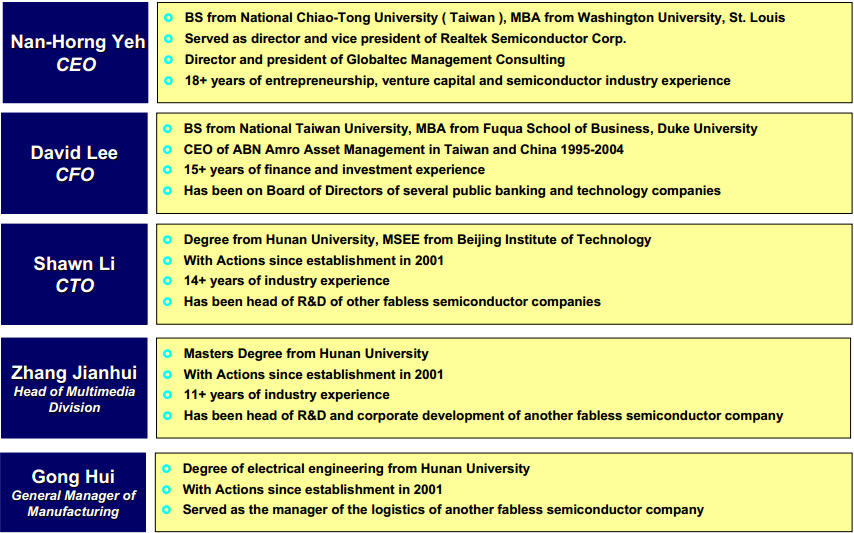
 It is quite remarkable that after Zhao Guangmin’s departure Actions went into decline as visible from the chart showing the revenues generated by the company. With $150M in 2005 Actions was the second-largest China-based fabless company. Employing not less than 280 people in 2006 the new Taiwanese executive duo of Nan-Horng Yeh as CEO and David Lee as CFO (both educated in the United States) have completely failed. This is all despite of their strategy to move into midrange products by developing mobile TV SoCs via licensing core technology from U.S.-based Mavrix Technology. See: SoC firm finds fertile ground in China [EDN, Aug 22, 2006]. This licensing decision led only into an industry sideline with stronger external reliance on MIPS processor cores (originally selected by Zhao Guangmin in July 2005 as the vice president, but for fast internal development) and a subsequent, necessary acquisition of Mavrix as licensee in 2010. Paradoxically Mavrix’s CEO, Dr. Zhenyu Zhou became even the CEO of Actions in December 2011. Only David Lee has still a high-level position with the company as chairman of the board. The future outlook for Actions is also rather uncertain as only a single analyst had any interest in the company’s Q2 2012 Results Call [Aug 7, 2012].
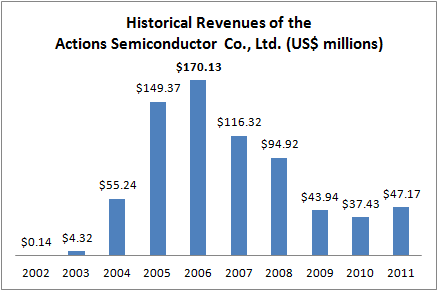
What a contrast with Zhao Guangmin’s new company which became after his death today’s Allwinner. Here is the Commemorate [what] Zhao insisted: a win-win situation, team together and do things realistic [Aug 24, 2007] by his deputy (??) and effective successor in charge of his Victory Microelectronics Co., Ltd., Zhang Jianhui:
Zhao went away from us, the circle of friends chatted about Zhao, and so far we are still unable to accept that this is a fact. Remembered Zhao, in addition to in the legendary entrepreneurial experience at Actions, we talk about the most, is the insistence of Zhao and low-key.
Speaking of the insistence of old Zhao, when Zhao won the Zhuhai Special Economic Person of the Year in 2004, in an interview he said: “As long as you choose the right direction, be sure to persist in walking, did not insist on was not successful.” It is this insistence on belief and perseverance of action which created Zhao’s unusual success story.
First, Zhao insisted on the concept of win-win, through the development of core IC products to add value for the customer, and industry chain downstream supporting enterprise vertical and horizontal, building win-win business model among enterprises, resulting in overall lead between the company and the customer.
Zhao served as general manager of Actions by virtue of more than 10 years accumulated of IC design and enterprise operating management experience. He led there a well-trained professional operating team to share common goals, to carry out efforts with hard work, to get global semiconductor industry attention via achievements. This made Actions from an unknown small company, in just a few years, China IC design industry’s first to become a globally known enterprise. The MP3 multimedia master chip R & D accounted for more than 50% of the world market share. This led to billions of dollars via the quick formation of the MP3 industry chain in China, prompting mainland China to become world’s major export base of MP3 which has brought tremendous development and benefits to the consumer electronics industry [here].
This was for the first time as a mainland China IC design company established itself in the field of global consumer electronics products, mastered and mass provided the core technology products with international advanced level. Actions’ operating income grew significantly from a few million yuan in 2002 to 1.2 billion yuan in 2005, [thus] creating rapid growth of more than 100 times for the Actions Semiconductor in three years only, and [then] eventually prompting the success of Actions to be listed on NASDAQ.
Second, Zhao insisted on the need to uphold the integrity of the fundamental values [which] can be established between the team and the customer, [on the] long term sustainable growth of business culture, [that] the strength of the team is always greater than the power of any individual.
In the early venture days of Actions Zhao personally wrote a column for the internal publications, talked about the issues of development ideas and the reform of corporate culture, and also to encourage other executives to write articles for publication. Fixed each Wednesday [?his?] commuting leadership talked about the exchange of business issues, to develop common thinking habits and language of communication – because every time before this would open, the kitchen will cook a pot of noodles as participants of dinner, affectionately called “noodles will”.
This will sometimes be open until two o’clock at night, and the truth is argued more and more out; companies and departments use the monthly regular meeting with employees face-to-face communication. After a year passed, not only everyone has made great progress, but he also formed a fully functional teamwork of high degree of homogeneity and quality, great combat effectiveness of entrepreneurial backbone of the team, and subsequently laid a very good foundation to the success of the company.
Third, Zhao insisted on doing anything seriously, down-to-earth. He used to say that a 99.99% working IC is still not working. Design paradoxes are in place, it is where the BUG. In 1995 I and old Zhao did cooperative research and development projects for the first time. I was responsible for the system design, Zhao for the circuit design. There was no RTL coding method as now, the circuit was built by human hand structures. Zhao’s design adhered to repeated scrutiny and carefully optimized design logic based on clear, simple drawing. Sometimes he explained to me where is the circuit of the collar, which is the heart of the circuit and the limbs, old Zhao could meander, and the favorite circuit design is input ready.
It is quite unfortunate that China’s IC design industry has lost an outstanding leader, and friends lost an honest, down-to-earth best friend. However, true to Zhao’s spirit, I believe in increasing prosperity and burgeoning growth of Chinese IC design, offering useful lessons and inspirations, and I believe this will also correspond to Zhao’s heartfelt wishes and expectations.
Mr. Zhao Guangmin may rest [in peace] .
Author: Zhang Jianhui, Victory Microelectronics [全胜] Co., Ltd. (Zhuhai), general manager, for the friends and colleagues of Zhao Guangmin years
For more information see Mr. Zhao Guangmin Memorial page [Aug 29, 2007] of eMedia Asia Global resources. Note from there that he entered the university in 1977 which is the first year of entry after the Cultural Revolution when only exceptional people were able to enter the universities. More explanation about that phenomenon see in Yoshida in China: Cultural rev survivors leap forward [EE Times, Oct 1, 2012]
Allwinner’s close cooperation with ARM Holdings started with Victory Technology selects ARM processor for ultra-low-power high-definition network video applications [joint press release available only in Chineese on eetrend.com and elsewhere, Feb 9, 2010]
ARM926EJ-S processor to achieve high-definition video processing while reducing power consumption by up to 50%.
Zhuhai Victory Technology Co., Ltd. (referred Victory Technology) and ARM [(LSE: ARM); (Nasdaq: ARMH)] today jointly announced: Victory Technology licensed the ARM926EJ-S ™ processor for its IC design for ultra-low-power high-definition network video applications. These applications include: home Internet video streaming via the Internet, cable television and wireless network high-definition video player and other network video equipment.applications include: home video streaming via the Internet, cable television and wireless network high-definition video player and other video devices on the network.
Victory CEO Zhang Jianhui said: “In addition to the well known high-performance and low-power characteristics, another important feature of the ARM ® processors is versatility, they can bring better scalability, reducing the workload and difficulty of development, and shorten time to market. These features help us design IC products for the fast-changing Internet video applications, and are very important. ARM has always spared no effort to promote innovation through its strong product planning, which provides an opportunity for us to further cooperation in the future. The resources required to design the system is very rich around the ARM ecosystem, and we are very confident in each other’s cooperation capability that it will be successful.”
With more and more Chinese consumers having broadband access at home or on the move, China’s Internet video applications market is developing very rapidly. With rich experience in the field of video processing technology, as well as a deep understanding of the market, combined with ARM’s top high-performance, low-power processor technology Victory Technology has the capability to meet the standards and local consumer demand to develop IC products for the high-definition Internet video equipment. Through the use of excellent performance at low power consumption of ARM926EJ-S processor as well as Victory Technology’s ultra-low-power design techniques, the company hopes that its new chip can achieve 50% of energy consumption savings versus the similar products on the market, without sacrificing performance needed for HD video streaming on the Internet.
…
Brief English content appearing about the same on Sept 26, 2012:
Gan Lin, Party Secretary of Zhuhai, Visited Allwinner Technology


Gan Lin, Party Secretary of Zhuhai, accompanied by several other leaders, visited Allwinner Technology on June 10, 2011.
During the visit, Gan gave Allwinner Technology credit for its independent R&D and spirit of leadership in technology. He pointed out that Allwinner Technology should continue embracing innovation to boost its competitive edge and accelerate the development of strategic emerging industry.
A10 won “The Most Promising Award” on the Sixth “China Chip” Ceremony [Allwinner press release, in Chinese: Dec 31, 2011, reproduced in English: Sept 26, 2011]
Allwinner Technology A10, xPad SoC of High Integration and High Definition, has won “The Most Promising Award” in China IC Industry Promotion Conference 2011, also the sixth “China chip” ceremony held in Jinan on December 16th.
The China Chip hosted by the Software and Integrate Circuit Promotion center (CSIP) of Information Industry Ministry, is a rather influential ceremony among domestic IC enterprises, experts, as well as other manufacturers involved in the industry chain. More than three hundreds enterprise representatives attended this ceremony.
On the basis of striking video codec technology, DVFS, multi-core multiplexing technology, and advanced 55nm process, A10 outruns other competing solutions in its high integration, and outstanding multimedia and network processing capability. It supports 3D video playback, 2160P ultra-HD video decoding and 1080P HD H.264 video encoding, multi-screen, and integrates full-format audio codec engine, rich A/V outputs such as HDMI, LVDS, VGA, TVOUT, etc, and memory interfaces such as DDR3, DDR2, LPDDR1, NAND flash, etc, plus its edge in BOM and power consumption, it becomes one of the most favored solutions after marketing for several months, and is honored “the most promising” solutions in this ceremony.
Zhang Jianhui, General Manager of Allwinner Technology, said that this award bears testimony to the efforts Allwinner has made in the past few years, and will definitely encourage Allwinner to come up with better solutions to meet customer demand, and carry forward the IC industry.
Allwinner Technology and ARM working together to get to market quicker [ARM’s Multimedia blog, June 19, 2012 – in Chinese on Oct 4, 2012]
The dynamics of the mobile device industry can be seen in the rise of tablets and in particular the growth in Android based tablets. This new form factor has grown to an expected 100M shipping volume in 2012 with this being projected to exceed 200M by 2016 – when Android tablet shipments is expected to be over 50% (Source: IDC). This new form factor and pace of change have opened up opportunities for new companies to offer specific System on Chip (SoC) businesses a chance to address this market. Allwinner Technology Co., Ltd.is one of these. Over the last 12 months Allwinner Technology has become one of the major China Android tablet SoC chip vendors, with many of the Android tablet OEM system makers adopting our chip and system solution. A key
industry analyst in China expects 40M Android tablets to ship in the China grey market in 2012, and it is expected that 60% of the share will be from Allwinner Technology.
This rapid time to market has been achievable through the close working relationship and usage of ARM Intellectual Property (IP). Allwinner Technology uses a combination of the ARM CortexTM-A8 and ARM MaliTM-400 MP. This combination enables Allwinner Technology to balance the required performance needs for tablet applications with the power consumption boundaries of a mobile device. By working with ARM for both CPU and GPU elements Allwinner Technology have been able to maximize the benefits of both high performance with low power consumption that ARMs years of knowledge in the mobile device market brings to new entrants to the market.
Allwinner Technology has gone from the licensing [in April 2011] of the Mali-400 to production silicon in 7 months . This speed of execution has been enabled by the close linkage between the CPU and GPU from a design perspective, the RVDS [toolchain, the legacy solution for software development on older ARM processors replaced by the new ARM Development Studio 5, DS-5] and ARM DS-5TM toolchain [comprises tools such as the best-in-class ARM C/C++ Compiler, a powerful Linux/Android™/RTOS-aware debugger, the ARM Streamline™ system-wide performance analyzer and real-time system model simulators, all conveniently packaged in a user friendly integrated development environment (IDE) based on the Eclipse] and the out-the-box quality software drivers which are all supported by localised support teams. All these elements combined have enabled Allwinner Technology to move swifter and in an agile way to address the needs of this market and we look forward to working with ARM going forward.
Guest Partner Blogger:
Jack Lee, CMO, Allwinner Technology Co., Ltd.

ARM gaining traction in GPU IP market [DIGITIMES, June 22, 2012]
… ARM has expanded its GPU licensee base at a fast pace, according to Kevin Smith, VP of strategic marketing at the firm’s media processing division. Taking the China market as an example, ARM’s Mali GPUs are currently shipping in over 70% of graphics-enabled digital TVs, 50% of Android tablet PCs and 20% of Android phones, said Smith.
ARM’s partners are forecast to ship more than 100 million Mali GPUs in 2012, up over 100% from 2011 levels, Smith indicated. The anticipated shipment rise – driven by brisk demand for Android smartphones and tablets, and China’s growing smart-TV market – will boost ARM’s presence significantly in the global GPU-IP market this year, Smith added.
ARM’s Mali GPUs are targeted at smart TVs, handsets and tablets, which require high-definition graphics and higher picture fluency, Smith stated. The product line has been enhanced to meet various customer needs such as high-resolution images, multi-game offerings and energy saving, Smith said.
Combining with ARM’s CPU platform, the Mali GPU technology comes with additional features such as power efficiency, Smith noted. The combination is able to generate a complete multi-IP solution, Smith said.
In addition, Smith indicated that ARM’s solutions are able to help system customers speed up time-to-market. For example, it took less than half a year for both China-based AllWinner Technology and Rockchip Electronics to launch their integrated CPU-GPU SoC solutions targeting the local tablet PC market, Smith said.
…
New ARM DS-5 v5.9 Toolchain Provides Developers With an Integrated Processor and GPU Software Optimization Platform For Mobile Gaming [ARM press release, March 5, 2012]
ARM today released the latest edition of the ARM Development Studio 5 (DS-5™ v5.9) toolchain with additional support for graphics analysis on ARM Mali Graphics Processing Units (GPUs). The toolchain can be downloaded by developers today, enabling them to achieve integrated optimization across the whole system, including both the applications processor and GPU. The ARM DS-5 v5.9 toolchain provides significant benefits to semiconductor suppliers and OEMs, as well as mobile application and game developers, by enabling improved system visibility and decreased time-to-market. In particular, the ARM Streamline™ Performance Analyzer, within the DS-5 toolchain, allows developers to design more interactive interfaces and immersive game play for end users whilst extending battery life. This will enable next generation user experiences for use on smartphones, tablets, smart-TVs and set-top boxes.
The launch of the updated toolchain addresses the increasing demand for high-performance graphics development. Such advanced visual computing capabilities will deliver next generation smartphone and tablet applications where console-like gaming graphics, 3D User Interfaces (UI) and Augmented Reality (AR) will be the norm. Multicore systems, such as these, benefit from optimization of intensive tasks where integrated applications processor, GPU and memory subsystem designs can be configured to achieve the highest levels of performance and energy-efficiency.
By using the ARM DS-5 v5.9 toolchain, developers can quickly and easily locate system performance bottlenecks across the Cortex processors, Mali GPUs and System IP, enabling the creation of faster applications and accelerating the software development cycle.
… [additional information: Developing Top Performing Graphics Applications for Android Made Easy [ARM’s Software Enablement blog, March 7, 2012] and
ARM Launches Free Toolkit For Android Application Developer Community [ARM press release of the DS-5 Community Edition, Nov 28, 2011]
]
The first Allwinner A10 tablets came to the market from a number of vendors in November 2011. See just these reports by Micdigi from China:
- SurperPad With Allwinner A10 Trend—LingyunF1 [from Lingyun Technology] [Nov 22, 2011]
- MOMO8 [from Ployer] Business Version Based on Allwinner A10 [Nov 24, 2011]
- L-Y F1 [from Shenzhen Lingyun, with IPS screen] Based On Allwinner A10 [Nov 28, 2011]
In December more tablets of that kind came to the Chinese market as Micdigi reported:
The tablet based on Allwinner A10 processor and 5-point touch capacitive screen [Dec 7, 2011]
Recently, Allwinner tablet PCs are so popular. 7-inch capacitive screen tablet based on Allwinner [Cortex-]A8 solution sells for only $80.
Now I will introduce a tablet based on Allwinner A10 from Shenzhen HongYuXing.
Based on Allwinner A10 processor, Q780 is launched [Dec 8, 2011]
Allwinner A10 has so good cost performance that it is the most suitable chip for entry level tablet PCs.
Q780 from Shenzhen Xlong is launched.
Allwinner A10 tablet—PC741 [from Shenzhen Inote] [Dec 12, 2011]
Now the tablet chips are like a hundred flowers in bloom, like ten thousand horses galloping ahead. Allwinner A10 appeared late in the market but they came back. At present most of the tablet PCs from China are based on Allwinner A10 chips.
Q701 based on Allwinner A10 [Dec 16, 2011]
With cheap price and powerful performance for video playback, Allwinner A10 processor is popular in the world.
Q701 is introduced Allwinner A10 processor.
Then the events unfolded as follows:
- The tablet PC based on Allwinner A10 sells for about $65 [Jan 9, 2012]
- Tablet chips competition analysis in 2012 [Feb 28, 2012]
Based on high cost performance, Allwinner A10 has good sales after the Spring Festival. The chips with high cost performance are welcome.
AMLogic based on A9 core is a high-end chip, which is introduced by SONY and Philips.
RockChip chips became cheaper and cheaper since Allwinner released A10.
As the first chip of Allwinner, A10 is released with cheap price, which makes it has good sales. Allwinner is a famous company in MP3 times so that Allwinner has a strong customer base.
In addition, A10 has few bugs since it is released. The performance of other chips is not stable in the beginning, such as RK2808 and VIA8505.
The agents who have ordered VIA chips go to order Allwinner A10. VIA will release VIA8850 next month [but mass production just started in June, see later] which is based on A9 core. The performance is not different from A10. It means that it does not have any advantage.
VIA8850 will be cheaper than Allwinner A10. Allwinner will release A13 to compete with VIA8850 so that VIA will get in a difficult position. [Was more expensive the the A13 when mass production started in June, see later]
MTK will release MTK6575 which is the upgraded version of MTK6573, based on dual-core, 1GHz frequency and A9 core. The chip with excellent call function is mainly introduced by smart phone. It is also suitable for tablet PCs.
AMLogic will release AMLogic M6 and RockChip will release RK30XX. They are all dual-core chips.
[for RK30XX and the earlier RK29XX and RK28XX see MWC 2012: Fuzhou Rockchip Electronics [this same ‘Experiencing the Cloud’ blog, March 13, 2012] where it is stated: Samples of the Rockchip RK30xx platform will be available in March 2012]
At present, there are few new products in the market, but many new products will be released in May.
- The Allwinner A10 PCBA from Crownho sells for about $27 [March 7, 2012]
As Allwinner A10 solution is so cheap, it is introduced by most of Chinese tablet PCs.
The Allwinner A10 PCBA from Shenzhen Crownho sells for about $27.
With this PCBA, the cost price of the tablet will be less than $64, such as DA701 [tablet] based on capacitive screen, which sells for about $63.5.
- 7-inch Allwinner A10 tablet [from Shenzhen HongYuXing] sells for about $59 [March 10, 2012]
- 7-inch tablet [from Shenzhen Hystom] with [Cortex-]A9 core [inside its Amlogic 8726 SoC] and capacitive screen sells for $54 [March 10, 2012]
INSERT ABOUT THE CURRENT AND FUTURE SoC COMPETITION
Competitive SoCs from Chinese vendors that were available in March’12 or came soon after March’12:
Amlogic 8726-MX (dual core), 8726-M3; Rockchip RK3066(dual core), RK2918 Source: http://www.eeworld.com.cn/xfdz/2012/0725/article_14042.html
(A10 $7, A13 $5)
Among those competitors the Rockchip RK3066 (dual core) became a market leader in China on its own as was already shown in the very beginning by the example of Window N90 Dual Core II 2 (16G) leading the dual core market in China:
No surprise therefore that this is also a kind of leading product on the global market as shown by Merimobiles:
List Price: $399.99 Your Price: $214.99 (with shipping)
First Review – Window N90 Dual Core II 2 – RK3066 IPS – Purchase at: Merimobiles.com [MrTasselhof YouTube channel, May 24, 2012]
while the Benchmarks Review – Window N90 Dual Core II 2 – RK3066 IPS – Purchase at: Merimobiles.com [MrTasselhof YouTube channel, May 24, 2012] is:
and the global dual-core competition represented by Merimobiles as follows:

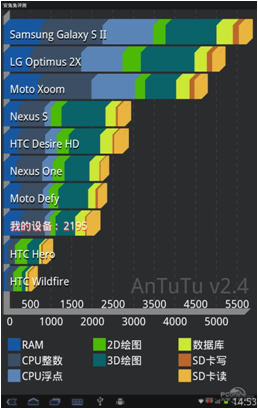 Note that for the 1.5GHz Windows N70 (as opposed to the above 1.6GHz version available globally) the AnTuTu v2.4 benchmark on the PConline is on the right (see also: AnTuTu Benchmark):
Since a multiple core Cortex ARM based Allwinner SoC will come just after those SoCs (“processors” – as named wrongly) shown in the table above, given the credentials of Allwinner presented in this post I dare to predict that the next-generation in the “A series” SoCs from Allwinner will beat the Rockchip RK3066 (or RK30XX in general) and others. There was just one concrete rumor recently: Ampe Allwinner Cortex-A7 Quad-core Tablet is Coming [ChinaEshops.com, July 12, 2012]
Rockchip and AMLogic dual-core tablet come out to snatch the tablet PC market while AllWinner dual-core tablet keeps in silence. Although Allwinner A10 & A13 still hot in the middle-low end market. Rockchip RK3066 and AMLogic AML8726-MX has already listed for two months from the beginning of May. Now these two chip still mainly occupy the china dual-core tablet PC market. Freescale’s quad-core tablet PCs begin to launch, even Tegra3 quad-core. Obviously, allwinner may it is late for launch dual-core, but it doesn’t mean that Allwinner will give up dual-core tablet. Allwinner will launch Quad-core chips in August. Latest news report that AMPE will launch a new 10.1 Inch IPS Tablet PC equipped with allwinner quad-core processor.
According to latest report the allwinner quad-core is using ARM Cortex-A7 structure. …
max says: August 8, 2012 at 8:43 pm
any news on this.chinaeshops says: August 31, 2012 at 5:11 pm
Sorry, it is coming soon.
As a matter of fact the Cortex-A7 was meant to be a companion ship for the Cortex-A15, all targeted for 28nm TSMC technology which is in extremely tighty supply at least till the end of the year. On the Cortex-A7 Processor—Related Products page we can find (among other things) that:
Physical IP
ARM Physical IP Platforms deliver process optimized IP, for best-in-class implementations of the Cortex-A7 processor at 40nm and below. A set of high performance Processor Optimization Packs (POPs) containing advanced ARM Physical IP for 28nm technologies to enable rapid development of leadership physical implementation supports the Cortex-A7 processor. ARM is also working early to assure a roadmap to 20nm optimizations. Optimization packs support ARM’s strategy of offering specifically targeted Physical IP to enable Partners to achieve tuned implementations of ARM cores. ARM is uniquely able to design the optimization packs in parallel with the Cortex-A7 MPCore processor architecture, enabling the processor and physical IP combination to deliver workstation class performance in a mobile power envelope while facilitating rapid time-to-market.
But according to the later ARM Expands Processor Optimization Pack Solutions for TSMC 40nm and 28nm Process Variants [ARM press release, April 16, 2012] Cortex-A7 PoP became available for both “TSMC 40LP” and “TSMC 40 LP high speed options” type of process technologies (where LP stands for “Low Power”). This practically means that Allwinner can indeed deliver by this time its next-gen SoC at 40nm.
Breaking news:
1. Quad-core tablets large chaos department: Allwinner quad-wide prototype will debut in November [Bolopad.com, Oct 3, 2012]
Before beginning I have to say to you: “I’m sorry”. Because last week we happily told everyone interested in quad-core prototype that it appeared in September, and it is not far from the days of mass production. But yesterday your editor suddenly received a mysterious call to be informed that the Allwinner quad-core prototype can’t come in September, it is estimated to be out in November to meet with you. I really wanted OOXX to be cursed to death (thought better of course).
…
2. Exclusive: Allwinner quad-core processors code-named A15X coming soon [Bolopad.com, Sept 18, 2012]
…
All right, now that the product finally appeared, we at Bolopad are also excited and highly interested in the quad-core chip code-named A15X (don’t get me wrong, this A15X has nothing to do with
AppleA15 [rather Cortex A15 wrongly percieved by many to be in the A6 SoC of the iPhone 5]). Now the related PCBA layout began to take shape, the chip samples came out and so on. Last reportedly bounced because the Allwinner quad-core is dependent on [Cortex] A7 architecture build, but as 40nm and 32nm was short of the desired effect, the 28nm tapeout eventually came in to achieve the desired results.…
END OF THE INSERT ABOUT THE CURRENT AND FUTURE SoC COMPETITION
NOW BACK TO THE CADENCE OF
ALLWINNER A10-RELATED EVENTS & INFORMATION:
An even bigger market push started when Allwinner A10 with the Android 4.0.3 Software Development Kit was officially launched on March 10, 2012. From the press release:
TSMC’s 55 nanometer “half generation” derivative of the 65-nanometer process technology directly miniatures 90%, including input/output and analog circuits, for customer provides competitive advantage with single die cost significantly reduced, while can also save power consumption by 8% at the same speed of operation.
As it was reported later in Taiwan: Allwinner Technology Introduces New SoC Platform on TSMC 55nm Process [CENS, March 29, 2012]
Allwinner Technology Co., Ltd., a leading supplier of high-definition media semiconductor solutions headquartered in
Shanghai[Zhuhai, as the contact address is: Block 1 Software Park, Zhuhai City, Guangdong Province, B6, four], recently released a new system-on-chip (SoC) platform based on Taiwan Semiconductor Manufacturing Co.’s (TSMC’s) 55nm process technology.The platform, codenamed A10, employs advanced SoC design technology to integrate central processing unit, graphic processing unit, high-definition multi-frame video engine, 3D multi-screen engine, and high-speed video interface module on a chip.
Equipped with Allwinner’s Android 4.0.3 Software Development Kit, A10 consumes fewer energy to achieve higher computing efficiency on mobile devices.
Using TSMC’s 55nm process technology, A10 is able to deliver quality dynamic voltage frequency scaling (DVFS) performance and brand new video management capability on mobile computing devices, and extend battery lifespan of the devices.
TSMC’s 55nm process shrinks geometry of integrated circuits, including I/O, on chips by 90% as compared with chips with 65nm process, considerably cutting down cost of every single chip and saving electricity on a chip by 8% relative to competing chips.
Allwinner General Manager Zhang Jianghui pointed out that TSMC has been a reliable partner supporting Allwinner in product production, quality and lead time.
Allwinner Technology-A10 [product page, April 13, 2012] 
In A10 Allwinner used 55nm technology, the integrated chip has four times full HD [i.e. the 2160p “Quad HD”] video decoding technology, smart power management system CoolFlex, HD multi-screen display processing and output, efficient and high-speed system architecture, mixed analog-digital high-speed signal design and integration of advanced technology, and integrated, smart power balance, and more items of leading technology. A10 is mainly used in tablet PCs, high-definition players, smart phones, network set-top boxes, smart TV machines.
With A10, Allwinner Technology will drive SoC into a brand new era of connected Smart HD which can enhance the application of connected HD SoC as well as user experience of electronic multimedia products. A10 is offering MULTI-CHANNEL decoding and 1080p encoding, MULTI-CHANNEL display with independently developed advanced frame, as well as MULTI-CHANNEL Analog TV Decoder Interfaces. What’s more, power consumption can be much lower than its competitors during 1080p decoding process.
Features
VPU
– HD Video Decoding (Super HD 2160P/3D Film)
– Support all popular video formats, including VP8, AVS, H. 264 MVC, VC-1, MPEG-1/2/4, …
– HD Video Encoding (H.264 High Profile) [datasheet: 1080p@60fps]
– Support encoding in H.264 format
[datasheet: 720p@100fps]
Rich Connectivity
– USB2.0 Port
– CSI, TS
– SD Card3.0
– 10/100 Ethernet controller
– CAN Bus, Built-in SATA2.0 Interface
– I2S, SPDIF and AC97 audio interfaces
– PS2 , SPI , TWI and UART
DPU
– MULTI-CHANNEL HD displays
– Built-in HDMI
– YPbPr, CVBS, VGA
– LCD interfaces: CPU, RGB, LVDS up to Full HD
Boot Devices
– NAND FLASH
– SPI NOR FLASH
– SD Card
– USB
Powerful Acceleration
– Graphic( 2D/3D)
– VPU(Super HD)
– APU
– E-reader
Benefits
High-performance processing and multimedia capabilities
Outstanding Super HD 2160p/3D Film video decoder makes bunds of creative application possible
High level of integration enables you to launch products in less time, with less effort and at a lower total system cost
Further development Kits, including OS BSP( Android2.3.4, Linux2.6,WinCE6.0)
Typical Application
Pad
Integrated Smart TV
Internet Player
Vehicle Multimedia Center
HDMI Dongle
Projector
2160p [Wikipedia, excerpted on Sept 18, 2012]
2160p is the shorthand name for 4K UHDTV, a video mode planned to appear in future HDTV products.[1] It has a resolution of 3840×2160 (8.3 megapixels in the 16:9 aspect ratio) and is one of the levels of Ultra-high-definition television.[2][3][4][5] The number 2160 stands for 2,160 lines of vertical display resolution, while the letter p stands for progressive scan or non-interlaced. In a progressive image, the lines of resolution of the image go from the top of the screen to the bottom.
2160p is also called “Quad HD” since it displays four times the number of pixels of the highest HDTV standard resolution, 1080p (a standard which is also known as “Full HD“). The only planned higher definition format for television is 8K UHDTV.
Phillips has made a 3D Quad HDTV with a native resolution of 2160p.[6]
In June 2012, Toshiba launched the world’s first 3D TV without glasses with 9 parallax images which passed through special lenticular lenses to deliver 3D effect with glasses-free on a 55″ Toshiba Regza RZ1 Quad Full HD TV, 3840x2160p resolution.[7] Due to delivered 9 parallax images at the same time, so the 3D image will only be seen as HD 720p (1280×720) —> 3840×2160 = 9x1280x720.
Sony plans Quad HD TV to launch between 2012 and 2020. Holographic Versatile Discs and Blu-ray Disc may be used for 2160p video, since it theoretically has a storage capacity of up to 10 Terabytes.[citation needed]
The AllWinner A10 System on Chip Specifications [the alternative allwinner.com product page, July 20, 2012]

Overview
Using 55nm technology, Allwinner Technology’s A10 SoC chip integrates full HD video decoding technology, multi-screen display processing, various analog-digital I/O interfaces, and a high-speed efficient ARM core with intelligent power management. The A10 is used in a number of consumer products such as tablet PCs, high-definition players, smart phones, network set-top boxes and mobile media hubs but with the availability of excellent development tools, the A10 is positioned to expand that list.
Key Features
VPU
• HD Video Decoding (Super HD 2160P/3D Film)
Support all popular video formats, including VP8, AVS, H. 264 MVC ,VC-1, MPEG-1, 2,4, …
• HD Video Encoding (H.264 High Profile)
Support encoding in H.264 format
1080p @ 60 fps
720p @ 100 fpsDPU
MULTI-CHANNEL of HD displays
Built-in HDMI v1.3/v1.4
YPbPr, CVBS,VGA
LCD interfaces: CPU, RGB, LVDS up to Full HDRich Connectivity
• THREE USB2.0 Port (OTG/HOST/UTI)
UTI Digital TV(TS over USB)
• CSI(2), TS(2)
• SD Card3.0(4)
• 10/100 Ethernet controller
• CAN Bus, Built-in SATA2.0 Interface
• I2S, SPDIF and AC97 audio interfaces
• PS2 (2), SPI (4), TWI (3) and UART (8)Boot Devices
• On board NAND FLASH
• SPI NOR FLASH
• SD Card
• USBPowerful Acceleration
• Graphic( 2D/3D, Mali400 MP)
• VPU(Super HD 2160P/3D)
• APU
• E-reader
Support text in EPUB, PDF, FB2, PDB, CHM, HTML, TXT
Support coding format in ANSI/ASCII, UTF-8, UTF16-BE, UTF16-LE, GB2312, EUC-KR, SHIFT-JIS, Windows-1250/1251, Support Chinese, English, French, Italian, Spanish, Dutch, Russian, Japanese, and KoreaCPU/GPU
• ARM Cortex-A8 at 1.2 Ghz without cooling
• 32KB I-Cache/32KB D-Cache
•256KB L2 Cache
• MALI 400 MP GPU
• ARM NEON general-purpose SIMD engineMemory
•DDR3 SDRAM, 32-bit 16G bits Memory Capacity
• SLC/MLC/TLC/DDR NAND
8 flash chips, ECC 64bits
Memory Capacity up to 64GB/chipSecurity
• Trustzone Technology and DRM
• Supports DES, 3DES AES encryption/decryption
• Support SHA-1, MD5 message digest
• hardware 64-bit random generator
• 128-bit EFUSE chip IDPMU
• Flexible built-in power options
• Intelligent Power Select allocates power safely and transparently among USB, external AC adapter, Li-battery and application loads
• adaptive and USB-compatible PWM chargerBenefits
• Very high performance processing and multimedia capabilities
• Hardware acceleration enables very low power consumption for HD video and graphics
• High level of integration makes you can launch product in less time, with less effort and at a lower total system cost
• Optimized Standard Operation Procedure (SOP) creates high First Pass Yield (FPY) in mass production
• OS Board Support Packages for Android, Linux and WinCE
NEW Allwinner Technology-A10s [product page, Sept 26, 2012]

Allwinner Tech has expanded its processor lineup to include a new ARM Cortex-A8 chip A10s which is even more competitive for HDMI Dongle with higher performance (ManyCore Structure), better compatibility of Streaming Video Protocol/local multimedia formats, lower power consumption, and lower total system cost. As the brains of Android 4.0.4, A10s makes multitasking smoother, apps loading more quickly, and anything you use responds instantly. What’s more important, A10s is available in BGA336 package with Audio Codec, and HDMI integrated.
Features
CPU / GPU
– ARM Cortex-A8 Core
– 32KB D-Cache / 32KB I-Cache
– 256KB L2 Cache
– Mali-400 3-D EngineVPU
– HD Video Decoding
– 1920 * 1080 @ 30fps
– Support VP8/6, H.264/H.263, WMV9/VC-1, WMV7/8, MPEG-4/2/1, Xvid, etc
– HD Video Encoding
– Support encoding in H.264 format up to 1920 * 1080 @ 30fpsHDMI
– HDMI 1.4
– 1080P OutputBoot Devices
– NAND Flash
– SPI Nor Flash
– SD Card
– USBUltra-low System Power Consumption
– 15 ~ 20% lower than competitors
DPU
– LCD Interfaces: CPU, RGBMemory
– DDR2/DDR3: Up to 533MHz
– 16 bits/32 bits Data Bus
– MLC / TLC / SLC / EF-NAND
– ECC 64-bit
– Support NAND of 4xnm, 3xnm, 2xnm …
– Support NADN of Samsung, Toshiba, Hynix …Peripherals
– USB2.0 OTG, USB2.0 HOST (OHCI / EHCI)
– SD Card V.3.0, eMMC V.4.2
– SPI, TWI and UART
– TS Port
– EMAC
– CSI
– IISAudio Codec
– integrated Audio Codec
– MIC/FM/LINEIN InputPowerful Acceleration
– Graphic (3D, Mali400 MP)
– VPU (1080P)
– APUPackage
– BGA336, 14mm*14mmBenefits
Optimum multimedia and processing abilities
Lower power consumption of HD videos and graphics due to hardware acceleration
Lower power consumption of HD videos and graphics due to hardware acceleration
Total solution, including OS BSP (Android 4.0.4 UP)
Typical application
And A10s is definitely coming to the market as per this [Sept, 21, 2012] discussion thread
Today I found a seller on on a website selling new model of Android TV stick, it claims adopting new A10S chip & support DLNA function that is just what I want, is that a good deal?
Allwinner Technology-A13 [product page, April 13, 2012]
Allwinner Technology has expanded its processor lineup to include a new ARM Cortex-A8 chip A13 which is even more competitive for Android tablets with higher performance (ManyCore Lite), lower power consumption, and lower total system cost. As the brains of Android 4.0. 3, A13 makes multitasking smoother, apps loading more quickly, and anything you touch responds instantly. What’s more important, A13 is available in eLQFP176 package with Audio Codec, and 2 Points R-TP integrated.
Features
CPU / GPU
– ARM Cortex-A8 Core
– 32KB D-Cache / 32KB I-Cache
– 256KB L2 Cache
– Mali-400 3-D Engine
VPU
– HD Video Decoding
– 1920 * 1080 @ 30fps
– Support H.264, H.263, VC1, Mpeg1/2/4, Divx 3/4/5/6, Xvid, VP6 / 8, AVS etc
– HD Video Encoding
– Support encoding in H.264 format up to 1920 * 1080 @ 30fps
Boot Devices
– NAND Flash
– SPI Nor Flash
– SD Card
– USBUltra-low System Power Consumption
– 15 ~ 20% lower than competitors
– Smart Backlight: auto adjust backlight acc. to the image display
DPU
– LCD Interfaces: CPU, RGBMemory
– DDR2/DDR3: Up to 533MHz
– 16 bits Data Bus
– Memory capacity up to 512MB
– MLC / TLC / SLC / EF-NAND
– 2 flash chips, ECC 64-bit
– Support NAND of 5xnm, 4xnm, 3xnm, 2xnm …
– Support NADN of Samsung, Toshiba, Hynix …Peripherals
– USB2.0 OTG, USB2.0 HOST (OHCI / EHCI)
– SD Card V.3.0, eMMC V.4.2
– SPI, TWI and UART
– integrated Audio Codec
– CSIR-TP Controller
– 4-wire resistive TP interface
– 2 points and gesture detectionPowerful Acceleration
– Graphic (3D, Mali400 MP)
– VPU (1080P)
– APU
– E-ReaderPackage
– eLQFP176Benefits
Optimum multimedia and processing abilities
Lower power consumption of HD videos and graphics due to hardware acceleration
Much faster, easier and cost efficient product launch due to the high integration
Further development kits, including OS BSP (Android 4.0.3 UP)
Typical application

Note that Allwinner is operating in a world-class environment as you could easily see from the below picture of their office building taken from their brief intro page [April 13, 2012]:

全志科技 Allwinner Technology has been committed to the IC design industry, is one of a handful of domestic enterprise engaged in system-level ultra-large-scale mixed analog-digital chip design the SoC and intelligent power management. Our main products are intelligent terminal application processor chip, smart power management chip.
With excellent R & D team and technical strength, the company’s products to achieve industry-leading levels of high-definition video codec, a high level of integration, low power consumption, rapid market expansion, has become a domestic Tablet PC application processor chip, high-definition player application processor chip as well as one of the mainstream supplier of intelligent power management chip market, has a clear lead.
New content replacing the above on Sept 26, 2012:
Allwinner Technology, one of the domestic companies in integrated circuit design industry, is dedicated to the design of mixed analog-digital VLSI SoC and smart power management SoC.
Depending on its excellent R&D capability, Allwinner Technology has
beenled the industry in terms of its HD video codec, high integration and low power consumption, etc. As a result, it is gaining more market share, and has become one of the domestic mainstream suppliers of tablet processors, HD player processors, as well as smart power management SoC.
Note therefore that Allwinner’s roots are in the video (multimedia) related chips as also shown by their latest pre-A10 SoC product (introduced in August’11) for that market, the F1C100 (another SoC, the more focussed F20 introduced in August’11 for portable video players, living room computers etc. has even better, 1080p full HD decode technology; as well as the very latest F10 introduced in April’12 for HD players and lower end –relative to A10—car multimedia), described on its product page as:
With advanced independently developed video decoding technique, F1C100 becomes the ONLY processor in the market that can decode video in all formats based on ONLY 4MB NOR FLASH and 16MB SDRAM. In the mass production of final products, NOR bootloader burning is much easier and faster compared with NAND FLAHS ‘. Last but not least, F1C100 supports two-point touch which can improve the using experience of end-users.
New F10 content replacing the above on Sept 26, 2012:
The F10 is an advanced HD video CODEC processor with unparalleled competitive edges in integration, video compatibility and cost efficiency, which have been widely verified by mass production of dozens of applications. End-users are overwhelmed by its capability to serve banquet for the eyes.
Typical Application
F1C100’s datasheet [initial version, March 31, 2011] is providing the following, more precise description:

and for the video engine of their own design in particular:
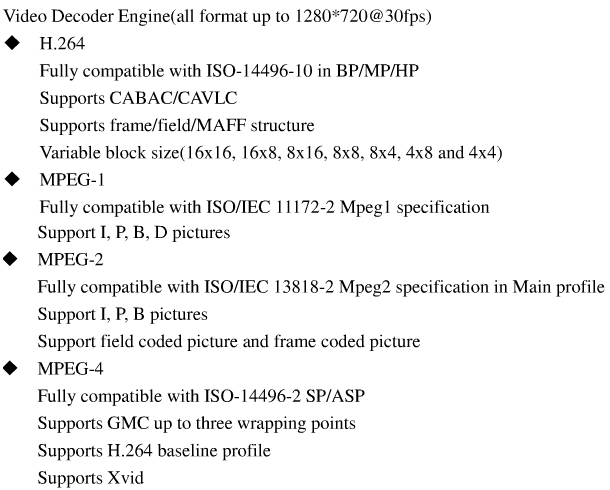
…

With this intellectual property they were able to upscale to a market leading 2160p functionality in the A10 (vs. the 720p in the above F1C100) while using a less upscaled IP for the 1080p in A13. So they can even have a scaleable video engine IP of their own.
In the A10 datasheet or here [initial version, Aug 22, 2011] the following description is giving some hint regarding the company’s strategic intent to remain in the forefront of video acceleration technology:

It is quite notable that neither on the product page nor in this datasheet Allwinner is giving further information about their video engine. Even in the functional block diagram of datasheet the video engine (VE) is simple put into a central box with Cartex-A8 and the Mali GPU:
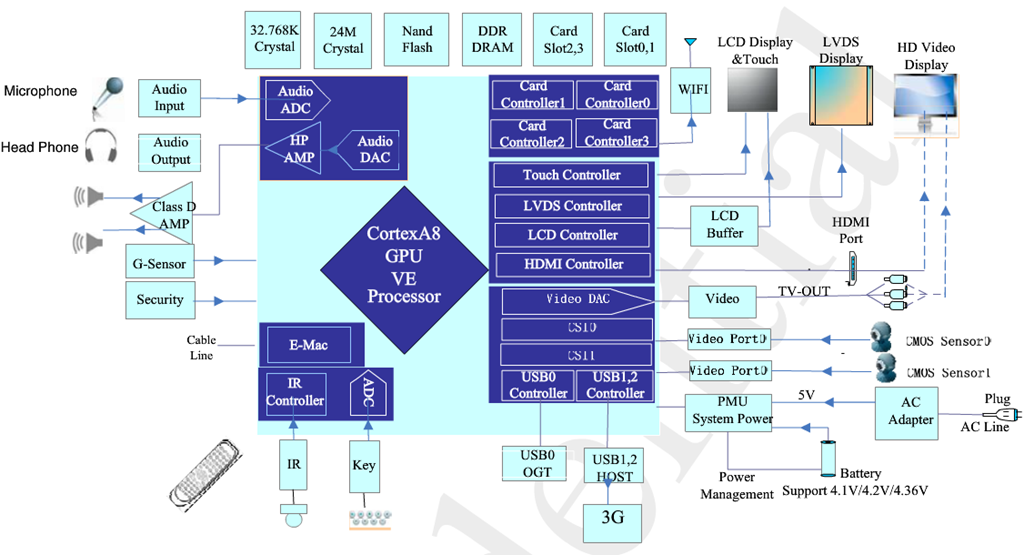
The only available information is the CedarX wiki page [July 14 – Sept 16, 2012] on linux-sunxi wiki:
CedarX is Allwinner’s multimedia decoding technology. It is composed of several parts, including:
- A hardware video decoding unit
- Proprietary libraries to communicate with the hardware unit
- Glue code to use those libraries on an actual system with video playback capabilities (e.g. Android)
Benefits
Efficient use of system resources when decoding multimedia.
Allows small ARM systems to playback high resolution/bitrate multimedia content, which wouldn’t be possible using software-only decoding.
Disadvantages
The proprietary libraries have no clear usage license.
The android glue code is implemented as a “media player” (parallel to stagefright) instead of as OMX components.
This media player has limitations when it comes to playing back content pointed to by Android URIs and some web-based content.
There is no glue code for any other multimedia frameworks on GNU/Linux systems. The use of OMX would’ve rendered this a non-issue, with existing projects like GstOpenMAX.
Integration
Reverse Engineering
On June 15 2012 Iain Bullard started reverse engineering the proprietary libraries.
open_cdxalloc as an free reimplementation of Allwinner‘s libcederxalloc.a.
CedarXWrapper as a LD_PRELOADed wrapper to help understanding the proprietary libraries.
CedarXPlayerTest as a basic player to use when testing.
Some leading tablets (single core) as of April, 2012 per Merimobiles (with an office in Canada)
(Haipad I7 is now $99, the price of Ployer Momo9 is unchanged, see: HAIPAD I7 IPS 1024*600 Multitouch Screen with Android 4.0 Dual Camera 1080P HDMI [Merimobiles.com, Sept 10, 2012], Haipad’s latest 7-inch ICS tablet Haipad i7 gets FCC clearance [Merimobiles blog, March 6, 2012], from Shenzhen Haina Electronic Co., Ltd “founded in 2003 as a high-tech company specializing in laptops and other digital mobile devices”)

The Allwinner A10 based tablets came to the global market from quite a number of vendors as shown by the following table (=50) compiled from two related threads from SlateDroid.com (note that global arrival of A10-based product started in Jan’12):
Comprehensive List of Allwinner
|
„2nd generation” A10 tablets (with 1 GB or more):Ainol: Novo Elf, Novo AuroraBmorn V11 ExtremeAmpe A90Gemei: G9, Gemei G2Eken A90Ployer Momo11 Birdnewman P81Onda: Vi40 (8g, 16g, 32g/ 10” screen), Vi10 elite, 1GB Ram, 8 GB Flash, 1024×600 LCDTeclast: P85 (8″ screen), A10Later/OTHER devices (not verified, just put on the thread, THOSE WITH LINKS are from the Adding new Allwinner A10 CPU Devices THREAD [Jan 19-Sept 17, 2012]):Ampe: A80, A85, A10Andtai FG-A97Benyi M8Coby Kryos 7042Gemei G3Haipad i7HKC M701ICOO: D50 deluxe edition, D80WiNote: V4, A8, A8-2, A-8-3Kliver MB9703MyAudio 908ANaviatec MD710Onda Vi40 FlagshipPolaroid PMID701CShimaro M5Sinvigo M7Sysbay s-mp99Treq A10CTrio Stealth Pro 7VISTURE 3Zonge M90Yarvik Xerios TAB464Xtouch X716Woxter Tablet PC 97 |
Note that there were only couple of Chinese vendors with multiple Allwinner A10-based tablet offerings, namely: Ainol, Ampe, Bmorn, Eken, Gemei, ICOO, iNote, Onda, Ployer, Sanei, Teclast (i.e. just 11 out of 50).
There is a much shorter and later started list of Allwinner A13-based tablets on SlateDroid.com, see: List of Allwinner A13 CPU Devices [from Aug 1, 2012]
Then from April to August there were the following events unfolding in China as per Micdigi reports:
- Allwinner A13 tablet PCs begin to appear in market [April 28, 2012]:
A13 is cheaper than A10 with only 512M memory and 800×600 resolution but without Bluetooth and HDMI. Allwinner A13 can be only used for 7-inch tablet PC and 8-inch tablet PC, it does not support 10-inch tablet PC.
Contrasted with VIA8850 and RK2906, A13 with low cost will have strong market competitive capability. The price of 7-inch tablet with A13 and capacitive screen will be less than $48 in May.
- The [7-inch] tablet PC [from Shenzhen Haipad] based on A13 solution sells for $47.5 [May 8, 2012]
- The [7-inch] A10 tablet PC [from Shenzhen Zhongjiweiye] based on 1G memory and 8G storage sells for about $52 [May 23, 2012]
- The [7-inch] A13 tablet [from Shenzhen VAYEE] sells for 299 RMB [$47] [May 25, 2012]
- The tablet PC based on RK2906 is cheaper than A10 tablet PC [May 25, 2012]:
Rockchip has released RK2906 chip to defeat Allwinner A10. The chip is not different from RK2918 but it can only used for 7-inch tablet and 8-inch tablet.
The tablet based on RK2906 comes from Shenzhen DavidMid.
- The Allwinner A13 PCBA from Shenzhen SMIT [State Micro Technology] [May 25, 2012]: [SMiT, Official website: http://www.smit.com.cn/] [“slot-in screen” is rather “embedded capacitive screen”: 内嵌电容屏]
The two sample tablet PCs from SMIT are based on slot-in screen and flat screen. The price of the slot-in screen is less $8 than the price of the flat screen.
The price of the PCBA sells for about $19, the tablet PC based on A13 solution, slot-in screen and capacitive control sells for about $47.
… The slot-in screen does not have external glass and interaction sets that it is cheaper. But the experience is not different from the flat screen. …
Remark: Embedded Touchscreen Technology and Market Analysis [Displaybank, March, 2010]
The embedded touch technology is divided into In-cell and On-cell technologies. Conventionally, only the In-cell technology which was exclusively developed by panel makers drew attention, but it entailed issues in technology and cost regarding a mass production by satisfying the touch function demanded by customers and market. The on-cell technology lies at a grafting point between the conventional touch industry infra and LCD panel industry that it tends to mutually supplement the two industries in terms of performance and function.
The embedded touch technology which includes above On-cell and In-cell technologies is ideal since it reduces thickness and weight as well as it overcomes shortcomings of the conventional add-on type: reduced transmittance, lowered readability due to contrast ratio decrease, and thick bezel width. Based on above advantages, related makers continue with the technology development. The market is yet insignificant, but it is expected to show high growth rate comparable to the Touch market’s growth.
Latest info:
– On-cell Touch Screen Panel Slims Down Mobile Displays [Electronic Design, June 10, 2012]
– TOUCH TECHNOLOGY IN SMARTPHONES EXPLAINED [FlatpanelsHD, Sept 19, 2012]
- Q780 based on Allwinner A10 solution and 7-inch screen [from Shenzhen Xunlong] sells for 29X RMB [$46.x] [June 28, 2012]
- The volume production of VIA8850 chip will start in this month. [June 25, 2012] In last year, VIA8650 has controlled most of the market share. As the new chip is released so late, Allwinner and Rockchip get more market share.
- Structure of VIA8850 competition [June 29, 2012]
VIA8850 based on Cortex-A9 core is powerful than VIA8650. VIA8650 is so worse that some famous manufactures in China have not made their tablet PCs to introduce VIA8650 chip, such as Ramos, Window and TOBE.
VIA8850 will come with cheap price and powerful performance. It will be mainly used for SuperPad tablet PCs. It is said that VIA will release another chip for big-brand companies.
Actually it is same with VIA8850, but it has different name.
As VIA8650 chip is so worse, Infotmic [X200] 7-inch chip, Allwinner A10, Allwinner A13 have got most of the market share.
Could VIA8850 chip get more market share in this year?
1. There are so many Allwinner A10 tablet PCs that the competition is so fierce. Some manufactures do not make any money. They will not continue to release A10 tablet PCs. Maybe they will release VIA8850 tablet PCs.
2. VIA8850 based on Cortex-A9 core is [more] powerful than Allwinner A10 based on A8 core and A13 based on A8 core. With the resource of HTC, the system optimization of the VIA8850 tablet PC is excellent. It not only has powerful performance but also has cheap price.
3. VIA is a famous chip company in the world. They have good marketing channel.
Allwinner has released the A10 chip for about half a year. They have earned so much money including the investment cost and the profit.
VIA must do their best to earn the investment cost. The cost of VIA8850 is [more] expensive than Allwinner A13.
Allwinner has advantage in the price war.
- The tablet PC based on VIA8850 [from Shenzhen Vayee] sells for $299 RMB [$47] [July 6, 2012]
- Most of Shenzhen tablet manufactures export to other countries. Because Chinese do not like knock off tablet PCs or SurperPad tablet PCs, they like brand ones. [July 19, 2012]
- The 7-inch tablet PC based on Infotmic [X200] solution [from Shenzhen Wave] sells for 199 RMB [$32] [July 21, 2012]
Configurations: Infotmic solution, 256M memory, 4G storage, 7-inch resistive screen with 800×480 resolution, front facing camera, Android2.3 OS.
Infotmic X200 series are based on ARM11, 1GHz frequency, supports 1080P video decode.
- The 7-inch tablet PC based on Allwinner A13 solution [from Shenzhen Shenzhen Jinsuoai] sells for 25X RMB [$39.X] [July 28, 2012]
Recent examples of tablets:
$39 AllWinner A13 Tablet (100K bulk) by Hott at IFA 2012 [Charbax YouTube channel, Sept 2, 2012]
$46 AllWinner A13 by OMG at IFA 2012 [Charbax YouTube channel, Sept 2, 2012]
$99 3G Allwinner A10 Eken G70 at IFA 2012 [Charbax YouTube channel, Sept 1, 2012]
And here is an earlier $55 AllWinner Boxchip A13 Tablet Factory Tour [Charbax YouTube channel, May 27, 2012] to understand why and how the workforce is able to assembe the tablets at such a cheap price:
AAPPAA Shenzhen JinPinXing Tablets [Charbax YouTube channel, Sept 2, 2012]
Some important information mentioned in the video:
MID-971:
– World’s Thinnest 9.7” [IPS] Pad
– Only 8.9 mm
– Built-in 3G (can be also without it)
– WiFi + Bluetooth
– VIMICRO??? or Longcheer 2918/3066
– the WiFi only version is US$115-120 depending on quantityMID-803:
– 8” Pad
– Built-in 3G
– Dual Camera
– Rockchip 3066 dual core
– US$172 with 8GB and 3G
?MID-973?: a 9” tablet with Allwinner A13 is said to cost US$73-74
30K tablets sold per month, can sell upto 50K per month
On their product microsite (see below) the tablets shown currently have the following SoCs and parameters:
– Allwinner A10 (Cortex A8@1.5GHz): MID-501 and MID-702 (both 512MB DDR3 and 7” 800×480 with Android 4.0.4)
– Allwinner A13 (Cortex A8@1.0GHz): MID-438 (7” 262×480 and Android 4.0.3), MID-703 (7” 800×480 and Android 4.0.4) both with 512MB DDR3
– VIMICRO882 (Cortex A8@1.0GHz): MID-706 (512MB DDR3 and 7” 800×480 with Android 4.0)
– all the those are with capacitive touch screens, NAND FLASH 4GB/8GB/16GB / 32GB (optional), AMD graphics acceleration, full support for OpenGL ES2.0 (AMD Z340) and h.264 720P HD 1080i
Jinpin Xing Technology Co., Ltd., Shenzhen – Tablet PC – Products – [as of Sept 18, 2012]
深圳市金品兴科技有限公司 – 平板电脑 – 产品介绍


AAPPAA –About us [Aug 19, 2011]

AAPPAA, founded in 2005, is an established manufacture of smart digital products with super perfect design in MP3/4/5, Mini Speaker products field. We design and produce super perfect quality products, many of them are original which we ship to wholesale customers all over the world. Given the wide array of geographic regions across which we distribute product, we work closely with our customers and retail partners to ensure the AAPPAA team remains innovative and competitive in a constantly evolving market sector.
AAPPAA’s Success: AAPPAA’s success can be attributed to close collaboration with our global set of customers and partners combined with internal efforts to continually improve our productivity, design creativity and quality management initiatives. Through the years, AAPPAA has experienced tremendous growth while also enhancing the personal lives of our customers, and the well being of our loyal employee base. AAPPAA employs 60+ people with an average employment tenure of nearly 3 years a fantastic achievement amidst China’s explosive growth that has offered a continuous list of new opportunities of a young, energetic workers.
AAPPAA’s Manufacturing Capacity: AAPPAA’s 1500 square meters of manufacturing space and 60+ workers are based in Shenzhen China. We operate multiple production lines with SMT machines, hot plastic packing machines as well as high & low temperature age and vibration testing units. Production capacity exceeds 110,000 units per month. In addition, AAPPAA’s products are CE, FCC, RoHS certified.
Address: 5F, Nankeng No.2 Industrial Park Abuilding, Bantian Town, Longgang District, ShenZhen City 518129, China
Tel : +86-755-83579180 Fax:+86-755-83579189 E-mail: sales@aappaa.com


5. The wireless display and 2160p (“Quad HD”/4K) outlook
Wi-Fi CERTIFIED Miracast™: Your Content – Now Showing on Screens Everywhere [WiFiAlliance YouTube channel, Sept 18, 2012]
What that means practically is currently best shown by a non-Chinese tablet SoC vendor:
NVIDIA Tegra 3 Enhances Miracast Wireless Display [nvidia YouTube channel, July 26, 2012]
What you see here is the Hardware + software optimization done by NVIDIA for Miracast. Since Allwinner is using its own video processing unit (VPU) which is said to be the fastest relative to the video engines of its Chinese SoC competitors (e.g. Amlogic) we can expect a similar to the NVIDIA’s kind of software optimization for the Allwinner VPU. (Take also into consideration “the company’s strategic intent to remain in the forefront of video acceleration technology” as it was proven in the “Allwinner Advantage” section before.)
In other respect a separate 3d party WiFi chip is coming into the play, and there is already quite a number of those chips already to be designated Wi-Fi CERTIFIED Miracast™ :
Easy-to-use, multi-vendor wireless display has arrived: Wi-Fi Alliance® launches Wi-Fi CERTIFIED Miracast™ [Wi-Fi Alliance press release, Sept 19, 2012]
Wi-Fi Alliance® today announced the launch of the Wi-Fi CERTIFIED Miracast™ certification program. Miracast devices provide simplified discovery and setup, so users can quickly transmit video content from one device to another. Industry analysts predict annual shipments of Miracast-certified devices to exceed one billion units within the next four years.
Miracast users can do things like view pictures from a smartphone on a big screen television, share a laptop screen with the conference room projector in real-time, and watch live programs from a home cable box on a tablet. Miracast connections are formed using Wi-Fi CERTIFIED Wi-Fi Direct™, so access to a Wi-Fi® network is not needed – the ability to connect is inside Miracast-certified devices.
“Wi-Fi users around the world want to experience multimedia on the device of their choice – no matter what brand – and Miracast is the breakthrough they have been waiting for,” said Edgar Figueroa, CEO of Wi-Fi Alliance. “We have been delighted with the level of enthusiasm and support among our member companies for this new offering.”
Miracast supports protected content streaming, enabling devices to stream feature films and other copy-protected materials. To protect premium content, Miracast uses a wireless adaptation of the trusted content protection mechanisms widely used today for cabled interfaces like HDMI® and DisplayPort. In addition, the latest WPA2™ security protections are automatically enabled on every device, making the transport of all multimedia content private.
“Miracast builds on Wi-Fi Direct with a compelling application,” said Brian O’Rourke from IHS iSuppli Research. “This is a big step forward in a market migration from single-vendor display solutions, into an offering from a wide array of vendors. With more than 1.5 billion Miracast devices expected to ship in 2016, the program is poised to have broad adoption.”
The technology underlying Miracast was developed in Wi-Fi Alliance by a diverse group of mobile and consumer electronics manufacturers and silicon vendors to standardize methods for simplified video sharing. Based on the Wi-Fi Alliance Display Specification, products bearing the Miracast brand interoperate across vendors, making it easy to enjoy video on screens throughout the home or office.
The first products to be designated Wi-Fi CERTIFIED Miracast, and which form the test suite for the certification program, are:
Broadcom Dualband 11n WiFi
Intel® WiDi
Marvell Avastar USB-8782 802.11n 1×1 Dual-band Reference Design
MediaTek a/b/g/n Dualband Mobile Phone Client, MT662X_v1 and DTV Sink, MV0690
Ralink 802.11n Wireless Adapter, RT3592
Realtek Dual-band 2×2 RTL8192DE HM92D01 PCIe Half Mini Card and RTD1185 RealShare Smart Display Adapter
The first consumer products certified since testing opened to vendors include the LG Optimus G smartphone, Samsung Galaxy S III smartphone and Samsung Echo-P Series TV.
More information, including a list of Wi-Fi CERTIFIED Miracast products, the Wi-Fi Alliance Display technical specification, white paper, and more is available at www.wi-fi.org/miracast.
Broad industry support for Wi-Fi CERTIFIED Miracast
“As a Wi-Fi market leader, Broadcom is honored to be one of the primary certification solutions for the Wi-Fi Alliance Miracast™ program and is committed to driving new Wi-Fi standards,” said Dino Bekis, Senior Director, Wireless Connectivity Combo Group at Broadcom. “The standardization of this technology will enable consumers to easily and seamlessly share content across the ever-growing landscape of connected devices.”
“Users clearly expect that they should be able to move their content and applications freely at home, at work, in the classroom, and on the go,” said Joe Van De Water, Director of Consumer Product Marketing at Intel. “Intel has seen tremendous user enthusiasm for Intel® WiDi, and as a member of the Wi-Fi Alliance, we support enabling this usage more broadly and are excited to announce WiDi as one of the first Wi-Fi CERTIFIED Miracast solutions.’’
“We celebrate the launch of the Wi-Fi CERTIFIED Miracast™ program,” said Hyunghoon Oh, Head of LG Mobile Communication R&D Division. “Miracast brings an exciting advancement in the way devices deliver display applications.”
“The Wi-Fi Alliance’s Miracast certification program will allow for easy sharing of video content, regardless of vendor,” said Bart Giordano, Director, Wireless Marketing at Marvell Semiconductor, Inc. “We have included Miracast in our solutions, and are honored to have been selected for the program’s test bed.”
“The video streaming applications enabled by Wi-Fi CERTIFIED Miracast™ are key to the growth of the Wi-Fi ecosystem encompassing Consumer Electronics, Personal Computing, and Mobile devices.” said Mr. SR Tsai, General Manager of Wireless Connectivity & Networking Business Unit at MediaTek. “We are honored to have our Android mobile platforms, Digital TV, as well as our connectivity solutions for Windows platforms selected for the Miracast test bed.”
“Miracast on NVIDIA Tegra will bridge the distance between mobile devices and high-def TVs, providing customers a rich – and cable-free – multimedia experience,” said Matt Wuebbling, Director of Product Marketing at NVIDIA. “We have embraced Miracast and are working with our OEM partners to bring its amazing possibilities to market.”
“We are happy to have been involved in developing the Miracast program and to be one of the first companies to receive certification,” said Jessy Chen, Vice President and Spokesman at Realtek. “The solution will greatly expand the market for easy-to-use interoperable wireless display connectivity.”
“As a leader in N-screen technology, Samsung has introduced AllShare Cast (based on Miracast), which is incorporated into most of Samsung’s high-end smart mobile devices including the GALAXY S III, GALAXY Note 10.1, and GALAXY Note II, “ said Hankil Yoon, Senior Vice President of Product Strategy Team, Samsung’s Mobile Communication Business. “We will continue to support the program, and plan to offer more Miracast-certified devices to our customers going forward.”
“Sony Mobile is pleased to support the Wi-Fi CERTIFIED Miracast™ certification program. We continuously strive to deliver new exciting user experiences and Miracast™ technology will enhance our ability to offer consumers seamless connectivity to move their content freely between smartphones and other screens,” says Nikolaus Scheurer, Director Marketing Planning for Sony Mobile Communications.
“Miracast will play an important role in enabling true seamless media streaming, gaming and content sharing between mobile screens and large displays,” said Ram Machness, director of marketing, Wireless Connectivity Solutions, Texas Instruments Incorporated. “Our OMAP™ platform, DaVinci™ video processors and WiLink™ connectivity products will offer Miracast-certified source and sink solutions to provide a rich experience for our customers’ end products.”
About the Wi-Fi Alliance®
www.wi-fi.org
The Wi-Fi Alliance is a global non-profit industry association of hundreds of leading companies devoted to seamless connectivity. With technology development, market building, and regulatory programs, the Wi-Fi Alliance has enabled widespread adoption of Wi-Fi worldwide.
The Wi-Fi CERTIFIED™ program was launched in March 2000. It provides a widely-recognized designation of interoperability and quality and it helps to ensure that Wi-Fi-enabled products deliver the best user experience. The Wi-Fi Alliance has completed more than 15,000 product certifications, encouraging the expanded use of Wi-Fi products and services in new and established markets.
Wi-Fi®, Wi-Fi Alliance®, WMM®, Wi-Fi Protected Access® (WPA), the Wi-Fi CERTIFIED logo, the Wi-Fi logo, the Wi-Fi ZONE logo and the Wi-Fi Protected Setup logo are registered trademarks of the Wi-Fi Alliance. Wi-Fi CERTIFIED™, Wi-Fi Direct™, Wi-Fi Protected Setup™, Wi-Fi Multimedia™, WPA2™, Wi-Fi CERTIFIED Passpoint™, Passpoint™, Wi-Fi CERTIFIED Miracast™, Miracast™, Wi-Fi ZONE™ and the Wi-Fi Alliance logo are trademarks of the Wi-Fi Alliance.
All other company and product names mentioned are trademarks and/or registered trademarks of their respective owners.
For Chinese vendors the WiFi-related MediaTek chips are the most accessible and affordable, so I am including the additional MediaTek press release as well:
MediaTek Interlinks Mobile Devices and TVs for Wireless Display MiracastTM Applications [MediaTek press release, Sept 19, 2012]
MediaTek Inc., a leading fabless semiconductor company for wireless communications and digital multimedia solutions, today announced that its 802.11a/b/g/n Dual-band Mobile Phone Client (MT662X), 802.11n Wireless Adapter (RT3592) and DTV Sink solutions (MV0690) have all been selected as part of the Wi-Fi CERTIFIED MiracastTM test bed. As the benchmark to drive interoperability testing for the newest Wi-Fi program, MediaTek’s Miracast-certified solutions allow mobile devices to wirelessly stream multimedia content, such as video and games, onto big screen DTVs without a connection to an access point.
“We congratulate MediaTek on achieving selection to the Wi-Fi CERTIFIED MiracastTM test bed,” said Wi-Fi Alliance CEO Edgar Figueroa. “MediaTek’s participation in the development of this program has been instrumental in the achievement of industry-wide certification.”
In a typical MiracastTM usage scenario, one device acts as the source (the transmitting device sending out the content) while the other becomes a sink (a receiving device displaying the content). Thanks to the new Wi-Fi test program and MediaTek’s proven technologies, interoperability and user experience of Miracast applications can be guaranteed.
“We are partnering with MediaTek to provide consumers with high-performance, affordable smartphone solutions that incorporate the latest Miracast Wi-Fi display technology for the home and on the go, “ said Dr. Ji-Yang Wang, COO at TCL Communications Technology. “MediaTek’s industry-leading technologies, cross-platform advantages across home and mobile, and ‘hands-on’ approach to design and support, are essential in creating products that helps us deliver a compelling user experience and differentiated offering.”
“The video streaming applications enabled by Wi-Fi CERTIFIED MiracastTM are key to the growth of the Wi-Fi ecosystem encompassing Consumer Electronics, Personal Computing, and mobile devices.” said Mr. SR Tsai, General Manager of MediaTek’s Wireless Connectivity & Networking Business Unit. “Having our Android Smartphone, Digital TV, as well as our connectivity solutions for Windows platforms selected for the MiracastTM test bed is a strong testament to the breadth and quality of MediaTek’s Wi-Fi technology.”
MediaTek offers a broad portfolio of high-performance SoC and wireless connectivity solutions for the proliferation of smartphones, tablets, PCs, DTVs, Blu-ray players and AP/routers. The Wi-Fi CERTIFIED MiracastTM MediaTek solutions included in the test bed are:
• MT662X a/b/g/n Dual-band Mobile Connectivity Combo
• RT3592, Ralink 802.11n Wireless Adapter
• MV0690 DTV Sink
The Wi-Fi CERTIFIED MiracastTM MediaTek solutions have entered mass production and are shipping in commercially launched devices.
* Windows is a registered trademark of Microsoft Corporation in the United States and other countries.
See also:
Wi-Fi CERTIFIED Wi-Fi Direct™: Personal, portable Wi-Fi® that goes with you anywhere, anytime [Wi-Fi Alliance, Aug 15, 2010]
As far as the 2160p (“Quad HD” or 4K) technology is concerned, which is already on our footsteps, I would first recommend to watch the below demo video available on YouTube in QUAD HD resolution. You should “simply” select the “Original” quality in full screen viewing mode, and if your monitor has sufficient resolution than you could get the proper experience (do not forget that your Internet connection should be sufficiently fast in terms of guarranteed dowload speed as well). If not than correspondingly less:
IT005 QUAD HD 4K – Italy travel guide Bird watching [VOXLIBERTUM YouTube channel]
Then please watch another video which is showing what the leader in this TV technology, Toshiba was showing on the recent IFA 2012 fair in Berlin:
Toshiba 4K Quad-HD 3840×2160 TVs with CEVO Engine upscaling/processing from 55″ to 84″ [Charbax YouTube channel, Aug 30, 2012]
The reporter (Nicolas Charbonnier alias Charbax) did an excellent job with this video, as well as the Toshiba guy showing him around. Even his English is very good and enjoyable. Note that from [02:10] and “Glassless 3D” is shown and explained quite extensively, then highly zoomable Google Maps in 3D etc. Charbonnier is doing during all this an excellent job zooming with camera so one can really grasp the 4K and 3D experience quite well even in a normal viewing environment of your monitor. THANKS!
More information:
– Toshiba unveils the first large-screen glasses-free 3D TV in Asia
[Toshiba Singapore press release, May 3, 2012]
– Toshiba Brings New Generation of TVs and PCs to the Philippines Announces New Brand Ambassador [Toshiba Philippines press release, June 20, 2012]
– RZ1 SERIES NEW! Glasses-Free 3D TV [Regza Asia microsite, June 4, 2012]
– Toshiba Regza RZ1 [Toshiba Regza YouTube channel, May 31, 2012]
– Toshiba Regza RZ1 3D TV Review [gadgetguruindia YouTube channel, Aug 6, 2012]
You can also watch Charbonnier’s shorter report about Sony 84″ 4K TV KD-84X9005 with 4K X-Reality Pro [Charbax YouTube channel, Sept 2, 2012] which came after Toshiba to the market and said to be widely available for Christmas.
Finally: Status of the TV Display industry by Paul Gray, Director of European TV Research for DisplaySearch [Charbax YouTube channel, Aug 31, 2012]
6. Are the established client device players
recognizing this strategic inflection point or not?
Decide for your yoursel, dear reader:
Ballmer trumpets Microsoft’s ‘epic year’ [The Seattle Times, Sept 15, 2012]
Q: The iPad has the largest share of the tablet market, but its soft spot, it seems to me, is the price.With the Surface, are you planning to compete with the iPad on price or on features?
A: We haven’t announced pricing. I think we have a very competitive product from the features perspective. …
I think most people would tell you that the iPad is not a superexpensive device. … (When) people offer cheaper, they do less. They look less good, they’re chintzier, they’re cheaper.
If you say to somebody, would you use one of the 7-inch tablets, would somebody ever use a Kindle (Kindle Fire, $199) to do their homework? The answer is no; you never would. It’s just not a good enough product. It doesn’t mean you might not read a book on it….
If you look at the bulk of the PC market, it would run between, say, probably $300 to about $700 or $800. That’s the sweet spot.
…
Q: Where do you see Microsoft’s position in five years, 10 years?
A: First of all, I’d say: pre-eminent technology company. I think that in a back-looking view, people would say we were a software company. That’s kind of how we were born.
I think when you look forward, our core capability will be software, (but) you’ll probably think of us more as a devices-and-services company. Which is a little different. Software powers devices and software powers these cloud services, but it’s a different form of delivery….
Doesn’t mean we have to make every device. I don’t want you to leap to that conclusion. We’ll have partners who make devices with our software in it and our services built in. … We’re going to be a leader at that.
Supply chain estimates x86 Surface Price at US$500-700 and RT below US$399 [DIGITIMES, Sept 18, 2012]
Microsoft’s own-brand Surface tablets are expected to launch at the end of October with the related supply chain players estimating that the Surface RT’s hardware cost is at around US$300-400 and the end price will be less than US$399. However, the pricing is not confirmed by Microsoft.
Microsoft’s pricing strategy for its own-brand tablets will relatively affect PC brand vendors’ pricing strategy and sales projections for their Windows 8 tablets. As the launch time at the end of October is approaching, PC brand vendors are keeping a close eye on Microsoft’s actions. With the related Surface pricing speculations having been floating around the market, Surface RT was previously rumored to be priced at only US$199, leaving the PC brand vendor in a cold sweat.
Since CEO Steve Ballmer in a recent interview pointed out that a price level between US$300-800 will be the sweet spot for PC sales, some market watchers have interpreted the statement as a hint for Surface pricing.
The sources revealed that the hardware cost of Surface RT is at US$300-400 and US$400-500 for the x86 version. Since the devices will not need to pay the licensing fee for the operating system. The RT version will be priced below US$399, while the x86 version is estimated to be US$100-200 higher based on hardware costs and priced at US$500-700.
The PC brand vendors also pointed out that they will not be absent from launching x86-based Windows tablet products since Windows still has leadership position in the global enterprise market. If the x86 Surface’s end user price is at US$500-700, although they will feel the pressure from competition, the product line would still be profitable.
Acer, Asustek Windows 8 tablet prices may be to high to attract consumers [DIGITIMES, Sept 20, 2012]
Acer and Asustek Computer’s Windows 8 tablets are reportedly to be priced at above US$800, about the same price as the New iPad with the highest specifications, and market watchers are concerned that the high price may drag down consumer demand and impact the vendors’ performance.
Although PC brands including Acer, Toshiba, Dell, Lenovo, Asustek, Samsung and Sony, have mostly unveiled or showcased their Windows 8 tablets publicly, their prices and specifications are still not yet to be officially revealed. However, some websites have recently leaked information about Acer and Asustek’s tablets including prices and specifications.
Asustek is reportedly to release three Windows 8 tablet models and the 11.6-inch Vivo Tab will be priced at US$799.
Acer reportedly will release two sizes of Windows 8 tablet – the 10.1-inch 64GB Iconia Tab W510 with Wi-Fi support only and priced at NZD999 (US$827), a keyboard accessory will raise the price to about US$993; and the 11.6-inch 128GB Iconia Tab W700 with Wi-Fi support only at NZD1,799 (US$1,490), and with a Bluetooth keyboard, the machine’s price will go up to about US $1,570.
However, Acer and Asustek have both declined to comment on the leaked prices and only pointed out that they will host product launches in the near future. Intel has also recently sent out media invitations and will host a Windows 8 tablet conference on September 27 in the US to showcase tablets and convertibles from Acer, Asustek, HP, Lenovo, Dell, Samsung and ZTE to promote for the launch of Windows 8.
Acer and Asus to Launch Windows 8 Tablet PCs in Q4 [CENS, Aug 22, 2012]
Eying business opportunities created by the new Windows 8 operating system (OS), scheduled for release in October, Taiwan-based personal computer (PC) vendors Acer and Asus will soon launch Win 8 tablet PC models.
Acer plans to launch two Windows 8 tablet PCs supporting keyboard input, and will soon launch several Android smartphone models, including the A9- and C-series in September. Acer`s CA and C1 smartphones will be demonstrated in pan-European market in the fourth quarter possibly in cooperation with some telecom carriers.
Industry sources said that Asus` new tablet PC TF500T will be priced between its lower-end Transformer Pad TF300 and high-level model Transformer Pad Infinity TF700.
Some institutional investors deem that after the Windows 8 products go to market, consumer response will decide how intensive PC vendors will promote compatible models.
Lenovo has also announced to launch price-competitive Windows 8 tablet models priced from US$200 to US$300, with its IdeaPad Yoga notebook PC also to be announced in October.
According to PC part and component suppliers, all major international vendors, including Dell, HP, Lenovo, Samsung, Acer and Asus, are actively developing Windows 8 products, leading to parts suppliers` revenue peaks in the fourth quarter.
Compal Electronics Inc., a major contract notebook PC assembler, is reportedly developing Windows 8 notebook PC models for HP, which plans to unveil the new models in the fourth quarter to boost sales in the Christmas season.
Acer to Keep Launching Netbook PCs: Chairman Wang [CENS, Sept 18, 2012]
In the face of tablet PCs encroaching on sales of netbooks worldwide, J.T. Wang, chairman of Acer Inc., a Taiwanese, globally leading brand vendor of PCs, stated that his company will keep launching netbook models in the future.
Since the launch of Apple Inc.’s iPad in 2010 ignited the market for tablet PCs, such emerging electronic devices have rapidly eaten into market shares of netbook PCs over the past few years. This forces most PC vendors, including Samsung, Dell and Lenovo, to consider giving up the diminishing market.
Acer’s Taiwanese counterpart Asustek Computer Inc., which once rode on netbook PCs to achieve bigger shares of the global laptop market, also confirmed earlier that it will retire netbook PC production lines starting in the fourth quarter of this year, since such products, the company’s CEO Jerry Shen said, have already fulfilled tasks for the development of the global PC industry.
Another factor prompting PC vendors to exit the netbook market is the lack of support from Microsoft and Intel. Accordingly, Microsoft doesn’t launch any starter edition of Windows 8 for netbook PCs, while Intel will focus the development of its Atom processors on tablet PCs and smartphones. This has made netbook PCs even more unworthy of development.
But, Acer’s chairman Wang is still optimistic about the market for netbook PCs. He said that consumer demand for such devices will continue growing in emerging countries, not to mention that netbook sales in developed countries still make up a majority of the global total at present. Therefore, Wang said promotion of netbook PCs will remain part of his company’s product strategy in the short term.
The latest statistics issued by International Data Corp. (IDC), a global PC market researcher, show that global sales of netbook PC totaled 8.913 million units in the first half of this year, with 26.2% of which supplied by Acer. The sales volume is estimated to reach between 15 million and 16 million units for the whole year.
With most of its peers jumping out of the market, Acer, backed by strong brand recognition and huge outlets, is expected to take over most of the shares that they will leave to dominate this segment.
Shares by Top 5 Brands in Global Market for Netbook PCs in Q2
Ranking
Brand
Sales Volume
Market Share
1
Acer
1.182 million units
26.2%
2
Asus
1.019 million units
22.6%
3
HP
413,000 units
9.2%
4
Samsung
407,000 units
9.0%
5
Canaima
293,000 units
6.5%
Source: International Data Corp.
Contract Manufacturers Make About Nine Out of 10 Media Tablets in 2012 [IHS iSuppli press release, Sept 21, 2012]
Although your new media tablet may sport the logo of a familiar brand name like Apple or Amazon, there’s a 90 percent chance the device was actually made by a company with a much less famous moniker, such as Hon Hai or Quanta.
That’s because the vast majority of tablets—including the iPad and Kindle Fire—actually are made by contract or outsourced manufacturers based in Asia, according to an IHS iSuppli Global Manufacturing & Design Report from information and analytics provider IHS. (NYSE: IHS). The percentage of tablets made by outsourced manufacturers is set to rise this year and beyond as brands seek to minimize operational risks and reduce costs.
Outsourced manufacturers in 2011 were responsible for 87.5 percent of tablet production, compared to 12.5 percent that were made in-house. The percentage of outsourced tablets this year is expected to increase to 89.2 percent, with the portion claimed by in-house production projected to decline to 10.8 percent, as shown in the figure below. The years after that will see the share by outsourced manufacturing of tablets remain in the low 90 percent range, hitting a high of 91.1 percent by 2015 before settling back down at 90.4 percent in 2016.
“The high percentage of outsourced manufacturing of tablets reflects the choice among tablet brands and original equipment manufacturers—even ones as big as Apple—to refrain from in-house production,” said Jeffrey Wu, senior analyst for OEM at IHS. “Tablet brands use outsourcing for many reasons, including faster time to market; the leveraging of capabilities, especially for firmware development and hardware integration; and asset flexibility that translates into reduced corporate expenditures and lower headcount.”
Hon Hai Dominates Tablet Contract Manufacturing
The biggest contract manufacturer of tablets is Apple partner Hon Hai, of Taiwan, also known as Foxconn. Hon Hai accounted for 62 percent of tablet shipments last year. The company’s position in the tablet space is unique—not only because it accounts for the majority of tablet shipments in 2011, but also because of its close relationship with Apple.
Hon Hai is an EMS provider, a type of outsourced manufacturer that generally does not participate in designing product but simply offers manufacturing and supply chain management services. EMS providers for the most part control a smaller piece of the outsourced manufacturing space for computing products like notebook PCs—traditionally dominated by a rival group of makers known as original design manufacturers (ODM), which enjoy an advantage over EMS providers by being able to design products and offer manufacturing services alike. In the tablet production space, however, ODMs are the underdogs.
This is because Hon Hai, with Apple as its main client, holds the coveted right to make the iPad, the industry’s best-selling tablet by a wide margin. The ODMs have then been left to scramble for what remains of the tablet market—making rival devices for the likes of Barnes & Noble, Amazon and Asus, none of whose product offerings matches the iPad’s soaring sales and unequalled clout.
Android and Windows Power Rise of ODMs in Tablet Market
With the emergence of Android—and soon, Windows-based tablets—ODMs will have a better chance of breaking Hon Hai’s near-impregnable hold on the market. If the Android and Windows tablets prove successful, ODMs could see their share of the tablet outsourcing market grow, expanding to as much as 53 percent by 2016, on the assumption that consumers will embrace iPad alternatives.
Nonetheless, concerns for ODMs and Hon Hai alike could be in store.
Currently sidelined in much of the dynamic tablet space, ODMs also have concerns about their prospects in future tablet production. Most ODMs make notebook PCs as well, and choosing to produce tablets for other clients could mean endangering their own stake in the PC market—much as tablets are now eating into the share traditionally enjoyed by notebook computers among consumers. However, strengthening their foothold in the tablet space is inevitable for ODMs, especially as tablets continue to gain momentum at the expense of notebook computers.
ODMs also face potentially higher operating expenses and risks with the emergence of more tablet platform options—signified by the rise of Android and Windows—which would involve additional research and development costs in order for ODMs to maintain technical capabilities on those fronts.
Hon Hai, the current champion among tablet producers, is likewise not entirely free of peril. Should Apple shift some of its tablet production to other contract manufacturers in an effort to diversify its contract manufacturing base, Hon Hai could suffer a blow.
For other tablet brands like Samsung and Motorola that choose in-house production, their share of tablet manufacturing is not expected to exceed the 12.5 percent that the collective in-house space saw in 2011. Share of in-house production in the years ahead will stay in the 9 to 10 percent range, IHS predicts, as ODMs and EMS providers battle fiercely among themselves for an increasing stake in the hotly contested tablet business.

7. Possible further hardware advances
sustaining this new trajectory.
The current and already mature value proposition in brief is:
the rhombus tech initiative, along with the EOMA-68 standard, has been designed to tackle the very problems that RockChip and other SoC vendors face. our strategy is very straightforward:
a) invite SoC vendors to release EVBs in a standardised modular form which can go straight into mass-production, needing only a very simple 2 to 4 layer PCB for the main I/O of any matching product.
b) standardise and therefore greatly simplify the software development. the advantage of having standard I/O boards (products into which the CPU Modules can fit) is that the software for those products will already have been written. porting a CPU Card to work in a range of existing hardware products is far, far simpler than forcing everyone to design complete products from scratch (including the software).
the cost savings and time savings should be evident, and this is absolutely critical and will only become more so as the prices are driven down further by 28nm and beyond, as well as the product lifecycles becoming shorter and shorter.
it’s quite complex to explain initially but very straightforward once it’s fully understood, and very exciting as well. would you be so kind as to mention to Mr Chen that we would love to work with him, especially to help introduce RockChip CPUs properly into the Free Software Community, which will result in considerable engineering cost saving for RockChip, apart from anything else? i am easy to find on the internet but here is my email address anyway: lkcl@lkcl.net
Comment on 10/1/2012 by Luke Kenneth Casson Leighton, CTO at Rhombus Tech entered for China Fabless: Rockchip rattled by Android tablet wars [EE Times, Sept 25, 2012]
Latest information: A10 EOMA-68 CPU Card [luke.leighton | 24 Nov, 2012]
hi folks, small update: wits-tech detected an ambiguity in how the usb
interfaces work, which needed clarification from allwinner as well as
a PCB layout alteration.  we'll have more details as-and-when they're
available to us and as-and-when knowledge of the solution has been
shared with is.  usual china "save face" thing is going on at the
moment i.e. don't share details of the problem until a full solution
has been found.

what this translates into is at least another 2 weeks whilst the new
PCB layout's done and the new sample PCBs are printed.  obviously
that's an estimate, as it's beyond our control.
Note: wits-tech = Shenzhen WITS Technology Co.,Ltd
The original concept of a year ago:
Embedded Open Modular Architecture/EOMA-68 [Embedded Linux Wiki, Sept 23, 2012]
earlier: Embedded Open Modular Architecture/PCMCIA [Embedded Linux Wiki, Sept 5, 2011 – March 11, 2012]
…
The Obligatory Tablet – a simple tablet motherboard which could potentially be developed as a very low cost single-sided 2-layer PCB. Components are chosen to reduce development cost and risk, as well as reduce manufacturing cost.
…
Embedded Open Modular Architecture/EOMA-68/Tablet [Embedded Linux Wiki, Sept 21, 2011],
note that what is excerpted below had not essentially been changed till Feb 12, 2012, the last date of change for this wiki page
The Tablet Motherboard
Popular by decree, but only successfully-sold when the price is stunningly low yet the feature-set rich, tablets are the “must-have” for all ODMs and OEMs who aspire to a chunk of the large apple pie. Key goals for this motherboard are therefore to be small, slim, low component count and based on a low-risk development strategy. Thanks also to the modular design, the board is sufficiently simple that it may even be possible to do as a single 2-layer PCB, thus reducing costs even further.
Connectors and Components
The connectors required are:
- 1x USB2
- PCMCIA Connector “inline” (signals conforming to EOMA/PCMCIA Standard)
- 5V Power
- 1x PCI Express “inline” (supporting USB Wifi, not PCI-e Wifi, such as RT2070 and RT8191)
- 1x Stereo Speakers and Microphone
- 1x RGB/TTL LCD Output (with LED Backlight)
- 2x Battery Connectors
Major components are:
- An STM32F103RBT6 Embedded Controller (same as in the Micro Engineering Board)
- A 4-port USB-2 High-speed Hub (e.g. FE11
- 12.5Mhz XTAL (for the USB Hub)
- Power Management ICs (Buck Converters for 3.8v Lithium to 5.0v; 3.3v LDOs)
- Step-up DC-DC Converter for the LCD Backlight AP3029
- An I2C EEPROM
- An RT2070, RT8191 or Atheros ath9k USB-compliant MiniPCIe WIFI Module
- An Antenna for the WIFI Module
- A 7in LED-backlit LCD (e.g. AT070TN93)
- A resistive or capacitive touchpanel (resistive: low-cost; capactive: expensive, often more expensive than the LCD)
- A slim-line PCMCIA Ejector Assembly
The estimated BOM is therefore around the $30 to 35 mark [Sept 21, 2011 !], excluding the EOMA/PCMCIA-compliant CPU Card, and including the batteries, case and WIFI module. The most expensive component is the LCD Panel, whilst the 2nd most expensive one is the batteries.
…
Diagram of Tablet Motherboard Layout
From this diagram, it can be seen that there is very little involved. Like the Odroid, it’s possible to have a product where the connectors and buttons define the size of the PCB more than the ICs and discrete components. In this case, many of the major connectors (such as USB-OTG, HDMI, Micro-SD and Headphones) will already be on the EOMA/PCMCIA-compliant CPU Card, leaving nothing left for the motherboard than to provide USB2 and Power connectors! An alternative revision is also shown which takes a USB 3G Modem, in PCI-e form-factor.
…
Diagram of Tablet Construction
…
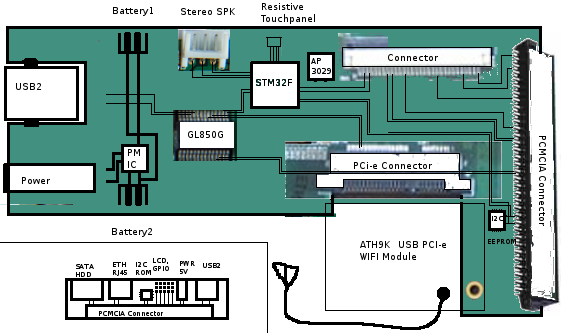

Others: Laptop LCD Monitor (TV)


Embedded Open Modular Architecture/EOMA-68 [Embedded Linux Wiki, Sept 23, 2012]
earlier: Embedded Open Modular Architecture/PCMCIA [Embedded Linux Wiki, Sept 5, 2011 – March 11, 2012],
note that the excerpts below are essentially as of Sept 21, 2011, image: Jan 16, 2012
EOMA-68 Specification
This page describes the specification of EOMA-68. The number of pins on the interface is 68; the physical form-factor is the legacy PCMCIA.
Re-purposing of the PCMCIA interface and form-factor has been chosen to create portable Embedded Computing Modules (Computer on Module). Mass-volume “Lowest Common Denominator” interfaces have been chosen, all of which have existed for over a decade, but are low-power enough to be standard across virtually all mass-produced powerful Embedded CPUs.
The interfaces are:
- 24-pin RGB/TTL (for LCD Panels)
- I2C
- USB (Low Speed, Full Speed, optionally Hi Speed/480 Mbit/s and optionally USB3)
- 10/100 Ethernet (optionally 1,000 ethernet)
- SATA-II (optionally SATA-III)
- 8 pins of General-purpose Digital I/O (GPIO).
These interfaces are NOT OPTIONAL for CPU Cards. All CPU Cards MUST provide all interfaces. I/O Boards on the other hand are free to implement whichever interfaces are required for the device. For example: whilst all CPU Cards must have an SATA interface, devices such as tablets or laptops into which CPU Cards are plugged are not required to have an SATA hard drive.
…
Future Versions
… At the time of writing (2011), the interfaces in the 1.0 Specification are “Lowest Common Denominator” yet are still present across the majority of 2011’s powerful embedded SoCs (OMAP4440, Enyxos4210, Tegra 3, iMX53 etc.) However, in the future, the “Lowest Common Denominator” could well comprise MIPI instead of RGB/TTL, 2 lane PCI-express (or its successor), and USB-3 instead of USB-2 (perhaps even a faster version of ULPI).
As of 2011 however, the total number of Embedded CPUs supporting all these newer interfaces and still keeping to a 1.5 watt budget is precisely zero. Support for these high-speed interfaces will therefore be re-evaluated in 2 to 3 years time, and a future version of this standard created when a large proportion of available embedded CPUs have these or other high-speed interfaces that are available at the time.
…
The project had been initiated by a Crowd funding proposal [Rhombus Tech, Dec 25, 2011],
note that Rhombus Tech website rhombus-tech.net started on Nov 18, 2011 as well as there was an earlier low-cost EOMA-PCMCIA CPU Card initiative (allwinner cortex a8) e-mail by Luke Kenneth Casson Leighton <lkcl@lkcl.net> on Dec 14, 2011
To: opensuse-arm@opensuse.org, linaro-dev@lists.linaro.org, arm@lists.fedoraproject.org, meego-community@meego.com,ubuntu-server-arm@lists.ubuntu.com, maemo-developers@maemo.org, gentoo-embedded@lists.gentoo.org, general@lists.tizen.org,
ARM <debian-arm@lists.debian.org>
Cc: Linux on small ARM machines <arm-netbook@lists.phcomp.co.uk>
Aim: Small (Free as in Speech) Linux device which can be upgraded
In particular, a small CPU card which:-
- Complies with GPL (Free as in Speech)
- Powerful
- Upgradeable
- Cheap
For example I can buy a tablet, after a few years the display, touch-screen and memory will be perfect. After a few years I may want to upgrade the CPU, or fix a software bug, or both – at the moment this is not possible.
We are aiming for this CPU Card will have full GPL Source Code publicly available and will be suitable for many purposes including use as a Freedom Box, or as an embedded computer, or in the future to drive products such as Tablets, Laptops, IPTVs and Desktop PCs simply by plugging it in. These devices can then run a nice GNU/Linux distribution like Debian, Ubuntu or similar.
Current Situation
Not many tablets or small devices run a nice GNU/Linux distribution like Debian, Ubuntu or similar. They are either low powered, closed source, GPL violating or not cheap.
The problem that if you want low-cost mass-produced hardware, you normally have to go with GPL-violating product. We then spend the majority of our time reverse-engineering before getting something useful. By the time we are done, the product is usually end-of-life: thus if it breaks, we are back to square one. If there is a security bug in the kernel supplied – again we are back to square one.
The reason for the GPL violations is that the low-cost China-based Factories simply have zero software skill and a chain of about five business relationships between the seller and manufacturer. The manufacturer has got their money at this stage, so at this point we are asking the manufacturer for more effort in return for no extra income. Thus, we logically concluded that the only way to get non-GPL-violating product out there is to go directly to the factories and be the supplier of their software.
Aim of this Funding Round
To get funding, to deliver a stable CPU on a card:-
GPL: Full source code available.
Powerful: 1.5ghz
Upgradeable: A standard layout, which will allow the card to be ejected and replaced.
Cheap: Stable version at $30
Long Term Aim
High-volume production, then the costs will be $15. Yes $15 for GPL-Loving, powerful, packaged CPU Card.
So put this with :-
2000mAh battery $8,
7in 800×600 LCD $15,
resistive touchpanel $5,
main motherboard including WIFI module about $8,
Case about $3
Total of $39. yes, really – $39. So basically, you can see that a mass-volume retail cost of about $80 for a 7in tablet with the Allwinner A10 and a resistive touchpanel would be quite reasonable. Running Debian, with a CPU upgrade only costing $15.
Progress So Far
Rhombus Tech has been established to serve Free Software Developers, entrepreneurs, enthusiasts and Engineers with access to affordable, modern and importantly GPL-compliant hardware. It is a Community interest company – designed for social enterprises that want to use their profits and assets for the public good.
Over the past two years we been contacting and vetting China-based factories, directly, to find at least one which is prepared to work with us. We found one.
We have also found an absolutely great CPU, called the Allwinner A10, which in mass-volume quantities is only about $7: that means that a PCB similar to the raspberrypi with similar features can be made for about $15 (not $25) and, because the Allwinner CPU is an ARM Cortex A8 not an ARM11 it is at least three times quicker than the raspberrypi’s CPU. (A 400-pin highly feature-rich 1.5ghz ARM Cortex A8 with a MALI400 GPU. )
We have full support of the Board of Directors of the Allwinner CPU: they released full source code to us in advance. We have made it available and found it to compile successfully.
We have selected a standard layout, which will fit within 55mm, which large number of pins can be removed by the user without damage. Which will be the cases are already available and which will have a trivial cost in low-volumes. A PCMCIA format.
Complies with GPL – Yes
Powerful – Yes
Upgradeable – Yes
Cheap – Not yet.
Next Steps
The primary reason for using a Community Interest Company for the sale of GPL-compliant products to Free Software Developers is that profits from sales will be re-invested directly into development of further products, with a primary focus of serving the Free Software Community yet at the same time leveraging mass-volume sales opportunities.
But this needs a kick-start. Then the end-product will get cheaper, then profits are re-invested and end-products get cheaper still. The snowball needs a little magic snow to get it started.
Magic Snow required: $13,500
To fund the three stages:-
Unstable (Also know as Sid for all Debian lovers) : $3,500
Testing Stage: $4,000
Stable: $6,000
Long Term Support: Self-funding
Unstable
5 CPU cards available at a cost of $3,500
A initial cost of $2000 per “board development change”. This is the non-recurring expense. This sets up the PCB tooling so further changes cost about $1500. The aim is to have a development board, tweak then have a second set of development boards.
This gives us the hardware only – about 5 development boards available. Time for the 15 Debian developers, already on board to start coding. (Bootloader, Kernel and main software).
Timeframe – AA months
Rhombus Tech to loan the boards to the developers, free as in beer, in return for help with coding.
Testing
100 CPU cards available at a total cost of $4,000 Timeframe – AA + BB months
We have a board, the bootloader work and the kernel is okay. No full Distribution images as yet. If you are a software developer and are basically happy to get involved doing u-boot, debian-installer, ubuntu images a board is suitable to play with at this point. Hard, but not impossible.
Rhombus Tech to loan half (50) CPU cards to developers, free as in beer, in return for help with coding. The other half of the board to be sent as premium rewards.
Stable
250 CPU cards available at a total cost of $6,000 Timeframe – AA + BB + CC months
Rhombus Tech to give 50 boards to developers, free as in beer who helped with coding. The remainder of CPU cards to be sent as rewards.
Long Term Support (Just for Ubuntu lovers)
Timeframe – AA + BB + CC + DD months CPU Cards at less than $30
The CPU cards can then be produced in mass-volume. Sold through Rhombus Tech, with profits used to seed further CPU upgrades.
Rewards
Total funds required for Unstable, Testing and Stable stages: $13,500
Testing CPU Cards – $50 (Aiming for 50 = $2,500)
Stable CPU Cards, with working OS image – $50 (Aiming for 50 = $2,500)
Stable CPU Cards – $35 (Aiming for 200 = $7,000)
Special Rewards
A Rhombus Tech Sticker sent world wide – $5 ($1.50 profit per sticker)
Mention in the source code – $5
A certificate mentioning your contribution to the Small (Free as in Speech) Linux device which can be upgraded. – $10
A testing CPU Card, with your choice of Debian Packages loaded by a Debian Developer – $250
You select the code name for the Unstable Board (legal, ethical names only) – $250
You select the code name for Testing CPU Card (legal, ethical names only) – $500
You select the code name for Stable CPU Card (legal, ethical names only) – $1,000
Then more information came in the for of FAQ [Rhombus Tech, March 25, 2012]
What’s the goal, again?
To create a synergy between the ultra-low-cost Factories and SoC vendors of China with their expertise in Hardware, and Software (Libre) Developers with their expertise in GNU/Linux and other OSes, with a view to leveraging the combination to create affordable and desirable mass-volume products that are GPL-compliant before they hit the Retail Hypermarket shelves;
For those products to be modular, versatile and open, so that they can be upgraded without the environmental waste of throwing away an entire device; for Retailers, Factories and users to be able to keep up with the rapid and increasing pace of technological development;
For anyone to be able to use the products for their original purpose as well as for Educational purposes, Research, Engineering and more.
How will this goal be achieved?
Very carefully, in small steps, having learned from the experiences of the OpenMoko and OpenPandora projects.
Produce very simple EOMA-68-compliant CPU modules which can act as stand-alone computers in their own right (powered via USB-OTG) so that Software (Libre) Developers have something to start working on.
Start designing IO boards.
Software (Libre) Developers help develop the software to run on the products.
Products go to market.
Profit.
Use profits to repeat the process, to the benefit of all parties, including the Software (Libre) Developers.
And… a CIC? really? But those are for Social Clubs!
The rules for CICs are “to not make a loss”, which makes sense for any business. There is no limit on the profitability of a CIC: it’s just that, at the end of each Financial Year, the profits have to be allocated to a charitable cause, or they have to have been ploughed back into the business. A Community Interest Company simply does makes more sense in the context of the goals of bringing Software (Libre) Developers together into this exciting technological area that has previously been dominated by vertical market sales strategies.
Why is the price of the Allwinner A10 EOMA-68 Card $15?
It damn well isn’t! We are getting a massive amount of misunderstandings about this. We have reported that based on estimates from the Reference Board supplied by the Manufacturer of the SoC that the MATERIALS COST is APPROACHING $15 in MASS VOLUME quantities of 100,000 units.
That is excluding a case, power supply (which as the unit can be powered by USB-OTG is not needed), packaging, tax, customs duty, shipping and, most importantly, a profit margin.
Any company has to make a profit, and a CIC is no different. Charities and Not-for-Profit Foundations can get away with not making a profit, but Rhombus Tech is not a Charity.
Profits made will be used to fund Free Software Developers, as well as future CPU Cards and the creation of Reference Design Products: Laptops, Routers and so on, all of which will be done in an Open fashion.
What is EOMA?
It stands for “Embedded Open Modular Architecture”. The concept of modular architecture isn’t new: many companies have divided out CPUs into separate PCBs or modules, but it just hasn’t been done recently, not on a mass-volume scale and not on a user-controllable basis. See the elinux.org EOMA page for more information.
Why re-use PCMCIA??
It’s legacy – nobody makes PCMCIA cards any more: it’s all changed to the PCIe-based “PCI express” aka “ExpressCard” thing. However, it turns out that Satellite TV “Conditional Access Modules” are in PCMCIA form-factor, meaning that the connectors, housings and assemblies are all still mass-produced. So there’s less risk of having someone destroy their CPU card if they force-break the mechanical barriers (see specification for details) but the pricing on parts is still good in mass-volume quantities.
What’s so special about the interfaces on EOMA-68?
The interfaces that have been picked happen to have been around for at least a decade, and the number of pins, including 16 pins of GPIO and including enough GND pins to separate each of the high-speed signals, by a jammy coincidence comes to exactly 68 pins.
RGB/TTL: 28 pins
USB2: 2 pins
I2C: 2 pins
10/100 Ethernet: 4 pins
SATA-II: 4 pins
GPIO: 16 pins
5V Power: 2 pins @ 0.5A per pin
The total comes to 58 pins, and there are 5 groups of GND pins to separate each group. Grand total: 68 pins. jammy or what? More information is available here.
Whoa, wait, PCMCIA is 100ohms approximately!
Yes, we know. It’s not all bad. By a coincidence, SATA-II is 100 ohms and USB-2 is 90 ohms. We think that’s close enough. Absolute absolute last resort: both SATA-II and USB-2 can be ramped down in speed. This would be a bugger, but at least product would work. Other than that: yes it is possible to adjust impedance through careful placement of tracks and ground planes etc.
Bottom line: we’ll just have to pick the right PCMCIA connector supplier, that’s all.
Why is the first CPU that RHT picked a China-based one?
Cost and features – pure and simple. Consumers do not care about Software Freedom – they just don’t. Only Software (Libre) Developers care about Software Freedom. However, GPL Compliance is very very important to RHT, because we do not wish to be liable for GPL violations, and we do not wish our mass-volume Retail Hypermarket Clients to be liable for GPL Violations, either. So, RHT has spent the past two years negotiating with SoC vendors to find one that has the three critical factors of: 1) Cost 2) features 3) GPL Compliance. Amazingly, it was a China-based Fabless Semiconductor Company that first met the requirements. Yes we are looking for more.
Which CPUs have you analysed so far, and why were they rejected?
We have analysed dozens of CPUs. With the exception of the Allwinner A10, none of them really fulfil all of the criteria. This section turned out to be so large that it was moved to its own page: Evaluated CPUs.
So what FSF Hardware-Endorseable options are there?
The Ingenic MIPS jz4760 (700mhz) – $USD 7 in mass-volume
The 600mhz ARM Cortex A8 OMAP 3503 ($19, 1k volumes)
The 720mhz ARM Cortex A8 AM3357 – ($14, 1k volumes and $5 in 100k)
Sadly, none of these CPUs however fulfil the mass-volume criteria of being able to do 3D Graphics or 1080p video. Some of them can do 720p, but that is not enough for commercial mass-volume purposes: it really does have to be 1080p now. 4 years ago, 720p was acceptable: now it isn’t.
These CPUs are listed on the Evaluated CPUs page.
Is this an “Open Hardware” Project i.e. can I get the full schematics?
This is a misleading question: here’s some clarification. The EOMA-68 initiative is an “Open Specification“. That means that anyone can create either CPU cards or motherboards that conform to it. Thus, it is possible for anyone to create an “Open Hardware” compliant CPU card or motherboard.
Rhombus Tech has chosen to work with a small, dynamic factory in China that loved the idea of the “we’ll do the software if you do the hardware” deal. It would be rather a different proposition for us to then ask them to release the full schematics.
Also in development is a 8mm-high (Type III) EOMA-68 CPU card with a AMD 64-bit x86 APU with Dual-core CPU, integrated Radeon 3D Graphics, with full Free Software support.
Bari also has an initiative to turn the Beaglebone or any other ARM SOC or AMD Fusion APU into an EOMA-68 CPU card, if enough people show interest in this happening. Given that the Beaglebone (and other systems like it such as the IMX53QSB, Origen, Pandaboard etc.) schematics are available under an Open Hardware License, the Beaglebone EOMA-68 CPU Card will be “Open Hardware”.
Additionally, given that the Leaflabs Maple is an “Open Hardware” Project, there exists the possibility for the creation of EOMA-68-compliant Motherboards based around the adaption of Leaflabs Maple Boards.
Summary of the above: it’ll happen. (update: 10jan12 – sooner than anticipated!schematics being developed here).
Rhombus-Tech/ allwinner a10/ news
…
24 Jul 2012: Casework for EOMA-68 CPU Card
Titoma Design is delighted to be involved with the EOMA-68 project and has a preliminary design for the first EOMA-68 CPU Card, using the Allwinner A10 SoC. Titoma Design specialises in casework and full product design, and will be more than happy to assist clients to develop products based around the time and cost saving benefits of the EOMA-68 upgradeable design strategy.

28 Jul 2012: GPIO and Expansion Headers for EOMA-68 CPU Card
A rework of the GPIO and Expansion Headers for the first Qimod EOMA-68 CPU Card has been carried out. Almost all interfaces available of the Allwinner A10 CPU have been made available on the 55x85mm Credit-card-sized CPU Card, including both Transport Streams, SIM Card, PATA, the 24-pin Camera Interface, both 24-pin LCD Interfaces, VGA, Composite Video (CVBS), SPDIF, AC97, I2S, GPS, CAN-Bus, Infrared, and many more. This is in addition to the standard EOMA-68 Interfaces of Ethernet, I2C, SATA, LCD 24-pin RGB/TTL, USB2 and 16 GPIO pins.
The rework involved adding an extra optional 45-pin FPC, which is in addition to the optional 44-pin FPC. The orders page has been updated to reflect the full pinouts, as well as the finalised selection for the 16 EOMA-68 GPIO pins.
…
The most current product information therefore is available on Preorders [Rhombus Tech, July 28, 2012, but preorders are listed from Dec 12, 2011 to Sept 23, 2012]
This is the preorders page for EOMA-68-compliant Allwinner Cortex A8 CPU modules. This product will have full GPL Source Code publicly available, and will be suitable for many purposes including Educational and R&D purposes, a USB-OTG-powered Thin Client, use as a Freedom Box, or as an embedded computer, or in the future to drive products such as Tablets, Laptops, IPTVs and Desktop PCs simply by plugging it in. Some options for hardware that is on the roadmap are described as example motherboards on the EOMA-68 page.
Features
The Allwinner EOMA-68-compliant module will have the following features:
- Approximately Credit-card size format (56mm x 90mm)
- An Allwinner A10, 1.2ghz ARM Cortex A8
- 1gb of RAM
- at least 1gb of NAND Flash (possibly up to 16gb)
- Operation as a stand-alone computer (USB-OTG powered)
- 2160p (double 1080p) Video playback
- MALI 400MP 3D Graphics, OpenGL ES 2.0 compliant.
- HDMI, Micro-SD, Headphones Socket,
- EOMA-68-compliant interfaces (RGB/TTL, I2C, USB2, SATA-II, 10/100 Eth)
- Expansion Header (similar to Beagleboard, IMX53QSB, Origen etc.)
…
These are the available interfaces on the 44-pin [Expansion Header’s interfaces] DIL:
- 2pins: 1x USB-2
- 8pins: 5-pin AC97 shared with 8-pin I2S Signals.
- 2pins: PWM0 (PB2)
- 4pins: TV-Out, VGA-Out
- 4pins: 4-wire Resistive Touchscreen
- 10pins: LVDS0 (multiplexed with LCD0)
- 10pins: LVDS1 (multiplexed with LCD0)
- 5V and 3.3V power
…
Due to multiplexing on the Allwinner A10, the following interfaces are also available on the PCMCIA connector via the 24-pin RGB/TTL pins (WARNING: non-EOMA-compliant).
- IDE (PATA)
- 24-bit Camera Sensor
- 20 External Interrupts
- 8×8 Keypad Interface
- 2 full UARTS with RX,TX,CTS,RTS
- CAN-bus
- 2 PS/2 interfaces
- SD/MMC 3.0 Ultra-High-Speed Class, UHC-I
Further multiplexing also allows the I2C interface to be switched over to two extra GPIO pins (WARNING: non-EOMA-compliant).
Also, the pins on the Micro SD/MMC interface can also be switched over to JTAG and a UART. With a special PCB with a Micro SD/MMC slot on the end it is possible to perform debugging of the device, live, without opening it up.
The Infrared Interface on the expansion header supports the following data formats:
- MIR FIR IrDA 1.1
- 0.576 Mbit/s 1.152 Mbit/s Medium Infrared (MIR)
- 4 Mbit/s FIR IrDA 1.4
- CIR
These are being considered:
- 2pins: 3.8v Battery Connection, on separate connector
- 3pins: Reset and Power, on separate connector
- 3pins: u-boot select, on separate connector
Pricing
Regarding pricing: the hardware NREs from the factory are $USD 2,000. Therefore, based on the number of committments so far (23 as of 2011Dec12), pricing looks set to be around $100. By the time the number of preorders reaches 30, that will be around $75 (30 reached as of 2011Dec17). (Update: as of 2012Mar01 the alpha units have reached 141 and it’s down to $41 per unit assuming NREs of $2,000 and component costs of $30. Please note: we do not yet know the unit cost! this is entirely preliminary!).
The mass-volume (100k units) cost will be somewhere around $15: the more committments received, the closer the price will get to that. One expression of interest has been received for 1,000 (stable) units: a pricing evaluation request is outstanding with the factory and will be reported as soon as it is received.
Please note: this cost excludes a case, power supply, packaging, shipping, tax, customs and import duty. and profit.
Software Freedom Information
Regarding Software Freedom: the caveat regarding this CPU is that it requires ARM-proprietary libraries for the 3D Graphics (as does virtually every single suitable consumer-grade embedded SoC on the planet with the almost exclusive sole exception of the Ingenic jz4760 and some of the TI ARM Cortex OMAP and Sitara SoCs). However, simply not using the proprietary MALI 3D GPU does not impact any other functionality in any way.
(update: MALI 400MP is being reverse-engineered)
Yet to be determined is how to program the proprietary 2160p MPEG decoder, but through a preliminary examination of the GPL Source Code it would appear that the drivers are publicly available. However, this CPU does have NEON, so can be used for Software Decode of Open CODECs.
Overall: if this module is not for you, an AM3357 module may be more suitable.
[committments so far:
– 23 as of Dec 12, 2011
– 30 as of Dec 17, 2011
– 141 alpha units as of Mar 01, 2012
large (=5 or more) number of units on preorder after Mar 01:
– 215= 43×5
– 762=9×10+1×15+1×18+3×20+1×30+1×49+2×50+4×100
– 3466=1000+1000+1000+466
– 75000=15000+50000+10000
so the whole project looks quite feasible from the point of view of achieving the $15 unit cost for which 100K units should be on order]
Rhombus-Tech/ allwinner a10/ news
6 Sep 2012: PCB design completed for EOMA-68 CPU Card
Many thanks to Wits Tech for completing the PCB design: the board layout and GERBER files are done. This brings the A10 EOMA-68 CPU Card one step closer to reality. The next stage is to get initial samples made up, the first script.fex created and a first boot completed.
[Wits Tech with products such as: MID and PCBA, e-book, smart MP4, 1080P high-definition MP4, 768P, 1080P harddisk player, IPTV, Google TV-BOX and so on]
Following on very very quickly from this, and driving a rather fast development schedule, is a commission from a client to convert an existing x86 laptop (1280×800) over to using the new A10 EOMA-68 CPU Card, and to provide 25 working prototypes for a Trade Show. Luckily, as the CPU Card is completely independent of the I/O Board, separate teams can focus on the development tasks.
Other news coverage:
…
Marketing Strategy [Rhombus Tech, May 1, 2012]
- TTM – Time to market lead
- Open versatile Common Platform
- EOMA One
Three ways EOMA helps to bring new products to market faster and save money
EOMA – From month to weeks TTM reduction
ODM
One platform, many Distros: Vanilla GNU/Linux, Android etc.
Software comes pre-flashed by default
One module, many applications
Instant upstream compatibility with Linux GIT tree
OEM
Need for software expertise is removed from OEM side
BOM reduction X 5
Access to bigger market platform
Readapting the design is as easy as changing one module
System Integrators
Quick access to many ODM designs
Plug and play
LOW TTM and high flexibility
Update process is made trivial and faster
Reasoning behind the Marketing Strategy
EOMA is platform for the whole industry that benefits the whole “food chain”.
Its good for ODM because they will have upstream support and they will be able to support their own clients better.
For OEMs the benefit is that they will no longer need to deal with software by themselves, it simplifies production and logistics, lowers production run times thus less cost of capital.
For integrators, the benefit is less obvious, but its also lower time to market, increased ability to reuse existing designs.
In general, the idea is that EOMA uses open source principles to increase efficiency across the industry. EOMA will be doing to computer hardware market the same thing what linux has done to server OS market.
Rhombus Tech Presentation [Rhombus Tech, March 12, 2012]
what is the project.
EOMA is an initiative to separate the platform from the widget
EOMA module is System-On-Module that will come in standardized 68 pin package
It can utilize most of low cost SoC of your choice. At current stage, Allwinner A10 is the favoured chip.
The first EOMA-68 CPU Card is Cortex A8 based design
Module provides I2C, USB, Ethernet, SATA, 8 bit ttl rgb (display), and gpio on remaining pins
At current stage Rhombus plans to reinvest all profits into platform development and improvement
what is the advantage and scenarios.
Rhombus facilitates upstream integration with linux and other major OSS projects.
OEMs receive standard platform that greatly reduces time-to-market.
OEMs no longer need to contract ODMs or have extensive software expertise to make a worthwhile product.
what is the latest status of this project.
Rhombus is in process of getting pre-orders
lkcl [Luke Kenneth Casson Leighton] is working with manufacturers to start production
See also: Embedded Open Modular Architecture This slideshow could not be started. Try refreshing the page or viewing it in another browser.


Boosting both the commodity and premium brand markets in 2013 with much more smartphones and tablets while the Windows notebook shipments will shrink by 2%
This is my conclusion after reviewing
- The ongoing trends in the commodity and premium brand ecosystems of Android devices:
– Smartphones
– Tablets
and
- The emerging new trends in the premium ecosystem of the Windows devices:
– Notebooks
– Smartphones
as reported by the most knowledgeable sources.
Updates: – ODMs see weaker profits from tablet business [DIGITIMES, March 26, 2013]
As Google and Amazon reportedly will release their next-generation 7-inch entry-level tablets in the near future, sources from the upstream supply chain have estimated that related ODMs’ profits from these tablets will be about 20% less than those from notebooks.
Since tablets have a simpler design than notebooks, the ODMs are only able to earn about US$9-10 for each tablet made, lower than US$13-20 for notebooks.
In addition, fewer components needed means that ODMs will have difficulties using their purchasing advantages to earn profits, and tablet brand vendors’ demand for specific components will also impact the makers’ profits, the sources noted.
Seeing weak growth in the notebook industry, most ODMs have turned to place their focuses on the tablet market and are competing aggressively for orders through price cuts, the sources said.
– Wintel camp mulls measures to rekindle weakening notebook industry [DIGITIMES, Feb 21, 2013]
Suppliers within the Wintel camp are mulling to launch a series of measures, including price cuts for their products, in the second quarter of 2013 to rekindle the stymied notebook industry caused by growing popularity of tablets, according to industry sources.
The launch of Windows 8 has failed to ignite replacement demand for notebooks in the end markets, resulting in a prolonged inventory adjustment process at the supply chain that has been going on since the third quarter of 2012, the sources noted.
With market reports indicating that global tablet shipments are likely to reach 200-300 million units in 2013, including 150 million units in China and other emerging markets, notebook vendors will see their market share continue to be eroded by tablets, commented the sources.
While agreeing to the consensus that price-cutting will be the only way to stimulate notebook demand, related PC chip suppliers are urging the major players in the Wintel camp, mainly Intel and Microsoft, to take the lead in action so that the entire supply chain can follow.
The Wintel camp has always chosen to start cutting their product prices in the third quarter each year, noted the sources, but it would be too late to safeguard the notebook industry as well as its supply chain if Intel and Microsoft do not take actions till the third quarter this year.
Since Intel usually will cut significantly its CPU prices prior to the launch of new models, the planned launch of Haswell platform in June may persuade the chip giant to lower the quotes for its Ivy Bridge family CPUs earlier, the sources revealed.
But it remains to be seen if price cuts by Intel alone could stir up notebook replacement demand amid the squeezing-out effect triggered by the rise of tablets, mobile phones and other mobile Internet devices, commented the sources.
End of updates
Before reading the sections of this post corresponding to the above, do not forget to read my own analytical posts which are based on the new product directions and supporting SoC trends (and as such predicting the year 2013 market even better than the external analyses quoted here which are mainly based on supply chain trends and market changes observed already in 2012):
– $48 Mogu M0 “peoplephone”, i.e. an Android smartphone for everybody to hit the Chinese market on November 15 [Nov 9, 2012]
– Lowest H2’12 device cost SoCs from Spreadtrum will redefine the entry level smartphone and feature phone markets [July 26 – Nov 9, 2012]
– The low priced, Android based smartphones of China will change the global market [Sept 10-26, 2012]
– Unique differentiators of Nokia Lumia 920/820 innovated for high-volume superphone markets of North America, Europe and elsewhere [Sept 6 – Nov 13, 2012]
– With Asha Touch starting at $83 and Lumia at $186 Nokia targeting the entry-level and low-end smartphone markets [Nov 1, 2012]
– Boosting the MediaTek MT6575 success story with the MT6577 announcement – UPDATED with MT6588/83 coming early 2013 in Q42012 and 8-core MT6599 in 2013 [June 27, July 27, Sept 11-13, Sept 26, Oct 2, 2012]
– MT6577-based JiaYu G3 with IPS Gorilla glass 2 sreen of 4.5” etc. for $154 (factory direct) in China and $183 [Sept 13, 2012]
– China’s HW engineering lead: The Rockchip RK292 series (RK2928 and RK2926) example [Oct 27, 2012]
– Nexus 7: Google wanted it in 4 months for $199/$245, ASUS delivered + Nexus Q (of Google’s own design and manufacturing) added for social streaming from Google Play to speakers and screen in home under Android device control [June 28, 2012]
– Giving up the total OEM reliance strategy: the Microsoft Surface tablet [June 19 – July 30, 2012]
– ASUS: We are the real transformers, not Microsoft [Oct 17, 2012]
– Microsoft Surface: its premium quality/price vs. even iPad3 [Oct 26, 2012]
– BUILD 2012: Notes on Day 1 and 2 Keynotes [Oct 31, 2012]
– Acer Iconia W510: Windows 8 Clover Trail (Intel Z2760) hybrid tablets from OEMs [Oct 28, 2012]
– Microsoft Surface with some questions about the performance and smoothness of the experience [Nov 12, 2012]
Update: The sections of this post are somewhat taking into the account the most dramatic disruption in the whole history of ICT, what I am calling the ‘ALLWINNER PHENOMENON’ (all ‘Allwinner et al phenomenon’ sometimes when including Allwinner’s internal mainland China competitors such as Rockchip into account as well). EVERYBODY SHOULD BE AWARE of the fact, however, that even in the latest forecasts by bigname ICT market researchers the ‘Allwinner phenomenon’ is not taken into account at all. The two very recent updates from IDC given below should therefore be read with that in mind as the ‘Allwinner phenomenon’ will add hundreds of millions to those forecasts starting as early as in 2013. Especially the numbers for the tablets will be affected. To understand more about that please read my special posts given in a newly created blog about the ‘Allwinner phenonmenon’:
– Allwinner A31 SoC is here with products and the A20 SoC is coming [Dec 10, 2012]
– Is low-cost enough for global success? [Dec 5, 2012]
– The upcoming Chinese tablet and device invasion lead by the Allwinner SoCs [Dec 4, 2012]
– $40 entry-level Allwinner tablets–now for the 220 million students Aakash project in India [Dec 4, 2012] from this alone 220 million additional tablets would have been delivered from 2013 to 2016
– USD 99 Allwinner [Nov 30, 2012]
– It’s a Strategic Inflection Point [Dec 1, 2012]
Update: HTC 1Q13 smartphone shipments to grow slower than expected, say sources [DIGITIMES, Dec 18, 2012]
Affected by the launch of iPhone 5 and rapidly declining smartphone prices in China, HTC reportedly has revamped its product roadmap for 2013 and is expected to see its smartphone shipments rise 10-15% sequentially in the first quarter of the year compared to a 20-30% growth projected previously, according to industry sources.
HTC has suspended development of a number of new models for 2013, reducing the visibility of its orders for handset components, the sources revealed.
HTC declined to comment on market speculation.
However, the industry watchers believe that HTC is heading for a bumpy road ahead, since shipments of its Windows Phone 8-based smartphones have not been as strong as expected, while Apple’s iPhone 5 and Samsung Electronics’ Galaxy III have continued to enjoy brisk sales.
In China, HTC is facing cut-throat competition from local white-box smartphone vendors and has been forced to enter the sub-CNY2,000 (US$321) segment, which runs counter to its established policy focusing mainly on the high-end sector, said the sources.
Update: Worldwide Smart Connected Device Market, Led by Samsung and Apple, Grew 27.1% in the Third Quarter, According to IDC [IDC press release, Dec 10, 2012]

The worldwide smart connected device market – a collective view of PCs, tablets, and smartphones – grew 27.1% year-over-year in the third quarter of 2012 (3Q12) reaching a record 303.6 million shipments valued at $140.4 billion dollars. Expectations for the holiday season quarter are that shipments will continue to reach record levels rising 19.2% over 3Q12 and 26.5% over the same quarter a year ago. According to the International Data Corporation (IDC) Worldwide Quarterly Smart Connected Device Tracker, 4Q12 shipments are expected to reach 362.0 million units with a market value of $169.2 billion dollars. Holiday season growth will be driven by tablets and smartphones, which are expected to grow 55.8% and 39.5% year-over-year respectfully, while PCs are expected to decline slightly from this quarter a year ago.
From a vendor perspective, Samsung maintained the top position in 3Q12 with 21.8% market share based on shipments. Apple, which ranked second overall in shipments, led all vendors in value with a total of $34.1 billion in 3Q12 and an average selling price (ASP) of $744 across all device categories. Following Samsung’s 21.8% share and Apple’s 15.1% share were Lenovo (7.0%), HP (4.6%), and Sony (3.6%). While Samsung, Apple, and Lenovo have all grown share over the past year, HP, which is virtually non-existent in the mobile space, has dropped its share from 7.4% in 3Q11 to 4.6% in 3Q12 with shipments declining -20.5% during that time.
“The battle between Samsung and Apple at the top of the smart connected device space is stronger than ever,” said Ryan Reith, program manager, Worldwide Mobile Device Trackers at IDC. “Both vendors compete at the top of the tablet and smartphone markets. However, the difference in their collective ASPs is a telling sign of different market approaches. The fact that Apple’s ASP is $310 higher than Samsung’s with just over 20 million fewer shipments in the quarter speaks volumes about the premium product line that Apple sells.”
Looking forward, IDC expects the worldwide smart connected device space will continue to surge well past the strong holiday quarter and predicts shipments to surpass 2.1 billion units in 2016 with a market value of $796.7 billion worldwide. IDC’s research clearly shows this to be a multi-device era, although market dynamics are shifting in terms of product category. In 2011, PC’s – a combination of desktop and portable PCs – accounted for 39.1% of the smart connected device market. By 2016 it is expected to drop to 19.9%. Smartphones will be the preferred product category with share growing from 53.1% in 2011 to 66.7% in 2016. Tablets will also grow significantly with share growing from 7.7% in 2011 to 13.4% in 2016. The shift in demand from the more expensive PC category to more reasonably priced smartphones and tablets will drive the collective market ASP from $534 in 2011 to $378 in 2016.
“Both consumers and business workers are finding the need for multiple ‘smart’ devices and we expect that trend to grow for several years, especially in more developed regions,” said Bob O’Donnell, program vice president, Clients and Displays. “The advent of cloud-based services is enabling people to seamlessly move from device to device, which encourages the purchase and usage of different devices for different situations.”
Top 5 Smart Connected Device Vendors, Shipments, and Market Share, Q3 2012 (shipments in millions)
Vendor
3Q12 Unit Shipments
3Q12 Market Share
3Q11 Unit Shipments
3Q11 Market Share
3Q12/3Q11 Growth
Samsung
66.1
21.8%
33.5
14.0%
97.5%
Apple
45.8
15.1%
33.1
13.9%
38.3%
Lenovo
21.1
7.0%
13.2
5.5%
60.0%
HP
14.0
4.6%
17.6
7.4%
-20.5%
Sony
11.0
3.6%
8.7
3.7%
25.4%
Other
145.6
48.0%
132.7
55.6%
9.7%
Total
303.6
100.0%
238.9
100.0%
27.1%
Source: IDC Worldwide Quarterly Smart Connected Device Tracker, December 10, 2012.
Smart Connected Device Market by Product Category, Shipments, Market Share, 2012-1016 (shipments in millions)
Product Category
2016 Unit Shipments
2016 Market Share
2012 Unit Shipments
2012 Market Share
2016/2012 Growth
Desktop PC
151.0
7.2%
149.2
12.5%
1.2%
Portable PC
268.8
12.8%
205.1
17.2%
31.1%
Smartphone
1405.3
66.7%
717.5
60.1%
95.9%
Tablet
282.7
13.4%
122.3
10.2%
131.2%
Total
2107.8
100.0%
1194.0
100.0%
76.5%
Source: IDC Worldwide Quarterly Smart Connected Device Tracker, December 10, 2012.

Update: IDC Raises Tablet Forecast for 2012 and Beyond As iOS Picks Up Steam, Android Gains Traction, and Windows Finally Enters the Market [IDC press release, Dec 5, 2012]

A strong competitive landscape—including surging Android tablet shipments and robust demand for Apple’s new iPad mini—has led International Data Corporation (IDC) to increase its 2012 forecast for the worldwide tablet market to 122.3 million, up from its previous forecast of 117.1 million units. In the latest forecast update of the Worldwide Quarterly Tablet Tracker, IDC also raised its 2013 forecast number to 172.4 million units, up from 165.9 million units. And by 2016 worldwide shipments should reach 282.7 million units, up from a previous forecast of 261.4 million units.
“Tablets continue to captivate consumers, and as the market shifts toward smaller, more mobile screen sizes and lower prices points, we expect demand to accelerate in the fourth quarter and beyond,” said Tom Mainelli, research director, Tablets at IDC. “Android tablets are gaining traction in the market thanks to solid products from Google, Amazon, Samsung, and others. And Apple’s November iPad mini launch, along with its surprise refresh of the full-sized iPad, positions the company well for a strong holiday season.”
In addition to increasing the unit totals for 2013, IDC also updated its operating system splits for the year to reflect Android’s growing strength in the tablet market. IDC now expects Android’s worldwide tablet share to increase from 39.8% in 2011 to 42.7% for the full year of 2012. During that same time Apple’s share will slip from 56.3% in 2011 to 53.8% in 2012. Long term, IDC predicts Windows-based tablets (including Windows 8 and Windows RT) will grab share from both iOS and Android, growing from 1% of the market in 2011 to 2.9% in 2012, on its way to 10.3% in 2016.
“The breadth and depth of Android has taken full effect on the tablet market as it has for the smartphone space,” said Ryan Reith, program manager for IDC’s Mobile Device Trackers. “Android tablet shipments will certainly act as the catalyst for growth in the low-cost segment in emerging markets given the platform’s low barrier to entry on manufacturing. At the same time, top-tier companies like Samsung, Lenovo, and ASUS are all launching Android tablets with comparable specs, but offered at much lower price points.”
Once again, IDC’s increase in tablet shipments comes at the expense of eReaders. IDC lowered its forecast for eReaders for 2012 and beyond. While the front-lit eReader offerings from Amazon and Barnes & Noble have captured the interest of a subset of consumers who prefer a dedicated eReader, most buyers are gravitating toward multi-use tablet products and finding a ‘good enough’ reading experience on these traditional back-lit tablets. IDC now expects 2012 eReader shipments to top out at 19.9 million units, down from the 27.7 million units that shipped in 2011.
Tablet Operating Systems, Market Share Forecast and CAGR 2012-2016
Tablet OS
2012 Market Share
2016 Market Share
CAGR 2012 – 2016 (%)
iOS
53.8%
49.7%
20.9%
Android
42.7%
39.7%
21.0%
Windows
2.9%
10.3%
69.2%
Other
0.6%
0.3%
7.7%
Grand Total
100.0%
100.0%
23.3%
Source: IDC Worldwide Quarterly Tablet Tracker, December 5, 2012
Table Notes:
- Windows shipments include Windows RT, Windows 8, and Windows 7 tablets.
- Shipments include shipments to distribution channels or end users. OEM sales are counted under the vendor/brand under which they are sold.
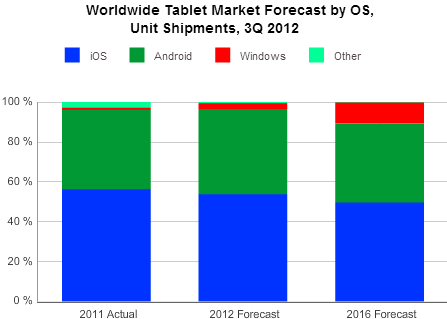
The ongoing trends in the commodity
and premium brand ecosystems of Android devices
Smartphones
Motorola likely to bid farewell to Taiwan handset ODMs after Google sells plants to Flextronics [DIGITIMES, Dec 17, 2012]
The partnerships between Motorola Mobility and Taiwan-based handset ODMs such as Foxconn International Holdings (FIH) will begin to fade away, as Google, the parent company of Motorola, has signed an agreement to hand over Motorola’s manufacturing operations in Tianjin, China, and Jaguariuna, Brazil to Flextronics International, according to industry sources.
After the deal between Google and Flextronics is completed in the first half of 2013, Motorola will completely withdraw from the handset manufacturing industry, and instead will transform to a brand operator targeting mainly the mid-range to high-end smartphone segment, the sources indicated.
While the streamlining of Motorola’s operations comes as no surprise to Taiwan handset ODMs, Google’s decision to sell Motorola’s plants to Flextronics, instead of its long-tern partner FIH, has raised concerns among the industry.
Flextronics is purchasing the plants in exchange for orders from Motorola since the Singapore-based EMS giant has made little progress in gaining handset orders from Apple or major players in the Android or Windows Phone camps, the sources commented.
It is also no longer necessary for FIH to buy plants in exchange for orders, as the company has transferred from handset EMS operations to focus on smartphone ODM business, indicated the sources, adding that FIH has also managed to establish partnerships with a number of major players in the smartphone sector.
However, a deepened cooperation between Motorola and Flextronics may affect the handset component supply chain in Taiwan, the sources warned.
Digitimes Research: Android phones to account for 70% of global smartphone market in 2013 [DIGITIMES Research, Dec 6, 2012]
Android will further solidify its market leadership in the smartphone operating system race in 2013, thanks to a broad support from smartphone vendors and the rollout of a wide range of low-priced models for sale in emerging markets. Shipments of Android phones are expected to top 600 million units or over 70% of global smartphone shipments in 2013, Digitimes Research estimates.
iOS will trail Android to take the number two position in the OS ratings with a 20% share, while other smartphone platforms will share the remaining 10%.
Shipments of Windows Phones, including 7.x and 8.x models, will grow 150% on year to 52.5 million units in 2013 for a 6.1% share, followed by RIM’s BlackBerry devices with a 3.7% share, Digitimes Research estimates. Other platforms, including Tizen and Firefox, will take up a portion lower than 1%.
Digitimes Research: Global smartphone shipments to grow 30% in 2013 [DIGITIMES Research, Nov 19, 2012]
Global smartphone shipments are expected to grow 30% to 865 million units in 2013, accounting for 43.9% of total handset shipments in the year, Digitimes Research has estimated.
Factors including relationships between platform providers and hardware makers, support from telecom carriers for new models, and key developments or decisions by some vendors will affect smartphone sales in 2013, Digitimes Research believes.
Google is expected to further strengthen its control over the Android ecosystem and its production partners, which may limit the development of other platforms or variant Android models.
Microsoft’s launch of own-brand smartphones may result in a reduction in support for the Window Phone platform by hardware vendors, which should otherwise serve as a key factor to push for the growth of the Window Phone to become a third major platform in the segment.
While Amazon is likely to enter the smartphone market, 2013 may be crucial a year for Nokia and RIM (Research in Motion) to make vital decisions concerning their smartphone businesses.
Demand for high-end smartphone models in Western Europe will be affected seriously by reduced government budgets and weak consumption in the region because of the prolonged financial crisis.
However, smartphones’ growing penetration in China, Russia, India, Indonesia, South America and other emerging markets will serve as a growth driver for global smartphone shipments in 2013, Digitimes Research believes.
Google, Amazon and other vendors in China to lead pricing in low-cost smartphone segment, say sources [DIGITIMES , Nov 5, 2012]
While sales of low-cost smartphones are expected to continue growing in the next few years, Google, Amazon and other Internet service companies in China may lead price competition in the segment, according to industry sources.
Shipments of low-cost smartphones, defined as models with a selling price of less than US$150, are forecast to double every year from 2010 to 2016, increasing from 4.5 to 311 million units, according to NPD DisplaySearch.
Most of the demand (60%) is from the Asia Pacific region, where a large majority of component suppliers and manufacturing factories are located – providing both time and cost savings, said DisplaySearch.
In China, the trend for telecom carriers to continue cooperating with chipset suppliers, handset design houses and handset vendors for the launch low-priced smatphone models will continue for a while, the sources noted.
Vendors including Huawei Device, ZTE, Lenovo and Coolpad have emerged as the leading group of the smartphone suppliers in China through the offerings of low-cost models, but most of vendors has suffered losses or seen the profits of their handset business decline due to fierce price competition in the segment, the sources revealed.
Lenovo’s handset business unit is still operating in red, and Huawei and Coolpad have seen their profits decline, while ZTE and TCL have seen their handset businesses swing from profitability to loss, the sources indicated.
In order to stemming losses, or improving profitability, most branded smartphone vendors in China have been trying to expand their share in the mid- and high-end segment, while pushing their sales through local retain channels or export sales.
But other China-based smartphone vendors such as Xiaomi Technology, Internet service companies including Baidu and Shada Interactive Entertainment, as well as online retail giant 360buy, are likely to continue to adopt aggressive price strategies to pushing sales of their own models, said the sources.
In the global market, the cooperation between Google and LG Electronics for the launch of Nexus 4 at prices ranging from US$299-349 is also expected to lead to the proliferation of more low-priced Android smartphone models, the sources indicated.
Amazon, which has been aggressive in the tablet segment, is expected to release its first smartphone model in 2013 with the same price tactics, which is likely to further drive down the prices of smartphones, commented the sources.
Digitimes Research: Nexus 4 to be popular in prepaid SIM card and telecom retail channels [DIGITIMES Research, Nov 7, 2012]
Google’s Nexus 4, which comes with a 4.7-inch 720p HD display and Qualcomm quad-core Snapdragon S4 processor, is expected to become a popular model in the prepaid SIM card segment as well as in telecom retail channels for unlocked subscribers, according to Digitimes Research.
With its high hardware specifications and pricing of US$299 for the 8GB version and US$349 for the 16GB version, the Nexus 4 will cause price pressure on other comparable models rolled by rival brands.
Sales of Windows phones are expected to grow 250% in 2013 due in part to support from telecom carriers which are seeking a third platform other than Android or iOS. However, Android will continue to lead the market with a wide margin, Digitimes Research said.
Google aggressive pricing for Nexus 4 smartphone to affect sales of other brands [DIGITIMES, Oct 30, 2012]
Google’s pricing of US$299-349 for its newly released 4.7-inch, quad-core Nexus 4 smartphone is lower than market expectations, and thus could affect the sales of Android-based smartphones launched by other branded vendors, according to industry sources.
Prior to the release of the Nexus 4 in cooperation with LG Electronics, Google had cooperated with HTC and Samsung Electronics, respectively, for the launch of three generations of Nexus smartphones with prices ranging from US$500-700.
The Nexus 4 will enjoy the advantage in pricing even compared to the latest quad-core Android models rolled out by other vendors, indicated the sources, noting that Asustek Computer’s 4.7-inch Padfone 2 is available for US$600, while China-based Xiaomi Technology’s second-generation Xiaomi phone is priced at CNY1,999 (US$320).
Other Android-based smartphone vendors, including HTC, Sony Mobile Communications, Huawei Device, ZTE and even Motorola Mobility, all are likely to adjust their price strategies, since chances are high that the Nexus 4 will make a strong impact on the smartphone market, commented the sources.
China market: Nexus 4 pricing to affect sales, prices of other brands, says report [DIGITIMES, Nov 7, 2012]
The aggressive pricing strategy adopted by Google for its Nexus 4 may affect sales of Xiaomi smartphones in China and may also force other brands including Samsung Electronics, Motorola and HTC to lower the prices of their offerings in China, according to a China-based 21st Century Business Herald report.
The price of US$299 (CNY1,890) for the 8G version of the Nexus 4 is more competitive than Xiaomi’s next-generation quad-core smartphone which is available at CNY1,999, the paper noted.
Xiaomi is selling its first quad-core model below its BOM of CNY2,350 and will limit initial sales of the model to 50,000 units only, said the paper, which added that Xiaomi aims to ramp up volumes to 250,000 units to bring down the BOM when it begins to offer the second round of sales in mid-November.
Although the Nexus is not yet available in China, consumers may hesitate to pick up the quad-core Xiaomi smartphones because they have to wait for several months before Xiaomi will begin delivering the devices, said the paper.
China market: Coolpad hopes to regain mid-range, high-end smartphone share [DIGITIMES , Nov 7, 2012]
China-based handset maker Coolpad hopes to re-enter the mid-range and high-end smartphone market in China by introducing smartphone products with China Mobile that will be priced above CNY5,000/unit (US$800/unit).
In the recent years, Coolpad has been focusing on smartphones at the price range of CNY1,000/unit by cooperating with China’s three telecom service providers. Entry-level and mid-range models have accounted for 85% of Coolpad’s total shipments. The firm recently introduced a new model, Coolpad 9960 (Da Guan HD), with a 4.7-inch screen, Nvidia Tegra 3 quad-core processor, and a 13-megapixel front camera. The model will be priced above CNY5,000/unit.
Currently, China’s mid-range and high-end smartphone markets have been dominated by international brands such as Apple, HTC, Motorola, and Sony. Coolpad has been the only local brand that has a relatively strong market share.
According to industry sources, in 2012, Coolpad increased investment in R&D of high-end products by 20% on year and formed an R&D team of 800 staff to strengthen its high-end product line.
Lenovo, Huawei, ZTE faced with challenges to reach quarterly shipments of 10 million smartphones, say Taiwan makers [DIGITIMES , Nov 5, 2012]
A total of 60 million smartphones were shipped to the China market in the third quarter of 2012, and Lenovo, Huawei and ZTE shipped nine million units, 8.5 million units and 7.5 million units, respectively, with a combined market share of 41.7%, according to DRAMeXchange under consulting company TrendForce.
Except for Apple and Samsung Electronics, other international vendors including HTC, Sony Mobile Communications, LG Electronics, Nokia have not been able to attain quarterly shipments of 10 million smartphones, the sources indicated. Lenovo, Huawei and ZTE stand a chance to ship 10 million smartphones a quarter if they can strengthen their branding operations, marketing and product lines of mid-range and high-end models in overseas markets, the sources pointed out.
Lenovo has focused on entry-level smartphones priced below CNY1,500 (US$240) and relied too much on the domestic market, the sources indicated. In comparison with Lenovo, Huawei and ZTE have the advantage of cooperation with mobile telecom carriers in many countries, but their brand image is not strong enough for marketing mid-range and high-end smartphones, the sources pointed out.
PC vendors recommended to target niche smartphone market to avoid direct competition [DIGITIMES , Oct 3, 2012]
Branded PC vendors including Hewlett-Packard (HP) and Asustek Computer, which plan to reignite their smartphone businesses, are recommended to offer models with strong application platforms, sleek product design and integrated cloud computing capabilities targeting niche markets, while avoiding direct competition with smartphone vendors, according to sources at Taiwan’s handset supply chain.
Among the leading brands, HP, Dell and Asustek have not launched new handsets for some time, while Acer has made little progress in the sector although it has continued rolling out new phones, indicated the sources.
Lenovo’s performance has been exceptional, taking the second-ranked title in China’s smartphone market by optimizing an array of entry-level models priced at around CNY1,000 (US$158).
The reason major branded PC vendors are considering a comeback to the smartphone market hinges on emerging business opportunities that are anticipated to come along with the launch of Windows 8. They are hoping that sales of Windows 8-based PCs will help promote the sale of Windows Phone 8 smartphones as well.
Even so, prospects are still slim for PC brands to make a strong presence in the smartphone market, given that Apple and Samsung Electronics are currently the top-2 vendors dominating the segment, while other smartphone brands including Nokia, RIM, Sony Mobile Communications, Motorola Mobility are lagging behind with heavy losses, the sources commented.
Worldwide Mobile Phone Growth Expected to Drop to 1.4% in 2012 Despite Continued Growth Of Smartphones, According to IDC [IDC press release, Nov 1, 2012]
The worldwide mobile phone market is forecast to grow 1.4% year over year in 2012, the lowest annual growth rate in three years despite a projected record number of smartphone shipments in the high-volume holiday season. According to the International Data Corporation (IDC) Worldwide Quarterly Mobile Phone Tracker, vendors will ship more than 1.7 billion mobile phones this year. In 2016, IDC forecasts 2.2 billion mobile phones will be shipped to the channel.
Global smartphone volume in the fourth quarter of 2012 (4Q12) is expected to reach 224.5 million units, representing 39.5% year-over-year growth due primarily to strong consumer demand. For the year, smartphone shipments are forecast to grow 45.1% year over year to 717.5 million units. Strong smartphone growth is a result of a variety of factors, including steep device subsidies from carriers, especially in mature economic markets where carriers resell the majority of smartphones, as well as a growing array of sub-US$250 smartphones in emerging markets.
“Sluggish economic conditions worldwide have cast a pall over the mobile phone market this year,” said Kevin Restivo, senior research analyst with IDC’s Worldwide Quarterly Mobile Phone Tracker. “However, the fourth quarter will be relatively bright due in part to sales of high-profile smartphones, such as the iPhone 5 and Samsung’s Galaxy S3, in addition to lower-cost Android-powered smartphones shipped to China and other high-growth emerging markets.”
Smartphone Operating Systems
“Underpinning the worldwide smartphone market is a constantly shifting mobile operating system landscape,” added Ramon Llamas, research manager with IDC’s Mobile Phone team. “Android is expected to stay in front, but we also expect it to be the biggest target for competing operating systems to grab market share. At the same time, Windows Phone stands to gain the most market share as its smartphone and carrier partners have gained valuable experience in selling the differentiated experience Windows Phone has to offer. What bears close observation is how BlackBerry’s new platform, BlackBerry 10, and multiple versions of Linux will affect the market once the devices running these systems are available.”
IDC forecasts Android to be the clear leader in the smartphone mobile operating system race, thanks in large part to a broad selection of devices from a wide range of partners. Samsung is the leading Android smartphone seller though resurgent smartphone vendors LG Electronics and Sony, both of which cracked the top five smartphone vendors during 3Q12, are not to be overlooked. IDC believes the net result of this will be continued double-digit growth throughout the forecast period.
iOS will maintain its position as the clear number two platform behind Android at the end of 2012 and throughout the forecast. The popularity of the iPhone across multiple markets will drive steady replacements and additional carrier partners will help Apple grow iOS volume. However, the high price point of the iPhone relative to other smartphones will make it cost prohibitive for some users within many emerging markets. In order to maintain current growth rates, Apple will need to examine the possibility of offering less expensive models, similar to its iPod line. Until that happens, IDC forecasts iOS to ship lower volumes than Android.
The BlackBerry OS will grow slowly but largely maintain share over the coming years following the BlackBerry 10 launch next year. The new operating system and devices will be valued by some longtime BlackBerry fans, particularly those who have waited for the new OS as Research In Motion delayed its release. This will allow the company to maintain pockets of strength in higher-growth emerging markets such as Indonesia and various Latin American countries. But, as with many other new platforms, the success of BB 10 will be partly dependent upon channel advocacy, like sales associates who can effectively tell the BlackBerry story.
Windows Phone will battle with BlackBerry for the number three spot in 2013, but will gain further clarity in the years that follow. Windows Phone will build on the progress it made in 2012, with Nokia establishing its presence and HTC solidly jumping back into the race. Moreover, contributions by Samsung, ZTE, and Huawei will help grow its footprint. With more vendors releasing more devices aimed at multiple segments, sales associates will be better positioned to tell a compelling Windows Phone story and to explain the value of Windows Phone’s differentiated experience compared to market leaders Android and iOS.
Linux will trail the market leaders throughout our forecast though it is expected to be the dark horse of the forecast. K-Touch has quietly built its Linux volumes this year while Haier recently released its first Linux smartphones. In addition, multiple platforms are expected to announce and launch their Linux-based smartphones in 2013, including Samsung’s Tizen and Jolla’s SailFish. Benefiting these platforms are their ties to previous platforms from the LiMo Foundation and Nokia’s MeeGo, which could lead to greater developer interest.
Top Smartphone Operating Systems, Forecast Market Share and CAGR, 2012–2016
Smartphone OS
2012 Market Share
2016 Market Share
CAGR 2012 – 2016 (%)
Android
68.3%
63.8%
16.3%
iOS
18.8%
19.1%
18.8%
BlackBerry OS
4.7%
4.1%
14.6%
Windows Phone
2.6%
11.4%
71.3%
Linux
2.0%
1.5%
10.5%
Others
3.6%
0.1%
-100.0%
Total
100.0%
100.0%
18.3%
Source: IDC Worldwide Mobile Phone Tracker, December 3, 2012

Android Marks Fourth Anniversary Since Launch with 75.0% Market Share in Third Quarter, According to IDC [IDC press release, Nov 1, 2012]
The Android smartphone operating system was found on three out of every four smartphones shipped during the third quarter of 2012 (3Q12). According to the International Data Corporation (IDC) Worldwide Quarterly Mobile Phone Tracker, total Android smartphone shipments worldwide reached 136.0 million units, accounting for 75.0% of the 181.1 million smartphones shipped in 3Q12. The 91.5% year-over-year growth was nearly double the overall market growth rate of 46.4%.
“Android has been one of the primary growth engines of the smartphone market since it was launched in 2008,” said Ramon Llamas, research manager, Mobile Phones at IDC. “In every year since then, Android has effectively outpaced the market and taken market share from the competition. In addition, the combination of smartphone vendors, mobile operators, and end-users who have embraced Android has driven shipment volumes higher. Even today, more vendors are introducing their first Android-powered smartphones to market.”
“The share decline of smartphone operating systems not named iOS since Android’s introduction isn’t a coincidence,” said Kevin Restivo, senior research analyst with IDC’s Worldwide Quarterly Mobile Phone Tracker. “The smartphone operating system isn’t an isolated product, it’s a crucial part of a larger technology ecosystem. Google has a thriving, multi-faceted product portfolio. Many of its competitors, with weaker tie-ins to the mobile OS, do not. This factor and others have led to loss of share for competitors with few exceptions.”
Mobile Operating System Highlights
Android, having topped the 100 million unit mark last quarter, reached a new record level in a single quarter. By comparison, Android’s total volumes for the quarter were greater than the total number of smartphones shipped in 2007, the year that Android was officially announced. Samsung once again led all vendors in this space, but saw its market share decline as numerous smaller vendors increased their production.
iOS was a distant second place to Android, but was the only other mobile operating system to amass double-digit market share for the quarter. The late quarter launch of the iPhone 5 and lower prices on older models prevented total shipment volumes from slipping to 3Q11 levels. But without a splashy new OS-driven feature like Siri in 2011 and FaceTime in 2010, the iPhone 5 relied on its larger, but not wider, screen and LTE connectivity to drive growth.
BlackBerry‘s market share continued to sink, falling to just over 4% by the end of the quarter. With the launch of BlackBerry 10 yet to come in 2013, BlackBerry will continue to rely on its aging BlackBerry 7 platform, and equally aging device line-up. Still, demand for BlackBerry and its wildly popular BBM service is strong within multiple key markets worldwide, and the number of subscribers continues to increase.
Symbian posted the largest year-on-year decline of the leading operating systems. Nokia remains the largest vendor still supporting Symbian, along with Japanese vendors Fujitsu, Sharp, and Sony. Each of these vendors is in the midst of transitioning to other operating systems and IDC believes that they will cease shipping Symbian-powered smartphones in 2013. At the same time, the installed base of Symbian users will continue well after the last Symbian smartphone ships.
Windows Phone marked its second anniversary with a total of just 3.6 million units shipped worldwide, fewer than the total number of Symbian units shipped. Even with the backing of multiple smartphone market leaders, Windows Phone has yet to make a significant dent into Android’s and iOS’s collective market share. That could change in 4Q12, when multiple Windows Phone 8 smartphones will reach the market.
Linux volume declined for the third straight quarter as did its year-over-year growth. Samsung accounted for the majority of shipments once again, but like most other vendors competing with Linux-powered smartphones, most of its attention went towards Android instead. Still, that has not deterred other vendors from experimenting, or at least considering the open-source operating system, as multiple reports of Firefox, Sailfish, and Tizen plan to release new Linux-based experiences in the future.
Top Six Smartphone Mobile Operating Systems, Shipments, and Market Share, Q3 2012 (Preliminary) (Units in Millions)
Operating System
3Q12 Shipment Volumes
3Q12 Market Share
3Q11 Shipment Volumes
3Q11 Market Share
Year-Over-Year Change
Android
136.0
75.0%
71.0
57.5%
91.5%
iOS
26.9
14.9%
17.1
13.8%
57.3%
BlackBerry
7.7
4.3%
11.8
9.5%
-34.7%
Symbian
4.1
2.3%
18.1
14.6%
-77.3%
Windows Phone 7/ Windows Mobile
3.6
2.0%
1.5
1.2%
140.0%
Linux
2.8
1.5%
4.1
3.3%
-31.7%
Others
0.0
0.0%
0.1
0.1%
-100.0%
Totals
181.1
100.0%
123.7
100.0%
46.4%
Source: IDC Worldwide Mobile Phone Tracker, November 1, 2012
Note: Data are preliminary and subject to change. Vendor shipments are branded shipments and exclude OEM sales for all vendors.Android Smartphone Shipments and Market Share, 2008 – 2012 YTD (Units in Millions)
2008
2009
2010
2011
2012 YTD
Android Total Unit Shipments
0.7
7.0
71.1
243.4
333.6
Android Market Share
0.5%
4.0%
23.3%
49.2%
68.2%
Source: IDC Worldwide Mobile Phone Tracker, November 1, 2012
Note: Data are preliminary and subject to change. Vendor shipments are branded shipments and exclude OEM sales for all vendors.
Gartner Says Worldwide Sales of Mobile Phones Declined 3 Percent in Third Quarter of 2012; Smartphone Sales Increased 47 Percent [Gartner press release, Nov 14, 2012]
Samsung Extended Its Lead in the Smartphone Market Widening the Gap with Apple
Worldwide sales of mobile phones to end users reached almost 428 million units in the third quarter of 2012, a 3.1 percent decline from the third quarter of 2011, according to Gartner, Inc. Smartphone sales accounted for 39.6 percent of total mobile phone sales, as smartphone sales increased 46.9 percent from the third quarter of 2011.
While the mobile phone market declined year-on-year, Gartner analysts said there were positive signs for the industry during the third quarter.
“After two consecutive quarter of decline in mobile phone sales, demand has improved in both mature and emerging markets as sales increased sequentially,” said Anshul Gupta, principal research analyst at Gartner. “In China, sales of mobile phones grew driven by sales of smartphones, while demand of feature phones remained weak. In mature markets, we finally saw replacement sales pick up with the launch of new devices in the quarter.”
Smartphones continued to fuel sales of mobile phones worldwide with sales rising to 169.2 million units in the third quarter of 2012. The smartphone market was dominated by Apple and Samsung. “Both vendors together controlled 46.5 percent of smartphone market leaving a handful of vendors fighting over a distant third spot,” said Mr. Gupta.
Nokia slipped from No. 3 in the second quarter of 2012 to No. 7 in smartphone sales in the third quarter of 2012. RIM moved to the No. 3 spot with HTC not far behind, at No. 4. “Both HTC and RIM have seen their sales declining in past few quarters, and the challenges might prevent them from holding on to their current rankings in coming quarters,” added Mr. Gupta.
While seasonality in the fourth quarter of 2012 will help end-of-year mobile phone sales to end users, Gartner analysts said that there will be a lower-than-usual boost from the holiday season. Consumers are either cautious with their spending or finding new gadgets like tablets, as more attractive presents.
Samsung’s mobile phones sales continued to accelerate, totaling almost 98 million units in the third quarter of 2012 (see Table 1), up 18.6 percent year-on-year. Samsung saw strong demand for Galaxy smartphones across different price points, and it further widened the gap with Apple in the smartphone market, selling 55 million smartphones in the third quarter of 2012. It commanded 32.5 percent of the global smartphone market in the third quarter of 2012.
Table 1
Worldwide Mobile Device Sales to End Users by Vendor in 3Q12 (Thousands of Units)
Company
3Q12
Units
3Q12 Market Share (%)
3Q11
Units
3Q11 Market Share (%)
97,956.8
22.9
82,612.2
18.7
Nokia
82,300.6
19.2
105,353.5
23.9
Apple
23,550.3
5.5
17,295.3
3.9
ZTE
16,654.2
3.9
14,107.8
3.2
LG Electronics
13,968.8
3.3
21,014.6
4.8
Huawei Device
11,918.9
2.8
10,668.2
2.4
TCL Communication
9,326.7
2.2
9,004.7
2.0
Research in Motion
8,946.8
2.1
12,701.1
2.9
Motorola
8,562.7
2.0
11,182.7
2.5
HTC
8,428.6
2.0
12,099.9
2.7
Others
146,115.1
34.2
145,462.2
32.9
Total
427,729.5
100.0
441,502.2
100.0
Source: Gartner (November 2012)
Nokia’s mobile phone sales declined 21.9 percent in the third quarter of 2012, but overall sales at 82.3 million were better than Gartner’s early estimate, largely driven by increased sales of the Asha full touch range. Nokia had a particularly bad quarter with smartphone sales, and it tumbled to the No. 7 worldwide position with 7.2 million smartphones sold in the third quarter. The arrival of the new Lumia devices on Windows 8 should help to halt the decline in share in the fourth quarter of 2012, although it won’t be until 2013 to see a significant improvement in Nokia’s position.
Apple’s sales to end users totaled 23.6 million units in the third quarter of 2012, up 36.2 percent year-on-year. “We saw inventory built up into the channel as Apple prepared for the coming holiday season, global expansions and the launch into China in the fourth quarter of 2012,” said Mr. Gupta. With iPhone 5 launching in more territories in the fourth quarter of 2012, including China, and the upcoming holiday season Gartner analysts expect Apple will have its traditionally strongest quarter.
In the smartphone market, Android continued to increase its market share, up 19.9 percentage points in the third quarter of 2012. Although RIM lost market share, it climbed to the No. 3 position as Symbian is nearing the end of its lifecycle. There was also channel destocking in preparation of new device launches for RIM, which resulted into 8.9 million sales to end users in the third quarter of 2012. With the launch of iPhone 5, Gartner analysts expect iOS share will grow strongly in the fourth quarter of 2012 because users held on to their replacements in many markets ahead of the iPhone 5 wider roll out. Windows Phone’s share weakened quarter-on-quarter as the Windows Phone 8 launch dampened demand of Windows Phone 7 devices.
Table 2
Worldwide Mobile Device Sales to End Users by Operating System in 3Q12 (Thousands of Units)
Operating System
3Q12
Units
3Q12 Market Share (%)
3Q11
Units
3Q11 Market Share (%)
Android
122,480.0
72.4
60,490.4
52.5
iOS
23,550.3
13.9
17,295.3
15.0
Research In Motion
8,946.8
5.3
12,701.1
11.0
Bada
5,054.7
3.0
2,478.5
2.2
Symbian
4,404.9
2.6
19,500.1
16.9
Microsoft
4,058.2
2.4
1,701.9
1.5
Others
683.7
0.4
1,018.1
0.9
Total
169,178.6
100.0
115,185.4
100.0
Source: Gartner (November 2012)
Additional information can be found in the Gartner report “Market Share: Mobile Phones by Region and Country, 3Q12.” The report is available on Gartner’s website at http://www.gartner.com/resId=2236115.
Tablets
Digitimes Research: Global tablet shipments to surpass that of notebooks in 2013 [DIGITIMES Research, Nov 19, 2012]
Digitimes Research expects global tablet shipments to reach 210 million units in 2013, up 38.3% on year and surpass those of notebook for the first time, with branded tablet shipments to account for 140 million units, according to Digitimes Research senior analyst James Wang.
[Compare this to the notebook shipment forecast by Digitimes Research of 192 million units in 2012 expected to drop to 189 million units in 2013. See additional details of this forecast below in Digitimes Research: Windows 8 expected to have minimal impact on touch screen notebooks in 2013.]In 2013, Google is expected to maintain its momentum from the Nexus series products and become the second largest tablet brand vendor worldwide with shipments of 19 million units. Apple will remain the largest tablet vendor worldwide, but its share in the global branded tablet shipments will drop to only 55.6% [i.e. 78 million units], down from more than 60% in 2012, and 37.4% in total tablet shipments (including white-box models).
With surging shipment growth for white-box tablets, Android is expected to become the largest platform in the tablet market, surpassing iOS. In 2013, Digitimes Research expects Android-based tablet shipments including white-box and branded models, to reach 121 million units, up 40.2% on year. [With the global 210 millions and branded 140 millions the white-box tablet shipments are expected to grow to 70 million units in 2013 vs. 50 millions this year. Therefore the branded Android based-tablets to become 51 millions, and as the Nexus tablets are said here to become 19 millions there will be 32 millions other branded Android tablets sold in 2013 .]
Digitimes Research also expects global tablet shipments will reach 320 million units in 2015 with branded tablets to account for 220 million units and white-box models to account for 100 million units.
Digitimes Research: Global Tablet Market to Enjoy Strong Shipment Growth in 4Q12 [DIGITIMES Research, Nov 13, 2012]
Global tablet shipments from major brands worldwide are expected to reach 40.93 million units in the fourth quarter of 2012, up 72.7% sequentially and 89.7% on year, according to Digitimes Research senior analyst James Wang.
As for the tablet vendor rankings in the quarter, Apple will remain as the largest vendor worldwide, while Amazon is expected to return as the second-largest and Google will rank third with assistance from its Nexus 7 and Nexus 10. Microsoft will rank fourth, Samsung Electronics fifth, and Barnes & Noble sixth. Asustek, Lenovo and Acer will rank seventh, eighth and ninth, respectively, Wang noted.
As for the tablet processor supplier rankings, Texas Instruments (TI) will return as the second-largest with Nvidia at third. Intel will also be ranked for the first time due to Windows 8.
Taiwan makers are expected to ship 36.6 million tablets combined in the fourth quarter, up 82.3% sequentially and 86.7% on year, with the volume accounting for 89% of global tablet shipments. Foxconn Electronics (Hon Hai Precision Industry) will be the largest tablet maker, followed by Quanta Computer, Pegatron Technology, Wistron and Compal Electronics.
Digitimes Research estimates that global branded tablet shipments will reach 104 million units in 2012, up 64% on year, with iPad accounting for 63% of the volume, down 2pp on year, while both Android and Windows will see their proportions increase.
In comparison the white-box tablet shipments are up by whopping 317% in 2012 at least (50 million units shipped as a minimum vs. 12 million units in 2011) according to sources given below:
Digitimes Research: White-box tablet shipments to surpass 50 million units in 2012 [DIGITIMES Research, Nov 8, 2012]
White-box tablets are expected to see a surge in shipment growth in 2012 with volumes surpassing 50 million units, according to Digitimes Research senior analyst James Wang.
There are three major drivers that will help white-box tablets achieve strong growth in the year: a large number of potential consumers brought in by Android handsets, mature development of China-based processors, and decreasing costs o white-box tablets. With the addition of white-box tablet shipments, Android is expected to surpass iOS and become the largest mobile operating system in 2012, while 7-inch displays will also become the mainstream specification for tablets.
As the branded tablet PC market is seeing fierce competition in terms of technology, capacity, yield rates, patents and prices, the rise of white-box tablets has already made these players a new force in the tablet market, with some white-box players even seeing higher shipment volumes than first-tier vendors.
Digitimes Research believes that brand vendors should be aware of white-box tablet players’ developments in the future, since even platform designers such as Google and Microsoft have used their resources to increase price competition in the tablet market, and the situation may gradually turn to favor China-based players with expertise in lowering costs.
Source: Digitimes Research, November 2012
or from the Chinese version of the same [Nov 9, 2012]:

China Fabless: Rockchip rattled by Android tablet wars [by Junko Yoshida on EE Times, Sept 25, 2012]
…
How many tablets does China make, how big is the Chinese market?
80 percent of media tablets made in China are exported

Unit: Million of units
Source: Chinese industry estimates
For more information see also: Yoshida in China: ‘Shanzhai’ clouds tablet data [EE Times, Nov 8, 2012]
In retrospect: just 4 months ago the forecast was increased from 30 million to 40 million
Global shipments of white-box tablet PCs to reach 40 million units in 2012, say chip designers [DIGITIMES, July 25, 2012]
Forecast global shipments of white-box tablet PCs in 2012 have been upward adjusted from 30 million units originally to 40 million units due to growing demand in emerging markets including China, India, Thailand and Latin America, according to Taiwan-based design houses of ICs used in tablet PCs.
An estimated 10 million white-box tablet PCs were shipped globally in 2011, and shipments increased to 18 million units in the first half of 2012, the sources indicated.
Vendors/makers of white-box tablet PCs currently cluster in Shenzhen and Dongguan, southern China, the sources noted. A large portion originally made netbooks and have stepped into tablet PCs as chips and the Android operating systems have matured, the sources said.
White-box tablet PCs are primarily competitive in price with models launched by own-brand vendors, with retail prices standing at US$59 for 7-inch models and US$149 for 10.1-inch models, the sources indicated.
China market: Domestic chipset vendors ramping up shipments to white-box tablet PC makers [DIGITIMES, July 20, 2012]
China-based chipset solution vendors including Rockchip Electronics and Allwinner Technology have been ramping up their shipments to white-box tablet PC vendors in China, cutting out market share from Taiwan-based VIA Technologies, according to industry sources.
Shipments of white-box tablet PCs in China totaled eight million units in the first half of 2012 and are expected to reach 16-17 million units for the year, compared to 20 million projected previously, the sources indicated.
Rockchip shipped at least 1.6 million tablet chipset solutions in the first half, accounting for 20% of the white-box tablet PC segment. Rockchip’s latest ARM-based dual-core solution, the SoC RK3066, is being built using a 40nm process at Taiwan Semiconductor Manufacturing Company (TSMC), said the sources.
Allwinner has been delivering more of its A10 solutions, which are also manufactured by TSMC utilizing a 55nm process, added the sources.
then came the news that: Demand for white-box tablets keeps growing despite keen competition [DIGITIMES, Oct 15, 2012]
Demand for white-box tablets rolled out by China-based makers remains strong currently despite the launch of US$199 models by Amazon, Barnes & Noble and Google, and the dominance of Apple’s iPads, according to industry sources.
Some white-box makers in Shenzhen are shipping 200,000-300,000 tablets a month, and a number of large-scale operators are even shipping one million units a month, buoyed by their tactics of optimizing hardware specifications, while keeping device prices low, noted the sources.
Most 9.7- or 10.1-inch white-box tablets powered by a dual-core CPU are currently quoted below US$200, while those comparable models with a single-core processor are priced at US$70-120, revealed the sources.
Some 7-inch models built with China-based Allwinner’s A10 solutions can be available for US$50, the sources added.
Additionally, the FOB prices of US$150-250 for 9.7-inch white-box tablets with dual-core CPUs, high resolution displays and 3G modules are also competitive in emerging markets, the sources commented.
Some tablet exhibitors at the ongoing HKEF 2012 (Hong Kong Electronics Fair, Autumn Edition) estimate that China-based white-box makers as a whole are shipping four million tablets a month currently.
Allen Wu, president, ARM China, predicts that shipments of Android-based tablets by China makers are likely to reach 50 million units in 2012 and increase to 100 million units in 2013.
Over 5.0 million Nexus 7s to be shipped in 2012, say Taiwan makers [DIGITIMES Research, Nov 19, 2012]
At the end of the second quarter, Google expected shipments of 2.5 million Nexus 7s in 2012 but since then it has continually placed additional orders in view of booming sales, with the cumulative shipment volume in 2012 will reach 5.0 million units based on orders released, according to Taiwan-based players in the supply chain.
While international vendors usually place orders for shipments to peak in October and November to meet year-end peak demand beginning in late November, Nexus 7 shipments are expected to remain at a high level of 700,000-1,000,000 units in both November and December, the sources pointed out.
After the launch of the 16Gb Nexus 7 for sale at US$199 and a 32GB version at US$249, Google on November 13 launched a 32GB 3G-enabled Nexus 7 for sale at US$299 and Google Play and Google’s partner AT&T have sold out available stock, the sources indicated.
While the iPad mini is thought of as a major competitor for the Nexus 7, Taiwan-based iPad mini supply chain makers indicated that Apply has not adjusted order volumes since the tablet was launched and monthly shipments remain at nearly 4.0 million units currently.
Digitimes Research: Google will become more influential in tablet market [DIGITIMES Research, Nov 2, 2012]
Senior analyst James Wang of Digitimes Research believes that Google’s recently announced Nexus 10, developed in cooperation from Samsung Electronics, and upgraded storage for the Nexus 7, are aimed at starting competition with players such as Apple, Amazon, Barnes & Noble and China-based white-box tablet vendors.
Since Google has prepared a full-range of tablet products, Wang believes the company’s entry-level Nexus tablet, that has not yet been announced, will have the strongest influence on its competitors.
Google’s Nexus 7 shipments performed better than expected, and are forecast to reach 4.3 million units in 2012, accounting for about 20% of non-Apple tablet shipments (excluding white-box models), while the volume in the fourth quarter is also expected to enjoy sequential growth despite the weak global economy, Wang pointed out.
Digitimes Research estimates that Google’s Nexus series tablets will see total shipments of 19 million units in 2013
accounting for 50% of non-Apple tablet shipments. [In a later estimate Wang raised the shiments of other branded Android tablets to 32 millions, see also here in the beginning, so Google’s Nexus marketshare now is only 37% in its own category.]
But note: Nexus 7 not yet allowed to enter China market [DIGITIMES Research, Sept 11, 2012]
While the Nexus 7, the tablet co-developed by Google and Taiwan-based vendor Asustek Computer, has been witnessing booming sales in major markets around the world, it is difficult for the model to be available for sale in the China market because the China government has not yet approved its import, according to industry sources in Taiwan.
The China government’s negative attitude is interpreted as a response to Google’s announcement of withdrawing from the China market in March 2010, the sources pointed out. It is difficult for the Nexus 7 to enter the China market, even through sale of Asustek’s marketing network there, the sources indicated.
Without the Nexus 7 in the market, China-based white-box vendors of tablets are under much less competitive pressure, the sources indicated. This is because the Nexus 7 has the advantage of Google’s and Asustek’s brand image with commensurate product quality and is expected to be strongly competitive with 8GB Android 4.0 tablet models in the 7- to 9-inch range launched by China-based white-box vendors, including Ainol, Onda, Teclast and Cube, at US$149, the sources pointed out. In addition, the Nexus 7 will bring competitive pressure on tablet PC models of equal specifications offered by Samsung Electronics and China-based vendors Lenovo and Hasee Computer in the China market, the sources indicated.
Without the China market, the cumulative global sales volume of Nexus 7 will reach an estimated 3.5 million units at the end of 2012, the sources noted.
Google attitude against modified Android may lead to split in Android, say Taiwan handset makers [DIGITIMES Research, Sept 18, 2012]
Google’s opposition to Taiwan-based vendor Acer’s launch of the A800, a smartphone based on the Alibaba-developed operating system Aliyun, reflects Google’s attempt to check development of modified Android platforms, but if Google cracks down on this, developers of modified Android platforms may be forced to offer own-brand smartphones or tablets and give up on Android, resulting in an increased split in the adoption of Android, according to Taiwan-based handset supply chain makers.
Google explained that Aliyun is incompatible with the Google ecosystem and therefore unable to ensure a consistent user experience among developers, makers and consumers, the sources noted. In response, Alibaba emphasized that Aliyun, while based on open-source Linux as Google is, is not part of the Google ecosystem and therefore is not necessarily compatible with the ecosystem, the sources indicated.
Developers of modified Android platforms such as Amazon and Alibaba are not members of the Open Handset Alliance and are Google’s competitors, they need not care about Google’s attitude, the sources pointed out. However, smartphone vendors need to cooperate with Google to offer Android models and therefore have to be concerned about Google’s attitude against modified Android platforms, the sources indicated.
If Google cracks down by prohibiting smartphone vendors from adopting modified Android platforms, developers of modified Android platforms, such as Amazon, may skip vendors to directly partner with ODMs to offer their own-brand devices, with such platforms to set up their own ecosystems and thereby become more competitive with Android, the sources pointed out. For some China-based smartphone vendors which have adopted many locally developed applications, because losses arising from forgoing Android may be small, they may shift to a modified Android platforms.
Among China-based smartphone vendors, only Huawei Technologies, ZTE, Lenovo, Haier, Oppo and a few others joined the Open Handset Alliance, the sources noted. As China is the largest smartphone market around the world, Google had better pay attention to response from web service operators, smartphone vendors and consumers, the sources pointed out.
Commentary: Is it a blessing for Asustek to have Google backing? [DIGITIMES, Nov 7, 2012]
Asustek Computer has seen its brand image improve in the US and Japan recently thanks to the launch of dual-branded Nexus 7 in cooperation with Google. Asustek is proud of its product design with regard to the Nexus 7, and also aims to capture the top-vendor ranking in the Android tablet segment. But it remains to be seen whether Asustek will be able to continue to expand its brand image based on the charm of the Nexus 7, since Google has announced its Nexus 10 in conjunction with Samsung Electronics.
Google has been backing Asustek in the development of the Nexus 7, offering the Taiwan-based hardware vendor the priority to design-in its latest Android OS and to penetrate into the US tablet market jointly.
Due to aggressive pricing set for the Nexus 7, industry watchers have wondered whether the Google-Asustek cooperation would generate profits for Asustek before the production of the 7-inch tablet reaches economies of scale. But for Asustek, the dual-brand marketing was not aiming at generating profits initially but rather improving its brand image, particularly in North America.
Optimizing Asustek’s design capability and Quanta Computer’s manufacturing muscle, the Google-Asustek team is able to set the price of the Nexus 7 lower. The low-priced tactics is working as sales of the Nexus 7 have been better than expected, while Asustek’s notebook sales in the US are also improving.
Some industry watchers now estimate that total shipments of the Nexus 7 are likely to reach 4-4.2 million units by year-end 2012, while Asustek will also be able to sell more of its own brand notebooks in the US.
But the skepticism about the merits of the Google-Asustek tie-up still remains, since Google has showed its intention to control the development of the Android market, optimizing the production of the 7-inch Nexus 7 at Asustek and the 10-inch model at Samsung. Furthermore, the latest market rumors also indicate that Google may also team up with Lenovo for penetrating into the China market.
Does Google treat Asustek as a brand partner or an OEM supplier? John Lagerling, director of business development for Android, seems to have an answer to the question.
When approached by the New York Times during a recent interview seeking a confirmation of Asustek’s remarks that current shipments of the Nexus 7 have reached as many as one million units a month, Lagerling replied, “We haven’t announced numbers. We typically don’t allow our partners to announce numbers.”
The message clearly indicates that Google treats Asustek as an OEM partner, but not a dual-brand partner.
In the worst-case scenario, Google may tie up with other vendors such as HTC and Lenovo to develop its next-generation Nexus tablets, which will place Asustek under fire from rivals vying for the Android tablet market.
Asustek has estimated its tablet shipments to reach 6.3 million units in 2012, of which the Nexus 7 will account for over four million. In other words, shipments of Asustek’s own brand Transformer and Padfone tablets are limited.
Asustek’s competitive advantage will wane further if it fails to win the design-in priority for the next-generation Nexus tablets.
The emerging new trends
in the premium ecosystem of the Windows devices
[Windows] Notebooks
Third-generation ultrabooks may be able to achieve 40% of notebook shipments, say players [DIGITIMES, Dec 11, 2012]
As Intel failed to achieve its goal of having ultrabooks account for 40% of total notebook shipments with its Ivy Bridge platform, and the proportion only reached about 10%, sources from notebook players believe the goal may be achievable with the upcoming Haswell platform, which is set to launch at the end of second-quarter, 2013.
The sources pointed out that compared to Ivy Bridge, Haswell’s stronger performance and cheaper price, plus the expectation that Windows 8 should become more standardized by then, should mean ultrabooks have a chance to account for 40% of total notebook shipments by the end of 2013.
Although vendors have released ultra-like notebooks with prices around US$699-899 as alternatives, since these devices lack attractiveness in terms of design and weight, while ultrabook models with specifications similar to the MacBook Air have prices a lot higher than the MacBook Air, most consumers have turned to purchase Apple’s product instead, the sources noted.
Digitimes Research: Surface tablet to mainly devour notebook demand in the short term [DIGITIMES Research, Oct 30, 2012]
Microsoft’s recently launched own-brand Surface tablets have raised the question of whether Surface will devour consumer demand for tablets or notebooks, or maybe even both. In terms of hardware, Surface is capable of satisfying consumer demand for notebooks, but to replace other tablets, it still requires a more complete app software ecosystem, according to Digitimes Research senior analyst James Wang.
Currently, the major difficulty Surface faces in gaining a competitive edge in the tablet market is the lack of a complete app software ecosystem, which means that if Surface can achieve growth in the short term, it will mainly be at the expense of demand for notebook products.
To let Surface to become a tablet killer instead of a notebook killer, Microsoft must expand shipments of Windows RT devices to attract application designers to join and establish an ecosystem. However, due to Android’s existence in the market, most notebook vendors are hesitant about joining the Windows RT market.
Although IBM, Microsoft and Intel were able to defeat Apple previously with an open platform strategy, due to Android’s existence, Microsoft will be unable to compete against Google in terms of business model and will be forced to head to the same business direction as Apple of having a closed platform with integrated software and hardware, making it even more difficult for Microsoft to build a complimentary ecosystem built on the Windows RT platform.
The most popular strategy for platform competition is to offer a free or low-price product or service to attract users and establish an ecosystem to strengthen consumer loyalty, and then seek methods to gain profit. Apple, Google and Amazon’s strategies are all similar – by abandoning profit from some segments including hardware, operating system, software, digital content or advertising, they are able to increase their profits from the remaining segments; however, for Microsoft, since all the above segments belong to different business units, internal struggles and external industry fluctuations will all affect Microsoft’s performance in the future.
Digitimes Research: Windows 8 expected to have minimal impact on touch screen notebooks in 2013 [DIGITIMES Research, Nov 13, 2012]
Shipment growth for touch screens used in notebooks throughout the fourth quarter of 2012 and most of 2013 will at large not be affected by the release of Windows 8, according to Digitimes Research.
Research indicates that consumers are more likely to purchase tablets throughout the time period because of the wide variety of tablet products available, and because of the difference in pricing between tablets and notebooks.
The notebook shipment forecast is expected to drop by 192 million units in 2012 to 189 million units in 2013 as a result, as well as due to a lack of recovery in the global economy.
However, Digitimes Research pointed out that the expected drop in notebook shipments will also be due to notebook makers increasing the mainstream sizes of their products to 14- and 15-inch, which will thus decrease the amount of panels available for producing notebook products.
Despite the shipment drop, the usage rate for touch panels used in notebooks is expected to increase to 10% in 2013, added Digitimes Research.
Digitimes Research: Asustek to compete with Acer for top-3 worldwide notebook vendor spot in 2013 [DIGITIMES Research, Nov 15, 2012]
Weak Global notebook demand is expected to reshuffle the top-10 notebook brand rankings in 2013, with Lenovo expected to successfully take over Hewlett-Packard’s (HP) leading position. Meanwhile, Asustek Computer, which will rank as the fourth-largest brand vendor worldwide in 2012, will compete against Acer to become the third-largest vendor in 2013.
Toshiba, the sixth-largest notebook brand worldwide in 2012 is expected to be surpassed by Apple in 2013.
With top brand vendors starting to lose their edge, the four new stars in the notebook brand market – Lenovo, Asustek, Apple and Samsung – are expected to see their combined market share rise from 40.9% in 2012, to 43.2% in 2013.
As for upstream ODMs, their contributions to global notebook shipments is expected to grow from around 70% in 2011 to 75% in 2013, while electronic manufacturing service (EMS) providers will step out of the design business and turn to focus mainly on manufacturing.
In 2013, Pegatron Technology and Wistron are expected to have the best performance among the top-five makers as the former will benefit from increased orders from Lenovo and Fujitsu, while the later will benefit from its enlarged cooperation with Asustek.
Source: Digitimes Research, November 2012

HP, Lenovo aim to ship 40 million notebooks each in 2013, say Taiwan makers [DIGITIMES, Nov 19, 2012]
Despite a stagnant global notebook market in 2012, Hewlett-Packard (HP) and Lenovo aim to ship 40 million notebooks each in 2013, respectively increasing by 25% and 33.3-37.9% from 2012, according to Taiwan-based supply chain makers.
As there have been no signals to indicate an economic rebound in the US and Europe, and demand for Windows 8 notebooks will not take off in the near future because consumers will take time to get accustomed to the new operating system, HP and Lenovo may be too optimistic about their notebooks sales in 2013, the sources analyzed.
Among other vendors, Samsung Electronics aims to ship 17 million notebooks and 40 million tablets in 2013, hiking from 2012 by 21.4% and 300% respectively, while Toshiba and Acer have set respective goals of shipping 20 million units, growing from 2012 by 25%, and 28 million units which will rise by 7.7%, the sources noted.
Lenovo 3Q12 global PC market share rises to 15.6% [DIGITIMES, Nov 9, 2012]
Lenovo saw its total global sales volume of notebooks, desktops and tablets during the third quarter of 2012 increase by 10.3% on year, with corresponding global market share rising to 15.6%, according to the company’s fiscal second-quarter 2012 (July-September) report released on November 8.
Lenovo posted sales revenues of US$8.7 billion, gross margin of 12.1%, net operating profit of US$206 million, pre-tax profit of US$204 million, and net profit of US$162 million for the third quarter of 2012.
Lenovo reached the largest PC market shares in China, Japan, India, Russia and Germany in the third quarter, and is likely to do so soon in Brazil, the company pointed out.
Lenovo shipped 8.5 million handsets in the third quarter, of which seven million were smartphones, the company indicated.
Notebook vendors headhunt R&D talent from ODM partners [DIGITIMES, Nov 19, 2012]
As notebook brand vendors grow more interested in-house R&D and manufacturing to promote their brand image, sources from the upstream supply chain have seen some notebook vendors starting to headhunt talent from their ODM partners.
Sources from notebook ODMs also pointed out that vendors have changed their outsourcing strategies and will check with their chassis and hinge suppliers for component materials and prices, and have their in-house R&D teams complete industrial design before handing the work to ODMs.
The sources pointed out that the new strategy is expected to expand in the notebook industry in 2013 and should benefit notebook brand vendors in terms of gaining more control over component costs as well as keeping their product designs confidential.
Acer and Hewlett-Packard (HP) have already started adopting the strategy.
Acer recently pointed out that the company will increase its R&D investment by 20% each year for the next three years. The company currently has about 1,000 R&D engineers. Lenovo will also continue strengthening its R&D and manufacturing abilities and is set to achieve an in-house production rate of 20% in 2013. Samsung’s in-house production rate is expected to maintain at 85-90% in 2013.
Notebook ODMs offer extra services to attract tablet orders [DIGITIMES, Nov 19, 2012]
With notebook shipments estimated to only have a single-digit percentage growth on year in 2013, notebook ODMs including Quanta Computer, Compal Electronics and Wistron, are aggressively trying to land tablet orders by offering extra services, according to sources in the upstream supply chain.
In addition to offering preferences over price, product specifications and shipment conditions, Compal and Wistron also offer their exclusive touchscreen solutions from related subsidiaries to attract downstream brand vendors to place orders.
Meanwhile, Quanta is offering services through its cloud computing expertise and the company reportedly has assisted brand vendors such as Amazon, to build data centers and successfully acquired their tablet orders.
In 2013, Compal estimates it will ship 6-8 million tablets, up from two million units in 2012, while Wistron expects its tablet shipments to reach six million units, up from 2.5 million units in 2012, and Quanta with shipments of 14-15 million units, up from 10 million units in 2012.
11.6-inch becomes niche-market size for notebooks, say Taiwan makers [DIGITIMES, Nov 15, 2012]
As global sales of netbooks have been decreasing due to competition from tablets, 11.6-inch has become niche-market size, according to Taiwan-based notebook supply chain makers.
Among notebook screen sizes, 11.6- and 13.3-inch have accounted for a relatively small proportion of total shipments, the sources indicated. However, as Samsung Electronics and Acer have launched inexpensive 11.6-inch Chromebooks and Asustek Computer has launched a 11.6-inch VivoBook touch-control notebook, an increasing number of 11.6-inch notebooks are available for sale, the sources commented.
Despite shrinking sales, demand for netbooks still exists, especially in emerging markets, the sources indicated. As most netbooks are have screen sizes of 10-inch, and 10.1-inch is so far the upper limit for typical tablet screen sizes, 11.6-inch notebooks are likely to see considerable demand in the global market, the sources pointed out.
Windows 8 may not start a PC replacement trend for enterprises until after 2014 [DIGITIMES, Nov 19, 2012]
Demand for Microsoft’s Windows 8 is unlikely to start emerging until 2013 for the consumer market, while for the enterprise market, demand is expected to come at an even later time and may not appear until 2014, according to sources from the PC industry.
Although Microsoft is trying to present its latest innovations in Windows 8 to response to consumers’ fluctuating demand, it turns out that consumers need more time to understand the new advantages that the product provides and relatively delay acceptance for the new operating system.
Although notebook brand vendors have a high expectation for the year-end holidays this year, their order placement to the upstream supply chain still shows they are cautious about the shipment performance during the traditional peak season.
To prompt enterprises to adopt Windows 8, Microsoft has recently noted that the company will stop providing support to Windows XP in April, 2014 with most of the enterprises expected to turn to Windows 7 and some to Windows 8 as stability and necessity are the major considerations for enterprises to make a purchase.
Component makers concerned Windows 8 demand may not emerge until 1Q13 [DIGITIMES, Nov 19, 2012]
Some upstream component makers have recently started to be concerned that the PC replacement trend expected to be brought on by Windows 8 may not occur in the fourth quarter of 2012 as originally estimated, but will take off in the first quarter of 2013, according to sources from upstream supply chain.
Since an operating system usually needs to have serious debugging after launch, the sources believe consumers may hold back their new PC purchases until some time later and their actions would impact demand for Windows 8-based systems in the fourth quarter.
However, the component makers are still placing high hopes on the new operating system to bring growth.
Notebook ODMs facing uncertainty as brand vendors take over R&D [DIGITIMES, Nov 7, 2012]
Acer plans to release a new notebook that is designed and developed in-house, creating an alert among notebook ODMs that brand vendors are trying to become more involved in R&D and the component purchasing of their notebook products which could impact ODMs’ profitability, according to sources from the upstream supply chain.
The sources pointed out that Acer’s in-house developed notebook features Windows 8 and a touchscreen display and will be showcased at Consumer Electronics Show (CES) in 2013, at the earliest. Related R&D has already been completed and Acer is currently seeking a partner to conduct assembly.
So far, the device is the only in-house developed project that Acer plans to release in the short term and shipments will be limited, indicating that the project is a test for Acer to try out its R&D capabilities, the sources noted.
With Lenovo also planning to expand its in-house production by establishing its own plants, if Acer also decides to conduct R&D in house, it could seriously impact the values of ODMs for their clients.
However, some ODMs pointed out that they are not concerned about the moves and believe the possibility of the new business model emerging is low since the brand vendors have already outsourced their R&D to ODMs for a long time, and rebooting their R&D capabilities will require a long period of learning.
Since Wintel is no longer dominating the PC market, brand vendors will also need to spend R&D resources on ARM and Android, which would seriously increase their burden.
At its Windows 8 product launch conference, Acer also revealed that the company will focus more on product R&D and will increase its R&D resources by at least 20% every year.
Commentary: Notebook ODMs face uncertainties in tablet market [DIGITIMES, Nov 7, 2012]
The rise of tablets and smartphones, plus the economic downturn in the US and Europe, have been causing PC brands such as HP, Dell and Acer to report unsatisfactory sales results. This has been affecting the performance of notebook ODM firms such as Quanta Computer, Compal Electronics and Wistron.
ODM firms have been hoping that Windows 8 can stimulate a new wave of demand as consumers switch to new PC models with the Microsoft operating system in 2013. Also, ODM firms have been aggressively fighting over tablet orders as demand in 2013 is likely to reach 200 million units.
Quanta Computers targets revenues from non-notebook business to increase to 30% of total revenues in 2012. Compal is looking to ship 6-8 million tablets in 2013, while Wistron aims to achieve its tablet shipment target of 6 million units in 2013.
Compal’s and Wistron’s targets of shipping 6-8 million tablets to a market whose total shipments are expected to reach 200 million in 2013 show how difficult it has been for notebook ODMs to obtain tablet orders.
One of the reasons is that most of the market has been dominated by Apple while other tablet vendors such as Amazon and Google have yet to see strong sales. Manufacturing orders have been over-concentrated, causing tough competition among firms. As a result, both Quanta and Compal have trimmed their tablet divisions.
The ODM firms have been facing uncertainties regarding tablet orders, such as multiple platforms, unstable orders, and different device sizes.
Apple’s iOS and Google’s Android platforms continue to dominate the market while Microsoft’s Windows comes in third. Samsung is planning to develop its own platform and HP’s webOS may also become one of the major players. The multiple platforms mean firms need to bet on the right one to maintain orders.
As for orders, clients may place large volumes expecting strong sales in the end market. But when sales turn out worse than expected, inventory will build up and orders will be cut. That is the case with Amazon’s Kindle Fire earlier this year. For the tablet segment, manufacturing partners are under much higher pressure from inventory management.
Another uncertainty comes from the size of the devices. There are currently products that are 7-, 8.9-, 9.7-, 10.1-, and 11.6-inch. A small difference in size can mean significant differences in revenues.
In addition, profits have been unstable. Some tablet brands want to increase market share by resorting to low price and sacrificing their gross margin. This directly affects the profit margin of ODM firms.
Taiwan component makers worried about Lenovo plans to hike in-house notebook production [DIGITIMES, Oct 8, 2012]
As China-based vendor Lenovo plans to increase in-house production of own-brand notebooks and will therefore procure components instead of letting ODMs release orders, as a result Taiwan-based component makers have felt pressure of losing orders, according to Taiwan-based notebook supply chain makers.
In-house production currently accounts for 20-30% of Lenovo’s shipments of notebooks, desktops and other types of PCs, the sources indicated.
Lenovo will have LCFC (Hofei) Electronics Technology, its joint venture with Taiwan-based ODM Compal Electronics in Hofei, northern China, start volume production at the end of 2012 or the beginning of 2013, to increase in-house production of notebooks, the sources pointed out. In addition, Lenovo is setting up PC production lines in the US and will do so in Brazil in 2013, with volume production to begin in 2013, the sources noted.
In addition to increasing in-house production, Lenovo may set up a supply chain consisting of China-based component makers, the sources pointed out.
Compal/Lenovo joint venture expected to output 3-5 million notebooks in 2013 [DIGITIMES, Sept 4, 2012]
The notebook manufacturing joint venture of Compal Electronics and Lenovo in Hefei, China was reported by local media to enjoy more than 10 million units of notebook production volume in 2013, but sources from notebook players estimate that the plants may only be able to output around 3-5 million units next year as their yield rates still need improvement, while the related process of shifting orders from other ODMs to the joint venture may also affect the total output volume from the joint venture.
The sources pointed out that Compal and Lenovo’s cooperation will create benefits for both firms as Lenovo will be able to directly control the quality of its products, understand the ODM manufacturing process and reduce its cost, while Compal will be able to tighten its relationship with Lenovo and benefit from Lenovo’s orders.
The joint venture will start pilot production in October and start mass production in the fourth quarter of 2012 with monthly capacity at around 300,000 units. Initially, the plants will focus on notebook production, but will later add production for all-in-one PC. The local media has reported that the plants will manufacture about one million notebooks in 2012, 13 million units in 2013 and 20 million units in 2014.
Currently, Lenovo has 51% stakes in the joint venture with Compal holding the remaining 49% and some market watchers are concerned that Lenovo may shift all its Compal orders to the joint venture, affecting Compal’s own orders and profitability since Compal will need to share its profit with Lenovo for any order received by the joint venture.
Commenting on the concerns, Compal president Ray Chen has noted that the two firms have already signed a contract to avoid from this type of situation, but he refused to reveal further details of the contract.
In 2013, sources from the supply chain pointed out that Lenovo will still maintain about 30% of notebook shipments being in-house manufactured and will outsource the remaining 70% with the orders to the joint venture considered as outsourcing.
Compal Electronics lays off tablet R&D, testing personnel [DIGITIMES, Oct 23, 2012]
Taiwan-based notebook and tablet ODM Compal Electronics has laid off more than 100 employees responsible for tablet R&D and testing.
Compal confirmed the layoffs, explaining that the company recruited staff members to meet growing orders for tablets in 2011 but orders received have been far short of expectations and therefore it is necessary to adjust manpower. Although Compal stressed that only one wave of layoffs is planned, internal sources indicated that there may be more.
Compal’s staff cuts signal that tablet vendors have encountered difficulties and notebook supply chains are under pressure, industry sources pointed out. For tablet vendors, the iPad has dominated the high-end segment while competition in among entry-level models, which includes the Amazon Kindle Fire series and Google Nexus 7, is already intensive, the sources analyzed. In addition, tablet vendors originally rested their hopes on Windows 8 models, but Microsoft’s launch of the Windows RT Surface at US$499, and Apple’s planned launch of the iPad mini will cut into their competitive advantages, the sources said.
Compal’s tablet clients are mainly Acer and Lenovo, the sources indicated.
In September 2011, Quanta Computer laid off over 1,000 production line workers due to a large decrease in orders for tablets from RIM, and in October 2011 Inventec laid off 432 employees because Hewlett-Packard reduced its tablet orders.
Lenovo to launch a table-shaped all-in-one PC [DIGITIMES, Nov 5, 2012]
Lenovo plans to launch a Windows 8-based all-in-one PC that features
asimilar industrial design asMicrosoft’s Surface[on June 18, 2012, a Microsoft tablet of the same name was unveiled, the original Microsoft Surface was rebranded as Microsoft PixelSense, see the About Microsoft PixelSense [Microsoft PixelSense press page, June 18, 2012]], a table-shaped PC. The machine features four legs and when the display is laid flat, it becomes like a table and can be used by multiple users simultaneously, according to sources from the upstream supply chain.The all-in-one PC features a 27-inch display with initial shipments of 20,000 units.
In addition to Lenovo, Acer, Asustek Computer and Hewlett-Packard (HP) all plan to launch new all-in-one PCs with some models will appear as soon as the end of 2012.
At Computex 2012, Asustek chairman Jonney Shih demonstrated an all-in-one PC product under its Transformer series and the all-in-one PC can be detached and become an 18.4-inch tablet, supporting both Windows 8 and Android; however, the product, so far, still has not yet been mass produced.
Meanwhile, Acer has also launched two Windows 8-based all-in-one PCs with special designed hinge and Lenovo also displayed its IdeaCentre A720 with a function to lay out flat.
In 2012, all-in-one PC shipments are expected to reach 16.4 million units, up 20% from 13.7 million units in 2011, according to figures from IHS iSuppli, while IDC also forecast that the all-in-one PC shipments will reach 17 million units in 2013.
[Windows] Smartphones
FIH reportedly lands handset orders from Microsoft and Amazon [DIGITIMES, Nov 26, 2012]
Foxconn International Holding (FIH) has reportedly landed handset orders from Microsoft and Amazon and is set to launch the devices in mid-2013, according to sources from the upstream supply chain. However, both the parent company Foxconn Electronics (Hon Hai Precision Industry) and FIH declined to comment about clients or orders.
Foxconn is the major manufacturer of Apple’s iPhone products, while its subsidiary FIH has clients including Nokia, Sony, Lenovo, Huawei and ZTE.
Microsoft’s own-brand handset will adopt its Windows Phone 8 operating system, the sources noted.
The sources pointed out that Microsoft and Amazon’s own-brand handsets will only have a limited shipment volume initially and may become a new business model for the manufacturers in the future.
In addition to provide manufacturing services to first-tier brand vendors, FIH also supplies white-box handsets to regional vendors in China, Europe and the US.
Taiwan IC design houses to benefit from Samsung aggressive product roadmaps in 2013 [DIGITIMES, Dec 7, 2012]
… the Korea-based vendor is reportedly set to adopt a more aggressive ‘shotgun’ strategy wherein many models will be created in the smartphone, tablet, notebook, LCD TV and DSC sectors that cover a wide range of market segments in 2013, according to industry sources.
In the smartphone sector, Samsung will move into the Windows Phone platform and roll out models targeting the entry-level, mid-range and high-end segments simultaneously, in an attempt to duplicate its success in the Android space, the sources revealed.
Digitimes Research: Android phones to account for 70% of global smartphone market in 2013 [DIGITIMES Research, Dec 6, 2012]
Shipments of Windows Phones, including 7.x and 8.x models, will grow 150% on year to 52.5 million units in 2013 for a 6.1% share
Worldwide Mobile Phone Growth Expected to Drop to 1.4% in 2012 Despite Continued Growth Of Smartphones, According to IDC [IDC press release, Nov 1, 2012]
For the year, smartphone shipments are forecast to grow 45.1% year over year to 717.5 million units.
…
Windows Phone will battle with BlackBerry for the number three spot in 2013, but will gain further clarity in the years that follow. Windows Phone will build on the progress it made in 2012, with Nokia establishing its presence and HTC solidly jumping back into the race. Moreover, contributions by Samsung, ZTE, and Huawei will help grow its footprint. With more vendors releasing more devices aimed at multiple segments, sales associates will be better positioned to tell a compelling Windows Phone story and to explain the value of Windows Phone’s differentiated experience compared to market leaders Android and iOS.
…
Top Smartphone Operating Systems, Forecast Market Share and CAGR, 2012–2016
Smartphone OS
2012 Market Share
2016 Market Share
CAGR 2012 – 2016 (%)
…
…
…
…
Windows Phone
2.6%
11.4%
71.3%
…
…
…
…
Total
100.0%
100.0%
18.3%
Source: IDC Worldwide Mobile Phone Tracker, December 3, 2012
The previous forecasts taken together mean:
– IDC: 18.7 million Window Phones in 2012 (calculated as 2.6% of 717.5 million units)
– IDC: 161 million Window Phones in 2016 (with 71.3% CAGR of that 18.7 million)
– DIGITIMES Research + IDC: 46.6 million Window Phones in 2013 (150% growth predidicted for WP in 2013 by DIGITIMES Research over 18.7 million given by IDC for 2012)
which makes DIGITIMES Research’s forecast of 52.5 million Window Phones in 2013 quite feasible for me, at least for three reasons:
-
Samsung aggressive move into the Windows Phone platform as noted above by DIGITIMES.
-
The kind of breakthrough for the WP8 Lumias, and WP8 in general, especially against iPhone 5, as described by my recent blog entries ragarding:
High-end smartphones state-of-the-art:
– Lumia 920 vs. iPhone 5 (and vs. Android, Galaxy S3, HTC One X+) [Dec 7, 2012]
– Windows Phone 8 vs. Android 4.1 and 4.2 [Dec 6, 2012] -
The additional, not yet recognized end-user and business partner advantages as described in all detail in my:
– Lead post: Marko Ahtisaari from Nokia and Steven Guggenheimer from Microsoft on the Internet of Things day of LeWeb Paris’12 [Nov 6, 2012]
Uncertain Windows 8 future may relatively affect Windows Phone 8 [DIGITIMES, Nov 5, 2012]
Although Microsoft has been aggressive promoting its new Windows 8 operating system (OS), a weak global economy has the notebook supply chain remaining conservative about the OS’ contribution to their performance in the fourth quarter and the OS’ uncertain future may relatively affect the software giant’s plan for its Windows Phone 8 platform, according to sources from the upstream supply chain.
Microsoft’s aggressive promotion of Windows 8 touchscreen functions is meant to blur the boundaries between smartphone, tablet, notebook and desktop through a similar usage experience, while expanding its advantages in the IT industry through a unified OS platform structure and gain some benefits from the smartphone market, where the company is currently still behind.
Microsoft originally hoped to strengthen its Windows Phone 8 penetration through a PC replacement trend brought by Windows 8, but since the OS may not trigger a replacement trend as expected, while Microsoft’s smartphone partners such as High Tech Computer (HTC) and Nokia are also conservative about their Windows Phone 8-based product shipments, the sources believe Microsoft’s plans for its operating systems will be further delayed.
Microsoft’s launch of own-brand smartphones in 2013?
It is based on rumors that Microsoft Is Reportedly Testing Its Own Smartphone [TechCrunch, Nov 2, 2012]
First it built the Surface, and now Microsoft is said to be working on another new hardware product, this time a smartphone. That’s according to a new report from the Wall Street Journal, which says Microsoft is currently working with Asian component suppliers on its own handset design, though it isn’t yet clear whether or not the device will ever go into mass production.
Details about what a Microsoft smartphone would look like are scarce, but the report does say that the version being currently tested has a screen between four and five inches, which is in keeping with recent designs from Apple and Android handset OEMs. It’s also probably pretty reasonable to assume that any device Microsoft puts out now will have more in common with the flagship phones from its hardware partners for Windows Phone 8, which include Nokia and HTC, than with its previous Kin smartphones. The teen-focused Kin carried Microsoft’s branding, but was made by Sharp, and lasted only 48 days on the market.
Microsoft had made a more dedicated approach to creating its own hardware with the Surface, albeit to mixed reviews. And as the WSJ reports, it’s also been more aggressive about enforcing hardware standards with its partners in recent years, both in terms of the look and makeup of Windows-certified PCs and in minimum specs for partner mobile handsets. That Microsoft could be considering an approach like Apple’s, wherein it would sell both hardware and software and control all aspects of the ecosystem, definitely seems more plausible than it has in the past.
Also, rumors have been building that Microsoft is working on a smartphone since back in June, thanks to Nomura analyst Rick Sherlund, who said that Microsoft was already working with a “contract manufacturer” to create their own Windows Phone 8 mobile device. Then at the beginning of October, Boy Genius Report received a tip that Microsoft was indeed working on its own smartphone, that would sell alongside and compete with partner OEM devices like the HTC 8X and Nokia Lumia 920. The company has shown it’s willing to go there with the Surface, and Nokia CEO Stephen Elop even said on a conference call two weeks ago that a Microsoft-made device would be a boost to the entire Windows Phone 8 device sales ecosystem.
Even if it didn’t become a top seller in and of itself, a Microsoft-branded smartphone could offer Windows Phone what the Nexus line provides Android: a place to show off the latest and greatest software, experiment and build hype around the platform. I think the biggest risk would be in potentially alienating hardware partners, but so far the Surface doesn’t seem to have dampened the enthusiasm of Windows PC OEMs all that much, and Elop has already declared his support. If nothing else, a Microsoft-made Windows Phone 8 smartphone would be interesting, and generating interest is maybe the key ingredient to Microsoft’s future mobile success.
Why Microsoft believes latest-gen Windows Phones are ‘killer hardware’ [TechRadar, Nov 18, 2012]
INTERVIEW We talk to the head of Windows Phone: Terry Myerson
For the last year, Nokia has been the poster child for Windows Phone but recently HTC and Samsung have seemed more in favour.
Samsung announced their Windows Phone 8 handsets first and the HTC 8x was handed out to enthusiasts at the Windows Phone 8 launch.
We asked corporate vice president of the Windows Phone Division Terry Myerson to explain how Microsoft juggles partnerships with rival phone makers and how much influence manufacturers have on the design of Windows Phone.
“We work in different ways with each of them on the engineering and on the marketing,” Myerson told TechRadar.
Nokia gets priority when it comes to development because of the commitment it’s made to Windows Phone; “Nokia is exclusive to Windows Phone and we definitely, on the engineering side, prioritise platform work to support their differentiation coming through.”
Despite the restrictions it puts on handset specs, Microsoft doesn’t want to see the same handset from every phone maker. “Our goal is that Windows Phone is a platform that our partner differentiation can shine through on.
We do spend time planning with HTC and Samsung, sitting down with them and collaborating on what a product is where their differentiation elegantly coexists with Windows Phone and what we bring. There are different cultures to each of these companies and they all have their own plans for how they want to bring their technologies to market.”
“The best devices”
He’s predictably enthusiastic about the handsets that come out of the collaboration with all three partners. “I think the result is the most fantastic killer hardware we’ve ever had, not only for the windows ecosystem – I think these devices are better than any device – well, I they’re the best devices. They’re colourful, they’re beautiful, they’re thin, amazing cameras…”
Some of what you see in Windows Phone 8 handsets is Microsoft’s idea, some comes from the OEMs. “In the case of wireless charging, that was definitely Nokia’s initiative to say they wanted that; they had technologies inside their labs, they took the initiative to put forward a number of engineering designs. There were definitely platform modifications we made to support their innovation but Nokia led on that. All the credit goes to them.”
“The Wallet feature is a place where the Windows Phone team thought about how to use NFC. Roaming content though SkyDrive, encryption; these are all features coming from Microsoft. But the wide angle camera that HTC did with Skype in mind, Nokia’s wireless charging – those are innovations coming from our hardware partners.”
Although app developers get far more access to the platform in Windows Phone 8, Microsoft is still keeping some control and treading a fine line between the free for all of Android that Google is increasingly trying to rein in and the central control of the Apple ecosystem.
“We like to think of it as the structured ecosystem that allows the differentiation of partners to shine though on our platform, at the same time providing consumers the confidence that we will protect their privacy, keep malware off the platform, provide a consistently familiar user experience, and providing developers confidence they can write apps once and target our platforms. So there is more structure and structure at times can feel constraining but also there are benefits to it. It’s helpful that everyone drives on the same side of the road, for example…”
Why was the SDK so hard to get?
Myerson is unapologetic about not making the Windows Phone 8 SDK widely available before the launch (when most developers didn’t have phones to work with) and concentrating instead of key developers to get big-name apps; 46 of the top-selling 50 apps from other phones will be on Windows Phone 8 (and yes, he knows who the missing four are and is working on changing their minds).
The sheer number of apps in the Store is far from the most important thing. “It’s a balance; definitely there is magic that occurs in that long tail of apps, [you get some] delightful things… but it is also true that working with these incredibly popular mobile apps is important as well.”
Windows Phone 8 is the future and it’s getting all the marketing love at the moment, but Windows Phone 7 is far from dead. Myerson assured us. “We’re going to have more to say about 7.8 in the coming weeks,” he promised.
“I would expect both platforms to exist for quite some time, from a global point of view. Windows Phone 7.8 devices will span much lower price points than Windows Phone 8 devices, initially, and given the application compatibility across the platforms, it makes the ecosystem stronger to have more device and more price points. We value every 7 and 7.8 customer we have; we’ll continue to work for them as well but it is true that Windows Phone 8 is our future platform.”
Of course that only matters if Microsoft can finally start selling Windows Phone devices in significant numbers. Just as Steve Ballmer promised you wouldn’t be able to escape Windows 8 ads, Myerson promises what sounds like an advertising blitz, focussing on Windows Phone rather than on the handset makers.
“This holiday it’s very important to us to get out there and tell the Windows Phone story: how we do have this amazingly unique point of view, the smartphone that can be so personal and reflect your interests and the people in your life. Telling that in the most pure sense without confusing them which brands we’re talking about is important. We need consumers to understand and love Windows Phone.”
More advertising money
Certainly Microsoft has promised to advertise Windows Phone better before, without much to show for it, and Myerson seems happy to admit it.
“We weren’t out there with same experience as Windows, even we though shared the same brand; we didn’t have all the right teamwork in place with our partners on the go to market, and we were not advertising the product. We were not out there telling the story to consumers – and that changes now. We will start telling our story. We are going to go out there and advertise the product and tell people.”
What’s different now? In a word, Windows 8 – but also more operator support. “It’s a special time. We have a great product that expresses this unique differentiated point of view, that we are the most personal smartphone, we’ve got killer hardware from partners and we have a great partnership with the mobile operators.
“The fact that they’ve ranged so many phones at such great price points is fantastic. And of course having Windows out there at the same time is exciting; making the experience familiar to users and being the best phone for Windows; if you’re a Windows user, this is the phone for you.”
 Experiencing the Cloud