Home » Posts tagged 'Gionee'
Tag Archives: Gionee
16nm / DDR4! MediaTek Helio X30 / X22 Exposure
Recommended background information on this same blog:
- MediaTek’s next 10 years’ strategy for devices, wearables and IoT [March 10, 2015]
- MediaTek CorePilot™ 3.0 with Tri-Cluster™ [July 3, 2015]
Aug 3, 2015: 16nm/DDR4!联发科Helio X30/X22曝光- MTK手机网 by MTK mobile phone network (MTK手机网) as has been translated by Google and Bing with my manual edits as appropriate by the meaning
MediaTek has earlier launched a solution, code-named Helio X10, the MT6795 [Aug 1, 2014] kind of high-quality product [see in the background post No.1], but at the end of this year, with a more advanced technology, a higher performance 10 core processor Helio X20 will come [see in the background posts No.2]. Now follow-up products in the Helio high-end product line have been exposed, and with that more violent MediaTek’s solutions will be available.
Weibo user named @Kuro_Ne_Ko released a message a few days ago, in which the Helio X30 was announced and some information was published on Helio X22. According to the released content Helio X30/X22 will be the next push of the MediaTek’s flagship program, i.e. a significant upgrade to the X20.
It is reported that Helio X30 uses a 16nm FinFET technology and a ten core design as the X20, but the architecture is different. Helio X30 uses a more aggressive four clusters processor design. The first group has four [Cortex-]A72 performance cores, clocked at 2.5GHz; the second group of has the same Cortex-A72, their number is 2, and the frequency rate is 2GHz; and the rest is integrating 2 [Cortex-]A53 CPU cores at 1.5GHz, and the 2 other [Cortex-]A53 CPU cores at 1GHz.
This is all for a 10 core, 2xA53+2xA53+2xA72+4xA72 design. On the basis of the Helio X20 Tri-Cluster architecture [see in the background post No.2], the increase of the number of clusters, as well as the number of Cortex-A72 CPU cores will let the Helio X30 work under different loads more efficiently, one can imagine. Helio X30’s performance when going into a full play will undoubtedly be even better than that of the X20.
In addition to the architecture and technology upgrades, other specifications of Helio X30 could also be upgraded, such as memory. Helio X30 finally supports LPDDR4 (dual-channel /1600MHz/4G), in storage [functionality] can support the eMMC5.1 specification, and supports POP [Package on package] packaging. On the other hand Helio X30 will integrate a 800MHz ARM Mali-T880MP4 graphics processor that supports a camera of 40 million pixels (24fps), or 16 million pixels (60fps) as well as 8 million pixels (120fps).
Another Helio X series high-end product has also been exposed, code-named Helio X22. This new product is an upgraded version of Helio X20, the clock frequency will be increased, while other specifications should be close to Helio X20.
This year is the starting year for building the high-end MediaTek brands. The results achieved are also obvious, its current top-end product Helio X10 has been used by HTC, Gionee [金立], VIVO and OPPO, makers of flagship products. Supported by stronger performances, Helio X30/X22 are also expected to be used by a large number of manufacturers. After all it is already apparent that Mediatek products have the advantage of low power consumption. However, taking into account that the recent Helio X20 has to wait until December or so to be listed, Helio X22 and X30 should be for a more later date.
The lost U.S. grip on the mobile computing market, including not only the device business, but software development and patterns of use in general
This is my conclusion after the two sections of analysis presented below:
I. China-based white-box tablet and smartphone vendors were shaping the 2013 global device market which will even more so in 2014
II. Asia is following different patterns of mobile use than the United States – the case of China and South Korea
The single, most forceful evidence for all of the above is the extraordinary presentation of Hugo Barra, Vice President, Xiaomi Global & Loic Le Meur, LeWeb Founders- LeWeb’13 Paris – [LeWebYouTube channel, Dec 11, 2013]
I. China-based white-box tablet vendors and smartphone vendors were shaping the 2013 global device market which will even more so in 2014
My analysis of the smartphone market in general was first presented in the Device businesses should have a China-based independent headquarter at least for Asia/Pacific if they want to succeed [‘Experiencing the Cloud’, Jan 28, 2014] and then it was already updated by the recent Chinese smartphone brands to conquer the global market? [‘Experiencing the Cloud’, March 18, 2014] post of mine.
As a Q4’13 update to The tablet market in Q1-Q3’13: It was mainly shaped by white-box vendors while Samsung was quite successfully attacking both Apple and the white-box vendors with triple digit growth both worldwide and in Mainland China [‘Experiencing the Cloud’, Nov 14, 2013] post of mine I should first add here the following analysis:

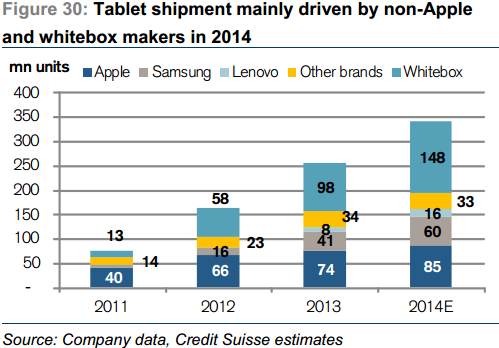
Note that the white-box tablet shipments from China were estimated by company data and Credit Suisse estimates as 7% and 10% higher: 2012: 58M (vs. 54.4M here), 2013: 98M (vs. 89.1M here) (as per the “Figure 30” chart in this blog below). As you see here and later on the conclusion of the Q1-Q3’13 analysis for the tablet market, represented by the title of the previous post will hold for the whole CY2013 as well. The only remarkable change is the sudden jump in Apple iPad sales in Q4, both worldwide and in China. This is, however, only attributed to Q4 introduction of the new iPad Air which was much anticipated for months, thus postponement of new purchases and the peak when it was available. So, for the whole year, my conclusion still holds true,
 Note that the 2013 tablet market in China was 17.2M as per the above data, while the 2013 worldwide tablet market was 219.5M per IDC, and 255M according to company data and Credit Suisse estimates (as per the “Figure 30” chart in this blog below). So China was just 7.8% or 6.4% of the worldwide tablet market, while China shipped significantly more, 38.4% of the worldwide tablet market by the Chinese white-box vendors only (the last one according to company data and Credit Suisse estimates). This is 5.5% higher than the share of China-based smartphone vendors in the global 2013 smartphone shipments (32.9%, according to DIGITIMES Research—see well below), although in tablet space only Lenovo was a significant player, while in smartphones Huawei, ZTE, Coolpad and TCL were also signicant ones (being actually in the global Top 10). In addition a much higher portion of that was shipped internally: about 50% according to company data and Credit Suisse estimates (as per the “Figure 25” chart in this blog below), while for tablets 3M local brand tablets were shipped (as per Analysys International, see the above chart) against 98M of white-box tablets only (as per company data and Credit Suisse estimates), i.e. around 3%. Even taking the DIGITIMES Research’ 54.4M white-box tablet shipment data as the basis, this number will only climb to around 5.5%.


Then I need to add here some external analysis as well, for both the smartphone and tablet markets:
From Taiwan Display IC Sector [Credit Suisse Equity research, March 12, 2014]
[p. 10] … We are … seeing entry level tablet shifting from 7″ to 8″ with higher resolutions given the competition from large size smartphone (Phablet). Tablet brands also plan to introduce over 10″ models for more commercial applications. …
China smartphone will continue to proliferate
Credit Suisse Global Research team estimates global smartphone shipment growth of 18% CAGR in 2013-2016E, while China build smartphone shipment (domestic and export) will see 29% CAGR in 2013-16E. For 2014, we forecast total China smartphone DDI [Display Driver IC] demand of 650-700mn units, up 33-36% YoY, and panel resolution to see faster migration on aggressive pricing and less capacity constraint …
[p. 10] Tablet unit demand still solid in 2014 post strong 2013
Tablet set shipment growth is expected to slow down in 2014 (34% YoY) after a strong 57% YoY growth in 2013 and 107% YoY growth in 2012. However, we believe Chinese tablet makers (brand and whitebox) … will outgrow the industry thanks to further cost reduction …
[p. 11] We estimate there will be limited growth for high-end or branded tablets in 2014, with the exception of Samsung (60% YoY growth). We believe the overall tablet demand will be driven by the Chinese, such as Lenovo and whitebox makers.
[2011: 73M*, 2012: 163M, 2013: 255M, 2014E: 342M]
* Samsung’s own data: 2010: 1.5M, 2011: 5.8M, 2012: 16.6M
** Note that the white-box tablet shipments were estimated by DIGITIMES Research as lower: 2012: 54.4M (vs. 58M here), 2013: 89.1M (vs. 98M here)
(as per the 1st chart in this blog above)


2014 China smartphone market and industry – Forecast and analysis [DIGITIMES Research, March 24, 2014]
Digitimes Research expects demand in the domestic China market to reach 422 million smartphones in 2014, with 278 million units contributed by China-based smartphone vendors. The continued expansion by international vendors Samsung and Apple will push up their sales to almost 144 million units, accounting for nearly 4% growth from 2013. As competition in the local market heats up, China-based vendors are turning to overseas markets in order to maintain their shipment volumes, especially taking an aggressive approach to penetrating emerging markets, which hold higher barriers for overseas vendors to enter.
The outlook for the 2014 China domestic smartphone market is that fewer local brands will remain to compete in the market. With the general enhancement of software-hardware specifications in 2013, brand-building and channel management have become the key to sustainability. Vendors without the advantage of substantial product differentiation will face the challenge of being eliminated in the short term. On the other hand, local vendors need to deal with inventories with discretion to counter the vigorous attacks initiated by international vendors in the domestic market.
In terms of the China smartphone industry, Digitimes Research expects global shipments of China-based smartphone vendors to reach 412 million units in 2014, a 30.7% increase from 2013. Overseas shipments will account for about 126 million units. While shipments to mature markets are expected to grow on a small scale, shipments to emerging markets are expected to expand at strong rates, mainly due to the low base they are starting from.
In the forecast for shipments from different vendors in 2014, Lenovo and Huawei are expected to reach 50 million units. Huawei has been engaged in overseas markets for a long time so its export portion outweighs Lenovo’s. ZTE’s and CoolPad‘s shipments are expected to reach 35.5 million units. TCL [Alcatel] has shown a significant growth in exports with shipments expected to exceed 26 million units in 2014, ranking No. 5 on the list. Second-tier vendors Gionee and Xiaomi are expected to ship 20 million units.

Digitimes Research: China smartphone shipments to decline slightly in 1Q14 [DIGITIMES Research, Feb 7, 2014]
China-based handset companies are expected to see their shipments of smartphones decline lightly in the first quarter of 2014, after combined shipments posted a 13% sequential growth in the previous quarter, according to Digitimes Research.
Efforts by brand vendors to clear out entry-level models in previous quarters and increased overseas shipments by Huawei, ZTE and TCL contributed to shipment gains the fourth quarter of 2013.
Additionally, first- and second-tier vendors also launched a number of new models in the fourth quarter to meet demand during the year-end buying season, ramping up total shipments in the quarter.
For all of 2013, China-based handset makers shipped a total of 314 million smartphones, increasing 62.4% from a year earlier, Digitimes Research said.
Second-tier vendors, including Xiaomi Technology, TCL, Oppo Mobile and Gionee managed to ship over 15 million smartphones in 2013.
Digitimes Research: Global smartphone shipments to top 1.24 billion units in 2014 [DIGITIMES Research, Jan 14, 2014]
Global smartphone shipments are expected to top 1.24 billion units in 2014, with Samsung Electronics, Apple, LG Electronics, Sony Mobile Communications, Lenovo, Huawei, Microsoft, ZTE, Coolpad and TCL serving as top-10 vendors, according to Digitimes Research.
Apple may see its shipments double in 2014 largely due to increased shipments to China and Japan as it will benefit from its cooperation with the largest telecom operators in the two countries, said Digitimes Research.
The growth rate for Samsung will be limited in 2014 as its sales in the US, China and Japan will be depressed by growing popularity of iPhones.
China-based Lenovo, Huawei and Coolpad are expected to step up their efforts to boost sales in overseas markets after being enlisted among the top-10 vendors due to higher shipment volumes in the home market in China.
However, TCL and ZTE will continue to ship smartphones to overseas markets mainly, but will also strengthen sales in China, with domestic sales to account for less than 50% of their total shipments in 2014, commented Digitimes Research.
2014 global smartphone market forecast [DIGITIMES Research, Jan 7, 2014]
In 2014, smartphones are expected to continue penetrating rapidly into emerging markets such as Russia, India, Indonesia and Latin America, while China’s smartphone shipments will see weakened on-year growth in the year, but still enormous volume. This report will provide in-depth analyses to forecast whether global smartphone shipments in 2014 will maintain a growth similar to that of 2013 and what the global shipment scale will reach in 2014.
Within the top-10 smartphone vendors in 2013, four of them are from China and in 2014 more China-based vendors are expected to enter the top 10. This report will also analyze which China-based vendors will have the best chance to become parts of the top-tier players.
How Microsoft’s acquisition of Nokia’s handset business will affect Windows Phone products’ shipment growth in 2014 and shake Android and iOS’ domination in the smartphone market, as well as the possibility of Amazon and Facebook joining the smartphone competition in 2014 and their potential influence to the market will also be analyzed within the report.

Digitimes Research: Global smartphone shipments to reach 1.24 billion in 2014 [DIGITIMES Research, Nov 25, 2013]
Global smartphone shipments are expected to reach about 1.24 billion in 2014, up 30% on year [i.e. 954M in 2013], according to Digitimes Research.
The increase in growth is expected to be driven by demand in Russia, India, Indonesia and Latin America countries.
Digitimes Research believes that Samsung Electronics will lead the way in shipments followed by Apple, LG Electronics, Sony, Lenovo, Huawei Device, Microsoft, ZTE, Coolpad and TCL [Alcatel].
Android and IOS operating systems are expected to be used in about 93% of the devices shipped in 2014, added Digitimes Research.
Global tablet market – 4Q 2013 [DIGITIMES Research, March 24, 2014]

Global tablet shipments grew 25% sequentially and 29.8% on year to reach 78.45 million units in the fourth quarter of 2013 benefiting mainly by economic recoveries of Europe and North America, which relatively boosted demand during the year-end holidays.
Digitimes Research: Global tablet shipments in 1Q14 to drop over 20% sequentially [DIGITIMES Research, Jan 27, 2014]
An estimated 62.14 million tablets will ship globally in the first quarter of 2014, decreasing 20.8% on quarter but increasing 10.9% on year, according to Digitimes Research.
iPads will account for 29% of shipments, brand models launched by vendors other than Apple for 36.7%, and models launched by white-box vendors for 34.3%, Digitimes Research indicated.
Of brand tablet shipments in particular, Android-based models will take up 50.5%, iOS-based 44.1% and Windows-based 5.4%. 7.9-inch models will account for 24.8% of the shipments, followed by 7-inch models with 20.2%, 9-inch models with 19.6%, 10-inch models with 18.3% and 8-inch models with 15.3%. In terms of touch solutions, GFF will account for 47.8% of shipments, GF2 for 42.9%, OGS for 5.3%, GG for 2.7% and G1F for 1.3%.
Among vendors, Apple will have the largest global market share at 29%, followed by Samsung Electronics with 23.1%, Lenovo 4.7%, Asustek Computer 2.7%, Amazon 1%, Acer 1%, Microsoft 0.9%, Dell 0.8%, Google 0.5% and Hewlett-Packard 0.5%.
Taiwan-based ODMs/OEMs will ship 22.5 million tablets in the quarter, taking up 55.1% of total brand model shipments. Foxconn Electronics will account for 51.7% of shipments, Pegatron 34.8%, Compal Electronics 5.1%, Wistron 4.3% and Quanta Computer 4.1%.
Digitimes Research: Global tablet shipments in 4Q13 estimated at 78.45 million units [DIGITIMES Research, Jan 24, 2014]
There were an estimated 78.45 million tablets shipped globally in the fourth quarter of 2013, increasing 25% on quarter and by 29.8% on year, according to Digitimes Research.
iPads accounted for 29.7% of shipments, brand models launched by vendors other than Apple for 36.6%, and models launched by white-box vendors for 33.8%, Digitimes Research indicated. Android-based models took up 51.2% of the shipments, iOS-based 44.9% and Windows-based 3.9%. 7-inch models accounted for 31% of the shipments, followed by 9-inch models with 25.4%, 7.9-inch models with 19.7%, 10-inch models with 15.8% and 8-inch models with 7.6%. In terms of touch solutions, GF2 accounted for 41.5% of shipments, GFF for 38.6%, OGS for 9.8% and GG for 9.5%.
Among vendors, Apple had the largest global market share at 29.7%, followed by Samsung Electronics with 17.4%, Amazon 5.4%, Lenovo 4.2%, Asustek Computer 2.8%, Google 1.4%, Acer 1%, Dell 0.8% and Hewlett-Packard 0.5%.
Taiwan-based ODMs/OEMs shipped 32.8 million tablets in the fourth quarter, with Foxconn Electronics accounting for 52.7%, Pegatron 24.4%, Compal Electronics 12%, Quanta Computer 6.6% and Wistron 4.2%.
II. Asia is following different patterns of mobile use than the United States – the case of China and South Korea
The Post-PC Era: Is the U.S. losing its grip on the software industry? [Flurry Blog, Aug 29, 2013]

Just five years ago, PCs reigned supreme and so did the US software industry. In 2008, U.S. companies produced an estimated 65% of all PC software units sold on a worldwide basis.
In only half a decade, smartphones, tablets, and perhaps most importantly, apps, have changed the nature of the software industry. In this post we look at where apps are being developed and used and discuss the implications of that for the Post-PC Era software industry.
More Apps Are Now Being Created Outside The U.S. Than Inside The U.S.
… By June of this year only 36% of the apps we measure were made in the U.S.A. …
…
U.S. Made Apps Still Dominate App Engagement, But Their Share Is Slipping
Of course, some apps enjoy much greater use than others, so we next considered how the picture changes if apps are weighted by total time, which takes into account both user numbers and engagement. Once time is taken into account, things look considerably better for the U.S., suggesting that, on average, user numbers or engagement are greater for apps made in the U.S. than for apps created elsewhere. That makes sense given the size of the U.S. population, the fact that it was an app pioneer country, and the number of English speakers in other countries who might be able to use U.S.-made apps without any localization. Nonetheless, even the weighted percentage of apps made in the U.S.A. has dropped in the past year.

Use of Local Apps Is Strong In China
This should not lull U.S. app developers into a false sense of security however. That becomes evident from examining where the apps used by people in particular countries are made. That’s what the chart below does, starting with the United States. Nearly sixty percent (59%) of the time U.S. users spend in apps is spent in apps developed domestically, meaning that more than 40% of the app time of U.S. consumers is already spent in apps developed in other countries.
And while U.S. made apps are used elsewhere, unsurprisingly, people in many other countries spend a significant amount of their app time in apps developed in their home countries. For example, 13% of the time spent in apps in the UK is spent in apps made in the UK and 8% of the time spent in apps in Brazil is spent in apps made in Brazil. But as is so often the case, it’s China where things get really interesting. Nearly two-thirds of the time spent in apps in China is spent in apps made in China. U.S. made apps only account for 16% of total time spent in apps in China. The size and growth rate of the Chinese app market imply that the worldwide share of time spent in apps that are produced in the U.S. can be expected to contract further.
China Report: Device and App Trends in the #1 Mobile Market [Flurry Blog, July 23, 2013]

In June of this year Flurry Analytics measured 261,333,271 active smartphones and tablets in China. That represented a whopping 24% of the entire worldwide connected device installed base measured by Flurry.
…
Smartphones and tablets are not just about fun and games in China. Compared to iOS device owners elsewhere, the average time Chinese owners spend using Books, Newsstand, Utility, and Productivity apps is greater than the rest of the world (1.8x, 1.7x, 2.3x, and 2.1x respectively). On average Chinese owners of Android devices spend more than seven times as much time in Finance apps (7.4x) than Android owners elsewhere spend in Finance apps, but they also spend more time in Entertainment apps (1.7x).

The South Korea Report: Device and App Trends in The First Saturated Device Market [Flurry Blog, Oct 14, 2013]

In August of this year Flurry Analytics measured 33,527,534 active smartphones and tablets in South Korea. While that was only 2.8% of the entire worldwide connected device installed base Flurry measures, South Korea is an important market for connected devices for several reasons. First, it is the first connected device market in the world to approach saturation. Second, it is Samsung’s home market, and largely as a consequence of that, more of the devices in use there are manufactured by domestic firms than is the case for any other country. Finally, it is home to more phablet fans than anywhere else.
…Social networking accounts for a significant share of app activity in South Korea, as it does in many other countries. Tool apps are used heavily by South Korean Android users, and entertainment apps capture a lot of time spent in iOS apps.
Compared to app users elsewhere, South Koreans over-index on Entertainment apps on iOS and several Android app categories (Media / Video, Photography, Lifestyle, Shopping, and Tools).
…
Given that South Korea’s rapid period of connected device growth was ushered in by the phablet, it is perhaps not surprising that it continues to surpass the rest of the world in its preference for that form factor. As shown below, in a worldwide sample of 97,963 iOS and Android devices, only 7% were phablets, but for South Korea that percentage was 41%. The appeal of phablets in South Korea appears to suppress the tablet market there. Worldwide, 19% of the devices in our sample were tablets compared to only 5% in South Korea.


Worldwide:
Size Matters for Connected Devices. Phablets Don’t. [Flurry Blog, April 1, 2013]


… For this study, we focused on the top 200 device models, as measured by active users in Flurry’s system, which represent more than 80% of all usage. Doing so, five groups emerged based on screen size:
1. Small phones (e.g., most Blackberries), 3.5” or under screens
2. Medium phones (e.g., iPhone), between 3.5” – 4.9” screens
3. Phablets (e.g., Galaxy Note), 5.0” – 6.9” screens
4. Small Tablets (e.g., Kindle Fire), 7.0” – 8.4” screens
5. Full-size tablets (e.g., the iPad), 8.5” or greater screens
…
The ‘Is it a phone or is it a tablet’ devices otherwise known as phablets have attracted interest, but currently command a relatively small share (2%) of the device installed base, and their share of active users and sessions is also relatively small.
…
Android owns the phablet market and also has the greatest proportion of devices using small tablets. iOS has the greatest share of active devices using large tablets.
…
… notice that nearly a third of time spent playing games take places on larger devices, namely full-sized tablet, small tablets and phablets. And while they command consumer time spent, they represented only 15% of device models in use in February and 21% of individual connected devices. These differences are statistically significant.Studying books and videos, it’s somewhat surprising that tablets, which possess larger screens, do not see a larger proportion of time spent. An explanation for the high concentration in time spent in smartphones could be that consumers watch videos from their smartphones on-the-go (e.g., commuting to work on public transit), whereas they opt for a bigger screen to watch video (e.g., computer or TV) when at work or home. We expect that tablets may represent a greater share of time spent in book and video apps in the future as tablet ownership expands and tablet owners branch out into more types of apps.
…
From our study, consumers most prefer and use apps on medium-sized smartphones such as the Samsung Galaxy smartphones and full-sized tablets like the iPad. In particular, smaller smartphones under-index in terms of app usage compared to the proportion of the installed base they represent, and would suggest they are not worth developers’ support.
…
Mobile Use Grows 115% in 2013, Propelled by Messaging Apps [Flurry Blog, Jan 13, 2014]

… the segment that showed the most dramatic growth [worldwide] in 2013 was Messaging (Social and Photo sharing included). The growth in that segment should not come as a surprise to many, given the attention that messaging apps such as WhatsApp, WeChat, KakaoTalk, LINE, Facebook Messenger and SnapChat have received in the press. What is surprising, however, is that the rate of growth (tripling usage year-over-year) dramatically outpaced other popular categories. This type of growth could explain the high valuation Facebook has allegedly put on SnapChat, or Facebook’s rush to add direct messaging in Instagram, an app frequented by teens.
…
Another explosive growth year in mobile has passed. On December 31st, 2013 at 11:59 pm, Flurry Analytics tracked a record 4.7 Billion app sessions in a single day, for a total of 1.126 Trillion sessions for the whole year. Those are some very, very big numbers. …
The Truth About Cats and Dogs: Smartphone vs Tablet Usage Differences [Flurry Blog, Oct 29, 2012]
… Taking a snapshot in September 2012 from Flurry Analytics, that totaled more than 6 billion application sessions across approximately 500 million smart devices, Flurry provides a comprehensive comparison between smartphones and tablets, spanning age, gender, time of day usage, category usage and engagement metrics. For age and gender comparisons, Flurry leverages a panel of more than 30 million consumers who have opted-in to share demographic data. …
…
The chart below compares the time spent across app categories between smartphones and tablets. At a high level, consumers spend more time using tablets for media and entertainment, including Games (67%), Entertainment (9%) and News (2%) categories which account for nearly four-fifths of consumption on tablets. Smartphones claim a higher proportion of communication and task-oriented activities with Social Networking (24%), Utilities (17%), Health & Fitness (3%) and Lifestyle (3%) commanding nearly half of all usage on smartphones. Games are the most popular category on both form factors with 67% of time spent using games on tablets and 39% of time spent using games on smartphones. Further reinforcing that tablets are “media machines” is the fact that consumers spend 71% more of their time using games on tablets than they spend doing so on smartphones.

Indie Game Makers Dominate iOS and Android [Flurry Blog, March 6, 2012]
For the first two months of 2012, Flurry Analytics measured that more than half of all end user sessions were spent in games. Across January and February, Flurry observed sessions across a sample of more than 64 billion applications sessions across more than 500 million iOS and Android devices.

United States
:
Apps Solidify Leadership Six Years into the Mobile Revolution [Flurry Blog, April 1, 2014]
Last year, on the eve of the fifth anniversary of the mobile revolution, Flurry issued its five-year report on the mobile industry. In that report we analyzed time-spent on mobile devices by the average US consumer. We have run the same analysis, using data collected between January and March of 2014, and found some interesting shifts that we are sharing in this report
…The chart
belowon the left takes a closer look at app categories. Comparing them to last year, gaming apps maintained their leadership position at 32% of time spent. Social and messaging applications, including Facebook, increased share from 24% to 28%. Entertainement (including YouTube) and Utility applications maintained their positions at 8% each, while productivity apps saw their share double from 2% to 4% of the overall time spent.


Flurry Five-Year Report: It’s an App World. The Web Just Lives in It
[Flurry Blog, April 3, 2013]
… On the five-year anniversary of launching Flurry Analytics, we took some time to reflect on the industry and share some insights. First, we studied the time U.S. consumers spend between mobile apps and mobile browsers, as well as within mobile app categories. Let’s take a look. …

Mobile App Usage [in U.S.] Further Dominates Web, Spurred by Facebook [Flurry Blog, Jan 9, 2012]

The chart compares how daily interactive consumption has changed over the last 18 months between the web (both desktop and mobile web) and mobile native apps. For the web, shown in green, we built a model using publicly available data from comScore and Alexa. For mobile application usage, shown in blue, we used Flurry Analytics data, which tracks anonymous sessions across more than 140,000 applications. We estimate this accounts for approximately one third of all mobile application activity, which we scaled-up accordingly for this analysis.
…
With mobile app usage soaring, Flurry additionally studied which categories most occupy consumers’ time. The results are shown in the pie chart below.
Further considering that Flurry does not track Facebook usage, the Social Networking category is actually larger. Combined, from just what Flurry can see, these two categories control a whopping 79% of consumers’ total app time. This breakdown in usage reveals Facebook’s inherent popularity as the leading social network, as well as how important controlling the game category is for all platform providers. As we drill down into the category data, consumers use these two categories more frequently, and for longer average session lengths, compared to other categories.

Chinese smartphone brands to conquer the global market?
The smartphone market in China became saturated between Q3’12 and Q4’13 as per the below chart from Analysys International (EnfoDesk):

Note that this chart corresponds to Chinese writing traditions, i.e. in Q2’11 16.81 million smartphones and 51.01 million feature phones were sold, while in Q4’13 97.63 million smartphones and 9.2 million feature phones. Source: 易观分析:2013年第4季度中国手机销量增速放缓,智能手机市场呈现饱和态势 (Analysys analysis: China mobile phone sales growth slowed in the fourth quarter of 2013, the smart phone market is saturated) [EnfoDesk, March 11, 2014]
Chinese Handset Vendors Will Account for Over 50% of Mobile Handset Sales in 2015 [ABI Research press release, March 10, 2014]
ABI Research reports that Chinese handset vendors will account for over 50% of mobile handsets in 2015. Chinese vendors already accounted for 38% of mobile handset shipments in 2013 and the ongoing shift in growth to low cost handsets, especially smartphones, will increase their market share.
Greater China has long dominated the mobile handset manufacturing supply chain, but now its OEMs are beginning to dominate sales at the expense of the traditional handset OEMs, including even Samsung.
Many of the Chinese OEMs have focused almost exclusively on the huge Chinese market, with little activity beyond its borders, but this is set to change. Huawei (6th in worldwide market share for 2013) and ZTE (5th) have already made an impact on the world stage, but other Chinese handset OEMs like Lenovo—the Motorola acquisition is a clear statement of intent—and Xiaomi are set to join them.
“Chinese vendors already take up five of the top ten places in terms of worldwide market share, despite three of them only really shipping into China. The Chinese vendors highlight the changing shape of the mobile handset market, as the Chinese manufacturing ecosystem, specifically reference designs, enable the next wave of smartphone growth in low cost emerging markets and amongst price conscious consumers everywhere,” said Nick Spencer, senior practice director, mobile devices.
“South East Asia has already experienced this trend, but ABI Research expects to see the impact of these Chinese vendors increasing in all emerging markets and even advanced markets, especially on prepay,” added Spencer.

The New Phone Giants: Indian And Chinese Manufacturers’ Fast Rise To Threaten Apple And Samsung [Business Insider India, March 15, 2014]
The top Indian and Chinese smartphone manufacturers are classically disruptive. They produce products that are “good enough,” at a fraction of the cost of comparable models from premium brands. These ultra low-cost devices are the key to nudging consumers in massively untapped markets like India and Indonesia onto smartphones.
And these companies are starting to aim higher – producing 4G LTE smartphones that have the same processing power as Samsung and Apple premium devices.
They’re also far more innovative than they’re given credit for in terms of their strategy, supply chain management, and hardware.
In a new report from BI Intelligence, we explain why global consumer Internet and mobile companies will increasingly need to work with companies like Xiaomi and Micromax – not to mention Lenovo, Huawei, ZTE, Coolpad, Karbonn, and others – if they don’t want to miss out on mobile’s next growth phase in emerging markets
- Major local manufacturers now account for two-fifths of China’s smartphone market, and one-fourth of India’s. Xiaomi already sells four of the top 10 best-selling Android devices in China, and operates one of the top five app stores.
- Combined, the top five manufacturers in China and the top two in India – the “Local 7” in the chart above – are now shipping about 65 million smartphones every quarter, more than Apple, and coming close to drawing even with Samsung.
- These local manufacturers wield influence in various ways. They run their own successful app stores, mobile operating systems, and mobile services. They also hold the keys to which apps are preloaded on their phones. When BlackBerry wanted to take its BBM messaging service for Android into India, it signed a deal with Micromax.
- The local manufacturers are not provincial outfits producing knock-offs, as some might be inclined to assume. But their main competitive tool, for now, remains price. Local manufacturers in China and India match the features of more expensive devices and manage to produce comparable hardware at a fraction of the price. A Micromax handset comparable to Apple’s iPhone 5C costs less than one-fourth as much.
- Xiaomi has used a four-point strategy in its three-year rise to produce four of the most popular phone models in China. We discuss all four aspects, including tight inventory management and crowdsourcing product development feedback.
- These manufacturers will continue to expand overseas, in search of new growth opportunities. Micromax is in Nepal, Bangladesh, and Sri Lanka. Xiaomi has its eyes on Malaysia and Brazil. Huawei is already in the U.S. For example, it sells a 4G LTE handset on MetroPCS.
Smartphone Prices Race to the Bottom as Emerging Markets Outside of China Come into the Spotlight for Future Growth, According to IDC [press release, Feb 24, 2014]
Singapore and London, February 24, 2014 – Emerging markets have become the center of attention when talking about present and future smartphone growth. According to the International Data Corporation (IDC) Worldwide Quarterly Mobile Phone Tracker, in 2013 the worldwide smartphone market surpassed 1 billion units shipped, up from 752 million in 2012. This boom has been mainly powered by the China market, which has tripled in size over the last three years. China accounted for one out of every three smartphones shipped around the world in 2013, equaling 351 million units.
Recently the surge in growth has started to slow as smartphones already account for over 80% of China’s total phone sales. The next half billion new smartphone customers will increasingly come mainly from poorer emerging markets, notably India and in Africa.
“The China boom is now slowing,” said Melissa Chau, Senior Research Manager for mobile devices at IDC Asia/Pacific. “China is becoming like more mature markets in North America and Western Europe, where smartphone sales growth is slackening off.”
Emerging markets in Asia/Pacific outside of China, together with the Middle East and Africa, Central and Eastern Europe, and Latin America, account for four fifths of the global feature phone market, according to IDC data. “This is a very big market opportunity,” said Simon Baker, Program Manager for mobile phones at IDC CEMA. “Some 660 million feature phones were shipped last year, which could add two thirds to the size of the current global smartphone market.”
India will be key to future smartphone growth as it represents more than a quarter of the global feature phone market. “Growth in the India market doesn’t rely on high-end devices like the iPhone, but in low-cost Android phones. Nearly half of the smartphones shipped in India in 2013 cost less than US$120,” said Kiranjeet Kaur, Senior Market Analyst for mobile phones at IDC Asia/Pacific.
“Converting feature phone sales to smartphone sales implies a relentless push towards low cost,” added Baker. IDC research shows nearly half the mobile handsets sold across the world have retail prices of less than US$100 without sales tax. Two thirds of those have prices of less than US$50.
“The opportunity gets larger the lower the price falls,” continued Baker. “If you take retail prices without sales tax, in 2013 nearly three quarters of the US$100-125 price tier was already accounted for by smartphones. Within US$75-100 the proportion was down to just over half, and between $50-75 it was not much more than a third.”
Many smartphone vendors have begun gearing up for this next wave of cost pressure. Samsung is increasingly switching production to Vietnam, where manufacturing costs currently undercut mainland China. Even Hon Hai, one of the largest contract manufacturers for handsets in China, has announced plans for a plant in Indonesia to furnish a lower production cost base.
In addition to the table below, an interactive graphic showing worldwide sub-$100 feature phone shipments by region is available here. The chart is intended for public use in online news articles and social media. Instructions on how to embed this graphic can be found by viewing this press release on IDC.com.
Worldwide Sub-$100 Feature Phone Shipments by Region, 2013
Region
Shipments (M Units)
India
212.3
Middle East & Africa
150.0
Asia/Pacific (excluding Japan, China, and India)
140.7
Latin America
76.4
PRC
68.1
Central & Eastern Europe
43.6
Western Europe
39.8
North America
13.9
Total
744.9
Source: IDC Worldwide Mobile Phone Tracker, February 24, 2014


Analysys International: Xiaomi Ranked Among Top Five in Q4, 2013 [March 11, 2014]
The statistics from EnfoDesk, the Survey of China Mobile Terminals Market in Q4, 2013, newly released by Analysys International, shows that the market share of Samsung, Lenovo, Huawei, Coolpad and Xiaomi ranked the top five of China smartphone in Q4, 2013. The market share of Samsung shrink slightly over the previous quarter, but it still accounted for 15.07 percent of smartphone market and maintain the leading position.
The release of Apple‘s new product has brought efficiency in Q4, and its market share slightly rebounded. Owning to the release of MI3 (Xiaomi), the market share of Xiaomi up 3.85 percentage points compared to the previous quarter. MI3 still should be bought from booking and the booking is relatively frequent. Meanwhile, the purchase restriction of MI2(Xiaomi) and Red MI(Xiaomi) has been relaxed, coupled with the strategic cooperation between Xiaomi and mobile operators, making it easier to buy custom models as well as contributing to the enlargement of Xiaomi’s market share. It can be expected that Xiaomi will put more energy into the complement of its retail capabilities and continue to increase their market share.
From: UMENG Insight Report – China Mobile Internet 2013 Overview [UMENG, March 12, 2014]
– The number of active smart devices in China exceeded 700 Million by the end of 2013.
– The five fastest growing mobile apps categories (excluding games) are : news, health & fitness, social networking, business, and navigation. These areas will bring new opportunities for developers in 2014.
– Socializing your apps is the key to success for developers. Currently among the top 1,000 apps (apps and games) in the Chinese market, 55% of them provide links to Chinese social networking services (e.g. Sina Weibo, Wechat, QQ, Renren) The amount of app content sharing to social network platforms per mobile Internet user per day has tripled in the last 6 months.
– Social network sharing in game has become incredibly popular on all social networking platforms, 48% of in app sharing traffic to social networks are from games.
– High-end devices (pricing above 500US$) have a significant market share in China, contributing 27% of total devices. These users have dynamic needs on mobile apps . The users of below 150US$ phones prefer casual games for their entertainment requirements.
– The year of 2013 became known as the first year Chinese developers took IP seriously with many developers licensing IP from rights holders. By the end of 2013, among the Top 100 games, 20% license 3rd party IP.
– Over the course of 2013 the percentage of iOS jailbroken devices in the Chinese Mainland fell by 17% to 13% of all devices. Domestic users are becoming more hesitant to jailbreak their devices.
…
700 Million active smart devices in China
…
The market for budget Android phones is strong in China with 57% of devices under 330 USD price range. However over a quarter of users are using high-end smart phones costing over 500USD, 80% of these are iPhones.
…
Fragmented Android device market
- In the 4th quarter of 2013, Samsung and XiaoMi (a local brand) prove to be the most popular Android brands as between them they manufacture all of the top 10 active Android devices.
- However the Android market is still highly fragmented with hundreds of different handsets on the market. Samsung who manufacture many devices in all price ranges control 24% of the device market, while the domestic manufactures are battling it out with the international brands to extend their market share.
…
- In 2013, changes to device connectivity saw a large growth in WiFi connectivity, from 38% at the beginning of the year to 52% at year end. Mobile Internet infrastructure has become better in China. However Chinese users are still price sensitive to mobile data tariff.


…
- Glossary:
Active Device: active device refers to device which has activated at least one app covered by Umeng platform in the stipulated time frame. All the “devices” in the report refers to “active devices”, not the actual shipment.…
- Data Source:
Analysis data in the report is based on over 210,000 Android and iOS apps from the Umeng platform. All data was collected from January to December 2013.

From: More than 247 million mobile handsets shipped in India during CY 2013, a Y-o-Y growth of 11.6%; over 70 million mobile handsets shipped in 4Q 2013 alone [CyberMedia Research press release, Feb 26, 2014]
According to CMR’s India Monthly Mobile Handsets Market Review, CY 2013, February 2014 release, India recorded 247.2 million mobile handset shipments for CY (January-December) 2013. During the same period, 41.1 million smartphones were shipped in the country.
…

India Smartphones Market
The India smartphones market during 2H 2013 saw a rise in shipments by 60.3% over 1H 2013, taking the overall contribution of smartphones to 16.6% for the full year. Further, 65.8% of the total smartphones shipped in the country were 3G smartphones during CY 2013.
Commenting on these results, Tarun Pathak, Lead Analyst, Devices, CMR Telecoms Practicesaid, “CY 2013 was primarily the year of smartphones for the India market, particularly for local handset vendors. A first for the India market was a marginal decline in featurephone shipments on a year-on-year basis. This trend is likely to continue with more vendors focusing on entry level smartphone offerings aimed at the consumer segment.”
“Nearly 70 vendors operated in the highly competitive India smartphones market in CY 2013, with ‘Tier One’ brands like Apple, Samsung, Nokia, Sony, HTC, LG and Blackberry capturing close to 53% of the total smartphones market, followed by India brands capturing close to 43% of total smartphone shipments. The remaining market of roughly 4% smartphone shipments was captured by China OEM brands, where we expect a few more players to enter the India market directly, instead of continuing as ODM partners to Indian brands”, Tarun added.

Rapid Growth In Smartphones Offset The Slump Witnessed In Feature Phone Sales In 4Q13, Says IDC [press release, Feb 26, 2014]
India was one of the fastest growing countries worldwide in terms of smartphone adoption in 2013. According to the International Data Corporation (IDC) in 2013 the smartphone market surpassed 44 million units shipped, up from 16.2 million in 2012. This surge has been mainly powered by home grown vendors which have shown a tremendous and consistent growth over the past 4 quarters of 2013.
The overall phone market stood at close to 257 million units in CY 2013 – an 18% increase from 218 million units in CY2012.
CY2013 also witnessed a remarkable migration of the user base from feature phones to smartphones primarily due to the narrowing price gaps between these product categories.
Q413 Perspective:
The India smartphone market grew by 181% year over year (YoY) in the fourth quarter of 2013 (4Q13). According to International Data Corporation’s (IDC) APEJ Quarterly Mobile Phone Tracker, vendors shipped a total of 15.06 million smartphones in 4Q13 compared to 5.35 million units in the same period of 2012. 4Q13 grew by almost 18% Quarter-on-Quarter.
The shipment contribution of 5.0inch-6.99inch screen size smartphones (phablets) in 4Q2013 was noted to be around 20% in the overall market. The category grew by 6% in 4Q13 in terms of sheer volume over 3Q13.
The overall mobile phone market (Feature Phones and Smartphones) stood at 67.83 million units, a 16% growth YoY and a meager 2% growth quarter over quarter (QoQ).The share of feature phones slid further to make 78% of the total market in 4Q13, with the market showing a decline of 2% in 4Q13 over 3Q13.

The fourth quarter of 2013 witnessed a spike in the smartphone shipments by smaller homegrown vendors like LAVA, Intex which have shown tremendous growth in the past couple of quarters.
“The growth in the smartphone market is being propelled by the launch of low-end, cost competitive devices by international and local vendors which are further narrowing the price gaps that exist between feature phones and smartphones”, said Manasi Yadav, Senior Market Analyst with IDC India.
“The international vendors have understood the importance of creating a diverse portfolio of devices at varied price points and are striving to launch cost competitive devices that cater to every segment in the target audience ” comments Kiran Kumar, Research Manager with IDC India.
Top Five Smartphone Vendor Highlights
Samsung: Samsung maintained its leadership spot with about 38% in terms of market share. Its smartphone shipments grew by close to 37% from 3Q 2013 to 4Q2013. The fourth quarter saw quite a few new launches across price points by Samsung – however the low-end Galaxy portfolio in smartphones contribute to 50% in terms of shipment volumes
Micromax: Micromax held on to its second spot with about 16% in terms of market share in 4Q2013. Some of the top selling models were the entry level smartphones like A35 Bolt and A67. The Canvas range of devices has also done well in terms of volume contribution owing to the marketing campaigns launched around them.
Karbonn: The market share for Karbonn in 4Q2013 was close to 10%, some of the top selling models for this brand were A1+ and A51.
Sony: Sony managed to make a comeback in the top-5 smartphone vendor list in 4Q13 and garnered a market share of 5%. The top selling models included Xperia M Dual and Xperia C handsets, which are targeted at mid-tier price range.
Lava : Lava managed to hold onto the number 5 spot in the top-5 smartphone vendor list. The continued traction around the XOLO and IRIS range of devices helped the vendor garner a market share of 4.7% in 4Q13. Some of the top selling models include the newly launched XOLO A500 S and the existing models like IRIS 402 and IRIS 349.

IDC India Forecast:
IDC anticipates the growth in Smartphone segment to outpace the overall handset market growth for the foreseeable future. The end-user shift towards mid-to-high screen size products will be amplified by the declining prices and availability of feature-rich localized product offerings. Vendors who are able to differentiate their offerings at affordable prices will maintain a competitive edge and secure a strong position in the mobile phone market in CY 2014.


From: Gartner Says Annual Smartphone Sales Surpassed Sales of Feature Phones for the First Time in 2013 [press release, Feb 13, 2014]
…
Worldwide Smartphone Sales to End Users by Vendor in 2013 (Thousands of Units)
Company
2013
Units
2013 Market Share (%)
2012
Units
2012 Market Share (%)
Samsung
299,794.9
31.0
205,767.1
30.3
Apple
150,785.9
15.6
130,133.2
19.1
Huawei
46,609.4
4.8
27,168.7
4.0
LG Electronics
46,431.8
4.8
25,814.1
3.8
Lenovo
43,904.5
4.5
21,698.5
3.2
Others
380,249.3
39.3
269,526.6
39.6
Total
967,775.8
100.0
680,108.2
100.0
Source: Gartner (February 2014)
Worldwide Smartphone Sales to End Users by Vendor in 4Q13 (Thousands of Units)
Company
4Q13
Units
4Q13 Market Share (%)
4Q12
Units
4Q12 Market Share (%)
Samsung
83,317.2
29.5
64,496.3
31.1
Apple
50,224.4
17.8
43,457.4
20.9
Huawei
16,057.1
5.7
8,666.4
4.2
Lenovo
12,892.2
4.6
7,904.2
3.8
LG Electronics
12,822.9
4.5
8,038.8
3.9
Others
106,937.9
37.9
75,099.3
36.2
Total
282,251.7
100.0
207,662.4
100.0
Source: Gartner (February 2014)
Top Smartphone Vendor Analysis
Samsung: While Samsung’s smartphone share was up in 2013 it slightly fell by 1.6 percentage points in the fourth quarter of 2013. This was mainly due to a saturated high-end smartphone market in developed regions. It remains critical for Samsung to continue to build on its technology leadership at the high end. Samsung will also need to build a clearer value proposition around its midrange smartphones, defining simpler user interfaces, pushing the right features as well as seizing the opportunity of bringing innovations to stand out beyond price in this growing segment.
Apple: Strong sales of the iPhone 5s and continued strong demand for the 4s in emerging markets helped Apple see record sales of 50.2 million smartphones in the fourth quarter of 2013.
“However, Apple’s share in smartphone declined both in the fourth quarter of 2013 and in 2013, but growth in sales helped to raise share in the overall mobile phone market,” said Mr. Gupta. “With Apple adding NTT DOCOMO in Japan for the first time in September 2013 and signing a deal with China Mobile during the quarter, we are already seeing an increased growth in the Japanese market and we should see the impact of the last deal in the first quarter of 2014.”
Huawei: Huawei smartphone sales grew 85.3 percent in the fourth quarter of 2013 to maintain the No. 3 spot year over year. Huawei has moved quickly to align its organization to focus on the global market. Huawei’s overseas expansion delivered strong results in the fourth quarter of 2013, with growth in the Middle East and Africa, Asia/Pacific, Latin America and Europe.
Lenovo: Lenovo saw smartphone sales in 2013 increase by 102.3 percent and by 63.1 percent in the fourth quarter of 2013. Lenovo’s Motorola acquisition from Google will give Lenovo an opportunity to expand within the Americas.
“The acquisition will also provide Lenovo with patent protection and allow it to expand rapidly across the global market,” said Mr. Gupta. “We believe this deal is not just about entering into the U.S., but more about stepping out of China.”
Gartner expects smartphones to continue to drive overall sales in 2014 and an increasing number of manufacturers will realign their portfolios to focus on the low-cost smartphone sector. Sales of high-end smartphones will slow as increasing sales of low- and mid-price smartphones in high-growth emerging markets will shift the product mix to lower-end devices. This will lead to a decline in average selling price and a slowdown in revenue growth.
In the smartphone OS market, Android’s share grew 12 percentage points to reach 78.4 percent in 2013 (see below). The Android platform will continue to benefit from this, with sales of Android phones in 2014 approaching the billion mark.
Worldwide Smartphone Sales to End Users by Operating System in 2013 (Thousands of Units)
Operating System
2013 Units
2013 Market Share (%)
2012 Units
2012 Market Share (%)
Android
758,719.9
78.4
451,621.0
66.4
iOS
150,785.9
15.6
130,133.2
19.1
Microsoft
30,842.9
3.2
16,940.7
2.5
BlackBerry
18,605.9
1.9
34,210.3
5.0
Other OS
8,821.2
0.9
47,203.0
6.9
Total
967,775.8
100.0
680,108.2
100.0
Source: Gartner (February 2014)
…
Nokia X family of smartphones, leading local brand partners for Windows Phone and the potential of all that on the Indian market
For some observers in the Western media the Nokia X family is a kind of challenge to Microsoft unlike my earlier post describing it as Nokia’s “best of everything” X range smartphones to conquer the smartphone market between the Asha and Lumia devices [‘Experiencing the Cloud’, Feb 24, 2014]. In Will Satya Nadella and Microsoft Pick Up The Challenge Laid Down By The Android-Powered Nokia X? Forbes contributor, Ewan Spence simply concludes that:
If Nadella is looking to move Microsoft towards a future with more focus on easily accessible services rather than hardware lock-in, then the Nokia X should continue to receive some love and affection, along with continued support in the media and from the press teams in Redmond. It may even be made available for other manufacturers looking for an Android base to build on with some preferential patent licensing bundled along with the deal.
Other journalists accustomed to the U.S. market, where you don’t buy your smartphone but getting it as part of your paid subscription “for free”, even critisizing the Nokia X performance (see two critics on the right) unlike the head of UX Design, an American (see his view on the left) in charge of the team in Beijing, China “with global scope and BRIICA (Brazil, India, Indonesia, China, Africa) focus”:
Doug Walston, Head of MP [Mobile Phones] UX Design, Nokia – Beijing*:“With the X family,” says Doug, “we were really focused on the needs of new people using smartphones, especially those in emerging markets. We wanted to create a beautifully simple device that gives access to a wealth of apps.”“Apps don’t need to be rewritten to tap into Fastlane. We’ve used some special sauce (and native platform hooks) so it all just works.” “If there’s an element of the interface of which I’m particularly proud, it’s the home screen. It’s so distinctive, bold and direct. It’s a break from the confusion that you see elsewhere in phones at this price.” “The simplicity of the interface also means that it has a very low overhead on performance. Typically for a phone with all these features, you would expect a horrid battery life and a laggy interface in this segment, but that isn’t true of the X family at all. The performance is surprisingly good.”From Not just a pretty face – the UI of the X family [Nokia Conversations blog, Feb 26, 2014]
|
Jane McEntegart, Writer/Editor at Tom’s Hardware: Nokia X 1.0 is not slow or sluggish, but in the brief time we played with it, it wasn’t blazing fast either. The tile-interface also didn’t feel quite as sleek as it does in Windows Phone 8. From Hands On with Nokia’s Windows Phone-flavored Android OS [Tom’s Hardware, Feb 24, 2014]Tom Warren, Senior Reporter for The Verge, the resident Microsoft expert: If you put the Nokia X side-by-side with the company’s Lumia 520 handset it might be hard to tell them apart. Using the X software can be quite frustrating, however, as the entire interface is prone to slow response and a lot of lag. Closing or switching between apps on the X takes far longer than other, even entry-level, smartphones, and browsing the web will quickly test your patience. The third-party apps we saw on the X, such as Facebook, looked as they do on other Android smartphones, but they too suffered from poor performance. Nokia’s choice to combine the functions of home and back into the single back button is confusing, and it’s difficult to predict exactly where in the interface the button will take you when you press it. Part of the reason for the laggy interface and apps … is more likely related to the Android version in use on these devices. Nokia appears to be positioning the X as a method to draw people to Microsoft’s cloud services. From This is Nokia X: Android and Windows Phone collide [The Verge, Feb 24, 2014] |
Is the head of MP UX design is right or such a harsh critic as Tom Warren? You could decide it for yourself by watching the video below. Draw special attention to the Fastlane performance difference between the Nokia X with 512MB of RAM and Nokia X+/XL with 768MB ([3:46-4:30] vs. [5:53-6:26]). It is also not an accident that “Resizeable tiles” are demonstrated on the 768MB version. My impression is, that if you are buying the 768MB versions (Nokia X+ or Nokia XL) you won’t feel the problems Tom Warren outlined above, won’t feel at all:
Nokia Launches Nokia X At Mobile World Congress In Barcelona [Red Robot – Intelligent Distribution YouTube channel, Feb 24, 2014]
[0:06] Press conference
>> [0:50] Elop’s 1st introduction: the new Nokia 220
>> [1:20] 2nd introduction: the new Nokia Asha 230
>> [1:32] 3d introduction: the new Nokia X and Nokia X+
>> [2:07] Preloaded great applications on the Nokia X family, hundreds of thousands of Android apps, Nokia signature experiences (HERE Maps, Nokia Mix Radio)
>> [2:42] Fastlane as a fantastic element of Nokia X experience
>> [2:57] 4th introduction: the Nokia XL
[3:40] B-roll (i.e. alternative) footages (with no sound):
> [3:42] Nokia X: Runs Android Apps, 4″ display, Fastlane, 3MP camera, 1GHz Dual Core Processor, Dual SIM
>> [3:46] Nokia X: Fastlane
>> [4:30] Nokia X: Skype
>> [5:08] Nokia X: Nokia Store
>> [5:33] Nokia X: Third Party App Stores
> [5:49] Nokia X+: Runs Android Apps, 4″ display, Fastlane, 3MP camera, 1GHz Dual Core Processor, 768MB RAM, Dual SIM
>> [5:53] Nokia X+: Swipe
>> [6:26] Nokia X+: Resizeable tiles
>> [7:15] Nokia X+: Nokia Mix Radio
>> [8:02] Nokia X+: Demo App: Plants VS Zombies 2
> [8:40] Nokia XL: Runs Android Apps, 5″ display, Fastlane, 5MP camera with flash, 2MP fron-facing camera, 1GHz Dual Core Processor, 768MB RAM, Dual SIM
>> [8:45] Nokia XL: Swipe
>> [9:26] Nokia XL: Camera: 5MP with autofocus and flash
Even more, as the rest of my post goes through the below details (i.e. sections 1. to 4.), you will find (along with with me) that from the point of view of focusing on the BRIICA (Brazil, India, Indonesia, China, Africa) markets (which was the task of the development team in Beijing China) this is an excellent product with no problems mentioned by some media people in the West. There is even no conflict with Microsoft at all (another critical speculation typical to the Western Media) as the Nokia X family is also preparing the ground for the upcoming super low-cost (higher levels as well) Windows Phone devices from local and regional brands like the #3 Karbonn and the #4 Lava (Xolo) in India, as well as Gionee which is a large local brand in China with strong recognition in India as well, not to speak of those who will supplied from Foxconn, the biggest white-label phone manufacturer in China.
- Why does this post concentrate on the Indian market?
- Nokia X family has been well positioned for the highest growth Indian market
- The feature phone and smartphone markets in India according to CyberMedia Research India and IDC
- New low-cost Windows Phone partnering strategy by Microsoft especially aimed at the Indian market
1. Why does this post concentrate on the Indian market?
Answer #1: The Indian smartphone market is expected to double and touch 80 million by the end of current fiscal, a top Samsung India official said today.
“We are expecting smartphone sales in the country to touch 80 million mark by the end of current fiscal [Samsung’s fiscal years are the same as the calendar years], while total sales were around 40 million in 2012-13,” Samsung Mobile and IT India Head Vineet Taneja said.
From Indian smartphone market to double to 80 million by fiscal end: Samsung [The Economic Times (of India), Feb 18, 2014]
Answer #2: “Now is the right time because there is a rapidly growing low-price affordable smartphone segment that’s really taking off in a number of growth economies. We’re seeing that in countries like Indonesia, Russia, Vietnam and a number of others,” [Stephen] Elop [former Nokia CEO and soon-to-be Microsoft executive vice president] says in the interview, shot at Mobile World Congress in Barcelona.
While Nokia X is based on Android, the user interface “is remarkably similar to the Windows Phone interface,” he says.
That means these customers, many of whom have never owned a smartphone before, will learn to navigate in Microsoft’s world first, with the potential over time to buy higher end Nokia Lumia phones that run Windows Phone as Lumia prices drop.
“And so we’ve gone for that and we’ll take advantage of that to keep people in the Lumia family but using Nokia X as a feeder system into our Windows Phone strategy,” Elop says.
The strategy isn’t meant for the U.S. where cellular carriers widely and generously subsidize the price of high-end phones in order to lock customers in to long-term contracts, he says.
The above excerpts are from the Nokia’s Stephen Elop Talks Android video interview:
From Nokia chief: Nokia X Android smartphone is a gateway drug to Windows Phone [Network World, Feb 25, 2014]
Answer #3: is in another post of mine: Nokia’s “best of everything” X range smartphones to conquer the smartphone market between the Asha and Lumia devices [‘Experiencing the Cloud’ Feb 24, 2014] but before reading that here is Nokia X/ Nokia X Plus Hands On (Dual SIM) [WPXBOX YouTube channel, Feb 24, 2014] video from which you can easily understand why is it “best of everything” instead of a stock Android smartphone:
Answer #4: in section 2 of this post I will show you that these smartphones will quite probably have a competitive on line pricing starting at most from:
– Rs 7400 ($119) for Nokia X vs. the list price of EUR 89 [$122]* (Rs 7582)
– Rs 8000 ($129) for Nokia X+ vs. the list price of EUR 99 [$136]* (Rs 8434)
– Rs 8600 ($139) for Nokia XL vs. the list price of EUR 109 [$150]* (Rs 9284)
* Although these prices are before local taxes.
Answer #5: India will be key to future smartphone growth as it represents more than a quarter of the global feature phone market. “Growth in the India market doesn’t rely on high-end devices like the iPhone, but in low-cost Android phones. Nearly half of the smartphones shipped in India in 2013 cost less than US$120,” said Kiranjeet Kaur, Senior Market Analyst for mobile phones at IDC Asia/Pacific.
From Smartphone Prices Race to the Bottom as Emerging Markets Outside of China Come into the Spotlight for Future Growth, According to IDC [press release, Feb 24, 2014]
Answer #6: In addition to existing partners — Nokia, Samsung, HTC and Huawei — Microsoft has announced it is now working with Foxconn, Gionee, Lava (Xolo), Lenovo, LG, Longcheer, JSR, Karbonn and ZTE to develop on the Windows Phone platform. … Customers can expect to see an even broader array of devices, from iconic to lower-cost options, coming to market. … The expanded Windows Phone ecosystem will also provide mobile operators and retail partners with additional opportunities to offer white-label Windows Phone devices under their own brands.
From Microsoft adds nine new Windows Phone hardware partners [press release, Feb 23, 2014] where Karbonn is the #3 and Lava (Xolo) the #4 brands (after #1 Samsung and #2 Micromax), while Gionee is a local brand in China with strong recognition in India as well, and Longcheer as a local Chinese brand that has long been in India as well (albeit with top recognition already lost). Finally Foxconn is the biggest white-label phone manufacturer in China whose production has already influenced the Indian market very much.
We are adding support for Qualcomm Snapdragon 200 and 400 series chipsets, with options that support all major cellular technologies, including LTE (TDD/FDD), HSPA+, EVDO and TD-SCMA. We will also support soft keys and dual SIM where our partners want it for their devices. One nice benefit of these additions is that many hardware vendors will be able to use the same hardware for both Android and Windows Phone devices [obviously if they are using the Qualcomm SoCs]. From Joe Belfiore, corporate vice president of Microsoft Windows Phone in Scaling Windows Phone, evolving Windows 8 [Windows Phone Blog, Feb 23, 2014]
Q. Many of your recent partnerships and announcements have focused on emerging markets. Is that a major priority?
A. It’s not our only focus, but it’s a very big one. The purpose of low-cost phones in emerging markets is to drive volume. From Joe Belfiore, corporate vice president of Microsoft Windows Phone in Q.&A. With Joe Belfiore on the Future of Windows Phone [Bits blog of The New York Times, Feb 23, 2014] That is the Nokia X family will not only prepare the ground for its own Lumias but for these upcoming low-cost Windows Phone devices as well (also why IMHO Microsoft will not kill the Nokia X family after Nokia devices and services becomes part of it)
2. Nokia X family has been well positioned for the highest growth Indian market
X marks the sweet spot [Nokia Conversations, Feb 25, 2014]
We asked Jussi Nevanlinna, VP for Mobile Phone marketing, some of your questions about the new Nokia X family, why it’s important for Nokia and why customers will be delighted with the phones.
First of all, why now? Why is the timing now right for an Android-based smartphone from Nokia?
There are a couple of answers to that question.
To launch the Nokia X family, we needed to be able to create a product that was true to Nokia’s heritage in design and build quality. But we also needed to make it very affordable. Lots of different components had to come into place for us to create something that’s clear and easy to use, but also high quality and within people’s financial reach.
The other answer is that the market itself is moving. We’re the number one manufacturer in growth markets in the ‘entry-level’ and ‘feature phone’ categories. But a lot of those people are now aspiring to smartphone products. There are a significant number of users worldwide who are about to experience the Internet through a mobile device. As you can imagine, we want to be ready for them.

The Nokia X family is based on the Android Open Source Platform (AOSP). Does that put the future of the family at the mercy of Google?
To fully explain, this is a Nokia smartphone that runs Android apps. At its heart, we have AOSP on top of which we have added Nokia design and usability expertise to create the user interface that people see. Then we have added Nokia experiences like HERE Maps and Nokia MixRadio, and Microsoft services like Skype, Outlook.com and OneDrive. What we don’t have is Google services: this was deliberate. Instead, we have implemented Nokia and Microsoft services to create something truly differentiated.
So who is the target audience for the Nokia X family?
These are global products, which will be available pretty much everywhere except North America, Korea and Japan. We have a particular focus on growth markets – for example, India and China, Thailand and Indonesia then over to Egypt, Kenya and Nigeria, and South America, especially countries like Brazil, and Mexico. They are all places where we’re seeing this big shift from feature phones to affordable smartphones.
Our Nokia X family customers are young, social, very aspirational and are fans of Nokia. They love our brand and our product design. And they also love Android apps: the quantity and choice is very appealing to them.
So we’re offering them the best of three worlds:
- Nokia design and build quality;
- Microsoft cloud services; and
- Android apps.
Does the X family compete with the Lumia family and maybe mean lost sales for Lumia?
Our approach to compete in the affordable smartphone market is twofold. While Lumia remains our primary smartphone platform and we continue to push the prices down, Nokia X addresses price points that are generally lower than those reached by Lumia, and we’ll keep pushing the Nokia X prices down even further.
In fact we see Nokia X as a stepping-stone to Lumia. With Nokia X we are bringing people the best of Nokia and Microsoft services and experiences, making a future switch to Lumia natural.
Some might see creating an Android-based device as strange considering that the plan is for Nokia’s devices and services business to join Microsoft soon?
I can’t speak on Microsoft’s behalf; what I can say is our strategy with Mobile Phones has been, and remains, connecting the next billion. Microsoft is equally focussed on ‘mobile first; cloud first’. As I have explained, getting people exposed to and loving Microsoft and Nokia services in the affordable segment creates a natural pathway to Lumia, which is designed to be the pinnacle smartphone experience.

Technology becomes cheaper all the time. When it becomes possible to create a Lumia for $100, will the X family be retired?
I think the key word is ‘family’. We will be announcing more products in the family over the course of the next year, and the price range it covers will change to suit the markets. We will be taking Nokia X into even more affordable price points.
What do app developers need to do to make their Android apps available for the Nokia X family?
The short answer is: nothing. In the vast majority of cases, Android apps will run very well on the Nokia X family, out of the box.
Furthermore, we’re working with developers to make it very easy to submit apps into the Nokia Store. In most cases, they simply republish their apps to Nokia Store .
Where apps depend on functionality that isn’t on the Nokia X family devices, like Google Maps, we’ve created API plugins for the Android SDK to allow developers to simply tick the box to use HERE Maps instead.

And what advantages can developers and customers gain by using Nokia Store?
Android developers stand to make big gains by supporting the Nokia X family. We have heard many times that they find it hard to monetise their apps. One reason for that is, in emerging markets, people are a lot less likely to have credit cards. The Nokia Store offers in-app payments through operator billing, and we have the largest network of operators signed up for that. It’s been shown through experience that when operator billing is available, then revenues increase by up to five times.
That’s one reason the Nokia Store offers a better alternative. The other is from the user’s side. The Nokia Store is curated. The apps are screened and scanned so you won’t bump up against malware or inappropriate content. So they can shop in our store with confidence and security.
And worldwide, people are very comfortable with using third-party app stores that aren’t owned by Google. In Russia, the Yandex Store dominates the Android marketplace. In China, Google Play isn’t available, so all app purchases are through third parties. So you see, non-Google stores are already the norm for most Android owners.


Nokia X is a phone made for India [India Today, Feb 24, 2014]
The Finnish handset maker has finally unveiled its much talked of Android phone, the Nokia X, at the ongoing Mobile World Congress 2014.
Nokia has launched a family Android phones with three variants–Nokia X, X+ and XL–at affordable prices. All three Nokia X variants are going to be low-cost phones with the Nokia XL expected to be priced around Rs.9,000 [$145]. For now, the prices that have been revealed are: Nokia X for 89 euros, the X+ 99 euros and the larger LX carries a price tag of 109 euros.
Specs-wise, these are basic level phones. All three devices are powered by a Qualcomm Snapdragon Dual Core processor and are dual SIM. The Nokia X comes with 4-inch display, the X+ has a bit of more storage options and the XL variant comes with 5-inch LCD screen and and 5-megapixel rear and 2-megapixel front cameras.
The Nokia X phones do not come with pre-installed Google Play Services. As a result the Play Store isn’t available on the Nokia X or Nokia X+. Though, Android apps can be downloaded through Yandex Store.
Once, Nokia was the leader of Indian mobile industry. Nokia feature phones used to be first choice of the Indian consumers. But it could not keep pace with the emergence of smartphones. Its competitors like Samsung, Sony and Micromax took away the markets from the Finnish handsets maker with innovative smartphones at affordable prices.
With affordable Android phones, the world’s largest smartphone maker, Samsung, is dominating the Indian market. Even, the home grown tech company Micromax made a market for itself with range of affordable Android phones having great features.
With its budget prices and widely used Android OS, the Nokia X series of smartphones will target the consumers looking to upgrade themselves from feature to smartphones. As the smartphone market is growing in India, given its brand reputation in the country, Nokia phones are going to give its competitors a run for their money in the sub Rs.10,000 [$161]segment. An Android phone from the Nokia at affordable price will be a good deal.
Well aware of its advantageous positing in the price-sensitive Indian market, Nokia has listed the X series devices on its India website as coming soon just after unveiling the devices at the ongoing Mobile World Congress 2014 in Barcelona.
Nokia Lumia 525 – First Impressions [Digit YouTube channel, Jan 7, 2014]
The current (Feb 25, 2014) lowest online price for Lumia 525 (in India) is on Snapdeal.com:
(list price) –> Rs 9519 [$154] Black/White –> Rs 9712 [$158 ] Yellow
Rs 11499 [$186]

Competing with the following models of the marketing leading brands (Samsung, Micromax, Karbonn):
Rs 11230 [$181]Rs 9244 [$149] …Rs 12100 [$195]Rs 9379 [$151] … Rs12990 [$207]Rs 9997 [$161]


For comparison the preceding the Lumia 520 on the same site:
Rs 10499 [$169](list price) –> Rs 7976 [$128] Black –> Rs 7995 [$129] White
–> Rs 8169 [$132 ] Yellow

Then some leading competitors for the Nokia X range (also from Snapdeal.com):
All list prices:Rs 9999 [$161]Rs 8949 [$144] … Rs 7225 [$117] … Rs 7895 [$127]


13767 |
6878 |
10957 |
7440 |
7623 |
Broadcom BCM23550 |
Broadcom BCM21654G |
MediaTek MT6572 |
Qualcomm MSM8225 |
Qualcomm MSM8225 |
Which means a competitive on line pricing starting at most from:
– Rs 7400 ($119) for Nokia X vs. the list price of EUR 89 [$122]* (Rs 7582)
– Rs 8000 ($129) for Nokia X+ vs. the list price of EUR 99 [$136]* (Rs 8434)
– Rs 8600 ($139) for Nokia XL vs. the list price of EUR 109 [$150]* (Rs 9284)
* Although these prices are before local taxes.
For comparison the top of the Asha Touch range, the Asha 503 on the same site (currently):

Rs 7399 [$119] (list price) –> Rs 6549 [$106] Black/White –> Rs 6894 [$111] Yellow
–> Rs 6939 [$112] Red

Which means that the price of Asha devices could be lowered after the Nokia X devices appear on the market. This is especially true with the introduction of Asha 230 using the same SoC:

As the Asha 230 was announced for EUR 45 [$62]* (Rs 3823) you got an immediate price indication for such a decrease. In fact this new model is an effective replacement for the current Asha 500 as the entry level Nokia Asha Software Platform 1.1 device which has:
- 2 MP rear camera instead of a 1.3 MP one on Asha 230
- standby time up to 840 h (2G), talk time up to 14 h (2G) because of an 1200 mAh battery instead of the 1020 mAh one on Asha 230
but has the best online price of Rs 3999 ($66), actually from Nokia India against the list price of USD69 before taxes or subsidies.
3. The feature phone and smartphone markets in India according to CyberMedia Research India and IDC
From CMR announces top Telecom trends for 2014 in India [CyberMedia Research India press release, Dec 31, 2013]
CMR today released its MarketVision 2014 for Telecommunications in India. Below are the key trends identified for 2014 for some priority segments.
Mobile Handsets
2013 witnessed the first time decline in growth of feature phones in India and this trend is going to further sharpen in 2014 as the primary focus of the industry as well as consumers would remain around the smartphones.
CMR identifies the following trends for 2014 in Smartphones
- LTE enabled smartphone releases to be among priority areas of the vendors.
- Chinese ODM’s have started taken a direct OEM route towards India Smartphone market. CMR expect around 10 Chinese ODMs entering into India Mobile market in 2014.
- ‘Made in India’ smartphones amount to 47% of the total sales. With such tremendous growth and success witnessed by these brands in the local market, 2014 will be the time to look at newer geographies including MENA, Latin America and the SAARC [South Asian Association for Regional Cooperation] region for the home grown vendors. CMR expects 3-4 such brands looking for new geographic markets.
- With the increasing confidence and reliance of Indian consumers on the online retailing, particularly after the emergence of successful platforms like flipkart, CMR expects the role of ‘etailing’ becoming important for emerging brands who for various reasons cannot establish their physical distribution network across the country, particularly the non-metro cities and towns.
- While the ecosystem partners like ODMs and app developers will be exploring Windows as a platform for mobility, CMR identifies Tizen, Firefox, Ubuntu and Sailfish among the new open source OSs emerging in 2014 in the India market.
- CMR expects vernacular apps to start getting focus in 2014 from the developer community in the country. Since national elections are going to be among the predominant themes for 2014, we expect a lot of apps being developed around this space which could be owned by a political party or being promoted by a neutral app developer.
62.9 million mobile handsets shipped in India during July-Sept 2013, a Y-o-Y growth of 10.9%; September registers, 19.5 million handset shipments; Nokia retains overall leadership [CyberMedia Research India press release, Nov 19, 2013]
- Smartphone shipments cross 11.1 million units; Samsung still the market leader in smartphones category with Micromax and Karbonn at #2 and #3, respectively. Top 3 vendors make up nearly 63.1% of the total smartphone shipments.
- Featurephone segment witnesses the first ever negative growth in shipments in the India Mobile handsets market.
According to CMR’s India Mobile Handsets Market Review, 3Q 2013, November 2013 release,India registered 62.9 million mobile handset shipments for the period July-September (3Q) 2013. During the same period, 11.1 million smartphones were shipped in the country.
Commenting on the results, Faisal Kawoosa, Lead Analyst, CMR Telecoms Practice said, “We have been saying that the way forward is smartphones. JAS 2013 is the first quarter to actually report this trend in numbers. This means vendors can expect to see large opportunities in the upgrades market where many featurephone users will upgrade to a smartphone. It may also so happen that new smartphone purchases register lower volumes vis-à-vis upgrades. But this phenomenon may be a few quarters away.”
“So there is going to be a huge opportunity as well as competition in the entry- to mid-level smartphone segments, which is where the volumes would remain for a while,” Faisal further added.

India Smartphones Market
The India smartphones market during July-September 2013 saw a rise in shipments by 152.3% over and above the July-September 2012 number, taking the contribution of smartphones to 17.6% of total mobile handset shipments during the period July-September 2013.

Commenting on these results, Tarun Pathak, Analyst, CMR Telecoms Practice said, “The India smartphones market continues to be a competitive space with close to brands vying with each other. Going forward, we expect this segment to be even more competitive as we expect some of the China-based ODM partners entering directly into the India market during 1H 2014. It will be interesting to see what impact this will have on the market share of existing smartphone players.”
“Another interesting observation is that local handset brands have now close to 47% market share in the India smartphones market and this momentum has been a source of confidence to a couple of players to enter new geographies outside India where the smartphone market is on the rise. Going forward 3G smartphone shipments will continue to rise and we can expect to see a few smartphone vendors introduce 4G-enabled devices by the end of 2013,” Tarun concluded.
Notes for Editors
This release is a part of the CyberMedia Research (CMR) Smart Mobility Market Programme.
CyberMedia Research (CMR) uses the term “shipments” to describe the number of handsets leaving the factory premises for OEM sales or stocking by distributors and retailers. For the convenience of media, the term shipments has been replaced by ‘sales’ in the press release, but this reflects the market size in terms of units of mobile handsets and not their absolute value. In the case of handsets imported into the country it represents the number leaving the first warehouse to OEMs, distributors and retailers. CyberMedia Research does not track the number of handsets brought on their person by individual passengers landing on Indian soil from overseas destinations or ‘grey market’ handsets. These are, therefore, not part of the CyberMedia Research numbers reported here.
CyberMedia Research (CMR) tracks shipments of mobile handsets on a monthly basis. However, as per convention, the market size is reported on a calendar quarter basis where appropriate to the context; in all such cases this refers to an aggregated number for the three calendar months in the quarter to which the press release refers.
About CyberMedia Research
A part of CyberMedia, South Asia’s largest specialty publisher, CyberMedia Research (CMR) has been a front runner in market research, consulting and advisory services since 1986. CMR offers research and consulting services – insights, market intelligence, market sizing, ecosystem mapping and go-to-market services – covering the Information Technology, ITeS, Semiconductor & Electronics, Telecommunications, Government, SMB & Entrepreneurship, Smart Infrastructure, Energy & Utilities and Healthcare & Life Sciences verticals.
Cyber Media Research Ltd., an ISO 9001: 2008 company, is a member of the Market Research Society of India (www.mrsi.in) and enrolled with ESOMAR (www.esomar.org) CMR’s forthcoming studies include stakeholder satisfaction surveys, mega spender assessments and market mapping studies for these domains.
For more details, please visit http://www.cybermediaresearch.co.in or http://www.cmrindia.com/


Explosive Smartphone Growth Driven by Lower-Priced Models, Cannibalises Feature Phone Sales in Indian Mobile Market, Says IDC [press release, Dec 2, 2013]
The India smartphone market grew by 229% year over year (YoY) in the third quarter of 2013 (3Q13). According to International Data Corporation’s (IDC) APEJ Quarterly Mobile Phone Tracker, vendors shipped a total of 12.8 million smartphones in 3Q13 compared to 3.8 million units in the same period of 2012. 3Q13 grew by close to 28% over the units shipped in the second quarter of 2013 (2Q13).
The 5.0 inch-6.99 inch screen size smartphones (phablets) continued to show sustained growth in 3Q2013 as well – the phablet category contributed to 23% in the overall market in terms of volume.
The overall mobile phone market (Feature Phones and Smartphones) had a 12% growth YoY and a 7% growth quarter over quarter (QoQ) with the share of feature phones sliding further to make 81% of the total market in 3Q13 despite the feature phone market growing at 3% in 3Q2013 over 2Q2013.


Source: IDC Asia Pacific Quarterly Mobile Phone Tracker, 3Q 2013
The third quarter of 2013 witnessed a slowdown in the numbers for top local vendors such as Micromax and Karbonn – while international vendors like Samsung and Nokia powered by their new product launches made up for close to 30% of the overall market in 3Q2013.
“The growth in the smartphone market continues to drive the overall growth numbers for the phone market – given that there’s still a huge potential for smartphone penetration in India, this trend is expected to continue in the coming quarters”, said Manasi Yadav, Senior Market Analyst with IDC India.
“The change agents for this rapid shift of consumer preference towards Smartphones have been the narrowing price gap between Feature phones and Smartphones. The Smartphone market is expected to maintain these elevated levels of growth in the near future” comments Kiran Kumar, Research Manager with IDC India.
Top Five Smartphone Vendor Highlights
Samsung: Samsung maintained its leadership spot with about 33% in terms of market share. Its smartphone shipments grew by close to 36% from 2Q 2013 to 3Q2013. The third quarter saw quite a few new launches across price points by Samsung – however the low-mid tier phones such as Galaxy S
Duos and Galaxy Star continued to drive their volumes.
Micromax: Micromax held on to its second spot with about 17% in terms of market share in 3Q2013. Some of the top selling models were A27 and A26 in terms of volumes – we have seen a dedicated marketing and advertising push from the brand with continued investments to up the brand recall.
These efforts are expected to bear fruit in the coming quarters in time for their upcoming launches.
Karbonn: The market share for Karbonn in 3Q2013 was close to 11%, some of the top selling models for this brand were A6 and A50. There has been a significant pick-up for the Titanium range of phones especially S5 and S2 specifically.
Nokia: The Lumia range of devices continued to show a growth trajectory in 3Q2013 and garnered close to 5% market share – the trend is expected to continue with greater support from Microsoft in the coming quarters. The third quarter of 2013 saw a few notable launches like the Lumia 625 and Lumia 925 which have been able to generate positive interest from consumers and developers alike.
Lava : Lava made it to the top 5 for the first time in 3Q2013 owing to huge shipments coming in from its XOLO and IRIS range of competitively priced devices. Some of the top selling models for the brand are IRIS 349 and IRIS 402. Keeping in mind the shifting consumer preferences, there has been a conscious shift from feature phones to smartphones, which is expected to continue in the upcoming quarters too.

Smartphone Prices Race to the Bottom as Emerging Markets Outside of China Come into the Spotlight for Future Growth, According to IDC [press release, Feb 24, 2014]
Singapore and London, February 24, 2014 – Emerging markets have become the center of attention when talking about present and future smartphone growth. According to the International Data Corporation (IDC) Worldwide Quarterly Mobile Phone Tracker, in 2013 the worldwide smartphone market surpassed 1 billion units shipped, up from 752 million in 2012. This boom has been mainly powered by the China market, which has tripled in size over the last three years. China accounted for one out of every three smartphones shipped around the world in 2013, equaling 351 million units.
Recently the surge in growth has started to slow as smartphones already account for over 80% of China’s total phone sales. The next half billion new smartphone customers will increasingly come mainly from poorer emerging markets, notably India and in Africa.
“The China boom is now slowing,” said Melissa Chau, Senior Research Manager for mobile devices at IDC Asia/Pacific. “China is becoming like more mature markets in North America and Western Europe, where smartphone sales growth is slackening off.”
Emerging markets in Asia/Pacific outside of China, together with the Middle East and Africa, Central and Eastern Europe, and Latin America, account for four fifths of the global feature phone market, according to IDC data. “This is a very big market opportunity,” said Simon Baker, Program Manager for mobile phones at IDC CEMA. “Some 660 million feature phones were shipped last year, which could add two thirds to the size of the current global smartphone market.”
India will be key to future smartphone growth as it represents more than a quarter of the global feature phone market. “Growth in the India market doesn’t rely on high-end devices like the iPhone, but in low-cost Android phones. Nearly half of the smartphones shipped in India in 2013 cost less than US$120,” said Kiranjeet Kaur, Senior Market Analyst for mobile phones at IDC Asia/Pacific.
“Converting feature phone sales to smartphone sales implies a relentless push towards low cost,” added Baker. IDC research shows nearly half the mobile handsets sold across the world have retail prices of less than US$100 without sales tax. Two thirds of those have prices of less than US$50.
“The opportunity gets larger the lower the price falls,” continued Baker. “If you take retail prices without sales tax, in 2013 nearly three quarters of the US$100-125 price tier was already accounted for by smartphones. Within US$75-100 the proportion was down to just over half, and between $50-75 it was not much more than a third.”
Many smartphone vendors have begun gearing up for this next wave of cost pressure. Samsung is increasingly switching production to Vietnam, where manufacturing costs currently undercut mainland China. Even Hon Hai [better known outside as Foxconn], one of the largest contract manufacturers for handsets in China, has announced plans for a plant in Indonesia to furnish a lower production cost base.
In addition to the table below, an interactive graphic showing worldwide sub-$100 feature phone shipments by region is available here. The chart is intended for public use in online news articles and social media. Instructions on how to embed this graphic can be found by viewing this press release on IDC.com.


The China Smartphone Market Hiccups as Growth Streak Ends with First Sequential Decline in 2013 Q4, Says IDC [press release, Fev 13, 2014]
Singapore and Hong Kong, February 13, 2014 – After 9 consecutive quarters of explosive growth, which propelled China into the top smartphone market in the world, the China smartphone market experience its first slowdown in 2013 Q4.
According to the International Data Corporation (IDC) Asia/Pacific Quarterly Mobile Phone Tracker, shipped 90.8 million units compared to 94.8 million in 2013 Q3, declining by 4.3% quarter on quarter (see Figure 1). Several factors drove this stumble – for one, China Mobile’s 4G TD-LTE network went live on December 18, translating into supplies of 4G handsets not able to reach the market fully until 2014 Q1. The increasing popularity of phablets and channel inventory also played a role, whereby operators cut phone subsidies on phones with smaller screens, triggering distribution channels looking to clear out those stocks.
“The world has increasingly looked to China as the powerhouse to propel the world’s smartphone growth and this is the first hiccup we’ve seen in an otherwise stellar growth path,” says Melissa Chau, Senior Research Manager with IDC Asia/Pacific’s Client Devices team.
“There will certainly be future drivers to unlock further smartphone growth in China, as Apple demonstrated with its China Mobile tie-up in January, and the massive device migration to come of phones only supporting 2G and 3G networks to devices supporting 4G networks. However, we are now starting to see a market that is becoming less about capturing the low-hanging fruit of first time smartphone users and moving into the more laborious process of convincing existing users why they should upgrade to this year’s model”
Looking ahead at the prospects for the Asia/Pacific (excluding Japan) region, with mature Asia/Pacific markets like already having hit market saturation and China growth facing more moderate increases, two trends will become more prominent.
First, growth will increasingly shift to ever-more emerging markets. While India volumes significantly lag China, India has taken the number three ranking of largest smartphone markets in the world in 2013, surpassing Japan, the United Kingdom, South Korea, Germany and France, which were all ranked higher in 2012.
Second, Chinese phone players which have previously been content to make their mark on the China market itself, are looking to expand their ambitions overseas. While this trend has started already through 2013, IDC expects it to become more common in 2014.
“Chinese players are getting hungrier to turn themselves into international rather than China-only brands. Nowhere is this more clear than Lenovo’s acquisition of Motorola’s handset business, and even smaller players, some unknown to much of the world, like Oppo, BBK, Gionee and of course Xiaomi are ramping up on international expansion.”
Figure 1.
Asia/Pacific (Excluding Japan) Smartphone Shipments by Sub-Region, 2011Q1-2013Q4
Notes:
- Mature markets include Australia, Hong Kong, New Zealand, Singapore and Taiwan
- SEA markets include Indonesia, Malaysia, Philippines, Thailand and Vietnam
Source: Asia/Pacific Quarterly Mobile Phone Tracker, February 2014

4. New low-cost Windows Phone partnering strategy by Microsoft especially aimed at the Indian market
Mobile World Congress, Microsoft and Nokia [The Official Microsoft Blog, Feb 24, 2014]
The following post is from Frank X. Shaw, Corporate Vice President of Communications at Microsoft.
Mobile World Congress is in full swing in Barcelona this week, one of the biggest events of the year for the mobile industry. I love Barcelona, and am sad to miss MWC this year. There is something about the combination of the history and tradition of Barcelona past and the energy and innovation of Barcelona present, with all the attendees of MWC a punctuation mark. And there is always something new, companies with something to say.
Microsoft is no exception. On Sunday afternoon, we hosted a press conference where we reinforced the momentum we’re seeing for Windows Phone – the fastest growing mobile OS with 91 percent year-over-year growth. We announced we’re working with nine new Windows Phone hardware partners , including Foxconn, Gionee, Lava (Xolo), Lenovo, LG, Longcheer, JSR, Karbonn and ZTE as well as a collaboration with Qualcomm to help more manufacturers build Windows Phones faster. You can read Joe Belfiore’s blog post [see also below] from yesterday for more details.
Nokia held its press conference earlier Monday. They announced a number of new devices from their Mobile Phone division including Nokia X, which will compete with Android devices in the affordable smartphone category and introduce the Microsoft cloud to a new set of customers in growth markets.
There’s been lots of speculation about what this announcement means for Microsoft and about our pending acquisition of Nokia’s Devices and Services business. Here are a couple of points to put things into context.
First, our transaction with Nokia has not yet closed. Today, we operate as two independent companies as required by antitrust law, and we will until the acquisition is complete. The anticipated close timeframe for the acquisition remains end of the first quarter of 2014.
Second, we’re pleased to see Microsoft services like Skype, OneDrive and Outlook.com being introduced on these devices. This provides the opportunity to bring millions of people, particularly in growth markets, into the Microsoft family. The Skype team on Monday announced an offer in select markets for the first customers who purchase a Nokia X, one month of Skype’s Unlimited World Subscription. Read the Skype blog for more details.
Finally, our primary smartphone strategy remains Windows Phone, and our core device platform for developers is the Windows platform.
It is a fascinating time in the industry today. The rate of improvements in devices, the breadth of services offered, the way consumers and businesses are using devices of all shapes and sizes to do more – it is a reminder to all of us that what is considered status quo in Barcelona this year has the potential to look very different in the rear view mirror a year from now.
We’d have it no other way. 🙂
Microsoft adds nine new Windows Phone hardware partners [press release, Feb 23, 2014]
New hardware partners and tools will accelerate global scale.
Microsoft Corp. on Sunday announced nine new hardware partners for Windows Phone and direct access to tools that will broaden the portfolio of devices for consumers and introduce new price points to accelerate growth in key markets. In addition to existing partners — Nokia, Samsung, HTC and Huawei — Microsoft has announced it is now working with Foxconn, Gionee, Lava (Xolo), Lenovo, LG, Longcheer, JSR, Karbonn and ZTE to develop on the Windows Phone platform.
With this latest news, Microsoft is now working with seven of the top 10 smartphone manufacturers in the world in addition to leading brands in China, India and Taiwan, representing more than 56 percent of the addressable market globally (IDC Worldwide Mobile Phone Tracker, 2013). Customers can expect to see an even broader array of devices, from iconic to lower-cost options, coming to market.
“We are pleased to add these new partners to our expanding Windows Phone ecosystem. They will be key contributors to continued growth across price points and geographies for Windows Phone,” said Nick Parker, corporate vice president of the OEM Division at Microsoft.
Windows Phone is the fastest-growing smartphone operating system, according to IDC, and posted the largest increase for 2013 (90.9 percent), more than doubling the growth of the overall market during the year.
Microsoft also unveiled expanded hardware support that provides more flexibility so Windows Phone partners can build devices to meet the unique needs of their region or customer segments. Microsoft is adding support for Qualcomm Snapdragon™ 200 and 400 processors by Qualcomm Technologies Inc. with options that support various major cellular technologies, including LTE (TDD/FDD), HSPA+, EVDO and TD-SCMA. Windows Phone will also support soft keys and dual SIM, critical requirements particularly in Asian markets. These changes allow for manufacturing partners to easily leverage existing design investments to diversify their portfolio to include Windows Phone devices, including larger screen phablets.
On Sunday, Microsoft launched the Windows Hardware Partner Portal, which is designed to speed up device commercialization while minimizing development costs. Speed and economies are especially important for manufacturers needing to compete and win in the dynamic high-volume smartphone segment. The Windows Hardware Partner Portal is now open to all smartphone device manufacturers to learn about and begin the process to develop on the Windows Phone platform. Windows Phone device manufacturers will also be able to leverage the great services Microsoft has to offer in that market, which could include Office Mobile, Skype, Xbox and Bing; a growing app catalog; and features like Live Tiles and People Hub, which make Windows Phone so uniquely personal.
To further help enable smartphone device manufacturers to quickly and easily broaden their portfolio to include Windows Phone devices, Microsoft and Qualcomm Technologies are collaborating to give OEMs and ODMs that are working with the various Qualcomm Reference Designs for Snapdragon 200 and 400 processors direct access to Microsoft tools, content and adaptation kits to build devices on the Windows Phone platform. With Microsoft and Qualcomm Technologies, through its Qualcomm Reference Design program, delivering the building blocks to help design and build Windows Phones, Microsoft hardware partners will be able to focus on differentiating their offering based on apps and services. Device manufacturers will now be able to choose from hundreds of ways to customize their Windows Phone devices while keeping the consistently high-quality experience that the Windows Phone platform provides.
“We are making it easier, faster and more affordable for partners to develop a Windows Phone,” Parker said.
The well-established Qualcomm Reference Design program offers Qualcomm Technologies’ leading technical innovation, differentiated hardware and software, easy customization options that save engineering costs, access to an ecosystem of hardware providers, and testing and acceptance readiness for regional and leading operator requirements.
The expanded Windows Phone ecosystem will also provide mobile operators and retail partners with additional opportunities to offer white-label Windows Phone devices under their own brands. Mobile operators will also have more options to build custom apps and services for their Windows Phone devices that increase customer satisfaction, retention rates and revenue streams.
Scaling Windows Phone, evolving Windows 8 [Windows Phone Blog, Feb 23, 2014]
The following post is from Joe Belfiore, Corporate Vice President of corporate vice president of Windows Phone and Windows Program Management & Design at Microsoft.
A lot of you folks know me as “the Windows Phone guy.” Over the past five years I’ve been co-managing the Windows Phone product team on a mission to make Windows Phone a delightful and successful platform. Recently my job changed to focus not just on Windows Phone but also on the user experience of Windows 8 and future versions of Windows. Today Nick Parker and I had a chance to talk to media and analysts from around the world attending Mobile World Congress in Barcelona—we shared some updates about Windows and Windows Phone, and we announced a new phase in our plan to continue growing and scaling Windows Phone globally.
Let’s start with Windows Phone.
We’ve experienced steady growth in recent years due to our “highly personal” approach to the smartphone experience and the amazing devices we’ve seen from our hardware partners HTC, Huawei, Nokia and Samsung. Together we’ve solidified our spot among the top three operating systems and celebrated some impressive milestones:
- Recognized as the fastest growing OS with 91% year-over-year growth in 2013 (IDC, February 2014)
- More than 10% share across Europe—which is more than double compared with last year. (Kantar Worldpanel ComTech, January 2014)
- Most important to me, we’ve seen high customer satisfaction data—a fact that even our competitors have acknowledged!
- Reached critical mass in the Windows Phone Store (now over 240,000 apps) and are still growing – fast – with an average of 500 apps added each day. We’ve had key additions such as Instagram, Vine, Waze and Mint—and today, we announced Facebook Messenger will be available in the coming weeks.
This past year was especially busy as we delivered three updates to the Windows Phone platform—we continued building the platform out for scale (via new chipsets, new carrier/country support, and more screen sizes) and we enabled some great scenarios for customers (e.g. the Nokia Lumia 41 MP camera and advanced camera features).
New Windows Phone Hardware Partners
Broadly speaking, our partners overall are the engine of growth for Windows. In addition to our great partners HTC, Huawei, Nokia and Samsung, today in Barcelona we announced we’re now working with nine new Windows Phone partners, including: Foxconn, Gionee, JSR, Karbonn, Lava (Xolo), Lenovo, LG, Longcheer and ZTE. Collectively, Windows Phone partners make up an impressive 56 percent of the global smartphone market, according to IDC.
This is exciting news for phone buyers around the world. With seven of the top 10 global OEMs—in addition to some of the leading brands in China, India and Taiwan— now collaborating with Windows Phone, you can expect to see an incredible new range of devices across screen sizes and price points. And of course we’re committed to delivering this device diversity without compromising the consistent, designed-around-you Windows Phone experience our users have grown to love.
Some of these partners are names that might not be familiar to you, but they’re leading the global expansion in the smartphone category. They bring competitive products to market because of their knowledge of the local markets, channels and consumers. They are important partners that will help broaden availability of Windows Phones to new and emerging markets.
New Windows Phone Hardware Support
Getting a wider range of device builders to create Windows Phones required us to enable even more hardware flexibility and to make the engineering process of building a Windows Phone even easier. Thus we also announced:
- We are adding support for Qualcomm Snapdragon 200 and 400 series chipsets, with options that support all major cellular technologies, including LTE (TDD/FDD), HSPA+, EVDO and TD-SCMA. We will also support soft keys and dual SIM where our partners want it for their devices. One nice benefit of these additions is that many hardware vendors will be able to use the same hardware for both Android and Windows Phone devices.
- To streamline the process of building a Windows Phone device, today we launched the Windows Hardware Partner Portal so that all our hardware partners will have direct access to the tools and content needed to build and market their Windows Phone devices efficiently and cost-effectively.
We also are working closely with Qualcomm Technologies, Inc. to help manufacturers anywhere in the world quickly and easily broaden their portfolio by building Windows Phone devices through the well-established Qualcomm Reference Design (QRD) program. Making it easier for manufacturers to take advantage of reference design options is an important step for Windows Phone. ABI Research notes a major smartphone industry shift towards reference designs since they speed time to market, and estimates that more than 400 million reference design smartphones will be shipped in 2014.
Evolving Windows 8
As part of my “new job,” I talked as well about Windows on tablets and PCs, and what to expect from us in the near future.
We are committed to making Windows the best place for our partners to build great devices. Today that means different screen sizes, input methods, connectivity needs, and usage scenarios. Above all, we want that experience to feel natural for our customers. We want it to be familiar and tailored to the device. We want your stuff to be there no matter where you are, ready for whatever you need, and we want it to run beautifully on hardware made by partners around the world.
With Windows 8, there’s no doubt that we made a big bet and took a first step toward that future. We bet on touch and on mobility in a big way, and included a fresh take on what a touch-based interface could be for customers. We believe deeply in this direction and the future will continue to build on Windows 8.
We shipped Windows 8.1 in under a year in response to customer and partner feedback, and we’ll continue to refine and improve Windows to deliver a productive and delightful experience for all users on all devices. And, you’ll see us continue on a more rapid release cadence where we deliver ongoing value to all your Windows devices.
Over the next few months, we’ll continue to deliver innovation and progression with an update to Windows 8.1, coming this spring. We’re especially excited about several things I want to preview with you here.
- We’ll enable our partners to build lower cost hardware for a great Windows experience at highly competitive price points.
- We are making improvements to the user interface that will naturally bridge touch and desktop, especially for our mouse and keyboard users. We have a number of targeted UI improvements that keep our highly satisfying touch experience intact, but that make the UI more familiar and more convenient for users with mouse/keyboard. Don’t worry, we still LOVE and BELIEVE IN touch… but you’ll like how much more smooth and convenient these changes make mouse and keyboard use!
- We are enhancing support for enterprise customers via a few tweaks, particularly including features that greatly improve IE8 compatibility in Internet Explorer 11, which is especially critical for web-based line of business applications. Additionally, we’re extending mobile device management capabilities and making deployment easier.
More news still to come
Speaking of our enterprise customers, we are also hard at work on delivering a compelling new update for Windows Phone that will add key features for consumers, as well as a big investment in enterprise customer capabilities, including VPN, S/MIME support, enterprise Wi-Fi, extended mobile device management and certificate management. Along with a host of great developer and consumer value, we expect to deliver this to customers this spring with new phones following as we move into summer.
2013 was an exciting and busy year chock full of big changes in our industry and at Microsoft. I’m really excited about seeing what the new and hot technologies are as Mobile World Congress opens tomorrow, and even more excited about the work we’ll be able to deliver for customers, partners and developers over the next several months. Stay tuned!
Q.&A. With Joe Belfiore on the Future of Windows Phone [Bits blog of The New York Times, Feb 23, 2014]
Joe Belfiore is the corporate vice president of Microsoft Windows Phone, and he oversees the software that powers handsets using the company’s operating system. Microsoft is expected to close its $7.2 billion deal to buy the handset and services division of Nokia by the end of March. The acquisition will give Microsoft control of both mobile software and hardware, as it looks to expand its 4 percent market share in global smartphone sales. Mr. Belfiore will play a crucial role in Microsoft’s efforts to take on Apple and the cellphone makers that use Google’s Android operating system.
On Sunday, Mr. Belfiore declined to comment on rumors that Nokia would unveil an Android-based phone on Monday at the Mobile World Congress conference in Barcelona. But during a news conference earlier in the day, he said, “What they do as an independent company is up to them. There are some things they do that we are excited about. There are other things that we are not so excited about.”
The following is an edited interview with Mr. Belfiore on other questions facing Microsoft and Windows Mobile.
Q. You have talked about 2013 being a year that Windows Phone had to eat its vegetables. What do you mean by that?
A. We faced a massive problem. It would have been very difficult to create a range of devices for every operator at every price that included every app in the world. We decided to focus on building something at a limited set of price points in a small, limited number of countries. That’s what we did this year. We had to get that right. Now that we’ve done that, we want to get Windows Phone at more price levels and in more countries.
Q. It’s difficult to attract users if you can’t offer them the apps that they want. But to get the apps, you need users. How do you solve that problem?
A. There’s no magic solution. We have to grow phone volume where we can. To increase our market share, we have to be available where customers are at low-cost and high-end price points. The stage is now set. Given our hardware partners, and Microsoft and Nokia coming together, we are in a good position to kick-start our market share.
Q. The Microsoft-Nokia acquisition is expected to close this quarter. What excites you about the deal?
A. There are some straightforward benefits. We can build on our existing healthy engineering relationship between software and hardware. And when one company takes products to market, it can tell the story with one voice. That will be a benefit. The biggest problem we face is how to get the word out about what we do. Those marketing activities, the storytelling around our products, are underestimated.
Q. When Microsoft closes the deal with Nokia, it will compete directly with other handset makers that also use the Windows Phone operating system. What is your response to that?
A. We can help build the market for Windows Phones. When there’s a healthy ecosystem, there’s a sales opportunity for all our partners. There are some markets and some countries where Nokia already competes with other manufacturers. But there’s a large opportunity out there. There are niches that are partners will be able to fill.
Q. Many of your recent partnerships and announcements have focused on emerging markets. Is that a major priority?
A. It’s not our only focus, but it’s a very big one. The purpose of low-cost phones in emerging markets is to drive volume. But doing high-end products like the Lumia 1520 and Lumia 1020 also gives an aspirational view of the way the product line will go.
Q. In a year’s time, where would you like the Windows Phone experience to be?
A. A year from now, I would like to have widespread consumer knowledge of the type of value proposition that is available with Windows Phone. People who use the phones have a favorable experience with them. But we need to get the word out there.
Q. Smartphones that use either Android or Apple’s iOS have almost 95 of the global market share. What is your response to analysts who say that Microsoft should give up on Windows Phone?
A. We benefit from investing in mobile innovation. And we think we have a lot to offer our partners and customers. The mobile market will continue to grow, the opportunities will continue to grow. We are not going anywhere.
Q. Microsoft has just appointed a new chief executive. How does Windows Phone fit into his vision?
A. The way we’ve built our team and how we have approached innovation is massively focused on mobile first, cloud first. That’s very much aligned with the vision that he has outlined.
2014 will be the last year of making sufficient changes for Microsoft’s smartphone and tablet strategies, and those changes should be radical if the company wants to succeed with its devices and services strategy
For the company’s most recent “ONE Microsoft” strategy see:
– Microsoft reorg for delivering/supporting high-value experiences/activities [‘Experiencing the Cloud’, July 11, 2013]
– How the device play will unfold in the new Microsoft organization? [‘Experiencing the Cloud’, July 14, 2013]
Update: There are extremely worrying signs on the horizon as per Jan 27, 2014:
– MediaTek MT6592-based True Octa-core superphones are on the market to beat Qualcomm Snapdragon 800-based ones UPDATE: from $147+ in Q1 and $132+ in Q2
– End of the Nokia “magic” hurting European and Asian consumers while mobile carriers are uncertain about the future under the Microsoft brand
End of Update
As 2014 will be the last year of “free ride” in the smartphone and tablet spaces for ARM-based competitors of Intel – at least what Intel is insisting again [‘Experiencing the Cloud’, Jan 17, 2014] it is time to summarize the ARM-based opportunities for 2014 (note that Intel’s goal in the tablet space is only 40 million units, both Android and Windows):
 Compare everything to 2014 global notebook demand forecast [DIGITIMES Research, Dec 5, 2013] which estimates that global notebook shipments in 2014 will reach around 160 million units, down from a peak of over 200 million in 2011, but the drop in 2014 will be lower than the on-year drop in 2013, with new market developments, new product opportunities, and changes in the major players’ strategies all playing critical roles in the IT industry’s future trends.
Digitimes Research: Global smartphone shipments to top 1.24 billion units in 2014 [Jan 14, 2014]Global smartphone shipments are expected to top 1.24 billion units in 2014, with Samsung Electronics, Apple, LG Electronics, Sony Mobile Communications, Lenovo, Huawei [according to the company: 52 million units in 2013 vs 60 million target] , Microsoft, ZTE, Coolpad and TCL serving as top-10 vendors, according to Digitimes Research.Apple may see its shipments double in 2014 largely due to increased shipments to China and Japan as it will benefit from its cooperation with the largest telecom operators in the two countries, said Digitimes Research.The growth rate for Samsung will be limited in 2014 as its sales in the US, China and Japan will be depressed by growing popularity of iPhones.China-based Lenovo, Huawei and Coolpad are expected to step up their efforts to boost sales in overseas markets after being enlisted among the top-10 vendors due to higher shipment volumes in the home market in China.However, TCL and ZTE will continue to ship smartphones to overseas markets mainly, but will also strengthen sales in China, with domestic sales to account for less than 50% of their total shipments in 2014, commented Digitimes Research.This article is an excerpt from a Digitimes Research Special Report (2014 global smartphone market forecast).Digitimes Research: China smartphone-use application processor shipments edge up 2.4% in 4Q13 [Jan 15, 2014]Shipments of application processors for smartphone applications to China grew 2.4% sequentially and 20.8% on year in the fourth quarter of 2013, according to data compiled by Digitimes Research.MediaTek saw its AP shipments decline 3.9% sequentially in the fourth quarter due to inventory checks at clients and a high growth recorded in the previous quarter.However, it was a 20% sequential shipment decline suffered by Qualcomm the fourth quarter that weakened the growth momentum of the application processor sector, said Digitimes Research.Meanwhile, MediaTek has been shifting its focus to the high-margin segment, instead of seeking high shipment growth. China-based Spreadtrum Communications was hit with high inventory of TD-SCDMA chips and slow sales of its dual- and quad-core solutions, Digitimes Research indicated.Qualcomm also saw its performance weaken in the fourth quarter as its QRD (Qualcomm reference design) chips were less competitive than those offered by rivals in terms of product features.This article is an excerpt from a Chinese-language Digitimes Research report. Click here if you are interested in receiving more information about the content and price of a translated version of the full report. |
Digitimes Research estimates that in 2014 global tablet shipments will reach 289 million units [Dec 31, 2013]China white-box makers add extra value to tablets as cost reduction is no longer possible [DIGITIMES Research, Jan 16, 2014]China white-box players have not been able to lower their Wi-Fi-based tablets’ prices since the third quarter of 2013 because there is no room for further reductions in their BOM costs.The average BOM cost for a white-box tablet – most of which adopted a dual-core processors – stood at about US$25 as of the fourth quarter of 2013. Dual-core processor pricing could not drop any further, as their average prices came to about US$4, only less than US$1 higher than that of a single-core one.Memory and 7-inch TN LCD panels are the two key components that account for major shares of white-box tablet BOM costs. However, most panel suppliers have been only willing to upgrade specifications instead of dropping their quotes, and therefore, white-box players have been left with upgrading their devices with better panels without an option of reducing the panel cost.While cost reduction is no longer a feasible way to attract consumers, many white-box players have turned to push tablets with phone functions to increase their devices’ functionalities and value. The devices also provide higher gross margins for vendors.Digitimes Research estimates that currently, 80% of white-box tablets are available in countries other than China, because white-box tablets with phone functions have seen rising demand in Russia and other markets in Eastern Europe and Southeast Asia since the second half of 2013.China white-box players’ partnerships with regional brand vendors in emerging markets have also helped raise local consumers’ demand for tablets with phone functions.In the first half of 2013, most white-box tablets with phone functions adopted China-based Allwinner Technology’s solution which combined an entry-level single-core processor with a discrete baseband module. However, many white-box device makers have turned to MediaTek solutions for their tablets since the second half of 2013 after the Taiwan-based chipmaker also integrated a baseband chip into its tablet processor solution.MediaTek’s solution is more expensive, but its support for product development and hardware design has given it an upper hand over competitions. Meanwhile, independent design houses (IDHs), which provide white-box players with product design services, also started to design tablets using MediaTek’s smartphone processors in the second half of 2013, which prompted white-box players to adopt MediaTek’s solutions.Digitimes Research estimates that tablets with phone functions will account for 40% of 7-inch white-box tablet shipments in 2014, up from 20% in 2013. |
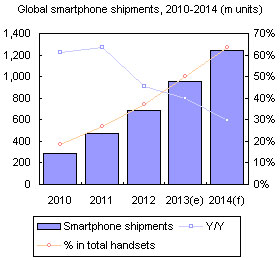
In 2014, smartphones are expected to continue penetrating rapidly into emerging markets such as Russia, India, Indonesia and Latin America, while China’s smartphone shipments will see weakened on-year growth in the year, but still enormous volume. Within the top-10 smartphone vendors in 2013, four of them are from China and in 2014 more China-based vendors are expected to enter the top 10.Three China-based handset vendors increase component deliveries [DIGITIMES, Dec 11, 2014]China-based handset vendors Xiaomi Technology, Gionee and Hisense have been taking increasing deliveries of panels and touch panels from suppliers in preparation for launching new models during the peak period before the 2014 Lunar New Year at the end of January, according to Taiwan-based supply chain makers.Other China-based vendors including Lenovo, Huawei Device and Oppo have begun to follow suit, the sources indicated.Xiaomi has seen success in marketing its high-end Xiaomi 3, mid-range Xiaomi 2S and entry-level Hong-mi (Red Rice), the sources noted.Gionee focuses on marketing high-end smartphones priced above CNY2,000 (US$328) through general retail chains without cooperation with China’s three mobile telecom carriers, the sources indicated. Gionee has shipped more than two million smartphones a quarter so far in 2013.Hisense is among several licensed vendors of 4G smartphones and has launched the 5-inch X6T, its first 4G smartphone featuring TD-LTE, LTE-FDD, TD-SCDMA, WCDMA and GSM, on 12 frequency bands, the sources noted. Hisense has taken delivery of components for use in more than one million handsets to be launched before the 2014 Lunar New Year, the sources noted.China market: Xiaomi lowers price for Hongmi smartphone [DIGITIMES, Jan 7, 2014]China-based vendor Xiaomi Technology has reduced the retail price for its budget TD-SCDMA smartphone, the Hongmi, launched in August 2013, from CNY799 (US$132) to CNY699, heralding upcoming competition in the Android smartphone segment in China, according to industry watchers.Rival vendor Huawei is likely to counteract by slashing the prices of its Honor-branded budget smartphones, while other local brands in China are also expected to follow suit soon, said the observers.Optimizing its policy of offering smartphones with high hardware specifications and yet at low prices, Xiaomi has managed to ramp up its shipments to over three million units a month and is expected to ship over 40 million smartphones in 2014, the sources estimated. [According to Xiaomi: “7.2 million devices … in 2012 and 18.7 million …bought in 2013. … for 2014 – the CEO expects forty million Xiamoi smartphones to be bought”]Asustek expected to ship 2014 target of 5 million smartphones [DIGITIMES, Jan 7, 2014]Asustek Computer unveiled three ZenFone-series smartphones for the opening of CES 2013. Viewing that ZenFone models have comparatively high price-performance ratios, Asustek will be able to hit its target shipments of five million smartphones for 2014, and is likely to ship 8-10 million units, according to market analysts.The three ZenFone models will initially launch in the Taiwan, China and Southeast Asia markets in March at contract-free retail prices of US$99 for the 4-inch model, US$149 for the 5-inch, and US$199 for the 6-inch.All three models are equipped with Intel Atom processors and Asustek will launch 3-4 models also with Atom processors in the second half of 2014, the sources indicated.Since Intel has offered incentives to attract PC vendors to adopt its platforms for smartphones, Asustek is expected to procure Atom processors at discount prices and receive subsidies from Intel for marketing the devices, the sources said.Asustek likely to release smartphone orders to China ODMs in 2H14, says paper [DIGITIMES, Jan 15, 2014]Asustek Computer does not rule out the possibility of tying up with handset ODMs in China for the production of smartphones in the second half of 2014, the Chinese-language Economic Daily News (EDN) has quoted company CEO Jerry Shen as saying.After unveiling five new models at the recently concluded CES 2014, Asustek plans to launch another five smartphones in the second half of the year, and therefore it needs more ODMs to support production, Shen was quoted as indicating.The three ZenFone-series smartphones out of the five models unveiled by Asustek at CES 2014, with displays sized in 4-, 5-, and 6-inch, will be available for US$99, US$149 and US$199 unlocked, respectively, and are designed to take on China-based rivals in the entry-level smartphone segment.The possible switch of orders to China-based ODMs may affect its current production partners in Taiwan, including Wistron and Pegatron, said the paper.Digitimes Research: Asustek ZenFone smartphones have lower price-performance ratios than comparable models from China [Jan 17, 2014]Asustek Computer unveiled three ZenFone-series smartphones at CES 2014 and will initially launch the models in the Taiwan, China and Southeast Asia markets in March with prices comparable to low-cost models offered by China-based Xiaomi Technology and Huawei. But the price-performance ratios of the ZenFones will be still lower than rival models from China-based vendors due to the use of different marketing channels, according to Digitimes Research.China-based vendors such as Huawei and Coolpad have been duplicating the business model initiated by Xiaomi by introducing entry-level models with higher hardware specifications and marketing the gadgets mainly through the Internet.Leveraging subsidies offered by telecom operators, Asustek has been able to lower prices for its ZenFone models to levels comparable to those offered by Xiaomi, Huawei and Coolpad, but the price-performance ratios are lower than of the Hongmi smartphone from Xiaomi, the Honor 3C from Huawei and the Great God F1 from Coolpad, due to markup costs added by channel operators in China selling the ZenFones.Due to the lower price-performance ratios, Asustek’s goal of shipping over five million smartphones in 2014 through a low-pricing model remains hard to achieve, commented Digitimes Research.This article is an excerpt from a Chinese-language Digitimes Research report. Click here if you are interested in receiving more information about the content and price of a translated version of the full report. |
Total: ~289+ million
|

More information (going back to end of July 2013) which is directly related to the possible changes on the 2014 markets in terms of 2014 will be the last year of “free ride” in the smartphone and tablet spaces for ARM-based competitors of Intel – at least what Intel is insisting again [‘Experiencing the Cloud’, Jan 17, 2014]:
-
Nokia should introduce an Android forked smartphone for the $75-120 range in order to enhance its Asha Software Platform strategy [‘Experiencing the Cloud’, Jan 17, 2014]
-
China market: Acer launches CNY599 7-inch tablet [DIGITIMES, Jan 17, 2014]
-
Microsoft to open Allwinner entry into Windows RT, for the production of 900 yuan (US$149) level Windows RT tablet [‘USD 99 Allwinner’, Jan 16, 2014]
-
The first wave of computational photography capabilities from Qualcomm for its new Snapdragon 805 SoCs [‘USD 99 Allwinner’, Jan 4, 2014]
-
The Cortex-A53 as the Cortex-A7 replacement core is succeeding as a sweet-spot IP for various 64-bit high-volume market SoCs to be delivered from H2 CY14 on [‘Experiencing the Cloud’, Dec 23, 2013]
-
MediaTek MT6592-based True Octa-core superphones are on the market to beat Qualcomm Snapdragon 800-based ones [‘Experiencing the Cloud’, Dec 22, 2013]
-
The future is here: Yes, it is Microsoft Surface 2 with modern apps only! (And ARM, not x86/x64!) [‘Experiencing the Cloud’, Nov 17, 2013]
-
Q3’13 smartphone and overall mobile phone markets: Android smartphones surpassed 80% of the market, with Samsung increasing its share to 32.1% against Apple’s 12.1% only; while Nokia achieved a strong niche market position both in “proper” (Lumia) and “de facto” (Asha Touch) smartphones [‘Experiencing the Cloud’, Nov 14, 2013]
-
The tablet market in Q1-Q3’13: It was mainly shaped by white-box vendors while Samsung was quite successfully attacking both Apple and the white-box vendors with triple digit growth both worldwide and in Mainland China [‘Experiencing the Cloud’, Nov 14, 2013]
-
The first multimode Android tablets and laptops from Lenovo [‘Experiencing the Cloud’, Nov 14, 2013]
-
Leading PC vendors of the past: Go enterprise or die! [‘Experiencing the Cloud’, Nov 7, 2013]
-
Intel is ready to push big in smartphones next year with its winning multimode voice and data, multiband LTE modem technology capable of global LTE roaming via a single SKU [‘Experiencing the Cloud’, Nov 5, 2013]
-
Leading edge Nokia phablets for both entertainment and productivity: Lumia 1320 targeting the masses at $339, and Lumia 1520 the imaging conscious business users and individuals at $749 [‘Experiencing the Cloud’, Oct 26, 2013]
-
Why Intel is pressed to go as far down as to $99 with its Android tablet prices (but not with Windows 8.1)? [‘Experiencing the Cloud’, Oct 16, 2013]
-
Dell’s all Intel tablets and laptops targeting the evolving mobile workforce even with their most consumer specific Android tablets [‘Experiencing the Cloud’, Oct 3, 2013]
-
Amazon’s move into overall leadership: Kindle Fire HDX with Snapdragon 800, “revolutionary on-device tech support” (Mayday), enterprise and productivity capable Fire OS 3.0 forked from Android 4.2.2 etc. PLUS a significantly enhanced, new Kindle Fire HD for a much lower, $139 price [‘Experiencing the Cloud’, Sept 27, 2013]
-
Multi-tasking and multi-window view used together for high performance productivity scenarios in the state-of-the-art UX environment of Microsoft Windows 8.1 – the ultimate solution not available with Apple and Android devices [‘Experiencing the Cloud’, Sept 26, 2013]
-
2nd generation Microsoft Surface family of productivity tablets priced upto $2420 (when for an All-in-One configuration) [‘Experiencing the Cloud’, Sept 24, 2013]
-
The long awaited Windows 8.1 breakthrough opportunity with the new Intel “Bay Trail-T”, “Bay Trail-M” and “Bay Trail-D” SoCs? [‘Experiencing the Cloud’, Sept 14, 2013]
-
The new Air Command S Pen User Experience making the Samsung Galaxy Note 3 phablet, and Galaxy Note 10.1, 2014 Edition tablet next-generation devices [‘Experiencing the Cloud’, Sept 12, 2013]
-
Companion Device Computing as envisaged and implemented by Pranav Mistry and his TTT team from Samsung: the case of Galaxy Gear + Galaxy Note 3 [‘Experiencing the Cloud’, Sept 12, 2013]
-
Samsung Exynos 5 Octa with Heterogeneous Multi-Processing and GPU Compute is the hidden gem in the Galaxy Note 3 and GALAXY Note 10.1, 2014 Edition, launched at ‘Samsung UNPACKED 2013 Episode 2’ event [‘Experiencing the Cloud’, Sept 12, 2013]
-
Xiaomi announcements: from Mi3 to Xiaomi TV [‘Experiencing the Cloud’, Sept 3, 2013]
-
Assesment of the Xiaomi phenomenon before the global storm is starting on Sept 5 [‘Experiencing the Cloud’, Aug 30, 2013]
-
Windows [inc. Phone] 8.x chances of becoming the alternative platform to iOS and Android: VERY SLIM as it is even more difficult for Microsoft now than any time before [‘Experiencing the Cloud’, Aug 20, 2013]
-
Android to overtake the overall PC market? [‘Experiencing the Cloud’, Aug 20, 2013]
-
With Android and forked Android smartphones as the industry standard Nokia relegated to a niche market status while Apple should radically alter its previous premium strategy for long term [‘Experiencing the Cloud’, Aug 17, 2013]
-
Google Play catchup with iOS App Store and its way of assuring compatibility across Android 1.6 to 4.3 [‘Experiencing the Cloud’, Aug 15, 2013]
-
Superphones turning point: segment satured with Tier 1 globals while the Chinese locals are at less than 40% of the Samsung price [‘Experiencing the Cloud’, Aug 3, 2013]
-
Xiaomi, OPPO and Meizu–top Chinese brands of smartphone innovation [‘Experiencing the Cloud’, Aug 1, 2013]
-
GiONEE (金立), the emerging global competitor on the smartphone market [‘Experiencing the Cloud’, July 22, 2013, Jan 17, 2014]
MediaTek MT6592-based True Octa-core superphones are on the market to beat Qualcomm Snapdragon 800-based ones UPDATE: from $147+ in Q1 and $132+ in Q2
[‘Experiencing the Cloud’, July 22-29, 2013; Jan 27, 2014]
Q3’13 smartphone and overall mobile phone markets: Android smartphones surpassed 80% of the market, with Samsung increasing its share to 32.1% against Apple’s 12.1% only; while Nokia achieved a strong niche market position both in “proper” (Lumia) and “de facto” (Asha Touch) smartphones
Details about Samsung’s strengths you can find inside the Samsung has unbeatable supply chain management, it is incredibly good in everything which is consumer hardware, but vulnerability remains in software and M&A [‘Experiencing the Cloud’, Nov 11, 2013] post of mine.
My findings supporting the above title:
- 205 million Android smartphones were delivered in Q3’13, representing 15.2% growth sequentially (Q/Q) and 67.3% growth relative to the same period of last year (Y/Y)
- Meanwhile the number of Apple iPhones shipped increased only to 33.8 million, growing by 8.3% sequentially (Q/Q), but still representing a 25.65% growth relative to the same period of last year (Y/Y)
- The shipment of “proper” smartphones from Nokia (S60/Symbian and Lumia/Windows Phone) increased to 8.8 million units, representing 18.9% growth sequentially (Q/Q) and 39.7% growth relative to the same period of last year (Y/Y)

- Meanwhile the shipment of “de facto” smartphones from Nokia (S60/Symbian, Lumia/Windows Phone and Asha Full Touch in S40 Series) increased to 14.7 million units, representing 25.6% growth sequentially (Q/Q) and 14.8% growth relative to the same period of last year (Y/Y). It is also important that the decline of Asha Full Touch after its peak of 9.3 million units sold in Q4’12 has been reversed with 5.9 million units shipped, representing a sizable 37.2% growth sequentially (Q/Q).
- The new (in Q3’13) Asha 501 became the most popular smartphone on the Indian market in the $60-80 price range (as per Flipkart, see above), successfully beating off the best competitive offerings from Samsung and the two leading local brands, Micromax and Karbonn. This is another positive sign of successfull revival of the Asha Touch platform started with Asha 501 (via the Asha Software Platform 1.0) as described in the New Nokia Asha platform for developers [‘Experiencing the Cloud’, May 9, 2013] and New Asha platform and ecosystem to deliver a breakthrough category of affordable smartphone from Nokia [‘Experiencing the Cloud’, May 9 – July 5, 2013] posts of mine. Everything is well represented by comparing the “micro reports” included into the bottom left corner of the overall chart a quarter ago and now:

- As one currently could see this Nokia (the devices part of it soon becoming the part of Microsoft*) could realise its goal of selling “100 million of the new generation Asha smartphones over the coming years, beginning with the Nokia Asha 501”. The Asha 500, Asha 502 and Asha 503 introduced in October 22 could already deliver a huge jump in shipments of “de facto smartphones” under Asha brand, helping to defend further and even improve Nokia’s market position against the sub $100 Android smartphones in Q4’13. Note also that Asha 500 was announced for $69 list price (before taxes or subsidies) which means that—depending on “race to the bottom” competition—could easily mean a street price of $60+ on the Indian market.
-
* See also the previous posts of mine:
– Unique Nokia assets (from factories to global device distribution & sales, and the Asha sub $100 smartphone platform etc.) will now empower the One Microsoft devices and services strategy [‘Experiencing the Cloud’, Sept 3 – Oct 23, 2013]
– Microsoft answers to the questions about Nokia devices and services acquisition: tablets, Windows downscaling, reorg effects, Windows Phone OEMs, cost rationalization, ‘One Microsoft’ empowerment, and supporting developers for an aggressive growth in market share [‘Experiencing the Cloud’, Sept 3 – Oct 23, 2013]
– Microsoft Nokia Transaction Conference Call with slides from Microsoft Strategic Rationale inserted-ebook – 3-Sept-2013 edited by Sándor Nacsa from those two sources into an ebook format PDF
– Leading edge Nokia phablets for both entertainment and productivity: Lumia 1320 targeting the masses at $339, and Lumia 1520 the imaging conscious business users and individuals at $749 [‘Experiencing the Cloud’, Oct 26, 2013] - The Asha Touch revival was also able to stop the decline of the overall Nokia “mobile phones” category (Nokia S30, S40, Asha and Asha Full Touch phones) exactly at 55.8 million units, the same number as for the Q1’13.

- In addition there are now the Leading edge Nokia phablets for both entertainment and productivity: Lumia 1320 targeting the masses at $339, and Lumia 1520 the imaging conscious business users and individuals at $749 [‘Experiencing the Cloud’, Oct 26, 2016].
- With that Nokia established a strong niche market position on both the $130+ market (starting with Lumia 520 sold at that price in India, also the most popular one on Flipkart for the the $80-160 price range of devices) and the sub $80 market against the onslaught of Android devices. The rest will depend now only on Microsoft.

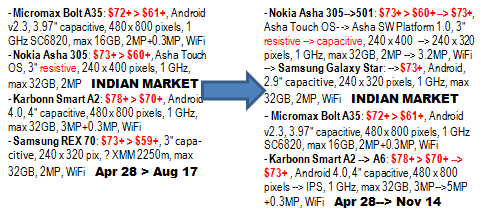


Than for the lead smartphone market, i.e. Mainland China I will include here:
- China market: Smartphone sales top 93 million units in 3Q13, says Analysys [Digitimes, Nov 12, 2013]
There were 102.66 million handsets sold in the China market during the third quarter of 2013, growing 13.6% on quarter and 54.5% on year, of which 93.08 million units were smartphones, increasing 20.7% on quarter and 89.3% on year, according to China-based consulting company Analysys International.

While for the worldwide market:
- China-based smartphone vendors set to rise in 2013 rankings, says IC Insights [Digitimes, Nov 13, 2013]
Lenovo, ZTE, Huawei and Yulong/Coolpad have taken advantage of the surging low-end smartphone market. According to IC Insights, the four major China-based handset companies are forecast to ship 168 million smartphones in 2013 and together hold a 17% share of the worldwide smartphone market.
Lenovo, ZTE, Huawei and Yulong/Coolpad shipped a combined 98 million smartphones in 2012, a more than 300% surge from the 29 million units shipped in 2011, IC Insights disclosed. It should be noted that the China-based suppliers of smartphones are primarily serving the China and Asia-Pacific marketplace, and offer low-end models that typically sell for less than US$200.
Low-end smartphones are expected to represent just under one-third (310 million) of the total 975 million smartphones shipped in 2013. IC Insights forecast that by 2017, low-end smartphone shipments will represent 46% of the total smartphone market with China and the Asia-Pacific region to remain the primary markets for these low-end models.
Samsung Electronics and Apple are set to continue dominating the total smartphone market in 2013. The two vendors are forecast to ship 457 million units and together hold a 47% share of the total smartphone market in 2013, IC Insights said. In 2012, Samsung and Apple shipped 354 million smartphones and took a combined 50% share of the total smartphone market.
Nokia was third-largest supplier of smartphones behind Samsung and Apple in 2011, but has seen its share of the smartphone market fall. Nokia’s smartphone shipments are forecast to decline by another 4% and grab an only 3% share of the total smartphone market in 2013, IC Insights indicated.
Other smartphone producers that have fallen on hard times include RIM and HTC. While each of these companies had about a 10% share of the smartphone market in 2011, IC Insights estimated they will have only about 2% shares of the 2013 smartphone market.

-
Gartner Says Smartphone Sales Accounted for 55 Percent of Overall Mobile Phone Sales in Third Quarter of 2013 [press release, Nov 14, 2013]
– Western Europe Grew for the First Time this Year
– Lenovo Became the No. 3 Worldwide Smartphone Vendor for the First Time
Worldwide mobile phone sales to end users totaled 455.6 million units in the third quarter of 2013, an increase of 5.7 percent from the same period last year, according to Gartner, Inc. Sales of smartphones accounted for 55 percent of overall mobile phone sales in the third quarter of 2013, and reached their highest share to date.
Worldwide smartphone sales to end users reached 250.2 million units, up 45.8 percent from the third quarter of 2012. Asia/Pacific led the growth in both markets – the smartphone segment with 77.3 percent increase and the mobile phone segment with 11.9 percent growth. The other regions to show an increase in the overall mobile phone market were Western Europe, which returned to growth for the first time this year, and the Americas.
“Sales of feature phones continued to decline and the decrease was more pronounced in markets where the average selling price (ASP) for feature phones was much closer to the ASP affordable smartphones,” said Anshul Gupta, principal research analyst at Gartner. “In markets such as China and Latin America, demand for feature phones fell significantly as users rushed to replace their old models with smartphones.”
Gartner analysts said global mobile phone sales are on pace to reach 1.81 billion units in 2013, a 3.4 percent increase from 2012. “We will see several new tablets enter the market for the holiday season, and we expect consumers in mature markets will favor the purchase of smaller-sized tablets over the replacement of their older smartphones” said Mr. Gupta.
While Samsung’s share was flat in the third quarter of 2013, Samsung increased its lead over Apple in the global smartphone market (see Table 1). The launch of the Samsung Note 3 helped reaffirm Samsung as the clear leader in the large display smartphone market, which it pioneered.
Lenovo’s sales of smartphones grew to 12.9 million units, up 84.5 percent year-on-year. It constantly raised share in the Chinese smartphone market.
Apple’s smartphone sales reached 30.3 million units in the third quarter of 2013, up 23.2 percent from a year ago. “While the arrival of the new iPhones 5s and 5c had a positive impact on overall sales, such impact could have been greater had they not started shipping late in the quarter. While we saw some inventory built up for the iPhone 5c, there was good demand for iPhone 5s with stock out in many markets,” said Mr. Gupta.

In the smartphone operating system (OS) market (see Table 2), Android surpassed 80 percent market share in the third quarter of 2013, which helped extend its leading position. “However, the winner of this quarter is Microsoft which grew 123 percent. Microsoft announced the intent to acquire Nokia’s devices and services business, which we believe will unify effort and help drive appeal of Windows ecosystem,” said Mr. Gupta. Forty-one per cent of all Android sales were in mainland China, compared to 34 percent a year ago. Samsung is the only non-Chinese vendor in the top 10 Android players ranking in China. Whitebox Yulong [Coolpad] is the third largest Android vendor in China with a 9.7 percent market share in the third quarter of 2013. Xiaomi represented 4.3 percent of Android sales in the third quarter of 2013, up from 1.4 percent a year ago.

Mobile Phone Vendor Perspective
Samsung: Samsung extended its lead in the overall mobile phone market, as its market share totaled 25.7 percent in the third quarter of 2013 (see Table 3). “While Samsung has started to address its user experience, better design is another area where Samsung needs to focus,” said Mr. Gupta. “Samsung’s recent joint venture with carbon fiber company SGL Group could bring improvements in this area in future products.”
Nokia: Nokia did better than anticipated in the third quarter of 2013, reaching 63 million mobile phones, thanks to sales of both Lumia and Asha series devices. Increased smartphone sales supported by an expanded Lumia portfolio, helped Nokia move up to the No. 8 spot in the global smartphone market. But regional and Chinese Android device manufacturers continued to beat market demand, taking larger share and creating a tough competitive environment for Lumia devices.
Apple: Gartner believes the price difference between the iPhone 5c and 5s is not enough in mature markets, where prices are skewed by operator subsidies, to drive users away from the top of the line model. In emerging markets, the iPhone 4S will continue to be the volume driver at the low end as the lack of subsidy in most markets leaves the iPhone 5c too highly priced to help drive further penetration.
Lenovo: Lenovo moved to the No. 7 spot in the global mobile phone market, with sales reaching approximately 13 million units in the third quarter of 2013. “Lenovo continues to rely heavily on its home market, which represents more than 95 per cent of its overall mobile phone sales. This could limit its growth after 2014, when the Chinese market is expected to decelerate,” said Mr. Gupta.

GiONEE (金立), the emerging global competitor on the smartphone market
In the Top 10 on the Q1 CY13 Chinese smartphone market Lenovo (w/13.1%), Huawei (w/10.1%) and ZTE (w/6.9%) are well-known brands globally. The #3 Coolpad (w/10.3%) is not, neither the #7 K-Touch/Tianyu (w/4.1%), nor the #8 GiONEE (w/3.8%), nor the #10 OPPO (w/2.9%).
When I looked into these companies I got interested only in GiONEE (金立), as the one with the best chance currently to succeed in the broad global market as well. Not least there is a very strong determination by GiONEE Group President Lu Wei Bing (卢伟冰) / William Lu (see the below picture that was taken on the July 10 launch) to succeed overseas as evidenced by his latest interview with Tencent Digital.

He is absolutely convinced that after doing 10 million unit ODM sales abroad the company is ready to expand under its own brand as well. Moreover he was in 2009 with K-Touch/Tianyu as responsible for mobile GSM and overseas business unit there, so has pretty much experience in overseas efforts from China.
Update:
Elife E7 Product Video [Gionee India YouTube channel, published on Dec 30, 2013]
The New Gionee E7 [Gionee India YouTube channel, published on Jan 2, 2014]
We’re now in the new smartphone era. Meet the New Gionee.
With 100 million users and presence in 40 countries. Wherever you are, Gionee is always easily approachable!
Our motto, “Innovations and advance with the times.” The integration of hardware and software in creating the perfectly balanced ecosystem.
Gionee has the largest Intelligent Manufacturing base in Asia. Over 10 years of experience accumulation. Today, Gionee has 4 R&D Centers and over 1,500 engineers worldwide and an annual investment of USD83 Million in R&D. Over 100 patents of mobile technology.
More than 8000 employees based in the Gionee Industrial Park, built with an investment of USD 125 Million with production capacity of 40 million units/ year which can be upgraded to 80 million units / year. China’s 1st lab developed specifically for supporting product design.
We cooperate with the World’s Top Developors including Google, Qualcomm, Samsung, Sharp who have now become Gionee’s strategic partners.
Technology will continue to change and shape our future. With our world class partners, Gionee will continue to bring innovations into your work and life. We will continue to expand and provide the best user experience in a Smartphone to more users worldwide.
Connect with us:
- Facebook: https://www.facebook.com/gionee.india
- Twitter: https://twitter.com/gioneeindia
- Instagram: http://instagram.com/gioneeindia
- Pinterest: http://www.pinterest.com/gioneeindia
How the handset newbie Gionee is on the route to take on Apple, Samsung [The Economic Times of India, Jan 17, 2014] “Lu Weibing …the 38-year old … President of the $2.5 billion Gionee” about “the Gionee disruption model”:
Weibing wants the 8,000-people-strong Gionee to be among the top five global brands in the smartphone business and claims that three Chinese brands will be in that bracket in the next five years. By then, he wants to lead the pack in India taking on the likes of Samsung and Apple.
Annually, Gionee sells about 25 million handsets compared to Samsung’s 396.5 million and Apple’s 135.8 million. It may be a long road, but his role model is Apple founder Steve Jobs—”because he was a product manager and back home in China, I’m a product manager involved in every step of the product”.
- Exclusivity with distributors
…- Own manufacturing
…- Ability to work with multiple partners
…- Exit ODM, enter brand
…- Own the OS
In the future, for any brand to succeed, it must have its own operating system (OS). We started work on our OS, Amigo, two years back, and it is up and running today with its cloud service, book centre, shopping, app store, browser. The OS is obviously being customized for different geographies.
- Innovate before others
…- Straddle all price points
…
Gionee Elife E7 – specifications, features and review [Gionee India YouTube channel, published on Jan 2, 2014]
Gionee announces the launch of its flagship ELIFE E7 smartphone in India. [Gionee India YouTube channel, published on Dec 29, 2013]
ELIFE E7 powered by the Qualcomm® Snapdragon™ 800 processor is an incredible Camera Smartphone.
New Delhi – December 24, 2013: Gionee Smartphones, a global leader in mobile manufacturing, design and R&D, today announced the launch of its new flagship Smartphone ELIFE E7 in India. ELIFE E7 is powered by the Qualcomm Snapdragon 800 processor and android based operating system AMIGO 2.0. Qualcomm Snapdragon processors are a product of Qualcomm Technologies, Inc., a wholly-owned subsidiary of Qualcomm Incorporated. Gionee ELIFE E7 is designed specifically to bring the technology of professional digital cameras to smartphones with a best-in-class lens and a breakthrough image sensor.
ELIFE E7 runs on the Qualcomm Snapdragon 800 processor featuring a 2.2GHz quad Krait CPU, designed for 3D gaming, faster processing and a professional photo shooting experience. The ELIFE E7 comes in two variants that support 3G and 4G respectively. The ELIFE E7 4G will be powered by the Qualcomm Snapdragon 800 processor featuring a 2.5 GHz quad Krait CPU.
The Gionee ELIFE E7 possesses a 16 MP rear camera and a stunning 8 MP front camera. Beside its powerful sensor and stunning resolution, the ELIFE E7 has been developed and customized with a large lens based on professional Largan M8 lens solution. ELIFE E7 features a 13.9 cm (5.5 Inch) FHD (JDI) Display with 1920 x 1080 and 401 PPI for spectacular viewing quality. ELIFE E7 is equipped with the latest 3rd Generation Gorilla Glass which is 20 times more scratch resistance than regular classes and twice as durable as the second generation of Gorilla Glass. The sensitive ELIFE E7 touch screen is also responsive to gloves, wet hands, and keys to ensure photographers can take pictures in any weather and any situation.
ELIFE E7 comes with built in 12 Levels of Auto Beauty feature to ensure that the user will always look flawless in every picture. An innovative SR Auto — Intelligent Scene Recognition Function also eliminates the hassle of changing the settings every time as it automatically changes the settings to automatic, portrait, Micro, night, night portrait, backlight, backlight portrait. ELIFE E7 has a new way for wakeup screen which can be performed by a simple Double Tap. Another interesting feature is the Black Screen Gesture that simply draws the gestures on the black screen and goes directly into the customized corresponding procedures.
“Since its launch in India, Gionee’s ELIFE series has been extremely well received by consumers. ELIFE E7 is sure to create buzz and recreate benchmarks in the industry. Gionee has crafted its unique space in the Indian market in a very short time supported with unmatched quality, distribution and service. ELIFE E7 is sure to set the Indian smartphone market ablaze with its never seen before features and great hardware.” added Mr. Arvind.R.Vohra, Director Syntech Technology Pvt. Ltd.
“We designed ELIFE E7 with the best in class hardware and software that will make it stand out on any parameter. While creating the most powerful camera for ELIFE E7, the idea was to come up with a way to create the perfect combination and balance of image resolution and picture quality. A joint development with OmniVison has enabled the Elife E7 to sport a 16 megapixel sensor with 1.34 μm pixels which enables users with the ability to shoot razor sharp images without compromising the photo’s resolution or image quality”, says Mr. Lu Weibing, President of Gionee Smartphones.
Additional Features of ELIFE E7
· NFC — Share your work anywhere
Share photos, MP3, videos, and anything you want in the blink of an eye, users can define different modes.
· OTG
Interconnection and freedom to share, connecting a usb to smartphone to instantly view or save documents.
· Sound
ELIFE E7 sports three-mic noise cancellation for reduced noise and clearer conversation in every situation.
The GIONEE ELIFE E7 will be available in black, white, blue, pink, green, yellow and orange colour and will be available in India starting January 2014.
The Price of Elife E7 32 GB and 16 GB is Rs. 29,999 [US$487] and Rs. 26,999 [US$438] respectively.
Qualcomm and Snapdragon are trademarks of Qualcomm Incorporated, registered in the US and other countries. Other product and brand names may be trademarks or registered trademarks of their respective owners.
End of Update
Then GiONEE has the largest manufacturing facility of its own among those additional players, with 40 million units capacity per year, and with an expansion capability already prepared in its industrial park for another 40 million when the market opportunity will arise. Finally the company was quickly exploiting MediaTek advances towards the high-end in H1 with prompt introductions even on the Indian market (where it is directly represented only since February), and this would bring even better, “Samsung and Apple beating” offerings in H2, especially with the eight-core MT6592:
MediaTek quad-core Cortex A7 CPU (MT6589 @1.2GHz, MT6589T @1.5GHz)
+ PowerVR Series5XT GPU + Dual SIM, Dual Standby + Android OS Jelly Bean:
| March 2013 |
July 23: $268+ (Rs. 15,999+) |
 DREAM D1 |
1.2 GHz 1GB/4GB 4.65″ HD Super AMOLED Plus 316ppi 8MP/1MP v4.1 Android |
| May 2013 |
July 23: $214+ (Rs.12,757+) |  Gpad G2 |
1.2 GHz 1GB/4GB 5.3″ qHD IPS, 960*540 8MP/1MP v4.1 Android |
| May 2013 |
July 23: $251+ (Rs. 14,999+) |
Elife E3 |
1.2 GHz 1GB/16GB 4.7″ IPS HD, 1280*720 8MP/2MP v4.2 Android |
| July 2013 |
July 23: $335 (Rs. 19,999 list) |
Elife E5 |
1.5 GHz 1GB/16GB 4.8″ AMOLED, 1280*720 8MP/5MP v4.2 Android |
This report will be organised into the following sections:
- Current situation in China:
Consolidation among Chinese mobile phone brands and manufacturers would escalate in the following months - Considering the well known Lenovo, Huawei, ZTE and HTC situation the most interesting Chinese brand for me quickly became GiONEE. Why?
- Earlier information about GiONEE
– From the company itself
– From my trend-tracking blog, ‘Experiencing the Cloud’
– From current media reports
Sidenote #1: K-Touch/Tianyu (天语) is only trying to regain its lost fame (when sold 17 million K-Touch phones in 2007, emerging as #2 cell-phone maker in the China market, second only to Nokia). Moreover it had also a U-turn in overseas expansion last year, and now concentrating on the domestic market only. In addition it is quite picky in SoC vendor selection: with Qualcomm Snapdragon 200 MSM8225Q for a $163 4.5”-er quad-core from April, then with Broadcom for a $98 4”-er dual-core from May, finally with Qualcomm Snapdragon 400 MSM8930 for a $163 TD-LTE dual-core from August, as the latest ones. This is all independently from its original, February, 2012 Qualcomm commitment. With this it looks like that it is also trying to avoid MediaTek which made its original success possible, while for others MediaTek has become an even more important partner than Qualcomm.
Sidenote #2: OPPO has a visibly lesser effort to expand abroad, and Coolpad (as a wholly owned subsidiary of China Wireless Technologies Limited), although “has established strong and close strategic cooperation relationships with certain global telecommunications operators” according to its parent, “in the year of 2011, most of the Coolpad smartphones were shipped to the domestic telecommunications operators” according to the chairman of the parent company. For 2012 the parent stated in the Market Share of Coolpad Smartphones Ranks No. 4 in China only these facts: “the Group has started to launch 4G FDD-LTE smartphones in the United States in 2012, a further expansion into overseas markets. … Except for the existing market in India and Taiwan, the Group successfully rolled out its proprietary 4G FDD-LTE smartphone in the American market. The affordable Coolpad smartphones not only enabled more and more American users to enjoy the 4G high-speed network, but also enhanced the brand awareness of Coolpad in the United States. … Meanwhile, the Group continued to partner with the tier-one chipset suppliers to successfully roll out the 4G FDD-LTE smartphone in the United States.” With that Coolpad has a very focused geographical, and even more focused technology segment strategy abroad than GiONEE.
Complementary posts reminder:
Eight-core MT6592 for superphones and big.LITTLE MT8135 for tablets implemented in 28nm HKMG are coming from MediaTek to further disrupt the operations of Qualcomm and Samsung[‘Experiencing the Cloud’, July 20, 2013] from which the following excerpts I will include here as the ones directly related to the content given here as well:
… according to Zhu Shangzu (朱尚祖), MediaTek Global Smartphone General Manager in the [Part 2] MediaTek to push 8 small cores, the mystery [ESM 国际电子商情 (International Electronic Business), July 18, 2013] exclusive interview … I think the future of high-end smartphones innovation will focus on the expansion of big screen multimedia applications, and this is our direction. …
Judging from the current situation, customers of high-end flagship phones are still using the products of the competitors, but there is flagship in our quad-core case as well, and OPPO, Vivo and GiONEE and other quad-core phones are also very popular. Our next goal is to get the customers of flagship machines using our platform via helping customers to achieve stronger performance on the big screen multimedia.
Evolution of Indian Handset OEMs – History, Current State and Future Outlook [Convergence Catalyst blog, March 27, 2012]
Many Indian handset brands were started by former national and regional distributors of global OEMs (such as Nokia, Motorola, Samsung, etc). These companies partnered with Mediatek (MTK), a fabless System-on-Chip (SoC) provider and ODMs based in Taiwan and China to source white-labeled devices (with basic Indian market hygiene requirements like long battery life and high audibility)
…
The Chinese handset market has undergone a similar influx of local vendors in partnership with MTK in 2007. Tianyu (market facing brand of Chinese telecom player K-Touch) was the first Chinese vendor to launch mobile handsets based on MTK’s turnkey solution in early 2007. Tianyu’s key success factors include products with feature set that address local market needs, faster turn-around time, wide spread distribution and high channel margins to distributors. By end of 2008, a number of local vendors such as Bird, Amoi, ChangHong, Gionee, etc had entered the Chinese market using Tianyu’s business model. Increased competition among numerous vendors resulted in ASP (Average Selling Price) reduction, in turn affecting handset margins adversely.
End of complementary posts reminder
Current situation in China:
Consolidation among Chinese mobile phone brands and manufacturers would escalate in the following months
The recent message from China was blunt: Xiaomi (小米), Lenovo (联想), ZTE (中兴) and GiONEE (金立) are pushing new products – Mobile phone industry, welcome to the final competitive play (小米联想中兴金立争推新品 手机业迎来淘汰赛) [IT Business News Network (IT商业新闻网), July 13, 2013]:
From Xiaomi mobile phone, Lenovo K900, HTC devices having depth customization with operators, and then to ZTE Geek phones in recent days, in addition to Meitu Kiss [rooted in a highly popular “picture beautifying software” made in China], the GiONEE mobile phone and a number of domestic brands, there were a number of new product launches in the first half. In the second half the smart phone will probably usher in a decisive knockout.
Then the message continues with an earlier information which I would take here in a little more detail from China’s mobile phone shipment up 36.4% in June [China Knowledge, June 12, 2013]
China saw its shipment of mobile phones in the domestic market surge 36.4% year on year to 42.29 million units in June this year, according to a report released by China Academy of Telecommunication Research of MIIT.
The figure last month was 29.1% lower than the 59.08 million it realized in May 2013.
China’s shipment of domestic brand mobile phones in the country hit 34.31 million units in June, accounting for 81.1% of the total.
A detailed media report is in the 6月份全国手机出货4248.8万部下降近三成,国产机处于“小学生”阶段 [China Industry Inside Network, July 12, 2013] which contains the explanation for the May market contraction as well. I will again include an already available explanation in English: China’s mobile phone shipment dips [ZDNet, July 12, 2013]
Some smaller cellphone manufacturers in China have been cutting production on inventory and funding issues, according to a Sina news report, which cited a report by First Financial Daily. iiMedia CEO Zhang Yi told the Chinese newspaper many Chinese brands also were adjusting their pace to reduce the frequency of new product launches as they aimed for higher profit.
Zhang believed consolidation among Chinese mobile phone brands and manufacturers would escalate in the following months.
Many domestic market players are struggling to stay afloat. Faced with falling margins and profits, smaller handset makers have been forced to close and these have included veteran market players in the market who had been in business for over two decades. OEM cellphone manufacturers are competing for orders, some agreeing to lower their profit to just 1 percent in order to secure the big orders.
A cellphone manufacturer told First Financial Daily that major local telcos, including China Mobile and China Telecom, were promoting mobile handsets priced between 299 and 499 yuan (US$48.7 to US$81.3), which basically cut off sales of other lower-end cellphone brands. The market was now a “playground for [well-known] foreign and domestic cellphone brands”, he added.
As far as the market share split between the leading brands the latest information was China market: Smartphone sales over 75 million units in 1Q13, says Analysys [DIGITIMES, May 22, 2013] and 78% of the market is shared by Top 10 vendors, with Samsung and Apple joint share just 24.1% while the domestic top brands held not less than 53.9%, according to the table below:
There were 90.54 million handsets sold in the China market during first-quarter 2013, growing 23.5% sequentially and 34.8% on year, and 75.28 million units of them were smartphones, increasing 32.2% sequentially and 141.5% on year, according to Analysys International.
Analysys: Main smartphone vendors in China by sales volume, 1Q13
Samsung: 17.3% Lenovo: 13.1% Coolpad: 10.3% Huawei: 10.1% ZTE: 6.9% Apple: 6.4% K-Touch: 4.1% GiONEE: 3.8% HTC: 3.1% OPPO: 2.9%
Considering the well known Lenovo, Huawei, ZTE and HTC situation the most interesting Chinese brand for me quickly became GiONEE. Why?
With the Facebook message on September 5, 2012 of the GiONEE FB site:
If you are waiting something new, something that does not only fancy your eye but also touch your heart, wait just with patience and GiONEE is coming…
GiONEE came to the international scene. On September 27, 2012 we were told:
… here unveils the mystic 4.65 inch Android device from GiONEE: Super AMOLED Plus display with QHD resolution (960*540 pixels), 8.0 Mega pixels autofocus camera, 1.0 Mega pixels front-facing camera, dual core 1.2GHz CPU, Android OS v4.0 Ice Cream Sandwich. …
referring definitely to a previous September 25, 2012 message and related image:
… see more about the Super AMOLED Plus screen. The color contrast ratio and brightness is the best, and it is most power saving. Do you like this?

I won’t detail further steps taken by the company on the international market, as documented on its Facebook site, but jump to the latest one of July 10:
Finally we unveil the latest flagship product of Elife series– Elife E6. We hope our fans and curious folks will like it.

the 2699 yuan price equals to not less than $440. Isn’t it too steep? GiONEE’s next message of July 10 seems to target that question with:
Full spec for E6

On July 13 we further learned that:
GIONEE E6 manufactured with CNC technology and handcraft [GioneeMobile YouTube channel, July 12, 2013]
and on July 14:
ELIFE E6’s delicate hand-polished sides allow it to standup by itself in order to take handsfree photos. Never again would someone be left out of a group shot!
on July 16:
This is Gionee Elife E6 – the revolutionary smartphone with more than just a smartphone.
GIONEE ELIFE E6 Smartphone [GioneeMobile YouTube channel, July 14, 2013]
the next July 17:
ELIFE E6’s 5-inch LCD includes the latest LTPS Technology with 1080 pixels and ultra Retina Standards of 441 pixels; allowing you to view the the details of every moment

 finally on July 18:
ELIFE E6’s Content Adaptive Backlight Control automatically adjusts screen brightness according to display, maximizing power consumption reduction, and allows power saving up to 30%
Next day we got reminded that:
With all the excitement surrounding Elife E6, don’t forget its 7.9mm curvy, colorful, and stylish little brother Elife E3!
Aha, that “little” device which was reported as Gionee’s Slim New Droid Totally Stole Samsung’s Thunder! [Gizmodo India, May 21, 2013]
… Just a day after Samsung flexed its muscles with a mid-range quad core dual-SIM offering – the Galaxy Grand Quattro, they’ve pretty much been left in the dust by, of all people – Gionee. The ELife E3, from the relatively unknown Chinese ODM (which entered India with its own brand earlier this year) seems to have whipped the Quattro in every department – at least on paper. Here’s the score-line of the tech-spec showdown:
ELife E3 vs Galaxy Grand Quattro: A 6-1 whipping!
1-0: 1.2GHz Quad Core A7 (Mediatek) vs 1.2GHz Quad Core A5 (Snapdragon)
2:0 16GB internal memory vs 8 GB
3:0 8MP/2MP rear/front cameras vs 5MP/VGA
4:0 Android Jelly Bean 4.2.1 vs 4.1.2
5:0 4.7″ IPS 1280×720 display vs 4.7″ 800×480
6:0 Priced at Rs. 15,000 [$252] vs Rs. 17,000 [$286]
6:1 1800 mAh battery vs 2000 mAh
Relative to all that above the original press release for E6 appeared as Gionee Launch ELIFE E6 smartphone – Simply Smart For all, the world’s first White OGS phone [Core Sector Communique, July 11, 2013] from which I will include here only those excerpts which provide additional information:
As the world’s first White OGS phone [OGS = One Glass Solution, touchscreen technology, see also the review within this], its 2.54mm narrow edge and 6.18mm thin miniature size allows it to slide comfortably into your pockets. … weighing only 128g …
Unibody Design
ELIFE E6’s innovative design features an unibody exterior in Pearl White and Stunning Black. …
The Best Display Technology across the Globe
Powered with a full HD Reality Display Resolution, 441PPI high pixel density and super bright AMOLED, ELIFE E6 automatically reduces 80% of sunlight reflection and increases the brightness of images by 20%, bringing you crispier and clearer razor sharp images. Full Lamination Technology allows 20% reduction in overall thickness and Light Transmittance increased by 10%.
Capturing Pictures Have Never Been Easier
ELIFE E6’s innovative camera technology redefines how photos are meant to be captured. Forget about dragging a camera around for high quality photos and videos. With the goal to make life better through technology, ELIFE E6’s camera sports the second generation of Backside Illumination Technology, antireflection coatings, anti-fingerprint film and finishes off with 5 layers of blue glasses, giving it its powerful 13MP rear-end camera for ease of picture taking and 1080P full HD video recording. Its 5MP front-facing camera comes with 12 levels of auto beauty effects, object tracing focus, instant facial beauty support and more; providing its user with Photoshop-polished photos with just a smile.
The GIONEE ELIFE E6 is available in black, white with matching color cases. ELIFE E6 will be available in China from Mid July 2013 with suggested retail price at CNY2699 and will be available in India, Nigeria, and Vietnam after August 2013.
About Gionee
Established in 2002, Gionee Communication Equipment Co. Ltd is a hi-tech company engaging in mobile device designing, R&D, manufacturing, sales in international markets, and mobile internet application services. Today, Gionee sells over 23 million handsets per year in China mainland alone. With innovation at the core of its R&D, in November 2011, Gionee ranked in as the No.3 brand in the 2G market and in August 2012, Gionee ranked in as the No. 2 in the GSM market. Gionee adheres to the motto “integrity, teamwork, innovation”.
Therefore I had two questions for GiONEE (I will add their answers as I get them):
GiONEE In the global press release – see it e.g. here: http://corecommunique.com/gionee-launch-elife-e6-smartphone-simply-smart-for-all-the-worlds-first-white-ogs-phone/– “White OGS” is indicated without any explanation. Even around the web I found only one explanation, as “OGS in white color”. If that is a right wording than it is still not understood. Could you explain?
Gionee India Is IPS Panel and 7.7 thickness is right for your country? As you published it with this picture: https://twitter.com/GioneeIndia/status/355217623287472128/photo/16.18mm
My problem is that in the global press release – see it e.g. here: http://corecommunique.com/gionee-launch-elife-e6-smartphone-simply-smart-for-all-the-worlds-first-white-ogs-phone/– 6.18mm thickness with OGS, super bright AMOLED and Full Lamination Technology has been stated, which is indeed possible with such things (vs. IPS).
Twitter / GioneeIndia: Gionee Elife E6 Specs compared …
…
Earlier information about GiONEE
From the company itself:
Gionee Brand Introduction Video– Who we are and what we do? [Gionee India YouTube channel, Feb 2, 2013]
From the content it becomes obvious that this company video was produced well back in 2012, presumably around August 2012 when the ‘About’ was first published as given here: Brand_GiONEE Communication Equipment Co., Ltd ShenZhen [with first content in Aug 15, 2012]
“An international fast growing brand”
Established in 2002, Gionee is a hi-tech company engaged in mobile device designing, R&D, manufacturing, and sales in international markets, and offering mobile internet application service.Gionee started the international branding firstly in China mainland in 2005 which was the gold mine for global investors and enterprises. Now Gionee sells over 23 million handsets per year in China mainland, ranking as No.3 brand in 2G market share after Samsung and Nokia in Nov 2011, and No. 2 in GSM market after Samsung in Aug 2012.
As a brand to be recognized as durable, long standby and easy to use, Gionee now is featured with new tags like fashionable, stylish, and premium user experience. Many Asian super stars have high praise for Gionee products and they are willing to tell people how nice the products are.
Asian super star Mr. Andy Lau, Korean TV play star, all young men’s dream princess, Miss. Yun Enh Huy, Taiwan movie prince Eric Ruan, the most popular music band Phoenix Legend in China mainland, etc, all have acted in Gionee product movies and the beautiful mobile phone stories once moved thousands of people.
Since 2011, Gionee moved rapidly for branding in Nigeria, Vietnam, Taiwan, Myanmar, India, Thailand,
Phillips[Philippines], and so on. And once launched one product, it soon became a best seller in the market, even in some cities and countries customers need to wait for new deliveries. Gionee is a hot word as everyone is talking about where to buy one.Gionee is working for the No.1 brand which is most welcomed by customers. The praises from Gionee customers is the only precious crown for Gionee.
Gionee Industrial Park Manufacturing Facility Video [Gionee India YouTube channel, March 4, 2013]
described in Manufacture_GiONEE Communication Equipment Co., Ltd ShenZhen [with first content in Aug 3, 2012]
With a total investment of more than 1 billion RMB and an area of 330,000 square meters, Phase 1 of Gionee Industrial Park was completed and went into production in 2006, with an annual production capacity of 40 million units. After the project is completed, the park’s annual production capacity will hit 80 million units as China’s largest and best professional mobile phone manufacturing base.
Gionee products are now selling to India, Bangladesh, Pakistan, Indonesia, Vietnam, Thailand, Philippines, Malaysia, Russia, Middle East and Africa. The export already increased to 1 Million phones per month to the overseas market.
A tight partnership with MediaTek and Qualcomm allows Gionee to offer a wide product portfolio covering both low end feature phone and high end smartphone. As all products are designed and manufactured by Gionee and as the company is only working with tier-1 suppliers, Gionee is awarded the Best Quality Mobile Phone Manufacturer in China.
Welcome to visit our industrial park!
Finally RD_GiONEE Communication Equipment Co., Ltd ShenZhen [with first content in Aug 3, 2012]
The company has over 10,000 employees, out of which 1000 belong to R&D and 8000 belong to the factory.
Technology reflects the strength of an enterprise; R&D is the key to sharpen the competitive edge of mobile phone industry chain roundly, and Gionee always insists on the strategy of independent R&D and innovation. At present, Gionee’s R&D system mainly comprises six professional R&D organs: Application R&D Institute, Smartphone R&D Institute, Overseas BU R&D Institute, CDMA R&D Institute, GOSO R&D Institute and AORA R&D Institute.
Persistence in quality is the impetus for Gionee’s sustained development. With deep R & D as core, lean manufacturing as foundation, outstanding after-sale service as guarantee and high-tech products as core competitiveness, Gionee has kept developing practical and handy products. Gionee has persisted in independent R & D by establishing professional R & D institutions in cities like Shenzhen, Shanghai and Hangzhou, thus ensuring its outstanding R & D performance.
And I will include here the following 3d party information as a very relevant one:
Gionee UX Design Training – PEOPEO [Peopeo UX Training information, Aug 9, 2012]
Introduction:
Peopeo was contracted by Gionee to give their headquarter team in Shenzhen a series of training program around user centered product design and development. Different level of teams, from management, product manager, designer, and engineers, had participated in this training course, to form a consistent acknowledgement.
Content:
Nowadays China is at a period of changing from Made in China to Designed by China, all companies have to facing such a challenge. Only through a professional user experience centered product design and development process, through in-depth research and understating on the users, the companies can save tremendous cost, can develop better product which meet users’ demands, fir users’ habits, bring users with great experience, hence win the market.
For companies like Gionee, while they compete with other big phone companies and other big companies in the internet industry, they have to establish a different competitive strategies and form a localized strategic advantage. So they have to have a clear understanding of user experience, to make UCD as the core in the product development process, which need to be implemented in the future work and to be reflected in all aspects of the company operation; they have to have a coherent, consistent user-centric and unified understanding, and put them into specific implementation, to ensure that users’ needs are met, to ensure that the users have expected user experience, and to further help the company to establish the core DNA.
Peopeo senior consultants Tingbin Tang, Sean Wee and Kelly Shi provided Gionee team this training. Courses combined with a large number of classical and forward-looking cases; together with presentations and discussions to improve every training participants’ knowledge and skills for user-centric design and development process. Including: lecture; case studies; interactive games; video playback; Q&A discussion; interactive workshops, etc.
From my trend-tracking blog, ‘Experiencing the Cloud’:
Be aware of ZTE et al. and white-box (Shanzhai) vendors: Wake up call now for Nokia, soon for Microsoft, Intel, RIM and even Apple! [‘Experiencing the Cloud’, Feb 21, 2011]
While the mainstream business model for manufacturing and distributing mobile handsets remains leveraging the OBM/ODM/OEM/EMS model, a whole new paradigm has developed within China’s domestic market, according to a new report from Digitimes Research.
The local China-based industry called “Shanzhai,” but translated as “white box,” is based on small-scale or underground factories whose products are seldom sold through regular sales channels, but the scale of the market now rivals that of global top-10 brands or major Chinese brands in the domestic China market, Digitimes Research pointed out. The “white-box” industry currently accounts for more than 100 million handset shipments, and some players in the market, such as K-Touch (Beijing Tianyu Communication Equipment) and Gionee have made the leap to become recognized brands.
…
According to MediaTek, the upcoming handset solution, codenamed as MT6252, supports serial flash memory and is cost efficient for handset makers as it uses lesser passive devices and smaller printed circuit board than existing solutions. Also, the MediaTek solution supports four-SIM, four-standby mobile phones, convincing the mainland`s home-grown handset makers including Gionee Communications Equipment, Ragentek Communication Technology Co., Ltd. and Leatek Technologies International Co., Ltd. to support it.
Boosting the MediaTek MT6575 success story with the MT6577 announcement – UPDATED with MT6588/83 coming early 2013 in Q42012 and 8-core MT6599 in 2013 [June 27, July 27, Sept 11-13, Sept 26, Oct 2, 2012]
Digitimes Research believes that market share rankings for the China smartphone market will change significantly during 2012. Samsung and Apple will take the top two places, while the big four China-based brands –Huawei, ZTE, Lenovo and Coolpad – will take third to sixth places, whileNokia will drop to seventh; these seven firms will collectively account for 85% of shipments.
In other words, the many other brands hoping to seize a share of the market will essentially be confined to competing for a potential market of just 15% of overall shipments or around 21 million handsets. Given such a situation, Digitimes Research projects that many of China’s best known smaller brandssuch as Xiaomi, TCL, Gionee, Tianyu, Oppo and BBK will see shipments of no more than a few million handsets.
…
Industry sources claim that China’s smartphone prices could drop to RMB 600 in H2 2012 due to increasing availability of low-priced smartphone chips. Smartphones featuring Taiwanese fabless semiconductor company MediaTek’s (MTK) MT6573 processor are available on B2C e-commerce sites such as Taobao and Paipai for RMB 800 and below. MediaTek’s MT6575 chipset, released in March, has already appeared in handsets from domestic handset vendors such as Lenovo (0992.HK), Gionee, ZTE (0763.HK; 000063.SZ), and Yulong (Coolpad), as well as foreign brands such as Motorola. The MT6575 is currently available for between RMB 1,000 to RMB 1,500. Taiwanese chipmaker MStar Semiconductor plans to release its first dual-core chipset solution for RMB 1,000 smartphones next week.
The low priced, Android based smartphones of China will change the global market [‘Experiencing the Cloud’, Sept 10, 2012]
Stellar growth sees China take 27% of global smart phone shipments, powered by domestic vendors [Canalys press release, Aug 2, 2012] – Android is the clear platform of choice, accounting for 81% of Chinese shipments … Local tier-one vendors have worked hard in recent quarters to greatly improve their brand resonance among consumers and to expand and enhance their relationships and influence within operators,’ said Canalys Research Director for China, Nicole Peng. ‘But the tier-two vendors — the likes of Oppo, K-Touch and Gionee — have also stamped their mark, boosting smart phone shipments into tier-three and tier-four cities, predominantly through the open channels. As feature phone vendors, they already have established partnerships and strong brand awareness. These domestic vendors are making significant progress transitioning their portfolios and customer bases to be more focused on smart phones.’
Apple Should Take The $199 Chinese Smartphone Seriously [Seeking Alpha, Sept 6, 2012] At a time when China is set to overtake the U.S. as the world’s largest smartphone market, little-known Chinese firms are prepared to battle it out for market dominance with the maker of the game-changing iPhone, Apple (AAPL). … There are a number of Chinese brands offering similar capabilities, nominally, as the iPhone at half the price, most of them using a forked version of Google’s (GOOG) Android. The names include ZTE Corp., Lenovo Group, and other small private firms like Xiaomi, Gionee, and Meizu Technology. Even cheaper smartphones are offered by Alibaba Group, Shanda Interactive, and Baidu (BIDU) for fewer than ¥1,000 (~$150 U.S.).
MediaTek MT6589 quad-core Cortex-A7 SoC with HSPA+ and TD-SCDMA is available for Android smartphones and tablets of Q1 delivery [‘Experiencing the Cloud’, Dec 12, 2012]
Currently Oppo, ZTE, Huawei, Lenovo, Gionee and even Sony have confirmed to be working on phones using the new quad-core CPU, with prices from some smaller brands expected to start at around $200.
Eight-core MT6592 for superphones and big.LITTLE MT8135 for tablets implemented in 28nm HKMG are coming from MediaTek to further disrupt the operations of Qualcomm and Samsung [‘Experiencing the Cloud’, July 20, 2013]
[Part 2] MediaTek to push 8 small cores, the mystery [ESM 国际电子商情 (International Electronic Business), July 18, 2013] exclusive interview … [with] Zhu Shangzu (朱尚祖), MediaTek Global Smartphone General Manager … Judging from the current situation, customers of high-end flagship phones are still using the products of the competitors, but there is flagship in our quad-core case as well, and OPPO, Vivo and GiONEE and other quad-core phones are also very popular. Our next goal is to get the customers of flagship machines using our platform via helping customers to achieve stronger performance on the big screen multimedia.
From current media reports:
Gionee and Opera get more people connected [Opera press release, Jan 24, 2013]
Opera Software and Gionee, one of the TOP 3 mobile phone brand in China and famous global smartphone solution supplier, are working together to get more people connected with the Opera Mini mobile phone browser.
Opera Mini will be pre-installed in Gionee’s Android-based smartphones to give Gionee users quick access to the internet. These handsets are already available in Vietnam and Nigeria.
Gionee always highlights innovation and makes continuous efforts to bring new features to its users, and is known as a leading provider of mobile phone solutions, products and services to global market.
“The trend that smartphones are replacing feature phones requires more of our inputs in high-end mobile platforms such as Android,” said William Lu, vice president, Gionee. “With a better browser for Android, Opera Mini, in the mix, we can bring better user experience to our customers.”
Opera is one of the most used mobile browsers with 229 million users worldwide. Opera Mini is designed for fast browsing on both 2G and 3G networks.
“The best possible user experience on any device and any network is what Opera works toward,” said Lars Boilesen, CEO, Opera Software. “With Opera Mini, Gionee will provide its users with all the advantages that Opera Mini users benefit from, including its speed and ease of use.”
Gionee has also launched Opera Mini in its Java and MRE based feature phones.
Lenovo, Huawei, Coolpad, Gionee, Xiaomi: 5 Chinese ‘Underdog’ Smartphone Brands Taking Your Sales [International Business Times, Feb 25, 2013]
Apple has been at the top of the smartphone industry since it came out with the iPhone. Five iterations later, it still holds a pretty big share of the industry. But lately, Chinese brands are making a name for themselves, starting in their own country.
…
Gionee
The good
Gionee’s flagship phone, Dream D1 features a 4.65-inch display with super AMOLED, a 1.2GHz Cortex A7 Processor, Android 4.1 Jelly Bean OS, 1 GB RAM, 4 GB of Rom with microSD card, an 8-megapixel rear camera, and a 1-megapixel front camera, reports GoTechMax.
The bad
Aside from the lower-than-normal pixel count of the camera, Gionee’s Dream D1 also has an HD 720p display, so you can’t expect full HD. Otherwise, it gives a pretty solid run for a phone that’s rumored to be sold at Rs 10,000 in India (approximately $185 USD), reports Droidify.
…
Cornucopia of Choices Spurs Smartphone Market to Double by End of 2017 [IHS iSuppli press release, July 17, 2013]
…
Apple’s iPhone franchise appears to be stalling as first-quarter shipments of 37.4 million fell below expectations. With the next iPhone model not expected until the second half of the year, there is a real possibility that the full-year 2013 sales volume of the iPhone may be essentially flat at around 150 million units, compared to 134 million units in 2012.
“The possible slowing growth of the iPhone and the rapid pace of competitive smartphones releases speak to the ferocious nature of the handset business, especially now as the market continues to pivot from a market dominated by lower-end handsets known as feature phones to one that is increasingly smartphone-centric,” Lam said.
Outshipped
The trend of deeper smartphone penetration continued in the fourth quarter of 2012 and the first quarter this year, as smartphones outshipped feature phones in the overall branded cellphone market.
After a seasonally high fourth quarter, which saw total mobile handset shipments topping 400 million units for the first time, handset shipments in the first quarter of 2013 contracted by nearly 50 million units quarter-over-quarter, keeping with seasonal sales trends.
Samsung continued its strong growth in the first quarter with a sequential increase of 9 million units, while brands such as Coolpad and Gionee outshipping the likes of HTC and Motorola in the first quarter.
Chinese smartphone OEMs were able to accomplish such growth on the back of a catalog of largely affordable smartphones, while Samsung rolled out a number of low-cost variants to its high-end flagship products.
These competitive forces, as well as changing consumer demand, will place pressures not only on Apple but also on other OEMs, IHS believes, forcing players to innovate and diversify smartphone offerings in order to continue growing.
…
Gionee To Launch Series Of Smart Phones In India [EFYTimes.com portal, Feb 19, 2013]
Established in 2002, Gionee is a specialized mobile device design company from China. Gionee over the years has believed in keeping Innovation as its Core Value Proposition which has helped the company’s growth over the last decade. Research & Development is an institution with over 2000 employees. A state of the art In house Manufacturing Unit ensures Gionee products deliver more than the best to its customers, creating new benchmarks of quality each time.
Gionee currently sells over 23 million handsets per year in China mainland and has been ranked No. 2 brand in the GSM market. With an investment of over 160 Million Dollars and 8000 employees, Gionee has a current annual production capacity of 40 million units. The company is already in the process of expansion with an area of 330,000 square meters, the Gionee Industrial Park is China’s largest and best managed mobile phone manufacturing facility unit on completion will have an annual production to hit 80 million units. Gionee’s export is in access of a million units monthly catering to well established brands overseas as an ODM.
Gionee will be launching its entire range of mobile devices in India, from feature phones to smart phones with a special focus on the smart phones. Gionee promises to offer its Indian customers the best in class experience, every time and would be available with its entire range of products for Indian customers by the end of Feb 2013. Gionee has also tied up 4 leading import and distribution and import partners including based out of Chandigarh, Jaipur, Kolkata & Bangaluru.
To support the India Operations Gionee has already set up an office in New Delhi and is in the process of building the core team. The India Office will help strengthen its brand presence by providing Marketing / Sales Support / Service Support to its Indian Partners & Consumers. The office will be playing a key role in product testing / validation and customization for the India Market. The India Office has already appointed Goosebumps as their Advertising agency and Intellect Digest as its Digital Media Partner.
Gionee has always believed in an integrated business approach and has therefore based its biz on its 3 pillars of strength being Own Design/ Own Manufacturing/ Own R&D. A close association with MediaTek and Qualcomm allows Gionee to offer a wide product portfolio covering both feature and smart phones. Living up to its name Gionee Meaning “Golden Quality” the brand has always kept quality and experience at the top. Tight partnerships with key Tier 1 suppliers and an innovative Sales & Marketing Approach have developed Brand Gionee.
Gionee started international branding in 2005 from mainland China and is now in the process of setting up its Brand business globally and having a strong presence in the Middle East, Northern Africa, Vietnam, Taiwan, Myanmar, Thailand and NOW India.
Gionee Dream D1 launched in India for Rs 17,999, features a 4.65-inch screen, quad-core processor and runs on Android Jelly Bean [BGR India, March 12, 2013]
Following UMI which recently launched the X2, Gionee, another Chinese mobile maker, has launched the Dream D1 in India. This 4.65-inch smartphone will be available by the end of this month at retail stores across the country for Rs 17,999 [$302].
The Dual-SIM Dream D1 sports a 4.65-inch Super AMOLED Plus HD (1280×720 pixels) display and is powered by a 1.2GHz quad-core Cortex A7 processor, PowerVR Series5XT GPU and 1GB RAM. The phone also includes features like 8-megapixel rear camera with LED flash and support for 720p video recording, VGA front camera, 4GB of internal memory which can be expanded up to 32GB and a 2,100mAH battery. On the software side of things the Dream D1 has a built-in Digital Theatre System (DTS) Sound for enhanced audio and runs on Android 4.1 Jelly Bean.
The phone is priced at a slightly higher price than the UMI X2, LAVA Q800 and the Micromax Canvas HD that offer similar features.

Gionee Elife E6 with 5-inch 1080p display announced, coming soon to India [Fone Arena, July 10, 2013]
Gionee has finally announced the most expected Elife E6 at an event in China just now. The Elife E6 packs a 5-inch (1920 x 1080 pixels) display based on one-glass solution (OGS+) technology, powered by a 1.5 GHz quad-core Mediatek MT6589T processor and runs on Amigo ROM Android 4.2 (Jelly Bean). It packs a 13-megapixel rear camera with f2.2 wide angle lens, BSI sensor, LED flash and a 5-megapixel front-facing camera with f2.4 wide angle lens. The phone is 7.9mm thick and has just 2.54mm thin bezel around the display. It weighs just 128 grams. It has DTS surround sound technology and has dedicated Yamaha audio chip for enhanced audio experience.
The phone has CABC screen brightness regulation technology that automatically reduces screen brightness automatically and the synchronization heartbeat technology that reduces application wake up time) to save power. The phone packs a 2000 mAh battery with intelligent power meter that minimizes charging and discharging errors.


At the launch Gionee listed India in the global launch countries among several countries. So we can expect the phone to launch in India soon. Gionee launched the Elife E5 in India recently.
…
Eight-core MT6592 for superphones and big.LITTLE MT8135 for tablets implemented in 28nm HKMG are coming from MediaTek to further disrupt the operations of Qualcomm and Samsung
Updates
Update: The Power of 8: MediaTek True Octa-Core [mediateklab YouTube channel, July 29, 2013]
Update: MT6592—The world’s first true octa-core SOC with scalable eight-core processing [product page, March 13, 2014]
Overview
MediaTek MT6592 is the world’s first heterogeneous computing SOC with scalable eight-core processing for superior multi-tasking, industry-leading multimedia features and excellent performance-per-watt. Based on 28nm HPM (High-Performance Mobile) process technology, MT6592 has eight CPU cores, each capable of clock speeds up to 2GHz.
Features
- ARM® Cortex®-A7 processor (1.7GHz or 2GHz)
- 28nm HPM process technology
- MAGE 3D graphics engine
- UMTS / HSPA+ R8 / TD-SCDMA / EDGE / LTE
- 801.11a/b/g/n, Bluetooth, GPS, FM tuner
- 16MP camera image signal processor
- Full HD H.265 / VP9 and Ultra HD H.264 video playback
- ARM Mali™ GPU (700MHz)
- MediaTek ClearMotion™ video enhancement
Update: [€147.18] Cubot X6 OctaCore MT6592 Phone Ultimate Slim Design 5″ OGS HD Retina [arif rachman YouTube channel, March 1, 2014]
Cubot X6 OctaCore MT6592 Ultimate Slim Design
Please follow the link below to see the full specification
http://bit.ly/CubotX6This is the latest phone from Cubot. Well.. the phone has the latest MT6592 1.7GHz processor. 28nm process, with quad core mali 450 GPU. Frequency is up to 700MHz. It supports full HD video with wide screen decoding format.
The true eight core processor can run simultaneously through advanced scheduling algorithm, dynamic temperature control and power management technology to optimize workload distribution to each core. When handling multiple tasks and heavy duty needs, achieve the peak performance of full eight core. At light load, you can turn off the core, the ultimate energy saving idle. It means substantial increase in cell phone battery life.
The Mali 450 graphics processor, overall performance is up to twice of the previous Mali 400. It supports full-HD 60fps. The triangles per second and render is 152M 2.8G pixels. Should be easy to run 3D games, smooth playback of 1080 HD videos. It also has a built in powerful MAGE 3D engine.
The front camera is 5 mega pixels while the back camera is 8 mega pixels. The camera is equipped with five pieces of high precision glass structure, which can effectively filter infrared blue glass. This is to achieve the level of professional SLR camera. Far better than ordinary lenses. The phone uses Sony sensor with latest 13Mega-Pixel CMOS Image Sensor.
In a week, the phone will be available at banggood for only $184.99 with free shipping worldwide! That’s an octa core phone below 200$ price tag! Not cheap enough?
Leave your email to get referred and get 10$ discount! Cheapest price out there!
Please follow the link below to see the full specification
http://bit.ly/CubotX6
IllusionMage [Wikipedia, excerpted on March 15, 2014]
IllusionMage is a paid for 3D modeling, animation, and rendering software packages comprising the core engine of Blender, an open-source, 3D software suite, and bundled with materials related to Blender.
Other names this bundle has gone under are IllusionMage3D, 3DMagix, and 3DMagixPro.[1]
All materials and software included are freely available from other sources. The marketing of this program includes images that were stolen from other sources, often created with competing 3D applications. The image of the alleged creator of the software, Seth Avery, is a random stock photo.[2]
Criticism
IllusionMage has come under fire by many prominent Blender news sites and figures, including Ton Roosendaal, the founder of the Blender Foundation[3][4]
Related
“Illusion Mage & 3D Magix Pro (affiliate) domain names” Topic: Illusion Mage & 3D Magix Pro *is* a scam. KatsBits Forum. Retrieved 2 October 2011.
“Handsome young man isolated over white”. Laflor Photography via iStockPhoto. Retrieved 8 May 2012.
January 2011 Blender Foundation Press Release
“3DMagix and IllusionMage, scam or open source leeches?”. BlenderNation. Retrieved 30 September 2011.
Update: 联发科平板四核心MT8135 官方成绩曝光 (MediaTek MT8135 quad-core tablet exposure Official Results) [ 驱动之家 (MyDrivers.com), July 29, 2013]

Update: MediaTek’s Quad-core Tablet SoC MT8135 : Performance Benchmark [mediateklab YouTube channel, July 19, 2013]
Update: MediaTek Introduces Industry Leading Tablet SoC, MT8135 [press release, July 29, 2013]
TAIWAN, Hsinchu – July 29, 2013 – MediaTek Inc., (2454: TT), a leading fabless semiconductor company for wireless communications and digital multimedia solutions, today announced its breakthrough MT8135 system-on-chip (SoC) for high-end tablets. The quad-core solution incorporates two high-performance ARM Cortex™-A15 and two ultra-efficient ARM Cortex™-A7 processors, and the latest GPU from Imagination Technologies, the PowerVR™ Series6. Complemented by a highly optimized ARM® big.LITTLE™ processing subsystem that allows for heterogeneous multi-processing, the resulting solution is primed to deliver premium user experiences. This includes the ability to seamlessly engage in a range of processor-intensive applications, including heavy web-downloading, hardcore gaming, high-quality video viewing and rigorous multitasking – all while maintaining the utmost power efficiency.
In line with its reputation for creating innovative, market-leading platform solutions, MediaTek has deployed an advanced scheduler algorithm, combined with adaptive thermal and interactive power management to maximize the performance and energy efficiency benefits of the ARM big.LITTLE™ architecture. This technology enables application software to access all of the processors in the big.LITTLE cluster simultaneously for a true heterogeneous experience. As the first company to enable heterogeneous multi-processing on a mobile SoC, MediaTek has uniquely positioned the MT8135 to support the next generation of tablet and mobile device designs.
“ARM big.LITTLE™ technology reduces processor energy consumption by up to 70 percent on common workloads, which is critical in the drive towards all-day battery life for mobile platforms,” said Noel Hurley, vice president, Strategy and Marketing, Processor Division, ARM. “We are pleased to see MediaTek’s MT8135 seizing on the opportunity offered by the big.LITTLE architecture to enable new services on a heterogeneous processing platform.”
“The move towards multi-tasking devices requires increased performance while creating greater power efficiency that can only be achieved through an optimized multi-core system approach. This means that multi-core processing capability is fast becoming a vital feature of mobile SoC solutions. The MT8135 is the first implementation of ARM’s big.LITTLE architecture to offer simultaneous heterogeneous multi-processing. As such, MediaTek is taking the lead to improve battery life in next-generation tablet and mobile device designs by providing more flexibility to match tasks with the right-size core for better computational, graphical and multimedia performance,” said Mike Demler, Senior Analyst with The Linley Group.
The MT8135 features a MediaTek-developed four-in-one connectivity combination that includes Wi-Fi, Bluetooth 4.0, GPS and FM, designed to bring highly integrated wireless technologies and expanded functionality to market-leading multimedia tablets. The MT8135 also supports Wi-Fi certified Miracast™ which makes multimedia content sharing between devices remarkably easier.
In addition, the tablet SoC boasts unprecedented graphics performance enabled by its PowerVR™ Series6 GPU from Imagination Technologies. “We are proud to have partnered with MediaTek on their latest generation of tablet SoCs” says Tony King-Smith, EVP of marketing, Imagination. “PowerVR™ Series6 GPUs build on Imagination’s success in mobile and embedded markets to deliver the industry’s highest performance and efficient solutions for graphics-and-compute GPUs. MediaTek is a key lead partner for Imagination and its PowerVR™ Series6 GPU cores, so we expect the MT8135 to set an important benchmark for high-end gaming, smooth UIs and advanced browser-based graphics-rich applications in smartphones, tablets and other mobile devices. Thanks to our PowerVR™ Series6 GPU, we believe the MT8135 will deliver five-times or more the GPU-compute-performance of the previous generation of tablet processors.”
“At MediaTek, our goal is to enable each user to take maximum advantage of his or her mobile device. The implementation and availability of the MT8135 brings an enjoyable multitasking experience to life without requiring users to sacrifice on quality or energy. As the leader in multi-core processing solutions, we are constantly optimizing these capabilities to bring them into the mainstream, so as to make them accessible to every user around the world,” said Joe Chen, GM of the Home Entertainment Business Unit at MediaTek.
The MT8135 is the latest SoC in MediaTek’s highly successful line of quad-core processors, which since its launch last December has given rise to more than 350 projects and over 150 mobile device models across the world. This latest solution, along with its comprehensive accompanying Reference Design, will like their predecessors fast become industry standards, particularly in the high-end tablet space.
Update: Optimized big. LITTLE – MediaTek [MediaTek, July 29, 2013]
Multi-core system-on-chip (SoC) design has brought tremendous benefits to mobile device users by offering seamless engagement in rigorous multitasking. To overcome the issue with high energy consumption and thermal readings, MediaTek is deploying an advanced scheduler algorithm, combined with adaptive thermal and interactive power management to maximize the performance and energy efficiency benefits of the ARM big.LITTLE™ architecture. The technology will allow applications software to simultaneously access all the processors in the big.LITTLE™ cluster for a true heterogeneous experience, activating both of its CPU clusters concurrently for extreme performance.
Optimized big. LITTLE™
ARM big.LITTLE™ processing is designed to address the energy and thermal issues associated with multi-core system-on-chip (SoC) solutions. It allows for the creation of dual-cluster SoCs, with one more powerful (big) cluster for processing intensive tasks and a less powerful (LITTLE) cluster for executing routine functions. MediaTek is among the first SoC designers to have adopted this ground-breaking technology. Unlike its counterparts, however, the company has done so in a manner that affords device users the utmost energy and thermal efficiency rates.
Enabling Heterogeneous Multi-Processing
Of the three big.LITTLE™ software models that can be integrated, for example, MediaTek chose the Heterogeneous Multi-Processing [developed and named by ARM as Global Task Scheduling (GTS), also known earlier as big.LITTLE MP, see in the last section of this post in detail] approach, which unlike the other two methods – Cluster- [as was implemented in Galaxy S4 by Samsung with Exynos 5 SoC having 4xA7+4xA15 configuration] and CPU-Migration [IKS (In Kernel Switcher) developed by Linaro, see in the last section of this post in detail] – allows for individual cores to be activated as and when needed for maximum efficiency.
However, use of the most versatile model isn’t MediaTek’s only advantage. In line with its reputation for creating innovative, market-leading platform solutions, MediaTek has deployed an advanced scheduler algorithm, combined with adaptive thermal and interactive power management to maximize the performance and energy efficiency benefits of the ARM big.LITTLE™ architecture.
The technology will allow applications software to simultaneously access all the processors in the big.LITTLE™ cluster for a true heterogeneous experience, activating both of its CPU clusters concurrently for extreme performance.
In comparison, the current octa-core SoC solution, utilizes one of the more inferior big.LITTLE™ software models. As a result, the processor is not as efficient as it otherwise might be.
As the first company to enable Heterogeneous Multi-Processing on a mobile SoC in the form of its MT8135 Reference Design, MediaTek is uniquely positioned to support the next wave of tablet and mobile devices.


Update: Optimized ARM big.LITTLETM – MediaTek Enables ARM big.LITTLETM Heterogeneous Multi-Processing Technology in Mobile SoCs [MediaTek Position Paper in PDF, July 29, 2013]
MediaTek MT8135 brings PowerVR Series6 GPUs to a mobile device near you [With Imagination Blog, July 29, 2013]
Over the years, our close partnership with MediaTek has resulted in the release of some very innovative platforms that have set important benchmarks for high-end gaming, smooth UIs and advanced browser-based graphics-rich applications in smartphones, tablets and other mobile devices. Two recent examples include:
- MT8125/MT8389, an extension of MediaTek’s highly successful quad-core portfolio which integrates power-efficient PowerVR Series5XT graphics that deliver compelling multimedia features and sophisticated user experiences
- MT8135, the first in a series of PowerVR Series6-based mobile chipsets that are due to be announced in the second half of this year
MediaTek has been steadily establishing itself as an important global player for consumer products like smartphones, tablets and smart TVs, with a strong foothold in Latin America and Asia, and a rapidly growing presence in Europe and North America. Earlier this year, MediaTek introduced MT8125, one of their most successful tablet chipsets for high-end multimedia capabilities.
While MT8125 has been extremely popular with OEMs including Asus, Acer or Lenovo, MT8135 has the potential to consolidate Mediatek’s existing customer base and open up exciting new opportunities thanks to the advanced feature set provided by Imagination’s PowerVR ‘Rogue’ architecture.
MT8135 is a quad-core SoC that aims for the middle- to high-end tier of the tablet OEM market. It supports a 4-in-1 connectivity package that includes Wi-Fi, Bluetooth 4.0, GPS and FM radio, all developed in-house by MediaTek. Miracast is another important addition to the multimedia package, enabling devices using MT8135 to stream high-resolution content more easily to compatible displays, over wireless networks.

MT8135 incorporates a PowerVR G6200 GPU [from the block diagram corresponds to the PowerVR G6230] from Imagination that enables advanced mobile graphics and compute applications for the mainstream consumer market, including fast gaming, 3D navigation and location-based services, camera vision, image processing, augmented reality applications, and smooth, high-resolution user interfaces.
As MT8135-powered mobile devices start appearing in the market, developers will have access to new technologies and features introduced by our PowerVR Series6 family such as:
- our latest-generation tile based deferred rendering (TBDR) architecture implemented on universal scalable clusters (USC)
- high-efficiency compression technologies that reduce memory bandwidth requirements, including lossless geometry compression and PVRTC/PVRTC2 texture compression
- scalar processing to guarantee highest ALU utilization and easy programming
Thanks to the PowerVR G6200 GPU inside the MT8135 application processor, MediaTek brings high-quality, low-power graphics to unprecedented levels by delivering up to four times more ALU horsepower compared to MT8125, its PowerVR Series5XT-based predecessor. PowerVR G6200 fully supports a wide range of graphics APIs including OpenGL ES 1.1, 2.0 and 3.0, OpenGL 3.x, 4.x and DirectX 10_1, along with compute programming interfaces such as OpenCL 1.x, Renderscript and Filterscript.
By partnering up with Imagination, MediaTek has access to our industry-leading PowerVR graphics, worldwide technical support, and a strong ecosystem of Android developers capable of making the most of our technology. We look forward to shortly seeing our brand-new PowerVR Series6 GPUs in the hands of millions of consumers, and see MediaTek as one of our strategic partners for our latest generation PowerVR GPUs moving forward.


End of Updates
This report consists of the following parts:
- The latest MediaTek roadmap, high-end and OS strategy
- News reports about MT6592 and its first application
Update: MediaTek True Octa [MediaTek, July 23, 2013]
 Efficient video playback:
When on decoding mode, the battery used for decoding HEVC (H.265) FHD video
can be reduced by up to 18 percent compared to current quad-core solutions
(from MediaTek True Octa-Core Position Paper [MediaTek, July 23, 2013])- What is new vs. my earlier The state of big.LITTLE processing [‘Experiencing the Cloud’, April 7, 2013] report

For the preceding smartphone SoC in the current roadmap see MediaTek MT6589 quad-core Cortex-A7 SoC with HSPA+ and TD-SCDMA is available for Android smartphones and tablets of Q1 delivery [‘Experiencing the cloud’, Dec 12, 2012]. For smartphone SoCs before that see Boosting the MediaTek MT6575 success story with the MT6577 announcement – UPDATED with MT6588/83 coming early 2013 in Q42012 and 8-core MT6599 in 2013 [‘Experiencing the cloud’, June 27, July 27, Sept 11-13, Sept 26, Oct 2, 2012]. Note that MT6588 was renamed MT6589 when was launched, as MT6599 would be renamed MT6592 now.
The latest MediaTek roadmap, high-end and OS strategy
Maybank Kim Eng just published in its MediaTek Closing In Fast [July 17, 2013] report the following two SoC roadmaps:

GPU for MT6592 smartphone SoCs (and presumably for MT6588 as well) will be Mali according to Zhu Shangzu (朱尚祖), MediaTek Global Smartphone General Manager in the [Part 2] MediaTek to push 8 small cores, the mystery [ESM 国际电子商情 (International Electronic Business), July 18, 2013] exclusive interview.
According to 28nm Technology [TSMC, June 21, 2011] description: The 28nm technology node of the TSMC foundry (which is used for manufacturing by MediaTek) has a high performance (HP) process as the first option to use high-k metal gate (HKMG) process technology. The 28nm low power with high-k metal gates (HPL) technology, as the second option, adopts the same gate stack as HP technology while meeting more stringent low leakage requirements with a trade of performance speed. Explanation: From about 10 µm (1971) to below 0.1 µm (100 nm) conventional silicon oxynitride as the gate insulator with polysilicon gate, so called poly/SiON gate stack, was used for CMOS technology. It was typically possible to scale down to 45 nm (2008), only TSMC was able to scale it down further to 28 nm in which most of the current 28nm SoCs from TSMC are produced.  While Intel (and IBM) had to introduce high-K dielectric as the gate insulator with metal gate, so called High-k / Metal Gate stack, for the performance of their 45 nm products in 2008 (in order to continue with the Moore’s law in their realm) as you could see on the right (taken from Life With “Penryn” [DailyTech, Jan 27, 2007] interview with Mark Bohr, Intel Senior Fellow, and Steve Smith, Intel Vice President DEG Group Operations), TMSC could introduce that only on the 28nm node as described above. The HKMG based 28nm SoCs are much higher performance (or higher performance still with low power by HPL) as you could see from the 2GHz clockrate of the MT6592 (above) or MT8315 (below) vs. that of the convential poly/SiON counterparts, MT6589 and MT8389 with 1.2GHz.


Complementary post reminder: H2CY13: Upcoming next-gen Nexus 7, the ASUS MeMO Pad HD 7 “re-incarnation” at reduced by $50 price, dual/quad-core mid-range tablets from white-box vendors starting from $65 [‘Experiencing the Cloud’, July 5, 2013] in which there is plenty of information regarding the non high-end tablet SoCs, from MediaTek (MediaTek MT8125, MediaTek MT8377 and MediaTek MT8389) as well as competition from Allwinner and Rockchip. The pre-eminent ASUS MeMO Pad™ HD 7 described in detail there is using the MT8125 SoC, while the new Nexus 7 (to be announced before the ending of July) the Qualcomm Snapdragon 600 Quad Core SoC. In that sense we got with that post not only a complete H2 competitive tablet market picture for mid-range but some information regarding the new Qualcomm high-end as well.
For the upcoming MT8135 tablet SoC it is known from the part 3 of the Zhu Shangzu interview that the quad-core configuration will be 2xA15+2xA7, which means a big.LITTLE architecture and quite probably the already mature ‘In Kernel Switcher’ (IKS) scheduler initially GTS with MediaTek’s “advanced scheduler algorithm, combined with adaptive thermal and interactive power management” and called Heterogeneous Multi-Processing (HMP) by MediaTek (see in the updates in front of the original post). But as As ARM already decided on the architecture of the other, more general ‘Global Task Scheduling’ (GTS) solution (see much below) I would assume that the proper hardware underpinnings for GTS will already be built in (unlike in the Samsung’s Exynos 5 SoC released before), so when the scheduler software will be mature enough it will run well on MT8135. The inclusion of just two cores of each (unlike in Exynos 5) is a very strong proof-point of that. As far as the GPU is concerned we know from Zhu Shangzu interview that an Imagination GPU will be used, therefore I will leave the next-generation SGX6XX (PowerVR Series6 or ‘Rogue’) indication in the above table. Update: It is the PowerVR G6200 GPU [from the block diagram corresponds to the PowerVR G6230] as you could see from Imagination block post published on the MT8135 announcement (July 29), and included here in front of the original post.
with the following commentary:
Strong fundamentals intact. Having exceeded its 2Q13 guidance so significantly, we believe MTK will continue to ride the strong momentum in 3Q13, perhaps growing its revenue by low-to-mid-teens QoQ or 30% YoY to chalk up another record high of TWD36-38b [US$1.2-1.27B]. Importantly, a better product mix and cost structure would help lift its profitability to ±44%. We expect MTK to ship 70-72m units of smart devices, up 25-30% QoQ, with quad-core APs and tablets making up nearly 50% of total shipment. The benefits of operating leverage should drive OPM past 20%, the highest since 3Q10. MTK is set to report its 2Q13 results in late July or early August and we forecast net profit of TWD6.8b [US$227M] (EPS: TWD5.02; Street: TWD6.3b), up over 80% QoQ and 100% YoY. GM is also likely to meet the high end of its guidance, ie, 43.5%, on richer mix and improved cost structure. Reported revenue of TWD33.3b, up almost 40% QoQ and 42%YoY, is already well ahead of guidance (TWD30-32b). However, we cut our FY13/14 earnings forecasts by 3% each to factor in the delay in merger with MStar and potential inventory correction in 4Q13/1Q14. MTK remains a key BUY in our tech space.
Closing in fast on QCOM. MTK has spared no efforts to enhance its smart device portfolio since 2H12 and further signs of acceleration are evident. It is introducing two high-end APs in 4Q13 – MT6588 and MT6592 – using 28nm HKMG and advanced graphic features. While the former is a quad-core AP operating at 1.7GHz, the latter is capable of running at 2GHz (when all eight core engines are turned on). In the absence of full details, we estimate MT6592 may perform closer to Qualcomm Snapdragon 600 AP (used in Galaxy S4 and HTC One), while MT6588 should outshine Snapdragon 400. MTK has won several international OEMs with MT6589 and with MT6588/6592, its chances of penetrating tier-1 OEMs have increased significantly. In addition, it will sample its high-end 4G/LTE/LTE-TDSCDMA modem chipset in anticipation of the launch of 4G network in China later this year. As for tablets, MTK’s latest APs MT8125/8389 were well-received and it is set to deliver the high-end MT8135 (big.Little design) in 3Q13. We expect its smartphone/tablet shipments to reach 200-225m/25m units in 2013.
In the same part of the interview Zhu Shangzu explained MediaTek’s high-end strategy as follows (as translated by Google and Bing with manual edits):
… I think the future of high-end smartphones innovation will focus on the expansion of big screen multimedia applications, and this is our direction. …
Judging from the current situation, customers of high-end flagship phones are still using the products of the competitors, but there is flagship in our quad-core case as well, and OPPO, Vivo and GiONEE and other quad-core phones are also very popular. Our next goal is to get the customers of flagship machines using our platform via helping customers to achieve stronger performance on the big screen multimedia.
Therefore, the 8-core MT6592 can be regarded as our first bugle call for moving towards the high-end market. Our mission is that one day customers can also recognize MediaTek as doing high-end flagship products. MT6592 is the first step, strictly speaking, it is not the most high-end platform, next we will move step by step towards the higher end.
Q: Why will MediaTek use eight small A7 cores as a generation of high-end platform, but did not choose to use four large A15 cores or four big and four small ones as a way to achieve the goal? This is also a question for the industry as there are many controversial issues with this.
For power, or performance per watt, we did a lot of investigation. Eight A7 cores is currently the best solution, and as through a process we designed to boost peak frequency of the A7 to 1.9-2Ghz, performance is also very strong.
Currently we chose a small core, because under the existing process, the larger the chip die size, the larger is the standby leakage, resulting in higher standby power consumption. For example, the A15 is the strongest core currently, but not in run-time power cosumption. Even if its frequency is pushed down to very low levels, there is still a larger leakage. Therefore, the larger is the area of a single-core, the larger is the overhead energy efficiency, and as long as the poweris on, there will be a greater leakage.
In addition, the 8-core CPU is just one aspect of improving the mobile multimedia experience. In fact, as we have been doing MediaTek digital TV for a long time, we will extend that digital TV competency here – some strong move for the smartphones. This is what other platform vendors can not do. In the 6592, for example, the latest HEVC codec will be integrated. [HEVC is a video compression standard, a successor to H.264/MPEG-4 AVC]
…
Although our MT6592 GPU is also using a ‘Deluxe’ Mali quad-core GPU, but in order for content developers to achieve better compatibility, our HEVC is a software solution via the 8-core CPU, it is not using a GPU- based software solution. Because there are some strong content developers who will use their own HEVC decode. Currently the ‘Deluxe’ quad-core GPU on 6592 is mainly used to perform large-scale games and to do some advanced UI.
[Part 3] How to plan the future in the tablet market?
Q: I do note that the MT6592 is now using a quad-core Mali GPU, while before the MediaTek mainstream used Imagination GPU. How would you rate these two companies’ products?
The Imagination company has been doing GPUs long time in its history, the architecture design is beautiful, more artistic. The initial architecture of Mali [from ARM] would be more rough, and therefore area and power consumption will be worse. But after nearly three years of time, Mali has made a lot of progress, both are learning from each other, and by now the levels of these two are equal. The future perspective is that ARM’s overall resources are somewhat more fully available.
Q: This year we have seen MediaTek to attack the tablet market, what is the plan for the future in the tablet market?
A: Our current strategy is to carry out a mobile phone product line extension.
At the end of July the launch of a tablet chip is expected: the MT8135, with 2xA15 +2xA7, still using an Imagination GPU [Update: It is the PowerVR G6200 GPU (from the block diagram corresponds to the PowerVR G6230) as you could see from Imagination block post published on the MT8135 announcement (July 29), and included here in front of the original post], and mainly targeting the high-end tablet market. A small reminder, our MT6572 is not suitable for tablet computers as the original definition did not take into account the application of flat-screen.
…
[Part 6] If Google Android OS will be converged how MediaTek will respond?
Q: There is also a very large concern, as the industry is worried that after doing their own hardware next year (e.g. Xphone, watches, glasses, etc.) whether Google will close the Android OS, i.e. to do a Pure Android later on, and don’t let OEMs to change it? MTK will also have a very big impact, what do you think? What is the MTK attitude on other free OS’s?
A: If Google OS will be closed and converged that will have a huge impact on us. But from what we observe and communicate with Google, they will not close the OS or converge it. Google’s profitability does not depend on OS, he is relying on the service for profit. By doing hardware Google also aims to promote his services, he is very happy to use someone else’s machine on their home services.
Of course, we will also be prepared, as we comprehesively examine and take into account the prevailing factors. We will use Windows as a second priority, while using Firefox [OS] and HTML5 as a secondary backup, by keeping track of them. Because we judge that the [Android] OS convergence from Google profitability point of view is very low, therefore our vote for these two emerging open OS’s is in the ‘not so urgent’ category, in addition to and outside of Android. The other focus is again on Windows Phone 8. For the moment, however, WP8 hardware configuration requirements are still higher (mainly memory), power consumption – after optimizing the gap with Android – is not too large.
…

News reports about MT6592 and its first application
Update: MediaTek True Octa [MediaTek, July 23, 2013]
Update: MediaTek True Octa [MediaTek, July 23, 2013]
Efficient video playback:
When on decoding mode, the battery used for decoding HEVC (H.265) FHD video
can be reduced by up to 18 percent compared to current quad-core solutions
(from MediaTek True Octa-Core Position Paper [MediaTek, July 23, 2013])
July 18 this information appeared on the English http://en.v5zn.com/ website of the related smartphone vendor as well: MediaTek MT6592’s first eight-core mobile phone exposure makes you believe [July 15, 2013] as translated by Google and Bing with manual edits
MediaTek so-called true eight-core processor MT6592 was announced not long ago, it is expected the first models equipped with processors to surface. It broke the news, that the domestic mobile phone manufacturer brand named after the 19th-century French writer Jules Verne [凡尔纳] has been determined to launch a flagship model “V8” quipped with the MT6592 processor.
Verne’s current main product is the “V5” model, equipped with a quad-core MediaTek MT6589, and a 5-inch 720p OGS full lamination screen, 1GB of RAM, 4GB storage, 8-megapixel back-illuminated camera, 2400 mAh Battery, with a list price of 999 yuan [$166].
V8 has not yet announced the exact configuration bit it is estimated to have about 5.5 inch 1080p screen, 2GB RAM, 32GB storage, 13 million pixels Sony stacked camera, higher capacity battery, etc., without these natural shot himself embarrassed flagship.
It looks like that cooperation between MediaTek and the domestic Shanzhai vendors remains close. As MT6589 has rocked the Main Street, MT6592 will soon become a standard, and “an eight-core” promotion will be overwhelming.
Incidentally recap: MT6592 uses eight Cortex-A7 architecture cores, clocked at up to 2.0GHz, with TSMC 28nm manufacturing, Antutu run is known as close to 30,000, but the graphics core has not been confirmed,
PowerVR SGX 544MP4/554MP4 are likely[it will be Mali, as communicated by MediaTek, see above].The marketing of the processor has begun to customers, but mass production will be in November, so if recent high profile publicity is to be fulfilled, certainly we will have a large sale early next year.
Company introduction [Jules Verne mobile phone, January 16, 2013] as translated by Google and Bing with manual edits
Shenzhen MINDRAY Platinum Communication Technology Ltd. is is specialized in products development, production, sales and service of intelligent mobile terminals of high-tech companies. Under the “Jules Verne VOWNEY” brand the company is to create a mobile intelligent terminal brand.
MINDRAY Platinum company with “intelligent life” as the brand mission, is to “enhance the user experience, to help people grasp the development opportunities” as the goal, trying to make Jules Verne a trustworthy, continuous innovation and smart moves life guide. Every effort, just as long as you!
Jules Verne mobile phone network direct sales, stripping agents layers, increases direct benefits to consumers. We are committed to allow more consumers to have a better quality of life with an intelligent terminal.
The “Jules Verne VOWNEY ” brand aspires to be able to improve the quality of life for mobile users intelligent terminal INITIATIVE persons.
is to become quality of life can improve the user moves Smart The Terminal Guide. Lead you into “Slide 5.0”.
“Verne VOWNEY “brand aspires to be able to improve the quality of life for mobile users intelligent terminal INITIATIVE persons. I lead you into the “Slide 5.0″era.
Brand interpretation
Jules Verne: a derivative of intelligent life???
English explanation : VOWNEY
V : value— Value
O : opportunity— Opportunity
W : worth— It is worth
N : new— New
E : e— Mobile Internet
Y : you— YouJules Verne is to ” create a new life guided smart” as the goal, and strive to become a trusted, sustainable and innovative mobile phone brand, all efforts, just because of you!
Mediatek MT6592 8 core processors coming by the end of July! [Gizchina.com]
Reports out of Taiwan state that Mediatek will launch the MT6592 8-core processor by the end of July.
There was word that Mediatek were working on an 8 core chipset late last year, but like many we believed it had been placed on the back burner while they prepared their LTE chip. This seems to be wrong though as sources in Taiwan claim that Mediatek’s 8-core processor will arrive before the end of this month!
The MT6592 chip will be made up of 8 Cortex-A7, 28nm processor clocked at a frequency of up to 2Ghz! Early tests have the 8 core MT6592 scoring up to 30,000 points in Antutu which is more than Samsung’s 8 core Exynos 5410 processor.
The first batch of these new processors will be ready for manufacturers to begin development by the end of July, while Mediatek are preparing full-scale manufacture for November!
If everything goes to plan we can expect powerful 8 core phones from Tier 1 Chinese phone manufacturers by December!
MediaTek to launch true 8-core, 2GHz MT6592 chipset in November? [Engadget, July 2, 2013]
Samsung may already have its 8-core Exynos 5 Octa offering, but the original “big.LITTLE” implementation means only up to four cores work together at any time — either the Cortex-A15 quartet or its lesser Cortex-A7 counterpart. In other words, we’d rather rename the chipset range to something like “Exynos 5 Quad Dual.” But according to recent intel coming from Taipei and Shenzhen, it looks like Taiwan’s MediaTek is well on its way to ship a true 8-core mobile chipset in Q4 this year.
The first mention of this 2GHz, Cortex-A7 MT6592 chip came from UDN earlier today. The Taiwanese publication claims MediaTek started introducing its first octa-core product to clients last week, and it’s expected to enter mass production using TSMC’s 28nm process in November. The first mobile devices to carry this hot piece of silicon may hit the market in early 2014 — hopefully just in time for the Chinese New Year shopping rush.
UDN adds that the MT6592 scored close to 30,000 on AnTuTu, which is pretty high but still some distance behind Qualcomm’s 2.2GHz quad-core Snapdragon 800. Of course, chances are MediaTek’s offering will be much cheaper, as evidenced by all the affordable MediaTek-powered devices in China these days.
In a separate article from last week, UDN pointed out that judging by over a hundred job openings released by MediaTek last month, the company is clearly putting an emphasis on 4G LTE technology, alongside GPU and Android development. The publication also quoted chairman Tsai Ming-kai saying he will launch an LTE solution in Q4 this year, by which point MediaTek will only be one or two years behind its competitors.
The second piece of info came from HQ Research analyst Pan Jiutang, who posted an alleged spy shot of MediaTek’s upcoming roadmap (pictured left). There the octa-core MT6592 is listed with a clock speed of 1.7GHz to 2GHz, along with 1080p 30fps video decoding support. There’s also a quad-core 1.7GHz MT6588 accompanying its octa-core sibling in the same period on the timeline, though it appears to be just a faster version of the current 1.2GHz MT6589.
For the sake of phone manufacturers, both new chipsets will apparently be pin-to-pin compatible with the quad-core 1.3GHz MT6582 due Q3 this year, thus lowering R&D costs. Better yet, the roadmap also states that the MT6290 LTE modem — as teased by Tsai above — will be compatible with these three chipsets.
With MediaTek quickly catching up ahead of China’s eventual TD-LTE launch, Qualcomm will need to tread carefully to keep its Chinese QRD partners happy.
[Thanks, Ryan!]
Update: It’s worth noting that ARM’s eventual “big.LITTLE MP” implementation will allow all eight cores to run simultaneously, but the Exynos 5 Octa currently doesn’t support this. Thanks, UncleAlbert!
SOURCE: Sina Weibo (login required), UDN (1), (2)
What is new vs. my earlier
The state of big.LITTLE processing [‘Experiencing the Cloud’, April 7, 2013] report
Power scheduler design proposal [by Morten Rasmussen from ARM on Linux kernel mailing list, July 9, 2013]
This patch set is an initial prototype aiming at the overall power-aware scheduler design proposal that I previously described <http://permalink.gmane.org/gmane.linux.kernel/1508480>.
The patch set introduces a cpu capacity managing ‘power scheduler’ which lives by the side of the existing (process) scheduler. Its role is to monitor the system load and decide which cpus that should be available to the process scheduler. Long term the power scheduler is intended to replace the currently distributed uncoordinated power management policies and will interface a unified platform specific power driver obtain power topology information and handle idle and P-states. The power driver interface should be made flexible enough to support multiple platforms including Intel and ARM.
This prototype supports very simple task packing and adds cpufreq wrapper governor that allows the power scheduler to drive P-state selection. The prototype policy is absolutely untuned, but this will be addressed in the future. Scalability improvements, such as avoid iterating over all cpus, will also be addressed in the future.
Thanks,
Morten
From <http://permalink.gmane.org/gmane.linux.kernel/1508480>
…
                        +-----------------+
                         |                 |     +----------+
         current load    | Power scheduler |<----+ cpufreq  |
              +--------->| sched/power.c   +---->| driver   |
              |          |                 |     +----------+
              |          +-------+---------+
              |             ^    |
        +-----+---------+   |    |
        |               |   |    | available capacity
        | Scheduler     |<--+----+ (e.g. cpu_power)
        | sched/fair.c  |   |
        |               +--+|
        +---------------+  ||
           ^               ||
           |               v|
 +---------+--------+  +----------+
 | task load metric |  | cpuidle  |
 | arch/*           |  | driver   |
 +------------------+  +----------+
…
Linux Kernel News – June 2013 [by Shuah Khan in Linux Journal , July 9, 2013]
As always the Linux kernel community has been busy moving the Linux mainline to another finish line and the stable and extended releases to the next bump in their revisions to fix security and bug fixes. It is a steady and methodical evolution process which is intriguing to follow. Here is my take on the happenings in the Linux kernel world during June 2013.
Mainline Release (Linus’s tree) News
Linus Torvalds released Linux 3.10. You can read what Linus Torvalds had to say about this release in his release announcement athttp://lkml.indiana.edu/hypermail/linux/kernel/1306.3/04336.html
Two notable features in this release are improved SSD caching and better Radeon graphics driver Power Management.
…
Power efficient scheduling design
Ingo Molnar (Red Hat, x86 maintainer), Morten Rasmussen (ARM, power mgmt.), Priti Murthy (IBM, scheduler), Rafael Wysocki (Intel, Linux PM, and Linux ACPI maintainer) and Arjan van de Ven discussed the proposed power-aware or power-efficient scheduler design and what’s the best way to integrate it into the kernel.
Power management and the ability to balance performance and power efficiency is important and complex. It is not just about scheduler or cpus. It spans I/O devices that transition into lower-power states and how costly it is to bring them back to fully active state when needed. There is latency involved in these transitions. As always, Linux developers reach consensus to solve complex problems such as these and come up with path to get to the goal taking small steps towards that goal. Here is another example of that process at work.
Power-efficient scheduler work has been active for a few months now. Several RFC patches have been floated and discussed. This work is being pursued very actively in x86 space by IBM and in ARM space by ARM. The premise is that, if scheduler could pack tasks on a few cores and keep these cores fully utilized and, transition other cores to low power states, when the scheduling goal is power savings over performance. In other words, instead of keeping all the cores active, scheduler could consolidate tasks on a few cores and transition other cores to low-power states for better power efficiency.
It is easier said than done. Scheduler is at a higher level and would not be the best judge of making decisions on transitioning CPUs to idle states and deciding on the ideal frequency they should be running at. These decisions are better left to platform drivers that have the specific knowledge of the platform and architecture as they are complex and very hardware specific. In other words, power aware scheduler tuned to run well on x86 platforms will not work as well or could fail miserably on ARM platforms.
Scheduler has to accomplish load balancing as well as power balancing in a way to meet performance and power goals and do it well on all platforms. A generic scheduler doesn’t have to control and drive low-power state decisions on a platform. However, the goal of power-efficient scheduler is to set higher level abstracted policies that would work on all platforms. After a long and productive discussion, there is a consensus and here is the summary:
- A new kernel configuration option CONFIG_SCHED_POWER to enable/disable the power scheduler feature. Power scheduler is totally inactive, when CONFIG_SCHED_POWER is disabled, and fully active when CONFIG_SCHED_POWER is enabled. The important goal is evolving the power scheduler feature without disrupting and destabilizing the current scheduler.
- Work on a generic power scheduler with hardware and platform abstractions that will work well on big little ARM, x86, and other platforms. Avoid platform specific power policies that could lead to duplication of functionality in platform specific power drivers.
Please check the Linux Foundation site for presentations made at the Linux Collaboration Summit back in April 2013 on this topic. Here is the link to Jonathan Corbet’s blog on this topic.
http://www.linux.com/news/featured-blogs/200-libby-clark/715486-boosting……
From: big.LITTLE Software Update [by George Grey on Linaro Blog, July 10, 2013]
There are also two software models now available, that ARM and Linaro have developed to enable control of workloads, performance, and power management on big.LITTLE SoCs.
The first is the IKS [In Kernel Switcher, also known as CPU Migration]software, developed by Linaro, that treats each pair of Cortex-A7 and Cortex-A15 cores as a single ‘virtual’ core. On a multicore SoC each pair is treated as 1 of n virtual symmetric cores by the Linux kernel.
Core Software Configuration for IKS (4+4)
Using existing mechanisms in the Linux kernel for each pair the cpufreq driver controls whether the Cortex-A7 is active (for low power) or the Cortex-A15 is active (for maximum performance). Overall maximum performance and throughput on a 4+4 core SoC is from 4 Cortex-A15s. The key attribute of IKS is that it relies on existing well-understood mechanisms in the Linux kernel and it is easy to implement, test and characterize in a production environment.
The second is the Global Task Scheduling (GTS) [also known as big.LITTLE MP or Heterogeneous Multi-Processing (HMP)] software developed (and now named) by ARM. This is known in Linaro as big.LITTLE MP. Using GTS all of the big and LITTLE cores are available to the Linux kernel for scheduling tasks. We are very proud that Linaro has contributed to ARM’s development of the GTS software, and that it is now publicly available in Linaro builds. ARM and Linaro recommend GTS for new products, and Linaro members are actively planning product deployments using this solution.
Core Software Configuration for GTS (4+4)
…
The big.LITTLE MP patch set creates a list of Cortex-A15 and Cortex-A7 cores that is used to pick the target core for a particular task. Then, using runnable load average statistics, the Linux scheduler is modified to track the average load of each task, and to migrate tasks to the best core. High intensity tasks are migrated to the Cortex-A15 core(s) and are also marked as high intensity tasks for more efficient future allocations. Low intensity tasks remain resident on the Cortex-A7 core(s).
IKS and GTS are now publicly available in Linaro monthly engineering releases for the ARM TC2 Versatile Express hardware, and in Linaro’s interim Long Term Supported Kernel (LSK) build. Both will also be incorporated into the first full Linaro LSK, which will be based on the next Linux Foundation, Greg Kroah-Hartman designated, Long Term Supported (LTS) kernel.
…
Until GTS functionality is fully upstream, ARM is supporting the big.LITTLE MP patch set for its licensees, leveraging Linaro’s public monthly and Linaro LSK builds, so that it is available to all ARM licensees for product integration and deployment. Linaro also expect to provide a topic branch for the latest work available on the upstream GTS implementation for interested developers.
… ARM and Linaro now recommend product development and deployment to be based on the GTS solution. However, there are some cases where hardware limitations or a requirement for the traditional Linux scheduler (for example in some embedded applications) may lead to IKS still being required.
Future Work
Power management software in Linaro is worked on by the Power Management Working Group. Other activities within the Group will enable additional power savings on ARM multi-core devices. One current project worth highlighting is the work being done by Vincent Guittot on small-task packing. Normally the Linux kernel will spread running tasks over all the available CPU cores. On a handset in standby, or even when being used with low activity, there may be a number of housekeeping and other small tasks that run in the background or relatively infrequently and therefore keep cores active unnecessarily. If “small” tasks can be migrated to one core, then the other cores could be made idle or even turned off completely, potentially resulting in significant power savings. This feature is expected to offer improved power management to systems based on symmetric multi-core SoCs (for example dual or quad-core Cortex-A7 or Cortex-A15 parts), as well as big.LITTLE SoCs.
While the current big.LITTLE efforts are focused on Cortex-A15 and Cortex-A7, the techniques being implemented today for 32-bit systems are already being run on 64-bit models. We therefore expect to see the GTS software running on 64-bit Cortex-A57 and Cortex-A53 based big.LITTLE SoCs as soon as they become available.
Real Life Results
ARM has published further information on big.LITTLE configurations and performance in a blog entry here [Ten Things to Know About big.LITTLE [Brian Jeff on SoC Design blog of ARM, June 18, 2013]].
The first commercial products based on big.LITTLE are certain international versions of the latest Galaxy S4 phone from Linaro member, Samsung. Samsung-LSI provide an ‘Octa-core’ 4+4 big.LITTLE chip for this phone. As has been publicly noted, the current generation of hardware cannot yet take full advantage of the IKS or the GTS designs because the hardware power-saving core switching feature is implemented on a cluster basis rather than on a per-core or a per-pair basis. Even so, the first big.LITTLE implementation produces performance and power consumption on a par with the latest Qualcomm multi-core Snapdragon processor according to reviews from Engadget, PocketNow and others. Often first implementations of new technology never see the light of day – it is a tribute to Samsung’s engineers that the Exynos 5 is already seeing the Cortex-A15 level of performance with the power saving of the Cortex-A7s in a mass market handset in the very first big.LITTLE iteration.
We look forward to seeing what improvements full use of GTS will bring when used on future production devices from Samsung and others.


More information: Power Management with big.LITTLE: A technical overview [by Steven Willis in SoC blog of ARM, June 20, 2013]
Why all this sudden attention on the Linux Scheduler? [LCE13, Linaro Connect Europe]
12:00 PM – 13:00 PM on Monday, Jul 8, 2013 (IST)
Description
The Linux scheduler is getting a lot of attention in the ARM ecosystem these days. Come to this discussion to find out why.
Several people working on the scheduler or interested in changes to the scheduler will be invited to talk about their requirements, what is the state of their work, who will benefit from it, etc.
Minutes of the above discussion
Determinism: problems
———————* Preemption: interrupts, locking
* Latency
* Scheduling overhead
* Realtime processingMost of the requirements are coming from LEG/LNG.
Solutions:
– PREEMPT_RT
– Adaptive NO_HZ (merged in 3.10)Came out of high-performance computing. When there is just one
task, the scheduler is switched off for that CPU. Results in
zero scheduler overhead. When the only task finishes – the CPU
will get into scheduling/idle again.There is still once-per-second tick for scheduling. There
is a patch removing that last remaining bit to make it fully
tickless.We’re not sure yet if all the possible limitations are found –
there still might be some scheduler overhead left.
If interrupt handling is offloaded to other cores, caching
related issues will still affect performance (e.g. serving IO
interrupts for the task on a different core will require the
dedicated core to cache the date once again).– Deadline
Physical process isolation: none addresses
– Needed for KVM.
Temporal isolation: all three (with some limitations)
No scheduling overhead: ADAPTIVE NO_HZ only.
Firm/Hard Real-time PREEMPT_RT only
Complexity:
high for PREEMPT_RT
low for the restRequirements:
all of the abovePower efficiency: history
————————-
* sched-mc (got removed)
* big.LITTLE MP patches implementing GTS (ARM)
* Packing Small Tasks (Linaro/ARM)
Pack all small background tasks on as little number of small cores
as possible to conserve power.Intel approach does not care about which core is selected as the
best one (Turbo Mode is effectively converting the core into a BIG
core, while all the other cores are becoming little ones). Task
migration is expensive – this approach helps avoiding it.* Power aware scheduling (Intel)
Discussions were lasting for a while and then Ingo Molnar requested
an integral solution (not a set of independent bits).He made a good point. What we have an SMP legacy implementation.
Are we starting from scratch because of that?
It is going to be a significal change. We need to re-think as it’s
not SMP case anymore. b.L is not a new architecture – Intel already
does that but differently.The task is to find the most efficient way of performing the work
needed. The best place to make those decisions is the scheduler.Power officiency – proposal (from ARM)
————————————–Separate process and power scheduler (ARM). This is the first step
to get to the fully integral scheduler in the future. Helps fighting
with the complexity at hand. In this case there are certain
limitations – one of the schedulers will be leading while the second
one will be limited.That doesn’t work well for Intel CPUs (no pre-configured small/BIG
cores).Issues:
– Topology
Missing:
– Frequency domains, which CPUs are affected. That would be
useful for the scheduler.– Idle + DVFS
Missing:
– information about the cost of using a certain core at certain
DVFS operation point to perform a certain amount of work.– Thermal
The idea is to keep an eye on the temperature trend to avoid
cases when whole cores are needed to be temporarily shut down to
cool them down.GPU contribution into the thermal budget should also be
considered.Trying to control DVFS from the scheduler. Patches are expected very
soon.Q: How much of the improvements are we looking for (power wise)?
A: Something that will get upstream. 😀
Linux 3.10 [by Linus Torvalds on Linux kernel mailing list, June 30, 2013]
Linux kernel 3.10 arrives with ARM big.LITTLE support [Engadget, July 1, 2013]
Thanks to Linus Torvalds’ figurative stroke of the pen, the Linux kernel 3.10 is now final — paving the way for its inclusion in a bevy of Linux distributions, and even offshoots such as Android and Chrome OS. The fresh kernel brings a good number of changes, such as timerless multitasking, a new caching implementation and support for the ARM big.LITTLE architecture. In simplistic terms, the new multitasking method should help improve performance and latency by firing the system timer only once per second — rather than 1,000 times — when tasks are running. Meanwhile, users with both traditional hard drives and SSDs will find performance benefits from bcache, which brings writeback caching and a filesystem agnostic approach to leveraging the SSD for caching operations. Also of significance, Linux kernel 3.10 enhances ARM supportby including the big.LITTLE architecture, which combines multiple cores of different types — commonly the Cortex-A7 and Cortex-A15 — that focus on either power savings or performance. The full list of improvements is rather lengthy, but if you feel like nerding out with the changelog, just grab a caffeinated beverage and get to it.
Linaro 13.06 Released! [by Amber Graner on Linaro Blog, June 27, 2013]
The Linaro 13.06 release is now available for download!
…
It’s been a very active cycle for the Builds and Baselines team, reporting that the Continuous Integration (CI) loop for the Linaro Stable Kernel (LSK) Android proof of concept which is based on 3.9.6 kernel version was set up and includes the big.LITTLE IKS and MP patches (also called beta patchset). Support for Kernel CI loop with Android filesystem was added to android-build and CI loop was set up to track the ARM Landing Team (LT) integration tree. The HiSilicon member build with complete CI loop was set up and now tracks the LT kernel tree.
…
The low priced, Android based smartphones of China will change the global market
During the 12 months or so China took over the overall leading market role for smartphones from the key markets considered to be in the lead: US, Australia, Brazil, Great Britain (GB), Germany, France, Italy and Spain.
An even more dramatic change was that while on the old, combined lead market of the above countries high/moderate margin products were the dominating ones, on the new lead market of China average retail prices went down in the second quarter of 2012 to 1560 yuan (i.e. US$246) for the #1 Android with a whopping 82.8% market share, and to 1320 yuan (i.e. US$208) for the #2 Symbian now having only 6% share of the market.
It is notable as well that in China Apple had only a 6% market share vs. 23.7% in the combined old lead markets. According to a recent Reuters video report from Hong Kong we are witnessing (you can also watch this report in this post, as embedded well below in the following elaboration of details):
… commoditization of smartphones … hardware specifications for the handsets have already peaked…
A race to the bottom therefore will present a major challenge for Apple and Samsung who put together have dominated the industry in the last couple of years. If the China trends spread globally the shift to cheaper handsets will mean tighter margins and slower growth for this industry powerhouses and new opportunities for little known upstarts like Xiaomi.
Given my previous trend tracking posts the change will even be more dramatic as:
- The best smartphone based on the MediaTek MT6577 both technically and in terms of price is the MT6577-based JiaYu G3 with IPS Gorilla glass 2 sreen of 4.5” etc. for $154 (factory direct) in China and $183 [Sept 13, 2012], which is also the best example of the low priced, Android based smartphones of China will change the global market.
- – Lowest H2’12 device cost SoCs from Spreadtrum will redefine the entry level smartphone and feature phone markets [July 26 – Aug 16, 2012]
– Boosting the MediaTek MT6575 success story with the MT6577 announcement – UPDATED with MT6588/83 comingearly 2013in Q42012 and 8-core MT6599 in 2013 [June 27, July 27, Sept 11-13, Sept 26, Oct 2, 2012]
– Smartphone-like Asha Touch from Nokia: targeting the next billion users with superior UX created for ultra low-cost and full touch S40 devices [July 20 – Aug 12, 2012]
– MediaTek’s ‘smart-feature phone’ effort with likely Nokia tie-up[Aug 15-31, 2012] - Update: China to ship 300 mil. smartphones in ’13: MediaTek head [The China Post, Sept 26, 2012]: … overall shipments in China may reach 200 million in 2012. …
- Update: China market: Dual-core CPUs, 4-inch displays become standards for entry-level smartphones [DIGITIMES, Sept 17, 2012]:
Local brands in China have made upgrades to the specifications of their entry-level smartphones for the CNY1,000-1,500 (US$158-237) segment making dual-core 1GHz processors and 4-inch displays the industry standards, according to industry sources.
Prices of the previous mainstream models with single-core CPUs and displays below 4-inch sizes for the CNY1,000 segment in the first half of 2012 are now expected to drop to CNY500-800, the sources added.
China Unicom has led the purchase of the upgraded dual-core, 4-inch display smartphones recently, and its suppliers are all China-based vendors including Huawei Technologies, ZTE, Lenovo, Coolpad, TCL, Hisense, K-Touch and Wanlida, the sources revealed, adding that those makers will source chipset solutions from Qualcomm or MediaTek.
First-tier international players did not participate in China Unicom’s procurement on concerns of pricing and hardware specifications, the source asserted.
However, the pace of hardware upgrading may start slowing down as telecom companies in China are mulling reducing their subsidies to smartphone subscribers, while smartphone makers are also trying to maintain their profit margins, commented the sources.
The next round of competition will shift from hardware to software including product design, user’s interface and also smart audio recognition, the sources noted.
Neither Apple nor Samsung reacted to these challenges yet. Nokia was also playing safe with its recent announcement:
– Unique differentiators of Nokia Lumia 920/820 innovated for high-volume superphone markets of North America, Europe and elsewhere [Sept 6, 2012]
We may expect a fundamental reorganisation of the market in the next two quarters.
Meanwhile read through the details included below and make your own, hopefully more fine-tuned conclusions and predictions:
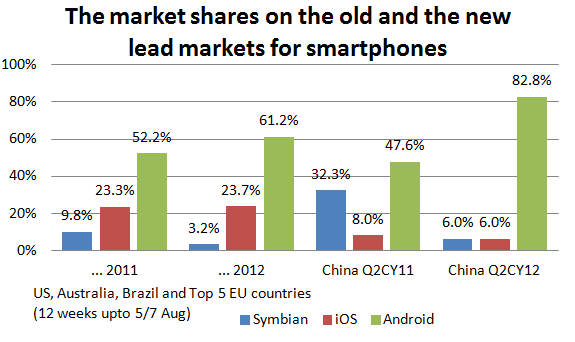
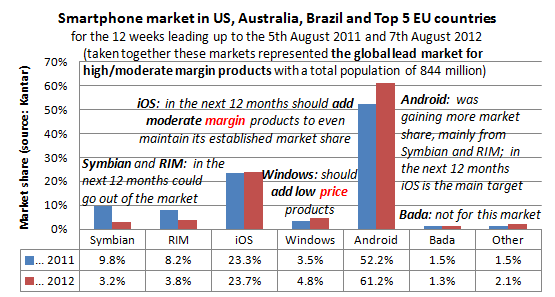
See: Kantar: Windows Phone has overtaken RIM Market Share in USA, “Key 8 Countries”
[WMPoweruser, Sept 3, 2012]
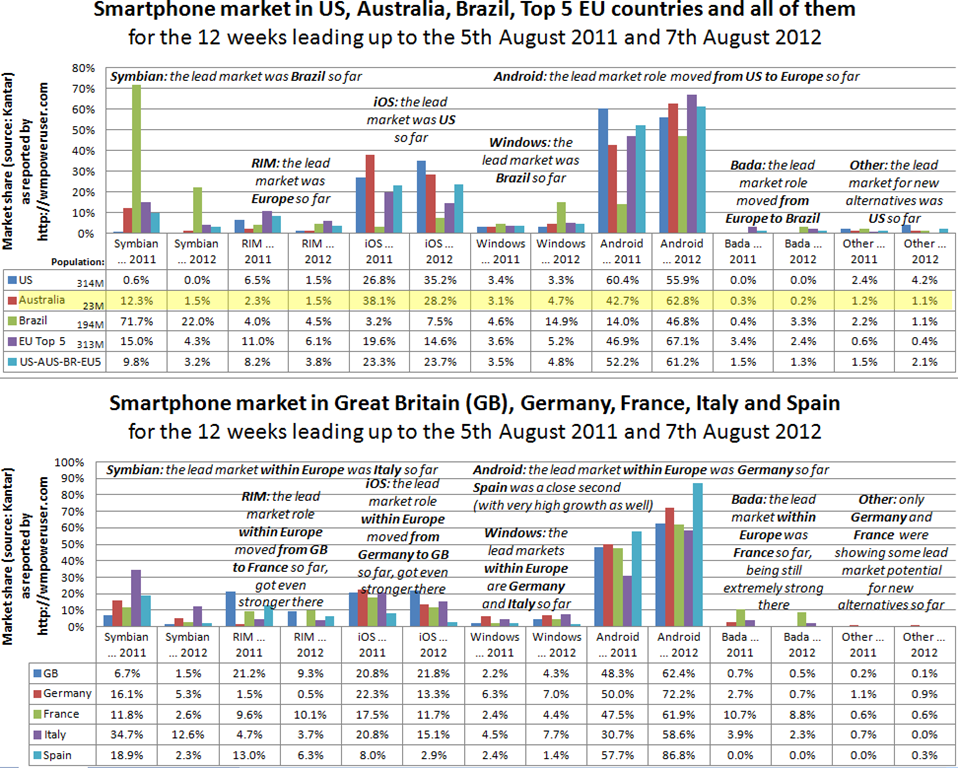

Note that in terms of mobile data traffic the market share is quite different. For North America (U.S. and Canada) Chitika Insights, the independent research arm of online ad network Chitika, released the following web usage market share report [Sept 5, 2012]:
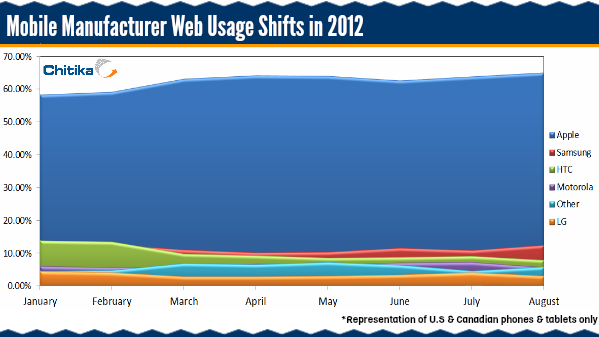
Remark: iPads and other tablets are included here as well!
Relative to all that China is a quite different story:
3G phones months shipments reach 21.64 million, domestic mobile share over 70% – 3G手机月出货量达2164万部 国产手机份额超七成 [Sohu IT – 搜狐IT, Sept 10, 2012]
According to data published by the Telecommunications Research Institute of the Ministry of Industry and Information Technology …
根据工业和信息化部电信研究院公布的数据 …[the data in the translated Chinese text I’ve compiled into the below table:]

China sees soaring smartphone market in Q2 [Xinhua, Sept 3, 2012]
Beijing: China’s smartphone market saw its sales volume soar to 38.19 million units in the second quarter, according to a report released Monday by market researcher Analysys International.
The figure represented a 22.5-per cent increase compared with that of the previous quarter and a sharp rise of 127.1 per cent over the corresponding period in 2011, said the report.
Nearly 67 million mobile phones were sold in China in the second quarter, the report said, representing a 1-per cent decrease from the previous quarter and a 2-per cent decrease from the corresponding period in 2011.
Stellar growth sees China take 27% of global smart phone shipments, powered by domestic vendors [Canalys press release, Aug 2, 2012] – Android is the clear platform of choice, accounting for 81% of Chinese shipments
Shanghai, Palo Alto, Singapore and Reading – Canalys published its final Q2 2012 country-level shipment estimates to clients yesterday. Results show that China saw phenomenal growth of 199% year-on-year and 32% over the previous quarter. In total, more than 42 million smart phones were shipped into the channel in China in Q2 2012, representing the second consecutive quarter of record breaking volumes in a single country market. China accounted for 27% of the 158 million global smart phone shipments, compared to 16% for the United States.
Notably, growth in China was heavily driven by domestic vendors, while international vendors struggled to keep pace.
While Samsung maintained its overall leadership position in China with a 17% market share, this reduced sequentially as volumes were flat and as several local vendors closed the gap. ZTE, Lenovo and Huawei were the second-, third- and fourth-placed vendors, ahead of Apple, making up a third of the market. They achieved growth of 171%, 2,665% and 252% year-on-year respectively. Collectively, domestic Chinese vendors shipped 25.6 million units, representing a growth of 518% and 60% of the market. By comparison, international vendors grew by a more modest 67% to 16.7 million units. Apple fell to fifth place in China. While its shipments were up 102% year-on-year, they were down 37% compared to Q1 2012.
‘The rise of the domestic tier-one brands has been aided by a number of factors. Their reactiveness to market demands and deep understanding of local consumer behavior and preferences have been key in helping them surpass international peers in the fast-evolving Chinese market. Local tier-one vendors have worked hard in recent quarters to greatly improve their brand resonance among consumers and to expand and enhance their relationships and influence within operators,’ said Canalys Research Director for China, Nicole Peng. ‘But the tier-two vendors — the likes of Oppo, K-Touch and Gionee — have also stamped their mark, boosting smart phone shipments into tier-three and tier-four cities, predominantly through the open channels. As feature phone vendors, they already have established partnerships and strong brand awareness. These domestic vendors are making significant progress transitioning their portfolios and customer bases to be more focused on smart phones.’
Nokia and Motorola both lost significant ground in China, with Nokia’s volumes down 47% on Q2 2011. ‘Among the international vendors, only HTC managed an outstanding performance in mainland China. Its shipments grew 389% year-on-year to reach 1.8 million units for the quarter,’ said Jessica Kwee, Canalys Research Analyst. ‘Its success this quarter is heavily based on the strong performance of Desire V series devices, designed with the local China market in mind, underscoring the importance of tailoring propositions to local consumer preferences.’
Android has become a major growth driver in China, running on 81% of the smart phones shipped in China in Q2 2012.
On a global basis, Android continued to grow in significance, surpassing 100 million quarterly smart phone shipments for the first time and reaching two-thirds share of the market. ‘Growth in Android volumes of 110% far outpaced growth in the overall market of 47% year-on-year, heavily driven by Samsung, which saw Android volumes of over 45 million, contributed to by a full and broad portfolio of products, from its high-end flagship Galaxy S III down to its aggressively priced Galaxy Y and Galaxy Mini. Its sponsorship of the London Olympics and subsequent product placements are sure to attract new customers to ensure that Q3 delivers a strong performance,’ commented Pete Cunningham, Canalys Principal Analyst.
Samsung retained its gold medal position in the global smart phone market with a 31% share, followed by Apple and Nokia once again. Huawei and ZTE were unable to push in on the global top five with shipments of their own branded devices. HTC moved up to fourth place, though, just ahead of RIM, which shipped 8.5 million units in the calendar quarter.
Analyst contacts
To speak with any analyst quoted in this release, please contact the appropriate Canalys office: Nicole Peng, Jessica Kwee (Canalys APAC), Pete Cunningham (Canalys EMEA). Alternatively, you can speak with other members of Canalys’ global team of mobile analysts: Chris Jones (Canalys Americas), Rachel Lashford (Canalys APAC), Tim Shepherd (Canalys EMEA).
About Canalys
Canalys is an independent analyst firm that strives to guide clients on the future of the technology industry and to think beyond the business models of the past. We deliver smart market insights to IT, channel and service provider professionals around the world. Our customer-driven analysis and consulting services empower businesses to make informed decisions and generate sales. We stake our reputation on the quality of our data, our innovative use of technology, and our high level of customer service.

Smart phone and pad forecasts show varying OS fortunes [Canalys press release, Sept 10, 2012] – China and Android influence smart phone landscape, the US and Apple dominate pads
Shanghai, Palo Alto, Singapore and Reading – The latest product announcements by leading smart phone and pad vendors will help drive consumer demand to new heights, according to Canalys. It forecasts that in 2016, global annual smart phone shipments will be around 1.2 billion units, meaning a CAGR (Compound Annual Growth Rate) of 19.5%. It predicts pad shipments in the same year will hit 207 million – a CAGR of 26.8%.
Apple’s latest unveiling is attracting extraordinary interest and competitors have also made several major announcements in the past week, including Windows 8 devices from Nokia and Samsung; new Android smart phones from Sony, Motorola and Samsung; and Amazon’s enhanced Kindle Fire pads. With these big vendors attracting the headlines, Canalys has issued a timely reminder that the trends across pads and smart phones in various countries will be markedly different.
In smart phones, Canalys expects Asia Pacific to remain the largest region by volume, with annual shipments reaching 594 million by 2016. China will account for almost half of all shipments in the region and nearly a quarter of the world’s smart phones in 2016. This equates to only 10 million less than is forecast to ship in the whole of the Americas in that year.
Canalys managing director for Mobile and APAC, Rachel Lashford, said, ‘The latest, in-depth research for our dedicated Smart Phone Analysis China service reveals there will be a substantial increase in the number of first-time smart phone users in China over the next 12 months, while feature phone shipments will continue to decline. Smart phone sales will move beyond tier-one and tier-two cities.’
China’s domestic feature phone vendors are rapidly moving their businesses to smart phones, supported by low-cost solutions from chipset providers, such as MediaTek, Spreadtrum and Qualcomm’s QRD.
‘We anticipate strong demand from local Chinese vendors selling in both operator and open channels,’ said Nicole Peng, Canalys Research Director for China. ‘Chipset vendors are reporting growing momentum in 2.5G (EDGE) smart phone solutions. For less developed areas where 3G coverage is limited, 2.5G smart phones have advantages in cost and battery life. They are becoming popular with consumers, especially where prices are already close to those of feature phones (around RMB500, US$78). The tier-three and tier-four cities are feature phone vendors’ traditional strongholds. Local vendors will use their long-standing relationships with open channels and their established infrastructure to distribute smart phones, with or without operator subsidies, over the next few years.’
In terms of percentage growth, Canalys expects Latin America to move fastest, with a CAGR to 2016 of 27.3%. It forecasts good double-digit growth in all countries, but Brazil and Mexico will account for more than half of all shipments in the region.
Globally, Canalys expects Android to remain dominant, with 57% of the smart phones shipped in 2016 running the OS (up from 49% in 2011). It expects Apple’s share of this much larger market to remain similar to today, at around 18%. Microsoft is expected to make inroads over the coming years.
In the pad market, however, the OS picture will be quite different. Canalys expects Apple to take a little under half of the market in 2016. The plethora of Windows 8 pads that will be introduced over the next few years are predicted to bring Microsoft’s share to around 17%. Competitively priced Android pads, such as Google’s Nexus 7 and Amazon’s Kindle Fire models will have an impact in terms of volumes, but Android’s share is forecast to remain relatively stable at 35%, unless vendors make radical improvements to the overall user experience. In contrast to smart phone market trends, the US is expected to dominate pad shipments, with the volume more than doubling to 88 million units in 2016. China is expected to be the second largest country market, with shipments of around 20 million.
‘Pads are the fastest growing consumer electronics products in history and are forecast to represent 29% of total PC shipments in 2016. But the market remains dominated by a single vendor. Other PC and smart phone vendors are currently finding it hard to weaken Apple’s position,’ said Canalys Analyst Tim Coulling. ‘The only product that most would consider a big hit is the Kindle Fire, brought to market by Amazon – an Internet retailer. Tight integration of hardware, software and services is a prerequisite for competing in the pad market, even at low price points, and fragmentation among other pad vendors’ offers helps Apple maintain its position.’
Analyst contacts
To speak with any analyst quoted in this release, please contact the appropriate Canalys office: Rachel Lashford, Nicole Peng (Canalys APAC), Tim Coulling (Canalys EMEA). Or contact another member of Canalys’ global analyst team: Chris Jones (Canalys Americas), Jessica Kwee, Pin-Chen Tang (Canalys APAC), Pete Cunningham, Tim Shepherd, Tom Evans (Canalys EMEA).
Analysys data: 2012Q2 China Android Smartphone market 82.8% [Analysys International release, Sept 5, 2012] as translated by Bing:
Easy views network hearing” easy views international: according to EnfoDesk easy views intellectual library industry database recently publishing of 2012 2nd quarter China phone terminal market monitoring report under displayed, 2 quarter, China smart phone terminal (does not containing parallel and cottage machine) market in the, Android Department sales accounted for than from Shang last quarter of 76.7% upgrade to this quarter of 82.8%, net 6.1%. While the Symbian sales percentage has continued to free fall to the ground from the parent 11.8% to 6%. In addition, iOS small callback to 6%.
2012Q2 OS smartphone market penetration in China (not including parallel and cottage)
2 quarter pick-up systems from Smartphone ( encyclopedia of Analysys : smartphones ) [average smartphone] price changes, Android from 1670 [yuan i.e. US$263] last quarter, continuing down to the quarter of 1560 [yuan i.e. US$246]; 1320 [yuan i.e. US$208] of Symbian from last quarter down to 1170 dollars [yuan i.e. US$185] this quarter.
2012Q2 China Android and Symbian Smartphone price
(not including parallel and cottage)Information about the mobile Internet more relevant data, please visit
http://data.eguan.CN/yidonghulianFor more content, please visit http://www.enfodesk.com/SMinisite/maininfo/regapply-cf-17.html
Or call the customer service-4006-515.


Analysys data: 2012Q1 China Android Smartphone market share increased from 76.7% [Analysys International release, June 6, 2012] as translated by Bing:
“Analysys Web video” Analysys: at present, according to EnfoDesk Analysys think-tank on traditional retail markets of mobile phones (of the last quarter of 2012 quarterly monitoring mobile terminal market) data monitor display: Chinese smartphone market, Android system’s market share in handset sales rising 5 consecutive quarters.
Vulnerability analysis:
In the last quarter of 2012 China Mobile end-markets quarterly monitoring data show end of 2012 Q1, carrying Android in the Smartphone market system’s market share in the Smartphone Terminal 76.7%, 10% average quarterly market share gain. At the same time, as the Smartphone market continues to mature, carrying Android system average Smartphone prices are also way down to 1670 [yuan i.e. US$263 from 2300 yuan i.e. US$363 a year earlier].
Combined with traditional mobile phone sales channels under the line status, EnfoDesk Analysys Research think-tank believes that mobile phone sales market share of Android system continue to enhance, benefit from its open source nature attract numerous manufacturers to participate in, and China in the past two years in the Smartphone market and 3G business increment. Through the performance of manufacturers on the market today as well as the impact of EnfoDesk Analysys think tank study says
1. Is now dominated by application of the formation of eco-systems, as well as the Android open source, attracting new industry participants, such as Internet companies to enter product prices are depressed, make the increasingly intense market competition environment, product prices are driven down, threats to traditional enterprise bargaining power in the channel.
2012Q1 China smartphone sales share

2. Fragmentation trends exacerbate the Android system. Traditional manufacturing enterprises to overcome the effects of homogenization of products of intelligent systems, secondary development on the Android system, causes the application to version adjusted accordingly, application developer development costs gradually increased.
Smartphone price quarterly changes of 2011Q1-2012Q1 Android system
3. Sales in this period dominated by domestic brands in the low-end products, intelligent products of these enterprises continue to 3G input costs on the production line. But at the same time, while veteran international brand market share continues to decline, it would shorten the product line, focusing its research and development production 4G products research and development. With the advent of 4G era, will reshuffle the mobile terminal market. (Analysys International)
Information about the mobile Internet more relevant data, please visit http://data.eguan.CN/dianzishangwu
For more content, please visit Enfodesk Analysys Thinktank
http://www.enfodesk.com/SMinisite/maininfo/regapply-cf-17.html
Or call the customer service-4006-515.Related reading:
2011Q2 China’s massive increase in Android share Symbian tumble

Is sun setting on smartphone profit miracle? [ReutersVideo YouTube channel, Aug 16, 2012]
… in 2 years the low-end has blown up …
China smartphone sales by price tier Q1 – 2010 Q1 – 2012 <1,500 yuan [<US$ 237] 17.7% 60% 1,500-3,000 yuan [US$ 237-473] 51.5% 24% >3,000 yuan [>US$ 473] 30.8% 16% Source: Jefferies Research
Cynthia Meng, China/HK TMT Equity Research, Jefferies Hong Kong:
[00:49] Next year it’s going to be about who is going to provide the best value for my money from a consumer point of view, from a telco point of view, because we think that hardware specifications for the handsets have already peaked. [01:03]Narrator, xxx Gordon in Hong Kong:
In other words the oversized screen and quadcore processors of your precious Samsung [Galaxy] S III will soon be standard and achieved in handsets in China. [01:13]… commoditization of smartphones …
[02:11] A race to the bottom will present a major challenge for Apple and Samsung who put together have dominated the industry in the last couple of years. [02:19] If the China trends spread globally the shift to cheaper handsets will mean tighter margins and slower growth for this industry powerhouses and new opportunities for little known upstarts like Xiaomi. [02:26]
The Chinese View: VIDEO: STUDIO INTERVIEW: CHINA’S SMARTPHONE MARKET [CCTV News – CNTV English, Sept 3, 2012]
iPhone Ranked Seventh in China’s Smartphone Market — Watch Out, ZTE [AllThingsD.com, Aug 24, 2012]
Apple’s iPhone has been gaining a lot of traction in China recently. As Apple CEO Tim Cook said during the company’s third-quarter earnings call, greater China accounted for two-thirds of Apple’s revenue in the Asia-Pacific region during the period.
“In terms of iPhones in general in mainland China, we were incredibly pleased with our results,” Cook said. “We were up over 100 percent, year over year.”
That’s an impressive achievement. But Apple still has a lot of work to do in China before the iPhone claims the same levels of market penetration it enjoys in the U.S. In China, the iPhone has captured about 7.5 percent of the smartphone market, compared to rival Samsung, which has claimed more than 20 percent, according to IHS iSuppli. Despite its popularity in the country, the iPhone is still ranked seventh in the Chinese smartphone market.
Why? Two reasons. First, Apple doesn’t yet offer a truly low-end smartphone that appeals to price-conscious Chinese consumers. (To be clear, China Telecom is offering the iPhone fully subsidized, but it requires subscribers to sign a contract that ties them to a two-year $62 per month plan.) Second, and more importantly, the iPhone doesn’t yet support Time Division Synchronous Code Division Multiple Access (TD-SCDMA), China’s homegrown wireless standard. And until it does, China Mobile, the world’s largest wireless carrier, can’t offer it to its 688 million or so subscribers.
“Among all the international smartphone brands competing in China, Apple is the only one not offering a product that complies with the domestic TD-SCDMA air standard,” IHS iSuppli’s Kevin Wang said in a statement. “For Apple, this is a huge disadvantage, as TD-SCDMA represents the fastest-growing major air standard for smartphones in China, with shipments of compliant phones expected to rise by a factor of 10 from 2011 to 2016.”
In other words, if Apple wants access to the massive addressable market that China Mobile has to offer, it’s going to have to offer a lower-end iPhone variant designed specifically for TD-SCDMA, something it has been loath to do in the past, and hasn’t given any indication that it’s willing to do in the future. As Cook said during Apple’s last earnings call, the company feels that its business is strongest when it focuses on making the best products it can, not the most inexpensive ones.
“I firmly believe that people in the emerging markets want great products, like they do in developed markets,” Cook said. “And so we’re going to stick to our knitting and make the best products. And we think that if we do that, we’ve got a very, very good business ahead of us. So that’s what we are doing.”
Breakingviews: Apple v. Samsung [ReutersVideo YouTube channel, Aug 27, 2012]
Apple Should Take The $199 Chinese Smartphone Seriously [Seeking Alpha, Sept 6, 2012]
At a time when China is set to overtake the U.S. as the world’s largest smartphone market, little-known Chinese firms are prepared to battle it out for market dominance with the maker of the game-changing iPhone, Apple (AAPL). As per the predictions of IDC and Gartner, China’s smartphone shipments could hit 140 million this year, exceeding those in the United States.
There are a number of Chinese brands offering similar capabilities, nominally, as the iPhone at half the price, most of them using a forked version of Google’s (GOOG) Android. The names include ZTE Corp., Lenovo Group, and other small private firms like Xiaomi, Gionee, and Meizu Technology. Even cheaper smartphones are offered by Alibaba Group, Shanda Interactive, and Baidu (BIDU) for fewer than ¥1,000 (~$150 U.S.).
Xiaomi Technology, founded just two years ago, has emerged as a serious potential threat to the likes of Apple and Samsung in smartphone arena. According to its CEO, the company sold more than 3 million phones with revenues close to $1 billion for the first half of 2012. Its latest offering, a successor to its popular MiOne (MI) smartphone, the MI2, costs less than half the price of iPhone 4S, but exceeds its specifications. Xiaomi not only tries to mimic the iPhone’s specifications, but has also been able to charge fans ¥199 (~$31) to attend the Beijing launch of the phone, the same way as Apple followers would pay to see Steve Jobs showcasing new products. The Xiaomi conference was attended by more than 1,000 people, with the proceeds going to charity. The MI2, which is expected to hit the markets in October, will have quad-core Qualcomm (QCOM) S4 Pro SoC, an 8 mega-pixel camera, and a voice-assistant similar to Apple’s Siri, and is priced at ¥1,999 ($310). This is no cheap knock-off, but rather a serious piece of hardware packed with the latest technology.
The fascinating part of Android’s rise here is that Microsoft (MSFT) will likely see more profit from many of these phones than Google will due to the licensing agreements many of them have made to avoid patent issues with Redmond. Reports are spotty, but Microsoft collects anywhere from $5 to $15 per Android license and has deals with at least half of the phones sold. Moreover, it is very possible it makes more money than Google does.
In the coming years it is expected that Apple’s market share may flatten out or even dip, as it has this year, but market share is not Apple’s goal; it has always been about margins — selling a premium product at extremely high margins to those with the resources to not care about the upfront cost. Estimates from IDC place the sub-$200 smartphone at 40% of the shipments, while devices costing more than $700 made up 11% of the market, which is where Apple plays and why it still controls most of the profits generated by the industry. China and India make up 40% of new smartphone activations.
This huge difference in shipments is mainly due to the limited purchasing power of an average Chinese person, which is around ¥800-¥1,500 ($130-$240). By contrast, the iPhone comes with a price tag of around $800, the equivalent of two months of earnings of an urban Chinese person (in an area that has around 670 million people).
According to a report from Gartner, Apple’s market share by volume has been sliding and iOS‘ share of the mobile operating system space is expected to slip to third place by 2016 below Android and Windows Phone. The Gartner report is, however, very controversial as Windows Phone has not proven anything to this point, although Nokia’s (NOK) sales of its Lumia 610 and Asha line of proto-smartphones are keeping its brand alive while it searches for the killer phone. Even in its second-largest market, iPhone sales slipped for the April-June quarter due to inventory adjustments after the huge launch of the iPhone 4S.
Apart from these estimates, Apple also suffers on various fronts in China. The iPhone is backed by China Telecom and China Unicom, but the country’s and the world’s leading telco China Mobile (with about 655 million subscribers) has still not supported it. Apple and China Mobile are still working on the details of China Mobile’s implementation of CDMA, which requires Apple to build a specific phone for its network.
Responding to the competition and the difference between the iPhone and the local offerings, Apple recently slashed the price of the iPhone 3GS below $200. While an entry-level Apple phone is something that the market will absorb, part of Apple’s appeal is the status it confers and a 3GS simply not a strong enough status symbol to drive sales. Mix in that with Chinese preferences for buying from Chinese companies and this market becomes a whole lot harder for Apple to maintain not its sales per se — it can manipulate prices to maintain sales — but its extreme margins. The latest earnings call highlighted this as it sold a lot of lower-end iPads and iPhones in Asia, which pushed its results and future guidance under 40% net margins.
Companies like Lenovo, ZTE, and Huawei are gaining because they are Chinese and are providing good products at reasonable prices. Lenovo, in particular, is pushing its smartphone and PC strategy both up and down the value chain, similar to Samsung’s approach. It is working very well for Lenovo, whose revenues were up 40% in the second quarter when everyone else was complaining of softening business.
Apple’s problems are the standard problems for a company on top of the world; everyone will nibble away at it in various little ways. How it responds to this is key.
The recent lawsuit victory over Samsung and its pressing of the legal attack smacks of a company that is frightened. Why should it fear Samsung? And if it doesn’t, why did it go after Samsung and restrict consumer choice, a clear breach of its branding compact with its fans? Is it trying to push Samsung into Windows 8 Phone’s arms? All of these things point to further margin erosion for Apple and a slowing of its titanic growth without a new market to push into. As things stand now, staking a new position in Apple requires believing none of these issues matter.
It points to Apple becoming a value trap at some point in the future. Not every country, especially China, will grant Apple an injunction against knockoff competition; quite the opposite is true. Many investors are sitting on capital gains so large they can’t sell, and the dividend will pay them well enough to stay in even if the price goes nowhere. But new investors should be very careful in light of the market dynamics.
Microsoft adding staff, R&D in China mobile push [Associated Press, Sept 6, 2012]
BEIJING (AP) — Microsoft Corp. will hire more than 1,000 additional employees in China this year and boost research and development spending by 15 percent as it tries to catch up with Apple and Google in the fast-growing mobile Internet market, executives said Thursday.
The announcement adds to intensifying competition in wireless Internet in China, where nearly 400 million people surf the Web using mobile phones and other devices. Microsoft is promoting its Windows 8 mobile operating system but came late to the market and trails Apple Inc. and Google Inc., whose Android system is widely used in China.
“We respect that we have two players in the market which have a strong role, and we feel ready to attack and have different offers to basically change the game plan on that one,” said Microsoft’s CEO for China, Ralph Haupter, at a news conference.
The new employees will be in addition to Microsoft’s workforce of 4,500 in China and will be spread across research and development, marketing and customer service, Haupter said.
Research spending in China will rise by 15 percent over last year’s $500 million, according to another executive, Ya-Qin Zhang, Microsoft’s Asia-Pacific chairman for research and development. He said the current research staff of 3,000 would be expanded by about 15 percent.
Global technology companies and local rivals are spending heavily to gain a foothold in mobile Internet in the world’s most populous online market as Chinese users shift quickly to the new technology.
This week, Chinese search engine Baidu Inc. released its own new mobile browser to compete with Google and Apple and announced it will open a cloud computing center.
China had 538 million people online at the end of July, up 11 percent from a year earlier, according to the China Internet Network Information Center, an industry group. The share that uses wireless devices grew twice as fast, rising 22 percent to 388 million, or 70 percent of the total.
Android dominates the Chinese smartphone market, used on 76.7 percent of phones in the
secondfirst quarter of this year, according to Analysys International, a research firm. Apple’s iPhone dominates the higher end of the market.Microsoft plans to recruit more local partners to develop mobile applications specifically for China, said Haupter. He said the company believes it has an advantage in doing that because developers can draw on their experience working on other Microsoft products.
Zhang said Microsoft’s six development centers in China that now spend about 80 percent of their time working on products for global markets will focus more on creating offerings tailored to Chinese customers.
Microsoft also plans to expand its cloud computing business in China, the executives said. Zhang said about 100,000 commercial customers now use its private cloud computing service and a service for use by the public is being developed.
Microsoft Names New Leaders in Key International Markets [Microsoft press release, April 13, 2012]
… Ralph Haupter, currently serving as area vice president (AVP) for Microsoft Germany, has been promoted to corporate vice president and named CEO for Microsoft GCR. Haupter is replacing Simon Leung who has decided to leave Microsoft for personal and family reasons. Gordon Frazer, currently serving as managing director (MD) for Microsoft U.K., has been named chief operating officer (COO) for Microsoft GCR. He is replacing Michel van der Bel, who will assume the role of MD for Microsoft U.K. Haupter and van der Bel will report to Jean-Philippe Courtois, president of Microsoft International, and Frazer will report to Haupter. …
…
Haupter is a seven-year veteran of Microsoft, having delivered excellent and sustainable results in growth and profitability and repeatedly proving his ability to build and grow high-performing, diverse organizations. He previously served as head of the partner division for Europe, Middle East and Africa and general manager (GM) of Microsoft’s Small and Midmarket Solutions & Partners Group for Western Europe, both based in Paris, and served as COO for Microsoft Germany before becoming the German AVP. Before that, he worked for IBM both in Germany and internationally.
Frazer is a 16-year veteran of Microsoft, having served as the GM for Microsoft South Africa for four years and most recently as the Microsoft U.K. MD for the past six years. He brings a tremendous amount of operational expertise to the Microsoft GCR team from his various roles across both developed and emerging markets. His leadership in managing the full breadth and depth of Microsoft’s business in the U.K. will serve as a strong asset in helping take Microsoft China’s operations to the next level of efficiency and growth.
…
Leading the New Era, Winning the Future—Microsoft Announces Development Strategy in China [Microsoft China press release, Sept 6, 2012]
Partnering for an Innovative, Competitive, and Talented China
New leadership team in Greater China
(third from left is the COO Gordon Frazer and the fourth is the CEO Ralph Haupter)September 6, 2012, Beijing– Microsoft China today announced its new strategy and commitment to partnering with the country for an innovative, competitive and talented China by further enhancing and accelerating investments. In the new fiscal year, Microsoft will recruit more than 1,000 staff in China, 50% of which will be college graduates. Microsoft’s annual R&D investment will exceed $500 million, and the company will explore local markets in more provinces and deepen its engagement in industrial informatization.
Over two decades of growth, Microsoft China has continued to penetrate deeply into increasingly important local markets. Ralph Haupter, Corporate Vice President, Chairman & CEO Microsoft Greater China Region, said: “Since entering China 20 years ago, Microsoft has grown steadily in China and acquired a deeper understanding of the Chinese market. Our new strategy reflects our perception, emphasis and commitment to the China market. In this new era, China and the entire Greater China Region will become the source of global innovations. Through comprehensive devices and services combined with cloud computing, Microsoft is working closely with the Chinese government, partners, customers and the academic world, entering this new era by leveraging our advantages.”
Haupter stressed that this year is a big year for Microsoft, with the introduction of many new products and technologies, and also a year where Microsoft China is making a great effort to further develop the market. “Our new leadership team in Greater China has helped develop a new strategy for customers and partners, deepening cooperation with governments of all levels to strengthen innovation in China. The team will popularize new technologies and explore new markets,” Haupter said.
Through continuous investment of innovation resources and improving the scale of partnerships in China over the years, Microsoft Asia-Pacific R&D Group has become Microsoft’s largest R&D base outside of the United States, with the most complete functions and innovation chain covering basic research, technology incubation, product R&D and industry cooperation. Chinese R&D teams have made great contributions to Microsoft products launched this year, such as Windows Server2012, Windows 8, New Office, SQL Server 2012 and Surface. Ya-Qin Zhang, Corporate Vice President and Chairman of Microsoft Asia-Pacific R&D Group, said: “We are lucky to be in an era where globalization is deepening, the IT revolution is emerging and China is rising. Microsoft’s continuous exploration in natural human-machine interfaces, mobile Internet and cloud computing will help us win the future and contribute to China’s sustainable development.”
Samuel Shen, COO of Microsoft Asia-Pacific R&D Group, said Microsoft’s software outsourcing business was now worth more than $200 million per year. In the future, Microsoft will continue to work closely with local communities through programs such as the Internet of Things, Big Data, cloud computing, cloud-based smart cities and the Microsoft Accelerator for Cloud Computing, accelerating the vision of “Innovation in China, Innovation for the World”
According to Microsoft’s new strategy in China, Microsoft is committed to cooperating with the Chinese government and industry, aligning with China’s priorities and partnering for an Innovative, Competitive, and Talented China. Gordon Frazer, Vice President and COO of Microsoft Greater China Region, said that over the next five years, Microsoft China will expand its footprint in China, deepen cooperation with governments of all levels and partners, improve customer support and foster talents on a broad scale:
Expand Microsoft’s footprint in local markets: Over the next five years, Microsoft will expand its presence in over 20 cities across 15 provinces by expanding local teams, enhancing local management, working closely with local governments, making contributions to local informatization, building cloud-based smart cities, and providing cloud-based solutions for e-government, city management and citizen services.
Accelerate local partner ecosystems and expand service coverage: Microsoft will deepen customer services, deliver joint services and solutions with partners, and engage in further convergence of informatization and industry upgrading to improve the core competency of Chinese enterprises. By the end of this year, Microsoft will set up its second technical support center in China to enhance support for Chinese customers and partners, share best practices and knowledge of supporting global customers to help them accelerate the adoption of new technologies and share with them the experience of providing cloud services to customers in Asia. Microsoft will also drive partners’ development through many forms: system-grade innovation support for OEMs, software engineering assistance for software outsourcing companies and innovative design references for hardware manufacturers.
Foster talents in a large scale: Over the next five years, Microsoft will hire more talent in China to better serve and support its partners in China, foster talents for the Chinese software industry and improve the skills of Chinese youths.

China to Overtake United States in Smartphone Shipments in 2012, According to IDC [IDC press release, Aug 30, 2012]
Top Five Smartphone Markets and Market Share for 2011, 2012, and 2016 (based on shipments)
Country 2011 Market Share 2012 Market Share 2016 Market Share 2011 – 2016 CAGR PRC 18.3% 26.5% 23.0% 26.2% USA 21.3% 17.8% 14.5% 11.6% India 2.2% 2.5% 8.5% 57.5% Brazil 1.8% 2.3% 4.4% 44.0% United Kingdom 5.3% 4.5% 3.6% 11.5% Rest of World 51.1% 46.4% 46.0% 18.1% Total 100.0% 100.0% 100.0% 20.5% Source: IDC Worldwide Mobile Phone Tracker, 2012 Q2 Forecast Release, August 30 2012
Strong end-user demand and an appetite for lower-priced smartphones will make China (PRC) the largest market for smartphones this year, overtaking the United States as the global leader in smartphone shipments. According to the International Data Corporation (IDC) Worldwide Quarterly Mobile Phone Tracker, China will account for 26.5% of all smartphone shipments in 2012, compared to 17.8% for the United States.
“Looking ahead, the PRC smartphone market will continue to be lifted by the sub-US$200 Android segment,” said Wong Teck-Zhung, senior market analyst, Client Devices, IDC Asia/Pacific. “Near-term prices in the low-end segment will come down to US$100 and below as competition for market share intensifies among smartphone vendors. Carrier-subsidized and customized handsets from domestic vendors will further support the migration to smartphones and boost shipments. Looking ahead to the later years in the forecast, the move to 4G networks will be another growth catalyst.”
“Regionally, we expect smartphone demand to flow down to lower-tier cities,” added James Yan, senior market analyst for Computing Systems Research at IDC China. “After going through a period of sustained high growth, top-tier cities are likely to see decelerating smartphone growth rates. In contrast, secondary cities are expected to experience accelerated smartphone growth, with strong demand for low-cost models as well as high-end models, which are desired as status symbols.”
“The fact that China will overtake the United States in smartphone shipments does not mean that the U.S. smartphone market is grinding to a halt,” said Ramon Llamas, senior research analyst with IDC’s Mobile Phone Technology and Trends program. “Now that smartphones represent the majority of mobile phone shipments, growth is expected to continue, but at a slower pace. There is still a market for first-time users as well as thriving upgrade opportunities.”
“In addition to China and the United States, several other countries will emerge as key markets for smartphone shipment volume over the next five years,” said Kevin Restivo, senior research analyst with IDC’s Worldwide Mobile Phone Tracker program. “High-growth countries such as Brazil and Russia will become some of the most hotly contested markets as vendors seek to capture new customers and market share.”
Top Five Markets for Smartphone Shipments
As it becomes the leading country for smartphone shipments this year, the PRC smartphone market will continue to grow, primarily on demand for lower-cost handsets. While this bodes well from a volume perspective, it also means lower average sales values (ASVs), thinner margins, and increased competition from all players. Over the course of the forecast, China’s share of the global smartphone market will decline somewhat as smartphone adoption accelerates in other emerging markets.
Smartphone shipments into the United States will increase as users upgrade their devices and feature-phone users switch over to smartphones. Furthermore, a combination of lower-priced models, expansion of 4G networks, and the proliferation of shared data plans will encourage continued smartphone adoption. Smartphones are already the device of choice at the major carriers, and regional and prepaid carriers are following suit and competing with alternative service plans.
With smartphone penetration in India currently among the lowest in Asia/Pacific, the market has tremendous untapped growth potential. Low-end smartphones offering dual-SIM capability and local apps and priced around US$100 will rapidly bring this market to life. Although 3G data plans are currently too expensive for the majority of consumers in India, IDC expects the popularization of 3G, and in later years 4G, to drive smartphone uptake as operators roll out more affordable data plans and generous subsidies while expanding offerings to tier 2 and tier 3 cities. The affordability of service plans will be another important key to smartphone adoption in India.
Smartphone growth in Brazil will be bolstered by strategic investments by mobile operators, smartphone vendors, and regulators. Operators’ focus on increasing ARPU will drive greater demand for smartphones while smartphone vendors will look to reap greater profitability from offering such devices. The Brazilian government, meanwhile, will offer tax exemptions for smartphones and protect local manufacturing against foreign vendors. These factors, combined with solid end-user demand, will drive smartphone volumes in the coming years.
The United Kingdom has been one of the fastest growing smartphone markets in Western Europe, driven by the high operator subsidies and long-term post-paid contracts. Over the forecast period, smartphone shipments will continue to increase due to the introduction of LTE and a new range of services that will appeal to heavy smartphone users. In addition, price erosion on HSPA devices will also attract feature phones users. Growth rates will slow in the later years of the forecast as penetration plateaus and operators seek out alternative subsidy models.
Be aware of ZTE et al. and white-box (Shanzhai) vendors: Wake up call now for Nokia, soon for Microsoft, Intel, RIM and even Apple!
Update as of August 10, 2012: After acquiring the Qt commercial licensing business in March 2011 from Nokia, the Helsinki based, ~1000 people strong Digia, with 2011 sales of 121.9 million Euro, yesterday acquired all the rest of the Qt business from Nokia. More details in the Digia extends Its commitment to Qt with plans to acquire full Qt software technology and business From Nokia [Digia’s Qt Commercial Blog, Aug 9, 2012] and Digia Committed to Thriving Qt Ecosystem [KDE.NEWS, Aug 9, 2012] posts from Digia’s R&D director Tuuka Turunen. With this all pre-Windows Phone software platform commitments except the Java based S40 (evolved in the new Asha range) have strategically been revoked by Nokia.
Here is the shortest and still very comprehensive way to understand the essence of Nokia’s decision to radically change its strategy – Engadget’s video interview with Stephen Elop [Feb 15, 2011], the CEO of Nokia:
STATEMENTS IN THE ABOVE VIDEO YOU WILL FIND NOWHERE ELSE:
[00:48]: As it relates to the low-end we think regardless of how far we can push down Symbian and/or Windows Phone, which will rapidly come down in price as well, in price points, we believe there is always going to be this layer below, i.e. the absolute lowest level, highest cost-optimized approach. So Series 40 and its successors, and new work that we’ll do in that area, we think will continue to be an important part of the strategy going forward. [1:13] … [1:17] We call those ’mobile phones’ [i.e. not feature phones]. In our strategy, the Nokia strategy has three pieces to it: the smartphone strategy, which is about Windows Phone, it has what we call ’the next billion strategy’ which is about taking those first mobile experiences … at the very lowest of the price continuum, and the third part of our strategy is what we call ’the future disruptions’. Investing today to plan for to lead the next disruption beyond all the current activities we are doing today. [1:45]
[1:58]: Part of the specific relationship between Nokia and Microsoft is for us to contribute the expertise to planning, design and everything else, so that the Windows Phone product is not only a premium product but in the same way that Symbian has been pushed way down the price continuum, you’ll see us to do that very aggressively with Windows Phone as well. [2:16]
[08:07]: Our Plan B is to make Plan A successful. Just to be clear. What we’re doing is not thinking of MeeGo as the Plan B. We’re thinking about MeeGo and related development work as what’s the next generation. So to the extent that today there is a three horse race – Windows Phone, Android, Apple, and so forth – what comes next, what is the next major wave of business and technological disruption. We want to make it sure that we’re leading through that as well, and so the efforts will focus further into the future. [8:35]
Update: Nokia N9 UX [?Swipe?] on MeeGo 1.2 Harmattan [June 24, 2011]
Update: Open Letter from Purnima Kochikar to Developer Community [March 25, 2011] (emphasis is mine):
First, let’s recap what it is we announced; the three main areas of our strategy:
- Plans for a broad strategic partnership with Microsoft on Windows Phone
- Connecting the Next Billion
- Future disruptive technologies
What about Symbian? What about Qt?
Understandably, these are the first questions that come to mind. Although Windows Phone will become our primary smartphone platform, we will continue to deliver a great deal of value from Symbian. We’re making investments that will help us to engage and attract existing and new Symbian users and allow us to launch new competitive smartphones.
Over the past weeks we have been evaluating our Symbian roadmap and now feel confident we will have a strong portfolio of new products during our transition period – i.e. 2011 and 2012. These devices will take advantage of the strong integration of devices and services as well as our strength in areas such as imaging and location-based services. They will also include improvements in hardware performance such as GHz+ processing capabilities and faster graphics speeds.
To further enhance the competitiveness of these products we will deliver updates to the current Symbian user experience. The first major update will arrive in summer, delivering a new home screen, new flexible widgets, new icons, a faster browser, new Navbar and a fresh look and feel to Ovi Store and Ovi Maps, including integration of social media services in Ovi Maps….
I’ve been asked many times how long we will support Symbian and I’m sure for many of you it feels we have been avoiding the question. The truth is, it is very difficult to provide a single answer. We hope to bring devices based on Windows Phone to market as quickly as possible, but Windows Phone will not have all language and all localization capabilities from day one.
In many markets, including markets where Symbian is currently the lead smartphone platform with significant market share such as China, India, Russia and Turkey, we will continue to make our Symbian portfolio as competitive as possible while we work with Microsoft to introduce Windows Phone. For that reason certain markets will play a more significant role in selling the 150 million Symbian devices than others and we will be selling devices long after Windows Phone devices from Nokia have already started to appear in other markets. That is why we cannot give you the date when Symbian will no longer be supported.
… Qt, the development platform for Symbian and future MeeGo technology remains critically important and Nokia is committed to investment in Qt as the best toolset for those platforms and we are focusing on future developments in part by our plan to divest the commercial licensing business [“by the end of March 2011” Digia to acquire Qt commercial licensing business from Nokia [March 7, 2011]], used mainly by developers of embedded and desktop applications beyond the mobile market. [“Qt is actively used by around 3500 desktop and embedded customer companies which will be transferred to Digia upon closing. The commercial customers represent a broad range of industries, e.g. consumer electronics, finance, aviation, energy, defence and media.”]
Additionally we are readying app analytics, in-app advertising, in-app purchasing, a new browser and hardware enhancements. There are a lot of new things for developers to take advantage of in these soon-to-be-released APIs. We are continuing to explore Qt for use in other strategic investment areas as well.
WHAT IS NOT CLEAR AT ALL FROM THE VIDEO is the global market situation in all its details and nuances which forced Nokia to make such a radical change in its alltime strategies of going alone. From simple news articles it is also not clear to outsiders whether it was the best decision for Nokia or not, specifically considering the current favorite of the market, the Google Android platform. And to have a clear picture on both is more the essential. For everybody who is doubting that please first read Nokia’s radical CEO has a mercenary, checkered past [Feb 14, 2011] and after being confused with that (especially with the comments part) get yourself familiar with (emphasis is mine):
Shanzai [alt. sp. shanzhai or Shan Zai] literally means “Mountain Bandit or Fortress” [here is a very detailed wikipedia explanation] in Mandarin Chinese. It is a phenomenon that goes far beyond the simplistic view of “copycat products” and in popular Chinese cultural usage is used to describe a vendor who operates a business without observing traditional rules or practices — often resulting in innovative and unusual products or business models. Reading the stories on this website will open your eyes to a whole new business phenomenon that is affecting all of our lives whether we realize it or not.
from the Shanzai.com opened in July 2009, when it became obvious to Timothy James Brown, an IT executive working in Asia for the past 13 years, that Shanzhai (I will use rather this form as it is more general in referenced sources used below) is indeed a new business phenomenon which will start to influence the non-Chinese speaking world of the global technology in an big way. In the last two years another new name also came out for part of Shanzhai: white-box vendors, to reflect the fact that they were hard pressed (by the government) to leave the gray-market, thus to become legitimate in all respects, as well as naturally becoming larger scale operations capable of entering the international markets.
It is also worth to look at China Gray-Market Cell Phone Shipments Slow in 2011 [iSuppli press release, Dec 16, 2010] (emphasis is mine):
China’s gray-market cell phone shipments will amount to 255 million units in 2011, up 11.8 percent from 228 million in 2010. This compares to a rise of 43.6 percent in 2009.
Gray-market handsets are cell phones manufactured in China that are not recognized or licensed by government regulators. Makers of these products generally do not pay China’s value-added taxes and, therefore, profit illegally from their participation in the market.
“The object of a nationwide government crackdown, the gray cell phone market in the world’s most populous country is facing some trepidation as official scrutiny focused on illegal handsets and as consumers are starting to lose some interest in the devices,” said Kevin Wang, director of China research at iSuppli. “This created particular challenges for white-box handsets – on which gray-market dealers can put their logos. These types of phones use smuggled chips, carry no certification from China’s Ministry of Industry and Information Technology, sport fake international mobile equipment identity codes and are smuggled to Hong Kong to avoid value-added taxes.”
What growth there is in 2011 will be driven by demand from emerging countries as well as by falling average selling prices for gray handsets.
After growing in 2011, the gray market will begin to decline in 2012. This is because gray market cell phone suppliers will be unable to cut prices any further – even if they wish to win more new customers in emerging countries. Suppliers also will find themselves competing with an increasing number of locally branded original equipment manufacturers (OEMs) that provide better quality and after-sales service, iSuppli believes.
The market for gray handsets
Aside from serving domestic demand in China, gray handsets command sizable sales in other countries in the Asia-Pacific region, an area that includes Thailand, Vietnam, Indonesia and the Philippines – as well as Pakistan, a neighbor to China. And while gray-handset shipments in 2010 within China will fall to 24.2 million units, down from 33.2 million in 2009, gray-handset shipments to other Asian countries during the same period will rise to 154.4 million units, up from 110.2 million.
The market for non-gray handsets
Meanwhile, shipments from Chinese non-gray handset makers will grow by 36.4 percent in 2010 and continue to climb during the next five years. Not only will Chinese OEMs improve their global market sales – especially in the emerging countries – China’s white-box handset shipments also will keep growing. Furthermore, Chinese handset makers will win more orders from international carriers and from locally branded OEMs in the emerging markets.
Within the domestic market, China’s 3G handsets are poised for dramatic expansion – reaching 51 million units in 2010 and maintaining growth in the next five years, thanks to the continued decline of both 3G handset prices and service fees. By 2014, local 3G handsets are projected to reach 134 million units.
Read More > China’s Gray Market Handset Shipments Continue Expanding in 2011

Update: China’s innovation drive in “post-Shanzhai” era [Xinhua, March 11, 2011] (emphasis is mine)
The “Shanzhai” industry, which churns out electronic goods that imitate well-known brands, is declining even in its hotbed and birthplace in south China’s Shenzhen City.Signs that say “Shop to Let” adorned many electronic stores along Shenzhen’s Huaqiangbei Road. About one-third of Huaqiangbei’s estimated 3,000 sellers of “Shanzhai” cell phones have left the business, said Tang Ruijin, the secretary general of Shenzhen Mobile Communication Association.
The price cut of branded cell phones and the public’s growing intellectual property protection (IPR) awareness contributed to the decline of “Shanzhai.” But the heaviest blow came from China’s determination to enhance IPR protection and develop indigenous innovation, Tang said.
Sociologist Ai Jun noted that the “Shanzhai” phenomenon is a period that China and other developing countries must go through in fostering their companies’ innovative capacities. “It is a natural process to first imitate and then innovate.”
So it might quite well be the case that big name legacy businesses will need leaders like Stephen Elop to compete with the new, legalized (non-gray) “mountain bandits”, i.e. Shanzhai, if the bad-mouthing about Elop referred above is indeed true. If this is not true, then a very impressive leader, like Steve Elop is in the above video again, will be needed either.
You will understand this in all details when coming through the sections below:
- Stir in the “old boys” camp: Nokia, Microsoft, Intel, and Apple
- Earthquake like changes in the mobile phone market: numbers from IDC
- Radical strategy shift/reorg at Nokia
- White-box (Shanzhai) vendors
- MediaTek as the catalyst of the white-board ecosystem
- ZTE et al.
(If you don’t like such long readings you can finish with a quite literary type story of how Nokia’s Flirtations Put the Fear of Google Into Microsoft [WSJ, Feb 18, 2011]. The “only” thing you will miss will be the real understanding of the deal.)
Stir in the “old boys” camp: Nokia, Microsoft, Intel, and Apple
Nokia sees Windows phone prices dropping fast [Feb 18, 2011] (emphasis is mine)
Prices of smartphones using Microsoft’s Windows Phone software platform will fall fast, Nokia’s chief executive Stephen Elop said on Friday.
Last week Nokia, the world’s largest phone maker by volume, said it would adopt Microsoft’s software across its smartphones, raising fears the firm would miss out during the transition on surging demand for cheaper smartphone models.
Elop said one of the key topics in the talks on doing a deal with Microsoft was convincing Nokia that it could reach “a very low price point.”
“We have become convinced that we can do that very quickly,” Chief Executive Stephen Elop said in a meeting with Finnish business journalists.
Trying to better compete with Apple’s iPhone, Microsoft has so far had tight hardware requirements for phone models using its software — pushing up handset prices and limiting the potential market.
As part of the push to a wider market and lower prices, Microsoft plans to open its mobile platform to other chipset suppliers beyond Qualcomm.
Nokia’s shares dropped more than 20 percent after it announced the Microsoft deal, but industry executives have said the new alliance will be good for competition and innovation.
Elop said the final agreement between Nokia and Microsoft would be signed in the next few months.
“The conclusion of the agreement will happen, we think, quite quickly, measured in a couple of months, it may be a bit longer, it may be shorter,” he said.
ELOP SELLS MICROSOFT, BUYS NOKIA
Elop, who joined Nokia from Microsoft last September said he sold all his Microsoft shares on February 17 and has bought 150,000 shares in Nokia. The Canadian is the first non-Finn to head the firm.
Shares in Nokia were up 0.7 percent at 6.76 euros by 1038 GMT.
Now it is worth to watch a 7-minute highlights video of Microsoft’s (Steve Ballmer’s) keynote from the Mobile World Congress 2011 to understand the enhanced version of Windows Phone 7 which will be introduced quite probably in fall of this year with the new WP7 Nokia devices:
Stephen Elop has summarized the significance and the benefits of this new strategic partnership as follows (during Steve Ballmer’s keynote at the Mobile World Congress 2011 [Feb 14, 2011]): (emphasis is mine)
It’s truly a pleasure to address you here today at a moment that we think is pretty significant in how we see the evolution of the mobile industry evolve.
You’ve heard me talk about it in a number of forums, that the world is shifting from a battle of devices to a war of ecosystems. And with the announcement that we made jointly with Microsoft just a couple of days ago, it’s very clear the selection we’ve made as it relates to that war.
As you read all of the press and the analyst commentary, of which there’s been a little bit over the last couple of days, it is the case that there’s a common theme emerging that I want to focus on, and that is that Microsoft and Nokia together represent a natural partnership. People are getting it, and they’re getting it for a variety of reasons.
First of all, if you think about the device experience, Nokia brings iconic hardware, incredible industrial design, and we’re matching that up and bringing that together with a leading operating system platform for the future, with an amazing amount of capability that you saw demonstrated here today, and between the two of us we have the understanding of what it means to take it from where it is today, even more broadly down through the pricing continuum so that we have the opportunity to deliver an entire portfolio and range of devices the world over. So, that’s an incredible bit of symmetry and the complementary nature of the relationship, a very powerful element.
A second point of symmetry relates to the area of our global reach, our distribution, the power of our brand, the volumes that we bring, and what we can do to strength the Windows ecosystem, while at the same time getting the support from Microsoft to help us address some of our challenges, which, of course, relates to reentering the U.S. market in a compelling way where Windows Phone has already had a strong start, so there’s an opportunity there.
And, of course, the third point of symmetry relates to the services area that Steve referenced here a few moments ago. We bring mapping, location-based services, the capability to do local advertising, and a variety of other things, together with things like Bing search, Office for productivity, Xbox, and a variety of other things, and thereby form that third ecosystem, because again what our consumers are purchasing today is a combination of all of those things, a single user experience that is a combination of all of those pieces, and together we’ve been able to bring those together to create that third ecosystem.
But if you were to sum it all up, what we’re able to do through this relationship is to ensure that we deliver products that are more competitive, which, of course, is what it’s all about.
Now, it is our belief that this is good news for operators. It’s good news for operators because we’re in a situation where we can actually create that third ecosystem and create an entirely different dynamic than that which was appearing to be forming as it relates to the actions of those other ecosystems, and you understand what I mean in terms of the importance of that balance, because that balance also allows operators to deliver more choice to the ultimate consumer, which is important.
It is also the case that for operators Nokia has had a longstanding relationship with operators all over the world. We understand what it means to be the most friendly partner to operators, we know what we have to do, and this is an area where we will be contributing our strength and our knowledge, our engineering and other assets to allow the Windows Phone ecosystem to be unquestionably the most operator-friendly ecosystem that exists today, because that’s clearly part of it.
We also think this is very good news for developers. It’s good news for developers because we can bring a scale operation, a large number of devices and opportunities to reach customers all over the world through what Nokia will deliver to this partnership through our broad reach and distribution.
Microsoft has a very modern collection of tools to help developers move in that direction. Nokia contributes things like operator billing and other forms of monetization that are not available through any of the other ecosystems. So, we bring those pieces together.
And, of course, finally and most importantly, we think this is great for consumers: iconic hardware, stellar software, combined with unique services, the third ecosystem. We’re thrilled to have this opportunity.
So, there’s been a lot of news, a lot of things going on. Our focus today shifts to delivering those first devices, and changing the industry.
The upcoming new features of the WP7 are not limited to the ones demonstrated by Joe Belfiore in the previous video. Here is another benefit the combined Windows Phone 7, Xbox and Kinect experience [Feb 14, 2011]:
How Microsoft was summarizing the benefits of that strategic partnership? The shortest but still essential presentation of that was given on Microsoft financial analyst briefing at the 2011 Mobile World Congress [Feb 14, 2011] by Andy Lees, President of Microsoft Mobile Communications Business (emphasis is mine):
The other thing that we announced at Mobile World Congress is the partnership with Nokia. Our ecosystem is very important for the success of the phone. Nokia sold about 100 million smart phones over the last 12 months, and they are putting Windows Phone as their primary smart phone platform going forward. They’ll still continue to sell Symbian during a transition period. So, it will carry on in parallel for a while, but nonetheless, it’s a strong commitment to the ecosystem.
And that’s going to have a big acceleration for us. That’s going to have benefits for Microsoft, and actually for the ecosystem – that includes operators, ISVs, developers, and even, in many respects, the other OEMs. When speaking with the other OEMs, they’re excited about the competition in many respects, because it will broaden the overall size of the market, and <it will broaden> the adoption of Windows Phone by users and, therefore, the breadth of the ecosystem that supports it.
It’s a very good arrangement for ourselves, and it’s also good for Nokia. Nokia does a wide variety of things, not just the handset; they innovate in lots of different ways. And they’re going to be able to bring those <innovations> to the Windows Phone ecosystem. For example, the agreement includes mapping. We will adopt Nokia’s core mapping technology, which really is second to none. Bing will be integrated across everything that Nokia does. Their location services will generate advertising revenue for Nokia, not only on their phones, but actually across where those same location services are used on other phones, and even on the PC and other devices.
It’s a multi-faceted agreement, and it includes royalty payments for our software. It includes joint marketing and, as I mentioned, significant revenue opportunities. Considering the size of the smart phone market is growing to being in excess of half a billion phones over the next few years as a run rate, and an install base that will very quickly reach over a billion smart phones, you can see how the opportunity for them not only to sell more devices through the differentiation that they provide and the collaboration that we do to enable that, but also to add-on through these individual services.
…
QUESTION: My question would be related to the Nokia licensing agreement. Do you see Nokia as a more important licensee to Windows Phone 7 than others? And are they going to have any special treatment when it comes to royalty fees? Thank you.
ANDY LEES: So, first of all, it’s a much broader agreement than being a licensee. It includes an element where they are a licensee but, as I described before, it incorporates a wide variety of things like mapping, location-based services, advertising, search, joint marketing, and joint development. Because of the footprint of Nokia, and the overall unit volume that they represent, the multi-faceted element of this agreement is unique.
Having said that, we do continue to support other OEMs. They’re excited about the impact that that’s going to have on the ecosystem. They also have the ability to differentiate and compete. So, yes, the agreement is very unique, because it’s multifaceted and very broad with Nokia, and that’s part of the reason why I think it’s going to be good for them. But also, we know that an important element is to have competition, and Nokia recognizes that, and it’s an important part for them that the ecosystem is healthy.
…
QUESTION: I was wondering if you could help us understand a little bit about the timeframe for the design cycle for a new Windows Phone?
ANDY LEES: It varies a lot by OEM. If you were to start completely from scratch, it takes a while, 18 months. But, you don’t often need to start from scratch. If you’re asking specifically with Nokia, Nokia has lots of components that they can use in order to get a much faster start. So, it depends on how far progressed you already are, and how much is transferable with that.
One of the things that we did in Windows Phone 7 is to design much more of the totality of the core system, which does improve overall quality, and the predictability of the experience, but it has a nice side effect of being a much faster operating system for people to come on stream with. So, that’s an advantage of Windows Phone versus other options.
QUESTION: Nokia said that Microsoft will transfer billions to kind of get this ecosystem going. I’m just wondering what your priorities might be in terms of jumpstarting the initiative, where those billions might be spent, and also if you now have feedback from carriers of what they might be saying about the combination?
ANDY LEES: So, in terms of the agreement, it’s a long-term multi-faceted agreement, as I’ve just said. It includes search revenue transfer, advertising revenue transfer, location-based services revenue transfer, royalty payments for software, and it includes joint marketing. There are lots of facets of the deal. We’re not going into the numbers for each one of those things. Given the size of the total market, there is very substantial opportunity both for Nokia and for ourselves in order to grow units, revenue, and margin. We’re not predicting that, obviously. So, we see it as a good opportunity for us.
And I think Nokia went through a very rigorous evaluation process. Certainly from the conversations we had with them, and being involved in the process in that way, they did an evaluation that included the technology, a strategic evaluation of long-term roadmap and differentiation that they can provide, assets that they have that they can apply, and then, of course, an economic return through our businesses. And they chose this. They could have chosen whatever one, so they must think it’s the best opportunity for them going forward having done that, and I would say it was a very, very rigorous evaluation done over actually a few months. And it was probably one of the most rigorous things I’ve been involved in in that way.
…
QUESTION: Just a quick one on sortre of skins and customization. I just wondered whether Nokia would be able to customize the devices that they offer with Windows Phone 7. And then related to that, whether there was an issue with Qt for Windows 7, or whether it wasn’t a problem, because I think Stephen Elop last night said that Qt wouldn’t be available for Win 7. Thank you.
ANDY LEES: So, the first question is about differentiation. Yes, we’ll enable differentiation. What we don’t want to do, though, is fragment the ecosystem. And fragment it for developers, or indeed for end users. So, we have a collaborative development process with OEMs, and in this case particularly with Nokia, to be able to listen to what it is they want to do and then make a joint decision. And what they know is fragmentation in the ecosystem is ultimately a significant problem. And so they don’t want that. And so having change for the sake of change, which is what does happen in other places, is sometimes a negative thing. So, yes, they can differentiate, yes they can add value, yes, they can enhance in that way. However, we want to make sure that we are consistent.
And then the second question was to do with Qt. Qt is a development part of Symbian. It is not a development part of Windows Phone. We will be helping developers with Nokia, who want to do that transition. But, they will be transitioning from Qt to Windows Phone. They will carry on development of Symbian for a number of ‑‑ quite a period of time. They have a huge install base and developers will want to go through and continue to address that.
So, they’ll continue to enhance and support Qt for quite some time. I think they’ve predicted that they will be selling, even from this day forward, about 150 million copies of Symbian over the next few years. So, it’s not that it’s a dramatic change over – it’s that there will be an evolution and we’ll help developers with that transition.
QUESTION: Can you summarize for us your message to the operators as Stephen Elop put it earlier today, the most operator-friendly ecosystem?
ANDY LEES: Yes, if you look at the choices that operators have in terms of fully fledged ecosystems, the conversations we’ve had with operators is that they have been ecstatic without exception, and I mean so much so that what they have said to us is that this is strategically important for us. They would like to have a balance of ecosystems. They want to bet on having a balance of ecosystems in their network and therefore, they will disproportionately work to help make sure this ecosystem is successful.
One of the things they are finding is that increasingly the other ecosystems appear more and more hostile, with the people that are working on those using it as a way to control revenue flow and to control relationships with customers. [Quite obvious reference to Apple and the way how AppleStore is set up, could be even a reference to Android ecosystem as well.]
That’s not our strategy and our strategy is to be a full-fledged ecosystem. We’re not trying to own the customer in the place of somewhere else, we’re not trying to stop other people from making revenue on the phone. An ecosystem is all about people working together and that means making money together and dealing with customers together. So, that really is our strategy. We are therefore very operator-friendly. So is Nokia. And that really helps us, I think, quite a lot in getting their support.
UPDATE 2-Intel says will find new MeeGo partners [Feb 17, 2011] (emphasis is mine):
Intel Corp (INTC.O) said its partner Nokia dropped the MeeGo operating system [not exactly true, see later] after Microsoft offered “incredible” amounts of money for the phonemaker to switch to Windows but it would find new partners for MeeGo.
Intel’s Chief Executive Paul Otellini said in a meeting with analysts in London, accessed by Reuters via conference call, that Nokia’s (NOK1V.HE) choice of Microsoft (MSFT.O) over Google’s (GOOG.O) Android platform was a financial decision. [ID:nLDE71A0DG]
Otellini said Nokia’s Chief Executive Stephen Elop received “incredible offers — money” from Google and Microsoft to switch.
“I wouldn’t have made the decision he made, I would probably have gone to Android if I were him,” he said. “MeeGo would have been the best strategy but he concluded he couldn’t afford it.“
Microsoft was not immediately available for comment.
Google Chief Executive Eric Schmidt said at the Mobile World Congress in Barcelona on Wednesday that he had held extensive talks to try to woo Nokia. [ID:nLDE71F026]
Otellini said Nokia would find it hard to differentiate using the Windows platform: “It would have been less hard on Android, on MeeGo he could have done it.”
“We will find another partner. The carriers still want a third ecosystem and the carriers want an open ecosystem, and that’s the thing that drives our motivation,” he said.
MeeGo was created last year by the merger of Nokia and Intel’s Linux-based platforms Maemo and Moblin. [ID:nLDE61E0Z2]
Otellini said in Barcelona that open systems had the edge over closed systems: “Some closed models will certainly survive, because you can optimise the experience, but in general, if you harness the ability of all the engineers in the world and the developers in the world, open wins.”
Intel as the new champion of open systems? YES. Nokia’s decision is – however – representing the best interests of Nokia. There is certainly nothing left to Mr. Ottelini as represent his own company’s best interests which he does well, by championing open systems for example. Another proof is just that when President Obama Visited Intel’s Oregon Research and Manufacturing Site, Highlights Education, Jobs and Innovation [Feb 18, 2011] the simultaneous announcement was that Intel to Invest More than $5 Billion to Build New Factory in Arizona [Feb 18, 2011] (emphasis is mine):
The new Arizona factory, designated Fab 42, will be the most advanced, high-volume semiconductor manufacturing facility in the world. Construction of the new fab is expected to begin in the middle of this year and is expected to be completed in 2013.
“The investment positions our manufacturing network for future growth,” said Brian Krzanich, senior vice president and general manager, Manufacturing and Supply Chain. “This fab will begin operations on a process that will allow us to create transistors with a minimum feature size of 14 nanometers. For Intel, manufacturing serves as the underpinning for our business and allows us to provide customers and consumers with leading-edge products in high volume. The unmatched scope and scale of our investments in manufacturing help Intel maintain industry leadership and drives innovation.”
While more than three-fourths of Intel’s sales come from outside of the United States, Intel manufactures three-fourths of its microprocessors in the United States. The addition of this new fab will increase the company’s American manufacturing capability significantly.
Building the new fab on the leading-edge 14-nanometer process enables Intel to manufacture more powerful and efficient computer chips. The nanometer specification refers to the minimum dimensions of transistor technology. A nanometer is one-billionth of a meter or the size one ninety-thousandth the width of an average human hair.
“The products based on these leading-edge chips will give consumers unprecedented levels of performance and power efficiency across a range of computing devices from high-end servers to ultra-sleek portable devices,” said Krzanich.
Fab 42 will be built as a 300mm factory, which refers to the size of the wafers that contain the computer chips. The project will create thousands of construction and permanent manufacturing jobs at Intel’s Arizona site.
Considering that it was just last October as came the news Intel Announces Multi-Billion-Dollar Investment in Next-Generation Manufacturing in U.S. [Oct 19, 2010] (emphasis is mine):
- Intel will spend $6-8 billion in manufacturing to support future technology advancements in Arizona and Oregon.
- The investment supports the creation of 6,000-8,000 construction jobs and 800-1,000 permanent high-tech jobs, and also allows Intel to maintain its current manufacturing employment base at these U.S. sites.
- The investment will fund a new development fab in Oregon, as well as upgrades to four existing fabs to manufacture the next-generation 22-nanometer (nm) process technology.
- Intel’s next-generation, 22nm microprocessors will enable sleeker device designs, higher performance and longer battery life at lower costs.
Intel’s strategy – quite obviously – is to “outmanufacture” everybody else. See also my post: Intel’s industry position and prospects for years ahead [Dec 9, 2010 with updates till Jan 14, 2011]. In a longer term it is definitely the best representation of Intel’s own interests.
Parallel to that they are strengthening their software-related investments as well, see Intel Capital Investments to Help Expand the Mobile Ecosystem [Feb 14, 2011] (emphasis is mine):
MOBILE WORLD CONGRESS, Barcelona, Feb. 14, 2011 – Intel Capital, Intel Corporation’s global investment organization, today announced six new investments to drive continued innovation across the mobile hardware, software and applications ecosystems. The new deals total approximately $26 million and include open source mobile software solutions company Borqs; location-based mapping platform and tools provider CloudMade; QuantumFilm™-based image sensor vendor InVisage; open source online video platform Kaltura; online authentication provider SecureKey Technologies; and unified communications and collaboration service software provider VisionOSS Solutions.
The six companies each have developed innovative technologies to enhance the user experience across a continuum of devices, including handhelds, tablets and laptops, that run a variety of operating systems including MeeGo and Android*.
…
Borqs Ltd. (Borqs) (Beijing) is an Android software integrator for mobile devices. The company works with name-brand smart phone OEMs, semi-conductor companies, and mobile operators to enhance the Android system to meet their requirements. With expertise ranging from kernel, device-level drivers to top-level user interfaces, Borqs Android solution has been deployed in more than 30 Android mobile devices for W-CDMA networks and TD-SCDMA networks. Borqs Android solution is Google CTS compliant. The investment from Intel Capital, subject to the satisfaction of closing conditions, aligns with Intel’s port of choice strategy to support multiple operating systems across a variety of devices and will be used by the company for business development.
CloudMade (Menlo Park, Calif.) was founded in 2007 to enable developers to build location-enabled applications and services. The company provides application developers with a range of innovative tools and application programming interfaces to enable the creation of unique location-based applications across all major web and mobile platforms. Today there are more than 16,000 developers using CloudMade’s tools to create applications for mobile and Web consumers. The investment from Intel Capital will be used to further strengthen the platform and to work with developers to provide them with an unparalleled suite of tools designed for their specific needs. CloudMade will be certified under the Intel’s AppUp™ application store.
Kaltura (New York) provides a widely adopted open source online video platform. More than 100,000 media and entertainment companies, enterprises, small- and medium-size businesses, educational institutions, service providers, platform vendors and system integrators use Kaltura’s flexible platform to enhance their websites, Web services and Web platforms with advanced customized rich-media functionalities that are delivered through any connected device. Kaltura’s features and products enable the easy deployment of custom workflows involving video, photo and audio creation, ingestion, publishing, management, distribution, engagement, monetization and analysis. The investment will be used to enhance rich-media functionalities on tablets, mobile phones and other connected devices, with a special emphasis on supporting the MeeGo™ mobile operating system and Intel’s AppUp application store.
Software-wise Intel’s strategic bet is definitely the open-source as it was already shown in my earlier post Intel’s industry position and prospects for years ahead [Dec 9, 2010 with updates till Jan 14, 2011] by a single presentation excerpt of:
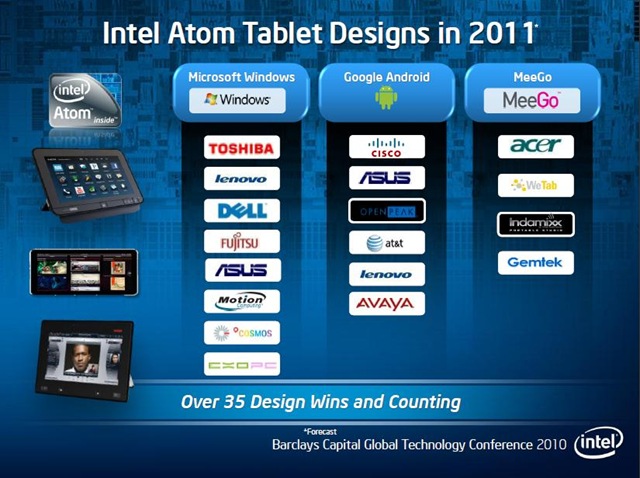
(where Nokia was already missing from the MeeGo design wins !) as well as by the another post of mine Intel Oak Trail to beat ARM with MeeGo specific prices [Nov 25, 2010]. Note that Android is high on Intel’s list as well since MeeGo is a quite new system. See Nokia, Intel release MeeGo 1.1; lacks support for tablets [Oct 29, 2010], For developers’ eyes only: MeeGo version 1.1 [Nokia’s own blog, Oct 28, 2010], MeeGo 1.1 Release [meego.com, Oct 28, 2010], MeeGo v1.1 for Netbooks (Google Chrome Browser) [meego.com], MeeGo v1.1 for Handset [meego.com] and MeeGo v1.1 for In-Vehicle Infotainment (IVI) [meego.com]. Nokia also had different plans for MeeGo from Intel back then platformwise as per Nokia Makes Qt its Sole App Development Framework [Oct 21, 2010], Nokia Focuses on Qt to Extend Reach for Developers, Make Mobile Experience Richer for Users [Oct 21, 2010] and Nokia further refines development strategy to unify environments for Symbian and MeeGo [Oct 21, 2010].
With the latest Nokia decision to select Windows Phone 7 as its primary operating system Nokia’s plans for MeeGo changed only in the sense that Qt has been dropped as the unified environment for developers but as per the Nokia outlines new strategy, introduces new leadership, operational structure [Feb 11, 2011]:
Under the new strategy, MeeGo becomes an open-source, mobile operating system project. MeeGo will place increased emphasis on longer-term market exploration of next-generation devices, platforms and user experiences. Nokia still plans to ship a MeeGo-related product later this year.
which is very painful for Intel as it practically should push MeeGo through the market alone while Nokia can pick the fruits of Intel’s effort practically free of charge when MeeGo becomes a factor on the market. Nokia’s biggest contribution to the MeeGo success will be just the advanced user experience as has been promised before, see my earlier post Nokia to enter design pattern competition for 2011 smartphones with MeeGo [Dec 9, 2010]. But that user experience wil be kept to Nokia, so Intel will not benefit from it elsewhere.
Whether Intel understands the upcoming threat to its business is still not clear from all that above.
Meanwhile Apple definitely needs to take the white-box vendors threat more seriously as indicated by two recent news below:
New York Times: Apple Is Not Making a Smaller iPhone [Feb 18, 2011]
The New York Times has poured cold water on a rumor that Apple is preparing to sell a smaller version of the iPhone.
The report conflicts with stories published earlier this week by Bloomberg and The Wall Street Journal, who both claim that Apple is making a smaller iPhone that relies heavily on cloud-based storage and media streaming.
Citing an anonymous source, NYT explained that Apple is working on methods to bring costs of the iPhone down, and a smaller iPhone wouldn’t necessarily be cheaper to produce, nor would it be easier to operate.
Two major publications say something is happening, and one major publication is saying it’s not. We’re inclined to believe NYT, however, because the explanation seems more rational. Reducing storage and size wouldn’t bring down costs much, and a different screen size would also cause fragmentation in the App Store.
Apples biggest plans to upset faster retail store progress in China [Shanzai.com, Feb 21, 2010]:
We’ve reported before that Apple was lagging on meeting its earlier commitments to open 15 or 25 retail stores in China this year but now it seems an effort to build its biggest store yet will slow things down further.
40,000 people/day apparently tromp through the few Apple retail outlets in China at the moment (I’m never sure but now I think there are 5 locations)… so bigger is probably a much welcome strategy for building an Apple shrine/store.
Since Apple revenue in China last year grew over 4x from the previous year, they’re probably needing to scout new locations that can handle higher retail traffic volumes.
Apple, which had all but neglected the China market for years, has recently stepped up efforts to expand outside the U.S. In its last earnings call, the company’s Chief Operating Officer Tim Cook said revenue from Greater China reached $2.6 billion, four times the company’s China revenue a year earlier.–Source
Apparently Chinese Apple retail store traffic is also 4x larger than American retail traffic so I suppose they’ll also need to find 4x the geniuses to guide consumers through the buy and use process.
Earthquake like changes in the mobile phone market: numbers from IDC
According to CORRECTING and REPLACING Mobile Phone Market Grows 17.9% in Fourth Quarter, According to IDC [Jan 28] the phone market changed significantly in 2010:

Considering the market changes in the 4th quarter 2010 the changes are even more significant:
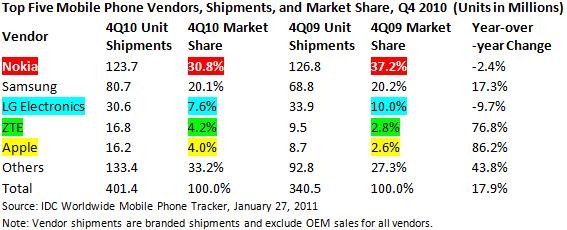
IDC also released information about the smartphone part of the phone market. See Android Rises, Symbian^3 and Windows Phone 7 Launch as Worldwide Smartphone Shipments Increase 87.2% Year Over Year, According to IDC [Feb 7, 2011]. Here we can see even more troubling signs for four traditional phone vendors in the Top 5. Year-over-Year the situation is as follows:

Here Research in Motion (the Blackberry vendor) is quite visiblibly in a trouble zone as its strong smartphone position is fast declining against such Top 5 challengers as Samsung and HTC. Even Apple should worry since it barely succeeded grow a little faster than the overall smartphone market but the upcoming challengers, Samsung and HTC grew by several times faster, 318.2% and 165.4% accordingly. This observation for all three Top 5 companies in trouble is even more proven by IDC’s 4th quarter 2010 numbers:

Here we can see that Nokia lost 27.5% of its quarterly market share in a year, Research in Motion (RIM) 27.1%, and Apple remained on the same quarterly market share as a year before which means that all the lost marketshare by Nokia and RIM, which is not less than 16% of the overall (10.6% + 5.4% subsequently) went to the other challengers. Samsung’s and HTC’s gains were “just” 10.3% of the overall (6.6% + 4% subsequently) which means that even vendors in the “others” category were able to pick 5.4% out of the Nokia’s and RIM’s 16% combined loss of marketshare. For Apple it is as much of a danger sign as the most obvious things for Nokia and RIM.
IDC’s additional verbatim assesment of the 4th quarter situation (from their press release indicated above, emphasis is mine):
“Android continues to gain by leaps and bounds, helping to drive the smartphone market,” said Ramon Llamas, senior research analyst with IDC’s Mobile Phone Technology and Trends team. “It has become the cornerstone of multiple vendors’ smartphone strategies, and has quickly become a challenger to market leader Symbian. Although Symbian has the backing of market leader Nokia, Android has multiple vendors, including HTC, LG Electronics, Motorola, Samsung and a growing list of companies deploying Android on their devices.”
Adding to the competitive landscape is the entrance of two refreshed operating systems, Symbian^3 and Windows Phone 7 [wrong: WP7 is a completely new system, has nothing related to the previous Windows Mobile line]. “In their first quarter of commercial availability, both Symbian^3 and Windows Phone 7 ramped up quickly, just in time for the holidays,” added Llamas. “By the end of the quarter, Nokia had shipped five million Symbian^3 units while Windows Phone 7 vendors shipped more than 1.5 million units. Now, with the holiday quarter over, both platforms will need to sustain this initial growth in the quarters to come.”
Regarding Nokia IDC was even somewhat positive:
Nokia noted the positive progress of its new Symbian^3 smartphones during 4Q10: five million units combined from the N8, C7, and C601 worldwide, a strong showing given their recent introduction to the market. At the same time, Nokia’s volumes are largely comprised of older devices, while MeeGo-powered devices have yet to arrive on the market. In addition, Nokia continues to struggle in the North America market. The recent cancellation of the X7 smartphone at AT&T highlights Nokia’s challenges and a new device has yet to be revealed.
Regarding Apple and RIM IDC did not see any kind of problems worth to mention. Regarding the overal mobile phone market situation (as given in the first press release linked so far) their observations are (emphasis is mine):
It’s not just smartphone-focused suppliers that capitalized on the mobile phone market’s renewed growth last year. ZTE, a company that sells primarily lower-cost feature phones in emerging markets, moved into the number 4 position worldwide in 4Q10. It is the first quarter the Chinese handset maker finished among IDC’s Top 5 vendors.
“Change-up among the number four and five vendors could be a regular occurrence this year,” added Ramon Llamas, senior research analyst with IDC’s Mobile Devices Technology and Trends team. “Motorola, Research In Motion, and Sony Ericsson, all vendors with a tight focus on the fast-growing smartphone market who had ranked among the top five worldwide vendors during 2010 are well within striking distance to move back into the top five list.”
Regionally they were only indicating that (emphasis is mine):
… Domestic brands in India like G-Five, Micromax, and Karbonn grew with aggressive advertising and branding activities for entry-level phones, while ZTE and Huawei worked closely with carriers to push low-cost Android smartphones in China. …
… In Western Europe, carrier smartphone promotions motivated more users to scrap their feature phones, resulting in strong smartphone sales. … In CEMA, quarterly volumes breached the 70 million unit threshold for the first time, marked by an influx of Chinese and unbranded handsets. Meanwhile, smartphones experienced brisk growth due to falling prices and more Android-powered devices.
The United States … [and] Canada, the focus was on smartphones. Android-powered devices from multiple players, along with incumbent vendors RIM and Apple, pushed shipment volumes to a new record level.
In Latin America, sustained user interest in smartphones drove the market, resulting in strong results for Nokia, RIM, and Samsung as well as relative newcomer Huawei. Smartphones, as well as QWERTY-enabled feature phones, helped boost social networking and messaging, two fast-growing trends in the market. Finally, Alcatel and ZTE once again thrived in the inexpensive entry-level device market.
The numbers as have been indicated by me on the above tables are however exceptionally worrying for Nokia as the leaked internal memo (Engadget, Feb 8) by their new CEO Stephen Elop has described to the employees (emphasis is mine):
In 2008, Apple’s market share in the $300+ price range was 25 percent; by 2010 it escalated to 61 percent. They are enjoying a tremendous growth trajectory with a 78 percent earnings growth year over year in Q4 2010. Apple demonstrated that if designed well, consumers would buy a high-priced phone with a great experience and developers would build applications. They changed the game, and today, Apple owns the high-end range.
And then, there is Android. In about two years, Android created a platform that attracts application developers, service providers and hardware manufacturers. Android came in at the high-end, they are now winning the mid-range, and quickly they are going downstream to phones under €100. Google has become a gravitational force, drawing much of the industry’s innovation to its core.
Let’s not forget about the low-end price range. In 2008, MediaTek supplied complete reference designs for phone chipsets, which enabled manufacturers in the Shenzhen region of China to produce phones at an unbelievable pace. By some accounts, this ecosystem now produces more than one third of the phones sold globally – taking share from us in emerging markets.
While competitors poured flames on our market share, what happened at Nokia? We fell behind, we missed big trends, and we lost time. At that time, we thought we were making the right decisions; but, with the benefit of hindsight, we now find ourselves years behind.
… We thought MeeGo would be a platform for winning high-end smartphones. However, at this rate, by the end of 2011, we might have only one MeeGo product in the market.
At the midrange, we have Symbian. It has proven to be non-competitive in leading markets like North America. Additionally, Symbian is proving to be an increasingly difficult environment in which to develop to meet the continuously expanding consumer requirements, leading to slowness in product development and also creating a disadvantage when we seek to take advantage of new hardware platforms. …
At the lower-end price range, Chinese OEMs are cranking out a device much faster than, as one Nokia employee said only partially in jest, “the time that it takes us to polish a PowerPoint presentation.” They are fast, they are cheap, and they are challenging us.
And the truly perplexing aspect is that we’re not even fighting with the right weapons. We are still too often trying to approach each price range on a device-to-device basis.
The battle of devices has now become a war of ecosystems, where ecosystems include not only the hardware and software of the device, but developers, applications, ecommerce, advertising, search, social applications, location-based services, unified communications and many other things. Our competitors aren’t taking our market share with devices; they are taking our market share with an entire ecosystem. This means we’re going to have to decide how we either build, catalyse or join an ecosystem.
Note that Gartner’s numbers are diufferent, as descibed in Gartner’s 77 million shanzhai mystery [Nov 26, 2010]
Radical strategy shift/reorg at Nokia
As the result of Elop’s assesment on February 11 came the news that Nokia and Microsoft announce plans for a broad strategic partnership to build a new global ecosystem [Feb 11]. The line of thought behind this decision from Nokia’s part was clearly explained a couple of days later on the Mobile World Congress 2011 on the Stephen Elop’s Nokia Press Conference at MWC [Feb 14] as (emphasis is mine):
There were three possible options for Nokia’s future, he explained. It might pursue the internal route and rely on Symbian and MeeGo to see Nokia through to regaining its mobile crown through further and faster development. Second, the company could go to Google and become another licensee of the Android platform. Third, it could become a licensee of Microsoft’s Windows Phone.
Looking at the pace and performance of Symbian and MeeGo over recent years was enough to discount the first choice. Of course, he then talked to Google and Microsoft, the only two realistic external choices.
Both companies were keen. Nokia has a massive global footprint and retains an enormous market share. Nokia was, in Stephen’s words, “suited” by both companies.
So why choose Microsoft over Google? It’s all about how it affects the mobile ecosystem.
If Nokia had gone with Google, it would have been another Android licensee and handed Google massive share. The world of mobile phones would have become a “duopoly” – Google versus Apple.
Going with Microsoft might look counter-intuitive, given the lower market share and youth of that mobile operating system.
However the point, Stephen said, was exactly that. Microsoft has everything to gain by supporting Nokia’s venture in creating devices with its operating system. Windows Phone is a challenger in the mobile space, not one of the current incumbents.
Here’s the way the deal works: Nokia pays Microsoft royalties, it gives Microsoft unprecedented reach, it also gives them access to services such as Maps. Nokia’s hardware expertise creates devices that truly let the Microsoft’s new OS shine.
In return, Nokia gets a substantial reduction in its operating expenses; it gains a range of services to enrich its smartphone offering. There’s a new revenue stream for Nokia in the form of mobile advertising. It gets marketing support with a value of billions of dollars.
The real point is that there’s a co-dependency between Nokia and Microsoft – both partners need the other to fully succeed. That’s part of what makes it the right choice.
The other part of this is about new ecosystems. There are two flourishing apps and services ecosystems currently, Apple’s and Google’s. The combination of Nokia and Microsoft creates a third choice: that’s good news for consumers and good news for the whole of the mobile industry. More choice and more competition drives everything forward.
That means a complete overhaul of Nokia businesses which is best described in the Nokia provides financial targets and forecasts linked to new strategy [Feb 11] as (emphasis is mine):
Due to the initiation of Nokia’s strategic transformation on February 11, 2011, the full-year prospects for its Devices & Services business are subject to significant uncertainties, and therefore Nokia believes it is not appropriate to provide annual targets for 2011 at the present time. …
Nokia expects 2011 and 2012 to be transition years, as the company invests to build the planned winning ecosystem with Microsoft. After the transition, Nokia targets longer-term:
– Devices & Services net sales to grow faster than the market.
– Devices & Services non-IFRS* operating margin to be 10% or more.
During this two years transition there will be the following essential setup as per the Nokia outlines new strategy, introduces new leadership, operational structure [Feb 11]:
With Nokia’s planned move to Windows Phone as its primary smartphone platform, Symbian becomes a franchise platform, leveraging previous investments to harvest additional value. This strategy recognizes the opportunity to retain and transition the installed base of 200 million Symbian owners. Nokia expects to sell approximately 150 million more Symbian devices in the years to come.
Under the new strategy, MeeGo becomes an open-source, mobile operating system project. MeeGo will place increased emphasis on longer-term market exploration of next-generation devices, platforms and user experiences. Nokia still plans to ship a MeeGo-related product later this year.
In feature phones, Nokia unveiled a renewed strategy to leverage its innovation and strength in growth markets to connect the next billion people to their first Internet and application experience.
…
As of April 1, Nokia will have a new company structure, which features two distinct business units: Smart Devices and Mobile Phones. They will focus on Nokia’s key business areas: high-end smartphones and mass-market mobile phones. Each unit will have profit-and-loss responsibility and end-to-end accountability for the full consumer experience, including product development, product management and product marketing.
Smart Devices will be responsible for building Nokia’s leadership in smartphones and will be led by Jo Harlow [she is a 49 years old American marketing executive who joined Nokia in 2003 as VP of North America Mobile Phones Marketing, then responsible for the same just globally as a SVP, then a few device specific roles like Symbian smartphones and finally appointed to her smartphones releated role in July 2010, before the arrival of Elop]. The following sub-units now in Mobile Solutions will move under Smart Devices:
– Symbian Smartphones
– MeeGo Computers
– Strategic Business OperationsTo support the planned new partnership with Microsoft, Smart Devices will be responsible for creating a winning Windows Phone portfolio.
Mobile Phones will drive Nokia’s “web for the next billion” strategy [i.e. the feature phones as mentioned above]. Mobile Phones will leverage its innovation and strength in growth markets to connect the next billion people and bring them affordable access to the Internet and applications. The Mobile Phones unit will be led by Mary McDowell [she is a 46 years old American computer industry executive who joined Nokia in 2004 as an executive VP and GM of Enterprise Solutions, then leading the Corporate Development unit from 2008 until assuming her current role in July 2010, before the arrival of Elop].
…
Services and Developer Experience will be responsible for Nokia’s global services portfolio [i.e. location, messaging, entertainment and context-based services], developer offering, developer relations and integration of partner service offerings. Tero Ojanpera will lead the Services and Developer Experience unit in an acting capacity. [46 years old Tero Ojanpera has been with Nokia along his full carrier which started in research. He is said to be an oustanding radio engineer back then. In 2003-2004, he headed the Nokia Research Center, and was appointed chief strategy officer a year later. From 2006, Tero served as chief technology officer, responsible for corporate and technology strategy, strategic alliances and partnerships, research and intellectual property rights. He has been a member of the Nokia Leadership Team since 2005, and was appointed to his current position in 2009.]
NAVTEQ, an integral part of Nokia’s location and advertising business, will be headed by Larry Kaplan, and continue as a separate reporting entity.
…
Design, responsible for Nokia product and user experience design, will be led by Marko Ahtisaari. [Although not a member of the Leadership Team he is an equally important person on the new operational structure. Marko Ahtisaari re-joined Nokia in September 2009 to head the Design team within the new Solutions Unit and then becoming SVP Design and User Experience. Before he was the CEO and co-founder of Dopplr, the online social atlas for smart travel acquired simultaneously by Nokia. In 2006-2008, he was the Head of Brand & Design at Blyk, the free mobile service for young people. Previously, he worked at Nokia as Director of Design Strategy and held management positions in corporate strategy and venturing since 2002. In 1999-2001, he built and led the mobile practice at digital services company Satama.]
[as noted by ArcticStartup [Sept 29, 2009]: “Last time he stayed almost two years with the Finnish mobile phone giant pulling the Design unit from individual separate pieces into a well functioning shop before leaving in August 2006 to Blyk as a Head of Brand & Design.”]
Note that the above structure essentially means the dissolution of the previous Mobile Solutions unit with dropping the mobile computers focus for the next two years (just retained with MeeGo for longer term) as well as the focus on the “world-class suite of internet services under the Ovi brand” which is now moved into a joint services and developers unit responsibility. The previous structure was as follows:
Structure
July 1, 2010
Our organizational structure is designed to position us for a world where the mobile device, the Internet and the computer are fusing together.
Mobile Solutions is responsible for developing and managing our portfolio of smartphones and mobile computers. The team is also busy developing a world-class suite of internet services under the Ovi brand, with a strong focus on maps and navigation, music, messaging and media. Mobile Phones is responsible for developing and managing our portfolio of affordable mobile phones, as well as a range of services that people can access with them. Markets manages our supply chains, sales channels, brand and marketing activities, and is responsible for delivering our mobile solutions and mobile phones to the market.
Nokia Siemens Networks, jointly owned by Nokia and Siemens, provides wireless and fixed network infrastructure, communications and networks service platforms, as well as professional services to operators and service providers.
NAVTEQ is a leading provider of comprehensive digital map data and related location-based content and services for automotive navigation systems, mobile navigation devices, Internet-based mapping applications, and government and business solutions.

White-box (Shanzhai) vendors
While Nokia and Microsoft are talking about the need to have a third smartphone ecosystem (in addition to Apple’s and Google/Android’s) the fact is that within the Google/Android camp there is an absolutely threatening ecosystem in itself which is generally called the China-based white-box vendors. The Special Report: China’s white-box handset market (Jul 26) from Digitimes Research (Taiwan) describing this as follows (emphasis is mine):
In China, there is a specific form of business operation that has come to be called the white-box industry mostly targeting the vast low-income segment of the market. The white-box supply chain is a production system centered in southern China, with product designs relying on core component suppliers and with a supply chain working on a division of labor, high flexibility and a minimal amount of assets.

In more details this kind of model is described in Digitimes Research analyzes China white-box handset market in new report [Aug 10] (emphasis is mine):
While the mainstream business model for manufacturing and distributing mobile handsets remains leveraging the OBM/ODM/OEM/EMS model, a whole new paradigm has developed within China’s domestic market, according to a new report from Digitimes Research.
The local China-based industry called “Shanzhai,” but translated as “white box,” is based on small-scale or underground factories whose products are seldom sold through regular sales channels, but the scale of the market now rivals that of global top-10 brands or major Chinese brands in the domestic China market, Digitimes Research pointed out. The “white-box” industry currently accounts for more than 100 million handset shipments, and some players in the market, such as K-Touch (Beijing Tianyu Communication Equipment) and Gionee have made the leap to become recognized brands.
While accounting for about one-third of domestic handset shipments, the white-box industry in China has been working under the acquiescence, and even active encouragement in some cases, of the government and is proclaimed by its proponents as representing the success of China’s homegrown innovation and enterprise. The Digitimes Research special report examines the difference between the traditional ODM supply chain and the virtual organization used by white-box players, and highlights the advantages of the white-box business model.
Next we should clearly understand What drove the shanzhai success? [Shanzai.com, Nov 13, 2009]:
Shanzhai players have gained a strong foothold in the local market in the last two years [i.e. in 2008 and 2009]. Although they started off with copied brands, nearly one third of them are now [i.e. Nov’09] becoming more and more innovative in their products.
… Five years back, none of us had even heard of shanzhai. Copy or fake products existed only in the grey market.
… why are we instantly attracted to shanzhai products?
Price is surely one major factor. While you get a shanzhaid version of an Apple iPhone in China for around USD 70, the real iPhone will cost you 5 to 7 times more. The shanzhai have given a new ray of hope to the lower middle classes to flaunt the features of branded phones.
… While established brands are cautious about trying something new, the shanzhai design their products according to customer demand. Netbooks with CD drives and dual SIM phones with TV streaming are common examples of shanzhai designing customized products for identified consumers.
… The shanzhai option is also often the first way of getting a new product … er well, a version of a new model anyway, something Kiran [from shanzai.com] pointed out, “Since they are acutely aware of the need to cater to local needs, they have the inherent capability to produce a slew of new devices with the latest technology every one to two months. This innovative, flexible and cheap market strategy poses a huge challenge to legal branded manufacturers. For the branded manufactures, the gestation period of a new product is much longer than the shanzhai counterparts. If a new product is designed it takes approximately 6 months to release into the market as it passes through different safety and regulatory measures. By the time it enters the market, it is already out of date due to the early availability of its clone products devised by the shanzhai bandits.”
The shanzhai are also rebelling against established brands by promoting open source platforms, which cost less and offer similar features of other platforms. … The actual manufacturing cost of a phone is only 20% of the retail price of a phone; the rest is spent in designing, marketing, tax, regulatory checks, safety tests and post sales services. Shanzhai products save the funds spent in TV advertising and other marketing activities.
While price, specs and rebellion against established brands has contributed to the success of the shanzhai business model, another major factor responsible for the sudden boom of the shanzhai is the economic downturn of 2007-09. Although the impact of the financial crisis is less evident in countries like China and India, it has paralyzed foreign investments to a large extent. The recession has actually affected the spending power of people, so a person thinks twice even before making a small investment like buying a new phone. So when offered similar features at a much lower price, many people go for the cheaper option where they once might have stuck loyally with a big brand.
…
Shanzhai distribution channels work quite effectively and actually quite speedily too. In Shenzhen, a small group of workers have their own factories with R&D, software development and hardware manufacturing facilities. Go to any shop in Shenzhen in the morning and tell them the features you want in your mobile phone and collect your phone in the evening! Shanzhai prefers its marketing through its local channels; Chinese people also prefer their local brands over international products. If we take a look at tech building companies in countries like India and Brazil, the shanzhai lead there too. They export the hardware parts to save export duties, and then the completed products can be assembled easily in these countries.
[Another factor – in fact a major “catalyst type” force – is mentioned in the article as “the emergence of local silicon players like MediaTek” which – quite naturally – will be discussed in the next section separately: see MediaTek as the catalyst of the white-board ecosystem below.]
The attached diagramm (to the first news item above) of mainland China’s home market growth is clearly showing that there is essentially no forecasted growth for 2011 so there is no other way for the white-box vendors as enter the international market even more aggressively than before. Digitimes even reported that White-box handset makers gearing up smartphone and 3G handset production, MediaTek to benefit [Dec 3, 2010] also indicating the Chineses government increased support for that (emphasis is mine):
White-box handset makers in China are gearing up their production of in-house designed smartphones and 3G handsets, a trend which will benefit Taiwan-based IC design house MediaTek. China’s white-box handset industry in 2010, has begun to place more emphasis on upgrading specifications and added value to enter the high-end segment, and has allocated more resources on development of intellectual property.
Even the China government has voiced its support for the white-box industry. Yang Xueshan, Deputy Minister of the Ministry of Industry and Information Technology (MIIT), recently said that the government will support the white-box business model as long as there is no infringement of IP.
Yang pointed out that from imitation to innovation is a process white-box handset makers have to go through, citing China-based telecom equipment maker Huawei Technologies as a success story. Huawei’s foray into the handset sector began with low-cost products and the company now has research and development capability, he said.
Supporting the white-box business model, given that no patents are infringed, is a good way to protect intellectual property rights as well as provide the most cost-effective products to consumers, Yang added.
Two months later came out the news that Shipments of sub-US$150 Android handsets to reach 20-25 million units in 2011, says Digitimes Research [Jan 28] (emphasis is mine):
Shipments of entry-level Android handsets with a price tag of below US$150 are likely to reach 20-25 million units in 2011 which could affect Nokia’s performance, according to an estimate by Digitimes Research.
Shipments of sub-US$150 Android phones totaled only 2.5-3 million units in 2010, mostly shipped by China-based Huawei Technologies and ZTE. However, the number of sub-US$150 Android phones is likely to increase by 8-10 fold in 2011 resulting a substantial increase in shipments, Digitimes Research said.
Google’s efforts to push Android phones to emerging markets, strong demand from markets in China, India, South America, Southeast Asia, Africa, and Russia, and a shift of telecom carriers in mature markets from feature phones to smartphones all work to stir up shipments of Android phones.
In addition to Huawei, ZTE, white-box handset makers in China and Taiwan-based ODMs, Samsung Electronics, LG Electronics and Motorola are also likely to step up their presence in the entry-level Android segment, Digitimes Research said.
The increasing popularity of low-cost Android phones is expected to have a major impact on Symbian-based smartphones as Nokia is projecting merely a 10% sales growth rate for its smartphones, far below the 50% growth projected for the segment, Digitimes Research noted.
Two weeks later even more threating news were coming stating that China-based white-box vendors to offer below US$100 Android smartphones for emerging markets [Feb 9] (emphasis is mine):
China-based vendors are poised to offer Android smartphones priced at below US$100 for sale in China and other emerging markets including India, Indonesia and Brazil [so called BRIC] in 2011, according to Taiwan-based handset and component makers.
Such low-price Android smartphones are equipped with basic functions including dual-mode or dual-SIM, Bluetooth, Wi-Fi, FM radio, trackball and G-sensors, with other functions such as mobile TV and GPS available for additional choice, the sources noted.
The low price is based on non-customized turnkey solutions featuring the integration of chips, operating systems, software and user interfaces, the sources pointed out. Taiwan-based IC design houses MediaTek and Infomax Communication have offered such solutions at less than US$100 and US$80-90 respectively, while China-based Leadcore Technology and Fuzhou Rockchip Electronics have done so at US$80-105 and US$90-105 respectively, the sources indicated. Qualcomm, ST-Ericsson and Broadcom have also offered such solutions, but mostly for 3G and priced higher at US$100-120, the sources noted.
In an additional news it was indicated that FOB price of turnkey solutions for Android smartphones now under US$120, says Digitimes Research [Feb 9] (emphasis is mine):
FOB prices of turnkey chip solutions for Android-based smartphones are now under US$120, according to Digitimes Research.
Taiwan-based MediaTek and Infomax Communications are offering Android chip solutions at below US$100 and around US$80-90, respectively. China’s Leadcore Technology and Rockchip Electronics are quoting at US$80-90 and US$80-105, respectively. Even international players such as Qualcomm, ST-Ericsson and Broadcom have joined in the battle with solutions priced between US$100-120.
International chip providers are outsourcing their solution designs to handset designers and manufacturers. Qualcomm is working with Gsmart [Taiwan] and Thundersoft, [HQ in Beijing, branch in Tokyo, support centre in Seoul and Taipei], Marvell has partnered with Zoom Technologies [HQ in Beijing, mainly EMS for OEMs + ODM + own brand sales via Hong Kong, ownership via Delaware-BVI chain of holdings], Broadcom with Yuhua [rather Yuhua TelTech, an ODM in Shanghai, with ~$40M international ODM sales] and ST-Ericsson with Beijing Xuntong Antian (transliterated).
More background information:
– Cheap chips off the old block [China Daily, Oct 31, 2008]
– Decoding Shan Zhai Ji (Bandit cell phone) – the opposite side of brand chasing [Nov 17, 2008]
– The phenomenon of Shan Zhai products and culture [Noc 19, 2008]
– ‘Shanzhai’: Faking it for money or fun? [China Daily, Dec 9, 2008]
– MIIT: GSM Association Issues IMEI Numbers To Chinese Mobile Phones [Dec 25, 2008]
– Copycat “Shanzhai” culture takes on life of its own [Xinhua, Dec 30, 2008]
– Chinese Mobile Phones Lacking IMEI Numbers Face Death In India [April 7, 2009]
– Mountain village handsets storm market [China Economic Net, July 19, 2009]
– Experience the shanzhai market: video [Oct 6, 2009]
– China’s ‘Bandit’ Cell Phones – The High-Tech Golden Egg with ‘Taiwan Inside’ [Oct 6, 2009]
– India Starts To Block Chinese-made “Shanzai” Mobile Phones Without IMEI [Dec 3, 2009]
– Chinese Shanzhai Mobile Manufacturers Will Move Production To India [Feb 23, 2010]
– Egypt Will Ban Chinese Shanzai Mobile Phones [June 28, 2010]
– Shanzhai grew by 43.6% in 2010, production cycle also cut by 25% [Shanzai.com, Feb 3, 2011]
MediaTek as the catalyst of the white-board ecosystem
Update: MediaTek to Launch Ultra Cheap Handset Chip Against Spreadtrum Communications [March 21. 2011.] (emphasis is mine)
MedaiTek Inc. has recently announced plans to introduce an ultra low cost multimedia system-on-chip for mobile handsets in a bid to rival a competing solution Spreadtrum Communications Inc. of mainland China will roll out in April.
According to MediaTek, the upcoming handset solution, codenamed as MT6252, supports serial flash memory and is cost efficient for handset makers as it uses lesser passive devices and smaller printed circuit board than existing solutions. Also, the MediaTek solution supports four-SIM, four-standby mobile phones, convincing the mainland`s home-grown handset makers including Gionee Communications Equipment, Ragentek Communication Technology Co., Ltd. and Leatek Technologies International Co., Ltd. to support it.
MT6252 is also designed to replace MediaTek MT6251, a provisional low cost solution to 2.5G mobile phone. Industry executives pointed out that the SOC-based MT6252 is crucial to whether or not MediaTek can dominate the mainland`s market for 2G chips.
The mainland`s market for low-end handset chips had been controlled by Infineon Technologies AG of Germany with its ULC2/3 solutions until the end of last year, when Intel phased out of the low-end business after acquiring Infineon`s handset chip asset.
The low-priced solution Spreadtrum will launch in April is named SC6610, which incorporates embedded SRAM into it.
Here it is worth to start with a historical detour of Shanzhai. Quoting from MediaTek rides high in bandit territory [May 16, 2010] article (emphasis is mine):
MediaTek, which originally focused on making chips for DVD players [see: MediaTek Announces the MT1389S-DVD-Player single chip. To enable the best digital media experience [March 26, 2007]], switched to designing mobile-phone chips after recognizing that cheap locally made phones from China’s Ningbo Bird and DBTel of Taiwan could not match the functionality of Nokia and Motorola, which 10 years ago dominated the China mobile handset market.
MediaTek’s response was to create “complete solutions” for mobile phones – the so-called “system-on-a chip”. It integrated the handset’s motherboard with other major components and the software for practically any desired feature onto a single circuit board. Most important, the products were extremely cheap. According to industry insiders, a set of such systems sells for as little as 100 yuan (US$12.50) to 200 yuan.
Practically all that is then required to produce a mobile handset is the addition of a battery and a casing to hold MediaTek’s “semi-product”. The combination of innovative Taiwan technology and mainland China’s low-cost mass manufacturing makes such handsets available at less than a third of the price of branded rivals.
“MediaTek revolutionized how cell-phone handsets are made in China,” said Zhang, formerly a general manager of Motorola’s Mobile Software Solutions Group for Asia-Pacific and now president of Yostar.net. “It makes it possible for toy factories to manufacture mobile phones.”
Many of these phones are imitations of major branded products, with similar (or the exact) functionality and style. But a lot of innovative handsets are also produced – mobile phones with seven speakers, for students to reproduce dance floor or boom-box music environments; handsets with four bright LED lights to serve as a cell phone and a powerful flashlight. For senior citizens, devices have big displays, big keys and a loud sound. For people who work outside in the fields, there are handsets with longer battery life. There are handsets with two sim-card slots for people traveling between different cities – allowing use of, for example, both a Hong Kong number and a Beijing number. Some are even equipped with a reader to check whether cash is counterfeit. Others look like a pack of cigarettes, or have a built-in laser pointer, a global positioning system, or a TV signal receiver.
The adaptability of small manufacturers also means that whatever is the latest trend – a new iPhone design, for example – can be almost immediately matched by a bandit version.
Then what happened is that after purchasing Analog Devices’ cellular radio and baseband shipset operations [Sept 10, 2007], completed next January [Jan 11, 2008], and the company report that its approach to providing a total solution for customers resulted in a total shipment of mobile solution chipsets over 150 million in volume in 2007 [June 8, 2008] followed an even more effective step of introducing its first multimedia-rich GSM/GPRS single-chip [Feb 12, 2009] (emphasis is mine):
MediaTek, Inc., the leading fabless semiconductors company for wireless communications and digital multimedia solutions, today announced that its first GSM/GPRS single chip, the MT6253, has been adopted in mobile phones on the GSM/GPRS network. Integrating all essential electronic components, including DBB, ABB, power management unit and RF transceiver onto a single chip, the MT6253 can further reduce the materials costs of a complete mobile phone. Equipped with strong peripheral supports including camera, high speed USB and Class D audio AMP, MediaTek’s MT6253 is the most highly integrated chip in the market for mobile communication.
“Bringing together advanced multimedia technology, efficient manufacturing, system-level design tools and real-time support, MediaTek’s MT6253 sets a new standard for cellular SoCs ”, said JiChang Hsu, Executive Vice President of MediaTek. “To better address the needs of emerging market, where handset manufacturers care cost-performance ratio more than ultra low cost, MT6253 provides perceptual peripheral support to bring down costs and reduce space requirements greatly.”
In addition to MT6253, MediaTek also brings its multimedia expertise to its smart phone solutions. Supporting LCD resolution up to WVGA, MediaTek’s first smart phone solution – MT6516 is the first solution for smart phones in the market which is able to process MPEG-2 transport stream decoding without any co-processor. MediaTek’s MT6516 features multiple video codec to enable MDTV applications, including DVB-T, CMMB and DVB-H, all of which can be easily implemented without multimedia co-processor.
This was followed by the advanced single-chip all-in-one GPS solution, MT3329 [May 25, 2009], by three second generation IEEE 802.16e WiMAX chips, the MT7110 Series [June 1, 2009] which was found by an external benchmark to outperform its peer products [July 28, 2010] and thus laying a foundation towards IMT-Advanced (4G) via the WirelessMAN-Advanced route (see my earlier post: IMT-Advanced (4G) for the next-generations of interactive mobile services, China is triumphant [Oct 24, 2010]), as well as both types of LTE Advanced. It is said to be possible to base all these advanced protocols on the same chipset construction. Thus MediaTek has already all the foundations to continue its leadership as the Mobile Internet is going to be faster and faster every year, as well as well more and more accessible to everybody in this decade.
Then came the news that MediaTek to Obtain WCDMA License from Qualcomm [Oct 15, 2009] (emphasis is mine):
Taiwanese wireless semiconductor manufacturer MediaTek has announced that it will soon receive a license to produce Qualcomm’s WCDMA chipset.
Once the license agreement is finalized, MediaTek’s first WCDMA 3G chipset, the MT6268, is aiming for release late this year, with hopes of becoming a major earner for the Taiwanese manufacturer next year. Qualcomm will receive a 6% licensing fee on every 3G chipset produced by MediaTek [the arrangement obtained later was different, see below].
MediaTek says that its license agreement discussion with Qualcomm has entered its final stages. The broad framework and provisions are already agreed upon by both sides, with only minor technical issues still under discussion.
Because Qualcomm still holds the patent on WCDMA technology, any manufacturer that has a product involving WCDMA technology or wishes to produce WCDMA chips must first obtain a license from Qualcomm.
Although MediaTek has yet to officially obtain a license from Qualcomm, its MT6268 3G chipset has already entered small-scale test production by Taiwan Semiconductor Manufacturing Company (TSMC). The test production, which mainly utilizes a 65nm manufacturing process, has so far met with success, and full production can begin immediately upon receipt of the license agreement.
The agreement has been reached as per MediaTek and Qualcomm Enter Into Patent Arrangement [Nov 20, 2009]:
MediaTek’s customers do not receive rights to any of Qualcomm’s patents and such customers will need to obtain a separate license from Qualcomm in order to receive rights to any of Qualcomm’s patents. Qualcomm’s customers do not receive rights to any of MediaTek’s patents and such customers will need to obtain a separate license from MediaTek in order to receive rights to any of MediaTek\’s patents. The remainder of the terms of the arrangement are confidential.
This allowed MediaTek reaching out to 3G market with Multimedia Phone Solution MT6268 [Dec 10, 2010] as far as in India:
Grant Kuo, MD, MediaTek [India] said, “With MT6268 multimedia solution, MediaTek has started reaching out to 3G market. The 3G strategic layout of MediaTek will be significant for the industrialization and the future moment of the 3G market in India.”
With high level of integration, MT6268 which supports 3G is targeted for the feature-rich multimedia market. MT6268 offers key features such as support for Video Calling, 5Mpixel camera, High GPRS speed, integrated BT, Dual SIM and full html browser. In addition to it, MT6268 is intended to address the need of embedded devices for low power with its patented power saving technology. These chipset solutions are intended to revolutionalize the market and take the industry to the next level of mass market adoption.
On this year’s Mobile World Congress – quite naturally – MediaTek announced the MT6573 platform for mainstream 3G smartphones [Feb 11] (emphasis is mine):
The MT6573 platform incorporates a highly-integrated, core chipset, a full range of connectivity solutions and supports the latest versions of the popular AndroidTM operating system. The MT6573 platform supports a quad-band [i.e.: all 4 GSM bands, the 850 and 1900 MHz bands – used in Americas – and 900/1800, used elsewhere], 3G/HSPA modem with mobile broadband rates of 7.2Mbps in the downlink and 5.76 Mbps uplink, as well as quad-band EDGE. The integrated applications processing system combines a 650 MHz dedicated ARM®11subsystem for the Android operating system; support for advanced 3D graphics; multi-format video capture and playback up to FWVGA 30fps; high-resolution camera support to 8MP and a high-end FWVGA, touch-screen display. The platform chipset is completed with a full range of connectivity solutions for Bluetooth, WiFi, GPS, FM radio and Mobile TV from MediaTek.
The core chipset of the MT6573 integrates the modem, applications, multimedia subsystem and all necessary power management functions into a single SOC. Combined with a single-chip, multi-mode, multi-band transceiver, it enables extremely small footprints that allow for smaller, more innovative industrial designs and form-factors. Additionally, the integrated 3D graphics capability brings gaming and user interface capabilities that were previously available only to high-end smartphones. Finally, the platform provides advanced camera and multimedia features that include smile and face detection, panorama and burst shot, as well as high-resolution video capture and playback. The platform can be delivered as a full system solution consisting of hardware reference design and fully-tested, compliant software suite that can improve design efficiency and speed time to market for customers in the rapidly changing smartphone market.
… The MT6573 platform is currently sampling to lead customers and will be in mass-production by mid 2011.
Back to the MediaTek rides high in bandit territory [May 16, 2010] article (emphasis is mine):
Big-name Chinese phone-makers such as TCL, Lenovo and Konka are now using MediaTek chips for their products, followed more recently by foreign brands like Motorola and Sharp for their low-end products.
“The local Chinese phone-makers made huge losses in 2005-06 due to the rise of shanzhai ji,” said Knock of JPMorgan, to the extent that the top 20 local Chinese brands have used MediaTek chips for their phones. “The mobile phone companies have outsourced their R&D [research and development] to MediaTek and now focus on marketing and manufacturing only.”
In 2008-09, US giant Motorola restructured its global operation, significantly cutting back its R&D department. “That is when Motorola started to use MediaTek chips,” said Knock, “In this way, Motorola only needs to keep a research team for cutting-edge technology, leaving MediaTek to work on the more mature or mainstream technology research.”
MediaTek has now captured about 30-40% of the branded handset market in China, estimates Knock. Moreover, demand for affordable phones in places such as India and Latin America has made it one of the top five global suppliers of all handset chips. Last year, only about half of the 360 million phone mobile chips made by MediaTek were shipped to China, with the remainder going to the rest of the world.
Now MediaTek Aims to become the Best Mobile Chipset Partner of Indian Mobile Manufacturers [Jan 27] according to MediaTek India (emphasis is mine):
“We do believe that our latest single chipset solution- MT6253, and a customized Android platform for the India market that features many extremely popular applications will help sustain our leadership in the Indian market and the introduction of some of our new 3G solutions will help penetrate new segments”, says Mr. Grant Kuo, MD MediaTek India.
According to a recent Gartner survey, major handset manufacturers view India as a very attractive investment because it is projected to have the most rapid growth of mobile users worldwide: 660 million mobile users in India by end of 2010. This number is expected to cross the one billion mark by 2014 according to global consultancy firm PwC. Rural India is expected to drive this growth in mobile adoption including 3G handsets. PwC also predicts the 3G subscriber base to grow to around 107 million by 2015 out of which 24% will be rural subscribers.
At the forefront of this growth in rural India will be low cost mobile handsets. According to the Voice&Data100 Indian Telecom Survey, low cost Indian brands like Micromax, Spice and Karbonn strengthened their presence in the market in 2009-10, at the cost of well established MNC’s.
“India is a high potential market for our company. The consumers in semi urban and rural areas, who have been the traditional users of low cost handsets, now demand high end features at affordable rates. MediaTek has a proven track record worldwide and aims to leverage this to become the preferred chipset provider to indigenous Indian handset makers, thereby bringing high end applications within the reach of the Indian masses. We are planning to step up our marketing initiatives in India to create awareness about our products and enhance our brand value in the Indian market”, adds Mr. Arun Gupta, Business Development Director MediaTek India.
MediaTek’s technology and product innovation has also received a lot of recognition and awards from media and institutions around the world. In 2010, MediaTek is ranked top 10 among Asia’s 200 most-admired companies by “The Wall Street Journal” and ranked No. 12 among Global Top 100 High-Tech Companies by “Bloomberg Business Week. In addition, its highly integrated mobile single chip MT6253 has been honored with the EDN innovation award. In 2010 MediaTek also had five publications in the distinguished International Solid State Circuits Conference – highest record in the Taiwan semiconductor industry. MediaTek is also honored with the “Excellence in Corporate Social Responsibility Top 50” award every year since 2007 by Taiwan’s most prestigious Common Wealth Magazine.
And for this local manufacturers penetration strategy MediaTek has all the prerequisites via the earlier Shanzhai’s route.
Meanwhile International handset vendors align with Taiwan and China makers to take on local competition in emerging markets [June 24, 2010] (emphasis is mine) and by doing this they are essentially following Motorola’s route:
International handset brand vendors will likely step up cooperation with manufacturers in Taiwan and China to compete more effectively with local vendors in emerging markets that are sourcing white-box models and selling under their own brands.
India’s Micromax, Indonesia’s Nexian and i-Mobile of Thailand are some of the domestic brand vendors that have taken down global giants at home with current market share rankings at third, second and fourth, respectively, in their countries.
Their business models are sourcing handsets from white-box manufacturers to target the entry-level segment as well as niche opportunities that were neglected by larger international vendors, according to sources from Taiwan-based handset makers.
The low-end strategy is certainly effective since consumers in emerging regions are typically more price sensitive. For niche markets, Micromax introduced phones with long standby time of 30 days and models with dual-card, dual-band and dual-standby functionalities. Nexian heavily promoted devices with dual-card and dual-standby features and QWERTY keypads. i-Mobile launched dual-card and dual-standby phones and models with analog-TV features.
Besides entry-level products, local vendors have rolled out smartphones and begun to expand to markets overseas, the sources said.
Most of the local vendors are also well-known distributors with strong ties within domestic sales channels and are responsible for their own after-sale services, the sources pointed out. This solves two major issues white-box critics often bring up – low brand recognition and poor service. Combined with protectionism policies and consumer preferences for home-made brands, the local players still have plenty of room for growth.
Recently, several brand vendors ranked in the top-five globally have contacted manufacturers in Taiwan and China-based handset designers to outsource new models that are comparable in both features and price to those sold by local vendors, said the sources.
Taiwan handset manufacturers have previously produced for local players in emerging markets but gradually gave up orders to white-box makers, since those clients never provided long-term order commitment and often shopped around between seven to eight contract manufactures, the sources noted.
And just now came the news that MediaTek reportedly to secure new orders from Nokia and Samsung for 2011 [Feb 17] (emphasis is mine):
IC design house MediaTek will likely attract new orders for entry-level and mid-range handsets from Nokia and Samsung Electronics in 2011, in addition to its existing ones from Motorola and LG Electronics (LGE), according to market sources.
New contracts, as well as continued-strong demand from China’s white-box handset market, may assist MediaTek to fulfill its handset-chip shipment goal of 550 million units for 2011, the sources said.
Having grown its market share in China’s white-box handset market with 2.5G solutions, MediaTek finds it hard to gain a further larger presence in the white-box handset market. As a newcomer to the 3G and smartphone chip segment, MediaTek is facing strong competition from international chipset companies. Meanwhile, price cuts initiated by local China-based rivals have squeezed its 2.5G market share.
MediaTek now stands a chance of breaking into the supply chains of more brand-name handset companies in 2011, the sources pointed out. MediaTek is likely to grab orders mainly for entry-level and mid-range devices from four out of the global top-five handset vendors, the sources indicated. The orders could boost MediaTek’s handset-IC shipments to 600 million units in 2011, the sources said.
In addition, the sources pointed out that MediaTek is preparing the launch of its next-generation 2.5G single-chip solution, which will be built using 40nm process technology with more features integrated in the compact all-in-one package.
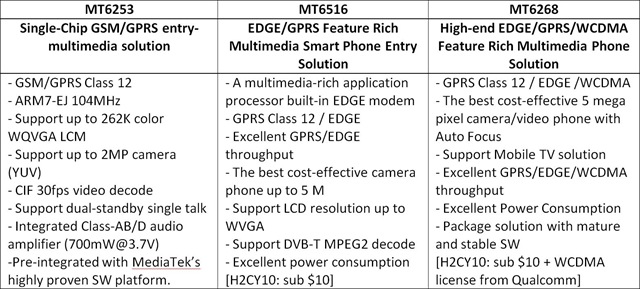
Note that in 4Q10 at least one mainland China rival started to use heavily MediaTek’s major foundry – albeit at 65nm not the 40nm MediaTek is aiming for – as reported by TSMC to get 60% more orders from Spreadtrum in 4Q10 [Oct 15, 2010]. In fact MediaTek had two make two pricecuts in the second half of 2010 and smartphone chipsets MT6516 and MT6268 now down to under US$10 [Dec 3, 2010] (that price is without the WCDMA license which should be additionally paid to Qualcomm, see above). There is more information about that came in MediaTek to take on MStar with 40nm single-chip 2.5G solutions [Feb 17]:
MediaTek will take on rival MStar Semiconductor in the 2.5G handset chipset segment with single-chip solutions built using 40nm process technology soon, according to industry sources.
MediaTek aims to take back the service privilege in the 2.5G chipset sector with advanced manufacturing processes after MStar managed to boost its share in the segment in the China market from the original 5-10% to almost 30% in the second half of 2010, the sources noted.
MediaTek’s next-generation 40nm parts will integrate baseband, RF, Bluetooth, power amplifier and power management ICs into an all-in-one package, said the sources. In comparison, MStar’s 40nm chips, which are still in development, will come with only baseband and RF chips.
Having cut its chip prices drastically in the past few months to stop MStar from further denting its share in the 2.5G segment, MediaTek’s strategy to launch parts made with advanced technology will also force MStar to channel its newly earned profits into a technology race, the sources asserted.
Note: MStar is a Taiwan-based competitor of MediaTek as per MediaTek to see challenges in China market [Sept 9, 2009]
In this way the white-board ecosystem will expand not only outside mainlad China but also to the international brand vendors, and MediaTek will likely remain the major catalyst of that peculiar ecosystem for the years to come.
ZTE et al.
@ MWC: ZTE Goes For The High End With The Skate [Feb 14, 2011]:
ZTE, the Chinese handset and wireless equipment maker, epitomises a certain kind of new entrant in the mobile industry: very determined, very cheap, and very much on the rise. At an overheated stand crowded with competitors, partners and non-partisan observers checking out ZTE’s newest devices — led by the Skate Android-based smartphone—I retreated to a quiet, air-conditioned room with Zhang Xiaohong, ZTE’s VP for handsets, to talk cannibalization, me-too Android competitors and more.
North America is our fastest-growing market. ZTE’s home market of China, where it ships devices with the three major operators China Unicom, China Mobile and China Telecom, is the company’s single largest market. But North America, shays Zhang is growing the fastest. Shipments in that region went up four-fold in the last year, with ZTE signing distribution deals with the U.S.‘s four major operators (selling both handsets and data cards for mobile broadband). Europe also grew—by a rate of 100 percent, with notable increases also in Japan, Australia, Russia and Latin America.
ZTE has already made a crucial shift in the last year to exporting more devices than it sells domestically. Zhang says the current rate is 35:65. If you take IDC’s recent number that indicates that ZTE shipped 60 million units in 2010, that works out to 21 million in China and another 39 million everywhere else.
Is it all about the cheapest price? No, she says. ZTE has disrupted the market with devices like the Blade (which sold for under $200), but it looks like it is now trying to leverage that market share to expand into the more premium segment against higher-end competitors like HTC and Apple:
“We will continue to focus on low-cost solutions for developing and developed markets, especially developing markets” she says. “But it’s also about new devices like the Skate.” No prices have yet been revealed for the Skate, which features a 4.3-inch screen and runs using Android 2.3—but the device, when I tried it out, seemed a little slow and jerky in its graphics. The specs say it runs on a 800MHz processor, compared to some of the newer devices from other Android OEMs built on 1GHz chips. The device is set to debut in May 2011.
Who is your biggest competitor? No straight answer on this one. Zhang says ZTE splits their competitors into two segments: “established” companies like Nokia (NYSE: NOK) and Samsung and “new ones” like HTC and Apple (NSDQ: AAPL). “ZTE can produce devices that compete with both,” she says.
What makes you different from other Android device makers? Ultimately a lot of these devices start looking more or less the same as each other, I say.
“We are good at customisation, according to different cultures and customs. We can differentiate.” ZTE says that it can and has developed devices for specific operators, making them unique in the marketplace. It also looks like ZTE is looking to take customisation to the software level, too: the company launched a new app store this week, to deliver services that complement those in the Android Market.
One other key area, says Zhang, is that, unlike a lot of the other Android OEMs, ZTE also sells network equipment: this means that ZTE can sell “total solutions”—at very competitive prices. She says that ZTE has such agreements with 28 of the top 30 operators worldwide.
What do you think of the Nokia/Microsoft (NSDQ: MSFT) deal, and do you have any plans for MeeGo? For now, Nokia’s choice to work on Windows Mobile phones “means the future does not look good for MeeGo,” she says. “Last week’s news may have been the last straw or it, and we have no plans to develop on it for now. But whether going with Microsoft will give Nokia advantages over the long term remains to be seen.”
http://www.shanzai.com/ remark on that article is that ZTE is still singing tried and true Shanzhai tune: “We are good at customisation” [Feb 11, 2011]
ZTE is a Shanzhai success story. Starting out small and then big in China, ZTE is now doing well in North America and is expected to increase market share there even more this year. When their VP was asked this week, why they have been so successful, their Shanzhai their Shanzhai roots showed through.
According to IDC, ZTE shipped 60 million products in 2010. Their exports were mainly to North America and also to Japan, Australia and Latin America.
Now what we have seen, time and time again, is that the successful Shanzhai make handsets that fulfill a local (rather than generalized global) market need. Sometimes that can lead to quirky products, like exchangeable solar batteries, cigarette lighters, or more practical factors like dual SIM support, etc. It turns out that even in “mainstream” North America, catering to the local audience is the key.
Zhang Xiaohong, ZTE’s VP for handsets at the Mobile World Congress said that ZTE’s success is because “We are good at customisation, according to different cultures and customs. We can differentiate”.
It’s ironic that the Shanzhai are often seen as strangers to differentiation because of the high profile of clone models, when actually it’s the Shanzhai’s adaptability that keeps their business strong.
But ZTE and Huawei are not alone. Here is another example, G’Five so far known only in India but expanding rapidly both in India and into the other parts of the world:
India Mobile Handset shipments grow 6.7%, to 101 million units in 12 Months ending June 2009 [IDC India, Oct 9, 2009]
Market intelligence firm, IDC’s India Quarterly Mobile Handsets Tracker, 2Q 2009, September 2009 release issued today states that in terms of units shipped Nokia had the largest share of 56.8%, followed by Samsung with a 7.7% share while LG stood third with a 5.4% share in the 12-month period ended June 2009.
…
New Vendors Make a Mark
A number of new vendors entered the India mobile handsets market in the last 12 to 18 months to carve a niche for themselves by offering feature-rich (dual SIM card, full QWERTY keyboard) and application-rich (IM enabled) mobile handsets at attractive price points. They also introduced entry-level models for the ‘price sensitive’ Indian consumer.Figure 1: India Quarterly Mobile Handsets Market: New Vendor Shipments Growth
Source: IDC’s India Quarterly Mobile Handsets Tracker, 2Q 2009, September 2009 releasee
This development shows that even in a crowded market there is room for vendors to enter with the right product-feature-price mix.

IDC’s India quarterly mobile handsets tracker 2Q 2010 [Sept 28, 2010] (some emphasis is mine):
According to Mr. Anirban Banerjee, Associate Vice President-Research, IDC India, “In the recent quarters several new players successfully launched their own devices at significantly lower Average Selling Values (ASVs) in the price sensitive India market. Such handsets found ready acceptance amongst first time buyers, especially from small towns and villages.”
This influx of new brands led to a spurt in overall market and saw ‘emerging vendors’ corner as much as 33.2% of total India mobile handset shipments in 2Q 2010. The Finnish handset maker Nokia retained its No.1 spot with a market share of 36.3% in terms of units shipped. The Korean electronic giant Samsung retained the No. 2 position, while Chinese brand G’Five emerged as the No. 3 player.
…
According to IDC’s India Quarterly Mobile Handsets Tracker, 2Q 2010, September 2010 release, the number of emerging vendors in India’s burgeoning mobile handsets market grew to 35 in 2Q 2010 and they together garnered 33.2% of total shipments for the first time during the April-June 2010 quarter. This represented a manifold increase from five (5) new vendors representing a 0.9% combined share of units shipped in the January-March 2008 quarter.
During the last 6 months (January-June 2010) the top five mobile handset vendors in India were Nokia, Samsung, G’Five, Micromax and Spice.
Figure 1: India Mobile Handsets Market: New Vendor Contribution to Shipments, Q1 2008 to Q2 2010
Source: IDC India, 2010

July-September 2010 mobile phone shipments (sales) log 3.6% quarter-on-quarter growth to
cross 40 million units: ‘Emerging Vendors’ capture 41.2% combined share [IDC India, Dec 29, 2010] (emphasis is mine):
… the Finnish handset maker Nokia had the largest share of 31.5%* in terms of units shipped during 3Q 2010.
The Chinese brand G’Five emerged as No. 2 player in terms of unit shipments market share and Korean handset manufacturer Samsung stood at No. 3 in 3Q 2010.The India mobile handsets market continued to grow in 3Q 2010 as well to record a quarter-on-quarter (3Q 2010 over 2Q 2010) growth of 3.6%* to touch 40.08 million units in the quarter, according to IDC India. The year is expected to end with total mobile handset sales of 155.9 million units.
The number of emerging vendors in India’s burgeoning mobile handsets market grew to 68 and they together garnered 41.2%* of total shipments (sales) for the first time during the July-Sep 2010 quarter.
…
Smartphone prices continued to drop through the year and as competition increased, devices were made available by vendors at successively lower price points. So, while 80%* of total India smartphone sales were below the ASV (Average Sales Value) of Rs. 18,000 in 2Q 2010, this proportion increased to 90%* in 3Q 2010.
Top G’Five mobile phones in India [Jan 13, 2011] (emphasis is mine)
Which are the top two cell phone brands today in India in terms of shipment volumes? Nokia and Samsung, many of us would like to think, right? Or maybe Sony…or LG…or Micromax which has been advertising quite a bit.
Not quite, folks. A recent report from leading market intelligence firm IDC India reaffirms the Finnish telecom giant’s status as the leading cell-phone player in the country, with Nokia accounting for 31.5% of the domestic cell-phone market during the July-September period last year. But, surprisingly, a little known Chinese brand called G’Five has made it to the second spot by capturing a 10.6% market share–with Samsung coming in third at 8.2%!
Sounds shocking, right? How can a Chinese player, without any big-ticket advertising campaign or any celebrity as its brand ambassador, manage to create such a big impact in the cut-throat Indian cell phone industry–without any fanfare? Well, the answer lies in G’Five’s strategy of rolling out a bevy of feature-rich phones at competitive prices (in the Rs.1,400-Rs.7,000 range), targeted exclusively at urban first-time buyers and those in semi-urban and rural areas looking to upgrade from basic phones.
So if you are looking to buy a G’Five mobile phone, here is a list of eight affordable (costing not more than Rs.5,000) models from around 26 G’Five phones currently available in India (in the order of ascending prices)– with each of them having their own USPs.
G’Five D10 Price: Rs.1,820 [US$40.4] … G’Five X5 Price: Rs.1,899 [US$42.1] … G’Five N92 Price: Rs.2,249 [US$49.9] … G’Five i310 Price: Rs. 2,400 [US$53.2] … G’Five M33 Price: Rs.2,499 [US$55.4] … G’Five L600 Price: Rs 2,700 [US$59.9] … G’Five X33+ Price: Rs.3,786 [US$83.9] … G’Five V60 Price: Rs. 4,490 [US$99.6] …
And these phones are not crap as you can even see from their pictures (for features info it is worth to go into the article).
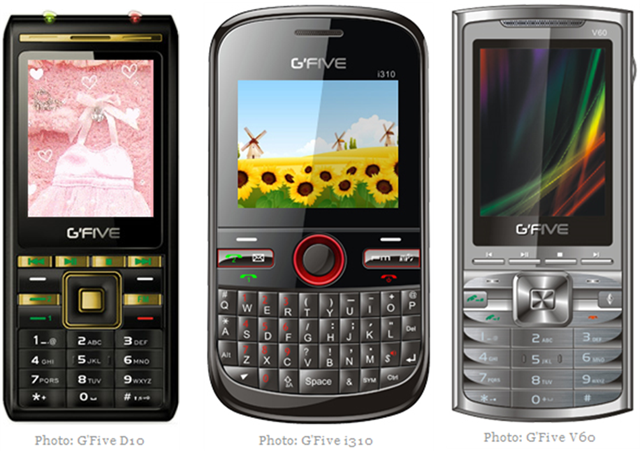
Note that to target the upper part of this range Social networking is Nokia’s latest mobile strategy [Feb 17, 2010] (which the above phones do not have):
The company’s latest launch on Nokia X2-01 mobile, at Rs 4,459 [US$99.2] is one such product. “QWERTY is one of the fastest growing mobile phone category in the world due to the rise in messaging and social networking. The Nokia X2-01 makes it easy to set up chat and email direct from the mobile phone,” said Nokia India General Manager-South T S Sridhar. “This means superfast access to your favourite Ovi Mail, Ovi Chat or other popular accounts.”
As young users want to stay connected with friends on the move, instant messaging is rapidly on the rise. With messaging devices like Nokia X2- 01, we are empowering the youth, he said. The handset also provides live updates from social networks such as Facebook, Orkut and Twitter directly from home screen. The Nokia X2-01 is Series 40 2G phone with VGA camera and FM radio. It has one click access the music player and has 3.5mm AV connector ideal for headphones or speakers. It also has Bluetooth and can support up to an 8GB micro SD memory card and has a standby battery time of up to 20 days, he claimed. For affordable access to internet, Nokia has also tied up with country’s largest mobile service provider Airtel which allows 100 mb of free data download per month for 12 months to its subscribers on this phone. Under this scheme one can access Face Book, and OVI Chat and Ovi Mail free of charges.
Gfive Mobile Phones (by Devika Rajpali)
The company of GFive is from China. The investors of the company are a syndicate named Zerone group that of the most esteemed OEM factories that boost of producing around 100 million mobile phones. The GFive mobile phones are the hottest running brand in indisputable imei china mobiles. The company has now established itself completely in the field of tech support, repairing and software installation. You will find the GFive mobile phone to be very stylish with large number of mobile phones to offer to its consumers. The company claims to have experience, confidence and data along with the in-depth insight of their Chinese mobile phones.
The KingTech Telecom (Shenzhen) Co Ltd. is behind the brand with KingTech Telecom (HK) Limited behind the export activities. As far as India is concerned the arrangement will be developed into a stronger local representation as Victor Infotech ties up with King Tech Telecom [Nov 11, 2010] (emphasis is mine):
Victor Infotech Ltd has tied up with King Tech Telecom Ltd (a Hong Kong-based telecom company) to form a joint venture company — Asian Telecom Ltd. The majority stake of 51% in the new company will be held by King Tech Telecom Ltd and the balance 49% equity will be held by Victor Infotech Ltd.
Asian Telecom Ltd., the new joint venture company, will come into being with immediate effect to launch the G’Five brand of mobile phones in the Indian market. The company plans to take the G’Five brand of mobiles to new heights in India and achieve 20% of the market share in the next two years.
As part of the collaboration, Kingtech Telecom shall manufacture the mobile phones and Victor Infotech will be responsible for distribution and marketing of the phone in India. Initially Kingtech Telecom will manufacture the Indian specific mobile phones in Hong Kong [rather in Shenzen] and gradually the same shall be manufactured in India.
The Indian mobile phone market is growing very fast. The company expects the sales of the mobile phones to grow 5 times in the next two years and plans to take advantage of this growth to gain the maximum market share. To achieve this, the company shall introduce many variations in its mobile phones, which shall be specific to the needs of the Indian consumer.
Meanwhile for other parts of the world a new sales and marketing operation has been set up: GLX mobile – G’FIVE Mobile’s Brother Company [Dec 14, 2010] (emphasis is mine)
A new member of Zerone Group called GLX mobile has been founded. With its full name as GLX International Limited, GLX mobile is dedicated in global distribution of GLX mobile phone.
Since G’FIVE is a member of Zerone Group, G’FIVE and GLX are brother companies. The new-founded GLX focuses on international markets, especially emerging markets. GLX mobile covers the whole range of mobile phone user market, from low-end to high-end with stylish and unique handsets.
GLX is aiming to create golden life for worldwide consumers with all ranges of mobile phones.
And the GLX company’s website indicates that it has taken over (almost all) the rest of the existing G’Five business network:

 Experiencing the Cloud


