Home » Posts tagged 'Haier'
Tag Archives: Haier
Qualcomm’s SoC business future is questioned first time
Among the hits for simple ‘Qualcomm’ search between April 25 and 30 you will first time find headlines such as:
|
While such headlines are in minority by far and had been market balanced by Qualcomm’s media wide Snapdragon 800 communication (“Snapdragon 800 to enter mass production in late May”) we are witnessing first time that Qualcomm’s SoC future had been questioned for very first time. So it is worth to examine this abrupt change in a little more detail than the articles behind those worries:
First of all China: Entry-level dual core IPS WVGA (480×800) smartphones $65+ now, quad-core $70+ in June [‘Experiencing the Cloud’, April 29, 2013] behind of which there is a very said turn of events from Qualcomm’s point of view that:
Qualcomm recently quoted its quad-core solutions at less than US$10, slightly cheaper than MediaTek’s offerings, the sources indicated. Meanwhile, Spreadtrum has lowered its quad-core processor prices to similar levels. Both firms are trying to gain market share through aggressive pricing, the sources said.
That is Qualcomm has no other way against its market dominant entry-level rival MediaTek as start an outright price competition. In fact it is an even bigger problem as its hastily reworked new SoC product line setup:
was meant to be a very broad offensive move as it was noted in Qualcomm moving ahead of Allwinner et al. in CPU and GPU while trying to catch up with Allwinner in Ultra HD [‘Experiencing the Cloud’, Jan 12 -Feb 27, 2013]
Even more, in China: Entry-level dual core IPS WVGA (480×800) smartphones $65+ now, quad-core $70+ in June [‘Experiencing the Cloud’, April 29, 2013] we already had the following slide from yet another Chinese rival Spreadtrum:

So while Qualcomm is trying to undercut MediaTek prices in the quad-core entry-level SoC segment its another rival had been pushed to do the same, and now Qualcomm has another very potent rival, already much better established in the entry-level segment than Qualcomm, even outside China as was shown by Temporary Nokia setback in India [‘Experiencing the Cloud’, April 28, 2013]. Should Qualcomm drop its quad-core entry level price further? Hardly, as those $10 SoC prices are at the very bottom from the point of view of deterring additional entry-level quad-core rivals like Allwinner to enter that segment at large.
The competition between these three parties in terms of the entry level functionality looks like as follows (availability data is suggesting Q3 2013 entry level smartphone devices with extremely high volume production from Tier 1 international vendors down to a large number of white-box Chinese vendors):
|
MediaTek |
Qualcomm |
Spreadtrum |
|
|
Product |
MT6582 |
MSM8225Q, MSM8625Q |
SCXXXX |
|
Availability |
Q3 2013 volume |
Q1 2013 sample |
Q2 2013 sample |
|
Modem |
TD-SCDMA/W-CDMA/ TD + W |
CDMA multimode / UMTS modem options |
TD-SCDMA/W-CDMA/ TD + W |
|
Integrated App processor |
Quad Cortex-A7 |
Quad Cortex-A5 |
Quad Cortex-A7 |
|
Speed |
1.x GHz |
1.4 GHz |
1.x GHz |
|
GPU |
ARM Mali 400 |
Adreno 203 |
ARM Mali-400MP2 likely |
Block diagrams of the MT6572 entry level SoC from MediaTek, the quad-core MT6582 will differ from that only in the number of cores:

From: Mediatek “Wu Song” [MT6572] uphill [product], against the Spreadtrum “Tiger” [SC8825] / 联发科武松上山,展讯猛虎迎战 [52RD, March 8, 2013]
and

from 28-nanometer dual-core MT6572 WCDMA version is first to debut / 28纳米双核MT6572临近 WCDMA版本率先登场 [MTK手机网/MTK Mobile Phone Network, March 23, 2013] based on which a brief English report was the Mediatek MT6572 Chipset Details [Quazmo, April 6, 2013]
Meanwhile the first MT6572-based products are already launched:
MTK6572 mobile phone, Sunspan [天迈] D18/D28X first appearance [China Unlocked Phone Review, April 26, 2013] which is the rough English translation (therefore I made some manual edits to it) of MTK6572手机来了 天迈D18/D28X率先亮相 [MTK手机网/MTK Mobile Phone Network, April 26, 2013] article
MediaTek MT6572 dual-core processor was adopted some time ago by the majority of mobile solution providers. Informed sources said MT6572 began mass production, in addition to the dual-core MT6572, quad-core chip MT6582 coming soon. There is no quad-core version of the specific information of MT6582 chip, but to guess from the naming of the quad-core chip may be rumors it is MT6572 quad core version .
Description of MT6572
MediaTek MTK/MT6572 is a low-power highly integrated single-chip phone processor. The chip is based on Cortex-A7 architecture, using the 28-nanometer process. a single core’s clocked at 1.xGHz, it also has built-in Mali-400MP graphics processor, support for TD-SCDMA, WCDMA and EDGE 2.75G network, integrated 4-in-1 wireless chip. In addition to that it has been listed dual-core and quad-core chip versions. The MT6572 product line also has speed and price advantages. It is learned that old Spreadtrum customers, including WingTech (闻泰) etc. will be launching MTK6572 products, but the end product equipped with MT6572 chip will be officially listed in May.

T-SMART D28X/D26X
T-Smart Sunspan Communication, operating in the field of TD for many years and in good cooperation with China Mobile and other operators, signed a 600,000 full year supply agreement with D.Phone [who claims to be China’s largest retailer of mobile phones and accessories, with over 1300 stores, more than 800 of which are directly owned stores, see its TMall store for current offerings]. In this year’s upcoming new machine, Sunspan D28X/D26X and D18/D96X, several new machines will be using MTK6572 program, the listing of these models has been formed, will soon be listed.
Sunspan D28X/D26X
The two Sunspan D28X/D26X machines have the same appearance. Body size is 132 * 68 * 10.5 mm, which is equipped with MTK6572 dual-core processor, clock frequency is 1GHz, the screen size is 4.5 inches with 5MP camera, and running Android 4.2 version of the system. Another standard capacity of 1600 mAh battery, built-in commonly used sensor. The D28X/D26X both support different network standards, the D28X will provide the China Mobile’s customized one, i.e. can support the TD-SCDMA network, while the D26X has the Unicom [W-CDMA] version.

T-SMART D18/D96X
In addition to the Sunspan D28X/D26X, there are also new D18/D96X machines which to be powered by the MTK6572 dual-core processor. The D18/D96X models also differ in supported networks. D18 is the China Mobile version and D96X is the Unicom version. In addition to that the D18 will run Android 4.2 system, equipped with a 2MP camera, while the the D96X using system version 4.1, the camera pixel is higher, 3MP. D18/D96X body style is more upright, while the color is much richer, the machine size is 126 * 64 * 10.9 mm.
Hardware parameters of both are also consistent: with a 4-inch screen, the battery capacity of 1500 mAh, supports common sensors.
MT6572 is primarily intended for [so called] one thousand yuan [~$150] mobile terminal products, so the MTK6572 phone sells are worth of the wait, as several new machines with lower to Sunspan hardware specifications, maybe the same, will have a friendly price. After May a large number of MTK6572 dual-core processor models will become available, the choice available to users will be more and more, and we look forward to the MT6572′s performance.


And those first Sunspan products were produced by the largest cellphone ODM in mainland China, WingTech [闻泰] Communications:
From the feature to quickly switch your Smartphone / 从功能机到智能机的快速切换 [Jiaxing Daily, March 22, 2013] as traslated by Bing and Google, with manual edits:
Decoding the “top ten 2012 to take a new road to industrialization enterprises”: WingTech Communications Review
“Sales of only 640 million yuan [$104M] in the first half of last year, while in the second half, sales more than doubled over the first half, jumped to 1.2 billion yuan [$195M]. In January to February period of this year, sales have exceeded 600 million yuan [$97M], an increase of 140%.” At the time of describing the achievement WingTech Communications Vice Chairman Xiao Xuebing [肖学兵] conceals his excitement inside: benefit from timely adjustment, increased research and development, decisiveness in the transformation and upgrading.
… From the first half of 2012 Xiao Xuebing introduced in Wingtech a timely transformation and upgrading, increased investment in the development of 3G smart phones in order to gradually force new products onto the market in the second half of the year, and quickly switch from the feature phone market to the most popular smart phone market.
… WingTech has large scale, low-cost advantage, which thanks to ODM orders from Huawei [华为], Haier [海尔], Sunspan [天迈], TCL and other domestic brands, as well as a powerful combination with carriers and falling smartphone prices lead to rapid sales growth and rapid adoption in the market. Now WingTech is still mass recruiting the staff, nevertheless it is expected that the whole production would exceed 3 million units in March, again hitting an all-time record.
Even in the worst economic situation of the winter of 2008 the 1000 people strong R&D team of WingTech Communications, under the leadership of CEO Zhang Xuezheng [张学政], still advocated a “while others are ‘dormant’ we need to have ‘winter’ “ approach – a gathering of its hundreds of elite “retreats” hundred days focus research and development. This spirit of innovation remains to this day – still coming down.
“After the 4-inch dual-core smartphones, we will soon launch 5-inch and 6-inch quad-core smart phones, as well as 7-inch, 8-inch and 10-inch PAD tablets, for which WingTech will use its own core technology, building more ordinary people affordable smart electronic products.” said Xiao Xuebing “The new products apply a lot of new technologies from the latest R&D. In the upcoming smartphones we’ve designed in a dual microphone, one for sound recording and the other for filtering the background noise. In the dual camera space, as distinct from the existing front camera, the light rear camera consists in fact two cameras, so as to achieve a 3D effect shooting.”
Outside of research and innovation, during the manufacturing process, WingTech is also vigorously promoting technological innovation, introducing more robots and constantly increasing automation. Automation can not only rapidly increase productivity, but also can help with the stability of product quality. “Product testing was done by manual inspection in the past, only one at a time, and now with automated tools, we can have a simultaneous inspection, measuring eight mobile phones at once” – young workers of the company are saying.
Meanwhile, thanks to the technology innovation, there are cost savings to the WingTech. “Circuit boards used to have a border. Now with a free border process, as long as the increase in the tray, the circuit board does not require a border.” For businesses less materials, for society reduced energy consumption and reduced waste generation.
“Last year we had less than 2000 people working for us, of which 500 were short-term employed, but at full horsepower we may take up to 3000 employees.” Xiao Xuebing told reporters that: “In March this year, the unit sales of cell phones would reach 3 million units and sales volume will reach 500 million yuan [$81M]. WingTech Communications’ annual target for the year 2013 is to exceed unit sales of 40 million and the value of production to be over 4 billion yuan [$649M], up to 6 billion yuan [$973M].”
Automation was indeed a primary direction when moving to the smartphone production, as evidenced by Wingtech Chooses LitePoint IQ2010 to Calibrate and Test Smartphones [LitePoint press release, Feb 5, 2013]
/PRNewswire/ — LitePoint( http://www.litepoint.com )(R) announced today that Wingtech Electronics Tech( http://www.wingtech.com/EngLish ), one of China’s leading providers of mobile phone design and manufacturing services, has chosen LitePoint’s IQ2010 for production calibration and verification of Wi-Fi and Bluetooth functionality in its new line of smartphones.
With the surge in the use of high-end smartphones and the increasing complexity of technology built into these devices, Wi-Fi testing is expected—and often mandated by the cellular service provider. Being at the forefront of smartphone design and development, Wingtech recognized the need for a fast, accurate and cost-effective production test solution. YeHua, Director of Research and Development at Wingtech, said, “We looked into a variety of solutions to test our products and chose the IQ2010 because of the system’s overall performance, as well as the confidence we have in LitePoint as a total solution provider. The IQ2010 addresses our need for a high-quality, turn-key test solution, so it was the obvious choice for us.”
Manufacturing cost-effective mobile devices requires a comprehensive wireless test solution that provides complete functional verification while maximizing unit throughput—the deployment of which typically occurs under intense time-to-market pressure. “Cost considerations in setting up a production line, coupled with demanding quality assurance requirements, mandate high-speed wireless test without sacrificing test coverage,” said Gary Wang, general manager of LitePoint, China. “The IQ2010 is well suited for the growing China smartphone market and designed to meet rigorous production test requirements while optimizing the total cost of ownership.”
Availability
LitePoint’s IQ2010 solution is available today.
About Wingtech
Wingtech ( http://www.wingtech.com/EngLish ) is a new technology enterprise group in the China wireless network communication market that provides mobile phone design services, manufacturing services and value-added services based on wireless terminal series. Wingtech is mainly dedicated to product customization, research and development, production and sales of wireless terminals. It also focuses on providing solutions using new business models with vertical integration of cell phone design and manufacturing of integrated terminal, brand, mobile Internet solutions for the Internet of things.
About LitePoint
LitePoint( http://www.litepoint.com ), a wholly owned subsidiary of Teradyne, Inc.(http://www.teradyne.com ) (TER), is based in Sunnyvale, California. The company designs, develops and supports advanced wireless test solutions( http://www.litepoint.com/Solutions.html ) for developers of wireless devices and consumer electronics, contract manufacturers and wireless integrated circuit designers. LitePoint solutions( http://www.litepoint.com/Solutions.html ) have enabled optimization and verification of the operation of more than one billion wireless devices worldwide. LitePoint products( http://www.litepoint.com/Products.html ) are used in development and high-volume manufacturing, providing its customers with improved ROI, time-to-market, manufacturing yields, and product quality. For more, go to www.litepoint.com.
Previously WingTech was supported by the state and party to becomer the largest feature phone maker in China, as evidenced by: Party Secretary and Chief Executive of Huangpu District in Shanghai Zhou Wei Inspected Industrialized Base for Wingtech Cell Phones [WingTech press release]
On June 18, 2009, accompanied by … <a long list of people> … Zhou Wei, deputy party secretary and chief executive of Huangpu District paid a visit to the industrialized base for Wingtech cell phones.
Zhou Wei and his companions toured the showroom, test room and production lines of Wenxun and Wendi. After that, the leaders and Zhang Xuezheng, the CSO of Wingtech Group, held a symposium, where Mr. Zhang reported in details the company’s history and achievements since its establishment, and current situations.
Zhou Wei, deputy party secretary and chief executive of Huangpu District, said that it was not easy for Wingtech to be developed into the largest cell phone maker in China within less than two years. As a leading enterprise in the communication industry, Wingtech has made its great contributions in terms of fiscal revenue, personnel introduction, protection of intellectual property rights and technological innovation. He also added that the District Government of Huangpu should pay closer attentions on caring about and supporting high-tech groups like Wingtech so as to support its sustainable development.
With regards to patent application and protection, leaders from the Science Committee of Huangpu District expressed that more supports would be provided to enterprise like Wingtech in protecting the intellectual property rights, and the smooth transfer should be ensured in executing the policies of the state, municipality and the district and the enterprise, so as to promote Wingtech to make new progresses in technological innovation and application and protection of intellectual property rights.
With respect to finance and taxes, the leader from the Finance Bureau of Huangpu said special funds invested in Wingtech would increase and preferential tax policies supporting Wingtech and other high-tech enterprises be implemented so as to reduce their burdens and enhance their strength for development.
For the issue of personnel indraught, the leaders concerned expressed that Shanghai may need a large number of highly qualified personnel in the field of communication to satisfy the economic development, whereas Wingtech, as a leading enterprise in the sector, can serve as a cradle to attract and foster the communication personnel. In order to support enterprises like Wingtech to attract and retain personnel, the government of Huangpu District will further study and discuss such matters as household registration policies, individual income tax and education of children so as to figure out a practical preference scheme as soon as possible. In addition, as Wingtech Group develops rapidly, its office space becomes over crowded due to the suddenly increased number of personnel. Leaders from Huangpu said they would solve this issue as soon as possible.
During the meeting, Zhou Wei, the deputy secretary and chief executive of Huangpu District, presented on behalf of Huangpu District Government a gift—Hangguang Porcelain to Wingtech Group. The gift indicates that Wingtech Group could develop stably, maintain its foundation permanently and make innovations and breakthroughs continuously so as to be the model enterprise in the communication industry in both China and the world.


More information of the above kind is in the Wingtech Group honored with “outstanding performance prize of China mobile phone industry 2010 [press release, Dec 21, 2010]
The still old company profile About Wingtech [闻泰] Group [集团] [LinkedIn, originally created on July 23, 2009], the corrections in square brackets are from the WingTech profile page in Chinese (http://www.wingtech.com/Chinese/Company-Content-ID-8.html) in the hope that it contains later information
As a high-tech company, Wingtech Group mainly provides clients with the integrated cell phones program design, production, and wireless terminal-based value-added service, and is committed to the customized service, R&D, production, sales, after-sales service of wireless terminal products.
Founded in 2006, Wingtech Group consists of Shanghai R&D Center, Shenzhen Operation Center, and Jiaxing Production Center. Currently, Wingtech has a team of nearly
2000[4000] employees. Its products cover PHS, GSM(GPRS), CDMA(1X), EDGE, TD-SCDMA[, EVDO] and all handheld device series ranging from 2G to 4G, with an annual turnover of hundreds of millions of US dollars.Since its foundation, Wingtech has always persisted in the independent technical innovation, and make a lot of efforts in development and application of new technology of wireless communication. So far, Wingtech has owned nearly one thousand technical patents, a number of the world leading technologies, and is increasing 500 patents every year. Meanwhile, Wingtech has been in possession of perfect sales networks and under total process control systems (ISO9001:2000, ISO14001, QC080000).
Wingtech puts focus on local strengths while eyeing the world. Due to strong innovation, reliable quality, and high cost performance, Wingtech products have been very popular with customers at home and abroad. Currently, Wingtech products have been exported to over 30 countries, and over
50[80] million consumers around the world are enjoying happy wireless mobile experience through Wingtech products and services.Website: http://www.wingtech.com
Industry: Telecommunications
Type: Privately Held
Company Size: 1001-5000 employees
The latest external to China (actually for India) Overview [Callbar, July 15, 2011]
Callbar is a world leading mobile phone brand owned by WINGTECH GROUP LIMITED. Registered in HK with operation center in Shenzhen, manufacture base in Jiaxing and R&D center in Shanghai & Xi’an, we directly or indirectly employ over 4,000 people in China and other countries worldwide. Since establishment in 2006, we’ve evolved into a leading ODM supplier serving customers including MOTOROLA, LG, Philips and HUAWEI. In last 2 years we successfully extended our business into Wireless Terminal Internet Service and international distribution with our own brand WING. Our annual turnover reached USD 600million in 2009. Consumers around the world are enjoying Callbar mobile phones which features innovation, quality and cost effectiveness.
Better Quality, Better Price.
And the latest external to China milestone descriptions (actually for India):
History [Callbar, July 15, 2011]
2006 Y
In 2006,Wingtech Telecom was registered in Hong Kong and marched into cell phone PCBA industrial.
2007 Y
In May 2007, Zhejiang Communication Industry (Jiaxing) Base and Wingtech Cell Phone Industrialization Base started to be built.
In May 2007, Wingtech Telecom cooperated with SpreadTrum in the field of 3G industry in order to promote the development of 3G industry
In November 2007, Wingtech Telecom joined TD-SCDMA industry alliance, focusing on development and application of TD technique.
In December 2007, Wingtech Telecom sold 20 million sets of cell phones in total, which made Wingtech to be NO.1 of iSuppli.
2008 Y
In April 2008, Wingtech Telecom ranked the top one in the Chinese IDH industry.
In April 2008, Wingtech and Indian famous cell phone company-FRIWO cooperated to establish a mobile terminal product showroom in New Delhi, which is a totally new mode of cooperation between China and India.
In November 2008, Wingtech held the “Wireless Communication New Tech Summit”.
In November 2008, Zhejiang Communication Industry (Jiaxing) Base and the Wingtech Cell Phone Industrialization Base were put into production.
2009 Y
In March 2009, Wingtech and China Telecommunication Technology Labs entered into the cooperative agreement to establish the strategic cooperative relationship.
In May 2009, Xi’an R&D centre established, which further enhances Wingtech telecom R&D capability.
2011 Y
Wingtech launches its Callbar brand strategy all over the world so as to make more people to be serviced by Wingtech.
While the latest external to China (actually for India) Structure [Callbar, July 15, 2011], with geographical inserts added as required
Shanghai R&D centre
Shanghai R&D Center has a team of over one thousand R&D staff members, with R&D achievement covering the whole series of mobile terminal products of GSM, CDMA, EDGE, TD-SCDMA, EVDO etc, ranging from 2G to 3G. So far, the R&D Center has owned nearly one thousand national patents.
With strong R&D strength and firm technical foundation, the R&D Center has been rewarded many titles by Shanghai Government.Meanwhile, Wingtech joins the TD-SCDMA industrial alliance to actively conduct the R&D and application of TD products so as to speed up the Chinese industrialization.
Jiaxing production centre
In addition to the cell phone design service, Wingtech can provide customers with the high-efficiency and high-quality production service.Wingtech invested $70 million in building a cell phone industrial base of over 140 000 square meters in Jiaxing,in which Wingtech produces mobile phones of first class for world famous brands.
Wingtech Cell Phone Industrial Base has given an impetus to the development of the local communications industry. And with this impetus, a world-class cell phone industrial cluster with an output of more than 30,000,000 sets, and an annual turnover of RMB 10 billion formed around this Cell Phone Industrial Base.
More information: Jiaxing [Wikipedia article]Shenzhen operation centre
To better serve market and customers, Wingtech Telecom establishes the Operation Center in Shenzhen which is responsible for the procurement, sales and technical support. And with the help of its reliable supply chain system, professional marketing team, the world-class ERP and logistics guarantee system, Shenzhen Operation Centre provides first class service to our local and worldwide customers.
At present, over 70 million consumers around the world are enjoying happy wireless mobile experience through Wingtech products and services.
Xi’an R&D Centre
Founded in 2009, Xi’an R&D Centre is a wholly-owned subsidiary of Wingtech Group. It is mainly engaged in R&D and application of wireless communication new technology for providing 2G-4G GSM, CDMA and TD-SCDMA full system mobile terminal devices.
Xi’an Wingtech enjoys an internationally top grade R&D team and powerful R&D capacity. Among the over 100 R&D engineers, above 60% of them are doctoral degree holders and master degree holders. As for quality control, Xi’an Wingtech has introduced whole process quality control system (ISO9001:200, ISO14001, QC080000), and performs Six Sigma Management following quality control standards of internationally top grade enterprises for developing and providing stable and reliable products to customers.


Xi’an is on the far left of this map, Jiaxing and Shanghai are on the far right
More information: Xi’an [Wikipedia article]

Note that in Xi’an another cellphone industrial cluster has been created, as evidenced by World’s biggest wireless semiconductor producer establishes branch in N.W China city [Xinhua, Dec 23, 2011] news article
Qualcomm, the world’s largest wireless semiconductor company, has announced it will set up a branch in Xi’an, capital of northwest Shaanxi province, according to the management committee of the city’s high-tech area on Friday.
In the past years, the U.S.-based global leader in 3G and next generation wireless telecommunication technologies has established cooperative relationships with Chinese counterparts such as Huawei, ZTE, Yulong Coolpad and Wingtech.
Qualcomm’s branch in Xi’an is a strategic option and also a good beginning, said Zhao Hongzhuan, director of the Xi’an high-tech area management committee, adding that the area will provide “big support and quality service” to Qualcomm, and said he hopes the company will expand its investment in Xi’an.
China has already become one of the fastest growing markets for Qualcomm, said Wang Xiang, president of Qualcomm greater China. “Qualcomm decided to set up its branch in Xi’an because of the city’s complete industrial chain, strong technical strengths and rich talent,” Wang said.
Qualcomm entered the Chinese market in the late 1990s and already has branches in Beijing, Shanghai and Shenzhen.
Note as well that Wingtech’s engagement with Spreadtrum goes much older:
Spreadtrum and WingTech Enter Strategic Partnership [joint press release, April 24, 2008]
JIAXING, China, April 24 /Xinhua-PRNewswire-FirstCall/ — Spreadtrum Communications, Inc. (Nasdaq: SPRD), one of China’s leading wireless baseband chipset providers, today announced during the “International Handset Supply Chain Summit 2008” that Spreadtrum and WingTech Group have entered into a strategic partnership aimed at leveraging their respective leading edge chip and handset design technologies. This two-day summit, sponsored by Jiaxing Communication Industry Association and organized by WingTech Communication Science and Technology Co. Ltd., promotes the theme of “Developing hand in hand for mutual benefits in the future.”
The announced Spreadtrum-WingTech partnership is expected to benefit both companies and their customers as it is intended to capitalize on Spreadtrum’s technology expertise in developing chipsets and WingTech’s strengths in handset design for the industry. With the establishment of this new strategic partnership, WingTech will deploy Spreadtrum’s SC6600W chip in its handsets. The SC6600W is a single chip quad-band GSM/GPRS multimedia baseband intended for WingTech handsets targeted at feature rich entry-level phones that include features such as MP3 playback, stereo output, voice recording, and Bluetooth interface for wireless data transmissions. Like Spreadtrum’s other highly integrated basebands, the SC6600W features an integrated multimedia processor and built-in power management circuits on a single chip, which should reduce production costs, while enabling customers such as WingTech to develop new, differentiated products within a quick time-to-market threshold.
Referring to this strategic partnership, president of WingTech Group, Zhang Xueying said, “WingTech and Spreadtrum have a long history of close and steady partnership. Spreadtrum’s advanced technologies and products are one of the important factors that account for WingTech’s rapid growth. By entering this partnership, we believe we will be in the best possible position to win additional market share through use of the customized SC6600W chip, since it may greatly reduce the time-to-market and overall cost while improving core competitiveness of our products. This announcement further strengthens the strategic alliance between our two companies, but also starts a new mode of business collaboration in the industry to push the differentiation of the terminal products. WingTech will commit itself to unite all the segments in the industry to develop hand in hand for mutual benefits in the future.”
Dr. Ping Wu, President and CEO of Spreadtrum, expressed, “By establishing this strategic partnership, we hope to expand and deepen the cooperation with WingTech in technology, marketing and other aspects to further expand our markets and accelerate our respective technology innovation. We believe that closer cooperation between the handset design solution provider and chip designer will be in everyone’s interest to further improve the features and diversity of future handset products. We look forward to a sustained, close partnership with WingTech and to driving a new round of development in China’s communication industry.”
About Spreadtrum:
Spreadtrum Communications, Inc. (Nasdaq: SPRD; “Spreadtrum”) is a fabless semiconductor company that designs, develops, and markets baseband processor solutions for the mobile wireless communications market. Spreadtrum combines its semiconductor design expertise with its software development capabilities to deliver highly-integrated baseband processors with multimedia functionality and power management. Spreadtrum has developed its solutions based on an open development platform, enabling its customers to develop customized wireless products that are feature-rich and meet their cost and time-to-market requirements.
For more information, please check: http://www.spreadtrum.com
About WingTech:
WingTech group was founded in Hong Kong at the end of 2005 and ever since then, it has been devoting to R&D, manufacturing and marketing of mobile terminals. The main business scope includes complete design solution for mobile phones and value-added services based on mobile terminals. With technological strength and excellent products, after only two years from its establishment, WingTech has risen to be one of the top Chinese mobile companies
Meanwhile WingTech has well established itself in India:
– originally as a feature phone ODM for a number of leading local brands in India, as evidenced by: Wingtech Group [microsite on Importers.com, May 31, 2010]:
Company already designing mobiles for Lava, Karbon, Spice, Intex, Videocon, Micromax, G-five. Now plannig to launch their own brand”WING”. Looking for importers.
– in addition indeed introducing its first own brand, WING in 2010, as evidenced by the History page of a separate http://www.wingtele.com/ site
– then by the already referenced Callbar brand a year later, as evidenced by another separate site http://www.callbar.in
– then becoming available under the Wingtech brand itself, evidenced by Wingtech Mobile Phones in India [Sulekha.com] microsite
Background: MediaTek: Ready For Prime Time [stock analysis report from Maybank, April 25, 2013]
…
With smartphones hitting the mainstream market, the replacement cycle for feature phones seems to be accelerating and tablet adoption in the emerging markets (in particular China) is gathering momentum. Against this backdrop, we think MTK may have to raise its target unit shipments of 400-450m smartphones and 100m tablets for 2013.
Best positioned to benefit from new secular trend. MTK is stepping up efforts to diversify its product portfolio to capture the proliferation of smart devices. It will have all its application processors (APs) on 28nm node this year, with designs based on the latest Cortex-A7 and/or Cortex-A15. By mid-year, it will introduce several low-cost models (MT6572/6582/6589M) to consolidate its position in the white-box market and enhance its cost structure. Also, MTK will foray into tablet markets (MT8389/8135 [big.Little design]), a new addressable market. By 4Q13, it will sample its high-end 4G/LTE/LTE-TDSCDMA modem chipset. Importantly, the ongoing consolidation of the AP industry and recent hiring of high-profile executives from Qualcomm could spur MTK to become a major force in the global smart device industry.
…
We note that MTK’s shipments include the white-box market, which is not captured by third-party research firms such as IDC. As such, analysing the change in MTK’s handset types may offer a clue to the dynamics of the handset industry, especially in the global emerging markets. We estimate MTK may ship close to 90m smartphones in 1H13 and its full-year target of 200m units (400-450m for global emerging markets) thus seems too conservative to us. An official upgrade in shipment per se and industry revisions should be expected. We currently forecast MTK to ship 235-240m smartphones in 2013. Back in November last year, our industry forecast of 500-550m unit shipments sounded aggressive, but now, it might look realistic given the speed of the replacement cycle and the popularity of smartphones in the global emerging countries.
…
Best positioned to benefit from new secular trend. MTK is stepping up efforts to diversify its product portfolio to capture the proliferation of smart devices. It will have all its APs on 28nm node this year, with designs based on the latest CortexA7 and/or Cortex-A15. In this section, we provide an update on MTK’s new products and compare them to some of the solutions offered by its peers. Figures 7-8 illustrate the timeline of product introduction and specifications.
MT6572 enters mass production in 2Q13 with the first shipment expected between late-May and June. MT6572 (dual-core, Cortex A7) is designed to replace MT6515 (single-core, Cortex A9) with significant cost savings and battery life enhancement. The die size of MT6572 is significantly smaller (than MT6515) and this AP comes with an integrated WiFi chipset – the first for MTK. Coupled with 28nm node and requiring only four layers of PCB board, we believe MT6572 offers significant cost savings for handset OEMs. MT6572 will also be a significant volume runner for MTK as it comes with various connectivity such as MT6572E (for 2.75G), MT6572T (TD-SCDMA) and MT6572W (WCDMA). The W-version targets smartphones with ASP of CNY1,000 (USD160) while the E-and-T-versions will go well-below CNY1,000 (USD100-125), and both should be well-received by the white-box market. We believe MT6572T can hold its own against Spreadtrum’s latest SC8825 (dual-core Cortex A5, TD-SCDMA on 40nm node and without integrated WiFi).
The MT6582 has features similar to those of the MT6572 but the former comes with Quad-core, Cortex A7 engines as opposed to the latter’s dualcore engine. Like the MT6572, MT6582 targets the white-box market for better system performance. We expect volume shipments to commence in 3Q13. We believe the MT6582W will compete well with Qualcomm’s MSM8225Q, the low-end Quad-core Cortex A5 AP which only supports WCDMA networks.
MT6589M is a cost-down version of the currently leading quad-core MT6589, which began shipment in March and has found favour among OEM customers (60-70 clients) in China. MT6589M shares most of the features and design architecture of MT6589. But it comes with HD and 8MP camera compared with full HD and 13MP camera for the latter. In addition, we estimate MTK could achieve 15-20% cost savings on MT6589M by tweaking some foundry and back-end processes. As such, MT6589M offers a lower cost solution for handset OEMs who do not wish to equip their smartphones with similar high-end features as MT6589. With a lower ASP, MTK could narrow the price gap between MT6589M and Qualcomm’s MSM8225Q by 10-15% and yet offer better features. We estimate the price gap between MT6589 and MSM8225Q currently is at least 30-40%. That being said, we note that MSM8225Q is a quad-core using Cortex A5 and 40nm node, and does not support TD-SCDMA network.


Boosting both the commodity and premium brand markets in 2013 with much more smartphones and tablets while the Windows notebook shipments will shrink by 2%
This is my conclusion after reviewing
- The ongoing trends in the commodity and premium brand ecosystems of Android devices:
– Smartphones
– Tablets
and
- The emerging new trends in the premium ecosystem of the Windows devices:
– Notebooks
– Smartphones
as reported by the most knowledgeable sources.
Updates: – ODMs see weaker profits from tablet business [DIGITIMES, March 26, 2013]
As Google and Amazon reportedly will release their next-generation 7-inch entry-level tablets in the near future, sources from the upstream supply chain have estimated that related ODMs’ profits from these tablets will be about 20% less than those from notebooks.
Since tablets have a simpler design than notebooks, the ODMs are only able to earn about US$9-10 for each tablet made, lower than US$13-20 for notebooks.
In addition, fewer components needed means that ODMs will have difficulties using their purchasing advantages to earn profits, and tablet brand vendors’ demand for specific components will also impact the makers’ profits, the sources noted.
Seeing weak growth in the notebook industry, most ODMs have turned to place their focuses on the tablet market and are competing aggressively for orders through price cuts, the sources said.
– Wintel camp mulls measures to rekindle weakening notebook industry [DIGITIMES, Feb 21, 2013]
Suppliers within the Wintel camp are mulling to launch a series of measures, including price cuts for their products, in the second quarter of 2013 to rekindle the stymied notebook industry caused by growing popularity of tablets, according to industry sources.
The launch of Windows 8 has failed to ignite replacement demand for notebooks in the end markets, resulting in a prolonged inventory adjustment process at the supply chain that has been going on since the third quarter of 2012, the sources noted.
With market reports indicating that global tablet shipments are likely to reach 200-300 million units in 2013, including 150 million units in China and other emerging markets, notebook vendors will see their market share continue to be eroded by tablets, commented the sources.
While agreeing to the consensus that price-cutting will be the only way to stimulate notebook demand, related PC chip suppliers are urging the major players in the Wintel camp, mainly Intel and Microsoft, to take the lead in action so that the entire supply chain can follow.
The Wintel camp has always chosen to start cutting their product prices in the third quarter each year, noted the sources, but it would be too late to safeguard the notebook industry as well as its supply chain if Intel and Microsoft do not take actions till the third quarter this year.
Since Intel usually will cut significantly its CPU prices prior to the launch of new models, the planned launch of Haswell platform in June may persuade the chip giant to lower the quotes for its Ivy Bridge family CPUs earlier, the sources revealed.
But it remains to be seen if price cuts by Intel alone could stir up notebook replacement demand amid the squeezing-out effect triggered by the rise of tablets, mobile phones and other mobile Internet devices, commented the sources.
End of updates
Before reading the sections of this post corresponding to the above, do not forget to read my own analytical posts which are based on the new product directions and supporting SoC trends (and as such predicting the year 2013 market even better than the external analyses quoted here which are mainly based on supply chain trends and market changes observed already in 2012):
– $48 Mogu M0 “peoplephone”, i.e. an Android smartphone for everybody to hit the Chinese market on November 15 [Nov 9, 2012]
– Lowest H2’12 device cost SoCs from Spreadtrum will redefine the entry level smartphone and feature phone markets [July 26 – Nov 9, 2012]
– The low priced, Android based smartphones of China will change the global market [Sept 10-26, 2012]
– Unique differentiators of Nokia Lumia 920/820 innovated for high-volume superphone markets of North America, Europe and elsewhere [Sept 6 – Nov 13, 2012]
– With Asha Touch starting at $83 and Lumia at $186 Nokia targeting the entry-level and low-end smartphone markets [Nov 1, 2012]
– Boosting the MediaTek MT6575 success story with the MT6577 announcement – UPDATED with MT6588/83 coming early 2013 in Q42012 and 8-core MT6599 in 2013 [June 27, July 27, Sept 11-13, Sept 26, Oct 2, 2012]
– MT6577-based JiaYu G3 with IPS Gorilla glass 2 sreen of 4.5” etc. for $154 (factory direct) in China and $183 [Sept 13, 2012]
– China’s HW engineering lead: The Rockchip RK292 series (RK2928 and RK2926) example [Oct 27, 2012]
– Nexus 7: Google wanted it in 4 months for $199/$245, ASUS delivered + Nexus Q (of Google’s own design and manufacturing) added for social streaming from Google Play to speakers and screen in home under Android device control [June 28, 2012]
– Giving up the total OEM reliance strategy: the Microsoft Surface tablet [June 19 – July 30, 2012]
– ASUS: We are the real transformers, not Microsoft [Oct 17, 2012]
– Microsoft Surface: its premium quality/price vs. even iPad3 [Oct 26, 2012]
– BUILD 2012: Notes on Day 1 and 2 Keynotes [Oct 31, 2012]
– Acer Iconia W510: Windows 8 Clover Trail (Intel Z2760) hybrid tablets from OEMs [Oct 28, 2012]
– Microsoft Surface with some questions about the performance and smoothness of the experience [Nov 12, 2012]
Update: The sections of this post are somewhat taking into the account the most dramatic disruption in the whole history of ICT, what I am calling the ‘ALLWINNER PHENOMENON’ (all ‘Allwinner et al phenomenon’ sometimes when including Allwinner’s internal mainland China competitors such as Rockchip into account as well). EVERYBODY SHOULD BE AWARE of the fact, however, that even in the latest forecasts by bigname ICT market researchers the ‘Allwinner phenomenon’ is not taken into account at all. The two very recent updates from IDC given below should therefore be read with that in mind as the ‘Allwinner phenomenon’ will add hundreds of millions to those forecasts starting as early as in 2013. Especially the numbers for the tablets will be affected. To understand more about that please read my special posts given in a newly created blog about the ‘Allwinner phenonmenon’:
– Allwinner A31 SoC is here with products and the A20 SoC is coming [Dec 10, 2012]
– Is low-cost enough for global success? [Dec 5, 2012]
– The upcoming Chinese tablet and device invasion lead by the Allwinner SoCs [Dec 4, 2012]
– $40 entry-level Allwinner tablets–now for the 220 million students Aakash project in India [Dec 4, 2012] from this alone 220 million additional tablets would have been delivered from 2013 to 2016
– USD 99 Allwinner [Nov 30, 2012]
– It’s a Strategic Inflection Point [Dec 1, 2012]
Update: HTC 1Q13 smartphone shipments to grow slower than expected, say sources [DIGITIMES, Dec 18, 2012]
Affected by the launch of iPhone 5 and rapidly declining smartphone prices in China, HTC reportedly has revamped its product roadmap for 2013 and is expected to see its smartphone shipments rise 10-15% sequentially in the first quarter of the year compared to a 20-30% growth projected previously, according to industry sources.
HTC has suspended development of a number of new models for 2013, reducing the visibility of its orders for handset components, the sources revealed.
HTC declined to comment on market speculation.
However, the industry watchers believe that HTC is heading for a bumpy road ahead, since shipments of its Windows Phone 8-based smartphones have not been as strong as expected, while Apple’s iPhone 5 and Samsung Electronics’ Galaxy III have continued to enjoy brisk sales.
In China, HTC is facing cut-throat competition from local white-box smartphone vendors and has been forced to enter the sub-CNY2,000 (US$321) segment, which runs counter to its established policy focusing mainly on the high-end sector, said the sources.
Update: Worldwide Smart Connected Device Market, Led by Samsung and Apple, Grew 27.1% in the Third Quarter, According to IDC [IDC press release, Dec 10, 2012]

The worldwide smart connected device market – a collective view of PCs, tablets, and smartphones – grew 27.1% year-over-year in the third quarter of 2012 (3Q12) reaching a record 303.6 million shipments valued at $140.4 billion dollars. Expectations for the holiday season quarter are that shipments will continue to reach record levels rising 19.2% over 3Q12 and 26.5% over the same quarter a year ago. According to the International Data Corporation (IDC) Worldwide Quarterly Smart Connected Device Tracker, 4Q12 shipments are expected to reach 362.0 million units with a market value of $169.2 billion dollars. Holiday season growth will be driven by tablets and smartphones, which are expected to grow 55.8% and 39.5% year-over-year respectfully, while PCs are expected to decline slightly from this quarter a year ago.
From a vendor perspective, Samsung maintained the top position in 3Q12 with 21.8% market share based on shipments. Apple, which ranked second overall in shipments, led all vendors in value with a total of $34.1 billion in 3Q12 and an average selling price (ASP) of $744 across all device categories. Following Samsung’s 21.8% share and Apple’s 15.1% share were Lenovo (7.0%), HP (4.6%), and Sony (3.6%). While Samsung, Apple, and Lenovo have all grown share over the past year, HP, which is virtually non-existent in the mobile space, has dropped its share from 7.4% in 3Q11 to 4.6% in 3Q12 with shipments declining -20.5% during that time.
“The battle between Samsung and Apple at the top of the smart connected device space is stronger than ever,” said Ryan Reith, program manager, Worldwide Mobile Device Trackers at IDC. “Both vendors compete at the top of the tablet and smartphone markets. However, the difference in their collective ASPs is a telling sign of different market approaches. The fact that Apple’s ASP is $310 higher than Samsung’s with just over 20 million fewer shipments in the quarter speaks volumes about the premium product line that Apple sells.”
Looking forward, IDC expects the worldwide smart connected device space will continue to surge well past the strong holiday quarter and predicts shipments to surpass 2.1 billion units in 2016 with a market value of $796.7 billion worldwide. IDC’s research clearly shows this to be a multi-device era, although market dynamics are shifting in terms of product category. In 2011, PC’s – a combination of desktop and portable PCs – accounted for 39.1% of the smart connected device market. By 2016 it is expected to drop to 19.9%. Smartphones will be the preferred product category with share growing from 53.1% in 2011 to 66.7% in 2016. Tablets will also grow significantly with share growing from 7.7% in 2011 to 13.4% in 2016. The shift in demand from the more expensive PC category to more reasonably priced smartphones and tablets will drive the collective market ASP from $534 in 2011 to $378 in 2016.
“Both consumers and business workers are finding the need for multiple ‘smart’ devices and we expect that trend to grow for several years, especially in more developed regions,” said Bob O’Donnell, program vice president, Clients and Displays. “The advent of cloud-based services is enabling people to seamlessly move from device to device, which encourages the purchase and usage of different devices for different situations.”
Top 5 Smart Connected Device Vendors, Shipments, and Market Share, Q3 2012 (shipments in millions)
Vendor
3Q12 Unit Shipments
3Q12 Market Share
3Q11 Unit Shipments
3Q11 Market Share
3Q12/3Q11 Growth
Samsung
66.1
21.8%
33.5
14.0%
97.5%
Apple
45.8
15.1%
33.1
13.9%
38.3%
Lenovo
21.1
7.0%
13.2
5.5%
60.0%
HP
14.0
4.6%
17.6
7.4%
-20.5%
Sony
11.0
3.6%
8.7
3.7%
25.4%
Other
145.6
48.0%
132.7
55.6%
9.7%
Total
303.6
100.0%
238.9
100.0%
27.1%
Source: IDC Worldwide Quarterly Smart Connected Device Tracker, December 10, 2012.
Smart Connected Device Market by Product Category, Shipments, Market Share, 2012-1016 (shipments in millions)
Product Category
2016 Unit Shipments
2016 Market Share
2012 Unit Shipments
2012 Market Share
2016/2012 Growth
Desktop PC
151.0
7.2%
149.2
12.5%
1.2%
Portable PC
268.8
12.8%
205.1
17.2%
31.1%
Smartphone
1405.3
66.7%
717.5
60.1%
95.9%
Tablet
282.7
13.4%
122.3
10.2%
131.2%
Total
2107.8
100.0%
1194.0
100.0%
76.5%
Source: IDC Worldwide Quarterly Smart Connected Device Tracker, December 10, 2012.

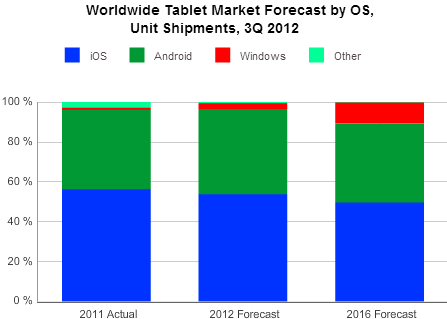
Update: IDC Raises Tablet Forecast for 2012 and Beyond As iOS Picks Up Steam, Android Gains Traction, and Windows Finally Enters the Market [IDC press release, Dec 5, 2012]

A strong competitive landscape—including surging Android tablet shipments and robust demand for Apple’s new iPad mini—has led International Data Corporation (IDC) to increase its 2012 forecast for the worldwide tablet market to 122.3 million, up from its previous forecast of 117.1 million units. In the latest forecast update of the Worldwide Quarterly Tablet Tracker, IDC also raised its 2013 forecast number to 172.4 million units, up from 165.9 million units. And by 2016 worldwide shipments should reach 282.7 million units, up from a previous forecast of 261.4 million units.
“Tablets continue to captivate consumers, and as the market shifts toward smaller, more mobile screen sizes and lower prices points, we expect demand to accelerate in the fourth quarter and beyond,” said Tom Mainelli, research director, Tablets at IDC. “Android tablets are gaining traction in the market thanks to solid products from Google, Amazon, Samsung, and others. And Apple’s November iPad mini launch, along with its surprise refresh of the full-sized iPad, positions the company well for a strong holiday season.”
In addition to increasing the unit totals for 2013, IDC also updated its operating system splits for the year to reflect Android’s growing strength in the tablet market. IDC now expects Android’s worldwide tablet share to increase from 39.8% in 2011 to 42.7% for the full year of 2012. During that same time Apple’s share will slip from 56.3% in 2011 to 53.8% in 2012. Long term, IDC predicts Windows-based tablets (including Windows 8 and Windows RT) will grab share from both iOS and Android, growing from 1% of the market in 2011 to 2.9% in 2012, on its way to 10.3% in 2016.
“The breadth and depth of Android has taken full effect on the tablet market as it has for the smartphone space,” said Ryan Reith, program manager for IDC’s Mobile Device Trackers. “Android tablet shipments will certainly act as the catalyst for growth in the low-cost segment in emerging markets given the platform’s low barrier to entry on manufacturing. At the same time, top-tier companies like Samsung, Lenovo, and ASUS are all launching Android tablets with comparable specs, but offered at much lower price points.”
Once again, IDC’s increase in tablet shipments comes at the expense of eReaders. IDC lowered its forecast for eReaders for 2012 and beyond. While the front-lit eReader offerings from Amazon and Barnes & Noble have captured the interest of a subset of consumers who prefer a dedicated eReader, most buyers are gravitating toward multi-use tablet products and finding a ‘good enough’ reading experience on these traditional back-lit tablets. IDC now expects 2012 eReader shipments to top out at 19.9 million units, down from the 27.7 million units that shipped in 2011.
Tablet Operating Systems, Market Share Forecast and CAGR 2012-2016
Tablet OS
2012 Market Share
2016 Market Share
CAGR 2012 – 2016 (%)
iOS
53.8%
49.7%
20.9%
Android
42.7%
39.7%
21.0%
Windows
2.9%
10.3%
69.2%
Other
0.6%
0.3%
7.7%
Grand Total
100.0%
100.0%
23.3%
Source: IDC Worldwide Quarterly Tablet Tracker, December 5, 2012
Table Notes:
- Windows shipments include Windows RT, Windows 8, and Windows 7 tablets.
- Shipments include shipments to distribution channels or end users. OEM sales are counted under the vendor/brand under which they are sold.
The ongoing trends in the commodity
and premium brand ecosystems of Android devices
Smartphones
Motorola likely to bid farewell to Taiwan handset ODMs after Google sells plants to Flextronics [DIGITIMES, Dec 17, 2012]
The partnerships between Motorola Mobility and Taiwan-based handset ODMs such as Foxconn International Holdings (FIH) will begin to fade away, as Google, the parent company of Motorola, has signed an agreement to hand over Motorola’s manufacturing operations in Tianjin, China, and Jaguariuna, Brazil to Flextronics International, according to industry sources.
After the deal between Google and Flextronics is completed in the first half of 2013, Motorola will completely withdraw from the handset manufacturing industry, and instead will transform to a brand operator targeting mainly the mid-range to high-end smartphone segment, the sources indicated.
While the streamlining of Motorola’s operations comes as no surprise to Taiwan handset ODMs, Google’s decision to sell Motorola’s plants to Flextronics, instead of its long-tern partner FIH, has raised concerns among the industry.
Flextronics is purchasing the plants in exchange for orders from Motorola since the Singapore-based EMS giant has made little progress in gaining handset orders from Apple or major players in the Android or Windows Phone camps, the sources commented.
It is also no longer necessary for FIH to buy plants in exchange for orders, as the company has transferred from handset EMS operations to focus on smartphone ODM business, indicated the sources, adding that FIH has also managed to establish partnerships with a number of major players in the smartphone sector.
However, a deepened cooperation between Motorola and Flextronics may affect the handset component supply chain in Taiwan, the sources warned.
Digitimes Research: Android phones to account for 70% of global smartphone market in 2013 [DIGITIMES Research, Dec 6, 2012]
Android will further solidify its market leadership in the smartphone operating system race in 2013, thanks to a broad support from smartphone vendors and the rollout of a wide range of low-priced models for sale in emerging markets. Shipments of Android phones are expected to top 600 million units or over 70% of global smartphone shipments in 2013, Digitimes Research estimates.
iOS will trail Android to take the number two position in the OS ratings with a 20% share, while other smartphone platforms will share the remaining 10%.
Shipments of Windows Phones, including 7.x and 8.x models, will grow 150% on year to 52.5 million units in 2013 for a 6.1% share, followed by RIM’s BlackBerry devices with a 3.7% share, Digitimes Research estimates. Other platforms, including Tizen and Firefox, will take up a portion lower than 1%.
Digitimes Research: Global smartphone shipments to grow 30% in 2013 [DIGITIMES Research, Nov 19, 2012]
Global smartphone shipments are expected to grow 30% to 865 million units in 2013, accounting for 43.9% of total handset shipments in the year, Digitimes Research has estimated.
Factors including relationships between platform providers and hardware makers, support from telecom carriers for new models, and key developments or decisions by some vendors will affect smartphone sales in 2013, Digitimes Research believes.
Google is expected to further strengthen its control over the Android ecosystem and its production partners, which may limit the development of other platforms or variant Android models.
Microsoft’s launch of own-brand smartphones may result in a reduction in support for the Window Phone platform by hardware vendors, which should otherwise serve as a key factor to push for the growth of the Window Phone to become a third major platform in the segment.
While Amazon is likely to enter the smartphone market, 2013 may be crucial a year for Nokia and RIM (Research in Motion) to make vital decisions concerning their smartphone businesses.
Demand for high-end smartphone models in Western Europe will be affected seriously by reduced government budgets and weak consumption in the region because of the prolonged financial crisis.
However, smartphones’ growing penetration in China, Russia, India, Indonesia, South America and other emerging markets will serve as a growth driver for global smartphone shipments in 2013, Digitimes Research believes.
Google, Amazon and other vendors in China to lead pricing in low-cost smartphone segment, say sources [DIGITIMES , Nov 5, 2012]
While sales of low-cost smartphones are expected to continue growing in the next few years, Google, Amazon and other Internet service companies in China may lead price competition in the segment, according to industry sources.
Shipments of low-cost smartphones, defined as models with a selling price of less than US$150, are forecast to double every year from 2010 to 2016, increasing from 4.5 to 311 million units, according to NPD DisplaySearch.
Most of the demand (60%) is from the Asia Pacific region, where a large majority of component suppliers and manufacturing factories are located – providing both time and cost savings, said DisplaySearch.
In China, the trend for telecom carriers to continue cooperating with chipset suppliers, handset design houses and handset vendors for the launch low-priced smatphone models will continue for a while, the sources noted.
Vendors including Huawei Device, ZTE, Lenovo and Coolpad have emerged as the leading group of the smartphone suppliers in China through the offerings of low-cost models, but most of vendors has suffered losses or seen the profits of their handset business decline due to fierce price competition in the segment, the sources revealed.
Lenovo’s handset business unit is still operating in red, and Huawei and Coolpad have seen their profits decline, while ZTE and TCL have seen their handset businesses swing from profitability to loss, the sources indicated.
In order to stemming losses, or improving profitability, most branded smartphone vendors in China have been trying to expand their share in the mid- and high-end segment, while pushing their sales through local retain channels or export sales.
But other China-based smartphone vendors such as Xiaomi Technology, Internet service companies including Baidu and Shada Interactive Entertainment, as well as online retail giant 360buy, are likely to continue to adopt aggressive price strategies to pushing sales of their own models, said the sources.
In the global market, the cooperation between Google and LG Electronics for the launch of Nexus 4 at prices ranging from US$299-349 is also expected to lead to the proliferation of more low-priced Android smartphone models, the sources indicated.
Amazon, which has been aggressive in the tablet segment, is expected to release its first smartphone model in 2013 with the same price tactics, which is likely to further drive down the prices of smartphones, commented the sources.
Digitimes Research: Nexus 4 to be popular in prepaid SIM card and telecom retail channels [DIGITIMES Research, Nov 7, 2012]
Google’s Nexus 4, which comes with a 4.7-inch 720p HD display and Qualcomm quad-core Snapdragon S4 processor, is expected to become a popular model in the prepaid SIM card segment as well as in telecom retail channels for unlocked subscribers, according to Digitimes Research.
With its high hardware specifications and pricing of US$299 for the 8GB version and US$349 for the 16GB version, the Nexus 4 will cause price pressure on other comparable models rolled by rival brands.
Sales of Windows phones are expected to grow 250% in 2013 due in part to support from telecom carriers which are seeking a third platform other than Android or iOS. However, Android will continue to lead the market with a wide margin, Digitimes Research said.
Google aggressive pricing for Nexus 4 smartphone to affect sales of other brands [DIGITIMES, Oct 30, 2012]
Google’s pricing of US$299-349 for its newly released 4.7-inch, quad-core Nexus 4 smartphone is lower than market expectations, and thus could affect the sales of Android-based smartphones launched by other branded vendors, according to industry sources.
Prior to the release of the Nexus 4 in cooperation with LG Electronics, Google had cooperated with HTC and Samsung Electronics, respectively, for the launch of three generations of Nexus smartphones with prices ranging from US$500-700.
The Nexus 4 will enjoy the advantage in pricing even compared to the latest quad-core Android models rolled out by other vendors, indicated the sources, noting that Asustek Computer’s 4.7-inch Padfone 2 is available for US$600, while China-based Xiaomi Technology’s second-generation Xiaomi phone is priced at CNY1,999 (US$320).
Other Android-based smartphone vendors, including HTC, Sony Mobile Communications, Huawei Device, ZTE and even Motorola Mobility, all are likely to adjust their price strategies, since chances are high that the Nexus 4 will make a strong impact on the smartphone market, commented the sources.
China market: Nexus 4 pricing to affect sales, prices of other brands, says report [DIGITIMES, Nov 7, 2012]
The aggressive pricing strategy adopted by Google for its Nexus 4 may affect sales of Xiaomi smartphones in China and may also force other brands including Samsung Electronics, Motorola and HTC to lower the prices of their offerings in China, according to a China-based 21st Century Business Herald report.
The price of US$299 (CNY1,890) for the 8G version of the Nexus 4 is more competitive than Xiaomi’s next-generation quad-core smartphone which is available at CNY1,999, the paper noted.
Xiaomi is selling its first quad-core model below its BOM of CNY2,350 and will limit initial sales of the model to 50,000 units only, said the paper, which added that Xiaomi aims to ramp up volumes to 250,000 units to bring down the BOM when it begins to offer the second round of sales in mid-November.
Although the Nexus is not yet available in China, consumers may hesitate to pick up the quad-core Xiaomi smartphones because they have to wait for several months before Xiaomi will begin delivering the devices, said the paper.
China market: Coolpad hopes to regain mid-range, high-end smartphone share [DIGITIMES , Nov 7, 2012]
China-based handset maker Coolpad hopes to re-enter the mid-range and high-end smartphone market in China by introducing smartphone products with China Mobile that will be priced above CNY5,000/unit (US$800/unit).
In the recent years, Coolpad has been focusing on smartphones at the price range of CNY1,000/unit by cooperating with China’s three telecom service providers. Entry-level and mid-range models have accounted for 85% of Coolpad’s total shipments. The firm recently introduced a new model, Coolpad 9960 (Da Guan HD), with a 4.7-inch screen, Nvidia Tegra 3 quad-core processor, and a 13-megapixel front camera. The model will be priced above CNY5,000/unit.
Currently, China’s mid-range and high-end smartphone markets have been dominated by international brands such as Apple, HTC, Motorola, and Sony. Coolpad has been the only local brand that has a relatively strong market share.
According to industry sources, in 2012, Coolpad increased investment in R&D of high-end products by 20% on year and formed an R&D team of 800 staff to strengthen its high-end product line.
Lenovo, Huawei, ZTE faced with challenges to reach quarterly shipments of 10 million smartphones, say Taiwan makers [DIGITIMES , Nov 5, 2012]
A total of 60 million smartphones were shipped to the China market in the third quarter of 2012, and Lenovo, Huawei and ZTE shipped nine million units, 8.5 million units and 7.5 million units, respectively, with a combined market share of 41.7%, according to DRAMeXchange under consulting company TrendForce.
Except for Apple and Samsung Electronics, other international vendors including HTC, Sony Mobile Communications, LG Electronics, Nokia have not been able to attain quarterly shipments of 10 million smartphones, the sources indicated. Lenovo, Huawei and ZTE stand a chance to ship 10 million smartphones a quarter if they can strengthen their branding operations, marketing and product lines of mid-range and high-end models in overseas markets, the sources pointed out.
Lenovo has focused on entry-level smartphones priced below CNY1,500 (US$240) and relied too much on the domestic market, the sources indicated. In comparison with Lenovo, Huawei and ZTE have the advantage of cooperation with mobile telecom carriers in many countries, but their brand image is not strong enough for marketing mid-range and high-end smartphones, the sources pointed out.
PC vendors recommended to target niche smartphone market to avoid direct competition [DIGITIMES , Oct 3, 2012]
Branded PC vendors including Hewlett-Packard (HP) and Asustek Computer, which plan to reignite their smartphone businesses, are recommended to offer models with strong application platforms, sleek product design and integrated cloud computing capabilities targeting niche markets, while avoiding direct competition with smartphone vendors, according to sources at Taiwan’s handset supply chain.
Among the leading brands, HP, Dell and Asustek have not launched new handsets for some time, while Acer has made little progress in the sector although it has continued rolling out new phones, indicated the sources.
Lenovo’s performance has been exceptional, taking the second-ranked title in China’s smartphone market by optimizing an array of entry-level models priced at around CNY1,000 (US$158).
The reason major branded PC vendors are considering a comeback to the smartphone market hinges on emerging business opportunities that are anticipated to come along with the launch of Windows 8. They are hoping that sales of Windows 8-based PCs will help promote the sale of Windows Phone 8 smartphones as well.
Even so, prospects are still slim for PC brands to make a strong presence in the smartphone market, given that Apple and Samsung Electronics are currently the top-2 vendors dominating the segment, while other smartphone brands including Nokia, RIM, Sony Mobile Communications, Motorola Mobility are lagging behind with heavy losses, the sources commented.
Worldwide Mobile Phone Growth Expected to Drop to 1.4% in 2012 Despite Continued Growth Of Smartphones, According to IDC [IDC press release, Nov 1, 2012]
The worldwide mobile phone market is forecast to grow 1.4% year over year in 2012, the lowest annual growth rate in three years despite a projected record number of smartphone shipments in the high-volume holiday season. According to the International Data Corporation (IDC) Worldwide Quarterly Mobile Phone Tracker, vendors will ship more than 1.7 billion mobile phones this year. In 2016, IDC forecasts 2.2 billion mobile phones will be shipped to the channel.
Global smartphone volume in the fourth quarter of 2012 (4Q12) is expected to reach 224.5 million units, representing 39.5% year-over-year growth due primarily to strong consumer demand. For the year, smartphone shipments are forecast to grow 45.1% year over year to 717.5 million units. Strong smartphone growth is a result of a variety of factors, including steep device subsidies from carriers, especially in mature economic markets where carriers resell the majority of smartphones, as well as a growing array of sub-US$250 smartphones in emerging markets.
“Sluggish economic conditions worldwide have cast a pall over the mobile phone market this year,” said Kevin Restivo, senior research analyst with IDC’s Worldwide Quarterly Mobile Phone Tracker. “However, the fourth quarter will be relatively bright due in part to sales of high-profile smartphones, such as the iPhone 5 and Samsung’s Galaxy S3, in addition to lower-cost Android-powered smartphones shipped to China and other high-growth emerging markets.”
Smartphone Operating Systems
“Underpinning the worldwide smartphone market is a constantly shifting mobile operating system landscape,” added Ramon Llamas, research manager with IDC’s Mobile Phone team. “Android is expected to stay in front, but we also expect it to be the biggest target for competing operating systems to grab market share. At the same time, Windows Phone stands to gain the most market share as its smartphone and carrier partners have gained valuable experience in selling the differentiated experience Windows Phone has to offer. What bears close observation is how BlackBerry’s new platform, BlackBerry 10, and multiple versions of Linux will affect the market once the devices running these systems are available.”
IDC forecasts Android to be the clear leader in the smartphone mobile operating system race, thanks in large part to a broad selection of devices from a wide range of partners. Samsung is the leading Android smartphone seller though resurgent smartphone vendors LG Electronics and Sony, both of which cracked the top five smartphone vendors during 3Q12, are not to be overlooked. IDC believes the net result of this will be continued double-digit growth throughout the forecast period.
iOS will maintain its position as the clear number two platform behind Android at the end of 2012 and throughout the forecast. The popularity of the iPhone across multiple markets will drive steady replacements and additional carrier partners will help Apple grow iOS volume. However, the high price point of the iPhone relative to other smartphones will make it cost prohibitive for some users within many emerging markets. In order to maintain current growth rates, Apple will need to examine the possibility of offering less expensive models, similar to its iPod line. Until that happens, IDC forecasts iOS to ship lower volumes than Android.
The BlackBerry OS will grow slowly but largely maintain share over the coming years following the BlackBerry 10 launch next year. The new operating system and devices will be valued by some longtime BlackBerry fans, particularly those who have waited for the new OS as Research In Motion delayed its release. This will allow the company to maintain pockets of strength in higher-growth emerging markets such as Indonesia and various Latin American countries. But, as with many other new platforms, the success of BB 10 will be partly dependent upon channel advocacy, like sales associates who can effectively tell the BlackBerry story.
Windows Phone will battle with BlackBerry for the number three spot in 2013, but will gain further clarity in the years that follow. Windows Phone will build on the progress it made in 2012, with Nokia establishing its presence and HTC solidly jumping back into the race. Moreover, contributions by Samsung, ZTE, and Huawei will help grow its footprint. With more vendors releasing more devices aimed at multiple segments, sales associates will be better positioned to tell a compelling Windows Phone story and to explain the value of Windows Phone’s differentiated experience compared to market leaders Android and iOS.
Linux will trail the market leaders throughout our forecast though it is expected to be the dark horse of the forecast. K-Touch has quietly built its Linux volumes this year while Haier recently released its first Linux smartphones. In addition, multiple platforms are expected to announce and launch their Linux-based smartphones in 2013, including Samsung’s Tizen and Jolla’s SailFish. Benefiting these platforms are their ties to previous platforms from the LiMo Foundation and Nokia’s MeeGo, which could lead to greater developer interest.
Top Smartphone Operating Systems, Forecast Market Share and CAGR, 2012–2016
Smartphone OS
2012 Market Share
2016 Market Share
CAGR 2012 – 2016 (%)
Android
68.3%
63.8%
16.3%
iOS
18.8%
19.1%
18.8%
BlackBerry OS
4.7%
4.1%
14.6%
Windows Phone
2.6%
11.4%
71.3%
Linux
2.0%
1.5%
10.5%
Others
3.6%
0.1%
-100.0%
Total
100.0%
100.0%
18.3%
Source: IDC Worldwide Mobile Phone Tracker, December 3, 2012

Android Marks Fourth Anniversary Since Launch with 75.0% Market Share in Third Quarter, According to IDC [IDC press release, Nov 1, 2012]
The Android smartphone operating system was found on three out of every four smartphones shipped during the third quarter of 2012 (3Q12). According to the International Data Corporation (IDC) Worldwide Quarterly Mobile Phone Tracker, total Android smartphone shipments worldwide reached 136.0 million units, accounting for 75.0% of the 181.1 million smartphones shipped in 3Q12. The 91.5% year-over-year growth was nearly double the overall market growth rate of 46.4%.
“Android has been one of the primary growth engines of the smartphone market since it was launched in 2008,” said Ramon Llamas, research manager, Mobile Phones at IDC. “In every year since then, Android has effectively outpaced the market and taken market share from the competition. In addition, the combination of smartphone vendors, mobile operators, and end-users who have embraced Android has driven shipment volumes higher. Even today, more vendors are introducing their first Android-powered smartphones to market.”
“The share decline of smartphone operating systems not named iOS since Android’s introduction isn’t a coincidence,” said Kevin Restivo, senior research analyst with IDC’s Worldwide Quarterly Mobile Phone Tracker. “The smartphone operating system isn’t an isolated product, it’s a crucial part of a larger technology ecosystem. Google has a thriving, multi-faceted product portfolio. Many of its competitors, with weaker tie-ins to the mobile OS, do not. This factor and others have led to loss of share for competitors with few exceptions.”
Mobile Operating System Highlights
Android, having topped the 100 million unit mark last quarter, reached a new record level in a single quarter. By comparison, Android’s total volumes for the quarter were greater than the total number of smartphones shipped in 2007, the year that Android was officially announced. Samsung once again led all vendors in this space, but saw its market share decline as numerous smaller vendors increased their production.
iOS was a distant second place to Android, but was the only other mobile operating system to amass double-digit market share for the quarter. The late quarter launch of the iPhone 5 and lower prices on older models prevented total shipment volumes from slipping to 3Q11 levels. But without a splashy new OS-driven feature like Siri in 2011 and FaceTime in 2010, the iPhone 5 relied on its larger, but not wider, screen and LTE connectivity to drive growth.
BlackBerry‘s market share continued to sink, falling to just over 4% by the end of the quarter. With the launch of BlackBerry 10 yet to come in 2013, BlackBerry will continue to rely on its aging BlackBerry 7 platform, and equally aging device line-up. Still, demand for BlackBerry and its wildly popular BBM service is strong within multiple key markets worldwide, and the number of subscribers continues to increase.
Symbian posted the largest year-on-year decline of the leading operating systems. Nokia remains the largest vendor still supporting Symbian, along with Japanese vendors Fujitsu, Sharp, and Sony. Each of these vendors is in the midst of transitioning to other operating systems and IDC believes that they will cease shipping Symbian-powered smartphones in 2013. At the same time, the installed base of Symbian users will continue well after the last Symbian smartphone ships.
Windows Phone marked its second anniversary with a total of just 3.6 million units shipped worldwide, fewer than the total number of Symbian units shipped. Even with the backing of multiple smartphone market leaders, Windows Phone has yet to make a significant dent into Android’s and iOS’s collective market share. That could change in 4Q12, when multiple Windows Phone 8 smartphones will reach the market.
Linux volume declined for the third straight quarter as did its year-over-year growth. Samsung accounted for the majority of shipments once again, but like most other vendors competing with Linux-powered smartphones, most of its attention went towards Android instead. Still, that has not deterred other vendors from experimenting, or at least considering the open-source operating system, as multiple reports of Firefox, Sailfish, and Tizen plan to release new Linux-based experiences in the future.
Top Six Smartphone Mobile Operating Systems, Shipments, and Market Share, Q3 2012 (Preliminary) (Units in Millions)
Operating System
3Q12 Shipment Volumes
3Q12 Market Share
3Q11 Shipment Volumes
3Q11 Market Share
Year-Over-Year Change
Android
136.0
75.0%
71.0
57.5%
91.5%
iOS
26.9
14.9%
17.1
13.8%
57.3%
BlackBerry
7.7
4.3%
11.8
9.5%
-34.7%
Symbian
4.1
2.3%
18.1
14.6%
-77.3%
Windows Phone 7/ Windows Mobile
3.6
2.0%
1.5
1.2%
140.0%
Linux
2.8
1.5%
4.1
3.3%
-31.7%
Others
0.0
0.0%
0.1
0.1%
-100.0%
Totals
181.1
100.0%
123.7
100.0%
46.4%
Source: IDC Worldwide Mobile Phone Tracker, November 1, 2012
Note: Data are preliminary and subject to change. Vendor shipments are branded shipments and exclude OEM sales for all vendors.Android Smartphone Shipments and Market Share, 2008 – 2012 YTD (Units in Millions)
2008
2009
2010
2011
2012 YTD
Android Total Unit Shipments
0.7
7.0
71.1
243.4
333.6
Android Market Share
0.5%
4.0%
23.3%
49.2%
68.2%
Source: IDC Worldwide Mobile Phone Tracker, November 1, 2012
Note: Data are preliminary and subject to change. Vendor shipments are branded shipments and exclude OEM sales for all vendors.
Gartner Says Worldwide Sales of Mobile Phones Declined 3 Percent in Third Quarter of 2012; Smartphone Sales Increased 47 Percent [Gartner press release, Nov 14, 2012]
Samsung Extended Its Lead in the Smartphone Market Widening the Gap with Apple
Worldwide sales of mobile phones to end users reached almost 428 million units in the third quarter of 2012, a 3.1 percent decline from the third quarter of 2011, according to Gartner, Inc. Smartphone sales accounted for 39.6 percent of total mobile phone sales, as smartphone sales increased 46.9 percent from the third quarter of 2011.
While the mobile phone market declined year-on-year, Gartner analysts said there were positive signs for the industry during the third quarter.
“After two consecutive quarter of decline in mobile phone sales, demand has improved in both mature and emerging markets as sales increased sequentially,” said Anshul Gupta, principal research analyst at Gartner. “In China, sales of mobile phones grew driven by sales of smartphones, while demand of feature phones remained weak. In mature markets, we finally saw replacement sales pick up with the launch of new devices in the quarter.”
Smartphones continued to fuel sales of mobile phones worldwide with sales rising to 169.2 million units in the third quarter of 2012. The smartphone market was dominated by Apple and Samsung. “Both vendors together controlled 46.5 percent of smartphone market leaving a handful of vendors fighting over a distant third spot,” said Mr. Gupta.
Nokia slipped from No. 3 in the second quarter of 2012 to No. 7 in smartphone sales in the third quarter of 2012. RIM moved to the No. 3 spot with HTC not far behind, at No. 4. “Both HTC and RIM have seen their sales declining in past few quarters, and the challenges might prevent them from holding on to their current rankings in coming quarters,” added Mr. Gupta.
While seasonality in the fourth quarter of 2012 will help end-of-year mobile phone sales to end users, Gartner analysts said that there will be a lower-than-usual boost from the holiday season. Consumers are either cautious with their spending or finding new gadgets like tablets, as more attractive presents.
Samsung’s mobile phones sales continued to accelerate, totaling almost 98 million units in the third quarter of 2012 (see Table 1), up 18.6 percent year-on-year. Samsung saw strong demand for Galaxy smartphones across different price points, and it further widened the gap with Apple in the smartphone market, selling 55 million smartphones in the third quarter of 2012. It commanded 32.5 percent of the global smartphone market in the third quarter of 2012.
Table 1
Worldwide Mobile Device Sales to End Users by Vendor in 3Q12 (Thousands of Units)
Company
3Q12
Units
3Q12 Market Share (%)
3Q11
Units
3Q11 Market Share (%)
97,956.8
22.9
82,612.2
18.7
Nokia
82,300.6
19.2
105,353.5
23.9
Apple
23,550.3
5.5
17,295.3
3.9
ZTE
16,654.2
3.9
14,107.8
3.2
LG Electronics
13,968.8
3.3
21,014.6
4.8
Huawei Device
11,918.9
2.8
10,668.2
2.4
TCL Communication
9,326.7
2.2
9,004.7
2.0
Research in Motion
8,946.8
2.1
12,701.1
2.9
Motorola
8,562.7
2.0
11,182.7
2.5
HTC
8,428.6
2.0
12,099.9
2.7
Others
146,115.1
34.2
145,462.2
32.9
Total
427,729.5
100.0
441,502.2
100.0
Source: Gartner (November 2012)
Nokia’s mobile phone sales declined 21.9 percent in the third quarter of 2012, but overall sales at 82.3 million were better than Gartner’s early estimate, largely driven by increased sales of the Asha full touch range. Nokia had a particularly bad quarter with smartphone sales, and it tumbled to the No. 7 worldwide position with 7.2 million smartphones sold in the third quarter. The arrival of the new Lumia devices on Windows 8 should help to halt the decline in share in the fourth quarter of 2012, although it won’t be until 2013 to see a significant improvement in Nokia’s position.
Apple’s sales to end users totaled 23.6 million units in the third quarter of 2012, up 36.2 percent year-on-year. “We saw inventory built up into the channel as Apple prepared for the coming holiday season, global expansions and the launch into China in the fourth quarter of 2012,” said Mr. Gupta. With iPhone 5 launching in more territories in the fourth quarter of 2012, including China, and the upcoming holiday season Gartner analysts expect Apple will have its traditionally strongest quarter.
In the smartphone market, Android continued to increase its market share, up 19.9 percentage points in the third quarter of 2012. Although RIM lost market share, it climbed to the No. 3 position as Symbian is nearing the end of its lifecycle. There was also channel destocking in preparation of new device launches for RIM, which resulted into 8.9 million sales to end users in the third quarter of 2012. With the launch of iPhone 5, Gartner analysts expect iOS share will grow strongly in the fourth quarter of 2012 because users held on to their replacements in many markets ahead of the iPhone 5 wider roll out. Windows Phone’s share weakened quarter-on-quarter as the Windows Phone 8 launch dampened demand of Windows Phone 7 devices.
Table 2
Worldwide Mobile Device Sales to End Users by Operating System in 3Q12 (Thousands of Units)
Operating System
3Q12
Units
3Q12 Market Share (%)
3Q11
Units
3Q11 Market Share (%)
Android
122,480.0
72.4
60,490.4
52.5
iOS
23,550.3
13.9
17,295.3
15.0
Research In Motion
8,946.8
5.3
12,701.1
11.0
Bada
5,054.7
3.0
2,478.5
2.2
Symbian
4,404.9
2.6
19,500.1
16.9
Microsoft
4,058.2
2.4
1,701.9
1.5
Others
683.7
0.4
1,018.1
0.9
Total
169,178.6
100.0
115,185.4
100.0
Source: Gartner (November 2012)
Additional information can be found in the Gartner report “Market Share: Mobile Phones by Region and Country, 3Q12.” The report is available on Gartner’s website at http://www.gartner.com/resId=2236115.
Tablets
Digitimes Research: Global tablet shipments to surpass that of notebooks in 2013 [DIGITIMES Research, Nov 19, 2012]
Digitimes Research expects global tablet shipments to reach 210 million units in 2013, up 38.3% on year and surpass those of notebook for the first time, with branded tablet shipments to account for 140 million units, according to Digitimes Research senior analyst James Wang.
[Compare this to the notebook shipment forecast by Digitimes Research of 192 million units in 2012 expected to drop to 189 million units in 2013. See additional details of this forecast below in Digitimes Research: Windows 8 expected to have minimal impact on touch screen notebooks in 2013.]In 2013, Google is expected to maintain its momentum from the Nexus series products and become the second largest tablet brand vendor worldwide with shipments of 19 million units. Apple will remain the largest tablet vendor worldwide, but its share in the global branded tablet shipments will drop to only 55.6% [i.e. 78 million units], down from more than 60% in 2012, and 37.4% in total tablet shipments (including white-box models).
With surging shipment growth for white-box tablets, Android is expected to become the largest platform in the tablet market, surpassing iOS. In 2013, Digitimes Research expects Android-based tablet shipments including white-box and branded models, to reach 121 million units, up 40.2% on year. [With the global 210 millions and branded 140 millions the white-box tablet shipments are expected to grow to 70 million units in 2013 vs. 50 millions this year. Therefore the branded Android based-tablets to become 51 millions, and as the Nexus tablets are said here to become 19 millions there will be 32 millions other branded Android tablets sold in 2013 .]
Digitimes Research also expects global tablet shipments will reach 320 million units in 2015 with branded tablets to account for 220 million units and white-box models to account for 100 million units.
Digitimes Research: Global Tablet Market to Enjoy Strong Shipment Growth in 4Q12 [DIGITIMES Research, Nov 13, 2012]
Global tablet shipments from major brands worldwide are expected to reach 40.93 million units in the fourth quarter of 2012, up 72.7% sequentially and 89.7% on year, according to Digitimes Research senior analyst James Wang.
As for the tablet vendor rankings in the quarter, Apple will remain as the largest vendor worldwide, while Amazon is expected to return as the second-largest and Google will rank third with assistance from its Nexus 7 and Nexus 10. Microsoft will rank fourth, Samsung Electronics fifth, and Barnes & Noble sixth. Asustek, Lenovo and Acer will rank seventh, eighth and ninth, respectively, Wang noted.
As for the tablet processor supplier rankings, Texas Instruments (TI) will return as the second-largest with Nvidia at third. Intel will also be ranked for the first time due to Windows 8.
Taiwan makers are expected to ship 36.6 million tablets combined in the fourth quarter, up 82.3% sequentially and 86.7% on year, with the volume accounting for 89% of global tablet shipments. Foxconn Electronics (Hon Hai Precision Industry) will be the largest tablet maker, followed by Quanta Computer, Pegatron Technology, Wistron and Compal Electronics.
Digitimes Research estimates that global branded tablet shipments will reach 104 million units in 2012, up 64% on year, with iPad accounting for 63% of the volume, down 2pp on year, while both Android and Windows will see their proportions increase.
In comparison the white-box tablet shipments are up by whopping 317% in 2012 at least (50 million units shipped as a minimum vs. 12 million units in 2011) according to sources given below:
Digitimes Research: White-box tablet shipments to surpass 50 million units in 2012 [DIGITIMES Research, Nov 8, 2012]
White-box tablets are expected to see a surge in shipment growth in 2012 with volumes surpassing 50 million units, according to Digitimes Research senior analyst James Wang.
There are three major drivers that will help white-box tablets achieve strong growth in the year: a large number of potential consumers brought in by Android handsets, mature development of China-based processors, and decreasing costs o white-box tablets. With the addition of white-box tablet shipments, Android is expected to surpass iOS and become the largest mobile operating system in 2012, while 7-inch displays will also become the mainstream specification for tablets.
As the branded tablet PC market is seeing fierce competition in terms of technology, capacity, yield rates, patents and prices, the rise of white-box tablets has already made these players a new force in the tablet market, with some white-box players even seeing higher shipment volumes than first-tier vendors.
Digitimes Research believes that brand vendors should be aware of white-box tablet players’ developments in the future, since even platform designers such as Google and Microsoft have used their resources to increase price competition in the tablet market, and the situation may gradually turn to favor China-based players with expertise in lowering costs.
Source: Digitimes Research, November 2012
or from the Chinese version of the same [Nov 9, 2012]:
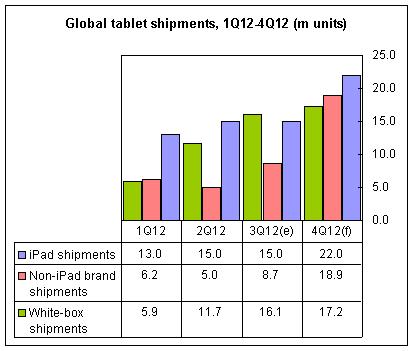

China Fabless: Rockchip rattled by Android tablet wars [by Junko Yoshida on EE Times, Sept 25, 2012]
…
How many tablets does China make, how big is the Chinese market?
80 percent of media tablets made in China are exported

Unit: Million of units
Source: Chinese industry estimates
For more information see also: Yoshida in China: ‘Shanzhai’ clouds tablet data [EE Times, Nov 8, 2012]
In retrospect: just 4 months ago the forecast was increased from 30 million to 40 million
Global shipments of white-box tablet PCs to reach 40 million units in 2012, say chip designers [DIGITIMES, July 25, 2012]
Forecast global shipments of white-box tablet PCs in 2012 have been upward adjusted from 30 million units originally to 40 million units due to growing demand in emerging markets including China, India, Thailand and Latin America, according to Taiwan-based design houses of ICs used in tablet PCs.
An estimated 10 million white-box tablet PCs were shipped globally in 2011, and shipments increased to 18 million units in the first half of 2012, the sources indicated.
Vendors/makers of white-box tablet PCs currently cluster in Shenzhen and Dongguan, southern China, the sources noted. A large portion originally made netbooks and have stepped into tablet PCs as chips and the Android operating systems have matured, the sources said.
White-box tablet PCs are primarily competitive in price with models launched by own-brand vendors, with retail prices standing at US$59 for 7-inch models and US$149 for 10.1-inch models, the sources indicated.
China market: Domestic chipset vendors ramping up shipments to white-box tablet PC makers [DIGITIMES, July 20, 2012]
China-based chipset solution vendors including Rockchip Electronics and Allwinner Technology have been ramping up their shipments to white-box tablet PC vendors in China, cutting out market share from Taiwan-based VIA Technologies, according to industry sources.
Shipments of white-box tablet PCs in China totaled eight million units in the first half of 2012 and are expected to reach 16-17 million units for the year, compared to 20 million projected previously, the sources indicated.
Rockchip shipped at least 1.6 million tablet chipset solutions in the first half, accounting for 20% of the white-box tablet PC segment. Rockchip’s latest ARM-based dual-core solution, the SoC RK3066, is being built using a 40nm process at Taiwan Semiconductor Manufacturing Company (TSMC), said the sources.
Allwinner has been delivering more of its A10 solutions, which are also manufactured by TSMC utilizing a 55nm process, added the sources.
then came the news that: Demand for white-box tablets keeps growing despite keen competition [DIGITIMES, Oct 15, 2012]
Demand for white-box tablets rolled out by China-based makers remains strong currently despite the launch of US$199 models by Amazon, Barnes & Noble and Google, and the dominance of Apple’s iPads, according to industry sources.
Some white-box makers in Shenzhen are shipping 200,000-300,000 tablets a month, and a number of large-scale operators are even shipping one million units a month, buoyed by their tactics of optimizing hardware specifications, while keeping device prices low, noted the sources.
Most 9.7- or 10.1-inch white-box tablets powered by a dual-core CPU are currently quoted below US$200, while those comparable models with a single-core processor are priced at US$70-120, revealed the sources.
Some 7-inch models built with China-based Allwinner’s A10 solutions can be available for US$50, the sources added.
Additionally, the FOB prices of US$150-250 for 9.7-inch white-box tablets with dual-core CPUs, high resolution displays and 3G modules are also competitive in emerging markets, the sources commented.
Some tablet exhibitors at the ongoing HKEF 2012 (Hong Kong Electronics Fair, Autumn Edition) estimate that China-based white-box makers as a whole are shipping four million tablets a month currently.
Allen Wu, president, ARM China, predicts that shipments of Android-based tablets by China makers are likely to reach 50 million units in 2012 and increase to 100 million units in 2013.
Over 5.0 million Nexus 7s to be shipped in 2012, say Taiwan makers [DIGITIMES Research, Nov 19, 2012]
At the end of the second quarter, Google expected shipments of 2.5 million Nexus 7s in 2012 but since then it has continually placed additional orders in view of booming sales, with the cumulative shipment volume in 2012 will reach 5.0 million units based on orders released, according to Taiwan-based players in the supply chain.
While international vendors usually place orders for shipments to peak in October and November to meet year-end peak demand beginning in late November, Nexus 7 shipments are expected to remain at a high level of 700,000-1,000,000 units in both November and December, the sources pointed out.
After the launch of the 16Gb Nexus 7 for sale at US$199 and a 32GB version at US$249, Google on November 13 launched a 32GB 3G-enabled Nexus 7 for sale at US$299 and Google Play and Google’s partner AT&T have sold out available stock, the sources indicated.
While the iPad mini is thought of as a major competitor for the Nexus 7, Taiwan-based iPad mini supply chain makers indicated that Apply has not adjusted order volumes since the tablet was launched and monthly shipments remain at nearly 4.0 million units currently.
Digitimes Research: Google will become more influential in tablet market [DIGITIMES Research, Nov 2, 2012]
Senior analyst James Wang of Digitimes Research believes that Google’s recently announced Nexus 10, developed in cooperation from Samsung Electronics, and upgraded storage for the Nexus 7, are aimed at starting competition with players such as Apple, Amazon, Barnes & Noble and China-based white-box tablet vendors.
Since Google has prepared a full-range of tablet products, Wang believes the company’s entry-level Nexus tablet, that has not yet been announced, will have the strongest influence on its competitors.
Google’s Nexus 7 shipments performed better than expected, and are forecast to reach 4.3 million units in 2012, accounting for about 20% of non-Apple tablet shipments (excluding white-box models), while the volume in the fourth quarter is also expected to enjoy sequential growth despite the weak global economy, Wang pointed out.
Digitimes Research estimates that Google’s Nexus series tablets will see total shipments of 19 million units in 2013
accounting for 50% of non-Apple tablet shipments. [In a later estimate Wang raised the shiments of other branded Android tablets to 32 millions, see also here in the beginning, so Google’s Nexus marketshare now is only 37% in its own category.]
But note: Nexus 7 not yet allowed to enter China market [DIGITIMES Research, Sept 11, 2012]
While the Nexus 7, the tablet co-developed by Google and Taiwan-based vendor Asustek Computer, has been witnessing booming sales in major markets around the world, it is difficult for the model to be available for sale in the China market because the China government has not yet approved its import, according to industry sources in Taiwan.
The China government’s negative attitude is interpreted as a response to Google’s announcement of withdrawing from the China market in March 2010, the sources pointed out. It is difficult for the Nexus 7 to enter the China market, even through sale of Asustek’s marketing network there, the sources indicated.
Without the Nexus 7 in the market, China-based white-box vendors of tablets are under much less competitive pressure, the sources indicated. This is because the Nexus 7 has the advantage of Google’s and Asustek’s brand image with commensurate product quality and is expected to be strongly competitive with 8GB Android 4.0 tablet models in the 7- to 9-inch range launched by China-based white-box vendors, including Ainol, Onda, Teclast and Cube, at US$149, the sources pointed out. In addition, the Nexus 7 will bring competitive pressure on tablet PC models of equal specifications offered by Samsung Electronics and China-based vendors Lenovo and Hasee Computer in the China market, the sources indicated.
Without the China market, the cumulative global sales volume of Nexus 7 will reach an estimated 3.5 million units at the end of 2012, the sources noted.
Google attitude against modified Android may lead to split in Android, say Taiwan handset makers [DIGITIMES Research, Sept 18, 2012]
Google’s opposition to Taiwan-based vendor Acer’s launch of the A800, a smartphone based on the Alibaba-developed operating system Aliyun, reflects Google’s attempt to check development of modified Android platforms, but if Google cracks down on this, developers of modified Android platforms may be forced to offer own-brand smartphones or tablets and give up on Android, resulting in an increased split in the adoption of Android, according to Taiwan-based handset supply chain makers.
Google explained that Aliyun is incompatible with the Google ecosystem and therefore unable to ensure a consistent user experience among developers, makers and consumers, the sources noted. In response, Alibaba emphasized that Aliyun, while based on open-source Linux as Google is, is not part of the Google ecosystem and therefore is not necessarily compatible with the ecosystem, the sources indicated.
Developers of modified Android platforms such as Amazon and Alibaba are not members of the Open Handset Alliance and are Google’s competitors, they need not care about Google’s attitude, the sources pointed out. However, smartphone vendors need to cooperate with Google to offer Android models and therefore have to be concerned about Google’s attitude against modified Android platforms, the sources indicated.
If Google cracks down by prohibiting smartphone vendors from adopting modified Android platforms, developers of modified Android platforms, such as Amazon, may skip vendors to directly partner with ODMs to offer their own-brand devices, with such platforms to set up their own ecosystems and thereby become more competitive with Android, the sources pointed out. For some China-based smartphone vendors which have adopted many locally developed applications, because losses arising from forgoing Android may be small, they may shift to a modified Android platforms.
Among China-based smartphone vendors, only Huawei Technologies, ZTE, Lenovo, Haier, Oppo and a few others joined the Open Handset Alliance, the sources noted. As China is the largest smartphone market around the world, Google had better pay attention to response from web service operators, smartphone vendors and consumers, the sources pointed out.
Commentary: Is it a blessing for Asustek to have Google backing? [DIGITIMES, Nov 7, 2012]
Asustek Computer has seen its brand image improve in the US and Japan recently thanks to the launch of dual-branded Nexus 7 in cooperation with Google. Asustek is proud of its product design with regard to the Nexus 7, and also aims to capture the top-vendor ranking in the Android tablet segment. But it remains to be seen whether Asustek will be able to continue to expand its brand image based on the charm of the Nexus 7, since Google has announced its Nexus 10 in conjunction with Samsung Electronics.
Google has been backing Asustek in the development of the Nexus 7, offering the Taiwan-based hardware vendor the priority to design-in its latest Android OS and to penetrate into the US tablet market jointly.
Due to aggressive pricing set for the Nexus 7, industry watchers have wondered whether the Google-Asustek cooperation would generate profits for Asustek before the production of the 7-inch tablet reaches economies of scale. But for Asustek, the dual-brand marketing was not aiming at generating profits initially but rather improving its brand image, particularly in North America.
Optimizing Asustek’s design capability and Quanta Computer’s manufacturing muscle, the Google-Asustek team is able to set the price of the Nexus 7 lower. The low-priced tactics is working as sales of the Nexus 7 have been better than expected, while Asustek’s notebook sales in the US are also improving.
Some industry watchers now estimate that total shipments of the Nexus 7 are likely to reach 4-4.2 million units by year-end 2012, while Asustek will also be able to sell more of its own brand notebooks in the US.
But the skepticism about the merits of the Google-Asustek tie-up still remains, since Google has showed its intention to control the development of the Android market, optimizing the production of the 7-inch Nexus 7 at Asustek and the 10-inch model at Samsung. Furthermore, the latest market rumors also indicate that Google may also team up with Lenovo for penetrating into the China market.
Does Google treat Asustek as a brand partner or an OEM supplier? John Lagerling, director of business development for Android, seems to have an answer to the question.
When approached by the New York Times during a recent interview seeking a confirmation of Asustek’s remarks that current shipments of the Nexus 7 have reached as many as one million units a month, Lagerling replied, “We haven’t announced numbers. We typically don’t allow our partners to announce numbers.”
The message clearly indicates that Google treats Asustek as an OEM partner, but not a dual-brand partner.
In the worst-case scenario, Google may tie up with other vendors such as HTC and Lenovo to develop its next-generation Nexus tablets, which will place Asustek under fire from rivals vying for the Android tablet market.
Asustek has estimated its tablet shipments to reach 6.3 million units in 2012, of which the Nexus 7 will account for over four million. In other words, shipments of Asustek’s own brand Transformer and Padfone tablets are limited.
Asustek’s competitive advantage will wane further if it fails to win the design-in priority for the next-generation Nexus tablets.
The emerging new trends
in the premium ecosystem of the Windows devices
[Windows] Notebooks
Third-generation ultrabooks may be able to achieve 40% of notebook shipments, say players [DIGITIMES, Dec 11, 2012]
As Intel failed to achieve its goal of having ultrabooks account for 40% of total notebook shipments with its Ivy Bridge platform, and the proportion only reached about 10%, sources from notebook players believe the goal may be achievable with the upcoming Haswell platform, which is set to launch at the end of second-quarter, 2013.
The sources pointed out that compared to Ivy Bridge, Haswell’s stronger performance and cheaper price, plus the expectation that Windows 8 should become more standardized by then, should mean ultrabooks have a chance to account for 40% of total notebook shipments by the end of 2013.
Although vendors have released ultra-like notebooks with prices around US$699-899 as alternatives, since these devices lack attractiveness in terms of design and weight, while ultrabook models with specifications similar to the MacBook Air have prices a lot higher than the MacBook Air, most consumers have turned to purchase Apple’s product instead, the sources noted.
Digitimes Research: Surface tablet to mainly devour notebook demand in the short term [DIGITIMES Research, Oct 30, 2012]
Microsoft’s recently launched own-brand Surface tablets have raised the question of whether Surface will devour consumer demand for tablets or notebooks, or maybe even both. In terms of hardware, Surface is capable of satisfying consumer demand for notebooks, but to replace other tablets, it still requires a more complete app software ecosystem, according to Digitimes Research senior analyst James Wang.
Currently, the major difficulty Surface faces in gaining a competitive edge in the tablet market is the lack of a complete app software ecosystem, which means that if Surface can achieve growth in the short term, it will mainly be at the expense of demand for notebook products.
To let Surface to become a tablet killer instead of a notebook killer, Microsoft must expand shipments of Windows RT devices to attract application designers to join and establish an ecosystem. However, due to Android’s existence in the market, most notebook vendors are hesitant about joining the Windows RT market.
Although IBM, Microsoft and Intel were able to defeat Apple previously with an open platform strategy, due to Android’s existence, Microsoft will be unable to compete against Google in terms of business model and will be forced to head to the same business direction as Apple of having a closed platform with integrated software and hardware, making it even more difficult for Microsoft to build a complimentary ecosystem built on the Windows RT platform.
The most popular strategy for platform competition is to offer a free or low-price product or service to attract users and establish an ecosystem to strengthen consumer loyalty, and then seek methods to gain profit. Apple, Google and Amazon’s strategies are all similar – by abandoning profit from some segments including hardware, operating system, software, digital content or advertising, they are able to increase their profits from the remaining segments; however, for Microsoft, since all the above segments belong to different business units, internal struggles and external industry fluctuations will all affect Microsoft’s performance in the future.
Digitimes Research: Windows 8 expected to have minimal impact on touch screen notebooks in 2013 [DIGITIMES Research, Nov 13, 2012]
Shipment growth for touch screens used in notebooks throughout the fourth quarter of 2012 and most of 2013 will at large not be affected by the release of Windows 8, according to Digitimes Research.
Research indicates that consumers are more likely to purchase tablets throughout the time period because of the wide variety of tablet products available, and because of the difference in pricing between tablets and notebooks.
The notebook shipment forecast is expected to drop by 192 million units in 2012 to 189 million units in 2013 as a result, as well as due to a lack of recovery in the global economy.
However, Digitimes Research pointed out that the expected drop in notebook shipments will also be due to notebook makers increasing the mainstream sizes of their products to 14- and 15-inch, which will thus decrease the amount of panels available for producing notebook products.
Despite the shipment drop, the usage rate for touch panels used in notebooks is expected to increase to 10% in 2013, added Digitimes Research.
Digitimes Research: Asustek to compete with Acer for top-3 worldwide notebook vendor spot in 2013 [DIGITIMES Research, Nov 15, 2012]
Weak Global notebook demand is expected to reshuffle the top-10 notebook brand rankings in 2013, with Lenovo expected to successfully take over Hewlett-Packard’s (HP) leading position. Meanwhile, Asustek Computer, which will rank as the fourth-largest brand vendor worldwide in 2012, will compete against Acer to become the third-largest vendor in 2013.
Toshiba, the sixth-largest notebook brand worldwide in 2012 is expected to be surpassed by Apple in 2013.
With top brand vendors starting to lose their edge, the four new stars in the notebook brand market – Lenovo, Asustek, Apple and Samsung – are expected to see their combined market share rise from 40.9% in 2012, to 43.2% in 2013.
As for upstream ODMs, their contributions to global notebook shipments is expected to grow from around 70% in 2011 to 75% in 2013, while electronic manufacturing service (EMS) providers will step out of the design business and turn to focus mainly on manufacturing.
In 2013, Pegatron Technology and Wistron are expected to have the best performance among the top-five makers as the former will benefit from increased orders from Lenovo and Fujitsu, while the later will benefit from its enlarged cooperation with Asustek.
Source: Digitimes Research, November 2012

HP, Lenovo aim to ship 40 million notebooks each in 2013, say Taiwan makers [DIGITIMES, Nov 19, 2012]
Despite a stagnant global notebook market in 2012, Hewlett-Packard (HP) and Lenovo aim to ship 40 million notebooks each in 2013, respectively increasing by 25% and 33.3-37.9% from 2012, according to Taiwan-based supply chain makers.
As there have been no signals to indicate an economic rebound in the US and Europe, and demand for Windows 8 notebooks will not take off in the near future because consumers will take time to get accustomed to the new operating system, HP and Lenovo may be too optimistic about their notebooks sales in 2013, the sources analyzed.
Among other vendors, Samsung Electronics aims to ship 17 million notebooks and 40 million tablets in 2013, hiking from 2012 by 21.4% and 300% respectively, while Toshiba and Acer have set respective goals of shipping 20 million units, growing from 2012 by 25%, and 28 million units which will rise by 7.7%, the sources noted.
Lenovo 3Q12 global PC market share rises to 15.6% [DIGITIMES, Nov 9, 2012]
Lenovo saw its total global sales volume of notebooks, desktops and tablets during the third quarter of 2012 increase by 10.3% on year, with corresponding global market share rising to 15.6%, according to the company’s fiscal second-quarter 2012 (July-September) report released on November 8.
Lenovo posted sales revenues of US$8.7 billion, gross margin of 12.1%, net operating profit of US$206 million, pre-tax profit of US$204 million, and net profit of US$162 million for the third quarter of 2012.
Lenovo reached the largest PC market shares in China, Japan, India, Russia and Germany in the third quarter, and is likely to do so soon in Brazil, the company pointed out.
Lenovo shipped 8.5 million handsets in the third quarter, of which seven million were smartphones, the company indicated.
Notebook vendors headhunt R&D talent from ODM partners [DIGITIMES, Nov 19, 2012]
As notebook brand vendors grow more interested in-house R&D and manufacturing to promote their brand image, sources from the upstream supply chain have seen some notebook vendors starting to headhunt talent from their ODM partners.
Sources from notebook ODMs also pointed out that vendors have changed their outsourcing strategies and will check with their chassis and hinge suppliers for component materials and prices, and have their in-house R&D teams complete industrial design before handing the work to ODMs.
The sources pointed out that the new strategy is expected to expand in the notebook industry in 2013 and should benefit notebook brand vendors in terms of gaining more control over component costs as well as keeping their product designs confidential.
Acer and Hewlett-Packard (HP) have already started adopting the strategy.
Acer recently pointed out that the company will increase its R&D investment by 20% each year for the next three years. The company currently has about 1,000 R&D engineers. Lenovo will also continue strengthening its R&D and manufacturing abilities and is set to achieve an in-house production rate of 20% in 2013. Samsung’s in-house production rate is expected to maintain at 85-90% in 2013.
Notebook ODMs offer extra services to attract tablet orders [DIGITIMES, Nov 19, 2012]
With notebook shipments estimated to only have a single-digit percentage growth on year in 2013, notebook ODMs including Quanta Computer, Compal Electronics and Wistron, are aggressively trying to land tablet orders by offering extra services, according to sources in the upstream supply chain.
In addition to offering preferences over price, product specifications and shipment conditions, Compal and Wistron also offer their exclusive touchscreen solutions from related subsidiaries to attract downstream brand vendors to place orders.
Meanwhile, Quanta is offering services through its cloud computing expertise and the company reportedly has assisted brand vendors such as Amazon, to build data centers and successfully acquired their tablet orders.
In 2013, Compal estimates it will ship 6-8 million tablets, up from two million units in 2012, while Wistron expects its tablet shipments to reach six million units, up from 2.5 million units in 2012, and Quanta with shipments of 14-15 million units, up from 10 million units in 2012.
11.6-inch becomes niche-market size for notebooks, say Taiwan makers [DIGITIMES, Nov 15, 2012]
As global sales of netbooks have been decreasing due to competition from tablets, 11.6-inch has become niche-market size, according to Taiwan-based notebook supply chain makers.
Among notebook screen sizes, 11.6- and 13.3-inch have accounted for a relatively small proportion of total shipments, the sources indicated. However, as Samsung Electronics and Acer have launched inexpensive 11.6-inch Chromebooks and Asustek Computer has launched a 11.6-inch VivoBook touch-control notebook, an increasing number of 11.6-inch notebooks are available for sale, the sources commented.
Despite shrinking sales, demand for netbooks still exists, especially in emerging markets, the sources indicated. As most netbooks are have screen sizes of 10-inch, and 10.1-inch is so far the upper limit for typical tablet screen sizes, 11.6-inch notebooks are likely to see considerable demand in the global market, the sources pointed out.
Windows 8 may not start a PC replacement trend for enterprises until after 2014 [DIGITIMES, Nov 19, 2012]
Demand for Microsoft’s Windows 8 is unlikely to start emerging until 2013 for the consumer market, while for the enterprise market, demand is expected to come at an even later time and may not appear until 2014, according to sources from the PC industry.
Although Microsoft is trying to present its latest innovations in Windows 8 to response to consumers’ fluctuating demand, it turns out that consumers need more time to understand the new advantages that the product provides and relatively delay acceptance for the new operating system.
Although notebook brand vendors have a high expectation for the year-end holidays this year, their order placement to the upstream supply chain still shows they are cautious about the shipment performance during the traditional peak season.
To prompt enterprises to adopt Windows 8, Microsoft has recently noted that the company will stop providing support to Windows XP in April, 2014 with most of the enterprises expected to turn to Windows 7 and some to Windows 8 as stability and necessity are the major considerations for enterprises to make a purchase.
Component makers concerned Windows 8 demand may not emerge until 1Q13 [DIGITIMES, Nov 19, 2012]
Some upstream component makers have recently started to be concerned that the PC replacement trend expected to be brought on by Windows 8 may not occur in the fourth quarter of 2012 as originally estimated, but will take off in the first quarter of 2013, according to sources from upstream supply chain.
Since an operating system usually needs to have serious debugging after launch, the sources believe consumers may hold back their new PC purchases until some time later and their actions would impact demand for Windows 8-based systems in the fourth quarter.
However, the component makers are still placing high hopes on the new operating system to bring growth.
Notebook ODMs facing uncertainty as brand vendors take over R&D [DIGITIMES, Nov 7, 2012]
Acer plans to release a new notebook that is designed and developed in-house, creating an alert among notebook ODMs that brand vendors are trying to become more involved in R&D and the component purchasing of their notebook products which could impact ODMs’ profitability, according to sources from the upstream supply chain.
The sources pointed out that Acer’s in-house developed notebook features Windows 8 and a touchscreen display and will be showcased at Consumer Electronics Show (CES) in 2013, at the earliest. Related R&D has already been completed and Acer is currently seeking a partner to conduct assembly.
So far, the device is the only in-house developed project that Acer plans to release in the short term and shipments will be limited, indicating that the project is a test for Acer to try out its R&D capabilities, the sources noted.
With Lenovo also planning to expand its in-house production by establishing its own plants, if Acer also decides to conduct R&D in house, it could seriously impact the values of ODMs for their clients.
However, some ODMs pointed out that they are not concerned about the moves and believe the possibility of the new business model emerging is low since the brand vendors have already outsourced their R&D to ODMs for a long time, and rebooting their R&D capabilities will require a long period of learning.
Since Wintel is no longer dominating the PC market, brand vendors will also need to spend R&D resources on ARM and Android, which would seriously increase their burden.
At its Windows 8 product launch conference, Acer also revealed that the company will focus more on product R&D and will increase its R&D resources by at least 20% every year.
Commentary: Notebook ODMs face uncertainties in tablet market [DIGITIMES, Nov 7, 2012]
The rise of tablets and smartphones, plus the economic downturn in the US and Europe, have been causing PC brands such as HP, Dell and Acer to report unsatisfactory sales results. This has been affecting the performance of notebook ODM firms such as Quanta Computer, Compal Electronics and Wistron.
ODM firms have been hoping that Windows 8 can stimulate a new wave of demand as consumers switch to new PC models with the Microsoft operating system in 2013. Also, ODM firms have been aggressively fighting over tablet orders as demand in 2013 is likely to reach 200 million units.
Quanta Computers targets revenues from non-notebook business to increase to 30% of total revenues in 2012. Compal is looking to ship 6-8 million tablets in 2013, while Wistron aims to achieve its tablet shipment target of 6 million units in 2013.
Compal’s and Wistron’s targets of shipping 6-8 million tablets to a market whose total shipments are expected to reach 200 million in 2013 show how difficult it has been for notebook ODMs to obtain tablet orders.
One of the reasons is that most of the market has been dominated by Apple while other tablet vendors such as Amazon and Google have yet to see strong sales. Manufacturing orders have been over-concentrated, causing tough competition among firms. As a result, both Quanta and Compal have trimmed their tablet divisions.
The ODM firms have been facing uncertainties regarding tablet orders, such as multiple platforms, unstable orders, and different device sizes.
Apple’s iOS and Google’s Android platforms continue to dominate the market while Microsoft’s Windows comes in third. Samsung is planning to develop its own platform and HP’s webOS may also become one of the major players. The multiple platforms mean firms need to bet on the right one to maintain orders.
As for orders, clients may place large volumes expecting strong sales in the end market. But when sales turn out worse than expected, inventory will build up and orders will be cut. That is the case with Amazon’s Kindle Fire earlier this year. For the tablet segment, manufacturing partners are under much higher pressure from inventory management.
Another uncertainty comes from the size of the devices. There are currently products that are 7-, 8.9-, 9.7-, 10.1-, and 11.6-inch. A small difference in size can mean significant differences in revenues.
In addition, profits have been unstable. Some tablet brands want to increase market share by resorting to low price and sacrificing their gross margin. This directly affects the profit margin of ODM firms.
Taiwan component makers worried about Lenovo plans to hike in-house notebook production [DIGITIMES, Oct 8, 2012]
As China-based vendor Lenovo plans to increase in-house production of own-brand notebooks and will therefore procure components instead of letting ODMs release orders, as a result Taiwan-based component makers have felt pressure of losing orders, according to Taiwan-based notebook supply chain makers.
In-house production currently accounts for 20-30% of Lenovo’s shipments of notebooks, desktops and other types of PCs, the sources indicated.
Lenovo will have LCFC (Hofei) Electronics Technology, its joint venture with Taiwan-based ODM Compal Electronics in Hofei, northern China, start volume production at the end of 2012 or the beginning of 2013, to increase in-house production of notebooks, the sources pointed out. In addition, Lenovo is setting up PC production lines in the US and will do so in Brazil in 2013, with volume production to begin in 2013, the sources noted.
In addition to increasing in-house production, Lenovo may set up a supply chain consisting of China-based component makers, the sources pointed out.
Compal/Lenovo joint venture expected to output 3-5 million notebooks in 2013 [DIGITIMES, Sept 4, 2012]
The notebook manufacturing joint venture of Compal Electronics and Lenovo in Hefei, China was reported by local media to enjoy more than 10 million units of notebook production volume in 2013, but sources from notebook players estimate that the plants may only be able to output around 3-5 million units next year as their yield rates still need improvement, while the related process of shifting orders from other ODMs to the joint venture may also affect the total output volume from the joint venture.
The sources pointed out that Compal and Lenovo’s cooperation will create benefits for both firms as Lenovo will be able to directly control the quality of its products, understand the ODM manufacturing process and reduce its cost, while Compal will be able to tighten its relationship with Lenovo and benefit from Lenovo’s orders.
The joint venture will start pilot production in October and start mass production in the fourth quarter of 2012 with monthly capacity at around 300,000 units. Initially, the plants will focus on notebook production, but will later add production for all-in-one PC. The local media has reported that the plants will manufacture about one million notebooks in 2012, 13 million units in 2013 and 20 million units in 2014.
Currently, Lenovo has 51% stakes in the joint venture with Compal holding the remaining 49% and some market watchers are concerned that Lenovo may shift all its Compal orders to the joint venture, affecting Compal’s own orders and profitability since Compal will need to share its profit with Lenovo for any order received by the joint venture.
Commenting on the concerns, Compal president Ray Chen has noted that the two firms have already signed a contract to avoid from this type of situation, but he refused to reveal further details of the contract.
In 2013, sources from the supply chain pointed out that Lenovo will still maintain about 30% of notebook shipments being in-house manufactured and will outsource the remaining 70% with the orders to the joint venture considered as outsourcing.
Compal Electronics lays off tablet R&D, testing personnel [DIGITIMES, Oct 23, 2012]
Taiwan-based notebook and tablet ODM Compal Electronics has laid off more than 100 employees responsible for tablet R&D and testing.
Compal confirmed the layoffs, explaining that the company recruited staff members to meet growing orders for tablets in 2011 but orders received have been far short of expectations and therefore it is necessary to adjust manpower. Although Compal stressed that only one wave of layoffs is planned, internal sources indicated that there may be more.
Compal’s staff cuts signal that tablet vendors have encountered difficulties and notebook supply chains are under pressure, industry sources pointed out. For tablet vendors, the iPad has dominated the high-end segment while competition in among entry-level models, which includes the Amazon Kindle Fire series and Google Nexus 7, is already intensive, the sources analyzed. In addition, tablet vendors originally rested their hopes on Windows 8 models, but Microsoft’s launch of the Windows RT Surface at US$499, and Apple’s planned launch of the iPad mini will cut into their competitive advantages, the sources said.
Compal’s tablet clients are mainly Acer and Lenovo, the sources indicated.
In September 2011, Quanta Computer laid off over 1,000 production line workers due to a large decrease in orders for tablets from RIM, and in October 2011 Inventec laid off 432 employees because Hewlett-Packard reduced its tablet orders.
Lenovo to launch a table-shaped all-in-one PC [DIGITIMES, Nov 5, 2012]
Lenovo plans to launch a Windows 8-based all-in-one PC that features
asimilar industrial design asMicrosoft’s Surface[on June 18, 2012, a Microsoft tablet of the same name was unveiled, the original Microsoft Surface was rebranded as Microsoft PixelSense, see the About Microsoft PixelSense [Microsoft PixelSense press page, June 18, 2012]], a table-shaped PC. The machine features four legs and when the display is laid flat, it becomes like a table and can be used by multiple users simultaneously, according to sources from the upstream supply chain.The all-in-one PC features a 27-inch display with initial shipments of 20,000 units.
In addition to Lenovo, Acer, Asustek Computer and Hewlett-Packard (HP) all plan to launch new all-in-one PCs with some models will appear as soon as the end of 2012.
At Computex 2012, Asustek chairman Jonney Shih demonstrated an all-in-one PC product under its Transformer series and the all-in-one PC can be detached and become an 18.4-inch tablet, supporting both Windows 8 and Android; however, the product, so far, still has not yet been mass produced.
Meanwhile, Acer has also launched two Windows 8-based all-in-one PCs with special designed hinge and Lenovo also displayed its IdeaCentre A720 with a function to lay out flat.
In 2012, all-in-one PC shipments are expected to reach 16.4 million units, up 20% from 13.7 million units in 2011, according to figures from IHS iSuppli, while IDC also forecast that the all-in-one PC shipments will reach 17 million units in 2013.
[Windows] Smartphones
FIH reportedly lands handset orders from Microsoft and Amazon [DIGITIMES, Nov 26, 2012]
Foxconn International Holding (FIH) has reportedly landed handset orders from Microsoft and Amazon and is set to launch the devices in mid-2013, according to sources from the upstream supply chain. However, both the parent company Foxconn Electronics (Hon Hai Precision Industry) and FIH declined to comment about clients or orders.
Foxconn is the major manufacturer of Apple’s iPhone products, while its subsidiary FIH has clients including Nokia, Sony, Lenovo, Huawei and ZTE.
Microsoft’s own-brand handset will adopt its Windows Phone 8 operating system, the sources noted.
The sources pointed out that Microsoft and Amazon’s own-brand handsets will only have a limited shipment volume initially and may become a new business model for the manufacturers in the future.
In addition to provide manufacturing services to first-tier brand vendors, FIH also supplies white-box handsets to regional vendors in China, Europe and the US.
Taiwan IC design houses to benefit from Samsung aggressive product roadmaps in 2013 [DIGITIMES, Dec 7, 2012]
… the Korea-based vendor is reportedly set to adopt a more aggressive ‘shotgun’ strategy wherein many models will be created in the smartphone, tablet, notebook, LCD TV and DSC sectors that cover a wide range of market segments in 2013, according to industry sources.
In the smartphone sector, Samsung will move into the Windows Phone platform and roll out models targeting the entry-level, mid-range and high-end segments simultaneously, in an attempt to duplicate its success in the Android space, the sources revealed.
Digitimes Research: Android phones to account for 70% of global smartphone market in 2013 [DIGITIMES Research, Dec 6, 2012]
Shipments of Windows Phones, including 7.x and 8.x models, will grow 150% on year to 52.5 million units in 2013 for a 6.1% share
Worldwide Mobile Phone Growth Expected to Drop to 1.4% in 2012 Despite Continued Growth Of Smartphones, According to IDC [IDC press release, Nov 1, 2012]
For the year, smartphone shipments are forecast to grow 45.1% year over year to 717.5 million units.
…
Windows Phone will battle with BlackBerry for the number three spot in 2013, but will gain further clarity in the years that follow. Windows Phone will build on the progress it made in 2012, with Nokia establishing its presence and HTC solidly jumping back into the race. Moreover, contributions by Samsung, ZTE, and Huawei will help grow its footprint. With more vendors releasing more devices aimed at multiple segments, sales associates will be better positioned to tell a compelling Windows Phone story and to explain the value of Windows Phone’s differentiated experience compared to market leaders Android and iOS.
…
Top Smartphone Operating Systems, Forecast Market Share and CAGR, 2012–2016
Smartphone OS
2012 Market Share
2016 Market Share
CAGR 2012 – 2016 (%)
…
…
…
…
Windows Phone
2.6%
11.4%
71.3%
…
…
…
…
Total
100.0%
100.0%
18.3%
Source: IDC Worldwide Mobile Phone Tracker, December 3, 2012
The previous forecasts taken together mean:
– IDC: 18.7 million Window Phones in 2012 (calculated as 2.6% of 717.5 million units)
– IDC: 161 million Window Phones in 2016 (with 71.3% CAGR of that 18.7 million)
– DIGITIMES Research + IDC: 46.6 million Window Phones in 2013 (150% growth predidicted for WP in 2013 by DIGITIMES Research over 18.7 million given by IDC for 2012)
which makes DIGITIMES Research’s forecast of 52.5 million Window Phones in 2013 quite feasible for me, at least for three reasons:
-
Samsung aggressive move into the Windows Phone platform as noted above by DIGITIMES.
-
The kind of breakthrough for the WP8 Lumias, and WP8 in general, especially against iPhone 5, as described by my recent blog entries ragarding:
High-end smartphones state-of-the-art:
– Lumia 920 vs. iPhone 5 (and vs. Android, Galaxy S3, HTC One X+) [Dec 7, 2012]
– Windows Phone 8 vs. Android 4.1 and 4.2 [Dec 6, 2012] -
The additional, not yet recognized end-user and business partner advantages as described in all detail in my:
– Lead post: Marko Ahtisaari from Nokia and Steven Guggenheimer from Microsoft on the Internet of Things day of LeWeb Paris’12 [Nov 6, 2012]
Uncertain Windows 8 future may relatively affect Windows Phone 8 [DIGITIMES, Nov 5, 2012]
Although Microsoft has been aggressive promoting its new Windows 8 operating system (OS), a weak global economy has the notebook supply chain remaining conservative about the OS’ contribution to their performance in the fourth quarter and the OS’ uncertain future may relatively affect the software giant’s plan for its Windows Phone 8 platform, according to sources from the upstream supply chain.
Microsoft’s aggressive promotion of Windows 8 touchscreen functions is meant to blur the boundaries between smartphone, tablet, notebook and desktop through a similar usage experience, while expanding its advantages in the IT industry through a unified OS platform structure and gain some benefits from the smartphone market, where the company is currently still behind.
Microsoft originally hoped to strengthen its Windows Phone 8 penetration through a PC replacement trend brought by Windows 8, but since the OS may not trigger a replacement trend as expected, while Microsoft’s smartphone partners such as High Tech Computer (HTC) and Nokia are also conservative about their Windows Phone 8-based product shipments, the sources believe Microsoft’s plans for its operating systems will be further delayed.
Microsoft’s launch of own-brand smartphones in 2013?
It is based on rumors that Microsoft Is Reportedly Testing Its Own Smartphone [TechCrunch, Nov 2, 2012]
First it built the Surface, and now Microsoft is said to be working on another new hardware product, this time a smartphone. That’s according to a new report from the Wall Street Journal, which says Microsoft is currently working with Asian component suppliers on its own handset design, though it isn’t yet clear whether or not the device will ever go into mass production.
Details about what a Microsoft smartphone would look like are scarce, but the report does say that the version being currently tested has a screen between four and five inches, which is in keeping with recent designs from Apple and Android handset OEMs. It’s also probably pretty reasonable to assume that any device Microsoft puts out now will have more in common with the flagship phones from its hardware partners for Windows Phone 8, which include Nokia and HTC, than with its previous Kin smartphones. The teen-focused Kin carried Microsoft’s branding, but was made by Sharp, and lasted only 48 days on the market.
Microsoft had made a more dedicated approach to creating its own hardware with the Surface, albeit to mixed reviews. And as the WSJ reports, it’s also been more aggressive about enforcing hardware standards with its partners in recent years, both in terms of the look and makeup of Windows-certified PCs and in minimum specs for partner mobile handsets. That Microsoft could be considering an approach like Apple’s, wherein it would sell both hardware and software and control all aspects of the ecosystem, definitely seems more plausible than it has in the past.
Also, rumors have been building that Microsoft is working on a smartphone since back in June, thanks to Nomura analyst Rick Sherlund, who said that Microsoft was already working with a “contract manufacturer” to create their own Windows Phone 8 mobile device. Then at the beginning of October, Boy Genius Report received a tip that Microsoft was indeed working on its own smartphone, that would sell alongside and compete with partner OEM devices like the HTC 8X and Nokia Lumia 920. The company has shown it’s willing to go there with the Surface, and Nokia CEO Stephen Elop even said on a conference call two weeks ago that a Microsoft-made device would be a boost to the entire Windows Phone 8 device sales ecosystem.
Even if it didn’t become a top seller in and of itself, a Microsoft-branded smartphone could offer Windows Phone what the Nexus line provides Android: a place to show off the latest and greatest software, experiment and build hype around the platform. I think the biggest risk would be in potentially alienating hardware partners, but so far the Surface doesn’t seem to have dampened the enthusiasm of Windows PC OEMs all that much, and Elop has already declared his support. If nothing else, a Microsoft-made Windows Phone 8 smartphone would be interesting, and generating interest is maybe the key ingredient to Microsoft’s future mobile success.
Why Microsoft believes latest-gen Windows Phones are ‘killer hardware’ [TechRadar, Nov 18, 2012]
INTERVIEW We talk to the head of Windows Phone: Terry Myerson
For the last year, Nokia has been the poster child for Windows Phone but recently HTC and Samsung have seemed more in favour.
Samsung announced their Windows Phone 8 handsets first and the HTC 8x was handed out to enthusiasts at the Windows Phone 8 launch.
We asked corporate vice president of the Windows Phone Division Terry Myerson to explain how Microsoft juggles partnerships with rival phone makers and how much influence manufacturers have on the design of Windows Phone.
“We work in different ways with each of them on the engineering and on the marketing,” Myerson told TechRadar.
Nokia gets priority when it comes to development because of the commitment it’s made to Windows Phone; “Nokia is exclusive to Windows Phone and we definitely, on the engineering side, prioritise platform work to support their differentiation coming through.”
Despite the restrictions it puts on handset specs, Microsoft doesn’t want to see the same handset from every phone maker. “Our goal is that Windows Phone is a platform that our partner differentiation can shine through on.
We do spend time planning with HTC and Samsung, sitting down with them and collaborating on what a product is where their differentiation elegantly coexists with Windows Phone and what we bring. There are different cultures to each of these companies and they all have their own plans for how they want to bring their technologies to market.”
“The best devices”
He’s predictably enthusiastic about the handsets that come out of the collaboration with all three partners. “I think the result is the most fantastic killer hardware we’ve ever had, not only for the windows ecosystem – I think these devices are better than any device – well, I they’re the best devices. They’re colourful, they’re beautiful, they’re thin, amazing cameras…”
Some of what you see in Windows Phone 8 handsets is Microsoft’s idea, some comes from the OEMs. “In the case of wireless charging, that was definitely Nokia’s initiative to say they wanted that; they had technologies inside their labs, they took the initiative to put forward a number of engineering designs. There were definitely platform modifications we made to support their innovation but Nokia led on that. All the credit goes to them.”
“The Wallet feature is a place where the Windows Phone team thought about how to use NFC. Roaming content though SkyDrive, encryption; these are all features coming from Microsoft. But the wide angle camera that HTC did with Skype in mind, Nokia’s wireless charging – those are innovations coming from our hardware partners.”
Although app developers get far more access to the platform in Windows Phone 8, Microsoft is still keeping some control and treading a fine line between the free for all of Android that Google is increasingly trying to rein in and the central control of the Apple ecosystem.
“We like to think of it as the structured ecosystem that allows the differentiation of partners to shine though on our platform, at the same time providing consumers the confidence that we will protect their privacy, keep malware off the platform, provide a consistently familiar user experience, and providing developers confidence they can write apps once and target our platforms. So there is more structure and structure at times can feel constraining but also there are benefits to it. It’s helpful that everyone drives on the same side of the road, for example…”
Why was the SDK so hard to get?
Myerson is unapologetic about not making the Windows Phone 8 SDK widely available before the launch (when most developers didn’t have phones to work with) and concentrating instead of key developers to get big-name apps; 46 of the top-selling 50 apps from other phones will be on Windows Phone 8 (and yes, he knows who the missing four are and is working on changing their minds).
The sheer number of apps in the Store is far from the most important thing. “It’s a balance; definitely there is magic that occurs in that long tail of apps, [you get some] delightful things… but it is also true that working with these incredibly popular mobile apps is important as well.”
Windows Phone 8 is the future and it’s getting all the marketing love at the moment, but Windows Phone 7 is far from dead. Myerson assured us. “We’re going to have more to say about 7.8 in the coming weeks,” he promised.
“I would expect both platforms to exist for quite some time, from a global point of view. Windows Phone 7.8 devices will span much lower price points than Windows Phone 8 devices, initially, and given the application compatibility across the platforms, it makes the ecosystem stronger to have more device and more price points. We value every 7 and 7.8 customer we have; we’ll continue to work for them as well but it is true that Windows Phone 8 is our future platform.”
Of course that only matters if Microsoft can finally start selling Windows Phone devices in significant numbers. Just as Steve Ballmer promised you wouldn’t be able to escape Windows 8 ads, Myerson promises what sounds like an advertising blitz, focussing on Windows Phone rather than on the handset makers.
“This holiday it’s very important to us to get out there and tell the Windows Phone story: how we do have this amazingly unique point of view, the smartphone that can be so personal and reflect your interests and the people in your life. Telling that in the most pure sense without confusing them which brands we’re talking about is important. We need consumers to understand and love Windows Phone.”
More advertising money
Certainly Microsoft has promised to advertise Windows Phone better before, without much to show for it, and Myerson seems happy to admit it.
“We weren’t out there with same experience as Windows, even we though shared the same brand; we didn’t have all the right teamwork in place with our partners on the go to market, and we were not advertising the product. We were not out there telling the story to consumers – and that changes now. We will start telling our story. We are going to go out there and advertise the product and tell people.”
What’s different now? In a word, Windows 8 – but also more operator support. “It’s a special time. We have a great product that expresses this unique differentiated point of view, that we are the most personal smartphone, we’ve got killer hardware from partners and we have a great partnership with the mobile operators.
“The fact that they’ve ranged so many phones at such great price points is fantastic. And of course having Windows out there at the same time is exciting; making the experience familiar to users and being the best phone for Windows; if you’re a Windows user, this is the phone for you.”
Shrinking capital investment in the worldwide LCD industry
Updates: Samsung board approves LCD business spin-off [Feb 21, 2012]
Samsung Electronics has announced that plans to spin off the company’s LCD display business have been approved by its board of directors. The new body will be 100%-held by Samsung, concentrating on developing future display technologies such as OLEDs.
“The display market is undergoing rapid chances with OLED panels expected to fast replace LCD panels to become the mainstream. Amid this structural change of the display industry, adopting measures for change and innovation, including business restructuring, are essential to improve our competitiveness for our display business,” Samsung said in a statement.
The spin-off is scheduled to take effect on April 1, 2012, subject to approval by company shareholders, according to Samsung.
Samsung indicated that running its LCD unit separately will also allow it to make investment and other business decisions efficiently, while strengthening its technological capability and competitiveness.
Tentatively named Samsung Display Company, the new company will be built with paid-in capital of KRW750 billion (US$667.8 million), Samsung disclosed. Going forward, the entity will consider adopting various restructuring measures including a merger with Samsung Mobile Display (SMD) and S-LCD, Samsung indicated.
Samsung’s display panel unit – including its LCD business and subsidiary SMD – reported KRW750 billion [US$667.8 million] in operating losses for 2011, while its other businesses stayed profitable. The firm saw its overall operating profits slip 6% to KRW16.25 trillion [US$14.5 billion] in 2011.
Samsung also makes memory chips and mobile phones.
– Samsung to invest more into display technologies [Feb 15, 2012]
Industry sources indicated that Samsung Electronics continues to expand its TV product lines and is aiming for smart TV shipments to reach 50 million units in 2012. In particular, Samsung may invest up to KRW6.6 trillion (US$5.9 billion) into LCD display products.
LG also plans to introduce OLED TV products at the end of 2012. The market believes LG will adopt white OLED display technology.
Industry sources noted that Samsung will likely focus on producing OLED TVs after merging Samsung Mobile Display into the group.
Taiwan-based panel maker AU Optronics (AUO) also has OLED technology. However, the firm indicated that large-size OLED panels will only be produced in small amounts. The firm will focus its OLED technology towards small- and medium-size products such as smartphones and tablet PCs. AUO showcased a 32-inch OLED TV at the end of 2011.
AUO added that yields from producing large-size OLED panels continues to be a problem. Currently, the price of OLED TVs is still quite high. Taiwan-based TV brands believe that low-priced models will continue to take over the TV market in 2012, hence it is unlikely for consumers to try out OLED TVs while the price is still high.
– China government reportedly plans to raise import tariffs for LCD panels [Feb 6, 2012]
The China government plans to raise import tariffs for LCD panels by 3-5% in the second quarter of 2012 in order to safeguard the development of the domestic flat panel industry, according to industry sources.
While acknowledging the speculation, most Taiwan-based panel makers stated that they have not heard any official announcement from the China government and expect the new tariff policy to become more clear in May.
If the new tariffs are realized, China-based flat panel makers BOE Technology and China Star Optoelectronics Technology (CSOT) will benefit from the adjustment as the two companies are ready to ramp up their output this year, the sources commented.
The possibility is high for the China government to raise tariffs for LCD panels at a time when its 8.5G lines begin volume production and domestic 10G lines have gradually been established, Jason Hsuan, chairman of TPV Technology, said earlier.
See also the updates as of January 4, 2012 in the ending part of this post.
End of updates
Digitimes Research: Samsung may cut LCD panel orders for Taiwan after Sony exit from S-LCD [Jan 2, 2012]
Sony has been cooperating with Samsung Electronics on the TFT LCD business since 2004 when the Japan vendor was optimistic about the growth of the LCD TV market. Large-size panel makers in general were able to achieve gross margin of 20% and some even had 35% in the period between second-half 2003 and first-half 2004. This further hardened Sony’s determination to invest in large-size LCD TV panel production, forming a joint venture, S-LCD, with Samsung in April 2004.
But the price of LCD TVs and related panels have been dropping rapidly and growth of the market is also slowing down. Accumulated loss for Sony’s TV business unit has reached JPY650 billion (US$8.4 billion) since 2003. Hence, lowering the cost of procuring panels and the cost of running S-LCD has become a priority.
Due to the loss incurred by the TV business unit and the rising popularity of smartphones, Sony decided to buy back all shares of Sony Ericsson to expand its own smartphone department, but at the same time exit the cooperation in S-LCD. The departure from S-LCD can help Sony decrease losses and obtain a certain amount of cash.
Taiwan firms have seen Japan vendors such as Sharp, Panasonic, Toshiba and Sony increase panel procurement and TV orders. Sony may now decrease the amount of panel procurement from Samsung, and rely even more on Taiwan suppliers. As for Samsung, it is possible that it may move one of S-LCD’s 8.5G production lines to Suzhou, China to avoid tariffs.
Samsung is the world’s largest LCD TV vendor. In 2011, about 40% of its TVs used LCD panels from AU Optronics (AUO) or Chimei Innolux (CMI). So once Sony decreases the amount of panel procurement from Samsung, it is predictable that Samsung will decrease the number of panels procured from Taiwan-based panel makers. Therefore, Sony’s exit of S-LCD cooperation is not completely beneficial to Taiwan-based firms.
Reinvent the display–again [Dec 27, 2011]
By Mary Lou Jepsen, Founder and CEO, Pixel Qi (as told to Barb Darrow)
Mary Lou Jepsen could be called the queen of screens. Her pioneering work on computer displays took her from graduate studies in holography at MIT and optical science at Brown to MicroDisplay to Intel to One Laptop Per Child. Today, she is the founder and CEO of PixelQI, where she works on creating energy-stingy, bright, and lightweight screens for laptops and smaller devices, including phones. In her view, the screens are not an after thought, they are key to the user experience.
The LCD industry is in meltdown. The losses are huge and have been for the last five years or so. It’s unclear how some of the large companies are going to make it through.
The recession’s different in the hardware industry. I think it’s much worse today than in 2008 and early 2009. For the tier one companies, it’s not about the hardware anymore. It’s abouthardware, software, content. And content suppliers are king right now. A lot of the hardware suppliers won’t survive unless they restructure. It’s a bit like the airline industry. Many of the airlines we fly are bankrupt. We’re dealing with that kind of scenario. They all make the same products and compete on price. You can only do that for a number of years before the consequences get worse and worse. E-ink stands alone, as a category that is doing relatively well.
In 2011, it became apparent to the executives that they need to do something different. That made our life easier at PixelQI. Now we can get into the factories. Before it was a struggle, with us trying to say, “We know more about designing an LCD than you do.” They’d look at us and say, “How many people are you? We’ve got 50,000 people. Where’s your fab? How many engineers do you have?” For me to say, “Well, my engineers have Ph.D.s from MIT and Stanford” — they don’t care about that.
Over the course of our company’s life, we’ve shipped three million units, including the One Laptop Per Child units. No one’s ever done that before for a novel display company. It usually takes decades. We’ve shown our stuff can be mass-produced in volume and deal with the price structure inside existing factories.
We may move into the cell phone space next year, but for that we need to demonstrate volume in multiple fabs, because the volume in cell phones is so large.
…
One challenge for next year is whether the industry, our customers, find an interesting tablet that isn’t just like the iPad but cheaper. Certainly Amazon is making a go of it. The competitive landscape has been tough on our big customers, the ones in Best Buy who compete with Apple. There are a lot of products that haven’t made it.
We’re also working on some displays that will be rollable, flexible, put anywhere displays, and look better than OLED and don’t need power cables or data cables. That’s pretty cool, because then you can solve some problems in portable computing. With rollable displays you can look at more data. You can write notes in one area and view things in other areas. Digital signage needs it. TV needs it.
LCD is a bit like low-end DRAM these days and it doesn’t have to be. There’s so much more we can do to use it like we use
DCMOS. With what we’re doing, we’ll show you that you don’t need batteries. Or it might be more like a watch where you might change a small battery.I’ve also been thinking about the way we perceive images. When you see something really striking, it feels like it’s burnt on your retina. There’s some data that suggests that it kind of is. Not the retina exactly, but right behind it, on the LGN [lateral geniculate nucleus]. There’s research that shows that it’s possible to extract that information, suck it out. Two thirds of our brainpower is allocated to processing visual images. What are they? Do they look like what we think they are? Can we get those out to people? How will communication change? Will it be better, worse? Will it shock people? In the ultimate future of display technology, there is no display. We will communicate with images that are in our minds already.
Mary Lou Jepsen of Pixel Qi at TEDxTaipei [May 9, 2011]
You have to consider, while it has been 23 months ago that I [i.e. Charbax] published my first Pixel Qi interviews from Taiwan (2), (3), (4), (5), (6), (7), (8), (9), (10), (11), (12), (13), (14) while that might sound like a long time, in the display industry, 2 years is peanuts. Things move rather slowly there. Since then, there has been an economic crisis and a sort of re-focus from netbooks to tablets, although netbooks have sold more than 100 million units in 3 years, the display investments are focused on tablets. The display business can be considered to be the worlds biggest non-profit industry, the 5 biggest LCD makers who produce 90% of the worlds LCDs, produce for $120 Billion in screens every year but can only make small profit margins out of that because of the strong competition and the large volumes shipped. Those companies that produce the worlds LCD screens have very high costs, very high risks, little flexibility. Let’s hope Pixel Qi has amply well convinced the big LCD makers like Quanta, CPT, Chi Mei, Samsung, LG, Sharp, Sony, Foxconn, let’s hope that they have all signed with Pixel Qi and that they are all right now in the process of tuning the mass manufacture of millions of these screens for all the worlds upcoming Chrome OS notebooks, ARM Powered Macbooks, Kindle4s, iPad3s, a solution for using the interactive UIs of Android on all the worlds e-readers. It would also be nice to double the battery runtime and improve outdoor readability on all the worlds Smartphones using Pixel Qi.
More information:
– Pixel Qi’s first big name device manufacturing partner is the extremely ambitious ZTE [Feb 15, 2011]
– Pixel Qi’s second investment round concluded by the 3M investment [Sept 19, 2011]
– Reflectivity/Sunlight readability category of posts on this blog (14)
Anticipated Tablet Growth Alters TFT LCD Manufacturing Strategies, NPD DisplaySearch Reports [Dec 13, 2011]
In response to falling large-area TFT LCD panel prices in 2011, panel makers have minimized their 2H’11 production, but preparation for 2012 models and gradual clearing of supply chain inventories are encouraging panel makers to take a more positive stance in their production strategies. According to the NPD DisplaySearch Quarterly Large-Area Production Strategy Report, global TFT LCD glass input peaked in Q2’11, achieving a record 42.1 million square meters, but then fell to 36.5 million square meters in Q3’11, and is expected to reach 37.8 million square meters in Q4’11.
In Q1’12, panel makers are expecting to increase glass input by 5%, to 39.8 million square meters. The forecast capacity utilization is 77% in Q1’12, which is 7% higher than previously expected. This is partly based on expectations that prices have bottomed out in this cycle. Also, panel makers are planning for new models, such as larger size multi-function monitor panels, ultra-slim notebook PC panels, new TV panel sizes including 39”W, 43”W, 48”W and 50”W with cost effective CCFL and LED backlights, and slim bezels. However, with 2012 market demand still unclear, panel makers foresee the possibility of adjusting capacity utilization again in Q1’12.
Table 1: Global TFT LCD Glass Input by Application (Million m²/Quarter)
|
Application
|
Q1’11
|
Q2’11
|
Q3’11
|
Q4’11
|
Q1’12
|
|
LCD Monitor
|
7.9
|
9.2
|
7.8
|
7.5
|
8.1
|
|
LCD TV
|
22.8
|
25.4
|
21.6
|
23.3
|
24.4
|
|
Notebook PC
|
3.7
|
4.3
|
4.0
|
3.9
|
4.0
|
|
Tablet/Mini-Note PC
|
0.7
|
1.0
|
1.1
|
1.2
|
1.4
|
|
Small/Medium
|
2.0
|
2.0
|
1.9
|
1.8
|
1.9
|
|
Others
|
0.1
|
0.2
|
0.1
|
0.1
|
0.1
|
|
Total
|
37.2
|
42.1
|
36.5
|
37.8
|
39.8
|
Source: NPD DisplaySearch Quarterly Large-Area Production Strategy Report
According to Shawn Lee, Senior Analyst for NPD DisplaySearch, “Increasing production does not necessarily increase shipments, as panel prices are close to cash costs in many cases. However, improved inventory and price outlooks, as well as the launch of new panel models, are leading panel makers to be more optimistic.” Lee added, “Other factors leading to the increased production forecast include the need to increase utilization rates in order to cover depreciation costs, and the fact that new panel producers in China are starting to ramp up their fabs, contributing to the increased input. Lee concluded, “After a long oversupply period, panel makers are still cautious about glass input and utilization rates, and they do not plan to increase utilization to more than 80% in Q1’12.”
Tablet Panel Production on the Rise, While Mini-Notes Slide
In mobile PC applications, panel makers plan to decrease production of mini-note PC panels while increasing production of tablet PC panels, with area production of tablet PC panels expected to double from Q1’11 to Q2’11. Panel makers are also reshaping their tablet PC panel production strategies, with Sharp using its Gen 8 fab to produce tablet PC panels with oxide TFT backplanes, and Samsung, LG Display, and Sharp producing tablet PC panels with more than 200 pixels per inch.
Other panel makers, including AUO, Chimei Innolux, BOE, CPT and HannStar, are planning to apply more production resources to tablet PC panels in 2012. Although Gen 5 and smaller fabs will mainly produce mini-note and tablet PC panels, more than half of these will be produced in Gen 6 and Gen 8 starting in Q1’12.
Table 2: TFT LCD Glass Input for Mini-Note and Tablet PC by Generation (Million m²/Month) [emphasis in red is mine]
|
Generation Fab
|
Q1’11
|
Q2’11
|
Q3’11
|
Q4’11
|
Q1’12
|
|
Gen3.5
|
10.8%
|
13.0%
|
8.1%
|
5.9%
|
0.1%
|
|
Gen4
|
1.4%
|
0.4%
|
0.1%
|
0%
|
0%
|
|
Gen5
|
83.9%
|
83.9%
|
74.1%
|
57.1%
|
49.4%
|
|
Gen6
|
3.2%
|
3.2%
|
17.7%
|
16.8%
|
10.1%
|
|
Gen8
|
0.7%
|
0.7%
|
0%
|
20.3%
|
40.5%
|
Source: NPD DisplaySearch Quarterly Large-Area Production Strategy Report
The NPD DisplaySearch Quarterly Large-Area Production Strategy Report offers the industry’s most complete view of large-area panel production by analyzing panel makers’ quarterly production plans. Subscribers receive production plans by application in different generation fabs, with granular detail down to the size by aspect ratio and by country. With 100% coverage of panel makers, the Quarterly Large-Area Production Strategy Report provides reliable information and insight needed to evaluate production strategies, understand current capacity, spot key supply trends before it is too late and manage inventory. Please contact Charles Camaroto at 1.888.436.7673 or 1.516.625.2452, e-mail contact@displaysearch.com or contact your regional NPD DisplaySearch office in China, Japan, Korea or Taiwan for more information.
About NPD DisplaySearch
Since 1996, NPD DisplaySearch has been recognized as a leading global market research and consulting firm specializing in the display supply chain, as well as the emerging photovoltaic/solar cell industries. NPD DisplaySearch provides trend information, forecasts and analyses developed by a global team of experienced analysts with extensive industry knowledge and resources. In collaboration with The NPD Group, its parent company, NPD DisplaySearch uniquely offers a true end-to-end view of the display supply chain from materials and components to shipments of electronic devices with displays to sales of major consumer and commercial channels. For more information on NPD DisplaySearch analysts, reports and industry events, visit us at www.displaysearch.com. Read our blog at www.displaysearchblog.com and follow us on Twitter at @DisplaySearch.About The NPD Group, Inc.
The NPD Group is the leading provider of reliable and comprehensive consumer and retail information for a wide range of industries. Today, more than 1,800 manufacturers, retailers, and service companies rely on NPD to help them drive critical business decisions at the global, national, and local market levels. NPD helps our clients to identify new business opportunities and guide product development, marketing, sales, merchandising, and other functions. Information is available for the following industry sectors: automotive, beauty, commercial technology, consumer technology, entertainment, fashion, food and beverage, foodservice, home, office supplies, software, sports, toys, and wireless. For more information, contact us or visit www.npd.com and www.npdgroupblog.com. Follow us on Twitter at @npdtech and @npdgroup.
Low Temperature Polysilicon and IGZO Production Forecast to Skyrocket 150% in 2012 [Dec 19, 2011]
Adoption of High Mobility TFT LCD Backplanes in the iPhone and iPad Create a New Paradigm in FPD Manufacturing
Santa Clara, California, December 19, 2011—The explosive growth of smart phones and tablets has made high performance TFT technologies, particularly LTPS (low temperature polysilicon) and IGZO (indium gallium zinc oxide), critical to production of the high resolution displays used by these devices. These TFT technologies employ high mobility semiconductor materials, which allow panel manufacturers to shrink TFT dimensions and increase light transmission. LCDs with greater than 230 ppi (pixels per inch) resolution, such as Apple’s Retina Display, are enabled by high transmission because it minimizes power consumption, allowing mobile devices to run longer without recharging.
According to the NPD DisplaySearch TFT LCD Process Roadmap Report, high mobility backplane production is forecast to grow 150% from 5.6 million square meters in 2011 to 14.1 million square meters in 2012. Drivers for this tremendous growth include multiple Gen 5 and larger LTPS fabs starting production in 2012, as well as expected IGZO production on existing lines by Sharp, LG Display and Samsung.
Figure 1: Manufacturing Capacity Devoted to High Resolution Backplane Production
Source: NPD DisplaySearch TFT LCD Process Roadmap Report
“Smart phones, tablets and cost reduction are expected to be the key drivers pushing the FPD industry in 2012,” stated Charles Annis, NPD DisplaySearch Vice President of Manufacturing Research. “With FPD profitability under extreme pressure, LCD makers are focusing development efforts on rapidly-growing mobile segments and a wide array of cost reduction strategies. Because of this, high mobility backplanes, optical alignment, high resolution lithography and advanced LC modes are expected to be some of the most important manufacturing technology trends over the next year.”
All of these technologies target increasing panel transmission. With only about 4-9% of illumination generated by LCD backlights making it to the front of screen, very powerful light sources are required to meet LCD brightness specifications. In addition, backlight units are the single most expensive components in large-area LCD modules. Thus, by increasing transmission, panel makers can trade off power consumption and costs.
“However, a lot of know-how and proprietary technology are required to successfully increase transmission without sacrificing yield. Panel makers and their suppliers are racing to create competitive advantages through manufacturing technologies to increase profitability in 2012,” Annis added. “Any technology, such as IGZO, that may simultaneously lower costs while improving performance offers a double competitive advantage to panel makers, and potentially can create a new standard in FPD manufacturing.”
The new NPD DisplaySearch TFT LCD Process Roadmap Report offers a unique and unprecedented guide to these rapidly evolving FPD manufacturing technologies. The report provides technical discussions, process flows, production status by maker, adoption forecasts for 57 technologies and analysis of benefits, opportunities, negatives and challenges. Additionally, LCD cost and performance specifications for manufacturing technologies are projected through 2016.
For more information about the new NPD DisplaySearch TFT LCD Process Roadmap Report please contact Charles Camaroto at 1.888.436.7673 or 1.516.625.2452, e-mail contact@displaysearch.com or contact your regional DisplaySearch office in China, Japan, Korea or Taiwan for more information.

Apple to utilize IGZO panels for its new products [Dec 30, 2011]
Apple is expected to push forward the adoption of IGZO (indium gallium zinc oxide) flat panels, instead of IPS (in-plane switching) panels used currently, for its next-generation mobile display products, according to sources in Apple’s supply chain.
Starting with the new iPads, Apple will utilize IGZO panels from Sharp in order to upgrade the display resolution of the new tablets to full HD level, the sources indicated.
To enter the supply chain of iPads, Sharp has switched some of its capacity for large-size panels to the production of small-size panels for smartphones and tablet PCs, said the sources, adding that Sharp will also continue to roll out its Galapagos tablet lineup in 2012 using IGZO panels.
Most Taiwan-based flat panel makers are capable to produce IGZO panels, but the yield rates of such panels still remain a major concern for the makers, said the sources.
Digitimes Research: iPad pricing to change tablet game [Jan 3, 2011]
Market watchers have mostly expected Apple to follow its traditional pricing strategy for its next-generation tablet device, which is likely to start from US$499 with the present iPad 2 to drop to US$399. But if Apple releases two versions of the new iPad, as reported by Digitimes, the vendor’s pricing strategy may change.
Sources from Apple’s supply chain have claimed that there will be two versions of the new iPad, one targeting the high-end segment and the other the mid-range. Digitimes Research believe the two new iPad models will both be equipped the A6 processor with high-end model coming with a high resolution panel (2048×1536) and the mid-tier model featuring the same grade of panel as iPad 2 (1024×768).
With the existing iPad 2, the Apple tablet series may cover all price segments – from entry-level to high-end. Apple’s pricing strategy for its iPad series is crucial to the tablet market. It remains to be seen at what price level Apple will set its entry-level iPad. For Wi-Fi only models, US$299, US$349 or US$399 may all be possible.
Currently, the non-Apple camp is maneuvering in the US$199-399 range. If Apple drops its iPad price to US$299, it could seriously affect the non-Apple camp’s pricing strategy and even Amazon’s Kindle could also be affected.
Apple to unveil two versions of next-generation iPad in January, sources claim [Dec 29, 2011]
Apple is set to unveil its next-generation iPad – which will come in two versions – at the iWorld scheduled for January 26, 2012, according to sources at its supply chain partners. The new models will join the existing iPad 2 to demonstrate Apple’s complete iPad series targeting the entry-level, mid-range and high-end market segments, the sources claimed.
The iPad 2 will be competing directly with Amazon’s kindle Fire in the price-sensitive market segment, while the new models will focus on the mid-range and high-end segments respectively, the sources said.
Apple officials declined to comment.
Instead of the previously-rumored 7.85-inch, the upcoming iPad models will still feature 9.7-inch screens but come with QXGA resolution (1,536×2,048 pixels), the sources indicated. Dual-LED light bars are designed for the new iPads to strengthen the brightness of the panels, the sources added.
Sharp will be the major panel supplier for Apple’s next-generation iPad series, while Samsung Electronics and LG Display are also responsible for a part of the orders, the sources said. Minebea, from which Sharp sources backlight units (BLUs), has accordingly entered the supply chain for the new iPads, the sources pointed out.
Apple continues to contract Samsung to manufacture its quad-core A6 processors, which will be used in the next-generation iPads, the sources revealed. The existing iPad 2 is based on the dual-core A5.
Samsung is also among the CMOS image sensor (CIS) suppliers for one of the versions of the new iPad that comes with a 5-megapixel lens, marking the Korea-based vendor’s first time to grab CIS orders from Apple, the sources noted. Sony is the other CIS supplier for the other model with a higher 8-megapixel lens, the sources added.
In addition, Simplo Technology and Dynapack International Technology have both secured orders for batteries with a capacity of as high as 14,000 milliampere-hour (mAh) used in the new iPads, according to the sources.
Updates:
Chimei Innolux to Cut Capital Spending to NT$30B. in 2012 [Jan 4, 2011]
Chimei Innolux Corp., the largest thin film transistor-liquid crystal display (TFT-LCD) panel manufacturer in Taiwan, plans to keep 2012 capital spending to under NT$30 billion (US$1 billion) compared to about NT$50 billion (US$1.67 billion) in 2011, according to CEO Tuan Hsing-chien.
The panel maker aims to utilize its capital spending to develop new technologies, including IPS (In-Plane Switching).
Chimei Innolux claims that all its businesses, including large-sized, small- and medium-sized and touch panels, will grow clearly in 2012, especially when the touch-panel shipments are forecast to increase 40%.
Tuan stressed that Chimei Innolux`s system-integration (assembly) business unit will totally spin off in 2012. The company`s system assembly business once generated revenues of about NT$10 billion (US$333.3 million) per year, and now about NT$5 billion to NT$6 billion (US$166.7 million to US$200 million), with revenue expected to rise regardless in 2012.
The CEO pointed out that the maker engaged in many basic works in 2011, including development of LED-backlighting and three-dimension (3D) panel products, as well as new TV-panel sizes as 39- and 50-inch. He added that Chimei Innolux`s shipments of small- and medium-sized panels will grow 20% to 30% in 2012, backed by added capacities of two of the company`s 4.5th-generation (4.5G) factories.
Tuan said that the company will continue to accelerate the development of active matrix organic light-emit diode (AMOLED) panels, which are to be small-volume produced in the third quarter.
Chimei Innolux to Supply Panels to 2nd-Gen. Kindle Fire [Dec 21, 2011]
Chimei Innolux Corp., the largest maker of thin film transistor-liquid crystal display (TFT-LCD) panels in Taiwan, recently won Amazon`s order for panels used in its Kindle Fire second-generation tablet PCs.
The company is already a panel supplier to Apple`s iPad 2, and the new order from Kindle Fire would further consolidate Chimei Innolux`s leading position in Taiwan in supplying tablet-use panels.
Industry sources said that tablet-PC panel is one of a few panel models still generating profits now for panel suppliers, so the new order is expected to have positive effects on Chimei Innolux`s operation.
The first-generation Kindle Fire was contract assembled by local Quanta Computer Inc. using panels supplied by Korean company LG Display and Taiwanese maker E Ink Holdings Inc. (formerly known as Prime View International Co., Ltd., who contracted local Chunghwa Picture Tubes, Ltd., or CPT to produce the panels).
Hon Hai Group [i.e. Foxconn] of Taiwan reportedly won the contract-assembly order for the second-generation Kindle Fire, allowing its affiliate Chimei Innolux to supply the panels.
Data compiled by market research firm iSuppli showed that Chimei Innolux ranked as the world`s No. 3 supplier of tablet-PC panels, trailing only LG Display and Samsung. With the new order from Amazon, Chimei Innolux`s market share is expected to rise further, industry sources said.
Chimei-Innolux Plans to Sell Production Equipment to Brazil [Dec 19, 2011]
Eike Batista, the richest person in Brazil, has reportedly planned to join hands with a Brazilian bank and Hon Hai Group in establishing an FPD (flat panel display) plant in Brazil by procuring existing 6th or 7.5G equipment from Chimei-Innolux at several tens of billions of NT dollar.
The project, if materialized, will enable Hon Hai to expand its deployment, while helping Chimei-Innolux weather its financial plight.
In response to the news, Chimei-Innolux reported yesterday (Dec. 18) that the company is evaluating related projects. Hon Hai failed to respond to the report. The Brazil side reportedly dispatched a delegation to Taiwan to study the feasibility of the project recently.
Brazilian media revealed that Batista already signed an agreement with Brazilian bank BNDES and Hon Hai [i.e. Foxconn] for the project recently. Initial investment will top US$4 billion, including US$500 million from Batista and US$1.2 billion from BNDES. Hon Hai intends to provide technology, without contributing fund. The investors intend to purchase the existing production equipment of Chimei-Innolux.
Chimei is considering selling its sixth- or 7.5th- generation plant to the project, with the former capable of turning out panels for use in tablet PC and TV and the latter mainly for the production of TV panels.
Sixth-generation plant is not the mainstream equipment on the market but still worth several tens of billions of NT dollar. The sales will greatly alleviate the financial pressure for Chimei-Innox, which has suffered red inks for six quarters in a row and is having difficulty in obtaining syndicated banking loans.
Brazil has a huge consumption market, with local sales of LCD TV topping 8 million units this year, for 40% growth. The country, however, doesn’t have FPD plants. Hon Hai, therefore, has planned to set up LCD TV production base in the country.
Foxconn denies rumors of Chimei takeover [Dec 9, 2011]
Foxconn, the world’s largest contract manufacturer of electronic products, has denied rumors that the companu is to play a larger role in Chimei Innolux’s operations after the Taiwanese flat panel maker’s chairman Frank Liao resigned Thursday.
Chimei’s stocks were boosted this week on the rumor that Liao’s resignation signifies a personnel shakeup that could include more influence from stakeholder Foxconn. If Foxconn were to play a larger role in the company, their success in the technology manufacturing industry could help give Chimei Innolux an edge.
Foxconn said the speculation about its future role at Chimei is just rumors and that Chimei Innolux will still be run by its own board.
Foxconn also stressed that it is only a shareholder of the company, holding 11% of Chimei shares, fewer than Chimei Corporation‘s 13.57%. Of the 11% holdings, 2.9% are personal investments by Foxconn founder Terry Gou. Foxconn says Gou’s holding are separate from the company’s investments. Foxconn remains the second largest shareholder of Chimei Innolux after Chimei.
Chimei Innolux to come under management of Foxconn [Dec 4, 2011]
Chimei Innolux chairman Frank Liao, right, has resigned and may be succeeded by CEO Tuan Hsing-chien, left, or Foxconn founder Terry Gou.Electronics contract manufacturer Foxconn may gain full management rights over flat panel maker Chimei Innolux as chairman Frank Liao resigned for health reasons and vice chairman and CEO Tuan Hsing-chien stepped down from the board but remained as CEO on Saturday. Foxconn founder Terry Gou and Tuan are the most popular candidates to succeed Liao at the Taiwan-based company.
There has been sepculation regarding the timing of Liao’s resignation. The flat panel maker has been struggling to secure a NT$40-$60 billion (US$1.3-$2 billion) consortium loan to save its faltering business, which has been blamed as the main cause of 74-year-old Liao’s deteriorating health.
Chimei has also struggled to cope with corporate infighting since it merged with Innolux Display in 2010. The two companies have a very different corporate culture and their similar organizations have seen an overlap in each other’s authority, creating constant leadership fights. They have therefore not seen much benefit from the consolidation of the flat panel sector that Taiwan’s government has called for since 2008. The tensions between them were raised even higher recently as Chimei Innolux attempted to split up its touch screens and medium and small display departments.
Liao’s resignation is widely viewed as signifying an end to Chimei’s influence over the company and the rise of a new leadership headed by Foxconn, where it is believed Terry Gou may take the helm himself.
The Taiwan-based Foxconn is the world’s largest contract manufacturer of electronic products, which counts Apple among one of its biggest clients.

LCD makers look to gain from growth in Chinese market [Dec 30, 2011]
Taiwanese display panel manufacturers AU Optronics and Chimei Innolux have benefited from the growing sales of LCD TVs in the Chinese market, which looks set to continue expanding in the near future.
Chimei has held the top spot in terms of market share in China for eight months straight, closely followed by AU. As of November, Chimei accounted for 30% of the Chinese market, while AU followed with 21.9%. South Korea-based LG and Samsung rounded out the top four, accounting for 21.7% and 20%, respectively. BOE, a Chinese brand, has also seen good performance in recent months, with a growth rate of 53% in November and market share of nearly 6%.
According to a report by LCD market research firms WitsView and Eintell, total shipments for the six largest TV brands came to 4.2 million in November, a figure that was higher than previously expected and is estimated to rise in December. Display panels sales also saw a higher-than-expected growth rate — 32.9% — in November.
WitsView also indicates that one of the important focuses for LCD makers next year will be TV size. Chimei will continue to develop and manufacture TVs of different sizes for the Chinese market, following its new 39-inch and 50-inch models. Samsung plans to produce 39-inch and 52-inch TVs.
An official at WitsView said that although LCD sales had increased thanks to Black Friday in the United States, it is still not clear whether demand for TVs will match supply after Chinese New Year.
Taiwan flat panel production value tops NT$1.39 trillion in 2011, says PIDA [Jan 2, 2012]
The production value of TFT LCD panels produced by Taiwan flat panel makers totaled NT$1.39 trillion (US$45.89 billion) in 2011, including NT$797 billion for large-size panels and NT$241.8 billion for small- to medium-size panels, according to an estimate of the Taiwan Photonics Industry and Technology Development Association (PIDA).
In terms of production volume, shipments of small- to medium-size panels reached 1.694 billion units for 2011, an increase of 21% from a year earlier, PIDA said.
Chunghwa Picture Tubes (CPT) was the top vendor in the small- to medium-size panel segment with shipments totaling about 500 million units, accounting for a 30% share, PIDA added.
Chimei Innolux (CMI) came in second in the same segment with shipments totaling 425 million units in 2011, accounting for a 26% share, down from 31% of a year earlier.
HannStar Display‘s shipments of small- to medium-size panels soared 67% to 414 million units during the year, but shipments of small- and medium-size panels from AU Optronics (AUO) slid 14% to 190 million units in 2011.
Shipments of small- to medium-size panels will continue to grow in 2012, since smart mobile devices will remain the mainstream products in the year and more low-priced smartphone will be rolled out, PIDA concluded.
Chunghwa Picture to be Taiwan’s top maker of small and medium panels [Dec 29, 2011]
Chunghwa Picture Tubes, Ltd. (CPT) will replace Chimei Innolux Corp. as Taiwan’s biggest maker of small and medium panels by the end of this year thanks to a shift in product mix, a Taipei-based industry association predicted Thursday.
The Photonics Industry and Technology Development Association (PIDA) said that shipments of small and medium panels in Taiwan will amount to around 1.69 billion units in 2011, up 21 percent year-on-year from the 1.4 billion units recorded in 2010 in light of strong demand from the smartphone and tablet PC markets.
Shipments of CPT’s small and medium panels in 2011 will increase by 42 percent from 352 million units last year to reach 500 million units, moving the Taoyuan-based company into the top spot in the market with a 30 percent share, the PIDA said.
Last year, CPT took 25 percent share of the market and ranked the second-largest vendor behind Chimei Innolux, according to the association.
CPT’s huge growth can be attributed to a transformation of its Generation 6 plant to produce high-end small and medium panels for smartphones, the PIDA said.
CPT Steps into Smartphone Panel Biz [Nov 2, 2011]
Chunghwa Picture Tubes, Ltd. (CPT), a major thin film transistor-liquid crystal display (TFT-LCD) panel manufacturer in Taiwan, recently announced to venture into the cellphone-display panel field, claiming also to utilize a sixth-generation (6G) production line to produce projected capacitive touch panels.
CPT said that it had modified a 4.5G production line specially for production of capacitor touch panels and 0.3T glass. To meet strong demand, the company has been aggressively adjusting product mix and upgrading technological capability, having successfully developed 3.5-inch panels for smartphone application and will begin mass production of such product at its 6G line in November.
CPT also aims to produce over-4-inch WVGA (400×800 and 400×864) smartphone panels, expecting to complete the project by year-end.
According to the panel manufacturer, it has been raising shipment of small- and medium-sized panels, hence successfully evading impacts from oversupply in the third quarter by shipping less TV and consumer-electronics panels. In the fourth quarter, CPT`s area of small and medium panels shipped is expected to rise to 70% to 80%, helping to improve profitability.
In the third quarter, CPT shipped 137 million small- and medium-sized panels, a record quarterly high, as well as a 22.8% quarter-on-quarter (QoQ) and 35.3% year-on-year (YoY) increase, with such shipments accounting for 60% of CPT`s total shipments during the period.
In the first three quarters, CPT shipped 346 million small- and medium-sized panels, up 41.2% YoY, and is expected to ship some 500 million such products this year.
China’s flat-panel queen calls for further industry cooperation [Jan 3, 2012]
Bai Weimin, vice president of the China Video Industry Association. (File Photo/Yen Chien-lung)Taiwan’s flat-panel sector should further its cooperation with China so that both sides of the Taiwan Strait can jointly establish industry standards for smart televisions, tablet computers and next-generation AMOLED display technology, says Bai Weimin, vice president of the China Video Industry Association.
In an interview with our Chinese-language sister newspaper Want Daily, Bai, who has been dubbed “China’s flat-panel queen,” said there was a large gap between the number of flat panels supplied by Chinese manufacturers and annual demand in the mainland market. China produced 100 million color televisions annually, while local manufacturers such as BOE could only supply over 20 million panels, Bai said.
Therefore, Bai said she encourages Chinese companies to import flat panels from Taiwan. She expects procurement in 2012 to total US$4 billion, the same amount as last year.
Last June, Bai announced a flat-panel procurement deal worth up to US$5.5 billion, when she visited Taiwan. It was difficult to implement nearly 80% of the deal towards the end, Bai said, given the poor market environment prevailing in western countries, the leading export market.
Bai also said that China’s purchases of Taiwanese flat panels doubled between 2008 and 2010. The average size of panels had also increased from 2009’s 30.3 inches to an estimated 39.5 inches in 2011.
Bai hopes that the Taiwanese government’s restrictions — only allowing flat-panel makers to adopt production technology one generation behind Taiwan’s in their Chinese operations — will be lifted soon.
Furthermore, she said several Taiwanese flat-panel makers had established joint ventures with Chinese television manufacturers, such as AU Optronics‘ collaboration with Haier and TCL, and Chimei Innolux‘s venture with Hisense and Konka. These companies, along with six others, were also members of a task force set up in 2008 to promote the flat-panel display industry across the Taiwan Strait.
Bai added that cross-strait cooperation should be further strengthened and should focus on improving post-sales service, standardization of technology, closer exchange and capital cooperation.
Speaking of her forecast for the global television market, Bai said she expects global demand to fall between 220 million and 230 million units in 2012, while China will produce 120 million units. Although a great push was still required for Chinese television manufacturers to establish a global brand, Bai said, 70 million units produced in China would be sold overseas.

 Experiencing the Cloud