Home » Posts tagged 'dual SIM'
Tag Archives: dual SIM
UPDATE Aug’13: Xiaomi $130 Hongmi superphone END MediaTek MT6589 quad-core Cortex-A7 SoC with HSPA+ and TD-SCDMA is available for Android smartphones and tablets of Q1 delivery
Formerly known as MT6588 but recently renamed as MT6589. About that history see my earlier post: Boosting the MediaTek MT6575 success story with the MT6577 announcement – UPDATED with MT6588/83 coming early 2013 in Q4 2012 and 8-core MT6599 in 2013 [June 27, July 27, Sept 11-13, Sept 26, Oct 2, 2012]
Although MediaTek is claiming that MT6589 is the first quad-core Cortex-A4 SoC, it is not true as the Allwinner A31 SoC is here with products … [my other ‘USD 99 Allwinner’ blog, Dec 10, 2012]. It should also be noted that Qualcomm quad-core Cortex-A7 SoCs with Adreno 305 and 1080p coming for the high-volume global market and China [this same ‘Experiencing the Cloud’ blog, Dec 9, 2012] with customer sampling by 2Q 2013. Therefore MediaTek will have at least several months advantage over Qualcomm in this respect, as according to MediaTek’s press release
the first models based on this new chipset are expected to ship commercially in Q1 2013.
Updates: MediaTek quadcore Cortex-A7 superphones go higher frequency and lower end in H2 CY2013
According to Maybank Kim Eng in its MediaTek Closing In Fast [July 17, 2013] report:

From this Xiaomi selected the current highest-frequency MT6589T (Turbo) MediaTek quad-core SoC for its own entry-level superphone:
The list price is as low as ¥ 799 i.e. $130 in order to challenge Apple’s entry
 http://www.xiaomi.com/hongmi: 红米手机 [Hongmi] Red Rice phone [July 31, 2013] as translated by Google

Size, weight, color
| Basic parameters |
|
| Capacity |
|
| Network |
|
| Battery |
|
| Screen |
|
| Photograph |
|
| Camera |
|
| Multimedia Player |
|
| Sensors |
|
Xiaomi shifts into low end of mobile sector [China Daily, August 1, 2013]
The company officially offers the first batch of products on Aug 12
Chinese smartphone manufacturer Xiaomi Corp launched a sub-brand “Hongmi” (red rice) on Wednesday that targets the country’s entry-level smartphone buyers.
With rumors circulating that Apple Inc will introduce cheaper iPhones for Chinese clients in the second half, Beijing-based Xiaomi aims to beat its rival to the punch in the lower-end market.
Xiaomi released the Hongmi smartphone, priced at 799 yuan ($130), at a Beijing newsbriefing on Wednesday.
Hongmi has a 4.7-inch screen, Android-based device equipped with MediaTek Inc’s 1.5-gigahertz quad-core processor. The dual-card handset supports China Mobile Ltd’s second-generation (2G) and third-generation (3G) networks.
Lei Jun, founder and chief executive officer of Xiaomi, said the launch of the Hongmi signifies Xiaomi’s first attempt to explore the nation’s affordable (below 1,000 yuan)smartphone market.
“I believe the Hongmi is the best product among all 1,000-yuan smartphones” in China,Lei said. “Xiaomi does not care much about sales or shipments, but we strive toproduce the finest devices” for our costomers, Lei said at the event.
Since Apple is hatching a plan to slash its iPhone price and garner more Chinese buyers, some Xiaomi officials said the “birth” of Hongmi is a preparation for the looming price-cut trend.
“People will pay more attention to cheaper but capable smartphones,” one said.
Apple’s Chief Executive Officer Tim Cook was in Beijing again, said officials at ChinaMobile Ltd on Wednesday.
Xi Guohua, China Mobile’s chairman, met with Cook on Tuesday to discussion cooperation, said Li Jun, spokesman of China Mobile, via a text message.
Analysts said Cook might have come to China to discuss Apple’s shrinking sales.
There’s no doubt that Hongmi will open more doors for Xiaomi. Compared with the middle and high ends of the smartphone market, where Xiaomi has been operating, the entry-level market boasts many more potential buyers.
According to data from Alibaba Group Holding Ltd, China’s biggest e-commercecompany by sales, 61 percent of the mobile phones sold on the Taobao marketplace and the business-to-customer platform Tmall.com were priced below 1,000 yuan. About one-fifth of the mobile phones sold cost 1,000 yuan to 2,000 yuan, while only 18 percent cost more than 2,000 yuan.
“The entry-level smartphone market is definitely the market offering the most consumers,” said Li Yanyan, an analyst with Beijing-based research firm Analysys International.
Domestic telecom operators have actively promoted and launched market campaigns for affordable smartphones, which help raise consumer awareness, she pointed out.
Sandy Shen, an analyst with Gartner China, said the launch of the Hongmi also fills avoid for Xiaomi in cooperation with the nation’s biggest mobile operator, China Mobile.
“Previously, Xiaomi partnered with both China Unicom and China Telecom, but we never heard any information about cooperation with China Mobile,” Shen said.
China Mobile, although struggling in the domestic 3G competition because it adopted a relatively inferior 3G technology, has gradually got on track to catch up with rivals inrecent months.
China Mobile sold more than 59 million mobile phones for its 3G network in the first half of this year, said Ma Jingxin, vice general manager of China Mobile Terminal Co, during the same event. Ma added the figure was close to China Unicom’s 3G mobile phone shipments.
The Hongmi smartphone is available for pre-orders on Tencent Holdings Ltd’s Qzone, a social-networking platform with more than 60 million users. On Aug 12, Xiaomi will officially offers the first batch of products.
Although Chinese media have reported that Tencent was about to invest in Xiaomi,officials at Xiaomi have denied any such plan.
“Qzone is China’s biggest social-networking website and it closely aligns with Xiaomi’s targeted clients,” Li Wanqiang, vice-president of Xiaomi, said.
“Social-networking platforms are the major battlefield (for Xiaomi marketing and sellingits products),” Li added.
While the MT6589 based smartphones were targeted to the mid-range market so far:
 CLICK HERE to get a clickable PDF version of the above “picture document” if needed. Note that the previous hit SoC from MediaTek, the MT6577 has only slightly more, 74 devices listed in this device database since July 2012, but only 47 if taking a similar period. So with 61 devices already MT6589 has a much greater market success. To compare with MT6577 see Boosting the MediaTek MT6575 success story with the MT6577 announcement – UPDATED with MT6588 [later renamed 6589]/83 coming
 early 2013 in Q4 2012 and 8-core MT6599 in 2013 [‘Exp. the Cloud’, June 27, July 27, Sept 11-13, Sept 26, O0ct 2, 2012] and MT6577-based JiaYu G3 with IPS Gorilla glass 2 sreen of 4.5” etc. for $154 (factory direct) in China and $183 internationally (via LightTake) [‘Exp. the Cloud’, Sept 13, 2012].
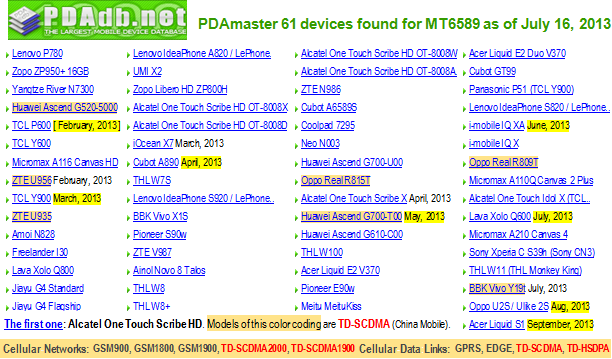
The first product was delivered from Micromax, the leading local brand in India (now world’s 3d largest smartphone market) with 19.3% smartphone market share in the January-April period (24.3% in April), #2 behind Samsung (which had 40.7% share out of the 9.4 million units in total). The 5” IPS 1280×720 8MP/2MP Micromax A116 Canvas HD went on sale starting February 14 for Rs. 13,990 [$236], and 1 million unit sales were achieved by April 24. It was followed by the 5” IPS 480*854 8MP/2MP A110Q Canvas 2 plus entry model from May 22 for Rs. 12,100 [$204], and then by the 5” IPS 1280×720 13MP/5MP Canvas 4 top model from July 8 for Rs. 17,999 [$303]. As other Micromax products they were manufactured in China by unknown white-label vendor(s).
Other Indian brands of similar kind were close to Micromax’s footsteps. I will add just the next two local brands: the #3 Karbonn with 8.6% smartphone market share, and Lava International which is aggressively targeting the smartphone market this year with $169M planned sales, 50% of the overall phone revenue plan. Note that overall phone revenue of Karbonn in the fiscal year ended June 30 was $408M, and for the next fiscal year its plan is $675M according to Karbonn Mobiles eyeing Rs 4,000 crore turnover in FY 2014.
The 4.5” IPS 540×960 5MP/VGA S1 Titanium model from Karbonn appeared February 16 on its website for pre-booking at Rs. 10,999 [$185], then came the 5.5” IPS 1280×720 13MP/5MP S9 Titanium top model announced on July 5 (in order to gain attention before Micromax Canvas 4) at Rs. 19.990 [$337] and to be released in the 2nd week of August. Note that two other quadcore Titanium models the S2 and the S5 are based on Snapdragon SoCs from Qualcomm, as well as a rumored S6 model.
Lava International’s subsidiary Xolo was starting the sales of its 4.5” IPS 540×960 8MP/1MP Q800 model from March 10 for Rs 12,499 [$211], the 4.5” IPS 540×960 5MP/VGA Q700 model from May 13 for Rs. 9999 [$169], the 5” IPS 720×1280 8MP/1.2MP Q1000 top model from May 22 for 14,990 [$253], the latest 4.5” 854×480 5MP/VGA Q600 entry model of the Q series from July 1 for Rs 8,499 [$143].
From announcement point of view the first one was the Alcatel One Touch Scribe HD (announced at the CES 2013 in January) but it was delivered only from March, although with subsequent rollouts worldwide. Here is the WMC 2013 presentation of it:
Building a Better Smartphone Experience: MediaTek Dual-SIM Platform
[mediateklab YouTube channel, June 23, 2013]
MediaTek: April EDM [newsletter, April 26, 2013]
New MediaTek-driven products revealed
MediaTek chipsets have found their way into several new products of late, many of which have since enjoyed widespread media coverage.
Alcatel‘s One Touch Scribe HD, which leverages MediaTek’s quad-core technology to deliver top of the line, HD720p picture was recently featured in CNET.
Lenovo meanwhile generated its own share of CNETand Engadget buzz with the release of its trio of new tablets. The company’s ten-inch IdeaPad S6000 and seven-inch A3000 were widely praised for their value proposition – Both devices, despite being priced for the mid-market, house a MediaTek 1.2 GHz quad-core processor, making them a viable contender in any tablet category. Likewise, Lenovo’s entry-level model, the A1000, is also said to punch well above its weight class.
Similarly, Micromax and BLU Products have achieved advances in their Canvas and BLU LIFE lines respectively, both of which are powered by the MT6589 processor. Both brands have garnered extensive local and international media coverage, including a glowing TECH2AUTO for Micromax. Interest for the new offerings by BLU Products has also been tracked across media such as Engadget and SlashGear .


How MediaTek reduces power consumption [3 video episodes in a playlist on mediateklab YouTube channel, CPU: Feb 24 – Display: March 12 – Multimedia: March 12, 2013]
Lenovo S6000 and A3000 hands-on [TheVerge YouTube channel, Feb 24, 2013]
MediaTek Powers Lenovo’s Premium Multimedia IdeaTab S6000 Tablet [and two other] [press release, Feb 25, 2013]
End of Updates
MediaTek Strengthens Global Position with World’s First Quad-Core Cortex-A7 System on a Chip – MT6589 [MediaTek press release, Dec 12, 2012]
MediaTek Inc., a leading fabless semiconductor company for wireless communications and digital multimedia solutions, announced the launch of the MT6589, the world’s first commercialized quad-core System on a Chip (SoC), available for mid to high-end Android smartphones and tablets worldwide. The new quad-core SoC integrates MediaTek’s advanced multi-mode UMTS Rel. 8/HSPA+/TD-SCDMA modem, a power-efficient quad-core Cortex™-A7 CPU subsystem from ARM, PowerVR™ Series5XT GPU from Imagination Technologies, and is delivered in 28nm process technology. As a leader in Dual-SIM technology, the MT6589 is also the world’s first HSPA+ smartphone platform supporting Dual-SIM, Dual-Active functionality to address increasing multi-SIM demand around the world. The integration of these compelling features makes the MT6589 a universal platform that delivers premium multimedia capabilities with extremely low power consumption for an outstanding user experience. It also enables handset makers to reduce time to market, simplify product development and manage product differentiation in a more cost effective way, for any market worldwide.
“The ARM Cortex™-A7 is the most power-efficient applications processor ever developed by ARM. We are pleased MediaTek is the first company to combine a quad-core Cortex-A7 and leading edge 28nm manufacturing with TrustZone® for system-level security. The MT6589 system-on-chip brings the performance and features associated with high-end mobile devices to mass-market smartphones and tablets,” said Laurence Bryant, director of mobile solutions, ARM.
The MediaTek MT6589 quad-core solution supports 1080p 30fps/30fps low-power video playback and recording, a 13MP Camera with Integrated ISP, up to FHD (1920×1080) LCD displays, and enhanced picture processing for DTV-grade image quality. In addition, the MT6589 also supports MediaTek’s “Cool 3D” suite, which includes support for stereo 3D cameras and displays, real-time 2D-to-3D conversion and an optimal 3D user interface. Leveraging MediaTek’s established 3D technologies from the DTV and Digital Home markets, this suite helps create an optimal stereo 3D display with a custom-tailored 3D interface, providing an extremely flexible platform for product differentiation.
Tony King-Smith, Vice President Marketing, Imagination Technologies, said, “Today’s smart device users have very high expectations for graphic quality and performance. The MT6589 gives Imagination a great opportunity to show the abilities of the PowerVR™ Series5XT GPU, which delivers around twice the performance of previous generation devices while maintaining the lowest possible power and silicon area. We are delighted to contribute to this impressive, highly integrated solution, which demonstrates the benefits of our ongoing close strategic relationship with MediaTek.”
The MT6589 also supports Miracast™ technology for multi-screen content sharing and pre-integrates MediaTek’s leading 4-in-1 connectivity combo, which supports 802.11n Wi-Fi, BT4.0, GPS and FM.
Jeffrey Ju, GM of the smartphone business unit at MediaTek, said, “As the world’s first quad-core SoC, the MT6589 is a strong proof point of MediaTek’s growing global presence and ambition to drive the democratization of the smartphone and reshape the mid to high-end device market. Having built a solid reputation for quality and reliability over the last 15 years, we’ve created a one-of-a-kind achievement with the MT6589 platform—marrying blazing performance and flexibility with surprising affordability and simplicity. It’s an innovative solution that accelerates product development, simplifies differentiation, and offers the best possible experience that mid to high-end smart device owners desire.”
“The demand for a Smartphone SoC that can be delivered anywhere in the world has never been greater, which is why the MT6589 is so important to our business,” said Dr. Ji-Yang Wang, COO at TCL Communications Technology/Alcatel One Touch. “As the first truly universal platform it is designed with the customer in mind to give us a crucial competitive edge. The MT6589 will make the life of our customers and partners easier, allowing them to bring the best possible experience to mid-to high-end users in multiple markets in the most timely and affordable manner, and most importantly, without compromising its performance.”
The MediaTek MT6589 is currently being incorporated into smart devices by MediaTek’s leading global customers, and the first models based on this new chipset are expected to ship commercially in Q1 2013.

For GPU related information see:
A brief history of the PowerVR Series5XT GPU family [Imagination, Nov 5, 2012]
MediaTek Launching Quad-Core MT6589 CPU’s Today [Gizchina.com, Dec 10, 2012]
Although we have been hearing alot about MT6589 powered phones already, Mediatek will only offiicially launch their low-cost quad-core CPU later
today!MediaTek took the smartphone market by storm this year with the single core MT6575 CPU and later the dual-core MT6577 and MT6577T processors which have found their way in to phones from local Chinese firms and larger international manufacturers.
The new quad-core MT6589 CPU, which will be launched later
todayin Shenzhen, will build on the company’s low-cost, high performance reputation, but could bring with it a new lower price. Rumour from earlier this year claimed the quad-core chip could cost less to manufacture than current dual-core MT6577 CPU’s, however this is not to say we are going to find $100 quad-core phones launching anytime soon.According to most companies already testing the MT6589, they hope to launch higher end phones with larger screens, in an attempt to take on the higher price range Android phones from big brands such as Samsung, HTC and Sony. Typical specifications for MT6589 phones current offer 5 inch 1920 x 1080 displays, 2GB RAM, and 12-13 mega-pixel cameras.
Currently Oppo, ZTE, Huawei, Lenovo, Gionee and even Sony have confirmed to be working on phones using the new quad-core CPU, with prices from some smaller brands expected to start at around $200.
MediaTek launches ‘world’s first’ quad-core Cortex-A7 SoC, we go hands-on (video) [engadget, Dec 11, 2012]

There’s a new player in the quad-core SoC game and it’s called the MT6589. MediaTek announced today that it’s launching the “world’s first” quad-core Cortex-A7 SoC and gave us the opportunity to take it for a spin — in prototype form, of course. The MT6589, which includes the aforementioned quad-core Cortex A7 1GHz+ CPU, also features a PowerVR Series5XT GPU, high-performance multimedia support (13MP / 3D camera, 1080p video and display, Miracast) and a built-in 42Mbps HSPA+ / TD-SCDMA-capable dual-SIM dual-active radio. By combining competitive performance with high thermal efficiency and low power consumption in an affordable package, MediaTek’s new chip is well suited for a wide-range of smartphones and tablets running Jelly Bean and beyond. The MT6589 will be available in devices starting Q1 2013. Check out the gallery and hit the break for our impressions and benchmarks plus MediaTek’s videos and PR.

We played with two devices equipped with the new chip — a generic handset with branding covered up by MediaTek stickers and an upcoming Alcatel smartphone with a 1.2GHz MT6589, five-inch HD display, 8MP 1080p camera, dual-SIM 42Mbps HSPA+ connectivity, Miracast support and a 2500mAh battery. While our hands-on time was extremely limited we managed to run some benchmarks on Alcatel’s prototype — namely Quadrant, Vellamo 2 and AnTuTu 2 / 3. As you can see in the table above, the scores are generally lower than the competition, but the results are still decent enough. Both handsets felt snappy despite neither using final software or hardware. What’s more impressive is how efficient the MT6589 appears to be in MediaTek’s videos below, both in terms of heat dissipation and power management. We’ll reserve judgement until we’re able to test a production device equipped with the company’s new quad-core Cortex-A7 SoC, but it sure looks like 2013 is going to be an interesting year in the chip business.
From the gallery:


Replaced with equivalent: MT6589 – The Coolest Quad-Core SoC Platform – Thermal Benchmark [mediateklab YouTube channel, Dec 28, 2012]
Replaced with equivalent: MT6589 – The Coolest Quad-Core SoC Platform – Low Power Benchmark [mediateklab YouTube channel, Dec 28, 2012]
Jiayu G4 redefines thousands of quad-core smart phone! [JiaYu product page, Dec 12, 2012] as translated by Google with manual edits
December 12, 2012, immediately following the MTK 6589 quad-core chip release, Yiayu Mobile will launch next-generation flagship smartphone – the Yiayu G4 redefines thousands Yuan quad-core smartphone!

The best domain the G4 main performance parameters are as follows:
1, CPU: MT6589 1.2Ghz quad-core; the GPU: SGX544
2, 4.7 inch IPS screen resolution of 1280×720 HD (MIPI interface), the the OGS whole fitting process (single glass program)
thickness of the dual-battery design, thin electric 1800 mA, 3000 mA thick power for the different needs of the user selects.
4, gyroscope \ distance \ light \ Gravity \ magnetic sensor \ double wheat Noise Reduction \ WIFI \ Bluetooth \ FM \ GPS galore!
5, body measurements: thin electrical about 130 × 63.5 × 8.1 (mm) thick power 130 x 63.5 x 10 (mm), a larger screen, a shorter, narrower, thinner body!
6, higher definition camera configuration, specific parameters be announced separately.

as translated by Bing with manual edits
On December 12, 2012, released along with the MTK 65,894 core chips, Yiayu Mobile will launch a new generation of flagship Smartphone—”Yiayu G4″ redefines the thousands of quad-core smart phone!
G4 major performance parameters are as follows:
Quad-Core 1, CPU:MT6589 1.2Ghz; GPU:SGX544
IPS,2 inch screen, resolution 1280×720 HD (MIPI interface), using OGS laminating technology (single glass scheme)
3, thickness double batteries design, thin 1800 Ma, thick by 3,000 Ma, for different needs of users.
4, gyro \ \ \ distance light gravity \ \ magnetic sensor dual noise-canceling Bluetooth \FM\GPS \WIFI\ MAK-everything!
5, body measurements: thin about 130×63.5×8.1 (mm), thick 130×63.5×10 (mm), a large screen, a shorter, narrower and thinner body!
6, HD camera configuration, specific parameters be announced separately.
Jiayu G4 Is Unveiled With MT6589 Quad-core Processor [GizmoChina, Dec 11, 2012]
Today is all concerned with MediaTek smart phone chip friend who’s big day, including manufacturers, including, has always been a cost-effective smartphone known for the Jiayu taking advantage of MediaTek released MT6589 4-core of the occasion, the official website released a long-awaited the quad-core smartphone – Jiayu G4.
The information revealed in succession before Jiayu G4 hardware parameters with consistent, the Jiayu G4 will equip MediaTek MTK6589 quad-core processor, clocked at 1.2GHz, built-in PowerVR SGX 544 graphics processor. The 4.7 inch IPS screen resolution of 1280 * 720 HD level. There are two different versions of the battery with body size, the the thick version of the body measurements of 133 * 65 * 10 mm, with a capacity of 3000 mA battery, thin version of body size of 133 * 65 * 8.2 mm, The battery capacity of 1800 mA. In addition, support for commonly used Bluetooth, FM, GPS and WIFI, and built-in gyroscope distance light Gravity magnetic sensors and other common sensing devices, and supports dual-microphone noise reduction technology.
See also: MT6577-based JiaYu G3 with IPS Gorilla glass 2 sreen of 4.5” etc. for $154 (factory direct) in China and $183 [on this same blog, Sept 13, 2012]
Qualcomm quad-core Cortex-A7 SoCs with Adreno 305 and 1080p coming for the high-volume global market and China
With Qualcomm’s this week announcement (see below in the details section) the company is expanding the high-volume Play tier of its S4 class SoCs for aggressive competition with Taiwan (especially MediaTek, see in the details) and mainland China based competitors, as well as NVIDIA (see in the details) and Marvell:
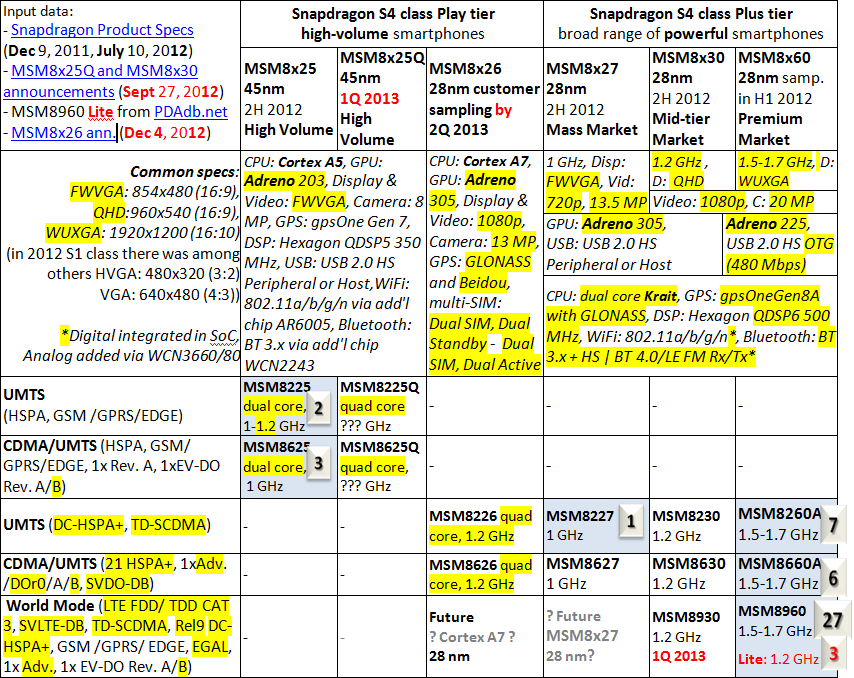
Note: the greyed boxes contain the number of available or announced products based on that particular SoC as of end of September, 2012.
As with it Qualcomm’s Krait based dual-core offerings came into a kind of performance overlap with the new quad-core Cortex-A7 SoCs (not according to Qualcomm obviously but easily recognizable from the above table) the company intensively emphasized in the last month the upcoming Krait v3 upgrade, officially called Krait 300, for the 2013 market. I will provide that information as well, after the MSM8x26 related information.
Finally Qualcomm published a new video about its strategic partnership with Dell in which Jeff Clarke, vice chairman & president of Global Ops and End User Computing at Dell is stating:
[1:13] Our strategic ARM partner is Qualcomm. Our strategic LTE partner is Qualcomm. Our wireless wins strategic partner is Qualcomm. [1:21]
As there is a special indication in the notes to that video about the Dell World 2012 (Dec 11-13, 2012), where Steve Mollenkopf, President and Chief Operating Officer of Qualcomm is listed among the 16 most distinguished speakers and Qualcomm is a Gold sponsor of the event, we may expect further details regarding both the MSM8x26 and Krate 300.
In order to have a complete and actual picture of Qualcomm’s SoC business I will also add some other information, particularly for the Adreno 300 series, along and after the MSM8x26 and Krate 300 related parts.
Before the details I will highly recommend to read my previous post Qualcomm decided to compete with the existing Cortex-A5/Krait-based offerings till the end of 2012 [Sept 30, 2012] as well.
The details
Qualcomm Announces S4 Play MSM8x26 and WTR2605 – Quad Core ARM Cortex A7 [AnandTech, Dec 5, 2012]
Yesterday, Qualcomm announced a new SoC for its Snapdragon S4 Play category, the MSM8x26, and alongside it a new transceiver, WTR2605. The announcement was a little light on detail and I waited until confirmation of a few details, but now know more about these two new parts geared at the growing entry-level Chinese handset market.
First off, MSM8x26 is a 28nm SoC consisting of four ARM Cortex A7 CPUs running at (1.2 GHz) alongside an Adreno 305 GPU. This is to my knowledge the first Qualcomm SoC using a Cortex A7 for CPU, previously we’ve seen a lot of Cortex A5 use at Qualcomm in parts like MSM8x25 (dual A5s), MSM8x25Q (quad A5s), and also onboard baseband as an optional AP for managing things like a router. MSM8x26 is the spiritual successor to MSM8x25Q, which was again quad core ARM Cortex A5s at 45nm with Adreno 203 graphics. MSM8x26 should bring a nice jump in performance on both CPU and GPU over that part, in addition to supporting 1080p video encode and decode, and support for 13 MP cameras. MSM8x26 will come in two flavors, 8226 with UMTS and TD-SCDMA, and 8626 with UMTS, CDMA, and TD-SDCMA, consistent with Qualcomm’s part numbering scheme.
The other part of the story is the new transceiver, WTR2605, whose name suggests a wafer-level package (W for wafer) and includes necessary improvements to accommodate dual SIM active and standby modes (DS-DS operation) popular in the entry level Chinese market MSM8x26 is geared at. I don’t know anything further about the WTR2605 or how it compares in terms of RF ports to WTR1605L, which is Qualcomm’s current flagship transceiver, but suspect it’s an evolution of that design with changes to accommodate the dual SIM modes. We’ll have a piece ready later in the week about WTR1605 and the state of Qualcomm’s modem portfolio.
Qualcomm Technologies Expands Line of Qualcomm Snapdragon S4 Processors with Quad-Core CPUs for High-Volume Smartphones [Qualcomm press release, Dec 4, 2012]
— MSM8226, MSM8626 and Reference Design Counterparts Add Depth to Qualcomm Snapdragon S4 Roster and Incorporate New WTR2605 Multimode Radio
Qualcomm Incorporated (NASDAQ: QCOM) today announced that its wholly-owned subsidiary, Qualcomm Technologies, Inc., is adding two chipsets to the Qualcomm Snapdragon™ S4 family of mobile processors, the MSM™8226 and MSM8626 chipsets, along with Qualcomm Reference Design versions of both. These Qualcomm Snapdragon S4 processors with quad-core CPUs will bring premium multimedia and connectivity features to high-volume 3G handsets. Featuring the powerful Adreno™ 305 GPU, 1080p capture and playback, and up to a 13 megapixel camera, the MSM8226 and MSM8626 processors are optimized to deliver visually stunning graphics and exceptionally long battery life to high-volume smartphones. Both processors will be ready for customer sampling by the second quarter of 2013 for UMTS, CDMA and TD-SCDMA.
Building on Qualcomm Technologies’ previous quad-core offering, both the MSM8226 and MSM8626 processors are fabricated using the 28nm technology node and will continue to support multi-SIM capabilities with Dual SIM, Dual Standby; and Dual SIM, Dual Active. In addition to quad-core CPU processing power, these chipsets incorporate the new WTR2605 multi-mode radio transceiver, optimized to address China specific requirements such as support for TD-SCDMA, CDMA 1xAdv and HSPA+. The WTR2605 transceiver comes with an integrated, high-performance GPS core with GLONASS and Beidou support. Optimized for low power consumption, the WTR2605 transceiver offers 40 percent power savings and 60 percent smaller footprint compared to previous generations.
“The expansion of our Qualcomm Snapdragon S4 family extends our leadership in performance and low power for the high-volume smartphones,” said Cristiano Amon, executive vice president and co-president of mobile and computing products, Qualcomm Technologies. “This expanded roadmap provides our customers with a differentiated feature set upon which to build compelling smartphones for budget-conscious consumers.”
Qualcomm Technologies will also be releasing Qualcomm Reference Design (QRD) versions of both MSM8226 and MSM8626 processors. The QRD program provides device manufacturers with comprehensive handset development resources and access to an ecosystem of hardware and software vendors, whose components and applications have been tested and validated for QRD-based devices. QRD customers are offered everything they need to rapidly deliver differentiated smartphones to the mass market. There have been more than 100 public QRD-based product launches to date in collaboration with more than 40 OEMs, and there are currently more than 100 designs in progress. The QRD versions of these particular Qualcomm Snapdragon processors—the QRD8226 and QRD8626—will also be available for sampling by the second quarter of 2013.
Windows RT on Snapdragon Processors [QUALCOMMVlog YouTube channel, Nov 16, 2012]
Nvidia Tegra 3 under strong pressure from S4 Pro, say Taiwan makers [DIGITIMES, Dec 7, 2012]
Snapdragon S4 Pro series processors developed by Qualcomm have brought increasing competitive pressure on Nvidia’s Tegra 3 because of its superior overall performance-cost ratio, according to Taiwan-based handset supply chain makers.
Although Nvidia successfully landed orders for Google’s Nexus 7 and Microsoft’s Surface RT in 2012, with Microsoft reportedly planning to adopt Qualcomm’s platform for its next-generation Surface RT, while Tegra-based smartphones have only had average sales performance, Nvidia may find it difficult to continue achieving strong growth in 2013 like in 2012.
In 2012, Nvidia received Tegra orders for smartphones including the HTC One X, LG Electronics Optimus 4X H, ZTE Era, K-Touch Treasure V8 and Fujitsu’s devices.
Qualcomm is expected to start fierce competition against MediaTek and China-based handset chipmakers in China’s mid-range to entry-level smartphone market in the first quarter of 2013, challenging Nvidia’s plans of releasing a solution for CNY1,000 smartphones (US$160), while ualcomm’s aggressiveness over striving orders from tablet players with its reference design, which is set to release in the first half of 2013, also places strong pressure on Nvidia, the sources noted.
From this you could see that Qualcomm and MediaTek is in a kind of mouse and cat game: MediaTek to bring forward launch date of MT6589 quad-core solutions [DIGITIMES, Dec 3, 2012]
MediaTek reportedly has decided to move forward the launch date of its quad-core smartphone solution, the MT6589, to December instead of January 2013 in order to meet market demand during the upcoming Lunar New Year holiday season, according to industry sources.
In addition to China-based smartphone makers, Motorola Mobility, Sony Mobile Communications and LG Electronics are also likely to be among the first wave of vendors taking deliveries of quad-core solutions from MediaTek, the sources indicated.
Smartphones powered by MediaTek’s quad-core chips are expected to hit the market in the first quarter of 2013 at the earliest, added the sources.
MediaTek November revenues dip to 5-month low [DIGITIMES, Dec 10, 2012]
MediaTek saw its consolidated revenues slide 17.5% sequentially to a five-month low of NT$8.65 billion (US$297 million) in November, according to company data. The monthly figures were up 13.4% from a year earlier.
Accumulated revenues for the first 11 months of 2012 amounted to NT$91.68 billion, increasing 15.5% from a year ago.
MediaTek will give a presentation for its quad-core MT6589 smartphone solution as well as a low-priced version MT6589M to clients on December 11 and to the media on December 13, according to a Chinese-language Economic Daily News (EDN) report.
Krait 300: The AnandTech Podcast: Episode 12 [Dec 3, 2012] from Brian Klug
(see also the Qualcomm’s Quad-Core Snapdragon S4 (APQ8064/Adreno 320) Performance Preview [AnandTech, July 24, 2012] where Krait v3 is already mentioned as well as Adreno 320 improvements with all detailed slides about the new GPU)
[51:44] … all current Kraits are Krait v2 (Krait v1 was a sort of internal thing we never saw) … soon will get Krait v3 and [MSM]8960T … T stands for Turbo … strait IPC [Instructions Per Cycle] increase of about 15% … additionally increased clocks from 1.5 GHz to 1.7 GHz … expect 20 to 30% higher overall performance … more power efficiency … more out-of-order capability … better branch prediction … there is Krait 400 at some point but don’t know about that … expect devices with MSM8960T shipping early next year … Adreno 320 GPU is coming with 8960T … [57:58]
CPU Leadership Now and into Next Generation:
Highest Performance at the Lowest Power

Most widely presented on Qualcomm Analyst Day, Nov 15, 2012 (slide #90) but taken from IAR_Americas_Summit_2012_Industry_Leadership_Anand_Chandrasekher (1)
Note from ExtremeTech:
The x86 SoC above is obviously Intel’s Medfield, while the 40nm competitor in green is almost certainly Tegra 3. The yellow line is Samsung’s dual-core Exynos Cortex-A15 CPU. The first magenta line presumably refers to the dual-core Snapdragon S4 designs …
… Cortex-A15 is primarily a server/netbook chip, but that doesn’t mean Samsung can’t build smartphones around it.
Snapdragon CPU Performance [QUALCOMMVlog YouTube channel, Aug 21, 2012]
How Snapdragon processors stack up against the competition [QUALCOMMVlog YouTube channel, Sept 20, 2012]
Current Krait v2/200 SoCs see in the table below (with actual devices as end of Sept):
taken from my earlier core post: Qualcomm decided to compete with the existing Cortex-A5/Krait-based offerings till the end of 2012 [Sept 30, 2012]. Note that the newer SoCs with quadcore S4 Pros (not even in this table) are not shown. About them see:
– HTC Droid DNA Rocks First 1080p Display [Qualcomm Insider Blog, Nov 13, 2012]
– Google Nexus 4 [Qualcomm product page]
– LG AND GOOGLE ANNOUNCE NEXUS 4 [LG press release, Oct 30, 2012]
Sleek, New Smartphone Combines LG’s Best-in-Class Hardware with the Best of Google

SEOUL, Oct. 30, 2012 -– Designed collaboratively by LG and Google, Nexus 4, the newest smartphone in the Nexus line-up from Google, was announced today for availa bility starting next month in select markets. With a sophisticated hardware design from LG, your favorite Google Apps, and the latest version of Android™, Nexus 4 puts the best of Google in the palm of your hand.
“LG is proud and excited to play this role in helping build the latest Nexus smartphone,” said Dr. Jong-seok Park, President and CEO of LG Electronics Mobile Communications Company. “Users will be delighted by the perfectly balanced combi nation of form and function with the latest generation of Android.”
“This is the first time we collaborated with LG to build a Nexus device,” said Andy Rubin, Senior Vice President of Mobile and Digital Content at Google. “They brought an extraordinary amount of talent to the project, and the result is a feature-packed device that feels great in your hand, and blazingly fast under the hood.”
Capture and share your world
Nexus 4 comes with a high-performance 8MP camera and takes stunning Photo Sphere images, letting you capture every detail of the world around you. Up, down and all around you, it’s like no camera you’ve ever seen; with Nexus 4, you can snap pictures in every direction that come together into incredible, immersive Photo Spheres that put you right inside the scene. Plus, photos upload themselves with Instant Upload so you’ll never lose a shot.
All of this comes to life with stunning clarity and crisp, natural color on the vibrant 1280-by-768 4.7-inch True HD IPS Plus display supported by Zerogap Touch technology. Gently curved glass edges allow your finger to slide smoothly on and off the 320ppi screen, while cutting edge display technology means you feel like you’re touching every pixel, protected by scratch resistant Corning® Gorilla® Glass 2.
Built for speed
Nexus 4 comes with a cutting-edge Qualcomm Snapdragon™ S4 Pro processor, so you’ve got speed and power to spare. Zip around the web, experience rich 3D graphics and gameplay, and effortlessly switch between multiple apps without ever missing a beat. With 2GB of RAM and the fastest version of Android ever, Nexus 4 is the snappi est Nexus smartphone yet.
Information at your fingertips
Nexus 4 comes with the latest Google apps, putting the best of Google in the palm of your hand. The latest version of Google Now is built-in, which keeps you even more organized -– get reminders about upcoming flights, restaurant reservations, hotel confir mations and even nearby photo opportunities -– when and where you need them.
Get to the places you care about quickly and easily with Google Maps™ for Android. With turn-by-turn GPS navigation, live traffic info, and integrated driving, walking and public transit directions, getting from A to B has never been easier. 3D Maps and rich satellite imagery give you a more realistic sense of what’s around you while features like Street View and Indoor Maps make sure you always know what’s in front of you.
Nexus 4 is sold unlocked and is GSM/HSPA+ compatible so it will operate on more than 200 network providers worldwide. Just pop in a supported SIM card and be up and running in no time. It will be available to purchase in both an 8GB version and a 16GB version on Google Play™ starting November 13 in the US, UK, Canada, Germany, France, Spain and Australia. Offline availability in Europe, Central/South Americas, Asia, CIS and the Middle East will begin from the end of November.
Key specifications
- Chipset: Qualcomm Snapdragon™ S4 Pro processor with 1.5GHz Quad-Core Krait CPUs
- Operating System: Android 4.2, Jelly Bean
- Network: 3G (WCDMA), HSPA+
- Display: 4.7-inch WXGA True HD IPS Plus (1280 x 768 pixels)
- Memory: 8GB / 16GB
- RAM: 2GB
- Camera: 8.0MP rear / 1.3MP HD front
- Battery: 2,100mAh Li-Polymer (embedded) / Talk time: 15.3 hours / Standby: 390 hours
- Size: 133.9 x 68.7 x 9.1mm
- Weight: 139g
- Other: Wireless charging, NFC
- Nexus 4 8GB on Google Play $299
- Nexus 4 16GB on Google Play $349
- LG Nexus 4 Price in India on 2012 Dec 09th is Rs.25990 [$477]
- Google Nexus 4 smartphone sold out until after Christmas?
- Google’s Nexus 4 briefly reappears in UK and Germany, but 8GB version sells out again
- LG UK Explains Nexus 4 Shortage
“As with any sales process, LG supplies product quantities against partners’/customers’ (ie retailers, operators etc) forecasts,” Andy Coughlin, head of mobile at LG UK, told CNet, adding that, “demand via the Play Store has been very high in this instance.”
Adreno 320 GPU Leads in Power-Efficient Performance:
Latest GPU Architecture – Higher Parformance, Lower Power

Most widely presented on Qualcomm Analyst Day, Nov 15, 2012 (slide #93) but taken from IAR_Americas_Summit_2012_Industry_Leadership_Anand_Chandrasekher (1)
Graphics Benchmarking [QUALCOMMVlog YouTube channel, Sept 26, 2012]
GPU Demonstration: Fortress [QUALCOMMVlog YouTube channel, Sept 19, 2012]
Adreno Graphics for Snapdragon [Qualcomm Industry Analyst Relations, Sept 7, 2012]
Adreno GPUs are custom-built by Qualcomm and exclusively integrated within Snapdragon processors. They provide the level of computational processing power needed for the high-end 3D gaming, complex UIs, super-responsive web browsing and rich navigation experiences that today’s savvy mobile users demand.
The newest generation of Adreno GPUs, the Adreno 300 series, integrated in Snapdragon S4 Prime (MPQ8064) and S4 Pro (APQ8064, MSM8960T) processors, lead the market in power-efficient graphical processing capacity, capabilities and quality. The first GPU in the series, Adreno 320, delivers over three times the computational performance of the previous Adreno GPU, Adreno 225. Adreno 320 also provides the API support needed to enable not only high-end, connected 3D gaming experiences, but also to assist the CPU with computationally intensive use cases like imaging and video enhancement.
- Snapdragon and Adreno have strong global adoption, as evidenced by the fact that Qualcomm shipped more GPUs in 2011 than any other mobile silicon provider.
- Adreno GPUs enable today’s advanced graphical use cases with industry leading performance and power efficiency.
- Adreno GPUs are uniquely designed to dynamically adjust to shader loads, minimizing processing power and boosting application performance by eliminating wasted cycles.
- Qualcomm’s newest GPU, Adreno 320, introduces support for the latest graphics APIs like OpenGL ES 3.0, as well as the latest compute APIs like OpenCL 1.2 that enable GPGPU acceleration of advanced computational camera and video effects.
- Qualcomm’s Adreno graphics solution includes support of leading game engines and valuable tools that save developers time and money.
Snapdragon GPU Technology [QUALCOMMVlog YouTube channel, Aug 6, 2012]
Adreno Profiler & SDK [QUALCOMMVlog YouTube channel, Oct 1, 2012]
$50 Nokia Asha 205 QWERTY phones and Nokia 206 feature phones with smartphone like connectivity and web experience but with more convenient keyboard interactions
Or further steps taken by Nokia to defend its enviable position of stabilized 75+ million quarterly unit sales on the “sub-smartphone” market. This is a significant addition to the already successful:
– Smartphone-like Asha Touch from Nokia: targeting the next billion users with superior UX created for ultra low-cost and full touch S40 devices [July 20 – Oct 18, 2012] and
– With Asha Touch starting at $83 and Lumia at $186 Nokia targeting the entry-level and low-end smartphone markets [Nov 1, 2012]
Nokia Asha 205 Price in India is Rs. 2,750/-, i.e. ~$50 at the online Shopping Portals there. The retail store price will be more than this. Since the estimated retail price announced was around $62 for both we could say that for the Nokia 206 the lowest retail price will be the same $50. With this Nokia has a perfect entry barrier against the onslaught of the entry level Android devices as well. I mean:
– $48 Mogu M0 “peoplephone”, i.e. an Android smartphone for everybody to hit the Chinese market on November 15 [Nov 9, 2012]
Nokia Asha 205 Dual SIM: Everyone online now [nokia YouTube channel, Nov 26, 2012]
Nokia 206 Dual SIM: Larger than life [nokia YouTube channel, Nov 26, 2012]
| Most social ever: Nokia Asha 205 | Nokia 206 – reinventing the feature phone |
With its QWERTY keypad, it’s made to make messaging and connecting through social networks quick and easy.The usability of the keyboard is one of the key factors in the success of QWERTY phones, and the Nokia Asha 205 comes with isolated keys and quick-access buttons for superior speed and accuracy. Super-social, the phone even boasts a dedicated button for access to Facebook, for the first time on a Nokia phone. |
The Nokia 206 brings together classic and contemporary, with a traditional keypad married to a stunning design and a generous 2.4-inch screen. Like the Nokia Asha 205, it comes in single and dual-SIM varieties. |
Sharing accelerated with SlamThe Nokia Asha 205 (and the Nokia 206 –also announced today) sees the debut of a brand new sharing technology from Nokia called ‘Slam’. What is it? Let’s say you take a picture, choose ‘Send’ and then ‘Slam’ from the list. This quickly detects the nearest Bluetooth-enabled device and offers that device the file.The other person can accept and download the picture instantly, without any need to pair the two devices, as you have to with regular Bluetooth sharing. The owner of the other device doesn’t even need to have a Nokia phone or Slam installed. You can also share using all the normal options like social networks and email. |
Slam it to meAs with the Nokia Asha 205, owners of the Nokia 206 can take advantage of the new Nokia Slam technology for sharing items on their phone. This uses Bluetooth for transmission, but doesn’t require you to pair the two phones. We’ll be going deeper into how it works and why you want Slam in a forthcoming article. |
Smarter Internet for service savingsThe Nokia Asha 205 is designed to make smarter use of the Internet, sipping data as it’s asked for, rather than guzzling it down unnecessarily. Notably, the latest version of the Nokia Xpress Browser is preinstalled, which uses cloud-based servers to reduce data volumes by 90 per cent, saving owners money. The browser is optimised for social networks and content discovery, making it quick and easy to make updates or read the content you want.Owners will also find Nokia Nearby installed. While the phone doesn’t have GPS, it can make use of cell-tower co-ordinates to present a local map and identify nearby points of interest like cafes or landmarks. The app shares the massive database of places used in Nokia Maps, so they’ll never run out of places to go. |
With the Nokia Xpress Browser installed, owners don’t need to fear running up excessive data charges when browsing the Web on their phone. It calls upon cloud-based servers which cut download sizes by up to 90 per cent, saving the owner money.Where the service is available, the Nokia 206 will ship with Nokia Life. |
King of contentFacebook, Twitter and eBuddy apps are preinstalled to connect with friends and family from the start. There’s also the very popular EA gift pack of 40 free premium games (worth around €75, depending on the market) to download and keep forever.Of course, owners also have access to the Nokia Store and the 1000s of free and paid games and apps available there.In selected markets, the phone will also ship with Nokia Life or the new Nokia Life+. |
AppstravaganzaYou can also share instantly to Facebook, as well as email. WhatsApp ( in the single SIM version) and eBuddy are preinstalled, and there’s a gift pack of ten premium entertainment titles to download. In addition, there are 1000s of free and paid games and apps in the Nokia Store. |
– |
The camera is optimised for content sharing with lower sized files. The 1.3-megapixel resolution can automatically resize pictures to around 700KB. This is great for a Facebook posting. It also offers an ‘intelligent imaging’ feature, which will tell you when self-portraits are in focus, and allows you to take a sequence of shots and choose the best. Video capture is also supported. |
Facebook and Nokia partner to increase connections on-the-go [Nokia press release, Nov 26, 2012]
Facebook and Nokia have today announced an innovation with the introduction of a built-in Facebook button available on the new Nokia Asha 205.
Introduced today, the Nokia Asha 205 is the first Nokia phone that includes a dedicated Facebook button, designed for people who want the fastest, one-click access to popular Facebook features.
“People around the world use Facebook Mobile to connect and share with their friends,” said Javier Olivan, head of growth, engagement and mobile for Facebook. “We are focused on delivering the best Facebook experience to as many people as possible and our partnership with Nokia perfectly complements our strategy of giving people around the world a rich Facebook experience for keeping in touch with their friends.”
“Globally, young consumers have increasingly started using Facebook for socializing, keeping in touch and striking new friendships. The launch of the Nokia Asha 205 responds to this growing demand and gives them a unique option for accessing Facebook while on-the-go,” said Timo Toikkanen, executive vice president, Mobile Phones, Nokia. “We have seen that many people who use Nokia Asha devices are hyper-social and we are proud to partner with Facebook to improve the user experience of those consumers further with the introduction of the Facebook button.”
The new Nokia Asha 205 enables people to easily access the Facebook for Every Phone app and use messaging, one of its most popular features. People using the messaging features in Facebook for Every Phone can now:
- See which of their friends are online to start chatting with them right away
- Start messages and group chats fast
- Reach more of the people they know, wherever they are, no matter what device they are using
People using the Nokia Asha 205 can also easily access other Facebook features, such as sharing photos and status updates with their friends, so they can stay close to the people around them with the touch of a button.
Nokia introduces ‘Slam’ on the new Nokia Asha 205 and Nokia 206 [Nokia press release, Nov 26, 2012]
…
Introducing Slam for fast, in the moment content-sharing
The Nokia Asha 205 and Nokia 206 are the first Mobile Phones devices to include Nokia’s exclusive Slam feature. Slam allows consumers to share multimedia content like photos and videos with nearby friends almost instantly. Slam works with most Bluetooth-enabled mobile phones without the need to pair devices, and without the recipient needing to also have Slam*. In just a few clicks, people can ‘Slam’ their content to another device faster than with Bluetooth alone and without consuming Internet data.“The latest Nokia devices give super-social consumers new ways to express their personalities through design, color and innovative new features like Slam,” explains Timo Toikkanen, Executive Vice President, Mobile Phones, Nokia. “Both devices are built with the trust and quality people have come to expect from Nokia, and offer smarter Internet experiences that help save money today and tomorrow.”
Nokia Asha 205: the ultimate social phone
The expressive Nokia Asha 205 has a pleasingly tactile QWERTY keyboard. It also introduces a new, dedicated Facebook button, making it the perfect device for social people who want the fastest access to their Facebook profile. Combined with eBuddy Chat, Twitter and support for popular email accounts such as Gmail, the Nokia Asha 205 is designed to allow that people are never more than a few clicks away from their social networks.
Other key features of the Nokia Asha 205 include:
– eBuddy screen notifications that keep users up-to-the-minute on new conversations
– The free Nokia Life+ web app, including the Life Skills and Live Healthy services
– A comprehensive mobile entertainment package, including 40 free EA Games available for download, along with tens of thousands of other apps available from the Nokia Store
– Available in single SIM and dual SIM models
– Dual SIM model features Nokia’s exclusive EasySwap technology that enables consumers to change SIM cards without having to turn off the device
– Great standby time: up to 37 days with single SIM and up to 25 days with dual SIMThe Nokia Asha 205 is available in Cyan, Magenta and Orange. The estimated retail price for the Nokia Asha 205 is around USD 62, excluding taxes and subsidies, and it is expected to start shipping in the fourth quarter of 2012.
Nokia 206: beautifully bold Internet
The Nokia 206 features a classic alphanumeric keypad and a generous 2.4″ display, giving ample room to surf the Internet, play games, or chat with friends. People can also enjoy fast access to Facebook and Twitter right from the home screen. Featuring a vibrant color palette including Cyan, Magenta and Yellow, the Nokia 206 is the ideal phone for those who want familiarity and ease of use, coupled with beautiful design and all the benefits of the mobile Internet.
Other key features of the Nokia 206 include:
– Imaging technology that optimizes photos taken with the 1.3MP camera for sharing on Facebook
– A comprehensive social and mobile entertainment package with eBuddy Chat, WhatsApp** and a gift pack of 10 free, premium content items
– Available in single SIM and dual SIM models
– Dual SIM model features Nokia’s exclusive EasySwap technology that enables consumers to change SIM cards without having to turn off the device
– Impressive standby time: up to 47 days with single SIM and up to 28 days with dual SIMThe estimated retail price for the Nokia 206 is around USD 62, excluding taxes and subsidies, and it is expected to start shipping in the fourth quarter of 2012.
The new devices take full advantage of the Nokia Xpress Internet platform, which uses Nokia’s cloud technology to reduce data consumption by up to 90%, helping consumers enjoy more affordable Internet access. They also feature Nokia Nearby, a web app that helps consumers discover points of interest such as restaurants, shopping and ATM machines close to their location.
*’Slam’ currently not compatible with iOS and Windows Phone devices
**Available on single SIM variants only
http://www.developer.nokia.com/Devices/Device_specifications/Comparison.xhtml?dev=Asha_205,Nokia_206
|
Nokia Asha 205 the ultimate social phone, with a QWERTY keyboard and new Facebook button |
Nokia 206 reinventing the feature phone, with a traditional keypad married to a stunning design and a generous 2.4-inch screen |
||||||||||||||||||||
|
Technical Specs |
|
|
|||||||||||||||||||
|
Developer Platform |
|||||||||||||||||||||
|
Operating System |
Nokia OS |
Nokia OS |
|||||||||||||||||||
|
Screen Resolution |
320 x 240 pixels |
240 x 320 pixels |
|||||||||||||||||||
|
General |
|
|
|||||||||||||||||||
|
Development Frameworks |
Java |
Java |
|||||||||||||||||||
|
Screen Resolution |
320 x 240 pixels |
240 x 320 pixels |
|||||||||||||||||||
|
Screen Color Depth |
16 bits |
16 bits |
|||||||||||||||||||
|
Screen Size |
2.4 inches |
2.6 inches |
|||||||||||||||||||
|
Display Technology |
LCD transmissive |
LCD transmissive |
|||||||||||||||||||
|
Device Size |
112.8 x 61.1 x 13 mm |
116 x 49.4 x 12.4 mm |
|||||||||||||||||||
|
Volume |
104 cc |
64 cc |
|||||||||||||||||||
|
Weight |
94 g |
91 g |
|||||||||||||||||||
|
Keypad |
QWERTY Keyboard |
Grid Key Mat |
|||||||||||||||||||
|
Other Keys |
2 Labeled Soft Keys |
3 Labeled Soft Keys |
|||||||||||||||||||
|
Frequency Bands |
GSM 1800 |
GSM 1800 |
|||||||||||||||||||
|
Data Bearers |
Dual Transfer Mode (MSC 12) |
Dual Transfer Mode (MSC 12) |
|||||||||||||||||||
|
Regional Availability |
Global |
Africa, Asia-Pacific, Europe, Middle East |
|||||||||||||||||||
|
Consumer Link |
|||||||||||||||||||||
|
Developer Page Link |
|||||||||||||||||||||
|
Notes |
1Combined call termination and power key |
1Combined Call Termination and Power key. |
|||||||||||||||||||
|
Extra Features |
|
|
|||||||||||||||||||
|
Extra Features |
Dual SIM[1] |
Dual SIM[1] |
|||||||||||||||||||
|
Notes |
1with RM-862 |
1with RM-872 |
|||||||||||||||||||
|
APIs |
|
|
|||||||||||||||||||
|
Java Runtime |
Java Runtime 1.0.0 for Series 40 |
Java Runtime 1.0.0 for Series 40 |
|||||||||||||||||||
|
Java Technology |
JSR 139 Connected, Limited Device Configuration (CLDC) 1.1JSR 118 MIDP 2.1JSR 75 FileConnection and PIM API 1.0JSR 82 Java™ APIs for Bluetooth 1.1JSR 135 Mobile Media API 1.1JSR 172 J2ME™ Web Services Specification 1.0 (RPC package)JSR 172 J2ME™ Web Services Specification 1.0 (XML Parser package)JSR 177 Security and Trust Services API for J2ME™ 1.0 (SATSA-APDU package)JSR 177 Security and Trust Services API for J2ME™ 1.0 (SATSA-CRYPTO package)JSR 179 Location API for J2ME™ 1.0JSR 184 Mobile 3D Graphics API for J2ME™ 1.1JSR 205 Wireless Messaging API 2.0JSR 211 Content Handler API 1.0JSR 226 Scalable 2D Vector Graphics API for J2ME™ 1.1JSR 234 Advanced Multimedia Supplements 1.1 (audio3d)JSR 234 Advanced Multimedia Supplements 1.1 (camera)JSR 234 Advanced Multimedia Supplements 1.1 (music)Nokia UI API 1.1JSR 248 Mobile Service Architecture Subset 1.1 for CLDC 1.1 |
JSR 139 Connected, Limited Device Configuration (CLDC) 1.1JSR 118 MIDP 2.1JSR 75 FileConnection and PIM API 1.0JSR 82 Java™ APIs for Bluetooth 1.1JSR 172 J2ME™ Web Services Specification 1.0 (RPC package)JSR 172 J2ME™ Web Services Specification 1.0 (XML Parser package)JSR 177 Security and Trust Services API for J2ME™ 1.0 (SATSA-APDU package)JSR 177 Security and Trust Services API for J2ME™ 1.0 (SATSA-CRYPTO package)JSR 179 Location API for J2ME™ 1.0JSR 184 Mobile 3D Graphics API for J2ME™ 1.1JSR 205 Wireless Messaging API 2.0JSR 211 Content Handler API 1.0JSR 226 Scalable 2D Vector Graphics API for J2ME™ 1.1JSR 234 Advanced Multimedia Supplements 1.1 (audio3d)JSR 234 Advanced Multimedia Supplements 1.1 (music)Nokia UI API 1.1JSR 135 Mobile Media API 1.2[1]JSR 248 Mobile Service Architecture Subset 1.1 for CLDC 1.1 |
|||||||||||||||||||
|
Recommended Java SDK |
Nokia SDK 1.0 for Java |
Nokia SDK 1.0 for Java |
|||||||||||||||||||
|
Java API Access Permissions |
|||||||||||||||||||||
|
Certificates |
UTI Root |
UTI Root |
|||||||||||||||||||
|
Notes |
– |
1without RTSP |
|||||||||||||||||||
|
Browser, Flash and Web Technologies |
|
|
|||||||||||||||||||
|
UAProfile Link |
– |
||||||||||||||||||||
|
Browser Details |
HTML 4.0 |
HTML 4.0 |
|||||||||||||||||||
|
Flash Technology |
Flash Lite 4.0 |
– |
|||||||||||||||||||
|
Flash Lite Features |
Screensaver |
– |
|||||||||||||||||||
|
Multimedia |
|
|
|||||||||||||||||||
|
Camera Resolution |
640 x 480 pixels |
1280 x 960 pixels |
|||||||||||||||||||
|
CMOS Sensor |
300000 pixels |
1.3 Megapixels |
|||||||||||||||||||
|
Camera Digital Zoom |
4 x |
4 x |
|||||||||||||||||||
|
Camera F-Stop/Aperture |
f/2.8 |
f/2.8 |
|||||||||||||||||||
|
Camera Focus range |
15 cm to infinity |
15 cm to infinity |
|||||||||||||||||||
|
Camera Image Formats |
JPEG/Exif |
JPEG/Exif |
|||||||||||||||||||
|
Camera Features |
Auto and Manual White Balance, Full Screen Viewfinder, Self Timer, Still Image Editor |
Auto and Manual White Balance, Full Screen Viewfinder, Self Timer, Still Image Editor |
|||||||||||||||||||
|
Video Recording Resolution |
176 x 144 pixels |
640 x 480 pixels |
|||||||||||||||||||
|
Video Recording Frame Rate |
10 fps |
15 fps |
|||||||||||||||||||
|
Video Digital Zoom |
– |
4 x |
|||||||||||||||||||
|
Video Recording Formats |
H.263 |
H.263, MPEG-4 |
|||||||||||||||||||
|
Video Features |
Video Player |
Video Player |
|||||||||||||||||||
|
Video Playback Formats |
3GPP formats (H.263), H.264/AVC, MPEG-4 |
3GPP formats (H.263), ASF, AVI, H.264/AVC, MP4, MPEG-4, WMV |
|||||||||||||||||||
|
Video Playback Frame Rate |
15 fps |
15 fps |
|||||||||||||||||||
|
Graphic Formats |
BMP, GIF87a, GIF89a, JPEG, M3G, PNG, SVG-T, WBMP |
BMP, GIF87a, GIF89a, JPEG, M3G, PNG, SVG-T, WBMP |
|||||||||||||||||||
|
Theme Version |
Series 40 Theme v3.0 |
Series 40 Theme v3.0 |
|||||||||||||||||||
|
Suggested Theme Template |
Series 40 Compact UI |
Series 40 Simple UI |
|||||||||||||||||||
|
Audio Features |
Audio Equalizer |
Audio Recorder AMR |
|||||||||||||||||||
|
Audio Formats |
AAC, AAC LC, AMR-NB, AMR-WB, HE-AAC v2, MIDI Tones (poly 64), Mobile XMF, MP3, MP4, NRT, True tones, WAV, WMA |
AAC, AMR-NB, AMR-WB, MIDI Tones (poly 64), Mobile XMF, MP3, MP4, NRT, True tones, WAV, WMA |
|||||||||||||||||||
|
Speech Codecs |
AMR-NB |
AMR-NB |
|||||||||||||||||||
|
Notes |
1up to 103 phon |
– |
|||||||||||||||||||
|
Memory Functions |
|
|
|||||||||||||||||||
|
ROM Memory |
64 MB |
64 MB |
|||||||||||||||||||
|
RAM Memory |
16 MB |
32 MB |
|||||||||||||||||||
|
Memory Card type |
Micro SD |
Micro SD |
|||||||||||||||||||
|
Maximum Memory Card Size |
32 GB |
32 GB |
|||||||||||||||||||
|
Maximum Heap Size |
2 MB |
2 MB |
|||||||||||||||||||
|
Maximum JAR Size |
2 MB |
2 MB |
|||||||||||||||||||
|
Connectivity |
|
|
|||||||||||||||||||
|
Local Connectivity |
Bluetooth 2.1 +EDR[1] |
Bluetooth 2.1 +EDR |
|||||||||||||||||||
|
Bluetooth Profiles |
DUN, FTP, GAP, GOEP, HFP, HSP, L2CAP, OPP, PBAP 1.0, SDAP, SPP 1.0 |
DUN, FTP, GAP, GOEP, HFP, HSP, OPP, PBAP 1.0, SAP, SDAP, SPP 1.0 |
|||||||||||||||||||
|
Notes |
1with Slam |
– |
|||||||||||||||||||
|
Messaging |
|
|
|||||||||||||||||||
|
Messaging |
AMS, IM, MMS+SMIL, SMS |
AMS, IM, MMS+SMIL, SMS |
|||||||||||||||||||
|
Messaging Features |
OMA Instant Messaging and Presence Service v1.2.1 |
OMA Instant Messaging and Presence Service v1.2.1 |
|||||||||||||||||||
|
Email Solutions |
Gmail: IMAP/SMTP |
Gmail: IMAP/SMTP |
|||||||||||||||||||
|
Supported Email Protocols |
IMAP4, IMAPS, POP3, SMTP |
IMAP4, IMAPS, POP3, SMTP |
|||||||||||||||||||
|
Power Management |
|
|
|||||||||||||||||||
|
Power Management |
2.0mm Charger Connector |
2.0mm Charger Connector |
|||||||||||||||||||
|
Battery model |
BL-5C 3.7V 1020mAh |
BL-4U 3.7V 1110 mAh |
|||||||||||||||||||
|
GSM Talk Time up to |
11.0 hours |
20.0 hours |
|||||||||||||||||||
|
GSM Standby Time up to |
891.0 hours |
1132.0 hours |
|||||||||||||||||||
|
Video Playback Time up to |
– |
6.0 hours |
|||||||||||||||||||
|
Video Recording Time up to |
– |
5.0 hours |
|||||||||||||||||||
|
Music Playback Time up to |
31.0 hours |
41.0 hours |
|||||||||||||||||||
|
Other |
|
|
|||||||||||||||||||
|
OMA Device Management |
OMA Client Provisioning v1.1 |
OMA Client Provisioning v1.1 |
|||||||||||||||||||
|
Synchronization |
OMA Data Synchronization v1.1.2 |
OMA Data Synchronization v1.1.2 |
|||||||||||||||||||
|
Digital Rights Management |
OMA DRM Forward Lock |
OMA DRM Forward Lock |
|||||||||||||||||||
|
DRM Delivery Method |
HTTP Download |
HTTP Download |
Tune in with Nokia Internet Radio for Series 40 devices [Nokia Conversations blog, Nov 28, 2012]
Listening to the radio feels intimate and personal in a way that’s difficult to replicate when you are watching TV. Unless, of course, you’re only listening to some pop or dance music station while you are doing the washing up.
But isn’t that variety part of radio’s magic? You might be listening to a heart-rending eulogy one minute and then a live sports commentary the next.
Another advantage that radio has traditionally enjoyed over TV is that it’s genuinely portable. Portability certainly lies at the heart of the Nokia Internet Radio app for Series 40 devices.
This great app, which is free to download from the Nokia Store, streams hundreds of radio stations from around the world direct to your mobile phone.
It is one of my favourite apps on my Nokia Asha 311, where it uses the WiFi connection so that it is not using any of my precious data allowance.

Finding the stations
Using Nokia Internet Radio is extremely easy and once you are familiar with how it works then you can also set up quick access to your favourite stations.
To start you will need to select a station to listen to. As you might imagine, there are hundreds of radio stations being streamed online all over the world, so Nokia Internet Radio has created a directory to help you find what you are looking for.
Select the three horizontal lines icon in the top left corner to open the app’s menu and tap on Station Directory.
The directory itself is further divided into these categories:
- Genres
- Languages
- Countries and Regions
There is also a search option if you happen to know the name of the station that you wish to listen to.
For example, if you want to discover which jazz music stations are available then you would select, Genre and scroll down to Jazz.

Selecting this folder will present you with a list of all jazz stations – as a matter of fact there happens to be 707 jazz stations listed in the directory. Pressing on any of these stations will start the stream and you can listen to your heart’s content.
As I am writing this, I happen to have 4U Smooth Jazz, a French station, playing on my Asha 311’s fantastic external speaker. That’s not a station I could have picked up with my old analogue radio!
The player
At any time you can return from the directory to the ‘player’. You do this by again selecting the option in the menu button (or by pressing the back button in the bottom right).
The player gives you further controls such as adjusting the volume, selecting the next station in the directory, or previous station and, where it’s available, the name of the song that is being played will even scroll across your screen.
One thing that may not be immediately obvious is that you can tap on the name of the station in the player and this will give you further information about it.
Saving favourites

Having such a vast directory is fantastic but it can also make navigating through them all rather time consuming.
Thankfully, once you’ve found the station you’re after, or have stumbled upon something that you like, it can be easily saved as a favourite for quick access in the future.
You can do this for any station that is currently playing by bringing up the menu on the player screen and selecting ‘Add to favourites’.
From the menu list – if you select Favourites you will find all your selected stations. After a while you might have a lot of stations stored even in your favourites! However, there is an easy remedy to this problem – you can also create different folders within your favourites to keep them organised.
To create a folder, select the menu button when you are in your Favourites and you will see the ‘Add New Folder’ option appear. You can even name your folders.
Another of my favourite features is the ‘recently played’ list that you can select from the main menu.
This shows you all the songs (where the naming information is available) that you have been listening to across all the radio stations. It’s really handy if you want to get the name of a song.
One final great feature about Nokia Internet Radio is that it continues playing even when you have put the display to sleep and the phone is locked. A minor thing perhaps but it truly turns my Asha 311 into a true Internet Radio.
Nokia Internet Radio is available for a number of Series 40 devices, including Asha. Series 40 devices with a smaller screen than QVGA [320×240] are not supported. [Note, both Nokia Asha 205 and Nokia 206 are QVGA devices]
Lowest H2’12 device cost SoCs from Spreadtrum will redefine the entry level smartphone and feature phone markets
And this is not a speculation but already a reality as the new Lenovo A288t came to market this month for ¥ 569 in retail [US$ 89] and as low as ¥ 479 in wholesale [US$ 75]. Such a breakthrough was enabled by Spreadtrum’s SC8810 SoC and Lenovo Mobile’s ability to exploit such an opportunity in only 5 months. Lenovo Mobile BTW became #2 behind Samsung on China’s smartphone market in June (just thanks to an earlier Mediatek based opportunity), aiming to become #1 in one or two years. So it is safe to say that with a number of other 1st tier vendors and even a kind of revitalised whitebox ecosystem soon joining the Spreadtrum (展讯处在) SoC opportunity, the H2’12 market in China will radically be redefined, with “earthquake-like” consequences for the global smartphone market as a whole. In this way the process indicated earlier in China becoming the lead market for mobile Internet in 2012/13 [this Experiencing the Cloud blog, Dec 1, 2011] will become even more dramatic.
SIGNIFICANT NEW UPDATE: Yes, indeed the revitalised whitebox ecosystem is doing the job, and in the most wonderful way, see $48 Mogu M0 “peoplephone”, i.e. an Android smartphone for everybody to hit the Chinese market on November 15 [Nov 9, 2012], which is the first “lead post” on my trend tracking blog because of such enormous significance.
Updates: Haier Adopts Spreadtrum’s Smartphone Platform [Spreadtrum press release, Aug 16, 2012]
Spreadtrum Communications, Inc. (NASDAQ: SPRD; “Spreadtrum” or the “Company”), a leading fabless semiconductor provider in China with advanced technology in 2G, 3G and 4G wireless communications standards, today announced that Haier, one of the global leaders in home appliances, has adopted Spreadtrum’s 1GHz TD-SCDMA Android platform, the SC8810. The Haier HT-I617, a smartphone designed to address the needs of the mass-market consumer, has completed China Mobile’s certification testing, paving the way for commercial launch through China Mobile channels.
…
Spreadtrum’s SC8810 integrates a 1GHz Cortex A5 processor, 3D/2D Mali graphics accelerator, a 5 megapixel camera sub-system and supports resolution up to WVGA and wireless connectivity including Bluetooth, WiFi and GPS. The SC8810 delivers low power multimode TD-SCDMA/EDGE/GPRS/GSM operations with dual-mode automatic switching and supports TD-HSDPA at 2.8Mbps and TD-HSUPA at 2.2 Mbps. The SC8810 is delivered with turnkey Android and systems software.
Counterfeiters rebrand themselves in China’s smartphone market [Want China Times, Aug 5, 2012]
THL, the new face of a man who once sold counterfeit Samsung phones and decided to starting producing his own brand of smart phone.
After experiencing a major drop-off in sales, the makers of counterfeit cell phones in China, known commonly as “shanzhai” phones, are now breaking back into the market under their own brand names.
Previously reliant on co-opting the names of top leading to sell their bootleg products, the new generation of cell phone manufacturers are focusing on producing budget smartphones under their own brand names.
Stores for these new brands are proliferating in Huaqiangbei, a well-known consumer electronics market in Shenzhen. These new “shanzhai” smartphone producers mostly rely on supplies of chips from MediaTek in Taiwan.
After some initial mishaps, MediaTek belatedly rolled out its first-generation smartphone chip 6513T in the second half of 2011. The move has prompted many shanzhai phone manufacturers to switch to the production of smartphones, some with their own brands.
Shanzhai smartphone makers target mainly the lower and middle end of the market for products priced at around 1,000 yuan (US$156). Huang Jixian, a shanzhai cell phone producer in Shenzhen, opened 210 stores for his new “THL” smartphones throughout China in the first four months of this year. Huang plans to increase the number of his stores to over 300 to bolster the brand image of his products.
In addition to directly owned and franchise stores, Huang has also opened online franchise stores on the platforms Taobao and 360buy. Wang Xuekai, sales manager for THL, says that the different stores play a critical role in the company’s operations, since the shopping and user experience is essential in attracting business. Online sales channels play a supplementary role, Wang said.
Spreadtrum Communications’ CEO Discusses Q2 2012 Results – Earnings Call Transcript [Seeking Alpha, Aug 10, 2012]
Leo Li – Chairman and CEO
In the second quarter of 2012, we achieved revenue of $173.1 million, which is in line with the guidance we gave previously and 7.5% increase over the first quarter. I am very pleased to update you on the progress we have made with our smartphone products.
This quarter we achieved a strong volume ramp-up of our 1 Ghz TD-SCDMA Edge smartphone chipset, shipping more than 1 million units as expected. Customers such as Huawei, Lenovo, [Pryor], Hisense and others have completed China Mobile’s certification test, launched low-cost smartphones based on our products. Many are targeting a new [ratio] price in the range of RMB500 to RMB700 [US$ 79 – US$ 110], which is making TD-SCDMA smartphone even more affordable and attractive for mass market consumers.
We are seeing very strong demand for our smartphone products and are raising our shipment focus. We now expect to ship more than 10 million smartphone chipsets in the third quarter alone. In the high end of TD-SCDMA market, we expanded our business with the first-tier OEMs, growing shipment of our best-in-class TD-SCDMA-based modems. In our customers, our customers use these modems in very high-end smartphone designs.
Our baseband and RF transceivers are shipping in flagship handsets, that is recently launched, including Samsung’s Galaxy S3, HTC One XT and the other devices from first-tier China OEMs.
With the continuing growth in our smartphone chipsets and modem business, we have firmly established our leadership position in TD-SCDMA smartphone market. Our best-in-class modems are designed into top-of-line handsets and our smartphone chipsets are in neighboring 1 Ghz devices at a price of as we low as RMB500 [US$ 79].
…
Recently, China Mobile has taken steps to speed up TD-SCDMA handset sales in the second half of this year. At a recent conference, China Mobile discussed a plan or plans to increase their investment in TD-SCDMA. In addition, they also encouraged handset makers to sell their TD-SCDMA product through open market with China Mobile providing support with the quality monitoring.
With the China Mobile’s handset replacement market now approaching 100 million units per year, this shift in distribution model will make the TD-SCDMA devices even more broadly available and help speed up the 3G adoption in China.
…
Looking ahead to the remainder of 2012, we have some exciting product introduction on that. We will be introducing our 1.2 Ghz single-core and dual-core smartphone platforms, our new WCDMA and connectivity products. These products will increase our total addressable market in China and overseas regions and position us for continuing business expansion in 2013.
…
Randy Abrams – Credit Suisse
Okay. My second question is on your outlook for TD-SCDMA. I think, one, from just a market perspective, volume, maybe what you expect smartphone and feature phones, and how you expect your market share. And I think you did well on recent tenders, maybe how you expect your product positioning. [Marvel] has been talking about a new platform for early next year and with MediaTek and MStar, how you see your market churn positioning and then overall market.
Leo Li – Chairman and CEO
I feel very confident that the TD overall volume for this year, I think what I said before in the last earnings call, is around 80 million to 90 million total units, both including the so-called central procurement, which you mentioned, and open market, which is the non-mentioned. I think the open market in particular next year, I can see a stronger and stronger demand for TD-SCDMA market in China.
So I certainly know for sure or I think next will be well above 100 million units for the total TD demand. So we at the moment, I think we’re about more than 55% market share in TD-SCDMA business. We hope with the technology leadership and also with the business model and then the quality of the products and everything else, we hope that we’ll maintain the leadership position in the future.
…
Mike Walkley – Canaccord Genuity
Okay, thanks. One question for Leo. Leo, with the MobilePeak hitting the milestone, can you just update us on your WCDMA progress and how you see the competitive landscape as you’re coming to market with that product later in the year?
Leo Li – Chairman and CEO
Sure. Yeah, they’re making nice progress there. I think it’s mostly [inaudible] type of the milestones for their WCDMA. I think also combine the 40nm technology and some other 2.5G product rolls, EDGE, GPRS and GSM, I think we’re making the progress for both modem and smartphone products towards the end of the year. So I think at this moment all the development are on track, so I’m pretty happy.
…
Jack Lu – RBS
Yeah, hi, Leo. One question for you. Can you talk about your 2012 smartphone full-year target? Because I think last call you mentioned a figure of 15 million to 20 million. Now, given that you are shipping more than 10 million alone in Q3, what’s your thought on that number for this year?
Leo Li – Chairman and CEO
This is a kind of — yeah, we usually only predict for the next quarter, which I did, right, around more than 10 million unit smartphones. If you really put me in a corner, so if I have to say anything to that question, I would like to say at least 25 million units for the whole year. So, yeah, it’s up number from 10 million to 15 million, what I said in early Q2.
…
Jack Lu – RBS
Okay. One last question if I may, can you talk about expectations for ASPs going to Q3 for both TD feature phones and smartphone products?
Leo Li – Chairman and CEO
Yeah, feature phones, unfortunately the volume dropped sharply. I mean this is unexpected a little bit. The switching from feature phone to smartphone is so quick. It’s quicker than most people expected. But as the pricing there stabilizes, the volume drops very sharply. And at this moment actually for the ASP for smartphones, it’s there quite nicely. We — actually it’s not the pricing pressure issue, rather it’s a whole [inaudible]. There’s a huge demand there. It’s just so strong that it really surprised many of us.
…
Andrew Lu – BarCap Research
Thank you. Earlier you also mentioned WCDMA smartphone solution will be introduced next year. Did you say Q1 next year?
Leo Li – Chairman and CEO
Actually we will try to introduce production small customers first. You know that, right? With big customers, takes longer time. So, Q1, maybe it could be the right time, and then Q2, something, yes.
…
Donald Lu – Goldman Sachs
Good morning. Leo, can you give us more color on how can China Mobile help the open market? By open market, I mean mobile probably is not going to subsidize, but can mobile help with distribution or marketing or anything like that?
Leo Li – Chairman and CEO
Sure. Recently there are high-level executives went to Shenzhen, the headquarter [inaudible] right, several times. And then recent one is a very high level China executive went there, had meetings with — we don’t call them free market or [inaudible] anymore, we call them a small brand, right? And actually the meeting, the result is very encouraging, because down the road, you know that year over year subsidies will be reduced and reduced, not increased and increased. So the China Mobile very much encouraging the vendors and the makers of the handsets to engage with open market. Like I said, someone asked me the question, and then, some of my customers already shipping their products in open market without any subsidies. So this is encouraging.
But I think the reason it has been now, not only encouraged by China Mobile, also because the quality of the products and the price of the smartphones, more importantly, we are facing the major trend that the smartphone is replacing the features phones in big way, in such a big way in China that we very much encourage open market people to engage.
Donald Lu – Goldman Sachs
I mean, how — I man, can China Mobile really help? Because China Mobile really is the biggest carrier in China, but can — I mean, let’s say, China Unicom and China Mobile all are encouraging open market. I mean —
Leo Li – Chairman and CEO
Remember, China Mobile was not very encouraging, remember. I mean, like last year, it was totally you had to go through, any product go through the central procurement program, passing quality acceptance test and with the subsidies and this and that, and then whatever type of handset has been determined selected by China Mobile. And now actually I think with the leadership change and then with the new kind of a thinking, I think it’s really helpful that China Mobile has this open market engagement. So they are encouraging this to — okay. And also they say that TD-SCDMA over WCDMA, very much over 2.75G for that matter actually is making a lot of sense because, one, it’s cheaper than WCDMA; two, you don’t need to pay the royalties to the WCDMA. I like that, obviously many folks, right? So they are cheaper price, high quality, and the networks are much improved, and the products much more varieties and more attractive, and the pricing obviously much more affordable.
…
Leo Li – Chairman and CEO
… EDGE type of smartphone is important for emerging markets. What you said is true. However, for their shipments of other company, I think the majority unfortunately is still in China, not in emerging markets. For the emerging markets, take India and Africa for example, I think at this moment the huge majority is still the low-end feature phone, not even middle-end feature phones.
So that I agree with the statement that EDGE smartphones are very much needed for emerging market, and even Qualcomm come up with the so-called platform, that means the rest of the [inaudible]. However, the volume ramp-up may not be as high as people expected. Only in China that the smartphone demand is so strong. There are other countries, I’m talking about emerging countries, there’s a demand but not as strong as this. Still majority — even the economic situation in some of the emerging countries, they’re actually deteriorating, it’s not improving. In that regard, actually putting pressure to reduce the high-end handsets actually going towards the low end. And then the demand for smartphones is there but not as strong. And then I think it will be — need maybe a couple of years to see the stronger demand, yeah.
Hao Guo – CICC
Okay, thank you. So if I may, follow up two questions. I heard from the industry that Qualcomm going to launch very low-end 3.5G solution in Q3, maybe Q4. Maybe it’s targeting for MTK and for low-end competition. So do you heard about — something about this? And can you comment on this? …
Leo Li – Chairman and CEO
The first one, I don’t comment on other people’s the product introduction. But the thing is I heard a similar type of thing and that means this EDGE smartphone is kind of important. And then as I said, I think most of that type of things being shipped in China, not necessarily shipped in overseas markets. So I think — but also I said in my opening statement and then in my Q&A that in China I think with the TD-SCDMA, to compete with the 2.5G, 2.75G type of smartphones, at least the TD-SCDMA offers some kind of [inaudible] still offer some kind of better connectivity than 2.75G, compared with WCDMA, yes, it’s cheaper and without paying the royalty, right?
End of updates
Note: MediaTek has definitely something going against Spreadtrum in this newly opening space. See: this very online (www.veryol.com) article of July 17, 2012:
– Cottage “big change in the situation (translation by Google)
– 山寨”大变局 (Chinese original)
For Cheng Rainbow Mobile general manager Wang Zhongcheng, really hard over the past 12 months. As one of the hundreds of small and medium-sized mobile phone manufacturer in Shenzhen, Wang Zhongcheng these eight characters of the “dire straits, lean” to describe his current situation.
…
Wang Zhongcheng company an area of about seventy to eighty square meters, about 10 young people in this office, mostly for sales staff. … Sitting in the office of Wang Zhongcheng, he showed reporters the company’s newly developed intelligent machines. These new MediaTek 6513T chip, more than 800 frequency, 3.5-inch capacitive screen, Android 2.3.5 operating system, ex-factory price of 400 yuan [US$ 63]. The target consumer groups positioned second and third tier cities in the country. …
Spreadtrum strengthening cooperation with Samsung, threatening MediaTek market position [DIGITIMES, July 23, 2012]
China-based handset solution vendor Spreatrum Communications has stepped up its cooperation with Samsung Electronics and may double its shipments by the fourth quarter of 2012, threatening MediaTek’s leading market position in China, according to industry sources.
Spreadtrum, through the cooperation with Samsung, won a number of TD-SCDMA solution orders from China Mobile in the first half of 2012, while MediaTek secured only one order, the sources revealed.
Spreadtrum has expanded its cooperation with Samsung to include 2.5G/2.75G/3G solutions, and Samsung’s handset shipments to China in the fourth quarter of 2012 will nearly all adopt chipset solutions from Spreadtrum, the sources indicated.
Samsung is expected to ship 70 million handsets to China in 2012, the sources estimated.
Meanwhile, Spreadtrum’s development and trial production of quad-core and 4G solutions is also ahead of MediaTek’s by over six months, indicating Spreadtrum’s improving capability, the sources added.
Note that this Spreadtrum’s cooperation with now world #1 Samsung may have an even bigger impact on Windows Phone. According to a latest report Windows Phone shipments in June were just less than 200,000 units in China which accounting for only 1.6% share of the smartphone market there.
See this it.sohu.com article of July 24, 2012:
– Acclimatized! Microsoft Windows Phone Chinese Long Way (translation by Google)
– 微软Windows Phone中国路漫漫 (Chinese original)
Spreadtrum Smartphone Chipset Undercuts MTK by USD 1 [Marbridge Daily, July 5, 2012]
Adopted from National Business Daily article of June 29, 2012:
– Cost of smart phones “counter-attack” the chip manufacturers to bring down program costs to ¥ 300 (translation by Google)
– 智能手机成本“逆袭” 芯片厂商拉低方案成本至300元 (Chinese original)
Chinese baseband chipset vendor Spreadtrum (Nasdaq: SPRD) has announced that its 8810 chipset is priced at USD 7-8, approximately USD 1 less than MediaTek’s 6573 solution, lowering the price of a 3.5-inch smartphone chipset solution to RMB 450-500 [US$ 70-78]. Spreadtrum currently supplies the 8810 to several major brands, including Samsung, HTC, Lenovo (0992.HK), ZTE, Huawei, and Tianyu (K-Touch). Spreadtrum estimates that its smartphone chipset shipments will exceed 20 mln in 2012.
Taiwanese chipmaker MediaTek received orders from major brands such as Huawei and ZTE (0763.HK; 000063.SZ) in early 2012. MediaTek aims to capture 50% of mainland China’s smartphone chipset market, and expects 60% of business to come from brand clients, while independent handset design firms will account for the remaining 40%.
Qualcomm senior VP Jeff Lorbeck disclosed that many handset vendors, including Lenovo, TCL, and Longcheer, have begun offering 3.5-inch HVGA smartphones using the Qualcomm Reference Design platform priced at USD 50.
MediaTek and Qualcomm have signed an agreement to offer chipsets at market prices, not below cost, according to an industry source. China’s three major domestic chipmakers produce solutions for entry-level smartphones costing under RMB 300 [US$ 50] to produce and sold at a retail price of RMB 600 [US$ 94].
Indeed a week ago came official information on SC8810-based Lenovo A288t becoming available through online channels and retail stores at 599 RMB [US$ 94] list price:
Lenovo Smartphone Based on Spreadtrum’s 1GHz TD-SCDMA Android Platform Completes China Mobile Certification Testing [Spreadtrum press release, July 19, 2012]
Spreadtrum Communications, Inc. (NASDAQ: SPRD; “Spreadtrum” or the “Company”), a leading fabless semiconductor provider in China with advanced technology in 2G, 3G and 4G wireless communications standards, today announced that the Lenovo A288t, which is a Lenovo TD-SCDMA smartphone based on Spreadtrum’s 1GHz Android smartphone platform, the SC8810, has completed China Mobile’s certification testing and is expected to achieve sales of more than one million units in the third quarter.
China Mobile’s certification test is a required step and important milestone in the operator’s procurement process and is used to confirm the maturity and stability of TD-SCDMA mobile terminal products. Lenovo’s completion of China Mobile’s certification process with its Lenovo A288tsmartphone validates Spreadtrum’s 1GHz low-cost smartphone platform as fully compliant with China Mobile’s commercial requirements.
“China Mobile’s certification testing is a key milestone for manufacturers and a prerequisite for mobile phone purchasing by its provincial offices,” said Dr. Leo Li, Spreadtrum’s president and CEO. “The certification of the Lenovo A288t demonstrates its commercial readiness by China Mobile. China Mobile will kick off the purchase of TD-SCDMA phones after completing its certification testing, and this will build the confidence of handset manufacturers in the open market to design the Spreadtrum SC8810 platform into more low-cost smartphones.”
“Lenovo is committed to promoting China’s 3G terminal development.” said Feng Xing, vice president of Lenovo. “We recently completed China Mobile’s certification testing with the Lenovo A288t, which is based on Spreadtrum’s SC8810, and expect to achieve sales of more than one million units of this model in the third quarter, underscoring the popularity of low-cost smartphone devices. This is a milestone in our strategy of vigorously promoting 3G uptake in China by bringing Chinese consumers cost-effective mobiles that are comparable to the world’s top smartphones. The Lenovo A288t is commercially available to consumers now through online channels and retail stores at 599 RMB [US$ 94].”
Spreadtrum’s SC8810 integrates a 1GHz Cortex A5 processor, 3D/2D Mali graphics accelerator, 5 megapixel camera sub-system and supports resolution up to WVGA and wireless connectivity including Bluetooth, WiFi and GPS. The SC8810 delivers low power multimode TD-SCDMA/EDGE/GPRS/GSM operations with dual-mode automatic switching and supports TD-HSDPA at 2.8Mbps and TD-HSUPA at 2.2 Mbps. The SC8810 is delivered with turnkey Android and systems software that reduces the design time and resources required to deliver new handsets to market.
 Currently Lenovo A288t is sold for ¥ 569 in retail [US$ 89/94] and as low as ¥ 479 in wholesale [US$ 75]. It has quite impressive parameters:
- Network type: Mobile TD-SCDMA, GSM
- Designs: straight
- Screen Size: 3.5 inches
- Resolution: (HVGA) 320 x 480 pixels
- Touch ways: capacitive screen (multi-touch)
- Pixels: 3.2 million pixels
- Operating System: Android the OS 2.3
- Memory: 256MB RAM
- Body[?ROM?] size: 512MB
- Type: Lithium battery, 1500mAh
- Weight: 105.0g
- GPS Module: Built-in GPS support A-GPS
Such aggressive exploitation of the SC8810 opportunity is no surprise as today came the report that China market: Lenovo takes up No. 2 in smartphone ranking, says Sino [DIGITIMES, July 26, 2012]:
Lenovo outperformed Huawei, ZTE, and Coolpad to capture the second-rank title in China’s smartphone phone market in June with a 13% share, trailing after only Samsung Electronics which took up a 15-16%share, according data compiled by Sino Market Research.
The launch of low-priced Android-based smartphones and cooperation with the top-three China-based telecom carriers contributed to Lenovo’s success in the smartphone segment, according to industry sources.
Lenovo’s capability to roll out a wide range of smartphone models targeting different price segments is also credited for its prevailing smartphone business, said the sources, adding that Lenovo plans to launch as many as 40 models of its Lephone lineup in 2012.
Following the steps of Lenovo, Acer has recently teamed up with China Mobile and China Unicom to promote its smartphones in China.
Note that Lenovo was probably the most successful vendor to adopt Mediatek’s MT6575 SoC that was leading the H1’12 smartphone market, see the Lenovo A60 related information in Boosting the MediaTek MT6575 success story with the MT6577 announcement [this Experiencing the Cloud blog, June 27, 2012] such as “China Unicom’s top selling handset in the sub-RMB 1000 [sub-US$ 157] smartphone category”. Today’s it.sohu.com article (of July 26, 2012) is providing further interesting details on that:
– Lenovo mobile phone whether a flash in the pan? Liu [Jun] said that sustainable success (translation by Google)
– 联想手机第二是否昙花一现?刘军称可持续成功 (Chinese original)
In 2010, the company launched the “Music Fund”, support for native application development business growth. “Music Fund” first phase of investment of 100 million yuan, managed by Legend Holdings, the company’s professional investment team operations. “Music Fund”, as the angel investors will focus on the development of start-up and early business support in the mobile Internet applications and services.
Liu [Jun, senior vice president of Lenovo Group, MIDH (Lenovo Mobile Internet and Digital Home Business Group) president] said in the dialogue with the Sohu IT, app store has more than 70,000 applications, nearly ten million monthly downloads, the latest data is Lenovo music application store has been downloaded more than 100 million times. Referring to the strategy to build a music store, Liu stressed, Lenovo insisted Android+ strategy on top of the native system in Android, plus Lenovo’s own software.
…
Liu predicted that Lenovo Mobile [climb up to the market] will be completed within a year or two beyond, to become the leader of the domestic market share. “Speed has become the core competitiveness of Lenovo Mobile, one of R & D speed. First, the speed of the supply chain.” Said Liu Jun, “smart phones than traditional mobile phones more like PCs, therefore, the product delivery time became particularly important, who first to enter the market who will have a head start. “
… Introduced, according to Liu Jun, Lenovo’s first best-selling models A60 color using MTK solution, from design to development to market in just five months, in accordance with the normal process, the same configuration of intelligent models often require 9-12 months of preparation time, Lenovo ahead of competitors in three or four months, in order to grab the opportunity, and accounted for the thousand Yuan machine market.
… Liu said Lenovo Mobile is already considering international expansion, and has taken a number of footsteps, such as Lenovo launched a smart phone in the Russian market. Accordance with the planning of the Lenovo Group, Lenovo will take the first emerging markets, after mature market strategy, the focus of this year, Russia, India, Indonesia and Vietnam.
At the end of the interview, Liu stressed that our primary task is to do the domestic market into the international market, Lenovo does not rule out in the interview a mergers and acquisitions strategy.
Previously, Lenovo executives repeatedly claimed that M & A has become the core competitiveness of the Lenovo Group. Look at the history of mergers and acquisitions from Lenovo, Lenovo has successfully completed and the integration of the United States IBM, NEC of Japan and Germany, Medion. Of course, the above integration is built around the PC expanded.
In the First Quarter 2012 Results Presentation[May 4, 2012] from Spreadtrum we could find the following slide:

and in the Q1 2012 Spreadtrum Communications, Inc Earnings Conference Call Transcript [May 4, 2012] (available via) the following remarks by Dr Leo Li – Spreadtrum Communications, Inc – Chairman and CEO: [in]
I just came back from meeting yesterday from China Mobile. … Actually I was told by the Chairman of China Mobile that more than 60 million [will be] centrally procured — actually that’s a minimum number. The actual number will be much higher. So I am very confident my take from China Mobile for recent meetings, executives, yes they are expanded the activities into TD-SCDMA and then they will resume the phase five or phase six type of development, further invested into infrastructure of TD-SCDMA, they will ramp up a much, much higher volume.
Actually next year they — I was told by both China Mobile and other experts in the industry that there will be more than 100 million units expected for TD-SCDMA. This year 80 million to 90 million. So this volume is — I think it’s real and I am very confident that the China Mobile — I was told by China Mobile people, by the way. It’s not that I just say that. It is — TD — it’s here to stay and it will grow very fast.
…
I think for open channel [i.e. whitebox vendors] will be 20 million-ish or 30 million-ish, will be actually more than 50% of smartphones and for centrally procured — according to China Mobile — I mean, today there is 50-50. So smartphones actually is at or more than 50% of the total TD shipment.
…
The reason open market [i.e. whitebox vendors] wants TD-SCDMA, you will understand why they want EDGE but TD is very interesting because remember China Mobile has more than 600 million subscribers and then the TD market actually — if you want to use the smartphones obviously you want to have some kind of connectivity, Internet communication and then you have only two choices.
One is W, the other is TD and then the W[CDMA] is more expensive, TD is cheaper. So that’s why — and also TD has this clear advantage over W[CDMA], is that you do not need to change the SIM card. You only change your hand set. You keep your same 2.5G SIM card and then purchase a TD smartphone or TD feature phone. You can enjoy, utilize TD, the wideband or faster data service.
…
To some extent, even I was told that in the Shenzhen market, maybe it’s kind of like revitalized by the TD-SCDMA or EDGE smartphone type of product, maybe help them to regain so-called strength to engage with the domestic market. Remember in the second half of last year it very rapidly went down — collapsing of (inaudible) market, right. I think I we’ve been asked by many of our Shenzhen customers, asking for both TD products and EDGE smartphone products.
…
I think [in] the second half the ramp up will be very robust. … both through the carriers … and open channels in the second half of the year, in particular third or fourth quarter, maybe more towards fourth quarter for the open market because people are preparing for the design right now.
…
… the 8810 and the 6820, those are our so–called single core. I think by the end of Q3 or early Q4 we will offer the dual core 1.2 GHz type of product and then by the end of this year or early next year we will offer quad core, again 1.5 GHz products both of which will be based on 40–nanometers product.
Also it was mentioned in the previous, Q4 2011 Spreadtrum Communications, Inc Earnings Conference Call Transcript [Feb 29, 2012] (available via) that:
… from what we’ve seen, that the open market segment starts growing in volumes or demand is obviously there. I’ll give you examples. There was the WCDMA type of smartphones, right, in China. However, when we go into detail for the WCDMA users, smartphone users, we’ve found that 70% of them are actually China Mobile users, meaning they actually cannot even use the 3G features, WCDMA features for those smartphones.
So obviously there is a natural demand for TD-SCDMA type of low-end smartphones, because for the same China Mobile users they can enable the 3G high-speed data type of applications. So both for feature phones and for smartphones, we’ve seen — from our customer we’ve seen a demand for TD-SCDMA type of products.
…
… we launched the — I think [in] Q4 of the — excuse me, 600 megahertz type of Android [see: World’s lowest cost, US$40-50 Android smartphones — sub-$100 retail — are enabled by Spreadtrum [in this Experiencing the Cloud blog, Dec 11, 2011 – Feb 27, 2012]]. One thing we didn’t anticipate was the market really don’t — they want the higher frequency one. I think we’ve seen an unusually fast market shift. I can tell you this. November, even October/November last year, even October, right, 600 megahertz type of Android smartphone was selling like hotcake. However, by November and then early December, all of a sudden the market demand for 1 gigahertz type of thing, because you want to have some kind of user experience with smartphones.
…
TD smartphones hasve become very attractive to general consumers and users of the TD type of — the TD market. For our TD-SCDMA 1 gigahertz Android, either Android 2.3 or later 4.0 type of things, ours are highly — maybe the highest level of integration. And like I said, maybe we are lowest cost structure in this segment.
That is Spreadtrum was able readjust its December 2011 strategy for the quickly changed market demand as is clearly visible from the following press releases as well:
Spreadtrum Introduces 1GHz Low-Cost Smartphone Platform For TD-SCDMA & EDGE/WiFi[Spreadtrum press release, Jan 4, 2012]
Spreadtrum Communications, Inc. (NASDAQ: SPRD; “Spreadtrum” or the “Company”), a leading fabless semiconductor provider in China with advanced technology in 2G and 3G wireless communications standards, today introduced a 1GHz Android smartphone platform for TD-SCDMA (SC8810) and EDGE/WiFi (SC6820) and announced that both products are now samplingwith customers. With these two new solutions, Spreadtrum is redefining the performance standard for low-cost smartphones, enabling OEMs to deliver 1GHz performance at US$100 retail prices.
“Our 1GHz Android platform sets a new bar for low-cost smartphone performance,” said Dr. Leo Li, Spreadtrum’s president and CEO. “The graphics and web browsing performance of the SC8810 and SC6820 compares favorably to one of the most popular smartphone models globally, delivering a high performance applications and gaming experience for consumers. This type of experience has previously been available only in mid- to high-end handset models and can now be delivered by OEMs in US$100 smartphone models. This will reshape the definition of and consumer expectations for a low-cost handset.”
Spreadtrum’s 1GHz platform is the most highly integrated, lowest power smartphone platform for the TD-SCDMA market. The solution delivers the lowest chip count with a multimode single-chip RF transceiver supporting TD-SCDMA, EDGE, GPRS and GSM and integrates power management. The platform’s Cortex A5 processor architecture delivers more than 40% lower power consumption compared to ARM11-based products and more than 70% lower power consumption than Cortex A9 products, delivering differentiated standby and talk time performance relative to other smartphone models.
Designed with 40nm CMOS silicon technology, the SC8810 and SC6820 baseband platforms are powered by a Cortex A5 1GHz processor and incorporate an advanced multimedia subsystem which includes a Mali GPU with 3D/2D graphics acceleration and supports high definition video playback, a 5 megapixel camera, a WVGA [800×480] touch panel and connectivity features including Bluetooth, WiFi and GPS. The SC8810 supports TD-SCDMA with HSDPA at 2.8Mbps, HSUPA at 2.2Mbps as well as quad-band GSM/GPRS/EDGE with dual-mode auto handover, while the SC6820 supports quad-band EDGE/GPRS/GSM. Both products combine silicon hardware with turnkey Android software that reduce both the design time and design resources required to deliver new handsets to market.
Spreadtrum’s expansion of its smartphone platform coincides with rapidly increasing demand in China for smartphone products. Industry analysts expect the smartphone market in China to exceed 100 million units in 2012, leading global demand for smartphone products.
Spreadtrum Announces Commercial Availability of its 1GHz TD-SCDMA and EDGE Android 2.3/4.0 Platforms [Spreadtrum press release, April 26, 2012]
More than 200 Smartphone Design Wins Lay Foundation for Second Quarter Volume Shipment
SHANGHAI, April 26, 2012 — Spreadtrum Communications, Inc. (NASDAQ: SPRD; “Spreadtrum” or the “Company”), a leading fabless semiconductor provider in China with advanced technology in 2G, 3G and 4G wireless communications standards, today announced the commercial availability of the SC8810, Spreadtrum’s 1GHz TD-SCDMA Android platform, and the SC6820, Spreadtrum’s 1GHz EDGE/Wifi Android platform. Both the SC8810 and the SC6820 support Android 2.3 and Android 4.0 designs.
“We have now secured more than 200 design wins for our 1GHz TD-SCDMA and EDGE/WiFi Android platforms, and we are expecting to see volume shipments of more than one million units during the second quarter,” said Dr. Leo Li, president and CEO of Spreadtrum Communications. “With these designs, our customers are targeting a $50-100 retailsegment, unsubsidized.”
The SC8810 and SC6820 have been adopted by China and global OEMs on large scale to address the growing demand for low-cost smartphones in China and emerging markets. Both products support both Android 2.3 and Android 4.0 platforms, deliver best-in-class power consumption and demonstrate graphics/web performance on par with globally popular premium smartphone models, while supporting sub-$100 unsubsidized retail price points. The solutions are designed into handsets that are expected to launch commercially starting in May.
The company was also quick to rearrange its 2.5 offering for the feature phone market as there were quick changes as well:
Spreadtrum launches industry’s first 40nm 2.5G baseband [April 26, 2012]
SHANGHAI, CHINA: Spreadtrum Communications Inc. announced commercial availability of the SC6530, the industry’s first 2.5G baseband designed in 40nm CMOS silicon.
“The SC6530 is an industry first for the 2.5G market,” said Dr. Leo Li, president and CEO of Spreadtrum. “By leveraging the most advanced process node in the 2.5G segment, we are able to achieve higher performance at lower cost relative to competitive alternatives.”
The SC6530, in addition to its 40nm design, is the first 2.5G product from Spreadtrum to integrate its leading-edge baseband and RF transceiver technology into a single-chip, simplifying design and reducing overall solution footprint. The chip incorporates an ARM9 processor for high performance on a low-cost platform, and supports quad-band GSM/GPRS, triple-SIM function, HVGA display, H.264 decode and integrates an audio PA. The SC6530 couples its advances in performance, cost and integration with Spreadtrum’s mature, proven turnkey software.
The SC6530 is commercially available now. Spreadtrum expects to achieve volume shipments in May.
Spreadtrum’s three leading SoCs for the second half of 2012 products have the following parameters:
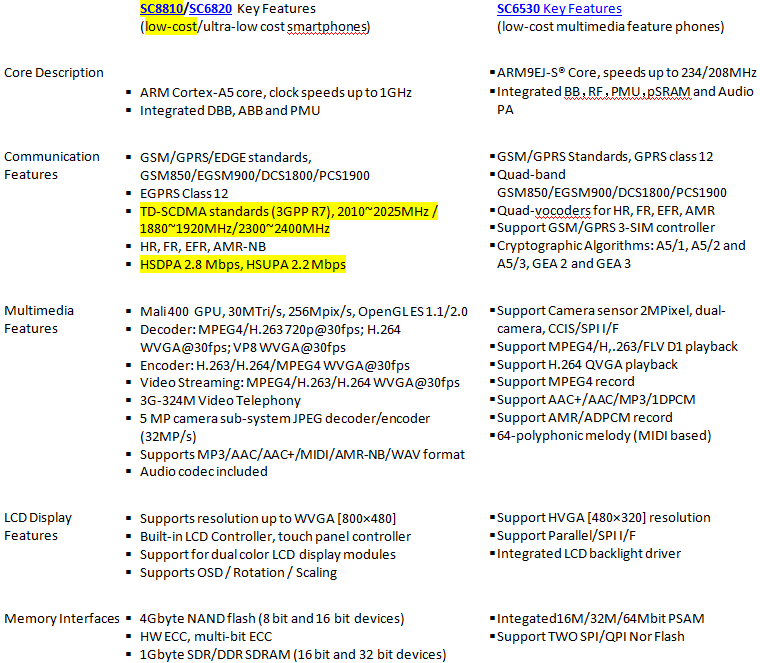
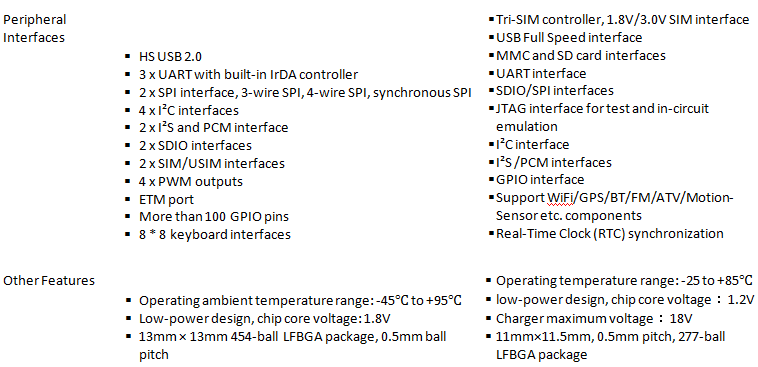
Source: the following Spreadtrum product pages
– SC8810 TD-HSPA/TD-SCDMA/EDGE/GPRS/GSM 1GHz Low-Cost Smartphone Platform
– SC6820 EDGE/GPRS/GSM 1GHz Low-Cost Smartphone Platform
– SC6530 GSM/GPRS Single-Chip Baseband/RF Transceiver for Multimedia Feature Phones
Notes:
1. WiFi and location technologies for SC8810 and SC6820 are according to Spreadtrum selects CSR connectivity and Location for Smartphone reference designs [CSR press release, Feb 27, 2012]. This is particularly relevant for SC6820-based EDGE/WiFi smartphones.
2. The ARM Cortex-A5 core has 1.57 DMIPS/MHz performance, while the ARM9EJ-S core 1.1 DMIPS/MHz performance. The former can be used in multicore SoCs as well with upto 4 Cortex-A5 cores (which Spreadtrum will exploit in its upcoming SoCs as well).
3. Dual-SIM Dual Standby solution became available as an option on Spreadtrum’s SC88xx series of TD-SCDMA basebands as well as future products, beginning in 4Q11. See: Spreadtrum Introduces First TD-Dual-SIM Dual-Standby Solution for TD-SCDMA [Spreadtrum press release, Oct 11, 2011]
Just this week came also the announcement of the – probably – highest end smartphone built on SC8810: Spreadtrum Powers Dual-SIM Dual-active TD-SCDMA Smartphone from Huawei [Spreadtrum press release, July 23, 2012]
Huawei T8808D completes China Mobile certification testing
Spreadtrum Communications, Inc. (NASDAQ: SPRD; “Spreadtrum” or the “Company”), a leading fabless semiconductor provider in China with advanced technology in 2G, 3G and 4G wireless communications standards, today announced that Spreadtrum’s SC8810 1GHz TD-SCDMA smartphone platform is powering the Huawei T8808D, a dual-SIM dual-active smartphone for China Mobile consumers.
Huawei’s dual-SIM dual-activefeature provides consumers with maximum flexibility in how they manage operator service fees. The dual-SIM function allows consumers to choose the SIM that offers the lowest rate or the best network coverage given their location to make or receive calls, send text messages, or use data. Dual-active capability allows both SIMs to be used at the same time, enabling users to switch back and forth between two calls and use voice and data functions simultaneously.
Mr. Wang Weijun, Huawei Device’s president of its Chinese division, said, “T8808D, as Huawei’s first dual-SIM dual-active mobile phone, delivers experience innovation to China’s 3G TD-SCDMA market. In collaboration with Spreadtrum, Huawei will continue to promote popularization and development of smartphones to meet the diverse needs of Chinese consumers with a variety of high quality terminal products.”
“Spreadtrum is driving technology innovation with 2.5G/3G single-chip dual-card dual-standby technology,” said Dr. Leo Li, Spreadtrum’s president and CEO. “In cooperation with Huawei, we have enabled the first TD-SCDMA device based on Spreadtrum’s SC8810 smartphone platform with dual-SIM dual-active capability. This feature will enable consumers to select attractive 3G services while maintaining their original operator service packages. We believe that this flexibility provided to the consumer will help further promote the rapid development of China’s TD-SCDMA market.”
Note that Spreadtrum’s early December 2011 flagship SoCs were clearly inferior to its current flagships:

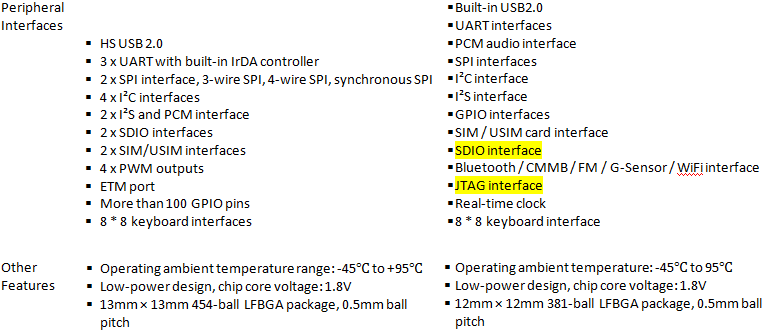
Additional source: the following Spreadtrum product pages
– SC8805G TD-HSPA/TD-SCDMA/EDGE/GPRS/GSM 600MHz Entry-Level Smartphone Platform
– SC6810 EDGE/GPRS/GSM 600MHz Entry-Level Smartphone Platform
Spreadtrum is also investigating alternative software platforms as shown by:
Spreadtrum Low-Cost Smartphone with HTML5 Operating System Demonstrated at Mobile Asia Congress 2012 [Spreadtrum press release, July 16, 2012]
Mozilla showcases Spreadtrum smartphone running Firefox OS, highlighting potential of HTML5 on low-cost smartphones
Spreadtrum Communications, Inc. (NASDAQ: SPRD; “Spreadtrum” or the “Company”), a leading fabless semiconductor provider in China with advanced technology in 2G, 3G and 4G wireless communications standards, today announced that Spreadtrum’s SC8810 smartphone platform was selected by Mozilla to showcase its HTML5 operating system, Firefox OS, running on low-cost smartphone devices. Mozilla demonstrated the handset, based on Spreadtrum’s 1GHz SC8810 smartphone chip and running Mozilla’s Firefox OS, at its booth during Mobile Asia Congress 2012 held last month in Shanghai, China.
Firefox OS for mobile devices is built on Mozilla’s “Boot to Gecko project” which allows HTML5 applications to access the underlying capabilities of a phone, previously only available to native applications. “Firefox OS is another major step at Mozilla to bring its core values — openness, innovation and opportunity on the web — to users and developers on smartphone platforms,” said Dr. Li Gong, CEO of Mozilla Online Ltd and Mozilla Taiwan. “Our collaboration with Spreadtrum will help enable the power of this truly-open operating system to reach the billions of consumers in emerging markets who will be coming online as first-time smartphone users as well as existing smartphone users who are looking for greater value at lower cost.”
“We have been closely tracking the progress of the “Boot to Gecko project” since its inception and are very excited about Firefox OS as a concrete realization,” said Mr. Yi Kang, vice president of marketing at Spreadtrum Communications. “This type of solution has generated a lot of interest from operators, as the open-source HTML5 platform can provide them with complete control over the handset experience. We expect that the appeal of this platform to our customers will grow as the HTML5 application ecosystem expands.”
This is leading to speculations like: The Feature phone rises (again?) [EE Times, July 24, 2012]
…
Is it plausible? You bet. I already see signs that make such plots believable.
First is the emergence of Firefox OS. While the jury’s still out on yet another new mobile OS, this HTML5-based mobile operating system may have enough power to stir the debate.
$40 smartphone
Second, there is mounting market pressure (from handset vendors and operators alike) for low, low-cost smartphones. In an interview with EE Times in early June, Spreadtrum’s CEO Leo Li was on the record by saying that “our customers are ready to roll out $40 ‘real’ smartphones this year.”Every chip company and handset vendor is in the market for a solution that makes all levels of smartphones possible at low cost.Third, operators are hatching a plot to retain full control of the billing relationship with subscribers. “Currently, operator billing is available for Android for only a handful of operators, all in developed countries,” according to Daniel Gleeson, an analyst on Mobile at IHS Screen Digest. “Otherwise payments for apps, games etc. go through credit card companies. Obviously operators would prefer that this goes through them as they would get a small slice of that pie as well.”
Fourth, as legal wrangling escalates on Apple iOS vs. Google’s Android IP front, handset vendors are surreptitiously looking for an alternative system – possibly something available for free.
Fifth, let’s not forget about a huge global market — beyond the United States and Europe — that hasn’t embraced smartphones yet. This creates big openings for developers of new technologies and new players on the mobile market.
Above all, I’m convinced that feature phones (OK, “entry-level smartphones”) are not going away, largely because the definition of smartphones vs. feature phones, in my opinion, is fundamentally phony. At best, it’s based on a self-serving marketing pitch by smartphone proponents.
…
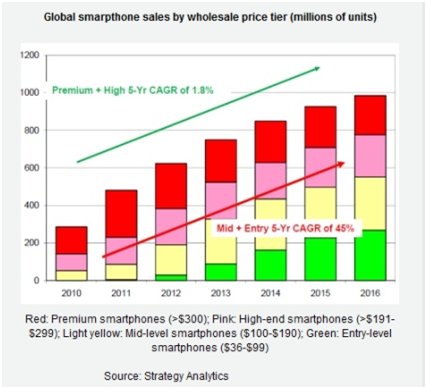
Boosting the MediaTek MT6575 success story with the MT6577 announcement — UPDATED with MT6588/83 coming in Q4 2012 and 8-core MT6599 in 2013
Follow-up: MediaTek MT6589 quad-core Cortex-A7 SoC with HSPA+ and TD-SCDMA is available for Android smartphones and tablets of Q1 delivery [Dec 12, 2012]
The MT6588 was recently renamed MT6589.
Update: Sold 70 million in the first three quarters, MediaTek smart chip dominates China [The Liberty Times, Taiwan, Oct 2, 2012] translated by Google/Bing with additional manual edits of my own 6588
Qualcomm (Qualcomm) last week launched a lower-priced smart phone chip against rival MediaTek (2,454), but according to the the recent shipment situation MediaTek shipped in China more than 70 million smartphone chips in the first three quarters, 10 million more than Qualcomm there, and become a smart-phone chip superpower in China. Merrill Lynch is bullish on MediaTek outlook because for Qualcomm’s “MSM8225Q” to shake up MediaTek’s leadership still will not be easy.
…
Barclays Capital analyst Lu Hang increased MediaTek smartphone chip shipments in the next two years to 180 million and 290 million, respectively.
…
Chinese mobile phone distributors circle recently the hottest topic number the high pass last week, low-cost quad-core mobile phone chip “MSM8225Q/MSM8625Q “, estimated price falls to $ 25, the market worry renewed price war, the impact MediaTek Maori. However, the latest released Merrill Lynch research report pointed out that the dual-core MediaTek chips and the two Qualcomm quad-core chips compared to each other competitively, plus “8225Q” mass production may be in March next year, by about one quarter behind the MediaTek quad-core chip “MT6589″ (formerly known as MT 6588), the cost of which is expected to be cheaper than the dual-core version, meaning MediaTek is still dominant.
…
Update: Taiwan chip designer MediaTek downgraded amid competitive pressure [WantChinaTimes.com, Oct 2, 2012]
… In a report dated Sept. 27, [independent financial services group] CLSA [Asia-Pacific Markets] said the market was optimistic about MediaTek’s gross margin in the second half of 2012 and in 2013 after the company forecasted a gross margin expansion for the third quarter of this year, ending 11 consecutive quarters of contraction.
However, MediaTek’s management told the press on Sept. 25 that the company’s quarterly gross margin growth is likely to remain flat in the fourth quarter of this year and will not expand until the second half of 2013, the report said. …
… One of the reasons investors were optimistic about MediaTek’s 2013 margin was that they thought its new quad-core MT6588 chip had no competition, as Qualcomm made only very high-end quad-core ICs, [CK] Cheng [a Taipei-based analyst at CLSA] said.
But the launch of the MSM8225Q will change that perception, Cheng said, noting that Qualcomm is aiming to release the chip for customer sampling by the end of 2012 and ship in volume in the first quarter of 2013.
Although the Qualcomm chip is scheduled to be launched a month or two later than MediaTek’s, Qualcomm’s price is likely to be 5% cheaper because of lower specifications, he said.
While MediaTek is believed to have superior products and better low-end smartphone ICs than Qualcomm, price does matter to Chinese handset makers, Cheng added.
“This is the main reason why MediaTek has been struggling to lift its average selling price and improve its margin since the third quarter of 2011, although it continues to offer faster processors and multi-core solutions,” he said.
“We don’t think MediaTek’s quad-core solution can reverse this trend,” Cheng said.
As for Chinese competitors, the increased production of RDA Microelectronics’s connectivity combo chip and Spreadtrum Communications’ 2G smartphone ICs will also weigh further on MediaTek’s margins and average selling price, Cheng said.
CLSA raised its forecast for MediaTek’s earnings per share by 3% for 2012 and by 8% for 2013, factoring in the company’s acquisition of its smaller rival MStar Semiconductor, but the brokerage maintained its target price of NT$250 (US$8.53) on the stock.
As of 10:26am Monday, MediaTek shares had dropped 4.62% to NT$310 (US$10.59) in Taipei.
Regarding actual Cortex-A5 and Krait-related information see on this blog the actual:
Core post: Qualcomm decided to compete with the existing Cortex-A5/Krait-based offerings till the end of 2012 [Sept 30, 2012]
Update: Mediatek [联发科] target price by Barclays is [NT$] 395 [Taiwan’s Commercial Times News, Sept 26, 2012] as translated by Google/Bing with additional manual edits of my own
Lu Hang [陆行] [principal analyst of semiconductors for Asia-Pacific at] Barclays Capital Securities [巴克莱资本证券 Taiwan Limited, 11F, 106 Xin-Yi Road, Sec. 5, Taipei, Taiwan, R.O.C. << from] yesterday (25) revealed, that MediaTek 28 nanometer quad-core A7 smartphone chip MTK6588 launch time is expected to advance to the fourth quarter of this year from the first quarter of next year! Because the price is very competitive, only 18 to 20 dollars, not only quadcore smartphone prices in mainland China will immediately fell to less than 150 dollars following that, the company will also have the opportunity to break into [the market of ] first-tier [i.e. global brand] manufacturers such as Samsung.
…
Lu Hang said that Mediatek’s biggest “backer” [in terms of stock market performance] is expected to be the launch of MT6588 (quad-core A7 [with] TD-SCDMA/WCDMA) and MT6599 (8 core of the ARM [with] LTE/TD-SCDMA/WCDMA) smartphone chips in 4th quarter [of this year] and in the next year, respectively.
Lu Hang believes that there are 5 items which will affect the profits of the overall market with MediaTek MT6588:
– First, the quad-core smartphone prices in mainland China can immediately be reduced from the current US$ 320 to US$ 150.
– Second, we will see in the near future more dual-core 1.7Ghz Krait-based MSM8960A [on one hand], and MSM8974 [on the other], which is same but with quad-core, rather than next to the launch of 8225Q.
– Third, in the fourth quarter of next year the estimated proportion of MT6583/MT6588 [shipments] within the total smartphone chip shipments will reach 50%, even the year after the fourth quarter launched MT6599 will also have 50% level, thus raised its shipment forecast value.
– Fourth, MT6588 will help to maintain the overall ASP at a level of more than $ 10, and customers can be [serviced via a] unified system design.
– Fifth, with the help of 13 million pixels CMOS the sensing power amplifier manufacturers will focus on mainland China and other emerging markets.
Important remark from Barclays Hires New Taiwan Investment Banking Head [The Wall Street Journal, Aug 19, 2012]:
Barclays … is … an advisor to chip design firm MediaTek Inc. on its proposed acquisition of a minority stake in MStar Semiconductor Inc. worth around $3.8 billion, announced in June, according to Dealogic.
Update: MediaTek will produce small amounts of MTK6588 in October [MTK mobile phone network, Sept 10, 2012] as translated by Google/Bing
Recently MediaTek message there are two who are more concerned about one thing, according to Taiwan media reports, the fastest possible production of MediaTek quad-core mobile processor chip MTK6588 will start in October this year a small amount, quantity should not be a lot, may be available only to large client proofing purposes. Rumored MediaTek MTK6588 manufacturing cost is even less than dual-core MTK6577. Quad-core MTK6588 is using 28 nm technology process to support tens of millions of pixels of camera, support for TD/WCDMA dual-mode network, support 1080P playback and recording, and is equipped with a PowerVR SGX 544 graphics processor.
According to show learned about MTK6588 before, Quad MT6588 or will before the end of trial production, mass production quantities listed in the first quarter of next year.
Update: Lenovo Selects MediaTek to Power New LePad Android Tablet [MediaTek press release, Sept 13, 2012], note: “The MT6577 is pin-to-pin compatible with the previously released MT6575” source: the MT6577 launch release
MediaTek Inc., a leading fabless semiconductor company for wireless communications and digital multimedia solutions, today announced that Lenovo has selected its highly integrated Android mobile platform for the new LePad A2107, dual-SIM 3G/HSPA tablet, which is shipping to customers globally.
The LePad A2107 provides high-speed cellular data and wireless connectivity and is designed for tablet users who want to be “connected always”. The A2107 uses MediaTek’s proven Android mobile platform consisting of the MT6575 and the MT6620 SoCs. The MediaTek MT6575 incorporates a 1GHz ARM® CortexTM A9 processor, a PowerVR™ Series5 SGX GPU (graphics processing unit) from Imagination Technologies, a 3G/HSPA modem and built‐in support for 3D displays and DTV‐grade multimedia capabilities by leveraging the company’s world‐leading DTV platform technologies. The MT6620 4-in-1 connectivity combo integrates an 802.11n Wi-Fi, Bluetooth 4.0+HS, GPS, and FM transmitter/receiver into a single chip with the world’s smallest footprint and leading low-power consumption. The MediaTek mobile platform is ideally suited to enable mobile device manufacturers like Lenovo, helping them to address the mid and entry‐level tablet market that demands global connectivity for today and tomorrow.
“Consumers are increasingly using tablets as a companion device to the PC and mobile phone to access media and information. We forecast that the tablet market will increase from 119 million in 2012 to 494 million by 2016(*),” said Mr. Mark Hung, Research Director at Gartner. “A company that has capabilities and technologies across different multi-screen platforms, from smartphones to DTV, should be well positioned to benefit from participating in the growing tablet market.”
*Source: Forecast: Media Tablets by Operating System, Worldwide, 2010-2016, 2Q12 Update, 4 July 2012, by Gartner
Update: the best smartphone based on the MediaTek MT6577 both technically and in terms of price is the MT6577-based JiaYu G3 with IPS Gorilla glass 2 sreen of 4.5” etc. for $154 (factory direct) in China and $183 [Sept 13, 2012], which is also the best example of The low priced, Android based smartphones of China will change the global market [this same ‘Experiencing the Cloud blog, Sept 10, 2012]
Update: MediaTek MT6577 Performance Review [mediateklab YouTube channel, Sept 3, 2012]
Update: New MediaTek chip efficiency: catching up with iPhone4s [MTK mobile phone network, Sept 6, 2012]
2012 International Semiconductor exhibition yesterday (5) days in Taipei debut, over the years, the first IC design Forum yesterday morning talk show, presenter mediatek Vice President Lu Guohong home 3G smart mobile phone chip specification level, noted that MediaTek MT6577 of the latest dual-core Smartphone chip efficiency, comparable with iPhone4s. By the show’s brief is not difficult to see, MediaTek, engaged global Smartphone chip leader Qualcomm momentum is high.
IPhone4s core processor for Apple A5, the design was based on Cortex-A9 dual core 1GHZ frequency of ARM architecture processors, Lu Guohong comparison list noted that mediatek MT6577 newest 3G Smartphone dual-core chips are used by An Mou with iPhone4s A9 dual core architecture, AP mobile core chips, baseband chip, RF chips and GPU architecture level par with iPhone4s.
Update: MediaTek Launches “Cool 3D”: A Comprehensive Suite of 3D Solutions for Smartphone Platforms [MediaTek press release, Sept 11, 2012]
MediaTek Inc., a leading fabless semiconductor company for wireless communications and digital multimedia solutions announced today the availability of “Cool 3D”, the world’s most complete 3D suite of solutions, for its smartphone platforms. Consumers continue to look for new features in smartphones, such as 3D capabilities, and a report by Global Industry Analysts, Inc, predicts that the global market for 3D enabled smartphones is projected to register 994 million units in annual shipments by the year 2018. Demand for this innovation will be driven by the increased availability of 3D content, such as games, videos and full length movies.
The “Cool 3D” suite for MediaTek smartphone platforms includes support for stereo 3D cameras and displays, real-time 2D-to-3D conversion and an optimal 3D user interface that is designed to provide consumers with a stunning 3D experience. Two distinguishing features are “3D Cool Shot” and “3D Cool Show”. MediaTek’s “3D Cool Shot” solution supports a cost-effective 5 MP, dual-lens camera, which achieves 1080P, 24 FPS 3D images, giving users a high-definition visual experience. The MediaTek smartphone platforms are the first of their kind in the industry to integrate the functionality of the dual-lens bridge devices into the main smartphone platform, reducing system cost and saving precious board area. The “3D Cool Show” technology substantially improves the stereo 3D effect with anti-fatigue capabilities, and real-time transformation between 2D/3D modes, allowing for convenient switching between the 2D and 3D displays. These solutions, which leverage MediaTek’s established 3D technologies from the DTV and Digital Home markets, are aimed at creating an optimal stereo 3D display with a custom-tailored 3D interface.
“One consequence of the rapid developments in the smartphone market is product homogenization or the ‘all smartphones look alike’ phenomena. Creating product differentiation has become one of the biggest challenges for the mobile phone industry “said Ching-Jiang Hsieh, President of MediaTek. “From Dual-SIM to 3D capabilities, MediaTek has always pushed technological innovation in our platforms, enabling rich and compelling devices and solutions. By working together with our customers, we hope our industry-leading, ”Cool 3D” suite of solutions can lead the wave of 3D smartphone popularity, allowing even more consumers to enjoy an extraordinary 3D experience.”
The “Cool 3D” suite of capabilities is already enabled on MediaTek’s shipping MT6575 single-core and MT6577 dual-core platforms. All future launches of MediaTek smartphone solutions will support these 3D capabilities.
Updates: Shares of MediaTek jump on positive shipment target revision [Focus Taiwan, Aug 1, 2012]
… As of 11:15 a.m., shares of MediaTek had added 6.67 percent to NT$272.00 (US$9.07), off an early high of NT$272.50, with 23.82 million shares changing hands. … MediaTek announced Tuesday at an investor conference that it had raised its target for smartphone chip shipments to 95 million units, from a previous estimate of 75 million units, mainly because of strong demand from China.
In the second quarter, the IC designer shipped 21 million smartphone chips, higher than the 18 million to 20 million previously forecast. The company said it would ship at least 30 million smartphone chips in the third quarter.
… MediaTek said it expects its gross margin will improve to 41-43 percent for the third quarter from 40.8 percent in the second quarter. …
MediaTek hikes 2012 target smartphone chip shipments [DIGITIMES, Aug 1, 2012]
… The company expects its MT6575 and MT6577 chips to account for 60% of total smartphone chips sales in the third quarter and 80% in the fourth. …
MediaTek eyes Q3 double-digit revenue growth [Taipei Times, Aug 1, 2012]
MediaTek Inc (聯發科), the nation’s largest handset chip designer, said yesterday revenue in the third quarter of this year is projected to grow between 13 percent and 18 percent from the second quarter, following the launch of new products and strong demand for smartphone chips.
That would mean a quarterly revenue of between NT$26.50 billion (US$883.33 million) and NT$27.70 billion, compared with NT$23.44 billion in the second quarter.
…
MediaTek said second-quarter revenue rose 19.5 percent sequentially and 11.7 percent from the same period last year, primarily driven by the fast-growing smartphone demand in China.
However, gross margin for the quarter was 40.8 percent, down 1.3 percent and 5.1 percentage points from the previous quarter and the same period of last year respectively. The company attributed that fall to fierce price competition in the market.
…
Total smartphone chip shipments are likely to reach 95 million units this year, of which between 50 percent and 60 percent will be 3G chips and the remainder 2G chips …
MediaTek a product roadmap leaked: Quad-core code-named MT6588 [MTK Smartphones Network (MTK手机网), July 27, 2012]
From a recently obtained electronic forum information abroad we see that the MT6585 code communicated earlier for the quad-core MediaTek smartphone chipset is wrong. The true model code is MT6588. It is built on the 28nm process in order achieve higher performance level than the dual-core MT6577 technology.
MT6588 has a 4-core CPU [Cortex-A7 (!), see on the second slide below] clocked at 1GHz [1.XGHz rather, see the included slides below], supports dual-channel at maximum 1066Mbps, has an integrated multimode modem for WCDMA [+ it is delivering HSPA+ WCDMA performance (!) vs just HSPA with MT6577/75, see the first slide below] and TD (!), that is it can support both Unicom [latest upgrade to HSPA+ service, see the news in the original post materials much below] and China Mobile 3G network, supports an up to 13 MP camera and 1080P video playback. It finally has a GPU upgrade with SGX544, doubles the resolution to 1280×800 HD level, and has 32KB L1 cache and 1MB L2 secondary cache.
Along the MT6588 there is a 28nm dual-core version, MT6583 on the MediaTek 2012 product roadmap. From the chipset parameters it is evident that MT6583 is a scaled down version of MT6588. It has 2 cores less, the camera support is 8MP, the video decoder is of 720P level, and the resolution is down to 854×480.
It is understood that MT6588 and MT6583 will be in production in the first quarter of 2013, early next year the fastest.


Note: No search reveals the source for the above information.
MediaTek to launch quad-core smartphone solutions in 1Q13, says paper [DIGITIMES, Aug 6, 2012]
MediaTek is expected to launch its first quad-core smartphone solution, the MT6588, in the first quarter of 2013, according to a Chinese-language Liberty Times report. The MT6588 features a quad-core 1.5GHz or 1.7GHzCortex-A7 CPU, supporting WCDMA and TD-SCDMA technologies.
The MT6588, which features a 13-megapixel camera, also supports 1080p video playback and a display resolution of 1280 by 800 pixels. The chip will be built using a 28nm process, the paper said.
Additionally, MediaTek will also roll out a 28nm dual-core solution, the MT6583, during the same quarter. While the dual-core CPU of the MT6853 will also run at 1.5GHz or 1.7GHz, the chip will support a resolution of 854 by 480 pixels targeting a segment different from that of the MT6588, the paper indicated.
End of updates
The original content:
- About the just four months old MT6575-based market
- MediaTek provided general MT6575 information
- Some history leading to MT6575
- Turmoil on the H1CY12 market in China:
International and local brands, as well as white-box vendors are repositioning for the most lucrative CNY500 (US$79) to CNY1,000 (US$157) smartphone market of H2CY12 and on
Note: the PowerVR SGX Series 5 GPU used for MT6577 is said to be by 3d parties SGX531, See: SoC list on Imagineers blog, or Lenovo (indirect).
Greater China mobile solutions – From silicon to software [DIGITIMES Research, June 8, 2012]
Abstract
The China mobile market has developed rapidly, with smartphone shipments reaching 69 million units in 2011 and tablet shipments soaring from around one million in 2010 to some 10 million in 2011, and potentially exceeding 20 million units in 2012. As consumer spending power increases, local vendors are focusing on more market tiers and makers have begun to make a play for the high-end market.
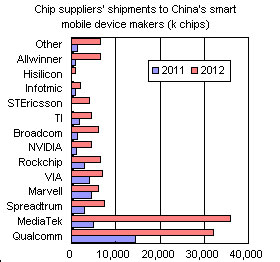
Updates: China market: Nearly 195 million handsets shipped in 1H12 [DIGITIMES, July 10, 2012]
There were 194.913 million handsets shipped in the China market during the first half of 2012, consisting of 106.874 million (54.83%) 3G handsets in 801 models and 88.039 million (45.17%) 2G handsets in 1,298 models, according to statistics published by the China Academy of Telecommunication Research (CATR) under the Ministry of Industry and Information Technology (MIIT).
Of the shipment volume, 94.855 million or 48.67% were smartphones in 822 models of which 801 models or 97.44% were based on Android. China-based vendors accounted for 75.16% of the half-year shipment volume, and international vendors 24.84%.
The monthly shipment volume of smartphones exceeded that of feature phones for the first time in April 2012, with the corresponding proportion increasing to 56.9% in June.
China market: Breakdown of total handset shipment volume, 1H12 Generation Technology standard
Number of models
Shipment volume (m handsets)
3G WCDMA (China Unicom)
476
53.099
CDMA2000 (China Telecom)
174
28.197
TD-SCDMA (China Mobile)
151
25.578
2G GSM
1,272
81.915
CDMA1x
26
6.076
Source: CATR under MIIT, compiled by Digitimes, July 2012
– China smartphone market 2012: Trends and analysis [DIGITIMES Research, July 3, 2012]
Abstract
The China handset market has exhibited strong growth, with the total number of mobile users in the country reaching 980 million people according to figures from the Ministry of Industry and Information Technology (MIIT), an increase of 130 million over the 2010 figure. Digitimes Research estimates that mobile user numbers could top 1.13 billion in 2012.
Digitimes Research estimates that the China handset market reached some 390 million units in 2011, representing 16% growth on 2010; the market is likely to grow to 430 million units in 2012, representing further growth of 9%. Thanks to the expansion of 3G service coverage and further falls in budget smartphone prices, the share of the handset market accounted for by smartphones is likely to reach 32% or around 143 million units, 70% of which will be Android handsets.
Digitimes Research believes that market share rankings for the China smartphone market will change significantly during 2012. Samsung and Apple will take the top two places, while the big four China-based brands – Huawei, ZTE, Lenovo and Coolpad – will take third to sixth places, while Nokia will drop to seventh; these seven firms will collectively account for 85% of shipments.
In other words, the many other brands hoping to seize a share of the market will essentially be confined to competing for a potential market of just 15% of overall shipments or around 21 million handsets. Given such a situation, Digitimes Research projects that many of China’s best known smaller brands such as Xiaomi, TCL, Gionee, Tianyu, Oppo and BBK will see shipments of no more than a few million handsets.
End of updates
China-based white-box vendors expected to ship 200 million smartphones [DIGITIMES, April 17, 2012]
China-based white-box vendors, mainly due to the availability of inexpensive new chip solutions, have been increasing the production of smartphones, with the total shipment volume expected to reach 200 million units in 2012, according to industry sources in Taiwan.
Taiwan-based MediaTek is offering the makers its MT6575 a chip solution for use in entry-level smartphones in the first quarter of 2012 and will offer the MT6577, a solution for high-level smartphones, in the middle of the third quarter of 2012, the sources indicated. MediaTek will ship 50-70 million chips to China-based white-box vendors to account for nearly 30% of smartphones to be shipped by these vendors in 2012.
In addition, Qualcomm has strengthened its marketing in the China market by offering turn-key solutions to white-box vendors, with prices for a chips lowered to US$6, the sources cited eMedia Asia as indicating.
China-based white-box vendors sell more than 60% of their smartphone output to overseas markets, including 2.5G models for markets where deployment of 3G networks is not mature yet, the sources indicated. White-box vendors are expected to see larger market demand if their production costs for entry-, medium- and high-level smartphones drop to US$60, US$85 and US$130 respectively, the sources pointed out.
Huawei adopts MediaTek dual-core chip for smartphones, says report [DIGITIMES, June 27, 2011]
MediaTek’s new MT6577, which uses a dual-core 1.2GHz Cortex A9 CPU, has been adopted by China-based Huawei for as many as four of its upcoming smartphone devices, according to a Chinese-languageCommercial Timesreport.
The new MediaTek MT6577 solution is scheduled to enter volume production starting July, the Chinese-language Economic Daily News (EDN)reported last week (June 22). The chip is built using 40nm process technology.
MediaTek previously upward revised the prediction for its total smartphone-IC shipments in 2012. The firm now expects to ship about 75 million smartphone chips this year, compared to the 50 million estimated initially.
From:


MediaTek Launches Dual-Core MT6577 Smartphone Platform [MediaTek press release, June 27, 2012]
MediaTek Inc., a leading fabless semiconductor company for wireless communications and digital multimedia solutions, today announced the availability of the MT6577, a dual-core platform developed specifically for sub-$200 smartphones, the fastest growing segment of the global smartphone market. The MediaTek MT6577 features a dual 1GHz Cortex™-A9 application processor from ARM, a PowerVR™ Series5 SGX GPU (graphics processing unit) from Imagination Technologies, MediaTek’s proven 3G/HSPA modem, and runs the latest Android 4.0 “Ice Cream Sandwich” operating system. By integrating a dual-core application processor architecture widely deployed in the majority of today’s premium smartphones, the MT6577 boosts application and browser performance by up to 40% compared to single-core platforms, bringing unprecedented levels of user experience to mid- and entry-level smartphones.
“MediaTek’s existing HSPA smartphone platforms – the MT6573 and MT6575 – have been extremely well-received by customers and consumers worldwide, and are currently shipping with major international brands such as Lenovo, TCL/Alcatel, and other top tier Chinese OEMs,”said Ching-Jiang Hsieh, President of MediaTek. “The MT6577 adds the next level of performance and enhanced user experience to the MediaTek smartphone family, delivering enhanced user interactivity, mobile connectivity and rich multi-media experience previously only available on high-end devices. Consumers everywhere will now benefit from the affordable, high-performance devices enabled by the MT6577. MediaTek is proud to be in the vanguard of companies enabling the democratization of smartphones.”
“Dual-core processors account for over 20% of current smartphone processor shipments, with these devices being mostly in the premium segment and addressed by standalone application processors. MediaTek’s new MT6577, with integrated dual-core processors and 3G/HSPA modem is well suited to bringing similar user experiences to the fast-growing mid and entry smartphone segment which is forecast to grow from under 200 Mu in 2012 to over 500 Mu in 2016” said Stuart Robinson, Director, Handset Component Technologies service at Strategy Analytics.
The MT6577 is designed to deliver rich multimedia experiences, with an 8MP camera, support for up-to high-definition 1080p video playback and the ability to support high-resolution displays up to HD720 (1280×720) resolution. The platform also pre-integrates MediaTek’s leading 4-in-1 connectivity combo that provides support for dual-band 802.11n Wi-Fi, BT4.0, GPS and FM. The MT6577 is pin-to-pin compatible with the previously released MT6575, allowing handset manufacturers to easily produce multiple tiers of devices leveraging a single PCBA hardware development effort.
The MT6577 dual-core platform is currently being incorporated into smartphone devices by MediaTek’s leading global customers, and the first smartphone models based on this new chipset are expected to ship commercially in Q3 2012.
MediaTek MT6577 [MediaTek100 YouTube channel, July 19, 2012]
MediaTek expects increase in smartphone chip sales [Taipei Times, June 14, 2012]
MediaTek Inc (聯發科) chairman Tsai Ming-kai (蔡明介) said yesterday that he still expects an increase in demand for smartphone chips in the second half of this year, despite a slowing global economy.
…
Last year, faced with competition that was fiercer than ever, MediaTek posted NT$13.62 billion (US$454 million) in net profit, or NT$12.35 earnings per share (EPS), down sharply from the NT$30.94 billion in net profit, or NT$28.44 EPS recorded in 2010.
Tsai said the worst phase was almost over for the IC designer and the company was gearing up to broaden its product portfolio and win orders to strengthen its profitability.
On the back of robust demand for smartphones, MediaTek has forecast smartphone chip shipments in the second quarter would range between 18 million and 20 million units, up sharply from the 10 million recorded in the first quarter.
For all of this year, the IC designer anticipates smartphone chip shipments to touch 75 million units from rising demand from China and other emerging markets.
MediaTek president Hsieh Ching-jiang (謝清江) said at the shareholders’ meeting that the company would not focus just on the Chinese market, but also target global demand, while operating a total of 23 offices worldwide.
About the just four months old MT6575-based market
ZOPO ZP200 3D Movie Playing [AndroidSale YouTube channel, March 22, 2012]
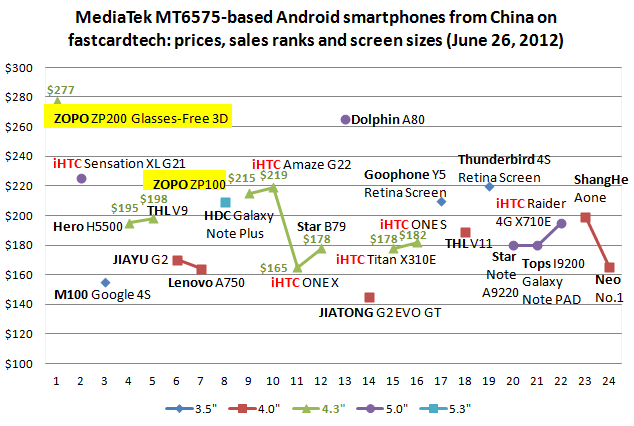
Source: MTK6575 Cpu Andorid >> on fastcardtech.com
Note that even for global wholesale there are much more products of the above kind, as you could see from the table below (the ones which are also on the above diagram are highlighted in yellow). Click here for a PDF version in case you want to click on the links:

There are a couple of recent Chinese startups capitalising on the MT6575 opportunity. The most successfull among them is probably ZOPO Mobile Communications-equipment Ltd. in Shenzhen, China, introducing itself as:
ZOPO Company is founded in 2012, which engages in research, development, produce, marketing and service of mobile intelligent terminal products. The ZOPO ZP200 model as” The China‘s first Glasses-Free 3D dual sim smart mobile phone ” has been a hot Star in China mainland.
Zopo ZP100 MT6575 4.3″ qHD $174 street price [ARMdevices.net YouTube channel, April 9, 2012]
I’m back in Shenzhen! Here getting ICS installed on my Zopo ZP100 MT6575 [ARMdevices.net YouTube channel, April 9, 2012]
The author of the above videos (Nicolas Charbonnier, aka Charbax, see also a recent interview with him about his videoblogging) went through quite a tour about the new MT6575-based entries in the first half of April:
– $158 5″ WVGA MT6575 Cortex-A9 Smartphone presented by www.yooe.com.cn
– Zhenai A900 waterproof MT6575 smartphone
– $79 3.5″ MT6575 Orient Smart Development Ltd
– MT6575 phone shown by Quality Industrial Co Ltd
– $142 Galaxy Nexus clone, runs ICS on MT6575, with 4.65″ LCD
– Hyundai Brilliant H950, 5.2″ MT6575 phone runs Ice Cream Sandwich at the HKTDC Electronics Fair
– $140 5.2″ MT6575 Android phone by Daza Electronics at the HKTDC Electronics Fair
– ICS on 5″ MediaTek MT6575 Dolphin A80 phone [from Yooe] (note that this is represented on both the above diagram and the table)
– Shenzhen Factory Entrance (note that this is also where Yooe is manufacturing, quite likely)
– The Shenzhen Speakers Factory (the same factory was manufacturing speakers during the visit)
Then he returned in the end of May with these video reports:
– Yooe MT6575 phone now selling
– MT6575 Cutepad 5″ phone
He was showing off some of the latest gadgets that he found in Shenzhen in this video as well: Interview with Nicolas Charbonnier at Linaro Connect, Hong Kong [jasonderose YouTube channel, June 4, 2012]
MediaTek provided general MT6575 information
MT6575 [MediaTek product page, March 29, 2012]
Dual-SIM smartphone platform for the mainstream mid and entry level market
MT6575 is MediaTek’s new dual-SIM smartphone platform for the mainstream mid- and entry-level smartphone markets. Enabling browsing, gaming and multimedia features that will delight consumers, support the latest Android releases and the industry’s best dual-SIM performance for voice and data calls, the MT6575 is MediaTek’s most advanced and competitive smartphone platform to date.The MT6575 combines a software and hardware reference design solution to enable dramatically faster time to market at a highly competitive price point. The MT6575 is set to redefine the performance of mainstream smartphones.
Features
- 1GHz ARM CortexTM-A9 CPU allows for outstanding web browsing and application performance
- High-performance 3D gaming and UIfeatures enabled by PowerVRTM SGX Series5 GPU
- High-definition 720p videoplayback and record
- Per-packet Rx antenna diversity
- 8 MP camerawith enhanced image processing capabilities
- Up to high-resolution qHD (960×540) displays
- Supports both portrait and landscape display modes by built-in dedicated HW
- Features stereo 3D video playback and advanced 2D-to-3D image/video conversion
- No lost calls on either SIM – even with active data transmission on either SIM
- Better Power Efficiency – Up to 500 hours of standby and over 8 hours of talk-time on 3G, 45 hours of audio playback and 6 hours of 3D gaming.
MediaTek – MT6575 [a featured product page, July 5, 2012]
Redefining performance of mid/entry smartphones in 2012
Overview
MT6575 is MediaTek’s new dual-SIM smartphone platform for the mainstream mid- and entry-level smartphone markets. Enabling browsing, gaming and multimedia features that will delight consumers, support the latest Android releases and the industry’s best dual-SIM performance for voice and data calls, MT6575 is MediaTek’s most advanced and competitive smartphone platform to date.
Key Features
The MT6575 platform offers a 1GHz ARM® CortexTM-A9 processer for outstanding web browsing and application performance, a proven 3G/HSPA modem and runs the latest “Ice-Cream Sandwich” Android 4.0 release. Other key features include:
♦ Superior CPU, GPU, and System Performance
– High-performance 3D gaming and UI features enabled by PowerVRTM SGX Series5 GPU♦ Richest Multimedia Features
– High-definition 720p video playback and record
– 8 MP camera with enhanced image processing capabilities♦ World-First Integration Of Stereo 3D Display Controller And 3D Video Processing
– Features stereo 3D video playback and advanced 2D-to-3D image/video conversion♦ Best Display Picture Quality
– Brings the same level of LCD-TV picture quality to mobile devices♦ Leading Dual-SIM Features and Performance
– No lost calls on either SIM♦ Lowest BOM costs
– Highly integrated platform includes the world’s smallest 4-in-1 connectivity combo (MT6620) that allows for small size and lower BOM costs♦ Better Power Efficiency
– Up to 500 hours of standby and over 8 hours of talk-time on 3G
– Up to 45 hours of audio playback and 6 hours of 3D gamingThe MT6575 is currently being incorporated into the latest smartphone offerings by many of MediaTek’s leading customers and the first smartphone models based on this new platform have already hit the market in the first quarter of 2012.
MediaTek – MT6620 [a featured product page, Sept 21, 2011]
Highly Integrated 4-in-1 WLAN/Bluetooth/GPS/FM Combo Solution
Overview
MediaTek MT6620 integrates WLAN, Bluetooth, GNSS and FM, to provide the best performance and most convenient single chip. MT6620 implements advanced and sophisticated Radio Coexistence algorithms and hardware mechanisms. MT6620 also supports a single shared antenna (2.4 GHz antenna for Bluetooth and WLAN, 5 GHz for WLAN and 1.575 GHz for GPS).
Enhanced overall quality for simultaneous voice, data and audio/video transmission on mobile phone and tablet PC can be achieved. The small size with low power consumption reduces PCB layout area. The software package “Symphony” comes with many advanced features.
Key Features
Low power, small size and high performance
WLAN/Bluetooth/GPS/FM solution WLAN 802.11 a/b/g/n dual band single stream (20/40MHz) with dual band LNA and 2.4GHz PA integration
Bluetooth 3.0+HS and V4.0 Low Energy support with LNA and PA integration
Support GPS/Galileo/QZSS/SBAS with -165dBm tracking sensitivity FM Tx/Rx with RDS/RBDS support
Support Wi-Fi Direct and WAPI hardware encryption
Support FM over Bluetooth
PLC (Packet Loss Concealment) technology for superior audio quality
Advanced AlwaysLocateTM location awareness technology with ultra low power consumption
Flexible host interfaces support include single SDIO interface for all wireless functions
MediaTek Launches MT6575 Android Platform [MediaTek press release, Feb 13, 2012]
MediaTek Inc., a leading fabless semiconductor company for wireless communications and digital multimedia solutions, today announced the availability of the MT6575, its 3rd generation platform for mid and entry‐level Android smartphones. The MT6575 platform offers a 1GHz ARM® CortexTM‐A9 processer, a proven 3G/HSPA modem and runs the latest “Ice‐Cream Sandwich” Android 4.0 release.
“We expect significant growth in entry and mid‐level smartphones, with wholesale prices under US$190, over the coming years. We forecast that this segment will almost triple in size from 191 million shipments in 2012 to 551 million by 2016. At that time, we also expect approximately 75% of those entry and mid‐level smartphones to ship to emerging markets” said Neil Mawston, Executive Director, Global Wireless Practice, at Strategy Analytics. The MediaTek MT6575 platform is ideally suited to cater to a wide range of smartphone devices that target this growing segment in multiple markets around the world.
“Leveraging the energy‐efficient, high‐performance Cortex‐A9 processor in Android smartphone applications is an extremely compelling proposition and a great proof point for the scalability of the ARM architecture. During 2011 the Cortex‐A9 processor has powered many of the most up‐to‐date and highest performance smartphones. The proliferation of Cortex‐A Series processors into lower cost, mainstream mobile devices will deliver a significant uplift in the user experience,” said Laurence Bryant, Director of Mobile, ARM.
For mid‐range smartphones, the MT6575 platform supports 720p high‐definition video playback and recording with an 8MP camera and qHD (960×540) high‐resolution displays via a PowerVRTM SGX Series5 GPU (graphics processing unit) from Imagination Technologies. In industry‐standard benchmark testing, the MT6575 offered over 35% improvement for browser applications and over 20% improvement in graphics capabilities for gaming when compared to competitors’ best offerings in these segments.
Additionally, the MT6575 platform provides built‐in support for advanced features such as integrated capabilities to drive 3D displays and proprietary algorithms for mobile display picture processing. In sum, the MT6575 provides DTV‐grade picture quality on a smartphone by leveraging MediaTek’s proven technology as a world‐leading DTV platform provider.
The MT6575 platform also supports entry‐level smartphones with smaller display sizes, lower resolution, less memory and reduced multimedia requirements. In addition, the MT6575 boasts the world’s lowest power consumption and most comprehensive integration of hot swap dual‐SIM capability compatible with the Android platform. With the MT6575 dual‐SIM solution, consumers will no longer have to worry about dropped calls while active data transfer is happening on either SIM card, and will experience automatic resumption of data exchange once calls on the other SIM card have ended, in addition, with the hot swap feature enabled, the SIM card can be inserted without switching off the mobile.
The 3G/HSPA modem integrated in the MT6575 platform has been qualified at major 3G operators world‐wide.
The MT6575, delivered in 40nm CMOS technology, builds on the proven track record of the 2nd generation MT6573 platform – i.e., the platform that powers the Lenovo A60, China Unicom’s top selling handset in the sub‐RMB 1000 (approx. $160 USD) smartphone category.
“We are very excited by the prospects of the MT6575 platform. It combines MediaTek’s innovative chipset technology with our proven reference design and complete software solution model. We believe this platform is ideally suited to enable our customers to address mid and entry‐level smartphone cost and performance needs on a global basis – today and tomorrow,” said Ching‐Jiang Hsieh, President of MediaTek.
The MT6575 is currently being incorporated into the latest smartphone offerings by many of MediaTek’s leading customers and the first smartphone models based on this new platform will hit the market in the first quarter of 2012.
MediaTek’s Full Line of 3G Platforms Aims to Address Mid to Entry-Level Smartphone Market [MediaTek press release, Feb 27, 2012]
MediaTek Inc., a leading fabless semiconductor company for wireless communications and digital multimedia solutions today announced the availability of the MT6515, its next generation TD smartphone solution for China sub-RMB 1000 (approx. $160 USD) smartphone market. The MT6515 TD smartphone platform solution integrates a powerful 1GHz ARM CortexTM-A9 processor, 3D hardware, and runs the latest “Ice-Cream Sandwich” Android 4.0 release. MediaTek’s latest foray into the 3G smartphone market enables high system performance with low power consumption and high cost-performance ratio that raises the bar for what consumers will come to expect from a TD-SCDMA smartphone experience.
According to a recent report released by the market research firm, Strategy Analytics, in the 3rd quarter of 2011, China overtook the US as the world’s biggest smartphone market. Sub-RMB 1000 smartphones were one the fastest growing segments of this market, due in large part to multiple purchases of these models by China’s three major operators in response to consumer needs. As a result, China has seen a sharp rise in smartphone sales starting in the beginning of 2011. MediaTek, with its years of experience serving the industry, attention to continuous innovation, and recent investments in the arena of 3G technologies, has been perfectly poised to meet the growing needs of this new market. With its cost effective, yet high performance smartphone platforms, MediaTek, along with industry partners (i.e. mobile device manufactures and operators), has emerged as a leader in the recent explosion of popularity of mid and entry-level smartphones.
As a member of China’s TD Industry Alliance (TDiA), MediaTek has invested heavily in the R&D of TD chipsets following the initial release of the TD-SCDMA standard. MediaTek’s signature high integration, yet low power consumption platforms have been introduced into TD operators’ handset customization strategies, and MediaTek currently offers a TD mobile device platform series uniquely customized to meet the needs of the Chinese market. As such, it is little surprise that among the mobile devices included in China Mobile’s multiple terminal procurement lists, one finds a variety of end user products that run on MediaTek-driven TD platforms.
Today, MediaTek announced the availability of the MT6515, its next generation TD smartphone platform for the sub-RMB 1000 smartphone market. The platform offers a powerful 1GHz ARM CortexTM-A9 processor, 3D hardware, and runs the latest “Ice-Cream Sandwich” Android 4.0 release. Multi-media applications and Internet speed have also been optimized. Additionally, the MT6515 TD-SCDMA offers a complete China Mobile 3G package, thus helping increase the speed in which manufacturers can get their products to end-users.
In the field of WCDMA and 3rd generation wireless standards, MediaTek has continued to build upon its proven track record of offering complete mobile device solutions. Worthy of note is the MT6573, MediaTek’s 3.75G smartphone platform released last year. This platform powered the Lenovo A60, China Unicom’s top selling handset in the sub-RMB 1000 smartphone category, and an important factor in the uptick of popularity in phones within this market segment.
Building on the success of the MT6573, MediaTek has released the MT6575, which is designed to run on the latest Android driven platforms. The MT6575 offers a 1GHz ARM® CortexTM-A9 processor and runs the latest “Ice-Cream Sandwich” Android 4.0 release. The platform supports dual-SIM solutions, and its web performance, power consumption rates, and multimedia features all meet or exceed industry-leading benchmarks, thus guaranteeing that the MT6575 will deliver a significant uplift in the smoothness of user experience. The MT6575 is currently being incorporated into the latest smartphone offerings by many of MediaTek’s leading customers and the first smartphone models based on this new platform will hit the market at the end of this month.
“Using innovative products to help our customers accurately reflect the needs of the market has always been one of MediaTek’s greatest strengths, and we have continued with this tradition of excellence as we expand into the growing smartphone market. MediaTek’s innovative chipset technology, with our proven reference design and complete software solution models, will ensure that our customers find a place in the growing mid and entry-level smartphone market of tomorrow where, along with power and functionality, cost effectiveness has become a must-have feature,” said Ching-Jiang Hsieh, President of MediaTek.
MediaTek Announces World’s Smallest 4-in-1 Combo Chip Wi-Fi/Bluetooth/GPS/FM Solution [press release, July 21, 2011]
MediaTek Inc., a leading fabless semiconductor company for wireless communications and digital multimedia solutions, today announced its most advanced wireless combo chip designed to enrich multimedia experience with small footprint and long battery life for smartphones, tablets and portable devices. The MediaTek MT6620 integrates 802.11n Wi-Fi, Bluetooth 4.0+HS, GPS, and FM transmitter/receiver on a single chip with superior size and power benefits, making it the best solution for smartphones, tablets, and portable devices.
Bringing connectivity features to mainstream products such as smartphones, tablets, portable media players (PMPs), gaming devices, and personal navigation devices (PNDs), the MediaTek MT6620 integrates Wi-Fi, Bluetooth, GPS, and FM, to provide superior performance and rich features. The MT6620 implements advanced and sophisticated radio coexistence algorithms and hardware mechanisms to enhanced overall quality for simultaneous voice, data, and audio/video transmissions. Its small size significantly reduces PCB layout area and simplifies design efforts. In addition, the MediaTek Symphony™ software package supports all advanced wireless features on the Android operation system. BlueAngel™ Bluetooth software currently can support up to 15 profiles to fulfill most user scenario and bring customer product differentiation.
The MT6620 supports all the leading standards: dual band 2.4GHz and 5GHz 802.11n Wi-Fi with WiFi Direct and Hotspot, Bluetooth 4.0+HS for simultaneous dual mode Bluetooth BR/EDR/HS and Bluetooth Low Energy (BLE) operations, GPS with Galileo/SBAS/QZSS and patent pending AlwaysLocate™ technology, FM radio with both transmitter and receiver, making the MT6620 ideal solution for portable devices that require superior performance and long battery life. The MT6620 passes 802.11n WiFi certificate including WPS2.0, WAPI and Bluetooth 4.0+HS on both the controller and MediaTek BlueAngle™ host software.
SR Tsai, General Manager of the Wireless Connectivity Business Unit at MediaTek said, “MediaTek is one of few in the industry to offer 4-in-1 SoC solution for a wide range of mobile applications. As a result of this attention to mobile device manufacturers’ needs, the MT6620 was designed to meet strict requirements, such as low power modes to conserve battery life, a reduced footprint to fit into small, sleek handset designs, and low cost to enable mass market mobile Wi-Fi enabled handsets. We believe that the MT6620 is optimized for mobile devices at the hardware, firmware, and driver levels to speed time to market of innovative designs.”
The MT6620 has entered mass production and is shipping to lead customers in sizable quantities now.
MT6620 Product Highlights:
– Low power, small size and high performance Wi-Fi/Bluetooth/GPS/FM solution
– Wi-Fi 802.11 a/b/g/n dual band single stream (20/40MHz) with dual band LNA and 2.4GHz PA integration
– Bluetooth 4.0+HS support with PA integration
– Supports GPS/Galileo/QZSS/SBAS with -165dBm tracking sensitivity
– FM Tx/Rx with RDS/RBDS support
– Supports Wi-Fi Direct and WAPI hardware encryption
– Supports FM over Bluetooth
– PLC (Packet Loss Concealment) technology for superior audio quality
– Advanced AlwaysLocateTM location awareness technology with ultra-low power consumption
– Flexible host interfaces including single SDIO for all wireless functions
Some history leading to MT6575
Stephen Elop’s (Nokia CEO) “Burning Platform” memo leaked by Engadget [Feb 8, 2011]:
In 2008, MediaTek supplied complete reference designs for phone chipsets, which enabled manufacturers in the Shenzhen region of China to produce phones at an unbelievable pace. By some accounts, this ecosystem now produces more than one third of the phones sold globally – taking share from us in emerging markets.
White-box handset makers gearing up smartphone and 3G handset production, MediaTek to benefit [DIGITIMES, Dec 3, 2010]:
White-box handset makers in China are gearing up their production of in-house designed smartphones and 3G handsets, a trend which will benefit Taiwan-based IC design house MediaTek. China’s white-box handset industry in 2010, has begun to place more emphasis on upgrading specifications and added value to enter the high-end segment, and has allocated more resources on development of intellectual property.
Even the China government has voiced its support for the white-box industry. Yang Xueshan, Deputy Minister of the Ministry of Industry and Information Technology (MIIT), recently said that the government will support the white-box business model as long as there is no infringement of IP.
Yang pointed out that from imitation to innovation is a process white-box handset makers have to go through, citing China-based telecom equipment maker Huawei Technologies as a success story. Huawei’s foray into the handset sector began with low-cost products and the company now has research and development capability, he said.
Supporting the white-box business model, given that no patents are infringed, is a good way to protect intellectual property rights as well as provide the most cost-effective products to consumers, Yang added.
More information: MediaTek as the catalyst of the white-board ecosystem
section within Be aware of ZTE et al. and white-box (Shanzhai) vendors: Wake up call now for Nokia, soon for Microsoft, Intel, RIM and even Apple! [Experiencing the Cloud, Feb 21, 2011]
Look at the MTK History :MTK6575 Heading Toward 1Ghz smartphone for below $200? [Lady Panda, April 14, 2012]
…
Let’s look at the MTK History:
They first created chipsets for general phone such as MT6225, MT6235 based on their own MTK RTOS. MTK RTOS is known for fast, features rich and very customizable interface with most features support such as Dual SIM Dual Standby, Dual Camera(Front/Rear), ,MicroSD-HC up to 16-32GB, WiFi, Bluetooth (A2DP/Stereo and most other profiles), Very good J2ME support, Analog/digital DVB, FM Radio. A lot of features rich and very affordable handsets become to appear on marketfor prices below $100.
Then they were one of the first to create a dual SIM WCDMA chipset MT6268 which had even better J2ME support and also 3g features such as WCDMA data and 3G Video calls support. A lot of Dual SIM 3G handsets started to appear for about $150. They all were fully unlocked by default and without any contracts. It provided handsets with a lot of features for a very low price.
Then back in 2009 they have decided to enter the smartphones market with the new MT6516 chipset which provided a solution for fully featured yet low price Windows Mobile 6.5 and Android 2.2. handset with a price tag of below $150 while maintaing the popular Dual SIM Dual Standby Quad Band GSM feature, TV, FM, Bluetooth,GPS/AGPS, HQ Youtube playback, Capacitive Multi-touch screen, Dual Camera with flashlight,Android Market, Voice Search. This chipset was not a high performance gaming chipset, But it’s performancewas surprisingly well and exceeded even a lot of high end expensive chipsets.
Then in 2011 they have released the new MT6573 chipset. Now the MT6573 Android 2.3.4 phone cost $150-$210 and they still maintain the Dual SIM Dual Standby with Quad Band GSM and WCDMA/HSPA support. This chipset, Which main ArmV6 core is clocked at 600-650Mhz, integrate the PowerVR Series 5 GPU so it can run fluently games like Angry Birds, Fruit Ninja, Asphalt 5 and many more games. Most of them have 5-8MP back camera with HD video shoting and flashlight supported, HD Videos decoding. Still maintain the analog tv, Capacitive Multi-touch screen, FM Radio, 32GB MicroSD Slot,Bluetooth, GPS/AGPS, WiFi, Voice search and a lot of other advanced smartphonefeatures. The performance is very impressive for such a low price.
…
Turmoil on the H1CY12 market in China:
International and local brands, as well as white-box vendors are repositioning for the most lucrative CNY500 (US$79) to CNY1,000 (US$157) smartphone market of H2CY12 and on
Digitimes Research: Huawei, ZTE, Lenovo and Coolpad to take 40% of China smartphone market in 2012 [June 27, 2012]
The development of China’s smartphone market has drawn much attention, particularly in 2012, during which the local brands Huawei Device and ZTE will make it to the global top-10 smartphone vendor list. Digitimes Research expects two other brands, Lenovo and China Wireless Technologies (Coolpad), to see their smartphone shipments surpass the 10 million mark in 2012.
In the domestic market, Huawei and ZTE both have been trying to expand their share in the mid-range to high-end segments, resulting in a decline in shipments of low-priced models. While smartphone shipments by Huawei and ZTE will continue increasing in 2012, the two vendors are expected to see the ratios of their shipments to total smartphone shipments in China decline to 12% and 9%, respectively in 2012 from 16% and 11% of a year earlier.
Lenovo, which has been maintaining a close relation with chipset solution vendor MediaTek and has been focusing on the entry-level segment, is expected to ship 12 million smartphones in 2012, Digitimes Research estimates.
Coolpad is migrating to the smartphone sector rapidly and is likely to ship 11.1 million smartphones this year, accounting for 70% of its total handset shipments.
Digitimes Research predicts that shipments of smartphones in China will top 140 million units in 2012, with Samsung and Apple accounting for a combined 40% share. Huawei, ZTE, Lenovo and Coolpad are expected to together take up another 40%, limiting the development potential of other brands.
Taiwan IC designers looking to orders from China-based white-box smartphone vendors [DIGITIMES, June 20, 2012]
Taiwan-based IC design houses have rekindled their hope that they can cooperate once again with China-based white-box handset makers to make a strong presence in China’s smartphone market thanks to the offering of inexpensive chipset solutions from MediaTek and MStar Semiconductor and the rising popularity of smartphone models priced at around CNY1,000 (US$158), according to industry sources.
The availability of the mature and inexpensive chipset solutions and reference designs has lowered the barriers for white-box makers to also jump into the smartphone segment, the sources indicated.
Taiwan-based IC design houses which made a fortune previously by supplying related 2.5G ICs to the white-box manufacturing sector, have begun building up their inventory to meet anticipated demand from China-based white-box makers, noted the sources.
Given that international handset brands have a tendency to cooperate with a limited number of IC vendors, shipments to white-box handset makers in China will serve as a growth driverfor Taiwan-based IC vendors in the second half of 2012, said the sources.
Taiwan-based LCD driver IC vendors Novatek Microelectronics, ILi Techonology (Ilitek), Sitronix Technology, Orise Technology, and controller IC vendors Elan Microelectronics, Egalax-empia Technology (EETI), as well as analog IC makers Richtek Technology, Global Mixed-code Technology and Anpec Electronics will bebenfit from the re-rise of white-box handset makers, commented the sources.
China market: Small-scale makers and retail channels to stage comeback in smartphone segment [DIGITIMES, June 15, 2012]
Small-scale handset makers as well as retail handset channels in China may stage a comeback in the smartphone segment optimizing the availability of low-priced models, according to industry sources.
Under the aggressive marketing strategy and heavy subsidies launched by telecom carriers, sales of smartphones have been strong in the replacement market, said the sources, but added that the top carriers have been dominating the market with their customized models, affecting sales in retail channels, said the sources.
However, the availability of reference designs for the production of smartphones has enabled a large number of small- and medium-size handset makers in China to also jump into the segment, triggering a sharp decline in prices of smartphones, noted the sources.
Prices of unlocked smartphones are expected to drop to below CNY500 (US$79) soon, making it affordable for consumers to pick up smartphones at retail shops without signing subscription contracts with carriers, the sources commented.
China market: Qualcomm pushing sales of 3G solutions to small- to medium-sized handset makers [DIGITIMES, June 12, 2012]
Qualcomm has geared up efforts to push sales of its smartphone solutions to small- to medium-sized handset makers in China, attracting a number of vendors shifting away from the comparable solutions offered by Taiwan-based MediaTek, according to industry sources.
To counter Qualcomm’s strategy, MediaTek has also stepped up sales of its 3G solutions to first-tier handset makers in Chinainstead of its previous focus on small- and medium-sized vendors, the sources indicated.
In addition to Qualcomm and MediaTek, other chipset vendors including ST-Ericsson, Intel, Spreadtrum Communications and MStar Semiconductor, are exerting all-out efforts to grab the handset solution market in China, said the sources, adding that competition between Qualcomm and MediaTek is the fiercest.
But a large number of branded and white-box handset makers in China still prefer Android- and 3.5G-enabled solutions as well as dual-core solutions from MediaTek, since they have established mature business relationships with MediaTek, the sources commented.
Digitimes Research: Smartphones to take 32% of China handset market in 2012 [June 8, 2012]
Digitimes Research estimates that China handset shipments will grow to 430 million units in 2012, with smartphones likely to take 32% of the market, equivalent to 143 million handsets. Given that China already accounted for 22% of global handset shipments in 2011 and the country’s mobile user base is projected to hit 1.13 billion people in 2012, the potential of the country’s smartphone market is staggering.
The boom in China’s smartphone market that began in 2011 was sparked by the expansion of 3G service coverage and falling budget smartphone prices. Carriers have driven this change in an attempt to bolster flagging ARPUs, which stood at just CNY37 (US$6) per month for 2G users of China Unicom in 2011; the ARPU for the carrier’s 3G subscribers was a much more respectable CNY110, according to an upcoming Digitimes Research Special Report on China’s smartphone market.
Carriers have been able to entice China’s price-conscious consumers to make the 3G switch chiefly by offering extremely cheap smartphones priced at around CNY1,000, a figure which could yet fall as low as CNY599 in 2012. This concentration in the low end of the market is a major contributing factor to the dominance of Android in China.
However, consumers in this sector are not willing to spend heavily on profitable 3G services and ARPU for 3G users is already falling steeply. At the current rate of decline, the 3G ARPU will fall to an estimated CNY82 during 2013. China’s smartphone switchover may therefore not prove to be quite as lucrative as the country’s carriers had hoped.
Android 4.0 in entry-level to mid-range smartphones to rise in 2H12 [DIGITIMES, June 7, 2012]
While Android 2.x versions take up about 90% of Android-based smartphones, Qualcomm and MediaTek have begun to offer Android 4.0 common chip solutionsfor smartphone vendors and therefore version 4.0 is expected to be widely adopted for entry-level to mid-range smartphones in the second half of 2012, according to industry sources.
Because Samsung Electronics, HTC, LG Electronics and other vendors have launched Android 4.0 smartphones, and have offered upgrades for older models in the second quarter of 2012, the penetration rate of Android 4.0 has risen from 2.9% in April to 7.1% currently, the sources indicated.
China market: Entry-level smartphones to feature dual-core CPUs in 2H12 [DIGITIMES, June 5, 2012]
Smartphones featuring dual-core CPUs are expected to begin penetrating into the CNY1,000 (US$157) smartphone segment in China in the second half of 2012 thanks to dual-core reference designs offered by MediaTek and Qualcomm, according to industry sources.
Other chipset solution vendors such as ST-Ericsson are also expected to enter the dual-core segment soon, indicated the sources.
Dual-core smartphones may even become the mainstream white-box models in the second half which will squeeze market share from single-core models, and hence triggering a price war, the sources said.
In addition to pushing the clock speeds of CPUs from 1GHz to 1.2GHz, China-based handset makers will also adopt 4.3-inch displays for mainstream entry-level and mid-range modelsinstead of the prevailing 4-inch screens, added the sources.
Prices of single-core smartphones in China are likely to fall below CNY500 in the second half, which may result in a dumping of entry-level and mid-range smartphones by China-based handset makers in the global market, the source commented.
Qualcomm scores points in promoting QRD in China [DIGITIMES, June 4, 2012]
Qualcomm began to offer Qualcomm Reference Design (QRD), a platform for developing smartphone components including memory, sensors, touch screens, cameras and RD devices as well as application software, for vendors and makers in China two years ago and has made significant achievements in boosting inexpensive smartphones by helping its China-based partners, according to company senior vice president and Greater China president, Wang Xiang.
QRD aims to reduce input of resources in development and time to market for China-based smartphone vendors and makers, Wang said. 28 models of smartphones have been launched by 17 vendors under QRD, and more than 100 models are being developed for launch in 2012, Wang indicated.
Qualcomm has set up four China branches in Beijing, Shanghai, Shenzhen and Xi’an and two R&D centers in Beijing and Shanghai, according to company senior vice president and QRD director, Jeff Lorbeck.
Qualcomm will focus promotion of QRD in China to reduce component costs in 2012 and plans to help China-based partners tap emerging markets in India, Latin America and Southeast Asia through providing technical support in 2013, Wang said.
Lenovo aims to triple smartphone shipments in 2012 [DIGITIMES, June 4, 2012]
Lenovo plans to launch as many as 40 new models of smartphones in 2012, aiming to ramp up its smartphone shipments to 18 million unitsin the year compared to six million units shipped in 2011, according to the company.
Lenovo aims to roll out a lineup of smartphones with different price tags to meet demand from all segments of customers, the company said. Smartphone models priced below CNY1,000 (US$157) currently account for 30% of smartphones sold in China, models priced at CNY1,000-1,499 take another 30%, and those priced above CNY1,500 make up the remaining 40%, Lenovo indicated.
Lenovo saw its smartphone shipments in China grow 21-fold on year in the first quarter of 2012, enabling the company to take up a 10% share in the quarter compared to just 1% a year earlier. The vendor also captured the fourth-rank position in the smartphone segment in China in Aprilwith a 10.21% share, said China-based Sino Marketing Research.
WCDMA models account for 49% of all smartphones sold by Lenovo currently, followed by CDMA EV-DO models at 26% and TD-SCDMA models at 18%, the company noted.
Lenovo also plans to roll out dual-core models in the second half of 2012, using MediaTek’s MT6577 solutions and Qualcomm’s QRD 8×25 and 8×26 solutions, according to industry sources.
Lenovo’s handset OEM partners, including Foxconn International Holdings (FIH), Compal Communications and Wistron NeWeb, are expected to benefit from increasing shipments by Lenovo, the sources indicated.
China market: China Unicom gearing up for sub-CNY800 WCDMA smartphones [DIGITIMES, June 4, 2012]
China United Network Communications (China Unicom), the only WCDMA mobile telecom carrier in China, will promote sale of WCDMA smartphone models priced at below CNY800 (US$127) to attract 2G subscribers to shift to WCDMAin the China market, according to the company.
Of handsets sold at CNY599 or below in the China market in April 2012, TD-SCDMA models took up 24%, CDMA2000 EV-DO models 15% and WCDMA models 1%, according to China-based Sino Market Research. Of handsets sold at CNY600-799, TD-SCDMA, CDMA2000 EV-DO and WCDMA accounted for 20%, 10% and 6% respectively, Sino indicated.
The demand for smartphones in the China market in 2012 is forecast at 200 million units and 44% of which, that is, 88 million units, will be sold at below CNY800, meaning big opportunities for China Unicom, the company said.
In addition to inexpensive smartphones, China Unicom has cooperated with international vendors including LG Electronics, Nokia, HTC, Motorola Mobility as well as China-based vendors K-Touch and Xiaomi Technology to launch mid- to high-level models in the China market for market segmentation, the company noted.
China Unicom has been upgrading HSPA+ service and has deployed 21Mbps HSPA+ networks in 56 cities in China, the company said. While there have been 245 models of HSPA+-enabled terminal devices around the world, China Unicom plans to launch price-competitive models of such devices, the company indicated.
China market: First-tier local brands shifting focus to CNY1,000-1,500 smartphones [DIGITIMES, June 1, 2012]
First-tier local brand handset vendors in China have begun adjusting their strategy to focus on marketing mid-range smartphoneswith prices ranging CNY1,000-1,500 (US$157-236) instead of the previous focus on sub-CNY1,000 models, according to industry sources.
The launch of sub-CNY1,000 smartphones by the top-3 telecom carriers as well as the roll-out of CNY500 models by second-tier handset makersin China has induced top-tier vendors to shift their focus, said the sources.
The second-tier handset makers have been engaged in cut-throat competitionin order to win open bids released by the top-3 telecom service companies, noted the sources, adding that China Mobile has even launched a sub-CNY200 model.
Top-tier vendors, including Coolpad, ZTE, Huawei and Lenovo, are expected to reduce the number of their the sub-CNY1,000 smartphones and will be more active to participate in bidding for CNY1,000-1,500 models, said the sources.
The move by China-based top smartphone brands to the mid-range segment will see them take on some international players including Samsung Electronics, HTC, Nokia, Motorola Mobility which have ventured into the CNY1,000-2,000 segment, the sources commented.
Rumor: China’s Smartphone Prices to Drop to RMB 600 [Marbridge Daily]
Southern Daily, 5/31/12
Industry sources claim that China’s smartphone prices could drop to RMB 600 in H2 2012 due to increasing availability of low-priced smartphone chips. Smartphones featuring Taiwanese fabless semiconductor company MediaTek’s (MTK) MT6573 processor are available on B2C e-commerce sites such as Taobao and Paipai for RMB 800 and below. MediaTek’s MT6575 chipset, released in March, has already appeared in handsets from domestic handset vendors such as Lenovo (0992.HK), Gionee, ZTE (0763.HK; 000063.SZ), and Yulong (Coolpad), as well as foreign brands such as Motorola. The MT6575 is currently available for between RMB 1,000 to RMB 1,500. Taiwanese chipmaker MStar Semiconductor plans to release its first dual-core chipset solution for RMB 1,000 smartphones next week.
According to a source within Lenovo Mobile, ST-Ericsson released its U8500 dual-core chipset platform in Q1 2012, and handset models using the platform are available from overseas brands at prices no higher than RMB 2,000. Domestic brand handset models featuring the chipset are expected to reach the market in Q2 and Q3 priced at approximately RMB 1,500. Chinese internet company Shanda Interactive will soon release its own branded smartphone using the U8500 priced at RMB 1,199. In addition, Qualcomm will launch its MSM7x27A and MSM7x25A low-priced chipset platforms this year, which will feature in a number of RMB 1,000 smartphones from domestic handset manufacturers.
China-based smartphone vendors to compete with big players with ultra-thin models [DIGITIMES, May 29, 2012]
China-based handset vendors have ventured into the production of ultra-thin smartphones, enhancing their strength to compete with international brands in the global market, according to industry sources.
China-based vendor Oppohas highlighted this manufacturing trend in China by releasing the Finder recently. The Android 4.0-based Finder has a thickness of only 6.65mm.
The Finder also features a 1.5GHz dual-core processor, 1GB RAM, 16GB ROM, a 4.3-inch Super AMOLED Plus screen, an 8-megapixel rear camera and a 1.3-megapixel front camera, for a suggested retail price of about CNY3,500 (US$555)in China.
Oppo, one of the top-10 local brandsin China, focuses on the production of smartphones priced above CNY2,000 instead of the prevailing sub-CNY1,000 models, the sources noted.
Thickness of ultra-thin models by brands
Vendor
Model
Thickness
OS
Oppo
Finder
6.65mm
Android 4.0
Huawei
Ascend P1 S
6.68mm
Android 4.0
Motorola
Razr XT910
7.1mm
Android 2.3
HTC
HTC One S
7.95mm
Android 4.0
LG Electronics
Prada 3.0
8.5mm
Android 2.3
Samsung
Galaxy S III
8.6mm
Android 4.0
Apple
iPhone 4S
9.3mm
iOS5
ST-Ericsson seeking cooperation with China-based low-cost smartphone vendors, says paper [DIGITIMES, May 28, 2012]
ST-Ericsson has won adoption of its U8500 chip solution by China-based Shanda which will launch a smartphone for sale at about CNY1,000 (US$158) in the China market on June 6, according to China-based 21st Century Business Herald.
ST-Ericsson is seeking adoption of its chip solutions by more China-based vendors looking to launch smartphones priced at CNY1,000-2,000, the paper indicated. Smartphones for sale at CNY1,000-2,000 accounted for about 50% of all smartphones sold in the China market in 2010 and 2011, with ZTE, Huawei, and Coolpad the leading vendors, the paper said.
China market: 4 local vendors amid top-5 in 3G smartphone market in April [DIGITIMES, May 25, 2012]
In the China market, Samsung Electronics recorded the largest market share of 22.75% for 3G smartphones in April 2012, followed by four China-based vendors — Coolpad with 11.17%, Huawei with 10.92%, Lenovo with 10.21% and ZTE with 9.28%, China Economic Netcited China-based Sino Market Research as indicating.
Other international vendors’ market shares were 8.52% for Apple, 4.14% for Motorola Mobility, 3.95% for Nokia and 2.82% for HTC, the report indicated.
The increased market occupation by China-based vendors was mainly due to selling of their entry- to mid-level 3G smartphone models through contract-bundled sales by China Mobile, China Telecom and China Unicom, the report said.
MediaTek lands 2.5G handset solution orders from Nokia, say sources [DIGITIMES, May 21, 2012]
MediaTek reportedly has landed orders for 2.5G handset solutions from Nokia with shipments to begin in the third quarter of 2012, according to industry sources. MediaTek declined to comment.
Given that global demand for 2.5G handset solutions still reaches one billion units a year, there is room for MediaTek to further expand sales in the segment although the company’s sales of 2.5G solutions have been turning weak recently, indicated the sources. MediaTek shipped 550 million 2.5G solutions in 2011.
With a revised goal of shipping 75 million 3G solutions in 2012, mostly to first-tier handset makers in China, MediaTek is expected to post strong revenue growth in the second half of the year, the sources noted.
Smartphone vendors considering other chip sources due to short supply of Qualcomm Snapdragon S4 [May 15, 2012]
Qualcomm has seen supply of its Snapdragon S4 processors fall short of increasing demand and the situation has pushed international smartphone vendors, including Samsung Electronics, LG Electronics, HTC and Sony Mobile Communications, to consider other suppliers, according to Taiwan-based handset supply chain makers.
The short supply of Snapdragon S4 is because Taiwan Semiconductor Manufacturing Company’s 28nm foundry capacity is not sufficient and/or the yield rate of the process is not high enough, the sources pointed out.
MediaTek looks to ship 75 million 3G solutions in 2012 [DIGITIMES, May 9, 2012]
MediaTek is expected to ship 75 million 3G handset solutions in 2012, a 50% increase from 50 million units it projected earlier, according to industry sources.
Insufficient capacity of the 28nm process at Qualcomm has forced China-based Huawei Device and ZTE, in addition to existing client Lenovo, to source 3G solutions from MediaTek, contributing to a sharp increase in orders for the IC design house, indicated the sources.
Huawei’s and ZTE’s 3G smartphones built based on MediaTek’s MT6575 solutions are expected to hit the market at the end of the second quarter or early in the third quarter of 2012, said the sources, adding that the new M6575 models from Huawei and ZTE will directly take on Lenovo’s comparable model, the A750, in the China market.
Meanwhile, MediaTek has reported consolidated revenues of NT$7.942 billion (US$269 million) for April, decreasing 3.48% on month but increasing 4.19% on year. For the January-April period of 2012, consolidated revenues amounted to NT$27.557 billion, up 0.25% on year, said MediaTek.
China-based white-box vendors expected to ship 200 million smartphones [DIGITIMES, April 17, 2012]
China-based white-box vendors, mainly due to the availability of inexpensive new chip solutions, have been increasing the production of smartphones, with the total shipment volume expected to reach 200 million units in 2012, according to industry sources in Taiwan.
Taiwan-based MediaTek is offering the makers its MT6575 a chip solution for use in entry-level smartphones in the first quarter of 2012 and will offer the MT6577, a solution for high-level smartphones, in the middle of the third quarter of 2012, the sources indicated. MediaTek will ship 50-70 million chips to China-based white-box vendorsto account for nearly 30% of smartphones to be shipped by these vendors in 2012.
In addition, Qualcomm has strengthened its marketing in the China market by offering turn-key solutions to white-box vendors, with prices for a chips lowered to US$6, the sources cited eMedia Asia as indicating.
China-based white-box vendors sell more than 60% of their smartphone output to overseas markets, including 2.5G models for markets where deployment of 3G networks is not mature yet, the sources indicated. White-box vendors are expected to see larger market demand if their production costs for entry-, medium– and high-level smartphones drop to US$60, US$85 and US$130 respectively, the sources pointed out.
China market: Motorola moving into CNY1,000 smartphone segment, says paper [DIGITIMES, April 13, 2012]
Motorola Mobility has ventured into the CNY1,000 (US$159) smartphone segment in China with the launch of its XT390 smartphone in cooperation with China Unicom, according to a Chinese-language Commercial Timesreport.
The XT390 is also the first Android-enabled smartphone rolled out by Motorola using MediaTek’s 6575 chipset solution, indicated the paper.
Motorola has outsourced the production of the XT390 to Arima Communications and may place orders for up to one million smartphones with the Taiwan-based handset ODM in the second quarter of 2012, said the paper.
China market: Top-4 local vendors to keep entry-level smartphone prices around CNY1,000 in 2012 [DIGITIMES, March 30, 2012]
The top-4 China-based branded handset vendors – Huawei Device, ZTE, Lenovo and Coolpad – will continue to develop the CYN1,000 (US$159) smartphone segment in China in 2012 and will prevent their channel operators from engaging in price-cutting competition with white-box vendors, according to industry sources.
More newcomers have entered the smartphone sector in China, propelled by the launch of related reference designs for smartphones by MediaTek, MStar Semiconductor, Qualcomm and Spreadtrum Communications, raising the possibility that prices of the entry-level smartphones may drill downward to a range of CNY400-700 compared to the prevailing prices of around CNY1,000, the sources noted.
Despite increasing pricing competition from white-box handset makers as well as international brands including Nokia and Samsung Electronics, the top-4 local brand vendors are unlikely to lower their prices further until makers in the handset component supply chain are able to reduce their quotes substantially, said the sources.
To maintain competitiveness and brand images, the top-4 vendors are expected to roll out models with higher hardware specifications for the CNY1,000 segment, the sources commented.
Shipments of smartphones in China are expected to grow 40-60% on year in 2012, the sources estimated.
China-based white-box handset players may face bankruptcy [DIGITIMES, March 29, 2012]
China-based white-box handset players are suffering as larger local players ZTE, Lenovo and Huawei are aggressively entering the CNY1,000 (US$159) smartphone segment, while first-tier smartphone brands such as Samsung Electronics and Nokia are also reducing their prices. White-box players are expected to see a 30% drop in their overall sales in 2012 with several hundred expected to go bankrupt, reshuffling China’s handset industry, according to sources from smartphone players.
As consumers in China have increasing demand for Internet connectivity, while their recognition of brand names is also rising, the white-box handset market in China, which is mainly focused on low price and design flexibility, is shrinking rapidly.
Since China-based telecom carriers are aggressively providing subsidies to ZTE, Huawei and Lenovo to allow these players to lower their smartphone prices, while white-box players are losing their advantages in price as they are unable to acquire cheap components due to their shipment scale, it has helped larger smartphone players to narrow the price gap with white-box handsets.
With more brand vendors pushing into the mid-range and entry-level smartphone market, the average price of entry-level smartphones is expected to reach CNY700 (US$100), a level almost the same as cost. In addition, white-box players’ advantages in design flexibility is also no longer attracting consumers as the size of the touch screen has already become the major criteria for consumers.
China market: Chip vendor competition heating up for 1GHz processors used in inexpensive smartphones [DIGITIMES, Jan 17, 2012]
As China Mobile, China Telecom and China United Network Communications will procure large volumes of inexpensive smartphones equipped with 1GHz processors, there is increasing competition among handset chip vendors Qualcomm, Taiwan-based MedaTek, Broadcom and China-based Spreadtrum Communications, according to Taiwan-based handset makers.
While the four vendors and others have offered 1GHz chip solutions supporting 3.5G, Android, multimedia and dual-mode functions, the Qualcomm-developed MSM7227A [Cortex-A5 based @ upto 1GHz]solution has gained the upper hand, followed by MediaTek-developed MT6575, the sources indicated. In contrast, Spreadtrum and Broadcom are competing for orders by virtue of differentiation in function, with the former focusing on TD-SCDMA, a China-developed 3G standard, solutions and the latter’s solutions featuring integration of NFC (near field communication), Bluetooth 4.0, 802.11n and GNSS (global navigation satellite system) functions, the sources pointed out.
In the China market, Nokia, Samsung Electronics, Motorola Mobility, Sony, HTC as well as China-based vendors Huawei Device, ZTE, Lenovo, TCL, Haier and Hisense will launch inexpensive entry-level smartphones equipped with 1GHz processor in 2012, the sources noted. China-based vendors are expected to release ODM or EMS orders to Taiwan-based makers, the sources indicated.
Nokia under transition (as reported by the company)

Note and updates: stock price is up 3.17% as per above (those numbers are in US$)
– see more: Nokia trying the first Lumia month in China with China Telecom exclusive [March 28, 2012]
– Nokia seeks to retake China market share [Reuters, March 28, 2012]: “Shares in Nokia rose 3 percent to 4.116 euros, helped also after Sweden’s Swedbank lifted its rating to “buy” from “neutral”.”
– Are Nokia’s Largest Shareholders Betting on a Turnaround With New Releases in China? [Wall St. Cheat Sheet, March 28, 2012]
279 institutional firms indicated owning shares of Nokia Corporation (NYSE:NOK) in both Q3 2011 and Q4 2011. These firms reported owning a total of 348.305 million shares on 09/30/2011 and 382.757 million shares [out of 3.74B, i.e. ~10%] on 12/31/2011. The shares closed at $5.66 on 09/30/2011 and $4.82 on 12/31/2011, for an aggregate market value of $1.971 billion and $1.845 billion, respectively.
– Nokia: The Recovery Begins; One Analyst Turns Bullish [Forbes, March 30, 2012]
… Town Hall Investment Research analyst Jamie Townsend this morning upped his rating onNokia to Buy from Avoid.
His view: for Nokia, the turnaround has begun. And for that he credits the company’s still unfolding new relationship with Microsoft, and its decision to adopt Windows Phone 7 as the operating system for its high-end smartphones.
“Our renewed enthusiasm is primarily driven by Nokia’s smartphone business and our belief that long term the company is now poised to slowly reestablish itself as a meaningful player in smartphone markets around the world,” Townsend writes in a research note. “While we believe that Q1 and Q2 2012 will continue to show the struggle between the death of Symbian and the rise of WP7, we also believe the pieces are now in place for a gradual reversal in the market share losses experienced in the last three years. Specifically, we are expecting positive unit surprises in the U.S. and Western Europe over the next two quarters, albeit coming off a very low base and expectations. While only a wild card right now, we also believe that some sort of partnership between Microsoft, Nokia and RIM is now a real possibility.”
…
“We believe that there are two issues for RIM that relate to NOK,” he writes. “First, we believe that RIM is now where NOK was approximately a year ago. There was no longer any doubt as to the declining state of the smartphone business but also no clear path to recovery. As we know from Nokia’s last year, the recovery required bold action and the a long lead time to the actual point of product improvement. We believe investors should wait until the recovery is clear which in our view is not yet the case with RIM, but is now on the near horizon for NOK.”
“Second, RIM management on the quarterly conference call made it abundantly clear that the company is seeking a new partnership that will allow it to enhance its consumer appeal but allow it to focus its attention on its core historical strength with the enterprise,” he adds. “We believe that this strategy carries a number of risks, but also believe that Nokia/Microsoft represents the most likely candidate for such a partnership. We have no data points to support that this will happen or that Nokia/Microsoft would want it to, but believe it to be a real possibility over the next six months. Should it occur we believe it would be perceived as a meaningful positive for NOK shares.”
NOK this morning is up 7 cents, or 1.2%, to $5.49.
End of updates
According to the below excerpts from the Nokia 2011 fiscal year report [March 8, 2012]
Current strategic business units, their responsibilities and accountabilities:
[F-9] As of April 1, 2011, the Group’s operational structure featured two new operating and reportable segments: Smart Devices and Mobile Phones, which combined with Devices & Services Other and unallocated items form Devices & Services business.
As of October 1, 2011, the Group formed a Location & Commerce business which combines NAVTEQ and Nokia’s social location services operations from Devices & Services. Location & Commerce business is an operating and reportable segment. From the third quarter 2008 until the end of the third quarter 2011, NAVTEQ was a separate reportable segment of Nokia. As a consequence, Nokia currently has four operating and reportable segments: Smart Devices and Mobile Phones within Devices & Services, Location & Commerce and Nokia Siemens Networks.
Prior year segment specific results for 2009 and 2010 have been regrouped and recasted for comparability purposes according to the new operational structure.
[F-26] Nokia’s reportable segments represent the strategic business units that offer different products and services. The chief operating decision maker receives monthly financial information for these business units. Key financial performance measures of the reportable segments include primarily net sales and contribution/operating profit. Segment contribution for Smart Devices and Mobile Phones consists of net sales as well as its own, directly assigned costs and allocated costs but exclude major restructuring projects/programs and certain other items that are not directly related to the segments. Operating Profit is presented for Location & Commerce and Nokia Siemens Networks. Nokia evaluates the performance of its segments and allocates resources to them based on operating profit/contribution.
Smart Devices focuses on smartphones and smart devices and has profit-and-loss responsibility and end-to-end accountability for the full consumer experience, including product development, product management and product marketing. ([52] Nokia’s portfolio of smartphones covers price points ranging from around EUR 100 to more than EUR 500, excluding taxes and subsidies. During 2011, we shipped approximately 77.3 million smartphones.)
Mobile Phones focuses on mass market feature phones and related services and applications and has profit-and-loss responsibility and end-to-end accountability for the full consumer experience, including development, management and marketing of feature phone products, services and applications. ([54] Nokia’s portfolio of feature phones covers a wide range of price points from the Nokia 100, our most affordable device which costs about EUR 20, excluding taxes and subsidies, through to devices with more premium features costing upwards of EUR 100, excluding taxes and subsidies. During 2011, we shipped approximately 339.8 million feature phones.)
Devices & Services Other includes net sales of Vertu, spare parts and related cost of sales and operating expenses, as well as intellectual property related royalty income. Operating expenses of Devices & Services Other also include common research and development. Other income and expenses include major restructuring projects/programs related to the Devices & Services business as well as other unallocated items.
Location & Commerce develops a range of location-based products and services for consumers, as well as platform services and local commerce services for the Group’s feature phones and smartphones ([96] in support of our strategic goals) as well as ([96] a portfolio of products for the broader Internet ecosystem, including products for our direct competitors) for other device manufacturers, application developers, Internet service providers, merchants, and advertisers. Location & Commerce also continues to serve NAVTEQ’s existing customers both in terms of provision of content and as a business-to-business provider of map data ([56]providing comprehensive digital map information and related location-based content and services for mobile navigation devices, automotive navigation systems, Internet-based mapping applications and government and business solutions). Location & Commerce has profit and loss responsibility and end-to-end accountability for the full consumer experience.
Nokia Siemens Networks provides a portfolio of mobile, fixed and converged network technology, as well as professional services including managed services, consultancy and systems integration, deployment and maintenance to operators and service providers.
[F-71] Nokia Siemens Networks B.V., the ultimate parent of the Nokia Siemens Network group, is owned approximately 50% by each of Nokia and Siemens and consolidated by Nokia. Nokia effectively controls Nokia Siemens Networks as it has the ability to appoint key officers and the majority of the members of its Board of Directors, and accordingly, Nokia consolidated Nokia Siemens Networks.
Business and segment information:
| 2009 | 2010 | 2011 | |
| Devices & Services | |||
| Net sales (EUR in M) | 27853 | 29134 | 23943 |
| Operating profit (EUR in M) | 3564 | 3540 | 884 |
| Gross margin | 33.10% | 29.90% | 27.70% |
| Operating margin | -1% | 12.20% | 3.70% |
| Volume (units in M) | 431.8 | 452.9 | 417.1 |
| ASP (EUR) | 64 | 64 | 57 |
| Smart Devices | |||
| Net sales (EUR in M) | 12649 | 14874 | 10820 |
| Gross margin | 37.20% | 30.80% | 23.70% |
| Contribution margin | 11.40% | 9.30% | -3.80% |
| Volume (units in M) | 67.8 | 103.6 | 77.3 |
| ASP (EUR) | 187 | 144 | 140 |
| Mobile Phones | |||
| Net sales (EUR in M) | 14644 | 13696 | 11930 |
| Gross margin | 28.50% | 28.00% | 26.10% |
| Contribution margin | 15.30% | 17.00% | 12.40% |
| Volume (units in M) | 364 | 349.2 | 339.8 |
| ASP (EUR) | 40 | 39 | 35 |
| Location & Commerce | |||
| Net sales (EUR in M) | 756 | 869 | 1091 |
| Operating profit (EUR in M) | -594 | -663 | -1526 |
| Gross margin | 82.70% | 80.60% | 80.40% |
| Operating margin | -78.60% | -76.30% | -139.90% |
| Nokia Siemens Networks | |||
| Net sales (EUR in M) | 12574 | 12661 | 14041 |
| Operating profit (EUR in M) | -1639 | -686 | -300 |
| Gross margin | 27.10% | 26.80% | 27.10% |
| Operating margin | -58% | -5.40% | -2.10% |
| Nokia Group | |||
| Net sales (EUR in M) | 40984 | 42446 | 38659 |
| Operating profit (EUR in M) | 1197 | 2070 | -1073 |
| Gross margin | 32.40% | 30.20% | 29.30% |
| Operating margin | 2.90% | 4.90% | -2.80% |
The overall market situation and the related Nokia strategies and actions:
Devices & Services:
[87] In 2011, the global mobile device market benefited from continued strength in key growth markets, such as the Middle East and Africa, Greater China and Latin America and, according to our estimate, industry mobile device volumes increased by 11% during the year. Smartphones continued to capture the major part of the volume and value growth, as well as the public focus, in the mobile device market. We estimate that our mobile device volume market share was 26% in 2011, compared to an estimated 32% in 2010, with the decline primarily driven by market share losses in the smartphones segment.
In February 2011, we announced our new strategy for our Devices & Services business, which has three core elements.
First, in smartphones, we announced our partnership with Microsoft, discussed below, to bring together our respective complementary assets and expertise to build a new global mobile ecosystem for smartphones. Under the partnership, formalized in April 2011, we are adopting and licensing Windows Phone from Microsoft as our primary smartphone platform. We launched our first Nokia products with Windows Phone under the Lumia brand in October 2011.
Second, in feature phones, our strategy continues to be to leverage our innovation and strength in growth markets to connect the next billion people to the Internet and information. Through our investments in developing assets designed to bring a modern mobile experience – software, services and applications – we believe we have the opportunity to connect the “next billion” aspirational consumers around the world to the Internet and information, especially in key emerging markets.
Third, we believe we must also invest to take advantage of future technology disruptions and trends. Through ongoing research and development, we plan to explore and lead next-generation opportunities in devices, platforms and user experiences to support our industry position and longerterm financial performance.
The competitive landscape for that is the following:
[60] The mobile device market continues to undergo significant changes, most notably due to the broad convergence of the mobile telecommunications, computing, consumer electronics and Internet industries. With the traditional feature phone market continuing to mature, a major part of volume and value growth in the industry has been in smartphones offering access to the Internet. Additionally, other large handheld Internet-centric computing devices, such as tablets and e-readers, have emerged, trading off pocketability and some portability for larger screen sizes, but in many cases offering both cellular and non-cellular connectivity in the same way conventional mobile devices do. Due to their larger size, such devices are not replacing conventional mobile devices, but are generally purchased as a second device. Nevertheless, larger-screened Internet-enabled devices have captured a significant share of consumer spend across the broader market for mobile products and digital content and in different ways. For example, some competitors seek to offer hardware at a low price to the consumer with the aim of capturing value primarily through the sale of content.
The increasing demand for wireless access to the Internet has had a significant impact on the competitive landscape of the market for mobile products and digital content. Companies with roots in the mobile devices, computing, Internet and other industries are increasingly competing directly with one another, making for an intensely competitive market across all mobile products and services. At the same time, and particularly in the smartphone and tablets segments, success for hardware manufacturers is increasingly shaped by their ability to build, catalyze or be part of a competitive ecosystem, where different industry participants, such as hardware manufacturers, software providers, developers, publishers, entertainment providers, advertisers and e-commerce specialists are forming increasingly large communities of mutually beneficial partnerships in order to bring their offerings to the market. A vibrant ecosystem creates value for consumers, giving them access to a rich and broad range of user experiences. As a result, the competitive landscape is increasingly characterized in terms of a “war of ecosystems” rather than a battle between individual hardware manufacturers or products.
At the heart of the major ecosystems is the operating system and the development platform upon which devices are based and services built. In smartphones, our competitors are pursuing a wide range of strategies. Many device manufacturers are utilizing freely available operating systems, the development of which is not paid for from device sales revenue or software license fees. The availability of Google’s Android platform has made entry into and expansion in the smartphone market easier for a number of hardware manufacturers which have chosen to join Android’s ecosystem, especially at the mid-to-low range of the smartphone market. For example, some competitors’ offerings based on Android are available for purchase by consumers for below EUR 100, excluding taxes and subsidies, and thus address a portion of the market which has been traditionally dominated by feature phone offerings, including those offered by Nokia. Accordingly, lower-priced smartphones are increasingly reducing the addressable market and lowering the price points for feature phones.
In general, we believe product differentiation with Android is more challenging, leading to increased commoditization of these devices and the resulting downward pressure on pricing. In addition, there is uncertainty in relation to the intellectual property rights in the Android ecosystem, which we believe increases the risk of direct and indirect litigation for participants in that ecosystem. Google, HTC, LG, Motorola, Samsung and Sony Ericsson are among competitors which have deployed the Android operating system on their smartphones. Samsung is among our strongest competitors, competing with us across a broad range of price points.
Other companies favor proprietary operating systems, including Apple, whose popular high-end iPhone models use the iOS operating system, and Research in Motion (RIM), which deploys Blackberry OS on its mobile devices. Both Apple and RIM have developed their own application stores, through which users of their products can access applications.
Apple, which has already gained a strong position in the market for high-end smartphones and tablets, has also used the strength of its ecosystem to further expand its offering of digital content through other interfaces such as television sets. Similarly, Google has sought to extend the Android ecosystem with its Google TV Internet-based television service.
Nokia currently offers smartphones based on the Symbian, MeeGo and Windows Phone operating systems, and we are transitioning to using Windows Phone as our primary smartphone platform. Users of Symbian-based Nokia products can access digital content and third-party applications through Nokia Store, while users of our Windows Phone devices can access the Microsoft-run Marketplace for digital content and third-party applications. The Windows Phone operating system is also being deployed on smartphones by others, including HTC and Samsung.
The significant momentum and market share gains of the global ecosystems around the Apple and Android platforms have increased the competitive barriers to additional entrants looking to build a competing global smartphone ecosystem, such as Nokia with the Windows Phone platform. At the same time, other ecosystems are being built which are attracting developers and consumers, and which may result in potential fragmentation among ecosystem participants and the inability of new ecosystems to gain sufficient competitive scale.
We also face intense competition in feature phones where a different type of ecosystem from that of smartphones is emerging involving very low-cost components and manufacturing processes, with speed to market and attractive pricing being critical success factors. In particular, the availability of complete mobile solutions chipsets from low-cost reference design chipset manufacturers has lowered the barriers of market entry and enabled the very rapid and low-cost production of feature phones by numerous manufacturers in China and India, which are gaining significant market share in emerging markets, as well as bringing some locally relevant innovations to market. Such manufacturers have also demonstrated that they have significantly lower gross margin expectations than we do.
We also face competition from vendors of unlicensed and counterfeit products with manufacturing facilities primarily centered around certain locations in Asia and other emerging markets which produce inexpensive devices with sometimes low quality and limited after-sales services that take advantage of commercially-available free software and other free or low-cost components, software and content. In addition, we compete with non-branded feature phone manufacturers, including mobile network operators, which offer mobile devices under their own brand, as well as providers of specific hardware and software layers within products and services at the level of those layers rather than solely at the level of complete products and services and their combinations. In the future, we may face competition from established Internet companies seeking to offer smartphones under their own brand.
Our competitors use a wide range of other strategies and tactics. Certain competitors choose to accept significantly lower profit margins than we are targeting. Certain competitors have chosen to focus on building products and services based on commercially available components and content, in some cases available at very low or no cost. Certain competitors have also benefited from favorable currency exchange rates. Further, certain competitors may benefit from support from the governments of their home countries and other measures which may have protectionist objectives.
Transition:
[88] Year 2011 was a year of transition for Nokia. Prior to the announcement of our partnership with Microsoft in February 2011 and the adoption of Windows Phone as our primary smartphone platform, the Symbian and MeeGo operating systems were our primary smartphone platforms. Following our announcement of the Microsoft partnership, we expected to sell approximately 150 million more Symbian devices in the years to come and to ship one MeeGo device. However, the demand for our Symbian devices began to deteriorate. The consequent decline in our Smart Devices net sales and profitability was a result of both a decline in our Symbian smartphone volume market share and pressure on pricing as competitors aggressively capitalized on our platform and product transition. Towards the end of 2011, the competitiveness of our Symbian devices continued to deteriorate as changing market conditions created increased pressure on Symbian, which further adversely affected our Smart Devices net sales, profitability, market share and brand perception. In certain markets, there has been an acceleration of the trend towards lower-priced smartphones with specifications that are different from Symbian’s traditional strengths, which has contributed to a faster decline in our Symbian volumes than we anticipated. We expect this trend to continue in 2012.
To endeavor to maximize the value of our Symbian asset going forward, we expect to continue to ship Symbian devices to specific regions and distribution channels, as well as to continue to provide software support to our Symbian customers, through 2016. The software support for our Symbian customers was outsourced to Accenture commencing from September 2011. As a result of the changing market conditions, combined with our increased focus on Nokia products with Windows Phone, we believe we will sell fewer Symbian devices than previously anticipated.
Towards the end of 2011, we launched the Nokia Lumia 800 and Nokia Lumia 710, our first smartphones based on the Windows Phone platform. During 2011, we also launched the Nokia N9, which was the outcome of efforts in our MeeGo program. Since the start of 2012, we have continued to bring the Lumia experience to several more geographies, including the United States, where we have launched the Nokia Lumia 900, the first LTE device designed specifically for the North American market, which is available exclusively through AT&T. In late February 2012, we announced our intention to bring the Lumia 900 to markets outside the United States and introduced the Lumia 610, our lowest cost Lumia smartphone to date.
During the first half of 2011, our mobile device market share decline was further negatively affected by weakness in our feature phone portfolio primarily due to a lack of a dual SIM offering. During the second half 2011, however, the competitiveness of our feature phones improved when we introduced several dual SIM devices, as well as the new Nokia Asha range of feature phones, which offers a more smartphone-like user experience. These new additions helped us recapture some market share in the feature phone segment.
Year 2012 is expected to continue to be a year of transition, during which our Devices & Services business will be subject to risks and uncertainties, as our Smart Devices business unit continues to transition from Symbian products to Nokia products with Windows Phone and our Mobile Phones business unit continues to bring more smartphone-like features and design to our feature phone portfolio. Those risks and uncertainties include, among others, continued deterioration in demand for our Symbian devices; the timing, ramp-up and demand for our new products, including our Lumia devices; further pressure on margins as competitors endeavor to capitalize on our platform and product transition; and uncertainty in the macroeconomic environment. Mainly due to these factors, we believe that it is not appropriate to provide annual financial targets for 2012.
Longer-term, we target:
• Devices & Services net sales to grow faster than the market, and
• Devices & Services operating margin to be 10% or more, excluding special items and purchase price accounting related items.
Partnership with Microsoft:
[F-26] In February 2011, Nokia announced a partnership with Microsoft to bring together the respective complementary assets and expertise of both parties to build a new global mobile ecosystem for smartphones. The partnership, under which Nokia is adopting and licensing Windows Phone from Microsoft as its primary smartphone platform, was formalized in April 2011.
The Group is paying Microsoft a software royalty fee to license the Windows Phone smartphone platform, which the Group records as royalty expense in its Smart Devices cost of goods sold. Nokia has a competitive software royalty structure, which includes annual minimum software royalty commitments and reflects the large volumes that the Group expects to ship, as well as a variety of other considerations related to engineering work to which both companies are committed. The Group expects that the adoption of Windows Phone will enable it to reduce significantly its operating expenses.
In recognition of the contributions that the Group is providing, the Group will receive quarterly platform support payments from Microsoft. ([90] In the fourth quarter of 2011, we received the first quarterly payment of USD 250 million (approximately EUR 180 million).) The received platform support payments are recognized over time as a benefit to our Smart Devices costs of goods sold. The total amount of the platform payments is expected to slightly exceed the total amount of the minimum software royalty commitments.
The Microsoft partnership also recognizes the value of intellectual property and puts in place mechanisms for exchanging intellectual property rights.
[89] We are contributing our expertise on hardware, design and language support to the Microsoft partnership, and plan to bring Nokia products with Windows Phone to a broad range of price points, market segments and geographies. We and Microsoft are closely collaborating on joint marketing initiatives and on a shared development roadmap on the future evolution of mobile products. The goal for both partners is that by bringing together our complementary assets in search, maps, locationbased services, e-commerce, social networking, entertainment, unified communications and advertising, we can jointly create an entirely new consumer proposition. We are also collaborating on our developer ecosystem activities to accelerate developer support for the Windows Phone platform on our mobile products. Although Microsoft will continue to license Windows Phones to other mobile manufacturers, the Microsoft partnership allows us to customize the Windows Phone platform with a view to differentiating Nokia smartphones from those of our competitors that also use the Windows Phone platform.
Specific initiatives include the following:
- Contribution of our mapping, navigation, and certain location-based services to the Windows Phone ecosystem. We aim to build innovation on top of the Windows Phone platform in areas such as imaging, while contributing our expertise on hardware design and language support, to help drive the development of the Windows Phone platform. Microsoft will provide Bing search services across our mobile device portfolio and will contribute its strength in productivity tools, advertising, gaming, social media and a variety of other services. We believe that the combination of navigation with advertising and search services will enable better monetization of our navigation assets and create new forms of advertising revenue.
- Joint developer outreach and application sourcing to support the creation of new local and global applications, including making Windows Phone developer registration free for all Nokia developers.
- Planning towards opening a new Nokia-branded global application store that leverages the Windows Marketplace infrastructure. Developers would be able to publish and distribute applications to hundreds of millions of consumers that use Windows Phone, Symbian and Series 40 devices.
- Contribution of our expertise in operator billing to ensure participants in the Windows Phone ecosystem can take advantage of our billing relationships with 112 operators in 36 markets.
Strategy for the trend: Continued Convergence of the Mobile Communications, Computing, Consumer Electronics and Internet Industries
[90] Value in the mobile handset industry continues to be increasingly driven by the convergence of the mobile communications, computing, consumer electronics and Internet industries. As consumer demand and interest for smartphone and tablets with access to a range of content has accelerated, new opportunities to create and capture value through innovative new service offerings and user experiences have arisen, with a greater emphasis and importance on software and ecosystem-driven innovation, rather than standalone devices. These opportunities seek to capitalize on various elements of ecosystems such as search services, maps, location-based services, e-commerce, social networking, entertainment, communications and advertising. Capturing these opportunities requires capabilities to manage the increased complexity and to provide an integrated user experience where all these various elements interact seamlessly either in one device or across multiple devices and electronic products. We expect these new opportunities to continue to emerge in 2012.
We believe that we are well-positioned with our new strategy and partnership with Microsoft, including our collective goal to build a new global mobile ecosystem for smartphones, to capture a number of these opportunities.
In Mobile Phones, we plan to leverage our innovation and strength in growth markets to connect the next billion people to the Internet and information. We also plan to drive third party innovation through working with our partners to engage in building strong, local ecosystems for our feature phones.
Strategy for the trend: Increasing Importance of Competing on an Ecosystem to Ecosystem Basis
[91] The increasing importance of ecosystems is, to a large degree, driven by the convergence trends mentioned above and the implications for the competencies and business model adjustments required for longer-term success. In the market for smartphones, we have seen significant momentum and emphasis on the creation and evolution of new ecosystems around major software platforms, including Apple’s iOS platform and Google’s Android platform, bringing together devices, software, applications and services. A notable recent development has been the increased affordability of devices based on the Android smartphone platform, which has enabled them to compete with a portion of the market that has traditionally been dominated by feature phone offerings. As Android is available free of charge and a significant part of the source code is available as open source software, entry and expansion in the smartphone market has become easier for a number of hardware manufacturers that have chosen to join Android’s ecosystem. Additionally, the success of an ecosystem and its ability to continue to grow may also depend on the support it lends to different kinds of devices. With multiple products available to suit different needs, such as mobile devices, tablets, computers and televisions, there is demand for greater seamless interaction between these devices. A number of vendors across different ecosystems are pursuing multi-screen strategies to capitalize on these opportunities.
Our partnership with Microsoft brings together complementary assets and competencies with the aim of creating a competitive smartphone ecosystem. We believe that together with Microsoft we will succeed in attracting the necessary elements for the creation of a successful ecosystem and that by extending the price points, market segments and geographies of our Windows Phone smartphones, we will be able to significantly strengthen the scale and attractiveness of that ecosystem to developers, operators and partners.
Strategy for the trend: Increased Pervasiveness of Smartphones and Smartphone-like Experiences Across the Price Spectrum
[91] During the past year, we saw the increasing availability of more affordable smartphones, particularly Android-based smartphones, connected devices and related services which were able to reach lower price points contributing to a decline in the average selling prices of smartphones in our industry.
This trend affects us in two ways.
First, it puts pressure on the price of our smartphones and potentially our profitability, as we need to price our smartphones competitively. We currently partially address this with our Symbian device offering in specific regions and distribution channels, and we plan to introduce and bring to markets new and more affordable Nokia products with Windows Phone in 2012, such as the Nokia Lumia 610 announced in February 2012.
Second, lower-priced smartphones put pressure on our higher-end feature phone offering from our Mobile Phones unit. We are addressing this with our planned introductions in 2012 of smarter, competitively priced feature phones with more modern user experiences, including software, services and application experiences. In support of our Mobile Phones business, we also plan to drive third party innovation through working with our partners to engage in building strong, local ecosystems.
Strategy for the trend: Increasing Challenges of Achieving Sustained Differentiation and Impact on Overall Industry Gross Margin Trends
[91] Although we expect the mobile device industry to continue to deliver attractive revenue growth prospects, we are less optimistic about the gross margin trends going forward. The creation and momentum of new ecosystems, especially from established Internet players with disruptive business models, has enabled handset vendors that do not have substantial software expertise or investment in software development to develop an increasingly broad and affordable range of smartphones and other connected devices that feature a certain user interface, application development and mobile service ecosystems. At the same time, this has significantly reduced the amount of differentiation in the user experience in the eyes of consumers. Our ability to achieve sustained differentiation with our mobile products is a key driver of consumer retention, net sales growth and margins. We believe that as it becomes increasingly difficult for many of our competitors to achieve sustained differentiation, overall industry gross margin trends may be depressed going forward.
Through our partnership with Microsoft and development of the Windows Phone ecosystem, we will focus more of our investments in areas where we believe we can differentiate and less on areas where we cannot, leveraging the assets and competencies of our ecosystem partners. Areas where we believe we can achieve sustained product differentiation and leadership include distinctive design with compelling hardware, leading camera and other sensor experiences and leading location-based products and services. Other ways for us to differentiate our products include using our localization capabilities, global reach, strong brand and marketing. We believe that our first Lumia devices reflect a number of these new and differentiated experiences on Windows Phone. We expect to continue to introduce new and more differentiated products from our Lumia product family in multiple markets throughout 2012.
In the Mobile Phones business, we believe our competitive advantages – including our scale, brand, quality, manufacturing and logistics, strategic sourcing and partnering, distribution, research and development and software platforms and intellectual property – continue to be important to our competitive position. Additionally, we plan to extend our Mobile Phones offerings and capabilities during 2012 in order to bring a modern mobile experience – software, services and applications – to aspirational consumers in key growth markets as part of our strategy to bring the Internet and information to the next billion people. At the same time, we plan to drive third party innovation through working with our partners to engage in building strong, local ecosystems.
Finally, we believe that we must invest in new projects to drive differentiation and take advantage of future technology disruptions and trends. Through ongoing research and development, we plan to explore and lead next-generation opportunities in devices, platforms and user experiences to support our industry position as well as our ability to further differentiate over the longer-term. For example, new web technologies such as those commonly referred to as HTML5 may lead to less operating system-centric ecosystems. It is important to be able to drive such industry developments, which we believe will define the future of our industry.
Strategy for the trend: Emergence of New Business Models
[92] We believe that the traditional industry monetization model – capturing the value of the overall experience through the sale of a mobile device – will continue to dominate in the near to medium term. However, we are also seeing the emergence of new indirect monetization models where the value is captured through indirect sources of revenue such as advertising revenue through applications rather than the actual sale of a device. These indirect monetization models could become more prominent in our industry in the longer-term. Accordingly, we believe that developing a range of indirect monetization opportunities, such as advertising-based business models, will be part of successful ecosystems over the coming years. Obtaining and analyzing a complex array of customer feedback, information on consumer usage patterns and other personal and consumer data over the largest possible user-base is essential in gaining greater consumer understanding. We believe this understanding is a key element in developing new monetization opportunities and generating new sources of revenue, as well as in facilitating future innovations, including the delivery of new and more relevant user experiences ahead of the competition.
The exploration of new revenue streams is a key element of our partnership with Microsoft. We are jointly developing new services with Microsoft to drive innovation and new sources of revenue from our ecosystem. We believe that our ability to understand the specific needs of different geographic markets and consumer segments and to localize services and applications appropriately will be a key competitive differentiator. To support this, in the coming years we plan to invest in local advertising platforms to further enhance and enrich our localized offerings. Supported by our scale, we believe that we have the opportunity to deliver more compelling and relevant local services and to build new monetization models for Nokia and the Windows Phone ecosystem.
Strategy for the trends in: Supply Chain, Distribution and Operator Relationships
[93] The industry in which we operate is one of the fastest growing and most innovative, with a broad range of industry participants contributing product and technological innovations. In particular, the role of component suppliers has grown in importance. At the same time, much of the value creation for consumers has shifted from hardware to software. Nevertheless, we believe that there continues to be substantial room to innovate in hardware. From that perspective and in order to deliver market-leading innovations and sustainable differentiation through hardware, it is critical to have good relationships with high quality suppliers. With good supplier relationships, allied with the strength of our world-class manufacturing and logistics system, we believe we are well-positioned to deliver high-quality hardware as well as to respond quickly to customer and consumer demand.
Amid rapid change in the industry, we have also seen new sourcing models emerge. Especially in smartphones, our competitors have shifted from traditional multi-sourcing strategies where you have multiple suppliers for each component, to more focused sourcing strategies where they integrate key strategic suppliers closer to their operations as well as use advance cash payments to secure supply for several quarters in advance in order to have more unique and differentiated components as well as more predictability in their sourcing. This means that we also need to look for new and more innovative ways of sourcing key components, particularly in our Smart Devices business.
Our own manufacturing network continues to be a valuable asset, especially in our high-volume Mobile Phones business. We realized, however, that we need to adjust our manufacturing to meet the lower overall demand for our products and increase our speed to market for our mobile products. In 2011 and in February 2012, we announced our plans to adjust our manufacturing capacity and renew our manufacturing strategy to focus product assembly primarily in Asia to better reflect how our global networks of customers, partners and suppliers have evolved. The changes included the closure of our manufacturing facility in Cluj, Romania at the end of 2011. We also announced planned changes at our facilities in Komárom, Hungary, Reynosa, Mexico and Salo, Finland. These three facilities are planned to focus on smartphone product and sales package customization, serving customers mainly in Europe and the Americas, while our smartphone assembly operations will be transferred to our facilities in Asia – Beijing, China and Masan, South Korea – where the majority of our component suppliers are based. With these adjustments to our manufacturing network, we are aiming to continue to generate meaningful benefits relative to our competitors.
As in any global consumer business, distribution continues to be an important asset in the mobile device industry. We believe the breadth of our global distribution network is one of our key competitive advantages. We have the industry’s largest distribution network with more than 850,000 points of sale globally. Compared to our competitors, we have a substantially larger distribution and care network, particularly in China, India and the Middle East and Africa.
During 2011, the importance of operator-driven distribution increased. Whereas in the past operators dominated distribution only in the large western markets in Europe and the United States, they have recently been growing their share of distribution in large growth markets such as China, a traditionally strong market for us. We have been historically more successful where our mobile products are sold to consumers in open distribution through non-operator parties. It is therefore increasingly important to not only have a large number of points of sale globally, but also to have good relationships with key operators in each region.
Strategically, we want to be the preferred ecosystem partner for operators. By creating a new global mobile ecosystem with Microsoft and focusing on driving operator data plan adoption in lower price points with our feature phone offering, we believe we will be able to create a greater balance for operators and provide attractive opportunities to share the economic benefits from services and applications sales compared to other competing ecosystems, thereby improving our long-standing relationships with operators around the world.
Strategy for the trends related to: Speed of Innovation, Product Development and Execution
[94] As the mobile communications industry continues to undergo significant changes, we believe that speed of innovation and product development are important drivers of competitive strength. For example, a number of our competitors have been able to successfully leverage their software expertise to continuously bring innovations to market at a pace faster than typical hardware cycles. This has placed increasing pressure on all industry participants to continue to shorten product creation cycles and to execute in a timely, effective and consistent manner.
In February 2011, we announced our new strategy, including changes to our operational structure, company leadership, decision-making, ways of working and competencies designed to accelerate our speed of execution in an intensely competitive environment. The changes to our ways of working fall into six categories:
- globally accountable business units;
- a revised services mission;
- local empowerment;
- simplified decision-making;
- a performance-based culture with consistent behavior; and
- a new leadership structure with new leadership principles.
We believe under the new operational structure and with these new ways of working we can deliver noticeable improvements to our speed of innovation, product development and execution of both our Smart Devices and Mobile Phones business units.
Strategy for the trends related to: More Active Licensing Strategies of Patents and Intellectual Property
[94] Success in our industry requires significant research and development investments, with intellectual property rights filed to protect those investments and related inventions. In recent years, we have seen new entrants in the industry as new ecosystems have lowered the barriers to entry. In 2011, we saw intensified and more active licensing and enforcement strategies of patents and intellectual property emerge through a series of legal disputes between several industry participants as patent holders sought to protect their intellectual property against infringements by new entrants. It is not only traditional industry participants that have sought to safeguard their intellectual property; non-manufacturing patent licensing entities owning relevant technology patents have also actively been enforcing their patents against new entrants. These companies’ sole business model is to buy patents from the innovators and to maximize the value from those patents. As a result, the industry’s focus on patents and intellectual property has increased significantly and patent portfolios have become increasingly valuable for industry participants. Increased activity has also created lucrative opportunities to monetize patents by selling them to others. We expect this trend to continue in 2012. We believe we are well-positioned to both protect our existing business as well as generate incremental value to our shareholders through our industry-leading patent portfolio.
We are a world leader in the development of mobile devices and mobile communications technologies, which is also demonstrated by our strong patent position. During the last two decades, we have invested more than EUR 45 billion in research and development and built one of the mobile device industry’s strongest and broadest intellectual property right portfolios, with over 10 000 patent families. In 2011, we continued to work hard to enforce our patents against unlawful infringement and realize the value of our intellectual property. Our 2011 initiatives included, among other things, the signing of a patent license agreement with Apple, which we expect will have a positive financial impact on our future business, as well as capitalizing on strong market conditions by divesting several hundred patent families in a series of transactions to non-manufacturing patent licensing entities. Despite such divestments, we have maintained the strength and size of our patent portfolio on a stable level of approximately 10 000 patent families.
Strategy for the trends related to: Uncertain Global Macroeconomic Environment
We are currently experiencing a time of great global macroeconomic uncertainty. This uncertainty can cause unprecedented and dramatic shifts in consumer behavior, which can have significant effects on the mobile device industry. These effects could include, for example, consumers reducing the amount they are willing to spend on mobile products, which would negatively affect industry average selling prices, or consumers postponing purchases of new products, which would negatively affect device replacement cycles. These types of shifts in consumer behavior could potentially have a material adverse effect on our net sales and profitability in 2012.
While negative to the industry overall, we believe that the impact of any dramatic shifts in consumer behavior could be mitigated to a certain extent by our global distribution network, geographically well diversified supply-chain, relatively fragmented customer space and the breadth of our offering, which covers a wide range of price points. Furthermore, during our ongoing transition to Windows Phone as our primary smartphone platform our financial position has continued to be relatively strong. We continuously monitor the strength of our financial position and assess its adequacy in different net sales and profitability scenarios.
Additionally, we have identified and implemented certain precautionary measures designed to limit the possible immediate direct negative consequences resulting from the potential deterioration of the economic situation within the eurozone.
Restructuring in accordance with all that:
[F-64] In April 2011, Nokia announced plans to reduce its global workforce by about 4 000 employees by the end of 2012, as well as plans to consolidate the company’s research and product development sites so that each site has a clear role and mission. In September 2011, Nokia announced plans to take further actions to align its workforce and operations, which includes reductions in Sales and Marketing and Corporate functions in line with Nokia’s earlier announcement in April 2011. The measures also include the closure of Nokia’s manufacturing facility in Cluj, Romania, which – together with adjustments to supply chain operations – has affected approximately 2 200 employees. As a result, Devices & Services recognized a restructuring provision of EUR 456 million in total.
In 2010, Devices & Services recognized restructuring provisions of EUR 85 million mainly related to changes in Symbian Smartphones and Services organizations as well as certain corporate functions that were expected to result in a reduction of up to 1 800 employees globally.
[96] The factors and trends discussed above influence our net sales and gross profit potential. In addition, operational efficiency and cost control are important factors affecting our profitability and competitiveness. We continuously assess our cost structure and prioritize our investments. Our objective remains to maintain our strong capital structure, focus on profitability and cash flow and invest appropriately to innovate and grow in key strategic areas.
We expect that the adoption of Windows Phone as our primary smartphone platform will enable us to reduce significantly our operating expenses. For example, the Microsoft partnership allows us to eliminate certain research and development investments, particularly in operating systems and services, which we expect will result in lower overall research and development expenditures over the longer-term in our Devices & Services business.
We announced in 2011 that we are targeting to reduce our Devices & Services operating expenses by more than EUR 1 billion for the full year 2013, compared to the Devices & Services operating expenses of EUR 5.35 billion for the full year 2010, excluding special items and purchase price accounting related items.
We have announced a number of planned changes to our operations during 2011 and 2012 in connection with the implementation of our new strategy in our Devices & Services business and the creation of our new Location & Commerce business. The planned changes include substantial personnel reductions, site and facility closures and reconfiguration of certain facilities.
Initially, we announced that we are focusing our restructuring work primarily on the research and development teams to ensure that we correctly allocate resources for the new strategy at appropriate cost levels. In addition, we agreed to outsource our Symbian software development and support activities to Accenture, which resulted in the transfer of approximately 2 300 employees to Accenture.
We later announced that we are accelerating structural change in other parts of the organization in order to ensure that we are responsive to the changing dynamics in our industry. This phase includes the alignment of our markets organization and other supporting functions. For sales, this includes a move to simplify our model based around four regions, twenty areas and additional local offices that serve individual countries or territories.
We also announced plans to adjust our manufacturing capacity and renew our manufacturing strategy to reflect how our global networks of customers, partners and suppliers have evolved, including the closure of our facility in Cluj, Romania, the review of our manufacturing operations in Komárom, Hungary, Reynosa, Mexico and Salo, Finland and the transfer of smartphone assembly operations to Beijing, China and Masan, South Korea.
With respect to combining NAVTEQ and our Devices & Services social location services operations to form our Location & Commerce business, we announced a plan to capture potential synergies and opportunities to increase effectiveness through automation. The planned changes in the Location & Commerce business are estimated to affect approximately 1 300 employees.
Since we outlined our new strategy, we have announced total planned employee reductions of approximately 11 500 employees, as well as the transfer of approximately 2 300 employees to Accenture as noted above.
The planned measures support the execution of our strategy and are expected to bring efficiencies and speed to the organization. In line with our values, we are offering employees affected by the planned reductions a comprehensive support program. We remain committed to supporting employees and the local communities through this difficult change.
As of December 31, 2011, we had recognized cumulative net charges in Devices & Services of EUR 797 million related to restructuring activities in 2011, which included restructuring charges and associated impairments. While the total extent of the restructuring activities is still to be determined, we currently anticipate cumulative charges in Devices & Services of around EUR 900 million before the end of 2012. We also believe total cash outflows related to our Devices & Services restructuring activities will be below the level of the cumulative charges related to these restructuring activities.
In the past, our cost structure has benefited from the cost of components eroding more rapidly than the price of our mobile products. Recently, however, component cost erosion has been generally slowing, a trend that adversely affected our profitability in 2010 and 2011, and may do so in the future.
The currency volatility of the Japanese yen and United States dollar against the euro continued to put pressure on our costs in 2011. During 2011, we were able to manage the currency volatility driven cost pressure with an appropriate level of hedging and by managing our sourcing towards more favorable currencies. Our currency exposure profiles have not changed significantly and continued currency volatility of the Japanese yen and US dollar against the euro may negatively affect us in the future.
Location & Commerce:
[97] Our Location & Commerce business aims to positively differentiate its digital map data and location-based offerings from those of our competitors and create competitive business models for our customers.
In the fourth quarter 2011, we conducted our annual impairment testing to assess if events or changes in circumstances indicated that the carrying amount of our goodwill may not be recoverable. As a result, we recorded a charge to operating profit of EUR 1.1 billion for the impairment of goodwill in our Location & Commerce business. The impairment charge was the result of an evaluation of the projected financial performance of our Location & Commerce business. This took into consideration the market dynamics in digital map data and related location-based content markets, including our estimate of the market moving long-term from fee-based towards advertising-based models especially in some more mature markets. It also reflected recently announced results and related competitive factors in the local search and advertising market resulting in lower estimated growth prospects from our location-based assets integrated with different advertising platforms. After consideration of all relevant factors, we reduced the net sales projections for Location & Commerce which, in turn, reduced projected profitability and cash flows.
Location & Commerce’s resources are primarily focused on the development of:
(i) content, which involves the mapping of the physical world and places such as roads and points of interest, as well as the collection of activity data generated and authorized for use by our users;
(ii) the platform, which adds functionality on top of the content and includes the development tools for us and others to create on top of it; and
(iii) applications built on the content and platform.
Our Devices & Services business is a key customer of Location & Commerce. Devices & Services purchases map and application licenses from Location & Commerce for its Nokia Maps service sold in combination with GPS enabled smartphones.
Competition:
[61] With respect to digital map data and related location-based content, several global and local companies, as well as governmental and quasi-governmental agencies, are making more map data with improving coverage and content, and high quality, available free of charge or at lower prices. For example, our Location & Commerce business competes with Google which uses an advertising-based model allowing consumers to use its map data and related services in their products free of charge. Google has continued to leverage Google Maps as a differentiator for Android, bringing certain new features and functionality to that platform. Apple has also sought to strengthen its location assets and capabilities through targeted acquisitions and organic growth.
Location & Commerce also competes with companies such as TomTom, which licenses its map data and where competition is focused on the quality of the map data and pricing, and Open Street Map, which is a community-generated open source map available to users free of charge. Aerial, satellite and other location-based imagery is also becoming increasingly available and competitors are offering location-based products and services with the map data to both business customers and consumers in order to differentiate their offerings.
Strategy for the trend: Location-Based Products and Services Proliferation
[97] A substantial majority of Location & Commerce net sales in 2011 came from the licensing of digital map data and related location-based content and services for use in mobile devices, in-vehicle navigation systems, Internet applications, geographical information system applications and other location-based products and services. Location & Commerce’s success depends upon the rate at which consumers and businesses use location-based products and services. In recent years, there has been a strong increase in the availability of such products and services, particularly in mobile devices and online application stores for such devices. Furthermore, as the use of the Internet through mobile devices has been growing rapidly, the anchor of the Internet is moving from the desktops to mobiles. This shift is making location-based content a key element of most Internet experiences. We expect this trend to continue, but we also expect that the level of quality required for these products and services and the ability to charge license fees for the use of map data incorporated into such products and services may vary significantly. By combining our NAVTEQ business with our Devices & Services social location services operations, we believe our Location & Commerce business will be better positioned to capture emerging business opportunities with a broader offering which is no longer limited to digital map data.
Strategy for the trend: Increasing Importance of Creating an Ecosystem around Location-Based Services Offering
[97] Creating a winning ecosystem around our Location & Commerce’s services offering will be critical for the success of this business. The longer-term success of the Location & Commerce business will be determined by our ability to attract strategic partners and developers to support our ecosystem. Location & Commerce is aiming to support its ecosystem by enabling strategic partners and independent developers to foster innovation on top of their location platform. We believe that making it possible for other vendors to innovate on top of Location & Commerce’s high quality location-based assets will further strengthen the overall experience and make our offering stronger and more attractive.
Strategy for the trend: Emergence of the Intelligent Sensor Network
[98] Mobile Internet devices are increasingly being enabled with a rich set of sensors such as a GPS, a camera and an accelerometer which enable interaction with the real world. This interaction also enables the collection of large volumes of rich data which, when combined with analytics, enable the development of increasingly sophisticated, contextually-aware devices and services. We believe the combination of NAVTEQ with our Devices & Services social location services operations will enable Location & Commerce to participate in this industry development and seize new opportunities to deliver new experiences that bridge the virtual with the real world.
Strategy for the trend: Price Pressure for Navigable Map Data Increasing
[98] Location & Commerce’s net sales are also affected by the highly competitive pricing environment. Google is offering turn-by-turn navigation in many countries to its business customers and consumers on certain mobile handsets at no charge to the consumer. While we expect these offerings will increase the adoption of location-based services in the mobile handset industry, we also expect they may lead to additional price pressure from Location & Commerce’s business customers, including handset manufacturers, navigation application developers, wireless carriers and personal navigation device (“PND”) manufacturers, which are seeking ways to offer lower-cost or free turn-by-turn navigation to consumers. Turn-by-turn navigation solutions that are free to consumers on mobile devices may also put pressure on automotive OEMs and automotive navigation system manufacturers to have lower cost navigation alternatives. This price pressure is expected to result in an increased focus on advertising revenue as a way to supplement or replace license fees for map data.
In response to the pricing pressure, Location & Commerce focuses on offering a digital map database with superior quality, detail and coverage; providing value-added services to its customers such as distribution and technical services; enhancing and extending its product offering by adding additional content to its map database, such as 3D landmarks; and providing business customers with alternative business models that are less onerous to the business customer than those provided by competitors. Location & Commerce’s future results will also depend on Location & Commerce’s ability to adapt its business models to generate increasing amounts of advertising revenues from its map and other location-based content.
We believe that Location & Commerce’s PND customers will continue to face competitive pressure from smartphones and other mobile devices that now offer navigation, but that PNDs continue to offer a viable option for consumers based on the functionality, user interface, quality and overall ease of use.
Strategy for the trend: Quality and Richness of Location-Based Content and Services Will Continue to Increase
[98] Location & Commerce’s profitability is also driven by Location & Commerce’s expenses related to the development of its database and expansion. Location & Commerce’s development costs are comprised primarily of the purchase and licensing of source maps, employee compensation and thirdparty fees related to the construction, maintenance and delivery of its database.
In order to remain competitive and notwithstanding the price pressure discussed above, Location & Commerce will need to continue to expand the geographic scope of its map data, maintain the quality of its existing map data and add an increasing amount of new location-based content and services, as well as using innovative ways like crowd sourcing to collect data. The trends for such location-based content and services include real-time updates to location information, more dynamic information, such as traffic, weather, events and parking availability, and imagery consistent with the real world. We expect that these requirements will cause Location & Commerce’s map development expenses to continue to grow, although a number of productivity initiatives are underway designed to improve the efficiency of our database collection processing and delivery. In addition, we will need to continue making investments in this fast paced and innovative location-based content and services industry, for instance through research and development, licensing arrangements, acquiring businesses and technologies, recruiting specialized expertise and partnering with third parties.
Restructuring in accordance with all that:
[F-64] In September 2011, Nokia announced a plan to concentrate the development efforts of the Location & Commerce business in Berlin, Germany and Boston and Chicago in the U.S., and other supporting sites and plans to close its operations in Bonn, Germany and Malvern, U.S. As a result, Location & Commerce recognized a restructuring provision of EUR 25 million.
Nokia Siemens Networks:
[99] Nokia Siemens Networks’ has a broad portfolio of products and services designed to address evolving needs of network operators from GSM to LTE wireless standards, a base of over 600 customers in over 150 countries serving over 2.5 billion subscribers and one of the largest services organizations in the telecommunications infrastructure industry. The company’s global customer base includes network operators such as Bharti Airtel, China Mobile, Deutsche Telekom, France Telecom, Softbank, Telefonica O2, Verizon and Vodafone.
Geographical diversity provides Nokia Siemens Networks with opportunities in both emerging markets, which may experience rapid growth, and developed markets where it believes its technologically advanced products and services portfolio provides a competitive advantage, while the geographic diversity of its customer base reduces exposure to fluctuating economic conditions in individual markets.
Nokia Siemens Networks’ net sales depend on various developments in the global telecommunications infrastructure and related services market, such as network operator investments, the pricing environment and product mix. In developed markets, operator investments are primarily driven by capacity and coverage upgrades, which, in turn, are driven by greater usage of the networks primarily through the rapid growth in data usage. Those operators are targeting investments in technology and services that allow them to provide end users with fast and faultless network performance in the most efficient manner possible, allowing them to optimize their investment. Such developments are facilitated by the evolution of network technologies that promote greater efficiency and flexibility.
In addition, those operators are increasingly investing in software and services that provide them with the means to better manage end users on their network, and also allow them additional access to the value of the large amounts of subscriber data under their control. In emerging markets, the principal factors influencing operator investments are the continued growth in customer demand for telecommunications services, including data, as well as new subscriber growth. In many emerging markets, this continues to drive growth in network coverage and capacity requirements.
The telecommunications infrastructure market is characterized by intense competition and price erosion caused in part by the entry into the market of vendors from China, Huawei and ZTE, which have gained market share by leveraging their low cost advantage in tenders for customer contracts. In recent years, the technological capabilities of those vendors, particularly Huawei, has improved significantly, resulting in competition not only on price but also on quality.
The pricing environment remained intense in 2011. In particular, the wave of network modernization that has taken place, particularly in Europe but increasingly in other regions including Asia Pacific, has experienced some aggressive pricing as all vendors fight for market share.
Nokia Siemens Networks’ net sales are impacted by those pricing developments, which show some regional variation, and in particular by the balance between sales in developed and emerging markets. While price erosion is evident across most geographical markets, it continues to be particularly intense in a number of emerging markets where many operator customers have been subject to financial pressure, both through lack of availability of financing facilities during 2011 as well as profound pricing pressure in their domestic markets.
Pricing pressure is evident in the traditional products markets, in particular, where competitors may have products with similar technological capabilities, leading to commoditization in some areas. Nokia Siemens Networks’ ability to compete in those markets is determined by its ability to remain price competitive with its industry peers and it is therefore important for Nokia Siemens Networks to continue to reduce product costs to keep pace with price attrition. Nokia Siemens Networks continued to make progress in reducing product and procurement costs in 2011, and will need to continue to do so in order to provide its customers with high-quality products at competitive prices. There is currently less pricing sensitivity in the managed services market, where vendor selections are often largely determined by the level of trust and demonstrated capability in the field.
In November 2011, Nokia Siemens Networks articulated its regional strategy, identifying three markets, Japan, Korea and the United States, as its priority countries where it will target growth. The Middle East and Africa, where political, financial and competitive pressures have led to particular weakness in 2011, will be the focus of turnaround efforts. In the remaining regions, Latin America, China, Asia-Pacific, Canada and Europe, Nokia Siemens Networks goal will be to defend market share and find areas for future profitable growth.
Over recent years, the telecommunications infrastructure industry has entered a more mature phase characterized by the completion of the greenfield roll-outs of mobile and fixed network infrastructure across many markets, although this is further advanced in developed markets. Despite this, there is still a significant market for traditional network infrastructure products to meet coverage and capacity requirements, even as older technologies such as 2G are supplanted by 3G and LTE. As growth in traditional network products sales slows, there is an emphasis on the provision of network upgrades, often through software, as well as applications, such as billing, charging and subscriber management, and services, particularly the outsourcing of non-core activities to companies
The competitive landscape for that is the following:
[70] Conditions in the market for mobile and fixed network infrastructure and related services improved, but remained challenging and intensely competitive in 2011. The market continued to be characterized by mixed trends as growth in mobile broadband and services was offset by equipment price erosion, a maturing of legacy industry technology and intense price competition.
Industry participants have changed significantly in recent years. Substantial industry consolidation occurred in 2007 with the emergence of three major European vendors: Alcatel-Lucent, Ericsson and Nokia Siemens Networks. The break-up of Nortel occurred in 2009 when it entered bankruptcy protection and many parts of the business were sold, including the wireless carrier unit, Metro Ethernet Networks, and its GSM business. In January 2011, Motorola Solutions completed its separation from Motorola Mobility Holdings Inc. In April 2011, Nokia Siemens Networks acquired the majority of Motorola Solutions’ wireless network infrastructure assets.
During 2011, the competitive environment in the telecommunications infrastructure market was characterized by continued overall growth in global network operators’ capital expenditures in Euro terms, mainly attributable to the Japanese, Chinese, APAC, North East Europe and Latin American markets. Growth in capital expenditures declined in the Middle East and remained relatively unchanged in the European and North American markets in Euro terms in 2011. Increased smart phone usage drove increased investments in the United States and European wireless markets. The vendors from China, Huawei and ZTE, continued to grow their market share but at a slower pace than in previous years and continued to challenge Alcatel-Lucent, Ericsson and Nokia Siemens Networks. Nokia Siemens Networks’ ability to compete with low-cost vendors primarily depends on its ability to be price competitive and, in certain circumstances, its ability to provide or facilitate vendor financing. In recent years, the technological capabilities of the Chinese vendors, particularly Huawei, has improved significantly, resulting in competition not only on price but also on quality. In addition to the major infrastructure providers, Nokia Siemens Networks also competes with Cisco and NEC.
In the Networks Systems business, the decline of 2G (GSM, CDMA) continued in 2011, whereas investments in 3G continued and increased worldwide. Also, fourth generation (4G) LTE trials and pilots continued strongly as operators continued to merge towards next generation LTE and all-IP networks. Within the LTE segment, leading vendors are competing based on factors including technology innovation, network typology and less complex network architectures as well as integration towards all-IP networks.
Growth in wireline and wireless broadband services sped up optical and wireless network upgrades in developed markets. In addition, the related investment in mobile backhaul networks continued to increase due to data traffic increases in the operator networks.
In services, which remained the fastest growing part of the industry, competition is generally based on a vendor’s ability to identify and solve customer problems rather than their ability to supply equipment at a competitive price. Competition in services is from both traditional vendors such as Alcatel-Lucent, Ericsson and Huawei, as well as non-traditional telecommunications entities and system integrators, such as Accenture and IBM. In addition to these companies, there are also local service companies competing, which have a narrower scope in terms of served regions and business areas.
Nokia Siemens Networks’ Business Solutions business unit assists network operators in transforming their business, processes and systems to enhance the customer experience, drive new revenue and improve operational efficiency to enable them to successfully address the challenges and opportunities of mobile broadband, smartphones, tablet computers, multi-play offerings, service innovation and new growth areas. In this area, Nokia Siemens Networks faces competition also from information technology and software businesses like Accenture, Amdocs, HP, IBM and Oracle, which are active in areas such as the service delivery platform market and business insight and analysis services.
Certain competitors may receive governmental support allowing them to offer products and services at substantially lower prices. Further, in many regions restricted access to capital has caused network operators to reduce capital expenditure and has produced a stronger demand for vendor financing. Certain of Nokia Siemens Networks’ competitors may have stronger customer financing possibilities due to internal policies or government support. While the amount of financing Nokia Siemens Networks provided directly to its customers in 2011 remained at approximately the same level as in 2010, as a strategic market requirement it plans to offer this financing option only to a limited number of customers and primarily to arrange and facilitate such financing with the support of export credit or guarantee agencies.
Strategy for the trends in: Mobility and Data Usage
[100] Over recent years the two most evident trends in the telecommunications market – the rise in use of mobile services and the exponential increase in data traffic – have converged. One result is that services once regarded as available primarily, if not exclusively, through fixed or wireline network are increasingly in demand from wireless networks also.
Alongside traditional voice and data services, such as text messaging, end-users access a wealth of media services through communications networks, including email and other business data; entertainment services, including games and music; visual media, including high definition films and television programming; and social media sites. End-users increasingly expect that such services are available to them everywhere, through both mobile and fixed networks, and a wealth of new devices, optimized to allow them to do so, have become available including tablet computers, highly sophisticated multimedia smartphones, mobile broadband data dongles, set-top boxes and mobile and fixed line telephones.
The widespread availability of devices has been matched by a proliferation of products and services in the market that both meet and feed end-user demand. These continue to drive dramatic increases in data traffic and signaling through both mobile access and transport networks that carry the potential to cause network congestion and complexity. During 2011, this increase continued to gain momentum as more users moved towards smartphones and tablets and even more devices that require constant connectivity were introduced to the market.
While the growth in traffic is clear, it has not been met by corresponding growth in operators’ revenues from data traffic, where growth appears to be slowing. This presents operators with a challenge: to cope with the growing traffic load within networks, it is fundamental that operators continue to invest in their networks, but within the financial constraints that their current business models dictate.
This means that while the addition of capacity, speed and coverage is crucial, it is critical that networks are built efficiently and effectively in a manner that optimizes capital investment and delivers networks with architecture sufficiently flexible to cope with evolving requirements.
During 2011, Nokia Siemens Networks recognized the centrality of mobile networks to the future development of telecommunications and announced that it would place mobile broadband at the heart of its strategy, articulating an ambition to provide the world’s most efficient mobile networks, the intelligence to maximize the value of those networks and the services capability to make all elements work together seamlessly. Nokia Siemens Networks said it expected to increase investment in mobile broadband.
Also during 2011, Nokia Siemens Networks launched the network architecture designed to equip operators to meet the challenges they are facing. “Liquid Net” architecture provides flexibility across networks to adapt to changing customer needs instantly, using existing resources more efficiently. This optimizes capital investment and allows operators to seek new revenue opportunities. Liquid Net uses automated, self-adapting broadband optimization to remain constantly aware of the network’s operational status, as well as the services and content being consumed, to ensure the best user experience. Liquid Net consists of three areas: Liquid Radio, Liquid Core and Liquid Transport.
Strategy for the trends in: Managed Services and Outsourcing
[101] There has been an acceleration in the development of the managed services market as operators increasingly look to outsource network management to infrastructure vendors. The primary driver for this trend is that managed services providers are able to offer economies of scale in network management that allow the vendor to manage such contracts profitably while operators can reduce the cost of network management. The outsourcing trend is also underpinned by many operators taking the view that network management is no longer either a core competence or requirement of their business and are increasingly confident they can find greater expertise by outsourcing this activity to a trusted partner that can also improve quality and reliability in the network.
Nokia Siemens Networks believes that this trend will continue and that it could in future be driven by financial imperatives of its customers facing slowing revenue growth but a continuing requirement for capital investment in their networks, a dynamic that has the potential to threaten their profitability levels. This results in some operators aiming to control their operating expenditure. In those circumstances, the outsourcing of the management of their network to infrastructure vendors, such as Nokia Siemens Networks, can be an attractive option.
In emerging markets, such as Africa and India, price pressure and competition in the end-user market has increased the financial pressure on many operators, which in turn has resulted in a similar trend as operators have looked to control and cut costs through outsourcing network management.
The trend towards network management outsourcing is evident in every region of the world and has intensified. Nokia Siemens Networks believes that this trend generates its own momentum in the market as vendors can increasingly demonstrate their capabilities with reference accounts and operators are exposed to their competitors taking steps that can enhance profitability and improve network quality and reliability.
In the announcement of its new strategy in November 2011, Nokia Siemens Networks reaffirmed its commitment to services, and will continue to aim to support mobile operators with high end services and will seek to maximize the potential of its global delivery model, with its global network solution centers in Portugal and India which offer the benefits of scale and efficiencies both to Nokia Siemens Networks and its customers.
Strategy for the trends in: Customer Experience Management
As operators in many markets see the growth of net new subscribers slowing or even stopping, they are increasingly focused on leveraging the value of the subscribers they have. As the acquisition of new subscribers to networks in such markets can be both difficult and expensive, customers look to limit “churn”, where end users transfer to a rival service provider, as well as to increase the revenue derived from each user through the addition of value-added services, such as access to media and entertainment and social networking services. This often requires that operators invest in software and solutions that allow customers to enjoy an improved experience. One of the key foundations for this improved end-user experience is understanding an end user’s behavior and preferences, which in turn allows the operator to tailor service offerings to the individual consumer. This not only includes services and applications, but also bespoke billing platforms and identity management solutions.
Nokia Siemens Networks continues to develop and enhance its offerings in this area, and in November 2011 announced that its Customer Experience Management unit would be a lead business area in its new strategy. Nokia Siemens Networks believes it has the industry’s leading subscriber database management platform, complemented by flexible billing and charging platforms and other software and solutions that provide its customers with the tools, flexibility and agility required to respond to a rapidly changing end-user market. Nokia Siemens Networks also provides business process and consulting services that help to lead its customers through business transformation opportunities.
Strategy related to: Motorola Solutions Acquisition
[102] In April 2011, Nokia Siemens Networks acquired the majority of the wireless network infrastructure assets of Motorola Solutions for a total consideration of EUR 642 million. The acquisition increased Nokia Siemens Networks’ global presence and expanded its position and product offerings in key markets. See Item 4B. “Business Overview – Nokia Siemens Networks – Motorola Solutions Acquisition.”
Trasition to a: New Strategy and [the corresponding] Restructuring Program
[103] Nokia Siemens Networks’ focus is on becoming the strongest, most innovative and highest quality mobile broadband and services business in the world. Rather than targeting the full spectrum of telecommunications equipment and services, Nokia Siemens Networks is the first of the telecommunications companies to refocus on providing the most efficient mobile networks, the intelligence that maximizes the value of those networks and the services that make it all work seamlessly.
In November 2011, Nokia Siemens Networks announced a new strategy, including changes to its organizational structure and an extensive restructuring program, aimed at maintaining and developing Nokia Siemens Networks, position as one of the leaders in mobile broadband and services and improving its competitiveness and profitability. Nokia Siemens Networks expects substantial charges related to this restructuring program in 2012. See Item 4B. “Business Overview—Nokia Siemens Networks—New Strategy and Restructuring Program” for a description of the main elements of the new strategy.
Year 2012 will be a year of transition for Nokia Siemens Networks as it implements its new strategy and restructuring program. Accordingly, Nokia and Nokia Siemens Networks believe it is currently not appropriate to provide annual targets for Nokia Siemens Networks for 2012. Additionally, the macroeconomic environment is making it increasingly difficult to estimate the outlook for 2012.
Longer-term, Nokia and Nokia Siemens Networks target Nokia Siemens Networks’ operating margin to be between 5% and 10%, excluding special items and purchase price accounting related items.
Nokia Siemens Networks targets to reduce its annualized operating expenses and production overheads, excluding special items and purchase price accounting related items, by EUR 1 billion by the end of 2013, compared to the end of 2011. While these savings are expected to come largely from organizational streamlining, the company will also target areas such as real estate, information technology, product and service procurement costs, overall general and administrative expenses and a significant reduction of suppliers in order to further lower costs and improve quality.
Nokia Siemens Networks plans to reduce its global workforce by approximately 17 000 by the end of 2013. These planned reductions are designed to align the company’s workforce with its new strategy as part of a range of productivity and efficiency measures. These planned measures are expected to include elimination of the company’s matrix organizational structure, site consolidation, transfer of activities to global delivery centers, consolidation of certain central functions, cost synergies from the integration of Motorola’s wireless assets, efficiencies in service operations and company-wide process simplification.
Nokia Siemens Networks has begun the process of engaging with employee representatives in accordance with country-specific legal requirements to find socially responsible means to address these reduction needs. Nokia Siemens Networks will continue to share information in affected countries as the process proceeds. In order to reduce the impact of the planned reductions, Nokia Siemens Networks intends to launch locally led programs at the most affected sites to provide re-training and re-employment support.
 Experiencing the Cloud