Home » Posts tagged 'Yulong'
Tag Archives: Yulong
Q3’13 smartphone and overall mobile phone markets: Android smartphones surpassed 80% of the market, with Samsung increasing its share to 32.1% against Apple’s 12.1% only; while Nokia achieved a strong niche market position both in “proper” (Lumia) and “de facto” (Asha Touch) smartphones
Details about Samsung’s strengths you can find inside the Samsung has unbeatable supply chain management, it is incredibly good in everything which is consumer hardware, but vulnerability remains in software and M&A [‘Experiencing the Cloud’, Nov 11, 2013] post of mine.
My findings supporting the above title:
- 205 million Android smartphones were delivered in Q3’13, representing 15.2% growth sequentially (Q/Q) and 67.3% growth relative to the same period of last year (Y/Y)
- Meanwhile the number of Apple iPhones shipped increased only to 33.8 million, growing by 8.3% sequentially (Q/Q), but still representing a 25.65% growth relative to the same period of last year (Y/Y)
- The shipment of “proper” smartphones from Nokia (S60/Symbian and Lumia/Windows Phone) increased to 8.8 million units, representing 18.9% growth sequentially (Q/Q) and 39.7% growth relative to the same period of last year (Y/Y)

- Meanwhile the shipment of “de facto” smartphones from Nokia (S60/Symbian, Lumia/Windows Phone and Asha Full Touch in S40 Series) increased to 14.7 million units, representing 25.6% growth sequentially (Q/Q) and 14.8% growth relative to the same period of last year (Y/Y). It is also important that the decline of Asha Full Touch after its peak of 9.3 million units sold in Q4’12 has been reversed with 5.9 million units shipped, representing a sizable 37.2% growth sequentially (Q/Q).
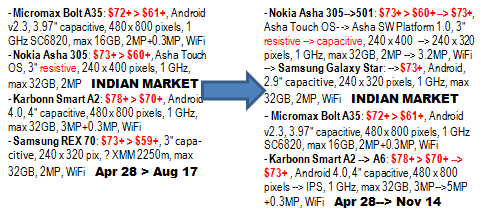
- The new (in Q3’13) Asha 501 became the most popular smartphone on the Indian market in the $60-80 price range (as per Flipkart, see above), successfully beating off the best competitive offerings from Samsung and the two leading local brands, Micromax and Karbonn. This is another positive sign of successfull revival of the Asha Touch platform started with Asha 501 (via the Asha Software Platform 1.0) as described in the New Nokia Asha platform for developers [‘Experiencing the Cloud’, May 9, 2013] and New Asha platform and ecosystem to deliver a breakthrough category of affordable smartphone from Nokia [‘Experiencing the Cloud’, May 9 – July 5, 2013] posts of mine. Everything is well represented by comparing the “micro reports” included into the bottom left corner of the overall chart a quarter ago and now:

- As one currently could see this Nokia (the devices part of it soon becoming the part of Microsoft*) could realise its goal of selling “100 million of the new generation Asha smartphones over the coming years, beginning with the Nokia Asha 501”. The Asha 500, Asha 502 and Asha 503 introduced in October 22 could already deliver a huge jump in shipments of “de facto smartphones” under Asha brand, helping to defend further and even improve Nokia’s market position against the sub $100 Android smartphones in Q4’13. Note also that Asha 500 was announced for $69 list price (before taxes or subsidies) which means that—depending on “race to the bottom” competition—could easily mean a street price of $60+ on the Indian market.
-
* See also the previous posts of mine:
– Unique Nokia assets (from factories to global device distribution & sales, and the Asha sub $100 smartphone platform etc.) will now empower the One Microsoft devices and services strategy [‘Experiencing the Cloud’, Sept 3 – Oct 23, 2013]
– Microsoft answers to the questions about Nokia devices and services acquisition: tablets, Windows downscaling, reorg effects, Windows Phone OEMs, cost rationalization, ‘One Microsoft’ empowerment, and supporting developers for an aggressive growth in market share [‘Experiencing the Cloud’, Sept 3 – Oct 23, 2013]
– Microsoft Nokia Transaction Conference Call with slides from Microsoft Strategic Rationale inserted-ebook – 3-Sept-2013 edited by Sándor Nacsa from those two sources into an ebook format PDF
– Leading edge Nokia phablets for both entertainment and productivity: Lumia 1320 targeting the masses at $339, and Lumia 1520 the imaging conscious business users and individuals at $749 [‘Experiencing the Cloud’, Oct 26, 2013] - The Asha Touch revival was also able to stop the decline of the overall Nokia “mobile phones” category (Nokia S30, S40, Asha and Asha Full Touch phones) exactly at 55.8 million units, the same number as for the Q1’13.

- In addition there are now the Leading edge Nokia phablets for both entertainment and productivity: Lumia 1320 targeting the masses at $339, and Lumia 1520 the imaging conscious business users and individuals at $749 [‘Experiencing the Cloud’, Oct 26, 2016].
- With that Nokia established a strong niche market position on both the $130+ market (starting with Lumia 520 sold at that price in India, also the most popular one on Flipkart for the the $80-160 price range of devices) and the sub $80 market against the onslaught of Android devices. The rest will depend now only on Microsoft.



Than for the lead smartphone market, i.e. Mainland China I will include here:
- China market: Smartphone sales top 93 million units in 3Q13, says Analysys [Digitimes, Nov 12, 2013]
There were 102.66 million handsets sold in the China market during the third quarter of 2013, growing 13.6% on quarter and 54.5% on year, of which 93.08 million units were smartphones, increasing 20.7% on quarter and 89.3% on year, according to China-based consulting company Analysys International.

While for the worldwide market:
- China-based smartphone vendors set to rise in 2013 rankings, says IC Insights [Digitimes, Nov 13, 2013]
Lenovo, ZTE, Huawei and Yulong/Coolpad have taken advantage of the surging low-end smartphone market. According to IC Insights, the four major China-based handset companies are forecast to ship 168 million smartphones in 2013 and together hold a 17% share of the worldwide smartphone market.
Lenovo, ZTE, Huawei and Yulong/Coolpad shipped a combined 98 million smartphones in 2012, a more than 300% surge from the 29 million units shipped in 2011, IC Insights disclosed. It should be noted that the China-based suppliers of smartphones are primarily serving the China and Asia-Pacific marketplace, and offer low-end models that typically sell for less than US$200.
Low-end smartphones are expected to represent just under one-third (310 million) of the total 975 million smartphones shipped in 2013. IC Insights forecast that by 2017, low-end smartphone shipments will represent 46% of the total smartphone market with China and the Asia-Pacific region to remain the primary markets for these low-end models.
Samsung Electronics and Apple are set to continue dominating the total smartphone market in 2013. The two vendors are forecast to ship 457 million units and together hold a 47% share of the total smartphone market in 2013, IC Insights said. In 2012, Samsung and Apple shipped 354 million smartphones and took a combined 50% share of the total smartphone market.
Nokia was third-largest supplier of smartphones behind Samsung and Apple in 2011, but has seen its share of the smartphone market fall. Nokia’s smartphone shipments are forecast to decline by another 4% and grab an only 3% share of the total smartphone market in 2013, IC Insights indicated.
Other smartphone producers that have fallen on hard times include RIM and HTC. While each of these companies had about a 10% share of the smartphone market in 2011, IC Insights estimated they will have only about 2% shares of the 2013 smartphone market.

-
Gartner Says Smartphone Sales Accounted for 55 Percent of Overall Mobile Phone Sales in Third Quarter of 2013 [press release, Nov 14, 2013]
– Western Europe Grew for the First Time this Year
– Lenovo Became the No. 3 Worldwide Smartphone Vendor for the First Time
Worldwide mobile phone sales to end users totaled 455.6 million units in the third quarter of 2013, an increase of 5.7 percent from the same period last year, according to Gartner, Inc. Sales of smartphones accounted for 55 percent of overall mobile phone sales in the third quarter of 2013, and reached their highest share to date.
Worldwide smartphone sales to end users reached 250.2 million units, up 45.8 percent from the third quarter of 2012. Asia/Pacific led the growth in both markets – the smartphone segment with 77.3 percent increase and the mobile phone segment with 11.9 percent growth. The other regions to show an increase in the overall mobile phone market were Western Europe, which returned to growth for the first time this year, and the Americas.
“Sales of feature phones continued to decline and the decrease was more pronounced in markets where the average selling price (ASP) for feature phones was much closer to the ASP affordable smartphones,” said Anshul Gupta, principal research analyst at Gartner. “In markets such as China and Latin America, demand for feature phones fell significantly as users rushed to replace their old models with smartphones.”
Gartner analysts said global mobile phone sales are on pace to reach 1.81 billion units in 2013, a 3.4 percent increase from 2012. “We will see several new tablets enter the market for the holiday season, and we expect consumers in mature markets will favor the purchase of smaller-sized tablets over the replacement of their older smartphones” said Mr. Gupta.
While Samsung’s share was flat in the third quarter of 2013, Samsung increased its lead over Apple in the global smartphone market (see Table 1). The launch of the Samsung Note 3 helped reaffirm Samsung as the clear leader in the large display smartphone market, which it pioneered.
Lenovo’s sales of smartphones grew to 12.9 million units, up 84.5 percent year-on-year. It constantly raised share in the Chinese smartphone market.
Apple’s smartphone sales reached 30.3 million units in the third quarter of 2013, up 23.2 percent from a year ago. “While the arrival of the new iPhones 5s and 5c had a positive impact on overall sales, such impact could have been greater had they not started shipping late in the quarter. While we saw some inventory built up for the iPhone 5c, there was good demand for iPhone 5s with stock out in many markets,” said Mr. Gupta.

In the smartphone operating system (OS) market (see Table 2), Android surpassed 80 percent market share in the third quarter of 2013, which helped extend its leading position. “However, the winner of this quarter is Microsoft which grew 123 percent. Microsoft announced the intent to acquire Nokia’s devices and services business, which we believe will unify effort and help drive appeal of Windows ecosystem,” said Mr. Gupta. Forty-one per cent of all Android sales were in mainland China, compared to 34 percent a year ago. Samsung is the only non-Chinese vendor in the top 10 Android players ranking in China. Whitebox Yulong [Coolpad] is the third largest Android vendor in China with a 9.7 percent market share in the third quarter of 2013. Xiaomi represented 4.3 percent of Android sales in the third quarter of 2013, up from 1.4 percent a year ago.

Mobile Phone Vendor Perspective
Samsung: Samsung extended its lead in the overall mobile phone market, as its market share totaled 25.7 percent in the third quarter of 2013 (see Table 3). “While Samsung has started to address its user experience, better design is another area where Samsung needs to focus,” said Mr. Gupta. “Samsung’s recent joint venture with carbon fiber company SGL Group could bring improvements in this area in future products.”
Nokia: Nokia did better than anticipated in the third quarter of 2013, reaching 63 million mobile phones, thanks to sales of both Lumia and Asha series devices. Increased smartphone sales supported by an expanded Lumia portfolio, helped Nokia move up to the No. 8 spot in the global smartphone market. But regional and Chinese Android device manufacturers continued to beat market demand, taking larger share and creating a tough competitive environment for Lumia devices.
Apple: Gartner believes the price difference between the iPhone 5c and 5s is not enough in mature markets, where prices are skewed by operator subsidies, to drive users away from the top of the line model. In emerging markets, the iPhone 4S will continue to be the volume driver at the low end as the lack of subsidy in most markets leaves the iPhone 5c too highly priced to help drive further penetration.
Lenovo: Lenovo moved to the No. 7 spot in the global mobile phone market, with sales reaching approximately 13 million units in the third quarter of 2013. “Lenovo continues to rely heavily on its home market, which represents more than 95 per cent of its overall mobile phone sales. This could limit its growth after 2014, when the Chinese market is expected to decelerate,” said Mr. Gupta.

With Android and forked Android smartphones as the industry standard Nokia relegated to a niche market status while Apple should radically alter its previous premium strategy for long term
Here is the chart reflecting the performance of the market-leading mobile phones upto Q2’13:

From this the most visible things are:
- Android and Android-forked (Xiaomi etc.) smartphones are the undisputed industry standards to dominate the market in years to come
- Both the Symbian to Windows Phone and S40 to Asha Full Touch smartphone platform transition strategies from Nokia could survive the continued Android onslaught but only in a niche market status
- There is no room for Apple’s further growth, and both the platform and the company could face a gradual decline in the smartphone market
My other observations about the state of the smartphone market after Q2’13 were already presented in the following posts:
- Superphones turning point: segment satured with Tier 1 globals while the Chinese locals are at less than 40% of the Samsung price [‘Experiencing the Cloud’, Aug 3, 2013] OR Samsung is leapfrogging Apple while the Chinese local brands are coming close to Samsung but at less than 40% price. Meanwhile the superphone segment of the market becomes saturated.
- Xiaomi, OPPO and Meizu–top Chinese brands of smartphone innovation [‘Experiencing the Cloud’, Aug 1, 2013]
- GiONEE (金立), the emerging global competitor on the smartphone market [‘Experiencing the Cloud’, July 22, 2013]
- Eight-core MT6592 for superphones and big.LITTLE MT8135 for tablets implemented in 28nm HKMG are coming from MediaTek to further disrupt the operations of Qualcomm and Samsung [‘Experiencing the Cloud’, July 20-29, 2013]
- China: Entry-level dual core IPS WVGA (480×800) smartphones $65+ now, quad-core $70+ in June [‘Experiencing the Cloud’, April 29, 2013]
In essence we came to a point when the superphone market came down in price to as low as $110 and up, while the entry-level segment of good quality came down to a $65+ price level. Also the smartphone market became saturated in all segments which brings an end to Samsung’s ability to base its premium profitability ambitions on smartphones alone (almost), as it was reflected in 20 years of Samsung “New Management” as manifested by the latest, June 20th GALAXY & ATIV innovations [‘Experiencing the Cloud’, July 2-26, 2013]:
… innovations in the broadest sense of the world: technology, hardware and software engineering and design, marketing in general and branding in particular etc.
Updates: Q2 record-high operating profit + smartphone worries deepen + overall business situation + nonproportionally high capex of the semiconductor business + the #2 capex beneficiary, the Display Panel Segment
These observations also led to much greater conclusions about the upcoming changes:
- China is the epicenter of the mobile Internet world, so of the next-gen HTML5 web [‘Experiencing the Cloud’, Aug 5, 2013]
- The Upcoming Mobile Internet Superpower [‘Experiencing the Cloud’, Aug 13, 2013]
Below I will assess the ‘Nokia Q2’13 market situation and changes’ as well as include ‘Gartner’s own assessment of the Q2’13 overall market situation and the changes’ to complete the picture.
Nokia Q2’13 market situation and changes:
Looking at the progress of Nokia Symbian to Windows Phone transformation Q2’13 was a straight continuation of the trends noted for Q1’13 in Nokia: Continued moderate progress with Lumia, urgent Asha Touch refresh and new innovations to come against the onslaught of unbranded Android and forked Android players in China and India [‘Experiencing the Cloud’, April 18, 2013] as you could also well observe from the chart included here as well:

Nokia was extensively discussing its Windows Phone transition in Nokia Corporation Interim Report for Q2 2013 and January-June 2013 [press release, July 18, 2013]:
-
Lumia Q2 volumes increased 32% quarter-on-quarter to 7.4 million units, reflecting strong demand from customers for a broadened Lumia product range.
-
Commenting on the second quarter results, Stephen Elop, Nokia CEO, said: “ … In our Smart Devices business unit, we continue to focus on delivering meaningful differentiation to consumers around the world. We are very proud of the recent creations by our Lumia team, from the Lumia 520 – our most affordable Windows Phone 8 product which has enjoyed a strong start in markets like China, France, India, Thailand, the UK, the US and Vietnam – to the Lumia 1020, our star imaging product which we unveiled to the world last week. Overall, Lumia volumes grew to 7.4 million in the second quarter, the highest for any quarter so far and showing increasing momentum for the ecosystem. During the third quarter, we expect that our new Lumia products will drive a significant part of our Smart Devices revenue.”
-
In the third quarter 2013, supported by the wider availability of recently announced Lumia products as well as recently announced Mobile Phones products, Nokia expects higher Devices & Services net sales, compared to the second quarter 2013.
-
The year-on-year decline in our Smart Devices volumes in the second quarter 2013 continued to be driven by the strong momentum of competing smartphone platforms and our portfolio transition from Symbian products to Lumia products. The decline was primarily due to lower Symbian volumes, partially offset by higher Lumia volumes. Our Symbian volumes decreased from 6 million units in the second quarter 2012 to approximately zero in the second quarter 2013. Our Lumia volumes increased from 4.0 million in the second quarter 2012 to 7.4 million in the second quarter 2013.
-
On a sequential basis, the increase in our Smart Devices volumes in the second quarter 2013 was due to higher Lumia volumes, as we started shipping the Lumia 520 and 720 in significant volumes. In the second quarter 2013, the vast majority of Smart Devices volumes were from Windows Phone 8-based Lumia products.
-
The year-on-year increase in our Smart Devices ASP in the second quarter 2013 was primarily due to a positive mix shift towards sales of our Lumia products which carry a higher ASP than our Symbian products, partially offset by our pricing actions. Sequentially, the decrease in our Smart Devices ASP in the second quarter 2013 was primarily due to a negative mix shift towards sales of our lower priced Windows Phone 8-based Lumia products as well as our pricing actions.
-
Nokia announced and started shipments in select markets of the Nokia Lumia 925, a new interpretation of its award-winning flagship, the Nokia Lumia 920. The Nokia Lumia 925 introduces metal for the first time to the Nokia Lumia range and includes the most advanced lens technology and next-generation imaging software to capture clearer and sharper pictures and video even in low light conditions. The Nokia Lumia 925 offers a variety of exclusive services such as Nokia Music for unlimited streaming of free playlists, integrated HERE services, and the option to add wireless charging with a snap-on wireless charging cover.
-
Nokia announced the Nokia Lumia 928 smartphone, exclusive to Verizon Wireless. With a 8.7MP camera and Nokia’s PureView imaging innovation, the Nokia Lumia 928 delivers superior imaging and video performance that enables people to capture bright, blur free photos and videos, even in low light conditions. The sleek and stylish smartphone comes with the latest high-end Nokia Lumia experiences, including Nokia Music, HERE services, and built-in wireless charging.
-
Nokia started shipping in volumes the Nokia Lumia 520, its most affordable Windows Phone 8 smartphone, delivering experiences normally found only in high-end smartphones, such as the same digital camera lenses found on the Nokia Lumia 920, Nokia Music for free music out of the box and even offline, and HERE services.
-
Nokia’s Lumia range of smartphones continued to attract businesses, including Miele & Cie. KG, a global leader in domestic appliances and commercial machinery, which has chosen the Nokia Lumia range as the smartphone of choice for its global employees.
-
The Windows Phone Store continued to strengthen in terms of the quantity and quality of applications. The Windows Phone Store today offers more than 165 000 applications and games.
The Q2’13-related improvements mentioned above and influencing the below chart were even more extensively discussed in my earlier posts:
-
High-volume Nokia Lumia superphones with Windows Phone 8 extended on the top for China, and on the entry level needed for Asia and Middle-East as well UPDATE: at even lower price by 27% [‘Experiencing the Cloud’, Dec 5, 2012 – March 21, 2013] Note that the Lumia 520 W-CDMA mentioned there for ¥ 1299.00 [$209] is now (Aug 17) ¥ 899.00 [$147] while in India it is even lower priced at Rs 7,667+ [$124+]
-
Nokia’s expanded, new risks and uncertainties for its Windows Phone strategy for 2013 [‘Experiencing the Cloud’, March 17, 2013]
while the Q3’13-related actions of improvements in these posts:
-
Nokia Lumia 1020: an excellent case of Nokia’s contribution to Microsoft as a key innovation partner [‘Experiencing the Cloud’, July 12, 2013]
-
Minutes of a high-octane but also expert evangelist CEO: Stephen Elop, Nokia [‘Experiencing the Cloud’, July 12, 2013]
Now look again at the performance chart for the reflections:

From the further decline of Asha Full Touch you could see that the Temporary Nokia setback in India [‘Experiencing the Cloud’, April 28, 2013] continued into the Q2’13 as well as the result of entry-level local brand Android smartphones being in heavy price competition with Nokia Asha Full Touch during Q2 while having superior hardware specifications. Even Samsung’s REX 70 competed in price with Asha Full Touch.
Nokia was talking in his Nokia Corporation Interim Report for Q2 2013 and January-June 2013 [press release, July 18, 2013] only about the following future-oriented actions that were introduced in Q2 in order to remedy this situation:
In Devices & Services, our Mobile Phones business unit started to demonstrate some signs of recovery in the latter part of the second quarter following a difficult start to the year. Also, towards the end of the second quarter, we started to ship the Asha 501, which brings a new design and user experience to the highly competitive sub-100 USD market. While we are very encouraged by the consumer response to our innovations in this price category, our Mobile Phones business unit is planning to take actions to focus its product offering and improve product competitiveness.
On a year-on-year basis, our Mobile Phones volumes in the second quarter 2013 were negatively affected by competitive industry dynamics, including intense smartphone competition at increasingly lower price points and intense competition at the low end of our product portfolio. Compared to the second quarter 2012, our Mobile Phones volumes declined across our portfolio, most notably for our non-full-touch devices that we sell to our customers for above EUR 30, partially offset by higher sales volumes of Asha full-touch smartphones.
Nokia started production at its new manufacturing facility in Hanoi, Vietnam. The new site has been established to produce our most affordable Asha smartphones and feature phones.
Nokia announced and started shipments of the Nokia Asha 501, the first of a new generation of smartphones to run on the new Asha platform. Retailing at a suggested price of USD 99, the Nokia Asha 501 offers users affordable smartphone design with bold color, a high-quality build and an innovative user interface. The new Asha platform also allows developers who write applications for the Nokia Asha 501 to reach all smartphones based on the new Asha platform without having to re-write code.
These things were already extensively discussed in my earlier posts:
- Nokia’s non-Windows crossroad [‘Experiencing the Cloud’, May 2, 2013]
- New Asha platform and ecosystem to deliver a breakthrough category of affordable smartphone from Nokia [‘Experiencing the Cloud’, May 9, 2013] my composite post of the all relevant launch information
- New Nokia Asha platform for developers [‘Experiencing the Cloud’, May 9, 2013] my composite post of the all relevant development platform information
- Nokia becoming the next Samsung from its new Vietnamese manufacturing base? [‘Experiencing the Cloud’, June 24, 2013]
And here is how Gartner was assessing the Q2’13 overall market situation and the changes:
Gartner Says Smartphone Sales Grew 46.5 Percent in Second Quarter of 2013 and Exceeded Feature Phone Sales for First Time [press release, Aug 14, 2013]
- Worldwide Mobile Phone Sales Grew 3.6 Percent in Second Quarter of 2013
- Microsoft Has Become the No. 3 Smartphone OS Overtaking BlackBerry
Worldwide mobile phone sales to end users totaled 435 million units in the second quarter of 2013, an increase of 3.6 percent from the same period last year, according to Gartner, Inc. Worldwide smartphone sales to end users reached 225 million units, up 46.5 percent from the second quarter of 2012. Sales of feature phones to end users totaled 210 million units and declined 21 percent year-over-year.
“Smartphones accounted for 51.8 percent of mobile phone sales in the second quarter of 2013, resulting in smartphone sales surpassing feature phone sales for the first time,” said Anshul Gupta, principal research analyst at Gartner. Asia/Pacific, Latin America and Eastern Europe exhibited the highest smartphone growth rates of 74.1 percent, 55.7 percent and 31.6 percent respectively, as smartphone sales grew in all regions.
Samsung maintained the No. 1 position in the global smartphone market, as its share of smartphone sales reached 31.7 percent, up from 29.7 percent in the second quarter of 2012 (see Table 1). Apple’s smartphone sales reached 32 million units in the second quarter of 2013, up 10.2 percent from a year ago.
Table 1
Worldwide Smartphone Sales to End Users by Vendor in 2Q13 (Thousands of Units)
Company
2Q13 Units
2Q13 Market Share (%)
2Q12 Units
2Q12 Market Share (%)
Samsung
71,380.9
31.7
45,603.8
29.7
Apple
31,899.7
14.2
28,935.0
18.8
LG Electronics
11,473.0
5.1
5,827.8
3.8
Lenovo
10,671.4
4.7
4,370.9
2.8
ZTE
9,687.6
4.3
6,331.4
4.1
Others
90,213.6
40.0
62,704.0
40.8
Total
225,326.2
100.0
153,772.9
100.0
Source: Gartner (August 2013)
In the smartphone operating system (OS) market (see Table 2), Microsoft took over BlackBerry for the first time, taking the No. 3 spot with 3.3 percent market share in the second quarter of 2013. “While Microsoft has managed to increase share and volume in the quarter, Microsoft should continue to focus on growing interest from app developers to help grow its appeal among users,” said Mr. Gupta. Android continued to increase its lead, garnering 79 percent of the market in the second quarter.
Table 2
Worldwide Smartphone Sales to End Users by Operating System in 2Q13 (Thousands of Units)
Operating System
2Q13 Units
2Q13 Market Share (%)
2Q12 Units
2Q12 Market Share (%)
Android
177,898.2
79.0
98,664.0
64.2
iOS
31,899.7
14.2
28,935.0
18.8
Microsoft
7,407.6
3.3
4,039.1
2.6
BlackBerry
6,180.0
2.7
7,991.2
5.2
Bada
838.2
0.4
4,208.8
2.7
Symbian
630.8
0.3
9,071.5
5.9
Others
471.7
0.2
863.3
0.6
Total
225,326.2
100.0
153,772.9
100.0
Source: Gartner (August 2013)
Mobile Phone Vendor Perspective
Samsung: Samsung remained in the No. 1 position in the overall mobile phone market, with sales to end users growing 19 percent in the second quarter of 2013 (see Table 3). “We see demand in the premium smartphone market come mainly from the lower end of this segment in the $400-and-below ASP mark. It will be critical for Samsung to step up its game in the mid-tier and also be more aggressive in emerging markets. Innovation cannot be limited to the high end,” said Mr. Gupta.
Nokia: Slowing demand of feature phone sales across many markets worldwide, and fierce competition in the smartphone segment, affected Nokia’s mobile phone sales in the second quarter of 2013. Nokia’s mobile phone sales totaled 61 million units, down from 83 million units a year ago. Nokia’s Lumia sales grew 112.7 percent in the second quarter of 2013 thanks to its expanded Lumia portfolio, which now include Lumia 520 and Lumia 720. “With the recent announcement of the Lumia 1020, Nokia has built a wide portfolio of devices at multiple price points, which should boost Lumia sales in the second half of 2013,” said Mr. Gupta. “However, Nokia is facing tough competition from Android devices, especially from regional and Chinese manufacturers which are more aggressive in terms of price points.”
Apple: While sales continued to grow, the company faced a significant drop in the ASP of its smartphones. Despite the iPhone 5 being the most popular model, its ASP declined to the lowest figure registered by Apple since the iPhone’s launch in 2007. The ASP reduction is due to strong sales of the iPhone 4, which is sold at a strongly discounted price. “While Apple’s ASP demonstrates the need for a new flagship model, it is risky for Apple to introduce a new lower-priced model too,” said Mr. Gupta. “Although the possible new lower-priced device may be priced similarly to the iPhone 4 at $300 to $400, the potential for cannibalization will be much greater than what is seen today with the iPhone 4. Despite being seen as the less expensive sibling of the flagship product, it would represent a new device with the hype of the marketing associated with it.”
Lenovo: Lenovo’s mobile phone sales grew 60.6 percent to reach 11 million units in the second quarter of 2013. Lenovo’s quarter performance was bolstered by smartphone sales. Its smartphone sales grew 144 percent year-over-year and helped it rise to the No. 4 spot in the worldwide smartphone market for the first time. Lenovo continues to rely heavily on its home market in China, which represents more than 95 percent of its sales. It remains challenging for Lenovo to expand outside China as it has to strengthen its direct channel as well as its relationships with communications service providers.
Table 3
Worldwide Mobile Phone Sales to End Users by Vendor in 2Q13 (Thousands of Units)
Company
2Q13 Units
2Q13 Market Share (%)
2Q12 Units
2Q12 Market Share (%)
Samsung
107,526.0
24.7
90,432.1
21.5
Nokia
60,953.7
14.0
83,420.1
19.9
Apple
31,899.7
7.3
28,935.0
6.9
LG Electronics
17,016.4
3.9
14,345.4
3.4
ZTE
15,280.7
3.5
17,198.2
4.1
Huawei
11,275.1
2.6
10,894.2
2.6
Lenovo
10,954.8
2.5
6,821.7
1.6
TCL Communi-cation [Alcatel]
10,134.3
2.3
9,355.7
2.2
Sony Mobile Communications
9,504.7
2.2
7,346.8
1.7
Yulong [Coolpad]
7,911.5
1.8
4,016.2
1.0
Others
152,701.5
35.1
147,354.60
35.1
Total
435,158.4
100.0
420,120.0
100.0
Source: Gartner (August 2013)
“With second quarter of 2013 sales broadly on track, we see little need to adjust our expectations for worldwide mobile phone sales forecast to total 1.82 billion units this year. Flagship devices brought to market in time for the holidays, and the continued price reduction of smartphones will drive consumer adoption in the second half of the year,” said Mr. Gupta.
Additional information is in the Gartner report “Market Share Analysis: Mobile Phones, Worldwide, 2Q13.” The report is available on Gartner’s website at http://www.gartner.com/document/2573119.
The new, high-volume market in China is ready to define the 2012 smartphone war
Follow-up: Boosting the MediaTek MT6575 success story with the MT6577 announcement [June 27, 2012]
– China TD-SCDMA and W-CDMA 3G subscribers by the end of 2011: China Mobile lost its original growth momentum [Jan 21, 2011]
Updates: China market: Local vendors to roll out CNY300 smartphones [DIGITIMES, July 13, 2012]
China-based handset makers are ready to begin volume shipments of smartphones priced at CNY300 (US$50) in the second half of 2012 compared to the previous focus on CNY600 models in the first half of the year, according to industry sources.
Competition among chipset solution vendors, promotions by telecom carriers, and the rise of new brands in China have contributed to the rapid decline in prices of smartphones in China, the sources revealed.
The top-3 telecom carriers had previously focused purchases on smartphones with a price tag of CNY1,000, but some local handset makers are now willing to offer quotes at around CNY500 in order to win orders, said the sources, adding that the pricing will serve as an indication for channel operators to follow.
While quotes for 2G smartphones in China have already dropped to below US$50, prices for 3G models currently range from US$60-80 and are expected to reach US$50 soon, the sources asserted.
Sub-CNY1,000 smartphones accounted for 21% of all smartphones sold in China in the first quarter of 2012, compared to a ratio of 12% a year earlier, according to IDC.
– China market: Nearly 195 million handsets shipped in 1H12 [DIGITIMES, July 10, 2012]
There were 194.913 million handsets shipped in the China market during the first half of 2012, consisting of 106.874 million (54.83%) 3G handsets in 801 models and 88.039 million (45.17%) 2G handsets in 1,298 models, according to statistics published by the China Academy of Telecommunication Research (CATR) under the Ministry of Industry and Information Technology (MIIT).
Of the shipment volume, 94.855 million or 48.67% were smartphones in 822 models of which 801 models or 97.44% were based on Android. China-based vendors accounted for 75.16% of the half-year shipment volume, and international vendors 24.84%.
The monthly shipment volume of smartphones exceeded that of feature phones for the first time in April 2012, with the corresponding proportion increasing to 56.9% in June.
China market: Breakdown of total handset shipment volume, 1H12 Generation Technology standard
Number of models
Shipment volume (m handsets)
3G WCDMA (China Unicom)
476
53.099
CDMA2000 (China Telecom)
174
28.197
TD-SCDMA (China Mobile)
151
25.578
2G GSM
1,272
81.915
CDMA1x
26
6.076
Source: CATR under MIIT, compiled by Digitimes, July 2012
– Second- and third-tier handset makers in China may not adopt Windows Phone 8 platform [DIGITIMES, July 5, 2012]
Microsoft has been eager to promote Windows Phone 8, Windows 8 and Windows RT. Despite having partners such as Nokia, Samsung, and HTC for Windows Phone 8, severe price competition in China will likely prevent second- and third-tier handset makers from switching from Google’s Android.
China-based handset makers have been aiming at customers switching from feature phones to smartphones for the first time and hence have little desire to adopt new platforms.
Industry sources indicated that competition in China’s smartphone market has been cutthroat. First-tier brands such as ZTE, Huawei, Coolpad and Lenovo have been introducing models at the price range of CNY1,000 (US$157). To increase market exposure, second-tier brands such as Haier and Konka have been introducing models below CNY500 in efforts to obtain cooperation with telecommunications service providers. The price difference is significant, said industry sources.
Microsoft hopes to increase market share in China’s smartphone market. However, Windows Phone 8 is unlikely to compete with Android in features such as localized applications and marketing resources, added industry sources.
Nevertheless, Microsoft has been adding new alliances such as Huawei and ZTE. Industry sources believe the two firms hope to generate more profits by providing products with different platforms.
– China smartphone market 2012: Trends and analysis [DIGITIMES Research, July 3, 2012]
Abstract
The China handset market has exhibited strong growth, with the total number of mobile users in the country reaching 980 million people according to figures from the Ministry of Industry and Information Technology (MIIT), an increase of 130 million over the 2010 figure. Digitimes Research estimates that mobile user numbers could top 1.13 billion in 2012.
Digitimes Research estimates that the China handset market reached some 390 million units in 2011, representing 16% growth on 2010; the market is likely to grow to 430 million units in 2012, representing further growth of 9%. Thanks to the expansion of 3G service coverage and further falls in budget smartphone prices, the share of the handset market accounted for by smartphones is likely to reach 32% or around 143 million units, 70% of which will be Android handsets.
Digitimes Research believes that market share rankings for the China smartphone market will change significantly during 2012. Samsung and Apple will take the top two places, while the big four China-based brands – Huawei, ZTE, Lenovo and Coolpad – will take third to sixth places, while Nokia will drop to seventh; these seven firms will collectively account for 85% of shipments.
In other words, the many other brands hoping to seize a share of the market will essentially be confined to competing for a potential market of just 15% of overall shipments or around 21 million handsets. Given such a situation, Digitimes Research projects that many of China’s best known smaller brands such as Xiaomi, TCL, Gionee, Tianyu, Oppo and BBK will see shipments of no more than a few million handsets.
– China-based white-box vendors expected to ship 200 million smartphones [DIGITIMES, April 17, 2012]
China-based white-box vendors, mainly due to the availability of inexpensive new chip solutions, have been increasing the production of smartphones, with the total shipment volume expected to reach 200 million units in 2012, according to industry sources in Taiwan.
Taiwan-based MediaTek is offering the makers its MT6575 a chip solution for use in entry-level smartphones in the first quarter of 2012 and will offer the MT6577, a solution for high-level smartphones, in the middle of the third quarter of 2012, the sources indicated. MediaTek will ship 50-70 million chips to China-based white-box vendors to account for nearly 30% of smartphones to be shipped by these vendors in 2012.
In addition, Qualcomm has strengthened its marketing in the China market by offering turn-key solutions to white-box vendors, with prices for a chips lowered to US$6, the sources cited eMedia Asia as indicating.
China-based white-box vendors sell more than 60% of their smartphone output to overseas markets, including 2.5G models for markets where deployment of 3G networks is not mature yet, the sources indicated. White-box vendors are expected to see larger market demand if their production costs for entry-, medium- and high-level smartphones drop to US$60, US$85 and US$130 respectively, the sources pointed out.
– China market: Handset makers upgrading hardware specifications of sub-CNY1,000 smartphone models [Feb 17, 2012]
China-based handset makers, including ZTE, Huawei Device, Lenovo and Coolpad, have continued to upgrade the hardware specifications of their sub-CNY1,000 (US$159) smartphone models due to intensifying competition in the segment, according to industry sources.
With the introduction of dual-core 1GHz CPUs for high-end models in 2011, the single-core 1GHz CPU is likely to become one of the standards for entry-level smartphones in China this year, the sources indicated.
Additionally, some vendors have also begun to adopt 4-inch displays for their sub-CNY1,000 models, instead of 3.5-inch displays used previously, the sources added.
Coolpad has recently launched a 4-inch model, the 7260, and saw sales of the model reach 30,000 units a month in the initial period, the sources revealed, adding that monthly shipments of the 7260 may top 100,000 units soon.
– China handset makers to push sales of sub-CNY1,000 smartphones to mature markets [Feb 16, 2012]
Having mass-produced smartphones with a price tag of around CNY1,000 (US$159) for the China market since 2011, China-based handset makers ZTE, Huawei Device, Lenovo and Coolpad plan to push the sale of sub-CNY1,000 smartphones to mature markets including North America and Taiwan, according to industry sources.
Sales of smartphones by Coolpad, Lenovo, ZTE and Huawei combined currently account for 30-40% of China’s smartphone market, with the ratio likely to surpass 50% by year-end 2012, the sources estimated.
In the Taiwan market, Coolpad has recently a WCDMA model with a suggested retail price of NT$5,990 (US$203). However, the company plans to launch more entry-level smartphones later and aims to take up a 3-5% share in the segment. Coolpad shipped about 270,000-280,000 CDMA models in Taiwan in 2011, the sources revealed.
– Chinese smartphone market sees explosive growth [Feb 16, 2012]
Judging from the structure of the smartphone market in 2011, Chinese smart terminals brands such as ZTE and Huawei seem to be on a trend of full-scale explosion. Having been suppressed by foreign brands for a long time, Chinese smartphones begin to take a solid footstep in the smartphone market by working closely with telecommunication operators and making full use of their “Chinese characteristics”, breaking the old pattern of market that has long been dominated by foreign brands. According to industrial participants, Chinese brands are rising in the 3G era.
According to media report, the Coolpad 7260, one of China Unicom’s 1000-Yuan smartphones, created a record sales of 110,000 units three days after it was put on the market, refreshing the shipment volume record of 1000-Yuan Chinese 3G smartphones, scoring a victory in its first battle. Also, this number gives the market more expectation for Unicom’s 8 new models of 4.0 series “WO 3G” 1000-Yuan smartphones that are co-launched by China Unicom and technology-intensive Chinese mobile phone manufacturers.
It is learned that these new 4.0 series 1000-Yuan phones boast three major features: big, fast, and HD. Big screens, previous 3.5-inch screens are replaced by 4-inch screens; fast processing speed, previous 600MHz CPUs are replaced by CPUs that are higher than 800MHz now; fast upload speed, supporting HSUPV; fast running speed, memory upgrades from 256M in the past to 512M now. High-definition picture taking, camera are required to increase from 2-3 million pixels to 3-5 million pixels.
According to person from China Unicom, the re-defined 1000-Yuan smart terminals introduced by China Unicom in May, 2011, and the numerous star terminals subsequently co-produced by China Unicom and Chinese mobile phones manufacturers have won excellent market response. Among these products, ZTE’s V880 scored daily sales of more than 10,000 units and monthly sales of more than 300,000 units. After months of promotion, the 1000-Yuan smartphones strategy remains effective, propelling the fast growth of China Unicom’s 3G subscribers.
In November, Unicom’s net growth of 3G subscribers was as high as 3.384 million with total 3G subscribers amounting to 36.534 million, making it the operator with the fastest 3G subscriber growth rate. This indicates that 1000-Yuan phones have accumulated significant subscriber base in the market and have established some brand effect. Presently, China Unicom makes use of the favorable conditions and defines the standards of 4.0 series 1000-Yuan smartphones, and offers high subsidy for the newly defined 4.0 series phones, with the purpose of making deployment in the middle-end market and grab a say of Chinese smart terminals in advance.
According to industrial participants, “users-friendly price and high-end experience” is the key to the success of China Unicom’s customized 1000-Yuan smartphones. Consumers’ favor for China Unicom’s customized terminals comes from its preferential subsidy policy, rather high-end configuration, and the user experience brought by the WCDMA network. Market research statistics show that the number of 3G subscribers worldwide in 2011 approached 1.3 billion, of which WCDMA subscribers accounted for 76 percent. In China, as per October 2011, WCDMA smartphones accounted for 69 percent of all 3G smartphones. Currently, China has become the largest smartphone market in the world, with nearly 70 percent of the phones being WCMDA. It is thus quite clear that WCDMA mobile phones are the mainstream in China and even all over the world.
Industrial participants point out that with the rapid development of smart terminals in the 3G era, the competition pattern of the mobile phone market will become even more complicated. In the meantime, the industry thinks positively of the marriage between domestic mobile phones and China Unicom’s WCDMA. Amidst the fierce competition of the terminal market globally, however, Chinese smartphones need to understand the market better, and puts more efforts in products R&D and brand image improvement, hoping to evolve from the “copycat” image to a national brand as soon as possible.

End of updates
The new high-volume smartphone market has been established by China Unicom with Lenovo and ZTE involvement from August 2011 on under the so called ‘RMB 1000’ [US$158] inititiative of the carrier.
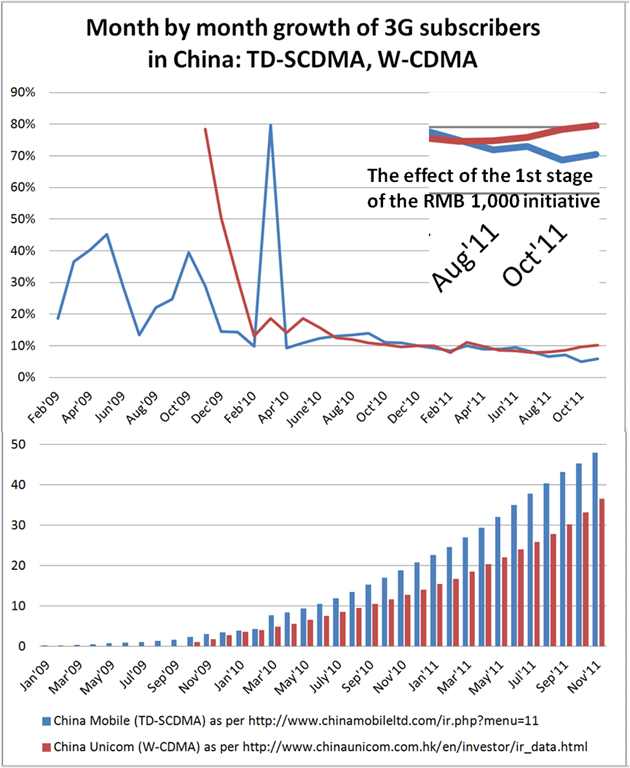
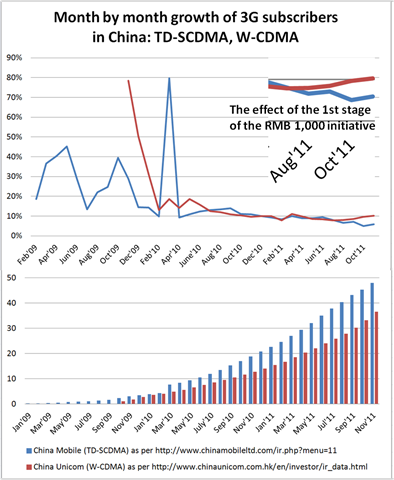 As visible on the chart (see left) China Unicom was able to return to the previous 10% month/month growth rate of the 3G subscribers as the result of this approach. Unicom’s main rival the much bigger China Mobile was, however, unable to sustain that growth rate. One of the reasons is certainly the fact that China Unicom has so far been the only Chinese operator with official iPhone offerings. By looking to the enlarged picture of the chart for the August-November period one can nevertheless see that the gap in month/month growth rates of the two companies has been steadily growing. This cannot be explained in other ways than by this 1st stage of the ‘RMB 1000’ initiative. Since in the end of December the initiative has been extended to the RMB 1500 [US$238] price cap with not less than 8 models joing the offerings under this umbrella, this will define an obvious smartphone war for 2012.
The first stage of this initiative has already radically redefined the 3G smartphone market for W-CDMA customers in China:
– the ‘RMB 1000’ [US$158] Android phone (Lenovo A60) has slightly better graphics performance than either the 4.26x more pricey iPhone 3G S or the 1.62x more pricey best classic Android phone (Sony Ericsson WT19i)
– the Dhrystone performance of that phone is quite enough comparing to both (2/3d of the iPhone and 4/10th of the Sony Ericsson device)
| Smartphone and its availability (+ recent price) |
Lenovo A60
|
Sony Ericsson WT19i
|
Apple iPhone 3G S
|
| DMIPS | 812.5 | 2100 | 1200 |
GLBenchmark 2.1 Egypt High
|
|||
|
2787 (3174) | 2653 (4806) | 2714 (3352) |
|
2765 (3159) | 2653 (4806) | 2646 (2913) |
|
2757 (3155) | 2653 (4806) | 2646 (3257) |
| Screen size | 480 x 320 | 480 x 320 | 480 x 320 |
| SoC w/ core inside |
MediaTek MT6573 w/ 650MHz ARM11 |
Qualcomm MSM8255 w/ 1GHz Scorpion |
Samsung S5PC100 w/
|
| GPU inside the SoC |
PowerVR SGX 531 |
Adreno 205 |
PowerVR SGX 535 |
Note: For realistic graphics performance the results of the ‘High’ version of the GLBenchmark 2.1 are used here since this is showing how the GPU is performing in high-quality rendering with “multi-sample anti-aliasing and at least 24 bits of color- and Z-buffer depths”. Also the results are shown here for the so called ‘Egypt’ benchmark as it “tests OpenGL ES 2.0 and represents the newest and most demanding benchmark” according to Anandtech. To understand what we are talking about here is also a video demonstration of the 2.1 Egypt benchmark by the globally recognized and accepted creator of it, Kishonti Informatics Ltd:
Since China Unicom launched the second stage of its ‘RMB 1000’ in the end of December, when not less than 8 models with a higher, 1500 [US$238] price cap have been joining the offerings, we can safely argue that what is happening now in China will apply to the global markets as well. We have already shown in an earlier post that China becoming the lead market for mobile Internet in 2012/13 [Dec 1, 2011], so there is no question about that.
Please find below a collection of all related information. It is necessary to highlight here the fact that with the higher, 1500 [US$238] price cap we are already in the 1.0 GHz Cortex-A9 and A5 CPU performance territories which mean 2500 and 1570 DMIPS respectively. The screen is also larger, 4” as well as the resolution is 800×480.
Another thing that needs to be highlighted here is China Unicom’s very attractive contract plan, described below as:
Customers who select the RMB 96 [US$15] per month two-year contract plan can receive the handset for free with a RMB 1,599 prepaid deposit. Users who purchase a smartphone without a contract plan for RMB 1,299 can later select a two-year contract plan starting at RMB 46 [US$7.3] per month and receive free calling credit.
NOW THE DETAILED COLLECTION
China Unicom Releases Eight Low-cost 3G Smartphones [Marbridge Daily, Jan 4, 2012]
During a recent [Dec 26, 2011] event in Beijing, China Unicom (NYSE: CHU; 0762.HK; 600050.SH) unveiled eight new “RMB 1,000” smartphones with 4-inch displays and CPUs clocking up to 1 GHz, as well as announcing its 3G smartphone policy for 2012.
The eight phones, all priced under RMB 1,500 [US$238], including China Wireless Technologies (2369.HK) subsidiary Yulong’s Coolpad 7260, the Hisense (600060.SH) HS-U8, ZTE (0763.HK; 000063.SZ) V889D, Huawei U8818, Lenovo (0992.HK) A750, TCL Communication Technology (2618.HK) W989, Amoi N89, and Philips W635. The Coolpad 7260 and Hisense HS-U8 hit the market in late December 2011.
Unicom expects China’s RMB 1,000 smartphone market to reach 90 mln units sold in 2012, while 60 mln smartphones priced between RMB 1,000 and RMB 2,000 will be sold, including both well-known domestic and international brands. Unicom expects the iPhone to continue to be the carrier’s flagship strategic product in the high-end RMB 2,000 or more smartphone market, and Unicom will continue to strengthen its line-up of operator-customized Android smartphones as well as a range of Windows Phone handsets. Unicom will also push dual-mode, dual-standby, dual-SIM smartphones.
The WCDMA/GSM dual-SIM, dual-standby Coolpad 7260 features a 4-inch WVGA 16 mln color HD multitouch display, Android 2.3, and Coolpad’s secure cloud services. The Hisense HS-U8 WCDMA/GSM dual-SIM, dual-standby smartphone is 1.6 mm thick and features a 5 MP autofocus camera and 3 MP front-facing camera. Both are available with contract plans. Customers who select the RMB 96 [US$15] per month two-year contract plan can receive the handset for free with a RMB 1,599 prepaid deposit. Users who purchase a smartphone without a contract plan for RMB 1,299 can later select a two-year contract plan starting at RMB 46 [US$7.3] per month and receive free calling credit.
China Unicom’s 3G network already covers 341 cities and over 95% of county towns nationwide. HSPA+ peak downlink speeds reach up to 21 MB in 56 key cities. Nearly 20,000 Unicom service centers offer 3G services, as well as nearly 10,000 non-operator stores run by hundreds of major retail chains. Unicom 3G service is also available through mainstream e-commerce channels. According to a source within Unicom, non-operator channels contribute over 50% of China Unicom’s 3G growth.
According to an industry source, China has 900 mln handset users, 90% of whom have a handset priced under RMB 2,000.
Regarding the full contract plan the only available information is from the Chinese press release: China Unicom released eight new definition of thousands of intelligent machines new 4.0 series [translated by Google, Dec 26, 2011]
Attachment: Cool 7260, Hisense HS-U8 contract plans
(A) “Stored send phone calls” contract plan
(B) “purchase mobile phones to send calls” contract plan


China Unicom releases low-end smartphones to woo 3G users [Want China Times, Dec 28, 2011 ]
A China Unicom promotion offers free smartphones paired with 3G service packages.China Unicom, one of China’s three major state-run telecom operators, has teamed up with several local cell phone vendors to launch its latest low-end smartphone in a bid to attract more 3G users.
Along with eight handset vendors — including Hisense, ZTE and Huawei — China Unicom on Monday unveiled its latest low-end smartphone, marketed as the “1,000-yuan (US$158) smartphone 4.0.” The new smartphone is equipped with a 1GHz processor and 4.0-inch screen, an improvement over the 3.5-inch screen of an earlier model.
The launch is widely seen as a move to attract more phone users to 3G smartphones. The number of [W-CDMA i.e. China Unicom’s] 3G users in China has increased to over 36 million, just three years after 3G licenses were made available in 2009.
“(The phone) is a win-win situation for chip makers, cell phone manufacturers and distribution vendors, and the boost in the 3G business is attributable to inexpensive cell phones,” said China Unicom general manager Lu Yimin.
“The launch of the inexpensive 4-inch-screen phone signals that the battleground has shifted from high-end phones to mid- to low-end phones,” said Fu Liang, an independent analyst.
Telecom operators agree that lowering the prices of 3G smartphones will be key in bringing the technology to 2G subscribers, who mainly use mobile phones to make calls, the analyst said. They realize that a price tag of 1,000 yuan will be instrumental in initiating that shift, the analyst said.
The boost to business is most obvious among handsets jointly launched by Chinese electronics makers Lenovo and ZTE. The two companies currently lead the market for phones that use the WCDMA network standard, with Lenovo selling 340,000 of its A60 phones and ZTE selling 240,000 of its V880 handsets per month, according to an analyst. In 2012, the analyst estimated, the number of phones priced under 1,000 yuan will climb to 90 million, while those priced between 1,000 and 2,000 yuan (US$316) will number around 60 million.
China Unicom has seen its 3G subscribers rapidly increase since it partnered with cell phone vendors such as Huawei and Lenovo to roll out inexpensive models in China. According to data from the three major telecom operators in China — China Unicom, China Telecom and China Mobile — 3G subscribers using China Unicom’s network increased to by 3.38 million in November, while China Mobile and China Telecom saw their 3G users rise to by 2.68 million and 2.16 million, respectively.

China Unicom today released an upgraded version of the new definition of thousands of intelligent machines 4.0 [Google translation, Dec 26, 2011]
… The first listing contains the models are Coolpad 7260 [酷派 Yulong], Hisense [海信] HS-U8, ZTE [中兴] V889D, Huawei [华为] U8818, Lenovo [联想] A750, TCL A996, Amoi [厦新] N89 and Philips* W635 …
…

* Sang Fei [桑菲通信]:
Sang Fei is one of China’s biggest mobile communication enterprises with a large export market and a fast-emerging domestic brand presence. A core subsidiary of China Electronics Corporation (CEC) [a highly specialized contract manufacturer in Taiwan] and SED Group [Shenzhen SED Industry Co., Ltd., a state-owned enterprise, which contains 20 solely-funded enterprises and Joint Ventures enterprises, is a publicly listed company on the Shenzhen Stock Exchange [from: the staff is over 5000, the yearly turnover is over 1000 million of U.S Dollar]] …
…
Sang Fei has evolved into a multi-million mobile communications player on the international stage since it was established in 1996 as a joint venture between electronics giant Royal Dutch Philips Electronics Ltd and SED. In 2007, its official buyout of Philip’s global mobile phone businessof Philips, backed by decades of knowledge transfer from the Dutch company, marked the beginning of a new chapter in Sang Fei’s history.
Although it has retained the world-famous Philips brand for its mobile phone products, Sang Fei has stamped its own mark on the business. With an accumulated output exceeding tens of millions, its mobile phones are well recognized by both the industry and customers from home and abroad …
Platform Qualcomm Snapdragon S1 [Google translation, Dec 26, 2011]
… Five models are using Qualcomm Snapdragon S1
- Coolpad 7260
[MSM7227T based with 800 MHz ARM11 processor, 4” display],- Hisense HS-U8
[MSM7227A based with Cortex A5 processor],- ZTE V889D
[MSM7227A based with 1.0 GHz Cortex A5 processor, 4” display],- Huawei U8818 [MSM7227A based with 1.0 GHz Cortex A5 processor, 4” display] and
- Philips [Sang Fei] W635 [MSM7227A based with 1.0 GHz Cortex A5 processor, 4” display]. …
[i.e. Lenovo A750, TCL A996 and Amoi N89 are not:
- Lenovo A750 has MediaTek MT6575 SoC with a 1.0 GHz Cortex-A9 core and HSPA+ support, and 4” display
- Amoi N89 quite probably has MediaTek MT6575 SoC with a 1.0 GHz Cortex-A9 core … as well
- TCL A996, meanwhile has the following specifications:
- Network standard: GSM / WCDMA
- Size: 123 × 65.5 × 12.9mm
- Screen: 4.0 inch IPScapacitive screen resolution of WVGA (480 × 800)
- Battery Capacity: 1500mAh
- Standby time: 300 hours
- Talk time: 4 hours
- Operating System: Android 2.3
- Processor: [Broadcom ARM11-based] BCM 21552
- Memory: RAM 512MB/ROM 512MB, support Micro SD expansion (up to 32GB)
]
![image_thumb9[1]](https://lazure2.wordpress.com/wp-content/uploads/2012/01/image_thumb91.png "image_thumb9[1]")
TCL increases smartphone sales 24x to over 1 mln units [Dec 9, 2011]
Chinese handset maker TCL shipped 1.1 million smartphones as part of the 39.15 million units of mobile phones and other products it sold in January-November, 24 times more than the 42,384 smartphones it shipped in the year-earlier period, when total product shipments stood at 39.15 million units. Due to the increasing popularity of handsets that carry social networking functions, the group continued to launch more Facebook phones, strengthening its brand reputation and expanding market share. In November, FrenchTelecom-Orange announced that it would launch the first of three new phones featuring a Facebook key, the Alcatel One Touch 908F. TCL said that the Alcatel phones with Facebook keys are set to be launched across Africa and Europe before the end of the year. TCL, which produced the Vodafone 555 Blue phone as a white-label product, expects its Alcatel One Touch branded phones to raise the product mix towards higher revenue-earning smartphones. TCL is also involved in future mobile technologies, including Terahertz spectrum (0.1-10THz). Still not fully utitilised, the band is being considered in China where TCL has produced a phone supporting THz communications, the Xianguyn A919.
Top TCL Executive Visits Taiwan’s Electronics Makers With Huge Procurement Hint [Dec 7, 2011]
Taipei, Dec. 7, 2011 (CENS)–TCL Corp. Chairman and Chief Executive Officer Li Dongsheng said his company will not limit spending on procurements of Taiwan’s electronics products when recently visiting some Taiwanese electronics heavyweights, including chip vendor MediaTek Inc.
TCL, currently the world’s 25th biggest producer of household appliances, plans to ship 12 million LCD TVs and 50 million mobile phones in 2012. Industry executives estimated the company to budget more than US$1 billion for sourcing Taiwan’s electronics products next year.
Among Taiwan’s contract suppliers on TCL’s outsourcing lists are MediaTek Inc., AU Optronics Corp. (AUO), and Chimei Innolux Corp. Li visited MediaTek’s and AUO’s Taiwan headquarters a few days ago. He said his talk with MediaTek Chairman M.K. Cai mainly focused on cooperation over smartphone development.
However, both AUO and MediaTek executives declined to comment on the meetings.
TCL is now MediaTek’s biggest customer, purchasing up to 30 million mobile phone chipsets from MediaTek in 2010. Li touted that TCL is already among the mainland’s first-tier handset makers, shipping around 45 million systems in 2011. The company shipped 36.2 million mobile phones in 2010.
Taiwan’s industry executives noted that TCL is also one of MediaTek’s major customers of TV chips. TCL has reportedly designed MediaTek MT6573 chip, MediaTek’s first 3.75G 3.5G smartphone chip unveiled early this year, into its mobile phones. MediaTek’s 3D TV chip launched early this year has also entered into TCL TVs.
Handset chips and TV chips have accounted for over 90% of MediaTek’s revenue.
Li pointed out that unlike tepid LCD TV demands in Europe and North America, the mainland’s LCD TV market will grow at least 10% in 2011. He estimated the mainland to turn out a total of 90 million LCD TVs throughout this year, with nearly half of which set aside for the mainland’s domestic market. Although TCL has secured supply of 30 million LCD panels with LCD maker BOE Co., Ltd. of the mainland, the volume is far short of its demand.
Li stressed that his company has entered into cooperation with LCD maker AUO and several Taiwanese LED makers to ensure steady supplies for its TVs.
Backend firms gearing up for new MediaTek solution [Dec 23, 2011]
IC packagers Advanced Semiconductor Engineering (ASE) and Siliconware Precision Industries (SPIL), and substrate makers Unimicron Technology and Kinsus Interconnect Technology are all getting ready for the launch of MediaTek’s MT6575 single-chip solution, according to industry sources.
The upcoming MT6575 will run at 1GHz – an upgrade from 650MHz that the predecessor MT6573 has – targeting growing demand for low-cost smartphones. MediaTek adopts the advanced 40nm process for its MT6575 chip line, and uses wire bonding instead of flip-chip packaging in the products for cost reasons, the sources indicated.
[from: MediaTek MT6575 chips [are] using the new 40-nanometer process, compared with the previous generation chip [the] MT6573 [is] smaller, [the] single-wafer die production is up to 1,200 pieces, [which is] an increase of nearly 50%, [thus] help[ing to] reduce costs.]MediaTek has delivered samples of the new MT6575 solution for design-in to about 40 companies since December, the sources said. It expects to start shipping in volume to customers between January and February 2012, the sources noted. [from: first in December for a small amount of trial production, about 400,000 single month]
Shipments of MediaTek’s MT6575 solution are likely to top 1.5 million units in January, and further expand to three million in February, the sources estimated. The anticipated boost in shipments will buoy sales at its backend suppliers in the first quarter of 2012, the sources said.
ASE remarked at its most recent investors meeting that shipments would decrease 3-4% sequentially in the last quarter of 2011. Looking forward, fewer working days in January might affect the company’s sales performance, said ASE, without elaborating further.
Kinsus has estimated flat sequential growth in fourth-quarter sales. Sales for the first quarter of 2012 would slide as a result of seasonal factors, the company said.
From a MediaTek product document:
MT6573(ap+modem+pmu) + MT6162(rf) + MT662(wifi,gps,bt,fm)
MT6573: ARM11 AP, ARM9 Modem processor,HSPA。
MT6573: 8 Mega pixel camera, OpenGL ES2.0MediaTek MT6573 is a highly integrated 3G system-on-chip (SOC) which incorporates advanced features like HSPA R6 modem, 650MHz ARM11 CPU, 3D graphics(OpenGL|ES 2.0), 8M camera ISP, LPDDR 400MHz, FWVGA(854×480) video decoder. MT6573 can helps phone manufacturers build high performance 3G smart phone with PC-like browser, 3D gaming and cinema class home entertainment experience.
World-Leading Technology:
Based on MediaTek’s world-leading mobile chip SOC architecture and 65nm advanced process, the MT6573 is the grand new generation smart phone SOC. It integrates the MediaTek HSPA R6 modem, 650MHz CPU, 3D graphics, FWVGA video decoder and power management unit.
Rich Feature for High Valued Product:
To enrich camera feature, MT6573 equips a 8M camera ISP with advanced features like auto focus, anti-handshake, continuous video AF, face detection, burst shot, optical zoom, panorama view and 3D photo.
Incredible Browser experience:
The 650MHz CPU brings PC-like browser experience and help accelerate OpenGL|ES 2.0 3D Adobe Flash 10 rendering performance to an unbeatable level.
3G chip market opening price war or acceleration of intelligent mobile phone [Dec 15, 2011]
… With MT6573 scenery, MediaTek then released their latest MT6575, treatment efficacy faster, as high chip MSM7227A. Frequency up to 1GHz, using ARM CortexA9, support for HSPA+. By comparison, MT6573 is inferior many, the chip using ARM11 AP processor frequency is 650 MHz, modem support HSPA speed of 7.2Mbps / 5.76Mbps. …
MediaTek reiterates 4Q11 sales guidance [Dec 29, 2011]
Following a report regarding falling feature phone and smartphone demand in China, MediaTek has said its sales guidance for the current fourth quarter should remain on track. MediaTek expects fourth-quarter sales to fall somewhere between a decrease of 2% to an increase of 5% sequentially.
MediaTek’s consolidated revenues for October and November totaled NT$15.16 billion, already making up 62-66% of the company’s targeted NT$22.9-24.5 billion for the fourth quarter.
Industry sources were quoted in a recent report suggesting a recent slowdown in chip orders from China’s handset market would imply an early arrival of the low season. Many Taiwan-based handset chip suppliers, which rely heavily on the China market, might report 5-10% sequential decreases in December revenues, the sources were quoted as saying.
Qualcomm cuts chip prices for Chinese smartphones [Dec 25, 2011]
Deep price cuts in new dual-core chips produced by American telecom equipment manufacturer Qualcommand used in smartphones produced in China could intensify competition between the company and Taiwan-based integrated circuit designer MediaTek.
The move marks the beginning of a new round of price slashing, Gao Guiming, senior vice president of A’Hong Communication & Digital Information, told the Shanghai-based First Financial Daily.
The US$7 reduction in the price of Qualcomm’s new dual-core chips will pit the company in direct competition with MediaTek in the market for smartphones priced at around 1,000 yuan (US$158). Gao pointed out that MediaTek remains a follower in the smartphone market and that Qualcomm’s price cut will force the Taiwanese firm to follow suit in order to expand its market share in China.
Smartphone shipments in China reached 24 million units in the third quarter of 2011, surging 58% from the second quarter and leading the country to pass the US as the world’s biggest market for the devices, according to data compiled by research and consulting firm Strategy Analytics. Total sales volume in China is projected to expand to 153 million phones in 2012.
Qualcomm’s latest price cut signals its plan to supply smartphone manufacturers with “public boards” designed for common use by various producers to quickly develop low-cost handsets.
Qian Zhijun, product director at Qualcomm China, revealed at a summit on smartphones held in Shenzhen last month that his company’s new research and development center in Shanghai will help producers shorten the time needed to roll out new products. Qualcomm aims to use its QRD development platform to help producers put new models on the market within 30-60 days, compared with the more than six months required today.
Sources at MediaTek say there is still no news about the company’s possible plans to cut prices in response. MediaTek president Hsieh Ching-chiang stressed in November that providing customers with low-cost customized chips has long been the company’s forte and that the smartphone sector will see little change.
Hsieh implied that MediaTek still has an advantage over Qualcomm in terms of offering more comprehensive services to clients. He revealed that MediaTek has shifted most of its resources to the smartphone sector. Hsieh expects the company’s shipments of dual-core chips for intelligent handsets to double to 20 million sets in 2012.
Liu Wenquan, an industry analyst based in Shenzhen, says an intense price war is unlikely in the near future as aggressive promotion by Chinese telecom service carriers has brought about skyrocketing demand for low-cost smartphones. MediaTek’s MT6573 chips are still in short supply, he said.
Analysts said Qualcomm’s major targets in China are larger smartphone producers, not mobile phone copycats. Senior vice president Jeff Lorbeck stated that the QRD development platform will be open mainly to companies that have already won Qualcomm technology certification and authorization.
Further, Qualcomm’s price still hovers about US$10 higher than similar products from MediaTek, which maintains the advantage of higher flexibility as well as closer and smoother communication with Chinese smartphone manufacturers.
Gu Wenjun, an analyst at market research firm iSuppli, said the Chinese market is too big and diverse for any single chip supplier to maintain a dominant role. The best policy for Qualcomm and MediaTek is to take better care of their largest clients, he suggested. Smartphone manufacturers are expected to continue the policy of choosing two or even three core chip suppliers in order to produce a variety of smartphones to satisfy consumers’ tastes, added Gu.
ZTE Skate [V960] Review CNET [cnetuk, Nov 23, 2011]
In this video review, Amie Parker-Williams does a double take when she gets her mitts on the ZTE Skate, the identical twin of the Orange Monte Carlo. While the two phones may have been cast in the same mold in terms of design, the Skate thankfully comes without the Orange bloatware, and is better off for it. Hit play to take a closer look at this glossy Android blower.
China Unicom Hopes To Sell Cheaper Phones Next Year [Dec 20, 2011]
Chinese telecom operator China Unicom announced its strategic focus for 2012 and said it will focus on the sales of phones with the prices between CNY1,000 and CNY2,000.
On December 12, 2011, China Unicom and ZTE, the Chinese telecom equipment maker, jointly launched a customized phone named Skate V960, which is recognized as a strategic productby Yu Yingtao, general manager for the sales department of China Unicom.
Yu previously revealed during an interview that many manufacturers were developing phones with the prices between CNY1,000 and CNY2,000 and China Unicom will bring surprises to users in 2012. The company plans to introduce more cost-effective products then.
Following the launch of Skate V960, other Chinese and International makers such as Huawei, Motorola, HTC, and Samsung will provide more options in this price range, said Yu. Products of this price range hold a 20% share of the market in China, which means a user group of about 50 million people. Therefore, China Unicom will cooperate with first-class makers in China and the world to meet the demands of these consumers.
However, Yu pointed out that it does not mean the company will focus less on smartphones with prices lower than CNY1,000, because these products own 63% share of the market and more international brands expressed their intention to launch CNY1,000 smartphones. According to Yu, for the year 2011, China Unicom’s sales of CNY1,000 smartphones made by ZTE, Huawei, Lenovo, Coolpad, and Amoi is expected to be over 10 million units.
ZTE SKATE [V960], Smart Choice, Bright Life [ZTEGlobal, Sept 22, 2011]
ZTE Smartphone Sales Top 12M Units [Dec 13, 2011]
ZTE Corporation (000063, 0763.HK) has met its 2011 annual sales target of 12 million smartphones, reports 163.com, citing company vice president He Shiyou. The companysold three million smartphones last year.
He said ZTE is currently planning its 2012 sales target, and that there will be more than a doublingof the smartphone sales target.
ZTE and China Unicom (600050, 0762.HK) jointly launched the Skate V960 smartphone priced at 1,499 yuanon December 12.
The Skate V960 mobile phone was first rolled out in overseas markets, including Brazil, Spain, Hong Kong, Germany and the U.S., before its launch in the domestic market.
He said ZTE will continue to cooperate with operators in terminal sales, and will develop other sales channels as well.
ZTE Skate – Light your smart world [ZTEGlobal, Oct 13, 2011]
ZTE V960 [= Skate] product page[translated by Google, Sept 23, 2011]
- Frequency range GSM: 900/1800/1900 UMTS: 900/2100 HSDPA: 7.2Mbps DL
- Chipset Qualcomm MSM7227-T [800 MHz]
- Size 126.5 * 68 * 11.2mm
- Weight 140g (with battery)
- Antenna comes with built-in antenna modeling straight memory
- Memory: 200 MB of available space is greater than the available expansion card memory MicroSD memory card expansion (up to 32 GB)
- The main screen 800 * 480 pixels, 262K TFT color screen, 4.3-inch external screen without camera
- 5M pixel camera take a picture: up to 2560 * 1920,
- Shooting video: up to 640 * 480
- Digital zoom: 1.6 times
- Battery Standard battery: Li-ion 1400 mAh
- Side keys (volume keys) with the keyboard menu, home, back
- Touch-screen full-touch capacitive touch-screen interface,
- Bluetooth extension, MicroSD card, USB 2.0 Full Speed
- SIM card insertion, 3V, 1.8V
- Stereo headphones with a microphone headset hands-free speaker with charger 5pin Micro-USB
- Sensor support gravity sensor, light sensor, proximity sensor
China-based branded smartphone vendors to produce sub-US$100 models [Nov 3, 2011]
China-based branded handset vendors including Lenovo, ZTE and Huawei Technologies are expected to venture into the production of smartphone models with a price tag of around US$100 in 2012 – a move which will add pressure on white-box vendorsin China as well as on upstream parts and components suppliers, according to industry sources.
The China-based makers are responding to growing competition from foreign branded smartphones vendors including HTC, Apple and Samsung Electronics, which have recently expanded their product lineups for the entry-level and mid-range markets, the sources noted.
Although HTC has refuted market rumors that it plans to launch smartphones for the US$100 segment, the sources said HTC has been trying to reduce its production costs by introducing models with comparable hardware specifications but running on different operating systems.
Taking the HTC Titan and HTC Sensational XL for example, the hardware specifications of the two models are comparable, but the HTC Titan runs on Windows Phone platform, while the HTC Sensational XL is powered by Android 2.3.4.
Apple’s launch of 8GB iPhone 4 and iPhone 3GS is also a vivid indication of the vendor’s ambition to expand its share in the entry-level and mid-range smartphone segments, the sources commented.
Qualcomm competing with MediaTek in China market with price competition [Dec 6, 2011]
In view of increasing adoption of the MT6575, a 1GHz chip solution developed by Taiwan-based MediaTek for use in 3G handsets and smartphones, by several China-based vendors and white-box clients, Qualcomm has lowered its quotes by keeping them close to MediaTek in order to strengthen its price competitiveness, according to China-based white-box vendors.
Following selling the 650MHz chip MT6573 in the China market during early October peak sales period, MediaTek has begun offering the MT6575featuring mainstream a computing speed of 1GHz and four functions, GPS, FM, Bluetooth and Wi-Fi, in one chip. The specifications plus price and rich content available on MediaTek’s handset development platform have made M6575 strongly competitive in the China market, the sources indicated.
Qualcomm has had its MSM7727 and MSM7727Acompete with MediaTek’s MT6573 and MT6575 respectively, the sources noted.
Based on a general price level of about US$10 for a 3G handset chip, the MT6575 is competitive enough in price, the sources indicated. To be competitive, Qualcomm has to decrease prices because its quotes for 3G handset chip solutions are mostly higher than MediaTek by more than 20%, the sources pointed out.
The competition for 3G handset chip solutions between Qualcomm and MediaTek will extend from China to emerging markets in 2012, the sources indicated.
The new frontier in mobile computing: Q&A with Qualcomm EVP Steve Mollenkopf [May 31, 2011]
…
Q: Convergence has been talked about for years, why is now such a critical time in the evolution of the market?
A: If you look at the current market situation, there are there are three areas that have driven the industry to reach critical mass.
First of all, advancements in semiconductor designhave substantially increased the amount of computing power that you be put into the small thermal envelope needed to efficiently power a mobile phone or portable device. What this means is that you can now put the same processing power in a smartphone or another type of handheld device that used to be in a notebook, and that is really opening up the market to new designs and usage models.
The second thing that is shaping the current market is that the shift to next-generation mobile networkshas meant that a lot of data can be quickly delivered to – and enjoyed by – mobile devices, with multimedia and Internet content driving demand. High-speed 3G and 4G networks really enable an enormous amount of connectivity to occur with mobile devices.
The third area where the market is really evolving is that the dynamics of the software markethave changed a great deal. Most developers used to focus on the PC ecosystem, and a major priority driving software vendors in the past was making sure that they maintained backward compatibility for their applications. If you look at the market now, most people are developing for smartphone platforms and those platforms are migrating up. This has broken the link of being encumbered by legacy applications. This phenomena is only going to accelerate even more as we move into cloud computing and most user data and applications end up being positioned somewhere in the cloud.
So what this means is that currently there is a kind of perfect stormin the mobile environment that is bringing the best of all worlds together. It is really going to change the way mobile devices are used and it is also going to change the technology in them.
Q: While users are expecting more from their mobile devices, system providers have to deal with more complexity, making it harder to quickly deliver products to market. Can you explain how Qualcomm can help enable its partners in this area?
A: It’s true. What you see, particularly as you start moving into mobile computing is that the devices are very complex. For market players, this means that your solution needs to excel along many different vectors. It has to have a high-performing processor. It has to have a high-performing graphics engine. It has to have a high-performing modem. It has to be a high performing connectivity solution.
Moreover, all of those areas need to be blended together in an optimal manner. It doesn’t make sense for a device to simply be a collection of assets. All the areas need to work properly together for that system to be a success. What that means for semiconductor solution providers is that you need to have all of these assets in house in order to best enable your customers.
Really, when the complexity of the solution becomes quite high, it is going to be very difficult for many players to deliver that system solution efficiently and at the speed that is required in order to be competitive in the market. A lot of solution providers may excel in one area or another, but not really in all areas. This makes things more difficult for downstream system providers. What Qualcomm has endeavored to achieve is to try to excel across multiple vectors. We have been lucky in that we have had the scale to invest, to allow us to be successful.
Q: Can you tell us a bit about your hardware features, especially Snapdragon?
A: Referring back to Qualcomm being able to succeed across multiple vectors, the Snapdragon is a perfect example. One misconception many users have about Snapdragon is that it is a processor but Snapdragon is an integrated system. It doesn’t refer solely to the processor or to the graphics engine. It doesn’t refer to the connectivity assetsor the modem individually. It refers to all of them together in an integrated solution.
Looking back at the first Snapdragon we did, which was really the first 1GhHz processor in a mobile phone; that was when we really began enabling the market with a much differentiated product relative to what the market had seen before. We are now on our fourth generation productand we will continue investing heavily in the platform as we move forward.
In terms of processing on the ARM-based Snapdragon platform, we currently have a mix of the highest performance and lowest power mix in the industry with our 28nm versions of the device. On the network side, Qualcomm has always been known as a leading modem company and we integrate the modem into the processor. Together with the GPU, the SoC (system on chip) family of solutions delivers one of the most integrated solutions today. In addition to providing us with a leadership position, this is pretty important because it allows our partners to develop unique designs. For example, the first LTE smartphone from Verizon is built around our Snapdragon platform.
And it is not just about hardware. A solution provider needs to be able to deliver software support as well. For example, currently we deliver Android over multiple chipsets at the same time. This is important because there are many tiers of devices, from high-end tablets down to entry level smartphones. With Qualcomm being able to deliver solutions that cover all market segments, we enable our partners to be competitive with a full range of products as well.
We started talking about complexity and finished with integration, but integration is really just the ability to pull together many different types of technologies into one easily deliverable package, whether it is one physical package or one system solution tied together by one set of software. As the market progresses and becomes more complex, fewer companies can deliver on this. That is why Qualcomm is leading the way.
Q: How does this level of integration help you enable your partners?
A:Combining all the levels of integration in our family of solutions allows for more creativity for system houses. OEMs can spend their resources and investment in areas that help differentiate their products. It is a much more efficient way to deliver technology.
In addition, our highly integrated solution actually expands the market by enabling more partners to participate in system design. By providing so much to our partners, we don’t limit our customer base to companies with very large engineering teams only. Many more companies are able to go to market with our products.
…
Taiwan foundries cut prices 10-15% [Dec 30, 2011]
Taiwan-based foundry service providers have cut their prices for wafers built on mature node processes to reflect lower production costs, according to sources at IC design firm. The move is also aimed to encourage customers to build inventory, the sources said.
Some fabless IC firms tend to accept their foundry partners’ low-price offerings in consideration of their long-term relationships, the sources indicated.
Chip inventories throughout the supply chain have actually been lowered to safe levels, the sources said. However, companies hold a wait-and-see attitude rather than restocking because of an uncertain business outlook, the sources pointed out.
Inventories climbed to excessive levels between the end of the second quarter and the beginning of the third quarter, due to a combination of negative macroeconomic factors such as weak consumer confidence in the US and the European crisis.
In other news, despite slow demand for mature process manufacturing, Taiwan Semiconductor Manufacturing Company (TSMC) continues to see orders heat up for advanced 28nm technology, according to sources at non Taiwan-based chip suppliers.
Foundry orders losing momentum [Nov 22, 2011]
Foundry chipmakers have seen short lead-time orders lose momentum, according to industry sources. Short lead-time orders were a key factor contributing to their revenue growth in October and better-than-expected results in the third quarter.
A surge of short lead-time orders was previously expected to emerge around this time amid low inventories in the semiconductor supply chain, the sources pointed out.
But fabless IC clients are now unable to meet order estimates placed earlier with the foundries, and have requested delivery to be delayed until after the first quarter of 2012, the sources indicated.
Major foundry players including Taiwan Semiconductor Manufacturing Company (TSMC) and United Microelectronics Corporation (UMC) might post double-digit sequential dips in revenues for the first quarter of 2012, due to a slowdown in orders, the sources said. Gross margin and operating margin for the quarter will also come under downward pressure along with their utilitzation rate declines, the sources added.
But starting from the middle of the second quarter, foundries are expected to see orders pick upwith clearer order visibility, the sources believe.
TSMC at its most-recent investors meeting estimated consolidated sales for the fourth quarter of 2011 would slip 1-3% sequentially. The firm reported higher-than-expected results for the third quarter driven short lead-time orders.
UMC has guided wafer shipments for the fourth quarter would decrease about 10% sequentially with ASPs up 5%. It did not provide a revenue guidance.
Both TSMC and UMC have not disclosed their revenue forecast for the first quarter of 2012.
China market: Handset demand weak [Dec 26, 2011]
Demand for feature phones in China has turned weaker than expected since the middle of October, according to sources at Taiwan’s LCD driver IC design houses. Smartphone demand in China is also slowing down recently, bringing further adverse impact to some firms’ sales performance, the sources indicated.
The slowdown in orders reflects an early arrival of the low season, the sources observed.
Many of Taiwan’s handset chip suppliers which rely heavily on the China market are likely to report 5-10% sequential decreases in December revenues, the sources estimated, citing falling demand from the region. Sales might further decline 10% or more sequentially in the first quarter of 2012, as a result of fewer working days during the long Chinese New Year holiday and seasonality, the sources noted.
However, most of Taiwan’s handset chip designers will see their sales recover starting the second quarter of 2012 when China-based handset firms’ inventories will be low, the sources said.
MediaTek likely to post higher revenues in December [Dec 21, 2011]
Brisk orders from China-based smartphone vendors who are preparing for Lunar New Year sales campaignsare buoying MediaTek’s sales in December, according to industry sources. The IC design firm is expected to post sequential growth in consolidated revenues for the month, the sources said.
The sources estimated MediaTek’s December consolidated revenues at between NT$7.7 billion (US$255 million) and NT$9.2 billion [US$305 million].
MediaTek previously guided consolidated sales for the fourth quarter would be NT$22.9-24.5 billion, compared to NT$23.38 billion in the third quarter.
MediaTek accumulated NT$79.36 billion [US$2,628 million] in consolidated sales from January through November, a 24.8% decline from 2010.
MediaTek posts lower-than-expected sales in November [Dec 8, 2011]
MediaTek has reported consolidated revenues grew 1.2% sequentially to NT$7.63 billion (US$252.9 million) in November. The figure came below market watcher estimates of NT$8.5-9.5 billion.
MediaTek’s November sales were affected by its China-based white-box clients’ lower-than-expected smartphone shipments, according to industry sources. Shipments were disrupted by tight supplies of ambient light sensorsfrom Texas Advanced Optoelectronic Solutions (TAOS), the sources revealed.
TAOS’ back-end operations in Thailandhave been suspended causing disruptions to its ambient light sensor shipments to customers, which also include brand-name consumer electronics vendors such as Apple, HTC and Nokia, the sources indicated. With its ambient light sensor availability becoming tight, TAOS is giving priority to orders placed by the first-tier brands, at the expense of those from second-tier and China’s white-box companies, the sources said.
TAOS is unlikely to provide adequate supplies of its ambient light sensors by the end of 2011, which would continue to disrupt certain CE manufacturers’ deliveries, the sources noted.
Previous reports quoted industry sources saying MediaTek had enjoyed brisk demand for its solutions targeting low-cost smartphones, and an influx of short lead-time orders from clients in China after the country’s National Day holidays.
MediaTek sales to top NT$9 billion in November [Dec 5, 2011]
Buoyed by an influx of short lead-time orders from handset clients in China, MediaTek will report better-than-expected sales results for November 2011, industry sources have said.
MediaTek’s consolidated revenues are likely to top NT$9 billion (US$298 million) in November, hitting the highest monthly level for 2011, according to the sources. The company saw its sales decrease about 5% sequentially to NT$7.53 billion in October.
MediaTek reportedly has enjoyed brisk demand for its MT6573 smartphone solution – targeting low-cost smartphones. In particular, demand received a boost driven by orders from China during the country’s National Day holidays in Octonber, the sources observed. Next-generation MT6575 is scheduled to start shipping prior to Lunar New Year, the sources indicated.
The upcoming MT6575 single-chip solution will run at 1GHz, an upgrade from 650MHz that its predecessor has, the sources revealed. In addition to white-box handset makers, a number of brand-name firms targeting the China marketreportedly will adopt the solution from MediaTek, the sources indicated.
MediaTek previously reiterated that its sales estimate of NT$22.9-24.5 billion for the fourth quarter remains unchanged. The company posted consolidated revenues of NT$23.38 billion in the third quarter, up 11.4% sequentially but down 17.1% on year.
Motorola increasing orders to Taiwan production partners, say sources [Dec 6, 2011]
Motorola Mobility has been strengthening its ties with Taiwan-based handset ODMs and parts and components suppliers with procurements from those production partners to increase 10% sequentially in the second half of 2011 and to further expand by 10-15% in 2012, according to sources in the supply chain.
Motorola’s increased orders to Taiwan production partners reflect a steady integration process between Google and Motorola as well as the vendor’s stepped-up efforts to launch new models, including the Razr XT910 flagship model [(Dec) TI OMAP 4430 based, with dual Cortex-A9 @1GHz], the high-end Milestone 3, [ME883 (July), XT860 (Sept) and ME863 (Sept) – all OMAP 4430 based, with dual Cortex-A9 @1GHz], the DEFY+ [MB526 (Sept) OMAP 3620 based, with Cortex-A8 @ 720 MHz] social networking phone and the entry-level XT319 [XT319 (Oct) with Qualcomm MSM7227T @ 800 MHz], in the fourth quarter of 2011, revealed the sources.
Motorola’s ODM handset orders to Taiwan production partners are expected to total 11-13 million units in 2011, of which over 90% are feature phones, estimated the sources, noting that Taiwan ODMs may receive more orders for smartphones from the vendor in 2012.
Motorola’s ODM partners include Arima Communications, Compal Communications and Foxconn International Holdings (FIH), while parts and components suppliers include Merry Electronics and Chi Cheng Enterprise.
Merry has reported consolidated revenues of NT$880 million (US$29.1 million) for November, increasing 25.47% on month and 9.67% on year and representing the highest monthly figures in 47 months, according to a company filing with the Taiwan Stock Exchange (TSE).
MediaTek, Spreadtrum, MStar sharing China market of handset chips [Dec 13, 2011]
Taiwan-based IC design house MediaTek and MStar Semiconductor and China-based fellow company Spreadtrum Communications are sharing the market demand for handset chips, according to China-based white-box vendors of handsets.
MediaTek, following victorious sales of its 3G chip MT6573 during the peak sales period in early October 2011, has launched 1GHz 3G chip MT6575 and received good market response, the sources pointed out. MediaTek’s shipments of MT6575 are expected to peak prior to the 2012 Lunar New Year in late January, the sources indicated.
Spreadtrum has dominated the market segment of TD-SCDMA, China-developed 3G standard, chips, with shipments of TD-SCDMA chip SC8800G on the rise, the sources noted.
While MediaTek and Spreadtrum have shifted focus to 3G chip solutions, MStar has focused on marketing of 2.5/2.75G chips with many new products, the sources indicated. MStar’s monthly shipments of 2.5/2.75G chips have climbed to 5.0 million units, more than triple the level in the first half of 2011, the sources pointed out.
Currently, MediaTek has a market share of 60% for 2.5/2.75G chips, while Spreadtrum and MStar have those of 25% and 10% respectively, the sources noted.
MStar reports on-year revenue growth for November [Dec 9, 2011]
MStar Semiconductor has announced consolidated revenues of NT$3.25 billion (US$107.7 million) for November, down 4.4% on month but up 6.5% on year, according to a company filing the Taiwan Stock Exchange.
For the first 11 months of 2011, revenues amounted to NT$32.52 billion [US$1,077.7 million], increasing 3.5% from a year earlier.
MStar taping out 3.75G [?3.5G?] handset solutions in 4Q11 [Nov 9, 2011]
Taiwan-based IC design house MStar Semiconductor will begin to tape out 3.75G [?3.5G?] handset solutions supporting TD-SCDMA and CDMA technologies soon with end market devices to hit the market in the first quarter of 2012, according to company chairman Wayne Liang.
Shipments of handset solutions will increase 30-50% sequentially in the fourth quarter, pushing handset solution revenues to 15% of the company’s total revenues in the quarter compared to 10% in the third quarter, Liang predicted.
Fourth-quarter revenues are expected to top US$311-329 million, up or down in a range of 3% from the previous quarter, Liang said at an investors conference. Gross margin will range 40-42% in the fourth quarter compared to 42.1% in the last quarter.
Shipments of TV chips will drop slightly in the fourth quarter, and demand for TV chips is expected to continue growing in emerging markets in 2012, but the prospects in the US and Europe are still unclear, said Liang.
MStar posted net profits of NT$1.62 billion (US$53.8 million) in the third quarter, up 7.2% sequentially. Third-quarter earnings translated into an EPS of NT$3.06 compared to NT$3.73 posted by rival MediaTek, according to data from the companies.
China market: 2.5G handset chipset prices falling [Nov 24, 2011]
Prices for 2.5G handset chipsets have slipped more than 10% in the fourth quarter of 2011, and will continue to fall at the same rate in first-quarter 2012 due to continued oversupply in the market, according to sources at white-box handset makersin China.
With branded and white-box handset vendors shifting their focus to smartphones, demand for 2.5G feature phones in China is decelerating, the sources said. Taking sales during China’s National Day holidays last month as an example, supplies were tight for many top-selling smartphones while 2.5G devices were unremarkable, the sources indicated.
As end-market demand began to fall, chipmakers including MediaTek, MStar Semiconductor and Spreadtrum Communications decided to lower their prices for 2.5G solutionsto stimulate demand and protect their market shares, the sources pointed out.
Another cause of the intensified price competition is high similarity of products. MediaTek’s 40nm-made 2.5G chipset that comes with a high level of integration enabled the company to stand out from the crowd in the first half of 2011, when competition with rivals was less fierce, the sources said. However, with MStar and Spreadtrum both launching 40nm, highly-integrated solutions, competition has intensified leading prices to fall in the second half of the year, the sources noted.
In addition, MediaTek, MStar and Spreadtrum have stepped up R&D efforts for the development of 3G WCDMA and TD-SCDMA chipset solutions, according to the sources.
Motorola to adopt MediaTek solutions for WCDMA smartphones, says paper [Oct 14, 2011]
Motorola Mobility will adopt MediaTek’s MT6573 solutions for its WCDMA-enabled smartphones, the Chinese-language Commercial Timescited Daiwa Securities analyst Chen Hui-ming as indicating.
Motorola’s order volume to MediaTek is still unclear as it will depend on market demand during the upcoming Lunar New Year holidays as well as Motorola’s cooperation with China-based telecom carriers, Chen was quoted as saying.
In addition, China-based Huawei Technologies is also likely to adopt smartphone solutions from MediaTek in early 2012, said Chen, but added that Huawei is going to buy MediaTek’s new 3.75G solution, the MT6575, instead of the MT6573. Huawei previously purchased most of its handset solutions from Qualcomm.
MediaTek Pursuing Japan’s 4G Biz [Nov 30, 2011]
… MediaTek President C.J Hsieh touted that MediaTek chipsets are not inferior to Qualcomm’s. MediaTek MT6573, for instance, supports EDGE and WCDMA specifications with its Bluetooth, LAN, GPS and FM wireless designs.
The company plans to ship 20 million smartphone chipsets in 2012, 10 million more than its goal for 2011. Totally, the company will deliver 550 million chipsets for various types of handsets this year. The shipment increase comes against the backdrop of the forecast that global market penetration of smartphones will increase to 50% from 2011’s projected 30%.
Hsieh believed that his company’s smartphone chipsets will be quickly flowing into global markets along with its mainland Chinese customers striving to ship mobile phones to Europe and North America.
Orders for MediaTek 3.75G 3.5G smartphone chip soaring [Oct 13, 2011]
China’s brand-name handset vendors, including Lenovo, ZTE and TCL, have ordered more MT6573 3.75G 3.5G smartphone chips from MediaTek, according to industry sources. To meet the continued rising demand, the fabless IC firm has asked for additional foundry capacity equivalent to 6,000-8,000 12-inch wafers from United Microelectronics Corporation(UMC), the sources indicated.
Backend service providers including Advanced Semiconductor Engineering (ASE), Siliconware Precision Industries (SPIL), King Yuan Electronics (KYEC) and Sigurd Microelectronics are also pinpointed by the sources as beneficiaries of the increased orders.
MediaTek released additional orders to UMC as well as Taiwan Semiconductor Manufacturing Company (TSMC) for foundry services in August – equivalent to a combined 25,000 12-inch wafers – to satisfy brisk demand for its MT6573 solution, which is gaining acceptance from the company’s principal customers in China, the sources revealed.
MediaTek is expected to see monthly shipments of its MT6573 chipset solutions to reach 1-1.5 million units in October and November, and continue expanding to 3.5-4 million in December, the sources estimated. The growing shipments will boost the company’s sales in the fourth quarter of 2011, the sources said.
In addition, acknowledging the MT6573’s popularity, Huawei Technologies reportedly is asking MediaTek to accelerate development of the chip’s successor, the sources said. Dubbed the MT6575, the next-generation single-chip solution could start shipping as early as the first quarter of 2012, the sources indicated.
MediaTek shares closed up 2% at NT$336 (US$11.10) on the Taiwan Stock Exchange on October 13. The price scored the highest in eight trading days.
In other news, ASE, SPIL, KYEC and Sigurd are likely to see their revenues for the fourth quarter of 2011 stay flat sequentially, the best-case scenario amid a global economic downturn, according to the sources. Orders from MediaTek as well as the depreciation of the NT dollar are seen as the major contributing factors.
MediaTek asks for additional capacity from UMC due to increased orders for MT6573 chip [Aug 24, 2011]
Due higher than expected orders for its MT6573 3.75G smartphone chip, MediaTek has asked for additional foundry capacity equivalent to several thousands of wafers from United Microelectronics Corporation (UMC), according to industry sources.
MT6573 has been adopted by Lenovo and other China-based vendors because its FOB price of US$60-70is much lower than US$100-120 quoted by MediaTek’s competitors and functional performance is better, the sources said. Based on orders received, MediaTek will ship more than one million MT6573 chips in September 2011, with monthly shipments to increase to 2-3 million chips in November and December, the sources indicated.
Due to the additional orders for foundry services, UMC has offered a 10% discount for all orders from MediaTek, the sources indicated. Similarly, MediaTek has asked Advanced Semiconductor Engineering and Siliconware Precision Industries to offer a 10% discount on IC packaging and testing services for the fourth quarter in exchange for additional orders, the sources said.
MediaTek profits improve sequentially in 3Q11 [Oct 28, 2011]
MediaTek has announced net income of NT$4.07 billion (US$135.38 million) for the third quarter of 2011, an increase of 22.4% from the prior quarter, but down 41.6% from the year-ago quarter. Third-quarter EPS were NT$3.73, compared with NT$3.05 in the previous quarter and NT$6.39 of a year earlier.
Consolidated revenues amounted to NT$23.376 billion [US$777.6 million] in the third quarter, up 11.4% sequentially but down 17.1% from a year earlier. The on-quarter revenue growth was mainly driven by seasonality and the increase of handset sales volume.
Third-quarter gross margin was 45.1%, or 0.8pps and 7.1pps lower than the previous quarter and the same period of last year, respectively, due mainly to decreased handset chipset prices.
MediaTek 3.5G-chip shipments likely to hit 1 million mark in September [Sept 30, 2011]
Shipments of MediaTek’s MT6573 3.5G chipset solution approached one million units in August, and are likely to exceed the mark in September, according to industry sources. Shipments have been fueled by roll-outs of new 3G handsets in China.
Monthly shipments of MediaTek’s MT6573 chips are expected to reach 1.5 million units in the fourth quarter, and climb further to two million in 2012, the sources said.
However, MediaTek has internally estimated that its sales for September will decrease slightly from August levels, the sources indicated. The company also maintained its revenue guidance for the third quarter at NT$22-23 billion (US$721.5 million-754.3 million), the sources revealed.
The sources previously predicted that MediaTek’s September sales would post another on-month growth following the 16.3% sequential rise in August. But a number of clients in China had actually made advance orders, which constrained the company’s sales growth in September.
MediaTek’s sales for the fourth quarter are set to decline about 10% sequentially, due to generally low order visibility, the sources said. The company has not given its outlook for the quarter.
Lenovo places short lead-time 3G chipset solution orders with MediaTek, says paper [Sept 27, 2011]
Lenovo has placed short lead-time orders for MT6573 3G solutions with MediaTek recently as the first batch of 500,000 units of its A60 smartphone, priced at CNY1,000 (US$156), have nearly sold out since the device launched in August, according to a Chinese-language Commercial Timesreport.
Due to strong sales of the A60, other vendors in China, including ZTE, Huawei Technologies, and Beijing Tianyu Communication Equipment, plan to launch low-priced smartphones soon, with chipset solutions also coming from MediaTek, the paper said.
MediaTek’s shipments of MT6573 chips are expected to top 1.2-1.3 million units a month prior to the arrival of the Lunar New Year holiday, which begins on January 22, 2012, added the paper.
Short lead-time orders buoying TSMC sales [Sept 14, 2011]
Taiwan Semiconductor Manufacturing Company ((TSMC) has disclosed that its consolidated revenues for the third quarter of 2011 are expected to exceed its guidance given in July, thanks to some “rush” orders from customers.
Industry sources speculate that the short lead-time orders were placed by the foundry’s fabless clients including Qualcomm, Broadcom, MediaTek and MStarSemiconductor, which enjoyed rising demand for their smartphone solutions targeting China and other emerging markets.
However, demand for smartphones coming from the Europe, Japan and US markets remain sluggish, the sources indicated. The major chip providers actually are bracing for unusual weak demand during the Christmas and year-end shopping season, the sources added.
TSMC’s sales and utilization rate for the fourth quarter may come under downward pressure, as order visibility remains opaque, the sources said.
TSMC reported NT$37.64 billion (US$1.29 billion) in consolidated revenues for August 2011, up 6.2% sequentially. Consolidated sales for July and August totaled NT$73.08 billion, already making up 69-72% of the company’s targeted NT$102-104 billion for the third quarter.
LENOVO LePhone A60 [Sept 9, 2011]
Price: USD169.00
Specifications
- Features
Android 2.3 / Capacitive / Dual-SIM Dual-stanby- Network
GSM + GSM or GSM + WCDMA, WCDMA:900/2100, GPRS/EDGE:900/1800/1900- Processor
MTK MT6573 650MHz / GPU PowerVR SGX 531- RAM
256MB RAM- Flash Memory
512MB ROM- Expansion Memory
Extend Memory up to 32GB micro sd card- Operating System
Androind 2.3- Languages
Multi-language: English, Chinese- Screen
3.5 inch 320x480pixels, Capacitive Multi-Touch screen- Video
rm,.rmvb,rv,.wmv,.mp4,.3gp,.asf, .m4v,.avi,.mov,.mpg.mpeg,.flv,.f4v,.asf,.mkv- Audio
RA, AAC, AAC+, MP3, WMA, WAV, OGG, MIDI, AMR NB,AU,AIFF, M4A, F4A- Peripherals Support
3.5mm Stereo Interface, Micro USB v2.0- Wireless
802.11b/g, Bluetooth, FM radio- GPS
Yes- Camera
Front: 0.3MP, Back: 3.2MP- Color
Black / White- Battery
1500mAH, 3.7V- Size & weight
116.5×60×13.2mm, 135 grams- Package Content
110-230V USB Charger, Battery, USB cable, Earphone
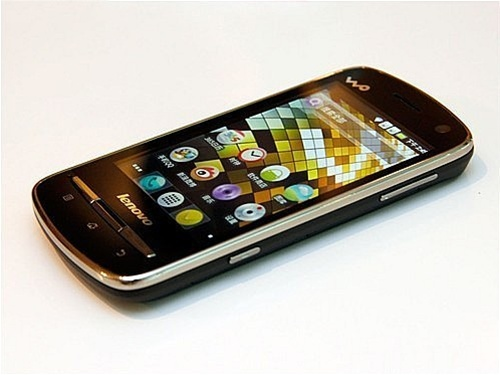
MediaTek buoyed by rising demand for Lenovo smartphones [Sept 15, 2011]
Brisk sales of Lenovo’s A60-series smartphone in China has been boosting MediaTek’s shipments of its 3.5G solution, the MT6573, according to market sources. Order momentum is expected to remain strong to sustain the chip supplier’s sales growth in September and the third quarter.
The new Lenovo smartphone hit store shelves in China earlier in the third quarter, but has been selling well thanks to its rich feature set and affordable price point, the sources said. With demand outpacing supply, the A60 has been quoted at as high as CNY1,100 (US$172) by local channel operators, up about 30% from the just over CNY800 original priced, the sources indicated.
Meanwhile, in view of the Lenovo A60’s rising popularity, China’s channel operators have released more orders for the device prior to China’s National Day holidays, the sources observed. The booming demand will simultaneously push up MediaTek’s sales generated from the orders placed by Lenovo, the sources said.
MediaTek began to ship its MT6573 3.5G chipset solution to China in August. The company was quoted as saying in previous reports that it aims to ship 10 million 3G smartphone solutions in 2011.
MediaTek has estimated consolidated revenues at NT$22-23 billion (US$743-777 million) for the third quarter of 2011. Sales grew 16.3% sequentially to NT$8.31 billion in August, and are expected to post another sequential growth in September.
Market watchers now expect MediaTek to enjoy a more than 15% sequential increase in third-quarter sales, exceeding its guidance of 5-10% growth given previously.
Spreadtrum increases TD-SCDMA chip orders to TSMC, says paper [Sept 29, 2011]
China-based handset solution vendor Spreadtrum Communications will increase its orders for TD-SCDMA baseband chips to Taiwan Semiconductor Manufacturing Company (TSMC) in the fourth quarter of 2011, according to a Chinese-language Commercial Times report.
Spreadtrum has avoided directly competing with MediaTek in the 3G and 4G segments and instead focuses on TD-SCDMA chips in cooperation with China Mobile. Spreadtrum currently holds 56% of the TD-SCDMA chip market in China, the paper said.
The TD-SCDMA chips will be made on a 40nm process at TSMC, while Advanced Semiconductor Engineering (ASE) will handle the backend packaging and testing, said the paper.
Handset solution vendors competing neck and neck in 3G smartphone market in China [Sept 13, 2011]
Demand for smartphone solutions in emerging markets, particularly in China, is gaining momentum, pushing chipset vendors to compete neck and neck to grab a large piece for the growing market, according to industry sources.
Qualcomm and MediaTek are both targeting the WCDMA solution market in China, and the two companies have landed orders from some branded handset vendorsin China, the sources noted.
China-based chipset vendor Spreadtrum Communications has received orders for TD-SCDMA solutions from Samsung Electronics, while rival Taiwan-based MStar Semiconductor has ventured into the EDGE solution segment.
Qualcomm’s launch of QRD (Qualcomm reference design) in 2010 paved the way for the company to gain more 3G solution orders in 2011, and the US-based solution vendor is expected to further enhance its market leadership with the launch of its next generation QRD, said the sources.
HTC, a strong supporter of Qualcomm, also plans to strengthen its marketing in China in 2012which will also help Qualcomm expand its share in China’s smartphone market, the sources added.
MediaTek has continued to exert efforts to reduce its production costs through integration of hardware, software, firmware and even applications, said sources, noting that MediaTek also reportedly plans to cut the prices of 3G solutions by 10-20% at the end of the third quarter in order to compete with Qualcomm’s forthcoming second-generation QRD.
Meanwhile, MStar‘s shipments of EDGE solutions have reportedly reached over five million units a month recently and will soon become a growth driver for the company, the sources added.
Smartphones moving toward hardware competition [Aug 30, 2011]
The global market competition among iOS, Android, Windows Mango and BlackBerry platforms is expected to heat up in the fourth quarter as international vendors are going to launch flagship smartphone models, with hardware specifications expected to develop toward 1.5GHz dual-core processors, large screens over 4-inch, ultra-slim form-factors and supporting HSPA+download speeds of 21Mbps, according to Taiwan-based handset makers.
Given some mid-range smartphones have already adopted 1GHz processors, the new flagship high-end smartphones are trended towards processors clocking at 1.2-1.5GHz, the sources noted.
In addition to market speculation of dual-core A5 processors for Apple’s forthcoming iPhone 5, new flagship models from Samsung Electronics, HTC and Sony Ericsson will also be powered by dual-core CPUs, the sources added. However, Nokia and RIM (Research in Motion) are not expected to roll out dual-core models until 2012.
HTC, Samsung and LG Electronics (LGE) are also expected to roll out models with display sizes ranging from 4.3- to 4.5-, or even up 4.7 inch, the sources indicated.
Taiwan handset ODMs bracing for structural upheaval [Aug 23, 2011]
Taiwan-based handset ODMs are bracing for repercussions of structural upheaval to be brought by Google’s intention to buy Motorola Mobility and Hewlett-Packard’s (HP’s) plan to stop selling WebOS-based smartphones, according to sources at Taiwan’s handset industry.
Even before the announcements of the latest deals in the hectic smartphone industry, Taiwan-based handset ODMs have mostly failed to perform well due to lackluster sales of smarphones of their branded handset clients, including HP, Dell, Acer, Lenovo and even Motorola and Sony Ericsson, the sources noted.
Although Taiwan handset ODMs have diversified their product roadmapsto include models supporting Android, Windows Mobile and WebOS platforms, their operations would still be affected by Google’s and HP’s stunning announcements, said the sources, adding that Compal Communications and Foxconn International Holding (FIH) are expected to suffer the most.
While some handset ODMs have also ventured into the development of tablet PCs, shipment volume of tablets from those handset ODMs have been smaller than expected due to the dominance of the Apple iPad in the market, the sources pointed out.
Handset vendors reportedly cutting back chipset orders for 4Q11 [Aug 19, 2011]
Some handset solution suppliers have indicated that a number of handset vendors, including Apple and HTC, have scaled down their chipset orders for the fourth quarter as compared with the third on concerns of the global economy, according to sources at Taiwan-based chipset makers.
While most smartphone vendors are likely to reach their shipment targets for the third quarter, they have begun to reduce orders for parts and components for the fourth quarter in preparation for a possible impact from changing economic conditions, the sources noted.
HTC raised its internal shipment target for 2011 to 70 million units in the first quarter, from 50 million units it projected at the end of 2010. However, the company has recently revised downward the target to 50-60 million units, according to sources familiar with HTC’s roadmap.
Sources in the supply chain of iPhone have revealed that Apple has also scaled down its orders for handset parts and components to be shipped at the end of third quarter.
MediaTek to increase investment in 3G, says chairman [July 19, 2011]
MediaTek will further strengthen its deployment in the global 3G chipset market by pouring more capital and resources into the development of platform products and application software, according to company chairman Tsai Ming-kai.
Buoyed by rapid growth in applications for mobile connectivity, the 3G industry and market in China has been developing in a fast manner, and MediaTek aims to grow in tandem with China’s booming 3G industry, Tsai said at a WCDMA supply chain conference held by China Unicom in China recently.
MediaTek will also cooperate with the WCDMA operators and makers of the WCDMA supply chain in China on technology development and marketingto accelerate the advancement of the WCDMA industry in China.
MediaTek has offered its highly integrated MT6268 WCDMA solution plus multiple application software platforms to handset makers to develop and manufacture high performance WCDMA handsets.
MediaTek to ship 3G solutions in August [July 13, 2011]
MediaTek has confirmed that it will begin to ship its HSUPA solution, the MT6573, to clients in August, but the company declined to comment on market speculations that it has landed orders for a quantity of over one million units each from clients including Lenovo and ZTE.
The specifications and performance of the MT6573, which is set to run on Android 2.3.3 platform, are similar to those chips adopted by Apple’s iPhones and HTC’s 3G smartphones, indicating that MediaTek has begun to make inroads into the global 3G chipset market, commented industry sources in Taiwan.
Other China-based handset makers, including Ningbo Bird, China Tianx and Shanghai Ragentek Communication Technology, have also decided to adopt the MT6573 solutions, the sources added.
Qualcomm likely to slash 30% off entry-level 3G solutions in next 9-12 months, says paper [June 16, 2011]
Qualcomm is likely to slash its prices for 3G smartphone solutions by 30% in the next 9-12 months in order to prevent other chipset makers from grabbing its share in the entry-level 3G solution segment, the Chinese-language Commercial Times quoted Michael Chou, a semiconductor analyst with Deutsche Securities in Taipei, as indicating.
More first-tier branded handset vendors are likely to adopt Qualcomm’s solutions for the production of entry-level and mid-range 3G smartphones in the next 12 months as Qualcomm has migrated the production of its chipset solutions to a 40nm processat Taiwan Semiconductor Manufacturing Company (TSMC), Chou said.
Qualcomm’s price-cutting strategy will affect the performance of Asia-based chipset makers, including MediaTek and MStar Semiconductor. Deutsche Securities has recommended a sell rating on shares of MediaTek and a hold rating on MStar, said the paper.
MT6573 Innovative Platform for Mainstream Smartphones [Feb 11, 2011]
Overview
The MediaTek MT6573 platform incorporates a highly-integrated core chipset, a full range of connectivity solutions and supports the latest versions of the popular AndroidTM operating system. The MT6573 platform supports a quad-band, 3G/HSPA modem with mobile broadband rates of 7.2Mbps in the downlink and 5.76 Mbps uplink, as well as quad-band EDGE. The integrated applications processing system combines a 650 MHz dedicated ARM®11 subsystem for the Android operating system; support for advanced 3D graphics; multi-format video capture and playback up to FWVGA 30fps; high-resolution camera support to 8MP and a high-end FWVGA, touch-screen display. This platform chipset is completed with a full range of connectivity solutions for Bluetooth, WiFi, GPS, FM and Mobile TV from MediaTek.
Key Features
• The core chipset of the MT6573 integrates the modem, applications & multimedia subsystem and all necessary power management functions into a single SOC.
• Combined with a single-chip, multi-mode, multi-band transceiver, it enables extremely small footprints that allow for smaller, more innovative industrial designs and form-factors.
• Additionally, the integrated 3D graphics capability brings gaming and user interface capabilities that were previously available only to high-end smartphones.
• Finally, the platform provides for advanced camera and multimedia features that include smile and face detection, panorama and burst shot, as well as high-resolution video capture and playback.
• The platform can be delivered as a full system solution consisting of hardware reference design and fully-tested, compliant software suite that can improve design efficiency and speed time to market for customers in the rapidly changing smartphone market.
MediaTek’s newly announced MT6573 application processor integrates POWERVR graphics [March 8, 2011]
New SoC brings advanced graphics to mass-market smartphones
MediaTek Inc., a leading fabless semiconductor company for wireless communications and digital multimedia solutions, and Imagination Technologies, a leading multimedia and communications technologies company, announce that MediaTek’s new application processor, features POWERVR graphics acceleration.
The MT6573 incorporates a POWERVR Series5 SGX GPU (graphics processing unit) from Imaginationto enable advanced smartphone graphics applications including gaming, navigation and location-based services, augmented reality and highly visual and dynamic user interfaces for the mainstream volume phone market.
MediaTek delivers innovative, feature-rich yet cost-effective solutions to meet consumer’s entertainment, communication and information needs. MediaTek is launching the MT6573 platform to address the accelerating demand for smartphones with features that can delight users at price points that meet the needs of operators in developed markets and consumers in emerging markets.
Says Hossein Yassaie, CEO, Imagination: “We are delighted that MediaTek has delivered this highly capable new mass-market application processor, which will enable its customers to address new levels of capabilities and meet emerging consumer demands for advanced performance in lower-priced smartphones. We look forward to building on our strategic relationship with this important semiconductor partner.”
Says Jeffrey Ju, General Manager of the Smartphone Business Unit at MediaTek: “MediaTek is committed to ensuring that wireless consumers across the globe can access the most advanced mobile technologies. Imagination delivers industry leading graphics technology and support, as well as an extensive and strong ecosystem of developers capable of utilising the technology. We are thrilled to have POWERVR graphics acceleration in MT6573, and the benefit of Imagination’s insight and experience as a strategic partner going forward.”
MediaTek announced the MT6573 platform for mainstream 3G smartphones [Feb 11] (emphasis is mine):
The MT6573 platform incorporates a highly-integrated, core chipset, a full range of connectivity solutions and supports the latest versions of the popular AndroidTM operating system. The MT6573 platform supports a quad-band [i.e.: all 4 GSM bands, the 850 and 1900 MHz bands – used in Americas – and 900/1800, used elsewhere], 3G/HSPA modem with mobile broadband rates of 7.2Mbps in the downlink and 5.76 Mbps uplink, as well as quad-band EDGE. The integrated applications processing system combines a 650 MHz dedicated ARM®11subsystem for the Android operating system; support for advanced 3D graphics; multi-format video capture and playback up to FWVGA 30fps; high-resolution camera support to 8MP and a high-end FWVGA, touch-screen display. The platform chipset is completed with a full range of connectivity solutions for Bluetooth, WiFi, GPS, FM radio and Mobile TV from MediaTek.
The core chipset of the MT6573 integrates the modem, applications, multimedia subsystem and all necessary power management functions into a single SOC. Combined with a single-chip, multi-mode, multi-band transceiver, it enables extremely small footprints that allow for smaller, more innovative industrial designs and form-factors. Additionally, the integrated 3D graphics capability brings gaming and user interface capabilities that were previously available only to high-end smartphones. Finally, the platform provides advanced camera and multimedia features that include smile and face detection, panorama and burst shot, as well as high-resolution video capture and playback. The platform can be delivered as a full system solution consisting of hardware reference design and fully-tested, compliant software suite that can improve design efficiency and speed time to market for customers in the rapidly changing smartphone market.
… The MT6573 platform is currently sampling to lead customers and will be in mass-production by mid 2011.
Marvell beaten by Chinese chipmakers in sub 1,000 yuan handset procurement tender of China Mobile
Follow-up: First real chances for Marvell on the tablet and smartphone fronts [Aug 21 – Sept 25, 2011]
No international vendors win China Mobile procurement bid for 6 million TD-SCDMA CMMB handsets, says report [Nov 15, 2010]:
China Mobile will procure 12 models of inexpensive TD-SCDMA CMMB handsets, with an equal procurement volume of 500,000 units for each model, the report indicated. The seven local suppliers are ZTE with three models, Huawei Device, Lenovo and Coolpad each with two models as well as K-Touch, Hisense and New Postcom each with one model.
Vendors, including Nokia, Sony Ericsson, Motorola and Samsung Electronics, all failed in the competition because China Mobile asked for a unit procurement price of below 1,000 yuan (US$150) and they do not offer such inexpensive TD-SCDMA handset models, the report pointed out. Consequently, the seven China-based vendors eat the whole pie, with prices ranging from 350 yuan [US$52.7] to 650 [US$97.8] yuan.
Seven of the 12 models will use TD-SCDMA chips developed by China-based Leadcore Technology, a member of Datang Telecom Technology & Industry Group, and five models will be equipped with chips developed by China-based Spreadcom [Spreadtrum] Communications and T3G (originally China-based but has merged into ST-Ericsson).
Details on the model number, TD-SCDMA chipset vendor, and CMMB chip vendor for each handset are as follows (source Marbridge Daily):

Earlier reports about the tender announcement were:
– China Mobile to procure 6 million TD-SCMA handsets, says Chinese media [Oct 8, 2010]: “Of the total, 3.6 million will be of entry-level models and 2.4 million mid-range products. … the latest procurement effort is largely due to the fourth phase of the China Mobile’s TD-SCMA network construction. When completed, demand for TD-SCMA end-use products is expected to increase substantially.”
– China market: Inexpensive TD-SCDMA handsets to be available in 4Q10 [Oct 13, 2010]: “Pushed by China Mobile, TD-SCDMA handsets and smartphones at retail prices of about 500 yuan (US$75) and 1,000 yuan respectively will be available in the China market in the fourth quarter of 2010. … China Mobile is setting up its fourth-phase TD-SCDMA network of more than 100,000 base stations and expects the number of TD-SCDMA subscribers to increase from 13.42 million currently to 100 million in 2012.”
Please note the globally rock-bottom nature of 350 yuan [US$52.7] for entry-level models and of 650 [US$97.8] yuan mid-range products. No wonder that such a low-cost and high-performance system-on-a-chip (SoC) leader as Marvell Technology Group Ltd. had no chance to succeed through any of its handset manufacturing partners. Despite of its long stated aim to capitalize on huge volumes made possible by the sub 1,000 yuan TD-SCDMA handsets:
– Marvell Empowers Mass Market TD-SCDMA OPhones with PXA920 Chipset [Sept 8, 2009]:
The Marvell PXA920 [which later has obtained the additional name Pantheon 920] comes with a dedicated high performance ARM instruction set compliant Sheeva™ processor and an integrated release 7 (TD-SCDMA, TD-HSDPA, TD-HSUPA) TD-SCDMA baseband [processor] as well as a China Mobile proven EDGE modem.
“China Mobile Research Institute believes that the OPhone platform operating on the Marvell PXA920 will catalyze the hyper-growth of TD-SCDMA smartphones as it provides a powerful combination of value-added services on a feature rich, high performance and highly affordable platform. We believe that the PXA920 solution will help us realize China Mobile’s vision of sub-1000 RMB [sub $146] TD OPhones in the near future,” said Bill Huang general manager of China Mobile Research Institute. “Marvell has worked with us from the start of the PXA920 program [2 years ago] and we are excited by the rapid progress we have made towards realizing this milestone. China Mobile will work closely with Marvell and handset eco-system partners to deploy the PXA920 and we look forward to the rapid launch of next generation TD-SCDMA OPhones based on the Marvell PXA920.”
“It is an especially proud moment for me to work with China Mobile on the mass market launch of TD-SCDMA OPhones in China,” said Shanghai-born, Weili Dai, Marvell co-founder and vice president and general manager of the company’s Consumer and Computing Business Group. “Marvell’s mission is to make technology more useful and more affordable to more of the world’s consumers. The PXA920 realizes a shared vision of China Mobile and Marvell to make powerful and affordable smartphones accessible to everyone. With the first single chip solution for TD-SCDMA, Marvell is raising the technology bar for the entire industry.
– Marvell’s Vision and Long Term Commitment to China Positions Company for Next Phase of Growth [Sept 7, 2009]:
Marvell, with approximately $3 billion in revenues in fiscal year 2009, has nearly 700 employees in its Shanghai campus and is aggressively planning to expand its operations in China. The company has focused on building its presence in the China market for most of its 14 year history, initially developing strong relationships with enterprise customers like Huawei and ZTE.
…
Last week, Marvell celebrated the culmination of several years of investment in the China smartphone market with the introduction of the Marvell® PXA920, the first commercially available single-chip solution, enabling mass market availability of TD-SCDMA smartphones. Developed by Marvell’s research and development center in Shanghai, the PXA920 is a high performance, super integrated chipset that makes the new smartphones far more affordable than feature phones currently offered by China Mobile while providing enhanced performance versus current smartphones.
Update: That opportunity was realized only 2 years later. See:First real chances for Marvell on the tablet and smartphone fronts [Aug 21, 2011]
– Marvell Technology Group CEO Sehat Sutardja on Bloomberg [Sept, 2009]:
Our strategy is to focus:
- Focus on high-end smartphones
- Move smartphones to mainstream cell/feature-phone price range
- Work with China Mobile [world’s largest mobile company] for TD-SCDMA
– Marvell Drives $99 Smartphones to Market With New Pantheon Platform [Feb 12, 2010]
– Marvell Affirms Significant Progress in TD-SCDMA Mobile Phone Chipset at Mobile World Congress 2010 – Company Showcases Array of New Smartphones Developed for the China Market Powered by Marvell’s Low Cost, High Performance Processors [Feb 15, 2010]:
More than 90 percent of all OPhones (EDGE and TD-SCDMA) shipped since launch last September are built on Marvell’s power efficient, high performance silicon technology.
In addition to OPhones, Marvell recently announced new breakthrough developments in cellular silicon technology with the new Pantheon(TM) communication processors which enable development of sleeker, high performance smartphones with HD-quality, live instant video, voice, data and 3D graphics for gaming and other popular mobile applications for consumers.
“Marvell is proud to have been an early technology partner to China Mobile on the development of the OPhone smartphone and we are delighted to see the rapid and broad adoption of China’s TD-SCDMA standard,” said Ms. Weili Dai, Marvell’s Co-founder and Vice President and General Manager of Marvell Semiconductor’s Consumer and Computing Business Unit. “… The collaboration with China Mobile affirms our commitment to drive the smartphone for mass market adoption and to deliver the ‘always-on lifestyle’ to consumers around the world.”
“China Mobile’s vision of the sub-1000 RMB (sub $150) TD-SCDMA OPhones will become a reality because of our collaboration with leading companies like Marvell,” said Bill Huang general manager of China Mobile Research Institute. “Marvell and China Mobile are excited by the rapid progress we have made in the TD-SCDMA technical cooperation.”
As the world’s first solution with a built-in TD-SCDMA platform solution with a 55nm design, the Pantheon 920 is a high performance, highly integrated solution that helps make smartphones far more affordable than feature phones while providing enhanced performance compared to current smartphones.
The Pantheon 920 processor [exactly the same as the PXA 920 announced in Sept 2009]supports all leading open operating system (OS) software platforms and come with a dedicated high performance ARM instruction set compliant Marvell CPU processor, high performance HD video, 3D graphics accelerators, and industry’s leading TD-SCDMA modem with 2.8Mbps HSDPA and 2.2Mbps HSUPA.
Certainly it could be the case that the next round of China Mobile tender for sub 2,000 yuan (sub $300) handset procurements will be won by Marvell. The sub 1,000 yuan (sub $150) segment, however, has been lost for them.
Background on Chinese chipmakers now succeeding against Marvell and all other international operations
When looking into the background of local chipmakers, especially that of the biggest winner Leadcore technology, one thing becomes absolutely clear. The telecommunication chip supply is as much under state control as the whole telecommunication market. Moreover every strategy related decision, which of this procurement process is just one example, is under direct control of the Central Commitee of the Chinese Communist Party. As as consequence there is no wonder that no international chip maker has any chance to penetrate the mass handset market technologically viable for local chipmakers. It is quite probable that the Central Commitee wants to build an internationally competitive local chip industry via the huge volumes available on their home handset market. Some evidence:
– Leadcore Unveiled oPhone Solutions to Strengthen the High-end TD-SCDMA Handset [April 23, 2009]
On April 23, 2009, in the Leadcore Technology Annual Client Conference 2009, Mr. Sun Yu, the president of Leadcore Tech revealed the progress of TD-SCDMA terminals development. Mr. Sun Yu said that more than 60 handsets are based on the Leadcore solutions in the current 100 TD-SCDMA handsets. More than 70% TD-SCDMA terminals products in the market were derived from the Leadcore’s DTivy. The Pecker test terminal launched by the Leadcore technology occupied the vast majority share of TD-SCDMA test terminal market. He also revealed that China Mobile was taking its great effort to R&D the solutions of OMS-based TD-SCDMA handset, oPhone, which will be released by Leadcore on April 23, 2009.
– TD Forum Attended Leadcore Technology Client Conference to Witness the New Heights of Chip Manufacturers [April 22, 2010]
– Continuous innovation to lead the future – the core technology wonderful debut thirteenth China Beijing International High-Tech Expo [May 27, 2010], as translated from Chinese by Google:
展会期间联芯科技展位受到了中央领导以及参展观众的高度关注,取得良好反响。 Core Technology Alliance booth during the exhibition by the central leadership and the participating audience attention and achieved good response. 中共中央政治局委员、市委书记刘淇,中共中央政治局委员、国务委员刘延东,国务委员、公安部部长孟建柱,均来到联芯科技TD联盟展位驻足参观,了解公司最新技术与市场化成果。 CPC Central Committee, Liu Qi, Party Secretary of the CPC Central Committee, State Councilor Liu Yandong, State Councilor and Minister of Public Security Meng Jianzhu, are the core technology to the joint booth TD Union stopped to visit, understand the latest technology and market results.
– General Secretary of the Central Committee of the CPC, Chinese President and Chairman of Central Military Commission, Jintao Hu paid an inspection visit to Spreadtrum Communications (Shanghai) Co., Ltd [Jan 18, 2010]
– Hu calls for independent innovation [Jan 18, 2010]:
Hu Jintao (R front), general secretary of the Central Committee of the Communist Party of China, Chinese president and chairman of the Central Military Commission, shakes hands with young members of the research and development team as he inspects Spreadtrum Communications, Inc., in Shanghai, east China, on Jan. 16, 2010. Hu Jintao made an inspection tour in Shanghai on Jan. 14-17. [Xinhua]
… At the Spreadtrum Communication, Inc., a high-tech company founded by returned overseas students, Hu said independent innovation is the lifeline of a company. He told the company staff “I hope you could make further breakthroughs in core technologies, so as to boost China’s communication industry.”
– Spreadtrum Communications, Inc. Announces $44 Million of New Financing [May 5, 2009]:
“We very much appreciate and are excited to receive this nearly interest-free financing. This indicates the Chinese government’s strong support and high confidence in Spreadtrum to develop semiconductor products in 2nd and 3rd generation wireless communications in the Chinese market. We plan to use our borrowings under the loan to increase R&D investment in our GSM and TD-SCDMA projects and to expand our IC operations in China. With our strengthened financial position, we are more confident in our ability to overcome the difficulties caused by the current worldwide economic and financial crisis and do not expect to need to raise additional funds in the near future,” said Dr. Leo Li, president and chief executive officer of Spreadtrum Communications, Inc.
And these are just the visible indications that local chipmakers are getting huge government subsidies. And T3G, now a wholly owned subsidiary of ST Ericsson, has also been a very much preferred player because of its parent’s huge patent portfolio and international Ericsson influence in the strategic (for China’s local and foreign market efforts) LTE wins (see: IMT-Advanced (4G) for the next-generations of interactive mobile services, China is triumphant [Oct 24, 2010]). With that they can beat even the best international chip house, the Marvell Technology Group.
1. Leadcore Technology (part of the state-owned Datang Telecom Technology & Industry Group)
The current outcome is not the first time for the biggest winner Leadcore Tedchnology (with seven of the 12 models using its TD-SCDAM chip, i.e. 58% or 3.5M chips) as evidenced by one and a half years old news of Leadcore Technology Gets Big Order from China Mobile [May 21, 2009]:
Leadcore Technology Co., Ltd., together with its three partners, wins nearly a half of the CNY 600 million subsidy from China Mobile in the telecom carrier’s latest round of bidding for TD-SCDMA terminal procurement
…
Leadcore’s mobile phone chips are applied in five models of TD-SDMA mobile phones that are ordered by China Mobile this time.
The TD-SCDMA network operator has ordered 11 models of mobile phones, including the Leadcore chip-powered low-end TD-SCDMA devices launched by ZTE Corporation (SZSE: 000063 and SEHK: 0763) and LG, as well as the Leadcore chip-based flagship broadband TD-SCDMA products rolled out by LG, ZTE, and Yulong Computer Telecommunication Scientific (Shenzhen) Co., Ltd.
The other companies share the TD-SCDMA terminal order from China Mobile include T3G Technology Co., Ltd., Spreadtrum Communications, Inc. (Nasdaq: SPRD), Dopod Communication Corporation, Motorola, Samsung, Huawei Technologies, Hisense, and Guangzhou New Postcom Equipment.
Leadcore Technology’s lead on the technology market for TD-SCDMA terminals goes back to the very beginning as was reported by Datang Licensed TD Tech from Leadcore [Sept. 30, 2009]:
Sun Yuwang, president at Leadcore Technology, once said that more than 60 of the over 100 TD handsets that have gotten network access licenses in the country have been equipped with Leadcore chips, with an additional 14 new models afoot. Among the top four PC makers in the world, Lenovo, HP and Acer have all adopted Leadcore’s products.
Leadcore’s TD chip shipment outpaced 1 million pieces this past April, topping 2 million by the end of this August. Now the company is holding more than 60% of the domestic TD chip market.
Leadcore’s dominance has been further evidenced by TD Forum Attended Leadcore Technology Client Conference to Witness the New Heights of Chip Manufacturers [April 22, 2010]:
Dr. Jing Wang, Secretary-general of TD Forum attended the conference and witnessed great achievements gained by TD-SCDMA chip manufacturers since TD-SCDMA commercialization one year ago. With the further mature of TD-SCDMA market and gradually strengthened cooperation among related parts of TD-SCDMA industry, the problems occurred in the development of TD-SCDMA industry will be resolved effectively.
Leadcore is part of the state-owned Datang Telecom Technology & Industry Group which has the following structure:

with officially provided links as below:
Affiliations
Datang Telecom Technology & Industry Holdings Co.,Ltd.
- Datang Mobile Communications Equipment Co., Ltd.
- Leadcore Technology Co.,Ltd.
- Beijing Xinwei Telecom Technology Co.,Ltd.
- Datang Capital(Beijing) Co.,Ltd.
Datang Telecom Technology Co.,Ltd.
GoHigh Data Networks Technology Co.,Ltd.
Unit in charge
State-owned Assets Supervision and Administration Commission of the State Council
Among the affiliate links given above there is no link for Semiconductor Manufacturing International Corporation (SMIC) although on the stucture image it is listed as part of the Datang Telecom Technology & Industry Holdings Co.,Ltd.
- Update: Datang to raise stake in SMIC, says report [Nov 23]:
Datang Telecom Technology & Industry Holdings has agreed to acquire US$102 million worth of Semiconductor Manufacturing International Corporation (SMIC) shares to bring its stake in the foundry chipmaker to 20%, according to a Chinese-language sina.com report.
The report said SMIC will use the new funds mainly to expand advanced process capacity at its 12-inch fabs.
Datang, directly owned by China’s central government, is currently the majority shareholder of SMIC with a 16.6% stake.
Semiconductor Manufacturing International Corporation (SMIC) will pump at least US$2 billion into research and development annually in the future, aiming to develop “world-class” technologies and manufacturing within the next five years, according to Jiang Shang Zhou, chairman of the China-based foundry chipmaker.
…
SMIC is now undertaking a project to ramp up 45nm process capacity, which will cost it a total of about US$4 billion, Jiang noted. In addition, the company’s next move to a 32nm technology will initially require US$600 million, Jiang added.
Soon the Datang Telecom Technology & Industry Group will be even larger as per the news that China Potevio to merge with Datang [July 15, 2010]:
The government has decided to merge two State-owned telecom equipment makers – China Datang Corp and Potevio – by the end of this year, sources from Datang said on Wednesday.
The merged entity is expected to become the third-biggest telecom equipment maker in China after Huawei Technologies and ZTE Corp, the source said.
…
Datang is a large power generation company and one of the key promoters of the TD-SCDMA standard in the nation.
China Potevio is a leading IT equipment manufacturer and service provider. Its main businesses span the manufacture of telecommunications products, the application of telecom products, and the informatization of broadcasting and TV.
The group is also playing an active role in high-tech investments as per Datang Telecom planning PE fund [May 20, 2010]:
Telecom equipment maker Datang Telecom on Wednesday said it plans to set up a 5 billion yuan ($732.18 million) private equity (PE) fund for investments in the booming Internet of Things (IOT) industry.
Datang will partner with the Wuxi New District Venture Investment Group, the Chinese Academy of Sciences (CAS) and Wuxi Guolian Development (Group) Co to set up the PE fund with a corpus of 1 billion yuan in the first stage.
The company will invest 200 million yuan during the first stage of fundraising and hold a 40 percent equity stake in the fund management company being set up to manage the private equity fund.
IOT refers to networks of real-world objects linked to the Internet that interact through web services. The technology is based on the concept that all real-world objects can be identified and managed by computers if they are equipped with radio tags and linked to the Internet. Technologies such as radio frequency identification and sensors form the cornerstones of the network.
What is the current status of the group and Leadcore itself in relationship to China’s own TD-SCDMA and TD-LTE technologies? The Datang Telecom Group was awarded “2nd China Annual 3G Prize” [June 30, 2010] press release is giving all the details (emphasis is mine):
Since Ministry of Industry and Information Technology of PR China issued 3G licenses in January 2009, in TD-SCDMA industry DTG has occupied 30% of market share in system equipment, and 50% in chips and Solutions.
Currently, DTG possesses the most comprehensive TD-SCDMA solutions for all circumstances in the industry, and is competent to provide complete, end to end TD-SCDMA and TD-LTE business solutions. DTG has already provided network equipment supply and construction services to Guangdong, Shandong, Jiangsu and Zhejiang, and other key provinces. DTG actively cooperated with China Mobile to accomplish coverage of complex scenes, such as, intensive urban areas, large scaled stadiums, maglev trains and Cross-ocean Bridge, and provided premium green network with TD-SCDMA technology. All products provided by DTG are ready for smooth evolution towards TD-LTE. This award collectively represents high recognition and acceptance towards Datang Telecom Group for its contribution in promoting the development of Chinese telecommunication industry.
LeadCore Technology, winner of “TD-SCDMA terminal chip and the best solution provider”, is the core enterprise specialized in TD-SCDMA terminal industry in DTG. As a chip enterprise in the upstream position of industrial chain, Leadcore Technology always focuses on layout of industrial chain and value chain; Leadcore adheres to technology innovation and market-orientation; promotes industrialization of innovation achievements, persists in pursuing win-win situation from cooperation and also coordinates with the partners from industrial chain, so as to promote rapid and healthy development of TD-SCDMA industry.
2. Spreadtrum Communications, Inc (founded by Chinese expatriates in 2001, a public company since 2007 with principal executive offices and most operations in China but incorporated in Cayman Islands)
– Spreadtrum and Hisense Jointly Launched the World’s First Affordable TD-SCDMA Phone Supporting CMMB Digital TV [Jan 10, 2010]
Hisense N51 was jointly developed by Spreadtrum and Hisense in a highly collaborative technical partnership. Executive Vice President of Hisense Communication, Ms. Wenlin Yang, said: “Hisense and Spreadtrum share a long history of co-operation. Partnering with Spreadtrum, we successfully won the bid of ‘thousand-yuan 3G mobile phones’ project of China Mobile’s ‘TD-SCDMA Terminal Special Incentive Fund Project.’ Through our six-month joint efforts and Spreadtrum’s very competitive TD-SCDMA and CMMB solutions, the Hisense N51 was introduced. … “
President and CEO of Spreadtrum Communications, Inc., Dr. Leo Li, said: “… Spreadtrum provides highly integrated TD-SCDMA/HSDPA/GSM/GPRS/EDGE baseband chip SC8800H and RF chip QS3200, which effectively reduce the cost of development and manufacturing of Hisense Communication products. Therefore, Hisense Communication is able to introduce cost-effective handsets such as N51 by targeting the Chinese 3G market quickly to meet the needs of consumers. Spreadtrum CMMB mobile TV chip SC6600V provides Hisense N51 with vast application space. Particularly, Hisense N51 is currently the world’s only 1000 RMB level TD-SCDMA phone that supports CMMB.”
– Spreadtrum’s TD-SCDMA Chip Adopted in the World’s First 3G OPhone Lenovo O1 [Dec 14, 2009]:
Lenovo Mobile Communication Technology Co., Ltd. (hereinafter referred to as “Lenovo Mobile”) launched the world’s first TD-SCDMA standard-based OPhone smart phones – Lenovo O1, with immediate sales in all local markets in mainland China. The phone is based on Spreadtrum Communications, Inc. (hereinafter referred to as “Spreadtrum”, Nasdaq: SPRD) TD-SCDMA solution, and supports China Mobile OPhone OS smart phone operating system.
Spreadtrum and Lenovo Mobile, in a highly collaborative technical partnership, jointly developed Lenovo O1. This new handset runs on the China Mobile led developed Intelligent Terminal software platform – the OPhone platform. Lenovo 01 uses Spreadtrum’s TD-SCDMA/HSDPA / GSM / GPRS / EDGE baseband chip SC8800S and radio frequency (“RF”) chip QS3200.
– Spreadtrum and China Telecommunications Technology Labs Announce Strategic Partnership to Promote New Technologies and Services [May 15, 2009]
A unique industry chain capability has developed in China’s mobile phone industry, which now comprises of design, R&D, support, production, marketing, etc. This development will enhance the competitiveness of phones made in China for the local and overseas markets. With the strategic partnership of CTTL and Spreadtrum, our cooperation will create new technologies and services in wireless communications and multimedia terminals. For example, we expect to innovative services by utilizing our combined resources and new techniques in 2G and 3G networks to develop high-tech information security technologies for the mobile and multimedia markets. Our cooperation will simultaneously broaden and strengthen interactions in the industry chain.
… China Telecommunications Technology Labs (“CTTL”), founded in 1981, was named under the authorization of the Ministry of Information Industry (MII) and the State General Administration for Quality Supervision, Inspection and Quarantine (AQSIQ). Currently, CTTL is administrated by the China Academy of Telecommunications Research (CATR) and was formed through re-organization and merges of four divisions of CATR, i.e. the Research Institute of Telecommunications Transmission (RITT), the Telecommunications Metrology Center (TMC), the Research Institute for Industry Standard of Posts and Telecommunications (PTISR), the CTTL Anti-seismic Research Institute of Telecommunications Equipment, BaoDing (ARITE). It is a leading high-tech laboratory with the following missions: telecommunications technology development, telecommunications product standards and test methods research, telecommunications metrology standards and methods research, products inspection, verification and technical assessment and testing instruments metrology and evaluation of communications software.
– Spreadtrum Communications, Inc. Announces $44 Million of New Financing [May 5, 2009]:
“We very much appreciate and are excited to receive this nearly interest-free financing. This indicates the Chinese government’s strong support and high confidence in Spreadtrum to develop semiconductor products in 2nd and 3rd generation wireless communications in the Chinese market. We plan to use our borrowings under the loan to increase R&D investment in our GSM and TD-SCDMA projects and to expand our IC operations in China. With our strengthened financial position, we are more confident in our ability to overcome the difficulties caused by the current worldwide economic and financial crisis and do not expect to need to raise additional funds in the near future,” said Dr. Leo Li, president and chief executive officer of Spreadtrum Communications, Inc.
– Spreadtrum: TD-based Chip Shipment Totaled 100,000 [March 6, 2009]:
Spreadtrum Communications, Inc. clarified on March 3, 2009 that the shipment of its TD-SCDMA-based chips totaled nearly 100,000.
Earlier, the shipment of Spreadtrum’s TD-SCDMA-based chips was reported to reach 10,000 or so. The number is inaccurate, explained the Nasdaq-listed company, adding that mobile phones adopting its chips accounted for nearly one third of China’s procurement of 300,000 TD-SCDMA cellphones and terminals.
The Shanghai-based company incurred a net loss of USD 31.3 million for the third quarter of 2008, in contrast to a net profits of USD 6.1 million Q3 2007 and USD 2.6 million in Q2 2008
– Spreadtrum Announces World’s First TD-SCDMA/HSDPA/EDGE/GPRS/GSM Single-chip RF Transceiver – The QS3200 RF transceiver features high integration and low power consumption and provides 2G/2.5G/3G/3.5G multimode support [Feb 16, 2009]:
Followed by the GSM/GPRS single-chip RF transceiver, the QS500, and the GSM/GPRS/EDGE single-chip RF transceiver, the QS1000, today Spreadtrum announced the QS3200, the world’s first single-chip RF transceiver to support multimode such as 2G/3G/3.5G. The QS3200 offers great improvement over the other TD-SCDMA RF chip on signal transmission, reception, and power amplification in addition to the integrated features and low power consumption in Spreadtrum’s other chip solutions. The launch of the QS3200 makes Spreadtrum one of the total solution providers in the wireless communications market and takes a positive step forward in commercializing TD-SCDMA technology.
– Spreadtrum Announces SC6600V: First Single-Chip Demodulator/Decoder for CMMB-Based Mobile TV [May 7, 2008]
Spreadtrum’s new SC6600V solution is an integrated CMMB demodulator and source decoder chip and is the first single chip solution that supports both AVS and H.264 video decoding standards. As the first CMMB single chip solution for mobile TV, the SC6600V is designed for feature phones. The SC6600V adopts an integrated platform design for communications and mobile multimedia to reduce the design period of Spreadtrum’s customers. … Spreadtrum’s SC6600V single-chip solution is designed to enable handset makers and carriers to offer mobile TV feature in feature phones at reasonable prices, instead of being relegated to expensive SmartPhones as most mobile TV solutions are currently.
… CMMB is a homegrown mobile TV standard that applies to mobile devices such as mobile phones, PDAs and Portable Media Players (PMPs). It features free mobility, rich video and data services. In addition, it provides consumers with cost-effective mobile TV service that satisfies most consumers’ needs and is expected to be used in the Beijing 2008 Olympic Games.
Mr. Ma Jv, President, Academy of Broadcasting Science of the State Administration of Radio Film and Television, indicated that, “We are very glad that Spreadtrum has developed the SC6600V, the first CMMB-based Mobile TV single chip solution for mobile phones, which integrated demultiplex, channel decoder and source decoder. We believe that it will help CMMB start to grow its market quickly, and we hope Spreadtrum will continue to unleash its technology strengths, allowing it to contribute to the CMMB industry’s ongoing development and road to becoming prosperous.”
– Spreadtrum Communications Completes Acquisition of Quorum Systems [Jan 16, 2008]:
With the acquisition of Quorum, Spreadtrum gains a highly skilled RF engineering team of 30 engineers with an average of 10 years of industry experience. The combination of Spreadtrum’s leading single-chip baseband solutions with Quorum’s complementary, low-power high-performance RF designs is expected to strengthen Spreadtrum’s competitive position in the wireless market, including in 2G, 3G, RF, baseband, physical layer software, protocol and applications. Since its founding in 2003, Quorum has created multi-band transceiver designs ranging from GSM/GPRS/EDGE to WCDMA and 3G HSDPA application, plus a recently announced TD-SCDMA platform.
3. T3G (an ST Ericssson subsidiary since December 2008)
T3G has achieved an impressive record of world firsts in bringing innovation to China:
- The world’s first ASIC based TD-SCDMA system level call achieved in 2004
- The world’s first international TD-SCDMA call in 2004
- The world’s first 384Kbps commercial TD-SCDMA/EDGE dual-mode Samsung phone, powered by T3G’s chipset in 2005
- The world’s first ASIC based 2.8Mbps TD-HSDPA system call achieved in 2007
- The world’s first 2.8 million TD-HSDPA/EDGE dual-mode dual-band commercial data card powered by T3G’s chipset in 2008
- Completed the world’s first TD-LTE end-to-end application demonstration on multimode soft modem platform in 2009
- Launched the world’s first TD-HSPA chip in 65nm in 2009
– Strong presence and identity in China:
ST-Ericsson, through its subsidiary T3G, has been actively developing platforms for the TD mobile standard since 2003. The company’s extensive investment in technology and product development has given it a leadership position in the market. The company provides solutions to Chinese and global handset manufactures and design houses. It offers mobile chipsets, software protocols, system reference designs and customized technical support. In May 2009, ST-Ericsson was selected by China Mobile as a major technology partner for the development of its highend and low-cost handsets. The company will also support four of its customers to commercialize their mobile phones during 2009-2010.
…
- ST-Ericsson’s 550 employees are based in Beijing, Shanghai, Shenzhen and Hong Kong
- ST-Ericsson (ST-NXP Wireless) acquired T3G in December 2008. T3G was established in January 2003 as a joint venture. Its founding partners were Philips Semiconductors (later NXP Semiconductors, and finally ST-NXP Wireless), Datang Mobile, Samsung Electronics, and since 2005 also Motorola. T3G is based in Beijing.
– Datang set to sell off T3G stake [June 19, 2008]:
Datang Mobile, the second largest stakeholder of T3G, is putting its 32.11 percent stake on sale for 122.2 million yuan, according to a notice posted on the website of Beijing Equity Exchange.
The move comes on the heels of the collapse of Commit Inc, another major TD-SCDMA chipmaker, which has dimmed the prospects of TD-SCDMA.
There are rumors that Geneva-based semiconductor maker STMicroelectronics might take over Datang Mobile’s stake in T3G.
…
Commit has had its own share of woes, forcing it to shut shop at the end of April after failing to secure fresh funding and pay its employees for months. Commit’s shareholders include Hyper Market, Texas Instruments, Nokia, LG and State-owned Potevio and Datang Telecom, parent of Datang Mobile.
Industry observers blame Commit and T3G’s woes on the slow roll-out of TD-SCDMA in China.
– ST-Ericsson and China Mobile to Bring TD-SCDMA to the Mass Market [May 26, 2009]:
China Mobile has selected ST-Ericsson’s company in China, T3G, as a major technology partner for the development of its high-end and low-cost handsets, based on the 3G standard TD-SCDMA. ST-Ericsson will also support four of its customers to commercialize their mobile phones during 2009-2010.
Under the agreement, ST-Ericsson, the 50/50 joint venture between Ericsson and STMicroelectronics, will develop a new low-cost platform to support its customers to offer affordable TD-SCDMA devices to the China consumers. ST-Ericsson will also support customers to develop high-end mobile phones, based on existing and new platforms such as the T7210, which will allow consumers to enjoy high-speed broadband and multimedia services.
“Although ST-Ericsson is a recent joint venture, our subsidiary T3G has been actively developing platforms for the mobile standard for more than six years, achieving an impressive record of world firsts in bringing innovation to China,” said Alain Dutheil, President and CEO of ST-Ericsson. “Our dedicated local R&D team, as well as our strong commitment to continuous innovation and close cooperation with customers, will enable China Mobile to offer a broad range of handsets for the mass market as well as for the high-end segment.”
ST-Ericsson’s T7210 mobile platform supports TD-SCDMA dual-band in 2010-2025MHz/1880-1920MHz frequencies, and has successfully completed handovers of voice and high-speed data services in order to operate optimally in Chinese dual-band network environments.
– ST-Ericsson Continues to Drive Innovation in TD Market [Sept 14, 2009]:
ST-Ericsson, a world leader in wireless platforms and semiconductors, and its Chinese subsidiary T3G today announced the industry’s first TD-HSPA modem chip samples in 65nm. This new chip is smaller than existing products, making it easier to implement in mobile devices, and is also designed to reach significantly lower power consumption.
– ST-Ericsson reaches key milestones in China [Nov 27, 2009]:
Confirms clear market leadership in the TD-technology
- Five million TD chipsets shipped
- ST-Ericsson’s solutions power more than 100 models of TD devices, including handsets, data cards and embedded devices
ST-Ericsson, a world leader in wireless platforms and semiconductors, has reached two important milestones, confirming its market leadership in the Chinese homegrown 3G standard, TD-SCDMA. ST-Ericsson, through its Chinese subsidiary T3G, has been leading the innovation in the TD market since 2003, bringing numerous industry firsts.
… Read more at: http://www.stericsson.com/press/Strong_presence_china_English.pdf
– ST-Ericsson to cooperate with China Mobile on TD-LTE [Feb 16, 2010]:
ST-Ericsson, a world leader in wireless platforms and semiconductors, announced today it will cooperate with China Mobile on TD-LTE development and will support a demonstration of TD-LTE at Shanghai World EXPO in 2010.
ST-Ericsson will also actively participate on other TD-LTE projects organized by China Mobile, including trial and interoperability testing (IOT) with infrastructure vendors.
Bill Huang, General Manager of China Mobile Research Institute, said: “China Mobile and ST-Ericsson are co-operating very successfully on TD-SCDMA technology and we are happy to extend our partnership into the TD-LTE area and then multi-mode technologies in future. We share a common goal of creating a global LTE market encompassing both TDD and FDD technologies.”
…
ST-Ericsson’s key milestones in LTE:
- In December 2009, ST-Ericsson and Ericsson were first to achieve LTE and HSPA mobility with a multimode device. Read more at www.stericsson.com/press_releases/LTE_HSPA.jsp
- 2009: Fully working LTE chipset available and interoperability testing of the platform with operators
- 2008: Platform interoperability tests activities initiated with network vendors
- 2007: First handheld LTE prototype available and first handheld public demonstration at Mobile World Congress in 2008
- 2004-2005: ST-Ericsson started research and standardization activities related to LTE
– ST-Ericsson launches feature rich mobile internet platform in China – T6718 enables development of cost-effective and power-efficient multimedia TD-HSPA handsets [May 27, 2010]:
The T6718 is the first commercial 65 nanometer-based TD-HSPA platform, enabling manufacturers to quickly produce compact, cost efficient and feature-rich mobile broadband handsets for the Chinese market. ST-Ericsson expects the T6718, which can support downlink speeds of 2.8Mbps and uplink speeds of 2.2Mbps, to be in commercial products from Q3 2010.
… Handsets based on the T6718 platform will be able to deliver up to seven hours of talk-time or 25 days of standby on one battery charge. Incorporating software support for Assisted-GPS (AGPS), the T6718 will also enable location-based services, such as navigation and local search.
The dual mode TD-HSPA/EDGE modem is integrated with an ARM processor to deliver small size, fast response time and low power. This is also the first TD-HSPA solution to take advantage of the additional size and power benefits of the 65 nm process node.
The T6718 delivers a rich Internet experience including fast browsing, streaming video, broadcast television and other multimedia services on a touch-screen display. The 5 Mpixel camera support and video recording capability coupled with the graphics hardware accelerator provide a great visual consumer experience. Furthermore, the T6718 has the lowest power consumption in its class which means more hours enjoying music, video, internet access and talking.
…
High performance and low power consumption
- The first commercial 65 nanometer based TD-SCDMA
platform on the market- Talk time up to 7 hours and stand by up to 25 days on one battery charge (standard 1000mAh battery)
- ARM926 processor up to 416 MHz
 Experiencing the Cloud