Home » Posts tagged 'Videocon'
Tag Archives: Videocon
Qualcomm’s SoC business future is questioned first time
Among the hits for simple ‘Qualcomm’ search between April 25 and 30 you will first time find headlines such as:
|
While such headlines are in minority by far and had been market balanced by Qualcomm’s media wide Snapdragon 800 communication (“Snapdragon 800 to enter mass production in late May”) we are witnessing first time that Qualcomm’s SoC future had been questioned for very first time. So it is worth to examine this abrupt change in a little more detail than the articles behind those worries:
First of all China: Entry-level dual core IPS WVGA (480×800) smartphones $65+ now, quad-core $70+ in June [‘Experiencing the Cloud’, April 29, 2013] behind of which there is a very said turn of events from Qualcomm’s point of view that:
Qualcomm recently quoted its quad-core solutions at less than US$10, slightly cheaper than MediaTek’s offerings, the sources indicated. Meanwhile, Spreadtrum has lowered its quad-core processor prices to similar levels. Both firms are trying to gain market share through aggressive pricing, the sources said.
That is Qualcomm has no other way against its market dominant entry-level rival MediaTek as start an outright price competition. In fact it is an even bigger problem as its hastily reworked new SoC product line setup:
was meant to be a very broad offensive move as it was noted in Qualcomm moving ahead of Allwinner et al. in CPU and GPU while trying to catch up with Allwinner in Ultra HD [‘Experiencing the Cloud’, Jan 12 -Feb 27, 2013]
Even more, in China: Entry-level dual core IPS WVGA (480×800) smartphones $65+ now, quad-core $70+ in June [‘Experiencing the Cloud’, April 29, 2013] we already had the following slide from yet another Chinese rival Spreadtrum:

So while Qualcomm is trying to undercut MediaTek prices in the quad-core entry-level SoC segment its another rival had been pushed to do the same, and now Qualcomm has another very potent rival, already much better established in the entry-level segment than Qualcomm, even outside China as was shown by Temporary Nokia setback in India [‘Experiencing the Cloud’, April 28, 2013]. Should Qualcomm drop its quad-core entry level price further? Hardly, as those $10 SoC prices are at the very bottom from the point of view of deterring additional entry-level quad-core rivals like Allwinner to enter that segment at large.
The competition between these three parties in terms of the entry level functionality looks like as follows (availability data is suggesting Q3 2013 entry level smartphone devices with extremely high volume production from Tier 1 international vendors down to a large number of white-box Chinese vendors):
|
MediaTek |
Qualcomm |
Spreadtrum |
|
|
Product |
MT6582 |
MSM8225Q, MSM8625Q |
SCXXXX |
|
Availability |
Q3 2013 volume |
Q1 2013 sample |
Q2 2013 sample |
|
Modem |
TD-SCDMA/W-CDMA/ TD + W |
CDMA multimode / UMTS modem options |
TD-SCDMA/W-CDMA/ TD + W |
|
Integrated App processor |
Quad Cortex-A7 |
Quad Cortex-A5 |
Quad Cortex-A7 |
|
Speed |
1.x GHz |
1.4 GHz |
1.x GHz |
|
GPU |
ARM Mali 400 |
Adreno 203 |
ARM Mali-400MP2 likely |
Block diagrams of the MT6572 entry level SoC from MediaTek, the quad-core MT6582 will differ from that only in the number of cores:

From: Mediatek “Wu Song” [MT6572] uphill [product], against the Spreadtrum “Tiger” [SC8825] / 联发科武松上山,展讯猛虎迎战 [52RD, March 8, 2013]
and

from 28-nanometer dual-core MT6572 WCDMA version is first to debut / 28纳米双核MT6572临近 WCDMA版本率先登场 [MTK手机网/MTK Mobile Phone Network, March 23, 2013] based on which a brief English report was the Mediatek MT6572 Chipset Details [Quazmo, April 6, 2013]
Meanwhile the first MT6572-based products are already launched:
MTK6572 mobile phone, Sunspan [天迈] D18/D28X first appearance [China Unlocked Phone Review, April 26, 2013] which is the rough English translation (therefore I made some manual edits to it) of MTK6572手机来了 天迈D18/D28X率先亮相 [MTK手机网/MTK Mobile Phone Network, April 26, 2013] article
MediaTek MT6572 dual-core processor was adopted some time ago by the majority of mobile solution providers. Informed sources said MT6572 began mass production, in addition to the dual-core MT6572, quad-core chip MT6582 coming soon. There is no quad-core version of the specific information of MT6582 chip, but to guess from the naming of the quad-core chip may be rumors it is MT6572 quad core version .
Description of MT6572
MediaTek MTK/MT6572 is a low-power highly integrated single-chip phone processor. The chip is based on Cortex-A7 architecture, using the 28-nanometer process. a single core’s clocked at 1.xGHz, it also has built-in Mali-400MP graphics processor, support for TD-SCDMA, WCDMA and EDGE 2.75G network, integrated 4-in-1 wireless chip. In addition to that it has been listed dual-core and quad-core chip versions. The MT6572 product line also has speed and price advantages. It is learned that old Spreadtrum customers, including WingTech (闻泰) etc. will be launching MTK6572 products, but the end product equipped with MT6572 chip will be officially listed in May.

T-SMART D28X/D26X
T-Smart Sunspan Communication, operating in the field of TD for many years and in good cooperation with China Mobile and other operators, signed a 600,000 full year supply agreement with D.Phone [who claims to be China’s largest retailer of mobile phones and accessories, with over 1300 stores, more than 800 of which are directly owned stores, see its TMall store for current offerings]. In this year’s upcoming new machine, Sunspan D28X/D26X and D18/D96X, several new machines will be using MTK6572 program, the listing of these models has been formed, will soon be listed.
Sunspan D28X/D26X
The two Sunspan D28X/D26X machines have the same appearance. Body size is 132 * 68 * 10.5 mm, which is equipped with MTK6572 dual-core processor, clock frequency is 1GHz, the screen size is 4.5 inches with 5MP camera, and running Android 4.2 version of the system. Another standard capacity of 1600 mAh battery, built-in commonly used sensor. The D28X/D26X both support different network standards, the D28X will provide the China Mobile’s customized one, i.e. can support the TD-SCDMA network, while the D26X has the Unicom [W-CDMA] version.

T-SMART D18/D96X
In addition to the Sunspan D28X/D26X, there are also new D18/D96X machines which to be powered by the MTK6572 dual-core processor. The D18/D96X models also differ in supported networks. D18 is the China Mobile version and D96X is the Unicom version. In addition to that the D18 will run Android 4.2 system, equipped with a 2MP camera, while the the D96X using system version 4.1, the camera pixel is higher, 3MP. D18/D96X body style is more upright, while the color is much richer, the machine size is 126 * 64 * 10.9 mm.
Hardware parameters of both are also consistent: with a 4-inch screen, the battery capacity of 1500 mAh, supports common sensors.
MT6572 is primarily intended for [so called] one thousand yuan [~$150] mobile terminal products, so the MTK6572 phone sells are worth of the wait, as several new machines with lower to Sunspan hardware specifications, maybe the same, will have a friendly price. After May a large number of MTK6572 dual-core processor models will become available, the choice available to users will be more and more, and we look forward to the MT6572′s performance.


And those first Sunspan products were produced by the largest cellphone ODM in mainland China, WingTech [闻泰] Communications:
From the feature to quickly switch your Smartphone / 从功能机到智能机的快速切换 [Jiaxing Daily, March 22, 2013] as traslated by Bing and Google, with manual edits:
Decoding the “top ten 2012 to take a new road to industrialization enterprises”: WingTech Communications Review
“Sales of only 640 million yuan [$104M] in the first half of last year, while in the second half, sales more than doubled over the first half, jumped to 1.2 billion yuan [$195M]. In January to February period of this year, sales have exceeded 600 million yuan [$97M], an increase of 140%.” At the time of describing the achievement WingTech Communications Vice Chairman Xiao Xuebing [肖学兵] conceals his excitement inside: benefit from timely adjustment, increased research and development, decisiveness in the transformation and upgrading.
… From the first half of 2012 Xiao Xuebing introduced in Wingtech a timely transformation and upgrading, increased investment in the development of 3G smart phones in order to gradually force new products onto the market in the second half of the year, and quickly switch from the feature phone market to the most popular smart phone market.
… WingTech has large scale, low-cost advantage, which thanks to ODM orders from Huawei [华为], Haier [海尔], Sunspan [天迈], TCL and other domestic brands, as well as a powerful combination with carriers and falling smartphone prices lead to rapid sales growth and rapid adoption in the market. Now WingTech is still mass recruiting the staff, nevertheless it is expected that the whole production would exceed 3 million units in March, again hitting an all-time record.
Even in the worst economic situation of the winter of 2008 the 1000 people strong R&D team of WingTech Communications, under the leadership of CEO Zhang Xuezheng [张学政], still advocated a “while others are ‘dormant’ we need to have ‘winter’ “ approach – a gathering of its hundreds of elite “retreats” hundred days focus research and development. This spirit of innovation remains to this day – still coming down.
“After the 4-inch dual-core smartphones, we will soon launch 5-inch and 6-inch quad-core smart phones, as well as 7-inch, 8-inch and 10-inch PAD tablets, for which WingTech will use its own core technology, building more ordinary people affordable smart electronic products.” said Xiao Xuebing “The new products apply a lot of new technologies from the latest R&D. In the upcoming smartphones we’ve designed in a dual microphone, one for sound recording and the other for filtering the background noise. In the dual camera space, as distinct from the existing front camera, the light rear camera consists in fact two cameras, so as to achieve a 3D effect shooting.”
Outside of research and innovation, during the manufacturing process, WingTech is also vigorously promoting technological innovation, introducing more robots and constantly increasing automation. Automation can not only rapidly increase productivity, but also can help with the stability of product quality. “Product testing was done by manual inspection in the past, only one at a time, and now with automated tools, we can have a simultaneous inspection, measuring eight mobile phones at once” – young workers of the company are saying.
Meanwhile, thanks to the technology innovation, there are cost savings to the WingTech. “Circuit boards used to have a border. Now with a free border process, as long as the increase in the tray, the circuit board does not require a border.” For businesses less materials, for society reduced energy consumption and reduced waste generation.
“Last year we had less than 2000 people working for us, of which 500 were short-term employed, but at full horsepower we may take up to 3000 employees.” Xiao Xuebing told reporters that: “In March this year, the unit sales of cell phones would reach 3 million units and sales volume will reach 500 million yuan [$81M]. WingTech Communications’ annual target for the year 2013 is to exceed unit sales of 40 million and the value of production to be over 4 billion yuan [$649M], up to 6 billion yuan [$973M].”
Automation was indeed a primary direction when moving to the smartphone production, as evidenced by Wingtech Chooses LitePoint IQ2010 to Calibrate and Test Smartphones [LitePoint press release, Feb 5, 2013]
/PRNewswire/ — LitePoint( http://www.litepoint.com )(R) announced today that Wingtech Electronics Tech( http://www.wingtech.com/EngLish ), one of China’s leading providers of mobile phone design and manufacturing services, has chosen LitePoint’s IQ2010 for production calibration and verification of Wi-Fi and Bluetooth functionality in its new line of smartphones.
With the surge in the use of high-end smartphones and the increasing complexity of technology built into these devices, Wi-Fi testing is expected—and often mandated by the cellular service provider. Being at the forefront of smartphone design and development, Wingtech recognized the need for a fast, accurate and cost-effective production test solution. YeHua, Director of Research and Development at Wingtech, said, “We looked into a variety of solutions to test our products and chose the IQ2010 because of the system’s overall performance, as well as the confidence we have in LitePoint as a total solution provider. The IQ2010 addresses our need for a high-quality, turn-key test solution, so it was the obvious choice for us.”
Manufacturing cost-effective mobile devices requires a comprehensive wireless test solution that provides complete functional verification while maximizing unit throughput—the deployment of which typically occurs under intense time-to-market pressure. “Cost considerations in setting up a production line, coupled with demanding quality assurance requirements, mandate high-speed wireless test without sacrificing test coverage,” said Gary Wang, general manager of LitePoint, China. “The IQ2010 is well suited for the growing China smartphone market and designed to meet rigorous production test requirements while optimizing the total cost of ownership.”
Availability
LitePoint’s IQ2010 solution is available today.
About Wingtech
Wingtech ( http://www.wingtech.com/EngLish ) is a new technology enterprise group in the China wireless network communication market that provides mobile phone design services, manufacturing services and value-added services based on wireless terminal series. Wingtech is mainly dedicated to product customization, research and development, production and sales of wireless terminals. It also focuses on providing solutions using new business models with vertical integration of cell phone design and manufacturing of integrated terminal, brand, mobile Internet solutions for the Internet of things.
About LitePoint
LitePoint( http://www.litepoint.com ), a wholly owned subsidiary of Teradyne, Inc.(http://www.teradyne.com ) (TER), is based in Sunnyvale, California. The company designs, develops and supports advanced wireless test solutions( http://www.litepoint.com/Solutions.html ) for developers of wireless devices and consumer electronics, contract manufacturers and wireless integrated circuit designers. LitePoint solutions( http://www.litepoint.com/Solutions.html ) have enabled optimization and verification of the operation of more than one billion wireless devices worldwide. LitePoint products( http://www.litepoint.com/Products.html ) are used in development and high-volume manufacturing, providing its customers with improved ROI, time-to-market, manufacturing yields, and product quality. For more, go to www.litepoint.com.
Previously WingTech was supported by the state and party to becomer the largest feature phone maker in China, as evidenced by: Party Secretary and Chief Executive of Huangpu District in Shanghai Zhou Wei Inspected Industrialized Base for Wingtech Cell Phones [WingTech press release]
On June 18, 2009, accompanied by … <a long list of people> … Zhou Wei, deputy party secretary and chief executive of Huangpu District paid a visit to the industrialized base for Wingtech cell phones.
Zhou Wei and his companions toured the showroom, test room and production lines of Wenxun and Wendi. After that, the leaders and Zhang Xuezheng, the CSO of Wingtech Group, held a symposium, where Mr. Zhang reported in details the company’s history and achievements since its establishment, and current situations.
Zhou Wei, deputy party secretary and chief executive of Huangpu District, said that it was not easy for Wingtech to be developed into the largest cell phone maker in China within less than two years. As a leading enterprise in the communication industry, Wingtech has made its great contributions in terms of fiscal revenue, personnel introduction, protection of intellectual property rights and technological innovation. He also added that the District Government of Huangpu should pay closer attentions on caring about and supporting high-tech groups like Wingtech so as to support its sustainable development.
With regards to patent application and protection, leaders from the Science Committee of Huangpu District expressed that more supports would be provided to enterprise like Wingtech in protecting the intellectual property rights, and the smooth transfer should be ensured in executing the policies of the state, municipality and the district and the enterprise, so as to promote Wingtech to make new progresses in technological innovation and application and protection of intellectual property rights.
With respect to finance and taxes, the leader from the Finance Bureau of Huangpu said special funds invested in Wingtech would increase and preferential tax policies supporting Wingtech and other high-tech enterprises be implemented so as to reduce their burdens and enhance their strength for development.
For the issue of personnel indraught, the leaders concerned expressed that Shanghai may need a large number of highly qualified personnel in the field of communication to satisfy the economic development, whereas Wingtech, as a leading enterprise in the sector, can serve as a cradle to attract and foster the communication personnel. In order to support enterprises like Wingtech to attract and retain personnel, the government of Huangpu District will further study and discuss such matters as household registration policies, individual income tax and education of children so as to figure out a practical preference scheme as soon as possible. In addition, as Wingtech Group develops rapidly, its office space becomes over crowded due to the suddenly increased number of personnel. Leaders from Huangpu said they would solve this issue as soon as possible.
During the meeting, Zhou Wei, the deputy secretary and chief executive of Huangpu District, presented on behalf of Huangpu District Government a gift—Hangguang Porcelain to Wingtech Group. The gift indicates that Wingtech Group could develop stably, maintain its foundation permanently and make innovations and breakthroughs continuously so as to be the model enterprise in the communication industry in both China and the world.


More information of the above kind is in the Wingtech Group honored with “outstanding performance prize of China mobile phone industry 2010 [press release, Dec 21, 2010]
The still old company profile About Wingtech [闻泰] Group [集团] [LinkedIn, originally created on July 23, 2009], the corrections in square brackets are from the WingTech profile page in Chinese (http://www.wingtech.com/Chinese/Company-Content-ID-8.html) in the hope that it contains later information
As a high-tech company, Wingtech Group mainly provides clients with the integrated cell phones program design, production, and wireless terminal-based value-added service, and is committed to the customized service, R&D, production, sales, after-sales service of wireless terminal products.
Founded in 2006, Wingtech Group consists of Shanghai R&D Center, Shenzhen Operation Center, and Jiaxing Production Center. Currently, Wingtech has a team of nearly
2000[4000] employees. Its products cover PHS, GSM(GPRS), CDMA(1X), EDGE, TD-SCDMA[, EVDO] and all handheld device series ranging from 2G to 4G, with an annual turnover of hundreds of millions of US dollars.Since its foundation, Wingtech has always persisted in the independent technical innovation, and make a lot of efforts in development and application of new technology of wireless communication. So far, Wingtech has owned nearly one thousand technical patents, a number of the world leading technologies, and is increasing 500 patents every year. Meanwhile, Wingtech has been in possession of perfect sales networks and under total process control systems (ISO9001:2000, ISO14001, QC080000).
Wingtech puts focus on local strengths while eyeing the world. Due to strong innovation, reliable quality, and high cost performance, Wingtech products have been very popular with customers at home and abroad. Currently, Wingtech products have been exported to over 30 countries, and over
50[80] million consumers around the world are enjoying happy wireless mobile experience through Wingtech products and services.Website: http://www.wingtech.com
Industry: Telecommunications
Type: Privately Held
Company Size: 1001-5000 employees
The latest external to China (actually for India) Overview [Callbar, July 15, 2011]
Callbar is a world leading mobile phone brand owned by WINGTECH GROUP LIMITED. Registered in HK with operation center in Shenzhen, manufacture base in Jiaxing and R&D center in Shanghai & Xi’an, we directly or indirectly employ over 4,000 people in China and other countries worldwide. Since establishment in 2006, we’ve evolved into a leading ODM supplier serving customers including MOTOROLA, LG, Philips and HUAWEI. In last 2 years we successfully extended our business into Wireless Terminal Internet Service and international distribution with our own brand WING. Our annual turnover reached USD 600million in 2009. Consumers around the world are enjoying Callbar mobile phones which features innovation, quality and cost effectiveness.
Better Quality, Better Price.
And the latest external to China milestone descriptions (actually for India):
History [Callbar, July 15, 2011]
2006 Y
In 2006,Wingtech Telecom was registered in Hong Kong and marched into cell phone PCBA industrial.
2007 Y
In May 2007, Zhejiang Communication Industry (Jiaxing) Base and Wingtech Cell Phone Industrialization Base started to be built.
In May 2007, Wingtech Telecom cooperated with SpreadTrum in the field of 3G industry in order to promote the development of 3G industry
In November 2007, Wingtech Telecom joined TD-SCDMA industry alliance, focusing on development and application of TD technique.
In December 2007, Wingtech Telecom sold 20 million sets of cell phones in total, which made Wingtech to be NO.1 of iSuppli.
2008 Y
In April 2008, Wingtech Telecom ranked the top one in the Chinese IDH industry.
In April 2008, Wingtech and Indian famous cell phone company-FRIWO cooperated to establish a mobile terminal product showroom in New Delhi, which is a totally new mode of cooperation between China and India.
In November 2008, Wingtech held the “Wireless Communication New Tech Summit”.
In November 2008, Zhejiang Communication Industry (Jiaxing) Base and the Wingtech Cell Phone Industrialization Base were put into production.
2009 Y
In March 2009, Wingtech and China Telecommunication Technology Labs entered into the cooperative agreement to establish the strategic cooperative relationship.
In May 2009, Xi’an R&D centre established, which further enhances Wingtech telecom R&D capability.
2011 Y
Wingtech launches its Callbar brand strategy all over the world so as to make more people to be serviced by Wingtech.
While the latest external to China (actually for India) Structure [Callbar, July 15, 2011], with geographical inserts added as required
Shanghai R&D centre
Shanghai R&D Center has a team of over one thousand R&D staff members, with R&D achievement covering the whole series of mobile terminal products of GSM, CDMA, EDGE, TD-SCDMA, EVDO etc, ranging from 2G to 3G. So far, the R&D Center has owned nearly one thousand national patents.
With strong R&D strength and firm technical foundation, the R&D Center has been rewarded many titles by Shanghai Government.Meanwhile, Wingtech joins the TD-SCDMA industrial alliance to actively conduct the R&D and application of TD products so as to speed up the Chinese industrialization.
Jiaxing production centre
In addition to the cell phone design service, Wingtech can provide customers with the high-efficiency and high-quality production service.Wingtech invested $70 million in building a cell phone industrial base of over 140 000 square meters in Jiaxing,in which Wingtech produces mobile phones of first class for world famous brands.
Wingtech Cell Phone Industrial Base has given an impetus to the development of the local communications industry. And with this impetus, a world-class cell phone industrial cluster with an output of more than 30,000,000 sets, and an annual turnover of RMB 10 billion formed around this Cell Phone Industrial Base.
More information: Jiaxing [Wikipedia article]Shenzhen operation centre
To better serve market and customers, Wingtech Telecom establishes the Operation Center in Shenzhen which is responsible for the procurement, sales and technical support. And with the help of its reliable supply chain system, professional marketing team, the world-class ERP and logistics guarantee system, Shenzhen Operation Centre provides first class service to our local and worldwide customers.
At present, over 70 million consumers around the world are enjoying happy wireless mobile experience through Wingtech products and services.
Xi’an R&D Centre
Founded in 2009, Xi’an R&D Centre is a wholly-owned subsidiary of Wingtech Group. It is mainly engaged in R&D and application of wireless communication new technology for providing 2G-4G GSM, CDMA and TD-SCDMA full system mobile terminal devices.
Xi’an Wingtech enjoys an internationally top grade R&D team and powerful R&D capacity. Among the over 100 R&D engineers, above 60% of them are doctoral degree holders and master degree holders. As for quality control, Xi’an Wingtech has introduced whole process quality control system (ISO9001:200, ISO14001, QC080000), and performs Six Sigma Management following quality control standards of internationally top grade enterprises for developing and providing stable and reliable products to customers.


Xi’an is on the far left of this map, Jiaxing and Shanghai are on the far right
More information: Xi’an [Wikipedia article]

Note that in Xi’an another cellphone industrial cluster has been created, as evidenced by World’s biggest wireless semiconductor producer establishes branch in N.W China city [Xinhua, Dec 23, 2011] news article
Qualcomm, the world’s largest wireless semiconductor company, has announced it will set up a branch in Xi’an, capital of northwest Shaanxi province, according to the management committee of the city’s high-tech area on Friday.
In the past years, the U.S.-based global leader in 3G and next generation wireless telecommunication technologies has established cooperative relationships with Chinese counterparts such as Huawei, ZTE, Yulong Coolpad and Wingtech.
Qualcomm’s branch in Xi’an is a strategic option and also a good beginning, said Zhao Hongzhuan, director of the Xi’an high-tech area management committee, adding that the area will provide “big support and quality service” to Qualcomm, and said he hopes the company will expand its investment in Xi’an.
China has already become one of the fastest growing markets for Qualcomm, said Wang Xiang, president of Qualcomm greater China. “Qualcomm decided to set up its branch in Xi’an because of the city’s complete industrial chain, strong technical strengths and rich talent,” Wang said.
Qualcomm entered the Chinese market in the late 1990s and already has branches in Beijing, Shanghai and Shenzhen.
Note as well that Wingtech’s engagement with Spreadtrum goes much older:
Spreadtrum and WingTech Enter Strategic Partnership [joint press release, April 24, 2008]
JIAXING, China, April 24 /Xinhua-PRNewswire-FirstCall/ — Spreadtrum Communications, Inc. (Nasdaq: SPRD), one of China’s leading wireless baseband chipset providers, today announced during the “International Handset Supply Chain Summit 2008” that Spreadtrum and WingTech Group have entered into a strategic partnership aimed at leveraging their respective leading edge chip and handset design technologies. This two-day summit, sponsored by Jiaxing Communication Industry Association and organized by WingTech Communication Science and Technology Co. Ltd., promotes the theme of “Developing hand in hand for mutual benefits in the future.”
The announced Spreadtrum-WingTech partnership is expected to benefit both companies and their customers as it is intended to capitalize on Spreadtrum’s technology expertise in developing chipsets and WingTech’s strengths in handset design for the industry. With the establishment of this new strategic partnership, WingTech will deploy Spreadtrum’s SC6600W chip in its handsets. The SC6600W is a single chip quad-band GSM/GPRS multimedia baseband intended for WingTech handsets targeted at feature rich entry-level phones that include features such as MP3 playback, stereo output, voice recording, and Bluetooth interface for wireless data transmissions. Like Spreadtrum’s other highly integrated basebands, the SC6600W features an integrated multimedia processor and built-in power management circuits on a single chip, which should reduce production costs, while enabling customers such as WingTech to develop new, differentiated products within a quick time-to-market threshold.
Referring to this strategic partnership, president of WingTech Group, Zhang Xueying said, “WingTech and Spreadtrum have a long history of close and steady partnership. Spreadtrum’s advanced technologies and products are one of the important factors that account for WingTech’s rapid growth. By entering this partnership, we believe we will be in the best possible position to win additional market share through use of the customized SC6600W chip, since it may greatly reduce the time-to-market and overall cost while improving core competitiveness of our products. This announcement further strengthens the strategic alliance between our two companies, but also starts a new mode of business collaboration in the industry to push the differentiation of the terminal products. WingTech will commit itself to unite all the segments in the industry to develop hand in hand for mutual benefits in the future.”
Dr. Ping Wu, President and CEO of Spreadtrum, expressed, “By establishing this strategic partnership, we hope to expand and deepen the cooperation with WingTech in technology, marketing and other aspects to further expand our markets and accelerate our respective technology innovation. We believe that closer cooperation between the handset design solution provider and chip designer will be in everyone’s interest to further improve the features and diversity of future handset products. We look forward to a sustained, close partnership with WingTech and to driving a new round of development in China’s communication industry.”
About Spreadtrum:
Spreadtrum Communications, Inc. (Nasdaq: SPRD; “Spreadtrum”) is a fabless semiconductor company that designs, develops, and markets baseband processor solutions for the mobile wireless communications market. Spreadtrum combines its semiconductor design expertise with its software development capabilities to deliver highly-integrated baseband processors with multimedia functionality and power management. Spreadtrum has developed its solutions based on an open development platform, enabling its customers to develop customized wireless products that are feature-rich and meet their cost and time-to-market requirements.
For more information, please check: http://www.spreadtrum.com
About WingTech:
WingTech group was founded in Hong Kong at the end of 2005 and ever since then, it has been devoting to R&D, manufacturing and marketing of mobile terminals. The main business scope includes complete design solution for mobile phones and value-added services based on mobile terminals. With technological strength and excellent products, after only two years from its establishment, WingTech has risen to be one of the top Chinese mobile companies
Meanwhile WingTech has well established itself in India:
– originally as a feature phone ODM for a number of leading local brands in India, as evidenced by: Wingtech Group [microsite on Importers.com, May 31, 2010]:
Company already designing mobiles for Lava, Karbon, Spice, Intex, Videocon, Micromax, G-five. Now plannig to launch their own brand”WING”. Looking for importers.
– in addition indeed introducing its first own brand, WING in 2010, as evidenced by the History page of a separate http://www.wingtele.com/ site
– then by the already referenced Callbar brand a year later, as evidenced by another separate site http://www.callbar.in
– then becoming available under the Wingtech brand itself, evidenced by Wingtech Mobile Phones in India [Sulekha.com] microsite
Background: MediaTek: Ready For Prime Time [stock analysis report from Maybank, April 25, 2013]
…
With smartphones hitting the mainstream market, the replacement cycle for feature phones seems to be accelerating and tablet adoption in the emerging markets (in particular China) is gathering momentum. Against this backdrop, we think MTK may have to raise its target unit shipments of 400-450m smartphones and 100m tablets for 2013.
Best positioned to benefit from new secular trend. MTK is stepping up efforts to diversify its product portfolio to capture the proliferation of smart devices. It will have all its application processors (APs) on 28nm node this year, with designs based on the latest Cortex-A7 and/or Cortex-A15. By mid-year, it will introduce several low-cost models (MT6572/6582/6589M) to consolidate its position in the white-box market and enhance its cost structure. Also, MTK will foray into tablet markets (MT8389/8135 [big.Little design]), a new addressable market. By 4Q13, it will sample its high-end 4G/LTE/LTE-TDSCDMA modem chipset. Importantly, the ongoing consolidation of the AP industry and recent hiring of high-profile executives from Qualcomm could spur MTK to become a major force in the global smart device industry.
…
We note that MTK’s shipments include the white-box market, which is not captured by third-party research firms such as IDC. As such, analysing the change in MTK’s handset types may offer a clue to the dynamics of the handset industry, especially in the global emerging markets. We estimate MTK may ship close to 90m smartphones in 1H13 and its full-year target of 200m units (400-450m for global emerging markets) thus seems too conservative to us. An official upgrade in shipment per se and industry revisions should be expected. We currently forecast MTK to ship 235-240m smartphones in 2013. Back in November last year, our industry forecast of 500-550m unit shipments sounded aggressive, but now, it might look realistic given the speed of the replacement cycle and the popularity of smartphones in the global emerging countries.
…
Best positioned to benefit from new secular trend. MTK is stepping up efforts to diversify its product portfolio to capture the proliferation of smart devices. It will have all its APs on 28nm node this year, with designs based on the latest CortexA7 and/or Cortex-A15. In this section, we provide an update on MTK’s new products and compare them to some of the solutions offered by its peers. Figures 7-8 illustrate the timeline of product introduction and specifications.
MT6572 enters mass production in 2Q13 with the first shipment expected between late-May and June. MT6572 (dual-core, Cortex A7) is designed to replace MT6515 (single-core, Cortex A9) with significant cost savings and battery life enhancement. The die size of MT6572 is significantly smaller (than MT6515) and this AP comes with an integrated WiFi chipset – the first for MTK. Coupled with 28nm node and requiring only four layers of PCB board, we believe MT6572 offers significant cost savings for handset OEMs. MT6572 will also be a significant volume runner for MTK as it comes with various connectivity such as MT6572E (for 2.75G), MT6572T (TD-SCDMA) and MT6572W (WCDMA). The W-version targets smartphones with ASP of CNY1,000 (USD160) while the E-and-T-versions will go well-below CNY1,000 (USD100-125), and both should be well-received by the white-box market. We believe MT6572T can hold its own against Spreadtrum’s latest SC8825 (dual-core Cortex A5, TD-SCDMA on 40nm node and without integrated WiFi).
The MT6582 has features similar to those of the MT6572 but the former comes with Quad-core, Cortex A7 engines as opposed to the latter’s dualcore engine. Like the MT6572, MT6582 targets the white-box market for better system performance. We expect volume shipments to commence in 3Q13. We believe the MT6582W will compete well with Qualcomm’s MSM8225Q, the low-end Quad-core Cortex A5 AP which only supports WCDMA networks.
MT6589M is a cost-down version of the currently leading quad-core MT6589, which began shipment in March and has found favour among OEM customers (60-70 clients) in China. MT6589M shares most of the features and design architecture of MT6589. But it comes with HD and 8MP camera compared with full HD and 13MP camera for the latter. In addition, we estimate MTK could achieve 15-20% cost savings on MT6589M by tweaking some foundry and back-end processes. As such, MT6589M offers a lower cost solution for handset OEMs who do not wish to equip their smartphones with similar high-end features as MT6589. With a lower ASP, MTK could narrow the price gap between MT6589M and Qualcomm’s MSM8225Q by 10-15% and yet offer better features. We estimate the price gap between MT6589 and MSM8225Q currently is at least 30-40%. That being said, we note that MSM8225Q is a quad-core using Cortex A5 and 40nm node, and does not support TD-SCDMA network.


Temporary Nokia setback in India
According to “Samsung Nokia India GfK-Nielsen” search from April 25 to April 28, 2013:
|
|
Indeed Nokia has sold only 5 million Asha full touch smartphones during the quarter, registering a 46% decline QoQ. CEO Stephen Elop noted that Asha Full Touch smartphone series is currently into its 9 month, and that Nokia would “in the very near term” refresh the product line. See: Nokia: Continued moderate progress with Lumia, urgent Asha Touch refresh and new innovations to come against the onslaught of unbranded Android and forked Android players in China and India [‘Experiencing the Cloud, April 18, 2013]

Remark: The above ones were The Hottest Selling Handsets in India Below Rs 5000 [$92] [Gizbot, April 19, 2013]. Their prices are as of April 28, 2013. They are only 2.75G but with dual SIM support. The Micromax Bolt A35 is using the Spreadtrum SC6820 SoC for which it was already indicated that:
– $48 Mogu M0 “peoplephone”, i.e. an Android smartphone for everybody to hit the Chinese market on November 15 [‘Experiencing the Cloud, Nov 9, 2012]
– Lowest H2’12 device cost SoCs from Spreadtrum will redefine the entry level smartphone and feature phone markets [‘Experiencing the Cloud, July 26 – Aug 16, 2012]
– World’s lowest cost, US$40-50 Android smartphones — sub-$100 retail — are enabled by Spreadtrum [‘Experiencing the Cloud, Dec 11, 2011 – Feb 27, 2012]
Note that the XMM 2250m is the latest incarnation of the XMM 2250 SoC from Infineon (now Intel).

Note, however, that the upcoming “in the very near term” refresh of the Asha Full Touch product line will continue with Nokia’s strategy for “the next billion” based on software and web optimization with super low-cost 2.5/2.75G SoCs [‘Experiencing the Cloud, Feb 14 – April 23, 2012] which was well proven in H2’12 as seen on the above diagram. As described in the post its software optimization is based on the unique Smarterphone end-to-end software solution for “the next billion” Nokia users [‘Experiencing the Cloud, Jan 9-11, 2012], while its web optimization on an even more unique browser technology which “reduces data consumption by up to 90%”.
In fact Nokia “just” needs to improve its value proposition against the entry level Android phones of the local brands (like Micromax and Karbonn) because its stance against the competing Samsung REX model is not bad at all (and the optimisations were even not taken into the account):
Nokia Asha 305 “6” vs “5” Samsung Rex 70 S3802 [MoreCellPhone, March 11, 2013]

And the Mobile Phone chosen is…
The choice of the MoreCellPhone is Nokia Asha 305
18 Items in common between the devices
More internal storage for photos and files
10MB user available
More external storage with the use of memory cards
Until 32GB
This device has a TFT LCD screen, which are brighter and more vivid
TFT LCD
More colors on the screen is better quality images and videos
65 thousand
Larger screen
3″
Higher resolution camera
2 MegaPixels (1.92)
The zoom allows for better focus and approach to take pictures
Only digital zoom
The 2G EDGE network is newer and faster
2G EDGE
Faster for surfing the internet and download files
0.236 Mbps
Better touch type. Multitouch allows to use more fingers at the same time
Multitouch
Headsets with 3.5mm Jack size are more common and easy to find in stores
3.5mm plug
Sensors help you use the device
Accelerometer / Proximity
Removable battery can be replaced easily
Lithium-ion – Removable
Speakerphone is useful when you are driving and on other occasions
Supported
The vibration of the device aids in the use of several features
Supported
With more SIM card slots you can have more operators and choose which one to use
2 slots DualSIM
The radio lets you listen to your songs and sports in general
FM with RDS / FM
More speed data transfer as mp3 and photos via USB
USB 2.0 Micro-B (Micro-USB)
In detail: Samsung overthrows Nokia to become the largest seller of mobile phones in [urban] India [The Economic Times, April 26, 2013]
KOLKATA: Samsung has overtaken Nokia to become the largest seller of mobilephones in the country’s major markets, as consumers lap up its new feature phones and its smartphones continue to do brisk business.
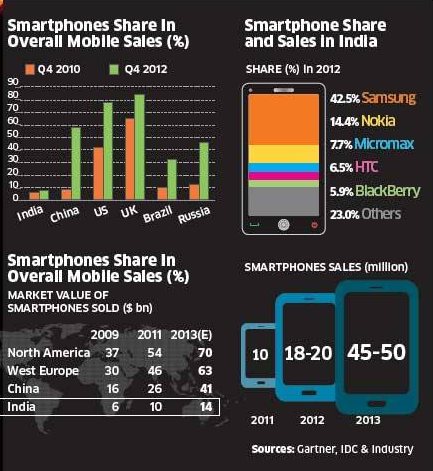
According to market tracker GfK-Nielsen’s data, Samsung‘s volume market share in urban areas in March rose to 31.4%, surpassing Nokia‘s 30.1%. GfK-Nielsen urban panel tracks sales in 793 cities and towns with a population of over 50,000, which account for more than 70% of India’s total handset sales.
This is the first time the Korean company’s volume market share has crossed that of Nokia’s in the GfK-Nielsen survey. The all-India figures, which will include rural sales, will be released shortly.
Some months ago, Samsung’s market share, measured in value terms, had exceeded that of Nokia’s, and there is now a considerable gap between the two due to growing demand for the Korean firm’s smartphones.
NEW MODELS PUSH SALES
Last month, Samsung‘s value market share in urban markets stood at 42.2% compared with Nokia‘s 20.7%. Analysts say Samsung’s gain in volume market share last month is led by the recent introduction of the Rex feature phone series and strong demand for smartphones such as Galaxy Grand and Note 2, the top-selling models at multi-brand retail outlets. Its newest premium smartphone, Galaxy S4, will be launched in India on Friday.
A Nokia India spokesperson said the company did not comment on country-specific market data, and added that it was executing its strategy with ‘urgency and at a new clock speed’. The spokesperson said at the higher end of the price spectrum, the company had launched ten Nokia Lumia devices in the past 16 months and claimed that Asha 305 was the best-selling smartphone in India.
“We are competing at every price point with better mobile experience. Nokia will continue to deliver new and innovative solutions to consumers,” she said.
Notwithstanding these initiatives, analysts and experts feel that Nokia’s more than a decade-long leadership in the Indian handset market is under threat. The company, which once enjoyed a dominant 80% market share, has never completely recovered from its failure to anticipate and react to the dual-SIM handset boom a few years ago.
“It’s truly unbelievable the way Nokia fell in India in the past six years. The brand failed to rejuvenate itself and fell prey to customer fatigue. Add to that the speed of execution – while Samsung was taking six months to launch a new model from the drawing board to retail store, Nokia was taking more than a year,” said former BlackBerry India head Sunil Dutt, who was Nokia’s head of sales till 2007. A Samsung India spokeswoman declined comment on the market share data. But Samsung India’s Country Head (mobile phone & digital imaging) Vineet Taneja said the company has gained market share.
“Samsung has created new segments, such as the Note series or the Rex series, which was developed in India. We have developed a strong product portfolio straddling across entry-level smartphones till the premium segment,” said Taneja. The Korean company has been the leader in the smartphones segment since end-2011, even as it trailed Nokia in the overall handset market.
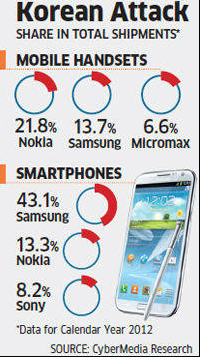
Are smartphones in India at a tipping point with 10% overall mobile shares? [The Economic Times, April 23, 2013]
Ten per cent. It’s a number that has come to mean much for smartphones — the category of phones with computing prowess. It’s the point where a critical mass of buyers meets a pool of sellers to create the perfect storm. This phenomenon — 10% share as a tipping point — played out in Western economies. It played out in China, where the share of smartphones in total phone shipments rocketed from 9% to 59% in two years. And it’s playing out in Brazil and Russia, where the corresponding number surged to 32% and 46%, respectively, in the same period.
Will India, where smartphones hit 10% earlier this year, follow suit? A sustained build-up is underway to add charge to that figure. The price of entry-level smartphones has dropped to around Rs 4,000 [$74], from Rs 15,000 [$276] two years ago. “It’s compelling buyers to opt for fancier phones,” says Anshul Gupta, principal research analyst of Gartner India, who feels something fundamentally changed for the Indian market in the last quarter of 2012. “We are at the tipping point.” However, Sashi Shankar, chief marketing officer of Idea Cellular, says handset prices have to fall further.
“The market is expanding fast, but a tipping point is still about a year away,” he says. “We need smartphones for around Rs 3,000 [$55].” Even that new floor may not be far away. During his visit to India last month, Eric Schmidt, executive chairman of Google, hinted at a $50 ( Rs 2,700) smartphone powered by its Android operating system. At the other end of the price spectrum, Apple and Samsung are in the midst of a blitz to package affordability through financing schemes and replacement offers. And the number of sellers has hit 30, with recent entrants including a Chinese computer company (Lenovo), a Chinese phone company (Gionee) and consumer durable manufacturers (Videocon and Salora).
They are all looking to add to the pool of 50 million smartphone owners in India. The challenge for them is to coax India’s 700 million users, 70% of whom have handsets that cost below Rs 2,000, to switch. “The replacement market is driving the bulk of sales,” says Amar Babu, MD of Lenovo India. IDC, a technology consultancy, projects smartphone sales growing at a compounded 57% in the next five years, against 10% for feature phones. “About 20% of the phones that Samsung sells are smartphones, and this has doubled in the past one year,” says Asim Warsi, VP, Samsung Mobile, which has a dozen smartphones priced from Rs 7,000 to Rs 42,000.
“By 2015, about a third of shipments will be smartphones, 67 million out of an expected market of 230 million,” adds Vipul Mehrotra, director, smart devices, Nokia India. Although that is phenomenal growth by any yardstick, it might still not translate into the hockey-stick trajectory that other markets witnessed because of the way the Indian mobile ecosystem is set up and its inherent weaknesses.
No Carrier-Based Model
While handset makers say the tipping point is here, analysts feel the real tipping point is still 18-24 months away. “It will come when users see value in it beyond a fashion accessory — like use it for mcommerce, m-banking and even entertainment,” says Mohammad Chowdhury, leader, telecom, PricewaterhouseCoopers. “Mobile will be the main mode of internet access, but we need cheaper data plans, better phones at lower costs, and content in Indian languages.” According to Chowdhury, China and western markets took off at 10% as, unlike India, theirs is a carrier-based model. “Phones came bundled with the internet and were sold by operators,” he says.
In India people buy a phone independent of the carrier. “About 95% of the mobile base in India is pre-paid,” he adds. “They don’t have credit cards, debit cards or e-payment services, essential for a carrier-based model.” A carrier-based model requires a telecom company to buy handsets and manage inventory. “The cost is higher for telcos and they have to enter into revenue share agreements with device makers,” says Arvind Vohra, director of Gionee India. “In a market where margins are low, a carrier-based model won’t work.” Instead, at the lower end, sellers are playing the price card.
“It’s beginning to pick up,” says Warsi. “Smartphone makers are able to push a dearer phone, where the margins are better, for a monthly instalment no more than a cost of a family dinner outing.” Features and Data Plans Although prices are falling, the value for a user at the lower-end centres more around the feel and an initial experience of a smartphone, rather than an expanding engagement. According to Vohra, entry-level devices currently account for 30% to 35% of the market.
“Location based services or high-definition gaming apps may not run on them,” says Saurav Singh, founder-CEO, AppStudioz, a mobile app developer. But, adds Shashin Devsare, executive director of Karbonn Mobiles: “For a new smartphone buyer opting for an entry-level phone, being able to browse, chat with friends on Facebook or send emails is a new thing. He can then upgrade.” Data is the other hurdle towards a speedy transition. Device makers blame operators, who are exhausting their spectrum capacity and have limited money to buy more, for not upgrading their networks to 3G, compromising the internet experience.
“One-third of the smartphones sold are not 3G, but 2.75G,” says Jerold Pereira, business head, handset division, Videocon. “And in remote areas, 3G is still not there. So, users won’t get value out of their top-end smart device.” For example, of its subscriber base of 117 million, Idea Cellular had 4.7 million 3G users. Shankar of Idea argues that prices of data plans have dropped by half to Rs 250 [$4.5]per month for 1GB, and that it’s the content and devices that need to improve. Despite teething troubles, the mobile is gaining traction in data transactions.
According to Reserve Bank of India, mobile banking transactions in January 2013 doubled to 5.6 million and trebled in value to Rs 625 crore, from a year ago. Elsewhere, Flipkart reports a three-fold increase in transactions via handsets. Gupta of Gartner believes such usage will accelerate the migration to smartphones, which offer a better experience. Pereira of Videocon points to falling prices and doubling sales across industry to drive home the point that, despite hiccups, mobile phones are set for a upgrade. “In 2011, 10 million smartphones were sold and all were at least Rs 10,000 [$184] or higher,” he says.
“In 2012, the market doubled to 20 million, at Rs 8,000- Rs 10,000 [$147-184]. This year, 45-50 million devices will be sold and prices have dropped below Rs 6,000 [$110].” Even if this is not the tipping point, it’s formidable by numbers. And the real tipping point is not far away.
Samsung’s REX series aims to take on Nokia’s Asha but misses the point [BGR India, Feb 14, 2013]
Samsung today announced its REX series of feature phones, which intend to take on Nokia’s Asha range. Unlike Nokia, which calls its Asha full-touch devices smartphones, Samsung correctly calls its REX series as smart feature phones, considering it is based entirely on Java. While some of the phones in the series, especially the REX 90, share design cues with Samsung’s Galaxy S III and feel very premium for its price, there is no real reason for the products to exist apart from having something in the portfolio to counter Nokia’s Asha series.
Unlike Nokia, which seems to be investing both time and R&D dollars on taking the S40 platform a few steps further than what it was originally built for, the Java-based REX phones have no future path. “As far as S40 goes, think of it as if it had been sleeping all this while and has just woken up. We are working to make it even better and there is lot more to come. We are also getting many big developers to make apps for Asha series,” Calin Turcanu, the head of Nokia’s mobile phone division for Middle East and Africa, told me earlier this week at the global launch of the Asha 310.
The REX series, on the other hand is severely limited by its operating system and there is very little Samsung can do to improve the experience. Samsung also does not have a content story in place – it does not have a huge music store (Samsung typically ties up wih Hungama for its music offering in India) and it does not have any navigation or location play either. In other words, I don’t see these REX phones any different from Samsung’s Star and Pop series, which it introduced a few years ago. And there is nothing that app developers can do to give users a better experience, which is close to smartphones.
Considering how far Samsung was able to go with creating an ecosystem with its Bada operating system, which was more scalable and had more scope for apps and services, I don’t see any way that the Korean vendor can take the REX series’ experience a few notches above its current state.
Samsung knows a Rs 5,000 Android smartphone cannot give the same experience as Nokia’s Asha and it did not have any other in-house platform that could do what Nokia’s ageing but still alive S40 did with the Asha phones. I don’t see the REX series surviving very long, though it would do well initially if we consider Samsung’s marketing muscle and the push it would give to counter Asha full-touch phones. But it certainly has no future when it comes to addressing the needs of the consumer or taking them to the next level.
[REX 70] Introducing Samsung REX 70 [SAMSUNGmobile YouTube channel, Feb 25, 2013]
More information: Samsung REX [company microsite]
Samsung Introduces the New REX Series Smart Feature Phones [press release, Feb 13, 2013]
Samsung aims to evolve mobile communications in emerging markets through easily accessible smart feature phones
Samsung Electronics Co., Ltd, a global leader in digital media and digital convergence technologies, today announced the launch of REX, a new series of smart feature phones that combine intelligence and capability to deliver an accessible, next-generation mobile experience for all.
“As the number one mobile leader and innovator, we are committed to developing the best possible mobile solutions to suit all lifestyles and budgets, which is why we are so excited to launch the REX series across a number of the world’s fastest growing markets,” said JK Shin, President and Head of IT & Mobile Communications Division at Samsung Electronics. “REX devices are designed to seamlessly prioritize and consolidate essential mobile functions that matter most to customers across diverse markets. The result is an extraordinary end-to-end mobile experience with the best value for money.”
The Samsung REX series consists of four devices: REX 90, REX 80, REX 70, and REX 60. Each device has been tailored to give users access to a variety of unique features that have been developed to enhance their day-to-day needs and lifestyles at a highly affordable budget. Merging advanced functionality and intuitive usability, the REX series delivers practical solutions to complement daily mobile needs. Its responsive QVGA touch-screen user interface with intelligent features is designed to deliver a simpler, intelligent user experience for those who value the essentials.
Other features include:
– Intuitive and easy full touch UX : The simple, user-friendly Touchwiz interface makes it easier to navigate your mobile phone. Menu choices are organized into icons arranged 4×4 on the large display for easy viewing. Access to social networking services is just a click away, and practical widgets offer easy access to weather and other frequently-used applications.
– Stylish and compact design : The curved design of the Samsung REX series is inspired by the aesthetics of nature. Its compact size gives users a comfortable grip and allows convenient one-hand operation. The brushed metal frame, organic nature-inspired design, and delicate back cover create a modern, sophisticated look that will fit perfectly with your personal life.
– Dual SIM Always-On : Customers who want to keep their personal and work calls separate will enjoy the convenience of Dual SIM on the Samsung REX series, offering the functionality of having two phones with just one mobile unit. To ensure no calls are missed, Dual SIM Always On allows you to receive calls on one SIM even when you are on the phone using the other. The Samsung REX series allows you to switch between a maximum of five SIM cards without rebooting your mobile. Ideal for business trips to different coverage areas or for those wanting more flexibility between calling plans, the Dual SIM feature puts you in control of your mobile experience.
– Essential mobile intelligence : Featuring all the essentials for an intelligent mobile experience, the Samsung REX series guarantees fast web-browsing and app support through the Opera Mini. By doing so, the REX series enables seamless communication through social networking and messaging services, including the cross-platform ChatOn, which means users can remain connected with their friends at all times.
“Feature phones continue to represent a large opportunity for mobile handset makers, especially in price-constrained emerging markets,” said Ian Fogg, senior principal analyst, mobile and telecommunications research at IHS. “IHS estimates that there will be 653 million feature and entry-level mobile phones shipped globally in 2013. Entry-level smartphones must compete with ever smarter touch screen feature phones that offer many of the same social network, games, and mobile Internet benefits as smartphones but at an even more compelling price.”
A clear indication of Samsung’s commitment to pioneering mobile communication growth across the emerging markets, the REX series devices will drive the “new normal” in future full-touch feature phone development.
Product Specifications
[Rex 90]
…
[Rex 80]
…
[Rex 70]
Network
EDGE (850/900/1800/1900MHz)
Display
3.0” QVGA TFT LCD, C[apacitive]-Type
Camera
2.0 Megapixel Camera
Video
H.263+AMR , MPEG4+AMR
Audio
AAC, AAC+, AMR, MP3, i-Melody, MIDI, Polyphonic, WAV
SIM
Dual SIM with hot swap (option)
Contents
&
Services
- Samsung TouchWiz
- Samsung ChatOn mobile communication service
- Yahoo Messenger (Push IM), Gtalk, Facebook chat
- Enhanced SNS (Java Facebook, Twitter)
Web Browser
Opera Mini, Access NF
Connectivity
- USB 2.0 Host
- Bluetooth® v 3.0 HS
- WiFi 802/11(b/g/n)
Sensor
Proximity
Memory
- 10MB User Memory
- microSD Slot (up to 32GB)
Dimension
104.9 x 57.2 x 11.99 mm
Battery
1,000mAh
[Rex 60]
…
China-based second-tier and white-boxed handset makers targeting the emerging markets
Update: China-based white-box vendors expected to ship 200 million smartphones [DIGITIMES, April 17, 2012]
China-based white-box vendors, mainly due to the availability of inexpensive new chip solutions, have been increasing the production of smartphones, with the total shipment volume expected to reach 200 million units in 2012, according to industry sources in Taiwan.
Taiwan-based MediaTek is offering the makers its MT6575 a chip solution for use in entry-level smartphones in the first quarter of 2012 and will offer the MT6577, a solution for high-level smartphones, in the middle of the third quarter of 2012, the sources indicated. MediaTek will ship 50-70 million chips to China-based white-box vendors to account for nearly 30% of smartphones to be shipped by these vendors in 2012.
In addition, Qualcomm has strengthened its marketing in the China market by offering turn-key solutions to white-box vendors, with prices for a chips lowered to US$6, the sources cited eMedia Asia as indicating.
China-based white-box vendors sell more than 60% of their smartphone output to overseas markets, including 2.5G models for markets where deployment of 3G networks is not mature yet, the sources indicated. White-box vendors are expected to see larger market demand if their production costs for entry-, medium- and high-level smartphones drop to US$60, US$85 and US$130 respectively, the sources pointed out.
China handset makers shifting to smartphones, pushing sales to emerging markets, say sources [Feb 13, 2012]
Demand for 2G feature phones in the China market is expected to subside in the next three years, pushing China-based handset makers to focus on the production of entry-level to mid-range smartphones and also to promote overseas sales, according to industry sources.
Sales of handsets in China grew by 10-15% on year to 260-280 million units in 2011, of which smartphones accounted for 70 million units.
However, total handset sales in the market are expected to drop to 240-250 million units in 2012, of which smartphone models will top 100-120 million units, increasing 43-70% from the previous year, said the sources, adding that handset sales are likely to remain flat in 2013-2014.
With a shrinking share in the 2G segment in the home market, China-based second-tier and white-boxed handset makers are strengthening their ties with retail chain operators or branded vendors in emerging markets, the sources noted.
China-based maker G’Five currently takes up the third-rank title in the India handset market with 7.5% share, trailing after Nokia’s 37.2% and Samsung’s 14.9%, according to data compiled by ABI.
Other brands in India, including Micromax, Spice, Karbonn, Maxx Mobile, Lava and Zen Mobile, have also maintained close ties with China-based handset makers, the sources added.
Earlier information on Micromax, Maxx, Lava and Videocon
(From: The precursor of 2012 smartphone war: Nokia Lumia vs. Samsung Omnia W in India[Jan 3, 2012])
India Handset Shipments, Vendor Market Share, Strategies and Key Trends Q3’2011 [Research and Markets report release announcement, Jan 4, 2012]
This report provides an in-depth assessment of handset shipments, vendor market share, strategies and key trends in Q3’2011 for the mobile handsets industry in India. Mobile handset shipments in India have been increasing and they were highest in 2010 with 146.93 million units. The shipments in 2011 are expected to reach all time high as the shipment for 3 quarters in 2011 is 125.32 million units. By the end of Q4’2011, a yearly figure of 162 million units is expected.
India has been one of the major players in the Asia Pacific handset shipments and since 2009 India has been able to capture more than 20% of the overall Asia Pacific shipments, with a market share of over There has been quarter on quarter growth in the handset shipments in India barring a few exceptions in two quarters.
Local manufacturing has been very beneficial for mobile handset makers in India and many Indian players are manufacturing the product locally. All the other players, who do not have the local manufacturing, are planning to start the manufacturing to get away with the problems of currency exchange rates and supply side spikes.
Nokia has been the top player in the Indian mobile handset market and it has achieved a market share of 29.44% in 2011 for all the three quarters. Nokia has been losing its share to new entrants and local players in the Indian market. Samsung is coming strongly and it is in the second place with 14.34% market share. The share of Samsung is up by 14.63% from 2010. Though all the players are trying to gain market share but still Nokia is way above all of them and it will take a long time before anyone else can take the lead position. Local players Micromax, Maxx, Lava and Videocon are gaining market share and most of them have launched low cost phones with features such as dual-SIM, long battery life etc. Local players also have the advantage of local manufacturing.
Earlier information on G’Five
(From: Be aware of ZTE et al. and white-box (Shanzhai) vendors: Wake up call now for Nokia, soon for Microsoft, Intel, RIM and even Apple![Feb 21, 2011])
So ZTE and Huawei are not alone. Here is another example, G’Fiveso far known only in India but expanding rapidly both in India and into the other parts of the world:
India Mobile Handset shipments grow 6.7%, to 101 million units in 12 Months ending June 2009 [IDC India, Oct 9, 2009]
Market intelligence firm, IDC’s India Quarterly Mobile Handsets Tracker, 2Q 2009, September 2009 release issued today states that in terms of units shipped Nokia had the largest share of 56.8%, followed by Samsung with a 7.7% share while LG stood third with a 5.4% share in the 12-month period ended June 2009.
…
New Vendors Make a Mark
A number of new vendors entered the India mobile handsets market in the last 12 to 18 months to carve a niche for themselves by offering feature-rich (dual SIM card, full QWERTY keyboard) and application-rich (IM enabled) mobile handsets at attractive price points. They also introduced entry-level models for the ‘price sensitive’ Indian consumer.
IDC’s India quarterly mobile handsets tracker 2Q 2010 [Sept 28, 2010] (some emphasis is mine):
According to Mr. Anirban Banerjee, Associate Vice President-Research, IDC India,“In the recent quarters several new players successfully launched their own devices at significantly lower Average Selling Values (ASVs) in the price sensitive India market. Such handsets found ready acceptance amongst first time buyers, especially from small towns and villages.”
This influx of new brands led to a spurt in overall market and saw ‘emerging vendors’ corner as much as 33.2% of total India mobile handset shipments in 2Q 2010. The Finnish handset maker Nokia retained its No.1 spot with a market share of 36.3% in terms of units shipped. The Korean electronic giant Samsung retained the No. 2 position, while Chinese brand G’Five emerged as the No. 3 player.
…
According to IDC’s India Quarterly Mobile Handsets Tracker, 2Q 2010, September 2010 release, the number of emerging vendors in India’s burgeoning mobile handsets market grew to 35 in 2Q 2010 and they together garnered 33.2% of total shipments for the first time during the April-June 2010 quarter. This represented a manifold increase from five (5) new vendors representing a 0.9% combined share of units shipped in the January-March 2008 quarter.
During the last 6 months (January-June 2010) the top five mobile handset vendors in India were Nokia, Samsung, G’Five, Micromax and Spice.
July-September 2010 mobile phone shipments (sales) log 3.6% quarter-on-quarter growth to
cross 40 million units: ‘Emerging Vendors’ capture 41.2% combined share [IDC India, Dec 29, 2010] (emphasis is mine):
… the Finnish handset maker Nokia had the largest share of 31.5%* in terms of units shipped during 3Q 2010.
The Chinese brand G’Five emerged as No. 2 player in terms of unit shipments market share and Korean handset manufacturer Samsung stood at No. 3 in 3Q 2010.The India mobile handsets market continued to grow in 3Q 2010 as well to record a quarter-on-quarter (3Q 2010 over 2Q 2010) growth of 3.6%* to touch 40.08 million units in the quarter, according to IDC India. The year is expected to end with total mobile handset sales of 155.9 million units.
The number of emerging vendors in India’s burgeoning mobile handsets market grew to 68 and they together garnered 41.2%* of total shipments (sales) for the first time during the July-Sep 2010 quarter.
…
Smartphone prices continued to drop through the year and as competition increased, devices were made available by vendors at successively lower price points. So, while 80%* of total India smartphone sales were below the ASV (Average Sales Value) of Rs. 18,000 in 2Q 2010, this proportion increased to 90%* in 3Q 2010.
Top G’Five mobile phones in India [Jan 13, 2011] (emphasis is mine)
Which are the top two cell phone brands today in India in terms of shipment volumes? Nokia and Samsung, many of us would like to think, right? Or maybe Sony…or LG…or Micromax which has been advertising quite a bit.
Not quite, folks. A recent report from leading market intelligence firm IDC India reaffirms the Finnish telecom giant’s status as the leading cell-phone player in the country, with Nokia accounting for 31.5% of the domestic cell-phone market during the July-September period last year. But, surprisingly, a little known Chinese brand called G’Five has made it to the second spot by capturing a 10.6% market share–with Samsung coming in third at 8.2%!
Sounds shocking, right? How can a Chinese player, without any big-ticket advertising campaign or any celebrity as its brand ambassador, manage to create such a big impact in the cut-throat Indian cell phone industry–without any fanfare? Well, the answer lies in G’Five’s strategy of rolling out a bevy of feature-rich phones at competitive prices (in the Rs.1,400-Rs.7,000 range), targeted exclusively at urban first-time buyers and those in semi-urban and rural areas looking to upgrade from basic phones.
So if you are looking to buy a G’Five mobile phone, here is a list of eight affordable (costing not more than Rs.5,000) models from around 26 G’Five phones currently available in India (in the order of ascending prices)– with each of them having their own USPs.
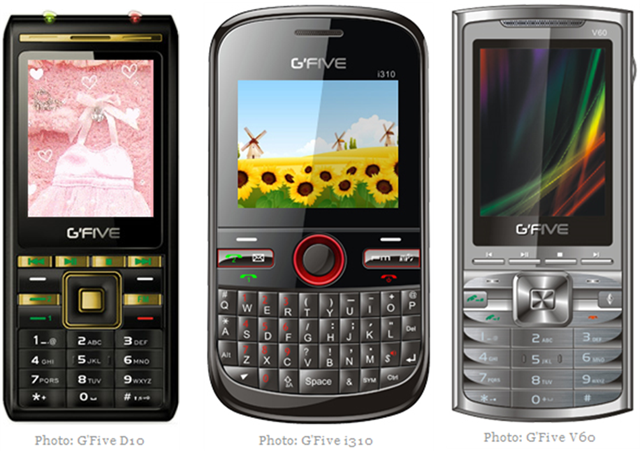
G’Five D10 Price: Rs.1,820 [US$40.4] … G’Five X5 Price: Rs.1,899 [US$42.1] … G’Five N92 Price: Rs.2,249 [US$49.9] … G’Five i310 Price: Rs. 2,400 [US$53.2] … G’Five M33 Price: Rs.2,499 [US$55.4] … G’Five L600 Price: Rs 2,700 [US$59.9] … G’Five X33+ Price: Rs.3,786 [US$83.9] … G’Five V60 Price: Rs. 4,490 [US$99.6] …
And these phones are not crap as you can even see from their pictures (for features info it is worth to go into the article).
Note that to target the upper part of this range Social networking is Nokia’s latest mobile strategy [Feb 17, 2010] (which the above phones do not have):
The company’s latest launch on Nokia X2-01 mobile, at Rs 4,459 [US$99.2] is one such product. “QWERTY is one of the fastest growing mobile phone category in the world due to the rise in messaging and social networking. The Nokia X2-01 makes it easy to set up chat and email direct from the mobile phone,” said Nokia India General Manager-South T S Sridhar. “This means superfast access to your favourite Ovi Mail, Ovi Chat or other popular accounts.”
As young users want to stay connected with friends on the move, instant messaging is rapidly on the rise. With messaging devices like Nokia X2- 01, we are empowering the youth, he said. The handset also provides live updates from social networks such as Facebook, Orkut and Twitter directly from home screen. The Nokia X2-01 is Series 40 2G phone with VGA camera and FM radio. It has one click access the music player and has 3.5mm AV connector ideal for headphones or speakers. It also has Bluetooth and can support up to an 8GB micro SD memory card and has a standby battery time of up to 20 days, he claimed. For affordable access to internet, Nokia has also tied up with country’s largest mobile service provider Airtel which allows 100 mb of free data download per month for 12 months to its subscribers on this phone. Under this scheme one can access Face Book, and OVI Chat and Ovi Mail free of charges.
Gfive Mobile Phones (by Devika Rajpali)
The company of GFive is from China. The investors of the company are a syndicate named Zerone group that of the most esteemed OEM factories that boost of producing around 100 million mobile phones. The GFive mobile phones are the hottest running brand in indisputable imei china mobiles. The company has now established itself completely in the field of tech support, repairing and software installation. You will find the GFive mobile phone to be very stylish with large number of mobile phones to offer to its consumers. The company claims to have experience, confidence and data along with the in-depth insight of their Chinese mobile phones.
The KingTech Telecom (Shenzhen) Co Ltd. is behind the brand with KingTech Telecom (HK) Limited behind the export activities. As far as India is concerned the arrangement will be developed into a stronger local representation as Victor Infotech ties up with King Tech Telecom [Nov 11, 2010] (emphasis is mine):
Victor Infotech Ltd has tied up with King Tech Telecom Ltd (a Hong Kong-based telecom company) to form a joint venture company — Asian Telecom Ltd. The majority stake of 51% in the new company will be held by King Tech Telecom Ltd and the balance 49% equity will be held by Victor Infotech Ltd.
Asian Telecom Ltd., the new joint venture company, will come into being with immediate effect to launch the G’Five brand of mobile phones in the Indian market. The company plans to take the G’Five brand of mobiles to new heights in India and achieve 20% of the market share in the next two years.
As part of the collaboration, Kingtech Telecom shall manufacture the mobile phones and Victor Infotech will be responsible for distribution and marketing of the phone in India. Initially Kingtech Telecom will manufacture the Indian specific mobile phones in Hong Kong [rather in Shenzen] and gradually the same shall be manufactured in India.
The Indian mobile phone market is growing very fast. The company expects the sales of the mobile phones to grow 5 times in the next two years and plans to take advantage of this growth to gain the maximum market share. To achieve this, the company shall introduce many variations in its mobile phones, which shall be specific to the needs of the Indian consumer.
Meanwhile for other parts of the world a new sales and marketing operation has been set up: GLX mobile – G’FIVE Mobile’s Brother Company [Dec 14, 2010] (emphasis is mine)
A new member of Zerone Group called GLX mobile has been founded. With its full name as GLX International Limited, GLX mobile is dedicated in global distribution of GLX mobile phone.
Since G’FIVE is a member of Zerone Group, G’FIVE and GLX are brother companies. The new-founded GLX focuses on international markets, especially emerging markets. GLX mobile covers the whole range of mobile phone user market, from low-end to high-end with stylish and unique handsets.
GLX is aiming to create golden life for worldwide consumers with all ranges of mobile phones.
And the GLX company’s website indicates that it has taken over (almost all) the rest of the existing G’Five business network:

 Experiencing the Cloud