Home » Posts tagged 'Super LCD'
Tag Archives: Super LCD
Tech investment banking expertise to strengthen the unique value focus of growing the HTC brand and to achieve high growth again
Updates #2:
– HTC sees revenues down sharply on-year in July [DIGITIMES, Aug 7, 2012]
HTC saw its revenues dip 16.7% on month and 44.5% on year to a five-month low of NT$25 billion (US$834.45 million) in July. For the first seven months of 2012, revenues amounted to NT$183.9 billion, decreasing 32.8% from a year earlier, according to company filing with the Taiwan Stock Exchange (TSE).
… With HTC estimating its revenues to reach only NT$70-80 billion in the third quarter [US$2.3-2.7 billion], it is unlikely to see HTC’s revenues rebound to NT$30 billion in August and September, the Chinese-language Commercial Times said on August 7 report.
– HTC sees fall in 3Q12 sales with lower margin [DIGITIMES, Aug 3, 2012] [US$3.5 billion]
HTC reported second-quarter consolidated revenues of NT$91.04 billion (US$3.04 billion), in line with its targeted NT$91 billion, which had been cut from its original target of NT$105 billion [US$3.5 billion]. Gross margin and operating margin for the second quarter came to 27.01% and 9%, respectively.
Second-quarter sales represented a 34.3% increase, but were 26.8% lower than those posted in the second quarter a year ago. Meanwhile, gross margin and operating margin showed improvement from the prior quarter, but decreases compared to the same period of 2011.
HTC generated net profits of NT$7.4 billion, or NT$8.90 a share, in the second quarter of 2012. Profits declined more than 50% from a year earlier, but rose over 60% on quarter.
– HTC adjusts workforce [DIGITIMES, July 25, 2012]
HTC has been adjusting human resources in its production, R&D, and sales teams. Industry sources believe corporate restructuring is necessary as HTC’s sales have been declining.
Sales of the HTC One series have not been picking up due to tough competition in Europe and North America. HTC has been adjusting its global workforce by shutting down the R&D team in North Carolina, US, and offices in Brazil. Some members of the R&D team have been laid-off and there will be no renewals of contracts for 600 workers. The adjustments have impacted close to 1,000 staff.
– Nokia, RIM and HTC to see smartphone shipments continue sliding in 2H12, say sources [DIGITIMES, July 9, 2012]
Nokia, RIM and HTC are expected to see their smartphone shipments, as well as market share, continue declining in the third and fourth quarters of 2012 due to a lag in migration to new platforms and weakening competitiveness of their products, according to industry sources.
Despite efforts initiated by Nokia, RIM and HTC to fend off competition from Apple and Samsung Electronics, RIM and HTC have reported lower than expected shipments for the second quarter of 2012, while Nokia is expected to see its second-quarter smartphone shipments drop below 10 million units, said the sources.
Although HTC managed to post a sequential gain in shipments in the second quarter, its second-quarter smartphone shipments barely reached nine million units, pointed out the sources.
HTC is expected to see its shipments stay flat or drop to eight million units in the third quarter and slip further to seven million in the fourth quarter, according to a Chinese-language Commercial Times report.
End of updates #2
Preliminary reading: HTC: the most promising ICT brand in Taiwan [Oct 18, 2010 – July 5, 2011; then with major updates on Feb 7, 2012
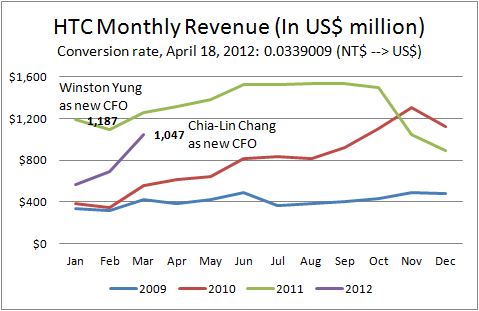 Source: HTC, Investor Relations
Updates #1: The MWC introduced HTC One series unveiled (for the first time) a proprietary HTC ImageChip image signal processor (thus not relying on ISPs coming with the Tegra 3 and Qualcomm S4 SoCs) in order to be able to take a shot “in just 0.7 seconds” and to have “a new superfast 0.2-seconds autofocus, continue to take nearly unlimited continuous shots“, as well as “capture a photo and shoot video at the same time” and be “also able to capture a photo frame from a previously recorded video.” (See also a detailed description of that inside of the so called HTC ImageSense feature set.) Such a hardware based differentiation approach will even be greater with HTC’s upcoming products according to the following news:
– HTC plans to develop customized processors [DIGITIMES, April 24, 2012]
In order to have significant product differentiation, HTC plans to cooperate with Qualcomm, Nvidia and ST-Ericsson to develop and produce customized processors with specific functions for its smartphones, according to Taiwan-based handset chip designers.
HTC may develop specific functions for its smartphones and secure supply of customized processors, but it may run the risk of inventories because such processors are unlikely to be adopted by other vendors, the sources commented.
– HTC plans to develop its own processor [China Times, April 23, 2012] with Google translation of the original in Chinese , or the same with Bing translation.The essential content of that was first reported by Unwired as: HTC is developing its own CPU for lower end smartphones with ST-Ericsson
HTC is following in the footsteps of Apple and Samsung, and is now working on its own dedicated applications processor. According to China Times, the Taiwanese smartphone maker has already signed memorandum of cooperation with ST-Ericsson to co-develop the chip.
Contrary to high performance Samsung and Apple CPUs which power their flagships, the new HTC processor will run the lower end smartphones. The devices with new chip will start shipping in volume sometime in 2013.
It seems that HTC is getting increasingly unhappy with Qualcomm, which powered most of HTC devices until this year. They have signaled their unhappiness in early February, and may even consider Qualcomm one of the reasons for the sales problems of the last few months. HTC has already added NVIDIA to its application processor supplier list –quad core Tegra 3 is powering non U.S. version of the new One X flagship. But it has yet to diversify on the lower end.
Turning to ST-Ericsson and co-developing its own, cheaper CPU, may also be a way for HTC to start moving down market with lower priced devices. Up until now – HTC was mostly focused on a premium high-end smartphones, pretty much ignoring the low-end of the market. But as component prices get cheaper, and ever better quality Android devices are released at ever lower price points by Samsung, ZTE and Huawei – Taiwanese vendor has to find a way to respond.
And this move may be one of the responses.
– HTC, Facebook jointly developing smartphone, say sources [DIGITIMES, April 25, 2012]
Given that Google is expected to continue to cooperate with Samsung Electronics for the development of the next-generation Nexus smartphone, HTC reportedly has decided to move forward in its own way and is currently developing a customized smartphone in cooperation with Facebook slated to be launched in the third quarter of 2012 at the earliest, according to industry sources.
HTC had previously joined forces with Google to launch Google’s first own-brand smartphone, the Nexus One. However, Google then shifted to cooperating with Samsung as its primary production partner for the launch of its second and third own-brand smartphones.
Since Samsung has become the top vendor of Android smartphones, Google will continue to have Samsung develop its next-generation Nexus models, leveraging Samsung’s innovation ability with regard to the Android platform, and its ability to control the supply of key components, said sources.
The new Android smartphone being developed by HTC will have a platform exclusive to Facebook to enable and integrate all functions available on the social networking site, the sources indicated. Previously, HTC launched two Facebook-enabled smartphones, the Salsa and Chacha.
Facebook is expected to further expand its investments and sources of income after becoming a public company, and the launch of own-brand smartphones will be part of its development strategy, the sources commented.
End of updates #1
HTC personnel change indicates new value focus: Goldman Sachs [Focus Taiwan, Taiwan’s national news agency, April 17, 2012]
… The 45-year-old Chang, an investment banker and partner at Goldman Sachs before joining HTC, will be responsible for corporate finance and accounting, strategic acquisitions and investment, and investor relations.
“We believe the change in CFO may indicate HTC’s more aggressive attitude toward its finance department in terms of creating value other than just accounting integrity,” Goldman Sachs analyst Robert Yen wrote in a research note.
For example, he said, added value could mean enhancing “the uniqueness and competitiveness of HTC’s smartphone products and services.”
Given HTC’s many acquisitions and strategic investments in content and mobile services in the past and its decent cash position, it could be creating a different value by choosing a CFO with industry and banking background, Yen said. …
 HTC Desire V for China Unicom (WCDMA)
Comparison [PDAdb.net]: HTC Desire VC T328d vs. HTC Desire V T328w vs. HTC Desire VT T328t [3]
Note: According to the detailed specifications given above these phones all have SLCD screens (see: Super LCD, Explained [DisplayBlog, Nov 24, 2011]), as on quite a number of higher end HTC smartphones in the last 2 years (since HTC Desire A8181 / HTC Bravo). Otherwise they have been using “transflective TFT LCD” mostly and in very few cases Super AMOLED.
HTC eyes cheaper smartphone market in China [Focus Taiwan, Taiwan’s national news agency, April 17, 2012]
Taiwan’s HTC Corp. launched several smartphones in China priced as low as 1,999 Chinese yuan (US$317) Tuesday in a bid to tap into the emerging mobile market.
The HTC launch in Beijing includes three smartphones in its customized New Desire series, which will go on sale from mid-April through three major Chinese telecom operators, according to a company statement.
The New Desire V, running on China Unicom’s 3G WCDMA network, will start from 1,999 Chinese yuan before subsidies, while the New Desire VC will support China Telecom’s CDMA 2000 frequency, for the same price tag.
Pricing for the New Desire VT, which will run on the country’s home-grown TD-SCDMA network provided by China Mobile, was not disclosed.
“The China market has always been a critical part of HTC’s global strategy. In addition to the HTC One series, we are introducing the New Desire series targeting Chinese consumers,” said Ray Yam, president of HTC’s China division.
“We believe HTC’s future is closely connected with China and that HTC will continue to bring the best experience and the most innovative smartphones to the country as soon as possible,” he added.
All the models in the New Desire series are equipped with a 4-inch display, a 1 GHz processor and a 5-megapixel camera, according to the company.
Separately, HTC said its new “One” family will also hit store shelves in China this month, with price tags ranging from 2,688 to 5,688 yuan.
The Taoyuan-based manufacturer is hoping that the streamlined models and an increased retail presence will help it boost its market share in China, which stood at only about 2 percent last year, according to analysts at Morgan Stanley.
…

HTC Desire VC for China Telecom (CDMA2000)
China market: HTC launches One, new Desire lineups [DIGITIMES, April 18, 2012]
… HTC currently accounts for a 10% share of smartphones sold with a price tag over CNY2,000 in China, but has not entered the mainstream sub-CNY1,000 segment, indicated the sources. …
HTC Prepares to Launch Lower-end “Kewang” Smartphones for China [IDG News, April 17, 2012]
… The HTC Kewang V, or Desire in English, will launch on April 23 through mobile operator China Unicom. … HTC’s goal with the Kewang series is to provide smartphones at a low price, but also with high-performance and strong features, said Ethan Qian, an HTC spokesman. The Kewang line is being released only in China, he added. …
 HTC Desire VT for China Mobile (TD-SCDMA)
Dual card dual standby for only 1999 yuan HTC desire V officially released [China Tech News, April 17, 2012]
On the afternoon of April 16, China Unicom and HTC jointly held “China Unicom fertile 3G HTC new Desire V listed” conference, officially released the HTC new Desire V. It is customized by China Unicom, has 9.3mm ultra-thin body, support dual card dual standby, using clocked at 1GHz Qualcomm MSM 7227A processor [with Cortex-A5 single core, having 1.57 DMIPS/MHz performance, while Cortex-A8 has 2.0 DMIPS/MHz], 4 inches [Super LCD] screen with a resolution of 480×800 (WVGA). The phone will be powered by the Android 4.0 system, using the HTC Sense 4.0 UI, 5 megapixel camera with auto-focus, [512MB RAM] 4GB ROM, integrated Beats audio audio technology, the battery capacity of 1650 mA. Bare metal price of 1999 yuan is also a bright spot.
Super LCD vs Super AMOLED displays (HD) [TheTechTonicdotCom YouTube channel, Dec 11, 2011]
Note: Nokia has a superior technology for better brightness, contrast and outdoor visibility with a significant enhancement of both In-Plane Switching (IPS) type TFT and AMOLED display panels typically used. See: The leading ClearBlack display technology from Nokia [Dec 18, 2011 – Feb 2, 2012], especially for comparison with Super LCD of HTC Mozart (as well as with the Super AMOLED of Samsung Galaxy S II).
Commentary: HTC appoints new CFO, but challenges remain [DIGITIMES, April 17, 2012]
HTC has reshuffled its management team again by appointing former Goldman Sachs Group partner Chia-Lin Chang as its chief financial officer, which is part of the company’s strategy for global deployment.
The new appointment, which took effect on April 16, came after HTC announced earlier a 70% on-year decline in net profits for the first-quarter of 2012.
Perhaps, the new CFO could help the Taiwan-based smartphone vendor secure more acquisitions to strengthen its global deployment, but it remains to be seen whether HTC is able to regain its growth momentum in 2012 as it faces more challenges in integration of its corporate culture as well as increasing competition.
HTC has created or added a number of high-level positions since the second half of 2010, including the appointments of Ron Loukes as chief strategy officer and Kouji Kodera as chief product officer in July 2010, and Matthew Costello as COO in December 2010. HTC also appointed Jason Mackenzie as its president of global sales and marketing in July 2011.
HTC has also brought in Scott Croyle of One & Company and Shashi Fernando of Saffron Digital responsible for design and content, respectively, through acquisitions of the two companies.
It is also the second time in less than two years HTC has changed its CFO. The newly appointed CFO Chia-Lin Chang replaced Winston Yung, who took the post in January 2011.
If the latest management team is unable to bring back the growth momentum in 2012 that HTC enjoyed during the period from 2010-2011, HTC will no longer be able to compete with Samsung Electronics, Apple and even Huawei Device in terms of economies of scale in production.
While the hiring of talent with management and marketing expertise from abroad, and the acquisition of certain companies overseas are indeed necessary for HTC in its thrust to become a global brand, the impact resulting from the integration of corporate culture on HTC is expected to intensify along with such processes.
Given that nearly all top-rank positions with the exception of the CFO post at HTC have been filled with foreign executives, the promotion of local talent will likely become a major issue of concern in the future.
The Quietly Brilliant Story of HTC [HTC YouTube channel, Nov 23, 2011]
HTC replaces CFO after just one year [15 1/2 months] on the job (update) [The Verge, April 17, 2012]
HTC has issued a statement on the transition:
On Monday, HTC announced the appointment of Chia-Lin Chang as Chief Financial Officer with Winston Yung, his predecessor, transitioning to a corporate development role.
“Media speculation that ties this announcement to HTC’s partnership and investment in Beats By Dre is categorically inaccurate,” said Peter Chou, CEO of HTC Corporation. “HTC and Beats have made impressive progress in innovation and brand awareness and the integration of the Beats brand and technology in the new HTC One series is a clear indication of our commitment to this partnership.”
Amazing camera, authentic sound, iconic design. HTC One has them all. [HTC YouTube channel, Feb 27, 2012]
HTC One series unveiled [from the 2012 HTC press releases or directly on the Canadian site]:
BARCELONA, SPAIN – Mobile World Congress – February 26, 2012 – HTC, a global designer of smartphones, today unveiled its new HTC One series of smartphones that represent its most premium mobile experience with a new level of iconic design and amazing camera and authentic sound experience. …
…
With HTC’s most premium experience, the HTC One series integrates Android 4.0 (ICS) with HTC Sense™ 4, the new version of HTC’s branded user experience that is introducing HTC ImageSense™, a new suite of camera and imaging features that set HTC One apart from other phones. HTC Sense 4 also includes broad enhancements to audio quality and simplifies how people listen to music on their phone.
Amazing Camera
With ImageSense HTC One rivals traditional digital cameras with improvements to every part of the camera, including the lens, the sensor, the software, and even integrating a new custom HTC ImageChip. These enhancements combine to deliver our fastest image capture, best image quality under adverse conditions and easiest interface that enables quick access to capturing stills and videos with side-by-side photo and video capture buttons.
- Superfast Capture – HTC One dramatically reduces the time it takes to capture those key moments. In just 0.7 seconds you’re able to take a shot, and with a new superfast 0.2-seconds autofocus, continue to take nearly unlimited continuous shots simply by holding the shutter button.
- Good photos in adverse conditions – HTC One delivers dramatic enhancements in image capture quality even in adverse conditions such as low light, no light or with bright backlighting. The f/2.0 lens on the HTC One X and HTC One S offers best-in-class performance, capturing 40 percent more light than the f/2.4 lenses available on other high-end phones. HTC One also includes HDR, a market-leading technology, for taking great photos even when there are varying levels of brightness.
- Video Pic (Concurrent Video/Still Capture) – With Video Pic you capture a photo and shoot video at the same time. Now, while you’re shooting HD video, all you have to do is tap the shutter button and it snaps a high-resolution still photo while the video continues to shoot. You are also able to capture a photo frame from a previously recorded video.
… Authentic Sound
With HTC One, Beats By Dr. Dre Audio™ integration is enabled for the first time across the entire experience for richer, more authentic sound whether you’re listening to your favorite music, watching a YouTube™ video or playing a game. … All this makes HTC One the one place to enjoy all your music, wherever you are, with the power of Beats By Dr. Dre Audio and HTC Car.HTC One X
… HTC One X is blazing fast with the new NVIDIA® Tegra 3 Mobile Processor for clear graphics, faster applications and longer battery life. It includes a 1.5GHz Super 4-PLUS-1™ quad-core with an integrated fifth Battery Saver Core and a high-performance 12-Core NVIDIA® GPU. The HTC One X also has an amazing 4.7-inch, 720p HD screen crafted from contoured Corning™ Gorilla Glass. HTC One X will also be available in select 4G LTE markets with a LTE-enabled Qualcomm Snapdragon S4™ processor with up to 1.5GHz dual-core CPU’s.HTC One S
The HTC One S is for people who want a high-end smartphone in a more compact size. It is powered by a Qualcomm Snapdragon S4 processor with up to 1.5GHz dual-core CPU’s. It also includes a 4.3-inch screen crafted from contoured Corning™ Gorilla Glass. …HTC One V
Utilizing the classic, award-winning design of the HTC Legend, the HTC One V brings top-end design to a smartphone with broad appeal and a premium experience that delivers an amazing camera and authentic sound. It features a simple, iconic aluminum unibody design that exudes craftsmanship and quality.Global Availability
With unprecedented excitement, the HTC One series will begin shipping in April with broad global availability available beginning in April through more than 140 mobile operators and distributors globally. For more information and to pre-register for HTC One visit www.htc.com.
HTC Rezound™, the only phone with the Beats Audio™ built in [HTC YouTube channel, Nov 3, 2011]
HTC And Beats By Dr. Dre Set To Introduce New Era In Mobile Audio [from the 2011 HTC press releases]:
Strategic HTC investment to result in Beats integrated HTC phones this Fall.
Taoyuan, Taiwan & Santa Monica, CA – August 11, 2011– HTC Corporation, a global designer of mobile devices, today announced a strategic partnership and investment with Beats™ Electronics LLC, the company redefining the audio market with its iconic Beats by Dr. Dre™ audio experience. The two fast-growing brands will focus on bringing high performance sound to HTC phones. …
… “Beats has found a unique way to harness popular culture in a manner that is unlike any other brand today,” said Peter Chou, CEO of HTC Corporation. “It’s an exciting brand that has been built around providing something very special, and we believe our strategic partnership will provide customers with unbeatable sound on HTC phones. We obsess over every detail of a consumer’s mobile experience and audio is a critical part of that experience.”
… Established in 2006, Beats Electronics is the brainchild of legendary artist and producer Dr. Dre and Chairman of Interscope Geffen A&M Records Jimmy Iovine, who set out to develop a new type of headphone with the capability to reproduce the full spectrum of sound that musical artists and producers hear in professional recording studios. For more information, please visithttp://beatsbydre.com.
The history of last HTC CFOs:
HTC Appoints Hui-Ming Cheng as CFO [HTC press release, Aug 23, 2006]
… he has served as CFO and Spokesperson for the Fubon Financial Holding Co. in Taipei. From October 2003 to February 2006, Mr. Cheng was VP and CFO of Taiwan Mobile and received the honor of being named as Taiwan’s best CFO by Institutional Investor Magazine in 2003. Prior to his appointment with Taiwan Mobile, Mr. Cheng held various senior-level positions with the Finance Center, Winbond Electronics Corp., China Development Industrial Bank, Chase Manhattan Bank, and the Asia Partner Fund.
Mr. Cheng received a BS in Chemical Engineering from National Taiwan University and an MBA from the Kelly School of Business at Indiana University.
HTC Announces Winston K. S. Yung as Chief Financial Officer [HTC press release, Dec 23, 2010]
… Prior to joining HTC, Yung was the Chief Financial Officer for Shin Kong Financial Holding in Taiwan where he played a key role in the company’s success, and also held key positions at McKinsey & Co in Hong Kong. Yung received a bachelor’s degree in social sciences with an economics major from University of Hong Kong and a MBA from the University of Pennsylvania’s Wharton Business School.
… HM Cheng, HTC’s current chief financial officer will retire from the company and move into an advisory role to HTC’s board of directors. Cheng joined HTC in September 2006 and successfully established a complete financial system and was a key contributor to HTC’s corporate governance system and HTC’s overall financial success
HTC names Chia-Lin Chang Chief Financial Officer [from the Latest HTC press releases]
Taoyuan, Taiwan – April 16, 2012 – HTC, a global leader in mobile innovation and design, today announced the appointment of Chia-Lin Chang as Chief Financial Officer and spokesperson effective April 16, 2012.
Chia-Lin Chang’s predecessor, Winston Yung, joined HTC in January 2011. Winston will focus on corporate development, helping HTC maintain its competitive edge by strengthening the organization and corporate talent.
Chia-Lin, previously an investment banker and partner at Goldman Sachs, will be responsible for corporate finance and accounting, strategic acquisition and investment, and investor relations. Chang earned a Ph.D. in Electrical Engineering from Princeton University and an M.B.A. from the Wharton School at University of Pennsylvania. After receiving his Ph.D. degree, Chang served as an engineer at Motorola in the US.
GOLDMAN SACHS ANNOUNCES NEW MANAGING DIRECTORS [Goldmann Sachs press release, Oct 24, 2007] “… it has invited 299 individuals to become Managing Directors as of December 1, 2007, the start of the firm’s fiscal year. … Chia-Lin Chang …”
From: Latest HTC press releases:
HTC releases unaudited results for 1Q 2012
Taoyuan, Taiwan – April 6, 2012 –HTC corporation (TWSE: 2498), a global leader in mobile innovation and design, today announces unaudited consolidated results for 1Q 2012. For the first quarter of 2012, total revenues reached NT$67,790 million, a decrease of 34.92% year-on-year. Unaudited operating income was NT$5,099 million, net income before tax was NT$5,551 million, net income after tax was NT$4,464 million, and unaudited earnings per share after tax were NT$5.35 based on 834,256 thousand weighted average number of shares.
2012 First Quarter Unaudited Consolidated Financial Results
(Unit: NT$ million, Except Earnings Per Share)

*Calculation of the after-tax EPS for first quarter 2011 was based on 807,867 thousand weighted average number of shares.
HTC Reports Fourth-quarter And Annual 2011 Results
Taoyuan, Taiwan, February 6, 2012– HTC Corporation (“HTC”, or the “Company”, TWSE: 2498), a global leader in mobile innovation and design, today announced consolidated results of the Company and its subsidiaries for the fourth quarter of 2011 and for the year.
4Q Highlights
• After-tax profit was NT$10.94bn, EPS was NT$13.06
• Total revenues were NT$101.42bn
• Gross profit margin and operating margin were 27.12% and 12.71%, respectively
2011 Highlights
• After-tax profit was NT$61.98bn, up 56.77% year-on-year; EPS was NT$73.32
• Total revenue was NT$465.79bn, up 67.09% year-on-year
• Gross profit margin and operating margin was 28.30% and 14.77%, respectively
• ROE was 70.37% compared to 56.33% in 2010
“In 2011 we saw growth in the global strength of our brand, as well as earnings and revenue growth,” said Peter Chou, CEO of HTC. “While short term performance may not meet the results as expected, we have gained further experience and advancement in the areas of brand management and product innovation. These fundamental strengths and the groundwork we have laid will take us into 2012 with a renewed focus and determination.”
4Q 2011 Results
HTC’s fourth quarter revenue came in-line at NT$101.42bn, resulting in after-tax earnings of NT$10.94bn and EPS of NT$13.06. Gross profit and operating margins came in at 27.12% and 12.71%, respectively. The decline in gross profit margin was mainly a result of product transition.
2011 Results
2011 annual revenue was NT$465.79bn, a 67.09% increase over 2010 annual revenues (NT$278.76bn), resulting in after-tax earnings of NT$61.98bn. Overall gross profits and operating margins were 28.30% and 14.77%, respectively.
In 2011, in addition to solid growth in revenues and profits, HTC’s brand gained significant momentum in the global landscape, being named one of Interbrand’s 100 Best Global Brands.
2012 Outlook
In 2012, HTC will focus on: growing the Company’s brand value; continuing to create competitive advantages through innovation; enhancing the efficiency of marketing campaigns; and further driving down operating costs.
To expand its brand preference and value, HTC will work at a global level to build emotional connections with consumers, putting more of its marketing resources behind fewer products and driving value in those product brands. By building a globalized marketing campaign, HTC aims to optimize its go-to-market strategy with operators, retail distributors, and end-users, and improve the efficiency of its marketing spend. In emerging markets, such as China, HTC will continue to extend its reach to customers by expanding distribution channels.
Despite temporary weakness resulting from product cycle transition, HTC believes it has the ability to create a new wave of momentum through the upcoming product cycle. It will also continue its attention on mass market consumers by driving product differentiation through design and innovation.
1Q Outlook
The Company’s outlook for the first quarter of 2012 is as follows:
• 1Q revenue expected to be around NT$65-70bn
• Gross margin expected to be around 25%
• Operating margin expected to be around 7.5%
These margins are a temporary phenomenon and will normalized when product cycle transition is over.
The leading ClearBlack display technology from Nokia
For better brightness, contrast and outdoor visibility In-Plane Switching (IPS) type LCD and AMOLED display panels are typically used. Nokia made a significant enhancement of both.
First in September 14, 2010 with the announcement of its ClearBlack technology “for improved outdoor visibility” with AMOLED displays in the new Nokia C6-01 and E7 smartphones. The AMOLED ClearBlack display variant used a year later in Nokia N9 “beat the Super AMOLED Plus of Samsung Galaxy S II in sunlight, and was almost exactly the same quality indoors” (see the below 3d party review). The later Lumia 800 has the same type of display as well as the earlier Nokia 700.
Next application of ClearBlack technology came in August 24, 2011 with the announcement of Nokia 701 having an IPS type LCD ClearBlack display. It got the “brightest screen on a mobile phone to date” title from its predecessor Nokia E7, moving even more ahead of the Apple iPhone 4 and Samsung Galaxy S II in that regard. And later came two other models with IPS type LCD ClearBlack displays: Nokia 603 and Lumia 710.
So Nokia with it ClearBlack enhancement has now a clear lead in display technologies. Below you can find more details about all that, including a technical explanation of the ClearBlack enhancement approach from Nokia itself. Plenty of evidence is given first by independent third parties testing the current flagships from Nokia against their rivals, then all kind of explanation materials are included from Nokia, and an interview with Nokia developers of ClearBlack as well.
Update: Tablet and Smartphone Displays Under Bright Ambient Lighting Shoot-Out [by DisplayMate]:
– [For comparison the earlier one without Nokia ClearBlack Display technology]
Master Photo Grid for Viewing on High Resolution Displays [Round 1] [March 3, 2012]
- [Tablets] Apple iPad 2 – Amazon Kindle Fire – Motorola Xoom – Samsung Galaxy Tab 10.1
- [Smartphones] Apple iPhone 4 – HTC Desire – Motorola Droid X – Samsung Galaxy S
…
– Master Photo Grid for Viewing on High Resolution Displays [Round 2] [May 8, 2012]
- [Tablets] Apple iPad 2 – Amazon Kindle Fire – Motorola Xoom – Samsung Galaxy Tab 10.1
- [Smartphones] Apple iPhone 4 – HTC Desire – Motorola Droid X – Nokia Lumia 900 – Samsung Galaxy S
…
The Master Photo Grid below includes Screen Shots from many of the Tablets and Smartphones in our Mobile Display Technology Shoot-Out article series. For more information on how Ambient Lighting affects the displays read the Results Highlights for Tablets or the Results Highlights for Smartphones. The visual results from the Screen Shots agree very well with the Lab measured DisplayMate Contrast Rating for High Ambient Light for Tablets and the Contrast Rating for High Ambient Light for Smartphones.
…
The Winner: The DisplayMate Contrast Rating for High Ambient Light for the displays ranges from a low of 15 (HTC Desire) to a high of 90 (Nokia Lumia 900). From both the Lab Measurements and the Screen Shot Viewing Tests (below) the top performing device for display viewability under Bright Ambient Lighting is the Nokia Lumia 900. This results from a combination of its high screen Brightness and low screen Reflectance, which Nokia calls ClearBlack technology.
The Samsung Galaxy S and Apple iPhone 4 are tied for second place.
The best Tablets all performed a notch below the Smartphones – the Samsung Galaxy Tab 10.1 was the leader, with the iPad 2 in second place. The new iPad (not included below) performs better than the iPad 2 and just behind the Galaxy Tab 10.1. The other Smartphones and Tablets performed well below these top models –
ALL manufacturers need to pay much more attention to their display performance in high Ambient Lighting because that is frequently how they are used. The highly touted and advertised display Contrast Ratio applies only to Absolute Darkness, which makes it pretty much irrelevant for mobile devices. Note that we plan on including the Lumia 900 in one of our upcoming Smartphone Shoot-Outs.
…
CR HAL is the DisplayMate Contrast Rating for High Ambient Light – which is based on the measured Screen Brightness and Screen Reflectance.
…
Update: The core products with ClearBlack technology [April 18, 2012]
| TFT with capacitive touch | AMOLED with capacitive touch |
| Nokia C6-01 (November, 2010): 3.2″, 16:9 nHD (640×360 pixels), 16.7 million colours | |
| Nokia E7 (February, 2011): 4″, 16:9 nHD (640 x 360 pixels), 16 million colours | |
| Nokia 701 (September, 2011): 3.5″, 16:9 nHD (640 x 360 pixels) IPS-LCD, 16 million colours; 160° viewing angle, Corning® Gorilla® Glass | Nokia 700 (September, 2011): 3.2″, 16:9 nHD (640 x 360 pixels), 16 million colours |
| Nokia 603 (November, 2011): 3.5″, 16:9 nHD (640 x 360 pixels), with IPS technology, 16.7 million colours; 160° viewing angle, 1000 nits brightness | Nokia Lumia 800 (November, 2011): 3.7” WVGA, 800 x 480 pixels, 16 million colours, with pinch zoom, 2.5D curved glass seamlessly integrated to unibody (Windows Phone, manufactured by Compal Electronics) |
| Nokia Lumia 710 (November, 2011): 3.7” WVGA, 800 x 480 pixels, 16 million colours, with pinch zoom (Windows Phone, manufactured by Compal Electronics) | Nokia Lumia 900 (April, 2012): 4.3″ WVGA, 800 x 480 pixels, 16 million colours, with pinch zoom (Windows Phone, manufactured by Compal Electronics) |
| Nokia 808 PureView (May, 2012): 4″, 16:9 nHD (640 x 360 pixels), 16.7 million colours, Corning® Gorilla® Glass, 2.5 D curved glass |
Update: Clear, black and super bright [Nokia Conversations, Feb 2, 2012]
Being able to answer emails and access entertainment while you’re out and about is one of the greatest revolutions in work and leisure of the last 100 years.
But the whole thing’s scuppered if the sun’s shining right on your screen and reflections mean you can’t see anything. In fact, the problem’s become worse in recent years as we’ve largely switched to full screen, touch-driven displays.
Brighter displays are one part of a solution. And so we’ve pumped up the power and moved to improved display solutions in pursuit of a few extra nits.
But making the screen brighter and brighter has a big drawback. Big, modern screens use up a lot more power than the 1.5-inch mono display on your old Nokia 3310. There comes a point where you’d be prepared for the screen to be a little dimmer if it meant you could get a couple more hours’ use out of your phone.
So a second strand to improving outdoor usability needed to be devised. One that focused on reducing the reflectiveness of your screen. Anti-reflective coatings were introduced. But they don’t go quite far enough.
That’s why Nokia created ClearBlack display.
ClearBlack display uses a sequence of polarising layers to eliminate reflections.
You have probably tried polarising sunglasses before now and so have a rough idea of how that works. If you look at a window or the surface of some water using polarising glasses, then they become more transparent – which is why they’re especially good for fishermen. The polariser cuts out reflected light.
Polariser layers used in display solutions are bit more sophisticated than in sunglasses. Light rays actually get “processed” many times on its way in and out of your phones´s screen.
Download the larger image from here.There’s both a linear polariser and retardation layers between the surface of your phone and the display. When light hits your screen, this is what happens:
- It hits the linear polariser, this vertically polarises the light. (Polarising means – roughly – aligning the wave vibration in a particular direction).
- Then it hits the circular polariser retardation layer. This converts the light again, making it right-circularly polarised.
- Then it hits the screen and bounces off it, switching the rotation of the light to leftist.
- It goes back through the retardation layer. When this happens, the light becomes horizontally polarised.
- Finally, it hits the linear polariser, since the light is horizontally polarised at this point it can be blocked entirely by this optical solution.
So why doesn’t the light from your phone’s display get blocked? Because it only goes through the second half of this journey so the light is unpolarised when it hits the final filter and goes through.

Nokia 701 with IPS type TFT LCD ClearBlack Display vs Apple iPhone 4 IPS type TFT LCD Display comparison [PhoneArena , Oct 1, 2011]
PhoneArena examines the 1000 nits display on the Nokia 701 via an improvised outdoor comparison with the Apple iPhone 4 and the Samsung Galaxy S II, about which you can read on: Thousand points of light: the brightest mobile display to date on the Nokia 701 compared[Oct 1, 2011]
Nokia 701 with IPS type TFT LCD ClearBlack Display vs Nokia 700 with AMOLED ClearBlack Display (Sept 19, 2011)
More information about this new brightness record is in The technical excellence of the new Symbian range from Nokia [Oct 1, 2011] post on this blog.
Nokia AMOLED ClearBlack Display [vs Super LCD] Sunlight Viewable Test on the Lumia 800 [minipcpro, Nov 23, 2011]
Nokia ClearBlack http://www.netbooknews.com The promise of sunlight viewable AMOLEDs has been around for a year now, and if you put on a foil to get rid of the glossy display you actually have a decent shot of using it outdoors. Nokia has actually done something very similar with their ClearBlack Display which is an AMOLED display with a polarized filter on top. The polarizer removes undesired reflections which increases visual contrast to provide vibrant colors and blacker blacks. This enables the ClearBlack Display to be usable in brightly lit conditions.
Information about the Lumia 800 phone used in this comparison see in the Nokia Lumia (Windows Phone 7) value proposition [Oct 26, 2011] post on this blog.
The other phone used for comparison in this video is the HTC Mozart with its so called Super LCD by Sony Mobile Display, a technology which is quite close to the IPS LCD technology. HTC is using the same technology on its latest HTC Titan and Radar phones, as well as on a number of other phones (plus a number of additional ones since the specification HTC’s product site typically says nothing about the type of display like in the case of HTC Mozart).
Super AMOLED Plus vs AMOLED ClearBlack Display [Videos From ZOMGitsCj.com, July 14, 2011]
From http://www.ZOMGitsCJ.com/2011/07/15/ye-giant-samsung-galaxy-s-ii-review/ here’s a quick video comparison of the Super AMOLED Plus Display on the Samsung Galaxy S II vs the [AMOLED]Clearblack CBD display on the Nokia E7.
Ye Giant Samsung Galaxy S II Review [ZOMGitsCJ.com, July 15, 2011]
… To sum it up, the Super AMOLED screen on the SGS2 is pretty darn great, with great image quality, good viewing angles, good sunlight legibility and great energy efficiency. It’d be hard to fault the screen on the SGS2, and apart from Nokia’s [AMOLED] CBD screens, nothing else really comes close to it. …
Here the “classic” ClearBlack, Nokia E7 is used for comparison. The “second generation” AMOLED ClearBlack displays of Nokia N9, Lumia 800 or Nokia 700 perform even better:
First Impressions of the Nokia N9 [ZOMGitsCJ.com, Oct 14, 2011]
…
What we liked:
…
- The 3.9 Inch AMOLED ClearBlack curved display is gorgeous. I put it right up next to a Galaxy S2 (which I thought was the benchmark in mobile screen tech) and the N9 beat it in sunlight, and was almost exactly the same quality indoors (even better I’d say). Great viewing angles too.
…

Other information: Nokia N9 UX [?Swipe?] on MeeGo 1.2 Harmattan [June 24 – Oct 27, 2011]
this new brightness record is in The technical excellence of the new Symbian range from Nokia [Oct 1, 2011] post on this blog.
Details from Nokia
ClearBlack Display, a vibrant differentiator [Nokia Conversations, Nov 15, 2011]
Smartphones have grown up in recent years, going from mainly keyboard based phones to now having the entire front being dominated by large touch screens. We’ve also gone from resistive displays that had to be pressed significantly to register a press to capacitive displays that are much more of a joy to use.
However, we can all agree on one thing: not all displays on touch screen phones are created the same. Here in Oregon, when the sun finally shines in the summer, we constantly battle screen glare that takes a good screen makes it unreadable in bright sunlight. Other complaints include poor colors, greyish-colored blacks and scratches taking away from the touch-screen experience.
Enter the advantages of Nokia’s ClearBlack Display. This awesome feature is proudly featured on the Nokia Lumia 710 and 800, along with the recently released Nokia E7 and C6-01, and the Nokia N9. To me, the exciting part is that the Lumia 710 and 800 are the only Windows Phone devices that feature ClearBlack Displays and this feature will be noticed every time you show your phone off to someone – they’ll notice the vibrancy of the display, whether you’re showing it off outside or inside under bright fluorescent lights, ClearBlack Display looks spectacular, every time.
What’s the story behind the magic of the ClearBlack Display?
What ClearBlack Display provides
Why integrate ClearBack display in these devices? Nokia’s engineers looked at display-related issues and wanted to provide a solution that would yield vibrant colors, blacker blacks and high contrast but which wouldn’t compromise battery life significantly. ClearBlack Display is an innovative solution that solves many of the issues that plague touch screen phone users.
Think about the last time you tried to use your phone outside, whether it was to post something on Facebook or navigate to a nearby location. To adequately see the screen, you likely had to tilt or shield the screen to see text or a map. To get around this, phone manufacturers have tried approaches such as increasing the display brightness, which helps, but also increases power consumption, affecting battery life. Mobile phone users have also bought antiglare screen protectors in an effort to cut down on glare.
ClearBlack Display helps solve this issue while preserving image quality and and keeping blacks as dark as possible. Also, ClearBlack Display phones create an amazing color contrastthat makes your apps, videos and images pop off the screen in a stunning manner.
So what is ClearBlack display? [nokia, Dec 1, 2010]
ClearBlack ensures that the blacks you see really are just that — black — which in turn enhances the contrast of the display and makes the whole screen much easier to see. Read more: http://conversations.nokia.com/2010/11/04/so-what-is-clearblack-display/To help explain how the display works, let’s talk about touch screens themselves. The touch screen on your phone is actually a layered pancake of different elements. The facet that makes ClearBlack Display so effective is where one of the layers, called the polarizer, is placed. The polarizer is a circular layer that is effective at removing undesired reflections. Stamping out reflections means higher visual contrast, resulting in vibrant colors and blacker blacks.
In ClearBlack Display phones, the polarizer is placed between the window and the touch sensor. The goal of this layers is to stack the optical performance with an air-gap solution. By putting the polarizer between the touch and display, engineers can block reflection from the captive sensor grid. To envision this, tilt a traditional touch screen phone in direct sunlight…see the grid of tiny dots? That’s the capacitive sensor grid.
Finally, when placing the polarizer in this position, light is diffused and reflection is minimized, resulting in a clearer display where all icons and colors contrast against one another. To see an example of the difference between a ClearBlack Display device, see the image below. On the left, a Nokia C6-01 with the polarizer is in place and on the right, a prototype C6-01 without ClearBlack Displayshows glare and reflection.
ClearBlack Display and you
The next time you’re outdoors, either looking up a map, showing off the photos from a weekend event or otherwise reading text on your phone, having a Nokia phone with ClearBlack Display will be of huge benefit.
You will no longer have to squint and rotate your phone to read text or see an image because of this revolutionary new display technology from Nokia’s display engineers. Also, you won’t have to reach for your charger as often because of the battery friendliness this solution provides.

So what is ClearBlack display? [Nokia Conversations, Nov 4, 2010]
Nokia displays have never looked better
In the past, phones were largely measured and compared by a few factors: ease of use, signal strength and the quality of the calls. However, over the years, phones have become smarter and do more, and there are now other components on the phone that are starting to be used to measure their quality. Many of us would probably put the display towards the top of the list. The display’s quality, its brightness, the viewing angle, the ability to be read in all lighting conditions, are all important. So it’s no surprise that one of the big talking points for the new devices launched at Nokia World 2010 was a new technology known as ClearBlack display.
ClearBlack display isn’t a completely new type of display technology like AMOLED. It’s actually a method to reduce reflections on the screen and improve visual image quality, especially outdoors. ClearBlack ensures that the blacks you see really are just that – black – which in turn enhances the contrast of the display and makes the whole screen much easier to see. This will be especially useful for apps like Ovi Maps, which are likely to be used outside. Also, sharing pictures or other items on-screen with others will be a lot easier due to the technology that enables excellent viewing angles.
The effect of the ClearBlack display technology is similar to that produced by a pair of polarising sunglasses. If you look at a body of water on a sunny day without a pair of polarising glasses, it’s really hard to see anything below the surface, but with the glasses on, the reflections are eliminated and you can see underneath the surface. In the same way, without ClearBlack display, you see the reflections on the phone’s screen, but with it you see the image on the screen. However, unlike sunglasses, ClearBlack display improves the vividness of the colors: in fact, because the contrast is higher, they’ll seem more vivid.
Another useful feature of this technology is also that the viewing angle of the device’s display is improved, so sharing pictures or other items on-screen will be a lot easier.
Here’s a picture of the Nokia C6-01 with ClearBlack display, alongside an early prototype of the same device without it:
Effectively, with ClearBlack display your device is able to provide a high quality image in any type of situation, indoors, outdoors, low-light and bright-light. ClearBlack display adjusts the brightness automatically to optimum level depending on the conditions you are in.
Another advantage is that by improving the image quality, and reducing the need to turn up the brightness, you also reduce the energy needed to power the display, and hence reduce the battery drain compared to regular technology, and so your mobile device will last longer between charges. Of the new Symbian^3 phones, the Nokia C6-01, and the Nokia E7 both have the very latest ClearBlack display technology.
…

Nokia E7 [Nokia Conversations, Nov 23, 2010]
The forthcoming Nokia E7 is set to be the new communicator. It’s powered by the new Symbian OS, offers three homescreens and a QWERTY keyboard for super-fast typing. All cased within an anodised aluminium shell and real glass display.
There’s a lot packed into this device. For starters there’s the 4 inch AMOLED capacitive touchscreen with Clear Black Display technology, which moves over to reveal the 4-row QWERTY keyboard. This makes it perfect for business use, and having Mail for Exchange, Quickoffice dynamic premium, F-Secure anti-theft for mobile and Adobe PDF reader preloaded means you’re able to make the Nokia E7 your own little portable office.
With 16GB of built-in storage and USB On-The-Go, you’ll be able to take as many HD videos as you like using the 8-megapixel camera, edit them using the preloaded video-editing software and watch them back later by plugging the Nokia E7 directly into your TV using the HDMI-out on the phone.
The Nokia E7 also comes with all the usual Ovi services, such as free navigation for life with Ovi Maps, Ovi Store for downloading apps or games and Ovi Music for downloading all your favourite bands.
…

Nokia Lumia 800 – light fantastic [Nokia Conversations, Oct 26, 2011]
… This is an amazing phone to hold in your hand. The polycarbonate body is all subtle curves topped with a bright AMOLED ClearBlack display [Nokia 700 also uses AMOLED, ClearBlack technology as well as Nokia N9 although in specifications AMOLED is only indicated and only the Australian N9 launch press release mentiones it] with toughened glass stretching to the sides of the phone. …
Nokia 603 is Belle-issimo! [Nokia Conversations, Oct 13, 2011]
… With a 3.5-inch ClearBlack display [the same TFT-LCD ClearBlack display with IPS technology as in the Nokia 701 and in the Lumia 710] under toughened glass to make sure your screen is visible even in bright sunlight, the Nokia 603 is versatile under any circumstances. The screen offers nHD resolution (640 x 360 pixels) and 16 million colours. …
The Nokia 701 screen outshines the rest [Nokia Conversations, Sept 28, 2011]
You don’t get to make the brightest touchscreen on the planet without being pretty, er, bright. So I pressed for an interview with Peter Nisula, head of the display and touch development team [more precisely: Senior Manager Display & Touch, Windows Phone Product Engineering at Nokia (since June 2011)] and Osku Sahlsten as Nokia 701 Display and Touch Project Manager [more precisely: Managing display development teams in Nokia. Responsibilities in display development, conceptual work and in technology projects.], to find out how Nokia managed to leave the rest of the world’s phones in the shade.
Nokia Conversations.
Creating a phone with the worlds brightest screen is great, but why do it?Peter Nisula.
In honesty, there’s two answers to this question. The first answer is, well, why not? We’ve got the technology to do it. The second answer is that having a screen that’s super-bright means that when used outdoors, it’s even easier to see what’s displayed on the screen if it’s lit really, really well.The IPS type LCD with ClearBlack technology makes the bright parts of the display bright and the dark bits, especially the black colours, dark. This combination gives a really clear display for the user.
NC.
Doesn’t a super-bright display drain the battery of the phone quicker?PN.
There is no significant impact on the battery life. We have performed studies in order to determine how people will use their phones on a daily basis. How long they spend on gaming, listening to music or even the simplest of tasks such as just standing at a bus stop typing a text message. With the information from studies we are able to decide the optimized settings for phone. All these things are considered when we make a phone.Although the screen of the Nokia 701 is the brightest screen on a smartphone, it’s not always cranked up to the highest level of luminance. As with most Nokia smartphones, there’s a built in ALS (ambient light sensor) that senses the light in the environment and adjusts the screen accordingly. If it’s dark, the phone turns down the screen brightness and the opposite happens if you’re in a really bright place.
NC.
How bright is this exactly?PN.
The brightness – or luminance – is measured in what’s called nitsand the Nokia 701 screen has 1000 of them.NC.
1000 nits huh? So, what does that mean? In real-life terms?PN.
Well, think of it this way. 1000 nits is equivalent 3145 lux. Sunlight on an average day ranges from 32,000 to 100,000 lux, TV studios are lit at about 1000 lux and moonlight measures at 1 lux. So, it’s clearly not as bright as daylight but much brighter than moonlight. However it’s three times brighter than a TV studiomaking it very bright.Oh, and the max brightness of the Nokia 701 is more than double higher than the iPad, if that’s a good example?
NC.
Is this really the brightest smartphone screen to date? What do other phones measure up to?PN.
We work with the major display manufacturers in the world and we know competition around, so we know the situation really well. We can bravely say this is the most brightest smartphone screen in the world.NC.
Are there plans to introduce IPS type LCD screens to every Nokia smartphone?PN.
IPS type LCD as a technology is giving certain advantages without doubts, but we need to see what technologies will be introduced to Nokia smartphones in the future. Of course, we’d love to have IPS type LCDs on all future Nokia smartphones. But we don’t know if that’s going to happen. We hope it will.If you’re still confused about some of the terminology used – and to be honest, it baffles us slightly, too – we’ve written a separate piece that explains all when it comes to nits and lux.
Would you like a smartphone with the worlds brightest screen? Let us know your thoughts, in the comments below.
Image credit: chadmiller

 Experiencing the Cloud
