Home » Posts tagged 'Android' (Page 3)
Tag Archives: Android
Microsoft’s integrated solution for streaming video and Live TV providers on all devices, plus the upcoming live-action and “shared experience” TV of its own on Xbox
This is my finding as an update to the one of a year ago in “Microsoft entertainment as an affordable premium offering to be built on the basis of the Xbox console and Xbox LIVE services [Feb 13, 2013] OR create interactive content as a premium offering together with partners using Kinect technology as a starter OR moving Microsoft Xbox 360 to ‘entertainment console’ OR leaving the good quality commodities to others and going for a premium brand with Xbox as well”.
One cannot understand the Microsoft solution without first looking at:
- Cable and satellite video market (U.S. only)
- Pay-TV market (cable and satellite, IPTV, terrestrial)
- The overall TV market (home video, on demand video, linear TV)
- IPTV—AT&T U-verse TV and Verizon FiOS video in particular
- OTT (Over-the-top content)
Then the Microsoft solution could be presented as follows:
6. Microsoft’s live TV solution on Xbox
7. Preliminary information on the upcoming products from Xbox Entertainment Studios
8. Xbox Music and Xbox Video services for other devices
Before all that, however, we should also understand a key trend that the Installed Base of Internet-Connected Video Devices to Exceed Global Population in 2017 [iSuppli press release, Oct 8, 2013] which is also showing the immense difficulty for the Microsoft effort:
More than 8 billion Internet-connected video devices will be installed worldwide in 2017, exceeding the population of the planet, according to research from the Broadband Technology Service at IHS Inc. (NYSE: IHS).
The installed base of video-enabled devices that are connected to the Internet—a category that includes diverse product such as tablets, smart TVs, games consoles, smartphones, connected set-top boxes, Blu-ray players, and PCs—will expand to 8.2 billion units in 2017. This will represent a nearly 90 percent increase from 4.3 billion in 2013, as presented in the attached figure.
With the world’s population amounting to 7.4 billion people in 2017, this means that there will be 1.1 Internet-connected video devices installed for each global citizen.

“On average every human being in the world will possess more than one Internet-connected video device by the year 2017—a major milestone for the electronics market,” said Merrick Kingston, senior analyst, Broadband Technology, at IHS. “In practice, ownership of Internet-connected hardware will be concentrated among users whose homes are equipped with broadband connections. We’re quickly approaching a world where the average broadband household contains 10 connected, video-enabled devices. This means that each TV set installed in a broadband-equipped home will be surrounded by three Internet-connected devices.”
Asia-Pacific gets connected
The number of connected devices in the mature North American and Western European regions will grow at a relatively modest compound annual growth rate (CAGR) of 10 percent from 2013 to 2017.
In contrast, Asia-Pacific will expand at 20 percent during the same period. Driven largely by Chinese demand, Asia-Pacific will add 1.9 billion connected devices to the global installed base between 2013 and 2017.
On the other end of the regional spectrum, sub-Saharan Africa will contribute 145 million net additions to the total installed base during the next four years.
Challenges and opportunities
In order to cash in on this massive growth in Internet-connected devices, media companies across the operator, broadcast, consumer electronics manufacturing and over-the-top (OTT) businesses have embraced Internet protocol (IP) video distribution. Big names making a foray into IP video include HBO, Microsoft, DirecTV and Netflix.
However, all of these companies face a major challenge: how to wrap consumers into their ecosystems, given the proliferation of platforms, high switching costs and strong incentives for consumers to stay with their existing services.
Back in 2005, PCs comprised 93 percent of all connected devices. By the end of 2017, the base of connected devices will diversify dramatically, with PCs comprising only 23 percent of the connected installed base. Other devices will account for the rest of the market, including smart TVs at 5 percent, consoles at 2 percent, and smartphones and tablets collectively representing 67 percent.
“Addressing the full breadth of the device landscape, and recuperating the development cost of doing so, will pose a major challenge for a number of media firms,” Kingston added.

1. Cable and satellite video market (U.S. only)
Let’s start with a list of cable and satellite video providers in the U.S.:

The chart is from Would a DirecTV-DISH Merger Still Make a New Pay-TV Media Monopoly?
[24/7 Wall St., Oct 10, 2013]. Note that Newco is the DirectTV-DISH merged company
just imagined by the article. The actual Top 5 companies represented 75.4% of the U.S.
cable and satellite video subscribers: 35.6% satellite (newco) and 39.8% cable.
Relative to that Verizon FIOS video IPTV had 4.7M subscribers and
AT&T U-verse [IP]TV 4.5M by the end of Q4’12 (see below).

See also (in order to understand the challenges cable operators are facing everywhere):
– TWC rebuffs Charter’s latest takeover bid [[IHS] Screen Digest commentary, Jan 14, 2014] with “The saga to create the nation’s second largest cable operation is moving into a new phase … With so many sharks circling TWC, IHS believes that it will be a matter of not if but when TWC accepts a bid.”
– Time Warner Cable prepares for its business future [[IHS] Screen Digest commentary, Oct 8, 2013] with “TWC and other cable operators are in the unenviable position of seeing their primary product, pay TV video, declining. Coupled with encroachment from IPTV, and potential upstart OTT technologies, cable operators are pushing to grow other business lines. … Staying ahead of the technological curve is a problem for all pay TV operators, and cable more than IPTV, with Satellite experiencing the worst of it.”
– Netflix added to Virgin’s TiVo platform [[IHS] Screen Digest commentary, Sept 10, 2013] with “UK cable company Virgin Media has signed what is effectively an OTT carriage deal with Netflix to bring the streaming service onto the Virgin TiVo platform. Groundbreaking move is the first deal of its type and indicates a change in the positioning of Netflix and the competitive positioning of OTT against ‘traditional’ pay TV. … that more firmly positions Netflix as a content aggregator (read: channel) rather than a platform and opens the door for similar deals internationally. Move vindicates our long-held view that this was the correct way to position Netflix and other OTT content aggregators.”
Cable takes the fight to OTT [[IHS] Screen Digest commentary, Oct 28, 2013]
After years of subscriber losses, Comcast announced on October 25, 2013, the first widespread test of a cable network lite bundle, the combination high-speed data (HSD) and broadcast basic video and premium channel. The trial is slated to run a minimum of one year, the operator plans to have stepped increases in the starter $49.99 per month price at 6 months ($60-$70) and again at one year ($70+).
This is not the first such offering however. In August of 2013 Time Warner Cable (TWC) initiated a similar promotion targeted at transitioning college students back toward video products, including HBO and HSD. TWC partnered with nine colleges in this limited trial, again the term is likely to run for a year or less. TWC is charging $79.99 per month for one year, but did not list a non-promotional price.
In the following analysis IHS makes two assumptions: 1) That cord-cutting and cord-never households will likely buy HSD from pay TV providers, and that it will skew toward higher speed tiers. 2) The price for bundled 25-30Mbit is ~$55 and unbundled ~$60.
Our take
The fact that the business of pay TV is changing is no longer in doubt, but the business has insulated itself well and is preparing to weather the storm. Comcast and TWC are not the first to experiment with new offerings, Cox recently concluded its flareWatch trial, the first pay TV OTT trial. The difference between the Cox effort and Comcast and TWC is that the two latter companies have price efficiencies working on their side.
That’s not to say that IHS believes that the Cox trial was ended because of price, more likely Cox received valuable customer feedback and experience. The Comcast and TWC deals are predicated on completely different foundations. Both offerings provide significant perceived value, and combined monetary value to subscribers.
Both deals compare to a HSD and Netflix and/or Hulu+ plan. The Netflix/Hulu+ plan will likely cost $68 to $76 depending upon HSD tier and number of OTT subscriptions, compared with Comcast’s year one monthly average of $60 and TWC’s $70. Another significant point of difference is the depth of offering.
Both pay TV providers share four common features, 25-30Mbit HSD, local broadcast channels, HBO, HBO GO – Comcast also includes StreamPix (Library title Subscription VOD). IHS believes that both Comcast and TWC are at a minimum matching Netflix on a like-for-like price content offering when considering HSD and HBO versus HSD and Netflix/Hulu+. The addition of broadcast local channels as well as SVOD in the case of Comcast, signal that cable is not going to give up the fight.
2. Pay-TV market (cable and satellite, IPTV, terrestrial)
Then, according to Worldwide pay-TV Subscribers to Exceed 1.1 Billion in 2019 with Increasing IPTV Market Share [ABI Research, Jan 22, 2014]
Worldwide pay-TV market reached 903.3 million subscribers in 2013, generating $249.8 billion in service revenue. IPTV operators enjoyed significant growth (18.5% YoY) in 2013 to 92 million subscribers with a total of $37.2 billion in service revenue.
“Increasing FTTH [Fiber To The Home] subscriber base and bundled subscriber base of telcos are boosting the IPTV market. ABI Research forecasts that the IPTV subscriber base will grow to 161 million subscribers in 2019 accounting for 15% of overall pay-TV market,” comments Jake Saunders, VP and practice director of core forecasting.
The global terrestrial TV market reached 9.5 million subscribers at the end of 2013. A declining pay DTT subscriber base in Italy and Spain had an impact on the overall Western European DTT market which dropped around 5% in 2013. Unlike Western Europe, the DTT market in Africa grew a remarkable 45% to 2.1 million subscribers in 2013. “As African countries start to switch over to digital, digital terrestrial TV has become an affordable alternative to satellite TV service in the region. ABI Research forecasts that Africa will have over 4.8 million DTT subscribers in 2019,” adds Khin Sandi Lynn, industry analyst.
DirecTV maintains its largest market share in terms of pay-TV service revenue. The company had around 20.2 million subscribers in the US with an ARPU above $102 by the end of 3Q-2013. Globally, the pay-TV market is expected to grow to 1.1 billion subscribers with $320.3 billion in service revenue in 2019.

3. The overall TV market (home video, on demand video, linear TV)
Or a broader view representing all other segments of the TV market as well:
Global TV market revenue to grow at a steady pace: up 23% by 2018
[DigiWorld by IDATE blog, Jan 30, 2014] by Florence Le Borgne
Head of the TV & Digital content Practice, IDATE.
At a time when video has become pervasive across all of our screens, most national TV markets are losing steam: shrinking viewership and pressure on advertising markets, especially in Europe. Although pay-TV seems to be holding its own, the fast-growing popularity of OTT offerings is shaking up the traditional pay-TV model, while the demise of physical media is virtually a foregone conclusion.
If the decline of physical media now seems inevitable, television still has a chance to reinvent itself in a way that takes into account changes in viewer behaviour and competition from new online vendors.
Accessing TV
According to IDATE, the number of TV households worldwide will reach 1.675 billion in 2018 (+9.6% in 5 years), with the number of digital TV households worldwide being 1.542 billion in 2018, which translates into 92% of TV households
Cable will the remain the chief access channel (592.3 million households in 2018) but will gradually lose ground to satellite and IPTV which will account for 32.9% and 10.9% of TV households, respectively, at the end of 2018.
Despite the development of hybrid TV solutions, terrestrial TV should continue its decline on the first TV set and drop down to number three spot by 2018, with roughly 21% share of the global market.
The development of hybrid solutions that combine live programming on broadcast networks (terrestrial and DTH) and OTT video services over the open Web is a key variable in the future development of the various TV access modes, and may well shake up current trends.
TV: top money-maker
Breakdown of audiovisual market revenue in 2013

TV revenue
According to IDATE, the global TV industry’s revenue will come to €374.8 billion in 2013 and €459.2 billion in 2018.
Pay-TV revenue will grow by 21.3% between 2013 and 2018, or by an average 3.9% annually, to reach €220.2 billion in 2018.
Ad revenue will enjoy even stronger growth of 27.3% between 2013 and 2018, to reach €201.1 billion in 2018.
Public financing/licensing fees will continue to increase significantly (+7.7% in 5 years) to reach nearly €38 billion in 2018.
Video revenue
According to IDATE, physical media sales will total €16.3 billion in 2018, when video on demand (VoD) revenue will reach €35.4 billion in 2018, which is 90% more than in 2013.
This means that the global market will have shrunk to more than a quarter of what it was in 2013 (-27.2%).
Blu-ray will be the most common format and help temper plummeting physical media sales.
OTT video will continue to be the biggest earner, generating 51% of total revenue.
VoD will still be the dominant model on managed networks. It will generate €6.9 billion in 2018 versus €2.3 billion for subscription video on demand (S-VoD).
American OTT video providers’ footprint in Europe as of 31 December 2013
Source: IDATE, December 2013American OTT vendors already have a solid foothold in Europe
Netflix is already present in seven European countries: Britain, Ireland, the Netherlands, Denmark, Norway, Finland and Sweden. The service had 1.6 million subscribers in the UK and Ireland at the end of 2013.
LoveFilm was reporting 1.9 million subscribers in the UK and Germany at the end of 2013.
At the end of 2013, iTunes’ VoD rental service was available in close to 110 countries, and permanent downloads in 14 countries, chiefly in North America and Europe.
More information on TV and new video services market report & database

UK Video Rental Market Plunges in 2013 as Half of Country’s Blockbuster Stores Close [IHS iSuppli press release, April 23, 2013]
The market for Blu-ray (BD) and DVD rental in the United Kingdom is expected to plunge by 22 percent in 2013, as half the country’s Blockbuster video stores shut down in a restructuring initiated by the company’s new management.
The U.K. market for physical-video rental will drop to £202 million in 2013, down £57 million, or 22 percent from £259 million in 2012, according to a newly updated forecast from IHS (NYSE: IHS) . While the market is generally on the decline, 2013 will bring the sharpest predicted annual decrease for the 11-year period from 2007 through 2017.
By the end of 2013, only 264 Blockbuster stores will be open in the country, down 50 percent from 530 in 2012. Blockbuster is the largest video rental chain in the country.
“The year 2013 is set to become a watershed for the U.K. video rental market as a result of the wholesale closure of Blockbuster UK stores,” said Tony Gunnarsson, senior video analyst at IHS. “The massive downturn in the store-based video rental market represents a significant loss to the video market and will result in a major decline and radical transformation of the U.K. video market overall. From 2013 on, the U.K. physical-video rental business increasingly will be dominated by online rent-by-mail subscription services.”
Both DVD and BD transactions are due to decrease across the store-based sector this year. DVD rentals will fall by a steep 53.2 percent to 15.4 million. BD is set to drop by an even larger 61.3 percent to 2.8 million respectively.
Blockbuster gets busted up
After filing for administration in January 2013, Blockbuster’s administrators Deloitte announced two separate rounds of store closures, including some 224 sites. In February 2013, supermarket chain Morrisons purchased 49 of these former Blockbuster stores in its drive to increase its store presence in southeast England.
Out of the remaining Blockbuster stores, Gordon Brothers acquired a total of 264 locations, including a number of Blockbuster outlets earmarked for closure that will now remain open.
Pay-TV killed the video store
In 2012, rental stores were responsible for 41.3 percent of the video rental market based on consumer spending. In the latest forecast for 2013, however, the store-based sector is now projected to generate just 24.7 percent of the overall market. This tilts the market toward the online sector, which will see its share of market increase massively from 58.7 percent in 2012 to 75.3 percent this year.
At the same time, the lost rental business won’t result in customers that used to rent at Blockbusters automatically signing up to become rent-by-mail customers with online providers, IHS believes. Rather, those customers are more likely to turn to a host of other video platforms, primarily pay-TV services.
Video rental market winds down
In the longer view, the U.K. rental market will return to a normal trend of decline after 2013, with spending on renting physical video shrinking at an annual rate of under 5 percent until 2017. By then, the retreat in spending is expected to be slightly more negative at 7 percent.

4. IPTV—AT&T U-verse TV and Verizon FiOS video in particular
As far as the U.S. is concerned AT&T U-verse TV and Verizon FiOS video are the leading IPTV services by far*, having 5.5 million and 5.3 million subscribers respectively, which is 11.7% of the above 92 million subscribers number by ABI Research:
 * The next service provider, CenturyLink “Ended the quarter with 149,000 CenturyLink® PrismTM TV subscribers, an increase of approximately 17,000 subscribers in third quarter 2013” according to its Q3 203 report [Nov 6, 2013]. CenturyLink only entered five U.S. markets after acquiring Embarq (2009) and Qwest (2010). In fact no other U.S. providers are in the Top 20 globally according to SNL Kagan Reports World’S 20 Largest IPTV Operators Served 83% of Global IPTV Households at End-2012 [June 6, 2013]. More:
– China’s leading telcos– China Telecom and China Unicom– serve an estimated 30% of the global IPTV subscriber base.
– Asian telcos accounted for 49.2% of the top 20’s IPTV subscribers in 2012, reflecting the region’s large market size and limited telco competition.
– France — the second-largest IPTV market by subscribers after China — is home to four operators ranked among the global top 20. [Note that among Top 5 are Iliad and France Telecom. Iliad’s Freebox TV offering proposes a broad selection of TV channels (over 450, of which more than 200 are included in the basic package), as well as numerous audiovisual services, such as catch-up TV (with 45 channels available on Freebox Replay), and a wide video-on-demand offering. It was actually the largest IPTV deployment in the world with 2.4 million IPTV-enabled customers as of end 2007 (see here).]
– Nine operators out of 20 are located in Western Europe and seven in Asia.

U-verse® Drives Wireline Consumer Growth and Broadband Gains
- Wireline consumer revenue growth of 2.9 percent versus the year-earlier period
- Total U-verse revenues, including business, up 27.9 percent year over year, now a $13 billion annualized revenue stream
- 10.7 million total U-verse subscribers (TV and high speed Internet) in service:
- 630,000 high speed Internet subscriber net adds; record annual net adds of 2.7 million
- 194,000 U-verse TV subscribers added, lowest churn in product history
- Continued U-verse broadband gains in the business customer segment, up 78,000, nearly doubling year-ago net adds
- Strategic business services growth accelerates with revenues up 17.4 percent year over year, now more than 25 percent of wireline business revenues
…
Record-Low U-verse TV Churn. Total U-verse subscribers (TV and high speed Internet) reached 10.7 million in the fourth quarter. U-verse TV had the lowest-ever churn in its history. U-verse TV added 194,000 subscribers in the fourth quarter with an increase of 924,000 for the full year to reach 5.5 million in service. AT&T has more pay TV subscribers than any other telecommunications company.
…U-verse TV penetration of customer locations continues to grow and was at 21 percent at the end of the fourth quarter.
- From AT&T Fourth Quarter 2013 Earnings Slide Presentation [Jan 28, 2014]

Note that after AT&T Extends TV Watching to More Devices with Launch of U-verse TV on Xbox 360 [press release, Oct 11, 2010] and even after New U-verse Internet Customers Can Take Their Pick: A Free Xbox 360, SONOS PLAY:3, Kindle Fire or Nexus 7 Tablet [press release, March 18, 2013] that Xbox tie-up ended with AT&T U-verse TV To Drop Support For Xbox 360 on December 31 [Multichannel, Nov 26, 2013]:
“We’ve made this decision due to low customer demand,” an AT&T spokeswoman said via email on Tuesday. AT&T declined to say how many customers currently use the Xbox 360 as a set-top. … AT&T, the spokeswoman added, currently has no plans to support U-verse TV on the Xbox One. Verizon Communications FiOS TV is the first, and so far only, U.S. pay-TV provider to offer an authenticated app for the Xbox One during its initial launch phase.
- From Verizon 4Q 2013 Quarter Earnings Conference Call Webcast [Jan 21, 2014]materials:
In FiOS video we added 92,000 new subscribers in the quarter. Total FiOS videos customers reached 5.3 million, representing 35% penetration.
…
As far as the OnCue acquisition [from Intel, i.e. the Intel Media operation], look, the focus here is really to accelerate the availability of the next-generation IP video service which we will integrate into the FiOS video service. And really what we are trying to do is differentiate this even more so with fiber to the home versus others with the TV offerings and reducing the deployment costs. And this really accelerates us from if we were trying to build IP TV versus buying the IP TV technology.
From an FiOS customer perspective, we expect the benefits that they will have more elegant search and discovery activity and cost stream ease of use. But also keep in mind, with the acquisition of Verizon Wireless and becoming 100% ownership of that we also plan to take that platform and integrate it more deeply with our Verizon Wireless 4G LTE network. So that really was the strategy behind this.
As far as would we enable this platform to take us over the top, obviously we have our video digital media services that we have been working on for 2.5 years. We’ve just made two acquisitions related to that platform. So, look, we are positioning ourselves strategically to be in a position to competitively compete around the whole mobile first world and video, so I think that is where we are.

Pay-TV Operators Can Stave Off OTT Threat with Multiscreen and CDN Investments [iSuppli press release, April 17, 2013]
Despite the dire competitive threat posed by over-the-top (OTT) services, pay-TV operators can thrive by investing in additional service offerings that should include multiscreen services to more than make up for the erosion in their customer base, according to the IHS Screen Digest TV Intelligence Service from information and analytics provider IHS (NYSE: IHS).
Speaking here today at the IHS PEVE Entertainment 2013 Conference, Guy Bisson, research director for television at IHS, noted that although European cable operators have lost 1.4 million households, they have gained 17.8 more revenue-generating units (RGUs), during the five-year period from 2007 through 2012.
While cable operators in Europe and other regions are expected to lose more households in the coming years, RGUs will continue to increase, driving revenue growth for the industry. The below figure presents the IHS history and forecast of cable households and RGUs for the 27 countries of the European Union.
5. OTT (Over-the-top content)
OTT and IPTV Integration Increasingly Popular [Pyramid Points, Nov 27, 2012]
How do you plan to spend your evening most times when you order a pizza? You’re very likely to watch a video.
In the UK, Domino’s Pizza Group saw the value of over-the-top (OTT) online video to boost customer loyalty, and back in October launched the Domino’s Pizza Box Office video streaming offer. Customers order a pizza and get a download code to stream a movie at home. This is just another example of how OTT is revolutionizing the way video content is delivered to consumers: Today almost anyone can become a content provider.
Exhibit: Evolving video delivery environment and video platforms
Source: Pyramid Research
Many operators see the proliferation of OTT as a threat to their established IPTV business models. They fear that OTT will subvert their role in the pay-TV value chain and cannibalize revenue. We’ve found, however, that the opposite is just as likely to be true. In our new report, “OTT Growth Sparks Innovation Multiscreen Video Business Models,” we argue that OTT is serving as an innovation stimulus for the pay-TV market, pushing telcos to enhance their IPTV services with more screens. We also find that an increasing number of operators, alongside their managed IPTV services, are directly entering into non-managed OTT environments. This means that more operators are using the open Internet to offer video services to potentially any consumer with a broadband connectivity, being their existing customers or not.
OTT in emerging markets: Challenges and opportunities
Operators are warming up to the idea of launching their own OTT services, especially in emerging markets. While IPTV remains a premium service, which requires subscribers to purchase more expensive bundles, OTT is more flexible and only requires a good broadband connection. This means that in the more price-sensitive markets, where there is still strong demand for online video, OTT is becoming an attractive option for users. Besides, OTT services are typically delivered over a wide range of screens and at different price points, including smartphones, tablets and gaming consoles, making them more accessible to different consumer profiles.
In Colombia, for example, ETB has announced that it will shortly launch an OTT service to complement its upcoming IPTV deployment. In Mexico, the OTT service provided by fiber-to-the-home (FTTH) operator Totalplay, dubbed Totalmovie, has rapidly become the main competitor to Netflix. It offers video content in Mexico alongside the operators’ IPTV platform and across Latin America by using third-party operator infrastructure. As of October, it had 1.9m registered users and 5m unique monthly visitors.
We expect to see more Latin American operators launching OTT services. The second largest regional group, Telefonica, is considering positioning OTT commercial offers in several countries. The decision between managed (IPTV) or unmanaged video delivery (OTT) ultimately depends on each country’s infrastructure, competitive environment and operator position. Telefonica has, however, confirmed that there are already ongoing OTT initiatives outside Spain.
In Turkey, TTNET, the ISP of fixed-line incumbent Turk Telekom, has already been quite successful in combining its IPTV and OTT offerings. TTNET wants to add value to the bundles, which in turns helps increase customer loyalty and reduce churn. This is crucial in preventing the decline of Turk Telekom’s fixed-line base. While IPTV is positioned as a premium service, OTT is priced very competitively. As of August this year, TTNET had over 1.2m OTT and 150,000 IPTV subscriptions.
OTT can provide significant benefits to operators. In the case of TTNET, positioning OTT alongside IPTV is encouraging consumers to break through their broadband allowances, thus creating the need to migrate to higher-value packages. In the case of Totalplay in Mexico, OTT is contributing to the monetization of the operator’s superfast fiber-based network. For both operators, using third-party infrastructure breaks the link between content delivery and network management.
The outlook is positive
In the near future, we expect to see significant revenue-generating opportunities associated with VoD, catch-up TV, and targeted advertising, especially when telcos can integrate their OTT and IPTV offerings with interactive and social media functions.
Using the open Internet for content delivery, however, has its downsides. The main shortcoming with OTT is that the operator is not in control of quality of service (QoS). Especially in emerging markets, quality of service and network speeds vary wildly from country to country, making it challenging to ensure the same quality of experience (QoE) that can be guaranteed through a managed IPTV network. Another challenge for operators is securing in-demand content for OTT platforms. Without doubt content is king, but content is also costly. Unless they are backed by multimedia and broadcasting groups, operators tend to be the weak link in the content production and delivery value chain. But that is a challenge with IPTV too.
All in all, if telcos are serious about developing a pay-TV offering that can resonate with the demand for multiple viewing platforms at different price levels, they need to seriously consider the opportunity of complementing IPTV platforms with OTT.
— Daniele Tricarico, Analyst

More information from Pyramid Research:
– Is the Arab World Ready for OTT Video? [Sept 13, 2013]
– CDNs Offer New OTT Revenue Hope [Feb 20, 2013]
– Chinese Regulator Opens Up to MVNOs [mobile virtual network operators] [March 15, 2013]
Finally here is a list of Top 10 Online Streaming Video Services [tom’sGUIDE, Jan 1, 2014] in the U.S. in order to understand the state-of-the-art of OTT video services:
Digital video options
Streaming video has just about displaced the DVD on the list of home entertainment options, and it may supersede cable and broadcast TV in the near future. Every modern computer has access to streaming video services, as do most game consoles and mobile devices, and even a growing proportion of televisions. Whether you’re looking to get your feet wet or expand your streaming horizons, check out 10 of the best services for watching movies, TV, music videos, Web shows and more.

Netflix
Netflix is the most popular video streaming service out there, and with good reason. The service is available on just about every platform, including computers, game consoles, set-top boxes and mobile devices, and it hosts movies and TV shows to accommodate every taste. From hit films like “The Avengers” to every “Star Trek” TV series to original programming like “Orange Is the New Black,” Netflix’s variety of content is unparalleled. You can even share an account among five different users to keep recommendations and viewing habits separate. Netflix costs $8 per month.
Inserts of mine:
– Netflix added to Virgin’s TiVo platform [[IHS] Screen Digest commentary, Sept 10, 2013] with “UK cable company Virgin Media has signed what is effectively an OTT carriage deal with Netflix to bring the streaming service onto the Virgin TiVo platform. Groundbreaking move is the first deal of its type and indicates a change in the positioning of Netflix and the competitive positioning of OTT against ‘traditional’ pay TV. … that more firmly positions Netflix as a content aggregator (read: channel) rather than a platform and opens the door for similar deals internationally. Move vindicates our long-held view that this was the correct way to position Netflix and other OTT content aggregators.”
– Netflix passes 38m paying ‘streaming’ subscribers [[IHS] Screen Digest commentary, Oct 22, 2013] with:
Netflix’s total number of paid streaming subscribers increased by 2.4m over the quarter, to reach 29.9m subscribers in the United States and 8.1m subscribers internationally. The international streaming service saw a larger than expected increase of free trialists to 1.1m driven by Latin America and the September launch of the service in the Netherlands.
The third quarter of 2013 is a significant milestone for Netflix, as the quarter in which the Netflix US streaming subscriber count pulled even with the US subscriber count of pay TV giant HBO. The company ended the quarter just shy of 30 million streaming subscribers with estimates for HBO at roughly the same level.
The comparison with HBO is the most appropriate for companies such as Netflix, Amazon and Hulu‘s subscription service, rather than with the pay TV operators. Netflix, as well as Hulu Plus and Amazon, are acting as premium channels in investing in acquired and original content and following in HBO’s early-1990s footsteps. Despite the investment Netflix has made in its own original programming, the company has reported that a greater percentage of overall viewing on the platform is of previous-season TV episodes and catalogue movies. Netflix indicates that it plans to double its investment in original content in 2014, although this will still represent less than 10per cent of global content expenditure.
…
Netflix’s international business remained a loss-making venture as the company struggles to gain profitability without scale and without a legacy high margin physical business. Whereas in the US the company initially bundled its streaming proposition with disc rentals add value to the physical subscription Netflix has not had a preexisting business from which to launch a digital subscription internationally. At present, the international ventures are subsidized by domestic market return and with ongoing market expansions planned by Netflix; IHS does not expect this to change in the mid-term.
End od my inserts for Netflix
Hulu Plus
If you want to catch TV shows almost as soon as they air, Hulu Plus may be right for you. This streaming service hosts a plethora of TV shows and movies. Whether you want to watch “Leverage,” “Family Guy” or “Spongebob Squarepants,” Hulu generally posts new episodes within days of their airing on TV. Hulu Plus costs $8 per month (with some shows available only on computers for free), and provides past seasons of shows along with Hulu’s original programs. It is available on computers, game consoles, streaming boxes and mobiles.
Amazon Prime Instant Video
Amazon Prime Instant Video is a streaming service that comes with an Amazon Prime subscription. In addition to offering free shipping on Amazon orders and free Kindle books to borrow, Amazon Prime allows subscribers to access approximately 40,000 movies and TV shows. In addition to unlimited streaming offerings, users can rent and buy other TV shows and movies a la carte. This makes Amazon Instant Video a good choice for watching newer movies before they touch down on unlimited streaming services like Netflix. Amazon Prime costs $79 per year.
See also: Amazon may hike Prime cost as earnings disappoint and further challenges lay ahead of the company for which it needs to adjust its business model and expand its operations [‘Experiencing the Cloud’, Jan 31, 2014]
M-Go
If you’re not interested in paying a monthly fee for your streaming video content, M-Go might be up your alley. M-Go, which is the default streaming service on Roku boxes and also available on computers and mobile devices, allows you to rent and buy TV shows and movies. Prices range from $2 for individual TV episodes to $20 for HD movie purchases. M-Go excels in offering both HD and SD versions of content, making it an attractive choice if you want a one-off rental.
Blip
Watching big-budget movies and TV is all well and good, but for curated, original Web shows from charismatic creators, nothing fits the bill like Blip. Think of Blip as a more curated, creator-friendly version of YouTube. Individuals create and upload original series, ranging from comedy to reviews to funny pet videos, and Blip ensures that the content has professional production values and that new entries are added regularly. All content on Blip is free, and you can access it via your computer, mobile device or Xbox 360.

Vevo
MTV hasn’t played music videos since the ’90s, but the medium is not dead just yet. Vevo hosts the latest music videos from artists ranging from Katy Perry to Old Crow Medicine Show, but audiophiles would be wise to stick around for its scads of original content. Users can access biographies, retrospectives, behind-the-scenes footage and interviews about their favorite musicians, and curated playlists for both individual artists and entire genres. Vevo is free, and available on computers, mobile devices, Rokus, Apple TVs and Xbox 360s.
MLB.TV
If you’re a baseball fan, you’re in luck: Major League Baseball‘s streaming service is one of the best in professional sports. MLB.TV allows viewers to watch most games during the regular MLB season. (Postseason games are available through the Postseason.TV service at additional cost.) Fans can watch both home and away games from anywhere in the world. Stat junkies can examine each pitch as it happens and compare their fantasy teams in real time. MLB.TV costs $130 per year and is available on computers, mobile devices, set-top boxes, Xbox 360s and PS3s.
Crackle
If you crave pop cinema, Crackle could be the best thing to happen to your TV since afternoon basic cable. The Crackle service offers a rotating selection of a few hundred movies and TV shows, including “Ghostbusters,” “The Cable Guy” and “The Shield.” Crackle also creates and hosts original content, ranging from espionage thriller serials to “Comedians in Cars Getting Coffee” starring Jerry Seinfeld. Crackle is free (though you’ll have to watch some commercials) and available on computers, mobile devices, set-top boxes and game consoles.
Twitch
Watching other people play video games is, surprisingly, almost as much fun as playing yourself — sometimes more so, if you have a good host. Twitch is a platform for gamers to livestream their play sessions. You can find streams of everything from “League of Legends” to “Minecraft.” Whether you want to see tutorials, speed runs or popular Web personalities’ reviews, Twitch has you covered. The service is free, both to watch and to stream your own sessions. Twitch is available on computers, mobile devices, set-top boxes and PS4s.
YouTube
The biggest video streaming service online is just about unbeatable when it comes to variety of content. YouTube is the go-to site to upload short videos: cats, clips from your favorite TV programs, cats, original Web shows, cats, movie trailers, cats and more. The service will be one of the first to support content for the higher-resolution 4K TVs. If you’re looking to watch short-form videos, this is the place to start. YouTube is free and available on just about every device with a screen and an Internet connection.
Discovery to take majority control of Eurosport [[IHS] Screen Digest commentary, Jan 22, 2014]
Discovery Communications has agreed to take a controlling interest in Eurosport International, the pan-European sports channel, from its partner TF1 Group [of France]. … Discovery, which primarily operates a portfolio of factual channels in Europe, has branched out in recent years with the acquisitions of SBS Nordic in Scandinavia and Italy’s Switchover Media. It now has the option to acquire 100% of Eurosport International and could also increase its interest in Eurosport France, though TF1 expects to retain its 80% interest until at least 1 January 2015.
…The US group‘s move to take control of Eurosport is, as the company noted yesterday, taking place a year sooner than originally planned. While sports is clearly a new playing field for Discovery, the male-skewing profile of Eurosport is a good fit with its factual channel brands, offering possibilities for combining advertising and network sales. To date, co-operation has focused on markets where Eurosport is not present, notably the US and China. In the US, Discovery has been showcasing Eurosport rally and superbike programming on its Velocity channel.
A further move into the US appears unlikely given the presence of ESPN and powerful rivals like Fox Sports, NBC Sports and CBS. Fox Sports in particular has recently made strong moves into the international market place. Outside the US, Eurosport successfully occupies a niche where it is not competing with premium pay operators like BSkyB, Canal Plus and Sky Italia for high cost events like league football, but instead focuses on lower profile events where rights are often shared with local free-to-air broadcasters.
The main uncertainty over Eurosport’s change of ownership surrounds its content supply from the European Broadcasting Union (EBU), which provides hundreds of hours of events like cycling, grand slam tennis, winter sports and athletics. TF1 is an EBU member, but with Discovery holding the reins, this arrangement will almost certainly have to be renegotiated, with possible implications for Eurosport’s cost base. Even now, there appears to be room for improvement: Discovery’s operating margin for its international operations was 44% in 2012, compared to a slender 14% for Eurosport International.
Sky sees future in OTT as upsell becomes focus [[IHS] Screen Digest commentary, July 26, 2013]
Sky [more precisely BSkyB] added more Now TV customers in the quarter to end June 2013 than new satellite customers and is increasingly pushing OTT access and connected devices as the core of its future growth strategy. In calendar second quarter (Sky’s fiscal Q4), the pay TV provider added 34,000 new TV customers to reach 10.442m and said the ‘bulk’ of TV growth came from OTT service Now TV. Organic growth for broadband stood at 119,000 (25 per cent more than BT added in the same quarter) with a further 400,000 added through the acquisition of O2’s UK broadband operations to reach 4.9m. Telephony grew 140,000 organically with 153,000 coming from O2 to reach 4.5m. The number of HD subscribers grew 117,000 to reach 4.789m or 46 per cent of the TV base, with 2.7m HD boxes connected to broadband. Annualised ARPU hit £577 up £29 in the year.
Sky said that its future strategy would focus on becoming the centre of the connected home across a range of content windows that would increasingly include DVD window for paid on-demand and movie retail as well as the traditional subscription window. The move comes on the back of impressive figures for on-demand and OTT content subscription with a three fold increase in Sky Store (on-demand) revenue and 166,000 customers paying £5 a month for the Sky Go Extra service that allows content download to mobile devices. Sky said that, on average, Sky homes have seven connected devices and that content access inside and outside the home was increasingly important to its offer. The operator said it had concluded four new studio deals with a wider range of rights to service this market and would prioritise getting its customer base connected. The new Sky HD box now comes with built in Wi-Fi and a new low-cost wireless connector is being made available. Sky also released a new Now TV box priced at £9.99 when a Now TV subscription is taken, the device also enables Smart TV functionality and is targeted at the 13m Freeview [a free-to-air digital terrestrial television service in UK, a joint venture between the BBC, ITV,Channel 4, BSkyB and transmitter operator Arqiva] homes who don’t currently subscribe to Sky services.
Our take
The latest move is interesting in that is represents a significant vote of confidence in both the incremental revenue that can be derived from OTT services and the potential to tap an entirely new customer base in the form of ‘dip-in’ Now TV users. While this goes hand in hand with an increased investment in original content and channels as well as sports rights to support the core service, it is clear that Sky sees the most upside in incremental revenue driven by OTT rather than strong additional growth in traditional satellite pay TV customers. With broadband and telephony being an increasingly important area of revenue growth, the connected device/OTT space becomes the next area for up-sell, meaning that the so-called ‘multi-product strategy’ becomes central. While none of the services require a tie-in to Sky’s own broadband, it is this very area that BT has chosen to attack with its bold move into sport. The free access to BT’s suite of new sports channels with a BT broadband 12 month contract means that not only could there be a subset of Sky TV customers who will migrate to BT broadband, but a further segment of existing BT customers who will not be available to Sky for triple-play up-sell. To date there has been no evidence that’s BT’s strategy is paying off (net TV additions for BT were roughly flat in the quarter to end June 2013). But BT says it believes this will change when the channels launch.
Sky’s strategy, then, is to fall back on its traditional strengths centred on content, but to do this in a way that embraces new forms of distribution and leverages the power of its existing customer relationships. Headroom for growth remains strong: despite triple-play penetration reaching 35 per cent among the Sky customer base, two-thirds of Sky customers have yet to take a broadband offer. With Sky out-performing the market in broadband net adds, this area is likely to ensure continued strong revenue and ARPU growth. But two areas of risk remain. If the majority of TV growth comes from Now TV, Sky will have to deal with an increasingly large segment of TV customers who are not tied into a contract and who are relatively low value in terms of ARPU. As this segment scales, clearly this could lead to large and seasonal fluctuations in churn and ARPU. The second area of risk is related: cannibalisation. While this is a risk that Sky is well aware of and keeping close tabs on, the renewed connected home push risks accelerating the transition to a more transient customer base.
UK TV viewing is about connection, says Ofcom report [[IHS] Screen Digest commentary, Aug 1, 2013]
The home entertainment experience is becoming increasingly connected with multi-tasking central to the enjoyment of TV content, according to the latest Communications Market Report from UK regulator Ofcom. According to the findings, there has been a huge increase in the devices that people take to the living room. On average, each UK household owns three different types on Internet-enabled device. The biggest growth over the last year in take-up of services and devices has been on the number of tablets and smart-phones. Thanks to the device mix, 22 per cent of people in the living room watching screens other than the main TV most of the time.
The main TV set remains important. Ninety-one per cent of UK population tune into the main TV set weekly up from 88 per cent in 2002, with viewers on average watching four hours a day in 2012 compared to 3.6 hours in 2006. Although the report finds that people gather around the TV in the living room, there has been a decline in the number of children with TVs in their bedroom; 52 per cent of UK children now have a TV set in their bedrooms which represents a 17 per cent decline over the last six years, mainly related to the increase number of tablets and Internet connected devices.
Average media household spend has increased in the last year to £113.51 a month after many years of decline. The biggest increase has been on mobile services (£46.73 a month) and fixed internet (£11.91 a month) and the biggest decrease has been on fixed voice (down £22.48 versus one year ago to £21.61 in 2012). TV spend has been stable over the last five years at between £28-£29 a month.
Our take
Ofcom figures reflect what IHS Screen Digest has long noted: live linear TV is not dead.
According to Ofcom, time-shifted viewing represents just 10 per cent of the total and hasn’t changed much over the last years despite the huge increase in DVR ownership. According to BARB figures DVR has grown from 18 per cent in 2007 to 55 per cent in 2010 and 67 per cent in 2012. Despite this, growth in time-shifted viewing has been only moderate up from six per cent four years ago.
More than half of UK adults are regular media multi taskers, they ‘stack’ or ‘mesh’while watching TV weekly, with tablet owners more likely to multi-task than average. Almost one in four UK adults made direct communication with friends and family about the programs as they watching (media meshing) and half of UK adults conduct other activities while they are watching TV on a weekly basis (media staking).
The increase in tablet owners has also changed consumer viewing behaviour with VOD requests coming from tablets increasing from three per cent in 2011 to 12 per cent in 2012. More than 56 per cent of tablet owners used them to watch TV and 57 per cent of those watched linear TV on the tablet.
Ofcom also found that, when it comes to the much-hyped area of social TV, it is news, reality shows and sport events that are engaging viewers through social media, but the knock-on effect is that consumers want to watch these shows live in order to engage socially, providing another boost for linear TV.
TV Everywhere Spreads Among US Television and Cable Networks; NBCUniversal Leads [IHS iSuppli press release, Oct 18, 2013]
NBCUniversal leads the US TV Everywhere (TVE) effort in providing access to TV content on second screens like smartphones and tablets, while EPIX and HBO share the distinction of supporting TVE on more second-screen devices than any other premium or basic cable network, according to a new report from the TV Intelligence Service at IHS Inc. (NYSE: IHS).
From Wikipedia: TV Everywhere (also sometimes known as authenticated streaming)[1] refers to a model wherein television providers and broadcasters, particularly cable channels, allow their subscribers to access their respective content on digital platforms, including video on demand and live streaming of the channels themselves. TV Everywhere systems utilize user accounts provided by the television provider—which are used to verify whether the user is a subscriber to a particular channel, thus allowing or denying access to the content. The U.S. provider Time Warner Cable first introduced the concept in 2009; in 2010, many television providers and broadcasters began to roll out TV Everywhere services for their subscribers, including major networks such as ESPN, HBO,NBC (particularly for its Olympics coverage).
NBCUniversal provides TVE in 15 of its 18 channels, or 83 percent of the studio’s total stable of cable and broadcast networks to pay-TV subscribers willing to authenticate on second-screen devices. Meanwhile, EPIX and HBO have been at the forefront of the TVE experience, with both very willing to embrace new technologies and offering significant amounts of content on their apps and portals.
EPIX first kicked off the TVE phenomena in October 2009, formed by partners Paramount, MGM and Lionsgate after their failed renewal with Showtime HBO followed suit in February 2010 with the launch of its web portal and how has a vast TVE library online, even though it does not yet offer live linear streaming.

HBO, along with Cinemax and BTN2Go, are the only three networks to have TV Everywhere authentication agreements with all major US pay TV operators.
For its part, Showtime is the only premium network offering live linear streaming through TV Everywhere. The company is also allowing for authentication outside of the home, a feature likely to expand to other basic and premium cable networks as TVE continues to evolve.
The last premium channel group to the party is Liberty’s STARZ. STARZ and Encore launched TV Everywhere services in October of 2012, but are still missing authentication deals with both Comcast and DISH Network.
One entity so far remains the lone hold-out among the major channel groups not providing any TV Everywhere content—Discovery Communications. But that will change as Discovery is expected to finally jump into the fray in the near to midterm time frame. It will likely become critical to offer similar services, IHS believes, as TVE access becomes more central to the future of US pay TV video.
Solving the cord-cutting problem before it gathers steam
All major pay-TV operators to date have implemented some form of the TVE service, although sometimes in very limited form, via either live linear streaming or video on demand (VoD). But while the streaming of live linear network feeds is largely relegated to in-home use, video on demand (VoD) is a significant out-of-home TVE product.
VoD streaming channels, at 73 including cable, premium and broadcast, far outnumber the channels offering live streaming, at 31, as shown in the attached figure. NBCUniversal, the TVE leader, has 15 VoD channels and five live streaming channels, followed by Time Warner with nine VoD channels and three live streaming channels.
“TV Everywhere has been developed as a collective strategy by both pay-TV operators and TV content owners to enhance the traditional linear TV proposition, so that secondary screens like tablets and smartphones can be used to view TV content in addition to the primary screen,” said Erik Brannon, analyst for U.S. cable networks at IHS. “And in spite of the differences in strategy, all TVE products have one thing in common: They allow for current pay-TV video subscribers to authenticate and consume on secondary screens a significant amount of content that they purchase as part of their normal pay-TV video subscriptions.”
TVE is one approach that pay-TV operators and network owners are using to stem the tide of cord-cutting among cable subscribers before the number of defections become significant. In many cases, cable subscribers are finding themselves increasingly tempted to end their subscriptions—either because of high costs or because of other alternatives now available, such as over-the-top (OTT) alternatives like Netflix. In the second quarter of 2013 alone IHS estimates that the pay-TV business shed 352,000 subscribers, mostly to seasonality, but some elements of cord-cutting are likely to have been present as well. To be sure, the combined price of $28 (Netflix, Hulu Plus and Aereo) may be more appealing to consumers than the $80+ average revenue per user that IHS estimates pay-TV video customers will pony up for service in 2013.
Through TVE, both pay-TV operators and network owners hope to add new functionality and interactivity to the television viewing experience. And by partnering with pay-TV operators, content owners like the broadcast networks hope they can continue to solidify their hold on the distribution of premium television content.
Device compatibility extending beyond iOS and Android
TV Everywhere is also evolving beyond Apple iOS and Android, the two platforms on which TVE apps first appeared. Now, TVE apps from networks are becoming available and are being deployed across a wide range of connected devices, including smart TVs; video game consoles like Microsoft’s Xbox; Amazon’s Kindle Fire; Blu-ray players; and digital media products such as Roku and Apple TV.
Adoption of TVE initiatives by the major channels is a reaction to the changing landscape of TV viewers in the country, Brannon noted. And as it continues to grow in awareness and popularity, TV Everywhere will remain a central focus for pay-TV operators.
6. Microsoft’s live TV solution on Xbox
From Worldwide launch of Xbox One sparks global celebration for a new generation in games and entertainment [Microsoft press release, Nov 21, 2013]
Xbox One’s innovative architecture means you no longer have to choose between your games and entertainment. Get multiplayer alerts while you watch TV, and keep watching TV while you play. Snap your NFL fantasy football stats next to the game. Jump instantly from a game to TV, movies, fitness, music, sports, the Internet and Skype video chat with the sound of your voice. With Xbox One, you never have to stop playing to talk to a friend, surf the Web or watch live TV. You also have access to a new generation of TV experiences, and starting in the U.S. and coming to many markets soon, OneGuide will allow you to access your favorite shows, channels, apps or games with the Bing natural language voice search.
Xbox One Live TV, Xbox Fitness with Yusuf Mehdi [scarlettgarden YouTube channel, Oct 27, 2013]
From Xbox One: Your Top Questions Answered [May, 2013]
Our goal is to enable live TV through Xbox One in every way that it is delivered throughout the world, whether that’s television service providers, over the air or over the Internet, or HDMI-in via a set top box (as is the case with many providers in the US). The delivery of TV is complex and we are working through the many technologies and policies around the world to make live TV available where Xbox One is available.
The TWC Case:
|
With an unexperienced person: Hands-on video: The Xbox One as a media device [gigaom YouTube channel, Nov 19, 2013]
First Wave of TV & Entertainment Apps Coming to Xbox One Unveiled [Xbox Wire from Microsoft, Nov 8, 2013]
Offering more entertainment options has always been important to Xbox fans. For years, we’ve been working with leading entertainment brands and TV providers to offer our customers a wide variety of live and on-demand entertainment. Today we unveiled the complete Xbox One experience – showcasing how Xbox One delivers the best games and multiplayer features, along with your favorite movies, music, sports and live TV experiences – all in one place.
“We set out to make Xbox One the all-in-one games and entertainment hub for your home. The one system that offers the best games next to the best entertainment experiences and apps,” said Marc Whitten, Xbox Chief Product Officer. “Along with offering a stellar app portfolio from around the world, Xbox One takes the next step by offering them in a way that is seamless and easy to use.”
In addition to delivering live TV in every market where Xbox One will be sold, we are also bringing premium, voice and gesture controlled TV and entertainment apps specifically designed for your living room. These apps have been built from the ground up uniquely for Xbox One and are designed to harness the power of the all-in-one platform. For example, Xbox One is empowering partners to bring media achievements and exclusive Snap experiences, as well as many other things to entertainment apps, offering everybody the opportunity to achieve badges or rewards for the media they consume in addition to gaming.
Something truly unique we’re doing with Xbox One is bringing together your favorite TV channels and entertainment app channels into one screen. Xbox One is also the only games and entertainment system that enables HDMI pass through. You can create your own personal Favorites in OneGuide – the Xbox One electronic program guide – so you can quickly and easily choose what you want to watch, whether it’s a TV channel like CBS, NBC or ESPN, or something inside an app like Xbox Video, Hulu Plus or the NFL on Xbox One. You can even add your personal photos and videos from the SkyDrive app to your OneGuide Favorites.
Additionally, a Bing search for TV, movies, games, or music scans across all apps to find exactly what you’re looking for, instead of having to hunt through each app individually. For the first time, you don’t have to juggle multiple screens across cable TV, video streaming services and other entertainment apps to quickly find the entertainment you’re looking for.
Today, we’re announcing the very first wave of some of the world’s biggest names in entertainment rolling out on Xbox One in the 13 launch markets between Nov. 22 at launch and spring 2014:
Australia
- Crackle
- Machinima
- MUZU TV
- Network Ten’s tenplay
- Quickflix
- SBS On Demand
- TED
- Twitch
Austria
- Eurosport
- Machinima
- MUZU TV
- TED
- Twitch
Brazil
- Crackle
- Machinima
- Muu
- Netflix
- Saraiva Player
- Sky Online
- SporTV
- TED
- Telecine
- Twitch
- Vivo Play
Canada
- CinemaNow
- Crackle
- Machinima
- MUZU TV
- Netflix
- Rogers Anyplace TV
- Sportsnet
- TED
- The NFL on Xbox One
- Twitch
France
- 6Play
- Canal+/CanalSat
- France 2,3,4,5
- La TV d’Orange
- Machinima
- MUZU TV
- MyTF1
- MYTF1VOD
- SFR TV
- TED
- Twitch
Germany
- Amazon\LOVEFiLM
- Eurosport
- Machinima
- MUZU TV
- TED
- Twitch
- Watchever
- Zattoo
Ireland
- Eurosport
- Machinima
- MUZU TV
- Netflix
- TED
- Twitch
Italy
- Eurosport
- Machinima
- MUZU TV
- Premium Play
- TED
- Twitch
Mexico
- Clarovideo
- Crackle
- Machinima
- Netflix
- TED
- Televisa
- The NFL on Xbox One
- TV Azteca
- Twitch
- Veo
New Zealand
- Machinima
- MUZU TV
- Quickflix
- TED
- Twitch
Spain
- Eurosport
- Gol Televisión
- Machinima
- MUZU TV
- RTVE
- TED
- Twitch
- Wuaki.tv
- Zattoo
United Kingdom
- 4oD
- Amazon\LOVEFiLM
- blinkbox
- Crackle
- Demand 5
- Eurosport
- Machinima
- MUZU TV
- Netflix
- NOW TV
- TED
- Twitch
- Wuaki.tv
United States
- Amazon Instant Video
- Crackle
- The CW
- ESPN
- FOX NOW
- FXNOW
- HBO GO (coming soon)
- Hulu Plus
- Machinima
- MUZU TV
- Netflix
- Redbox Instant by Verizon
- Target Ticket
- TED
- The NFL on Xbox One
- Twitch
- Univision Deportes
- Verizon FiOS TV
- VUDU

The list above* is just the first wave of third-party apps that are coming to Xbox One over the course of the next few months. We will continue to announce more apps coming to the platform and both the Xbox One and Xbox 360 entertainment app portfolios will continue to grow weekly.
*Xbox LIVE Gold membership required
In addition to the entertainment apps coming from partners, in every market Xbox One will also feature:
- Xbox Fitness
- Xbox Video
- Xbox Music
- Internet Explorer
- Skype
- SkyDrive
- Upload
With games, multiplayer gaming, live TV and the best entertainment apps, Xbox One is the most complete entertainment system.
Note that after AT&T Extends TV Watching to More Devices with Launch of U-verse TV on Xbox 360 [press release, Oct 11, 2010] and even after New U-verse Internet Customers Can Take Their Pick: A Free Xbox 360, SONOS PLAY:3, Kindle Fire or Nexus 7 Tablet [press release, March 18, 2013] that Xbox tie-up ended with AT&T U-verse TV To Drop Support For Xbox 360 on December 31 [Multichannel, Nov 26, 2013]:
“We’ve made this decision due to low customer demand,” an AT&T spokeswoman said via email on Tuesday. AT&T declined to say how many customers currently use the Xbox 360 as a set-top. … AT&T, the spokeswoman added, currently has no plans to support U-verse TV on the Xbox One. Verizon Communications FiOS TV is the first, and so far only, U.S. pay-TV provider to offer an authenticated app for the Xbox One during its initial launch phase.
With highly experienced users: Xbox One All-in-One Demo with Yusuf Mehdi and Marc Whitten [xbox YouTube channel, Nov 8, 2013]
From Xbox One: The Complete All-in-One Games and Entertainment System [Xbox Wire from Microsoft, Nov 8, 2013]
…
As we head toward Nov. 22, we’re showcasing the all-in-one capabilities of Xbox One. This is the real Xbox One in action. Corporate Vice President of Marketing and Strategy, Yusuf Mehdi, and Chief Product Officer Marc Whitten show the best of Xbox One in this new video. And, you can see 10 of our favorite new features below.
#1 – Unleashing the Power of Your Voice
A simple voice command turns on your Xbox One, your TV, your set-top box and your AV system because Kinect for Xbox One is an Infra-Red blaster. And when you say “Xbox On,” your game is always ready to resume from wherever you left off. You can start playing your favorite game, find your favorite show, change channels, turn up the TV volume and more – with the sound of your voice, powered by Bing voice recognition technology. Just say “Xbox, go to ESPN” and your TV will change directly to the ESPN channel. Or, “Xbox, go to Hulu Plus,” “Xbox, Volume Up,” “Xbox, Mute,” “Xbox, go to Music” – it’s simple. Kinect “talks to” your TV, set-top box and AV receiver, making it easier than ever to navigate entertainment in your living room.
#2 – Biometric Sign In
…#3 – Instant Resume and Instant Switching
We’ve talked about instant switching before, but now you can see it for yourself in action. The video showcases how quickly you can jump from one experience to another and right back where you left off. You can literally jump from a game to live TV, music, movies, sports, Web sites and back again in seconds, just by using your voice.
#4 – Watch Live TV via Xbox One
Xbox One lets you watch live TV from your HDMI-compatible cable or satellite box, making it easy to switch from games to live TV – all with the sound of your voice, and without having to switch TV inputs. No more multiple remotes, missed multiplayer matches while you’re watching TV, or frustrating delays. Just connect your set top box to your Xbox One and you can watch live TV through your Xbox One.
#5 – Get a Multiplayer Invite, while you are Watching a movie or live TV
…#6 – Game DVR and Upload Studio Let You Record and Share Your Greatest Moments
…#7 – Do Two Things at Once
You can also choose to snap two experiences together – so you can play a game while you watch TV or listen to Xbox Music. Or, watch the big NFL game while you manage your fantasy football team. For gamers, snapping Machinima opens up a whole new world of opportunity. Just by saying “Xbox, Snap Machinima,” the Machinima app will be snapped next to “Dead Rising 3” or your favorite game, and walk-throughs, game reviews, help videos and more will appear.
#8 – Skype on the Big Screen, With Groups and Free Long Distance
Skype is amazing on Xbox One, offering the only big screen experience with Group Video Chat with up to four people. Kinect is the only camera in the world that will follow the caller and pan and zoom automatically as if you had your own camera man. You can talk with your friends while surfing the Web or checking the latest stats of a sports team. And have full 1080p video calls for one-to-one chats on your TV. 1
1 For 1080p video call, both users must have compatible HD displays, web cams, messaging clients, and broadband internet.
#9 – OneGuide Delivers Personalized Guide to TV, Apps and More
Xbox One has its own TV listings guide that can be navigated with your voice. Say “Xbox, what’s on Discovery Channel?” and boom, there you have the list of shows. Call out your favorite TV show by name and start watching it instantly. And, Xbox One is the only system that brings together your favorite TV channels and entertainment app channels into one screen. Create your own personal Favorites in OneGuide, so you can easily choose what you want to watch – whether it’s on Fox, CBS, NBC, ESPN, Hulu Plus or the NFL on Xbox One app. For the first time you don’t have to juggle multiple screens across cable TV, video streaming services and other entertainment apps to quickly find the entertainment you’re looking for.
#10 – Xbox SmartGlass Enhances Gaming in New Way
…
Microsoft Is Changing the Game for Sports Fans [Xbox Wire from Microsoft, Sept 3, 2013]
Whether it’s in the living room or on the playing field, Microsoft and products like Xbox, Surface, and Windows 8 are impacting the way we experience our favorite sports.
In May, Microsoft announced a multi-year, landmark partnership with the NFL. For the Xbox community, this means exclusive interactive NFL experiences for fans at home, found only on Xbox One starting this November. Today, we’re excited to share more details about this partnership and the game changing NFL experiences for Xbox One and Surface. We are also pleased to introduce NFL.com Fantasy Football on Xbox 360, Windows 8 and Windows Phone which are available for download today.
Also making headlines today is the confirmation and details around the all-new ESPN application for Xbox One. Leveraging the unique platform capabilities of Xbox One, sports fans will now have control of the live programming, highlights, stats and more across ESPN like never before.
The NFL on Xbox One and Surface
Tailored for you, the NFL on Xbox One will deliver the best of the NFL, in a way that will completely reimagine the way you experience football from the comfort of your home. Only Xbox One can bring interactivity to live games, stats, scores, highlights and your NFL.com Fantasy Football team all together on the best screen in the house – your TV. Xbox One will personalize your NFL experience, for your team, with the best content the NFL has to offer including NFL.com, NFL Network, and NFL RedZone. Whether you’re watching the game or not, Xbox One makes it easy to keep tabs on the league with Snap mode. You can watch live TV, play games, or watch movies, while simultaneously tracking your NFL.com Fantasy Football team, or checking in for the latest scores and stats.
While you’re watching at home, Surface technology is in the stadium, on the sidelines to help protect your favorite players. Teams and trainers will implement use of the X2 concussion testing application this season to quickly diagnose potential player concussions immediately after leaving the playing field with the help of Surface tablets, helping quickly determine if they can get back in the game or call it a day.
ESPN on Xbox One We are also excited to announce ESPN on Xbox One, which builds on our innovations with ESPN on Xbox 360, and provides you with the best of ESPN networks and web content personalized just for you. Featuring deeper sports content personalization, ESPN on Xbox One gives you immediate access to the teams and sports you care about most. With WatchESPN, ESPN.com, and ESPN3 video content, you get the best highlights, live events and on-demand sports in full screen mode. Additionally, you will receive personalized scores and stats in Snap mode from the most popular sports.
NFL.com Fantasy Football on Xbox 360, Windows 8, and Windows Phone
Beginning today, NFL.com Fantasy Football is now available on Xbox 360, offering a whole new way to track your team and leagues on the best screen in your house – your TV. This destination is tailored just for you and your NFL.com Fantasy Football team, and is easy to jump into and simple to use. The Xbox 360 app brings you an endless playlist of Fantasy Football highlights, Fantasy analysis, stats, scores and standings about your NFL.com Fantasy Football team and leagues, making sure you don’t miss a thing. Consumers can head to NFL.com today to sign up for a league and get in the game before kick off on September 5th.
And, with the new NFL.com Fantasy Football apps for Windows 8 and Windows Phone, you can keep tabs on your team and leagues on your tablet, PC, and mobile device as well.
Download NFL.com Fantasy Football for Xbox 360, Windows 8 and Windows Phone today, and stay tuned for game changing experiences on Xbox One this November.
7. Preliminary information on the upcoming products from Xbox Entertainment Studios
Best Advice: Nancy Tellem [Fortune Magazine YouTube channel, Oct 31, 2013]
Faces to Watch in 2014: Digital media | Nancy Tellem, Mike Hopkins, Issa Rae [Los Angeles Times, Dec 27, 2013]
A big year is coming up for game designers Ryan and Amy Green and Ruben Farrus, plus Microsoft’s Nancy Tellem, Hulu’s Mike Hopkins and Web writer-actress Issa Rae.
The Times asked its reporters and critics to highlight figures in entertainment and the arts who will be making news in 2014. Here’s who they picked:
Nancy Tellem | Microsoft’s president of entertainment and digital media
The veteran CBS television executive had her work cut out when she joined Microsoft Corp. in 2012 to launch a Santa Monica studio to create original content.
Long fascinated with changes in consumer behavior, Tellem is now playing an important role in determining what appeals to younger consumers accustomed to getting their entertainment on multiple screens. She is trying to build on the momentum that Microsoft has achieved by encouraging millions of consumers to consider the Xbox more than just a video game console. Xbox users spend more than half of their time online listening to music and streaming movies, TV shows and exploring other entertainment options. Microsoft wants to build a trove of exclusive content to differentiate its game system from the rival Sony PlayStation.
Microsoft’s slate of new shows designed to appeal to the digitally connected generation is expected to launch in the first half of 2014. Microsoft also brought Tellem on board to make inroads with Hollywood’s creative community. One of the first projects she announced was a live-action TV series, produced by Steven Spielberg, based on the “Halo” game franchise for Xbox Live, a feature that enables gamers to play against online opponents.
Tellem was trained as a lawyer and worked her way up the ranks in business affairs at Lorimar, Warner Bros. and then CBS. At the broadcast network, Tellem was a key executive in the development of new shows, including the hit reality show “Survivor.” She was one of the TV industry’s first female entertainment presidents.
— Meg James
Mike Hopkins | Hulu chief executive
…Issa Rae | Actress-writer-director
…
Nancy Tellem at Wrap Power Women Breakfast: Microsoft Is Aiming for a “Game of Thrones” [The Wrap YouTube channel, Oct 30, 2013]
Nancy Tellem at Wrap Power Women Breakfast: Microsoft Is Aiming for a ‘Game of Thrones’ (Video) [TheWrap, Oct 30, 2013]
Nancy Tellem, Microsoft’s new president of entertainment and digital media, said on Wednesday she has the means and the ambition to make a “Game of Thrones”-like series for the new studio backed by the technology giant.
“I have the ambition” to make a show as grand as “Game of Thrones,” said the former president of CBS entertainment at TheWrap‘s Power Women Breakfast at the Montage in Beverly Hills.
“That, to me, was greatest testament to how wonderful television can be and how engrossed people are and committed – and it was a social experience,” she said.
And, she said smiling, Microsoft’s budget was “enough for me to do my job, let’s just say.”
…
Not being bound by the constraints of a 22-episode season or even show length and with the technology to engage the viewer through the Xbox platform allows Tellem and her team to “focus on the content itself” and then way viewers can “share that experience.”
Tellem said she expects that Microsoft will begin rolling out its new shows — which will range from sports programs to scripted series — as soon as the spring. She says they have not decided whether to release the episodes over time or put them all out at once, like Netflix.
Asked about binge viewing, Tellem said she was not sure if Microsoft would release all its content at once, observing that interactivity was more the distinctive purview of Microsoft.
Xbox One Reveal: Halo TV and NFL [xbox YouTube channel, May 23, 2013]
From Microsoft unveils Xbox One: the ultimate all-in-one home entertainment system [press release, May 21, 2013]
Blockbuster titles, Steven Spielberg-produced Halo TV series, and exclusive agreements with the NFL transform games, TV and entertainment for the 21st century living room.
…“Halo” television series. Award-winning filmmaker, director and producer, Steven Spielberg will executive-produce an original “Halo” live-action television series with exclusive interactive Xbox One content, created in partnership with 343 Industries and Xbox Entertainment Studios.
RTS Cambridge Convention 2013: Xbox One – From Gaming to Content [Royal Television Society, Sept 12, 2013]
Created for gaming, the Xbox One is the latest challenger to old-fashioned telly, but, said Microsoft entertainment and digital media president Nancy Tellem, it is not the final nail in the TV industry’s coffin.
“It’s an augmentation,” she argued. “Right now, [TV] is in a renaissance period — what Xbox offers is a different TV experience.”
Since joining Microsoft from CBS a year ago, Tellem has been spearheading the software giant’s move into TV, delivered via its Xbox One gaming console.
Interactivity among its current 76 million connected console users would be the key to Xbox One’s success. “It isn’t just delivering content. It really offers an immersive experience,” she said.
The session was chaired by Matt Frei from Channel 4 News, who said that he enjoyed being a “passive” consumer of TV. To laughter from the audience, Tellem replied: “Xbox addresses the next generation.”
Tellem identified sport, live events and scripted entertainment as genres particularly suited to Xbox One. Mentioning Game of Thrones as the type of complex drama suited to the console, she claimed: “You can give a much richer understanding of the characters and their history.”
Tellem is in discussions with studios and talent about commissions, which she hopes to announce in a few weeks. Earlier this year, Microsoft revealed that a TV show based on the Halo game, with the involvement of Steven Spielberg, was in the pipeline.
She also countered a suggestion from the audience that Xbox One’s programming would be geared at 18-year-old boys. Tellum said that her ambition was to reach out beyond traditional gamers, adding that 40% of its platform users were female, with most of the audience between 18 and 40.
“My mission it to transform it into an entertainment service,” she said, which would include music, film and sport as well as games. “It’s a simple offering that can access all your entertainment needs.”
Before joining Microsoft, Tellem had worked at the US network CBS for a decade and a half, latterly as senior adviser to chief executive Leslie Moonves.
Xbox Entertainment Studios to Debut Documentary Series Exclusively on Xbox in 2014 [Xbox Wire from Microsoft, Dec 19, 2013]
First Documentary Explores the Fabled Atari Mystery
Today, Xbox Entertainment Studios announced an original documentary series that will debut exclusively on Xbox in 2014. Xbox will produce the series with two-time Academy Award-winning producer Simon Chinn (Searching for Sugar Man and Man on Wire) and Emmy-winning producer Jonathan Chinn (FX’s 30 Days and PBS’s American High) through their new multi-platform media company, Lightbox.“Our collaboration with Xbox offers an unparalleled opportunity to make a unique series of films around the extraordinary events and characters that have given rise to the digital age,” said Simon Chinn. “Our goal is to produce a series of compelling and entertaining docs which will deploy all the narrative techniques of Simon’s and my previous work. It’s particularly exciting to be partnering with filmmakers like Zak Penn who come to this process from other filmmaking disciplines and who will bring their own distinctive creative vision to this,” added Jonathan Chinn.
“Jonathan and Simon Chinn are the perfect team to spearhead this series for Xbox. They are consummate story tellers and they plan to match their creative sensibility with the best talent in the industry,” commented Xbox Entertainment Studios President Nancy Tellem. “These stories will expose how the digital revolution created a global democracy of information, entertainment and commerce, and how it impacts our lives every day.”
The first film in the groundbreaking series investigates the events surrounding the great video game burial of 1983. The Atari Corporation, faced with overwhelmingly negative response to the video game “E.T. the Extra-Terrestrial,” buried millions of unsold game cartridges in the middle of the night in the small town of Alamogordo, New Mexico.
Fuel Entertainment, an innovator in cross-platform content development, secured the exclusive rights to excavate the Atari landfill and approached Xbox. Lightbox will document the dig, which is planned for early next year.
Filmmaker and avid gamer Zak Penn (X-Men 2, Avengers, Incident at Loch Ness) will direct. This episode will not only document the excavation, it will also place the urban legend of the burial in the context of the precipitous rise and fall of Atari itself.
“When Simon and Jonathan Chinn approached me about this story, I knew it would be something important and fascinating,” said Penn. “I wasn’t expecting to be handed the opportunity to uncover one of the most controversial mysteries of gaming lore.”
Shooting begins in January. The series will air exclusively on Xbox One and Xbox 360 in 2014 and will be available globally in all markets where Xbox Live is supported.
8. Xbox Music and Xbox Video services for other devices
Xbox Music + Video apps for Windows Phone 8 [Windows Phone Central YouTube channel, Dec 18, 2013]
Xbox Video for Windows Phone 8 Walkthrough [Pocketnow YouTube channel, Dec 19, 2013]
New Xbox Video and Xbox Music apps Available for Windows Phone 8 Customers [Xbox Wire from Microsoft, Dec 18, 2013]
It’s a big day for Windows Phone 8 customers. New apps for Xbox Video and Xbox Music are becoming available today in the Windows Phone store.
Xbox Video Comes to Windows Phone
Today, Xbox Video launches on Windows Phone 8, so now you can truly take your movies and TV shows with you wherever you go. Stream from the cloud or download your favorite movie or TV episodes to your phone to watch them offline. You can rent or buy the newest hit movies or search for classics from the massive catalog with the only app that lets you download movies and TV episodes right to your Windows Phone 8. You’ll even get Rotten Tomatoes ratings and Metacritic scores right on your phone.
Xbox Video on Windows Phone 8 also delivers countless TV shows. With a Season Pass, brand new episodes are automatically added to your collection so you don’t miss a beat from your favorite new shows. Or catch up with every episode from past seasons and relive the glory days of your favorite shows from years past.
With Xbox Video, your collection follows you from screen to screen in the cloud. For example, you can buy and start a movie or TV show from XboxVideo.com or Xbox Video on a Windows 8.1 tablet, and continue watching on your Xbox One, Xbox 360 or Windows Phone 8. And with Xbox SmartGlass, you get a richer viewing experience that isn’t found anywhere else. Xbox SmartGlass integrated with Xbox Video for Xbox One and Xbox 360 offers second-screen experiences with bonus content and exclusive extras, serves as a remote control, and gives you new ways to interact with whatever you’re watching.
Xbox Video is a free download in the Windows Phone Store today, and don’t forget to check out our new Web store at XboxVideo.com.
A Peek at the New Xbox Music for Windows Phone
Also releasing today is a new Xbox Music preview app. This early-access app gives Xbox Music Pass users a look into the new music experience on Windows Phone 8.¹ Stream millions of songs from your phone or download the ones you want for offline listening. Create playlists that sync across your devices. Play songs from your personal music collection alongside your Xbox Music Pass content. It’s the best way to experience all the music you love on your Windows Phone.
The Xbox Music Preview is available in all 22 markets where Xbox Music is available today and can be found in the Windows Phone Store. The full release will roll out in 2014. Xbox Music is available today on Windows Phone, Xbox One, Xbox 360, Windows 8/8.1, online at Music.Xbox.com and iOS and Android devices.
¹ Xbox Music Pass required to use the app. Compatible devices and internet required. Data charges apply. See Xbox.com/music.
Xbox Music For Android Review [Mikey Capoccia YouTube channel, Sept 9, 2013]
Microsoft launches Xbox Music across iOS and Android, adds free streaming on the Web [press release, Sept 8, 2013]
Enjoy your favorite music from a 30 million-song global catalog powered by the one service that integrates your music experiences across your tablet, PC, phone and TV. All the music you love, every way you want it.
Nearing its one-year anniversary, Microsoft Corp.’s all-in-one music service, Xbox Music, continues making strides to deliver all the music people want, wherever they want it played. Today, Microsoft announced its plans to bring Xbox Music to iOS and Android devices, as well as free streaming on Xbox Music via the Web.[1]
Accessing music across all the different devices people interact with has become complicated. People today use PCs, laptops, tablets, phones and TVs to access different music services that don’t connect with one another. Xbox Music is designed to solve this common problem by combining the best of all music offerings with free streaming on the Web and on Windows 8 PCs and tablets, Internet radio, subscription (called Xbox Music Pass), and download-to-own options.[2] With today’s news, access to Xbox Music grows to include iOS and Android devices, as well as a free Web-based interface on computers.
“Xbox Music now, more than ever, powers music experiences between Windows 8, Xbox, Windows Phone, and now iOS, Android and the Web,” said Jerry Johnson, general manager of Xbox Music. “We’re also excited to connect artists with their fans on the most anticipated consumer product of the year when Xbox One launches Nov. 22.”
Expanding the Xbox Music family of devices
Starting today, your Xbox Music Pass brings the catalog of music to iOS and Android devices. Get unlimited access to the songs and artists you want at any time with playback across your tablet, PC, phone and Xbox console for $9.99 per month or $99.99 per year. Add a song to your collection on your Xbox, and you’ll also have that song on your iOS, Android or Windows 8 device on the go or at the office. Xbox Music Pass also unlocks unlimited access to tens of thousands of music videos on your Xbox 360.
With the addition of free streaming on the Web, enjoy on-demand access to 30 million songs globally for free on the Xbox Music Web player at http://music.xbox.com or through the Xbox Music app on all Windows 8 tablets and PCs. Discovering and enjoying free music is as easy as typing an artist or song name and hitting “play.” Songs are instantly available to stream at no cost and for you to create an unlimited amount of playlists.[1]
Continued innovation
Xbox Music will continue to grow and evolve over the coming months. Microsoft will add Radio to the free Web player, a quick and dynamic way to personalize your collection, discover new favorites, and create ultimate playlists by launching instant mixes based on your favorite artists. With unlimited skips and a view of the full recommended music stream, Radio puts you in control of your Internet radio experience.[1]
Xbox Music will grow on Windows 8 when it adds the anticipated new Web Playlist tool this fall. The tool scans all the artists and music available on a given Web page and creates a custom playlist of all that music. Think about the Web page of your favorite radio station, or an upcoming music festival, and all the bands and songs included on that Web page. Web Playlist identifies all that music and creates an instant, custom playlist inside Xbox Music with the simple touch of a button. Web Playlist along with Windows 8.1 will be released Oct. 17.
In the coming months, additional updates for iOS and Android platforms will become available, including an offline mode that lets you save your music to your device for playback without an Internet or data connection.
About Xbox
Xbox is Microsoft’s premier entertainment brand for the TV, phone, PC and tablet. In living rooms or on the go, Xbox is home to the best and broadest games, as well as one of the world’s largest libraries of movies, TV, music and sports. Your favorite games, TV and entertainment come to life in new ways through the power of Kinect, Xbox SmartGlass and Xbox Live, the world’s premier social entertainment network. More information about Xbox can be found online at http://www.xbox.com.
[1] Free streaming available only on the Web and devices running Windows 8 or later. Limited hours of free streaming after six months; unlimited with paid subscription. Coming later this fall: artist-based Radio on Android, iOS and the Web.
[2] Xbox Music Pass is streaming only on Xbox consoles, Android, iOS and the Web. Applicable taxes extra. On Xbox consoles, Xbox Music requires an Xbox Music Pass and an Xbox Live Gold membership (both sold separately). Download music on up to four devices. Some Xbox Music content may not be available via Xbox Music Pass, and may vary over time and by region. Coming later this fall: Xbox music download-to-own on Android and iOS, and playlists and song sync on Windows Phone 8. See http://www.xbox.com/music.
For details, please visit http://news.xbox.com.
For assets, please visit http://news.xbox.com/media.
Device businesses should have a China-based independent headquarter at least for Asia/Pacific if they want to succeed
Back in August I found that China is the epicenter of the mobile Internet world, so of the next-gen HTML5 web [Aug 5, 2013]. That statement was strengthened even more recently with MediaTek MT6592-based True Octa-core superphones are on the market to beat Qualcomm Snapdragon 800-based ones UPDATE: from $147+ in Q1 and $132+ in Q2 [Dec 22, 2013; Jan 27, 2014].
Latest Nokia vs Apple vs Android:
With a trend analysis of the importance of the Asia/Pacific market in general, and the Chinese market in particular one comes to an even more striking conclusion: except Samsung (as it is just nearby) all dominant players in the mobile device market of today, and especially tomorrow, have to operate from China based headquarters. Otherwise they are unable to take the relevant decisions (unlike what was possible for PC era, just from U.S. based headquarters). This is especially applied to the merged Nokia-Microsoft Device Business!

Sources:
– Analysys International: China Mobile Phone Sales Hit 100 Million in Q3, 2013 [Nov 8, 2013]
– Gartner sources: like the latest Gartner Says Smartphone Sales Accounted for 55 Percent of Overall Mobile Phone Sales in Third Quarter of 2013 [Nov 14, 2013]
– IDC Finds Worldwide Smartphone Shipments on Pace to Grow Nearly 40% in 2013 While Average Selling Prices Decline More Than 12% [Nov 26, 2013]
– For IDC look at Smartphones Expected to Grow 32.7% in 2013 Fueled By Declining Prices and Strong Emerging Market Demand, According to IDC [June 4, 2013] as well (for Worldwide Smartphone Shipments by Market Maturity i.e. emerging and developed). Here is the historical chart embedded there:
 Developed Markets include: USA, Canada, Western Europe, Japan, Australia, and New Zealand.

With the latest news release of Jan 27 (Android ends the year on top but Apple scores in key markets) from Kantar Worldpanel Comtech one can compile an almost 2 years long representation of the smartphone trends in the key markets via a set of following charts:

The latest comments on that (from the news release) by Kantar Worldpanel Comtech:
Android ended 2013 as the top OS across Europe with 68.6% share, while Apple held second place with 18.5%. Windows Phone continues to show high year-on-year growth, but its share of the European market has essentially remained flat at 10.3% for the past three months.
Android finished 2013 strongly, showing year-on-year share growth across 12 major global markets including Europe, USA, Latin America, China and Japan. Apple has lost share in most countries compared with this time last year, but importantly it has held strong shares in key markets including 43.9% in USA, 29.9% in Great Britain and 19.0% in China.
Windows Phone has now held double digit share across Europe for three consecutive months. Unfortunately for Nokia the European smartphone market is only growing at 3% year on year so success in this market has not been enough to turn around its fortunes – reflected in its recent disappointing results. Its performance also deteriorated toward the end of 2013 in the important growth markets of China, USA and Latin America.
It’s no surprise that everyone is concentrating on high growth China, but currently local brands are proving clear winners. In December, Xiaomi overtook both Apple and Samsung to become the top selling smartphone in China – a truly remarkable achievement for a brand which was only started in 2010 and sells its device almost exclusively online. The combination of high spec devices, low prices and an ability to create unprecedented buzz through online and social platforms has proved an irresistible proposition for the Chinese.
Additional information for the period was provided by earlier Kantar Worldpanel Comtech news releases:
Android leads OS U.S. sales, as LG and Nokia see resurgence [Jan 7, 2014]
In the 3 months ending November 2013, Android maintained its lead of smartphone sales on the U.S., capturing 50.3% of the smartphone market. iOS follows with 43.1% of smartphone sales, an increase month on month, however, down 9.9% versus the same period a year ago, according to data on the U.S. market released today by Kantar Worldpanel ComTech.
Windows Phone, the third largest OS in the U.S, sold nearly 5% of smartphones in the 3 months ending November 2013, up 2.1% points from the previous year.
As with the previous period, Verizon maintained its lead as the top smartphone carrier, with just under a third of sales (31.7%). AT&T, in second, had 28.3% of smartphone sales in the 3 months ending November 2013. T-Mobile, overtaking Sprint as the third largest carrier had 13.3% of sales, and was the only major carrier to see growth year on year (up 6.3%).
The data is derived from Kantar Worldpanel ComTech USA’s consumer panel, which is the largest continuous consumer research mobile phone panel of its kind in the world, conducting more than 240,000 interviews per year in the U.S. alone. ComTech tracks mobile phone behavior and the customer journey, including purchasing of phones, mobile phone bills/airtime, and source of purchase and phone usage. This data is exclusively focused on the sales within this 3 month period rather than market share figures. Sales shares exemplify more forward focused trends and should represent the market share for these brands in future.
Kantar Worldpanel ComTech Global Strategic Insight Director, Dominic Sunnebo states, “The iPhone 5S and 5C were the two bestselling smartphones in the U.S for the 3 months ending November 2013. However, increased rivalry from Android brands and a resurgence of LG and Nokia, has made year-on-year share gains for Apple difficult. This is especially true on T-Mobile.”
On T-Mobile, the ‘UNcarrier’ strategy, launched earlier in 2013, has been successful because it has attracted first-time smartphone buyers, looking to upgrade to their first smartphone. Among T-Mobile smartphone buyers in November 2013, 55% of those that purchased an LG and Nokia smartphone were first-time smartphone buyers, compared to just 39% of Apple customers.
Sunnebo continues, “First-time smartphone buyers remain a key demographic for carriers and brand alike. The lower end iPhone 5C represents an opportunity for Apple to attract these customers. Thus far the majority of 5C customers have come from other smartphone platforms, though if historical trends hold, the lower end model (historically the older iPhone model following the release of a new iPhone), should be able to attract this demographic with its lower price and comparable specs.”
Apple launch momentum continues [Jan 7, 2014]
The latest smartphone sales data from Kantar Worldpanel ComTech, for the three months to November 2013, shows Apple’s share of smartphone sales continuing to grow month on month following the release of the iPhone 5S and 5C models. However, its share of most major markets remains lower than the same time last year as it increasingly faces challenges from its rivals.
While there’s no doubt that sales of the iPhone 5S and 5C have been strong, resurgent performances from LG, Sony and Nokia have made making year on year share gains increasingly challenging for Apple. Windows Phone, for example, is now the third largest OS across Europe with 10.0% – more than double its share compared with last year.
Apple now accounts for 69.1% of the Japanese market, 43.1% in the United States, 35.0% in Australia and 30.6% in Great Britain.
Strong sales of the iPhone 5S and 5C can be linked to high levels of customer satisfaction with both models, despite fears that the lower-end 5C could damage Apple’s appeal.
Some people worried that Apple was risking its historically high consumer satisfaction levels by releasing a lower cost, plastic iPhone. However, the latest data for the US shows that the iPhone 5C has an average owner recommendation score of 9.0/10 versus 9.1/10 for the iPhone 5S. Both devices attract different customers but crucially each group of owners remains very happy with their choice and are recommending it to others.
Android gains 3% market share each quarter in China [Nov 28, 2013]
Kantar Worldpanel ComTech is the first continuous panel to gather representative mobile phone data in China. The panel has been created to provide insight including mobile phone ownership, sales, usage, churn, loyalty and pricing in Chinese telecoms market.
The key points of Q3 report:
- Android’s steady growth in China is mainly coming from cheaper local brands, consumers are seeking for the ultimate value for money device.
- There were many speculations about the iPhone 5s and 5c prior their official launch. It actually made negative impact to iPhone Q3 sales, as people were holding out for the new models, and reduced Apple’s sales by almost 50% compared to the previous quarter.
- Almost a quarter of smartphone sales were made via online channels in 2013Q3. Even though online channels usually offer better price, the ability to test the phone is also a key purchase decision factor for Chinese customers, making it important for manufactures and leading retail chains to develop effective O2O strategies
- As most Android devices offer similar user experience, consumers are more focusing on cost effective devices.
¥ 1000 – ¥ 2000: US$ 165 – US$ 331
¥ 2000 – ¥ 3000: US$ 331 – US$ 496
¥ 3000- ¥ 4000: US$ 496 – US$ 661

|
With Kantar Worldpanel Comtech vendor market shares be very careful as the latest Analysys International: Apple’s Share Declining in China Smartphone Market in Q3, 2013 is providing quite a different picture: The statistics from EnfoDesk, the Survey of China Mobile Terminals Market in Q3, 2013, newly released by Analysys International, shows that the sales of China mobile phone (excluding parallel imports and the cottage) hit 102.66 million, up 54.5 percent year on year with a sequential growth rate being 13.6 percent by 2013Q3. Samsung, Lenovo and Coolpad still ranked top three with market share being 18.1 percent, 11.4 percent and 9.0 percent. |


Nokia and Windows global momentum continues [Nov 4, 2013]
The latest smartphone sales data from Kantar Worldpanel ComTech, for the three months to September 2013, shows Windows Phone now makes up one in 10 smartphone sales across the five major European markets*, has overtaken iOS in Italy, and is gaining momentum in emerging markets. Android remains the dominant operating system across Europe with 71.9%, an increase of 4.2 percentage points compared with the same period last year.
Windows Phone, driven almost entirely by Nokia sales, continues to make rapid progress in Europe and has also shown signs of growth in emerging markets such as Latin America.
With the smartphone market in developed countries so congested, it is emerging economies that now present manufacturers with the best opportunity for growth.
Nokia dominated in Latin America for many years, and while its popularity declined with the fortunes of Symbian it now has an opportunity to regain the top-spot. The majority of consumers in Latin America still own a Nokia featurephone and upgrading to an entry level Lumia is a logical next step. Price is the main barrier in developing markets and the budget Lumia 520 opens the door to smartphone ownership for many.
…Local brands growing in China
China is increasingly dominated by Android which accounts for 81.1% of the market, up 14.6 percentage points from last year. Domestic manufacturers made up 44% of smartphone sales in the latest period, compared to just 30% the previous year. Huawei, Xiaomi, Lenovo and Coolpad handsets are particularly popular outside of China’s largest cities and represent a more value-for-money option than global brands.
Chinese consumers are prepared to make a huge investment in their smartphone, with some spending up to 70% of their monthly salary on a new device. With such a high investment, Chinese consumers want to get the best value for money and are increasingly opting for a high-spec local brand over a low-spec global equivalent. The message for global manufacturers is clear – Chinese consumers demand value, and overpriced entry-levels models no longer cut it against increasingly impressive local competition.
Kantar Worldpanel ComTech: Urban China Smartphone Sales Data to Q313

Windows Phone nears double digit share across Europe [Sept 30, 2013]
The latest smartphone sales data from Kantar Worldpanel ComTech, for the three months to August 2013, shows Windows Phone has posted its highest ever sales share of 9.2% across the five major European markets* and is now within one percentage point of iOS in Germany. Android remains the top operating system across Europe with a 70.1% market share, but its dominant position is increasingly threatened as growth trails behind both Windows and iOS.
Windows Phone has hit double digit sales share figures in France and Great Britain with 10.8% and 12% respectively – the first time it has recorded double digits in two major markets.
After years of increasing market share, Android has now reached a point where significant growth in developed markets is becoming harder to find. Android’s growth has been spearheaded by Samsung, but the manufacturer is now seeing its share of sales across the major European economies dip year on year as a sustained comeback from Sony, Nokia and LG begins to broaden the competitive landscape.
Windows Phone’s latest wave of growth is being driven by Nokia’s expansion into the low and mid range market with the Lumia 520 and 620 handsets. These models are hitting the sweet spot with 16 to 24 year-olds and 35 to 49 year-olds, two key groups that look for a balance of price and functionality in their smartphone.

A key milestone for Android in China [May 31, 2013]
Kantar Worldpanel ComTech, the global market leader in longitudinal Telecom research panels, reports at the end of Q1 2013, Urban China Smartphone penetration reached 42%, an increase of 1.2% compared to Q4 2012. According to Kantar Worldpanel ComTech’s latest research in China, most of Smartphone growth comes from new Smartphone adopters, with almost half of Featurephone owners who changed their device in last quarter upgrading to a Smartphone. Craig Yu, Consumer Insight Director at Kantar Worldpanel ComTech, comments:”Featurephones are losing their price advantage as Android Smartphones are rapidly becoming more affordable and delivering better value. We expect to see accelerated Smartphone adoption in China in the coming months.”

During the first quarter of 2013, Android continued its steady growth in China, marking a key milestone in reaching 50% share of Smartphone Installed Base. At the end of March 2013, Android widened its lead of Smartphone operating systems with a 51.4% market share, an increase of 2.8% compared to the previous quarter. Second and third place was taken by Symbian and iOS, whose market share is 23% and 19.9% respectively. Symbian has declined 2% in the last quarter, whilst iOS remained resilient. Following the same trend, Symbian looks likely to lose its second place to be the third in the next 2 quarters.
Kantar Worldpanel ComTech also tracks the performance of various mobile device brands, according to its latest report, many Chinese local brands have been working closely with carriers and demonstrated strong growth in the Smartphone market for the first three months of 2013. ZTE, Lenovo and Xiaomi all have experienced share increases.

The combined market share of above four local brands are at 20%, a 17.6% growth in the past 6 months. Huawei, ZTE, Lenovo, Coolpad & Xiaomi combined make up 1 in 5 of all Smartphones in active use in China-this proportion will continue to grow as Nokia’s existing dominance is challenged.
Yu continues:”Local manufacturer brands have been able to drive strong growth through bundling their handsets with carriers tariff offers, seeking out new sales channels & combining innovative product design with value to capture many first time Smartphone buyers and those residing in City tiers 2/3/4.
However, Samsung remains the fastest growing Smartphone brand in China, ended Q1 2013 with 15.2% share of Installed Base (1.5%pts). Craig Yu continues:”Samsung has recently launched the Galaxy S4, selling over 10 million units globally in less than one month-we predict the launch of Galaxy S4 mini in the not too distant future will greatly increase its product reach in urban China.”


Apple achieves its highest ever Smartphone share in US [Dec 12, 2012]
The latest smartphone sales data from Kantar Worldpanel ComTech shows Apple has achieved its highest ever share in the US (53.3%) in the latest 12 weeks*, with the iPhone 5 helping to boost sales. In Europe, however, Android retains the highest share with 61% of the market, up from 51.8% a year ago.
* 12 w/e 25th November 2012
Apple has reached a major milestone in the US by passing the 50% share mark for the first time, with further gains expected to be made during December.
Meanwhile in Europe, Samsung continues to hold the number one smartphone manufacturer spot across the big five countries, with 44.3% share in the latest 12 weeks. Apple takes second place with 25.3% share while HTC, Sony and Nokia shares remain close in the chase for third position.
Although Windows sales in the US remain subdued, Nokia is managing to claw back some of its share in Great Britain through keenly priced Lumia 800 and 610 prepay deals. The next period will prove crucial in revealing initial consumer reactions to the Nokia 920 and HTC Windows 8X devices.
Nokia continues to find it tough to attract younger consumers in Great Britain. Over the past six months, just 28% of Nokia Lumia 800 sales have come from under 35’s, compared with 42% of all smartphone sales. With the Nokia Lumia 920 being one of the few handsets available on EE 4G, new tariffs may help to change this by attracting early adopters in the coming months.
Smartphone percentage penetration in Great Britain hit 60% in the latest period, with 83% of all mobile phone sales over the past 12 weeks being smartphones.
iPhone 5 release slows Android gains [Oct 30, 2012]
Recent smartphone sales data from Kantar Worldpanel ComTech shows Android continuing to gain share across Europe in latest 12 weeks of sales* increasing its share to 67.1% share, up from 50.9% a year ago. However, its rate of growth has slowed as week one of iPhone 5 sales show iOS gaining in the US and Great Britain.
My insert (see Q4’12):

* 12 w/e 30th September 2012
(Apple iPhone 5 released on 21st September in US, GB, Germany & France. Italy & Spain on 28th September. Not yet released in China & Brazil).
Apple has increased its share from 18.1% to 28.0% in the past year across Britain, while in the US its share increased by 14.2 percentage points.
While this latest data set only includes one week of iPhone 5 sales, we can see that in markets with a large number of existing Apple customers, sales have already seen a significant boost. We expect this momentum to be fully realised in the next set of results.
Tomorrow the UK joins the likes of the US, Germany and much of Scandinavia with the rollout of EE’s superfast 4G network.
Chinese consumers are rarely loyal to their brands [June 29, 2013]
Bain & Company, a global business consulting firm, and Kantar Worldpanel, a global leader in consumer panel insights, released the 2012 China FMCG Shopper report in Beijing. In most of 26 of the top consumer goods categories sold in China across packaged foods, beverages, personal care and homecare, covering more than 80 percent of the country’s fast-moving consumer goods (FMCG) market, shoppers who purchase more frequently in a category tend to buy more brands rather than more of the same brands.
Kantar Worldpanel equips shoppers from 40,000 households throughout urban China with barcode scanners to record their purchases from all channels. The findings dispel several misunderstood notions about how Chinese consumers respond to product brands. Although over 60 percent of Chinese shoppers have said that brands were their top consideration when purchasing (in previous Bain research), in reality, they rarely act on that consideration at the moment of purchase. Instead, they are in a near-constant state of trial, without leading to eventual preference and loyalty.
Xamarin: C# developers of native “business” and “mobile workforce” applications now can easily work cross-platform, for Android and iOS clients as well
… while other cross-platform applications, i.e. “applications for consumers only” are prohibited for C# developers by the still high price of Xamarin, which essentially applies to indie and start-up developers only
The mobile application development technology behind this, from the cloud to the clients, was extensively covered in Windows Phone 8: getting much closer to a unified development platform with Windows 8 [‘Experiencing the Cloud’, Nov 8, 2012] post of mine (including the cross-platform possibilities with Xamarin already), and then continued in Windows Azure becoming an unbeatable offering on the cloud computing market [‘Experiencing the Cloud’, June 28, 2013] and Microsoft partners empowered with ‘cloud first’, high-value and next-gen experiences for big data, enterprise social, and mobility on wide variety of Windows devices and Windows Server + Windows Azure + Visual Studio as the platform [‘Experiencing the Cloud’, July 10, 2013] posts for the cloud part.
Note: Decide for yourself how that “consumers only applications by indie and start-up developers” type of exclusion will effect the cross platform development needs, after you take a look at the current state of the evolution of smartphone and tablet markets:


Details
For one of the problems solved now by Microsoft see my Obstacles for .NET on other platforms [‘Experiencing the Cloud’, Oct 15, 2013] post.
To understand what is the situation now I will start with:
- Phil Haack working at GitHub “doing crazy”:
In: Cross Platform .NET Just A Lot Got Better [Haacked blog, Nov 13, 2013]
Not long ago I wrote a blog post about how platform restrictions harm .NET. This led to a lot of discussion online and on Twitter. At some point David Kean suggested a more productive approach would be to create a UserVoice issue. So I did and it quickly gathered a lot of votes.
…
Phil Haack – Customer Feedback for Microsoft http://visualstudio.uservoice.com/users/40986152-phil-haack:
Remove the platform restriction on Microsoft NuGet packages 4,929 votes
Phil Haack shared this idea and gave it 3 votes · Sep 26, 2013
COMPLETED · Visual Studio team (Product Team, Microsoft) responded
Thanks a lot for this suggestion and all the votes.We’re happy to announce that we’ve removed the Windows-only restriction from our license. We’ve applied this new license to most of our packages and will continue to use this license moving forward.
Here is our announcement:
http://blogs.msdn.com/b/dotnet/archive/2013/11/13/pcl-and-net-nuget-libraries-are-now-enabled-for-xamarin.aspxFor reference, the license for stable packages can be found here:
http://go.microsoft.com/fwlink/?LinkId=329770Thanks,
Immo Landwerth
Program Manager, .NET Framework TeamPhil Haack commented · Nov 13, 2013
Amazing! Thanks! This is great!
Bravo!
Serious Kudos to the .NET team for this. It looks like most of the interesting PCL packages are now licensed without platform restrictions. As an example of how this small change sends out ripples of goodness, we can now make Octokit.net depend on portable HttpClient and make Octokit.net itself more cross platform and portable without a huge amount of work.
I’m also excited about the partnership between Microsoft and Xamarin this represents. I do believe C# is a great language for cross-platform development and it’s good to see Microsoft jumping back on board with this. This is a marked change from the situation I wrote about in 2012.
- then will go to S. Somasegar, Corporate Vice President of the Developer Division at Microsoft:
In: Visual Studio 2013 Launch: Announcing Visual Studio Online [Somasegar’s blog, Nov 13, 2013]
… Microsoft and Xamarin are collaborating to help .NET developers broaden the reach of their applications to additional devices, including iOS and Android …
…
Partner News
With today’s launch of Visual Studio 2013, we have 123 products from 74 partners available already as Visual Studio 2013 extensions. As part of an ecosystem of developer tools experiences, Visual Studio continues to be a platform for delivering a great breadth of developer experiences.
Xamarin
The devices and services transformation is driving developers to think about how they will build applications that reach the greatest breadth of devices and end-user experiences. We’ve offered great HTML-based cross platform development experiences in Visual Studio with ASP.NET and JavaScript. But our .NET developers have also asked us how they can broaden the reach of their applications and skills.
Today, I am excited to announce a broad collaboration between Microsoft and Xamarin. Xamarin’s solution enables developers to leverage Visual Studio, Windows Azure and .NET to further extend the reach of their business applications across multiple devices, including iOS and Android.
The collaboration between Xamarin and Microsoft brings several benefits for developers today. First, as an initial step in a technical partnership, Xamarin’s next release that is being announced today will support Portable Class Libraries, enabling developers to share libraries and components across a breadth of Microsoft and non-Microsoft platforms. Second, Professional, Premium and Ultimate MSDN subscribers will have access to exclusive benefits for getting started with Xamarin, including new training resources, extended evaluation access to Xamarin’s Visual Studio integration and special pricing on Xamarin products.
…
-
followed by the Microsoft and Xamarin Partner Globally to Enable Microsoft Developers to Develop Native iOS and Android Apps With C# and Visual Studio [Xamarin press release, Nov 13, 2013]
Xamarin, the company that empowers developers to build fully native apps for iOS, Android, Windows and Mac from a single shared code base, today announced a global collaboration with Microsoft that makes it easy for mobile developers to build native mobile apps for all major platforms in Visual Studio. Xamarin is the only solution that unifies native iOS, Android and Windows app development in Visual Studio—bridging one of the largest developer bases in the world to the most successful mobile device platforms.
A highly competitive app marketplace and the consumerization of IT have put tremendous pressure on developers to deliver high quality mobile user experiences for both consumers and employees. A small bug or crash can lead to permanent app abandonment or poor reviews. Device fragmentation, with hundreds of devices on the market for iOS and Android alone, multiplies testing efforts resulting in a time-consuming and costly development process. This is further complicated by faster release cycles for mobile, necessitating more stringent and efficient regression testing.
The collaboration spans three areas:
- A technical collaboration to better integrate Xamarin technology with Microsoft developer tools and services.
Aligned with this goal, Xamarin is a SimShip partner for Visual Studio 2013, releasing same-day support for Microsoft’s latest Visual Studio release that launched today. In addition, Xamarin has released today full integration for Microsoft’s Portable Library projects in iOS and Android apps, making it easier than ever for developers to share code across devices.- Xamarin’s recently launched Xamarin University is now free to MSDN subscribers. The training course helps developers become successful with native iOS and Android development over the course of 30 days. Classes for the $1,995 program kick off in January 2014, with a limited number of seats available at no cost for MSDN subscribers.
- MSDN subscribers have exclusive trial and pricing options to Xamarin subscriptions for individuals and teams.
Get a 90-day trial to Xamarin, sign up for Xamarin University for free (normally $1,995), and save 30-50% on Xamarin with special MSDN pricing.
All the productivity you love in Visual Studio and C#,
on iOS and Android.
The broad collaboration between Microsoft and Xamarin which we announced today is targeted at supporting developers interested in extending their applications across multiple devices,said S. Somasegar, Corporate Vice President, Microsoft Corporation.With Xamarin, developers combine all of the productivity benefits of C#, Visual Studio 2013 and Windows Azure with the flexibility to quickly build for multiple device targets.According to Gartner, by 2016, 70 percent of the mobile workforce will have a smartphone, half of which will be purchased by the employee, and 90 percent of enterprises will have two or more platforms to support. Faced with high expectations for mobile user experiences and the pressures of BYOD, companies and developers alike are looking for scalable ways to migrate business practices and customer interactions to high-performance, native apps on multiple platforms.
To meet this need to support heterogeneous mobile environments, Microsoft and Xamarin are making it easy for developers to mobilize their existing skills and code. By standardizing mobile app development with Xamarin and C#, developers are able to share on average 75 percent of their source code across device platforms, while still delivering fully native apps. Xamarin supports 100 percent of both iOS and Android APIs—anything that can be done in Objective-C or Java can be done in C# with Xamarin.
In just two years, Xamarin has amassed a community of over 440,000 developers in 70 countries, more than 20,000 paying accounts and a network of over 120 consulting partners globally.
We live in a multi-platform world, and by embracing Xamarin, Microsoft is enabling its developer community to thrive as mobile developers,said Nat Friedman, CEO and cofounder, Xamarin.Our collaboration with Microsoft will accelerate enterprise mobility for millions of developers.The groundbreaking partnership was announced as part of the Visual Studio Live 2013 launch event in New York City. In addition, Xamarin and Microsoft have teamed up with the popular podcast, .NET Rocks!, for a 20-city nationwide road show featuring live demos on how to use Visual Studio 2013, Xamarin and Windows Azure to build and scale mobile apps for iOS, Android and Windows. For a full list of cities and to sign up for an event, please visit: xamarin.com/modern-apps-roadshow
About Xamarin
Xamarin is the new standard for enterprise mobile development. No other platform enables businesses to reach all major devices—iOS, Android, Mac and Windows—with 100 percent fully native apps from a single code base. With Xamarin, businesses standardize mobile app development in C#, share on average 75 percent source code across platforms, and leverage their existing skills, teams, tools and code to rapidly deliver great apps with broad reach. Xamarin is used by over 430,000 developers from more than 100 Fortune 500 companies and over 20,000 paying customers including Clear Channel, Bosch, McKesson, Halliburton, Cognizant, GitHub, Rdio and WebMD, to accelerate the creation of mission-critical consumer and enterprise apps. For more information, please visit: xamarin.com, read our blog, and follow us on Twitter @xamarinhq.
- as well as the PCL and .NET NuGet Libraries are now enabled for Xamarin [.NET Framework Blog, Nov 13, 2013] post
Earlier today, Soma announced a collaboration between Microsoft and Xamarin. As you probably know, Xamarin’s Visual Studio extension enables developers to use VS and .NET to extend the reach of their apps across multiple devices, including iOS and Android. As part of that collaboration, today, we are announcing two releases around the .NET portable class libraries (PCLs) that support this collaboration:
- We are making portable Microsoft .NET NuGet libraries available under a new license that enables use on all platforms. This includes HttpClient, Immutable Collections, SignalR, ODataLib and several others. Beyond that, we intend to use this license going forward.
- We are also making the RTM version of the portable reference assemblies available for use on all platforms. This announcement builds on the announcement we made a month ago around the RC release of these reference assemblies.
Microsoft .NET NuGet Libraries Released
Today we released the following portable libraries with our new license, on NuGet.org:
- Async for .NET Framework 4, Silverlight 4 and 5, and Windows Phone 7.5 and 8
- Microsoft ASP.NET SignalR .NET Client
- Microsoft BCL Build Components
- Microsoft BCL Portability Pack
- Microsoft Composition
- Microsoft Compression
- Microsoft HTTP Client Libraries
- Microsoft Immutable Collections
- ODataLib
You can now start using these libraries with Xamarin tools, either directly or as the dependencies of portable libraries that you reference.
We also took the opportunity to apply the same license to Microsoft .NET NuGet libraries, which aren’t fully portable today, like Entity Framework and all of the Microsoft AspNet packages. These libraries target the full .NET Framework, so they’re not intended to be used with Xamarin’s iOS and Android tools (just like they don’t target Windows Phone or Windows Store).
These releases will enable significantly more use of these common libraries across Windows and non-Windows platforms, including in open source projects.
Cross-platform app developers can now use PCL
Portable class libraries are a great option for app developers building for Microsoft platforms in Visual Studio, to share key business functionality across Microsoft platforms. Many developers use the PCL technology today, for example, to share app logic across Windows Store and Windows Phone. Today’s announcement enables developers using Xamarin’s tools to share these libraries as well.
In Visual Studio, you’ll continue to use Portable Class Library projects but will be able to reference them from within Xamarin’s tools for VS. That means that you can write rich cross-platform libraries and take advantage of them from all of your .NET apps.
The following image demonstrates an example set of .NET NuGet library references that you can use within one of your portable libraries. The .NET NuGet libraries will enable new scenarios and great new libraries built on top of them.
You can build cross-platform libraries with .NET
This announcement also benefits .NET developers writing reusable and open source libraries. You’ve probably used some of these libraries, for example Json.NET. These developers have been very vocal about wanting this change. This announcement greatly benefits those library developers, enabling them to leverage our portable libraries in their libraries.
Getting started with portable libraries and Xamarin
You can start by building portable libraries in Visual Studio, as you can see in the screenshot above. You can take advantage of the portable libraries that we released today. Write code!
You’ll need an updated NuGet client, to take advantage of this new scenario. Make sure that you are using NuGet 2.7.2 or higher, or just download the latest NuGet for your VS version from the Installing NuGet page.
We are working closely with Xamarin to ensure that our NuGet libraries work well with Xamarin tools, as well as PCL generally. Please tell us if you find any issues. We’ll get them resolved and post them to our known issues page.
Thank You
Thank you for the feedback on UserVoice. With today’s announcement, we can mark the request to Remove the platform restriction on Microsoft NuGet packages as complete. Thanks to Phil Haack for filing the issue. Coupled with our collaboration with Xamarin, .NET developers have some compelling tools, especially for targeting mobile devices.
Both Microsoft and Xamarin want to see this scenario succeed. We’d love your feedback. Please tell us how the new features are working for you.
This post was written by Rich Lander, a Program Manager on the .NET Team.
[Some] Comments
Immo Landwerth [MSFT] 13 Nov 2013 1:24 PM
Thanks a lot for the kind words!
@Curt: We absolutely understand that PCL support in Visual Studio express editions is super important to many of our developers. That’s why it’s on our list. However, I can’t promise that we actually end up delivering it in the VS 2013 time frame. As you’ve seen today, there is a lot of great stuff going on and resources are always more scarce than one would hope.
Gz 14 Nov 2013 4:19 AM
Xamarin is great but their pricing is insane! even with the MSDN discount. We’re a tiny start-up development house that has benefited from the MS BizSpark programme and we simply cannot stretch to paying out a thousand bucks per platform, per year, per developer – mobile isn’t even a revenue generator for us – it would merely be extending some functionality from our main apps to mobile and we’d give it to customers for free. I know they have a free & an indie edition blah blah blah but we wanna work in VS. The good news is that Xamarin will soon have a competitor in this space that could potentially blow them out of the water with full VS support and direct access to native APIs on each platform (iOS, Android & Mac) and their pricing will be less than 1/3rd of Xamarin’s. I’ve been sworn to secrecy about it but expect to have a cost-effective Xamarin alternative before the end of the year. (No I don’t work for the company, just got some info about it recently).
Stilgar 14 Nov 2013 8:30 AM
I second the need for PCLs in Express editions. Otherwise your company’s constant claims that the tooling for Windows 8 and Windows Phone development is free is pure hypocrisy.

- and end finally with New and improved EULA! [WCF Data Services Blog, Nov 13, 2013] post:
TL;DR: You can now (legally) use our .NET OData client and ODataLib on Android and iOS.
Backstory
For a while now we have been working with our legal team to improve the terms you agree to when you use one of our libraries (WCF Data Services, our OData client, or ODataLib). A year and a half ago, we announced that our EULA would include a redistribution clause. With the release of WCF Data Services 5.6.0, we introduced portable libraries for two primary reasons:
Portable libraries reduce the amount of duplicate code and #ifdefs in our code base.
Portable libraries increase our reach through third-party tooling like Xamarin (more on that later).
It took some work to get there, and we had to make some sacrifices along the way, but we are now focused exclusively on portable libraries for client-side code. Unfortunately, our EULA still contained a clause that prevented the redistributable code from being legally used on a platform other than Windows.
OData and Xamarin: Extending developer reach to many platforms
We are really excited about Microsoft’s new collaboration with Xamarin. As Soma says, this collaboration will allow .NET developers to broaden the reach of their applications and skills. This has long been the mantra of OData – a standardized ecosystem of services and consumers that enables consumers on any platform to easily consume services developed on any platform. This collaboration will make it much easier to write a shared code base that allows consumption of OData on Windows, Android or iOS.
EULA change
To fully enable this scenario, we needed to update our EULA. We, along with several other teams at Microsoft, are rolling out a new EULA today that has relaxed the distribution requirements. Most importantly, we removed the clause that prevented redistributable code from being used on Android and iOS.
The new EULA is effective immediately for all of our NuGet packages. This means that (even though we already released 5.6.0) you can create a Xamarin project today, take a new dependency on our OData client, and legally run that application on any platform you wish.
Thanks
As always, we really appreciate your feedback. It frequently takes us some time to react, but the credit for this change is due entirely to customer feedback. We hear you. Keep it coming.
Thanks,
The OData Team
The first multimode Android tablets and laptops from Lenovo
After Lenovo defies PC slump with 35% profit jump [Reuters TV YouTube channel, Nov 7, 2013]
the company launched its highly anticipated, multi-mode Yoga Tablet, with up to 18 hours of battery life, as well as its new dual-mode consumer laptop, IdeaPad A10 with the ability to flip the screen 300 degrees into a stand mode for a more natural, comfortable touch experience. These innovative offerings for the Android market are the latest steps in Lenovo’s ongoing consumer brand building effort. For the Yoga Tablet Lenovo is even partnering with Ashton Kutcher – the well known actor and technology investor with 15 million Twitter followers – to showcase this cutting edge technology and innovation.
Consolidated sales of Lenovo’s Mobile Internet Digital Home (MIDH) consumer products, including smartphones and tablets already increased 106 percent year-over-year during the second fiscal quarter to US$1.5 billion, representing 15 percent of the Company’s total revenue during the quarter. In China, Lenovo’s smartphone shipments increased by 64 percent year-over-year, helping the company maintain its strong position as the second largest smartphone supplier in that market. With the latest Android based offerings Lenovo could further its consumer market position in a differentiated way both in China and worldwide.
LENOVO® YOGA TABLET
The Yoga Tablet’s innovation lies in the unique handle design of its cylindrical battery, enabling three different usage modes – hold, stand and tilt, each offering a unique and beneficial way for users to interact with their tablet. The battery lasts up to an incredible 18 hours, taking the tablet experience to the next level. The Lenovo Yoga Tablet is available with both 8- and 10-inch screen sizes along with built-in multimedia features for entertainment on the go.
Innovative Multimode Design.
 Yoga Tablet’s pioneering design incorporates a battery cylinder and kickstand on the side of the device, shifting the center of gravity and opening up multiple usage modes: Hold, Tilt, and Stand. In hold mode, the weight of the device falls into your palm rather than your fingers, making it more comfortable for reading and browsing. Lay it down for Tilt mode and you have a perfect viewing angle for typing or gaming. Flick the kickstand and rest it upright in Stand mode to comfortably watch videos, listen to music, or video-chat.

 Optional Wireless Keyboard

Turn your Yoga Tablet 10 into a productivity machine with the optional Accutype keyboard, a stylish Bluetooth accessory that also serves as a cover for your device.
Detailed Specification
Processor |
Yoga Tablet 8: MT8125 (WiFi)/8389 (3G in select countries, not US) Quad Core 1.2GHzYoga Tablet 10: MT8125(WiFi)/8389 (3G in select countries, not US) Quad Core 1.2GHz |
Operating System |
AndroidTM 4. 2 Jelly Bean |
Display/
|
8-inch or 10-inch HD display (1280×800) with multitouch & 178o wide viewing angle |
Memory |
RAM: 1GB LP-DDR2 memory |
Storage |
Internal Storage: 16GB/32GB eMMCExternal storage: 64 GB micro-SD card storage support |
Sound |
Dual front-facing speakers with Dolby® Digital Plus DS1Microphone with noise reduction |
Integrated Comms |
Micro USB, up to 32G micro SD card, 3.5 millimeter audio jack, micro SIM (3G in select countries, not US) |
Wireless |
802.11b/g/n Wi-Fi , 3G (in select countries, not US): WCDMA (900/2100 MHz)*, GSM/EDGE (900/1800/1900 MHz)*, integrated Bluetooth® 4.0** |
Camera |
5MP rear camera, 1.6M HD front camera |
Battery*** |
Extended battery life with up to 18 hours on a single charge |
Weight**** |
Yoga Tablet 8: .88-.89 pounds (401-404 grams)Yoga Tablet 10: 1.33-1.34 pounds (605-610 grams) |
Dimensions |
Yoga Tablet 8: 8.39 x 5.67 x (.12 – .29) inches (213 x 144 x (3.0-7.3) millimeters)Yoga Tablet 10: 10.28 x 7.09 x (.12 – .32) inches (261 x 180 x (3.0-8.1) millimeters) |
* Phone call functionality only available in select countries: India, China, ASEAN Indonesia, Thailand
** Android 4.2 OS supports the PXP profile of Bluetooth 4.0
*** Actual battery life may vary based on many factors including screen brightness, active applications, features, power management settings, battery age and conditioning, and other customer preferences. Testing consisted of full battery discharge while performing each of the following tasks: two hours of video playback plus two hours of MP3 audio playback in Stand-by Mode plus two hours of Internet browsing using WiFi in Tilt Mode plus twelve hours of reading in Hold Mode.
**** Wi-Fi/3G weight allowance: ± 2g
Lenovo Unveils Its First Multimode Yoga Tablet [press release, Oct 29, 2013]
Multimode computing leader Lenovo (HKSE: 992) (ADR: LNVGY) today debuted its first multimode Yoga Tablet at a livestream launch event with Ashton Kutcher, the company’s newest product engineer. Known for pioneering innovative multimode devices like the Yoga convertible laptop, Lenovo now brings people a new way to get the most out of their tablet experience.
The game-changing Yoga Tablet features three unique modes, giving consumers a better way to use a tablet. Withhold, tilt and stand modes, the tablet adapts to the way people use it instead of forcing people to adapt to the technology. Additionally the Yoga Tablet has an amazing up to 18 hours of battery life1 to truly fit users’ ultra mobile lifestyles.
Lenovo Yoga Tablet Product Tour [Lenovo YouTube channel, Oct 29, 2013]
Meet the Yoga Tablet, Lenovo’s multimode tablet. Enjoy a better tablet experience with three awesome modes: hold, stand and tilt modes and get an amazing up to 18 hours of battery life. Featured song is “Keep Together” by Hunter Hunted. Learn More:http://lnv.gy/yogatablet“Watching and discovering that people frequently use tablets in three main ways allowed us to break the mold on the current ‘sea of sameness’ designs, giving them a better way to read, browse, watch and interact with content,” said Liu Jun, senior vice president and president, Lenovo Business Group, Lenovo. “As consumers’ continue to demand innovative multimode designs we’re thrilled to have Ashton Kutcher on board with us to help further develop the immersive and complementary hardware and rich content experience.”
Yoga Tablet: Three Modes And Longer Battery Life Give Tablets A Better Way
One size does not fit all, especially when it comes to tablets. Lenovo designers and engineers identified three challenges tablet users face: fatigue when holding and using the tablet; no self-supporting mechanism when laid on a flat surface; and an inadequate viewing angle when set on a table. These scenarios inspired Lenovo to break the mold on the “sea of sameness” design and to create Yoga Tablet’s unique modes.
Lenovo Yoga Tablet: Better by Design [Lenovo YouTube channel, Oct 29, 2013]
Why did Lenovo design the Yoga Tablet with three modes, a unique hinge, and 18-hour battery life? Lenovo product managers, designers and engineers discuss the user research they conducted that directly contributed to the design of this innovative multimode tablet. Learn More: http://lnv.gy/yogatablet
With its exclusive cylindrical handle, hold mode is designed to fit an individual’s hand, so the Yoga Tablet is easier to hold and offers more control over the device whereas other tablets require two hands. Hold mode makes reading, checking social media and browsing the web easy and parallels how people hold magazines when reading.
To convert the Yoga Tablet into stand mode, simply rotate the side cylinder 90° so that the tablet stand deploys, allowing the tablet to stand by itself on a desk or table. Users can change the viewing angle to fit what’s comfortable for them from 110° to 135°. Stand mode makes it easy for users to comfortably watch movies, place video calls and interact with the ten-finger touchscreen without having to rely on add-on accessories.
Users can lay the Yoga Tablet down in tilt mode to type directly on the tablet, play games and just surf the Internet with a better viewing angle. To further enhance the rich content and multimode tablet experience, users can enable the tablet’s auto-detection software that automatically brings up frequently used apps in hold and stand modes.
The Yoga Tablet’s multimode design not only provides a better usability experience, it offers dramatically longer battery life of up to 18 hours1, which is significantly more than the amount of typical tablets. Its cylindrical handle packs in powerful, dual batteries and unlike most tablets, it uses batteries typically found in laptops. The Yoga Tablet can even charge other devices such as smartphones via its USB on-the-go2. The 10 inch and 8 inch models run on MT8125 for WiFi models and MT8389 Quad Core processors for 3G models with 16 or 32 GB capacity and feature Android 4.2. Also equipped with Dolby® audio, Yoga Tablet’s front-facing speakers create a powerful surround sound experience through the device speakers and with headphones.
Extremely mobile, both models are featherweights weighing in at 1.35 lbs for the 10-in model and 0.88 lbs for the 8-in model. They feature high definition 1280 x 800 displays, a 5 MP auto focus rear camera plus an additional front camera, a micro SD expansion slot, allowing up to 64 GB of total storage, WiFi and optional 3G in select countries and a micro USB connection and Dolby DS1 for rich audio. Lenovo offers an optional Bluetooth keyboard for the 10-in model that functions as a cover and even wakes up the tablet when it’s removed and puts the tablet to sleep when it’s attached. Users can also opt for a WD100 dongle in select countries to stream video content from the tablet wirelessly to a TV. Lenovo also offers a portfolio of services solutions for the Yoga Tablet including warranty extensions, upgrades and premium technical support.
Pricing and Availability3
MSRP is $249 and $299, for the 8-in and 10-in, respectively. Starting on Oct. 30, the 8-in model will be available exclusively at Best Buy stores and www.lenovo.com while the 10-in model will be available via major retailers including Amazon.com, BestBuy.com, Fry’s, Newegg.com andwww.lenovo.com. The Lenovo Yoga 10 Bluetooth Keyboard Cover is $69 and will be available beginning Oct. 30 via major retailers and www.lenovo.com.
For the latest Lenovo news, subscribe to Lenovo RSS feeds or follow Lenovo on Twitter and Facebook. Also follow news about the Yoga Tablet at #betterway. The press kit is available at: http://news.lenovo.com/betterway.
About Lenovo
Lenovo (HKSE: 992) (ADR: LNVGY) is a US$34 billion personal technology company – the largest PC maker worldwide and an emerging PC Plus leader – serving customers in more than 160 countries. Dedicated to exceptionally engineered PCs and mobile internet devices, Lenovo’s business is built on product innovation, a highly-efficient global supply chain and strong strategic execution. Formed by Lenovo Group’s acquisition of the former IBM Personal Computing Division, the Company develops, manufactures and markets reliable, high-quality, secure and easy-to-use technology products and services. Its product lines include legendary Think-branded commercial PCs and Idea-branded consumer PCs, as well as servers, workstations, and a family of mobile internet devices, including tablets and smart phones. Lenovo, a global Fortune 500 company, has major research centers in Yamato, Japan; Beijing, Shanghai and Shenzhen, China; and Raleigh, North Carolina. For more information see www.lenovo.com.
1Actual battery life may vary based on many factors including screen brightness, active applications, features, power management settings, battery age and conditioning, and other customer preferences. Testing consisted of full battery discharge while performing each of the following tasks: two hours of video playback plus two hours of MP3 audio playback in Stand-by Mode plus two hours of Internet browsing using WiFi in Tilt Mode plus twelve hours of reading in Hold Mode.
2Additional cable required to use this feature.
3Prices do not include tax or shipping and are subject to change without notice. Reseller prices may vary. Price does not include all advertised features. All offers subject to availability. Lenovo reserves the right to alter product offerings and specifications at any time without notice.
LENOVO® IDEAPAD A10 LAPTOP
Want to enjoy apps on the go on an ultraportable Android notebook without busting your budget? The Lenovo A10 is an innovative, thin and light, dual-mode laptop that flips 300 degrees from laptop to stand mode, a perfect way to enjoy movies on the go or make the most of touchscreen applications.
Note: Pricing and availability information will come later. According to a Chinese source the starting price of IdeaPad A10 will be around 1,500 RMB, i.e. US$ 246. The official price of the 10-inch Yoga Tablet in China is 2,299 RMB, i.e. US$ 377. Considering that the price of the Yoga Tablet in U.S. is $299 this could mean an IdeaPad A10 starting price for the external markets as low as $199. In Germany the laptop is priced at €249, corresponding to which $249 is the more likely price.
Multimode Notebook — Switch Between Laptop and Stand Modes


When you’re relying heavily on the keyboard — writing emails or blogging, for example — keep your A10 in the classic laptop mode for maximum productivity. But when you’re focusing on touch applications, web chatting, or enjoying a film or video, flip the screen 300 degrees to enter stand mode. The A10’s unique design means it adapts to whatever you choose to Do.
Detailed Specification
Processor |
Rockchip RK3188 Cortex-A9 Quad Core 1.6GHz |
Operating system |
Android |
Bus architecture |
1066MHz DDR3 SDRAM (PC2-8500) |
Graphic Chipset |
Integrated Graphics, ARM Mali-400 MP4 533 MHz |
Display/Resolution |
10.1″ HD (1366 x 768) with multitouch |
Standard memory |
DDR3L (Max Memory 1GB or 2GB) |
SSD |
eMMC 16GB, 32GB |
I/O ports |
Combo headphone jack, Combo build in Microphone jack, USB 2.0 × 2, Micro USB × 1, TF card (Micro-SD) |
Audio |
Combo audio jack × 1, Speaker × 2, Built-in microphone |
Video |
HDMI port × 1 |
Bluetooth |
only support BT&WIFI combo module |
Keyboard |
New Key Board |
Touch pad |
One piece touchpad |
Integrated camera |
0.3 mega pixels |
Battery |
2 cells/22.6Wh Polymer, supports up to nine hours of continuous video playback |
AC adapter |
5V Universal AC Adapter, 100-240V/50-60Hz, 10W with 5V DC output |
Weight |
less than 1kg |
Dimensions |
just 17.3mm at its thickest point |
Lenovo A10 Debuts as First Lenovo Laptop Powered by Android [press release, Oct 18, 2013]
Multimode computing leader Lenovo (HKSE: 992) (ADR: LNVGY) today announced the Lenovo A10, an affordable, ultra-portable, dual-mode laptop and the company’s first to run on Android 4.2 OS. Weighing less than 1kg and measuring just 17.3mm at its thickest point, the Lenovo A10 is an ideal companion for users on the go, providing easy access to a wide range of apps on a unique, dual-mode platform, which enhances the user experience for entertainment and Web browsing as well as productivity.
Lenovo IdeaPad A10 – ARM TechCon ’13 [ARMflix YouTube channel, Oct 29, 2013]
Andy Frame, Senior Marketing Manager, Processor Division of ARM showcases the Lenovo IdeaPad A10, a dual mode Android notebook. It is based on quad-core ARM Cortex-A9 & quad-core Mali-400 GPUs.
“In laptop mode,” users can take advantage of the A10’s unique, Lenovo-customized user interface, which provides an app launcher, task bar and status bar for quick, intuitive access to the app library and desktop, as well as convenient multitasking and app switching. File manager software, also included with the Lenovo customized OS, makes it easy to locate and manage a library of documents, videos and music. In laptop mode, the device offers a full-size ergonomic, AccuType keyboard for safe, comfortable use.
With the A10’s 10.1-inch HD (1366 x 768) resolution screen flipped around 300 degrees in “stand mode,” the Lenovo A10 shines as a device optimized for touch-enabled apps and entertainment. The stable hinge and “fold-back” design keeps the device steady and prevents shaking and bouncing while using the 10-point multi-touch screen. Stereo speakers and an integrated 0.3M webcam help users stay connected with family and friends while enjoying an immersive “sight and sound” experience with multimedia apps, games and video.
The Lenovo A10 is powered by an [Rockchip] RK3188, quad-core Cortex-A9 processor, running at a maximum frequency of 1.6GHz, the highest frequency for all quad-core ARM-based CPUs currently available. The Cortex-A9 processor delivers solid performance for gaming and entertainment purposes, as well as enhances users’ ability to multitask and be productive. In addition, the A10’s battery supports up to nine hours of continuous video playback, ensuring that it is ready to perform, both on the road and at the desk.
“With the recent explosive growth in Android-based, smart connected devices, customers are relying more on Android apps for both work and play. Why should they be required to switch and duplicate to use their laptop? Lenovo’s A10 brings ultra-portability and dual-mode benefits to Android users at a reasonable price,” said Bai Peng, vice president and general manager, notebook business unit, Lenovo Business Group. “Thin and light, with multiple modes and user-inspired innovations for an outstanding user experience … the A10 is uniquely Lenovo.”
Pricing and availability varies per region. The A10 will not be available in North America. Please contact your local PR representative for details.
For the latest Lenovo news, subscribe to Lenovo RSS feeds or follow Lenovo on Twitter and Facebook.
About Lenovo
Lenovo (HKSE: 992) (ADR: LNVGY) is a US$34 billion personal technology company – the largest PC maker in the world and an emerging PC Plus leader – serving customers in more than 160 countries. Dedicated to exceptionally engineered PCs and mobile internet devices, Lenovo’s business is built on product innovation, a highly-efficient global supply chain and strong strategic execution. Formed by Lenovo Group’s acquisition of the former IBM Personal Computing Division, the Company develops, manufactures and markets reliable, high-quality, secure and easy-to-use technology products and services. Its product lines include legendary Think-branded commercial PCs and Idea-branded consumer PCs, as well as servers, workstations, and a family of mobile internet devices, including tablets and smart phones. Lenovo, a global Fortune 500 company, has major research centers in Yamato, Japan; Beijing, Shanghai and Shenzhen, China; and Raleigh, North Carolina. For more information see www.lenovo.com.
*Prices do not include tax or shipping and are subject to change without notice and is tied to specific terms and conditions. Reseller prices may vary. Price does not include all advertised features. All offers subject to availability. Lenovo reserves the right to alter product offerings and specifications at any time without notice.
Leading PC vendors of the past: Go enterprise or die!
Nov 5, 2013: Acer Chairman and CEO J.T. Wang Tenders Resignation
… J.T. Wang, chairman and CEO of Acer, said, “Acer encountered many complicated and harsh challenges in the past few years. With the consecutive poor financial results, it is time for me to hand over the responsibility to a new leadership team to path the way for a new era.” …
What I found after carefully analyzing the above outcome is summarized in the titles of the detailed sections of this post:
- To be great only for consumers was not enough to survive
- Taiwan is still confused
- How Acer’s “new strategy” that has been in place since April 1, 2011 came to an end
- The road which lead to Acer downfall
1. To be great only for consumers was not enough to survive
THE LATEST EPISODES showing what was great from a general consumer point of view but not enough by far from enterprise point of view:
- A Touch More: Acer’s 2013 Campaign Anthem [Acer YouTube channel, Nov 5, 2013]
- Acer @ IFA Berlin 2013 [Acer YouTube channel, Sept 26, 2013]
- Acer at Computex 2013 [Acer YouTube channel, July 1, 2013]
- Acer Global Press Conference NYC May 3rd, 2013 [Acer YouTube channel, May 13, 2013]
AcerCloud™ – Be Free! [Acer YouTube channel, Oct 23, 2012]
AND BACK THEN: May 9, 2011: Interview [AllThingsD]: Ousted Acer CEO Gianfranco Lanci Talks About His Departure
… Lanci said he was pushing the company to become more mobile-focused and more global. Acer, he said, needed to look beyond Taiwan as the world shifted to one in which Intel and Microsoft had less power and computer makers needed to do more work for themselves. … “The real major issue was doing that in Taiwan, this was not possible,” Lanci said. “We needed to go outside Taiwan, be it China or India or even the U.S. or Europe, wherever you can find software resources, software know-how.”
|
What Lanci wanted to move beyond:
Some highlights of the Acer Global Press Conference held in New York on November 23, 2010. Clear.fi, the Acer media sharing system, evolves with the introduction of some brand new products. Iconia, dual screen device, offers an entirely new touch experience, the new tablets ensure HD entertainment and Alive, the next generation content store, provides users with content tailored to their personal interests.
Dual-screen, multi-touch: ICONIA is the new 14-inches tablet that incorporates the best features of any notebook or tablet device and much more! Thanks to its innovative concept ICONIA was the proud winner of the ‘Last Gadget Standing’ competition at CES 2011, Las Vegas. Welcome to a brand new computing and touch experience!
Take a closer look at liquid mini, the compact and stylish Acer smartphone that packs maximum possibilities in a minimum size. Discover how many features are enclosed in this charming Android smartphone: multi-touch display, 5 megapixels camera, Acer’s exclusive Social Jogger app that integrates updates from your social network accounts into one feed… and much more!
At Mobile World Congress in Barcelona the new Acer Iconia Tab family was officially introduced: see here the Iconia Tab A500, with a 10.1 display and Android OS, Iconia Tab A100, 7″ display with Android, and Iconia Tab W500, with 10.1″ display and Windows OS.
NY Global Press Conference, November 23rd, 2010 – Iconia, the outstanding Acer’s dual screen device with all-point multi touch functionality, and the 10.1″ Windows tablet, completely touch screen but also equipped with a docking device that includes a keyboard, introduced by Jim Wong, Senior Corporate Vice President, Acer Group, President ITGO, Acer Inc.
NY Global Press Conference, November 23rd, 2010 – Enter into the world of Clear.fi: the smartest way to enjoy multimedia at home. Jim Wong, Senior Corporate Vice President, Acer Group, President ITGO, Acer Inc., explains that contents stored on any Clear.fi enabled devices can be shared seamlessly with the other devices using the same interface. Take also a look to the new 10.1″ tablet that ensure powerful performances, the 7″ tablet, ideal on the go, and, finally, the 4.8″phone that is a real mini tablet!
|
Lanci, who was replaced as CEO in March, said that the interests that control Acer were worried that his plan would lead to a de-Taiwanization of the company.
“I said, ‘Look, it is not de-Taiwanization,’” he said. “It is just globalization. If we want to be in the top three (PC makers) in the next three to five years, we need to be a global company and we need to leverage resources wherever they are.”
…
Although today’s tablets are a consumer phenomenon, Lanci said the push by Microsoft to deliver Windows on ARM-based chips will help the devices move solidly into the business domain.
“You can easily think about a tablet thin and light, like the current iPad 2,” he said, but offering everything that the PC offers as well. However, he said that Acer needed to do more to prepare for that world. In addition to boosting its own software capabilities, he said the company needed a different relationship with chipmakers. The PC world, he said, was one of buying and selling components, with pricing and availability based solely on volume. The mobile world, he said, is based on close partnerships and strategic alliances.
As for who is doing things right, Apple is clearly winning, but there are others also making moves to adjust for the shifting world.
“I see Samsung is probably doing the right thing,” he said. “HP, maybe. It depends what they are going to do with software and with WebOS.”
However, he said much of the PC industry is in a similar position where Acer was.
So with Acer Chairman and CEO J.T. Wang Tenders Resignation as the result of Acer Q3’13 Financial Results: Consolidated Revenue NT$92.15B (US$3.11B), Operating Loss NT$2.57B (US$86.61M), Intangible Asset Impairment NT$9.94B (US$335.13M) leading PC vendors of the past should take advice from Dell Goes Private: 8 Things To Expect [InformationWeek, Nov 4, 2013]
Dell CEO Michael Dell took the company private to gain more independence from Wall Street investors. Now that the buyout’s cleared, what moves can customers expect?
After eight months of maneuvering, Dell CEO and founder Michael Dell has finally taken the company private. Dell executives remained tightlipped about the buyout as the process wore on, and as the flailing PC market continued to punish the company’s margins. But now that Dell has officially delisted, many of its enterprise customers no doubt are asking the question: How will this affect me?
Many have probably been asking the question for months. Activist investors such as Carl Icahn at times appeared to have the upper hand against Michael Dell. It seemed plausible at points that the founder might be ousted from his own company, or that pieces of the company might be sold off.
And even after it became clear Michael Dell would prevail, questions still remained. Observers widely interpreted that Dell didn’t want the burden of Wall Street’s quarterly scrutiny; after all, it’s hard to invest in new enterprise services when shareholders are howling about PC profits every three months. But now that Dell has rid himself of investor pressure, the question still remains: What will he do with his new flexibility, and how will it help customers?
Dell North America President PH Ferrand spoke withInformationWeek about Dell’s strategy as a privately held company. Here are eight takeaways from the conversation.
1. Dell can make investments as a private company that it couldn’t make as a public company.
Ferrand affirmed one of the buyout process’s dominant narratives: that from Dell’s perspective, Wall Street was more trouble than it was worth. Ferrand said going private will give the company more flexibility. It “might not have been obvious to investors” when the company needed to double down on investments, he said.
2. Dell sees no reason to make a smartphone but will continue to make PCs.
“Very few players make money [selling smartphones],” Ferrand said. “We don’t feel we have to be in the space.”
That’s consistent with what Michael Dell told InformationWeek last year at Dell World. But many of the device manufacturers with which Dell competes have started positioning smartphones as a gateway to consumer sales and BYOD business. Microsoft’s purchase of Nokia’s device business is a notable example. Execs at HP, another company struggling to adjust to the mobile world, have repeatedly indicated that a smartphone is coming.
Why is Dell still resisting the trend? “The IT market is a $3 trillion business and we are about 2% of that,” Ferrand said. “We don’t need to have phones to get to 3% or 4%.”
Even so, Ferrand said Dell remains committed to PCs and intends to become a leader in the commercial tablet space. He said he can’t rule out a Dell smartphone eventually but predicted that in the meantime, people will soon stop differentiating between tablets and computers; instead, they’ll simply talk broadly about mobile devices. If this revolution in user behavior happens, Dell hopes its Venue 11 Pro tablet will be one of the devices that gets it started; a “three-in-one” device, it attaches to a keyboard to become a laptop and docks to an external monitor to become a desktop replacement.
3. Dell will focus on the hybrid cloud.
Ferrand highlighted hybrid cloud services as a market on which Dell will focus, and which Dell sees as ripe for growth. “We want to dominate hybrid,” he said, explaining that customers want a company that will allow them to be flexible with their data. Customers want to move applications between private and public clouds as they see fit, and they want security from outages and data leaks, he said. He cited some of the investments Dell has already made to fulfill these needs, such as its acquisition of Gale, a company that makes cloud automation tools.
But he said direct relationships with customers would be one of Dell’s defining traits as it builds its cloud business. With competitors such as HP, Microsoft, IBM and others occupying the same space, Dell hopes it can stand out not only with its products but also by serving as a “trusted advisor” for its customers.
4. Dell wants to enable IT to manage BYOD and fragmented workplaces.
Ferrand said device choice has become a smaller part of Dell’s conversations with customers. The reason? Dell’s cloud, virtualization and device management products allow companies to employ applications to whomever needs them, regardless of what kind device the person is using.
“Connecting devices” will be one of Dell’s core competencies as a private company, Ferrand said, and it will involve a variety of products from the company’s existing portfolio, from Wyse technologies for thin clients, to KACE products for management and deployment, to Credent technologies for added security. Device management tools and virtual desktop products are fairly common, but Dell hopes the breadth of its offerings can help it to stand out. This “one-stop shop” mentality plays in the “trusted advisor” persona noted above. Ferrand said the attitude would apply to all Dell’s businesses.
5. Dell will invest in next-gen data center technologies and big-data products.
Ferrand also said Dell would continue to focus on next-generation data center products and big-data applications. The company has already achieved some early momentum with its Active System line ofconverged infrastructure products, as well as its hyperscale servers built around energy-efficient ARM processors. But for both these data centers products and its emerging analytics tools to stand out in the crowded market, Dell will need to continue showing that its software assets are starting to coalesce. The company spent several years acquiring software patents and expertise, but Dell’s success will rely on integrating all of the technologies at the right price and pace.
6. Dell will increase its international sales coverage.
U.S. customers currently account for an inordinate amount of Dell’s business but the company believes emerging markets will be central to its long-term success. Ferrand said the company will continue to participate heavily with channel partners but will also expand its fleet of direct sales representatives throughout the world.
7. Dell will continue to focus on the middle market.
As its enterprise portfolio has expanded, Dell has tried to carve out a niche by delivering enterprise-class resources to SMBs and mid-market customers. Ferrand said Dell will continue this strategy as a private company partly because the middle market contains the largest group of potential customers. But he said this focus also enables Dell to design more flexible products. It’s easier to scale up a mid-market architecture than to affordably repackage one designed for large companies, he said.
8. Dell will execute moves more quickly than in the past.
Ferrand didn’t offer any hints regarding big moves Dell might be planning — such as another major acquisition, or some kind of new product launch. But he said customers can expect Dell to quicken the pace of innovation. As a publicly-traded corporation, the company faced a variety of hurdles in making aggressive moves. But with Michael Dell now securely in the driver’s seat, Ferrand said changes will unroll much more quickly.
2. Taiwan is still confused:
China Times: China’s Internet phenomenon sends warning to Taiwan [Focus Taiwan, Nov 6, 2013]
MomentCam, a mobile app that transforms pictures into cartoons, has quickly shot to popularity since its launch on Aug. 31, drawing 18.24 million users over the past two months.
The Chinese company that developed the app, founded by Ren Xiaoqing, has obtained new investment of 30 million Chinese yuan since the app hit the market.
The success story marks the rise of yet another Chinese Internet entrepreneur after Ma Huateng of Tencent Inc., Jack Ma of Alibaba Group, Yao Jinbo of 58.com Inc., and Zhuang Chenchao of qunar.com.
China’s booming Internet sector stands in sharp contrast to the situation in Taiwan, where the country’s star ICT industry has been losing its luster and the economy remains sluggish.
Taiwan’s ICT companies have hit a bottleneck because they have failed to reposition themselves from contract manufacturers to technology developers. In order to rescue the ICT industry, it is crucial for Taiwan to take part in the thriving Internet economy.
Google Inc. has seen its share price soar from US$85 to over US$1,000 within the nine years since it was launched in 2004, and it currently has a market value of US$338 billion. The market capitalization of Facebook, meanwhile, has reached 1.3 times that of Taiwan Semiconductor Manufacturing Co. — the world’s largest contract chip maker.
Taiwan’s ICT companies must not continue to confine themselves to the contract manufacturing market. The government should promote an alliance between the ICT industries of Taiwan and China and remove the current restrictions on the flows of information, talent and capital across the Taiwan Strait to salvage Taiwan’s dying economy. (Editorial abstract — Nov. 6, 2013)
MomentCam app, China’s latest overnight sensation [WantChinaTimes.com, Nov 6, 2013]
Three cartoon portraits made with the MomentCam app. (Internet Photo)
A smartphone application that converts pictures of the user into cute cartoon characters has become a hit overnight in China, with the number of subscribers topping 20 million in the fourth months after its launch.
The application, called MomentCam in English — a phonetic rendering of the Chinese which means “magic manga camera,” rose to the top of the free apps category on the Apple online store in China in just three days and notched a record 3.25 million subscribers a day. On the back of its rapid success, it recently attracted a 10 million yuan (US$1.64 million) loan.
The software was created by two young people, Ren Xiaoqing and Huang Guangming, both members of the Dark Horse Development Camp, a platform dedicated to startups.
Ren Xiaoqian, a fine-arts major, conceived of the idea when working as a souvenir designer for Walmart in the US in 2006. “A popular [design] for Walmart back then was planting a human face on the body of a cartoon character, although the effect was quite ugly as well as the dark background. This gave me the idea to render photographs of people in a cartoony comic style, believing that it would be even more popular,” Ren said.
In 2008, she encountered Huang Guangming, then a manager at Microsoft, and they decided to combine their respective expertise in the fields of fine art and computing by returning to China to found a startup.
The company initially dedicated itself to the production of custom-made cartoon souvenirs for some major local companies before Ren decided to switch to online business entirely due to the ceiling for offline products and her dislike of the need to entertain clients to drum up business.
From a slow start, the MomentCam app suddenly became a hit overnight. “We were not mentally prepared for the phenomenal growth of subscribers,” Ren admitted. The number of downloads topped 1 million in one month and 10 million in three months as people became aware of the software, which converts a photograph of a human into a cartoon figure in the space of a few seconds.
Ren said the challenge now is how to maintain the number of subscribers to avoid it becoming a short-lived fad, a fate that has befallen a great many applications in China.

Windows 8.1 tablet sales 20-30% below expectations [DIGITIMES, Oct 31, 2013]
Channel retailers are seeing their Windows 8.1-based tablet sales in October 20-30% below than their original expectations, despite strong price/performance ratios.
Asustek Computer’s recently released Transformer Book T100 is priced at US$349 for a 32GB model and US$399 for 64GB and after bundling with telecom services, the 64GB model’s price drops from NT$12,900 (US$438) to NT$5,000-6,000 in Taiwan.
Sources from channel retailers pointed out that the weakening Windows 8.1 tablet demand is due to competition from PC and Android-based tablets. Most of these products have received price cuts after the release of Windows 8.1-based 2-in-1 devices.
Since Windows 8.1-based tablets are starting to face problems similar to those of previous Windows-based models, the sources are concerned that inventory issues may rise again in 2014.
So far, channel retailers have not yet received any word about price cuts from brand vendors, but some retailers expect Windows 8.1 tablets to receive over 20% discounts in December for the year-end shopping season.
Dell expected to overtake Acer to become third-largest notebook vendor in 2014, say Taiwan makers [DIGITIMES, Sept 17, 2013]
Microsoft’s ending Windows XP technical support in April 2014 has triggered growing replacement of business-use notebooks, and this is expected to significantly benefit Dell because Dell has more focus on business-use modes than other notebook vendors, according to Taiwan-based supply chain makers. Consequently, Dell is expected to surpass Acer to become the global third-largest notebook vendor in 2014.
Notebook vendors normally do not rely on business-use models for volume shipments mainly because sales are subject to the government sector’s and enterprises’ procurement scheduling, the sources indicated. But while demand for consumer notebooks has been shrinking due to competition from tablets and smartphones, business-use models have become the main source of growth for notebook vendors, the sources said.
Dell is expected to continue to focus on the business-use market segment, especially after its privatization, the sources noted. Dell shipped 9.285 million notebooks globally in the first half of 2013, ranking fourth next to Acer’s shipments of 9.814 million units, the sources cited IDC statistics as indicating.
Commentary: Suppliers need to prepare for Dell strategy change [DIGITIMES, Sept 27, 2013]
As Dell is expected to become privatized, Taiwan’s upstream component suppliers may need to start preparing for the US vendor’s business reorganization.
Michael Dell previously said that the company will accelerate its reorganization after becoming privatized and though the PC business will not be abandoned, it will surely no longer be the major focus of the US vendor.
Dell’s financial report for the second quarter showed that the company still had about 33% of profits coming from computing-related product lines including desktops, notebooks and tablets. However, as the PC industry continues to decline, placing less emphasis on the PC business is a path Dell is likely to take in order to achieve growth in the future.
The PC industry has already been shrinking for two consecutive years and is expected to continue declining in 2014. Although Wintel has been aggressively releasing new products and cutting prices, it has been unable to stimulate PC demand. This is a clear indication that the industry has already entered the decline stage and users may only replace their PC products when they are no long functional.
PCs still have low penetration in emerging markets, but as consumers of these markets are also having high interest in smartphones and tablets, the PC industry is unlikely to return to a growth track through these markets.
With the integration between software and hardware becoming a new trend of the IT market, upstream suppliers may also need to start preparing for Dell’s future strategy of combining software design with hardware products.
Dell optimistic about Windows 8.1 for enterprise PCs [DIGITIMES, Aug 29, 2013]
As Microsoft is ready to release Windows 8.1 on October 18, Jeff Clarke, Dell’s vice chairman and president of Global Operations and End User Computing Solutions, has expressed his optimism about the operating system. Compared to Android and iOS, Windows’ security and management abilities will allow the OS to become the top pick of the enterprise PC industry, Clarke noted.
Although Clarke has mentioned that Dell is planning to release several Windows-based tablets in the second half, he has not provided much detail for the related plans.
However, sources from the upstream supply chain has revealed that Dell is currently planning to release an 8-inch Windows-based tablet in the second half, targeting mainly the enterprise market.
In addition, Dell is also considering releasing a 10.6-inch Windows tablet, adopting either a Core i or an Atom processor, the sources added.
Dell aims to strengthen software businesses in Greater China [DIGITIMES, June 24, 2013]
Dell has set up four major departments, End-User Computing, Enterprise Solutions Group (ESG), Dell Software Group (DSG) and Services, and plans to strengthen businesses in Greater China in 2013.
The DSG was established earlier in 2013, while the Service department was formed only three years ago. With the four departments, Dell is able to push complete solutions as well as increase service consulting for its clients in Greater China.
Dell has been acquiring solution providers in the market since 2010 and has acquired players such as Kace, SonicWall and Quest. Thanks to the acquisitions, Dell Taiwan’s software solution business currently has over one thousand clients that are using its solution services including datacenter, cloud computing, information and data management, mobile office management and security and data protection.
Currently, Dell has about 40-50 service consultants for the Greater China region and is currently hiring more to support demand from the information and data management service sectors.
Dell Taiwan president Terence Liao pointed out that Dell’s global revenues in 2012 were about US$50 billion and the software segment contributed about US$1.5 billion. Since Dell Taiwan’s software business also shared a similar proportion, it shows that the software business has already become a focus at Dell.
In the future, Liao expects Dell Taiwan’s sales growth to be driven mainly by cloud computing and security and data protection services, and therefore will offer promotions to push the two services in the channel.
3. How Acer’s “new strategy” that has been in place since April 1, 2011 came to an end:
FOCUS TAIWAN – CNA ENGLISH NEWS:
May 8, 2013: Acer forecasts shipment growth in Q2 (update)
Taiwanese computer maker Acer Inc. said Wednesday that it is aiming for single-digit growth in shipments in the current quarter after returning to profitability in the first quarter.
Acer Corporate President Jim Wong told an investor conference that he expects shipments of Acer’s notebooks, netbooks and tablets to remain flat or increase by up to 5 percent in the second quarter.
The company said its total PC shipments fell 11 percent sequentially in the first quarter, but it did not disclose the actual number of units shipped.
According to data compiled by research firm International Data Corp. (IDC), Acer shipments plunged 31.3 percent year-on-year to 6.15 million units in the first quarter, well below the industry’s average of a 13.9 percent decline.
Wong said touch-enabled notebooks are expected to account for about 25 percent of Acer’s total notebook shipments in the second quarter, and that the ratio is likely to hit 30 to 35 percent by the end of the year.
J.T. Wang, Acer’s chairman and chief executive officer, said his company plans to break even in the second quarter, when the shipping quantity of its touch notebooks is expected to double those shipped in the first quarter.
He said Acer will continue to make more efforts in customer-centric designs and marketing to help the company regain growth momentum in the next decade.
“Our approach is to focus on driving valuable growth that is profitable and enhances Acer brand value,” Wang said.
The company’s operating margin in the quarter was 0.03 percent, and it had consolidated revenue of NT$91.7 billion (US$3.08 billion), down 9.4 percent from the previous quarter due to seasonal factors.
The company’s first quarter net income was NT$515 million, or NT$0.19 per share, derived mainly from non-operating income such as foreign exchange gains and the disposal of stock.
Acer’s operating income was NT$29 million, compared with an operating loss of NT$3.37 billion in the fourth quarter of last year that included a NT$3.5 billion intangible asset impairment charge for the loss in value of its rights to four trademarks.
Acer unveiled a series of Windows 8-based laptops and tablets in New York on May 3 in a bid to boost shipments and strengthen its bottom line, but the company is still struggling to cope with weak PC demand and strong competition from other brands.
Kirk Yang, a Hong Kong-based analyst at British banking group Barclays Plc, said Acer’s operating margin of 0.03 percent was much lower than his forecast of 0.18 percent and a consensus estimate of 0.17 percent by Bloomberg.
“We expect Acer to guide revenue to grow by single digits sequentially, after posting quarter-on-quarter revenue contraction for five quarters in a row,” Yang said in a note to clients before the investor meeting.
“However, we estimate that Acer’s operating margin in the second quarter of 2013 will not see any meaningful recovery due to weakening global PC demand and more low-priced tablet PC shipments in the mix,” he wrote.
Barclays forecast that Acer’s sales revenue will grow 4.8 percent for the whole of 2013, with its operating margin improved to 0.8 percent. It maintained an “equal-weight” rating and a target price of NT$24 on the stock.
Acer shares closed up 2.26 percent at NT$24.85 before the announcement of the quarterly results.
August 8, 2013: Acer aiming to break even in Q3
Taiwanese computer maker Acer Inc. said Thursday it expects to break even or record a small operating loss in the third quarter of 2013, despite its disappointing results in the previous quarter.
The company’s mobile PC shipments — including notebooks, netbooks and tablets — are forecast to grow by 0-5 percent sequentially in the third quarter, Acer Corporate President Jim Wong told investors in a conference call.
However, Acer has lowered its annual tablet shipment target to between 5.5 million and 6.5 million units, from its projection in May of 5 million to 10 million units, Wong said.
He said touch-enabled notebooks will account for 20-25 percent of Acer’s total laptop shipments this year, below its previous estimate of 30 percent, in light of weakening demand for such products.
“I think applications are most important. Today, there are still no killer applications for touch (notebooks),” Wong said in the conference call.
Asked about Acer’s full-year outlook, he said the company is trying to “sustain its market share while protecting its bottom line.”
The company is aiming to stay profitable in 2013 after registering losses over the past two years, Wong indicated.
J.T. Wang, Acer’s chairman and chief executive officer, said the company is expanding its non-Windows business, including Android-based tablets and smartphones, as well as the web-centric Chromebook laptops promoted by Google Inc.
Non-Windows business is expected to make up 10-12 percent of Acer’s revenue this year and 20-30 percent next year, Wang said.
Acer reported an operating loss of NT$613 million (US$20.47 million) for the second quarter – following six consecutive quarters of operating profit — because of increasing investment and the rising cost of memory chips.
For the first six months of 2013, the Taiwanese PC maker’s consolidated revenue fell 18.9 percent year-on-year to NT$181.35 billion, resulting in an operating loss of NT$585 million and earnings per share of NT$0.06.
British bank Barclays Plc maintained its “equal-weight” rating on Acer shares and cut its earnings per share estimates by 5.4 percent for 2013, and by 5.3 percent for 2014, forecasting a contraction in Acer’s sales and more competition pressure.
“We expect Acer’s sales to continue to be weak and do not expect any further momentum currently,” Kirk Yang, head of Asia ex-Japan Tech Hardware Research at Barclays, said in a research note dated Aug. 6.
“We expect Acer will face a more competitive situation in the tablet and notebook segments in the near term and we don’t see it having an obvious plan in place to react,” said Yang, who reduced his price target on the stock from NT$24 to NT$23.
Acer shares ended 3.97 percent lower at NT$20.55 Thursday on the Taiwan Stock Exchange.
August 30, 2013: Talk of the Day — Will Acer be sold or merged?
Acer Inc., Taiwan’s leading computer vendor, has seen its share price plunge to historically low levels in recent months.
Market sources said earlier this week that investment banks are planning to broker a merger between Acer and one of two major rivals — Taiwan’s AsusTek Computer or China’s Lenovo Group.
Acer founder Stan Shih said Thursday that he had an open mind toward such an overture.
“I would let nature take its course,” Shih said, but he added that no investment bankers have approached him for such talks.
In charting the company’s future development strategy or direction, Shih said, the rights and interests of all stakeholders, including employees, shareholders and society at large, should be priority concerns.
Shih has retired and is no longer involved in Acer’s management, but he remains the company’s largest shareholder, controlling 2.64 percent of its shares. His wife has a similar sized stake in the company.
Shares of Acer gained 2.57 percent to close at NT$19.95 Friday.
The following are excerpts from local media coverage of Shih’s views on Acer’s future:
Economic Daily News:
Acer spokesman Henry Wang said Thursday that the company has never thought about a merger with any other corporation.
“We are restructuring and streamlining our operations, and focusing more on innovating,” Wang said.
While the company is tapping into the ever-expanding tablet market to help compensate for declining PC sales, it has also launched a new generation of laptops and desktops, including an ultra-thin laptop-tablet hybrid, he said.
In the past, some foreign analysts have suggested that Taiwan’s two leading PC makers — Acer and AsusTek — should merge to expand their operating scale and enhance their international competitiveness.
Acer Chairman J.T. Wang also said previously that Lenovo, which has emerged as the world’s second largest PC vendor and has a comprehensive portfolio of products, proposed a few years ago to buy out Acer, but Wang said he politely rejected such an offer.
On Thursday, Stan Shih was asked to comment on reports that investment banks intend to mediate an Acer-AsusTek merger or an Acer-Lenovo merger.
Shih said Acer is not a company that can be evaluated solely in financial terms.
“Capitalists tend to assess things simply in monetary terms, but Acer has something invaluable,” Shih said.
As one of Taiwan’s few international brands, Shih said, Acer has come a long way and overcome numerous challenges in building up its brand recognition.
“I hope local people will give Acer more encouragement and support,” Shih said. (Aug. 30, 2013).
China Times:
Shih said a company’s share price is not the sole indicator used to assess a company’s value.
“I have not been bothered by fluctuations in Acer’s share price,” Shih said Thursday when chairing an event marking the start of applications for this year’s Acer Digital Award.
But he added that the PC industry is changing rapidly.
“We should let nature take its course. If somebody wants to take over Acer at a price beyond what anybody could imagine and create an even better brand based on it, why we should resist such a deal,” he said. (Aug. 30, 2013).
May 11, 2013: Acer, Asustek upbeat about Windows 8 market reception
Taiwan-based Acer Inc. and Asustek Computer Inc., two of the world’s leading personal computer vendors, are optimistic about the market reception of Microsoft Corp.’s latest operating system Windows 8, which is to be revamped, market sources said Saturday.
Acer Chairman J.T. Wang said Microsoft is eager to communicate with hardware device providers like Acer in an attempt to improve the Windows 8 functions and make the platform more user-friendly.
Amid lackluster market reception since the new Microsoft operating system was launched at the end of October 2012, the U.S.-based software giant said it is planning to revamp the OS so that consumers will learn how to use the new platform more quickly.
The plan to launch a new version of Windows 8 was announced after Tami Reller, Microsoft’s chief marketing and financial officer, conceded that it was not easy for consumers to get used to the platform.
Many business users have been urging Microsoft to restore the “Start” button in its latest OS. In the earlier Windows versions, the icon appears in the lower-left corner of the computer screen, but is not visible in the latest software.
To stir up buying interest, Microsoft has lowered its royalties by US$20-US$30 (NT$600-NT$1,000) on touch notebook computers 11.6 inches or smaller, while offering incentives to distributors of Windows 8 tablet computers.
Market sources said Microsoft is expected to cut its royalties on Windows 8 tablet computers so that they can be sold at around US$199-US$349 and thus make them more competitive in the market.
Wang said the changes in Microsoft’s strategy will have a positive effect on market reception of the Windows 8 OS and also on the future development of the PC industry.
Acer said that with touch devices becoming the mainstream in the PC market, it will continue to unveil tablets, touch ultrabook computers, and combination PCs and smartphones, all running either Windows 8 or Google’s Android operating system.
Meanwhile, Asustek said Windows 8 is a good product, although some consumers have not gotten used to it. Once Microsoft revamps the OS, sales of Windows 8 mobile devices will pick up, Asustek said.
June 3, 2013: COMPUTEX: Acer unveils new product lines
Acer Chairman J.T. Wang (left) holds the 8-inch Iconia W3,
and Chief Marketing Officer Michael Birkin holds the 5.7-inch Liquid S1.Taiwanese computer maker Acer Inc. unveiled a series of new products Monday, including an 8-inch Windows tablet and a 5.7-inch phablet.
At an international press conference held under the theme of “Redefining Technology Through Touch,” Acer showcased a wide array of its latest products one day ahead of Asia’s largest computer trade show.
The 8-inch Iconia W3, one of the first 8-inch Windows tablets on the market, weighs 500 grams and is less than half an inch thick. With a battery life of eight hours, the device can beam out 720p video playback on a 1,280 x 800 display. It also comes with an optional full-size keyboard.
The company also displayed its first phone-tablet hybrid product, the Liquid S1, with the aim of gaining traction in the fast-growing hybrid market.
The new quad-core phablet features a 5.7-inch 720p display, weighs 195 grams and runs on Google’s Android 4.2 operating system.
Acer projected that the global phablet market will grow to about 10 million units in 2013, up from between 7 million and 8 million units last year.

June 3, 2013: COMPUTEX: Acer unveils new product lines (update)
Acer Chairman J.T. Wang said on the sidelines of the launch ceremony that touch technology applications have become all the rage, and this will continue in the future.
“It’s all about touch,” he said, adding that the launch of the new products is expected to meet consumer demand.
4. The road which lead to Acer downfall
:
Acer press release:
March 31, 2011: Acer CEO and President Gianfranco Lanci resigns – With immediate effect
Gianfranco Lanci is appointed President of Acer Inc., effective January 2005 … Current President, J.T. Wang, will step into the role of Chairman and Chief Executive Officer (CEO) as Stan Shih retires from Acer at the end of this year. The new positions are effective from 1 January 2005. Lanci’s designation marks Acer’s appreciation for his outstanding performance in the European market, including his management style and successful business model – which may now extend to the Acer group worldwide. …
Acer’s Lanci Takes Over CEO Role [IDG News Service, June 13, 2008] … Gianfranco Lanci, who came to Acer from Texas Instruments (TI) when Acer bought the TravelMate laptop PC business from TI in 1997, will add the CEO position to his current role as president of Acer.
The company’s laptop business has been a driving force in its double-digit growth over the past few years and helped catapult Acer into the number-three spot in the PC industry.
J.T. Wang, the current chairman of Acer, relinquished his CEO title at Acer but took on the title of Acer Group CEO on Friday, Acer said in a statement.
Wang took over as chairman at Acer from company founder Stan Shih several years ago, after Acer split itself into three distinct companies in order to separate its branded business from its contract manufacturing operations. Acer took over as the branded company, while Wistron took most of the PC-related contract manufacturing and BenQ took on mobile phone and PC-related work.
Shih retired from Acer in December 2004.
Acer CEO and President Gianfranco Lanci has resigned from the company, with immediate effect. Acer Chairman J.T. Wang takes acting role in the interim. The company has commenced with the planning of organizational and operational adjustments for the sustainable future of Acer.
The resignation was approved at a meeting of Acer’s Board of Directors today, and the company has communicated internally with its worldwide employees.
On the company’s future development, Lanci held different views from a majority of the board members, and could not reach a consensus following several months’ of dialog. They placed different levels of importance on scale, growth, customer value creation, brand position enhancement, and on resource allocation and methods of implementation.
The change does not affect current operations which are functioning as normal. Acer’s strong management team of multi-nationals has been well-informed and is committed to overseeing and implementing the company strategies, as does the amicable company relations with industry partners persist. Acer will continue to push for globalization, follow its multi-brand and channel business model, develop competitive products and services, and foster closer relations with key vendors and channel partners.
Acer Chairman, J.T. Wang expresses, “The personal computer remains the core of our business. We have built up a strong foundation and will continue to expand within, especially in the commercial PC segment. In addition, we are stepping into the new mobile device market, where we will invest cautiously and aim to become one of the leading players.”
“In this new ICT industry,” continued Wang, “Acer needs a period of time for adjustment. With the spirit of entrepreneurship, we will face new challenges and look to the future with confidence.”
In his role as President and CEO, Lanci has contributed significantly toward Acer’s growth. The company expresses its true appreciation for Lanci’s efforts and wishes him all the best in his future endeavors.
April 19, 2011: Acer appoints Jim Wong as Corporate President – Through teamwork, company to face challenges and embrace opportunities of the new ICT industry
Acer Inc.’s board of directors has approved the candidacy of Jim Wong as the new Corporate President, with immediate effect. Wong previously held the positions of corporate senior vice president and president of IT Products Group (ITGO). Together with Chairman and CEO, J.T. Wang, they will lead the company forward to embrace new challenges and opportunities in the new ICT age.
Acer Chairman and CEO, J.T. Wang … “As the ICT industry shifts from single to multiple operating system platforms, it opens up new challenges as well as new opportunities. Acer needs a leader who is familiar with technology, as well as understands the market. We reviewed Jim’s potential and agreed he would fit well in the role.”
The rapid growth from data-creation to data-consumption devices is increasing the ICT market scale and opening up new prospects. Acer will aggressively yet cautiously develop data-consumption products, tablet PCs and smartphones based on the solid foundation of the main PC business.
Jim Wong, new corporate president of Acer states, “The IT industry is encountering a profound change. I foresee many new opportunities and am ready to face the challenges ahead. I will encourage teamwork throughout the company and work closely with the new management team. We are ready with a clear set of goals and action plans.”
In the PC business, Acer will continue to seek volume/shipment growth, but we must optimize our multi-brand strategy by having clear differentiation of the brands’ positioning and create value for our customers. Concurrently, Acer shall focus on developing selective models for mobile devices to lay a solid foundation for the future.
Three key principles have been defined by Acer’s new management to ensure successful decision making:
- Promote the spirit of teamwork to enhance company’s overall competitiveness, and encourage closer communication between front-end and back-end management teams for better mutual understanding.
- Simplify operational systems and processes to boost effectiveness and speed.
- Strengthen corporate governance and enhance company sustainability.
Wong joined Acer in 1986, with experience in sales, product marketing, product development, with a keen understanding of ODM supplier operations and the brand business. In 2001 when he took charge of the ITGO, he has been one of the core members of Acer’s top management team. In 2005 he was promoted to corporate senior vice president.
Born in 1958, Wong holds a bachelor degree, majoring in mathematics from Soochow University in Taiwan, and an MBA from Emory University, Georgia, USA. In 1999 he received Taiwan’s 17th Annual Management of Excellency Award.
Acer ICONIA [press release, Nov 23, 2011]
Not so long ago mobile computing devices with touch screens were only found in science fiction. Now Acer presents ICONIA, a new concept device set to add a brand new tablet experience, combining the versatility of a conventional 14” form factor with a unique dual-screen layout and highly intuitive all-point multi-touch functionality, which means you can use all the fingers of your hands to navigate ICONIA.
If you are looking for a different and innovative approach to personal computing, look no further. With its two all-point multi-touch displays Acer ICONIA offers an enhanced content consumption experience and brings the interaction with the tablet to a new level.
Multimedia, entertainment, communication, web browsing and office productivity seamlessly flow across the dual screen, allowing users to set the best scenario for what they are doing. To improve readability of web sites or documents, the window can be spread across both screens. But the dual screen also means you can do one thing in one screen and something else entirely on the other: you can browse a website on the top screen and view the contents of your favourite folder on the bottom one or you can watch a video on the top screen and check out your multimedia library in the other.
“We took this insight and created a range of easy to use devices with touch technology including Smartphones, Notebooks, AIO PCs, Tablet and our latest addition, the ICONIA Touchbook: this level of commitment to touch technology is something no other PC vendor can compete with.” states Jim Wong Acer Inc. Vice President and ITGO President. “The Intel® Core™ i5 processor together with our experience with touch technology has allowed us to completely remap the user experience to create a far more natural interaction with our devices.
April 19, 2011: Acer establishes Touch Business Group to enhance development of new mobile devices
- Acer Corporate President Jim Wong to lead Touch Business Group
- Campbell Kan to lead PC Global Operations
- Walter Deppeler to lead Chief Marketing Office
Acer Inc. announces organizational adjustments in separating the back-end product-line operations into two independent entities: Touch Business Group (Touch BG) and PC Global Operations (PCGO) lead by new Acer corporate president, Jim Wong, and Campbell Kan, former VP of the smart handheld business unit, respectively. In addition, Acer announces new functions for mid- and long-term business planning and operation analysis.
To make significant inroads in the mobile device business, Acer has reorganized the former IT product global operations into two independent entities. The newly founded Touch BG comprises of the former tablet PC and smartphone teams, while the PCGO consists of the main PC product lines.
The Touch BG shall be led by new Acer corporate president, Jim Wong, and president of Eten Information Systems, Simon Hwang, concurrently appointed deputy president of Touch BG.
Acer president, Jim Wong, states, “Touch/mobile devices open up a host of new opportunities. They form Acer’s new business and growth engine for the future. To focus on this market, we saw the need to allocate sufficient resources, and devise a new management structure different from the PC business specifically for this line of business.”
New Functions
Acer also creates three new functions deemed necessary for company’s competitive development, they are: Chief Marketing Office (CMO) – responsible for brand position and marketing strategy; Chief Technology Office (CTO) – responsible for mid to long term planning and integration of technologies; and Operation Analysis Office (OAO) – for studying and analyzing company business models and financial affairs.Senior corporate VP and EMEA president, Walter Deppeler, shall concurrently serve as CMO, while Tiffany Huang, AVP of supply chain operations will concurrently oversee the OAO. The CTO will be jointly led by former VP of quality and service, Jackson Lin, former CTO of products development, R.C. Chang, and former VP of technology center, Arif Maskatia.
Acer’s new global IT manufacturing center in Chongqing has commenced production. Today a ceremony attended by Chongqing Mayor Huang Qifan and Acer President Jim Wong was held to mark this achievement. The city of Chongqing in western China offers excellent infrastructure including land and air transportation, and stable manpower supply. The newly operational manufacturing center is expected to enhance Acer’s worldwide business and logistics to boost overall competitiveness.
Acer President, Jim Wong, remarked, “Our decision to go west in China is a global strategy. Since December last year, the steps in setting up this manufacturing base have been smooth, enabling our production start in May. Acer is extremely grateful for the support of the Chongqing government and our manufacturing partners to make this a possibility.”
“Major OEM companies have already set foot in Chongqing and all will begin shipping by the second half of this year,” continued Wong. “Key component suppliers have also set up presence here to create a complete supply chain. To begin with, we will produce our notebook and netbook PCs in Chongqing and gradually expand our manufacturing volume. By the end of 2011, 30-40% of our total notebook and netbook PCs will be produced here.”
June 1, 2011: Acer Chairman & CEO to relinquish his remuneration
Acer Chairman and CEO J.T. Wang is taking responsibility of the one-time write-off totaling US$150 million by relinquishing total remuneration from his position as director of the company board, as well as employee bonus of 2010.
With Acer’s substantial loss in write-off, Wang deeply feels regretful of the current situation and will dedicate his efforts fully to investigating the reasons behind the loss and to improving internal management.
Global IT industry veteran, Dave Chan, has been appointed General Manager of China Operations, Acer Touch Business Group. Under Chan’s leadership, Acer expects to accelerate penetration into China’s smartphone and tablet PC market.
Chan has been working in the high-tech industry for more than 20 years, accumulating a wealth of experience in the consumer/retail business and operations with extensive geographic experiences ranging from global, regional (Asia) and country (China). Prior to this, he served as senior official for eight years at a first-tier IT company, responsible for notebooks, smartphones and tablet PCs in China.
Acer Corporate President, Jim Wong, said, “Touch mobile device is Acer’s new strategic business. While China’s huge IT market, with unique applications and customer segment, presents great business potential. To address these specific needs, we established a separate business group overseeing the China touch mobile device market and will allocate the needed human resource.”
“Dave will lead Acer’s touch business development team in China,” continued Wong, “cooperate with local telcos and operators on R&D, software, sales and services. His joining ensures that Acer has substantial leadership to steer this new business forward in China.”
To make significant inroads in the mobile device business, Acer announced in April the newly founded Touch Business Group comprising of the former tablet PC and smartphone teams, and directly overseen by Wong.
Chan holds a B.S. in Mechanical Engineering from Oregon State University and MBA from Santa Clara University.
July 18, 2011: Acer sets up global R&D center in Chongqing – Focus on smart handheld application software and services
A new global R&D center, Acer Intellectual (Chongqing) Co. Ltd., was inaugurated today to enhance Acer’s development in smartphones and tablet PCs. The center shall cooperate with Chongqing municipal government and China Mobile Ltd. in researching and developing smart handheld devices as well as related software and services.
An inaugural ceremony was held today and joined by Chongqing government officials, during which Acer also signed an agreement with Chongqing Economic and IT Commission (CQEIC) and China Mobile’s Chongqing subsidiary (Chongqing Mobile) to jointly research and develop smart handheld devices, including smartphones and tablet PCs, application software and services.
…
To begin with, Acer will invest US$4 million in Acer Intellectual (Chongqing) Co. The center, led by Acer Corporate President Jim Wong, will also focus on the smart handheld user behavior study in the China market.
Acer’s R&D taskforce has already begun collaborating with Chongqing Mobile and local IT companies to successfully develop software applications for Android based TD (time domain) smartphones; the applications are used by Chongqing civil servants. Further on, together with Chongqing government, the center will develop smart handheld mobile terminals to provide more value-added services.
January 8, 2012: Acer Unveils World’s Thinnest Ultrabook: Aspire S5
“The Ultrabook is much more than just a product segment,” said Jim Wong, president of Acer Inc. “It’s a new trend that will become the mainstream for mobile PCs, and customers will see the unique features gradually extended across Acer’s notebook family.”
January 8, 2012: AcerCloud Connects All Personal Devices Securely for Anytime, Anywhere Access to Digital Media and Data
Acer today previewed its upcoming AcerCloud, which securely connects all personal smart devices for anytime, anywhere access. Featuring Acer Always Connect technology, users can retrieve multimedia and data files anytime, even when their main PC is in sleep (standby/hibernation) mode. Users can enjoy these advantages knowing that their information is stored and transferred securely via strong encryption and authentication. Bringing users tremendous functionality and value, Acer will include the AcerCloud, without additional cost, on all new Acer consumer PCs.
Acer reduces the complexities of today’s fast-paced lifestyles by developing solutions that enable devices to communicate, simplifying the process of content sharing. With the ever-growing number of smart digital devices, users need to share and back up their multimedia and data files in a simple, smart way.
…
Acer Inc. President Jim Wong stated, “AcerCloud not only provides the simplicity and efficiency when accessing and sharing data, but it’s also free with a new Acer PC and gives our users peace-of-mind, knowing that their data is safely transferred in a personal cloud space.”
AcerCloud will be bundled on all Acer consumer PCs starting Q2 2012. It will support all Android devices, while future support is planned for Windows-based devices. The service will be available in America, Europe, Asia and China.
August 30, 2012: Acer Steps Up Marketing, Engages Red Peak Group and Appoints Michael Birkin as Chief Marketing Officer
To energize and strengthen Acer’s global marketing organization, Acer will engage Red Peak Group, a global marketing services firm, and appoint Red Peak Chairman Michael Birkin as Acer Chief Marketing Officer (CMO). This strategic move is aimed at strengthening Acer as a marketing-oriented company.
Red Peak will assign Birkin and other Red Peak members to perform related marketing functions and services for Acer. And as CMO, Birkin will lead the global brand marketing team, and report directly to Acer’s chairman and CEO, commencing October 1, 2012.
According to Acer Chairman and CEO, J.T. Wang, “Our key objectives for Red Peak are to enhance Acer’s marketing strengths and help steer the existing company mindset.”
“In the product development stages, we will place marketing ahead of R&D and design,” said Wang. “Our precise understanding of customers’ needs will lead the way in products and services development. We will build an end-to-end marketing environment and enhance our marketing-oriented mindset.”
Birkin is regarded as one of the world’s most respected brand strategists and marketing experts. During his career he served as the CEO of Interbrand Group, the brand consultancy, and worked in various capacities at Omnicom, the global advertising and marketing communications services group. In 2010, Birkin founded the Red Peak Group, a marketing services company with offices in New York, London and Los Angeles, offering a full range of services including brand consulting and design.
In addition to the marketing organization and personnel changes, the incumbent CMO Walter Deppeler, has been assigned to lead a newly established marketing committee as Chairman, responsible for integrating Acer’s global branding and marketing strategy.
Acer today announces its series of Windows 8-based products, which includes the premium Aspire S7 Ultrabook™, ICONIA W Series tablets, and Aspire U Series all-in-one (AIO) desktops, all featuring innovative ergonomic designs and appealing beauty that deliver greater convenience and delight to the overall user experience.
“It is a watershed moment for Acer,” says J.T. Wang, Chairman and CEO of Acer Inc. “Acer has always been committed to breaking the barriers between people and technology and the leading design of these products, when coupled with the Windows® 8 touch functions, will provide transformational experiences for users whether they are creating important output or simply being entertained.”
Jim Wong, Corporate President of Acer Inc. comments, “Acer collaborated closely with Microsoft Corp. and has taken the lead to engineer new products that will be great with Windows® 8, demonstrating our product development efficiencies and taking advantage of our ability to provide an enhanced and satisfying computing experience. By focusing on ergonomics and style, we are addressing key consumer demands.”
Wong continues: “Interaction between human beings and computers should be easy rather than complex. In our view, the touchscreen experience enabled by Windows® 8 is a massive step forward – simply because it makes computing more intuitive by offering users a backward in interface. We understand Windows® 8 innovation and benefits and by utilizing Intel’s architecture and platform performance on our products, we believe we will provide users a better touch experience across devices for both consumer and commercial products.”
“Microsoft and Acer have been working together on new devices for Windows® 8, and it’s great to see the progress Acer is making,” says Steven Guggenheimer, Corporate Vice President, OEM Division, Microsoft Corp. “We expect customers to have a great experience using the combination of Windows® 8 and the new hardware designs from Acer.”
“Intel and Acer continue to focus on innovation and collaboration delivering engaging and secure user experiences,” says Kirk Skaugen, Vice President and General Manager, PC Client Group of Intel Corp. “Combined with the increased responsiveness of Intel’s 3rd generation Intel Core processor, new breakthrough capabilities possible with future Microsoft Windows® 8, and the added flexibility of touch, the Acer Aspire Ultrabook™ will provide a magnificent experience for users.”
Wong says further, “At CES we announced Acer’s new brand positioning, the visible statement of which is to explore beyond limits. Today’s announcement is the most significant yet in our goal to create a modern day explorer in everyone. Our new products are 100% designed and created to enable anyone to accomplish more whether they be an individual or a business.”
In the development of the new product lineup, Acer has been working even more closely with Microsoft and Intel.
PRODUCT INFORMATION
The Aspire S7 Ultrabook™ — the premium model in the S Series — boasts a sleek aluminum unibody design. The 13.1-inch model is currently the thinnest Full HD touch Ultrabook™ and features glossy tempered glass, while the 11.6-inch model is the smallest Full HD touch-enabled Ultrabook™. Both devices are kitted out with the innovative Acer Twin Air cooling system for best thermal comfort, as well as a light-sensing keyboard that adjusts its backlight to facilitate typing, even in low light.
The ICONIA W510 and W700 tablets have raised touch functionality to the next level. The W510 is equipped with a 10.1-inch display and has tri-mode touch, which allows users to touch, type and view. It also delivers up to 18 hours of battery life and headlines Always On, Always Connect technology. The W700 is the best-performing Windows tablet with a versatile cradle that is adjustable for different viewing requirements while offering data storage expansion and an additional battery. Sporting an 11.6-inch Full HD touchscreen, this tablet stuns with high-quality 1080p images.
Aspire U Series AIO desktops are also available in two sizes. The 27-inch 7600U has an ultra-slim 35 mm profile and a gorgeous Full HD edge-to-edge screen and Dolby® Surround Sound. This AIO features multi-user touch, and can be tilted from 0 to 90 degrees. Furthermore, the screen can swivel to all sides when laid flat. The 23-inch 5600U is the slimmest AIO PC that can tilt from 30 to 85 degrees, enhancing personal touch use. Both models have leading ergonomic designs, and a slim, stylish finish that complements interior decor.
October 30, 2012: Acer Aspire S7 Series The Thinnest and Lightest “Touch & Type” Ultrabooks™
First previewed at Computex Taipei, the Acer Aspire S7 Series, the thinnest and lightest Ultrabooks™, has been hailed as one of the most exciting Windows 8-based touch Ultrabooks to launch. It was also featured prominently in Microsoft’s launch event in New York and highlighted as one of the best PCs ever made. The positive reviews have been unparalleled.
As thin as a smartphone, the S7 is an iconic combination of power and beauty. The use of straight lines, glossy white glass, electroluminescent lighting and anodized aluminum have culminated in an Ultrabook that champions cutting-edge technology and innovative design. The dual torque hinge and Acer Green Instant On / Always Connect features ensure the ultimate in control and seamless usability.
“Acer took a fresh approach to the design and development of the Aspire S7, using premium construction methods and materials,” said Jim Wong, corporate president of Acer. “The high level of engineering and design quality we set for the S7 was achieved by placing the user experience as our top design priority, and by our ongoing commitment to introducing technologies into our products that truly complement human behavior, and stimulate curious and progressive thought and action.”
November 12, 2012: Acer America’s New C7 Chromebook: Secure, Speedy and Simple
Editor’s Summary:
- Available for purchase starting tomorrow in the U.S. through Google Play, Best Buy stores and BestBuy.com at an affordable $199
- Provides hassle-free computing with automatic security and software updates
- Great for use as an additional home computer
- Includes built-in apps for productivity, collaboration and entertainment
Acer America today debuts its new Acer C7 Chromebook, its next-generation mobile computer that runs Google’s Chrome operating system and is priced at a low $199.
The new Acer C7 Chromebook is the ideal additional laptop for families, students and business people that need a fast, easy and secure way to get online to do their computing in the cloud, such as using Gmail, keeping up on social networks, shopping, and paying bills.
“Today’s computer users are doing more online heightening the need for enhanced security, quicker online access and an easy-to-use interface,” Jim Wong, corporate president, Acer Inc. “The Acer C7 Chromebook provides all this at an affordable price, making it the right choice for families and students on a budget as well as anyone who wants a new or second mobile PC for web-based computing.”
“The core of Google’s Chromebook vision is creating a better, more simple computing experience and making it available to everyone,” said Sundar Pichai, senior vice president, Chrome and Apps, Google. “We’re excited about the Acer C7 Chromebook, the newest addition to the Chromebook family. The Acer C7 delivers a hassle-free computing experience with the speed, security and simplicity that users expect of Chromebooks built in.”
December 10, 2012: Acer Appoints Tiffany Huang President of PC Global Operations – Incumbent president, Campbell Kan, to serve as special assistant to Acer chairman
Acer announces the appointment of Tiffany Huang to become the president of Personal Computer Global Operations (PCGO), reporting to the corporate president, Jim Wong. Huang shall replace Campbell Kan who will serve as special assistant to the chairman, J.T. Wang. Both appointments shall take effect from January 1, 2013.
Kan has held key positions within Acer’s IT products global operations over the past twelve years, and is accredited for his excellent management and contribution to the mobile PC business. With his extensive knowhow, Kan shall take charge of key projects assigned by Acer chairman where he can lend his expertise for the future of the company.
With her latest appointment, Huang leaves her post as associate vice president of Supply Chain Operations Business Unit after twelve years in this field. In the past year, she has also held positions in the Operations Analysis Office responsible for analyzing and strategizing corporate operations, and the Strategic Demand Planning Business Unit for demand and material planning.
During her career at Acer, Huang has demonstrated clear potential with her leadership quality, execution and communication skills, and experience in cross cultural and cross functions. Her sense of business acumen, global insight, matched by accurate end-to-end projections on many occasions deemed her to be the ideal candidate to take the position as president of PCGO, as Kan assumes his new post.
Huang joined Acer in 1988 in the legal division dealing with intellectual property rights. From 1997 to 2001 she served as director of operations management at Acer’s U.S. operations. In 2001 she returned to the Taipei headquarters and was later promoted to associate vice president of supply chain operations until the latest appointment.
Born in 1964, Huang has a Bachelor of Science degree in Law from Taiwan’s Chung-Hsing University.
January 7, 2013: Acer Extends AcerCloud to Top Three Operating Systems, Making it Easy to Share Files and Media among Windows, iOS and Android Devices
Acer today announced cross-platform support for AcerCloud, the company’s file sharing and media management solution, free to Acer customers. Consumers can now share, retrieve and enjoy their multimedia and data files using a variety of computing devices, regardless of which operating system they are running – Windows, Android or iOS.
AcerCloud uses the free space on a PC’s hard drive as cloud storage space. Users simply designate one of their PCs as their “Cloud PC,” enabling them to use the available hard drive space on their own PC, giving them security and full control over their storage needs. And unlike other cloud solutions, consumers won’t receive constant reminders about exceeding capacity with solicitations to pay for more storage.
“With AcerCloud, Acer now supports free file sharing between all of the key mobile devices, adding tremendous value to Acer customers,” said Acer President, Jim Wong. “AcerCloud greatly simplifies our customers’ ability to manage all of their digital assets across all of their devices, regardless of platform.”
Acer, Asustek actively marketing cloud computing solutions [DIGITIMES, July 25, 2013]
|
June 3, 2013: Acer Enhances its Flagship Ultrabook™, the Aspire S7
“We designed the S7 to be the best touch Ultrabook in the world, bar none,” said Jim Wong, Acer Corporate President. “We listened carefully to users to find substantial ways to make it even better.” The re-engineered S7 delivers improved battery life of up to 7 hours, a 33% increase from its predecessor. Its new light-sensing EL backlit keyboard is also refined, with a deeper keystroke for more natural and comfortable typing. Plus, thanks to 2nd generation Acer TwinAir cooling technology, the noise at maximum load is more than 20% lower than the previous S7, keeping the system quiet and cool. … The new Aspire S7 will be available in Q3 2013.
The end of the road announcements:
Acer Chairman and CEO J.T. Wang Tenders Resignation; Corporate President Jim Wong to Succeed as CEO – Wang to remain in chairmanship to fulfill tenure as Acer begins a comprehensive restructuring and transformation [press release, Nov 5, 2013]
Acer announces that the resignation of J.T. Wang, Chairman and CEO, has been approved by its board of directors. Wang shall remain in chairmanship until the end of his tenure next June. The Board and The Search Committee also agreed that Corporate President Jim Wong will succeed Wang as the new CEO from January 1, 2014. A comprehensive restructuring plan has been formulated by the Acer management team, and without delay, the Board will commence with its corporate transformation.
J.T. Wang, chairman and CEO of Acer, said, “Acer encountered many complicated and harsh challenges in the past few years. With the consecutive poor financial results, it is time for me to hand over the responsibility to a new leadership team to path the way for a new era.”
Acer’s board of directors stated, “We are very grateful for Wang’s contribution and hard work. The past two to three years have been extremely tough for Acer due to the rapidly changing industry and market conditions. We fully respect Wang’s decision to step down; however, in the interest of ensuring company stability and a smooth transition during this latest restructuring and transformation, we have asked J.T. to remain to complete his tenure as Chairman which ends in June 2014.”
Wang elaborated, “Together with the management team, we have crafted a far-reaching plan for Acer’s transformation. I wish to thank the board members for their support and to Jim for assuming the CEO duties. I feel optimistic toward Acer’s future. The management team promises to carry out the internal restructuring and will work closely with the Board on the corporate transformation.”
Acer’s Board has set up a Transformation Advisory Committee with board member [founder] Stan Shih as Chairman and Acer co-founder George Huang as executive secretary. The committee will propose changes in the company vision, strategy, and execution plans for the Board’s approval. They will work with the management team to carry out the transformation to increase shareholder value. To support new development needs, the Board has approved the issue of 136 million new common shares for a capital increase in cash (approximately 4.8% of total shares).
Stan Shih stated, “After I retired from Acer I shifted my attention to promoting public interests. But when J.T. tendered his resignation, the Board turned to me for help. In consideration of personal social responsibility and for Acer’s onward sustainability, I agreed to take on the duty to help the management team with a smooth handover during this transition period.”
Shih added, “After making structural adjustments, we will introduce more competitive products within the existing PC, tablet, and smartphone business and stabilize our market share. This will be the basis of our transformation and for developing new business opportunities.”
Acer’s personnel and business restructuring plans include reducing manpower, product plan termination with related product tooling and legal fees, resulting in a one-time cost of US$150M which is expected to be reported in the Q4’13 financial results. Acer will cut its worldwide employees by 7% resulting in OPEX savings of US$100M annually from 2014.
Acer Q3’13 Financial Results: Consolidated Revenue NT$92.15B (US$3.11B), Operating Loss NT$2.57B (US$86.61M), Intangible Asset Impairment NT$9.94B (US$335.13M), PAT NT$-13.12B (US$-442.19M), EPS NT$-4.82 [press release, Nov 5, 2013]
Acer’s financial results for Q3 2013, approved by its Board of Directors, are: Consolidated Revenue of NT$92.15B (US$3.11B), up 3.1% quarter-over-quarter and down 11.8% year-over-year; an Operating Loss of NT$2.57B (US$86.61M). In addition, due to a non-cash related intangible asset impairment of NT$9.94B (US$335.12M), profit after tax was NT$-13.12B (US$-442.19M), and earnings per share was NT$-4.82.
Q3’s operating loss was mainly due to the gross margin impact of gearing up for the Windows 8.1 sell in and the related management of inventory. In addition, in Q3, there were one time compensation payments related to the long standing eMachines consumers litigation. This is now settled.
The intangible asset impairment loss, which includes trademarks and goodwill, is NT$9.94B (US$335.13M).This impairment, which covers the Gateway, Packard Bell, Founder, iGware and ETen brands, is made in accordance with IFRS (International Financial Reporting Standards) and is reflective of changes in business strategy. The impairment is a non-cash charge and has no impact on Acer’s business operation and working capital.
Acer’s consolidated revenue for the first three quarters is NT$273.50B (US$9.22B), down 16.6% year-over-year; operating losses for this period are NT$3.15B (US$106.3M). Due to the impact of the intangible asset impairment of NT$9.94B (US$335.13M), PAT is NT$-12.95B (US$-436.42M), and EPS is NT$-4.76. After the impairment of intangible assets, Acer’s net value per share is NT$23.1.
Looking at Q4, due to the adjustment on brand strategy, shipments for Acer’s notebooks, tablet PCs and Chromebooks are expected to decrease by 10% compared to Q3, however, the gross margin is expected to improve.
Notes:
- The spot rate as of November 5, 2013 was used — US$1: NT$29.67.
- Acer Inc. consolidated revenue includes revenues from other companies in which Acer Inc. has 50% or more ownership, and already deducts any revenues between Acer Inc. and these companies to avoid double-counting.
Dell’s all Intel tablets and laptops targeting the evolving mobile workforce even with their most consumer specific Android tablets
Dell is 100% committed to Intel (“for speed, responsiveness, and battery efficiency”) from now on which was, nevertheless, not discovered by the media. Otherwise the essence was well expressed by these Oct 2, 2013 media reports (being similar to others):
Read also: The long awaited Windows 8.1 breakthrough opportunity with the new Intel “Bay Trail-T”, “Bay Trail-M” and “Bay Trail-D” SoCs? [‘Experiencing the Cloud’, Sept 14-26, 2013]
- BBC News: Dell‘s latest Venue tablets shun Windows RT system
- PCWorld: With new Venue tablets, Dell signals its PC division is alive and kicking
- TechCrunch: Dell Tries To Crack The Android Tablet Code (Again) With The Venue 7 & 8
- GigaOM: New Dell Venue Pro tablets run Windows 8.1; no Windows RT in sight
- CNET: Dell gives up on Windows RT “Neil Hand [VP Consumer Marketing], head of tablets at the PC maker, says Dell won’t be releasing follow-up Windows RT products because they didn’t sell well.”
- VentureBeat: Dell gets serious about stealing market share with new consumer laptops and tablets “… ‘A year ago, Dell had two tablets,’ Hand said. ‘Now we have seven or eight, depending on how you count them. That shows our commitment.’ … Android is a force in tablets. With multiple Android tablets and even a modular, Windows 8-based convertible, Dell appears more like the Dell of yesterday, who was prepared to take share from its competitors.’ …”
- The Verge: Dell unveils first four Venue tablets, including a Microsoft Surface competitor
Conspicuously missing from Dell’s lineup is any trace of Windows RT, the stripped-down version of Windows designed for ARM processors. Dell was the last remaining Windows RT supporter outside of Microsoft, at least until the company discontinued its XPS 10 last month. When we asked Dell’s director of tablets, Bill Gorden, he said the company’s still considering its options. “We’re very happy with the direction of Windows 8.1, and we have multiple screen sizes and capabilities there,” he said. “We’re not sure what our plans are for Windows RT at the moment.”
However, Gorden suggests that we should take the Venue launch as a sign that Dell isn’t planning to abandon the consumer market after it goes private. “I think the introduction of all these devices is really a signal of how important end-user computing is to Dell,” he toldThe Verge. “I think you’re going to start seeing Dell start being prominent in the consumer space.”
What was announced (according to Dell’s press release, available here at the very end):
The Dell Venue 7, Venue 8, Venue 8 Pro, and new XPS 15 will be available from October 18 on www.dell.com in the United States and select countries around the world. The Venue 11 Pro, XPS 11 and the updated XPS 13 with touch will be available in November. Starting prices are as follows:
- Venue 7 [Android]: $149.99
- Venue 8 [Android]: $179.99
- Venue 8 Pro: $299.99
- Venue 11 Pro: $499.99
- New XPS 15: $1,499.99
- XPS 11: $999.99
- New XPS 13: $999.99
…
All Dell Venue tablets are based on Intel processing power for speed, responsiveness, and battery efficiency. The Dell Venue 7 and Dell Venue 8 [Android tablets] feature Intel Atom Z2760 (“Clover Trail”) processors, while the Dell Venue 8 Pro and Dell Venue 11 Pro [Windows 8.1 tablets] feature the new Intel Atom quad-core processors, code named “Bay Trail.” The Venue 11 Pro offers up to 4th Generation Intel Core [”Haswell”] i3 and i5 processor options and Intel vPro for manageability.
Dell messages:
From the press release:
- New Dell Venue tablets offer the ability to connect, share, and access content with ease
- XPS 11 is the world’s thinnest, lightest and most compact 2-in-1 in the world with the world’s first Quad HD display on an 11.6-inch 2-in-1
- XPS 15 powerhouse laptop offers the world’s first 15.6-inch Quad HD+ display for jaw-dropping visuals and the ultimate experience
…
Dell Venue tablets are designed to give people on-the-go a wide-selection of sizes and options to meet their varying needs. From 8 and 11-inch Windows-based tablets complete with keyboard and stylus options, to the 7 and 8-inch Android tablets, Dell has created a dedicated brand of tablets to meet the needs of customers who are the epitome of the evolving workforce.
For New Dell Venue 7 and 8 Tablets [DellVlog YouTube channel, Oct 2, 2013]
Stay connected with Venue 7 and 8 tablets featuring fast Intel processors and easy to use Android OS.
For New Dell Venue 8 Pro Tablet [DellVlog YouTube channel, Oct 2, 2013]
Connect to what you need easily, quickly and securely with the Dell Venue 8 Pro tablet [powered by Intel quad-core processor].
For New Dell Venue 11 Pro Tablet [DellVlog YouTube channel, Oct 2, 2013]
http://www.dell.com/tablets
The no compromise tablet for those that expect more and do more [featuring Intel Core processors].
For Enabling the mobile workforce with Dell [DellVlog YouTube channel, Oct 2, 2013]
Learn more about the evolving mobile workforce, bring your own device (BYOD) trends and the opportunity they present you as a Dell partner.
For Dell Venue 11 Pro Tablet for Work and Home [DellVlog YouTube channel, Oct 2, 2013]
See how the Venue 11 Pro goes from your home life to work life, with no compromises.
Only here, and only inside there is a Microsoft related message (while Intel is everywhere here and especially in the above videos):
- Stay connected with the Intel Core based Dell Venue 11 Pro tablet.
- Keep in touch with loved ones across the globe.
- Portability and performance in one device.
- Chair projects with the stunning Full HD wide angle screen.
- Run Windows 8.1 and Microsoft Office powered by Intel processors.
- Interact like never before with near-field communication.
- Present new ideas with Miracast technology.
- Designed for on the go or on the couch.
- Do more with the do it all Dell Venue 11 Pro tablet.
While at least one media source, CNET was much more Microsoft/Windows focussed:
The Dell Venue 8 Pro delivers full Windows 8.1 in a $299 package [CNETTV YouTube channel, Oct 2, 2013]
http://cnet.co/19ZguLY
Dell’s Venue 8 Pro is a full Windows 8.1 tablet with an 8-inch screen.
The Dell Venue 7 and 8 mark Dell’s return to Android tablets [CNETTV YouTube channel, Oct 2, 2013]
http://cnet.co/1bw0Mdk
Dell finally moves beyond the Streak with two new Android tablets.
Get accessorized with the Dell Venue 11 Pro [CNETTV YouTube channel, Oct 2, 2013]
http://cnet.co/173mhOm
The 11-inch Venue 11 Pro from Dell features a removable battery and plenty of accessory options.
The Dell XPS 11 and 12 feature unique hybrid designs [CNETTV YouTube channel, Oct 2, 2013]
http://cnet.co/1fJpImK
Both the Dell XPS 11 and 12 are take traditional hybrid design and throws it on its ear.
The Dell XPS 13 and 15 feature high-end specs and thin designs [CNETTV YouTube channel, Oct 2, 2013]
http://cnet.co/1brtC1U
Dell goes ultra high-end with its XPS 13 and 15 laptops.
Press release from the company:
Dell Introduces New Line of Tablets and Updated XPS Laptops: Create, Share and Access Content from Virtually Anywhere [Oct 2, 2013]
- New Dell Venue tablets offer the ability to connect, share, and access content with ease
- XPS 11 is the world’s thinnest, lightest and most compact 2-in-1 in the world with the world’s first Quad HD display on an 11.6-inch 2-in-1
- XPS 15 powerhouse laptop offers the world’s first 15.6-inch Quad HD+ display for jaw-dropping visuals and the ultimate experience
Dell today took a bold step in unveiling a new family of tablets and new laptops, including a 2-in-1 Ultrabook. The Dell Venue line of tablets is comprised of four new ultrathin models designed to address the changing way people live and work today. Dell’s “damned sexy” tablets, as described by leading Enderle Group analyst, Rob Enderle, deliver leading performance and quality, backed by Intel processing technology. With compact designs that make it easy to stay connected on the go, the Dell Venue tablets have an exquisite fit and finish.
In addition to the versatile new Dell Venue tablets, Dell is introducing new XPS laptops, each with breakthrough displays for a phenomenal viewing experience with vibrant, crisp images in any available screen size. The new XPS 11, the thinnest, most compact 2-in-1 in the world, also features the first Quad HD (2560 x 1440) display on an 11.6-inch 2-in-1. The XPS 15 multimedia powerhouse boasts a stunningly thin design, and offers as an option the first 15.6-inch Quad HD+ (3200 x 1800) display in the world, which is the highest resolution available on a laptop of that size. Dell is also refreshing its award-winning XPS 13 Ultrabook with faster processors, touch Full HD (1920 x 1080) display and improved battery life. With these three laptops, Dell is leading the industry with the highest resolution displays possible.
“People today expect the best experience possible from their technology – they are counting on it to keep them connected and move with them, wherever they are,” said Sam Burd, vice president Dell Personal Computing Group. “The new Dell Venue tablets and XPS laptops give customers the stellar experience they expect from us, with performance that allows them to work how they want, when they want, in a design they’ll be proud to show off and own.”
Dell Venue Tablets: Connect, Share and Access Content with Ease
Dell Venue tablets are designed to give people on-the-go a wide-selection of sizes and options to meet their varying needs. From 8 and 11-inch Windows-based tablets complete with keyboard and stylus options, to the 7 and 8-inch Android tablets, Dell has created a dedicated brand of tablets to meet the needs of customers who are the epitome of the evolving workforce.
- The Dell Venue 8 Pro and Dell Venue 11 Pro Windows 8.1-based tablets combine the level of performance, design and responsiveness end-users love while giving IT departments what they need – the ability to integrate into an existing corporate environment with full compatibility with current Windows applications and Microsoft Office integration. Both tablets feature optional advanced security features and services such as TPM and Dell Enterprise Services.
- The lightweight Dell Venue 8 Pro runs Windows 8.1, has a bright HD IPS display, advanced connectivity options and provides long battery life so range anxiety is no longer an issue. People can also stay productive with Office 2013 Home & Student, included with the device, and the optional Dell Active Stylus.
- The Dell Venue 11 Pro, also based on Windows 8.1, provides ultimate 2-in-1 flexibility with the power of an Ultrabook, convenience of a detachable keyboard and experience of a desktop. Unlike competitive tablets, it has a user removable/replaceable battery, and its large, Full HD display with wide viewing angles makes it easy to read and create content while staying mobile. It is also available with a variety of keyboard and stylus options:
- Dell Active Stylus makes it easy to annotate, draw or take notes.
- Dell Slim Keyboard, designed for travel, also serves as a cover for the screen when folded up.
- Dell Mobile Keyboard with integrated battery provides all day productivity with a full-sized keyboard while extending the battery life.
- Dell Tablet Desktop Dock delivers full productivity on a desk with USB 3.0 ports, and dual display out ports for display extension.
- The Dell Venue 7 and Dell Venue 8 Android-based tablets are affordable, feature-rich tablets for people who want to be constantly connected wherever they are. Both tablets have an upscale fit and finish, and are designed with longevity in mind with the right components so that customers will be just as delighted with their tablet one year from now, as they are on the day they take it out of the box.
All Dell Venue tablets are based on Intel processing power for speed, responsiveness, and battery efficiency. The Dell Venue 7 and Dell Venue 8 feature Intel Atom Z2760 (“Clover Trail”) processors, while the Dell Venue 8 Pro and Dell Venue 11 Pro feature the new Intel Atom quad-core processors, code named “Bay Trail.” The Venue 11 Pro offers up to 4th Generation Intel Core i3 and i5 processor options and Intel vPro for manageability.
Dell XPS Laptops and 2-in-1: The Ultimate Experience with Gorgeous Displays
Dell’s award-winning XPS laptop line just got even better with the new XPS 15 powerhouse laptop, the introduction of the XPS 11 2-in-1, and an update to the flagship XPS 13 Ultrabook. In keeping with the XPS tradition of offering the best computing experience in any product category, the XPS laptops and 2-in-1 feature machined aluminum, carbon fiber, vibrant displays, and Corning Gorilla Glass NBT for performance, durability and the ultimate experience.
- Starting at 2.5lbs[i] and just 11-15mm thin, the XPS 11 is the world’s thinnest, lightest and most compact 2-in-1 Ultrabook available today, offering a tablet-first design with laptop functionality. It easily transitions from tablet to laptop with a 360 degree rotating hinge design, and an innovative solid surface backlit touch keyboard that provides a superb experience from lap to bag. With a Quad HD (2560 x 1440) display, the highest resolution display in an 11.6-inch 2-in-1 today, the XPS 11 has a bright, crisp viewing experience. The display also features True Color viewing powered by eeColor, which enables customers to enjoy true, rich consistent color in nearly any lighting environment.
- The XPS 15 continues to be a multimedia powerhouse delivering the highest resolution in its class, and incredible power in an ultra-thin, light wedge design, starting at 4.44lbsi. The XPS 15 is the first 15.6-inch laptop in the world to feature a Quad HD+ display, and also available with a touch option, boasts over 5.7 million pixels – five times the amount of standard HD – for jaw-dropping resolution. Designed for creative enthusiasts, the XPS 15 packs 4th Generation Intel Core i5 and i7 quad core processor options and NVIDIA discrete graphics options. Every XPS 15 boots and resumes within seconds with hard drive configuration options from 500GB to 1TB[ii], both with a 32GB mSATA SSD, to a 512GB solid state drive, all including Intel Rapid Start Technology[iii].
- The award-winning XPS 13, with its 13.3-inch, edge-to-edge display that innovatively fits into a footprint similar to an 11-inch laptop, is razor thin and light, starting at under 3lbsi. It is now even faster with 4thgeneration Intel Core processors, Intel HD 4400 graphics, and has longer battery life for the mobile professional who values a sleek design, responsiveness and ultimate mobility. Its Full HD display provides a brilliant viewing experience and is now even more versatile with a touch option.
“Dell appears to have its innovative mojo back,” said Tim Bajarin, President of Creative Strategies. “These new products clearly emphasize Dell’s commitment to create innovative mobile solutions for businesses and consumers and I believe represent some of the best products they have made in many years.”
Personal and Professional Content Anytime, Anywhere
The Dell PocketCloud application is pre-installed on all XPS and Venue products, helping users build their own “personal cloud” and remotely manage personal and professional content. By combining PocketCloud with the portability of the new Venue tablets and XPS laptops, mobile workers will be able to enjoy an easy and connected experience with access to all of their apps and content from virtually anywhere.Get the Most Out of Your Technology with Dell Services
Dell customers can get the most out of their technology with Dell Services, dedicated to keeping them connected and productive, whether they’re using their Dell Venue tablet or XPS purchase for work or home. In addition to the Dell Limited Hardware Warranty, consumers can elect to include additional protection such as Accidental Damage Service[iv], Premium Phone Support and Rapid Return for Repair after Remote Diagnosis[v], which means that their system will be repaired and returned to them within 3-5 business days after remote diagnosis. Likewise, business customers can be rest assured that their devices will fit seamlessly and securely into their corporate IT environment with Dell Enterprise Services like ProSupport[vi] on the Dell Venue 8 Pro and Venue 11 Pro tablets.Availability and Pricing
The Dell Venue 7, Venue 8, Venue 8 Pro, and new XPS 15 will be available from October 18 on www.dell.com in the United States and select countries around the world. The Venue 11 Pro, XPS 11 and the updated XPS 13 with touch will be available in November. Starting prices are as follows:
- Venue 7: $149.99
- Venue 8: $179.99
- Venue 8 Pro: $299.99
- Venue 11 Pro: $499.99
- New XPS 15: $1,499.99
- XPS 11: $999.99
- New XPS 13: $999.99
About Dell
Dell Inc. (NASDAQ: DELL) listens to customers and delivers innovative technology and services that give them the power to do more. For more information, visit www.dell.com.Dell World
Join us at Dell World 2013, Dell’s premier customer event exploring how technology solutions and services are driving business innovation. Learn more at www.dellworld.com and follow #DellWorldon Twitter.Dell, Dell Venue and XPS are trademarks of Dell Inc. Dell disclaims any proprietary interest in the marks and names of others.
[i] Weights vary depending on configuration and manufacturing variability.
[ii] Hard drives: GB means 1 billion bytes and TB equals 1 trillion bytes; actual capacity varies with preloaded material and operating environment and will be less.
[iii] Intel Rapid Start Technology: Requires a Solid-State Drive (SSD) or properly configured HDD + SSD.
For copy of Limited Hardware Warranty, write Dell USA LP, Attn: Warranties, One Dell Way, Round Rock, TX 78682 or see http://www.dell.com/warranty
[iv] Accidental Damage Service excludes theft, loss and damage due to fire, flood or other acts of nature, or intentional damage. Customer may be required to return unit to Dell. For complete details, visitwww.dell.com/servicecontracts
[v] Remote Diagnosis is determination by online/phone technician of cause of issue, which may take multiple extended sessions. If issue is covered by Limited Hardware Warranty and not resolved remotely, shipping instructions will be provided. Next Business Day shipping not available in all areas, which may delay repair and return times. Other conditions apply. For complete details about Rapid Return for Repair after Remote Diagnosis Service, visit Dell.com/servicecontracts.
[vi] Availability and terms of Dell Services vary by region. For more information, visitwww.dell.com/servicedescriptions.
The long awaited Windows 8.1 breakthrough opportunity with the new Intel “Bay Trail-T”, “Bay Trail-M” and “Bay Trail-D” SoCs?
“Bay Trail” was, and still is a highly secretive project inside Intel as you could see from this latest video Update: New Atom Chip, Bay Trail: Great User Experience and Battery Life [channelintel YouTube channel, Sept 26, 2013]
 Coming back to the title of the post: could be very much so. Look at the first tablet:
ASUS Transformer Book T100 [the Official ASUS Facebook page, Sept 11, 2013]
The announcements just keep coming! Introducing the ASUS Transformer Book T100, the 2-in-1 Ultraportable laptop with a 10″ tablet powered by Intel’s latest Bay Trail-T quad-core [Atom] processor. Available in the US starting October 18th from only $349.
ASUS Transformer Book T100 Press Event [ASUS North America YouTube channel, Sept 12, 2013]
From ASUS Transforms Expectations for Mobile Computing with New Transformer Books at IDF 2013 [press release, Sept 12, 2013]:
“The ASUS Transformer Book T100 is the perfect transformation of the Eee PC with full compatibility, detachable touch screen, immersive entertainment and enough battery for all-day computing,” said ASUS Chairman Jonney Shih. “It is truly a game-changer for our mobile lifestyle.”
Transformer Book T100— high-mobility notebook and tablet combined
ASUS Transformer Book T100 is a 10.1-inch ultraportable with an Intel® Atom™ ‘Bay Trail’ quad-core processor and detachable HD display than can be used as a standalone Windows 8.1 tablet. Featuring a sleek design and durable finish, Transformer Book T100 is not only one of the lightest ultraportables currently available at just 1.07kg, but also one of the lightest 10-inch tablets around, at 550g.
Transformer Book T100 features the new Intel® Atom™ Bay Trail-T Z3740 [2M Cache, 1.33 GHz, up to 1.86 GHz] quad-core processor for smooth multi-tasking performance and incredible energy efficiency that can last up to 11 hours on battery power. The lightweight keyboard dock features precision-engineered keys designed for comfortable extended use, a multi-touch touchpad with full Windows 8.1 gesture support and USB 3.0. Just 10.5mm thin, Transformer Book T100 features a brilliant HD 10.1-inch tablet IPS multi-touch display with wide 178-degree viewing angles and razor-sharp images. Transformer Book T100 is also pre-installed with Microsoft Office Home & Student 2013 with full versions of Word, Excel, PowerPoint and OneNote, the perfect productivity solution for both school and work.

In retrospective:
ASUS: We are the real transformers, not Microsoft [‘Experiencing the Cloud’, Oct 17, 2012]
ASUS Transformer Book T100 – Intel Bay Trail Quad-Core Tablet / Notebook 2-in-1 Hands On Preview [TechnologyGuide YouTube channel, Sept 12, 2013]
From Intel we learned the same day that smaller 8” or even 7” tablets without detachable keyboards will come for as low as $199. There will be certainly higher priced versions as well, with higher resolution than that of the T100’s 1366×768 (which has an IPS screen nevertheless), 11” screen instead of the 10” T100, and most importantly using the higher-end Z3770 SoC with up to 2.4 GHz in burst mode (when thermal and other conditions allow it) instead of T100’s Z3740 SoC with up to 1.8 GHz only. In fact there will be notebook and desktop SoC products as well, code named Bay-Trail-M and Bay-Trail-D, respectively.

#5 slide of SPCS004 – Technology Insight: Intel® Platform for Tablets, Code Name Bay Trail-T
by Shreekant (Ticky) Thakkar – Intel Fellow, Director, Platform Architecture,
Mobile & Communications Group, Intel Corporation


#47 slide of the same SPCS004 presentation as above

This is pretty good as the Qualcomm Snapdragon 800 and NVIDIA Tegra 4 are the current leaders among quad-core ARM SoCs. And a very important point here is that Intel went down very significantly with the recommended customer price of just $37 in volume (1K TRAY) for Z3770. Its “little brother” the Z3740 has even lower $32 price in volume (1K TRAY) while the same clock frequency Clover Trail Z2760 launched a year ago had $41 price (1K TRAY) but significantly less performance as you will see below. And remember that the non-tablet but netbook Atoms, the N470 and N475, launched 2 and a half year ago had even $75 (1K TRAY) price, and were inferior in all regards even to the Z2760. Intel has definitely decided to compete with ARM quadcores not only in performance but in price as well.
UPDATE as of Sept 20, 2013: By the time of publishing my analysis of The manufacturing side of the “Race to the Bottom” Ecosystem [‘USD 99 Allwinner’, Sept 19, 2013] the pricing information for the announced Bay Trail-T SoCs as well as the earlier generation Clover Trail (Z3770, Z3740 and Z2760) disappeared from subsequent ark.intel.com specification pages. I cannot think any other reason than the indicative pricing information became a public blunder for Intel when people were asking questions similar to the two opening ones in my above indicated post:
Update as of Oct 14, 2013:
|
Let’s see then the great video decoding capability of Z3770:
Bay Trail playing 4K video 100Mb/s on a 2560×1440 sreen [of Intel Z3770 based Reference Design] [Francois Piednoel YouTube channel, Sept 11, 2013]
then a recent game with 3D graphics: Torchlight II on Intel’s Bay Trail Tablet at IDF13 [HardwareZoneMY YouTube channel, Sept 11, 2013]
No wonder as relative to the previous generation Clover Trail Atom Z2760 introduced last September, which had the Imagination PowerVR SGX545 GPU @533 MHz, the Bay Trail Atom Z3770 has the Intel HD Graphics (Gen 7 with 4EU) @313 MHz. Measured at the same 13×7 resolution the improvement is not less than 6.42 times according to benchmarking run by Intel. It is also significantly better than the contemporary (Sept’12) leaders of quad-core ARM SoCs from NVIDIA and Qualcomm, by 4.4 and 3 times, respectively:
 #52 slide of SPCS004 – Technology Insight: Intel® Platform for Tablets, Code Name Bay Trail-T
by Shreekant (Ticky) Thakkar – Intel Fellow, Director, Platform Architecture,
Mobile & Communications Group, Intel Corporation

This comparison is speaking for itself:
Intel Bay Trail demo (tablet on the right) vs. Clover Trail (tablet on the left) [zzopmusic YouTube channel, Sept 11, 2013] i.e. the previous generation Atom
Note that relative to the current quadcore SoC leaders from ARM the GPU performance of Bay Trail Z3770 is still lagging somewhat:

#49 slide of SPCS004 – Technology Insight: Intel® Platform for Tablets, Code Name Bay Trail-T
by Shreekant (Ticky) Thakkar – Intel Fellow, Director, Platform Architecture,
Mobile & Communications Group, Intel Corporation

It is important here to compare the Bay Trail Z3770 with Qualcomm Snapdragon 800 only because only they are at the same 19×10 resolution while NVIDIA Tegra 4 is at the much higher 25×16 resolution.
This current lag in GPU performance may be overcome in the future as the Bay Trail-T GPU had been announced by much higher clock frequency possibilities, as given on #15 slide of the above presentation:
Intel HD Graphics architecture
– Graphics turbo supported with CPU-GPU power sharing
– DirextX 11, OpenGL ES 3.0 graphics core
– Support for high-resolution displays (up to 25×16)
– Programmable in-order multi-threaded
– 4EUs, 8 threads each, SIMD32
– >= 667MHzHigh-quality, high-performance, low power HD H.264 encoder
– High profile support, fast transcode
– Separate 3D and media power wells
– Video and display post-processing supportPower
– Autonomously hardware detects Idle condition, save state and power gate
– Dynamic voltage and frequency scaling
No wonder why at IDF 2013: Intel demos Bay Trail tablet with virtual shopping app [Computerworld YouTube channel, Sept 12, 2013]
That was meant to be the supposedly most convincing demo at the full IDF 2013 San Francisco Dr. Hermann Eul Keynote [karan YouTube channel, Sept 12, 2013]
Also read the relevant part of the from IDF Day 2 Keynote Transcript, from which I will quote here just the following:
[4:14] The platform from soups to nuts. What does that mean? First, we start with a fantastic CPU, then we add the gorgeous imaging processing, and we have a stunning graphics coming to this. And around this, of course we will always be connected. We want to have fast, robust, reliable connectivity, cellular connectivity, short range connectivity. We put this on this platform as well, and then we add much more stuff: I/Os, audio, display, and so on and so forth.
Last but not least, we dovetail very sophisticated security into this and a highly specialized, optimized power management. That is the crown jewel of the platform. On this, we put software, a protocol stack, hardened in more than 100 countries and operators around the globe, a very proven stack around all the connectivity connections, and of course a highly optimized software operating system load that runs best on our architecture. And this we call the platform, from A to Z. All these elements are important. They form this platform.
For the user-facing part, the application system, it all starts with a great CPU. A leadership CPU is necessary to do this. And we all know, all cores are not created equal. That compares very much to our brains. So to speak, the analogy is that the core is the brain of that system. And so, our brains are all not equal.
And for our platform, it just starts with an extraordinary brain. The Silvermont core. It’s a flexible, multi-core architecture, has 64 bits, it is leading in performance per watt efficiency. And the good thing is, it spans an ultra-wide dynamic range from very low power to extremely high performance that we need. And we are supporting with this the broadest range of devices and market segments. And needless to say, it comes with the advanced 22-nanometer tri-gate transistor technology.

#9 slide of SPCS004 – Technology Insight: Intel® Platform for Tablets, Code Name Bay Trail-T
by Shreekant (Ticky) Thakkar – Intel Fellow, Director, Platform Architecture,
Mobile & Communications Group, Intel Corporation

And having said this, we have the capabilities, and we know the secret sauce on matchmaking: this stunning architecture and this very advanced process technology manufacturing. That is what I call in that slide here magic. This is our secret sauce. And this is what, exactly what we have done.
And all that leads me to today’s announcement, the introduction of the Bay Trail platform.
Bay Trail is architected for the best mobile computing experience. In more detail, it has leading performance and outstanding battery life. It comes with the next generation of Intel multi-core technology. It provides immersive experiences with Intel HD graphics, and it has ample performance on demand, with the Intel Burst technology 2.0. And of course, it comes with advanced imaging capabilities, and with our next-gen programmable ISP. [8:54]
Intel Bay Trail the Newest Intel Atom Processor, Tech News Interview [Santa Barbara Arts TV YouTube Partner Global News YouTube channel, Sept 12, 2013]
Intel Executives and Developers talk about Bay Trail, the Newest Intel Atom Processor 22 nanometer, quad-core system-on-a-chip technology Intel Bay Trail the Newest Intel Atom Processor Tech News Interviews.
Dr. Hermann Eul, Vice President & General Manager for Intel’s Mobile and Communications Group: [1:33] “If you look at the Windows tablets I think it is amazing to see what you can do on these lightweight tablets. What you did years back with a heavy weight computer everything now works on those tablets: from office applications, from productivity work to what’s gaming, everything runs on it. They are just compatible PERIOD.” [1:57] – says
“Bay Trail is an amazing platform we’ve developed for tablets,” says Ticky Thakkar, Chief Platform Architect for Intel’s Mobile and Communication’s Group. [2:46] “Well, Bay Trail will give you the same performance as the previous generation of our core at about 5x less power. So that gives you some perspective of how much hard work we did on power.” [3:03] “You’re going to get awesome performance delivered in the thinnest, lightest tablet.” Thakkar led the development of the latest Atom processor, which is based on 22 nanometer, quad-core system-on-a-chip technology. Essentially, the technological achievement has resulted in a chip that outperforms laptops of just a few years ago.
Tami Reller from Microsoft talks Windows 8.1 at IDF 2013 Keynote [camwilmot YouTube channel, Sept 12, 2013]
Intel Launches New Multicore, Low-Power SoCs for Tablets, 2 in 1s and Other Computing Devices [press release, Sept 11, 2013]
Scalable 22nm Silvermont Microarchitecture Delivers Flexibility for a Range of Designs, Price Points
NEWS HIGHLIGHTS
- Built on its leading 22nm tri-gate technology and the new “Silvermont” microarchitecture, Intel launched three new multicore SoCs, formerly codenamed “Bay Trail,” for tablets, 2 in 1 devices, all-in-ones, laptops and desktops.
- The multi-core Intel® Atom™ Z3000 Series, Intel’s most powerful SoC for tablets to-date, delivers an ideal balance of performance, battery life, graphics and features for consumers and businesses, on both Android* and full Windows 8* operating systems.
- Leading OEMs will offer a wide range of Bay Trail-powered devices at a variety of prices starting in the fourth quarter of 2013.
INTEL DEVELOPER FORUM, San Francisco, Sept. 11, 2013 –Intel Corporation today launched its latest family of low-power systems-on-a-chip (SoC), codenamed “Bay Trail,” that will fuel a wave of highly powerful and energy efficient tablets, 2 in 1s and other mobile devices to market for consumers and business users in the fourth quarter of this year from leading OEMs including AAVA*, Acer*, ASUS*, Dell*, Lenovo* and Toshiba*.
The “Bay Trail” family of processors is based on Intel’s low-power, high-performance microarchitecture “Silvermont,” announced in May 2013. The Intel® Atom™ Z3000 Processor Series (“Bay Trail-T“) is the company’s first mobile multi-core SoC and its most powerful offering1 to date for tablets and other sleek mobile designs. It delivers a fast and fluid experience and a powerful balance of performance, battery life, graphics and rich features.
The flexibility of the new microarchitecture allows for variants of the SoC to serve multiple market segments, including new Intel® Pentium® and Celeron® processors (“Bay Trail”-M and -D) for entry 2 in 1s, laptops, desktops and all-in-one systems.
The family of “Bay Trail” SoCs provides a wide range of options for Intel’s customers by enabling one hardware configuration that supports both Windows 8* and Android*, ultimately offering people broader choice of form factors at a range of price points that meet the varied needs of consumers and business users.
“What we have delivered with our Bay Trail platform is an incredibly powerful SoC that delivers outstanding performance, long battery life, and a great experience for the way people use these devices today. It’s an incredible leap forward,” said Hermann Eul, corporate vice president and general manager of Intel’s Mobile and Communications Group. “With Bay Trail as the foundation, our OEM partners are bringing a wide variety of designs at a range of prices to delight consumers, business users and IT managers.”
To bring this level of performance to a processor aimed at mobile devices, Intel developed a new platform that solves the contemporary technology challenges people have today, including the ability to multitask, the need for prolonged battery life and enhanced graphics, and the ability to have a more productive, enjoyable mobile experience. Video content and B-roll featuring Intel executives and developers on the making of Bay Trail and supporting images are available at intel.synapticdigital.com.
More Powerful Tablets, 2 in 1s with Intel Atom Z3000 Processor Series
The Intel Atom Z3000 Processor series delivers leading performance with all-day battery life. It is Intel’s most capable, best-performing platform to-date for tablets and other sleek mobile devices. It offers a smaller footprint and lower power usage while also enabling double the compute performance and triple the graphics performance compared to the previous-generation Intel Atom processor. The low-power SoC platform enables over 10 hours of active battery life2 and three weeks of standby with an always-connected mobile experience.
The Intel Atom Z3000 Processor series also includes Intel® Burst Technology 2.0 with four cores, four threads and 2MB L2 cache. This performance allows users to multi-task, consume and create content, and enjoy a rich experience across either Android or Windows 8. People will also have a choice of form factors between tablets and 2 in 1s, with thin-and-light devices ranging from 8mm to 1 pound, and screen sizes ranging from 7-11.6 inches.* Tablets based on this latest Intel Atom SoC will be available at prices starting as low as $199.
The Intel Atom Z3000 series also enables business-ready tablets that deliver the experiences and designs people want with the protection for the enterprise that IT requires. With robust security features, including McAfee® DeepSAFE* Technology, AES hardware full disk encryption, Intel® Platform Trust Technology, Intel® Identity Protection Technology and Intel Data Protection Technology, the platform offers a more secure computing environment. It also supports Microsoft Windows 8 Pro Domain Join and Group Policy, and delivers full application and peripheral compatibility.
Intel has been working with top application developers to ensure the best experience is available for Intel® architecture platforms on both Windows and Android. Work with Cyberlink, Skype-HD and Netflix-HD, PhiSix, Arcsoft, Tieto, Gameloft, and many line of business apps are a few examples where Intel has focused on optimizing imaging, graphics, and overall performance that will ultimately improve the experience for consumers. Intel has a long history of optimizations for Windows and Andorid operating systems.
Intel will introduce 64-bit support for tablets in early 2014, delivering even greater value to IT managers. Devices built on this version of the SoC will offer enterprise-class applications and security, and with Intel® Identity Protection Technology (IPT) with PKI, will not require a VPN password when used with systems optimized for IPT and PKI.
Bay Trail Processors to Power Entry 2 in 1s, Notebooks, Desktops and All-in-Ones
The “Bay Trail M” line will be available in four SKUs: Intel Pentium N3510 and Intel Celeron N2910, N2810 and N2805 processors. This series will power a number of innovative 2 in 1 devices in addition to notebooks enabled with touch capabilities, bringing them to new audiences at lower price points.
With the microarchitecture flexibility and graphics improvements across all of the “Bay Trail” SKUs, the Pentium N3000 Processor and Celeron N2000 Processor series also boast two times faster performance in productivity applications and up to three times improvement in graphics compared to 2-year-old Intel-based value notebooks3. Designs powered by these processors can be fanless, can measure less than 11 mm thick and weigh just 2.2 lbs. Intel expects the systems to start at $199 for a clamshell device, $250 for a notebook with touch and $349 for a 2 in 1 device.
The “Bay Trail D” line will be available in three SKUs: Intel Pentium J2850, Intel Celeron J1850 and Intel Celeron J1750. These offerings are Intel’s smallest-ever packages for desktop processors, making them ideal for fanless and smaller form factor systems for entry level desktop computing. The processors are also ideal for vertical uses, including intelligent digital displays, with the power savings and up to three times faster performance than similar products from Intel just three years ago3. Full systems based on these SKUs are expected to start at $199.
Intel® Atom™ Z3000 Processor Series (“Bay Trail-T“) … its most powerful offering1 to date for tablets and other sleek mobile designs
1 Based on the geometric mean of a variety of power and performance measurements across various benchmarks. Benchmarks included in this geomean are measurements on browsing benchmarks and workloads including SunSpider* and page load tests on Internet Explorer*, FireFox*, & Chrome*; Dhrystone*; EEMBC* workloads including CoreMark*; Android* workloads including CaffineMark*, AnTutu*, Linpack* and Quadrant* as well as measured estimates on SPECint* rate_base2000 & SPECfp* rate_base2000; on Silvermont preproduction systems compared to Atom processor Z2580. Individual results will vary. SPEC* CPU2000* is a retired benchmark. Performance tests, such as SYSmark and MobileMark, are measured using specific computer systems, components, software, operations and functions. Any change to any of those factors may cause the results to vary. You should consult other information and performance tests to assist you in fully evaluating your contemplated purchases, including the performance of that product when combined with other products. For more information go to: www.intel.com/performanceIntel® Atom™ Z3000 Processor Series (“Bay Trail-T“) … over 10 hours of active battery life2
2 Battery life is measured 1080p,10″, 31Whr 13×7 OEM System; FFRD on 38.5 Whr 25×14, 10Mbps h.264 Elephants Dream video. Windows 8 only.The “Bay Trail M” line … two times faster performance in productivity applications and up to three times improvement in graphics compared to 2-year-old Intel-based value notebooks3
The “Bay Trail D” line … up to three times faster performance than similar products from Intel just three years ago3
3 Software and workloads used in performance tests may have been optimized for performance only on Intel microprocessors. Performance tests, such as SYSmark and MobileMark, are measured using specific computer systems, components, software, operations and functions. Any change to any of those factors may cause the results to vary. You should consult other information and performance tests to assist you in fully evaluating your contemplated purchases, including the performance of that product when combined with other products. For more information go to www.intel.com/performance
Intel Baytrail SOC Explained [minipcpro YouTube channel, Sept 11, 2013]
More information: Intel’s Bay Trail Fact Sheet (PDF) [Intel, Sept 11, 2013]
as well as from: http://ark.intel.com/products/codename/55844/Bay-Trail
……………………….………………….. Z3740 ……… Z3770 ……. Z3770D ….. Z3740D

UPDATE as of Sept 20, 2013: By the time of publishing my analysis of The manufacturing side of the “Race to the Bottom” Ecosystem [‘USD 99 Allwinner’, Sept 19, 2013] the pricing information for the announced Bay Trail-T SoCs as well as the earlier generation Clover Trail (Z3770, Z3740 and Z2760) disappeared from subsequent ark.intel.com specification pages. I cannot think any other reason than the indicative pricing information became a public blunder for Intel when people were asking questions similar to the two opening ones in my above indicated post:
|
The complete set of Z3000 Series SKUs from here (with all other Bay Trail SKUs as well):
According to #5 slide of SPCS004 – Technology Insight: Intel® Platform for Tablets, Code Name Bay Trail-T by Shreekant (Ticky) Thakkar – Intel Fellow, Director, Platform Architecture, Mobile & Communications Group, Intel Corporation the 2-core Z3600 Series (Z3680, Z3680D) is targeting only the Android tablets:

4th Generation Intel® Atom™ Processor-Based Tablet Overview [Intel Developer Zone article, Sept 11, 2013]
Introducing the next generation Intel® Atom™ Processor
(Code named “Bay Trail”)Abstract
Intel has launched its latest Intel® Atom™ processor, code named “Bay Trail”. It is the first Intel Atom processor based on 22-nm technology. This article discusses the key features of the platform like extended battery life, Intel® Gen7 graphics architecture, advanced imaging and video, improved performance, security, and more.
Platform Overview
The new processor offers Intel level performance for apps, games, photos, videos, and web browsing in the new thinnest/lightest/coolest form factors. The Intel Atom processor is optimized for tablets and 2 in 1 devices. Tablets based on the new Intel Atom processor support multiple cameras with excellent camera quality and feature integrated image signal processing for both still and video image capture. The table below shows the “Bay Trail” improvements.
Comparison of Clover Trail vs Bay Trail features
Intel Atom processor feature highlights
First-ever 22-nm Intel Atom processor
The new first-ever, 22-nm Intel Atom processor is a quad-core system on chip (SOC) with 4 cores/4 threads. With the CPU, graphics, and memory in one package, this modular design provides the flexibility to package a high-performance processor and graphics solution for multiple form factors.
Enhanced battery life
The new processor offers active battery life of more than 10 hours and standby performance of approximately 30 days3.
Graphics and Media Performance
The latest Intel Atom processor includes a 7th generation Intel® GPU with burst technology to provide a stunning graphics and media experience. The new processor supports high resolution displays up to 2560X1600 @ 60HZ and supports Intel® Wireless (Intel® WiDi) technology through Miracast. Seamless video playback is supported by a high performance and low power hardware acceleration of media encode and decode. The table below compares the two processors’ graphics features.
Intel Burst Technology 2.0
Automatically allows processor cores to run faster than the base operating frequency if they’re operating below power, current, and temperature specification limits.
Graphics Feature ComparisonAdvanced Imaging and video
The new Intel Atom processor comes with an integrated image signal processor and supports excellent camera quality. It supports video capture at 1080p with full HD playback. Superior multi axis Document Image Solution (DIS) and image alignment extend High Dynamic Range (HDR) to moving devices hence removing the moving blur. Ghost removal is also extended from HDR to moving scenes.
Security Features
With people carrying their devices with them almost everywhere they go, they are more likely to lose their tablet or laptop. And even if they don’t lose them, devices are susceptible to the growing number of viruses and malware threats. Intel® Identity Protection Technology (Intel® IPT)4 can help businesses keep their critical information secure and protect against malware. Intel® IPT helps prevent unauthorized access to personal and business accounts by using hardware-based authentication.
New business-class tablets built with the Intel Atom processor Z3700 Series are specifically designed for the needs of business and the enterprise. Hardware-enhanced Intel® security technologies and support for software from McAfee offer robust security capabilities.
Intel® Wireless Display benefits on Intel Atom processor
Intel® WiDi enables content-protected HD streaming and interactive usages between tablets and TVs. It supports full 1080p video and low latency gaming, and is Miracast compliant Intel® WiDi can be used to link health indicators as well. A few of the capabilities of Miracast-enabled apps are:
– Share & Enjoy: use a big screen HDTV to enjoy and share media with family and friends
– Wireless: quickly and securely connect with standard Wi-Fi to a TV without cables
– Easy Set-up: simple user interface makes it easy to connect; no additional remote controls
– Portable: adapter is small and light, so solution can move with youResources for Developers
Below are links to some resources for programming on Windows 8 that can help you take advantage of the new Intel Atom processor features.
1: Optimize apps for touch: The latest devices with Intel Atom processors include touch screens. To learn more on how about UX/UI guidelines and how optimize app design for touch, see:
– Ultrabook™ Device and Tablet Windows* Touch Developer Guide
– Handling touch input in Windows* 8 Applications
2: Optimize apps with sensors: Intel Atom processor-based platforms come with several sensors: GPS, Compass, Gyroscope, Accelerometer, and Ambient Light. These sensor recommendations are aligned with the Microsoft standard for Windows 8. Use the Windows sensor APIs, and your code will run on all Ultrabook™ and tablet systems running Windows 8. For more information, see:
– Ultrabook™ and Tablet Windows* 8 Sensors Development Guide
– Detecting Ultrabook sensors on Windows 8
3: Optimize apps with Intel platform features: Take advantage of the security features such as Intel Anti-Theft Technology4 and Intel Identity Protection Technology with HD Graphics. Please refer to resources below for more information on each. For more information, see:
– Intel® Anti-Theft Technology
– Intel® Identity Protection Technology
4: Optimize for visible performance differentiation: Intel® Quick Sync Video encode and post-processing for media and visual intensive applications. For more information, see:
– Intel® Media SDK
– Intel® Advanced Vector Extensions
– Intel® 64 and IA-32 Architectures Software Developer Manuals
– Graphics Developers Guide
5: Optimize app performance with Intel® tools: Check out the Intel® Composer XE 2013 and Intel® VTune™ Amplifier XE 2013 for Windows. These suites provide compilers, Intel® Performance Primitives, and Intel® Threaded Building Blocks that help boost application performance. You can also optimize and future-proof media and graphics workloads on all IA platforms with the Intel® Graphics Performance Analyzers 2013 and Intel Media SDK. For more information, see:
– intel.com/software/products
– http://software.intel.com/en-us/windows-tool-suites/
– http://software.intel.com/en-us/vcsource/tools
1 Claims for Intel® Atom™ Processor Z3770 (up to 2.40GHz, 4T4C Silvermont, 2MB L2 Cache) are based on an internal Intel® Reference design tablet which is not available for purchase: 10” screen with 25×14 resolution, Intel Gen 7 HD Graphics, pre-production graphics driver, 2GB (2x1GB) LPDDR3-1067, 64GB eMMC solid state storage, 38.5 Whr battery. Based on TouchXPRT, WebXPRT and SYSmark* 2012 Lite compared to Intel Atom Processor Z2760. Individual results will vary. Commercial systems may be available after future Windows updates. Consult your system manufacturer for more details. Software and workloads used in performance tests may have been optimized for performance only on Intel microprocessors. You should consult other information and performance tests to assist you in fully evaluating your contemplated purchases, including the performance of that product when combined with other products. For more information go to http://www.intel.com/performance.
2 Claims for Intel® Atom™ Processor Z3770 (up to 2.40GHz, 4T4C Silvermont, 2MB L2 Cache) are based on an internal Intel® Reference design tablet which is not available for purchase: 10” screen with 25×14 resolution, Intel Gen 7 HD Graphics, pre-production graphics driver, 2GB (2x1GB) LPDDR3-1067, 64GB eMMC solid state storage, 38.5 Whr battery. Measured using 3DMark* Ice Storm—a 3D graphics benchmark that measures 3D gaming performance compared to Intel Atom Processor Z2760. Find out more at http://www.futuremark.com. Individual results will vary. Commercial systems may be available after future Windows updates. Consult your system manufacturer for more details. Software and workloads used in performance tests may have been optimized for performance only on Intel microprocessors. You should consult other information and performance tests to assist you in fully evaluating your contemplated purchases, including the performance of that product when combined with other products. For more information go tohttp://www.intel.com/performance.
3 Based on a 30W Hour battery on 19×10 resolution on 10.1” display. Higher resolution will require larger battery. Active use measured as 1080/30 fps local video playback. Battery life may differ based on SKU and SoC performance.
4 No computer system can provide absolute security. Requires an Intel® Identity Protection Technology-enabled system, including an enabled Intel® processor, enabled chipset, firmware, software, and Intel integrated graphics (in some cases) and participating website/service. Intel assumes no liability for lost or stolen data and/or systems or any resulting damages. For more information, visit http://ipt.intel.com/. Consult your system manufacturer and/or software vendor for more information.


Tablet Performance: Intel® Atom™ Processor Z3770 [Intel Infographic]

System Configurations – Performance
- Latest Generation: Intel® Atom™ Processor Z3770 (4T4C, up to 2.4 GHz, 2 MB L2 Cache) measured on Intel® Reference Design 1.4.1: Memory: 2 GB; OS: Microsoft* Windows* 8.1 RTM; Browser: Chrome* 29.0.1547.57; Graphics driver 10.18.10.3266; Display size: 10”; Display Resolution: 2560×1440; Battery size: 38.5 WHr; Storage: 64 GB
- Prior generation / existing tablet: Intel® Atom™ Processor Z2760 (4T2C, up to 1.8 GHz, 1 MB L2 Cache) measured on Acer* Iconia* W510: Memory: 2 GB; OS Microsoft* Windows* 8; Browser: Chrome* 29.0.1547.57; Graphics driver: 9.14.3.1082; Display size: 10.1”; Display Resolution: 1366×768; Battery size: 26.6 WHr; Storage: 64 GB
System Configurations – Battery life
- Intel® Atom™ Processor Z3770 (4T4C, up to 2.4 GHz, 2 MB L2 Cache) measured on Intel® Reference Design 1.4.1: Memory: 2 GB; OS: Microsoft* Windows* 8.1 RTM; Browser: Chrome* 29.0.1547.57; Graphics driver 10.18.10.3266; Display size: 10”; Display Resolution: 2560×1440; Battery size: 38.5 WHr; Storage: 64 GB
- Intel® Atom™ Processor Z3740 (4T4C, up to 1.86 GHz, 2 MB L2 Cache) measured on OEM pre-production system: Memory: 2 GB; OS: Microsoft* Windows* 8.1 RTM; Browser: Chrome* 29.0.1547.57; Graphics driver 10.18.10.3266; Display size: 10”; Display Resolution: 1366×768; Battery size: 31 WHr; Storage: 64 GB
Product and Performance Information
1. Based on TouchXPRT*, WebXPRT*, and SYSmark* 2012 Lite compared to Intel® Atom™ processor Z2560. Individual results will vary.
2. Measured by TouchXPRT* 2013 overall score and Convert video for sharing sub score. TouchXPRT 2013 is a benchmark for evaluating the capabilities of your Windows* 8 and Windows RT devices. TouchXPRT 2013 runs tests based on five user scenarios (beautify photo album, prepare photos for sharing, convert videos for sharing, export podcast to MP3, and create slideshow from photos) and produces results for each of the five test scenarios plus an overall score. Find out more at http://www.principledtechnologies.com/benchmarkxprt/touchxprt/.
3. Measured by WebXPRT* 2013. WebXPRT 2013 uses scenarios created to mirror the tasks you do every day to compare the performance of almost any Web-enabled device. It contains four HTML5- and JavaScript-based workloads: Photo Effects, Face Detect, Stocks Dashboard, and Offline Notes. Find out more at http://www.principledtechnologies.com/benchmarkxprt/webxprt/. File transfer workload measures time transferring a 423 MB playlist from a PC to a tablet.
4. Measured by SYSmark* 2012 Lite overall score and TabletMark*. SYSmark 2012 Lite is an application-based benchmark that reflects usage patterns of business users in the areas of office productivity, data/financial analysis, system management, and web development. SYSmark 2012 Lite features popular applications from each of their respective fields. Find out more at http://bapco.com/products/sysmark-2012-lite. TabletMark is targeted specifically for touch-enabled devices. With support for Windows* 8 and Windows 8 RT, TabletMark measures performance for two different usage scenarios: Web & Email and Photo & Video sharing. Find out more at http://bapco.com/products/tabletmark.
5. Measured using 3DMark* Ice Storm, a 3-D graphics benchmark that measures 3-D gaming performance. Find out more at http://www.futuremark.com.
6. Display resolution is an OEM feature selection. Consult your system manufacturer for more details.
7. Battery life is measured using a 1080p 10Mbps h.264 Elephants Dream video. Configuration: In the device settings, disable all radios except Wi-Fi. Disable Intel® Display Power Saving Technology (Intel® DPST), set up the system to ~200 nits screen brightness using a full screen white background, and re-enable Intel DPST. Turn OFF the adaptive brightness setting under Power Options in Control Panel. Set “Dim the display” to never on both battery and AC. Set “Put the computer to sleep” to never on both battery and AC. Wait 15 minutes after boot. Launch the default Windows* 8.1 Style UI video player, start the workload video in a loop, and disconnect the AC plug to start the test. Measure the time until battery is exhausted.
8. Requires an Intel® Wireless Display-enabled system, compatible adapter, and TV with 1080p and Blu-ray* or other protected content playback, a compatible adapter and media player supporting Intel® WiDi software, and graphics driver installed. Consult your tablet manufacturer. For more information, see http://www.intel.com/content/www/us/en/architecture-and-technology/intel-wireless-display.html.
9. Software and workloads used in performance tests may have been optimized for performance only on Intel microprocessors. Performance tests, such as SYSmark and MobileMark, are measured using specific computer systems, components, software, operations, and functions. Any change to any of those factors may cause the results to vary. You should consult other information and performance tests to assist you in fully evaluating your contemplated purchases, including the performance of that product when combined with other products. For more information, go to http://www.intel.com/performance.
ASUS Transformer Book T100 [the Official ASUS Facebook page, Sept 11, 2013]
The announcements just keep coming! Introducing the ASUS Transformer Book T100, the 2-in-1 Ultraportable laptop with a 10″ tablet powered by Intel’s latest Bay Trail-T quad-core processor. Available in the US starting October 18th from only $349.
ASUS Transformer Book T100 Press Event [ASUS North America YouTube channel, Sept 12, 2013]
In retrospective:
ASUS: We are the real transformers, not Microsoft [‘Experiencing the Cloud’, Oct 17, 2012]
Jerry Shen, CEO, ASUS (from IDF Day 2 Keynote Transcript):
The machine in my hand, T100, which features the incredible Bay Trail quad-core processor, and incredible 11 hours of battery life. With SD IPS display and stereo audios. And the detachable keyboard back features precisely keyboard and touchpad. It’s perfect for productivity. We are very proud of this machine, and very excited about the Bay Trail quad-core promise. It’s perfect, it’s a perfect two-in-one device in the market.
Dell shows off new Venue tablet during IDF 2013 Keynote [camwilmot YouTube channel, Sept 12, 2013]
Neil Hand, VP Product Marketing, Dell (from IDF Day 2 Keynote Transcript):
I am really excited to be here at the Bay Trail launch to talk about some of the new platforms that Dell can actually innovate from some of the Bay Trail technologies that Intel is bringing out.
And what I want to show you today is, firstly, one of our new Windows 8 eight-inch tablets we’ll be introducing very soon. This system is part of a new family that we’re introducing that are going to really innovate and drive new capabilities into very small new form factors.
The whole family will offer several key benefits.
Firstly, quality, quality Dell is renowned for, products that last a long time but have great performance on the screen and usability. Secondly, battery life. Anybody worry about range anxiety? Am I going to be able to turn it on and be able to use it? This really fixes that.
Security, making sure you’re connecting to a business, or you’re connecting to your home. That data is secure in transit and on the device.
And lastly, to make sure that there is connectivity, a range of 4G and LTE connectivity, so wherever you happen to be, you’ll be able to connect to the wells.
So great features in the products. But more importantly, we think, is actually being able to have fun and easy to-use products.
So with this introduction, I’m actually pleased to announce here at IDF that we’ll be branding our new family of tablets, Venue, the Dell Venue family. Venue means the place where things happen. And to us, this really is the place that things happen and becomes the center of the universe.
So you can actually carry your entire life with you, connect back, use Dell pocket clouds to be able to access content, be able to use your files and applications wherever you happen to be, really excited about them.
And October 2 in New York City, we’ll be announcing the entire range of products.
Assesment of the Xiaomi phenomenon before the global storm is starting on Sept 5
Follow-up: Xiaomi announcements: from Mi3 to Xiaomi TV [‘Experiencing the Cloud’, Sept 5, 2013] with detailed information links and videos about the two market leading SoCs used in Mi3:
– NVIDIA Tegra 4 with 4+1 Cortex-A15 CPU, 72 GeForce GPU and the absolutely unique Chimera™ solution for HDR (High Dynamic Range imaging) photography and video recording
– Qualcomm Snapdragon 800 with the high-end Krate 400 CPU cores and Adreno 330 GPU
(Actually the benchmark performances are roughly equal although Qualcomm needs for that a much higher frequency.)
The news came yesterday declaring not less than
A new Android chapter [Hugo Barra on Google+, Aug 29, 2013]
After nearly 5½ years at Google and almost 3 years as a member of the Android team — the most amazing group of people I’ve ever worked with in my life — I have decided to start a new career chapter.
In a few weeks, I’ll be joining the Xiaomi team in China to help them expand their incredible product portfolio and business globally — as Vice President, Xiaomi Global. I’m really looking forward to this new challenge, and am particularly excited about the opportunity to continue to help drive the Android ecosystem.
It has been an amazing ride and true honor to be part of the Android team at Google, and I especially want to thank +Andy Rubin , +Hiroshi Lockheimer , +Sundar Pichai and +Vic Gundotra for their phenomenal support and mentorship over the years.
+Android team, I will truly miss you all!
To which co-founder and president of Xiaomi Corporation Bin Lin responded on his facebook account on August 29:
I am truly grateful to have Hugo joining Xiaomi to help lead our international business.
Being Google’s VP of Product Management for Android, Hugo has a deep understanding of Xiaomi’s unique business model of building a fully compatible Android OS (aka MIUI) by embracing the openness of the internet, building top performance device with great user experience, and selling direct to consumers at substantially lower price. We’ve achieved some level of success in China market. Hugo is the best person to drive this globally.
Being ex-Googler myself, I’ve always made sure that Xiaomi shares many of the believes as Google Android. For instance, we believe in protecting the Android ecosystem and therefore our handsets have always passed Android CTS [i.e. achieving Google Play compatibility]. We believe in top performance device and eCommerce sell-direct would benefit consumers. We are committed to drive the Android ecosystem moving forward.
Welcome to Beijing, Hugo!
Last time we have seen Hugo Barra at a press event in San Francisco with
Google’s Nexus 7 goes full HD [CNETTV YouTube channel, July 24, 2014]:
News were first leaked in: Android’s Hugo Barra Departs Google for China’s Xiaomi [AllThingsD, Aug 28, 2013 at 5:15 PM PT]
What’s going on? After Sundar Pichai expanded his Chrome responsibilities to Android as well, and Andy Rubin left the Android scene, so Hugo Barra became the #1 man in Google’s Android efforts, he is leaving for a much less influential Chinese maker of Android forked smartphones? What is the sense for him to have such a move?
In what follows below I will be able to give all the well justified reasons for that. Moreover, thanks to my earlier posts analyzing the Xiaomi phenomenon in all details, I will be able to convince every reader of this post in the most concise way that Hugo Barra was absolutely right about his decision to move to Xiaomi, as an even bigger thing is on the Horizon than what Google may become in the future.
Let’s start with the all-new RMB799 ($130) low-end superphone segment of Xiaomi: Xiaomi Red Rice (Hongmi) review
[a Xiaomi video on Youku via phonezilla2013 YouTube channel, Aug 21, 2013]
More information: UPDATE Aug’13: Xiaomi $130 Hongmi superphone END MediaTek MT6589 quad-core Cortex-A7 SoC with HSPA+ and TD-SCDMA is available for Android smartphones and tablets of Q1 delivery [‘Experiencing the Cloud’, Dec 12, 2012; Aug 1, 2013]
Note: Xiaomi Red Rice (Hongmi) manufacturing cost (BOM) has been estimated by TrendForce to be $84.7. See the press release, also included here in the very end of this post.
Then let’s see (note the Sept 5 warning on the illustration which is from Xiaomi itself):
| Previous segments |
Aug 16, 2011: | Aug 16, 2012: | April 9, 2013: |
| USD$326.6 | Xiaomi smartphone | Xiaomi 2 | Xiaomi 2S |
| USD$249.9 | Xiaomi 1S | Xiaomi 2A |
![image_thumb5[1]](https://lazure2.wordpress.com/wp-content/uploads/2013/08/image_thumb511.png "image_thumb5[1]")
Detailed further information and market analysis:
– Xiaomi, OPPO and Meizu–top Chinese brands of smartphone innovation [‘Experiencing the Cloud’, Aug 1, 2013]
– The Upcoming Mobile Internet Superpower [‘Experiencing the Cloud’, Aug 13, 2013]
Note: Only when you read The Upcoming Mobile Internet Superpower post (not only the e-book included there) completely (i.e. with the follow-up and global analysis parts) your understanding of the all-new Xiaomi Horizon could be sufficiently complete. It is only possible to give as a teaser certain crucial facts here:
– “The broader vision of Xiaomi, Lei [the founder and CEO of Xiaomi] pointed out, is to ship more than 100 million smartphones annually for one model by 2016” that was published in China Daily back 15 months ago. With Hugo Barra now in charge of Xiaomi Global it will be easy to achieve that, even far overcome.
– There is a new (maybe final before an IPO) round of financing said to be disclosed also on Sept 5 by Xiaomi. The amount was rumored as being not less than $2B and “from Chinese internet and mobile services firm Tencent (0700.HK), with Russian investment firm Digital Sky Technologies (DST) acting as an intermediary”. DST already invested $90 million into Xiaomi in Dec 2011, and another $216 million in Dec 2012.
– Then, DST is controlled by Russia’s richest man Alisher Usmanov with ~20B of private wealth and an additional ~13B wealth of its two business partners also controlled by Usmanov via 100% voting rights in his USM Holdings empire. USM Holdings has three groups of assets in its portfolio: Internet (with DST and a complete Mail.Ru Goup), Telecoms (with Megafon, Russia’s second largest mobile operator in terms of revenue and subscribers and the market leader in the mobile data segment, as well as Yota, the leader of the mobile broadband sector in Russia), Media and Steel & Mining.
– Tencent is controlled by Naspers (33.9%) which also heavily invested into the Mail.Ru Group earlier (29%), and might have some minority share of DST itself, indirectly via Tencent definitely (getting not less than 10.26% of DST with a $300M investment into it in April, 2010). Although Naspers’s CEO, Koos Bekker has a personal fortune of ‘only’ $580M (mid’12, so now closer to $1B probably) but has been the unquestioned leader and decision maker of the company, which has a market capitalisation of about $57B (mid’12, now much higher). Also Tencent’s own market capitalisation is not less than $88.6B (Aug 15, 2013).
– Also, Venture Capital Dispatch reported in January this year that “DST Global counts Chinese e-commerce giant Alibaba and online retailer JingdongMall [pre April 2013 360buy] as part of its Asian portfolio. DST, alongside other private equity firms like Silver Lake agreed to buy shares in Alibaba at a tender offer of $1.6 billion in 2011. That same year, DST Global also participated in a $1.5 billion third round of funding in Jingdong [pre April 2013 360buy] , with media reports stating that DST bought a 5% share in the online retailer for $500 million. … DST Global spent around $1.5 billion on both of those deals, said [DST partner John] Lindfors [responsible for the Chinese market].”
(AND THE FACTS DO NOT END HERE BUT ARE GOING TO EVEN HIGHER ECHELONS OF GLOBAL CAPITALISM. GOLDMANN SACHS AND LARRY SUMMERS ARE THE MOST NOTABLE EXAMPLES. BUT DO NOT FORGET J.P. MORGAN EITHER WHICH IS HAVING A 5% OWNERSHIP OF TENCENT AS WELL. So read The Upcoming Mobile Internet Superpower post completely.)
Now an additional focus on Xiaomi’s design and user experience leadership must be emphasized here, out of all that above (the illustration below is again from Xiaomi):

Xiaomi MI2 Product 3D View [Xiaomi China YouTube channel, Aug 25, 2013]
Xiaomi Fans Festival: MIUI V5 Design Concept [MrMiui YouTube channel, April 9, 2013]
Xiaomi One Minute Show 01 Smooth MIUI [Xiaomi China YuTube channel, May 22, 2013]
0:04 This is our smooth MIUI v5
0:07 You can feel the smooth animation effect from every detail of MIUI v5
0:11 when switching the list in apps like Contacts or App Market
0:18 Feel the smooth switch of the background in the interface of Music
0:22 even the tiny volume icon is smoothly optimized as well
0:25 Your playlist, album photo and lyrics are perfectly combined
0:31 Switch between the camera and gallery swiftly and smoothly
0:37 When you open a photo album, you can see photos smoothly blossom on your screen
0:43 You can also have a quick and smooth slide when there are a lot of photos in your album
0:48 All the icons vibrate smoothly after reordering
0:51 We also redesigned the animation of deleting apps
0:55 You can feel the smooth animation everywhere in MIUI v5
1:00 What do you think of MIUI v5?
1:03 For more Xiaomi One Minute Show, please visit Xiaomi Community
Note: The Xiaomi community is on https://www.facebook.com/xiaomichina. The other shows are available when one click on the “YouTube” in the header (not all of them are one minute long). The “proper” One Minute Shows I found on XiaomiHK: currently 11, unfortunately all in Chinese.
There is also a MIUI community around the world which will make Barra’s job much easier. With ‘MIUI fan clubs’ – already available in 23 countries 15 months ago – the localization problem has been well solved. These fan clubs are producing MIUI ROMs for modding a range of already existing phones. And the results are quite good:
MIUI 5 on Samsung Galaxy s4 !!! (Review) [TheExilimus YouTube channel, July 28, 2013]
Note: this is why 20+ million MIUI users were indicated on the previous illustration by Xiaomi vs. 15+ million Xiaomi phone users.
Moreover, MIUI is continously evolving, and updated every Friday based on feedback from its users. The latest example (full description of the update):
MIUI ROM 3.8.30 Update Highlights [MrMiui YouTube channel, Aug 29, 2013]
Also the marketing hype generated by Xiaomi should be emphasized separately here as well. It is best demonstrated by this:
Xiaomi 2012 Conference Start Show [Xiaomi China YouTube channel, Aug 27, 2013]
What kind of company Xiaomi is, after all?
Explanation: Xiaomi CEO: Don’t call us China’s Apple [Reuters TV YouTube channel, Aug 15, 2013]
Based on this interview Reuters published its news article For China’s Xiaomi, it’s what’s on the inside that counts [Aug 16, 2013] from which the following excerpts are the most relevant ones here:
Xiaomi looks a bit like Apple but is really more like Amazon with some elements of Google,” Lei said in an interview in Beijing, dressed in a blue shirt, blue jeans and brown shoes.
“The mobile phone is only the carrier,” Lei said. “Microsoft used to sell Windows in a box with a CD in it. Does that make Microsoft a paper box company?”
…
The 43 year-old chief executive said it was high time for the Apple comparisons to end and the rivalry with local tech giants Alibaba Group Holding, Baidu Inc and Tencent Holdings Ltd to start.
Xiaomi currently makes around 20 million yuan ($3.27 million) a month in revenue from its mobile Internet platform, which includes a game centre, an online marketplace and a social messaging app that competes with Tencent’s popular WeChat.
In the first half, that figure was equivalent to less than 1 percent of monthly revenue, company data shows.
Lei estimated mobile Internet revenue may rise to as much as 150 million yuan [$24.41 million] a month by the end of next year as Xiaomi develops what he called its software ecosystem.
He declined to give specific details, but said Xiaomi had the hardware it needed to expand into online services.
“Xiaomi selling mobile phones is like Amazon selling Kindles,” he added.
This points quite clearly to the expansion of Xiaomi’s application (and operations) portfolio towards the e-commerce. Only this way would be possible to increase the current annualized revenue of about $40 million from the mobile Internet platform to about $300 million in just one a half year. This also means that in the long-run Xiaomi is going to be a mobile e-commerce company with affordable mobile devices offered as well, and not a premium device company, like Apple. Similarly, there are fundamental differences of the same kind from the business model of Samsung as well. Even more, this means an all-encompassing disruption of the whole industry.
Finally read this 3d party analysis:
TrendForce:Xiaomi’s New Red Rice Phone Takes China by Storm, Carries $US 85 BOM [press release, Aug 29, 2013]
(Note that Xiaomi’s own superphone segments are different as was shown above:
USD$326.6 for high-end superphones, USD$249.9 for mid-range superphones, and
?USD$130? for low-end superphones, with the latest question mark for the reason of not yet announced global prices – as the USD$130 equivalent RMB799 is China only price. Wait for Sept 5.)
According to global market research firm TrendForce, smartphone manufacturing costs are decreasing – in 2014, low-end devices that cost less than US$150 are expected to represent 14% of total smartphone shipments worldwide, up from 11% forecasted for this year. Mid-end smartphones, which cost between US$150 and US$450, are projected to account for more than 50% of shipments in 2014. Clearly, smartphone makers looking to expand their market share cannot overlook the low to mid-end sector. Fully aware of this, Chinese smartphone manufacturer Xiaomi has released a Hongmi, or Red Rice, a device with decent specifications and a low price tag of RMB799 [$130].
Taking a look at Red Rice’s hardware, its MediaTek MT6589 chipset accounts for 20% of total manufacturing cost. The 4.7-inch, 312 ppi IPS display by AUO represents 22% of cost and is a significant upgrade from the 220 ppi display commonly used in similarly priced devices. Based on component cost, total manufacturing cost for the Red Rice device is estimated at US$85 (4Q”13). With a retail price of RMB799, roughly equivalent to US$130, Xiaomi is profiting at a rate difficult for other smartphone makers to keep up with.
Xiaomi is not relying on traditional sales channels for its new device but turning to Internet retailers instead – the company hopes to garner revenue from software, advertising, etc., creating a new smartphone profit model. TrendForce believes Xiaomi is able to offer Red Rice at such a low price because the maker has a solid grasp on three important points of cost control.
– First, Xiaomi usually unveils new products very early, at least a quarter before the actual release date, which gives component cost time to decrease.
– Second, Xiaomi controls inventory better than its competitors. Using an Internet pre-order sales model, Xiaomi is able to get a more exact estimation for initial production, thereby avoiding risk if sales are not as strong as expected.
– Third, by marketing via social networks, Xiaomi cuts down on advertising costs, enabling the manufacturer to continue causing a stir on the market with each new device release.Red Rice’s groundbreaking price will inevitably have an influence on other smartphone manufacturers’ pricing strategies, especially for low to mid-end products. Currently, Xiaomi’s main market is China. The company is eagerly expanding on foreign markets as well, but results have been limited. Whether Xiaomi’s low prices will have an effect on smartphone makers in other markets will depend on the Chinese manufacturer’s foreign sales.
TrendForce believes Xiaomi’s long-term strategy includes continued expansion on the domestic market as well as breaking into foreign markets with high price-performance ratio devices. As social networking platform services and software are the company’s main sources of profit, Xiaomi will need to develop new strategies to attract consumers in foreign markets. As the company’s recently closed funding round has skyrocketed its valuation, Xiaomi is financially set to expand in foreign markets, potentially by acquiring local businesses. Or, the funds could be used to improve manufacturing and ensure timely product delivery, a notable weakness of the growing company.


Windows [inc. Phone] 8.x chances of becoming the alternative platform to iOS and Android: VERY SLIM as it is even more difficult for Microsoft now than any time before
First recent findings about The hierarchy of developer needs: Creativeness, not money is the top motivator [VisionMobile blog, Aug 12, 2013] are showing quite clearly how much Microsoft is in disadvantage in the global developers community not only vs. iOS and Android, but even vs. HTML5 in general, which is already a real third platform for developers. Regarding that read UPDATE: HTML5 Vs. Native Mobile Apps — HTML5 Is Down But Not Out [Business Insider Australia, Aug 14, 2013], HIGHLY RECOMMENDED!
It is even more so as a much better HTML5 platform (than the corresponding Windows 8 subset, so called WinJS) came now to the market with FireFox OS:
– as its “first two devices hitting the market – the Alcatel OneTouch Fire and ZTE Open – the latter just launched in Spain from Telefonica for €69 ($90) contract-free including €30 ($39) of airtime for prepaid” according to p. 12 of the free Developer Economics Q3 2013 [VisionMobile, July 29, 2013] report
– and “In just a short space of time, Firefox OS has managed to amass a respectable Developer Intent share, even before devices hit the market, and while competing for Windows Phone, Windows 8 and BlackBerry 10 all of which are much older platforms, with devices in market and billions of market dollars behind them.” as per p. 24 of the same report.
Now the quite important findings from The hierarchy of developer needs: Creativeness, not money is the top motivator [VisionMobile blog, Aug 12, 2013]

What motivates developers? Is it fame or fortune? Our new Developer Segmentation 2013 report [starting from £1,495.00] addresses this questions, presenting a needs-bases segmentation model that focuses on developer goals, not just demographics. Based on data from our latest Developer Economics survey (6,000 respondents from 115 countries [FREE to download from here: HIGHLY RECOMMENDED]), this article gives you some insights from the report, discussing how the sense of achievement, not money is the prime motivator for developers.
…
Most business are resorting to traditional, textbook marketing techniques to segment developers – by technology (web, Java, Windows, Android, Apple), job function (coders, designers, architects, team leads, IT managers, CxOs), by company size, app category (games vs enterprise developers), by audience (B2C vs B2B) or by demographics (age, income, education or location).
Yet all these segmentation models are bound to fail, as they fundamentally neglect to address how developers make investment decisions in a new platform, API or SDK. In other words, it’s not age, job function, audience or technology background that influences how a developer chooses between Apple, Google, Windows Phone, BlackBerry or Tizen.
To understand the complex mosaic of developer personas we segment developers in terms of their outcomes, or what developers are trying to achieve. This is based on the Jobs to Be Done methodology, popularized by Harvard Professor Clay Christensen and which constitutes today’s cutting edge in segmentation techniques. We have backed this model with unprecedented statistical rigor and hard data, from the largest-ever mobile developer survey of 6,000+ developers.
Building on our earlier Developer Economics 2012 research work, we extracted hard data on thousands of developers in terms of their aspirations, motivations, challenges and plans in app development. We produced a unique model of eight developer segments – the Hobbyists, the Explorers, the Hunters, the Guns for Hire, the Product Extenders, the Digital Content Publishers, the Gold Seekers and the enterprise IT developers.
How do these eight segments and three clusters contribute to the app economy? More importantly, when do these segments interact with platforms?
We find that Explorers and Hobbyists, those seeking to learn, have fun and self-improve, make up 33% of the mobile developer population but only 13% of the app economy revenues. These segments prefer – more than average – BlackBerry 10, Windows Phone as a platform, as these are more often associated with experimentation and learning.
The Hunters and Guns for Hire, those seeking revenues from the app economy, make up 42% of the developer population and 48% of the app economy revenues. These segments prefer – more than average – iOS as a platform, due to the consistent revenue-generating opportunities of the platform.
Product Extenders, Enterprise IT developers, Digital Content Publishers and Gold Seekers, aiming at extending a [non-mobile] business [with apps], make up 29% of the developer population, and a whopping 39% of app economy revenues. These segments prefer – more than average – Android and HTML5 as a platform – due to the reach that these platforms offer across the entire smartphone and feature phone installed base.
… <goes to “The Hierarchy of Developer Motivations” chart, not relevant to this post, so omitted> …
Then Microsoft should take into account The evolution of handset business models: From source of profits to distribution channel [VisionMobile blog, Aug 5, 2013]
The evolution of the PC and mobile handset industry have been mirror images of each other, as both saw two distinct disruptions: a new market disruption, followed by a low-end disruption. Guest author Sameer Singh discusses how the shift from integrated companies to modular competitors will pressure hardware profit margins across the industry, leading to the emergence of a new business model, i.e. hardware-as-distribution.
The mobile handset industry has already seen two waves of disruption: A “new market disruption”, led by Apple, and a “low-cost disruption”, driven by Google and its Android platform. Each wave created distinctly different business models that completely realigned competitive dynamics in the industry. Where do we go from here?
We believe that the coming, third wave of disruption will again reshuffle the deck for all industry players. We will see growth in a new class of business models, where handset hardware is no longer seen as a source of profits, but is treated as a distribution channel for digital products and services.

… <two long sections about “Dual Disruption Patterns in Computing” and “Impact of Value Chain Integration on Business Model Evolution” which are quite important to prove the author’s prediction about the inevitability of the third wave of mobile handset industry disuption, but for us here it is sufficient for our subject to include his “Third Disruption” discussion> …
The Third Disruption: Hardware as a Distribution Channel
As there will be fewer profits left in the handset industry, a third wave of disruption is a certainty.
In the PC industry, once the dominance of modular architectures led to deep commoditization, hardware just became a distribution channel for software (the operating system and applications). The evolution of the mobile handset industry works out slightly differently. Google essentially destroyed the software licensing business model by giving the Android operating system away for free. Consequently, the cost of owning a proprietary operating system became unviable for most players (like Motorola, Sony Ericsson or Nokia) because hardware margins became severely pressured. This ensured that industry focus and profitability would accrue to the next layer of the value chain that was underserved, i.e. Google’s core business – online services.
In the PC industry, OEMs like Dell and Sony used the “hardware as distribution” approach to charge software vendors to pre-install applications on their devices and boost margins. In the mobile industry, we have seen already numerous companies follow this model to create a competitive advantage by leveraging established ecosystems. Many service companies like Baidu, Dropbox, Opera, Facebook and Whatsapp have attempted this strategy by partnering with OEMs to pre-install or use their services by default.
Another variation of this strategy, followed by services and content companies, is selling relatively high-end hardware at cost, in order to enable deeper penetration of the company’s core services. Companies like Amazon and Xiaomi compete asymmetrically with true hardware vendors in order to expand their consumer base. Both strategies have been quite successful – Amazon has expanded Kindle Fire availability to numerous countries based on strong sales and Xiaomi expects to double its handset sales
to 15 millionthis year [to 20 million, see p. 25 of my The Upcoming Mobile Internet Superpower mini e-book]. Many more services companies like Evernote and Spotify are contemplating the low-cost, “hardware as distribution” strategy in the future. We have already seen a smartphone called SmartNamo dedicated to an Indian politician, Narendra Modi. Will we see a “Justin Bieber phone”, “Shah Rukh Khan phone” or even a “Real Madrid phone”?Rapid commoditization will only make it easier for companies to convert hardware into a distribution channel. The tablet industry has seen more price competition than the smartphone market in the absence of carrier-driven price distortions. As a result, commoditization has been much more rapid and the “hardware as distribution” model has come to the forefront in a very narrow time frame. Low-cost tablet hardware has allowed companies like Newscorp to enter the industry with preloaded, education-focused content. We have seen similar models emerge in South Africa, India, China and many more countries. As price competition increases, commoditization pressure in the smartphone industry, variations of “hardware as distribution”, could become one of the primary drivers of profitability.
The expected shift in handset business models will reshuffle the deck once again. Companies that catch the trend early will find plenty of opportunities to create competitive advantages and thrive in the new environment. Those who miss it will be destined to fight the losing battle of “competition to the best”, which Prof. Porter calls “the granddaddy of all strategy mistakes”.
On pp. 32-33 of my The Upcoming Mobile Internet Superpower mini e-book [Aug 14, 2013] it was further noted that:
China Daily reported not less than 14 months ago that Xiaomi, China’s Apple success story?
…
The broader vision of Xiaomi, Lei [Jun, chairman and chief executive officer of Xiaomi Corp] pointed out, is to ship more than 100 million smartphones annually for one model by 2016.
“I know it (the vision) is crazy, but we would like to have a try,” said Lei. Cupertino-based Apple managed to sell more than 90 million iPhone devices last year. It is widely believed that Apple will break the 100 million unit mark this year, although it has been less than five years since the first iPhone launched in 2007.
The difference in business model was even more clearly communicated in this recent interview: Xiaomi CEO: Don’t call us China’s Apple [Reuters TV YouTube channel, Aug 15, 2013]
This shows very well how the above mentioned third disruption could fundamentally alter the current state of mobile intelligent devices market. As far as our subject is concerned my three other posts are giving further clues about growing Microsoft difficulties:
-
Google Play catchup with iOS App Store and its way of assuring compatibility across Android 1.6 to 4.3 [Aug 15, 2013]
-
With Android and forked Android smartphones as the industry standard Nokia relegated to a niche market status while Apple should radically alter its previous premium strategy for long term [Aug 17, 2013] from which I include here this major chart (from myself) as well:

Watch also a recent video report closely related to that: In China smartphone market, cheap rules – and Apple suffers [Reuters TV YouTube channel, Aug 19, 2013]
-
Android to overtake the overall PC market? [Aug 20, 2013] from which I include here this major chart (from IDC) as well:
Consider also Apple and Samsung Losing Share to Chinese Smartphone Makers [China Internet Watch, Aug 7, 2013]

The high-end players like Apple and Samsung are losing share to Chinese manufacturers like ZTE, Huawei, and Lenovo, and no-name brands which are willing to make extremely cheap smartphones. As you can see in the picture, Samsung’s Q2 share in 2013 is 1% lesser than that of 2012, and Apple decreases 3.6% share, while Chinese manufacturers grow 3.5%.
Android to overtake the overall PC market?
I came to this after the recent posts of mine (between July 20 and August 17, 2013):
- With Android and forked Android smartphones as the industry standard Nokia relegated to a niche market status while Apple should radically alter its previous premium strategy for long term
- Google Play catchup with iOS App Store and its way of assuring compatibility across Android 1.6 to 4.3
- The Upcoming Mobile Internet Superpower
- China is the epicenter of the mobile Internet world, so of the next-gen HTML5 web
- Superphones turning point: segment satured with Tier 1 globals while the Chinese locals are at less than 40% of the Samsung price
- Xiaomi, OPPO and Meizu–top Chinese brands of smartphone innovation
- GiONEE (金立), the emerging global competitor on the smartphone market
- Eight-core MT6592 for superphones and big.LITTLE MT8135 for tablets implemented in 28nm HKMG are coming from MediaTek to further disrupt the operations of Qualcomm and Samsung
as well as after the accumulated contents of my separated website on the whole issue of ‘USD99 Allwinner’ devoted to a multifaceted disruption to not only the traditional PC market but even to the current tablet market as the analyst companies are viewing that.
Those analyst companies are already hinting indirectly to the possibility of Android (sooner or later) overtaking the overall PC market via the following headlines which I derived from their recent press release contents:
- IDC: ‘Tablets will surpass portable PC volumes already this year’
- Gartner: ‘Traditional PC shipments to decline as tablets are becoming the primary consumption device’
- Digitimes Research: ‘Overtaking iPad will happen in 2H13’
- Canalys says ‘Yes’
- EnfoDesk (Analysys International) from China says ‘For sure, as it is already happening against the iPad in China even at a nascent stage of the local tablet market’
You can read those release in the detailed sections given below.
Before that first note: Everything is rooted in the established fact that: TrendForce: iPad Marked Historically Low Market Share 35% of Global Q2 Tablet Shipment [press release, July 25, 2013] (although the exact number differs between the different market research organisations, as you will see in the detailed sections below)
According to the survey by WitsView, the display research division of the global market intelligence provider TrendForce, the global shipment of the 7” tablets with WSVGA resolution and above attained 41.1 million units, dropping 12.4% from the previous quarter. The seasonal factor, the generation shuffles for some mainstream products, and the inventory adjustments amid the weakening sales were all key reasons for declining shipments.
WitsView’s research director Eric Chiou says that Apple, as one single brand that controls the most volumetric tablet shipment, saw its 9.7” iPad entering the end of life cycle in Q2, and iPad mini’s relatively selling prices caused slow sales and the impacts from the inventory adjustments, leading to a dropping shipment of 14.6 million units compared with 19.5 million units in Q1. On top of the quarterly drop as high as 25%, its market share has dropped to 35.5%, the new historical low.
Samsung’s ambition of boosting the tablet shipment was also shown on the Q2 shipment. Despite its slightly decreased shipment of 8.8 million units from the previous quarter, the Korean maker’s market share, supported by the newly launched 8” model, grew from 20.2% to 21.5%, still a remarkable result. As for the two leading PC brands, Asus and Acer, their business cores both were placed on the under-$130 7” products, and the price-cutting strategy helped them become the two of a few brands counter to the declining trend, seeing excellent QoQ growth of 60% and 36%, respectively.
“The two long-term winners of the entry-level tablet segment, Amazon and Google, showed unideal shipment results, holding shipment volumes of only 1.1 million and 0.9 million units, respectively,” Chiou indicates. Amazon’s 2013 new models are all concentrated after September and the brand is in an empty-product period, while Google’s fighter model Nexus 7 had the 1st generation approach the end of life cycle in Q2 and saw a significantly dropping shipment. The single-quarter shipment will bounce back to more than 2 million units in Q3 as the 2nd generation product is projected to ship smoothly.
The white-box tablet couldn’t avoid the decline in Q2. The price increases and the short supply for the key component RAM led to double strikes of cost increase and insufficient supply to white-box tablets that had smaller production scales, in addition to brands’ strongly promoted entry-level tablets that squeezed their room for survival. Under both the internal and external impacts, the white-box tablet saw a shipment volume of only 9.7 million units, declining 7% QoQ
Based on WitsView’s analysis, on top of Amazon’s yearly new 7” model and the 2nd generation of Nexus 7, several highly-anticipated models will be revealed in Q3, including Apple’s heavyweight Generation 5 iPad and the new Android 10.1” tablet intensively designed by PC brands. With the stimulation of improved spec and tempting prices, the Q3 shipment is projected to reach an amount of 49.6 million units, challenging a QoQ growth of 21%. The tablet shipment for the entire 2013 is estimated at 196.5 million units, including 153.2 million units of brand tablets and 43.3 million units of white-box tablets.

The second well established fact affecting the future is that Surface RT was a huge market failure first recognized indirectly via the FORM 10-K submission of the Microsoft on July 18, 2013.
… The general availability of Surface RT and Windows 8 started on October 26, 2012. The general availability of Surface Pro started on February 9, 2013. …
ITEM 6. SELECTED FINANCIAL DATA
… includes a charge for Surface RT inventory adjustments recorded in the fourth quarter of fiscal year 2013, which decreased operating income by $900 million, net income by $596 million, and diluted earnings per share by $0.07. …
RESULTS OF OPERATIONS
…
- Cost of revenue increased $2.7 billion or 16%, reflecting increased product costs associated with Surface and Windows 8, including an approximately $900 million charge for Surface RT inventory adjustments, higher headcount-related expenses, payments made to Nokia related to joint strategic initiatives, royalties on Xbox LIVE content, and retail stores expenses, offset in part by decreased costs associated with lower sales of Xbox 360 consoles and decreased traffic acquisition costs.
- Sales and marketing expenses increased $1.4 billion or 10%, reflecting advertising of Windows 8 and Surface.
…
Windows Division
…
Fiscal year 2013 compared with fiscal year 2012
Windows Division revenue increased $839 million. Surface revenue was $853 million. …
Cost of revenue increased $1.8 billion, reflecting a $1.6 billion increase in product costs associated with Surface and Windows 8, including a charge for Surface RT inventory adjustments of approximately $900 million. Sales and marketing expenses increased $1.0 billion or 34%, reflecting an $898 million increase in advertising costs associated primarily with Windows 8 and Surface.
…
The possibility of such failure was already recognized in my other posts:
- Microsoft Surface with some questions about the performance and smoothness of the experience [Nov 12 –28, 2012]
- Steven Sinofsky, ex Microsoft: The victim of an extremely complex web of the “western world” high-tech interests [Nov 13-20, 2012]
IDC: ‘Tablets will surpass portable PC volumes already this year’
IDC Forecasts Worldwide Tablet Shipments to Surpass Portable PC Shipments in 2013, Total PC Shipments in 2015 [press release, May 28, 2013]

According to a new forecast from the International Data Corporation (IDC) Worldwide Quarterly Tablet Tracker, tablet shipments are expected to grow 58.7% year over year in 2013 reaching 229.3 million units, up from 144.5 million units last year. IDC now predicts tablet shipments will exceed those of portable PCs this year, as the slumping PC market is expected to see negative growth for the second consecutive year. In addition, IDC expects tablet shipments to outpace the entire PC market (portables and desktops combined) by 2015. (A press release summarizing IDC’s latest PC market forecast can be found here.)
“What started as a sign of tough economic times has quickly shifted to a change in the global computing paradigm with mobile being the primary benefactor,” said Ryan Reith, Program Manager for IDC’s Mobility Trackers. “Tablets surpassing portables in 2013, and total PCs in 2015, marks a significant change in consumer attitudes about compute devices and the applications and ecosystems that power them. IDC continues to believe that PCs will have an important role in this new era of computing, especially among business users. But for many consumers, a tablet is a simple and elegant solution for core use cases that were previously addressed by the PC.”
While Apple has been at the forefront of the tablet revolution, the current market expansion has been increasingly fueled by low-cost Android devices. In 2013, the worldwide average selling price (ASP) for tablets is expected to decline -10.8% to $381. In comparison, the ASP of a PC in 2013 is nearly double that at $635. IDC expects tablet prices to decline further, which will allow vendors to deliver a viable computing experience into the hands of many more people at price points the PC industry has strived to meet for years.
“Apple’s success in the education market has proven that tablets can be used as more than just a content consumption or gaming device,” said Jitesh Ubrani, Research Analyst for the Worldwide Quarterly Tablet Tracker. “These devices are learning companions, and as tablet prices continue to drop, the dream of having a PC for every child gets replaced with the reality that we can actually provide a tablet for every child.”
In addition to lower prices, another major shift in the tablet market has occurred around screen sizes. Apple’s first generation iPad, which included a 9.7-inch display, was perceived by many as the sweet spot for tablets. That is, until 7-inch Android-based tablets began to gain traction in the market. Apple responded with the iPad mini in the fourth quarter of 2012, and in the space of two quarters the sub-8-inch category exploded to overtake the larger-sized segment in terms of total shipments.
Worldwide Tablet Market Share by Screen Size Band, 2011 – 2017
Screen Size
2011
2013
2017
< 8″
27%
55%
57%
8″ – 11″
73%
43%
37%
11″+
0%
2%
6%
Total
100%
100%
100%
Source: IDC Worldwide Tablet Tracker, May 28, 2013.
* Forecast Data
Table Notes:
- Shipments include shipments to distribution channels or end users. OEM sales are counted under the vendor/brand under which they are sold.
- IDC considers all LCD-based slate devices with screens between 7 and 16 inches as tablets, regardless of whether or not they include a removable keyboard (such as the Surface RT). Convertible devices with non-removable keyboards (such as Lenovo’s Yoga) are not counted as Tablets.
Tablet Shipments Slow in the Second Quarter As Vendors Look To Capitalize on a Strong Second Half of 2013, According to IDC [press release, Aug 5, 2013]

As expected, worldwide tablet shipment growth slowed in the second quarter of 2013 (2Q13), according to preliminary data from the International Data Corporation (IDC)Worldwide Quarterly Tablet Tracker. Worldwide tablet shipments finally experienced a sequential decline as total volumes fell -9.7% from 1Q13. However, the 45.1 million units shipped in the second quarter was up 59.6% from the same quarter in 2012, when tablet vendors shipped 28.3 million devices.
Lacking a new product launch in March to help spur shipments, Apple’s iPad saw a lower-than-predicted shipment total of 14.6 million units for the quarter, down from 19.5 million in 1Q13. In years past, Apple has launched a new tablet heading into the second quarter, which resulted in strong quarter-over-quarter growth. Now, Apple is expected to launch new tablet products in the second half of the year, a move that better positions it to compete during the holiday season. Meanwhile, the other two vendors in the top 3 also saw a decline in their unit shipments during the quarter. Second-place Samsung shipped 8.1 million units, down from 8.6 million in the first quarter of 2013, although up significantly from the 2.1 million units shipped in 2Q12. And third-place ASUS shipped a total of 2.0 million units in 2Q13, down from 2.6 million in 1Q13.
“A new iPad launch always piques consumer interest in the tablet category and traditionally that has helped both Apple and its competitors,” said Tom Mainelli, Research Director, Tablets at IDC. “With no new iPads, the market slowed for many vendors, and that’s likely to continue into the third quarter. However, by the fourth quarter we expect new products from Apple, Amazon, and others to drive impressive growth in the market.”
Not all vendors experienced a slowdown during the quarter. PC stalwarts Lenovo and Acer both re-entered the top five this quarter. Lenovo continued to make headway into the world of mobility and for the first time had shipments surpass the million unit mark in a quarter, shipping a total of 1.5 million devices. This was up 313.9% from a year ago and enough to capture 3.3% market share. Rounding out the top 5 was Acer, which shipped 1.4 million tablets in 2Q13 for 247.9% year-over-year growth and an increase of 35.4% over the first quarter of 2013.
“The tablet market is still evolving and vendors can rise and fall quickly as a result,” said Ryan Reith, Program Manager for IDC’s Mobility Tracker programs. “Apple aside, the remaining vendors are still very much figuring out which platform strategy will be successful over the long run. To date, Android has been far more successful than the Windows 8 platform. However, Microsoft-fueled products are starting to make notable progress into the market.”
Top Five Tablet Vendors, Shipments, and Market Share, Second Quarter 2013 (Shipments in millions)

Vendor
2Q13 Unit Ship-ments
2Q13 Market Share
2Q12 Unit Ship-ments
2Q12 Market Share
Year-over-Year Growth
1. Apple
14.6
32.4%
17.0
60.3%
-14.1%
2.Samsung
8.1
18.0%
2.1
7.6%
277.0%
3. ASUS
2.0
4.5%
0.9
3.3%
120.3%
4. Lenovo
1.5
3.3%
0.4
1.3%
313.9%
5. Acer
1.4
3.1%
0.4
1.4%
247.9%
Others
17.5
38.8%
7.4
26.2%
136.6%
Total
45.1
100.0%
28.3
100.0%
59.6%
Source: IDC Worldwide Tablet Tracker, August 5, 2013.
See additional Table Notes following the last table.
Top Tablet Operating Systems, Shipments, and Market Share, Second Quarter 2013 (Shipments in Millions)
Vendor
2Q13 Unit Ship-ments
2Q13 Market Share
2Q12 Unit Ship-ments
2Q12 Market Share
Year-over-Year Growth
1. Android
28.2
62.6%
10.7
38.0%
162.9%
2. iOS
14.6
32.5%
17.0
60.3%
-14.1%
3.Windows
1.8
4.0%
0.3
1.0%
527.0%
4. Windows RT
0.2
0.5%
N/A
N/A
N/A
5.BlackBerry OS
0.1
0.3%
0.2
0.7%
-32.8%
Others
0.1
0.2%
N/A
N/A
N/A
Total
45.1
100.0%
28.3
100.0%
59.6%
Source: IDC Worldwide Tablet Tracker, August 5, 2013
Table Notes:
- All data are preliminary and subject to change. Vendor shipments are branded shipments and exclude OEM sales for all vendors.
- Some IDC estimates prior to financial earnings reports.
- Shipments include shipments to distribution channels or end users. OEM sales are counted under the vendor/brand under which they are sold.
- IDC considers all LCD-based slate devices with screens between 7 and 16 inches as tablets, regardless of whether or not they include a removable keyboard (such as the Surface RT). Convertible devices with non-removable keyboards (such as Lenovo’s Yoga) are not counted as Tablets.
Gartner: ‘Traditional PC shipments to decline as tablets are becoming the primary consumption device’
Gartner Says Worldwide PC, Tablet and Mobile Phone Shipments to Grow 5.9 Percent in 2013 as Anytime-Anywhere-Computing Drives Buyer Behavior [press release, June 24, 2013]
Traditional PC Shipments to Decline 10.6 Percent in 2013, While Tablet Shipments Increase 67.9 Percent
Worldwide devices (the combined shipments of PCs, tablets and mobile phones) are projected to reach 2.35 billion units in 2013, a 5.9 percent increase from 2012, according to Gartner, Inc. The market is being driven by sales in tablets, smartphones, and to a lesser extent, ultramobiles, as PC shipments are on the decline.
Worldwide traditional PC (desk-based and notebook) shipments are forecast to total 305 million units in 2013, a 10.6 percent decline from 2012 , while the PC market including ultramobiles is forecast to decline 7.3 percent in 2013 (see Table 1). Tablet shipments are expected to grow 67.9 percent, with shipments reaching 202 million units, while the mobile phone market will grow 4.3 percent, with volume of more than 1.8 billion units. The sharp decline in PC sales recorded in the first quarter was the result in a change in preferences in consumers’ wants and needs, but also an adjustment in the channel to make room for new products hitting the market in the second half of 2013.
“Consumers want anytime-anywhere computing that allows them to consume and create content with ease, but also share and access that content from a different portfolio of products. Mobility is paramount in both mature and emerging markets,” said Carolina Milanesi, research vice president at Gartner.
Table 1
Worldwide Devices Shipments by Segment (Thousands of Units)
Device Type
2012
2013
2014
PC (Desk-Based and Notebook)
341,273
305,178
289,239
Ultramobile
9,787
20,301
39,824
Tablet
120,203
201,825
276,178
Mobile Phone
1,746,177
1,821,193
1901,188
Total
2,217,440
2,348,497
2,506,429
Source: Gartner (June 2013)
Demand for ultramobiles (which includes Chromebooks, thin and light clamshell designs, and slate and hybrid devices running Windows 8) will come from upgrades of both notebooks and premium tablets, such as the Apple iPad or Galaxy Tab10.1. Analysts said ultramobile devices are gaining in attractiveness and drawing demand away from other devices. This will be even more evident in the fourth quarter of 2013 when the combination of new design based on Intel processors Bay Trail and Haswell running on Windows 8.1 will hit the market. Although these devices will only marginally help overall sales volumes initially, they are expected to help vendors increase average selling prices (ASPs) and margins.
The tablet and smartphone markets are facing some challenges as these devices gain longer life cycles. There has also been a shift as many consumers go from premium tablets to basic tablets. The share of basic tablets is expected to increase faster than anticipated, as sales of the iPad Mini already represented 60 percent of overall iOS tablet sales in the first quarter of 2013.
“The increased availability of lower priced basic tablets, plus the value add shifting to software rather than hardware will result in the lifetimes of premium tablets extending as they remain active in the household for longer. We will also see consumer preferences split between basic tablets and ultramobile devices,” said Ranjit Atwal, research director at Gartner. “With mobile phones, volume expectations for 2013 have been brought down as the life cycles lengthen as consumers wait for new models and lower prices to hit the market in the Fall and holiday season. The challenge in the smartphone market is also that, as penetration moves more and more to the mass market, price points are lowering and in most cases so do margins.”
“Although the numbers seem to paint a clear picture of who the winner will be when it comes to operating systems (OS) in the device market (see Table 2), the reality is that today ecosystem owners are challenged in having the same relevance in all segments,” said Ms. Milanesi. “Apple is currently the more homogeneous presence across all device segments, while 90 percent of Android sales are currently in the mobile phone market and 85 percent of Microsoft sales are in the PC market.”
Table 2
Worldwide Devices Shipments by Operating System (Thousands of Units)
Operating System
2012
2013
2014
Android
505,509
866,781
1,061,270
Windows
346,464
339,545
378,142
iOS/MacOS
212,878
296,356
354,849
RIM
34,584
25,224
22,291
Others
1,118,004
820,592
689,877
Total
2,217,440
2,348,497
2,506,429
Source: Gartner (June 2013)
Additionally, with enterprises’ growing acceptance of bring your own device (BYOD), there is an increase in consumer-owned devices in the computing world. Gartner forecasts that computing devices bought by consumers will grow from 65 percent in 2013 to 72 percent in 2017. This signifies the growing importance of designing for the consumer inside the enterprise.
Gartner’s detailed market forecast data is available in the report, “Forecast: Devices by Operating System and User Type, Worldwide, 2010-2017, 2Q13 Update.” The report is on Gartner’s website athttp://www.gartner.com/resId=2524916.
Gartner Says Worldwide PC Shipments in the Second Quarter of 2013 Declined 10.9 Percent [press release, July 10, 2013]
PC Industry Continues to Shrink as the Installed Base Restructures to Accommodate Tablets as the Primary Consumption Device
Worldwide PC shipments dropped to 76 million units in the second quarter of 2013, a 10.9 percent decrease from the same period last year, according to preliminary results by Gartner, Inc. This marks the fifth consecutive quarter of declining shipments, which is the longest duration of decline in the PC market’s history.
All regions showed a decline compared to a year ago. The fall in the Asia/Pacific PC market continued, showing five consecutive quarters of the shipment decline, while the EMEA PC market registered two consecutive quarters of double-digit decline.
“We are seeing the PC market reduction directly tied to the shrinking installed base of PCs, as inexpensive tablets displace the low-end machines used primarily for consumption in mature and developed markets,” said Mikako Kitagawa, principal analyst at Gartner. “In emerging markets, inexpensive tablets have become the first computing device for many people, who at best are deferring the purchase of a PC. This is also accounting for the collapse of the mini notebook market.”
HP and Lenovo’s neck-and-neck competition continued. This time, Lenovo was back in the top position by only a small difference in share (see Table 1). Lenovo showed mixed regional results, as it experienced strong growth in the Americas and EMEA, while showing a major decline in Asia/Pacific. Weakness in China was most likely the contributor of Lenovo’s shipment decline in the region as the majority of Lenovo’s volume came from China.
While HP was slightly behind Lenovo, HP is a market leader in key regions including the U.S., EMEA and Latin America. Asia/Pacific has been a weakness the last three years for HP, but preliminary second quarter results suggest an improvement of their performance in the region.
Table 1
Preliminary Worldwide PC Vendor Unit Shipment Estimates for 2Q13 (Units)
Company
2Q13 Ship-ments
2Q13 Market Share (%)
2Q12 Ship-ments
2Q12 Market Share (%)
2Q12-2Q13 Growth (%)
Lenovo
12,677,265
16.7
12,755,068
14.9
-0.6
HP
12,402,887
16.3
13,028,822
15.3
-4.8
Dell
8,984,634
11.8
9,349,171
11.0
-3.9
Acer Group
6,305,000
8.3
9,743,663
11.4
-35.3
ASUS
4,590,071
6.0
5,772,043
6.8
-20.5
Others
31,041,130
40.8
34,675,824
40.6
-10.5
Total
76,000,986
100.0
85,324,591
100.0
-10.9
Note: Data includes desk-based PCs and mobile PCs, including mini-notebooks but not media tablets such as the iPad.
Source: Gartner (July 2013)
Dell’s shipments declined compared to a year ago, but its 2Q13 results showed a smaller decline than the past several quarters. Dell showed good growth in the U.S. and Japan, but struggled to increase shipments in Asia/Pacific and EMEA. Both Acer and ASUS showed steep declines compared to the second quarter last year. The decline was partly affected by their strategies to exit the mini-notebook market.
“While Windows 8 has been blamed by some as the reason for the PC market’s decline, we believe this is unfounded as it does not explain the sustained decline in PC shipments, nor does it explain Apple’s market performance,” Ms. Kitagawa said.
In the U.S. market, PC shipments totaled 15 million units in the second quarter of 2013, a 1.4 percent decline from the second quarter of 2012 (see Table 2). This decline was less than the past seven quarters, and the market grew 8.5 percent sequentially.
“Our preliminary results indicate that this reduced market decline was attributed to solid growth in the professional market,” Ms. Kitagawa said. “Three of the major professional PC suppliers, HP, Dell and Lenovo, all registered better than U.S. average growth rate. The end of Windows XP support potentially drove the remaining PC refresh in the U.S. professional market.”
Table 2
Preliminary U.S. PC Vendor Unit Shipment Estimates for 2Q13 (Units)
Company
2Q13 Ship-ments
2Q13 Market Share (%)
2Q12 Ship-ments
2Q12 Market Share (%)
2Q12-2Q13 Growth (%)
HP
3,957,761
26.4
3,976,041
26.2
-0.5
Dell
3,681,725
24.6
3,458,736
22.8
6.4
Apple
1,740,500
11.6
1,818,959
12.0
-4.3
Lenovo
1,515,562
10.1
1,266,109
8.3
19.7
Toshiba
848,984
5.7
1,006,900
6.6
-15.7
Others
3,230,717
21.6
3,659,220
24.1
-11.7
Total
14,975,249
100.0
15,185,965
100.0
-1.4
Note: Data includes desk-based PCs and mobile PCs, including mini-notebooks but not media tablets such as the iPad.
Source: Gartner (July 2013)
PC shipments in Europe, Middle East and Africa (EMEA) were weakened in the second quarter of 2013, with a 16.8 per cent decline over the same period last year, marking the fifth consecutive quarter of decreasing shipments.
“The sharp decline in the second quarter of 2013 was partly due to the shift in usage patterns away from notebooks to tablets, and partly because the PC market was exposed to inventory reductions in the channel due to the start of the transition to new Haswell-based products,” said Isabelle Durand, principal research analyst at Gartner. “Touch-based notebooks still account for less than 10 per cent of the total consumer notebook shipments in the last quarter.”
“Shipment levels remained weak in Western Europe in the second quarter of 2013 as PC replacement rates continued to be extremely low, while the challenging economic environment is muting spending in consumer markets,” said Ms Durand. “Shipments in Eastern Europe also remained low as this is typically a quiet quarter for business buyers in the region, and consumers are predominantly looking for Android-based tablets. In the Middle East and Africa, tablet and smartphone adoption also continued to draw demand away from PCs in the second quarter of 2013.”
Despite the steep shipment decline, HP retained the top position in EMEA due to better results in the professional PC market. Lenovo was the only top five vendor to exhibit shipment growth, recording a fourth consecutive quarter of growth and taking second place in the EMEA PC vendor rankings in the second quarter of 2013.
Acer exhibited the worst performance of the second quarter with a shipment decline of 38.5 percent year-on-year. Most of Acer’s decline resulted from its portfolio shifting away from netbooks to Android tablets. ASUS also experienced a PC shipment decline in the second quarter 2013. The drop of its netbooks continued to impact its overall notebook results.
Table 3
Preliminary EMEA PC Vendor Unit Shipment Estimates for 2Q13 (Units)
Company
2Q13 Ship-ments
2Q13 Market Share (%)
2Q12 Ship-ments
2Q12 Market Share (%)
2Q12-2Q13 Growth (%)
HP
3,779,160
17.8
4,683,376
18.3
-19.3
Lenovo
2,641,622
12.4
2,180,362
8.5
21.2
Acer Group
2,456,255
11.5
3,995,518
15.6
-38.5
Dell
1,979,895
9.3
2,173,552
8.5
-8.9
ASUS
1,743,345
8.2
2,670,268
10.4
-34.7
Others
8,675,143
40.8
9,864,285
38.6
-12.1
Total
21,275,420
100.0
25,567,361
100.0
-16.8
Notes: Data includes desk-based PCs and mobile PCs, including x86 tablets equipped with Windows 8. All data is estimated, based on a preliminary study. Final estimates will be subject to change. The statistics are based on the shipments selling into channels.
Source: Gartner (July 2013)
In Asia/Pacific, PC shipments surpassed 26.8 million units in the second quarter of 2013, an 11.5 percent decline from the first quarter of 2012. All country markets across the region showed weakness, but India performed slightly better due to a state PC tender fulfillment. China’s PC shipment remained weak as the consumer market was hampered with lack of new demand generation programs, such as subsidized PC program in the rural cities.
These results are preliminary. Final statistics will be available soon to clients of Gartner’s PC Quarterly Statistics Worldwide by Region program. This program offers a comprehensive and timely picture of the worldwide PC market, allowing product planning, distribution, marketing and sales organizations to keep abreast of key issues and their future implications around the globe. Additional research can be found on Gartner’s Computing Hardware section on Gartner’s website at http://www.gartner.com/it/products/research/asset_129157_2395.jsp.
Digitimes Research: ‘Overtaking iPad will happen in 2H13’
Digitimes Research: iPad sees its first on-year shipment drop in 2Q13 [July 29, 2013]
Global tablet shipments reached 29.32 million units in the second quarter of 2013, down 8.2% sequentially, but still up 46.6% compared to the same period a year ago. As overall market demand is declining, both iPad and non-iPad product shipments have been impacted. Because of the iPad mini’s significant shipment drop, Apple’s tablet shipments in the second quarter were only 14.6 million units, down 25.1% sequentially and 2.7% on year, according to Digitimes Research’s latest figures.
As for non-iPad tablet shipments, non-Apple brand vendors’ new products and the second-generation Nexus 7 have both contributed to the volume, helping it to grow 18.5% on quarter and reach 14.72 million units. However, since Samsung Electronics and Lenovo have both increased their in-house production rates, Taiwan’s share of global tablet shipments dropped below 70% in the second quarter with shipments of only 20.38 million units, Digitimes Research figures showed.
In terms of brand vendors’ ranking, Apple and Samsung Electronics were the top-two players, followed by Asustek Computer third, Lenovo fourth and Acer sixth. As for processor rankings, MediaTek was the third-largest supplier in the second quarter thanks to its strategy of pushing mainly in the entry-level segment, only behind Apple and Texas Instruments (TI). Nvidia was the fourth largest with Samsung and Intel following closely behind.

Digitimes Research: Tablet shipments to grow 17.7% on year in 2H13 [Aug 6, 2013]

Tablet shipments in the second half are expected to reach 82.07 million units, up 17.7% on year; however, several changes will also occur during the period: hardware brand vendors will dominate the small-size tablet segment; non-iPad tablet shipments will surpass those of iPad; closed Android platforms will be impacted by the official Android platform; and Qualcomm and MediaTek will replace Texas Instruments (TI) and Nvidia in the non-Apple camp, according to Digitimes Research’s latest figures.
Small-size devices are expected to become mainstream products of the tablet market, accounting for 70% of total shipments in the second half. Non-iPad tablet shipments are also expected to surpass those of iPad and reach 45.07 million units. With the non-iPad camp’s strong shipments, over 50% of global tablets will adopt the Android operating system in the second half, Digitimes Research estimates.
Android’s large market share will also strongly impact closed Android platforms such as Amazon’s operating system for its tablets due to lack of key application support.
The Retina display-featured iPad mini may not appear before the end of 2013 due to the panel’s weak yield rate and the possibility that the device may undermine sales of the new high-end iPad. As a result, Apple’s shipments in the second half may drop to 37 million units with an on-year growth of 3%.
As for Windows-based tablets, although Microsoft is offering more price cuts for its Small Screen Touch (SST) program, the deal is unlikely to help push vendors to release Windows-based devices and the platform will only account for 3.8% of second-half tablet shipments.
Qualcomm became the processor supplier of the second-generation Nexus 7 and the third-generation Kindle Fire, replacing Nvidia and TI. Qualcomm will ship close to 10 million processors in the second half of 2013, becoming the largest CPU supplier of the non-Apple camp. MediaTek, thanks to its hardware brand clients’ small-size tablet orders, will become the second largest supplier, followed by Samsung Electronics and Intel, both of whom will ship over seven million units.
Taiwan makers’s tablet shipments will reach 59.45 million units in the second half, but as Samsung and Lenovo are increasing their in-house production rates, Taiwan makers’ share of global tablet shipments will drop to around 70%. As ODMs are aggressively competing for orders, Apple, Amazon and Asustek Computer will no longer place most of their orders with only Foxconn Electronics (Hon Hai Precision Industry) and Quanta Computer and will spread out their orders more evenly, Digitimes Research believes.

Canalys says ‘Yes’
Small tablets drive big share gains for Android [Canalys press release, Aug 1, 2013]
– Android overtakes iOS with 53% market share in tablets
Over 34 million tablets shipped in Q2 2013, a 43% year-on-year increase. Tablets now account for 31% of worldwide PC shipments. But Apple’s performance faltered. Its tablet shipments declined 14% on Q2 2012 and its market share dropped to 43%. The chasing pack of Samsung, Amazon, Lenovo and Acer each grew annually by over 200%, driven by increasing demand for small-screen tablets. Canalys estimates that 68% of tablets shipped in Q2 had a screen size smaller than 9″. ‘Consumers have been evaluating tablets and the results are now in,’ said Tim Coulling, Canalys Senior Analyst. ‘With touch-screens contributing to a high proportion of the build cost of a tablet, small-screen products can be priced very aggressively.’

Apple’s decline in shipments and share has been partly attributed to its aging portfolio. But Canalys believes that new product launches will have less impact on its shipments in future. ‘When Apple does decide to refresh its iPad range it will not experience the buzz of previous launches,’ said Canalys Analyst James Wang. ‘Tablets are now mainstream products and hardware innovation is increasingly difficult. With branded Android tablets available for less than $150, the PC market has never been so good for consumers, who are voting with their wallets.’ The move to smaller tablets has sparked a price war that has real consequences for the entire supply chain. These products generate little absolute margin for channel partners, vendors or component manufacturers. Content, applications and accessories (especially cases and keyboards) are now even more important to boost margins – areas where Apple remains a leader.
In addition to disappearing margins, inventory management is emerging as a major challenge. If a vendor overcommits at the product planning stage, unsold inventory can play havoc with a company’s balance sheet, even with other hit products in a portfolio. The market for full-sized tablets has stalled and even Apple has found it harder to sell its larger iPads in recent quarters. ‘Microsoft’s inventory issues with the Surface have been well publicized,’ said Coulling. ‘Heavily discounted Surface RTs will fly off the shelves. Expect prices to continue to fall though, as the starting price of $350 is still too expensive to spark an HP TouchPad-style buying frenzy.’
Despite its 53% share, Android still lags far behind iOS in the availability of fully-optimized tablet apps, and tablet app downloads from the Apple App Store dwarf those from Google Play. But Android is expected to continue to close the ecosystem lead iOS has in tablets and increase share in coming quarters. ‘Developers can and will quickly switch their priorities as different opportunities evolve and improve,’ said Canalys Senior Analyst Tim Shepherd. ‘We expect to see a substantial increase in the quantity, as well as the quality, of apps built or optimized for Android tablets over the next 12 months, as Google brings more attention to them through improvements to the Play store, and as the addressable base of devices continues to soar.’
While it is true that Apple is losing its stranglehold on the tablet market in terms of volume, it will remain its most profitable vendor for years to come. Apple has already faced a similar battle in the smart phone market, and it now looks increasingly likely that it is readying a product that can address lower price tiers and high-growth markets in that space. If this is indeed the case, Apple could replicate a similar portfolio play in the tablet market. It will be in no rush – after all, the launch of the iPad mini was designed to address this segment. But its hand could be forced if competitors’ prices continue to plummet. The margin models in the smart phone and tablet markets are very different. It will still make good margin on a cheaper iPhone but will struggle to do so with a cheaper tablet, and would instead need to rely increasingly on accessory sales and, likely, subsidy from apps and content purchases.

PC market flat in Q2 2013, despite tablet growth [Canalys press release, Aug 6, 2013]
– Android takes 17% of PC market in Q2 as PC vendors turn to Google for tablets
The worldwide PC market experienced a quarter without growth, as a 42.9% increase in tablet shipments was offset by declines in desktop and notebook shipments, which fell 7.4% and 13.9% respectively. Despite tablet growth slowing in Q2, Canalys still believes that tablets will outsell notebooks by Q4 of this year.

PC shipments in EMEA fell by 3% year-on-year in Q2, the first decline after two successive quarters of double-digit growth. Western Europe and Central and Eastern Europe continue to be challenging for vendors, with annual declines of 10% and 3% respectively. PC shipments in the Asia Pacific region declined 0.5% year-on-year to just over 40 million units. The region was badly affected by slow shipments in the People’s Republic of China, which accounted for almost 45% of the region’s shipments and declined by approximately 6%. Demand for smart phones and tablets is increasing around the world. Faced by an industry in transition, channel partners are exercising caution when planning and placing orders.
Apple remained the top PC vendor in Q2, with a 4.5 million unit lead over second-placed Lenovo. But Apple’s share fell more than two percentage points to 17.1% from 19.4% in Q2 last year due an annual decrease in iPad shipments. Desktop and notebook shipments only accounted for around 20% of its total PC shipments. With tablet vendors attacking Apple on price it must bring fresh innovation to future generations of its iPad range if it is to maintain the lead it has built in the PC market.
Lenovo had a strong quarter, gaining share in its core notebook and desktop categories, as well as tablets. Its performance in Q2 was helped by strong annual growth in EMEA (34%), the US (28%) and Latin America (93%). Lenovo’s tablet business also performed well – it shipped around 1.5 million units. ‘It is striking how successful it has been in globalizing its PC business and breaking the 1 million unit barrier is an important milestone for its tablet shipments,’ noted Canalys Analyst James Wang. ‘Lenovo is on an upward curve with its tablets, expanding in mainland China and Latin America, where there is little competition from the likes of Google or Amazon.’
HP has overtaken Samsung to regain third place. HP has recently changed its tablet strategy and launched its first Android tablet in Q2, the Slate 7. ‘HP has a broad enterprise portfolio, channel relationships and global reach that others still cannot match,’ said Canalys Research Analyst Pin-Chen Tang. ‘To increase its market share it should look to leverage its strengths in the enterprise to advance Android in business.’
iOS and Android have profited from the shift to tablets, as they have proved to be the only type of PC with any momentum. Android’s share of the total PC market increased to 17% in Q2 2013 from 6% a year ago. With the likes of HP, Lenovo and Samsung looking to use Android to compete with iOS in the tablet space, the platform is well placed to continue increasing its share. Google is targeting the consumer market and has its sights set on beating Apple in the smart phone and tablet space. Android remains weak in management and security, which is preventing commercial uptake. Google, or its partners, must address this shortfall quickly if it is to penetrate the enterprise
There has been rapid innovation in the Windows category, as vendors such as HP, Lenovo, Toshiba and Acer have built PCs using a variety of new form factors. These products are struggling to take off as the difference in price between Android and Windows-based tablets remains high. ‘Component pricing has been an issue, particularly with multi-touch screens, though scale economies make this less of an issue as demand increases. The price of Windows itself is a contributing factor and one that Microsoft must address as a matter of urgency. Its PC OEM partners are in an increasingly difficult position and consolidation in the PC market is inevitable within the next 12 months,’ said Tim Coulling, Canalys Senior Analyst.
Half a billion PCs to ship in 2013 as tablet sales rocket [Canalys press release, June 11, 2013] – Tablet shipments to grow by 59% this year to reach 182.5 million units
Canalys’ latest forecasts for the PC market (desktops, notebooks and tablets) predict that 493.1 million units will ship in 2013, representing 7% year-on-year growth. The key driver behind this growth will be tablets, which will account for 37% of the market, up from a quarter in 2012. Looking ahead to 2017, Canalys expects that 713.8 million PCs will ship worldwide (a CAGR of 9.7%), with 64% being tablets and 25% notebooks.
Worldwide demand for tablets has gone from strength to strength, while that for desktops and notebooks has waned. In the first quarter of 2013, the desktop market fell 10.3% and the notebook market declined 13.1%. The size of the tablet market, however, more than doubled in Q1 2013, with a 106.1% increase in shipments to 41.9 million units. Shipments show no sign of slowing and Canalys forecasts that in 2013 tablet shipments will reach 182.5 million units, with global tablet shipments surpassing those of notebooks in the final quarter of the year.
The reception to Windows 8 has not reinvigorated demand for Microsoft-based PCs but there is a glimmer of hope for OEMs with Microsoft’s plan to release Windows 8.1 as a free upgrade. ‘Microsoft will continue to innovate. New versions will come and its OS release cycle will gain speed. But it must address some of the criticisms that have been directed at the OS’s user interface or it risks losing even more ground to iOS and Android in the PC space,’ said Tim Coulling, Senior Analyst at Canalys.
A plethora of PC vendors have now come to market with cheaper Android devices, notably Acer, Asus and HP, but these vendors are joining a crowded market. ‘Shipment numbers can be high but absolute margins on these products are expected to be small. Low-priced tablets will not be lucrative but it is necessary to compete or a vendor will simply lose relevance and scale. In fact, accessories, particularly cases, as well as the new generation of high-tech ‘appcessories’ will likely provide higher margins than the products themselves,’ said Pin-Chen Tang, Research Analyst. ‘This new influx of Android devices will provide a boost to the platform and
Canalysthereforeexpects Android to take a 45% share this year, behind Apple at 49%[this prediction failed already for Q2 results as was reported on Aug 1 by Canalys: ‘Android overtakes iOS with 53% market share in tablets‘]. The iPad mini is expected to continue selling well, becoming more significant in terms of the product mix and spawning a further increase in consumer demand for smaller tablets.’The great hope for Windows 8 was that it would unleash new PC form factors, combining the best of both PCs and tablets. But James Wang, an Analyst at Canalys, noted, ‘These convertible products have disappointed so far. Convertibles are too heavy in tablet form and too expensive when compared with clamshell products. Canalys therefore expects that, for at least the next 18 months, consumers will buy separate products, rather than compromise on a Windows 8 convertible or hybrid PC. Even for Android products, alternative form factors are not expected to grow rapidly due to the category being sandwiched between low-cost slates and more familiar Windows-based clamshell notebooks.’ Out of the 388.1 million mobile PCs (notebooks and tablets) that Canalys forecasts will ship in 2013, it estimates that less than 2% will be hybrids or convertibles.
Another ray of light for PC vendors is that PC sales to businesses are, and will continue to be, far stronger than those to consumers. This trend favors the likes of HP and Lenovo, though competition will increase as others shift resources toward the commercial channels to maximize their opportunity.
Canalys definitions
Appcessories: Products that connect to applications on smart devices (smart phones, tablets and notebook PCs).
Clamshell: A notebook with keyboard/second screen fixed with a one-directional hinge only enabling movement up to 180⁰.
Convertible: A notebook with keyboard/second screen that can be converted to a tablet form factor.
Slate: A tablet that is not designed by its manufacturer to be fixed to a keyboard accessory with a hinge.
Hybrid: A tablet that is designed by its manufacturer to be fixed to a keyboard accessory with a hinge.
About Canalys
Canalys is an independent analyst firm that strives to guide clients on the future of the technology industry and to think beyond the business models of the past. We deliver smart market insights to IT, channel and service provider professionals around the world. Our customer-driven analysis and consulting services empower businesses to make informed decisions and generate sales. We stake our reputation on the quality of our data, our innovative use of technology, and our high level of customer service.
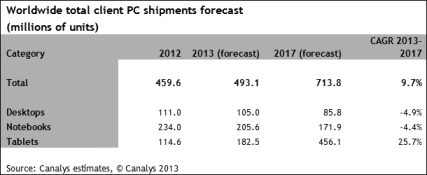
EnfoDesk (Analysys International) from China says ‘For sure, as it is already happening against the iPad in China even at a nascent stage of the local tablet market’
Industry data: 2013Q2 Chinese Tablet PC market sales of 3.58 million, the rapid expansion of domestic [products], apple [products] decline significantly [enfodesk.com, Aug 14, 2013] as translated by Google and Bing, with manual edits:
According to Analysys think tank EnfoDesk latest monitoring data shows that in the second quarter of 2013 tablet PC sales in China reached 3,576,000 units, up 5.2% Q/Q growth.
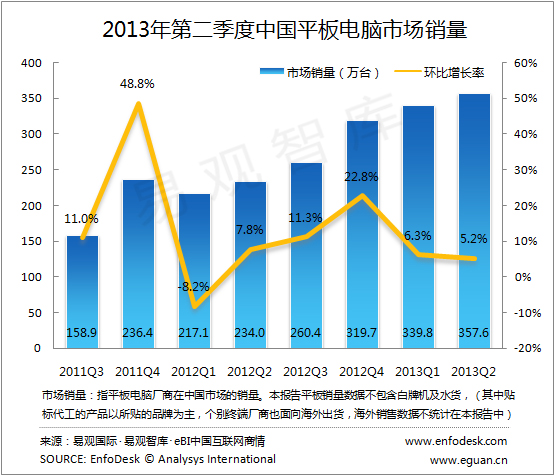
According to Analysis think tank EnfoDesk in the last quarter of 2013 sales growth on the tablet PC market in China slowed down to only 5.2% Q/Q growth rate, mainly due to weak sales of Apple’s tablet computers, as its sales fell for the first time. And Samsung had eye-catching performance this quarter, after N5110 Galaxy Note 8 has been released, and sought after by the market, so the Samsung Tablet PC overall sales increased dramatically, pulling the overall market growth. Worth mentioning this quarter is that domestic brand tablet PCs, such as Teclast (台电) [see Teclast’s Tmall site in Chinese, or Pandawill’ Teclast global online site in English] and ONDA (昂达) [see ONDA’s global site in English] have gained more market share with their low prices, ultra high yield of price/performance, and best selling online channels.
Throughout the three major tablet platforms, iOS declined significantly, it will be difficult to stop its market share erosion trends; Windows was tepid, the release of Microsoft Surface and continuous price cuts did not enhance the Windows market activity; Android cut right through the market, by virtue of many manufacturers to compete, high performance models being abundant, covering all price points of consumer groups, and with product prices constantly being refreshed, quickly seized the tablet PC market. If Apple can not launch innovative tablet PC products in the near future, [the event of] Android surpassing iOS market share is around the corner.
Compare this to the situation in 2012:
- China market: Apple shares over 71% of 4Q12 consumer tablet sales, says Analysys [DIGITIMES, April 19, 2013]
Apple occupied 71.6% of consumer tablets sold in the China market during the fourth quarter of 2012, according to China-based Analysys International.
For business-use tablets alone, Eben had the largest market share at 41.9%, followed by Samsung Electronics with 21.0%, Asustek Computer with 6.6% and Lenovo with 4.5%, Analysys indicated.
Vendor
Market share
Apple
71.6%
Lenovo
10.2%
Eben
4.0%
Samsung
3.9%
Acer
2.3%
Asustek
1.5%
Teclast
1.0%
Source: Analysys, compiled by Digitimes, April 2013
- Analysys International: iPad Sales Share Fell in Q3, 2012 [Analysys International, published in English on May 17, 2013]
According to the Quarterly Survey of China’s Tablet PC Market 2012Q3, 2.60 million sets tablet PC have been sold in Chinese market in Q3, 2012. Apple occupied 71.4% market share with a slight drop, Lenovo ranked second, reaching 10.52% and Ereneben ranked third with its market share being 3.61% and Samsung ranked fourth, taking up 3.53% market share.
EnfoDesk, Analysys International finds that 4 factors require our attention concerning China’s tablet PC manufacturers’ market layout in Q3, 2012:
- Compared with last quarter, Apple’s market share dropped from 72.66% to 71.42%. New iPad marketing promotions were made mainly in Q2. In Q3, iPad 2and The New iPad were in normal sales.
- The sales volume of Lenovo tablet PC rose considerably with its market share being 10.52%. Such a growth is resulted from the issue of its new products S2107 and S2109 and promotions when new semester begins for students.
- Ereneben issued its new product T5 in Q3, which drives the overall sales volume, and the price of T4 came down slightly in some provinces, thus increasing the sales volume of Ereneben.
- Samsung tablet PC enjoyed relatively stable sales in Chinese market. The company doubled their efforts in the marketing of tablet PC Note series (7 inches or above versions). Its branding effects gradually brought about and increased its sales in the Chinese market.
Besides, the research on e-business tablet PC market conducted by EnfoDesk, Analysys International shows that Ereneben ranked first with market share being 41.07%. Samsung offered Galaxy Note 10.1 e-tablet PC to consolidate its positioning in e-business tablet PC market. Its market share was 19.66% of total e-tablet PC market. Lenovo’s Thinkpad was in normal sales, only occupied 3.89% market share.

…
Analysys International: iPad took up 73% of Tablet PC Market 2012Q2 [Analysis International, published in English on May 16, 2013]
According to the Quarterly Survey of Tablet Market in China 2012Q2, released by EnfoDesk, Analysys International, market share of Apple rose to 72.66% with a sequential growth rate rising by 20.06%. Top 2 was Lenovo that witness a drop of its market share (Its market share was 8.38%). Eben ranked third with its market share being 3.63% and the market share of Samsung came down to 3.59% with its sequential growth rate dropping by 7.69%.

EnfoDesk Analysys International believes that three aspects should be noticed concerning the market layout of tablet PC market in Q2, 2012.
First, the market share of Apple has risen from 65.21% in Q1 to 72.66% in Q2. New iPad came into the market in March; however, since no substantial improvement has been made on the new products, consumers would rather wait to buy in Q2. The price reduction of iPad 2 promoted the sales volume of Apple products, allowing its market share to grow.
Second, compared with Q1, market share of Lenovo shrank. On one hand, it was a dull season; on the other hand, it was caused by its internal policy. In September, Lenovo will launch its promotion of new products when new term begins in September (during the peak season) and the company would rather clean up stocks of its other products in Q2.
Finally, iOS tablet PC suffers less seasonal factors than Android tablet PC. Currently, Android tablet PC market is getting stabilized. Solely relying on traditional sales channel to educate consumers was too slow and manufacturers could carry out more promotions to increase brand influence and brand concentration, grab the market share of smuggled products and clarify market layout of Android tablet PC. In addition, other tablet PC manufactures except Apple should consider its own market position and offer its unique products, gradually getting rid of homogenization of Android tablet PC. Eben as a leader in business tablet PC market offers unique products and its market positioning is clear.
…
- Analysys International: 2.34 Million Tablet PCs Were Sold in China 2012Q2 [Analysis International, published in English on May 16, 2013]
According to the statistics recently released by Analysys International, 2.34 million tablet PCs were sold in China in Q2, 2012. The sequential growth rate has reached 7.8%.
Analysys International holds that sales growth of China’s tablet PC in Q2, 2012(The growth rate has reached 7.8%) is due to the following factors:
iPad directly triggered the market fluctuation. The price reduction of iPad forced the average price of tablet PC to go down. As a result, consumers with cash in hand developed their desire to buy and such a desire transformed into procurement, which allowed the sales volume to grow in the dull season.
EnfoDesk, Analysys International predicts that the future market layout will be even clearer. Android manufacturers and others will target middle and low-end consumers with an attempt to avoid direct competition with Apple. Even though the sales volume of Apple will increase, its market share will continue to shrink. The market share of Android manufacturers is expected to grow and the market concentration will increase. The smuggled products will face the question of survival and the market will get further standardized.
Research Definitions
Tablet PC is a portable mobile internet device accessible to the network. It has independent mobile OS and is able to expand its applications. The screen ranges from 5 to 11 inch. Touch screen or pen is served as a basic input device.
The Sales Volume is tablet PC manufacturers’ sale in China, including some overseas brands which are sold by a purchasing agency (OEM labeling products is regarded as the labeled brand. Some device manufacturers also sell some products to market abroad. This part of sales volume is not calculated in the said report).
Research Statement
The industrial analyses, provided by Analysys International, mainly reflect the current situation, trend, inflection point, commercial law and manufacturers’ situation. The figures and statistics are drawn by adopting a unique industrial analysis model combined with the research and study methods used by market, industry and manufactures. All the data are based on industrial macro and historical data, seasonal end-users’ and business information.
It is believed that data concluded from research into market and trade is within acceptable errors. It can reflect the trend and commercial laws accurately.
Results obtained by the means of professional research methods are for reference. The actual data can be obtained by checking on financial report issued by manufacturers.
About Analysys International
Analysys International is a leading advisor on the technology, media and telecom (TMT) industries in China. We provide data, information and advice to 50,000 clients worldwide representing 1,500 distinct organizations, deliver over 150 consulting engagements a year, and hold more than 20 events that draw in over 8,000 attendees. Our clients include executives from companies as technology vendors, vertical information technology users, as well as professionals from professional service companies, the investment community and government agencies. Our mission is simple and clear: we help our clients make better business decisions. For more information, please visit our website at http://english.analysys.com.cn.
About EnfoDesk
EnfoDesk is an industrial data base for subscription offered by Analysys International. It aims to help you perceive opportunities and risks in the Internet age with online database search, analyst interaction, market alarms and other functions. EnfoDesk can help you get information in time and know more about:
– The business mode and trend of the Internet and mobile web market
– The trend in policy towards the Internet and Internetized market
– The activities and preferences of Internet and mobile web users
– The potential clients and commercial opportunities
– The more valuable partners and cooperation mode
– The trend and effects of e-marketing
 Experiencing the Cloud
